
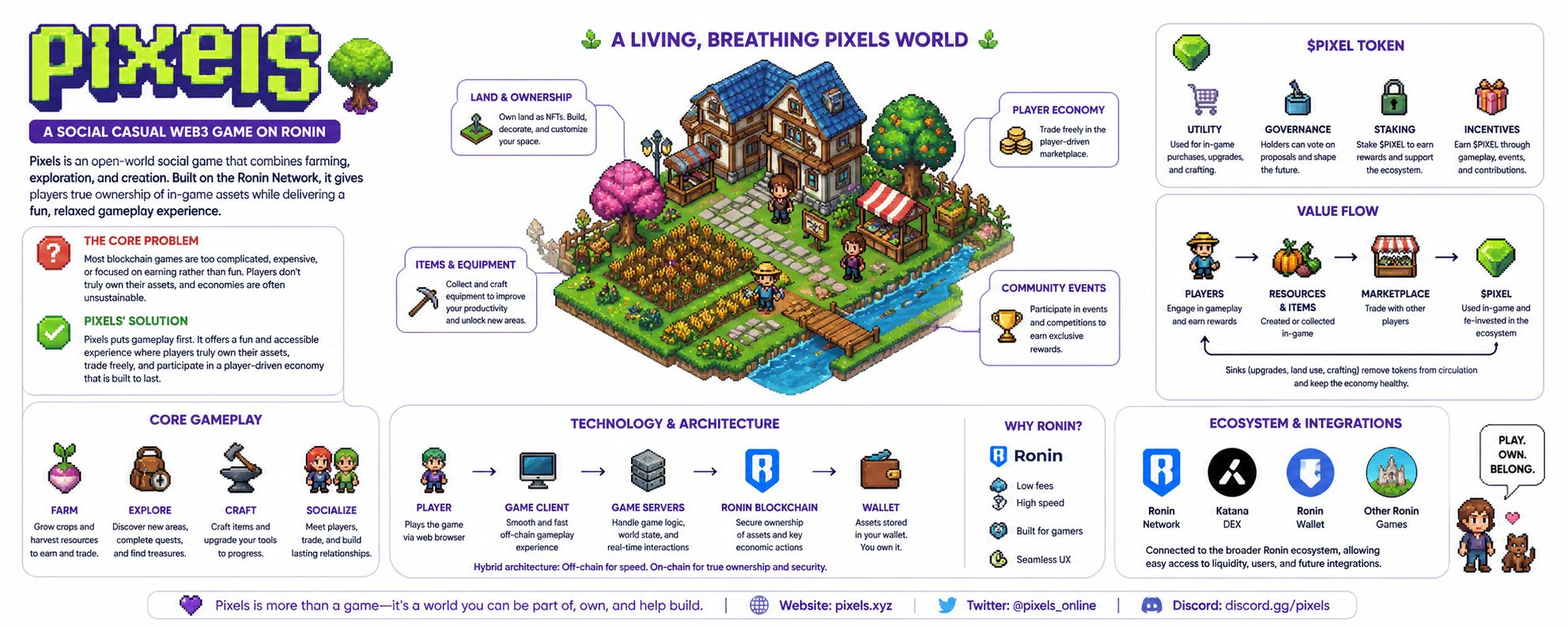

I’ve been thinking about how strange it is that most blockchain games still feel like work pretending to be fun, while the games people actually enjoy don’t really need crypto at all. That tension kept coming back to me when I first came across Pixels. On the surface, it looks like a simple farming game you’d casually play to pass time. But once you sit with it a bit longer, you start to see it’s trying to answer a much bigger question: can a game be genuinely fun first, and still have a real, working on-chain economy underneath?
The idea behind Pixels is surprisingly grounded. Instead of trying to build a complex AAA-style blockchain game, it focuses on something familiar—farming, exploring, crafting—things that already work in traditional games. The real problem it’s trying to solve isn’t just “how do we put assets on-chain,” but rather “how do we make a game where ownership and economy actually matter without breaking the fun?” Most Web3 games fail because they over-financialize gameplay. You log in not to enjoy, but to grind tokens. Pixels flips that by making the gameplay loop simple and social, then quietly layering ownership and economy underneath.
Technically, it runs on Ronin Network, which is an important choice. Ronin isn’t trying to be everything; it’s built specifically for games. That means transactions are cheap, fast, and don’t interrupt gameplay. From a player’s perspective, you’re just farming, trading, exploring. Behind the scenes, assets like land, items, and currencies are tied to wallets and can move across the network. The architecture is not overly complicated: the game logic mostly runs off-chain for speed and responsiveness, while ownership and key economic actions are anchored on-chain. This hybrid approach is what makes it actually playable, rather than feeling like you’re interacting with a slow financial app.
The token, PIXEL, sits right in the middle of everything, but not in an aggressive way. It’s used for in-game purchases, upgrades, and participating in the economy. What’s interesting is how value flows through the system. Players earn through activities like farming and crafting, but the real loop forms when those resources are used by others or fed back into progression systems. It’s not just “earn and dump.” There are sinks—upgrades, land usage, crafting—that pull tokens back into the system. Staking and incentives are designed to reward long-term engagement rather than quick extraction, although like any token system, the balance between rewarding players and avoiding inflation is something that constantly needs adjustment.
Where Pixels connects to the broader ecosystem is also worth noticing. Because it’s on Ronin, it naturally sits alongside other gaming projects, sharing users, wallets, and liquidity. This creates a kind of network effect. Someone who comes in through another Ronin game can easily step into Pixels without friction. That’s a subtle but powerful advantage compared to isolated blockchain games that have to build everything from scratch. Over time, this interconnected ecosystem could become more important than any single game.
In terms of real use and adoption, Pixels has something many Web3 games struggle with: actual players who aren’t just there for speculation. The game loop is simple enough to attract casual users, and the browser-based access removes a lot of friction. You don’t need to install heavy clients or understand wallets deeply to get started. That lowers the barrier in a way that feels closer to traditional web games. There have also been integrations with NFT land systems and resource economies that create real interaction between players, rather than isolated single-player grinding.
But it’s not all smooth. There are some real challenges that keep coming up when you think about it honestly. One is sustainability. Any token-based game has to constantly manage supply, demand, and player incentives. If too many players focus on extracting value instead of playing, the system weakens. Another issue is depth. While simplicity is a strength it can also limit long-term engagement. Farming and crafting loops need to evolve over time or players eventually get bored. Then there’s the broader question of whether Web3 elements truly add value for the average player, or if they’re mostly relevant to a smaller group of crypto-native users.
There’s also a more subtle risk: expectations. Once you introduce tokens and ownership, players start thinking economically. Even if the game is designed for fun, people will measure time versus reward. That changes behavior. Balancing that without killing the casual vibe is one of the hardest problems Pixels will continue to face.
Looking ahead the direction seems clear. The project isn’t trying to become a hyper-complex metaverse. Instead it’s leaning into being a social evolving game with a functioning economy. If it keeps improving gameplay depth, expanding social features and carefully managing its token system, it could become a model for how Web3 games should actually be built. Not loud, not overly technical but quietly effective.
What makes Pixels interesting isn’t that it’s revolutionary in technology but that it understands something simple: people don’t come for blockchain they come for the experience. If the experience works the blockchain part becomes invisible and that’s probably where the real future of this space lies.