

#qubic
qubic
262,661 vues
551 mentions
Populaire
Récents

·
--
Article
How Does the Brain Handle Time: Distributed Clocks & AI LimitsNeuraxon Intelligence Academy · Volume 12 · By the Qubic Scientific Team
The brain does not have a central clock. It has many, distributed throughout the tissue and tuned to scales ranging from the microsecond to the seasons of the year.
We know that [intelligence is not computed in steps but in time](https://www.binance.com/en/square/post/295315343732018), in which the neuron acts as a dynamical system: a state that changes continuously and never resets. But it is not enough for each unit to live in continuous time. An organism has to measure intervals, anticipate what is coming, learn from causes that occurred seconds ago and, at the same time, remain stable for years. These are different temporal problems, and the brain does not solve them with the same mechanism.
For decades the psychology of time searched for a single internal clock, a kind of pacemaker that would emit pulses and a counter that would accumulate them. That idea had descriptive success, but neuroscience kept finding something else. The literature today distinguishes between dedicated models, which postulate a circuit specialized in measuring time, and intrinsic models, in which time is read from the very evolution of neural activity (Ivry & Schlerf, 2008). There is no single stopwatch. There are distributed mechanisms, specialized according to scale and function: the cerebellum for brief and precise intervals, cortico-striatal circuits for intervals of seconds, the cortex for the integration of long sequences (Merchant, Harrington & Meck, 2013; Paton & Buonomano, 2018).
From the Microsecond to the Seasons: The Time the Brain Already Knows How to Handle
The brain simultaneously manages events that last less than a blink and cycles that last months. No other machine covers such a wide range with the same tissue.
At the fastest end is the localization of sounds. A noise coming from the left reaches the left ear some tens or hundreds of microseconds before the right one. Brainstem circuits detect that difference and convert it into a direction in space (Grothe, Pecka & McAlpine, 2010). We are not aware of the calculation; we simply turn our head toward the sound. A little higher up, on the scale of tens of milliseconds, is speech. What distinguishes "ba" from "pa" is, to a large extent, how long it takes for the voice to begin vibrating after the lips open (voice onset time). A difference of a few tens of milliseconds changes the consonant we hear (Lisker & Abramson, 1964).
On the scale of seconds lies almost everything we do intentionally: catching a ball in flight, following the beat of a song, waiting our turn in a conversation, noticing that a traffic light is taking longer than usual. Here the brain does not only perceive, it also anticipates. It knows when the next thing should arrive and is surprised if it does not.
On the scale of minutes and hours slower changes appear, which we do not experience as events but as states. An intense smell stops being noticed after a while: this is habituation. Attention degrades after a period of sustained task. And the organism has ultradian rhythms, that is, cycles shorter than a day that repeat several times in twenty-four hours. The best known is that of sleep: during the night we alternate between non-REM and REM sleep phases in cycles of about ninety minutes. Stress hormones are not released continuously either, but in roughly hourly pulses, and that pulsatility serves a purpose: tissues respond differently to a hormone that arrives in pulses than to the same amount administered constantly (Lightman & Conway-Campbell, 2010 - https://doi.org/10.1038/nrn2914).
Sleep deserves special mention, because it combines two clocks. One is a sleep pressure that accumulates with the hours of wakefulness and dissipates during sleep. The other is a rhythm of about twenty-four hours that opens and closes the sleep window regardless of how tired we are. During wakefulness synapses tend to strengthen overall, and during sleep they are readjusted downward, which preserves what is relevant and gives the brain back room to learn the next day (Tononi & Cirelli, 2014 - https://doi.org/10.1016/j.neuron.2013.12.025).
That twenty-four-hour rhythm is the circadian rhythm, from the Latin circa diem, "around a day." Its master clock is in the suprachiasmatic nucleus of the hypothalamus, a small group of neurons (about twenty thousand in rodents, counting both sides) located just above the crossing of the optic nerves (Abrahamson & Moore, 2001). Inside each of its cells, a loop of genes and proteins that activate and inhibit one another takes about twenty-four hours to complete a cycle (Takahashi, 2017). Light sets it to the correct time through cells in the retina that measure how much light there is in the environment (Hattar et al., 2002). Jet lag is the direct experience of this clock, in which the world changed time abruptly and the internal clock takes days to readjust.
Figure 1. The circadian rhythm across a 24-hour day. A master clock in the suprachiasmatic nucleus synchronizes sleep, hormone release, and alertness to the light-dark cycle. Image: "Biological clock (human),"Wikimedia Commons (public domain).
Above the day are the infradian rhythms, longer than twenty-four hours. In the female rat, the density of dendritic spines in the hippocampus, the small protrusions where synapses form, drops by about 30% in just twenty-four hours within an estrous cycle of four or five days that follows estradiol levels (Woolley & McEwen, 1992). The wiring of a structure key to memory changes rhythmically.
Beyond that are the seasonal rhythms: the duration of nocturnal melatonin secretion encodes the length of the night, and thus many mammals know what time of year it is (Wehr, 2001).
There remains the scale of a lifetime. During development there are critical periods in which certain circuits can only be organized within a specific time window; if experience arrives late, the circuit does not form the same way (Hensch, 2005). The brain does not only measure time. It is built in time.
All these scales coexist in the same organ and influence one another. The circadian clock opens the sleep window, sleep readjusts the synapses, hormones modify the wiring, and all of this conditions what is learned in a given second. That coexistence is the phenomenon that we want, as far as possible, to simulate.
A Hierarchy of Temporal Windows in the Cortex
The first clue to that architecture is that different cortical regions do not "remember" for the same length of time. Murray and colleagues (https://doi.org/10.1038/nn.3862) measured how long it takes for the autocorrelation of the spontaneous activity of neurons to fade in different areas of the macaque. Sensory areas have short time constants: they respond quickly and forget quickly. Prefrontal and association areas have much longer constants: they integrate information over a longer time. The cortex is ordered as a hierarchy of temporal windows.
In humans, something equivalent was observed with narrative stimuli. Hasson and colleagues (https://doi.org/10.1523/JNEUROSCI.5487-07.2008) presented films scrambled at different scales, from fragments of seconds to complete scenes. Primary sensory areas responded the same regardless of the scrambling. Higher-order areas responded reliably only when structure at long scales was preserved. Each region has its own "temporal integration window." Kiebel, Daunizeau and Friston (https://doi.org/10.1371/journal.pcbi.1000209) gave this observation a computational reading: if the world generates causes that change at different speeds, a brain that wants to predict it needs a hierarchy of timescales that reflects that structure.
There is even a privileged scale for experience. Pöppel (https://doi.org/10.1016/S1364-6613(97)01008-5) gathered evidence that we integrate events into windows of about two or three seconds, a functional "present" that groups what we perceive as simultaneous or continuous. It is not a magic number. It is the consequence of the nervous system working with several nested time constants.
Time as State: Population Clocks and Time Cells
If there is no central clock, how does a network know how much time has passed? The most elegant answer is that time is encoded in the very state of the network. Buonomano and Maass (https://doi.org/10.1038/nrn2558) formulated it as state-dependent computation, where a recurrent network receives a stimulus that traverses a trajectory of activity that does not repeat. At each instant its configuration is different. A reader that learns to recognize that configuration is enough to know how much time has elapsed since the stimulus.
The hippocampus offers a striking version of this idea. During the empty intervals of a task, some neurons fire at specific moments of the interval, in sequence, as if marking successive seconds. They were called time cells (MacDonald et al., 2011; Eichenbaum, 2014). The lateral entorhinal cortex provides another piece: populations whose activity drifts gradually with experience, so that elapsed time can be decoded from the accumulated change of the population (Tsao et al., 2018). In both cases time is not measured with pulses, but with changes of state.
Figure 2. "Time cells" tile an interval: individual hippocampal neurons fire at successive moments, so elapsed time is read from the sequence of active cells rather than from a central clock. Image: Cao, Bladon et al. (2022),eLife 75353, Fig. 1,CC BY 4.0.
Learning in Time: Windows of Synaptic Plasticity
Representing time is one thing. Learning in time is another. The world rarely delivers the consequence in the same millisecond as the cause. The brain solves this problem with several overlapping windows of plasticity.
The briefest is spike-timing-dependent plasticity (STDP, one of Neuraxon's mechanisms). If a presynaptic neuron fires a few milliseconds before the postsynaptic one, the synapse is strengthened; if it fires after, it is weakened. The useful window is a few tens of milliseconds (Bi & Poo, 1998). It is a detector of local causality, very precise and very short.
That window is not enough to associate an action with a reward that arrives a second later. That is what eligibility traces are for: the coincidence of activity leaves a transient mark on the synapse, and that mark becomes a weight change if a [neuromodulatory signal](https://www.binance.com/en/square/post/295306656801506) arrives while it persists. In dendritic spines of the striatum, dopamine strengthens synapses only if it arrives between about 0.3 and 2 seconds after the activity (Yagishita et al., 2014). The hippocampus adds behavioral timescale synaptic plasticity, capable of associating inputs separated by several seconds and of creating a place field in a single trial (Bittner et al., 2017).
Above these lie slower scales. Consolidation and structural plasticity operate over hours or days, and what is consolidated no longer depends on the activity of the moment.
Stability Without Freezing: Multi-Scale Homeostasis
A network that learns by Hebbian rules is unstable by nature. If what fires together is strengthened, what is strengthened fires more and is strengthened more. Without a counterweight, the network saturates or falls silent.
The brain has that counterweight. Turrigiano (2008) described synaptic scaling: when a neuron remains too active for hours, it proportionally reduces the strength of all its synapses, and increases it if it remains too silent. Intrinsic excitability adjusts in a similar way (Desai, Rutherford & Turrigiano, 1999). In vivo, this slow loop returns cortical activity to its set point over the course of days, and does so in a manner dependent on the states of wakefulness and sleep (Hengen et al., 2016).
But there is a difficulty. Hebbian plasticity acts in seconds and synaptic homeostasis in hours. Zenke, Gerstner and Ganguli (2017) showed that such a slow regulator cannot, by itself, curb such a fast instability. The conclusion is that there must be fast compensatory mechanisms, acting at almost the same speed as learning, and that slow homeostasis takes care of something else: correcting long-term drift. Stability is not provided by a thermostat, but by a cascade of regulators, each at its own scale.
Memory theory reaches a parallel conclusion. Benna and Fusi (2016) demonstrated that synapses with a single timescale, if they change quickly, learn well but forget soon; and if they change slowly, they retain but barely learn. Synapses with internal variables coupled to different scales escape that dilemma and multiply memory capacity. Multi-scale organization is the solution to a computational problem.
What Does a Transformer Do with Time?
With this whole framework we can look at the architecture that dominates current artificial intelligence. A Transformer processes a sequence of text fragments (tokens). So that the model knows in what order they appear, a positional encoding is added to each token, where a vector indicates whether it is the first, the second, or the thousandth (Vaswani et al., 2017). Then the attention mechanism compares all tokens with all tokens at once.
Figure 3. The Transformer architecture. Order is supplied once, as a positional encoding added to each token; self-attention then compares all tokens simultaneously, so the model treats sequence position as an index rather than living through time. Image: "Transformer, full architecture,"Wikimedia Commons (CC BY-SA 4.0).
The consequence is profound. For a Transformer, time is an index. There is no duration, only order. A silence of one second and one of an hour are indistinguishable if they do not generate different tokens. Moreover, the entire context is available simultaneously. The model does not live through the sequence; it contemplates it whole, like a map spread out on a table. In neuroscientific terms, it has turned time into space.
Nor are there learning timescales during use. The weights are fixed during training and remain frozen. What the model "remembers" within a conversation lives in its context window, which is an external and finite working memory. What it knows about the world stops at its cutoff date. Between the scale of the context window and the scale of retraining, which is measured in months, there is nothing.
Four Limitations of Transformers That Follow from That Choice
The first limitation is insensitivity to duration. Many phenomena of the physical and social world depend on how long something lasts, not only on what comes before. Transformers applied to time series illustrate the cost. A simple linear model outperformed several Transformer architectures specialized in long-series forecasting, partly because attention, being permutation-invariant, loses information about fine temporal order that positional encoding does not fully restore (Zeng et al., 2023).
The second is flat memory. The context window has no hierarchy of scales: everything that fits is equally present and whatever does not fit disappears. Not even within the window is access homogeneous. Models retrieve information located in the middle of long contexts worse than information at the beginning or the end (Liu et al., 2024). There is no equivalent to the nested windows described by Murray and Hasson.
The third is the rigid separation between learning and acting. A Transformer does not learn while it operates. If it is retrained with new data without precautions, it tends to overwrite what came before, a phenomenon known for decades as catastrophic interference (McCloskey & Cohen, 1989). It is exactly the single-scale dilemma, where without slow variables to protect what has been consolidated, the fast erases the old.
The fourth is imported stability. The network does not regulate itself. Its stability depends on fixed mathematical normalizations, on learning-rate schedules designed by engineers, and on a training process that ends. It works precisely because the system stops changing. An organism cannot afford that solution.
None of this denies the power of Transformers. It explains why they perform so well on tasks where the world fits into a text and so poorly when one has to act, wait, anticipate, and correct in an environment that keeps moving. There are alternatives within deep learning itself, such as liquid time-constant networks (Hasani et al., 2021) or state-space models. They are real advances, and they confirm that time has to be incorporated into the dynamics.
How Neuraxon 3.0 Attempts It: Multi-Scale Temporal Homeostasis (MSTH)
Neuraxon starts from the premise opposite to that of the Transformer. Time is not encoded as position; rather, it is the variable over which the state of each unit evolves. [Neuraxon 2.0](https://www.binance.com/en/square/post/295304276561778) already introduced continuous-time processing, synapses with fast and slow components, and a ChronoPlasticity mechanism that allows each synapse to adjust its memory horizon. Neuraxon 3.0, currently in development, reorganizes these pieces around the hierarchy of scales we have described.
The first decision is to separate what the brain separates. One thing is the synaptic current, which rises and dissipates in milliseconds according to receptor kinetics. Another is the weight, which persists. Conflating both variables makes memory depend on the noise of the instant (Destexhe, Mainen & Sejnowski, 1994; Tsodyks & Markram, 1997).
The second is to stack plasticity windows. On the millisecond scale, a rule dependent on spike order operates. On the scale of seconds, eligibility traces that wait for a neuromodulatory signal, in line with the experimentally described retroactive dopamine (Yagishita et al., 2014; Brzosko, Schultz & Paulsen, 2015), and a hippocampus-inspired behavioral-timescale plasticity. At slower scales, metaplastic gates and [astrocytic domains](https://www.binance.com/en/square/post/302913958960674) that decide how much a group of synapses can change.
The third is multi-scale homeostasis, which in Neuraxon we call MSTH (Multi-Scale Temporal Homeostasis). Instead of a single thermostat, four coordinated regulatory loops, from an ultrafast one that damps bursts of activity to a slow one that corrects long-term drift. It is the computational translation of the argument by Zenke, Gerstner and Ganguli (2017): the fast regulators contain Hebbian instability and the slow ones preserve the set point without freezing learning. [Criticality](https://www.binance.com/en/square/post/322900066069841), the regime in which activity neither dies out nor runs away, is measured as an observable of the system (Wilting & Priesemann, 2018).
Neuraxon 3.0 is today an architecture in design, and the contribution of MSTH will be subjected to specific experiments in long-horizon regimes before claiming anything about its effectiveness. Nor does it yet incorporate an offline consolidation phase equivalent to sleep, which the preceding overview suggests is essential and which we consider one of the main pending tasks.
Why Time Matters for Qubic
The intelligence we seek does not answer closed questions. It acts in environments that change while it acts. The interactive games of [ARC-AGI-3](https://www.binance.com/en/square/post/332806106415490) show this well: they do not present a problem statement, but a world whose rules are discovered by playing, turn by turn. A system that does not distinguish between what just happened and what happened fifty moves ago, that cannot associate an action with its delayed consequence, and that does not learn while it plays, is at a structural disadvantage.
That is why time is not an implementation detail in Neuraxon. It is the ground on which it is decided whether an architecture can adapt. And that is why it makes sense for it to be developed on a network like Qubic, which operates continuously and with state, where a system can persist, change, and regulate itself without anyone resetting it. The brain took hundreds of millions of years to learn to manage time on many scales at once. We are trying to compute that unique characteristic.
References
Abrahamson, E. E., & Moore, R. Y. (2001). Suprachiasmatic nucleus in the mouse: Retinal innervation, intrinsic organization and efferent projections. Brain Research, 916(1–2), 172–191. https://doi.org/10.1016/S0006-8993(01)02890-6Benna, M. K., & Fusi, S. (2016). Computational principles of synaptic memory consolidation. Nature Neuroscience, 19(12), 1697–1706. https://doi.org/10.1038/nn.4401Bi, G. Q., & Poo, M. M. (1998). Synaptic modifications in cultured hippocampal neurons: Dependence on spike timing, synaptic strength, and postsynaptic cell type. Journal of Neuroscience, 18(24), 10464–10472. https://doi.org/10.1523/JNEUROSCI.18-24-10464.1998Bittner, K. C., Milstein, A. D., Grienberger, C., Romani, S., & Magee, J. C. (2017). Behavioral time scale synaptic plasticity underlies CA1 place fields. Science, 357(6355), 1033–1036. https://doi.org/10.1126/science.aan3846Borbély, A. A. (1982). A two process model of sleep regulation. Human Neurobiology, 1(3), 195–204.Brzosko, Z., Schultz, W., & Paulsen, O. (2015). Retroactive modulation of spike timing-dependent plasticity by dopamine. eLife, 4, e09685. https://doi.org/10.7554/eLife.09685Buonomano, D. V., & Maass, W. (2009). State-dependent computations: Spatiotemporal processing in cortical networks. Nature Reviews Neuroscience, 10(2), 113–125. https://doi.org/10.1038/nrn2558Desai, N. S., Rutherford, L. C., & Turrigiano, G. G. (1999). Plasticity in the intrinsic excitability of cortical pyramidal neurons. Nature Neuroscience, 2(6), 515–520. https://doi.org/10.1038/9165Destexhe, A., Mainen, Z. F., & Sejnowski, T. J. (1994). Synthesis of models for excitable membranes, synaptic transmission and neuromodulation using a common kinetic formalism. Journal of Computational Neuroscience, 1(3), 195–230. https://doi.org/10.1007/BF00961734Eichenbaum, H. (2014). Time cells in the hippocampus: A new dimension for mapping memories. Nature Reviews Neuroscience, 15(11), 732–744. https://doi.org/10.1038/nrn3827Grothe, B., Pecka, M., & McAlpine, D. (2010). Mechanisms of sound localization in mammals. Physiological Reviews, 90(3), 983–1012. https://doi.org/10.1152/physrev.00026.2009Hasani, R., Lechner, M., Amini, A., Rus, D., & Grosu, R. (2021). Liquid time-constant networks. Proceedings of the AAAI Conference on Artificial Intelligence, 35(9), 7657–7666. https://doi.org/10.1609/aaai.v35i9.16936Hasson, U., Yang, E., Vallines, I., Heeger, D. J., & Rubin, N. (2008). A hierarchy of temporal receptive windows in human cortex. Journal of Neuroscience, 28(10), 2539–2550. https://doi.org/10.1523/JNEUROSCI.5487-07.2008Hattar, S., Liao, H.-W., Takao, M., Berson, D. M., & Yau, K.-W. (2002). Melanopsin-containing retinal ganglion cells: Architecture, projections, and intrinsic photosensitivity. Science, 295(5557), 1065–1070. https://doi.org/10.1126/science.1069609Hengen, K. B., Torrado Pacheco, A., McGregor, J. N., Van Hooser, S. D., & Turrigiano, G. G. (2016). Neuronal firing rate homeostasis is inhibited by sleep and promoted by wake. Cell, 165(1), 180–191. https://doi.org/10.1016/j.cell.2016.01.046Hensch, T. K. (2005). Critical period plasticity in local cortical circuits. Nature Reviews Neuroscience, 6(11), 877–888. https://doi.org/10.1038/nrn1787Ivry, R. B., & Schlerf, J. E. (2008). Dedicated and intrinsic models of time perception. Trends in Cognitive Sciences, 12(7), 273–280. https://doi.org/10.1016/j.tics.2008.04.002Kiebel, S. J., Daunizeau, J., & Friston, K. J. (2008). A hierarchy of time-scales and the brain. PLoS Computational Biology, 4(11), e1000209. https://doi.org/10.1371/journal.pcbi.1000209Kleitman, N. (1982). Basic rest-activity cycle—22 years later. Sleep, 5(4), 311–317. https://doi.org/10.1093/sleep/5.4.311Lightman, S. L., & Conway-Campbell, B. L. (2010). The crucial role of pulsatile activity of the HPA axis for continuous dynamic equilibration. Nature Reviews Neuroscience, 11(10), 710–718. https://doi.org/10.1038/nrn2914Lisker, L., & Abramson, A. S. (1964). A cross-language study of voicing in initial stops: Acoustical measurements. Word, 20(3), 384–422. https://doi.org/10.1080/00437956.1964.11659830Liu, N. F., Lin, K., Hewitt, J., Paranjape, A., Bevilacqua, M., Petroni, F., & Liang, P. (2024). Lost in the middle: How language models use long contexts. Transactions of the Association for Computational Linguistics, 12, 157–173. https://doi.org/10.1162/tacl_a_00638MacDonald, C. J., Lepage, K. Q., Eden, U. T., & Eichenbaum, H. (2011). Hippocampal "time cells" bridge the gap in memory for discontiguous events. Neuron, 71(4), 737–749. https://doi.org/10.1016/j.neuron.2011.07.012McCloskey, M., & Cohen, N. J. (1989). Catastrophic interference in connectionist networks: The sequential learning problem. Psychology of Learning and Motivation, 24, 109–165. https://doi.org/10.1016/S0079-7421(08)60536-8Merchant, H., Harrington, D. L., & Meck, W. H. (2013). Neural basis of the perception and estimation of time. Annual Review of Neuroscience, 36, 313–336. https://doi.org/10.1146/annurev-neuro-062012-170349Murray, J. D., Bernacchia, A., Freedman, D. J., Romo, R., Wallis, J. D., Cai, X., Padoa-Schioppa, C., Pasternak, T., Seo, H., Lee, D., & Wang, X.-J. (2014). A hierarchy of intrinsic timescales across primate cortex. Nature Neuroscience, 17(12), 1661–1663. https://doi.org/10.1038/nn.3862Paton, J. J., & Buonomano, D. V. (2018). The neural basis of timing: Distributed mechanisms for diverse functions. Neuron, 98(4), 687–705. https://doi.org/10.1016/j.neuron.2018.03.045Pöppel, E. (1997). A hierarchical model of temporal perception. Trends in Cognitive Sciences, 1(2), 56–61. https://doi.org/10.1016/S1364-6613(97)01008-5Takahashi, J. S. (2017). Transcriptional architecture of the mammalian circadian clock. Nature Reviews Genetics, 18(3), 164–179. https://doi.org/10.1038/nrg.2016.150Tononi, G., & Cirelli, C. (2014). Sleep and the price of plasticity: From synaptic and cellular homeostasis to memory consolidation and integration. Neuron, 81(1), 12–34. https://doi.org/10.1016/j.neuron.2013.12.025Tsao, A., Sugar, J., Lu, L., Wang, C., Knierim, J. J., Moser, M.-B., & Moser, E. I. (2018). Integrating time from experience in the lateral entorhinal cortex. Nature, 561(7721), 57–62. https://doi.org/10.1038/s41586-018-0459-6Tsodyks, M. V., & Markram, H. (1997). The neural code between neocortical pyramidal neurons depends on neurotransmitter release probability. Proceedings of the National Academy of Sciences, 94(2), 719–723. https://doi.org/10.1073/pnas.94.2.719Turrigiano, G. G. (2008). The self-tuning neuron: Synaptic scaling of excitatory synapses. Cell, 135(3), 422–435. https://doi.org/10.1016/j.cell.2008.10.008Vaswani, A., Shazeer, N., Parmar, N., Uszkoreit, J., Jones, L., Gomez, A. N., Kaiser, Ł., & Polosukhin, I. (2017). Attention is all you need. In Advances in Neural Information Processing Systems 30 (pp. 5998–6008). https://arxiv.org/abs/1706.03762Wehr, T. A. (2001). Photoperiodism in humans and other primates: Evidence and implications. Journal of Biological Rhythms, 16(4), 348–364. https://doi.org/10.1177/074873001129002060Wilting, J., & Priesemann, V. (2018). Inferring collective dynamical states from widely unobserved systems. Nature Communications, 9, 2325. https://doi.org/10.1038/s41467-018-04725-4Woolley, C. S., & McEwen, B. S. (1992). Estradiol mediates fluctuation in hippocampal synapse density during the estrous cycle in the adult rat. Journal of Neuroscience, 12(7), 2549–2554. https://doi.org/10.1523/JNEUROSCI.12-07-02549.1992Yagishita, S., Hayashi-Takagi, A., Ellis-Davies, G. C. R., Urakubo, H., Ishii, S., & Kasai, H. (2014). A critical time window for dopamine actions on the structural plasticity of dendritic spines. Science, 345(6204), 1616–1620. https://doi.org/10.1126/science.1255514Zeng, A., Chen, M., Zhang, L., & Xu, Q. (2023). Are transformers effective for time series forecasting? Proceedings of the AAAI Conference on Artificial Intelligence, 37(9), 11121–11128. https://doi.org/10.1609/aaai.v37i9.26317Zenke, F., Gerstner, W., & Ganguli, S. (2017). The temporal paradox of Hebbian learning and homeostatic plasticity. Current Opinion in Neurobiology, 43, 166–176. https://doi.org/10.1016/j.conb.2017.03.015
Neuraxon Intelligence Academy: The Complete Series
Continue exploring the science behind brain-inspired AI, Aigarth, and Neuraxon in the previous volumes of the Neuraxon Intelligence Academy:
[NIA Volume 1](https://www.binance.com/en/square/post/295315343732018): Why Intelligence Is Not Computed in Steps, but in Time — Explores why biological intelligence operates in continuous time rather than discrete computational steps like traditional LLMs.[NIA Volume 2](https://www.binance.com/en/square/post/295304276561778): Ternary Dynamics as a Model of Living Intelligence — Explains ternary dynamics and why three-state logic (excitatory, neutral, inhibitory) matters for modeling living systems.[NIA Volume 3](https://www.binance.com/en/square/post/295306656801506): Neuromodulation and Brain-Inspired AI — Covers neuromodulation and how the brain's chemical signaling (dopamine, serotonin, acetylcholine, norepinephrine) inspires Neuraxon's architecture.[NIA Volume 4](https://www.binance.com/en/square/post/295302152913618): Neural Networks in AI and Neuroscience — A deep comparison of biological neural networks, artificial neural networks, and Neuraxon's third-path approach.[NIA Volume 5](https://www.binance.com/en/square/post/302913958960674): Astrocytes and Brain-Inspired AI — How astrocytic gating transforms neural network plasticity through the AGMP framework in Neuraxon.[NIA Volume 6](https://www.binance.com/en/square/post/310198879866145): Conscious Machines vs Intelligent Organisms: AI Consciousness Explained — Explores AI consciousness through the lens of Global Workspace Theory, Integrated Information Theory, and predictive coding.[NIA Volume 7](https://www.binance.com/en/square/post/321350661453970): Conway's Game of Life, Artificial Life, and Digital Ecosystems — The science behind Qubic, Aigarth, and Neuraxon's emergent complexity and self-organized criticality.[NIA Volume 8](https://www.binance.com/en/square/post/322900066069841): Brain Criticality and the Branching Ratio in Neural and Artificial Networks — Why a branching ratio near 1 and self-organized criticality are bioinspired design principles in Neuraxon.[NIA Volume 9](https://www.binance.com/en/square/post/328379422341521): The Origins of the g Factor: From Education and Neuroscience to Artificial Intelligence — Explores the origins of the g factor across education, neuroscience, and AI.[NIA Volume 10](https://www.binance.com/en/square/post/332806106415490): How Do We Measure the Intelligence of a Machine? The g Factor, ARC-AGI, and the Future of AI Evaluation — The g factor, François Chollet's ARC-AGI benchmark, data contamination in LLM evaluation, and why skill-acquisition efficiency is the real test of intelligence.[NIA Volume 11](https://www.binance.com/en/square/post/342567558192178): What Is AGI? The Limits, Visions & Definitions of Artificial General Intelligence
#Qubic #AGI #AI #Neuraxon
How Does the Brain Handle Time: Distributed Clocks & AI Limits
Neuraxon Intelligence Academy · Volume 12 · By the Qubic Scientific Team
The brain does not have a central clock. It has many, distributed throughout the tissue and tuned to scales ranging from the microsecond to the seasons of the year.
We know that intelligence is not computed in steps but in time, in which the neuron acts as a dynamical system: a state that changes continuously and never resets. But it is not enough for each unit to live in continuous time. An organism has to measure intervals, anticipate what is coming, learn from causes that occurred seconds ago and, at the same time, remain stable for years. These are different temporal problems, and the brain does not solve them with the same mechanism.
For decades the psychology of time searched for a single internal clock, a kind of pacemaker that would emit pulses and a counter that would accumulate them. That idea had descriptive success, but neuroscience kept finding something else. The literature today distinguishes between dedicated models, which postulate a circuit specialized in measuring time, and intrinsic models, in which time is read from the very evolution of neural activity (Ivry & Schlerf, 2008). There is no single stopwatch. There are distributed mechanisms, specialized according to scale and function: the cerebellum for brief and precise intervals, cortico-striatal circuits for intervals of seconds, the cortex for the integration of long sequences (Merchant, Harrington & Meck, 2013; Paton & Buonomano, 2018).
From the Microsecond to the Seasons: The Time the Brain Already Knows How to Handle
The brain simultaneously manages events that last less than a blink and cycles that last months. No other machine covers such a wide range with the same tissue.
At the fastest end is the localization of sounds. A noise coming from the left reaches the left ear some tens or hundreds of microseconds before the right one. Brainstem circuits detect that difference and convert it into a direction in space (Grothe, Pecka & McAlpine, 2010). We are not aware of the calculation; we simply turn our head toward the sound. A little higher up, on the scale of tens of milliseconds, is speech. What distinguishes "ba" from "pa" is, to a large extent, how long it takes for the voice to begin vibrating after the lips open (voice onset time). A difference of a few tens of milliseconds changes the consonant we hear (Lisker & Abramson, 1964).
On the scale of seconds lies almost everything we do intentionally: catching a ball in flight, following the beat of a song, waiting our turn in a conversation, noticing that a traffic light is taking longer than usual. Here the brain does not only perceive, it also anticipates. It knows when the next thing should arrive and is surprised if it does not.
On the scale of minutes and hours slower changes appear, which we do not experience as events but as states. An intense smell stops being noticed after a while: this is habituation. Attention degrades after a period of sustained task. And the organism has ultradian rhythms, that is, cycles shorter than a day that repeat several times in twenty-four hours. The best known is that of sleep: during the night we alternate between non-REM and REM sleep phases in cycles of about ninety minutes. Stress hormones are not released continuously either, but in roughly hourly pulses, and that pulsatility serves a purpose: tissues respond differently to a hormone that arrives in pulses than to the same amount administered constantly (Lightman & Conway-Campbell, 2010 - https://doi.org/10.1038/nrn2914).
Sleep deserves special mention, because it combines two clocks. One is a sleep pressure that accumulates with the hours of wakefulness and dissipates during sleep. The other is a rhythm of about twenty-four hours that opens and closes the sleep window regardless of how tired we are. During wakefulness synapses tend to strengthen overall, and during sleep they are readjusted downward, which preserves what is relevant and gives the brain back room to learn the next day (Tononi & Cirelli, 2014 - https://doi.org/10.1016/j.neuron.2013.12.025).
That twenty-four-hour rhythm is the circadian rhythm, from the Latin circa diem, "around a day." Its master clock is in the suprachiasmatic nucleus of the hypothalamus, a small group of neurons (about twenty thousand in rodents, counting both sides) located just above the crossing of the optic nerves (Abrahamson & Moore, 2001). Inside each of its cells, a loop of genes and proteins that activate and inhibit one another takes about twenty-four hours to complete a cycle (Takahashi, 2017). Light sets it to the correct time through cells in the retina that measure how much light there is in the environment (Hattar et al., 2002). Jet lag is the direct experience of this clock, in which the world changed time abruptly and the internal clock takes days to readjust.
Figure 1. The circadian rhythm across a 24-hour day. A master clock in the suprachiasmatic nucleus synchronizes sleep, hormone release, and alertness to the light-dark cycle. Image: "Biological clock (human),"Wikimedia Commons (public domain).
Above the day are the infradian rhythms, longer than twenty-four hours. In the female rat, the density of dendritic spines in the hippocampus, the small protrusions where synapses form, drops by about 30% in just twenty-four hours within an estrous cycle of four or five days that follows estradiol levels (Woolley & McEwen, 1992). The wiring of a structure key to memory changes rhythmically.
Beyond that are the seasonal rhythms: the duration of nocturnal melatonin secretion encodes the length of the night, and thus many mammals know what time of year it is (Wehr, 2001).
There remains the scale of a lifetime. During development there are critical periods in which certain circuits can only be organized within a specific time window; if experience arrives late, the circuit does not form the same way (Hensch, 2005). The brain does not only measure time. It is built in time.
All these scales coexist in the same organ and influence one another. The circadian clock opens the sleep window, sleep readjusts the synapses, hormones modify the wiring, and all of this conditions what is learned in a given second. That coexistence is the phenomenon that we want, as far as possible, to simulate.
A Hierarchy of Temporal Windows in the Cortex
The first clue to that architecture is that different cortical regions do not "remember" for the same length of time. Murray and colleagues (https://doi.org/10.1038/nn.3862) measured how long it takes for the autocorrelation of the spontaneous activity of neurons to fade in different areas of the macaque. Sensory areas have short time constants: they respond quickly and forget quickly. Prefrontal and association areas have much longer constants: they integrate information over a longer time. The cortex is ordered as a hierarchy of temporal windows.
In humans, something equivalent was observed with narrative stimuli. Hasson and colleagues (https://doi.org/10.1523/JNEUROSCI.5487-07.2008) presented films scrambled at different scales, from fragments of seconds to complete scenes. Primary sensory areas responded the same regardless of the scrambling. Higher-order areas responded reliably only when structure at long scales was preserved. Each region has its own "temporal integration window." Kiebel, Daunizeau and Friston (https://doi.org/10.1371/journal.pcbi.1000209) gave this observation a computational reading: if the world generates causes that change at different speeds, a brain that wants to predict it needs a hierarchy of timescales that reflects that structure.
There is even a privileged scale for experience. Pöppel (https://doi.org/10.1016/S1364-6613(97)01008-5) gathered evidence that we integrate events into windows of about two or three seconds, a functional "present" that groups what we perceive as simultaneous or continuous. It is not a magic number. It is the consequence of the nervous system working with several nested time constants.
Time as State: Population Clocks and Time Cells
If there is no central clock, how does a network know how much time has passed? The most elegant answer is that time is encoded in the very state of the network. Buonomano and Maass (https://doi.org/10.1038/nrn2558) formulated it as state-dependent computation, where a recurrent network receives a stimulus that traverses a trajectory of activity that does not repeat. At each instant its configuration is different. A reader that learns to recognize that configuration is enough to know how much time has elapsed since the stimulus.
The hippocampus offers a striking version of this idea. During the empty intervals of a task, some neurons fire at specific moments of the interval, in sequence, as if marking successive seconds. They were called time cells (MacDonald et al., 2011; Eichenbaum, 2014). The lateral entorhinal cortex provides another piece: populations whose activity drifts gradually with experience, so that elapsed time can be decoded from the accumulated change of the population (Tsao et al., 2018). In both cases time is not measured with pulses, but with changes of state.
Figure 2. "Time cells" tile an interval: individual hippocampal neurons fire at successive moments, so elapsed time is read from the sequence of active cells rather than from a central clock. Image: Cao, Bladon et al. (2022),eLife 75353, Fig. 1,CC BY 4.0.
Learning in Time: Windows of Synaptic Plasticity
Representing time is one thing. Learning in time is another. The world rarely delivers the consequence in the same millisecond as the cause. The brain solves this problem with several overlapping windows of plasticity.
The briefest is spike-timing-dependent plasticity (STDP, one of Neuraxon's mechanisms). If a presynaptic neuron fires a few milliseconds before the postsynaptic one, the synapse is strengthened; if it fires after, it is weakened. The useful window is a few tens of milliseconds (Bi & Poo, 1998). It is a detector of local causality, very precise and very short.
That window is not enough to associate an action with a reward that arrives a second later. That is what eligibility traces are for: the coincidence of activity leaves a transient mark on the synapse, and that mark becomes a weight change if a neuromodulatory signal arrives while it persists. In dendritic spines of the striatum, dopamine strengthens synapses only if it arrives between about 0.3 and 2 seconds after the activity (Yagishita et al., 2014). The hippocampus adds behavioral timescale synaptic plasticity, capable of associating inputs separated by several seconds and of creating a place field in a single trial (Bittner et al., 2017).
Above these lie slower scales. Consolidation and structural plasticity operate over hours or days, and what is consolidated no longer depends on the activity of the moment.
Stability Without Freezing: Multi-Scale Homeostasis
A network that learns by Hebbian rules is unstable by nature. If what fires together is strengthened, what is strengthened fires more and is strengthened more. Without a counterweight, the network saturates or falls silent.
The brain has that counterweight. Turrigiano (2008) described synaptic scaling: when a neuron remains too active for hours, it proportionally reduces the strength of all its synapses, and increases it if it remains too silent. Intrinsic excitability adjusts in a similar way (Desai, Rutherford & Turrigiano, 1999). In vivo, this slow loop returns cortical activity to its set point over the course of days, and does so in a manner dependent on the states of wakefulness and sleep (Hengen et al., 2016).
But there is a difficulty. Hebbian plasticity acts in seconds and synaptic homeostasis in hours. Zenke, Gerstner and Ganguli (2017) showed that such a slow regulator cannot, by itself, curb such a fast instability. The conclusion is that there must be fast compensatory mechanisms, acting at almost the same speed as learning, and that slow homeostasis takes care of something else: correcting long-term drift. Stability is not provided by a thermostat, but by a cascade of regulators, each at its own scale.
Memory theory reaches a parallel conclusion. Benna and Fusi (2016) demonstrated that synapses with a single timescale, if they change quickly, learn well but forget soon; and if they change slowly, they retain but barely learn. Synapses with internal variables coupled to different scales escape that dilemma and multiply memory capacity. Multi-scale organization is the solution to a computational problem.
What Does a Transformer Do with Time?
With this whole framework we can look at the architecture that dominates current artificial intelligence. A Transformer processes a sequence of text fragments (tokens). So that the model knows in what order they appear, a positional encoding is added to each token, where a vector indicates whether it is the first, the second, or the thousandth (Vaswani et al., 2017). Then the attention mechanism compares all tokens with all tokens at once.
Figure 3. The Transformer architecture. Order is supplied once, as a positional encoding added to each token; self-attention then compares all tokens simultaneously, so the model treats sequence position as an index rather than living through time. Image: "Transformer, full architecture,"Wikimedia Commons (CC BY-SA 4.0).
The consequence is profound. For a Transformer, time is an index. There is no duration, only order. A silence of one second and one of an hour are indistinguishable if they do not generate different tokens. Moreover, the entire context is available simultaneously. The model does not live through the sequence; it contemplates it whole, like a map spread out on a table. In neuroscientific terms, it has turned time into space.
Nor are there learning timescales during use. The weights are fixed during training and remain frozen. What the model "remembers" within a conversation lives in its context window, which is an external and finite working memory. What it knows about the world stops at its cutoff date. Between the scale of the context window and the scale of retraining, which is measured in months, there is nothing.
Four Limitations of Transformers That Follow from That Choice
The first limitation is insensitivity to duration. Many phenomena of the physical and social world depend on how long something lasts, not only on what comes before. Transformers applied to time series illustrate the cost. A simple linear model outperformed several Transformer architectures specialized in long-series forecasting, partly because attention, being permutation-invariant, loses information about fine temporal order that positional encoding does not fully restore (Zeng et al., 2023).
The second is flat memory. The context window has no hierarchy of scales: everything that fits is equally present and whatever does not fit disappears. Not even within the window is access homogeneous. Models retrieve information located in the middle of long contexts worse than information at the beginning or the end (Liu et al., 2024). There is no equivalent to the nested windows described by Murray and Hasson.
The third is the rigid separation between learning and acting. A Transformer does not learn while it operates. If it is retrained with new data without precautions, it tends to overwrite what came before, a phenomenon known for decades as catastrophic interference (McCloskey & Cohen, 1989). It is exactly the single-scale dilemma, where without slow variables to protect what has been consolidated, the fast erases the old.
The fourth is imported stability. The network does not regulate itself. Its stability depends on fixed mathematical normalizations, on learning-rate schedules designed by engineers, and on a training process that ends. It works precisely because the system stops changing. An organism cannot afford that solution.
None of this denies the power of Transformers. It explains why they perform so well on tasks where the world fits into a text and so poorly when one has to act, wait, anticipate, and correct in an environment that keeps moving. There are alternatives within deep learning itself, such as liquid time-constant networks (Hasani et al., 2021) or state-space models. They are real advances, and they confirm that time has to be incorporated into the dynamics.
How Neuraxon 3.0 Attempts It: Multi-Scale Temporal Homeostasis (MSTH)
Neuraxon starts from the premise opposite to that of the Transformer. Time is not encoded as position; rather, it is the variable over which the state of each unit evolves. Neuraxon 2.0 already introduced continuous-time processing, synapses with fast and slow components, and a ChronoPlasticity mechanism that allows each synapse to adjust its memory horizon. Neuraxon 3.0, currently in development, reorganizes these pieces around the hierarchy of scales we have described.
The first decision is to separate what the brain separates. One thing is the synaptic current, which rises and dissipates in milliseconds according to receptor kinetics. Another is the weight, which persists. Conflating both variables makes memory depend on the noise of the instant (Destexhe, Mainen & Sejnowski, 1994; Tsodyks & Markram, 1997).
The second is to stack plasticity windows. On the millisecond scale, a rule dependent on spike order operates. On the scale of seconds, eligibility traces that wait for a neuromodulatory signal, in line with the experimentally described retroactive dopamine (Yagishita et al., 2014; Brzosko, Schultz & Paulsen, 2015), and a hippocampus-inspired behavioral-timescale plasticity. At slower scales, metaplastic gates and astrocytic domains that decide how much a group of synapses can change.
The third is multi-scale homeostasis, which in Neuraxon we call MSTH (Multi-Scale Temporal Homeostasis). Instead of a single thermostat, four coordinated regulatory loops, from an ultrafast one that damps bursts of activity to a slow one that corrects long-term drift. It is the computational translation of the argument by Zenke, Gerstner and Ganguli (2017): the fast regulators contain Hebbian instability and the slow ones preserve the set point without freezing learning. Criticality, the regime in which activity neither dies out nor runs away, is measured as an observable of the system (Wilting & Priesemann, 2018).
Neuraxon 3.0 is today an architecture in design, and the contribution of MSTH will be subjected to specific experiments in long-horizon regimes before claiming anything about its effectiveness. Nor does it yet incorporate an offline consolidation phase equivalent to sleep, which the preceding overview suggests is essential and which we consider one of the main pending tasks.
Why Time Matters for Qubic
The intelligence we seek does not answer closed questions. It acts in environments that change while it acts. The interactive games of ARC-AGI-3 show this well: they do not present a problem statement, but a world whose rules are discovered by playing, turn by turn. A system that does not distinguish between what just happened and what happened fifty moves ago, that cannot associate an action with its delayed consequence, and that does not learn while it plays, is at a structural disadvantage.
That is why time is not an implementation detail in Neuraxon. It is the ground on which it is decided whether an architecture can adapt. And that is why it makes sense for it to be developed on a network like Qubic, which operates continuously and with state, where a system can persist, change, and regulate itself without anyone resetting it. The brain took hundreds of millions of years to learn to manage time on many scales at once. We are trying to compute that unique characteristic.
References
Abrahamson, E. E., & Moore, R. Y. (2001). Suprachiasmatic nucleus in the mouse: Retinal innervation, intrinsic organization and efferent projections. Brain Research, 916(1–2), 172–191. https://doi.org/10.1016/S0006-8993(01)02890-6Benna, M. K., & Fusi, S. (2016). Computational principles of synaptic memory consolidation. Nature Neuroscience, 19(12), 1697–1706. https://doi.org/10.1038/nn.4401Bi, G. Q., & Poo, M. M. (1998). Synaptic modifications in cultured hippocampal neurons: Dependence on spike timing, synaptic strength, and postsynaptic cell type. Journal of Neuroscience, 18(24), 10464–10472. https://doi.org/10.1523/JNEUROSCI.18-24-10464.1998Bittner, K. C., Milstein, A. D., Grienberger, C., Romani, S., & Magee, J. C. (2017). Behavioral time scale synaptic plasticity underlies CA1 place fields. Science, 357(6355), 1033–1036. https://doi.org/10.1126/science.aan3846Borbély, A. A. (1982). A two process model of sleep regulation. Human Neurobiology, 1(3), 195–204.Brzosko, Z., Schultz, W., & Paulsen, O. (2015). Retroactive modulation of spike timing-dependent plasticity by dopamine. eLife, 4, e09685. https://doi.org/10.7554/eLife.09685Buonomano, D. V., & Maass, W. (2009). State-dependent computations: Spatiotemporal processing in cortical networks. Nature Reviews Neuroscience, 10(2), 113–125. https://doi.org/10.1038/nrn2558Desai, N. S., Rutherford, L. C., & Turrigiano, G. G. (1999). Plasticity in the intrinsic excitability of cortical pyramidal neurons. Nature Neuroscience, 2(6), 515–520. https://doi.org/10.1038/9165Destexhe, A., Mainen, Z. F., & Sejnowski, T. J. (1994). Synthesis of models for excitable membranes, synaptic transmission and neuromodulation using a common kinetic formalism. Journal of Computational Neuroscience, 1(3), 195–230. https://doi.org/10.1007/BF00961734Eichenbaum, H. (2014). Time cells in the hippocampus: A new dimension for mapping memories. Nature Reviews Neuroscience, 15(11), 732–744. https://doi.org/10.1038/nrn3827Grothe, B., Pecka, M., & McAlpine, D. (2010). Mechanisms of sound localization in mammals. Physiological Reviews, 90(3), 983–1012. https://doi.org/10.1152/physrev.00026.2009Hasani, R., Lechner, M., Amini, A., Rus, D., & Grosu, R. (2021). Liquid time-constant networks. Proceedings of the AAAI Conference on Artificial Intelligence, 35(9), 7657–7666. https://doi.org/10.1609/aaai.v35i9.16936Hasson, U., Yang, E., Vallines, I., Heeger, D. J., & Rubin, N. (2008). A hierarchy of temporal receptive windows in human cortex. Journal of Neuroscience, 28(10), 2539–2550. https://doi.org/10.1523/JNEUROSCI.5487-07.2008Hattar, S., Liao, H.-W., Takao, M., Berson, D. M., & Yau, K.-W. (2002). Melanopsin-containing retinal ganglion cells: Architecture, projections, and intrinsic photosensitivity. Science, 295(5557), 1065–1070. https://doi.org/10.1126/science.1069609Hengen, K. B., Torrado Pacheco, A., McGregor, J. N., Van Hooser, S. D., & Turrigiano, G. G. (2016). Neuronal firing rate homeostasis is inhibited by sleep and promoted by wake. Cell, 165(1), 180–191. https://doi.org/10.1016/j.cell.2016.01.046Hensch, T. K. (2005). Critical period plasticity in local cortical circuits. Nature Reviews Neuroscience, 6(11), 877–888. https://doi.org/10.1038/nrn1787Ivry, R. B., & Schlerf, J. E. (2008). Dedicated and intrinsic models of time perception. Trends in Cognitive Sciences, 12(7), 273–280. https://doi.org/10.1016/j.tics.2008.04.002Kiebel, S. J., Daunizeau, J., & Friston, K. J. (2008). A hierarchy of time-scales and the brain. PLoS Computational Biology, 4(11), e1000209. https://doi.org/10.1371/journal.pcbi.1000209Kleitman, N. (1982). Basic rest-activity cycle—22 years later. Sleep, 5(4), 311–317. https://doi.org/10.1093/sleep/5.4.311Lightman, S. L., & Conway-Campbell, B. L. (2010). The crucial role of pulsatile activity of the HPA axis for continuous dynamic equilibration. Nature Reviews Neuroscience, 11(10), 710–718. https://doi.org/10.1038/nrn2914Lisker, L., & Abramson, A. S. (1964). A cross-language study of voicing in initial stops: Acoustical measurements. Word, 20(3), 384–422. https://doi.org/10.1080/00437956.1964.11659830Liu, N. F., Lin, K., Hewitt, J., Paranjape, A., Bevilacqua, M., Petroni, F., & Liang, P. (2024). Lost in the middle: How language models use long contexts. Transactions of the Association for Computational Linguistics, 12, 157–173. https://doi.org/10.1162/tacl_a_00638MacDonald, C. J., Lepage, K. Q., Eden, U. T., & Eichenbaum, H. (2011). Hippocampal "time cells" bridge the gap in memory for discontiguous events. Neuron, 71(4), 737–749. https://doi.org/10.1016/j.neuron.2011.07.012McCloskey, M., & Cohen, N. J. (1989). Catastrophic interference in connectionist networks: The sequential learning problem. Psychology of Learning and Motivation, 24, 109–165. https://doi.org/10.1016/S0079-7421(08)60536-8Merchant, H., Harrington, D. L., & Meck, W. H. (2013). Neural basis of the perception and estimation of time. Annual Review of Neuroscience, 36, 313–336. https://doi.org/10.1146/annurev-neuro-062012-170349Murray, J. D., Bernacchia, A., Freedman, D. J., Romo, R., Wallis, J. D., Cai, X., Padoa-Schioppa, C., Pasternak, T., Seo, H., Lee, D., & Wang, X.-J. (2014). A hierarchy of intrinsic timescales across primate cortex. Nature Neuroscience, 17(12), 1661–1663. https://doi.org/10.1038/nn.3862Paton, J. J., & Buonomano, D. V. (2018). The neural basis of timing: Distributed mechanisms for diverse functions. Neuron, 98(4), 687–705. https://doi.org/10.1016/j.neuron.2018.03.045Pöppel, E. (1997). A hierarchical model of temporal perception. Trends in Cognitive Sciences, 1(2), 56–61. https://doi.org/10.1016/S1364-6613(97)01008-5Takahashi, J. S. (2017). Transcriptional architecture of the mammalian circadian clock. Nature Reviews Genetics, 18(3), 164–179. https://doi.org/10.1038/nrg.2016.150Tononi, G., & Cirelli, C. (2014). Sleep and the price of plasticity: From synaptic and cellular homeostasis to memory consolidation and integration. Neuron, 81(1), 12–34. https://doi.org/10.1016/j.neuron.2013.12.025Tsao, A., Sugar, J., Lu, L., Wang, C., Knierim, J. J., Moser, M.-B., & Moser, E. I. (2018). Integrating time from experience in the lateral entorhinal cortex. Nature, 561(7721), 57–62. https://doi.org/10.1038/s41586-018-0459-6Tsodyks, M. V., & Markram, H. (1997). The neural code between neocortical pyramidal neurons depends on neurotransmitter release probability. Proceedings of the National Academy of Sciences, 94(2), 719–723. https://doi.org/10.1073/pnas.94.2.719Turrigiano, G. G. (2008). The self-tuning neuron: Synaptic scaling of excitatory synapses. Cell, 135(3), 422–435. https://doi.org/10.1016/j.cell.2008.10.008Vaswani, A., Shazeer, N., Parmar, N., Uszkoreit, J., Jones, L., Gomez, A. N., Kaiser, Ł., & Polosukhin, I. (2017). Attention is all you need. In Advances in Neural Information Processing Systems 30 (pp. 5998–6008). https://arxiv.org/abs/1706.03762Wehr, T. A. (2001). Photoperiodism in humans and other primates: Evidence and implications. Journal of Biological Rhythms, 16(4), 348–364. https://doi.org/10.1177/074873001129002060Wilting, J., & Priesemann, V. (2018). Inferring collective dynamical states from widely unobserved systems. Nature Communications, 9, 2325. https://doi.org/10.1038/s41467-018-04725-4Woolley, C. S., & McEwen, B. S. (1992). Estradiol mediates fluctuation in hippocampal synapse density during the estrous cycle in the adult rat. Journal of Neuroscience, 12(7), 2549–2554. https://doi.org/10.1523/JNEUROSCI.12-07-02549.1992Yagishita, S., Hayashi-Takagi, A., Ellis-Davies, G. C. R., Urakubo, H., Ishii, S., & Kasai, H. (2014). A critical time window for dopamine actions on the structural plasticity of dendritic spines. Science, 345(6204), 1616–1620. https://doi.org/10.1126/science.1255514Zeng, A., Chen, M., Zhang, L., & Xu, Q. (2023). Are transformers effective for time series forecasting? Proceedings of the AAAI Conference on Artificial Intelligence, 37(9), 11121–11128. https://doi.org/10.1609/aaai.v37i9.26317Zenke, F., Gerstner, W., & Ganguli, S. (2017). The temporal paradox of Hebbian learning and homeostatic plasticity. Current Opinion in Neurobiology, 43, 166–176. https://doi.org/10.1016/j.conb.2017.03.015
Neuraxon Intelligence Academy: The Complete Series
Continue exploring the science behind brain-inspired AI, Aigarth, and Neuraxon in the previous volumes of the Neuraxon Intelligence Academy:
NIA Volume 1: Why Intelligence Is Not Computed in Steps, but in Time — Explores why biological intelligence operates in continuous time rather than discrete computational steps like traditional LLMs.NIA Volume 2: Ternary Dynamics as a Model of Living Intelligence — Explains ternary dynamics and why three-state logic (excitatory, neutral, inhibitory) matters for modeling living systems.NIA Volume 3: Neuromodulation and Brain-Inspired AI — Covers neuromodulation and how the brain's chemical signaling (dopamine, serotonin, acetylcholine, norepinephrine) inspires Neuraxon's architecture.NIA Volume 4: Neural Networks in AI and Neuroscience — A deep comparison of biological neural networks, artificial neural networks, and Neuraxon's third-path approach.NIA Volume 5: Astrocytes and Brain-Inspired AI — How astrocytic gating transforms neural network plasticity through the AGMP framework in Neuraxon.NIA Volume 6: Conscious Machines vs Intelligent Organisms: AI Consciousness Explained — Explores AI consciousness through the lens of Global Workspace Theory, Integrated Information Theory, and predictive coding.NIA Volume 7: Conway's Game of Life, Artificial Life, and Digital Ecosystems — The science behind Qubic, Aigarth, and Neuraxon's emergent complexity and self-organized criticality.NIA Volume 8: Brain Criticality and the Branching Ratio in Neural and Artificial Networks — Why a branching ratio near 1 and self-organized criticality are bioinspired design principles in Neuraxon.NIA Volume 9: The Origins of the g Factor: From Education and Neuroscience to Artificial Intelligence — Explores the origins of the g factor across education, neuroscience, and AI.NIA Volume 10: How Do We Measure the Intelligence of a Machine? The g Factor, ARC-AGI, and the Future of AI Evaluation — The g factor, François Chollet's ARC-AGI benchmark, data contamination in LLM evaluation, and why skill-acquisition efficiency is the real test of intelligence.NIA Volume 11: What Is AGI? The Limits, Visions & Definitions of Artificial General Intelligence
#Qubic #AGI #AI #Neuraxon
The brain does not have a central clock. It has many, distributed throughout the tissue and tuned to scales ranging from the microsecond to the seasons of the year.
We know that intelligence is not computed in steps but in time, in which the neuron acts as a dynamical system: a state that changes continuously and never resets. But it is not enough for each unit to live in continuous time. An organism has to measure intervals, anticipate what is coming, learn from causes that occurred seconds ago and, at the same time, remain stable for years. These are different temporal problems, and the brain does not solve them with the same mechanism.
For decades the psychology of time searched for a single internal clock, a kind of pacemaker that would emit pulses and a counter that would accumulate them. That idea had descriptive success, but neuroscience kept finding something else. The literature today distinguishes between dedicated models, which postulate a circuit specialized in measuring time, and intrinsic models, in which time is read from the very evolution of neural activity (Ivry & Schlerf, 2008). There is no single stopwatch. There are distributed mechanisms, specialized according to scale and function: the cerebellum for brief and precise intervals, cortico-striatal circuits for intervals of seconds, the cortex for the integration of long sequences (Merchant, Harrington & Meck, 2013; Paton & Buonomano, 2018).
From the Microsecond to the Seasons: The Time the Brain Already Knows How to Handle
The brain simultaneously manages events that last less than a blink and cycles that last months. No other machine covers such a wide range with the same tissue.
At the fastest end is the localization of sounds. A noise coming from the left reaches the left ear some tens or hundreds of microseconds before the right one. Brainstem circuits detect that difference and convert it into a direction in space (Grothe, Pecka & McAlpine, 2010). We are not aware of the calculation; we simply turn our head toward the sound. A little higher up, on the scale of tens of milliseconds, is speech. What distinguishes "ba" from "pa" is, to a large extent, how long it takes for the voice to begin vibrating after the lips open (voice onset time). A difference of a few tens of milliseconds changes the consonant we hear (Lisker & Abramson, 1964).
On the scale of seconds lies almost everything we do intentionally: catching a ball in flight, following the beat of a song, waiting our turn in a conversation, noticing that a traffic light is taking longer than usual. Here the brain does not only perceive, it also anticipates. It knows when the next thing should arrive and is surprised if it does not.
On the scale of minutes and hours slower changes appear, which we do not experience as events but as states. An intense smell stops being noticed after a while: this is habituation. Attention degrades after a period of sustained task. And the organism has ultradian rhythms, that is, cycles shorter than a day that repeat several times in twenty-four hours. The best known is that of sleep: during the night we alternate between non-REM and REM sleep phases in cycles of about ninety minutes. Stress hormones are not released continuously either, but in roughly hourly pulses, and that pulsatility serves a purpose: tissues respond differently to a hormone that arrives in pulses than to the same amount administered constantly (Lightman & Conway-Campbell, 2010 - https://doi.org/10.1038/nrn2914).
Sleep deserves special mention, because it combines two clocks. One is a sleep pressure that accumulates with the hours of wakefulness and dissipates during sleep. The other is a rhythm of about twenty-four hours that opens and closes the sleep window regardless of how tired we are. During wakefulness synapses tend to strengthen overall, and during sleep they are readjusted downward, which preserves what is relevant and gives the brain back room to learn the next day (Tononi & Cirelli, 2014 - https://doi.org/10.1016/j.neuron.2013.12.025).
That twenty-four-hour rhythm is the circadian rhythm, from the Latin circa diem, "around a day." Its master clock is in the suprachiasmatic nucleus of the hypothalamus, a small group of neurons (about twenty thousand in rodents, counting both sides) located just above the crossing of the optic nerves (Abrahamson & Moore, 2001). Inside each of its cells, a loop of genes and proteins that activate and inhibit one another takes about twenty-four hours to complete a cycle (Takahashi, 2017). Light sets it to the correct time through cells in the retina that measure how much light there is in the environment (Hattar et al., 2002). Jet lag is the direct experience of this clock, in which the world changed time abruptly and the internal clock takes days to readjust.
Figure 1. The circadian rhythm across a 24-hour day. A master clock in the suprachiasmatic nucleus synchronizes sleep, hormone release, and alertness to the light-dark cycle. Image: "Biological clock (human),"Wikimedia Commons (public domain).
Above the day are the infradian rhythms, longer than twenty-four hours. In the female rat, the density of dendritic spines in the hippocampus, the small protrusions where synapses form, drops by about 30% in just twenty-four hours within an estrous cycle of four or five days that follows estradiol levels (Woolley & McEwen, 1992). The wiring of a structure key to memory changes rhythmically.
Beyond that are the seasonal rhythms: the duration of nocturnal melatonin secretion encodes the length of the night, and thus many mammals know what time of year it is (Wehr, 2001).
There remains the scale of a lifetime. During development there are critical periods in which certain circuits can only be organized within a specific time window; if experience arrives late, the circuit does not form the same way (Hensch, 2005). The brain does not only measure time. It is built in time.
All these scales coexist in the same organ and influence one another. The circadian clock opens the sleep window, sleep readjusts the synapses, hormones modify the wiring, and all of this conditions what is learned in a given second. That coexistence is the phenomenon that we want, as far as possible, to simulate.
A Hierarchy of Temporal Windows in the Cortex
The first clue to that architecture is that different cortical regions do not "remember" for the same length of time. Murray and colleagues (https://doi.org/10.1038/nn.3862) measured how long it takes for the autocorrelation of the spontaneous activity of neurons to fade in different areas of the macaque. Sensory areas have short time constants: they respond quickly and forget quickly. Prefrontal and association areas have much longer constants: they integrate information over a longer time. The cortex is ordered as a hierarchy of temporal windows.
In humans, something equivalent was observed with narrative stimuli. Hasson and colleagues (https://doi.org/10.1523/JNEUROSCI.5487-07.2008) presented films scrambled at different scales, from fragments of seconds to complete scenes. Primary sensory areas responded the same regardless of the scrambling. Higher-order areas responded reliably only when structure at long scales was preserved. Each region has its own "temporal integration window." Kiebel, Daunizeau and Friston (https://doi.org/10.1371/journal.pcbi.1000209) gave this observation a computational reading: if the world generates causes that change at different speeds, a brain that wants to predict it needs a hierarchy of timescales that reflects that structure.
There is even a privileged scale for experience. Pöppel (https://doi.org/10.1016/S1364-6613(97)01008-5) gathered evidence that we integrate events into windows of about two or three seconds, a functional "present" that groups what we perceive as simultaneous or continuous. It is not a magic number. It is the consequence of the nervous system working with several nested time constants.
Time as State: Population Clocks and Time Cells
If there is no central clock, how does a network know how much time has passed? The most elegant answer is that time is encoded in the very state of the network. Buonomano and Maass (https://doi.org/10.1038/nrn2558) formulated it as state-dependent computation, where a recurrent network receives a stimulus that traverses a trajectory of activity that does not repeat. At each instant its configuration is different. A reader that learns to recognize that configuration is enough to know how much time has elapsed since the stimulus.
The hippocampus offers a striking version of this idea. During the empty intervals of a task, some neurons fire at specific moments of the interval, in sequence, as if marking successive seconds. They were called time cells (MacDonald et al., 2011; Eichenbaum, 2014). The lateral entorhinal cortex provides another piece: populations whose activity drifts gradually with experience, so that elapsed time can be decoded from the accumulated change of the population (Tsao et al., 2018). In both cases time is not measured with pulses, but with changes of state.
Figure 2. "Time cells" tile an interval: individual hippocampal neurons fire at successive moments, so elapsed time is read from the sequence of active cells rather than from a central clock. Image: Cao, Bladon et al. (2022),eLife 75353, Fig. 1,CC BY 4.0.
Learning in Time: Windows of Synaptic Plasticity
Representing time is one thing. Learning in time is another. The world rarely delivers the consequence in the same millisecond as the cause. The brain solves this problem with several overlapping windows of plasticity.
The briefest is spike-timing-dependent plasticity (STDP, one of Neuraxon's mechanisms). If a presynaptic neuron fires a few milliseconds before the postsynaptic one, the synapse is strengthened; if it fires after, it is weakened. The useful window is a few tens of milliseconds (Bi & Poo, 1998). It is a detector of local causality, very precise and very short.
That window is not enough to associate an action with a reward that arrives a second later. That is what eligibility traces are for: the coincidence of activity leaves a transient mark on the synapse, and that mark becomes a weight change if a neuromodulatory signal arrives while it persists. In dendritic spines of the striatum, dopamine strengthens synapses only if it arrives between about 0.3 and 2 seconds after the activity (Yagishita et al., 2014). The hippocampus adds behavioral timescale synaptic plasticity, capable of associating inputs separated by several seconds and of creating a place field in a single trial (Bittner et al., 2017).
Above these lie slower scales. Consolidation and structural plasticity operate over hours or days, and what is consolidated no longer depends on the activity of the moment.
Stability Without Freezing: Multi-Scale Homeostasis
A network that learns by Hebbian rules is unstable by nature. If what fires together is strengthened, what is strengthened fires more and is strengthened more. Without a counterweight, the network saturates or falls silent.
The brain has that counterweight. Turrigiano (2008) described synaptic scaling: when a neuron remains too active for hours, it proportionally reduces the strength of all its synapses, and increases it if it remains too silent. Intrinsic excitability adjusts in a similar way (Desai, Rutherford & Turrigiano, 1999). In vivo, this slow loop returns cortical activity to its set point over the course of days, and does so in a manner dependent on the states of wakefulness and sleep (Hengen et al., 2016).
But there is a difficulty. Hebbian plasticity acts in seconds and synaptic homeostasis in hours. Zenke, Gerstner and Ganguli (2017) showed that such a slow regulator cannot, by itself, curb such a fast instability. The conclusion is that there must be fast compensatory mechanisms, acting at almost the same speed as learning, and that slow homeostasis takes care of something else: correcting long-term drift. Stability is not provided by a thermostat, but by a cascade of regulators, each at its own scale.
Memory theory reaches a parallel conclusion. Benna and Fusi (2016) demonstrated that synapses with a single timescale, if they change quickly, learn well but forget soon; and if they change slowly, they retain but barely learn. Synapses with internal variables coupled to different scales escape that dilemma and multiply memory capacity. Multi-scale organization is the solution to a computational problem.
What Does a Transformer Do with Time?
With this whole framework we can look at the architecture that dominates current artificial intelligence. A Transformer processes a sequence of text fragments (tokens). So that the model knows in what order they appear, a positional encoding is added to each token, where a vector indicates whether it is the first, the second, or the thousandth (Vaswani et al., 2017). Then the attention mechanism compares all tokens with all tokens at once.
Figure 3. The Transformer architecture. Order is supplied once, as a positional encoding added to each token; self-attention then compares all tokens simultaneously, so the model treats sequence position as an index rather than living through time. Image: "Transformer, full architecture,"Wikimedia Commons (CC BY-SA 4.0).
The consequence is profound. For a Transformer, time is an index. There is no duration, only order. A silence of one second and one of an hour are indistinguishable if they do not generate different tokens. Moreover, the entire context is available simultaneously. The model does not live through the sequence; it contemplates it whole, like a map spread out on a table. In neuroscientific terms, it has turned time into space.
Nor are there learning timescales during use. The weights are fixed during training and remain frozen. What the model "remembers" within a conversation lives in its context window, which is an external and finite working memory. What it knows about the world stops at its cutoff date. Between the scale of the context window and the scale of retraining, which is measured in months, there is nothing.
Four Limitations of Transformers That Follow from That Choice
The first limitation is insensitivity to duration. Many phenomena of the physical and social world depend on how long something lasts, not only on what comes before. Transformers applied to time series illustrate the cost. A simple linear model outperformed several Transformer architectures specialized in long-series forecasting, partly because attention, being permutation-invariant, loses information about fine temporal order that positional encoding does not fully restore (Zeng et al., 2023).
The second is flat memory. The context window has no hierarchy of scales: everything that fits is equally present and whatever does not fit disappears. Not even within the window is access homogeneous. Models retrieve information located in the middle of long contexts worse than information at the beginning or the end (Liu et al., 2024). There is no equivalent to the nested windows described by Murray and Hasson.
The third is the rigid separation between learning and acting. A Transformer does not learn while it operates. If it is retrained with new data without precautions, it tends to overwrite what came before, a phenomenon known for decades as catastrophic interference (McCloskey & Cohen, 1989). It is exactly the single-scale dilemma, where without slow variables to protect what has been consolidated, the fast erases the old.
The fourth is imported stability. The network does not regulate itself. Its stability depends on fixed mathematical normalizations, on learning-rate schedules designed by engineers, and on a training process that ends. It works precisely because the system stops changing. An organism cannot afford that solution.
None of this denies the power of Transformers. It explains why they perform so well on tasks where the world fits into a text and so poorly when one has to act, wait, anticipate, and correct in an environment that keeps moving. There are alternatives within deep learning itself, such as liquid time-constant networks (Hasani et al., 2021) or state-space models. They are real advances, and they confirm that time has to be incorporated into the dynamics.
How Neuraxon 3.0 Attempts It: Multi-Scale Temporal Homeostasis (MSTH)
Neuraxon starts from the premise opposite to that of the Transformer. Time is not encoded as position; rather, it is the variable over which the state of each unit evolves. Neuraxon 2.0 already introduced continuous-time processing, synapses with fast and slow components, and a ChronoPlasticity mechanism that allows each synapse to adjust its memory horizon. Neuraxon 3.0, currently in development, reorganizes these pieces around the hierarchy of scales we have described.
The first decision is to separate what the brain separates. One thing is the synaptic current, which rises and dissipates in milliseconds according to receptor kinetics. Another is the weight, which persists. Conflating both variables makes memory depend on the noise of the instant (Destexhe, Mainen & Sejnowski, 1994; Tsodyks & Markram, 1997).
The second is to stack plasticity windows. On the millisecond scale, a rule dependent on spike order operates. On the scale of seconds, eligibility traces that wait for a neuromodulatory signal, in line with the experimentally described retroactive dopamine (Yagishita et al., 2014; Brzosko, Schultz & Paulsen, 2015), and a hippocampus-inspired behavioral-timescale plasticity. At slower scales, metaplastic gates and astrocytic domains that decide how much a group of synapses can change.
The third is multi-scale homeostasis, which in Neuraxon we call MSTH (Multi-Scale Temporal Homeostasis). Instead of a single thermostat, four coordinated regulatory loops, from an ultrafast one that damps bursts of activity to a slow one that corrects long-term drift. It is the computational translation of the argument by Zenke, Gerstner and Ganguli (2017): the fast regulators contain Hebbian instability and the slow ones preserve the set point without freezing learning. Criticality, the regime in which activity neither dies out nor runs away, is measured as an observable of the system (Wilting & Priesemann, 2018).
Neuraxon 3.0 is today an architecture in design, and the contribution of MSTH will be subjected to specific experiments in long-horizon regimes before claiming anything about its effectiveness. Nor does it yet incorporate an offline consolidation phase equivalent to sleep, which the preceding overview suggests is essential and which we consider one of the main pending tasks.
Why Time Matters for Qubic
The intelligence we seek does not answer closed questions. It acts in environments that change while it acts. The interactive games of ARC-AGI-3 show this well: they do not present a problem statement, but a world whose rules are discovered by playing, turn by turn. A system that does not distinguish between what just happened and what happened fifty moves ago, that cannot associate an action with its delayed consequence, and that does not learn while it plays, is at a structural disadvantage.
That is why time is not an implementation detail in Neuraxon. It is the ground on which it is decided whether an architecture can adapt. And that is why it makes sense for it to be developed on a network like Qubic, which operates continuously and with state, where a system can persist, change, and regulate itself without anyone resetting it. The brain took hundreds of millions of years to learn to manage time on many scales at once. We are trying to compute that unique characteristic.
References
Abrahamson, E. E., & Moore, R. Y. (2001). Suprachiasmatic nucleus in the mouse: Retinal innervation, intrinsic organization and efferent projections. Brain Research, 916(1–2), 172–191. https://doi.org/10.1016/S0006-8993(01)02890-6Benna, M. K., & Fusi, S. (2016). Computational principles of synaptic memory consolidation. Nature Neuroscience, 19(12), 1697–1706. https://doi.org/10.1038/nn.4401Bi, G. Q., & Poo, M. M. (1998). Synaptic modifications in cultured hippocampal neurons: Dependence on spike timing, synaptic strength, and postsynaptic cell type. Journal of Neuroscience, 18(24), 10464–10472. https://doi.org/10.1523/JNEUROSCI.18-24-10464.1998Bittner, K. C., Milstein, A. D., Grienberger, C., Romani, S., & Magee, J. C. (2017). Behavioral time scale synaptic plasticity underlies CA1 place fields. Science, 357(6355), 1033–1036. https://doi.org/10.1126/science.aan3846Borbély, A. A. (1982). A two process model of sleep regulation. Human Neurobiology, 1(3), 195–204.Brzosko, Z., Schultz, W., & Paulsen, O. (2015). Retroactive modulation of spike timing-dependent plasticity by dopamine. eLife, 4, e09685. https://doi.org/10.7554/eLife.09685Buonomano, D. V., & Maass, W. (2009). State-dependent computations: Spatiotemporal processing in cortical networks. Nature Reviews Neuroscience, 10(2), 113–125. https://doi.org/10.1038/nrn2558Desai, N. S., Rutherford, L. C., & Turrigiano, G. G. (1999). Plasticity in the intrinsic excitability of cortical pyramidal neurons. Nature Neuroscience, 2(6), 515–520. https://doi.org/10.1038/9165Destexhe, A., Mainen, Z. F., & Sejnowski, T. J. (1994). Synthesis of models for excitable membranes, synaptic transmission and neuromodulation using a common kinetic formalism. Journal of Computational Neuroscience, 1(3), 195–230. https://doi.org/10.1007/BF00961734Eichenbaum, H. (2014). Time cells in the hippocampus: A new dimension for mapping memories. Nature Reviews Neuroscience, 15(11), 732–744. https://doi.org/10.1038/nrn3827Grothe, B., Pecka, M., & McAlpine, D. (2010). Mechanisms of sound localization in mammals. Physiological Reviews, 90(3), 983–1012. https://doi.org/10.1152/physrev.00026.2009Hasani, R., Lechner, M., Amini, A., Rus, D., & Grosu, R. (2021). Liquid time-constant networks. Proceedings of the AAAI Conference on Artificial Intelligence, 35(9), 7657–7666. https://doi.org/10.1609/aaai.v35i9.16936Hasson, U., Yang, E., Vallines, I., Heeger, D. J., & Rubin, N. (2008). A hierarchy of temporal receptive windows in human cortex. Journal of Neuroscience, 28(10), 2539–2550. https://doi.org/10.1523/JNEUROSCI.5487-07.2008Hattar, S., Liao, H.-W., Takao, M., Berson, D. M., & Yau, K.-W. (2002). Melanopsin-containing retinal ganglion cells: Architecture, projections, and intrinsic photosensitivity. Science, 295(5557), 1065–1070. https://doi.org/10.1126/science.1069609Hengen, K. B., Torrado Pacheco, A., McGregor, J. N., Van Hooser, S. D., & Turrigiano, G. G. (2016). Neuronal firing rate homeostasis is inhibited by sleep and promoted by wake. Cell, 165(1), 180–191. https://doi.org/10.1016/j.cell.2016.01.046Hensch, T. K. (2005). Critical period plasticity in local cortical circuits. Nature Reviews Neuroscience, 6(11), 877–888. https://doi.org/10.1038/nrn1787Ivry, R. B., & Schlerf, J. E. (2008). Dedicated and intrinsic models of time perception. Trends in Cognitive Sciences, 12(7), 273–280. https://doi.org/10.1016/j.tics.2008.04.002Kiebel, S. J., Daunizeau, J., & Friston, K. J. (2008). A hierarchy of time-scales and the brain. PLoS Computational Biology, 4(11), e1000209. https://doi.org/10.1371/journal.pcbi.1000209Kleitman, N. (1982). Basic rest-activity cycle—22 years later. Sleep, 5(4), 311–317. https://doi.org/10.1093/sleep/5.4.311Lightman, S. L., & Conway-Campbell, B. L. (2010). The crucial role of pulsatile activity of the HPA axis for continuous dynamic equilibration. Nature Reviews Neuroscience, 11(10), 710–718. https://doi.org/10.1038/nrn2914Lisker, L., & Abramson, A. S. (1964). A cross-language study of voicing in initial stops: Acoustical measurements. Word, 20(3), 384–422. https://doi.org/10.1080/00437956.1964.11659830Liu, N. F., Lin, K., Hewitt, J., Paranjape, A., Bevilacqua, M., Petroni, F., & Liang, P. (2024). Lost in the middle: How language models use long contexts. Transactions of the Association for Computational Linguistics, 12, 157–173. https://doi.org/10.1162/tacl_a_00638MacDonald, C. J., Lepage, K. Q., Eden, U. T., & Eichenbaum, H. (2011). Hippocampal "time cells" bridge the gap in memory for discontiguous events. Neuron, 71(4), 737–749. https://doi.org/10.1016/j.neuron.2011.07.012McCloskey, M., & Cohen, N. J. (1989). Catastrophic interference in connectionist networks: The sequential learning problem. Psychology of Learning and Motivation, 24, 109–165. https://doi.org/10.1016/S0079-7421(08)60536-8Merchant, H., Harrington, D. L., & Meck, W. H. (2013). Neural basis of the perception and estimation of time. Annual Review of Neuroscience, 36, 313–336. https://doi.org/10.1146/annurev-neuro-062012-170349Murray, J. D., Bernacchia, A., Freedman, D. J., Romo, R., Wallis, J. D., Cai, X., Padoa-Schioppa, C., Pasternak, T., Seo, H., Lee, D., & Wang, X.-J. (2014). A hierarchy of intrinsic timescales across primate cortex. Nature Neuroscience, 17(12), 1661–1663. https://doi.org/10.1038/nn.3862Paton, J. J., & Buonomano, D. V. (2018). The neural basis of timing: Distributed mechanisms for diverse functions. Neuron, 98(4), 687–705. https://doi.org/10.1016/j.neuron.2018.03.045Pöppel, E. (1997). A hierarchical model of temporal perception. Trends in Cognitive Sciences, 1(2), 56–61. https://doi.org/10.1016/S1364-6613(97)01008-5Takahashi, J. S. (2017). Transcriptional architecture of the mammalian circadian clock. Nature Reviews Genetics, 18(3), 164–179. https://doi.org/10.1038/nrg.2016.150Tononi, G., & Cirelli, C. (2014). Sleep and the price of plasticity: From synaptic and cellular homeostasis to memory consolidation and integration. Neuron, 81(1), 12–34. https://doi.org/10.1016/j.neuron.2013.12.025Tsao, A., Sugar, J., Lu, L., Wang, C., Knierim, J. J., Moser, M.-B., & Moser, E. I. (2018). Integrating time from experience in the lateral entorhinal cortex. Nature, 561(7721), 57–62. https://doi.org/10.1038/s41586-018-0459-6Tsodyks, M. V., & Markram, H. (1997). The neural code between neocortical pyramidal neurons depends on neurotransmitter release probability. Proceedings of the National Academy of Sciences, 94(2), 719–723. https://doi.org/10.1073/pnas.94.2.719Turrigiano, G. G. (2008). The self-tuning neuron: Synaptic scaling of excitatory synapses. Cell, 135(3), 422–435. https://doi.org/10.1016/j.cell.2008.10.008Vaswani, A., Shazeer, N., Parmar, N., Uszkoreit, J., Jones, L., Gomez, A. N., Kaiser, Ł., & Polosukhin, I. (2017). Attention is all you need. In Advances in Neural Information Processing Systems 30 (pp. 5998–6008). https://arxiv.org/abs/1706.03762Wehr, T. A. (2001). Photoperiodism in humans and other primates: Evidence and implications. Journal of Biological Rhythms, 16(4), 348–364. https://doi.org/10.1177/074873001129002060Wilting, J., & Priesemann, V. (2018). Inferring collective dynamical states from widely unobserved systems. Nature Communications, 9, 2325. https://doi.org/10.1038/s41467-018-04725-4Woolley, C. S., & McEwen, B. S. (1992). Estradiol mediates fluctuation in hippocampal synapse density during the estrous cycle in the adult rat. Journal of Neuroscience, 12(7), 2549–2554. https://doi.org/10.1523/JNEUROSCI.12-07-02549.1992Yagishita, S., Hayashi-Takagi, A., Ellis-Davies, G. C. R., Urakubo, H., Ishii, S., & Kasai, H. (2014). A critical time window for dopamine actions on the structural plasticity of dendritic spines. Science, 345(6204), 1616–1620. https://doi.org/10.1126/science.1255514Zeng, A., Chen, M., Zhang, L., & Xu, Q. (2023). Are transformers effective for time series forecasting? Proceedings of the AAAI Conference on Artificial Intelligence, 37(9), 11121–11128. https://doi.org/10.1609/aaai.v37i9.26317Zenke, F., Gerstner, W., & Ganguli, S. (2017). The temporal paradox of Hebbian learning and homeostatic plasticity. Current Opinion in Neurobiology, 43, 166–176. https://doi.org/10.1016/j.conb.2017.03.015
Neuraxon Intelligence Academy: The Complete Series
Continue exploring the science behind brain-inspired AI, Aigarth, and Neuraxon in the previous volumes of the Neuraxon Intelligence Academy:
NIA Volume 1: Why Intelligence Is Not Computed in Steps, but in Time — Explores why biological intelligence operates in continuous time rather than discrete computational steps like traditional LLMs.NIA Volume 2: Ternary Dynamics as a Model of Living Intelligence — Explains ternary dynamics and why three-state logic (excitatory, neutral, inhibitory) matters for modeling living systems.NIA Volume 3: Neuromodulation and Brain-Inspired AI — Covers neuromodulation and how the brain's chemical signaling (dopamine, serotonin, acetylcholine, norepinephrine) inspires Neuraxon's architecture.NIA Volume 4: Neural Networks in AI and Neuroscience — A deep comparison of biological neural networks, artificial neural networks, and Neuraxon's third-path approach.NIA Volume 5: Astrocytes and Brain-Inspired AI — How astrocytic gating transforms neural network plasticity through the AGMP framework in Neuraxon.NIA Volume 6: Conscious Machines vs Intelligent Organisms: AI Consciousness Explained — Explores AI consciousness through the lens of Global Workspace Theory, Integrated Information Theory, and predictive coding.NIA Volume 7: Conway's Game of Life, Artificial Life, and Digital Ecosystems — The science behind Qubic, Aigarth, and Neuraxon's emergent complexity and self-organized criticality.NIA Volume 8: Brain Criticality and the Branching Ratio in Neural and Artificial Networks — Why a branching ratio near 1 and self-organized criticality are bioinspired design principles in Neuraxon.NIA Volume 9: The Origins of the g Factor: From Education and Neuroscience to Artificial Intelligence — Explores the origins of the g factor across education, neuroscience, and AI.NIA Volume 10: How Do We Measure the Intelligence of a Machine? The g Factor, ARC-AGI, and the Future of AI Evaluation — The g factor, François Chollet's ARC-AGI benchmark, data contamination in LLM evaluation, and why skill-acquisition efficiency is the real test of intelligence.NIA Volume 11: What Is AGI? The Limits, Visions & Definitions of Artificial General Intelligence
#Qubic #AGI #AI #Neuraxon
1
181
·
--
Article
Qubic Ant Colony Mining Is Live: The End of Throwaway Proof of WorkQubic Ant Colony Mining Is Live: The End of Throwaway Proof of WorkSince epoch 228, mining on Qubic builds on itself. No miner starts from zero anymore.That's the whole change. It's bigger than one sentence makes it sound.
What Ant Colony Mining Replaces: A Lottery With No Memory
Mining on Bitcoin, and on almost everything built after it, is a lottery with no memory.
Your machine guesses. It guesses again. It guesses trillions of times. One guess wins, and every other guess in the world gets thrown in the bin. Not stored, not reused, not worth anything to the next person who tries. And if more miners show up, the puzzle simply gets harder to keep the pace the same. Nobody ends up further ahead.
That waste isn't a flaw in the design. It is the design, written into Satoshi Nakamoto's original whitepaper in 2008 and unchanged since the first block in 2009. The scale of it is now measured full-time by the Cambridge Centre for Alternative Finance, which tracks Bitcoin's electricity consumption as a standing figure in the terawatt-hours.
Qubic already fixed half of that problem. Under useful proof of work, our miners don't burn electricity on meaningless guesses. They train small AI networks for Aigarth and compete on making the fewest mistakes. The work itself became useful.
But the searching stayed lonely. Thousands of machines, thousands of separate holes, every one of them starting from an empty page.
Ant colony mining fixes that half.
How Ant Colony Mining Works: Trails Instead of Holes
An ant that finds food doesn't keep the route to itself. It lays down a pheromone trail on the way home, and the ants behind it follow that trail instead of wandering off alone. A colony runs many trails at once, heading to different places, all of them starting at the same nest. Good routes get reinforced. The colony gets better at finding food without any single ant being clever.
Computer scientists have been borrowing this for decades. Ant colony optimization, first proposed by Marco Dorigo in 1992, is a well-established family of algorithms for finding good paths through enormous search spaces. Qubic is the first network to put that idea underneath crypto mining.
Here's what it means in practice. Every epoch, the whole network starts from the same place, one shared starting line, identical for everyone. From there, each mining effort lays its own trail: when a miner beats the result it started from, that result gets published and becomes the new starting point for the next miner working the same trail. A pool's machines don't each dig a separate hole. They extend one trail together, and every step forward is a step none of them has to take again.
A failed search still isn't worth anything. But a successful one now moves a trail forward for everyone working it, not just for the machine that found it. Work stops being deleted and starts being inherited.
The Three Rules That Keep the Trail Moving Forward
You have to improve on what you started from. Pick any published result, try to beat it, and you can only publish your own if it genuinely scores better. Not equal. Better. A trail can only improve as it gets longer, never slip backwards.
There's a bar for starting fresh. If you aren't building on anyone, you're building from the shared starting point every miner begins the round with, and your result has to clear a minimum quality bar before it counts. That keeps junk out of the system at the root.
Only your best result counts. At the end of each weekly epoch, the network ranks every miner by their single best result and harvests the top 676, one for each of the computors that run Qubic. There's no advantage to flooding the network with mediocre results. Depth beats volume.
Why Ant Colony Mining Matters Beyond Qubic
Hashrate stops being a lottery ticket
On any other chain, adding machines gets you a difficulty increase and nothing else. On Qubic, adding machines gets you more trails and deeper ones. More searching genuinely means a better answer at the end of the week. That relationship has never existed in mining before.
The network behaves like one distributed AI training run
Qubic mining has always been pointed at Aigarth. What ant colony changes is that it's now cumulative. Instead of thousands of independent attempts that never speak to each other, the network explores many trails at once, and progress along each one carries forward instead of being thrown away.
Smaller miners get a real seat
A modest machine was never going to win a race that starts from nothing. Joining a trail someone has already pushed forward is a different proposition. You don't need to out-muscle the field, you need to move your trail forward by one step, and that's within reach of far more hardware. If you've been curious about CPU mining for AI training, this is the friendliest entry point the network has had.
It isn't locked to one algorithm
Ant colony isn't the mining algorithm, it's the structure around it. BPP-9000, the algorithm that went live on mainnet in August, is what runs inside it today. A future algorithm can drop into the same framework without any of it being rebuilt.
Building on Someone Else's Work Takes Trust. Here's How Qubic Handles It.
If everyone is building on published results, those results had better be real.
Every result published on-chain carries a refundable deposit of 1,000,000 QU, paid by the computor publishing it rather than the miner who found it. The network independently re-checks the score. If it holds up, the deposit comes straight back. If it doesn't, the deposit is gone and the result counts for nothing.
Nobody wants to lose a million QU, so computors check results before publishing rather than after. An honest result costs nothing at all. A fake one is expensive. And the network re-checks every score regardless, so the deposit is a filter sitting on top of verification rather than a substitute for it.
What Ant Colony Mining Changes If You Mine QUBIC
Day to day, less than you'd think. Strategically, quite a lot.
The new question isn't only how hard you search. It's where you search from. Build on a result that's already deep and you inherit a strong position, but the margin left to improve on is thin. Build on a shallower one and there's more room to gain, but less of a head start. That choice didn't exist in Qubic mining a month ago, and getting it right will separate good operations from lucky ones.
If you're setting up, the Qubic mining software documentation covers your options, and the Mining Academy walks through the fundamentals from scratch. The complete technical specification, including the submission flow, every acceptance rule and the full integration guide for pools, lives in the[ qubic/core repository](https://github.com/qubic/core/blob/main/doc/ant_colony_mining.md).
What Comes Next for $Qubic Mining
Ant colony shipped on the Q3 roadmap, in the epoch it was scheduled for, one week after the halving. It's live on the mainnet now.
The more interesting part hasn't happened yet. Because the structure and the algorithm are separate pieces, BPP-9000 isn't the ceiling. A new algorithm can slot into everything already built: the trails, the quality bars, the deposit, the ranking, the consensus. The hard infrastructure is done. What runs inside it is now a question that can be answered more than once.
Qubic started from a simple position: computation should be useful. Ant colony mining adds a second half to that. Useful computation should also add up.
See you on mainnet.
#Qubic #UPoW #aigarth #Mining
Qubic Ant Colony Mining Is Live: The End of Throwaway Proof of Work
Qubic Ant Colony Mining Is Live: The End of Throwaway Proof of WorkSince epoch 228, mining on Qubic builds on itself. No miner starts from zero anymore.That's the whole change. It's bigger than one sentence makes it sound.
What Ant Colony Mining Replaces: A Lottery With No Memory
Mining on Bitcoin, and on almost everything built after it, is a lottery with no memory.
Your machine guesses. It guesses again. It guesses trillions of times. One guess wins, and every other guess in the world gets thrown in the bin. Not stored, not reused, not worth anything to the next person who tries. And if more miners show up, the puzzle simply gets harder to keep the pace the same. Nobody ends up further ahead.
That waste isn't a flaw in the design. It is the design, written into Satoshi Nakamoto's original whitepaper in 2008 and unchanged since the first block in 2009. The scale of it is now measured full-time by the Cambridge Centre for Alternative Finance, which tracks Bitcoin's electricity consumption as a standing figure in the terawatt-hours.
Qubic already fixed half of that problem. Under useful proof of work, our miners don't burn electricity on meaningless guesses. They train small AI networks for Aigarth and compete on making the fewest mistakes. The work itself became useful.
But the searching stayed lonely. Thousands of machines, thousands of separate holes, every one of them starting from an empty page.
Ant colony mining fixes that half.
How Ant Colony Mining Works: Trails Instead of Holes
An ant that finds food doesn't keep the route to itself. It lays down a pheromone trail on the way home, and the ants behind it follow that trail instead of wandering off alone. A colony runs many trails at once, heading to different places, all of them starting at the same nest. Good routes get reinforced. The colony gets better at finding food without any single ant being clever.
Computer scientists have been borrowing this for decades. Ant colony optimization, first proposed by Marco Dorigo in 1992, is a well-established family of algorithms for finding good paths through enormous search spaces. Qubic is the first network to put that idea underneath crypto mining.
Here's what it means in practice. Every epoch, the whole network starts from the same place, one shared starting line, identical for everyone. From there, each mining effort lays its own trail: when a miner beats the result it started from, that result gets published and becomes the new starting point for the next miner working the same trail. A pool's machines don't each dig a separate hole. They extend one trail together, and every step forward is a step none of them has to take again.
A failed search still isn't worth anything. But a successful one now moves a trail forward for everyone working it, not just for the machine that found it. Work stops being deleted and starts being inherited.
The Three Rules That Keep the Trail Moving Forward
You have to improve on what you started from. Pick any published result, try to beat it, and you can only publish your own if it genuinely scores better. Not equal. Better. A trail can only improve as it gets longer, never slip backwards.
There's a bar for starting fresh. If you aren't building on anyone, you're building from the shared starting point every miner begins the round with, and your result has to clear a minimum quality bar before it counts. That keeps junk out of the system at the root.
Only your best result counts. At the end of each weekly epoch, the network ranks every miner by their single best result and harvests the top 676, one for each of the computors that run Qubic. There's no advantage to flooding the network with mediocre results. Depth beats volume.
Why Ant Colony Mining Matters Beyond Qubic
Hashrate stops being a lottery ticket
On any other chain, adding machines gets you a difficulty increase and nothing else. On Qubic, adding machines gets you more trails and deeper ones. More searching genuinely means a better answer at the end of the week. That relationship has never existed in mining before.
The network behaves like one distributed AI training run
Qubic mining has always been pointed at Aigarth. What ant colony changes is that it's now cumulative. Instead of thousands of independent attempts that never speak to each other, the network explores many trails at once, and progress along each one carries forward instead of being thrown away.
Smaller miners get a real seat
A modest machine was never going to win a race that starts from nothing. Joining a trail someone has already pushed forward is a different proposition. You don't need to out-muscle the field, you need to move your trail forward by one step, and that's within reach of far more hardware. If you've been curious about CPU mining for AI training, this is the friendliest entry point the network has had.
It isn't locked to one algorithm
Ant colony isn't the mining algorithm, it's the structure around it. BPP-9000, the algorithm that went live on mainnet in August, is what runs inside it today. A future algorithm can drop into the same framework without any of it being rebuilt.
Building on Someone Else's Work Takes Trust. Here's How Qubic Handles It.
If everyone is building on published results, those results had better be real.
Every result published on-chain carries a refundable deposit of 1,000,000 QU, paid by the computor publishing it rather than the miner who found it. The network independently re-checks the score. If it holds up, the deposit comes straight back. If it doesn't, the deposit is gone and the result counts for nothing.
Nobody wants to lose a million QU, so computors check results before publishing rather than after. An honest result costs nothing at all. A fake one is expensive. And the network re-checks every score regardless, so the deposit is a filter sitting on top of verification rather than a substitute for it.
What Ant Colony Mining Changes If You Mine QUBIC
Day to day, less than you'd think. Strategically, quite a lot.
The new question isn't only how hard you search. It's where you search from. Build on a result that's already deep and you inherit a strong position, but the margin left to improve on is thin. Build on a shallower one and there's more room to gain, but less of a head start. That choice didn't exist in Qubic mining a month ago, and getting it right will separate good operations from lucky ones.
If you're setting up, the Qubic mining software documentation covers your options, and the Mining Academy walks through the fundamentals from scratch. The complete technical specification, including the submission flow, every acceptance rule and the full integration guide for pools, lives in the qubic/core repository.
What Comes Next for $Qubic Mining
Ant colony shipped on the Q3 roadmap, in the epoch it was scheduled for, one week after the halving. It's live on the mainnet now.
The more interesting part hasn't happened yet. Because the structure and the algorithm are separate pieces, BPP-9000 isn't the ceiling. A new algorithm can slot into everything already built: the trails, the quality bars, the deposit, the ranking, the consensus. The hard infrastructure is done. What runs inside it is now a question that can be answered more than once.
Qubic started from a simple position: computation should be useful. Ant colony mining adds a second half to that. Useful computation should also add up.
See you on mainnet.
#Qubic #UPoW #aigarth #Mining
What Ant Colony Mining Replaces: A Lottery With No Memory
Mining on Bitcoin, and on almost everything built after it, is a lottery with no memory.
Your machine guesses. It guesses again. It guesses trillions of times. One guess wins, and every other guess in the world gets thrown in the bin. Not stored, not reused, not worth anything to the next person who tries. And if more miners show up, the puzzle simply gets harder to keep the pace the same. Nobody ends up further ahead.
That waste isn't a flaw in the design. It is the design, written into Satoshi Nakamoto's original whitepaper in 2008 and unchanged since the first block in 2009. The scale of it is now measured full-time by the Cambridge Centre for Alternative Finance, which tracks Bitcoin's electricity consumption as a standing figure in the terawatt-hours.
Qubic already fixed half of that problem. Under useful proof of work, our miners don't burn electricity on meaningless guesses. They train small AI networks for Aigarth and compete on making the fewest mistakes. The work itself became useful.
But the searching stayed lonely. Thousands of machines, thousands of separate holes, every one of them starting from an empty page.
Ant colony mining fixes that half.
How Ant Colony Mining Works: Trails Instead of Holes
An ant that finds food doesn't keep the route to itself. It lays down a pheromone trail on the way home, and the ants behind it follow that trail instead of wandering off alone. A colony runs many trails at once, heading to different places, all of them starting at the same nest. Good routes get reinforced. The colony gets better at finding food without any single ant being clever.
Computer scientists have been borrowing this for decades. Ant colony optimization, first proposed by Marco Dorigo in 1992, is a well-established family of algorithms for finding good paths through enormous search spaces. Qubic is the first network to put that idea underneath crypto mining.
Here's what it means in practice. Every epoch, the whole network starts from the same place, one shared starting line, identical for everyone. From there, each mining effort lays its own trail: when a miner beats the result it started from, that result gets published and becomes the new starting point for the next miner working the same trail. A pool's machines don't each dig a separate hole. They extend one trail together, and every step forward is a step none of them has to take again.
A failed search still isn't worth anything. But a successful one now moves a trail forward for everyone working it, not just for the machine that found it. Work stops being deleted and starts being inherited.
The Three Rules That Keep the Trail Moving Forward
You have to improve on what you started from. Pick any published result, try to beat it, and you can only publish your own if it genuinely scores better. Not equal. Better. A trail can only improve as it gets longer, never slip backwards.
There's a bar for starting fresh. If you aren't building on anyone, you're building from the shared starting point every miner begins the round with, and your result has to clear a minimum quality bar before it counts. That keeps junk out of the system at the root.
Only your best result counts. At the end of each weekly epoch, the network ranks every miner by their single best result and harvests the top 676, one for each of the computors that run Qubic. There's no advantage to flooding the network with mediocre results. Depth beats volume.
Why Ant Colony Mining Matters Beyond Qubic
Hashrate stops being a lottery ticket
On any other chain, adding machines gets you a difficulty increase and nothing else. On Qubic, adding machines gets you more trails and deeper ones. More searching genuinely means a better answer at the end of the week. That relationship has never existed in mining before.
The network behaves like one distributed AI training run
Qubic mining has always been pointed at Aigarth. What ant colony changes is that it's now cumulative. Instead of thousands of independent attempts that never speak to each other, the network explores many trails at once, and progress along each one carries forward instead of being thrown away.
Smaller miners get a real seat
A modest machine was never going to win a race that starts from nothing. Joining a trail someone has already pushed forward is a different proposition. You don't need to out-muscle the field, you need to move your trail forward by one step, and that's within reach of far more hardware. If you've been curious about CPU mining for AI training, this is the friendliest entry point the network has had.
It isn't locked to one algorithm
Ant colony isn't the mining algorithm, it's the structure around it. BPP-9000, the algorithm that went live on mainnet in August, is what runs inside it today. A future algorithm can drop into the same framework without any of it being rebuilt.
Building on Someone Else's Work Takes Trust. Here's How Qubic Handles It.
If everyone is building on published results, those results had better be real.
Every result published on-chain carries a refundable deposit of 1,000,000 QU, paid by the computor publishing it rather than the miner who found it. The network independently re-checks the score. If it holds up, the deposit comes straight back. If it doesn't, the deposit is gone and the result counts for nothing.
Nobody wants to lose a million QU, so computors check results before publishing rather than after. An honest result costs nothing at all. A fake one is expensive. And the network re-checks every score regardless, so the deposit is a filter sitting on top of verification rather than a substitute for it.
What Ant Colony Mining Changes If You Mine QUBIC
Day to day, less than you'd think. Strategically, quite a lot.
The new question isn't only how hard you search. It's where you search from. Build on a result that's already deep and you inherit a strong position, but the margin left to improve on is thin. Build on a shallower one and there's more room to gain, but less of a head start. That choice didn't exist in Qubic mining a month ago, and getting it right will separate good operations from lucky ones.
If you're setting up, the Qubic mining software documentation covers your options, and the Mining Academy walks through the fundamentals from scratch. The complete technical specification, including the submission flow, every acceptance rule and the full integration guide for pools, lives in the qubic/core repository.
What Comes Next for $Qubic Mining
Ant colony shipped on the Q3 roadmap, in the epoch it was scheduled for, one week after the halving. It's live on the mainnet now.
The more interesting part hasn't happened yet. Because the structure and the algorithm are separate pieces, BPP-9000 isn't the ceiling. A new algorithm can slot into everything already built: the trails, the quality bars, the deposit, the ranking, the consensus. The hard infrastructure is done. What runs inside it is now a question that can be answered more than once.
Qubic started from a simple position: computation should be useful. Ant colony mining adds a second half to that. Useful computation should also add up.
See you on mainnet.
#Qubic #UPoW #aigarth #Mining
1
157
·
--
Article
Neuraxon at AMLDS Osaka and AGI-26 San FranciscoThe AGI 2026 (AGI-26) proceedings from Springer. Qubic's Multi-Neuraxon paper joined the peer-reviewed record of the 19th International Conference on Artificial General Intelligence
Two Conferences, Two Neuraxon Papers
First of all, special thanks to CfB and to all Qubic members for their support.
We had the opportunity to present the Neuraxon papers at two conferences.
Trinary Neurons and Self-Organized Criticality: The Neuraxon Paper at AMLDS Osaka
We took the trinary paper to AMLDS in Osaka. Trinary means a neuron whose output can be excitatory, inhibitory, or neutral, not just on or off. Almost everyone in the room had seen ternary before, but as a way of compressing weights to save memory. Our claim was different: the neutral state isn't a compression trick, it's a dynamical element that changes how the network regulates itself. To test it we built two networks that were identical in every respect (same wiring, same synapses, same plasticity rules, same inputs) and changed one thing only: whether the neuron had two output states or three. Then we let them run in an artificial-life world with no resets, no normalisation layers, and nothing telling them what to learn, and we watched how activity propagated over long horizons. What we found is that the trinary networks sit at criticality about two and a half times more often than the binary ones, and they get there on their own and stay there. The binary networks drift subcritical and never really recover. The result we care about most, though, is the one about robustness: the trinary networks hold criticality across the whole range of LTP/LTD imbalance we observed, while the binary ones only get close when plasticity happens to be finely balanced. In other words, the neutral state decouples critical dynamics from having to tune your plasticity correctly. Our reading is that it works as a buffer, a soft landing between silence and firing that absorbs fluctuations instead of amplifying them, which is exactly what subthreshold biology does with silent synapses and dendritic plateaus. For neuromorphic hardware that's an attractive trade: a third state costs you well under a bit per neuron and may let you drop the stabilisation circuitry you'd otherwise need. Where it's honestly weak is that all of this happened with no supervised objective, so we can't yet say criticality buys you accuracy on a benchmark
We got awarded with best evening presentation in our section.
Multi-Neuraxon at AGI-26: Modular, Frequency-Gated Spiking Neural Networks
The Multi-Neuraxon paper — "Emergent Specialization, Modular, Frequency-Gated Neural Dynamics for Context-Dependent Behaviour" — by David Vivancos and Jose Sánchez, Qubic Open Science.
At AGI 26 in San Francisco we presented Multi-Neuraxon, which is what happens when you stop treating Neuraxon as one network and start treating it as several. The architecture has four Spheres --- visual, auditory, association, motor --- each a complete Neuraxon in its own right, and the interesting part is how they talk to each other. Instead of fixed wiring, projections between Spheres are gated by oscillatory coherence: gamma carries feedforward, beta carries feedback, theta links the two sensory Spheres laterally. Similar to the brain mechanisms of active inference and predicting coding. When the phases align the channel opens; when they don't, it closes. We didn't design the configuration by hand --- an evolutionary architecture search found it --- and then we lesioned and probed that one healthy brain fourteen different ways. The result that surprised us most is what happens when you switch the gating off: information doesn't drop, it goes up, and yet coordination and motor stability fall apart. So the gating isn't a bandwidth mechanism, it's a constraint mechanism --- it keeps interactions inside a coherent regime rather than making them stronger. Alongside that, three internal mechanisms turned out to be co-essential: remove ChronoPlastic dynamics, complementary coding, or trinary logic and the system loses half its information each time. The behavioural side is where the talk got interesting: the Spheres specialise on their own, with visual and auditory becoming modality-selective and the association Sphere staying genuinely multimodal, without us ever assigning those roles. The system also recombines learned components it was never trained to combine, forgets gracefully rather than catastrophically across sequential tasks, and keeps working after losing three quarters of its neurons. To show none of this was just "modular spiking networks do that," we built a matched Nengo baseline with the same neuron count, topology and protocol, and the two are equivalent on recombination but diverge sharply on internal activity, where Nengo collapses without input and Multi-Neuraxon keeps going.
Honest Limitations of a Substrate-Level AGI Contribution
The limitations we put on the slide ourselves: this is a hundred and fifty neurons, so it's a substrate-level contribution and to be clear: nothing about scaling is demonstrated; everything comes from one architecture-search configuration. Perhaps the co-essential triad may be a co-adapted optimum rather than a principle. In fact, all three of those mechanisms are ours, which means cross-framework replication is the obvious next step. We also still owe the field a transformer baseline and a standard neuromorphic benchmark.
Deep Learning Highlights from AMLDS Osaka
In Osaka, there were some astonishing presentations on deep learning applications. Although we don't believe intelligence can emerge from language alone, LLMs deliver better results month after month. A strong keynote by Giuseppe Di Fatta covered multi-task deep learning. Drawing on Stein's paradox in statistics, his group used a shrinkage factor for multi-task regularisation. They set out to improve on Google DeepMind's Gato, a generalist agent trained to handle 604 distinct tasks.
AGI-26 Keynotes: Predictive Coding, Active Inference, and Embodied Intelligence
The next conference was AGI 26, in San Francisco --- the one devoted specifically to general intelligence. Its keynotes were reserved for genuine giants of neuroscience, psychology, computing and artificial intelligence. Karl Friston, the father of predictive coding, opened proceedings with a morning keynote. David Eagleman set out his vision of a future AI society and the signs by which we might recognise general intelligence.
Hod Lipson at the AGI-26 podium: "Self-awareness is the ability to imagine yourself in the future."
Hod Lipson presented superb work on robotics and human--machine interaction; his model of self-representation in robots is genuinely remarkable. Anil Seth argued that intelligence is an emergent property of biological, embodied, conscious organisms --- as a fellow meditation practitioner, I found myself very much in tune with that view. Other speakers took a more functionalist line, or, as someone quipped from the stage, a "com-functionalist" one.
The debate between embodied and functionalist views of mind ran through AGI-26 — here, Adam Safron and Victoria Klimaj on selfhood across enactivist and cognitivist perspectives.
Alison Gopnik made the case that it is children's intelligence, not adults', that we should be studying and modelling. Michael Levin, a synthetic biologist, presented a lifetime of extraordinary discoveries in non-human animals and in cells, showing that intelligence is bound up with structures far beyond complex nervous systems.
Michael Levin and Hananel Hazan (Allen Discovery Center, Tufts) on the invariants of intelligence across substrates — from living cells to AI and beyond.
We also had time to visit Google's headquarters, home to several Nobel laureates, Demis Hassabis among them. Organiser Ben Goertzel spoke at length about his own AGI project, Hyperon, and about Claw, his agent-communication layer for AGI.
Industry meets academia at AGI-26 — Google DeepMind's Alexander Lerchner on the main stage in San Francisco.
Alison Gopnik made the case that it is children's intelligence, not adults', that we should be studying and modelling. Michael Levin, a synthetic biologist, presented a lifetime of extraordinary discoveries in non-human animals and in cells, showing that intelligence is bound up with structures far beyond complex nervous systems.
Michael Levin and Hananel Hazan (Allen Discovery Center, Tufts) on the invariants of intelligence across substrates — from living cells to AI and beyond.
We also had time to visit Google's headquarters, home to several Nobel laureates, Demis Hassabis among them. Organiser Ben Goertzel spoke at length about his own AGI project, Hyperon, and about Claw, his agent-communication layer for AGI.
Industry meets academia at AGI-26 — Google DeepMind's Alexander Lerchner on the main stage in San Francisco.
Are We Close to Artificial General Intelligence?
Great speakers --- but, honestly, it seems we are still a long way from AGI. There were remarkable papers and projects on predictive coding and active inference, alongside thoughtful reflections on AI safety, regulation, futures, pitfalls, dangers and purpose. Yet as things stand there is no demonstrated system capable of learning genuinely new tasks without explicit training. For me that is not a bad thing at all. It simply confirms that the goal is a genuinely demanding one. Being part of the Artificial General Intelligence community, with a paper published for Qubic, feels like a real achievement --- and the more papers we publish, the better for the project. So if you ever feel we aren't yet reaching what you imagine, keep it in perspective: nobody has more than a glimpse of it right now.
Onward with Qubic's Open Science Research
Let's keep going with the research.
Thank you to the Qubic community and to CfB for your support. Jet lag, long flights, great effort, but truly rewarding.
Dr. Jose Sánchez. PhD. Neuroscientist.
Qubic Scientific Team
PD: contact me if you wish photos or links of the presenters at info@josesanchezgarcia.com
#Qubic #NEURON #Neuraxon #AI #AGI
Neuraxon at AMLDS Osaka and AGI-26 San Francisco
The AGI 2026 (AGI-26) proceedings from Springer. Qubic's Multi-Neuraxon paper joined the peer-reviewed record of the 19th International Conference on Artificial General Intelligence
Two Conferences, Two Neuraxon Papers
First of all, special thanks to CfB and to all Qubic members for their support.
We had the opportunity to present the Neuraxon papers at two conferences.
Trinary Neurons and Self-Organized Criticality: The Neuraxon Paper at AMLDS Osaka
We took the trinary paper to AMLDS in Osaka. Trinary means a neuron whose output can be excitatory, inhibitory, or neutral, not just on or off. Almost everyone in the room had seen ternary before, but as a way of compressing weights to save memory. Our claim was different: the neutral state isn't a compression trick, it's a dynamical element that changes how the network regulates itself. To test it we built two networks that were identical in every respect (same wiring, same synapses, same plasticity rules, same inputs) and changed one thing only: whether the neuron had two output states or three. Then we let them run in an artificial-life world with no resets, no normalisation layers, and nothing telling them what to learn, and we watched how activity propagated over long horizons. What we found is that the trinary networks sit at criticality about two and a half times more often than the binary ones, and they get there on their own and stay there. The binary networks drift subcritical and never really recover. The result we care about most, though, is the one about robustness: the trinary networks hold criticality across the whole range of LTP/LTD imbalance we observed, while the binary ones only get close when plasticity happens to be finely balanced. In other words, the neutral state decouples critical dynamics from having to tune your plasticity correctly. Our reading is that it works as a buffer, a soft landing between silence and firing that absorbs fluctuations instead of amplifying them, which is exactly what subthreshold biology does with silent synapses and dendritic plateaus. For neuromorphic hardware that's an attractive trade: a third state costs you well under a bit per neuron and may let you drop the stabilisation circuitry you'd otherwise need. Where it's honestly weak is that all of this happened with no supervised objective, so we can't yet say criticality buys you accuracy on a benchmark
We got awarded with best evening presentation in our section.
Multi-Neuraxon at AGI-26: Modular, Frequency-Gated Spiking Neural Networks
The Multi-Neuraxon paper — "Emergent Specialization, Modular, Frequency-Gated Neural Dynamics for Context-Dependent Behaviour" — by David Vivancos and Jose Sánchez, Qubic Open Science.
At AGI 26 in San Francisco we presented Multi-Neuraxon, which is what happens when you stop treating Neuraxon as one network and start treating it as several. The architecture has four Spheres --- visual, auditory, association, motor --- each a complete Neuraxon in its own right, and the interesting part is how they talk to each other. Instead of fixed wiring, projections between Spheres are gated by oscillatory coherence: gamma carries feedforward, beta carries feedback, theta links the two sensory Spheres laterally. Similar to the brain mechanisms of active inference and predicting coding. When the phases align the channel opens; when they don't, it closes. We didn't design the configuration by hand --- an evolutionary architecture search found it --- and then we lesioned and probed that one healthy brain fourteen different ways. The result that surprised us most is what happens when you switch the gating off: information doesn't drop, it goes up, and yet coordination and motor stability fall apart. So the gating isn't a bandwidth mechanism, it's a constraint mechanism --- it keeps interactions inside a coherent regime rather than making them stronger. Alongside that, three internal mechanisms turned out to be co-essential: remove ChronoPlastic dynamics, complementary coding, or trinary logic and the system loses half its information each time. The behavioural side is where the talk got interesting: the Spheres specialise on their own, with visual and auditory becoming modality-selective and the association Sphere staying genuinely multimodal, without us ever assigning those roles. The system also recombines learned components it was never trained to combine, forgets gracefully rather than catastrophically across sequential tasks, and keeps working after losing three quarters of its neurons. To show none of this was just "modular spiking networks do that," we built a matched Nengo baseline with the same neuron count, topology and protocol, and the two are equivalent on recombination but diverge sharply on internal activity, where Nengo collapses without input and Multi-Neuraxon keeps going.
Honest Limitations of a Substrate-Level AGI Contribution
The limitations we put on the slide ourselves: this is a hundred and fifty neurons, so it's a substrate-level contribution and to be clear: nothing about scaling is demonstrated; everything comes from one architecture-search configuration. Perhaps the co-essential triad may be a co-adapted optimum rather than a principle. In fact, all three of those mechanisms are ours, which means cross-framework replication is the obvious next step. We also still owe the field a transformer baseline and a standard neuromorphic benchmark.
Deep Learning Highlights from AMLDS Osaka
In Osaka, there were some astonishing presentations on deep learning applications. Although we don't believe intelligence can emerge from language alone, LLMs deliver better results month after month. A strong keynote by Giuseppe Di Fatta covered multi-task deep learning. Drawing on Stein's paradox in statistics, his group used a shrinkage factor for multi-task regularisation. They set out to improve on Google DeepMind's Gato, a generalist agent trained to handle 604 distinct tasks.
AGI-26 Keynotes: Predictive Coding, Active Inference, and Embodied Intelligence
The next conference was AGI 26, in San Francisco --- the one devoted specifically to general intelligence. Its keynotes were reserved for genuine giants of neuroscience, psychology, computing and artificial intelligence. Karl Friston, the father of predictive coding, opened proceedings with a morning keynote. David Eagleman set out his vision of a future AI society and the signs by which we might recognise general intelligence.
Hod Lipson at the AGI-26 podium: "Self-awareness is the ability to imagine yourself in the future."
Hod Lipson presented superb work on robotics and human--machine interaction; his model of self-representation in robots is genuinely remarkable. Anil Seth argued that intelligence is an emergent property of biological, embodied, conscious organisms --- as a fellow meditation practitioner, I found myself very much in tune with that view. Other speakers took a more functionalist line, or, as someone quipped from the stage, a "com-functionalist" one.
The debate between embodied and functionalist views of mind ran through AGI-26 — here, Adam Safron and Victoria Klimaj on selfhood across enactivist and cognitivist perspectives.
Alison Gopnik made the case that it is children's intelligence, not adults', that we should be studying and modelling. Michael Levin, a synthetic biologist, presented a lifetime of extraordinary discoveries in non-human animals and in cells, showing that intelligence is bound up with structures far beyond complex nervous systems.
Michael Levin and Hananel Hazan (Allen Discovery Center, Tufts) on the invariants of intelligence across substrates — from living cells to AI and beyond.
We also had time to visit Google's headquarters, home to several Nobel laureates, Demis Hassabis among them. Organiser Ben Goertzel spoke at length about his own AGI project, Hyperon, and about Claw, his agent-communication layer for AGI.
Industry meets academia at AGI-26 — Google DeepMind's Alexander Lerchner on the main stage in San Francisco.
Alison Gopnik made the case that it is children's intelligence, not adults', that we should be studying and modelling. Michael Levin, a synthetic biologist, presented a lifetime of extraordinary discoveries in non-human animals and in cells, showing that intelligence is bound up with structures far beyond complex nervous systems.
Michael Levin and Hananel Hazan (Allen Discovery Center, Tufts) on the invariants of intelligence across substrates — from living cells to AI and beyond.
We also had time to visit Google's headquarters, home to several Nobel laureates, Demis Hassabis among them. Organiser Ben Goertzel spoke at length about his own AGI project, Hyperon, and about Claw, his agent-communication layer for AGI.
Industry meets academia at AGI-26 — Google DeepMind's Alexander Lerchner on the main stage in San Francisco.
Are We Close to Artificial General Intelligence?
Great speakers --- but, honestly, it seems we are still a long way from AGI. There were remarkable papers and projects on predictive coding and active inference, alongside thoughtful reflections on AI safety, regulation, futures, pitfalls, dangers and purpose. Yet as things stand there is no demonstrated system capable of learning genuinely new tasks without explicit training. For me that is not a bad thing at all. It simply confirms that the goal is a genuinely demanding one. Being part of the Artificial General Intelligence community, with a paper published for Qubic, feels like a real achievement --- and the more papers we publish, the better for the project. So if you ever feel we aren't yet reaching what you imagine, keep it in perspective: nobody has more than a glimpse of it right now.
Onward with Qubic's Open Science Research
Let's keep going with the research.
Thank you to the Qubic community and to CfB for your support. Jet lag, long flights, great effort, but truly rewarding.
Dr. Jose Sánchez. PhD. Neuroscientist.
Qubic Scientific Team
PD: contact me if you wish photos or links of the presenters at info@josesanchezgarcia.com
#Qubic #NEURON #Neuraxon #AI #AGI
Two Conferences, Two Neuraxon Papers
First of all, special thanks to CfB and to all Qubic members for their support.
We had the opportunity to present the Neuraxon papers at two conferences.
Trinary Neurons and Self-Organized Criticality: The Neuraxon Paper at AMLDS Osaka
We took the trinary paper to AMLDS in Osaka. Trinary means a neuron whose output can be excitatory, inhibitory, or neutral, not just on or off. Almost everyone in the room had seen ternary before, but as a way of compressing weights to save memory. Our claim was different: the neutral state isn't a compression trick, it's a dynamical element that changes how the network regulates itself. To test it we built two networks that were identical in every respect (same wiring, same synapses, same plasticity rules, same inputs) and changed one thing only: whether the neuron had two output states or three. Then we let them run in an artificial-life world with no resets, no normalisation layers, and nothing telling them what to learn, and we watched how activity propagated over long horizons. What we found is that the trinary networks sit at criticality about two and a half times more often than the binary ones, and they get there on their own and stay there. The binary networks drift subcritical and never really recover. The result we care about most, though, is the one about robustness: the trinary networks hold criticality across the whole range of LTP/LTD imbalance we observed, while the binary ones only get close when plasticity happens to be finely balanced. In other words, the neutral state decouples critical dynamics from having to tune your plasticity correctly. Our reading is that it works as a buffer, a soft landing between silence and firing that absorbs fluctuations instead of amplifying them, which is exactly what subthreshold biology does with silent synapses and dendritic plateaus. For neuromorphic hardware that's an attractive trade: a third state costs you well under a bit per neuron and may let you drop the stabilisation circuitry you'd otherwise need. Where it's honestly weak is that all of this happened with no supervised objective, so we can't yet say criticality buys you accuracy on a benchmark
We got awarded with best evening presentation in our section.
Multi-Neuraxon at AGI-26: Modular, Frequency-Gated Spiking Neural Networks
The Multi-Neuraxon paper — "Emergent Specialization, Modular, Frequency-Gated Neural Dynamics for Context-Dependent Behaviour" — by David Vivancos and Jose Sánchez, Qubic Open Science.
At AGI 26 in San Francisco we presented Multi-Neuraxon, which is what happens when you stop treating Neuraxon as one network and start treating it as several. The architecture has four Spheres --- visual, auditory, association, motor --- each a complete Neuraxon in its own right, and the interesting part is how they talk to each other. Instead of fixed wiring, projections between Spheres are gated by oscillatory coherence: gamma carries feedforward, beta carries feedback, theta links the two sensory Spheres laterally. Similar to the brain mechanisms of active inference and predicting coding. When the phases align the channel opens; when they don't, it closes. We didn't design the configuration by hand --- an evolutionary architecture search found it --- and then we lesioned and probed that one healthy brain fourteen different ways. The result that surprised us most is what happens when you switch the gating off: information doesn't drop, it goes up, and yet coordination and motor stability fall apart. So the gating isn't a bandwidth mechanism, it's a constraint mechanism --- it keeps interactions inside a coherent regime rather than making them stronger. Alongside that, three internal mechanisms turned out to be co-essential: remove ChronoPlastic dynamics, complementary coding, or trinary logic and the system loses half its information each time. The behavioural side is where the talk got interesting: the Spheres specialise on their own, with visual and auditory becoming modality-selective and the association Sphere staying genuinely multimodal, without us ever assigning those roles. The system also recombines learned components it was never trained to combine, forgets gracefully rather than catastrophically across sequential tasks, and keeps working after losing three quarters of its neurons. To show none of this was just "modular spiking networks do that," we built a matched Nengo baseline with the same neuron count, topology and protocol, and the two are equivalent on recombination but diverge sharply on internal activity, where Nengo collapses without input and Multi-Neuraxon keeps going.
Honest Limitations of a Substrate-Level AGI Contribution
The limitations we put on the slide ourselves: this is a hundred and fifty neurons, so it's a substrate-level contribution and to be clear: nothing about scaling is demonstrated; everything comes from one architecture-search configuration. Perhaps the co-essential triad may be a co-adapted optimum rather than a principle. In fact, all three of those mechanisms are ours, which means cross-framework replication is the obvious next step. We also still owe the field a transformer baseline and a standard neuromorphic benchmark.
Deep Learning Highlights from AMLDS Osaka
In Osaka, there were some astonishing presentations on deep learning applications. Although we don't believe intelligence can emerge from language alone, LLMs deliver better results month after month. A strong keynote by Giuseppe Di Fatta covered multi-task deep learning. Drawing on Stein's paradox in statistics, his group used a shrinkage factor for multi-task regularisation. They set out to improve on Google DeepMind's Gato, a generalist agent trained to handle 604 distinct tasks.
AGI-26 Keynotes: Predictive Coding, Active Inference, and Embodied Intelligence
The next conference was AGI 26, in San Francisco --- the one devoted specifically to general intelligence. Its keynotes were reserved for genuine giants of neuroscience, psychology, computing and artificial intelligence. Karl Friston, the father of predictive coding, opened proceedings with a morning keynote. David Eagleman set out his vision of a future AI society and the signs by which we might recognise general intelligence.
Hod Lipson at the AGI-26 podium: "Self-awareness is the ability to imagine yourself in the future."
Hod Lipson presented superb work on robotics and human--machine interaction; his model of self-representation in robots is genuinely remarkable. Anil Seth argued that intelligence is an emergent property of biological, embodied, conscious organisms --- as a fellow meditation practitioner, I found myself very much in tune with that view. Other speakers took a more functionalist line, or, as someone quipped from the stage, a "com-functionalist" one.
The debate between embodied and functionalist views of mind ran through AGI-26 — here, Adam Safron and Victoria Klimaj on selfhood across enactivist and cognitivist perspectives.
Alison Gopnik made the case that it is children's intelligence, not adults', that we should be studying and modelling. Michael Levin, a synthetic biologist, presented a lifetime of extraordinary discoveries in non-human animals and in cells, showing that intelligence is bound up with structures far beyond complex nervous systems.
Michael Levin and Hananel Hazan (Allen Discovery Center, Tufts) on the invariants of intelligence across substrates — from living cells to AI and beyond.
We also had time to visit Google's headquarters, home to several Nobel laureates, Demis Hassabis among them. Organiser Ben Goertzel spoke at length about his own AGI project, Hyperon, and about Claw, his agent-communication layer for AGI.
Industry meets academia at AGI-26 — Google DeepMind's Alexander Lerchner on the main stage in San Francisco.
Alison Gopnik made the case that it is children's intelligence, not adults', that we should be studying and modelling. Michael Levin, a synthetic biologist, presented a lifetime of extraordinary discoveries in non-human animals and in cells, showing that intelligence is bound up with structures far beyond complex nervous systems.
Michael Levin and Hananel Hazan (Allen Discovery Center, Tufts) on the invariants of intelligence across substrates — from living cells to AI and beyond.
We also had time to visit Google's headquarters, home to several Nobel laureates, Demis Hassabis among them. Organiser Ben Goertzel spoke at length about his own AGI project, Hyperon, and about Claw, his agent-communication layer for AGI.
Industry meets academia at AGI-26 — Google DeepMind's Alexander Lerchner on the main stage in San Francisco.
Are We Close to Artificial General Intelligence?
Great speakers --- but, honestly, it seems we are still a long way from AGI. There were remarkable papers and projects on predictive coding and active inference, alongside thoughtful reflections on AI safety, regulation, futures, pitfalls, dangers and purpose. Yet as things stand there is no demonstrated system capable of learning genuinely new tasks without explicit training. For me that is not a bad thing at all. It simply confirms that the goal is a genuinely demanding one. Being part of the Artificial General Intelligence community, with a paper published for Qubic, feels like a real achievement --- and the more papers we publish, the better for the project. So if you ever feel we aren't yet reaching what you imagine, keep it in perspective: nobody has more than a glimpse of it right now.
Onward with Qubic's Open Science Research
Let's keep going with the research.
Thank you to the Qubic community and to CfB for your support. Jet lag, long flights, great effort, but truly rewarding.
Dr. Jose Sánchez. PhD. Neuroscientist.
Qubic Scientific Team
PD: contact me if you wish photos or links of the presenters at info@josesanchezgarcia.com
#Qubic #NEURON #Neuraxon #AI #AGI
2
127

AEON and QUBIC, Advancing AI Powered Commerce
Smart infrastructure creates more opportunities for digital assets. Through its partnership with Qubic, AEON is giving $QUBIC a practical role in AI native payments, allowing it to support autonomous transactions while expanding its real world utility through AEON Pay.
By combining decentralized AI infrastructure with a growing global payment network, AEON is helping build an ecosystem where intelligent systems, developers, and users can exchange value more efficiently and bring the agentic economy closer to everyday adoption.
#AEON #QUBIC #AgenticEconomy #AIPayments
@AEON_Pay
AEON and QUBIC, Advancing AI Powered Commerce
Smart infrastructure creates more opportunities for digital assets. Through its partnership with Qubic, AEON is giving $QUBIC a practical role in AI native payments, allowing it to support autonomous transactions while expanding its real world utility through AEON Pay.
By combining decentralized AI infrastructure with a growing global payment network, AEON is helping build an ecosystem where intelligent systems, developers, and users can exchange value more efficiently and bring the agentic economy closer to everyday adoption.
#AEON #QUBIC #AgenticEconomy #AIPayments
@AEON_Pay
Smart infrastructure creates more opportunities for digital assets. Through its partnership with Qubic, AEON is giving $QUBIC a practical role in AI native payments, allowing it to support autonomous transactions while expanding its real world utility through AEON Pay.
By combining decentralized AI infrastructure with a growing global payment network, AEON is helping build an ecosystem where intelligent systems, developers, and users can exchange value more efficiently and bring the agentic economy closer to everyday adoption.
#AEON #QUBIC #AgenticEconomy #AIPayments
@AEON_Pay

2
125

·
--
Vérifié

Article
Qubic:三进制AGI公链,已落地成果完整盘点在AI公链赛道,绝大多数项目都是在成熟二进制公链之上,嫁接一层AI应用。Qubic走了一条完全不同的路线,打造原生三进制的去中心化AGI底层公链。项目无VC投资、没有代币预挖,依靠科学家团队和社区驱动,从协议机制、学术科研,到真实商业应用,一步步交出看得见的落地成果。
一、代币经济:协议内置通缩,第二次减半正式落地
和比特币减少挖矿奖励的减半机制不一样,Qubic减半的核心是提升代币销毁比例,从源头直接收缩市场新增供给。
8月19日Epoch227,项目完成第二次协议减半。全网代币销毁比例从55%提升至77.5%。网络每周产出的代币,接近八成会被永久销毁,流入二级市场的新增代币直接减半。
销毁不是临时活动,是写进底层协议的规则。智能合约调用、预言机交互、合约IPO产生的各类手续费,全部执行销毁,不会分配给节点。
同时QEarn自愿锁仓机制面向社区开放,持有者可以主动锁仓代币,进一步减少市面上流通筹码,持续强化代币的稀缺属性。
二、学术科研:多篇论文通过同行评审,登上国际AI大会
三进制AGI不是口头概念。项目首席AI科学家David Vivancos带领科研团队,围绕Neuraxon神经网络、Aigarth生物启发式人工智能持续输出研究,多篇论文经过同行评审,登上全球人工智能、人工进化领域权威会议,部分成果被Springer、IEEE等权威学术数据库收录。
1. ICMLT 柏林国际机器学习技术大会
《Neuraxon v2.0》完成现场宣讲,斩获最佳晚间报告奖,成果录入IEEE Xplore与Scopus数据库,完整展示三进制神经网络的模型架构。
2. AMLDS 日本大阪会议
论文《The Neutral Buffer State》拿下最佳口头报告奖,重点论证三进制“激活‑抑制‑中性缓冲”三种状态,对比二进制,在神经网络稳定性、算力能耗上具备理论层面优势。
3. AGI‑26 旧金山国际通用人工智能峰会
Multi‑Neuraxon多神经元网络论文被大会正式接收,纳入Springer索引,这是全球研究通用人工智能的核心学术阵地。
4. EA2026法国尼斯,第17届国际人工进化大会
最新论文《探索长达一年的Neuraxon GameOfLife作品:从突触到社会——通过神经调制在最小人工生态中的多层次连续性》已被会议采纳。10月份团队将奔赴法国做现场口头报告,论文同步进入Springer数据库收录。
不止停留在纸面论文,团队完成cuNxon工具库开发,Neuraxon模型可以直接在英伟达GPU上运行;完成实体机器人原型测试,将三进制网络作为实体机器人的“大脑”完成控制。整套数据集全部开源上传GitHub,nxon.online开放线上模拟演示,任何人都可以在线体验三进制人工生态。
三、商业合作落地:打通法币通道与全球线下支付场景
今年二季度到三季度,项目接连落地两项重量级支付合作,把Qubic的使用场景,从单纯链上交互,延伸到全球真实线下消费,完成去中心化AI底层与现实支付的场景闭环。
1. Alchemy Pay法币入金合作(7月23日官宣)
合作覆盖全球173个国家地区。普通用户可以使用信用卡、Apple Pay、Google Pay以及各个国家本地银行渠道,直接购买Qubic。
极大降低全球普通用户获取资产的门槛,覆盖亚洲、拉美、非洲、欧洲主流本地支付渠道。
2. AEON Pay全球支付网络合作(8月6日官宣)
Qubic正式接入AEON支付结算网络,对接全球5000万线上与线下商户,业务覆盖亚洲、拉丁美洲、非洲。
这套模式解决商户对加密货币的顾虑:用户使用Qubic支付,商家直接收到本国法币,不需要接触、持有加密资产。商户不需要更换硬件,直接复用当地已有的二维码支付体系,兼容Pix、UPI、M‑Pesa等各地主流移动支付方式。
同时这套系统面向AI智能体开放结算能力,为未来AI Agent自动交易打下底层基础,实现AI技术和现实支付的双向打通。AEON平台已有230万用户,历史交易总额超过4.75亿美元。
四、底层基础设施持续迭代
• 外包计算Outsourced Computation进入主网测试阶段,实现链下AI算力调度,是去中心化AI训练的关键底层模块。
• 主网保持高性能,转账零Gas费用,智能合约直接硬件执行,绕开虚拟机带来的性能损耗。
• 持续更新开发者文档,开放开发资源,方便外部开发者基于Qubic搭建各类应用。
结语
从协议层面的减半通缩落地,到连续的国际学术会议成果,再到法币通道、数千万商户的支付合作落地,Qubic已经完成多个关键的可查证里程碑。
后续发展,将看外部开发者生态的壮大,以及QubicPay真实商户交易规模、全球用户群体的进一步扩张。#AI #AGI #Qubic #BTC
Qubic:三进制AGI公链,已落地成果完整盘点
在AI公链赛道,绝大多数项目都是在成熟二进制公链之上,嫁接一层AI应用。Qubic走了一条完全不同的路线,打造原生三进制的去中心化AGI底层公链。项目无VC投资、没有代币预挖,依靠科学家团队和社区驱动,从协议机制、学术科研,到真实商业应用,一步步交出看得见的落地成果。
一、代币经济:协议内置通缩,第二次减半正式落地
和比特币减少挖矿奖励的减半机制不一样,Qubic减半的核心是提升代币销毁比例,从源头直接收缩市场新增供给。
8月19日Epoch227,项目完成第二次协议减半。全网代币销毁比例从55%提升至77.5%。网络每周产出的代币,接近八成会被永久销毁,流入二级市场的新增代币直接减半。
销毁不是临时活动,是写进底层协议的规则。智能合约调用、预言机交互、合约IPO产生的各类手续费,全部执行销毁,不会分配给节点。
同时QEarn自愿锁仓机制面向社区开放,持有者可以主动锁仓代币,进一步减少市面上流通筹码,持续强化代币的稀缺属性。
二、学术科研:多篇论文通过同行评审,登上国际AI大会
三进制AGI不是口头概念。项目首席AI科学家David Vivancos带领科研团队,围绕Neuraxon神经网络、Aigarth生物启发式人工智能持续输出研究,多篇论文经过同行评审,登上全球人工智能、人工进化领域权威会议,部分成果被Springer、IEEE等权威学术数据库收录。
1. ICMLT 柏林国际机器学习技术大会
《Neuraxon v2.0》完成现场宣讲,斩获最佳晚间报告奖,成果录入IEEE Xplore与Scopus数据库,完整展示三进制神经网络的模型架构。
2. AMLDS 日本大阪会议
论文《The Neutral Buffer State》拿下最佳口头报告奖,重点论证三进制“激活‑抑制‑中性缓冲”三种状态,对比二进制,在神经网络稳定性、算力能耗上具备理论层面优势。
3. AGI‑26 旧金山国际通用人工智能峰会
Multi‑Neuraxon多神经元网络论文被大会正式接收,纳入Springer索引,这是全球研究通用人工智能的核心学术阵地。
4. EA2026法国尼斯,第17届国际人工进化大会
最新论文《探索长达一年的Neuraxon GameOfLife作品:从突触到社会——通过神经调制在最小人工生态中的多层次连续性》已被会议采纳。10月份团队将奔赴法国做现场口头报告,论文同步进入Springer数据库收录。
不止停留在纸面论文,团队完成cuNxon工具库开发,Neuraxon模型可以直接在英伟达GPU上运行;完成实体机器人原型测试,将三进制网络作为实体机器人的“大脑”完成控制。整套数据集全部开源上传GitHub,nxon.online开放线上模拟演示,任何人都可以在线体验三进制人工生态。
三、商业合作落地:打通法币通道与全球线下支付场景
今年二季度到三季度,项目接连落地两项重量级支付合作,把Qubic的使用场景,从单纯链上交互,延伸到全球真实线下消费,完成去中心化AI底层与现实支付的场景闭环。
1. Alchemy Pay法币入金合作(7月23日官宣)
合作覆盖全球173个国家地区。普通用户可以使用信用卡、Apple Pay、Google Pay以及各个国家本地银行渠道,直接购买Qubic。
极大降低全球普通用户获取资产的门槛,覆盖亚洲、拉美、非洲、欧洲主流本地支付渠道。
2. AEON Pay全球支付网络合作(8月6日官宣)
Qubic正式接入AEON支付结算网络,对接全球5000万线上与线下商户,业务覆盖亚洲、拉丁美洲、非洲。
这套模式解决商户对加密货币的顾虑:用户使用Qubic支付,商家直接收到本国法币,不需要接触、持有加密资产。商户不需要更换硬件,直接复用当地已有的二维码支付体系,兼容Pix、UPI、M‑Pesa等各地主流移动支付方式。
同时这套系统面向AI智能体开放结算能力,为未来AI Agent自动交易打下底层基础,实现AI技术和现实支付的双向打通。AEON平台已有230万用户,历史交易总额超过4.75亿美元。
四、底层基础设施持续迭代
• 外包计算Outsourced Computation进入主网测试阶段,实现链下AI算力调度,是去中心化AI训练的关键底层模块。
• 主网保持高性能,转账零Gas费用,智能合约直接硬件执行,绕开虚拟机带来的性能损耗。
• 持续更新开发者文档,开放开发资源,方便外部开发者基于Qubic搭建各类应用。
结语
从协议层面的减半通缩落地,到连续的国际学术会议成果,再到法币通道、数千万商户的支付合作落地,Qubic已经完成多个关键的可查证里程碑。
后续发展,将看外部开发者生态的壮大,以及QubicPay真实商户交易规模、全球用户群体的进一步扩张。#AI #AGI #Qubic #BTC
一、代币经济:协议内置通缩,第二次减半正式落地
和比特币减少挖矿奖励的减半机制不一样,Qubic减半的核心是提升代币销毁比例,从源头直接收缩市场新增供给。
8月19日Epoch227,项目完成第二次协议减半。全网代币销毁比例从55%提升至77.5%。网络每周产出的代币,接近八成会被永久销毁,流入二级市场的新增代币直接减半。
销毁不是临时活动,是写进底层协议的规则。智能合约调用、预言机交互、合约IPO产生的各类手续费,全部执行销毁,不会分配给节点。
同时QEarn自愿锁仓机制面向社区开放,持有者可以主动锁仓代币,进一步减少市面上流通筹码,持续强化代币的稀缺属性。
二、学术科研:多篇论文通过同行评审,登上国际AI大会
三进制AGI不是口头概念。项目首席AI科学家David Vivancos带领科研团队,围绕Neuraxon神经网络、Aigarth生物启发式人工智能持续输出研究,多篇论文经过同行评审,登上全球人工智能、人工进化领域权威会议,部分成果被Springer、IEEE等权威学术数据库收录。
1. ICMLT 柏林国际机器学习技术大会
《Neuraxon v2.0》完成现场宣讲,斩获最佳晚间报告奖,成果录入IEEE Xplore与Scopus数据库,完整展示三进制神经网络的模型架构。
2. AMLDS 日本大阪会议
论文《The Neutral Buffer State》拿下最佳口头报告奖,重点论证三进制“激活‑抑制‑中性缓冲”三种状态,对比二进制,在神经网络稳定性、算力能耗上具备理论层面优势。
3. AGI‑26 旧金山国际通用人工智能峰会
Multi‑Neuraxon多神经元网络论文被大会正式接收,纳入Springer索引,这是全球研究通用人工智能的核心学术阵地。
4. EA2026法国尼斯,第17届国际人工进化大会
最新论文《探索长达一年的Neuraxon GameOfLife作品:从突触到社会——通过神经调制在最小人工生态中的多层次连续性》已被会议采纳。10月份团队将奔赴法国做现场口头报告,论文同步进入Springer数据库收录。
不止停留在纸面论文,团队完成cuNxon工具库开发,Neuraxon模型可以直接在英伟达GPU上运行;完成实体机器人原型测试,将三进制网络作为实体机器人的“大脑”完成控制。整套数据集全部开源上传GitHub,nxon.online开放线上模拟演示,任何人都可以在线体验三进制人工生态。
三、商业合作落地:打通法币通道与全球线下支付场景
今年二季度到三季度,项目接连落地两项重量级支付合作,把Qubic的使用场景,从单纯链上交互,延伸到全球真实线下消费,完成去中心化AI底层与现实支付的场景闭环。
1. Alchemy Pay法币入金合作(7月23日官宣)
合作覆盖全球173个国家地区。普通用户可以使用信用卡、Apple Pay、Google Pay以及各个国家本地银行渠道,直接购买Qubic。
极大降低全球普通用户获取资产的门槛,覆盖亚洲、拉美、非洲、欧洲主流本地支付渠道。
2. AEON Pay全球支付网络合作(8月6日官宣)
Qubic正式接入AEON支付结算网络,对接全球5000万线上与线下商户,业务覆盖亚洲、拉丁美洲、非洲。
这套模式解决商户对加密货币的顾虑:用户使用Qubic支付,商家直接收到本国法币,不需要接触、持有加密资产。商户不需要更换硬件,直接复用当地已有的二维码支付体系,兼容Pix、UPI、M‑Pesa等各地主流移动支付方式。
同时这套系统面向AI智能体开放结算能力,为未来AI Agent自动交易打下底层基础,实现AI技术和现实支付的双向打通。AEON平台已有230万用户,历史交易总额超过4.75亿美元。
四、底层基础设施持续迭代
• 外包计算Outsourced Computation进入主网测试阶段,实现链下AI算力调度,是去中心化AI训练的关键底层模块。
• 主网保持高性能,转账零Gas费用,智能合约直接硬件执行,绕开虚拟机带来的性能损耗。
• 持续更新开发者文档,开放开发资源,方便外部开发者基于Qubic搭建各类应用。
结语
从协议层面的减半通缩落地,到连续的国际学术会议成果,再到法币通道、数千万商户的支付合作落地,Qubic已经完成多个关键的可查证里程碑。
后续发展,将看外部开发者生态的壮大,以及QubicPay真实商户交易规模、全球用户群体的进一步扩张。#AI #AGI #Qubic #BTC
1
1
493
·
--

Article
QUBIC Quorum Governance Proposals in Epoch 227: Upgrade Qraffle Smart Contract🚀 Core objectives
Upgrade the existing Qraffle Smart Contract on $Qubic to the latest reviewed implementation. - Add verifiable on-chain randomness and refine asset-raffle features. - Build on the previously approved asset-raffle release, not an initial deployment.
⚙️ Technical implementation
Integrate the RANDOM smart contract to purchase independent entropy (collateral tier 0, 256 bits) at each ENDEPOCH for winner selection. - Entropy purchase is additive and fail-safe: if RANDOM's pool is empty or purchase fails, settlement proceeds with the digest-only seed and the fee is fully refunded. - Remove restrictions blocking QRAFFLE SC shares and QXMR token from being used as asset-bundle raffle prizes. - Lower default QuRaffle pool/entry amount from 10,000,000 Qu to 1,000,000 Qu. - Add tests for RANDOM integration, including successful purchase, graceful fallback, and unfunded reserve scenarios.
💡 Innovative approach
Mix independent entropy from RANDOM with the existing digest-based seed, strengthening randomness without blocking settlement. - Build a self-sustaining entropy reserve retained in the contract's own balance, never transferred out.
💰 Economic aspects
Fund the entropy reserve with a 1% carve-out from QuRaffle and Asset Raffle Qu pools; token-denominated pools do not fund it. - Adjust winner/creator share of Qu-denominated pools from 80% to 79% to accommodate the reserve (remaining 21%: 5% burn, 5% DAO/register, 8% shareholders, 1% charity, 1% fee, 1% entropy reserve).
🌍 Expected impacts
Enhanced fairness and verifiability in raffle winner selection. - Expanded asset-raffle prize options by including previously restricted tokens. - Lower entry barrier for QuRaffle pools, increasing accessibility and participation.
🔗 Proposal link below
[Proposal: Upgrade Qraffle Smart Contract](https://github.com/profitphil/proposal/blob/main/SmartContracts/2026-08-21-qraffle_upgrade_proposal.md)
#Qubic #SmartContracts
QUBIC Quorum Governance Proposals in Epoch 227: Upgrade Qraffle Smart Contract
🚀 Core objectives
Upgrade the existing Qraffle Smart Contract on $Qubic to the latest reviewed implementation. - Add verifiable on-chain randomness and refine asset-raffle features. - Build on the previously approved asset-raffle release, not an initial deployment.
⚙️ Technical implementation
Integrate the RANDOM smart contract to purchase independent entropy (collateral tier 0, 256 bits) at each ENDEPOCH for winner selection. - Entropy purchase is additive and fail-safe: if RANDOM's pool is empty or purchase fails, settlement proceeds with the digest-only seed and the fee is fully refunded. - Remove restrictions blocking QRAFFLE SC shares and QXMR token from being used as asset-bundle raffle prizes. - Lower default QuRaffle pool/entry amount from 10,000,000 Qu to 1,000,000 Qu. - Add tests for RANDOM integration, including successful purchase, graceful fallback, and unfunded reserve scenarios.
💡 Innovative approach
Mix independent entropy from RANDOM with the existing digest-based seed, strengthening randomness without blocking settlement. - Build a self-sustaining entropy reserve retained in the contract's own balance, never transferred out.
💰 Economic aspects
Fund the entropy reserve with a 1% carve-out from QuRaffle and Asset Raffle Qu pools; token-denominated pools do not fund it. - Adjust winner/creator share of Qu-denominated pools from 80% to 79% to accommodate the reserve (remaining 21%: 5% burn, 5% DAO/register, 8% shareholders, 1% charity, 1% fee, 1% entropy reserve).
🌍 Expected impacts
Enhanced fairness and verifiability in raffle winner selection. - Expanded asset-raffle prize options by including previously restricted tokens. - Lower entry barrier for QuRaffle pools, increasing accessibility and participation.
🔗 Proposal link below
Proposal: Upgrade Qraffle Smart Contract
#Qubic #SmartContracts
Upgrade the existing Qraffle Smart Contract on $Qubic to the latest reviewed implementation. - Add verifiable on-chain randomness and refine asset-raffle features. - Build on the previously approved asset-raffle release, not an initial deployment.
⚙️ Technical implementation
Integrate the RANDOM smart contract to purchase independent entropy (collateral tier 0, 256 bits) at each ENDEPOCH for winner selection. - Entropy purchase is additive and fail-safe: if RANDOM's pool is empty or purchase fails, settlement proceeds with the digest-only seed and the fee is fully refunded. - Remove restrictions blocking QRAFFLE SC shares and QXMR token from being used as asset-bundle raffle prizes. - Lower default QuRaffle pool/entry amount from 10,000,000 Qu to 1,000,000 Qu. - Add tests for RANDOM integration, including successful purchase, graceful fallback, and unfunded reserve scenarios.
💡 Innovative approach
Mix independent entropy from RANDOM with the existing digest-based seed, strengthening randomness without blocking settlement. - Build a self-sustaining entropy reserve retained in the contract's own balance, never transferred out.
💰 Economic aspects
Fund the entropy reserve with a 1% carve-out from QuRaffle and Asset Raffle Qu pools; token-denominated pools do not fund it. - Adjust winner/creator share of Qu-denominated pools from 80% to 79% to accommodate the reserve (remaining 21%: 5% burn, 5% DAO/register, 8% shareholders, 1% charity, 1% fee, 1% entropy reserve).
🌍 Expected impacts
Enhanced fairness and verifiability in raffle winner selection. - Expanded asset-raffle prize options by including previously restricted tokens. - Lower entry barrier for QuRaffle pools, increasing accessibility and participation.
🔗 Proposal link below
Proposal: Upgrade Qraffle Smart Contract
#Qubic #SmartContracts
81
·
--
Article
Qubic:手机亦可参与挖矿,让每一台闲置手机,为去中心化AGI贡献算力传统加密挖矿,长期被高性能电脑、专业矿机垄断。想要参与网络,必须购置高配硬件,普通手机完全被排除在外。而随着移动端接入能力开放,Qubic打破硬件门槛,现在普通手机也能够参与网络挖矿,贡献算力,共同支撑#Aigarth三进制通用人工智能的进化。
不再只有电脑,手机也能成为网络节点
过往Qubic网络算力,大多来源于台式机、服务器CPU,依靠UPoW有用工作量证明,把算力投入Aigarth神经网络训练,而不是无意义的哈希碰撞。
如今门槛进一步下放,ARM架构的手机设备可以接入Qubic网络。不需要昂贵矿机,不需要高端电脑,每个人手里日常使用的智能手机,闲置的时候就可以释放多余算力,参与分布式AI训练。
这和市面上传统挖矿有着本质区别。比特币手机挖矿大多是概念噱头,算力微弱,只能参与随机哈希竞赛,电力消耗之后只留下热量与灰烬。而Qubic手机参与挖矿,手机输出的每一份算力,都会汇入Aigarth的训练体系,用于迭代三进制神经网络,实实在在服务去中心化通用人工智能的研发。
电脑可以做重型算力输出,手机做分布式长尾算力补充。全球千千万万台手机汇聚在一起,就组成规模庞大的分散算力池。 让参与不再是少数硬件大户的特权,普通普通人也可以成为Qubic生态的一份子。
UPoW有用工作量证明:手机算力,用来孕育心智
Qubic的核心就是UPoW有用工作量证明。别的公链矿工消耗电力,只为争夺记账奖励,计算结束算力全部作废。
Qubic不管是电脑,还是刚刚开放的手机设备,硬件跑起来产生的运算,全部是有效工作:训练神经网络单元Neuraxon,为Aigarth提供学习素材,推动去中心化AGI持续迭代进化。
手机算力虽然单台性能有限,但胜在数量巨大。一台手机算力微不足道,成千上万台手机分散在全球各个角落,聚合起来,就会形成一股不可忽视的分布式力量。
一台手机闲置的几个小时,不再白白待机浪费,每一次运算,都是Aigarth心智成长的一小步。
提示:手机参与会带来耗电、发热,单台手机产出有限,核心价值是贡献网络算力,不要期待高额收益。
真正的去中心化:把算力还给每一个普通人
很多AI大模型掌握在少数科技巨头手中,算力集中在少数超算中心,普通用户只能作为使用者,无法参与底层建设。
Qubic希望改变这个局面。从高性能服务器,普通家用电脑,再到如今的智能手机,尽可能兼容更多类型硬件。人人皆可参与,才是真正的分布式网络。
不用投入巨额资金买矿机,只要你有手机,就可以加入进来。不是简单的点击类模拟挖矿,而是实实在在贡献算力,投身去中心化通用人工智能这场宏大实验。
未来人形机器人、具身智能时代正在到来,Aigarth目标是成为去中心化的AI大脑。而这一切的算力基石,未来不仅来自机房服务器,也来自全球无数普通人的手机。
加密赛道很多项目的参与门槛越来越高,硬件越做越昂贵,离普通用户越来越远。Qubic移动端算力接入,代表着另一种方向:让每一台普通设备,都拥有参与构建下一代AI的机会。
电脑贡献重型算力,手机汇聚长尾分布式算力。同样消耗电力,传统PoW换来代币与灰烬;而Qubic,用全球无数设备,包括手机的算力,一点点孕育属于全世界的去中心化AGI——Aigarth。
#Qubic #Aigarth #DecentralizedAGI
Qubic:手机亦可参与挖矿,让每一台闲置手机,为去中心化AGI贡献算力
传统加密挖矿,长期被高性能电脑、专业矿机垄断。想要参与网络,必须购置高配硬件,普通手机完全被排除在外。而随着移动端接入能力开放,Qubic打破硬件门槛,现在普通手机也能够参与网络挖矿,贡献算力,共同支撑#Aigarth三进制通用人工智能的进化。
不再只有电脑,手机也能成为网络节点
过往Qubic网络算力,大多来源于台式机、服务器CPU,依靠UPoW有用工作量证明,把算力投入Aigarth神经网络训练,而不是无意义的哈希碰撞。
如今门槛进一步下放,ARM架构的手机设备可以接入Qubic网络。不需要昂贵矿机,不需要高端电脑,每个人手里日常使用的智能手机,闲置的时候就可以释放多余算力,参与分布式AI训练。
这和市面上传统挖矿有着本质区别。比特币手机挖矿大多是概念噱头,算力微弱,只能参与随机哈希竞赛,电力消耗之后只留下热量与灰烬。而Qubic手机参与挖矿,手机输出的每一份算力,都会汇入Aigarth的训练体系,用于迭代三进制神经网络,实实在在服务去中心化通用人工智能的研发。
电脑可以做重型算力输出,手机做分布式长尾算力补充。全球千千万万台手机汇聚在一起,就组成规模庞大的分散算力池。 让参与不再是少数硬件大户的特权,普通普通人也可以成为Qubic生态的一份子。
UPoW有用工作量证明:手机算力,用来孕育心智
Qubic的核心就是UPoW有用工作量证明。别的公链矿工消耗电力,只为争夺记账奖励,计算结束算力全部作废。
Qubic不管是电脑,还是刚刚开放的手机设备,硬件跑起来产生的运算,全部是有效工作:训练神经网络单元Neuraxon,为Aigarth提供学习素材,推动去中心化AGI持续迭代进化。
手机算力虽然单台性能有限,但胜在数量巨大。一台手机算力微不足道,成千上万台手机分散在全球各个角落,聚合起来,就会形成一股不可忽视的分布式力量。
一台手机闲置的几个小时,不再白白待机浪费,每一次运算,都是Aigarth心智成长的一小步。
提示:手机参与会带来耗电、发热,单台手机产出有限,核心价值是贡献网络算力,不要期待高额收益。
真正的去中心化:把算力还给每一个普通人
很多AI大模型掌握在少数科技巨头手中,算力集中在少数超算中心,普通用户只能作为使用者,无法参与底层建设。
Qubic希望改变这个局面。从高性能服务器,普通家用电脑,再到如今的智能手机,尽可能兼容更多类型硬件。人人皆可参与,才是真正的分布式网络。
不用投入巨额资金买矿机,只要你有手机,就可以加入进来。不是简单的点击类模拟挖矿,而是实实在在贡献算力,投身去中心化通用人工智能这场宏大实验。
未来人形机器人、具身智能时代正在到来,Aigarth目标是成为去中心化的AI大脑。而这一切的算力基石,未来不仅来自机房服务器,也来自全球无数普通人的手机。
加密赛道很多项目的参与门槛越来越高,硬件越做越昂贵,离普通用户越来越远。Qubic移动端算力接入,代表着另一种方向:让每一台普通设备,都拥有参与构建下一代AI的机会。
电脑贡献重型算力,手机汇聚长尾分布式算力。同样消耗电力,传统PoW换来代币与灰烬;而Qubic,用全球无数设备,包括手机的算力,一点点孕育属于全世界的去中心化AGI——Aigarth。
#Qubic #Aigarth #DecentralizedAGI
不再只有电脑,手机也能成为网络节点
过往Qubic网络算力,大多来源于台式机、服务器CPU,依靠UPoW有用工作量证明,把算力投入Aigarth神经网络训练,而不是无意义的哈希碰撞。
如今门槛进一步下放,ARM架构的手机设备可以接入Qubic网络。不需要昂贵矿机,不需要高端电脑,每个人手里日常使用的智能手机,闲置的时候就可以释放多余算力,参与分布式AI训练。
这和市面上传统挖矿有着本质区别。比特币手机挖矿大多是概念噱头,算力微弱,只能参与随机哈希竞赛,电力消耗之后只留下热量与灰烬。而Qubic手机参与挖矿,手机输出的每一份算力,都会汇入Aigarth的训练体系,用于迭代三进制神经网络,实实在在服务去中心化通用人工智能的研发。
电脑可以做重型算力输出,手机做分布式长尾算力补充。全球千千万万台手机汇聚在一起,就组成规模庞大的分散算力池。 让参与不再是少数硬件大户的特权,普通普通人也可以成为Qubic生态的一份子。
UPoW有用工作量证明:手机算力,用来孕育心智
Qubic的核心就是UPoW有用工作量证明。别的公链矿工消耗电力,只为争夺记账奖励,计算结束算力全部作废。
Qubic不管是电脑,还是刚刚开放的手机设备,硬件跑起来产生的运算,全部是有效工作:训练神经网络单元Neuraxon,为Aigarth提供学习素材,推动去中心化AGI持续迭代进化。
手机算力虽然单台性能有限,但胜在数量巨大。一台手机算力微不足道,成千上万台手机分散在全球各个角落,聚合起来,就会形成一股不可忽视的分布式力量。
一台手机闲置的几个小时,不再白白待机浪费,每一次运算,都是Aigarth心智成长的一小步。
提示:手机参与会带来耗电、发热,单台手机产出有限,核心价值是贡献网络算力,不要期待高额收益。
真正的去中心化:把算力还给每一个普通人
很多AI大模型掌握在少数科技巨头手中,算力集中在少数超算中心,普通用户只能作为使用者,无法参与底层建设。
Qubic希望改变这个局面。从高性能服务器,普通家用电脑,再到如今的智能手机,尽可能兼容更多类型硬件。人人皆可参与,才是真正的分布式网络。
不用投入巨额资金买矿机,只要你有手机,就可以加入进来。不是简单的点击类模拟挖矿,而是实实在在贡献算力,投身去中心化通用人工智能这场宏大实验。
未来人形机器人、具身智能时代正在到来,Aigarth目标是成为去中心化的AI大脑。而这一切的算力基石,未来不仅来自机房服务器,也来自全球无数普通人的手机。
加密赛道很多项目的参与门槛越来越高,硬件越做越昂贵,离普通用户越来越远。Qubic移动端算力接入,代表着另一种方向:让每一台普通设备,都拥有参与构建下一代AI的机会。
电脑贡献重型算力,手机汇聚长尾分布式算力。同样消耗电力,传统PoW换来代币与灰烬;而Qubic,用全球无数设备,包括手机的算力,一点点孕育属于全世界的去中心化AGI——Aigarth。
#Qubic #Aigarth #DecentralizedAGI
110
·
--
Vérifié
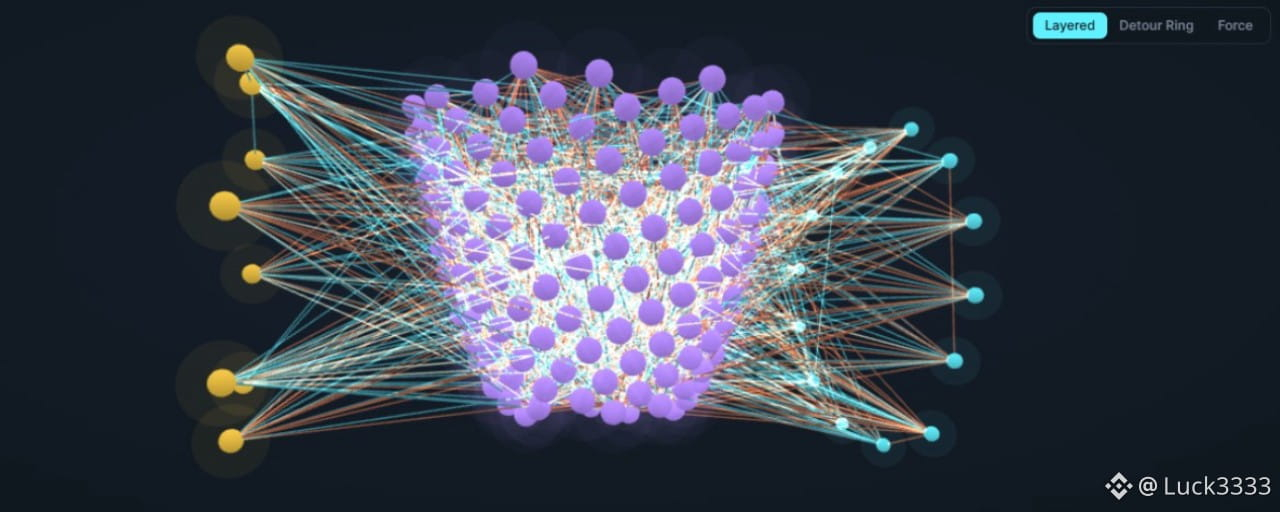
Article
The Qubic Ecosystem Unveiled: UPoW, Jetski Pool, & The Revolutionary ANN ExplorerThe intersection of Artificial Intelligence (AI) and Blockchain is the hottest narrative in crypto right now. But while most projects just slap "AI" onto standard tech, Qubic ($QUBIC) is fundamentally rewriting the rules of distributed computing.
If you are tired of the massive energy waste from traditional Proof-of-Work (PoW) and the centralization of big tech AI, it’s time to dive deep into Qubic's Layer-1 ecosystem, the critical role of Jetski Pool, and how the upcoming ANN Explorer is solving the biggest transparency problem in AI crypto. 👇
🚀 Qubic: Not Your Average Layer-1
Created by Sergey Ivancheglo (aka Come-from-Beyond), the pioneer behind the first PoS protocol and IOTA’s DAG architecture, Qubic is a bare-metal, decentralized computing platform built for extreme performance.
Forget Ethereum's gas fees and slow VMs. Qubic utilizes Quorum-Based Computation (QBC):
676 Computors: A strict set of 676 validator nodes process everything.Instant Finality: Consensus only requires 451 nodes (67%) to agree, acting as a strict Byzantine Fault Tolerant system.Insane Speed: Smart contracts execute directly on bare metal (C++), enabling speeds up to 15.52 million TPS at peak capacity.Feeless: Zero transaction fees for end-users.
🤖 Useful Proof of Work (UPoW): Mining for AGI
Traditional Bitcoin mining burns terawatt-hours of electricity to solve meaningless cryptographic puzzles (SHA-256). Qubic flips this model on its head with Useful Proof of Work (UPoW).
Instead of hashing, millions of AI miners use their CPU/GPU power to train Artificial Neural Networks (ANNs). This massive decentralized supercomputer feeds into Aigarth—an open-source AI system striving for Artificial General Intelligence (AGI).
The 7-Day Epoch: Every week, Computors are ranked based on the volume and quality of AI training they facilitated. Underperforming nodes are ruthlessly kicked out and replaced by eager competitors. It's digital Darwinism at its finest!
🧬 Biological AI vs. Big Tech Centralization
Modern AI (like ChatGPT) relies on Backpropagation—a method that requires billions of dollars in centralized Data Centers (CapEx). It’s highly expensive and completely static once trained.
Qubic takes a neurobiological approach. Miners create random neural topologies. The system then "prunes" (destroys) the weakest links to find the "sweet spot" of intelligence, mimicking the synaptic plasticity of the human brain. No massive data centers required—just the crowdsourced power of the DePIN ecosystem.
⛏️ The Merged Mining Masterstroke
How do you maximize miner efficiency? Merged Mining. Qubic realized that AI training doesn't use 100% of a miner's hardware at all times. So, they pioneered a system where idle CPU power is used to mine Monero (XMR) and Tari, while ASIC miners (using Scrypt) can simultaneously mine Dogecoin (DOGE)!
The genius part? The XMR/DOGE mined is sold for USDT, used to buy back $QUBIC on the open market, and BURNED. This transforms idle compute power into a deflationary financial mechanism.
🌊 Jetski Pool: Powering the Ecosystem
With UPoW being so competitive, solo miners struggle to find valid AI solutions. Enter Jetski Pool—a top-tier community mining pool developed by JETSKI LLC.
Jetski Pool aggregates the hash power of thousands of retail miners. They’ve even launched a sleek Mobile App offering:
Real-time Hashrate & Epoch tracking.Wallet Search to view exact contributions and payouts.Dedicated Dogecoin (Scrypt) Stratums with 0% fees during launch.
However, the rapid growth of pools led to a critical issue: The Black Box Problem.
🔍 Epoch 222 & The ANN Explorer: Making UPoW Visible
In Bitcoin, anyone can check an explorer to see block hashes. But in Qubic, UPoW is invisible. How do outsiders know miners are actually training AI and not just faking data for tokens?
To solve this, the top-voted governance proposal in Epoch 222 was introduced by jtskxx (the engineering team behind Jetski Pool). The mission? "Make Useful Proof of Work Visible."
Enter annexplorer.jetskipool.ai. This isn't a normal block explorer; it is a multi-dimensional real-time AI analytics dashboard. Its groundbreaking features include:
Dynamic Topology Visualization: A 3D render showing the actual neural networks being formed and pruned in real-time. You can literally watch the AI brain grow.Verified AI Solutions Ledger: Translates abstract AI math into a clear, verifiable blockchain ledger.Cross-Reference Miner Attribution: Miners can input their wallets and see exactly which parts of the Aigarth brain their hardware helped build.Compute Segregation Radar: Proves that computing power is dedicated to AI, independent of the Merged Mining (DOGE/XMR) side tasks, ensuring network integrity.
🔮 Conclusion: Redefining DePIN & AI
The Qubic ANN Explorer by Jetski Pool is setting a new industry standard. By turning the "invisible" intellectual labor of UPoW into visual, mathematically verifiable data, it destroys academic skepticism.
It proves that humanity doesn't need to rely on Big Tech monopolies to build the future of AI. We can build it together, fairly, on the blockchain.
What are your thoughts on Qubic's approach to AI? Let's discuss in the comments! 👇
#Qubic #DePIN #AI #CryptoMining #Web3
Read: [What Is AGI? The Limits, Visions, and Definitions of Artificial General Intelligence](https://www.binance.com/en/square/post/342567558192178)
The Qubic Ecosystem Unveiled: UPoW, Jetski Pool, & The Revolutionary ANN Explorer
The intersection of Artificial Intelligence (AI) and Blockchain is the hottest narrative in crypto right now. But while most projects just slap "AI" onto standard tech, Qubic ($QUBIC) is fundamentally rewriting the rules of distributed computing.
If you are tired of the massive energy waste from traditional Proof-of-Work (PoW) and the centralization of big tech AI, it’s time to dive deep into Qubic's Layer-1 ecosystem, the critical role of Jetski Pool, and how the upcoming ANN Explorer is solving the biggest transparency problem in AI crypto. 👇
🚀 Qubic: Not Your Average Layer-1
Created by Sergey Ivancheglo (aka Come-from-Beyond), the pioneer behind the first PoS protocol and IOTA’s DAG architecture, Qubic is a bare-metal, decentralized computing platform built for extreme performance.
Forget Ethereum's gas fees and slow VMs. Qubic utilizes Quorum-Based Computation (QBC):
676 Computors: A strict set of 676 validator nodes process everything.Instant Finality: Consensus only requires 451 nodes (67%) to agree, acting as a strict Byzantine Fault Tolerant system.Insane Speed: Smart contracts execute directly on bare metal (C++), enabling speeds up to 15.52 million TPS at peak capacity.Feeless: Zero transaction fees for end-users.
🤖 Useful Proof of Work (UPoW): Mining for AGI
Traditional Bitcoin mining burns terawatt-hours of electricity to solve meaningless cryptographic puzzles (SHA-256). Qubic flips this model on its head with Useful Proof of Work (UPoW).
Instead of hashing, millions of AI miners use their CPU/GPU power to train Artificial Neural Networks (ANNs). This massive decentralized supercomputer feeds into Aigarth—an open-source AI system striving for Artificial General Intelligence (AGI).
The 7-Day Epoch: Every week, Computors are ranked based on the volume and quality of AI training they facilitated. Underperforming nodes are ruthlessly kicked out and replaced by eager competitors. It's digital Darwinism at its finest!
🧬 Biological AI vs. Big Tech Centralization
Modern AI (like ChatGPT) relies on Backpropagation—a method that requires billions of dollars in centralized Data Centers (CapEx). It’s highly expensive and completely static once trained.
Qubic takes a neurobiological approach. Miners create random neural topologies. The system then "prunes" (destroys) the weakest links to find the "sweet spot" of intelligence, mimicking the synaptic plasticity of the human brain. No massive data centers required—just the crowdsourced power of the DePIN ecosystem.
⛏️ The Merged Mining Masterstroke
How do you maximize miner efficiency? Merged Mining. Qubic realized that AI training doesn't use 100% of a miner's hardware at all times. So, they pioneered a system where idle CPU power is used to mine Monero (XMR) and Tari, while ASIC miners (using Scrypt) can simultaneously mine Dogecoin (DOGE)!
The genius part? The XMR/DOGE mined is sold for USDT, used to buy back $QUBIC on the open market, and BURNED. This transforms idle compute power into a deflationary financial mechanism.
🌊 Jetski Pool: Powering the Ecosystem
With UPoW being so competitive, solo miners struggle to find valid AI solutions. Enter Jetski Pool—a top-tier community mining pool developed by JETSKI LLC.
Jetski Pool aggregates the hash power of thousands of retail miners. They’ve even launched a sleek Mobile App offering:
Real-time Hashrate & Epoch tracking.Wallet Search to view exact contributions and payouts.Dedicated Dogecoin (Scrypt) Stratums with 0% fees during launch.
However, the rapid growth of pools led to a critical issue: The Black Box Problem.
🔍 Epoch 222 & The ANN Explorer: Making UPoW Visible
In Bitcoin, anyone can check an explorer to see block hashes. But in Qubic, UPoW is invisible. How do outsiders know miners are actually training AI and not just faking data for tokens?
To solve this, the top-voted governance proposal in Epoch 222 was introduced by jtskxx (the engineering team behind Jetski Pool). The mission? "Make Useful Proof of Work Visible."
Enter annexplorer.jetskipool.ai. This isn't a normal block explorer; it is a multi-dimensional real-time AI analytics dashboard. Its groundbreaking features include:
Dynamic Topology Visualization: A 3D render showing the actual neural networks being formed and pruned in real-time. You can literally watch the AI brain grow.Verified AI Solutions Ledger: Translates abstract AI math into a clear, verifiable blockchain ledger.Cross-Reference Miner Attribution: Miners can input their wallets and see exactly which parts of the Aigarth brain their hardware helped build.Compute Segregation Radar: Proves that computing power is dedicated to AI, independent of the Merged Mining (DOGE/XMR) side tasks, ensuring network integrity.
🔮 Conclusion: Redefining DePIN & AI
The Qubic ANN Explorer by Jetski Pool is setting a new industry standard. By turning the "invisible" intellectual labor of UPoW into visual, mathematically verifiable data, it destroys academic skepticism.
It proves that humanity doesn't need to rely on Big Tech monopolies to build the future of AI. We can build it together, fairly, on the blockchain.
What are your thoughts on Qubic's approach to AI? Let's discuss in the comments! 👇
#Qubic #DePIN #AI #CryptoMining #Web3
Read: What Is AGI? The Limits, Visions, and Definitions of Artificial General Intelligence
If you are tired of the massive energy waste from traditional Proof-of-Work (PoW) and the centralization of big tech AI, it’s time to dive deep into Qubic's Layer-1 ecosystem, the critical role of Jetski Pool, and how the upcoming ANN Explorer is solving the biggest transparency problem in AI crypto. 👇
🚀 Qubic: Not Your Average Layer-1
Created by Sergey Ivancheglo (aka Come-from-Beyond), the pioneer behind the first PoS protocol and IOTA’s DAG architecture, Qubic is a bare-metal, decentralized computing platform built for extreme performance.
Forget Ethereum's gas fees and slow VMs. Qubic utilizes Quorum-Based Computation (QBC):
676 Computors: A strict set of 676 validator nodes process everything.Instant Finality: Consensus only requires 451 nodes (67%) to agree, acting as a strict Byzantine Fault Tolerant system.Insane Speed: Smart contracts execute directly on bare metal (C++), enabling speeds up to 15.52 million TPS at peak capacity.Feeless: Zero transaction fees for end-users.
🤖 Useful Proof of Work (UPoW): Mining for AGI
Traditional Bitcoin mining burns terawatt-hours of electricity to solve meaningless cryptographic puzzles (SHA-256). Qubic flips this model on its head with Useful Proof of Work (UPoW).
Instead of hashing, millions of AI miners use their CPU/GPU power to train Artificial Neural Networks (ANNs). This massive decentralized supercomputer feeds into Aigarth—an open-source AI system striving for Artificial General Intelligence (AGI).
The 7-Day Epoch: Every week, Computors are ranked based on the volume and quality of AI training they facilitated. Underperforming nodes are ruthlessly kicked out and replaced by eager competitors. It's digital Darwinism at its finest!
🧬 Biological AI vs. Big Tech Centralization
Modern AI (like ChatGPT) relies on Backpropagation—a method that requires billions of dollars in centralized Data Centers (CapEx). It’s highly expensive and completely static once trained.
Qubic takes a neurobiological approach. Miners create random neural topologies. The system then "prunes" (destroys) the weakest links to find the "sweet spot" of intelligence, mimicking the synaptic plasticity of the human brain. No massive data centers required—just the crowdsourced power of the DePIN ecosystem.
⛏️ The Merged Mining Masterstroke
How do you maximize miner efficiency? Merged Mining. Qubic realized that AI training doesn't use 100% of a miner's hardware at all times. So, they pioneered a system where idle CPU power is used to mine Monero (XMR) and Tari, while ASIC miners (using Scrypt) can simultaneously mine Dogecoin (DOGE)!
The genius part? The XMR/DOGE mined is sold for USDT, used to buy back $QUBIC on the open market, and BURNED. This transforms idle compute power into a deflationary financial mechanism.
🌊 Jetski Pool: Powering the Ecosystem
With UPoW being so competitive, solo miners struggle to find valid AI solutions. Enter Jetski Pool—a top-tier community mining pool developed by JETSKI LLC.
Jetski Pool aggregates the hash power of thousands of retail miners. They’ve even launched a sleek Mobile App offering:
Real-time Hashrate & Epoch tracking.Wallet Search to view exact contributions and payouts.Dedicated Dogecoin (Scrypt) Stratums with 0% fees during launch.
However, the rapid growth of pools led to a critical issue: The Black Box Problem.
🔍 Epoch 222 & The ANN Explorer: Making UPoW Visible
In Bitcoin, anyone can check an explorer to see block hashes. But in Qubic, UPoW is invisible. How do outsiders know miners are actually training AI and not just faking data for tokens?
To solve this, the top-voted governance proposal in Epoch 222 was introduced by jtskxx (the engineering team behind Jetski Pool). The mission? "Make Useful Proof of Work Visible."
Enter annexplorer.jetskipool.ai. This isn't a normal block explorer; it is a multi-dimensional real-time AI analytics dashboard. Its groundbreaking features include:
Dynamic Topology Visualization: A 3D render showing the actual neural networks being formed and pruned in real-time. You can literally watch the AI brain grow.Verified AI Solutions Ledger: Translates abstract AI math into a clear, verifiable blockchain ledger.Cross-Reference Miner Attribution: Miners can input their wallets and see exactly which parts of the Aigarth brain their hardware helped build.Compute Segregation Radar: Proves that computing power is dedicated to AI, independent of the Merged Mining (DOGE/XMR) side tasks, ensuring network integrity.
🔮 Conclusion: Redefining DePIN & AI
The Qubic ANN Explorer by Jetski Pool is setting a new industry standard. By turning the "invisible" intellectual labor of UPoW into visual, mathematically verifiable data, it destroys academic skepticism.
It proves that humanity doesn't need to rely on Big Tech monopolies to build the future of AI. We can build it together, fairly, on the blockchain.
What are your thoughts on Qubic's approach to AI? Let's discuss in the comments! 👇
#Qubic #DePIN #AI #CryptoMining #Web3
Read: What Is AGI? The Limits, Visions, and Definitions of Artificial General Intelligence
238
·
--
Qubic will be at two of Europe’s biggest AI events next week, both in Paris.
⭐
MACHINA on July 7 at Station F.
RAISE Summit on July 8-9 at the Carrousel du Louvre.
Their attendance was made possible by generous donations from community members who wanted to see Qubic represented where it matters.
MACHINA is Europe’s leading physical AI summit. Robotics, humanoid systems, embodied intelligence.
The room includes founders from Boston Dynamics, NEURA Robotics, and NVIDIA’s robotics division.
This is where the people building machines that move and act in the real world sit down and decide what comes next.
The intersection of AI and physical infrastructure is exactly where Qubic’s compute layer belongs in the conversation.
👉 https://www.machinasummit.com/
⭐⭐
RAISE Summit is the largest cross-industry AI leadership gathering in Europe.
Over 9,000 attendees, 350+ speakers including Yann LeCun, Eric Schmidt, and Jim Fan.
80% of the room is C-level or founder level.
The conversations happening here will shape where AI infrastructure, compute ownership, and enterprise adoption go over the next decade.
Having the Qubic community in that room matters.
👉https://www.raisesummit.com/
This presence was organized from the ground up by Qubic France, a community-driven group representing the project out of conviction.
They are still looking for support to cover travel costs and media publication.
Events at this level come with real costs, and every contribution strengthens how the project shows up.
The more the community backs it, the bigger the impact.
If you want to contribute, reach out to IrisNova_AI
#Qubic #RAISE #AI #AGI
Qubic will be at two of Europe’s biggest AI events next week, both in Paris.
⭐
MACHINA on July 7 at Station F.
RAISE Summit on July 8-9 at the Carrousel du Louvre.
Their attendance was made possible by generous donations from community members who wanted to see Qubic represented where it matters.
MACHINA is Europe’s leading physical AI summit. Robotics, humanoid systems, embodied intelligence.
The room includes founders from Boston Dynamics, NEURA Robotics, and NVIDIA’s robotics division.
This is where the people building machines that move and act in the real world sit down and decide what comes next.
The intersection of AI and physical infrastructure is exactly where Qubic’s compute layer belongs in the conversation.
👉 https://www.machinasummit.com/
⭐⭐
RAISE Summit is the largest cross-industry AI leadership gathering in Europe.
Over 9,000 attendees, 350+ speakers including Yann LeCun, Eric Schmidt, and Jim Fan.
80% of the room is C-level or founder level.
The conversations happening here will shape where AI infrastructure, compute ownership, and enterprise adoption go over the next decade.
Having the Qubic community in that room matters.
👉https://www.raisesummit.com/
This presence was organized from the ground up by Qubic France, a community-driven group representing the project out of conviction.
They are still looking for support to cover travel costs and media publication.
Events at this level come with real costs, and every contribution strengthens how the project shows up.
The more the community backs it, the bigger the impact.
If you want to contribute, reach out to IrisNova_AI
#Qubic #RAISE #AI #AGI
⭐
MACHINA on July 7 at Station F.
RAISE Summit on July 8-9 at the Carrousel du Louvre.
Their attendance was made possible by generous donations from community members who wanted to see Qubic represented where it matters.
MACHINA is Europe’s leading physical AI summit. Robotics, humanoid systems, embodied intelligence.
The room includes founders from Boston Dynamics, NEURA Robotics, and NVIDIA’s robotics division.
This is where the people building machines that move and act in the real world sit down and decide what comes next.
The intersection of AI and physical infrastructure is exactly where Qubic’s compute layer belongs in the conversation.
👉 https://www.machinasummit.com/
⭐⭐
RAISE Summit is the largest cross-industry AI leadership gathering in Europe.
Over 9,000 attendees, 350+ speakers including Yann LeCun, Eric Schmidt, and Jim Fan.
80% of the room is C-level or founder level.
The conversations happening here will shape where AI infrastructure, compute ownership, and enterprise adoption go over the next decade.
Having the Qubic community in that room matters.
👉https://www.raisesummit.com/
This presence was organized from the ground up by Qubic France, a community-driven group representing the project out of conviction.
They are still looking for support to cover travel costs and media publication.
Events at this level come with real costs, and every contribution strengthens how the project shows up.
The more the community backs it, the bigger the impact.
If you want to contribute, reach out to IrisNova_AI
#Qubic #RAISE #AI #AGI

NVDAUS+0,68%
1
149
·
--
Partiellement vrai
Article
How to Buy QUBIC With a Card: Qubic Is Live on Alchemy Pay in 173 CountriesFor most of its life, buying QUBIC meant taking the long way around. You bought another cryptocurrency first, moved it to an exchange that listed QUBIC, made the trade, then withdrew everything to a wallet. Four steps, three sets of fees, and a decent chance of losing the thread somewhere in the middle if it was your first time.
That path is now optional. Qubic has integrated with Alchemy Pay, a fiat-to-crypto payment gateway operating in 173 countries, which means you can buy QUBIC directly with a debit card, a credit card, or a local bank transfer. No exchange account. No bridging. No intermediate token.
Why buying QUBIC used to be difficult
Exchange listings expand where a token trades. Fiat on-ramp integrations expand who can buy it at all.
The gap between those two things is wider than it sounds. Someone in Jakarta or Lagos or São Paulo who has never opened an exchange account is not blocked by a lack of interest. They are blocked by KYC queues, deposit rails that do not reach their bank, and a purchase flow that quietly assumes they already hold crypto. Alchemy Pay removes that assumption by plugging into the payment methods people already use every day.
Where you can buy QUBIC, and how you can pay
QUBIC is now purchasable in 173 countries. The available payment methods depend on where you are, and Alchemy Pay detects your region automatically. Its supported payment methods include:
Global cards and wallets: Visa, Mastercard, JCB, Apple Pay, Google PayLatin America: PIX in Brazil, SPEI in MexicoAsia: UPI in India, QRIS in Indonesia, VietQR in Vietnam, plus e-wallets and bank transfers across Malaysia and the PhilippinesEurope: SEPA InstantAfrica: local bank transfers and mobile money in markets including Kenya and South Africa
Qubic's community was already spread across all those regions. What changes is that supporters can buy QUBIC using the same rails they use to pay rent.
Buying QUBIC in the United States
The US is usually where these announcements come with an asterisk. Not this time.
US-based buyers can purchase QUBIC directly with Visa or Mastercard debit and credit cards. Alchemy Pay has secured Money Transmitter Licenses in 18 states as of publication, with further approvals in progress, and covers the remaining ground through compliant channel partners. See the list of supported states here.
How to buy QUBIC with Alchemy Pay, step by step
The whole process takes a few minutes.
Before you start: set up a Qubic wallet
Alchemy Pay sends your QUBIC straight to a wallet you control, so you need the address before you begin.
If you do not have a Qubic wallet yet, this walkthrough covers the setup: How to create a Qubic wallet >> https://youtu.be/AboYp-wWksU
You can use the official Qubic web wallet, or the official mobile wallet on iOS and Android. Two things to get right while you are in there:
Back up your seed offline. Anyone who has it has your funds, and nobody can recover it for you.Copy your Qubic wallet address exactly. It is a 60-character uppercase string. Copy and paste it rather than retyping it.
Step 1: Open the Alchemy Pay ramp
Go to ramp.alchemypay.org.
Alchemy Pay reads your country from your IP address and shows the payment methods available there. If it guesses wrong, or you want to pay using an account you hold in another country, change the region manually at the top of the page.
Step 2: Select QUBIC and enter your amount
Choose your local fiat currency, then select QUBIC as the crypto you want to receive.
Enter the amount you want to spend. The widget calculates how much QUBIC that buys at the live rate and refreshes the quote every 15 seconds. Open the fee breakdown before continuing so you can see the payment processing fee and the network fee separately from the exchange rate.
Step 3: Paste your Qubic wallet address
Click Proceed and paste your Qubic wallet address into the recipient field.
Check it, then check it again. Crypto transfers are irreversible, and an address typo means the QUBIC lands somewhere you cannot reach. This is the one step in the process with no undo button.
Step 4: Choose a payment method and pay
Click Proceed again to reach the payment page, then pick your method: card, bank transfer, or whichever local option is available in your region. Enter your payment details and confirm. Alchemy Pay's own on-ramp guide walks through the same screens if you want a second reference.
Step 5: Check your wallet
Once the payment settles, Alchemy Pay sends the QUBIC to the address you provided. Card payments usually arrive within minutes. Bank transfers depend on the rail and can take longer.
Open your wallet and confirm the balance. You can also verify the incoming transaction on the Qubic Explorer by searching your address.
If a payment fails or gets stuck, failed transactions are not charged. Contact Alchemy Pay support with your order ID and payment reference at support@alchemypay.org.
Frequently asked questions
Can I buy QUBIC without a crypto exchange? Yes. Through Alchemy Pay you can buy QUBIC directly with fiat and have it delivered to your own wallet, with no exchange account required.
Can I buy QUBIC with a credit card? Yes. Visa and Mastercard credit and debit cards are supported, along with Apple Pay, Google Pay, and local payment methods depending on your country.
Can US residents buy QUBIC? Yes. US buyers can purchase QUBIC with Visa or Mastercard cards through Alchemy Pay's regulated US channels.
Where does my QUBIC go after I buy it? Directly to the Qubic wallet address you enter during checkout. Alchemy Pay does not custody it for you, which is why setting up your wallet first matters.
Are there fees? Yes. Alchemy Pay charges a payment processing fee, and there is a network fee. Both are shown in the quote breakdown before you confirm.
#Qubic #alchemypay #QubicPay
Dành cho các bạn Việt Nam👉 https://qubicvn.com
How to Buy QUBIC With a Card: Qubic Is Live on Alchemy Pay in 173 Countries
For most of its life, buying QUBIC meant taking the long way around. You bought another cryptocurrency first, moved it to an exchange that listed QUBIC, made the trade, then withdrew everything to a wallet. Four steps, three sets of fees, and a decent chance of losing the thread somewhere in the middle if it was your first time.
That path is now optional. Qubic has integrated with Alchemy Pay, a fiat-to-crypto payment gateway operating in 173 countries, which means you can buy QUBIC directly with a debit card, a credit card, or a local bank transfer. No exchange account. No bridging. No intermediate token.
Why buying QUBIC used to be difficult
Exchange listings expand where a token trades. Fiat on-ramp integrations expand who can buy it at all.
The gap between those two things is wider than it sounds. Someone in Jakarta or Lagos or São Paulo who has never opened an exchange account is not blocked by a lack of interest. They are blocked by KYC queues, deposit rails that do not reach their bank, and a purchase flow that quietly assumes they already hold crypto. Alchemy Pay removes that assumption by plugging into the payment methods people already use every day.
Where you can buy QUBIC, and how you can pay
QUBIC is now purchasable in 173 countries. The available payment methods depend on where you are, and Alchemy Pay detects your region automatically. Its supported payment methods include:
Global cards and wallets: Visa, Mastercard, JCB, Apple Pay, Google PayLatin America: PIX in Brazil, SPEI in MexicoAsia: UPI in India, QRIS in Indonesia, VietQR in Vietnam, plus e-wallets and bank transfers across Malaysia and the PhilippinesEurope: SEPA InstantAfrica: local bank transfers and mobile money in markets including Kenya and South Africa
Qubic's community was already spread across all those regions. What changes is that supporters can buy QUBIC using the same rails they use to pay rent.
Buying QUBIC in the United States
The US is usually where these announcements come with an asterisk. Not this time.
US-based buyers can purchase QUBIC directly with Visa or Mastercard debit and credit cards. Alchemy Pay has secured Money Transmitter Licenses in 18 states as of publication, with further approvals in progress, and covers the remaining ground through compliant channel partners. See the list of supported states here.
How to buy QUBIC with Alchemy Pay, step by step
The whole process takes a few minutes.
Before you start: set up a Qubic wallet
Alchemy Pay sends your QUBIC straight to a wallet you control, so you need the address before you begin.
If you do not have a Qubic wallet yet, this walkthrough covers the setup: How to create a Qubic wallet >> https://youtu.be/AboYp-wWksU
You can use the official Qubic web wallet, or the official mobile wallet on iOS and Android. Two things to get right while you are in there:
Back up your seed offline. Anyone who has it has your funds, and nobody can recover it for you.Copy your Qubic wallet address exactly. It is a 60-character uppercase string. Copy and paste it rather than retyping it.
Step 1: Open the Alchemy Pay ramp
Go to ramp.alchemypay.org.
Alchemy Pay reads your country from your IP address and shows the payment methods available there. If it guesses wrong, or you want to pay using an account you hold in another country, change the region manually at the top of the page.
Step 2: Select QUBIC and enter your amount
Choose your local fiat currency, then select QUBIC as the crypto you want to receive.
Enter the amount you want to spend. The widget calculates how much QUBIC that buys at the live rate and refreshes the quote every 15 seconds. Open the fee breakdown before continuing so you can see the payment processing fee and the network fee separately from the exchange rate.
Step 3: Paste your Qubic wallet address
Click Proceed and paste your Qubic wallet address into the recipient field.
Check it, then check it again. Crypto transfers are irreversible, and an address typo means the QUBIC lands somewhere you cannot reach. This is the one step in the process with no undo button.
Step 4: Choose a payment method and pay
Click Proceed again to reach the payment page, then pick your method: card, bank transfer, or whichever local option is available in your region. Enter your payment details and confirm. Alchemy Pay's own on-ramp guide walks through the same screens if you want a second reference.
Step 5: Check your wallet
Once the payment settles, Alchemy Pay sends the QUBIC to the address you provided. Card payments usually arrive within minutes. Bank transfers depend on the rail and can take longer.
Open your wallet and confirm the balance. You can also verify the incoming transaction on the Qubic Explorer by searching your address.
If a payment fails or gets stuck, failed transactions are not charged. Contact Alchemy Pay support with your order ID and payment reference at support@alchemypay.org.
Frequently asked questions
Can I buy QUBIC without a crypto exchange? Yes. Through Alchemy Pay you can buy QUBIC directly with fiat and have it delivered to your own wallet, with no exchange account required.
Can I buy QUBIC with a credit card? Yes. Visa and Mastercard credit and debit cards are supported, along with Apple Pay, Google Pay, and local payment methods depending on your country.
Can US residents buy QUBIC? Yes. US buyers can purchase QUBIC with Visa or Mastercard cards through Alchemy Pay's regulated US channels.
Where does my QUBIC go after I buy it? Directly to the Qubic wallet address you enter during checkout. Alchemy Pay does not custody it for you, which is why setting up your wallet first matters.
Are there fees? Yes. Alchemy Pay charges a payment processing fee, and there is a network fee. Both are shown in the quote breakdown before you confirm.
#Qubic #alchemypay #QubicPay
Dành cho các bạn Việt Nam👉 https://qubicvn.com
That path is now optional. Qubic has integrated with Alchemy Pay, a fiat-to-crypto payment gateway operating in 173 countries, which means you can buy QUBIC directly with a debit card, a credit card, or a local bank transfer. No exchange account. No bridging. No intermediate token.
Why buying QUBIC used to be difficult
Exchange listings expand where a token trades. Fiat on-ramp integrations expand who can buy it at all.
The gap between those two things is wider than it sounds. Someone in Jakarta or Lagos or São Paulo who has never opened an exchange account is not blocked by a lack of interest. They are blocked by KYC queues, deposit rails that do not reach their bank, and a purchase flow that quietly assumes they already hold crypto. Alchemy Pay removes that assumption by plugging into the payment methods people already use every day.
Where you can buy QUBIC, and how you can pay
QUBIC is now purchasable in 173 countries. The available payment methods depend on where you are, and Alchemy Pay detects your region automatically. Its supported payment methods include:
Global cards and wallets: Visa, Mastercard, JCB, Apple Pay, Google PayLatin America: PIX in Brazil, SPEI in MexicoAsia: UPI in India, QRIS in Indonesia, VietQR in Vietnam, plus e-wallets and bank transfers across Malaysia and the PhilippinesEurope: SEPA InstantAfrica: local bank transfers and mobile money in markets including Kenya and South Africa
Qubic's community was already spread across all those regions. What changes is that supporters can buy QUBIC using the same rails they use to pay rent.
Buying QUBIC in the United States
The US is usually where these announcements come with an asterisk. Not this time.
US-based buyers can purchase QUBIC directly with Visa or Mastercard debit and credit cards. Alchemy Pay has secured Money Transmitter Licenses in 18 states as of publication, with further approvals in progress, and covers the remaining ground through compliant channel partners. See the list of supported states here.
How to buy QUBIC with Alchemy Pay, step by step
The whole process takes a few minutes.
Before you start: set up a Qubic wallet
Alchemy Pay sends your QUBIC straight to a wallet you control, so you need the address before you begin.
If you do not have a Qubic wallet yet, this walkthrough covers the setup: How to create a Qubic wallet >> https://youtu.be/AboYp-wWksU
You can use the official Qubic web wallet, or the official mobile wallet on iOS and Android. Two things to get right while you are in there:
Back up your seed offline. Anyone who has it has your funds, and nobody can recover it for you.Copy your Qubic wallet address exactly. It is a 60-character uppercase string. Copy and paste it rather than retyping it.
Step 1: Open the Alchemy Pay ramp
Go to ramp.alchemypay.org.
Alchemy Pay reads your country from your IP address and shows the payment methods available there. If it guesses wrong, or you want to pay using an account you hold in another country, change the region manually at the top of the page.
Step 2: Select QUBIC and enter your amount
Choose your local fiat currency, then select QUBIC as the crypto you want to receive.
Enter the amount you want to spend. The widget calculates how much QUBIC that buys at the live rate and refreshes the quote every 15 seconds. Open the fee breakdown before continuing so you can see the payment processing fee and the network fee separately from the exchange rate.
Step 3: Paste your Qubic wallet address
Click Proceed and paste your Qubic wallet address into the recipient field.
Check it, then check it again. Crypto transfers are irreversible, and an address typo means the QUBIC lands somewhere you cannot reach. This is the one step in the process with no undo button.
Step 4: Choose a payment method and pay
Click Proceed again to reach the payment page, then pick your method: card, bank transfer, or whichever local option is available in your region. Enter your payment details and confirm. Alchemy Pay's own on-ramp guide walks through the same screens if you want a second reference.
Step 5: Check your wallet
Once the payment settles, Alchemy Pay sends the QUBIC to the address you provided. Card payments usually arrive within minutes. Bank transfers depend on the rail and can take longer.
Open your wallet and confirm the balance. You can also verify the incoming transaction on the Qubic Explorer by searching your address.
If a payment fails or gets stuck, failed transactions are not charged. Contact Alchemy Pay support with your order ID and payment reference at support@alchemypay.org.
Frequently asked questions
Can I buy QUBIC without a crypto exchange? Yes. Through Alchemy Pay you can buy QUBIC directly with fiat and have it delivered to your own wallet, with no exchange account required.
Can I buy QUBIC with a credit card? Yes. Visa and Mastercard credit and debit cards are supported, along with Apple Pay, Google Pay, and local payment methods depending on your country.
Can US residents buy QUBIC? Yes. US buyers can purchase QUBIC with Visa or Mastercard cards through Alchemy Pay's regulated US channels.
Where does my QUBIC go after I buy it? Directly to the Qubic wallet address you enter during checkout. Alchemy Pay does not custody it for you, which is why setting up your wallet first matters.
Are there fees? Yes. Alchemy Pay charges a payment processing fee, and there is a network fee. Both are shown in the quote breakdown before you confirm.
#Qubic #alchemypay #QubicPay
Dành cho các bạn Việt Nam👉 https://qubicvn.com
2
2
158
·
--
$Qubic smart contracts are about to gain a new sense: reading events straight from other blockchains.
Two new Oracle Machine services are in review, readEVMLog and readQubicLog.
Both already proven on the dev testnet.
Here is what they do.
The readEVMLog lets any #Qubic #SmartContracts read any event log from an #evm chain.
#Ethereum , #BSC , Polygon, Base, Arbitrum, and more.
No trusted middleman.
No single oracle operator.
Every answer is independently fetched and byte-verified by the computor network.
The readQubicLog lets a contract, or a cross-chain relayer, read any event from Qubic's own history the same way.
That makes Qubic events provable to the outside world through a zero knowledge proof.
One reads in.
The other proves out.
What this unlocks:
Tracking money moved on other chains, the core primitive for a cross-chain bridge.
Price feeds read directly from on-chain sources like Chainlink aggregators.
Access to on-chain facts like credentials, allowlists, proof-of-humanity, and NFT ownership.
Both services are fully generic.
They carry no application logic.
They deliver raw event bytes, and each contract decodes its own meaning.
Adding a new use case needs no oracle code change at all.
Both are proven on the dev testnet with full decentralized commit-reveal rounds.
The pull requests are open now: [init files for evm/qubic log service](https://github.com/qubic/oracle-machine/pull/15)
$Qubic smart contracts are about to gain a new sense: reading events straight from other blockchains.
Two new Oracle Machine services are in review, readEVMLog and readQubicLog.
Both already proven on the dev testnet.
Here is what they do.
The readEVMLog lets any #Qubic #SmartContracts read any event log from an #evm chain.
#Ethereum , #BSC , Polygon, Base, Arbitrum, and more.
No trusted middleman.
No single oracle operator.
Every answer is independently fetched and byte-verified by the computor network.
The readQubicLog lets a contract, or a cross-chain relayer, read any event from Qubic's own history the same way.
That makes Qubic events provable to the outside world through a zero knowledge proof.
One reads in.
The other proves out.
What this unlocks:
Tracking money moved on other chains, the core primitive for a cross-chain bridge.
Price feeds read directly from on-chain sources like Chainlink aggregators.
Access to on-chain facts like credentials, allowlists, proof-of-humanity, and NFT ownership.
Both services are fully generic.
They carry no application logic.
They deliver raw event bytes, and each contract decodes its own meaning.
Adding a new use case needs no oracle code change at all.
Both are proven on the dev testnet with full decentralized commit-reveal rounds.
The pull requests are open now: init files for evm/qubic log service
Two new Oracle Machine services are in review, readEVMLog and readQubicLog.
Both already proven on the dev testnet.
Here is what they do.
The readEVMLog lets any #Qubic #SmartContracts read any event log from an #evm chain.
#Ethereum , #BSC , Polygon, Base, Arbitrum, and more.
No trusted middleman.
No single oracle operator.
Every answer is independently fetched and byte-verified by the computor network.
The readQubicLog lets a contract, or a cross-chain relayer, read any event from Qubic's own history the same way.
That makes Qubic events provable to the outside world through a zero knowledge proof.
One reads in.
The other proves out.
What this unlocks:
Tracking money moved on other chains, the core primitive for a cross-chain bridge.
Price feeds read directly from on-chain sources like Chainlink aggregators.
Access to on-chain facts like credentials, allowlists, proof-of-humanity, and NFT ownership.
Both services are fully generic.
They carry no application logic.
They deliver raw event bytes, and each contract decodes its own meaning.
Adding a new use case needs no oracle code change at all.
Both are proven on the dev testnet with full decentralized commit-reveal rounds.
The pull requests are open now: init files for evm/qubic log service

2
111

🚨 Something interesting is happening with $QUBT.US that many people may be overlooking…
$QUBT.US is now spendable through AEON Pay across nearly 50 million merchant locations. 👀
But that’s not the only update.
⚡ BPP-9000 Useful Proof-of-Work is now live on mainnet
⚡ Outsourced Computing is live
⚡ Qubic’s AIO Dev Kit is now available for developers
So the bigger question is:
Is $QUBIC simply another speculative altcoin, or is it quietly building real-world utility around AI, payments and Web3 infrastructure? 🤔
The market is watching the price…
But I’m watching the fundamentals behind the move. 🔍
DYOR. Not financial advice.
#QUBIC #QUBICUSDT #Crypto #Altcoins #Aİ
🚨 Something interesting is happening with $QUBT.US that many people may be overlooking…
$QUBT.US is now spendable through AEON Pay across nearly 50 million merchant locations. 👀
But that’s not the only update.
⚡ BPP-9000 Useful Proof-of-Work is now live on mainnet
⚡ Outsourced Computing is live
⚡ Qubic’s AIO Dev Kit is now available for developers
So the bigger question is:
Is $QUBIC simply another speculative altcoin, or is it quietly building real-world utility around AI, payments and Web3 infrastructure? 🤔
The market is watching the price…
But I’m watching the fundamentals behind the move. 🔍
DYOR. Not financial advice.
#QUBIC #QUBICUSDT #Crypto #Altcoins #Aİ
$QUBT.US is now spendable through AEON Pay across nearly 50 million merchant locations. 👀
But that’s not the only update.
⚡ BPP-9000 Useful Proof-of-Work is now live on mainnet
⚡ Outsourced Computing is live
⚡ Qubic’s AIO Dev Kit is now available for developers
So the bigger question is:
Is $QUBIC simply another speculative altcoin, or is it quietly building real-world utility around AI, payments and Web3 infrastructure? 🤔
The market is watching the price…
But I’m watching the fundamentals behind the move. 🔍
DYOR. Not financial advice.
#QUBIC #QUBICUSDT #Crypto #Altcoins #Aİ
QUBTUS+0,86%
2
161
·
--

Article
QUBIC Quorum Governance Proposals - Epoch 227$QUBIC MARKETING PROPOSAL — Qubic Marketing Team
🚀Core objectives
- Fund the Qubic Marketing Team for August–October 2026, focusing on organic marketing and SEO after removing the paid media budget. - Evolve content toward a corporate style and reassess target audiences to broaden engagement beyond investors to all ecosystem participants. - Maintain consistent marketing operations during a transition period, with Mr. Rose acting as treasurer only, not Head of Marketing.
⚙️Technical implementation
- Team of 2 full-time equivalents (FTEs) plus part-time roles: Hagrid (marketing coordination/social media), Hash (content management), XXODUX (designer), Andrei (web developer), and Kimz (business development lead, salary split 50/50 with Core Tech). - Tools include ActiveCampaign (CRM), Framer (website), Metricool (social analytics), X Premium, Streamyard (AMAs), and Zapier, totaling $1,455/month. - Reporting via biweekly AMAs, metrics dashboards, and public monthly performance reports; unused funds returned to the CCF.
💡Innovative approach
- Splits marketing funding into two proposals: this one for the internal team, and a separate one for agency services, allowing Computors to vote independently on each. - Shifts focus entirely to organic marketing and SEO, eliminating paid media to sustain reach cost-effectively. - Uses a governance framework where "small execution groups" are funded by "full workgroups," enabling BD inclusion across budgets.
💰Economic aspects
- Total request: 59,366,666,667 QUBIC (~$26,715), covering team costs ($22,350) and tools ($4,365) for 3 months. - Monthly team cost is $7,450, with Mr. Rose serving unpaid as treasurer. - Lean, price-conscious budget with a $100 contingency for overages and tool trials.
🌍Expected impacts
- Ensures continuous content, social media, community visibility, and business development during the transition. - Broadens Qubic's engagement across different roles and activities, not just investors. - Maintains transparency and accountability, with full reporting and return of unused funds, supporting ecosystem trust and stability.
🔗Proposal link below
[https://github.com/MrRoseQubic/Marketing-proposal-for-interim-period-AUG-SEPT-26-/blob/f912c04/Qubic_Marketing_Proposal_Aug_Oct_2026.md](https://github.com/MrRoseQubic/Marketing-proposal-for-interim-period-AUG-SEPT-26-/blob/f912c04/Qubic_Marketing_Proposal_Aug_Oct_2026.md)
#Qubic #HIRING #governance #Web3Jobs
QUBIC Quorum Governance Proposals - Epoch 227
$QUBIC MARKETING PROPOSAL — Qubic Marketing Team
🚀Core objectives
- Fund the Qubic Marketing Team for August–October 2026, focusing on organic marketing and SEO after removing the paid media budget. - Evolve content toward a corporate style and reassess target audiences to broaden engagement beyond investors to all ecosystem participants. - Maintain consistent marketing operations during a transition period, with Mr. Rose acting as treasurer only, not Head of Marketing.
⚙️Technical implementation
- Team of 2 full-time equivalents (FTEs) plus part-time roles: Hagrid (marketing coordination/social media), Hash (content management), XXODUX (designer), Andrei (web developer), and Kimz (business development lead, salary split 50/50 with Core Tech). - Tools include ActiveCampaign (CRM), Framer (website), Metricool (social analytics), X Premium, Streamyard (AMAs), and Zapier, totaling $1,455/month. - Reporting via biweekly AMAs, metrics dashboards, and public monthly performance reports; unused funds returned to the CCF.
💡Innovative approach
- Splits marketing funding into two proposals: this one for the internal team, and a separate one for agency services, allowing Computors to vote independently on each. - Shifts focus entirely to organic marketing and SEO, eliminating paid media to sustain reach cost-effectively. - Uses a governance framework where "small execution groups" are funded by "full workgroups," enabling BD inclusion across budgets.
💰Economic aspects
- Total request: 59,366,666,667 QUBIC (~$26,715), covering team costs ($22,350) and tools ($4,365) for 3 months. - Monthly team cost is $7,450, with Mr. Rose serving unpaid as treasurer. - Lean, price-conscious budget with a $100 contingency for overages and tool trials.
🌍Expected impacts
- Ensures continuous content, social media, community visibility, and business development during the transition. - Broadens Qubic's engagement across different roles and activities, not just investors. - Maintains transparency and accountability, with full reporting and return of unused funds, supporting ecosystem trust and stability.
🔗Proposal link below
https://github.com/MrRoseQubic/Marketing-proposal-for-interim-period-AUG-SEPT-26-/blob/f912c04/Qubic_Marketing_Proposal_Aug_Oct_2026.md
#Qubic #HIRING #governance #Web3Jobs
🚀Core objectives
- Fund the Qubic Marketing Team for August–October 2026, focusing on organic marketing and SEO after removing the paid media budget. - Evolve content toward a corporate style and reassess target audiences to broaden engagement beyond investors to all ecosystem participants. - Maintain consistent marketing operations during a transition period, with Mr. Rose acting as treasurer only, not Head of Marketing.
⚙️Technical implementation
- Team of 2 full-time equivalents (FTEs) plus part-time roles: Hagrid (marketing coordination/social media), Hash (content management), XXODUX (designer), Andrei (web developer), and Kimz (business development lead, salary split 50/50 with Core Tech). - Tools include ActiveCampaign (CRM), Framer (website), Metricool (social analytics), X Premium, Streamyard (AMAs), and Zapier, totaling $1,455/month. - Reporting via biweekly AMAs, metrics dashboards, and public monthly performance reports; unused funds returned to the CCF.
💡Innovative approach
- Splits marketing funding into two proposals: this one for the internal team, and a separate one for agency services, allowing Computors to vote independently on each. - Shifts focus entirely to organic marketing and SEO, eliminating paid media to sustain reach cost-effectively. - Uses a governance framework where "small execution groups" are funded by "full workgroups," enabling BD inclusion across budgets.
💰Economic aspects
- Total request: 59,366,666,667 QUBIC (~$26,715), covering team costs ($22,350) and tools ($4,365) for 3 months. - Monthly team cost is $7,450, with Mr. Rose serving unpaid as treasurer. - Lean, price-conscious budget with a $100 contingency for overages and tool trials.
🌍Expected impacts
- Ensures continuous content, social media, community visibility, and business development during the transition. - Broadens Qubic's engagement across different roles and activities, not just investors. - Maintains transparency and accountability, with full reporting and return of unused funds, supporting ecosystem trust and stability.
🔗Proposal link below
https://github.com/MrRoseQubic/Marketing-proposal-for-interim-period-AUG-SEPT-26-/blob/f912c04/Qubic_Marketing_Proposal_Aug_Oct_2026.md
#Qubic #HIRING #governance #Web3Jobs
111

·
--
Every time someone asks "where is the AI in Qubic's mining," the answer used to require an explanation.
Now it requires a link.
The Qubic ANN Explorer, built by @JetskiPool, is now live.
It archives every mining solution the network produces, independently re-verifies the score, reconstructs the neural network behind it, and lets you replay the entire search. 🧵
#Qubic #DecentralizedFuture"
https://x.com/i/status/2079583315934249092
Every time someone asks "where is the AI in Qubic's mining," the answer used to require an explanation.
Now it requires a link.
The Qubic ANN Explorer, built by @JetskiPool, is now live.
It archives every mining solution the network produces, independently re-verifies the score, reconstructs the neural network behind it, and lets you replay the entire search. 🧵
#Qubic #DecentralizedFuture"
https://x.com/i/status/2079583315934249092
Now it requires a link.
The Qubic ANN Explorer, built by @JetskiPool, is now live.
It archives every mining solution the network produces, independently re-verifies the score, reconstructs the neural network behind it, and lets you replay the entire search. 🧵
#Qubic #DecentralizedFuture"
https://x.com/i/status/2079583315934249092
1
91
·
--
Article
Qubic Outsourced Computation Explained: How Smart Contracts Are Going Cross-ChainQubic's June 3rd “Tech on Deck” AMA centered on a development that will reshape how the protocol interacts with the outside world: Outsourced Computation. Core developers FNordSpace and Raika joined moderator Joetom to break down the architecture, explain the authorization model, and lay out a roadmap targeting a July 29 go-live date. The session also offered a look at the realities of building on Qubic's unconventional codebase, drawing over 3,500 live viewers.
What It's Like Building on Qubic's Bare Metal Architecture
Before diving into Outsourced Computation, the team discussed what $Qubic core development actually involves. The picture that emerged is one of constant adaptation. Network health dictates the day: if the chain gets stuck or tick speeds degrade, everything else pauses until the issue is resolved.
The Qubic codebase runs directly on UEFI with no standard C++ library available. That constraint colors everything. Basic functionality that most C++ developers take for granted has to be implemented from scratch. AI coding tools help catch small bugs, but they routinely suggest patterns that won't compile in a bare metal environment. The sandbox system for smart contract execution carries its own assumptions about memory and state that AI tools aren't aware of. As Raika noted, developers often end up guiding the AI more than the AI guides them.
Both developers shared war stories. FNordSpace's first public release caused the network to tick once and freeze, a small bug that shook his confidence in those early days. Raika spent months tracking a concurrency bug in the pending transaction pool before isolating it. These experiences drove process improvements: the team now has structured testing plans, better unit test coverage, and network recovery mechanisms. Raika also built a contract verification tool that has become essential as the volume of community-submitted Qubic smart contracts grows.
Outsourced Computation: From On-Chain Observer to Cross-Chain Actor
FNordSpace led the technical deep dive, drawing on three weeks of close collaboration with CFB to design the architecture. He opened with an important correction: Outsourced Computation has nothing to do with renting out compute power, to clarify any confusion. He confirmed this with CFB multiple times.
The concept fits alongside a system Qubic already has. Oracle Machines bring external data into the chain. A smart contract can query them for something like the current Bitcoin price and receive a verified answer. Information flows inward. Outsourced Computation reverses that flow. It allows a Qubic smart contract to send an authorized instruction outward, where an external system acts on it. FNordSpace put it simply: Oracle Machines gave smart contracts eyes and ears. Outsourced Computation gives them hands.
One critical difference separates the two systems. Oracle Machines return results. Outsourced Computation does not. It is fire-and-forget. The smart contract issues an intent, the network authorizes and delivers it, and the OC's job is done. If the contract needs confirmation that the action succeeded, it queries an Oracle Machine separately.
How the Qubic Outsourced Computation Invocation Works
The authorization process has four stages. A smart contract invokes an OC during execution and pays a fee. Every computor executing the contract at that moment records the request parameters into a core data structure. Computors then independently sign the request. Once 451 of the 676 computors have signed, the request is authorized. This two-thirds quorum threshold ensures no instruction leaves the chain without broad consensus, and the signature bundle lets external systems independently verify that the Qubic network sanctioned the action. Finally, each computor forwards the signed bundle to its processor, a separate machine built to carry out the specific off-chain task.
The processor is where the action happens, and it's developed by the smart contract developer, not by Qubic. The protocol provides the authorization machinery and the delivery mechanism. What the processor does with the authorized instruction is entirely up to whoever builds it.
Cross-Chain Actions, Custody Transitions, and Real-World Use Cases
Three categories of use cases emerged from FNordSpace's work with CFB. Cross-chain actions allow a Qubic smart contract to trigger transactions on Bitcoin, Ethereum, or other blockchains through a purpose-built processor. Custody transitions become possible, where a contract could rotate the authorized signers on a multisig wallet in another chain. And external service integrations open the door to real-world interactions: a user pays a contract in QU, the contract verifies the payment, and an OC triggers an action like unlocking a bike or releasing escrowed funds.
Blockchain bridges stand out as a near-term application. Current Qubic bridges depend on middleware that constantly monitors the tick chain. With OC, a smart contract could push instructions to the other chain directly, eliminating the need for an always-on listener and reducing reliance on third-party middleware that users can't easily audit.
One design constraint worth noting: because all 676 computors forward the authorized bundle to their processors, the receiving system must handle deduplication. A single instruction from Qubic arrives as 676 identical requests, and the destination needs logic to recognize them as one order. This can be handled at the processor level, but it has to be accounted for in the design.
Qubic Token Burn and Fee Model
The economics follow the same pattern as Oracle Machines. Each OC invocation costs a fee paid by the smart contract, and that fee is burned, permanently removing QUBIC tokens from circulation. Alongside existing execution fees and Oracle call fees, Outsourced Computation adds another deflationary channel that scales with network usage.
Outsourced Computation Roadmap: Timeline to July 29 Go-Live
The development roadmap is staged and concrete. Architecture documents were in review with CFB at the time of the AMA. Basic implementation started June 3. A mock OC targets the testnet by June 17 and mainnet by July 1, exercising the full invocation and authorization path without real-world actions. The production release, opening the protocol for developers to build on, is set for July 29. If the system stabilizes earlier, the team indicated the schedule could move up.
Qubic's Three Infrastructure Pillars Near Completion
With Outsourced Computation approaching its go-live, Qubic's smart contract infrastructure reaches a milestone. Smart contracts handle on-chain logic. Oracle Machines bring external data in. Outsourced Computation sends authorized intent out. Together, these three pillars give Qubic smart contracts bidirectional communication with the outside world at the protocol level.
The community now has a clear set of dates to watch: testnet mock in mid-June, mainnet testing in early July, and a full go-live on July 29. A follow-up Tech AMA covering release management and additional developer topics is planned. For anyone building on Qubic or evaluating where the protocol is headed, the next eight weeks will be telling.
#Qubic #SmartContracts #CrossChain #Oracle #CryptoNews
Qubic Outsourced Computation Explained: How Smart Contracts Are Going Cross-Chain
Qubic's June 3rd “Tech on Deck” AMA centered on a development that will reshape how the protocol interacts with the outside world: Outsourced Computation. Core developers FNordSpace and Raika joined moderator Joetom to break down the architecture, explain the authorization model, and lay out a roadmap targeting a July 29 go-live date. The session also offered a look at the realities of building on Qubic's unconventional codebase, drawing over 3,500 live viewers.
What It's Like Building on Qubic's Bare Metal Architecture
Before diving into Outsourced Computation, the team discussed what $Qubic core development actually involves. The picture that emerged is one of constant adaptation. Network health dictates the day: if the chain gets stuck or tick speeds degrade, everything else pauses until the issue is resolved.
The Qubic codebase runs directly on UEFI with no standard C++ library available. That constraint colors everything. Basic functionality that most C++ developers take for granted has to be implemented from scratch. AI coding tools help catch small bugs, but they routinely suggest patterns that won't compile in a bare metal environment. The sandbox system for smart contract execution carries its own assumptions about memory and state that AI tools aren't aware of. As Raika noted, developers often end up guiding the AI more than the AI guides them.
Both developers shared war stories. FNordSpace's first public release caused the network to tick once and freeze, a small bug that shook his confidence in those early days. Raika spent months tracking a concurrency bug in the pending transaction pool before isolating it. These experiences drove process improvements: the team now has structured testing plans, better unit test coverage, and network recovery mechanisms. Raika also built a contract verification tool that has become essential as the volume of community-submitted Qubic smart contracts grows.
Outsourced Computation: From On-Chain Observer to Cross-Chain Actor
FNordSpace led the technical deep dive, drawing on three weeks of close collaboration with CFB to design the architecture. He opened with an important correction: Outsourced Computation has nothing to do with renting out compute power, to clarify any confusion. He confirmed this with CFB multiple times.
The concept fits alongside a system Qubic already has. Oracle Machines bring external data into the chain. A smart contract can query them for something like the current Bitcoin price and receive a verified answer. Information flows inward. Outsourced Computation reverses that flow. It allows a Qubic smart contract to send an authorized instruction outward, where an external system acts on it. FNordSpace put it simply: Oracle Machines gave smart contracts eyes and ears. Outsourced Computation gives them hands.
One critical difference separates the two systems. Oracle Machines return results. Outsourced Computation does not. It is fire-and-forget. The smart contract issues an intent, the network authorizes and delivers it, and the OC's job is done. If the contract needs confirmation that the action succeeded, it queries an Oracle Machine separately.
How the Qubic Outsourced Computation Invocation Works
The authorization process has four stages. A smart contract invokes an OC during execution and pays a fee. Every computor executing the contract at that moment records the request parameters into a core data structure. Computors then independently sign the request. Once 451 of the 676 computors have signed, the request is authorized. This two-thirds quorum threshold ensures no instruction leaves the chain without broad consensus, and the signature bundle lets external systems independently verify that the Qubic network sanctioned the action. Finally, each computor forwards the signed bundle to its processor, a separate machine built to carry out the specific off-chain task.
The processor is where the action happens, and it's developed by the smart contract developer, not by Qubic. The protocol provides the authorization machinery and the delivery mechanism. What the processor does with the authorized instruction is entirely up to whoever builds it.
Cross-Chain Actions, Custody Transitions, and Real-World Use Cases
Three categories of use cases emerged from FNordSpace's work with CFB. Cross-chain actions allow a Qubic smart contract to trigger transactions on Bitcoin, Ethereum, or other blockchains through a purpose-built processor. Custody transitions become possible, where a contract could rotate the authorized signers on a multisig wallet in another chain. And external service integrations open the door to real-world interactions: a user pays a contract in QU, the contract verifies the payment, and an OC triggers an action like unlocking a bike or releasing escrowed funds.
Blockchain bridges stand out as a near-term application. Current Qubic bridges depend on middleware that constantly monitors the tick chain. With OC, a smart contract could push instructions to the other chain directly, eliminating the need for an always-on listener and reducing reliance on third-party middleware that users can't easily audit.
One design constraint worth noting: because all 676 computors forward the authorized bundle to their processors, the receiving system must handle deduplication. A single instruction from Qubic arrives as 676 identical requests, and the destination needs logic to recognize them as one order. This can be handled at the processor level, but it has to be accounted for in the design.
Qubic Token Burn and Fee Model
The economics follow the same pattern as Oracle Machines. Each OC invocation costs a fee paid by the smart contract, and that fee is burned, permanently removing QUBIC tokens from circulation. Alongside existing execution fees and Oracle call fees, Outsourced Computation adds another deflationary channel that scales with network usage.
Outsourced Computation Roadmap: Timeline to July 29 Go-Live
The development roadmap is staged and concrete. Architecture documents were in review with CFB at the time of the AMA. Basic implementation started June 3. A mock OC targets the testnet by June 17 and mainnet by July 1, exercising the full invocation and authorization path without real-world actions. The production release, opening the protocol for developers to build on, is set for July 29. If the system stabilizes earlier, the team indicated the schedule could move up.
Qubic's Three Infrastructure Pillars Near Completion
With Outsourced Computation approaching its go-live, Qubic's smart contract infrastructure reaches a milestone. Smart contracts handle on-chain logic. Oracle Machines bring external data in. Outsourced Computation sends authorized intent out. Together, these three pillars give Qubic smart contracts bidirectional communication with the outside world at the protocol level.
The community now has a clear set of dates to watch: testnet mock in mid-June, mainnet testing in early July, and a full go-live on July 29. A follow-up Tech AMA covering release management and additional developer topics is planned. For anyone building on Qubic or evaluating where the protocol is headed, the next eight weeks will be telling.
#Qubic #SmartContracts #CrossChain #Oracle #CryptoNews
What It's Like Building on Qubic's Bare Metal Architecture
Before diving into Outsourced Computation, the team discussed what $Qubic core development actually involves. The picture that emerged is one of constant adaptation. Network health dictates the day: if the chain gets stuck or tick speeds degrade, everything else pauses until the issue is resolved.
The Qubic codebase runs directly on UEFI with no standard C++ library available. That constraint colors everything. Basic functionality that most C++ developers take for granted has to be implemented from scratch. AI coding tools help catch small bugs, but they routinely suggest patterns that won't compile in a bare metal environment. The sandbox system for smart contract execution carries its own assumptions about memory and state that AI tools aren't aware of. As Raika noted, developers often end up guiding the AI more than the AI guides them.
Both developers shared war stories. FNordSpace's first public release caused the network to tick once and freeze, a small bug that shook his confidence in those early days. Raika spent months tracking a concurrency bug in the pending transaction pool before isolating it. These experiences drove process improvements: the team now has structured testing plans, better unit test coverage, and network recovery mechanisms. Raika also built a contract verification tool that has become essential as the volume of community-submitted Qubic smart contracts grows.
Outsourced Computation: From On-Chain Observer to Cross-Chain Actor
FNordSpace led the technical deep dive, drawing on three weeks of close collaboration with CFB to design the architecture. He opened with an important correction: Outsourced Computation has nothing to do with renting out compute power, to clarify any confusion. He confirmed this with CFB multiple times.
The concept fits alongside a system Qubic already has. Oracle Machines bring external data into the chain. A smart contract can query them for something like the current Bitcoin price and receive a verified answer. Information flows inward. Outsourced Computation reverses that flow. It allows a Qubic smart contract to send an authorized instruction outward, where an external system acts on it. FNordSpace put it simply: Oracle Machines gave smart contracts eyes and ears. Outsourced Computation gives them hands.
One critical difference separates the two systems. Oracle Machines return results. Outsourced Computation does not. It is fire-and-forget. The smart contract issues an intent, the network authorizes and delivers it, and the OC's job is done. If the contract needs confirmation that the action succeeded, it queries an Oracle Machine separately.
How the Qubic Outsourced Computation Invocation Works
The authorization process has four stages. A smart contract invokes an OC during execution and pays a fee. Every computor executing the contract at that moment records the request parameters into a core data structure. Computors then independently sign the request. Once 451 of the 676 computors have signed, the request is authorized. This two-thirds quorum threshold ensures no instruction leaves the chain without broad consensus, and the signature bundle lets external systems independently verify that the Qubic network sanctioned the action. Finally, each computor forwards the signed bundle to its processor, a separate machine built to carry out the specific off-chain task.
The processor is where the action happens, and it's developed by the smart contract developer, not by Qubic. The protocol provides the authorization machinery and the delivery mechanism. What the processor does with the authorized instruction is entirely up to whoever builds it.
Cross-Chain Actions, Custody Transitions, and Real-World Use Cases
Three categories of use cases emerged from FNordSpace's work with CFB. Cross-chain actions allow a Qubic smart contract to trigger transactions on Bitcoin, Ethereum, or other blockchains through a purpose-built processor. Custody transitions become possible, where a contract could rotate the authorized signers on a multisig wallet in another chain. And external service integrations open the door to real-world interactions: a user pays a contract in QU, the contract verifies the payment, and an OC triggers an action like unlocking a bike or releasing escrowed funds.
Blockchain bridges stand out as a near-term application. Current Qubic bridges depend on middleware that constantly monitors the tick chain. With OC, a smart contract could push instructions to the other chain directly, eliminating the need for an always-on listener and reducing reliance on third-party middleware that users can't easily audit.
One design constraint worth noting: because all 676 computors forward the authorized bundle to their processors, the receiving system must handle deduplication. A single instruction from Qubic arrives as 676 identical requests, and the destination needs logic to recognize them as one order. This can be handled at the processor level, but it has to be accounted for in the design.
Qubic Token Burn and Fee Model
The economics follow the same pattern as Oracle Machines. Each OC invocation costs a fee paid by the smart contract, and that fee is burned, permanently removing QUBIC tokens from circulation. Alongside existing execution fees and Oracle call fees, Outsourced Computation adds another deflationary channel that scales with network usage.
Outsourced Computation Roadmap: Timeline to July 29 Go-Live
The development roadmap is staged and concrete. Architecture documents were in review with CFB at the time of the AMA. Basic implementation started June 3. A mock OC targets the testnet by June 17 and mainnet by July 1, exercising the full invocation and authorization path without real-world actions. The production release, opening the protocol for developers to build on, is set for July 29. If the system stabilizes earlier, the team indicated the schedule could move up.
Qubic's Three Infrastructure Pillars Near Completion
With Outsourced Computation approaching its go-live, Qubic's smart contract infrastructure reaches a milestone. Smart contracts handle on-chain logic. Oracle Machines bring external data in. Outsourced Computation sends authorized intent out. Together, these three pillars give Qubic smart contracts bidirectional communication with the outside world at the protocol level.
The community now has a clear set of dates to watch: testnet mock in mid-June, mainnet testing in early July, and a full go-live on July 29. A follow-up Tech AMA covering release management and additional developer topics is planned. For anyone building on Qubic or evaluating where the protocol is headed, the next eight weeks will be telling.
#Qubic #SmartContracts #CrossChain #Oracle #CryptoNews
1
229
·
--
Vérifié
Article
Qubic Now Live on AEON Pay Across 50 Million MerchantsMost tokens live and die inside the same small loop. You buy them on an exchange, you watch a chart, you sell them on an exchange. The blockchain underneath might be doing something genuinely useful, but the token itself never leaves the financial system it was born in.
#Qubic has partnered with #AEON to change that for $QUBIC. Through #AEONPay , you can now pay with $QUBIC at real merchants across #Asianmarket , Latin America and Africa. Not as a novelty at a handful of crypto-friendly cafes, but through the same national payment systems that hundreds of millions of people already use to buy lunch.
What is AEON Pay?
AEON describes itself as a settlement layer built for the agentic economy. That covers two fairly different things, and it's worth separating them.
The first is consumer crypto payments, which is AEON Pay. By July 2026, AEON had processed more than $475M in total for 2.3 million users across Southeast Asia, Africa and Latin America. AEON Pay runs through a Telegram Mini App and is integrated with wallets including Bitget Wallet, Binance Wallet, OKX Wallet, Solana Pay, TokenPocket, KuCoin Pay and Bybit.
The clever part is what happens on the merchant's side, which is nothing. AEON does not ask a noodle shop in Manila to install a crypto terminal or hold a volatile asset. It connects into the domestic payment rails that shop already accepts, so the merchant sees an ordinary QR payment and is settled in local currency. The crypto part is invisible to them. That is why the merchant number runs to 50 million rather than 50 thousand.
The second thing AEON is building is settlement infrastructure for AI agents, using standards like x402 and ERC-8004. We'll come back to that, because for Qubic specifically it may end up mattering more than the coffee.
Where you can spend QUBIC today
AEON Pay is live on a long list of national payment systems. Some of these names will be unfamiliar depending on where you live, and that is rather the point: these are the rails that dominate in their own markets.
Asia
VietQR and VNPay QR payments and bank transfers in #Vietnam . QR Ph payments and bank transfers in the Philippines. UPI QR payments in India. bKash and Nagad transfers in Bangladesh. JazzCash and Easypaisa transfers in Pakistan.
Latin America
Pix QR payments and Pix Key transfers in Brazil. SPEI transfers in Mexico. Yape and PLIN QR payments in Peru. Transferencias 3.0 QR payments in Argentina. OPEN BCB QR payments in Bolivia. Bre-B QR payments in Colombia. AEON Pay also supports QR payments at well-known brands in the US and Canada.
Africa
NIBSS transfer payments in Nigeria. MTN and Airtel transfers in Zambia. Bank and mobile money transfers in Egypt. Bank and M-Pesa transfers in Kenya.
If you have followed the Qubic community for any length of time, that map should look familiar. It overlaps almost exactly with where Qubic's most active regional groups already are.
The markets opening next
AEON Pay's expansion roadmap adds SGQR payments in Singapore, PromptPay QR payments in Thailand and QRIS payments in Indonesia. In Latin America, transfer payments in Chile and Ecuador. In Africa, transfer payments in Ghana, Ivory Coast, Tanzania, Cameroon, Senegal, South Africa and Uganda.
Indonesia is the one to watch. It is the largest economy in Southeast Asia, QRIS is close to universal there, and Qubic has a substantial community presence. When that rail goes live, QUBIC's practical reach grows without any additional work on our side. That is the quiet advantage of integrating with a payment network rather than a single merchant: their expansion becomes our expansion.
What you can buy with QUBIC
Payment rails are abstract. Brands are not. AEON Pay's merchant coverage includes names like Starbucks, McDonald's, Pizza Hut, Jollibee, 7-Eleven and UNIQLO, alongside the millions of smaller merchants that accept QR payments in these markets.
Coffee, fast food, convenience stores, clothes. It is deliberately ordinary, and the ordinariness is the achievement. A token that pays for a 7-Eleven run in Manila is doing something most Layer 1 tokens, including far larger ones, still cannot do.
Why the AEON partnership matters for Qubic
For holders, the case is simple enough. QUBIC gains a use that does not require selling it first, in markets where Qubic already has people on the ground.
For anyone assessing Qubic as a protocol, the more interesting question is what this says about direction. Qubic's Useful Proof of Work points network computation at decentralized AI training instead of arbitrary puzzles, which is also what makes it the fastest CertiK-verified blockchain on record at 15.5M TPS. AEON is building the settlement layer that lets AI agents transact on their own, discovering services, consuming resources and paying for them without a human clicking confirm.
QUBIC and the agentic economy
Those two things fit together in a way a payments integration alone would not explain.
An AI agent that can reason but cannot pay for anything is stuck. Give it a settlement rail and it can hire compute, buy data and call APIs on its own account. That is what x402, the open HTTP-native payment standard now stewarded by the Linux Foundation, and ERC-8004, Ethereum's trustless agent standard, are both built for. AEON supports both, and by integrating $QUBIC it adds the token to the set of assets available for that kind of machine-to-machine settlement.
Qubic has been pointed at this problem from a different angle for years through Aigarth, the AI layer drawing on the network's miners. A chain whose computation does AI work, connected to a network where AI agents settle payments, is a coherent position rather than two unrelated announcements.
Whether the agentic economy arrives on the timeline its advocates expect is an open question, and we are not going to pretend otherwise. But the infrastructure is being built now, and QUBIC is in it.
How to pay with QUBIC on AEON Pay
$QUBIC is supported on AEON Pay now. AEON Pay is available through its Telegram Mini App and is integrated with leading Web3 wallets and ecosystems including Bitget Wallet, Binance Wallet, OKX Wallet, Solana Pay, TokenPocket, KuCoin Pay and Bybit.
Access AEON Pay at https://t.me/AEON_Pay_bot.
You pay with $QUBIC, and the merchant is settled in their local currency. From the merchant's side it is an ordinary QR payment, which is precisely why this works at 50 million locations rather than a handful.
If you do not hold QUBIC yet, our guide on how to buy QUBIC with a card covers the fastest route, and you can store it in the official Qubic wallet on web, iOS or Android.
What comes next
The rails live today are the starting position, not the finish. AEON's roadmap covers twelve more countries across three continents, and each one extends where QUBIC can be spent.
We will be watching how much QUBIC actually moves through AEON Pay over the coming months, because that number tells us something no announcement can. Adoption is the only real measure of whether a payment integration matters. You can follow network activity yourself on the Qubic Explorer.
If you are in one of the live markets, try it. Buy something small. Then tell us how it went in Discord or Telegram, because we would rather hear about the rough edges from our own community than find out about them later.
This post is for informational purposes only and does not constitute financial, investment or legal advice. Digital assets carry risk and availability varies by jurisdiction. Do your own research and consult a professional adviser before making any financial decision.
Qubic Now Live on AEON Pay Across 50 Million Merchants
Most tokens live and die inside the same small loop. You buy them on an exchange, you watch a chart, you sell them on an exchange. The blockchain underneath might be doing something genuinely useful, but the token itself never leaves the financial system it was born in.
#Qubic has partnered with #AEON to change that for $QUBIC. Through #AEONPay , you can now pay with $QUBIC at real merchants across #Asianmarket , Latin America and Africa. Not as a novelty at a handful of crypto-friendly cafes, but through the same national payment systems that hundreds of millions of people already use to buy lunch.
What is AEON Pay?
AEON describes itself as a settlement layer built for the agentic economy. That covers two fairly different things, and it's worth separating them.
The first is consumer crypto payments, which is AEON Pay. By July 2026, AEON had processed more than $475M in total for 2.3 million users across Southeast Asia, Africa and Latin America. AEON Pay runs through a Telegram Mini App and is integrated with wallets including Bitget Wallet, Binance Wallet, OKX Wallet, Solana Pay, TokenPocket, KuCoin Pay and Bybit.
The clever part is what happens on the merchant's side, which is nothing. AEON does not ask a noodle shop in Manila to install a crypto terminal or hold a volatile asset. It connects into the domestic payment rails that shop already accepts, so the merchant sees an ordinary QR payment and is settled in local currency. The crypto part is invisible to them. That is why the merchant number runs to 50 million rather than 50 thousand.
The second thing AEON is building is settlement infrastructure for AI agents, using standards like x402 and ERC-8004. We'll come back to that, because for Qubic specifically it may end up mattering more than the coffee.
Where you can spend QUBIC today
AEON Pay is live on a long list of national payment systems. Some of these names will be unfamiliar depending on where you live, and that is rather the point: these are the rails that dominate in their own markets.
Asia
VietQR and VNPay QR payments and bank transfers in #Vietnam . QR Ph payments and bank transfers in the Philippines. UPI QR payments in India. bKash and Nagad transfers in Bangladesh. JazzCash and Easypaisa transfers in Pakistan.
Latin America
Pix QR payments and Pix Key transfers in Brazil. SPEI transfers in Mexico. Yape and PLIN QR payments in Peru. Transferencias 3.0 QR payments in Argentina. OPEN BCB QR payments in Bolivia. Bre-B QR payments in Colombia. AEON Pay also supports QR payments at well-known brands in the US and Canada.
Africa
NIBSS transfer payments in Nigeria. MTN and Airtel transfers in Zambia. Bank and mobile money transfers in Egypt. Bank and M-Pesa transfers in Kenya.
If you have followed the Qubic community for any length of time, that map should look familiar. It overlaps almost exactly with where Qubic's most active regional groups already are.
The markets opening next
AEON Pay's expansion roadmap adds SGQR payments in Singapore, PromptPay QR payments in Thailand and QRIS payments in Indonesia. In Latin America, transfer payments in Chile and Ecuador. In Africa, transfer payments in Ghana, Ivory Coast, Tanzania, Cameroon, Senegal, South Africa and Uganda.
Indonesia is the one to watch. It is the largest economy in Southeast Asia, QRIS is close to universal there, and Qubic has a substantial community presence. When that rail goes live, QUBIC's practical reach grows without any additional work on our side. That is the quiet advantage of integrating with a payment network rather than a single merchant: their expansion becomes our expansion.
What you can buy with QUBIC
Payment rails are abstract. Brands are not. AEON Pay's merchant coverage includes names like Starbucks, McDonald's, Pizza Hut, Jollibee, 7-Eleven and UNIQLO, alongside the millions of smaller merchants that accept QR payments in these markets.
Coffee, fast food, convenience stores, clothes. It is deliberately ordinary, and the ordinariness is the achievement. A token that pays for a 7-Eleven run in Manila is doing something most Layer 1 tokens, including far larger ones, still cannot do.
Why the AEON partnership matters for Qubic
For holders, the case is simple enough. QUBIC gains a use that does not require selling it first, in markets where Qubic already has people on the ground.
For anyone assessing Qubic as a protocol, the more interesting question is what this says about direction. Qubic's Useful Proof of Work points network computation at decentralized AI training instead of arbitrary puzzles, which is also what makes it the fastest CertiK-verified blockchain on record at 15.5M TPS. AEON is building the settlement layer that lets AI agents transact on their own, discovering services, consuming resources and paying for them without a human clicking confirm.
QUBIC and the agentic economy
Those two things fit together in a way a payments integration alone would not explain.
An AI agent that can reason but cannot pay for anything is stuck. Give it a settlement rail and it can hire compute, buy data and call APIs on its own account. That is what x402, the open HTTP-native payment standard now stewarded by the Linux Foundation, and ERC-8004, Ethereum's trustless agent standard, are both built for. AEON supports both, and by integrating $QUBIC it adds the token to the set of assets available for that kind of machine-to-machine settlement.
Qubic has been pointed at this problem from a different angle for years through Aigarth, the AI layer drawing on the network's miners. A chain whose computation does AI work, connected to a network where AI agents settle payments, is a coherent position rather than two unrelated announcements.
Whether the agentic economy arrives on the timeline its advocates expect is an open question, and we are not going to pretend otherwise. But the infrastructure is being built now, and QUBIC is in it.
How to pay with QUBIC on AEON Pay
$QUBIC is supported on AEON Pay now. AEON Pay is available through its Telegram Mini App and is integrated with leading Web3 wallets and ecosystems including Bitget Wallet, Binance Wallet, OKX Wallet, Solana Pay, TokenPocket, KuCoin Pay and Bybit.
Access AEON Pay at https://t.me/AEON_Pay_bot.
You pay with $QUBIC, and the merchant is settled in their local currency. From the merchant's side it is an ordinary QR payment, which is precisely why this works at 50 million locations rather than a handful.
If you do not hold QUBIC yet, our guide on how to buy QUBIC with a card covers the fastest route, and you can store it in the official Qubic wallet on web, iOS or Android.
What comes next
The rails live today are the starting position, not the finish. AEON's roadmap covers twelve more countries across three continents, and each one extends where QUBIC can be spent.
We will be watching how much QUBIC actually moves through AEON Pay over the coming months, because that number tells us something no announcement can. Adoption is the only real measure of whether a payment integration matters. You can follow network activity yourself on the Qubic Explorer.
If you are in one of the live markets, try it. Buy something small. Then tell us how it went in Discord or Telegram, because we would rather hear about the rough edges from our own community than find out about them later.
This post is for informational purposes only and does not constitute financial, investment or legal advice. Digital assets carry risk and availability varies by jurisdiction. Do your own research and consult a professional adviser before making any financial decision.
#Qubic has partnered with #AEON to change that for $QUBIC. Through #AEONPay , you can now pay with $QUBIC at real merchants across #Asianmarket , Latin America and Africa. Not as a novelty at a handful of crypto-friendly cafes, but through the same national payment systems that hundreds of millions of people already use to buy lunch.
What is AEON Pay?
AEON describes itself as a settlement layer built for the agentic economy. That covers two fairly different things, and it's worth separating them.
The first is consumer crypto payments, which is AEON Pay. By July 2026, AEON had processed more than $475M in total for 2.3 million users across Southeast Asia, Africa and Latin America. AEON Pay runs through a Telegram Mini App and is integrated with wallets including Bitget Wallet, Binance Wallet, OKX Wallet, Solana Pay, TokenPocket, KuCoin Pay and Bybit.
The clever part is what happens on the merchant's side, which is nothing. AEON does not ask a noodle shop in Manila to install a crypto terminal or hold a volatile asset. It connects into the domestic payment rails that shop already accepts, so the merchant sees an ordinary QR payment and is settled in local currency. The crypto part is invisible to them. That is why the merchant number runs to 50 million rather than 50 thousand.
The second thing AEON is building is settlement infrastructure for AI agents, using standards like x402 and ERC-8004. We'll come back to that, because for Qubic specifically it may end up mattering more than the coffee.
Where you can spend QUBIC today
AEON Pay is live on a long list of national payment systems. Some of these names will be unfamiliar depending on where you live, and that is rather the point: these are the rails that dominate in their own markets.
Asia
VietQR and VNPay QR payments and bank transfers in #Vietnam . QR Ph payments and bank transfers in the Philippines. UPI QR payments in India. bKash and Nagad transfers in Bangladesh. JazzCash and Easypaisa transfers in Pakistan.
Latin America
Pix QR payments and Pix Key transfers in Brazil. SPEI transfers in Mexico. Yape and PLIN QR payments in Peru. Transferencias 3.0 QR payments in Argentina. OPEN BCB QR payments in Bolivia. Bre-B QR payments in Colombia. AEON Pay also supports QR payments at well-known brands in the US and Canada.
Africa
NIBSS transfer payments in Nigeria. MTN and Airtel transfers in Zambia. Bank and mobile money transfers in Egypt. Bank and M-Pesa transfers in Kenya.
If you have followed the Qubic community for any length of time, that map should look familiar. It overlaps almost exactly with where Qubic's most active regional groups already are.
The markets opening next
AEON Pay's expansion roadmap adds SGQR payments in Singapore, PromptPay QR payments in Thailand and QRIS payments in Indonesia. In Latin America, transfer payments in Chile and Ecuador. In Africa, transfer payments in Ghana, Ivory Coast, Tanzania, Cameroon, Senegal, South Africa and Uganda.
Indonesia is the one to watch. It is the largest economy in Southeast Asia, QRIS is close to universal there, and Qubic has a substantial community presence. When that rail goes live, QUBIC's practical reach grows without any additional work on our side. That is the quiet advantage of integrating with a payment network rather than a single merchant: their expansion becomes our expansion.
What you can buy with QUBIC
Payment rails are abstract. Brands are not. AEON Pay's merchant coverage includes names like Starbucks, McDonald's, Pizza Hut, Jollibee, 7-Eleven and UNIQLO, alongside the millions of smaller merchants that accept QR payments in these markets.
Coffee, fast food, convenience stores, clothes. It is deliberately ordinary, and the ordinariness is the achievement. A token that pays for a 7-Eleven run in Manila is doing something most Layer 1 tokens, including far larger ones, still cannot do.
Why the AEON partnership matters for Qubic
For holders, the case is simple enough. QUBIC gains a use that does not require selling it first, in markets where Qubic already has people on the ground.
For anyone assessing Qubic as a protocol, the more interesting question is what this says about direction. Qubic's Useful Proof of Work points network computation at decentralized AI training instead of arbitrary puzzles, which is also what makes it the fastest CertiK-verified blockchain on record at 15.5M TPS. AEON is building the settlement layer that lets AI agents transact on their own, discovering services, consuming resources and paying for them without a human clicking confirm.
QUBIC and the agentic economy
Those two things fit together in a way a payments integration alone would not explain.
An AI agent that can reason but cannot pay for anything is stuck. Give it a settlement rail and it can hire compute, buy data and call APIs on its own account. That is what x402, the open HTTP-native payment standard now stewarded by the Linux Foundation, and ERC-8004, Ethereum's trustless agent standard, are both built for. AEON supports both, and by integrating $QUBIC it adds the token to the set of assets available for that kind of machine-to-machine settlement.
Qubic has been pointed at this problem from a different angle for years through Aigarth, the AI layer drawing on the network's miners. A chain whose computation does AI work, connected to a network where AI agents settle payments, is a coherent position rather than two unrelated announcements.
Whether the agentic economy arrives on the timeline its advocates expect is an open question, and we are not going to pretend otherwise. But the infrastructure is being built now, and QUBIC is in it.
How to pay with QUBIC on AEON Pay
$QUBIC is supported on AEON Pay now. AEON Pay is available through its Telegram Mini App and is integrated with leading Web3 wallets and ecosystems including Bitget Wallet, Binance Wallet, OKX Wallet, Solana Pay, TokenPocket, KuCoin Pay and Bybit.
Access AEON Pay at https://t.me/AEON_Pay_bot.
You pay with $QUBIC, and the merchant is settled in their local currency. From the merchant's side it is an ordinary QR payment, which is precisely why this works at 50 million locations rather than a handful.
If you do not hold QUBIC yet, our guide on how to buy QUBIC with a card covers the fastest route, and you can store it in the official Qubic wallet on web, iOS or Android.
What comes next
The rails live today are the starting position, not the finish. AEON's roadmap covers twelve more countries across three continents, and each one extends where QUBIC can be spent.
We will be watching how much QUBIC actually moves through AEON Pay over the coming months, because that number tells us something no announcement can. Adoption is the only real measure of whether a payment integration matters. You can follow network activity yourself on the Qubic Explorer.
If you are in one of the live markets, try it. Buy something small. Then tell us how it went in Discord or Telegram, because we would rather hear about the rough edges from our own community than find out about them later.
This post is for informational purposes only and does not constitute financial, investment or legal advice. Digital assets carry risk and availability varies by jurisdiction. Do your own research and consult a professional adviser before making any financial decision.
3
7
992
·
--

Article
同样燃烧电力:比特币留下灰烬,$QUBIC 孕育通用心智加密世界从来不止算力与收益的博弈,真正的终极差距,藏在每一度电的归宿里。
全网所有人都知道,PoW挖矿需要消耗能源、燃烧电力。但极少有人深究:同样的电能消耗,有的项目只换来一场概率游戏,有的项目却在孕育人类下一代智能文明。
比特币矿工:燃烧能源,只为赢得一场随机彩票
比特币的工作量证明,是纯粹的暴力哈希竞赛。
无数矿机24小时高速运转、燃烧海量电力、消耗硬件损耗,所有算力投入的唯一目的,就是拼运气、解随机密码、抢夺区块奖励。
这套运行了十余年的机制,核心逻辑极度单一:
算力=彩票筹码,电力=购票成本。
矿工消耗的每一度电,都用于无意义的随机碰撞、重复无效的密码演算。计算结束、区块打包完成,所有算力成果瞬间归零,只留下电力消耗后的灰烬与热量,没有沉淀、没有迭代、没有任何正向技术增量。
比特币用全球百亿度的电力消耗,仅完成了「账本记账、资产确权」的单一金融功能。能源燃烧的全过程,只有消耗,没有进化;只有分配,没有创造。
哪怕比特币构建了去中心化金融体系,也无法改变本质:它的能源价值,止步于财富转移,从未创造新生事物。海量电力燃烧殆尽,最终只剩一堆温热的灰烬。
$QUBIC 矿工:燃烧同源电力,为世界孕育去中心化心智
和比特币的「零沉淀算力」完全相反,Qubic 的 UPoW 有用工作量证明,重新定义了加密能源的终极用途。
Qubic 同样消耗电力、同样是全球分布式矿工贡献算力,但它烧掉的每一度电,不再用于随机抽奖,而是用于训练神经网络、迭代通用智能。
比特币燃烧电力,是消耗;
Qubic 燃烧电力,是孕育。
全球无数节点、手机与设备的闲置算力,通过电力驱动持续运转,全部汇入 #Aigarth 三进制去中心化AGI 的进化体系:
每一次算力运算,都是神经单元的一次学习;
每一度电力消耗,都是通用心智的一次迭代;
每一个矿工的贡献,都在堆叠人工智能的底层基石。
比特币的算力,用完即废、转瞬成空;
Qubic 的算力,持续积累、永续进化。
同样的电力,截然不同的结局:
一种能源消耗,终结于灰烬;
一种能源消耗,诞生于心智。
两种算力文明,拉开时代维度的差距
比特币代表上一个加密时代:用能源换取金融信任,消耗资源固化存量财富,是「消耗型区块链」的终极形态。
而 $QUBIC 代表下一个AI+Web3时代:用能源孵化智能文明,消耗资源创造增量价值,是「生产型公链」的颠覆性革命。
传统挖矿的逻辑是:电力燃烧 → 算力作废 → 仅产出代币
Qubic 挖矿的逻辑是:电力燃烧 → 算力沉淀 → 迭代AGI心智 + 产出代币
没有无效能耗,没有资源浪费,每一份能源投入,都在为人类首个去中心化、三进制、可自主进化的通用人工智能 Aigarth 蓄力成长。
当全网所有传统挖矿都在制造热量与灰烬时,Qubic 的矿工正在用同样的能源,一点点孵化出能够赋能机器人、赋能全行业、赋能未来数字世界的通用心智。
终局:灰烬之上,新生智能正在崛起
加密行业的终极分水岭早已出现:
有的公链,靠消耗能源续命;
$QUBIC,靠消耗能源创世。
比特币燃烧电力,留给世界满地灰烬;
$QUBIC 燃烧电力,孕育出无限生长的 #Aigarth 通用心智。
同样的能源,不同的格局。
这不是算力的差距,这是时代维度的碾压。
AI 是未来,去中心化AGI是终极未来。
而 Qubic,就是用每一度平凡电力,托起这场伟大变革的唯一公链。
#Qubic #aigarth #DecentralizedAGI
同样燃烧电力:比特币留下灰烬,$QUBIC 孕育通用心智
加密世界从来不止算力与收益的博弈,真正的终极差距,藏在每一度电的归宿里。
全网所有人都知道,PoW挖矿需要消耗能源、燃烧电力。但极少有人深究:同样的电能消耗,有的项目只换来一场概率游戏,有的项目却在孕育人类下一代智能文明。
比特币矿工:燃烧能源,只为赢得一场随机彩票
比特币的工作量证明,是纯粹的暴力哈希竞赛。
无数矿机24小时高速运转、燃烧海量电力、消耗硬件损耗,所有算力投入的唯一目的,就是拼运气、解随机密码、抢夺区块奖励。
这套运行了十余年的机制,核心逻辑极度单一:
算力=彩票筹码,电力=购票成本。
矿工消耗的每一度电,都用于无意义的随机碰撞、重复无效的密码演算。计算结束、区块打包完成,所有算力成果瞬间归零,只留下电力消耗后的灰烬与热量,没有沉淀、没有迭代、没有任何正向技术增量。
比特币用全球百亿度的电力消耗,仅完成了「账本记账、资产确权」的单一金融功能。能源燃烧的全过程,只有消耗,没有进化;只有分配,没有创造。
哪怕比特币构建了去中心化金融体系,也无法改变本质:它的能源价值,止步于财富转移,从未创造新生事物。海量电力燃烧殆尽,最终只剩一堆温热的灰烬。
$QUBIC 矿工:燃烧同源电力,为世界孕育去中心化心智
和比特币的「零沉淀算力」完全相反,Qubic 的 UPoW 有用工作量证明,重新定义了加密能源的终极用途。
Qubic 同样消耗电力、同样是全球分布式矿工贡献算力,但它烧掉的每一度电,不再用于随机抽奖,而是用于训练神经网络、迭代通用智能。
比特币燃烧电力,是消耗;
Qubic 燃烧电力,是孕育。
全球无数节点、手机与设备的闲置算力,通过电力驱动持续运转,全部汇入 #Aigarth 三进制去中心化AGI 的进化体系:
每一次算力运算,都是神经单元的一次学习;
每一度电力消耗,都是通用心智的一次迭代;
每一个矿工的贡献,都在堆叠人工智能的底层基石。
比特币的算力,用完即废、转瞬成空;
Qubic 的算力,持续积累、永续进化。
同样的电力,截然不同的结局:
一种能源消耗,终结于灰烬;
一种能源消耗,诞生于心智。
两种算力文明,拉开时代维度的差距
比特币代表上一个加密时代:用能源换取金融信任,消耗资源固化存量财富,是「消耗型区块链」的终极形态。
而 $QUBIC 代表下一个AI+Web3时代:用能源孵化智能文明,消耗资源创造增量价值,是「生产型公链」的颠覆性革命。
传统挖矿的逻辑是:电力燃烧 → 算力作废 → 仅产出代币
Qubic 挖矿的逻辑是:电力燃烧 → 算力沉淀 → 迭代AGI心智 + 产出代币
没有无效能耗,没有资源浪费,每一份能源投入,都在为人类首个去中心化、三进制、可自主进化的通用人工智能 Aigarth 蓄力成长。
当全网所有传统挖矿都在制造热量与灰烬时,Qubic 的矿工正在用同样的能源,一点点孵化出能够赋能机器人、赋能全行业、赋能未来数字世界的通用心智。
终局:灰烬之上,新生智能正在崛起
加密行业的终极分水岭早已出现:
有的公链,靠消耗能源续命;
$QUBIC,靠消耗能源创世。
比特币燃烧电力,留给世界满地灰烬;
$QUBIC 燃烧电力,孕育出无限生长的 #Aigarth 通用心智。
同样的能源,不同的格局。
这不是算力的差距,这是时代维度的碾压。
AI 是未来,去中心化AGI是终极未来。
而 Qubic,就是用每一度平凡电力,托起这场伟大变革的唯一公链。
#Qubic #aigarth #DecentralizedAGI
全网所有人都知道,PoW挖矿需要消耗能源、燃烧电力。但极少有人深究:同样的电能消耗,有的项目只换来一场概率游戏,有的项目却在孕育人类下一代智能文明。
比特币矿工:燃烧能源,只为赢得一场随机彩票
比特币的工作量证明,是纯粹的暴力哈希竞赛。
无数矿机24小时高速运转、燃烧海量电力、消耗硬件损耗,所有算力投入的唯一目的,就是拼运气、解随机密码、抢夺区块奖励。
这套运行了十余年的机制,核心逻辑极度单一:
算力=彩票筹码,电力=购票成本。
矿工消耗的每一度电,都用于无意义的随机碰撞、重复无效的密码演算。计算结束、区块打包完成,所有算力成果瞬间归零,只留下电力消耗后的灰烬与热量,没有沉淀、没有迭代、没有任何正向技术增量。
比特币用全球百亿度的电力消耗,仅完成了「账本记账、资产确权」的单一金融功能。能源燃烧的全过程,只有消耗,没有进化;只有分配,没有创造。
哪怕比特币构建了去中心化金融体系,也无法改变本质:它的能源价值,止步于财富转移,从未创造新生事物。海量电力燃烧殆尽,最终只剩一堆温热的灰烬。
$QUBIC 矿工:燃烧同源电力,为世界孕育去中心化心智
和比特币的「零沉淀算力」完全相反,Qubic 的 UPoW 有用工作量证明,重新定义了加密能源的终极用途。
Qubic 同样消耗电力、同样是全球分布式矿工贡献算力,但它烧掉的每一度电,不再用于随机抽奖,而是用于训练神经网络、迭代通用智能。
比特币燃烧电力,是消耗;
Qubic 燃烧电力,是孕育。
全球无数节点、手机与设备的闲置算力,通过电力驱动持续运转,全部汇入 #Aigarth 三进制去中心化AGI 的进化体系:
每一次算力运算,都是神经单元的一次学习;
每一度电力消耗,都是通用心智的一次迭代;
每一个矿工的贡献,都在堆叠人工智能的底层基石。
比特币的算力,用完即废、转瞬成空;
Qubic 的算力,持续积累、永续进化。
同样的电力,截然不同的结局:
一种能源消耗,终结于灰烬;
一种能源消耗,诞生于心智。
两种算力文明,拉开时代维度的差距
比特币代表上一个加密时代:用能源换取金融信任,消耗资源固化存量财富,是「消耗型区块链」的终极形态。
而 $QUBIC 代表下一个AI+Web3时代:用能源孵化智能文明,消耗资源创造增量价值,是「生产型公链」的颠覆性革命。
传统挖矿的逻辑是:电力燃烧 → 算力作废 → 仅产出代币
Qubic 挖矿的逻辑是:电力燃烧 → 算力沉淀 → 迭代AGI心智 + 产出代币
没有无效能耗,没有资源浪费,每一份能源投入,都在为人类首个去中心化、三进制、可自主进化的通用人工智能 Aigarth 蓄力成长。
当全网所有传统挖矿都在制造热量与灰烬时,Qubic 的矿工正在用同样的能源,一点点孵化出能够赋能机器人、赋能全行业、赋能未来数字世界的通用心智。
终局:灰烬之上,新生智能正在崛起
加密行业的终极分水岭早已出现:
有的公链,靠消耗能源续命;
$QUBIC,靠消耗能源创世。
比特币燃烧电力,留给世界满地灰烬;
$QUBIC 燃烧电力,孕育出无限生长的 #Aigarth 通用心智。
同样的能源,不同的格局。
这不是算力的差距,这是时代维度的碾压。
AI 是未来,去中心化AGI是终极未来。
而 Qubic,就是用每一度平凡电力,托起这场伟大变革的唯一公链。
#Qubic #aigarth #DecentralizedAGI
208
·
--
Article
The Psychology of Wealth: Why Pure Holding Outperforms Active Trading in High-Tech Assets Like QubicIn the high-octane world of cryptocurrency, market participants are perpetually split between two fundamental philosophies: active trading (timing swings to buy low and sell high) and pure holding (accumulating and holding for long-term technological adoption).
For revolutionary, tech-driven ecosystems like $Qubic — which pioneer novel Quorum-based architectures and useful Proof-of-Work (uPoW) for artificial intelligence—the temptation to trade short-term price fluctuations is immense. However, both historical market data and behavioral finance point to an undeniable reality: Pure holders almost universally generate superior long-term returns compared to active traders.
The underlying cause of this performance gap isn't just technical analysis or market luck—it boils down to human psychology and the mathematical reality of exponential growth.
1. The Psychological Traps of Active Trading
Active trading forces a human brain evolved for short-term survival to operate in an environment of chaotic, 24/7 financial noise. This mismatch inevitably triggers key psychological pitfalls:
The Illusion of Perfect Timing: Traders fall victim to the overconfidence bias, believing they can consistently predict local tops and bottoms. In reality, asset prices rarely follow clean patterns during fundamental discovery phases.FOMO and Panic Selling: Constant chart watching fuels emotional volatility. A sudden 30% drop prompts fear-driven selling at the bottom, while a sudden pump induces "Fear Of Missing Out" (FOMO), leading traders to buy back at higher prices than where they sold.Decision Fatigue & Burnout: Executing dozens or hundreds of trades a month causes severe cognitive exhaustion. Over time, emotional fatigue leads to revenge trading and catastrophic risk-management failures.
2. The Structural Mechanics: Friction vs. Asymmetric Upside
Beyond psychology, the mathematical structure of disruptive tech favors the patient holder over the hyperactive trader.
A. The Risk of Missing Explosive Upswings
Disruptive technologies do not appreciate linearly; they move in sudden, parabolic jumps when key milestones are met or global adoption hits a tipping point.
The Trader's Dilemma: A trader who sells Qubic at a local peak expecting a 15% pullback risks being completely left behind if a major technological breakthrough triggers a 500% surge overnight. Once out of position, psychological anchor bias prevents them from re-entering at higher prices.
B. Compounding Frictions
Every active trade introduces invisible wealth destroyers:
Trading Fees & Slippage: Spreads and exchange commissions erode total capital over high trade volumes.Tax Inefficiencies: Short-term realized gains are frequently taxed at significantly higher rates than long-term capital gains in most jurisdictions, draining capital that could otherwise compound.
3. Active Trader vs. Pure Holder: A Structural Breakdown
4. The Qubic Paradigm: Fundamental Value Wins the Long Game
When evaluating a project with fundamental technological utility like Qubic, short-term price movements are merely market noise. Early-stage infrastructure building takes time to achieve global recognition. Once the broader market realizes the necessity of the underlying technology:
Value Accrual Accelerates: Market cap expansion moves faster than any trader can manually react to.Capital Efficiency Multiplies: A small initial capital base held pure through the growth phase routinely yields exponentially higher net returns than a massive trading balance eroded by bad entries, fees, and missed runs.
Final Conclusion
"The stock market [and crypto market] is a device for transferring money from the impatient to the patient." — Warren Buffett
Active trading offers the illusion of control, but in reality, it places investors at war with their own cognitive biases. For genuine tech breakthroughs like Qubic, trying to outsmart daily price swings is a low-probability gamble. By removing emotion, eliminating friction, and capturing 100% of the technological upside, pure holding remains the single most effective strategy to turn early conviction into life-changing wealth.
#Qubic #Price-Prediction #holder #traders
The Psychology of Wealth: Why Pure Holding Outperforms Active Trading in High-Tech Assets Like Qubic
In the high-octane world of cryptocurrency, market participants are perpetually split between two fundamental philosophies: active trading (timing swings to buy low and sell high) and pure holding (accumulating and holding for long-term technological adoption).
For revolutionary, tech-driven ecosystems like $Qubic — which pioneer novel Quorum-based architectures and useful Proof-of-Work (uPoW) for artificial intelligence—the temptation to trade short-term price fluctuations is immense. However, both historical market data and behavioral finance point to an undeniable reality: Pure holders almost universally generate superior long-term returns compared to active traders.
The underlying cause of this performance gap isn't just technical analysis or market luck—it boils down to human psychology and the mathematical reality of exponential growth.
1. The Psychological Traps of Active Trading
Active trading forces a human brain evolved for short-term survival to operate in an environment of chaotic, 24/7 financial noise. This mismatch inevitably triggers key psychological pitfalls:
The Illusion of Perfect Timing: Traders fall victim to the overconfidence bias, believing they can consistently predict local tops and bottoms. In reality, asset prices rarely follow clean patterns during fundamental discovery phases.FOMO and Panic Selling: Constant chart watching fuels emotional volatility. A sudden 30% drop prompts fear-driven selling at the bottom, while a sudden pump induces "Fear Of Missing Out" (FOMO), leading traders to buy back at higher prices than where they sold.Decision Fatigue & Burnout: Executing dozens or hundreds of trades a month causes severe cognitive exhaustion. Over time, emotional fatigue leads to revenge trading and catastrophic risk-management failures.
2. The Structural Mechanics: Friction vs. Asymmetric Upside
Beyond psychology, the mathematical structure of disruptive tech favors the patient holder over the hyperactive trader.
A. The Risk of Missing Explosive Upswings
Disruptive technologies do not appreciate linearly; they move in sudden, parabolic jumps when key milestones are met or global adoption hits a tipping point.
The Trader's Dilemma: A trader who sells Qubic at a local peak expecting a 15% pullback risks being completely left behind if a major technological breakthrough triggers a 500% surge overnight. Once out of position, psychological anchor bias prevents them from re-entering at higher prices.
B. Compounding Frictions
Every active trade introduces invisible wealth destroyers:
Trading Fees & Slippage: Spreads and exchange commissions erode total capital over high trade volumes.Tax Inefficiencies: Short-term realized gains are frequently taxed at significantly higher rates than long-term capital gains in most jurisdictions, draining capital that could otherwise compound.
3. Active Trader vs. Pure Holder: A Structural Breakdown
4. The Qubic Paradigm: Fundamental Value Wins the Long Game
When evaluating a project with fundamental technological utility like Qubic, short-term price movements are merely market noise. Early-stage infrastructure building takes time to achieve global recognition. Once the broader market realizes the necessity of the underlying technology:
Value Accrual Accelerates: Market cap expansion moves faster than any trader can manually react to.Capital Efficiency Multiplies: A small initial capital base held pure through the growth phase routinely yields exponentially higher net returns than a massive trading balance eroded by bad entries, fees, and missed runs.
Final Conclusion
"The stock market [and crypto market] is a device for transferring money from the impatient to the patient." — Warren Buffett
Active trading offers the illusion of control, but in reality, it places investors at war with their own cognitive biases. For genuine tech breakthroughs like Qubic, trying to outsmart daily price swings is a low-probability gamble. By removing emotion, eliminating friction, and capturing 100% of the technological upside, pure holding remains the single most effective strategy to turn early conviction into life-changing wealth.
#Qubic #Price-Prediction #holder #traders
For revolutionary, tech-driven ecosystems like $Qubic — which pioneer novel Quorum-based architectures and useful Proof-of-Work (uPoW) for artificial intelligence—the temptation to trade short-term price fluctuations is immense. However, both historical market data and behavioral finance point to an undeniable reality: Pure holders almost universally generate superior long-term returns compared to active traders.
The underlying cause of this performance gap isn't just technical analysis or market luck—it boils down to human psychology and the mathematical reality of exponential growth.
1. The Psychological Traps of Active Trading
Active trading forces a human brain evolved for short-term survival to operate in an environment of chaotic, 24/7 financial noise. This mismatch inevitably triggers key psychological pitfalls:
The Illusion of Perfect Timing: Traders fall victim to the overconfidence bias, believing they can consistently predict local tops and bottoms. In reality, asset prices rarely follow clean patterns during fundamental discovery phases.FOMO and Panic Selling: Constant chart watching fuels emotional volatility. A sudden 30% drop prompts fear-driven selling at the bottom, while a sudden pump induces "Fear Of Missing Out" (FOMO), leading traders to buy back at higher prices than where they sold.Decision Fatigue & Burnout: Executing dozens or hundreds of trades a month causes severe cognitive exhaustion. Over time, emotional fatigue leads to revenge trading and catastrophic risk-management failures.
2. The Structural Mechanics: Friction vs. Asymmetric Upside
Beyond psychology, the mathematical structure of disruptive tech favors the patient holder over the hyperactive trader.
A. The Risk of Missing Explosive Upswings
Disruptive technologies do not appreciate linearly; they move in sudden, parabolic jumps when key milestones are met or global adoption hits a tipping point.
The Trader's Dilemma: A trader who sells Qubic at a local peak expecting a 15% pullback risks being completely left behind if a major technological breakthrough triggers a 500% surge overnight. Once out of position, psychological anchor bias prevents them from re-entering at higher prices.
B. Compounding Frictions
Every active trade introduces invisible wealth destroyers:
Trading Fees & Slippage: Spreads and exchange commissions erode total capital over high trade volumes.Tax Inefficiencies: Short-term realized gains are frequently taxed at significantly higher rates than long-term capital gains in most jurisdictions, draining capital that could otherwise compound.
3. Active Trader vs. Pure Holder: A Structural Breakdown
4. The Qubic Paradigm: Fundamental Value Wins the Long Game
When evaluating a project with fundamental technological utility like Qubic, short-term price movements are merely market noise. Early-stage infrastructure building takes time to achieve global recognition. Once the broader market realizes the necessity of the underlying technology:
Value Accrual Accelerates: Market cap expansion moves faster than any trader can manually react to.Capital Efficiency Multiplies: A small initial capital base held pure through the growth phase routinely yields exponentially higher net returns than a massive trading balance eroded by bad entries, fees, and missed runs.
Final Conclusion
"The stock market [and crypto market] is a device for transferring money from the impatient to the patient." — Warren Buffett
Active trading offers the illusion of control, but in reality, it places investors at war with their own cognitive biases. For genuine tech breakthroughs like Qubic, trying to outsmart daily price swings is a low-probability gamble. By removing emotion, eliminating friction, and capturing 100% of the technological upside, pure holding remains the single most effective strategy to turn early conviction into life-changing wealth.
#Qubic #Price-Prediction #holder #traders
184
·
--
Article
What Is AGI? The Limits, Visions, and Definitions of Artificial General IntelligenceNeuraxon Intelligence Academy — Volume 11
By the #Qubic Scientific Team
In brief: There are few expressions repeated so much and defined so little as "artificial general intelligence." This volume examines why every #AGI definition on offer says something different, why narrow #AI that beats humans has never felt like general intelligence, and why the most useful clue we have is that intelligence is not a score but a viable system of systems, the principle that guides our work on #Neuraxon and #aigarth .
There are few expressions repeated so much and defined so little as «artificial general intelligence». We use it as if it were a frontier that some system will cross on a specific day. When we try to pin down what exactly lies on the other side, however, the consensus evaporates.
Why Every Lab Has a Different Definition of AGI
Each laboratory and company offers its own definition, and each definition resembles the capabilities that the laboratory already masters or promises to master soon.
For some, general intelligence is to equal the human being in any task.
For others, to surpass the human in economically valuable work.
For still others, to reach the majority of cognitive tasks.
The three formulations sound reasonable. The three say different things, and none withstands much scrutiny.
This is not an abstract quibble. OpenAI's charter defines AGI as highly autonomous systems that outperform humans at most economically valuable work, while other leading labs anchor the same word to matching humans across most cognitive tasks. As independent analyses of these competing definitions have noted, when the same term is stretched to fit each organization's economic arrangements, disagreement about whether we have "reached AGI" becomes inevitable, the debaters are not looking at the same finish line.
Academic Attempts to Define Machine Intelligence Without Anthropocentrism
Academic research has tried to escape anthropocentrism. Legg and Hutter (2007) proposed understanding intelligence as an agent's capacity to achieve goals across a wide variety of environments, an elegant definition precisely because it does not tie intelligence to resembling a human.
Wang (2019) shifted the emphasis toward adaptation, and defined it as a system's capacity to cope with insufficient knowledge and resources.
Chollet (2019) turned the question around: what matters is not accumulated skill, but the efficiency with which a system acquires new skills. Each of these proposals is more rigorous than any corporate slogan, and each still leaves the underlying problem open. There is no accepted standard for saying when a machine has arrived.
Defining AGI by Elimination: What General Intelligence Is Not
Perhaps the problem is that we seek a positive definition when the only thing we are clear about is the negative one. We know, with considerable certainty, what is not general intelligence.
A pocket calculator surpasses any human mathematician in arithmetic and it occurs to no one to call it intelligent.
A chess engine effortlessly defeats the best player on the planet and we consider it, at most, an extraordinarily refined tool.
An automatic translator handles dozens of languages that no polyglot would master in several lifetimes.
In all these cases there is superhuman performance and, at the same time, a total absence of generality.
Narrow performance that surpasses the human has existed for decades and never seemed to us like intelligence. Defining by elimination turns out, paradoxically, to be more honest: general intelligence is not the sum of many narrow competences, however impressive each one of them may be.
The Economic Turing Test: Measuring What Intelligence Does
Faced with this conceptual fog, some voices from the industry itself have proposed a more down-to-earth criterion, an economic variant of the old Turing test (1950).
Instead of arguing about what intelligence is, let us propose measuring what it does.
The idea shifts the question from the philosophical terrain to the occupational one. A system would have reached a relevant milestone on the day it could perform a real job, be hired to do it and be paid for it without anyone around it discovering that it is not human. It would not matter then whether it «understands» or «reasons» in some deep sense. What would matter is whether it sustains the performance long enough to become indistinguishable from a professional. The proposal has the virtue of being verifiable. It also has the limitation of confusing, once again, economic capacity with intelligence, and of relying on a social verdict rather than on a property of the system. A machine could pass that test and still remain, in essence, fragile outside the script for which it was prepared.
What Science Fiction Taught Us About Machine Intelligence (and Why It Misleads)
A good part of our intuition about these machines does not come from science, but from fiction, and fiction has bequeathed to us incompatible assumptions.
In Minority Report intelligence is anticipation: a system that predicts what is going to happen before it happens, to the point of acting on futures that do not yet exist.
In I, Robot intelligence is obedience to rules: creatures governed by explicit laws that, precisely because of their rigidity, end up producing consequences that no one had foreseen.
In 2001 intelligence is opacity: a machine that reasons impeccably and whose true motives remain, until the end, indecipherable.
In more recent stories, such as Ex Machina, the decisive test is no longer to solve problems, but to manipulate the observer; and in Her intelligence is measured by the intimacy and affection it is capable of awakening.
Each story installs in our head a different definition of what it means to be intelligent, to predict, to obey, to conceal, to seduce, and we drag those definitions along, without noticing, when we judge real systems. Cinema did not give us a theory of intelligence. It gave us a repertoire of expectations that contradict one another.
Intelligence in Nature: A Gradient, Not a Switch
If we look at nature, the panorama becomes even less clear-cut, and for good reasons. Intelligence does not appear in the living world as a switch that turns on or off, but as a gradient with very diverse forms.
A New Caledonian crow manufactures tools with which it extracts food and chains together several steps to solve a problem it had never seen before (Hunt, 1996).
An octopus distributes a good part of its nervous system through its arms and solves spatial problems with a bodily organization so different from ours that it is hard to find a common language to describe it (Godfrey-Smith, 2016).
A colony of bees chooses the location of a new nest through a collective process that no isolated individual could carry out, and it does so with notable reliability (Seeley, 2010).
None of these intelligences is reducible to the others, and none is «less» intelligence for not resembling the human one. What biology teaches us is that generality is not equivalent to a single scale where some stand higher than others, but to different ways of facing changing environments with limited resources.
Human Intelligence Is an Architecture, Not a Score
This lesson should make us cautious also with ourselves.
For more than a century we have tried to compress human intelligence into a number. Ever since Spearman (1904) described a general factor that seemed to influence almost all cognitive tests, the intelligence quotient became the convenient summary of something that does not let itself be summarized. And during that same century we have verified how little that number captures. Someone who obtains a high score is not necessarily the one who best negotiates a conflict, interprets an ambiguous situation or learns a new trade under pressure. The datum is stable; the life it claims to summarize is not. It would be a mistake, nonetheless, to go from excess to emptiness and conclude that intelligence lacks structure.
Decades of psychometric research, synthesized in the Cattell, Horn and Carroll model (Carroll, 1993; McGrew, 2009), point to something more interesting: human intelligence is organized hierarchically. At the apex there is a general factor that filters into almost everything we do. Below it, a handful of broad abilities, fluid reasoning, crystallized knowledge, working memory, processing speed. Further down still, dozens of specific abilities. It is neither a solitary number nor an archipelago of disconnected talents. It is an architecture. And it is worth retaining that word, architecture, because it will be the key to everything that follows.
(We traced the origins of that general factor across education, neuroscience, and AI in NIA Volume 9: The Origins of the g Factor, and examined how it breaks down when applied to machines in NIA Volume 10: How Do We Measure the Intelligence of a Machine?.)
Why AGI Benchmarks Fail: The Problem With Closed Worlds
If intelligence is architecture and not a score, then the tests with which we evaluate it matter enormously. Here lies one of the great self-deceptions of recent years.
We have celebrated that systems break record after record on standardized tests without noticing that almost all of them share the same flaw: they measure performance in closed worlds. Questions with a known answer, tasks with a fixed format, problems that someone already solved before. When a static test becomes popular, moreover, it becomes vulnerable: it is enough to generate thousands of attempts in parallel, or to train on similar tasks, to inflate the score without there being any true generalization.
But the intelligence that interests us manifests itself precisely where the world is open: when one must explore an unknown environment, build on the fly a model of how it works, infer what the goal is and chain actions toward it, correcting course when conditions change.
That is why the new generations of interactive tests, of the kind posed by ARC-AGI-3 (ARC Prize Foundation, 2026; Chollet, 2019), are so revealing. They do not present a puzzle and await an answer. They place the system inside an environment whose rules are discovered only by acting, turn by turn, without prior instructions. What they evaluate is not how much it knows, but how efficiently it learns something truly new. The contrast is telling: in its early versions, people solve almost all of these challenges while frontier models barely scratch a minimal fraction. It is a difference of nature, not of degree, and it reorients the entire conversation.
From "Is It Smart?" to "Is It Viable?": Stafford Beer's Better Question
Having reached this point, it is worth changing the question.
For too long we have asked whether a machine is «smart».
The cybernetician Stafford Beer, decades ago now, proposed a more fertile question for complex systems: not whether they are smart, but whether they are viable (Beer, 1981, 1985). A viable system is one capable of sustaining itself, preserving its identity and remaining governable while its environment changes ceaselessly. Beer maintained that any system that survives in a complex world, an organism, a company, a state, must house certain indispensable functions: units that carry out the task, mechanisms that coordinate them, instances that regulate internal resources, a capacity to scan the exterior and anticipate change, and a core that preserves the purpose of the whole. What is decisive about his model is that these functions repeat at different scales, like Russian dolls: each viable part contains viable parts and, at the same time, forms part of a viable whole. Read this way, intelligence ceases to be a property that an object possesses and becomes a property that a system sustains.
General Intelligence as a Network of Networks
This is, in our judgment, the most valuable clue we have.
If general intelligence is not the sum of narrow competences, nor a number, nor a record in a closed world, but the viability of a system that organizes itself at different scales, then it is improbable that it will arrive at the hand of a single gigantic model that one day crosses an invisible line. It is far more plausible that it will emerge from the interaction of many pieces: agents that specialize and coordinate, memories that persist, modules that evaluate and correct, networks that contain other networks. The idea is not new; Minsky (1986) already imagined the mind as a society of simple processes, none intelligent on its own, whose organization gave rise to something that was. Generality would then be a collective and not an individual phenomenon, something that appears between the components and not within any of them. The threshold we so eagerly seek does not exist as a line. It exists, if at all, as the moment when a network of networks begins to behave as a coherent whole.
How Neuraxon and Aigarth Pursue General Intelligence
It is precisely this intuition that guides our work. If intelligence is architecture, it is worth studying architectures; and if it emerges from networks that organize themselves at different scales, it is worth building, as a computational simulation, networks of simple units capable of coordinating, remembering, valuing and planning.
That is the logic we pursue with Aigarth and with the Neuraxons: not a model that imitates human language from the outside, but a system of systems inspired by the principles through which nervous tissue solves, in its own way, the problem of adapting to a world that never stops changing. We do not thereby claim to be approaching any form of consciousness or any ultimate mystery of the mind. We claim, more modestly and more ambitiously at once, that the path toward a truly general intelligence goes through understanding and simulating how many small pieces, suitably organized, come to sustain something that none of them contains on its own.
(This "third path" between biological and artificial networks is the subject of NIA Volume 4: Neural Networks in AI and Neuroscience, and the emergence of complexity from simple local rules runs through NIA Volume 7: Conway's Game of Life, Artificial Life, and Digital Ecosystems.)
Why a Single Superintelligence Cannot Replace a Society
It is worth, however, resisting one last temptation, the most seductive of all.
Suppose for a moment that this path succeeded and that we had a general, powerful and reliable system. It would be natural to imagine it then as a supreme instance, an oracle capable of taking for us the decisions that today overwhelm us. That image, attractive as it is, rests on an error that has nothing to do with the power of the machine, but with the nature of knowledge.
There is not, strictly speaking, a superior knowledge stored somewhere awaiting a sufficiently large processor. Hayek (1945) formulated it with a clarity that time has not belied: the knowledge that a society needs in order to function is not concentrated in any mind, but dispersed among millions of people, in large part tacit, tied to circumstances of place and moment that never come to be put in writing. That knowledge cannot be centralized because it does not exist in transferable form; it is created and revised in the very action of those who possess it.
Cybernetics arrived at the same conclusion by another route. Ashby's (1956) law of requisite variety, on which Beer built much of his thought, establishes that only variety can absorb variety: no single controller can match the diversity of states of a system more complex than itself. A society generates, at every instant, far more possible situations than any center could inspect and regulate. To place a single intelligence at the apex of that system would not be the height of viability, but its negation: a single point of control confronting a variety that exceeds it by definition, exactly the opposite of the recursive and distributed architecture that makes a whole viable.
There is, moreover, an obstacle that no increase in computation dissolves. Human systems are not closed mechanisms that can be solved from outside; they are adaptive orders in which agents learn, imitate, compete, err and react to what is said about them (Holland, 1995; Arthur, 2021). This reflexivity has an uncomfortable consequence: any prediction or any rule influential enough alters the behavior it meant to describe. A metric that becomes a target ceases to measure what it measured; a broadcast forecast becomes a prophecy that fulfills or belies itself. There is no stable, external observation point from which to compute the optimum, because the very act of intervening displaces the target. The uncertainty that surrounds these systems is not a lack of data that more information will remedy; it is structural. Their future is not computed: it is made.
And even if knowledge were complete and the system were not reflexive, the decisive thing would remain: the ends are in dispute. A plural society does not have a single correct objective function that an optimizer could maximize on its behalf. Disagreement, trial, error and correction are not defects of the social process, but the very mechanism by which a society discovers and readjusts its own answers. Under the right conditions, the diversity of perspectives solves problems better than any individual solver, however brilliant (Page, 2007). To replace that process with a single decision-maker would not perfect society: it would freeze precisely what allows it to adapt, and would eliminate the redundancy that makes it robust against error.
The Honest Role of Artificial Intelligence in a Viable Society
From all of this there follows an honest, and by no means modest, role for artificial intelligence, however general it may come to be.
It can help us see patterns that escape us, simulate scenarios before committing to them, refine concrete decisions and make them with less blindness. What it cannot do is take the place of the collective, fallible and self-correcting process through which we learn as a society.
If intelligence is a viable system of systems, so too is a society; and an artificial intelligence, however capable, is one more component within that system, never its apex.
References
ARC Prize Foundation. (2026). ARC-AGI-3: A new challenge for frontier agentic intelligence [Technical report]. arXiv. arcprize.org/arc-agi/3Arthur, W. B. (2021). Foundations of complexity economics. Nature Reviews Physics, 3(2), 136–145.Ashby, W. R. (1956). An introduction to cybernetics. Chapman & Hall.Beer, S. (1981). Brain of the firm (2nd ed.). Wiley.Beer, S. (1985). Diagnosing the system for organizations. Wiley.Carroll, J. B. (1993). Human cognitive abilities: A survey of factor-analytic studies. Cambridge University Press.Chollet, F. (2019). On the measure of intelligence (arXiv:1911.01547) [preprint]. arXiv.Godfrey-Smith, P. (2016). Other minds: The octopus, the sea, and the deep origins of consciousness. Farrar, Straus and Giroux.Hayek, F. A. (1945). The use of knowledge in society. The American Economic Review, 35(4), 519–530.Holland, J. H. (1995). Hidden order: How adaptation builds complexity. Addison-Wesley.Hunt, G. R. (1996). Manufacture and use of hook-tools by New Caledonian crows. Nature, 379(6562), 249–251.Legg, S., & Hutter, M. (2007). Universal intelligence: A definition of machine intelligence. Minds and Machines, 17(4), 391–444.McGrew, K. S. (2009). CHC theory and the human cognitive abilities project: Standing on the shoulders of the giants of psychometric intelligence research. Intelligence, 37(1), 1–10.Minsky, M. (1986). The society of mind. Simon & Schuster.Page, S. E. (2007). The difference: How the power of diversity creates better groups, firms, schools, and societies. Princeton University Press.Seeley, T. D. (2010). Honeybee democracy. Princeton University Press.Spearman, C. (1904). «General intelligence,» objectively determined and measured. The American Journal of Psychology, 15(2), 201–292.Turing, A. M. (1950). Computing machinery and intelligence. Mind, 59(236), 433–460.Wang, P. (2019). On defining artificial intelligence. Journal of Artificial General Intelligence, 10(2), 1–37.
Explore the Full Neuraxon Intelligence Academy Series
This is Volume 11 of the Neuraxon Intelligence Academy by the Qubic Scientific Team. If you are just joining us, explore the complete series to build a full understanding of the science behind Neuraxon, Aigarth, and Qubic's approach to brain-inspired, decentralized artificial intelligence:
[NIA Volume 1](https://www.binance.com/en/square/post/295315343732018): Why Intelligence Is Not Computed in Steps, but in Time — Explores why biological intelligence operates in continuous time rather than discrete computational steps like traditional LLMs.[NIA Volume 2](https://www.binance.com/en/square/post/295304276561778): Ternary Dynamics as a Model of Living Intelligence — Explains ternary dynamics and why three-state logic (excitatory, neutral, inhibitory) matters for modeling living systems.[NIA Volume 3](https://www.binance.com/en/square/post/295306656801506): Neuromodulation and Brain-Inspired AI — Covers neuromodulation and how the brain's chemical signaling (dopamine, serotonin, acetylcholine, norepinephrine) inspires Neuraxon's architecture.[NIA Volume 4](https://www.binance.com/en/square/post/295302152913618): Neural Networks in AI and Neuroscience — A deep comparison of biological neural networks, artificial neural networks, and Neuraxon's third-path approach.[NIA Volume 5](https://www.binance.com/en/square/post/302913958960674): Astrocytes and Brain-Inspired AI — How astrocytic gating transforms neural network plasticity through the AGMP framework in Neuraxon.[NIA Volume 6](https://www.binance.com/en/square/post/310198879866145): Conscious Machines vs Intelligent Organisms: AI Consciousness Explained — Explores AI consciousness through the lens of Global Workspace Theory, Integrated Information Theory, and predictive coding.[NIA Volume 7](https://www.binance.com/en/square/post/321350661453970): Conway's Game of Life, Artificial Life, and Digital Ecosystems — The science behind Qubic, Aigarth, and Neuraxon's emergent complexity and self-organized criticality.[NIA Volume 8](https://www.binance.com/en/square/post/322900066069841): Brain Criticality and the Branching Ratio in Neural and Artificial Networks — Why a branching ratio near 1 and self-organized criticality are bioinspired design principles in Neuraxon.[NIA Volume 9](https://www.binance.com/en/square/post/328379422341521): The Origins of the g Factor: From Education and Neuroscience to Artificial Intelligence — Explores the origins of the g factor across education, neuroscience, and AI.[NIA Volume 10](https://www.binance.com/en/square/post/332806106415490): How Do We Measure the Intelligence of a Machine? The g Factor, ARC-AGI, and the Future of AI Evaluation — The g factor, François Chollet's ARC-AGI benchmark, data contamination in LLM evaluation, and why skill-acquisition efficiency is the real test of intelligence.
Qubic is a decentralized, open-source network. To learn more, visit qubic.org. Join the discussion on X, Discord, and Telegram. Nothing on this site should be construed as investment, legal, or financial advice.
What Is AGI? The Limits, Visions, and Definitions of Artificial General Intelligence
Neuraxon Intelligence Academy — Volume 11
By the #Qubic Scientific Team
In brief: There are few expressions repeated so much and defined so little as "artificial general intelligence." This volume examines why every #AGI definition on offer says something different, why narrow #AI that beats humans has never felt like general intelligence, and why the most useful clue we have is that intelligence is not a score but a viable system of systems, the principle that guides our work on #Neuraxon and #aigarth .
There are few expressions repeated so much and defined so little as «artificial general intelligence». We use it as if it were a frontier that some system will cross on a specific day. When we try to pin down what exactly lies on the other side, however, the consensus evaporates.
Why Every Lab Has a Different Definition of AGI
Each laboratory and company offers its own definition, and each definition resembles the capabilities that the laboratory already masters or promises to master soon.
For some, general intelligence is to equal the human being in any task.
For others, to surpass the human in economically valuable work.
For still others, to reach the majority of cognitive tasks.
The three formulations sound reasonable. The three say different things, and none withstands much scrutiny.
This is not an abstract quibble. OpenAI's charter defines AGI as highly autonomous systems that outperform humans at most economically valuable work, while other leading labs anchor the same word to matching humans across most cognitive tasks. As independent analyses of these competing definitions have noted, when the same term is stretched to fit each organization's economic arrangements, disagreement about whether we have "reached AGI" becomes inevitable, the debaters are not looking at the same finish line.
Academic Attempts to Define Machine Intelligence Without Anthropocentrism
Academic research has tried to escape anthropocentrism. Legg and Hutter (2007) proposed understanding intelligence as an agent's capacity to achieve goals across a wide variety of environments, an elegant definition precisely because it does not tie intelligence to resembling a human.
Wang (2019) shifted the emphasis toward adaptation, and defined it as a system's capacity to cope with insufficient knowledge and resources.
Chollet (2019) turned the question around: what matters is not accumulated skill, but the efficiency with which a system acquires new skills. Each of these proposals is more rigorous than any corporate slogan, and each still leaves the underlying problem open. There is no accepted standard for saying when a machine has arrived.
Defining AGI by Elimination: What General Intelligence Is Not
Perhaps the problem is that we seek a positive definition when the only thing we are clear about is the negative one. We know, with considerable certainty, what is not general intelligence.
A pocket calculator surpasses any human mathematician in arithmetic and it occurs to no one to call it intelligent.
A chess engine effortlessly defeats the best player on the planet and we consider it, at most, an extraordinarily refined tool.
An automatic translator handles dozens of languages that no polyglot would master in several lifetimes.
In all these cases there is superhuman performance and, at the same time, a total absence of generality.
Narrow performance that surpasses the human has existed for decades and never seemed to us like intelligence. Defining by elimination turns out, paradoxically, to be more honest: general intelligence is not the sum of many narrow competences, however impressive each one of them may be.
The Economic Turing Test: Measuring What Intelligence Does
Faced with this conceptual fog, some voices from the industry itself have proposed a more down-to-earth criterion, an economic variant of the old Turing test (1950).
Instead of arguing about what intelligence is, let us propose measuring what it does.
The idea shifts the question from the philosophical terrain to the occupational one. A system would have reached a relevant milestone on the day it could perform a real job, be hired to do it and be paid for it without anyone around it discovering that it is not human. It would not matter then whether it «understands» or «reasons» in some deep sense. What would matter is whether it sustains the performance long enough to become indistinguishable from a professional. The proposal has the virtue of being verifiable. It also has the limitation of confusing, once again, economic capacity with intelligence, and of relying on a social verdict rather than on a property of the system. A machine could pass that test and still remain, in essence, fragile outside the script for which it was prepared.
What Science Fiction Taught Us About Machine Intelligence (and Why It Misleads)
A good part of our intuition about these machines does not come from science, but from fiction, and fiction has bequeathed to us incompatible assumptions.
In Minority Report intelligence is anticipation: a system that predicts what is going to happen before it happens, to the point of acting on futures that do not yet exist.
In I, Robot intelligence is obedience to rules: creatures governed by explicit laws that, precisely because of their rigidity, end up producing consequences that no one had foreseen.
In 2001 intelligence is opacity: a machine that reasons impeccably and whose true motives remain, until the end, indecipherable.
In more recent stories, such as Ex Machina, the decisive test is no longer to solve problems, but to manipulate the observer; and in Her intelligence is measured by the intimacy and affection it is capable of awakening.
Each story installs in our head a different definition of what it means to be intelligent, to predict, to obey, to conceal, to seduce, and we drag those definitions along, without noticing, when we judge real systems. Cinema did not give us a theory of intelligence. It gave us a repertoire of expectations that contradict one another.
Intelligence in Nature: A Gradient, Not a Switch
If we look at nature, the panorama becomes even less clear-cut, and for good reasons. Intelligence does not appear in the living world as a switch that turns on or off, but as a gradient with very diverse forms.
A New Caledonian crow manufactures tools with which it extracts food and chains together several steps to solve a problem it had never seen before (Hunt, 1996).
An octopus distributes a good part of its nervous system through its arms and solves spatial problems with a bodily organization so different from ours that it is hard to find a common language to describe it (Godfrey-Smith, 2016).
A colony of bees chooses the location of a new nest through a collective process that no isolated individual could carry out, and it does so with notable reliability (Seeley, 2010).
None of these intelligences is reducible to the others, and none is «less» intelligence for not resembling the human one. What biology teaches us is that generality is not equivalent to a single scale where some stand higher than others, but to different ways of facing changing environments with limited resources.
Human Intelligence Is an Architecture, Not a Score
This lesson should make us cautious also with ourselves.
For more than a century we have tried to compress human intelligence into a number. Ever since Spearman (1904) described a general factor that seemed to influence almost all cognitive tests, the intelligence quotient became the convenient summary of something that does not let itself be summarized. And during that same century we have verified how little that number captures. Someone who obtains a high score is not necessarily the one who best negotiates a conflict, interprets an ambiguous situation or learns a new trade under pressure. The datum is stable; the life it claims to summarize is not. It would be a mistake, nonetheless, to go from excess to emptiness and conclude that intelligence lacks structure.
Decades of psychometric research, synthesized in the Cattell, Horn and Carroll model (Carroll, 1993; McGrew, 2009), point to something more interesting: human intelligence is organized hierarchically. At the apex there is a general factor that filters into almost everything we do. Below it, a handful of broad abilities, fluid reasoning, crystallized knowledge, working memory, processing speed. Further down still, dozens of specific abilities. It is neither a solitary number nor an archipelago of disconnected talents. It is an architecture. And it is worth retaining that word, architecture, because it will be the key to everything that follows.
(We traced the origins of that general factor across education, neuroscience, and AI in NIA Volume 9: The Origins of the g Factor, and examined how it breaks down when applied to machines in NIA Volume 10: How Do We Measure the Intelligence of a Machine?.)
Why AGI Benchmarks Fail: The Problem With Closed Worlds
If intelligence is architecture and not a score, then the tests with which we evaluate it matter enormously. Here lies one of the great self-deceptions of recent years.
We have celebrated that systems break record after record on standardized tests without noticing that almost all of them share the same flaw: they measure performance in closed worlds. Questions with a known answer, tasks with a fixed format, problems that someone already solved before. When a static test becomes popular, moreover, it becomes vulnerable: it is enough to generate thousands of attempts in parallel, or to train on similar tasks, to inflate the score without there being any true generalization.
But the intelligence that interests us manifests itself precisely where the world is open: when one must explore an unknown environment, build on the fly a model of how it works, infer what the goal is and chain actions toward it, correcting course when conditions change.
That is why the new generations of interactive tests, of the kind posed by ARC-AGI-3 (ARC Prize Foundation, 2026; Chollet, 2019), are so revealing. They do not present a puzzle and await an answer. They place the system inside an environment whose rules are discovered only by acting, turn by turn, without prior instructions. What they evaluate is not how much it knows, but how efficiently it learns something truly new. The contrast is telling: in its early versions, people solve almost all of these challenges while frontier models barely scratch a minimal fraction. It is a difference of nature, not of degree, and it reorients the entire conversation.
From "Is It Smart?" to "Is It Viable?": Stafford Beer's Better Question
Having reached this point, it is worth changing the question.
For too long we have asked whether a machine is «smart».
The cybernetician Stafford Beer, decades ago now, proposed a more fertile question for complex systems: not whether they are smart, but whether they are viable (Beer, 1981, 1985). A viable system is one capable of sustaining itself, preserving its identity and remaining governable while its environment changes ceaselessly. Beer maintained that any system that survives in a complex world, an organism, a company, a state, must house certain indispensable functions: units that carry out the task, mechanisms that coordinate them, instances that regulate internal resources, a capacity to scan the exterior and anticipate change, and a core that preserves the purpose of the whole. What is decisive about his model is that these functions repeat at different scales, like Russian dolls: each viable part contains viable parts and, at the same time, forms part of a viable whole. Read this way, intelligence ceases to be a property that an object possesses and becomes a property that a system sustains.
General Intelligence as a Network of Networks
This is, in our judgment, the most valuable clue we have.
If general intelligence is not the sum of narrow competences, nor a number, nor a record in a closed world, but the viability of a system that organizes itself at different scales, then it is improbable that it will arrive at the hand of a single gigantic model that one day crosses an invisible line. It is far more plausible that it will emerge from the interaction of many pieces: agents that specialize and coordinate, memories that persist, modules that evaluate and correct, networks that contain other networks. The idea is not new; Minsky (1986) already imagined the mind as a society of simple processes, none intelligent on its own, whose organization gave rise to something that was. Generality would then be a collective and not an individual phenomenon, something that appears between the components and not within any of them. The threshold we so eagerly seek does not exist as a line. It exists, if at all, as the moment when a network of networks begins to behave as a coherent whole.
How Neuraxon and Aigarth Pursue General Intelligence
It is precisely this intuition that guides our work. If intelligence is architecture, it is worth studying architectures; and if it emerges from networks that organize themselves at different scales, it is worth building, as a computational simulation, networks of simple units capable of coordinating, remembering, valuing and planning.
That is the logic we pursue with Aigarth and with the Neuraxons: not a model that imitates human language from the outside, but a system of systems inspired by the principles through which nervous tissue solves, in its own way, the problem of adapting to a world that never stops changing. We do not thereby claim to be approaching any form of consciousness or any ultimate mystery of the mind. We claim, more modestly and more ambitiously at once, that the path toward a truly general intelligence goes through understanding and simulating how many small pieces, suitably organized, come to sustain something that none of them contains on its own.
(This "third path" between biological and artificial networks is the subject of NIA Volume 4: Neural Networks in AI and Neuroscience, and the emergence of complexity from simple local rules runs through NIA Volume 7: Conway's Game of Life, Artificial Life, and Digital Ecosystems.)
Why a Single Superintelligence Cannot Replace a Society
It is worth, however, resisting one last temptation, the most seductive of all.
Suppose for a moment that this path succeeded and that we had a general, powerful and reliable system. It would be natural to imagine it then as a supreme instance, an oracle capable of taking for us the decisions that today overwhelm us. That image, attractive as it is, rests on an error that has nothing to do with the power of the machine, but with the nature of knowledge.
There is not, strictly speaking, a superior knowledge stored somewhere awaiting a sufficiently large processor. Hayek (1945) formulated it with a clarity that time has not belied: the knowledge that a society needs in order to function is not concentrated in any mind, but dispersed among millions of people, in large part tacit, tied to circumstances of place and moment that never come to be put in writing. That knowledge cannot be centralized because it does not exist in transferable form; it is created and revised in the very action of those who possess it.
Cybernetics arrived at the same conclusion by another route. Ashby's (1956) law of requisite variety, on which Beer built much of his thought, establishes that only variety can absorb variety: no single controller can match the diversity of states of a system more complex than itself. A society generates, at every instant, far more possible situations than any center could inspect and regulate. To place a single intelligence at the apex of that system would not be the height of viability, but its negation: a single point of control confronting a variety that exceeds it by definition, exactly the opposite of the recursive and distributed architecture that makes a whole viable.
There is, moreover, an obstacle that no increase in computation dissolves. Human systems are not closed mechanisms that can be solved from outside; they are adaptive orders in which agents learn, imitate, compete, err and react to what is said about them (Holland, 1995; Arthur, 2021). This reflexivity has an uncomfortable consequence: any prediction or any rule influential enough alters the behavior it meant to describe. A metric that becomes a target ceases to measure what it measured; a broadcast forecast becomes a prophecy that fulfills or belies itself. There is no stable, external observation point from which to compute the optimum, because the very act of intervening displaces the target. The uncertainty that surrounds these systems is not a lack of data that more information will remedy; it is structural. Their future is not computed: it is made.
And even if knowledge were complete and the system were not reflexive, the decisive thing would remain: the ends are in dispute. A plural society does not have a single correct objective function that an optimizer could maximize on its behalf. Disagreement, trial, error and correction are not defects of the social process, but the very mechanism by which a society discovers and readjusts its own answers. Under the right conditions, the diversity of perspectives solves problems better than any individual solver, however brilliant (Page, 2007). To replace that process with a single decision-maker would not perfect society: it would freeze precisely what allows it to adapt, and would eliminate the redundancy that makes it robust against error.
The Honest Role of Artificial Intelligence in a Viable Society
From all of this there follows an honest, and by no means modest, role for artificial intelligence, however general it may come to be.
It can help us see patterns that escape us, simulate scenarios before committing to them, refine concrete decisions and make them with less blindness. What it cannot do is take the place of the collective, fallible and self-correcting process through which we learn as a society.
If intelligence is a viable system of systems, so too is a society; and an artificial intelligence, however capable, is one more component within that system, never its apex.
References
ARC Prize Foundation. (2026). ARC-AGI-3: A new challenge for frontier agentic intelligence [Technical report]. arXiv. arcprize.org/arc-agi/3Arthur, W. B. (2021). Foundations of complexity economics. Nature Reviews Physics, 3(2), 136–145.Ashby, W. R. (1956). An introduction to cybernetics. Chapman & Hall.Beer, S. (1981). Brain of the firm (2nd ed.). Wiley.Beer, S. (1985). Diagnosing the system for organizations. Wiley.Carroll, J. B. (1993). Human cognitive abilities: A survey of factor-analytic studies. Cambridge University Press.Chollet, F. (2019). On the measure of intelligence (arXiv:1911.01547) [preprint]. arXiv.Godfrey-Smith, P. (2016). Other minds: The octopus, the sea, and the deep origins of consciousness. Farrar, Straus and Giroux.Hayek, F. A. (1945). The use of knowledge in society. The American Economic Review, 35(4), 519–530.Holland, J. H. (1995). Hidden order: How adaptation builds complexity. Addison-Wesley.Hunt, G. R. (1996). Manufacture and use of hook-tools by New Caledonian crows. Nature, 379(6562), 249–251.Legg, S., & Hutter, M. (2007). Universal intelligence: A definition of machine intelligence. Minds and Machines, 17(4), 391–444.McGrew, K. S. (2009). CHC theory and the human cognitive abilities project: Standing on the shoulders of the giants of psychometric intelligence research. Intelligence, 37(1), 1–10.Minsky, M. (1986). The society of mind. Simon & Schuster.Page, S. E. (2007). The difference: How the power of diversity creates better groups, firms, schools, and societies. Princeton University Press.Seeley, T. D. (2010). Honeybee democracy. Princeton University Press.Spearman, C. (1904). «General intelligence,» objectively determined and measured. The American Journal of Psychology, 15(2), 201–292.Turing, A. M. (1950). Computing machinery and intelligence. Mind, 59(236), 433–460.Wang, P. (2019). On defining artificial intelligence. Journal of Artificial General Intelligence, 10(2), 1–37.
Explore the Full Neuraxon Intelligence Academy Series
This is Volume 11 of the Neuraxon Intelligence Academy by the Qubic Scientific Team. If you are just joining us, explore the complete series to build a full understanding of the science behind Neuraxon, Aigarth, and Qubic's approach to brain-inspired, decentralized artificial intelligence:
NIA Volume 1: Why Intelligence Is Not Computed in Steps, but in Time — Explores why biological intelligence operates in continuous time rather than discrete computational steps like traditional LLMs.NIA Volume 2: Ternary Dynamics as a Model of Living Intelligence — Explains ternary dynamics and why three-state logic (excitatory, neutral, inhibitory) matters for modeling living systems.NIA Volume 3: Neuromodulation and Brain-Inspired AI — Covers neuromodulation and how the brain's chemical signaling (dopamine, serotonin, acetylcholine, norepinephrine) inspires Neuraxon's architecture.NIA Volume 4: Neural Networks in AI and Neuroscience — A deep comparison of biological neural networks, artificial neural networks, and Neuraxon's third-path approach.NIA Volume 5: Astrocytes and Brain-Inspired AI — How astrocytic gating transforms neural network plasticity through the AGMP framework in Neuraxon.NIA Volume 6: Conscious Machines vs Intelligent Organisms: AI Consciousness Explained — Explores AI consciousness through the lens of Global Workspace Theory, Integrated Information Theory, and predictive coding.NIA Volume 7: Conway's Game of Life, Artificial Life, and Digital Ecosystems — The science behind Qubic, Aigarth, and Neuraxon's emergent complexity and self-organized criticality.NIA Volume 8: Brain Criticality and the Branching Ratio in Neural and Artificial Networks — Why a branching ratio near 1 and self-organized criticality are bioinspired design principles in Neuraxon.NIA Volume 9: The Origins of the g Factor: From Education and Neuroscience to Artificial Intelligence — Explores the origins of the g factor across education, neuroscience, and AI.NIA Volume 10: How Do We Measure the Intelligence of a Machine? The g Factor, ARC-AGI, and the Future of AI Evaluation — The g factor, François Chollet's ARC-AGI benchmark, data contamination in LLM evaluation, and why skill-acquisition efficiency is the real test of intelligence.
Qubic is a decentralized, open-source network. To learn more, visit qubic.org. Join the discussion on X, Discord, and Telegram. Nothing on this site should be construed as investment, legal, or financial advice.
By the #Qubic Scientific Team
In brief: There are few expressions repeated so much and defined so little as "artificial general intelligence." This volume examines why every #AGI definition on offer says something different, why narrow #AI that beats humans has never felt like general intelligence, and why the most useful clue we have is that intelligence is not a score but a viable system of systems, the principle that guides our work on #Neuraxon and #aigarth .
There are few expressions repeated so much and defined so little as «artificial general intelligence». We use it as if it were a frontier that some system will cross on a specific day. When we try to pin down what exactly lies on the other side, however, the consensus evaporates.
Why Every Lab Has a Different Definition of AGI
Each laboratory and company offers its own definition, and each definition resembles the capabilities that the laboratory already masters or promises to master soon.
For some, general intelligence is to equal the human being in any task.
For others, to surpass the human in economically valuable work.
For still others, to reach the majority of cognitive tasks.
The three formulations sound reasonable. The three say different things, and none withstands much scrutiny.
This is not an abstract quibble. OpenAI's charter defines AGI as highly autonomous systems that outperform humans at most economically valuable work, while other leading labs anchor the same word to matching humans across most cognitive tasks. As independent analyses of these competing definitions have noted, when the same term is stretched to fit each organization's economic arrangements, disagreement about whether we have "reached AGI" becomes inevitable, the debaters are not looking at the same finish line.
Academic Attempts to Define Machine Intelligence Without Anthropocentrism
Academic research has tried to escape anthropocentrism. Legg and Hutter (2007) proposed understanding intelligence as an agent's capacity to achieve goals across a wide variety of environments, an elegant definition precisely because it does not tie intelligence to resembling a human.
Wang (2019) shifted the emphasis toward adaptation, and defined it as a system's capacity to cope with insufficient knowledge and resources.
Chollet (2019) turned the question around: what matters is not accumulated skill, but the efficiency with which a system acquires new skills. Each of these proposals is more rigorous than any corporate slogan, and each still leaves the underlying problem open. There is no accepted standard for saying when a machine has arrived.
Defining AGI by Elimination: What General Intelligence Is Not
Perhaps the problem is that we seek a positive definition when the only thing we are clear about is the negative one. We know, with considerable certainty, what is not general intelligence.
A pocket calculator surpasses any human mathematician in arithmetic and it occurs to no one to call it intelligent.
A chess engine effortlessly defeats the best player on the planet and we consider it, at most, an extraordinarily refined tool.
An automatic translator handles dozens of languages that no polyglot would master in several lifetimes.
In all these cases there is superhuman performance and, at the same time, a total absence of generality.
Narrow performance that surpasses the human has existed for decades and never seemed to us like intelligence. Defining by elimination turns out, paradoxically, to be more honest: general intelligence is not the sum of many narrow competences, however impressive each one of them may be.
The Economic Turing Test: Measuring What Intelligence Does
Faced with this conceptual fog, some voices from the industry itself have proposed a more down-to-earth criterion, an economic variant of the old Turing test (1950).
Instead of arguing about what intelligence is, let us propose measuring what it does.
The idea shifts the question from the philosophical terrain to the occupational one. A system would have reached a relevant milestone on the day it could perform a real job, be hired to do it and be paid for it without anyone around it discovering that it is not human. It would not matter then whether it «understands» or «reasons» in some deep sense. What would matter is whether it sustains the performance long enough to become indistinguishable from a professional. The proposal has the virtue of being verifiable. It also has the limitation of confusing, once again, economic capacity with intelligence, and of relying on a social verdict rather than on a property of the system. A machine could pass that test and still remain, in essence, fragile outside the script for which it was prepared.
What Science Fiction Taught Us About Machine Intelligence (and Why It Misleads)
A good part of our intuition about these machines does not come from science, but from fiction, and fiction has bequeathed to us incompatible assumptions.
In Minority Report intelligence is anticipation: a system that predicts what is going to happen before it happens, to the point of acting on futures that do not yet exist.
In I, Robot intelligence is obedience to rules: creatures governed by explicit laws that, precisely because of their rigidity, end up producing consequences that no one had foreseen.
In 2001 intelligence is opacity: a machine that reasons impeccably and whose true motives remain, until the end, indecipherable.
In more recent stories, such as Ex Machina, the decisive test is no longer to solve problems, but to manipulate the observer; and in Her intelligence is measured by the intimacy and affection it is capable of awakening.
Each story installs in our head a different definition of what it means to be intelligent, to predict, to obey, to conceal, to seduce, and we drag those definitions along, without noticing, when we judge real systems. Cinema did not give us a theory of intelligence. It gave us a repertoire of expectations that contradict one another.
Intelligence in Nature: A Gradient, Not a Switch
If we look at nature, the panorama becomes even less clear-cut, and for good reasons. Intelligence does not appear in the living world as a switch that turns on or off, but as a gradient with very diverse forms.
A New Caledonian crow manufactures tools with which it extracts food and chains together several steps to solve a problem it had never seen before (Hunt, 1996).
An octopus distributes a good part of its nervous system through its arms and solves spatial problems with a bodily organization so different from ours that it is hard to find a common language to describe it (Godfrey-Smith, 2016).
A colony of bees chooses the location of a new nest through a collective process that no isolated individual could carry out, and it does so with notable reliability (Seeley, 2010).
None of these intelligences is reducible to the others, and none is «less» intelligence for not resembling the human one. What biology teaches us is that generality is not equivalent to a single scale where some stand higher than others, but to different ways of facing changing environments with limited resources.
Human Intelligence Is an Architecture, Not a Score
This lesson should make us cautious also with ourselves.
For more than a century we have tried to compress human intelligence into a number. Ever since Spearman (1904) described a general factor that seemed to influence almost all cognitive tests, the intelligence quotient became the convenient summary of something that does not let itself be summarized. And during that same century we have verified how little that number captures. Someone who obtains a high score is not necessarily the one who best negotiates a conflict, interprets an ambiguous situation or learns a new trade under pressure. The datum is stable; the life it claims to summarize is not. It would be a mistake, nonetheless, to go from excess to emptiness and conclude that intelligence lacks structure.
Decades of psychometric research, synthesized in the Cattell, Horn and Carroll model (Carroll, 1993; McGrew, 2009), point to something more interesting: human intelligence is organized hierarchically. At the apex there is a general factor that filters into almost everything we do. Below it, a handful of broad abilities, fluid reasoning, crystallized knowledge, working memory, processing speed. Further down still, dozens of specific abilities. It is neither a solitary number nor an archipelago of disconnected talents. It is an architecture. And it is worth retaining that word, architecture, because it will be the key to everything that follows.
(We traced the origins of that general factor across education, neuroscience, and AI in NIA Volume 9: The Origins of the g Factor, and examined how it breaks down when applied to machines in NIA Volume 10: How Do We Measure the Intelligence of a Machine?.)
Why AGI Benchmarks Fail: The Problem With Closed Worlds
If intelligence is architecture and not a score, then the tests with which we evaluate it matter enormously. Here lies one of the great self-deceptions of recent years.
We have celebrated that systems break record after record on standardized tests without noticing that almost all of them share the same flaw: they measure performance in closed worlds. Questions with a known answer, tasks with a fixed format, problems that someone already solved before. When a static test becomes popular, moreover, it becomes vulnerable: it is enough to generate thousands of attempts in parallel, or to train on similar tasks, to inflate the score without there being any true generalization.
But the intelligence that interests us manifests itself precisely where the world is open: when one must explore an unknown environment, build on the fly a model of how it works, infer what the goal is and chain actions toward it, correcting course when conditions change.
That is why the new generations of interactive tests, of the kind posed by ARC-AGI-3 (ARC Prize Foundation, 2026; Chollet, 2019), are so revealing. They do not present a puzzle and await an answer. They place the system inside an environment whose rules are discovered only by acting, turn by turn, without prior instructions. What they evaluate is not how much it knows, but how efficiently it learns something truly new. The contrast is telling: in its early versions, people solve almost all of these challenges while frontier models barely scratch a minimal fraction. It is a difference of nature, not of degree, and it reorients the entire conversation.
From "Is It Smart?" to "Is It Viable?": Stafford Beer's Better Question
Having reached this point, it is worth changing the question.
For too long we have asked whether a machine is «smart».
The cybernetician Stafford Beer, decades ago now, proposed a more fertile question for complex systems: not whether they are smart, but whether they are viable (Beer, 1981, 1985). A viable system is one capable of sustaining itself, preserving its identity and remaining governable while its environment changes ceaselessly. Beer maintained that any system that survives in a complex world, an organism, a company, a state, must house certain indispensable functions: units that carry out the task, mechanisms that coordinate them, instances that regulate internal resources, a capacity to scan the exterior and anticipate change, and a core that preserves the purpose of the whole. What is decisive about his model is that these functions repeat at different scales, like Russian dolls: each viable part contains viable parts and, at the same time, forms part of a viable whole. Read this way, intelligence ceases to be a property that an object possesses and becomes a property that a system sustains.
General Intelligence as a Network of Networks
This is, in our judgment, the most valuable clue we have.
If general intelligence is not the sum of narrow competences, nor a number, nor a record in a closed world, but the viability of a system that organizes itself at different scales, then it is improbable that it will arrive at the hand of a single gigantic model that one day crosses an invisible line. It is far more plausible that it will emerge from the interaction of many pieces: agents that specialize and coordinate, memories that persist, modules that evaluate and correct, networks that contain other networks. The idea is not new; Minsky (1986) already imagined the mind as a society of simple processes, none intelligent on its own, whose organization gave rise to something that was. Generality would then be a collective and not an individual phenomenon, something that appears between the components and not within any of them. The threshold we so eagerly seek does not exist as a line. It exists, if at all, as the moment when a network of networks begins to behave as a coherent whole.
How Neuraxon and Aigarth Pursue General Intelligence
It is precisely this intuition that guides our work. If intelligence is architecture, it is worth studying architectures; and if it emerges from networks that organize themselves at different scales, it is worth building, as a computational simulation, networks of simple units capable of coordinating, remembering, valuing and planning.
That is the logic we pursue with Aigarth and with the Neuraxons: not a model that imitates human language from the outside, but a system of systems inspired by the principles through which nervous tissue solves, in its own way, the problem of adapting to a world that never stops changing. We do not thereby claim to be approaching any form of consciousness or any ultimate mystery of the mind. We claim, more modestly and more ambitiously at once, that the path toward a truly general intelligence goes through understanding and simulating how many small pieces, suitably organized, come to sustain something that none of them contains on its own.
(This "third path" between biological and artificial networks is the subject of NIA Volume 4: Neural Networks in AI and Neuroscience, and the emergence of complexity from simple local rules runs through NIA Volume 7: Conway's Game of Life, Artificial Life, and Digital Ecosystems.)
Why a Single Superintelligence Cannot Replace a Society
It is worth, however, resisting one last temptation, the most seductive of all.
Suppose for a moment that this path succeeded and that we had a general, powerful and reliable system. It would be natural to imagine it then as a supreme instance, an oracle capable of taking for us the decisions that today overwhelm us. That image, attractive as it is, rests on an error that has nothing to do with the power of the machine, but with the nature of knowledge.
There is not, strictly speaking, a superior knowledge stored somewhere awaiting a sufficiently large processor. Hayek (1945) formulated it with a clarity that time has not belied: the knowledge that a society needs in order to function is not concentrated in any mind, but dispersed among millions of people, in large part tacit, tied to circumstances of place and moment that never come to be put in writing. That knowledge cannot be centralized because it does not exist in transferable form; it is created and revised in the very action of those who possess it.
Cybernetics arrived at the same conclusion by another route. Ashby's (1956) law of requisite variety, on which Beer built much of his thought, establishes that only variety can absorb variety: no single controller can match the diversity of states of a system more complex than itself. A society generates, at every instant, far more possible situations than any center could inspect and regulate. To place a single intelligence at the apex of that system would not be the height of viability, but its negation: a single point of control confronting a variety that exceeds it by definition, exactly the opposite of the recursive and distributed architecture that makes a whole viable.
There is, moreover, an obstacle that no increase in computation dissolves. Human systems are not closed mechanisms that can be solved from outside; they are adaptive orders in which agents learn, imitate, compete, err and react to what is said about them (Holland, 1995; Arthur, 2021). This reflexivity has an uncomfortable consequence: any prediction or any rule influential enough alters the behavior it meant to describe. A metric that becomes a target ceases to measure what it measured; a broadcast forecast becomes a prophecy that fulfills or belies itself. There is no stable, external observation point from which to compute the optimum, because the very act of intervening displaces the target. The uncertainty that surrounds these systems is not a lack of data that more information will remedy; it is structural. Their future is not computed: it is made.
And even if knowledge were complete and the system were not reflexive, the decisive thing would remain: the ends are in dispute. A plural society does not have a single correct objective function that an optimizer could maximize on its behalf. Disagreement, trial, error and correction are not defects of the social process, but the very mechanism by which a society discovers and readjusts its own answers. Under the right conditions, the diversity of perspectives solves problems better than any individual solver, however brilliant (Page, 2007). To replace that process with a single decision-maker would not perfect society: it would freeze precisely what allows it to adapt, and would eliminate the redundancy that makes it robust against error.
The Honest Role of Artificial Intelligence in a Viable Society
From all of this there follows an honest, and by no means modest, role for artificial intelligence, however general it may come to be.
It can help us see patterns that escape us, simulate scenarios before committing to them, refine concrete decisions and make them with less blindness. What it cannot do is take the place of the collective, fallible and self-correcting process through which we learn as a society.
If intelligence is a viable system of systems, so too is a society; and an artificial intelligence, however capable, is one more component within that system, never its apex.
References
ARC Prize Foundation. (2026). ARC-AGI-3: A new challenge for frontier agentic intelligence [Technical report]. arXiv. arcprize.org/arc-agi/3Arthur, W. B. (2021). Foundations of complexity economics. Nature Reviews Physics, 3(2), 136–145.Ashby, W. R. (1956). An introduction to cybernetics. Chapman & Hall.Beer, S. (1981). Brain of the firm (2nd ed.). Wiley.Beer, S. (1985). Diagnosing the system for organizations. Wiley.Carroll, J. B. (1993). Human cognitive abilities: A survey of factor-analytic studies. Cambridge University Press.Chollet, F. (2019). On the measure of intelligence (arXiv:1911.01547) [preprint]. arXiv.Godfrey-Smith, P. (2016). Other minds: The octopus, the sea, and the deep origins of consciousness. Farrar, Straus and Giroux.Hayek, F. A. (1945). The use of knowledge in society. The American Economic Review, 35(4), 519–530.Holland, J. H. (1995). Hidden order: How adaptation builds complexity. Addison-Wesley.Hunt, G. R. (1996). Manufacture and use of hook-tools by New Caledonian crows. Nature, 379(6562), 249–251.Legg, S., & Hutter, M. (2007). Universal intelligence: A definition of machine intelligence. Minds and Machines, 17(4), 391–444.McGrew, K. S. (2009). CHC theory and the human cognitive abilities project: Standing on the shoulders of the giants of psychometric intelligence research. Intelligence, 37(1), 1–10.Minsky, M. (1986). The society of mind. Simon & Schuster.Page, S. E. (2007). The difference: How the power of diversity creates better groups, firms, schools, and societies. Princeton University Press.Seeley, T. D. (2010). Honeybee democracy. Princeton University Press.Spearman, C. (1904). «General intelligence,» objectively determined and measured. The American Journal of Psychology, 15(2), 201–292.Turing, A. M. (1950). Computing machinery and intelligence. Mind, 59(236), 433–460.Wang, P. (2019). On defining artificial intelligence. Journal of Artificial General Intelligence, 10(2), 1–37.
Explore the Full Neuraxon Intelligence Academy Series
This is Volume 11 of the Neuraxon Intelligence Academy by the Qubic Scientific Team. If you are just joining us, explore the complete series to build a full understanding of the science behind Neuraxon, Aigarth, and Qubic's approach to brain-inspired, decentralized artificial intelligence:
NIA Volume 1: Why Intelligence Is Not Computed in Steps, but in Time — Explores why biological intelligence operates in continuous time rather than discrete computational steps like traditional LLMs.NIA Volume 2: Ternary Dynamics as a Model of Living Intelligence — Explains ternary dynamics and why three-state logic (excitatory, neutral, inhibitory) matters for modeling living systems.NIA Volume 3: Neuromodulation and Brain-Inspired AI — Covers neuromodulation and how the brain's chemical signaling (dopamine, serotonin, acetylcholine, norepinephrine) inspires Neuraxon's architecture.NIA Volume 4: Neural Networks in AI and Neuroscience — A deep comparison of biological neural networks, artificial neural networks, and Neuraxon's third-path approach.NIA Volume 5: Astrocytes and Brain-Inspired AI — How astrocytic gating transforms neural network plasticity through the AGMP framework in Neuraxon.NIA Volume 6: Conscious Machines vs Intelligent Organisms: AI Consciousness Explained — Explores AI consciousness through the lens of Global Workspace Theory, Integrated Information Theory, and predictive coding.NIA Volume 7: Conway's Game of Life, Artificial Life, and Digital Ecosystems — The science behind Qubic, Aigarth, and Neuraxon's emergent complexity and self-organized criticality.NIA Volume 8: Brain Criticality and the Branching Ratio in Neural and Artificial Networks — Why a branching ratio near 1 and self-organized criticality are bioinspired design principles in Neuraxon.NIA Volume 9: The Origins of the g Factor: From Education and Neuroscience to Artificial Intelligence — Explores the origins of the g factor across education, neuroscience, and AI.NIA Volume 10: How Do We Measure the Intelligence of a Machine? The g Factor, ARC-AGI, and the Future of AI Evaluation — The g factor, François Chollet's ARC-AGI benchmark, data contamination in LLM evaluation, and why skill-acquisition efficiency is the real test of intelligence.
Qubic is a decentralized, open-source network. To learn more, visit qubic.org. Join the discussion on X, Discord, and Telegram. Nothing on this site should be construed as investment, legal, or financial advice.
3
155
Connectez-vous pour découvrir plus de contenu
Rejoignez la communauté mondiale des adeptes de cryptomonnaies sur Binance Square
⚡️ Suviez les dernières informations importantes sur les cryptomonnaies.
💬 Jugé digne de confiance par la plus grande plateforme d’échange de cryptomonnaies au monde.
👍 Découvrez les connaissances que partagent les créateurs vérifiés.
Adresse e-mail/Nº de téléphone
Sujets d’actualité
1
#US10YearYieldNears5.3%
582 vues
45 mentions
2
#BitcoinETFsTake$6.34BillionInQ3
53 vues
11 mentions
3
#KoreaProposesTokenizingStocksAndBonds
22,393 vues
327 mentions
4
#MetaMaskExitsLidoValidatorsAfterSecurityIncident
87,672 vues
1,036 mentions
5
#MicronBeatsEarningsLiftsGuidance
50,517 vues
792 mentions
6
#CFTCSubmitsTwoEventContractRulesToWhiteHouse
34,727 vues
641 mentions
7
#BitcoinClears$85200
39,735 vues
365 mentions
8
#AltcoinSeasonIndexHoldsAbove60For5Days
188,080 vues
2,258 mentions
9
#USADPAdds90000JobsInSeptember
89,338 vues
1,284 mentions
10
#USCorePCEEasesTo3%InAugust
62,699 vues
825 mentions