Binance Square
#humafinance

humafinance

8.8M vues
66,457 mentions
LucaSolana
·
--
¿Por que #HumaFinance es el líder en #PayFi y tiene un uso real? Defi cada vez mas va llegando a lugares, personas y empresas en todo el mundo, de allí surge una de las razones principales de #PayFi siendo @humafinance el promotor y líder de este sistema, que consiste básicamente en hacer usos de blockchain en el día a día de empresas, instituciones y usuarios de todo le mundo, aportando transacciones de miles de millones de dólares. Pagos transfronterizos 24/7, financiamiento de comercio, liquidaciones de tarjetas de crédito, entre otros tipos de pagos. PayFi permite financiar pagos en el momento exacto en que ocurren, en lugar de esperar días o semanas por liquidaciones tradicionales que conocemos. ¿De donde proviene la liquidez? La liquidez proviene de proveedores de liquidez "LPs" que depositan stablecoins como por ejemplo $USDC en los pools del protocolo. Estos fondos se usan para otorgar crédito a instituciones y empresas que necesitan financiar pagos. 1. Financiamiento de pagos reales donde las empresas pagan intereses por acceso instantáneo a liquidez 2. Depósitos y stake 3. Yield y ganancias 4. Ingresos del protocolo como los fees de transacción, ingreso de fondos de pools Tiene una liquidez activa de $177.9M y más de $12B en Total Transaction Volume (TTV). Lo que indica que si es indispensable, util y sostenible. $PST la principal stablecoin nativa de huma PST es el token liquido, que acumula rendimiento y su valor sube con el tiempo gracias al yield generado por fees de pagos reales, es el token que recibes cuando depositas $USDC en Classic Mode. Puedes intercambiarlo por USDC en Jupiter, Orca, Meteora o usarlo como collateral en Kamino. Con PST, mPST y pools se a obtenido cerca de $154M, Esto son números muy buenos para la liquidez activa, donde cerca la mayor parte está en pools como Arf y estrategias que generan yield para $PST holders. Puedes obtener APY base en USDC de hasta el 13% y también obtener recompensas extras que se convierten en $HUMA Deposita aquí y gana: https://app.huma.finance?ref=NrGnkr
¿Por que #HumaFinance es el líder en #PayFi y tiene un uso real?

Defi cada vez mas va llegando a lugares, personas y empresas en todo el mundo, de allí surge una de las razones principales de #PayFi siendo @humafinance el promotor y líder de este sistema, que consiste básicamente en hacer usos de blockchain en el día a día de empresas, instituciones y usuarios de todo le mundo, aportando transacciones de miles de millones de dólares.

Pagos transfronterizos 24/7, financiamiento de comercio, liquidaciones de tarjetas de crédito, entre otros tipos de pagos. PayFi permite financiar pagos en el momento exacto en que ocurren, en lugar de esperar días o semanas por liquidaciones tradicionales que conocemos.

¿De donde proviene la liquidez?

La liquidez proviene de proveedores de liquidez "LPs" que depositan stablecoins como por ejemplo $USDC en los pools del protocolo. Estos fondos se usan para otorgar crédito a instituciones y empresas que necesitan financiar pagos.

1. Financiamiento de pagos reales donde las empresas pagan intereses por acceso instantáneo a liquidez
2. Depósitos y stake
3. Yield y ganancias
4. Ingresos del protocolo como los fees de transacción, ingreso de fondos de pools

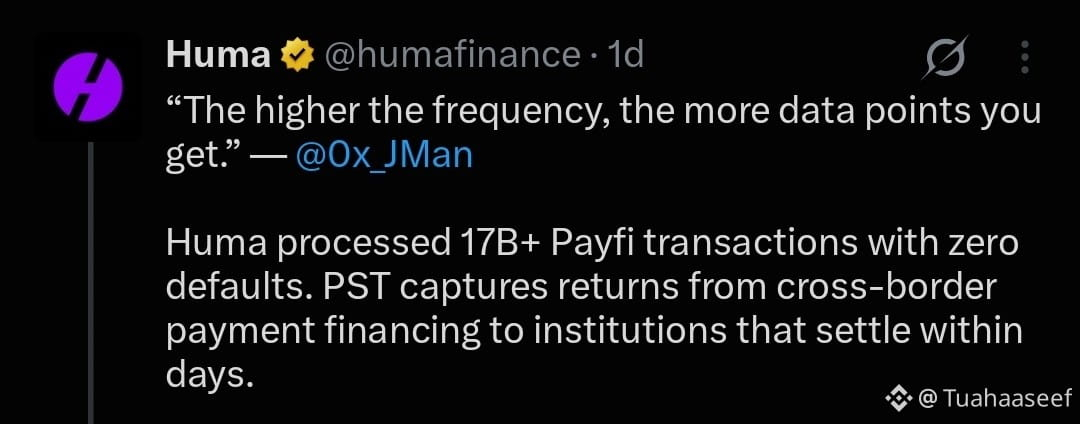
Tiene una liquidez activa de $177.9M y más de $12B en Total Transaction Volume (TTV). Lo que indica que si es indispensable, util y sostenible.

$PST la principal stablecoin nativa de huma

PST es el token liquido, que acumula rendimiento y su valor sube con el tiempo gracias al yield generado por fees de pagos reales, es el token que recibes cuando depositas $USDC en Classic Mode. Puedes intercambiarlo por USDC en Jupiter, Orca, Meteora o usarlo como collateral en Kamino.

Con PST, mPST y pools se a obtenido cerca de $154M, Esto son números muy buenos para la liquidez activa, donde cerca la mayor parte está en pools como Arf y estrategias que generan yield para $PST holders.

Puedes obtener APY base en USDC de hasta el 13% y también obtener recompensas extras que se convierten en $HUMA

Deposita aquí y gana: https://app.huma.finance?ref=NrGnkr
$HUMA {spot}(HUMAUSDT) Huma Finance (HUMA) is a leading protocol in the emerging PayFi (Payment Finance) sector, specializing in on-chain credit infrastructure. Unlike many DeFi protocols that rely on speculative collateral, Huma focuses on financing real-world payments and receivables. As of April 23, 2026, here is a short analysis of the asset: 1. Core Utility & Ecosystem PayFi Infrastructure: Huma facilitates instant liquidity for global payments. It has processed over $4.5 billion in stablecoin credit with a remarkable track record of zero reported defaults to date. Institutional Partnerships: A key driver of its current valuation is its partnership with Qiro, an institutional-grade credit underwriting platform. This collaboration aims to deploy up to $250 million in tokenized private credit throughout 2026. Governance & Yield: HUMA tokens are used for protocol governance and are central to the upcoming on-chain governance launch scheduled for later this year. 2. Current Market Performance (April 2026) Price Action: HUMA is currently trading at approximately $0.024, marking a significant +18% surge in the last 24 hours. Market Cap: Its market capitalization stands at roughly $42 million, with a circulating supply of 1.73 billion tokens (out of a 10 billion maximum). Recovery Trend: The token has shown strong resilience, recovering from a yearly low of $0.011 in February 2026. Recent buying sentiment has been bolstered by its ability to break through the psychological $0.02 resistance level. 3. Strategic Tokenomics (The "Lock-Up" Factor) The most bullish catalyst for HUMA this month was the April 17 announcement regarding a six-month extension of token lock-ups for the core team and early investors. Impact: By pushing the first major token unlock from May to November 2026, the team has effectively eliminated a massive source of potential sell pressure for the next two quarters. #HumaFinance #huma #bnb #BTC走势分析 #bnb一輩子
$HUMA
Huma Finance (HUMA) is a leading protocol in the emerging PayFi (Payment Finance) sector, specializing in on-chain credit infrastructure. Unlike many DeFi protocols that rely on speculative collateral, Huma focuses on financing real-world payments and receivables.

As of April 23, 2026, here is a short analysis of the asset:
1. Core Utility & Ecosystem
PayFi Infrastructure: Huma facilitates instant liquidity for global payments. It has processed over $4.5 billion in stablecoin credit with a remarkable track record of zero reported defaults to date.

Institutional Partnerships: A key driver of its current valuation is its partnership with Qiro, an institutional-grade credit underwriting platform. This collaboration aims to deploy up to $250 million in tokenized private credit throughout 2026.

Governance & Yield: HUMA tokens are used for protocol governance and are central to the upcoming on-chain governance launch scheduled for later this year.

2. Current Market Performance (April 2026)
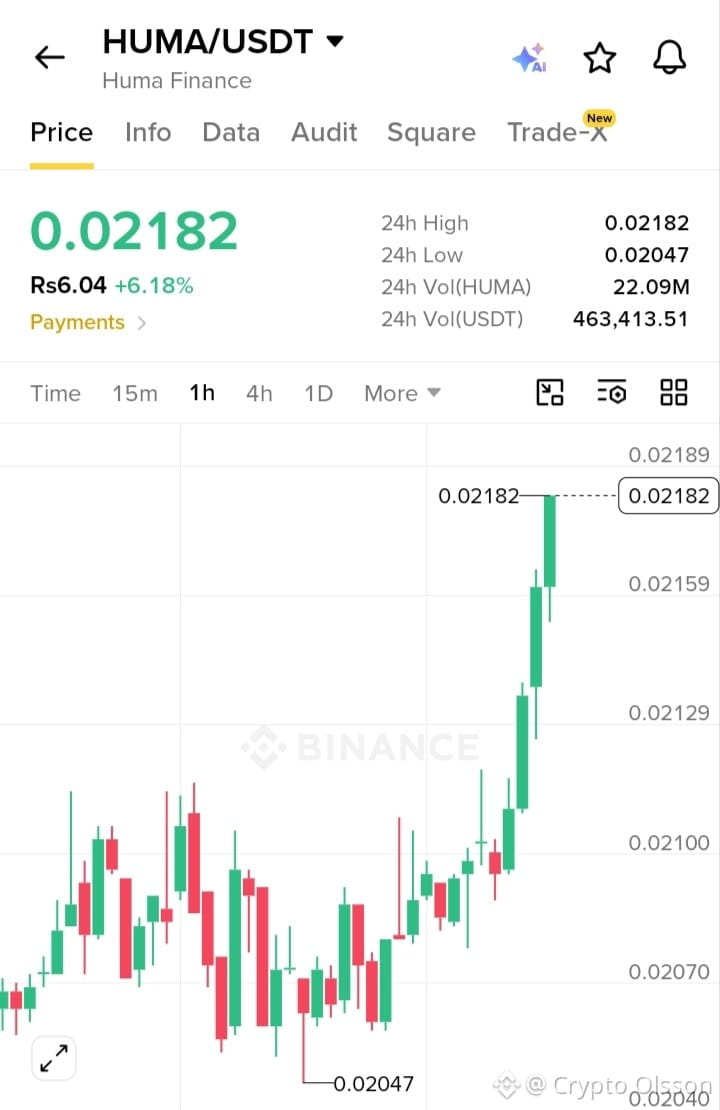
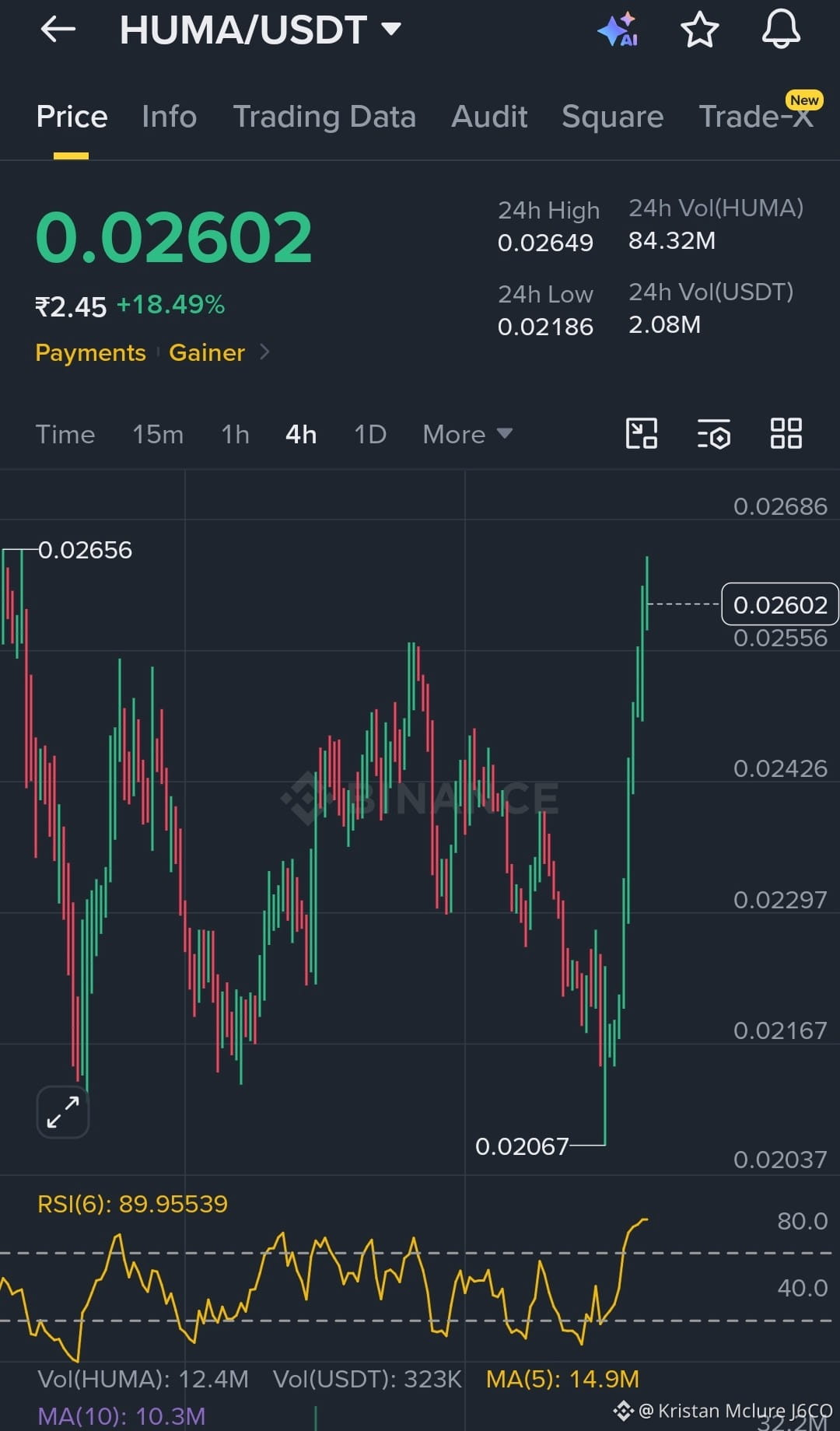
Price Action: HUMA is currently trading at approximately $0.024, marking a significant +18% surge in the last 24 hours.

Market Cap: Its market capitalization stands at roughly $42 million, with a circulating supply of 1.73 billion tokens (out of a 10 billion maximum).

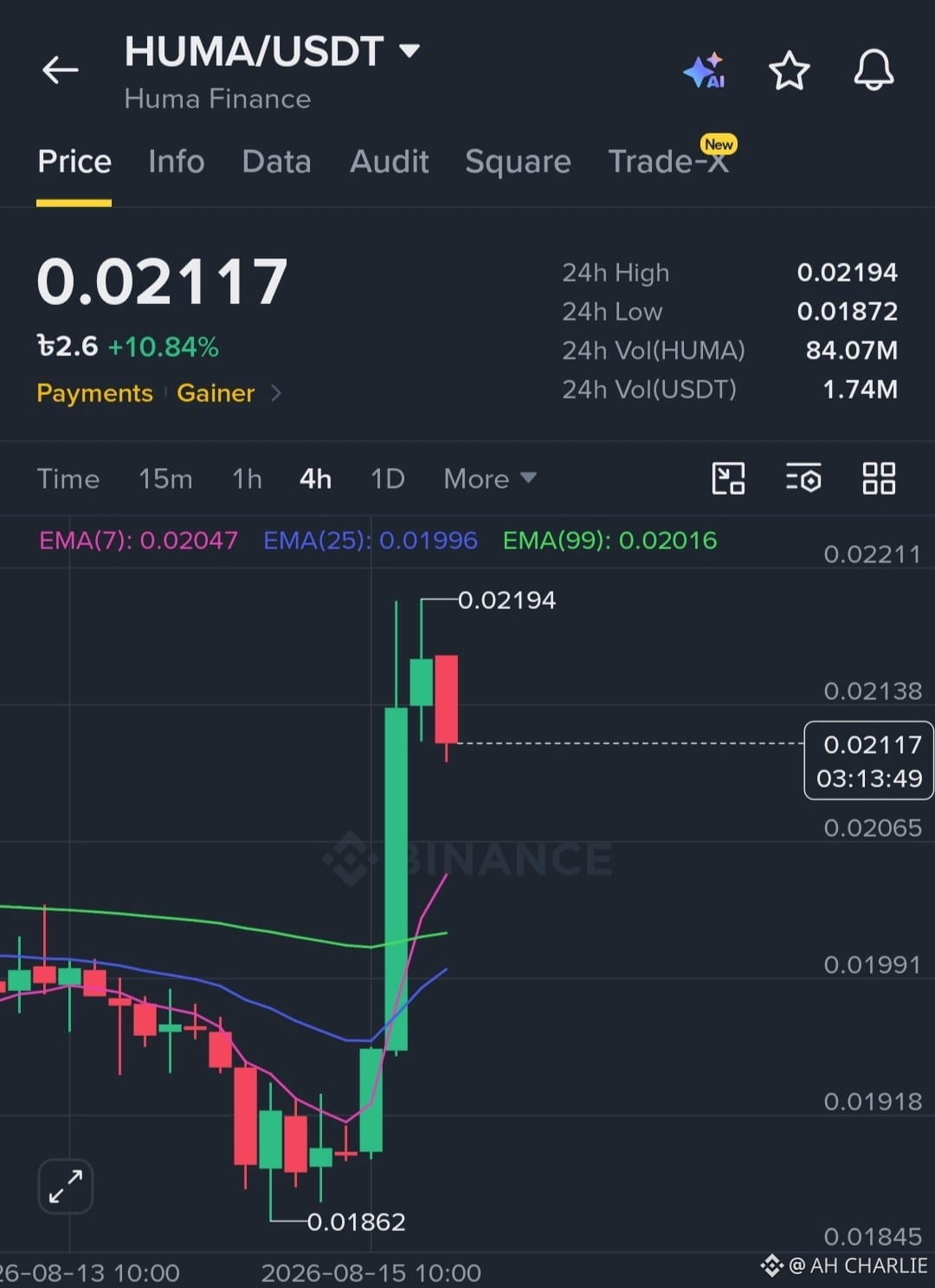
Recovery Trend: The token has shown strong resilience, recovering from a yearly low of $0.011 in February 2026. Recent buying sentiment has been bolstered by its ability to break through the psychological $0.02 resistance level.

3. Strategic Tokenomics (The "Lock-Up" Factor)
The most bullish catalyst for HUMA this month was the April 17 announcement regarding a six-month extension of token lock-ups for the core team and early investors.

Impact: By pushing the first major token unlock from May to November 2026, the team has effectively eliminated a massive source of potential sell pressure for the next two quarters.

#HumaFinance #huma #bnb #BTC走势分析 #bnb一輩子
🔥 HUMA: Будущее финансов уже здесь! 🚀 Пока толпа гадает на графиках, @humafinance ($HUMA ) строит реальный мост между криптой и настоящим сектором. Это не просто DeFi-протокол, это входной билет в мир RWA (Real World Assets). 💎🌍 Почему стоит присмотреться? 🤔 Реальные активы: Доходность тут не из «воздуха», а от работающих бизнесов. Чистый профит! 📈💰 Институционалы на подходе: Huma дает ту прозрачность, которую ищут крупные фонды. Это прямой путь к иксам! 🏦🔓 Прощай, бюрократия: Мгновенные кредитные линии на блокчейне вместо недель ожидания в банках. ⚡️💳 Будь в тренде первым! 🏆 Мир меняется. Быть в $HUMA сейчас — значит поймать волну до того, как она накроет рынок. Мы на пороге революции, где технологии и смелость важнее старых офисов и связей. 💥💪 Хватит смотреть со стороны — забирай свое будущее сегодня! 🔥🚀 {spot}(HUMAUSDT) #Humafinance #RWA #defi #HUMA
🔥 HUMA: Будущее финансов уже здесь! 🚀

Пока толпа гадает на графиках, @Huma Finance 🟣 ($HUMA ) строит реальный мост между криптой и настоящим сектором. Это не просто DeFi-протокол, это входной билет в мир RWA (Real World Assets). 💎🌍

Почему стоит присмотреться? 🤔

Реальные активы: Доходность тут не из «воздуха», а от работающих бизнесов. Чистый профит! 📈💰

Институционалы на подходе: Huma дает ту прозрачность, которую ищут крупные фонды. Это прямой путь к иксам! 🏦🔓

Прощай, бюрократия: Мгновенные кредитные линии на блокчейне вместо недель ожидания в банках. ⚡️💳

Будь в тренде первым! 🏆

Мир меняется. Быть в $HUMA сейчас — значит поймать волну до того, как она накроет рынок. Мы на пороге революции, где технологии и смелость важнее старых офисов и связей. 💥💪
Хватит смотреть со стороны — забирай свое будущее сегодня! 🔥🚀


#Humafinance #RWA #defi #HUMA
Huma Finance (@humafinance ) 推出的 $HUMA ,正成为区块链金融领域备受关注的资产。 为什么值得买入?原因很简单。 HUMA是Huma Finance生态系统的核心代币,支持全球首个PayFi网络,这个网络创新地将未来收入作为借贷抵押,开创无抵押链上借贷新模式。 随着PayFi网络的不断扩展,HUMA的需求和价值将稳步提升。 此外,持有HUMA还能参与平台治理,享受更多权益,真正成为生态的一部分。 投资$HUMA ,就是投资未来金融的创新和发展。 千万不要错过,一定要抓住HUMA的成长机会! #HumaFinance {future}(HUMAUSDT) {spot}(HUMAUSDT)
Huma Finance (@Huma Finance 🟣 ) 推出的 $HUMA ,正成为区块链金融领域备受关注的资产。

为什么值得买入?原因很简单。
HUMA是Huma Finance生态系统的核心代币,支持全球首个PayFi网络,这个网络创新地将未来收入作为借贷抵押,开创无抵押链上借贷新模式。

随着PayFi网络的不断扩展,HUMA的需求和价值将稳步提升。

此外,持有HUMA还能参与平台治理,享受更多权益,真正成为生态的一部分。

投资$HUMA ,就是投资未来金融的创新和发展。

千万不要错过,一定要抓住HUMA的成长机会!

#HumaFinance
@humafinance e use hashtag #HumaFinance (@humafinance) is an innovative platform dedicated to advancing decentralized finance (DeFi) solutions. By leveraging cutting-edge blockchain technology, HumaFinance aims to provide users with secure, transparent, and accessible financial services. Their ecosystem offers features such as staking, yield farming, liquidity pools, and decentralized trading, empowering users to maximize their crypto assets. HumaFinance emphasizes community involvement and sustainability, making DeFi accessible to everyone. Whether you're a seasoned investor or a beginner, @humafinance's user-friendly interface and robust security measures make it an attractive platform for growing your digital assets. Join the movement with #HumaFinance!
@Huma Finance 🟣 e use hashtag #HumaFinance (@humafinance) is an innovative platform dedicated to advancing decentralized finance (DeFi) solutions. By leveraging cutting-edge blockchain technology, HumaFinance aims to provide users with secure, transparent, and accessible financial services. Their ecosystem offers features such as staking, yield farming, liquidity pools, and decentralized trading, empowering users to maximize their crypto assets. HumaFinance emphasizes community involvement and sustainability, making DeFi accessible to everyone. Whether you're a seasoned investor or a beginner, @humafinance's user-friendly interface and robust security measures make it an attractive platform for growing your digital assets. Join the movement with #HumaFinance!
@humafinance #humafinance pioneers PayFi, offering uncollateralized lending against future income streams via TVM model, with liquidity matching 70-90% of expected revenue."
@Huma Finance 🟣 #humafinance
pioneers PayFi, offering uncollateralized lending against future income streams via TVM model, with liquidity matching 70-90% of expected revenue."
·
--
Haussier
HumaFinance – Bringing Real-World Credit On-Chain Huma is bridging TradFi and DeFi with income-based lending protocols. 🏦 Key Differentiators: - On-chain credit scoring and identity - Real-world asset integration for stable returns - Ideal for underbanked and global users Huma is rewriting the rules of credit and lending. 🔗 Finance meets freedom. #HumaFinance #RWAs #OnChainCredit #BinanceSquare $HUMA {future}(HUMAUSDT)
HumaFinance – Bringing Real-World Credit On-Chain
Huma is bridging TradFi and DeFi with income-based lending protocols.
🏦 Key Differentiators:
- On-chain credit scoring and identity
- Real-world asset integration for stable returns
- Ideal for underbanked and global users
Huma is rewriting the rules of credit and lending.
🔗 Finance meets freedom.

#HumaFinance #RWAs #OnChainCredit #BinanceSquare
$HUMA
"Exciting times in the crypto space! 🚀 I've been exploring @humafinance and their innovative approach to lending and borrowing. By leveraging blockchain technology, Huma is making financial services more accessible and efficient. 💡 What do you think about the future of decentralized finance? Share your thoughts! 💬 Let's discuss the potential of Huma and other DeFi projects. Are they the future of traditional banking? 🤔 How can we harness their power for financial inclusion? 🌐 #HumaFinance 🚀💸"
"Exciting times in the crypto space! 🚀 I've been exploring @Huma Finance 🟣 and their innovative approach to lending and borrowing. By leveraging blockchain technology, Huma is making financial services more accessible and efficient. 💡 What do you think about the future of decentralized finance? Share your thoughts! 💬 Let's discuss the potential of Huma and other DeFi projects. Are they the future of traditional banking? 🤔 How can we harness their power for financial inclusion? 🌐 #HumaFinance 🚀💸"
🌍 Excited to see how @humafinance is transforming real-world assets into on-chain opportunities! 🚀 Huma Finance is bridging traditional finance with DeFi, opening doors for credit access and yield generation. Let’s support innovation that brings sustainability and financial freedom to more people. #HumaFinance $HUMA {future}(HUMAUSDT)
🌍 Excited to see how @Huma Finance 🟣 is transforming real-world assets into on-chain opportunities! 🚀
Huma Finance is bridging traditional finance with DeFi, opening doors for credit access and yield generation.
Let’s support innovation that brings sustainability and financial freedom to more people.
#HumaFinance
$HUMA
🚀 "Your Earnings, Your Credit: @humafinance Rewrites the Rules" Banks see risk - we see potential. Huma's next-gen credit system unlocks fair financing by analyzing what really matters: 💡 The Huma Difference • AI That Gets You: Evaluates crypto earnings, gig income & digital assets • Smart Limits: Credit grows as your income increases • Lightning Fast: 83% of approvals in under 7 minutes 🌟 Perfect For: → Freelancers bridging payment gaps → Crypto traders avoiding liquidations → Digital nomads needing travel funds → Small businesses managing cash flow By The Numbers: ✓ $2,500 average credit line ✓ 60% lower rates than alternatives ✓ 200+ countries served $HUMA Token Perks: • Reduce loan fees by 15-30% • Earn staking rewards • Vote on platform upgrades "Used my NFT sales history to secure a loan for my creative studio - traditional finance would never understand!" - Jamal, Digital Artist #HumaFinance $HUMA {spot}(HUMAUSDT)
🚀 "Your Earnings, Your Credit: @Huma Finance 🟣 Rewrites the Rules"

Banks see risk - we see potential. Huma's next-gen credit system unlocks fair financing by analyzing what really matters:

💡 The Huma Difference
• AI That Gets You: Evaluates crypto earnings, gig income & digital assets
• Smart Limits: Credit grows as your income increases
• Lightning Fast: 83% of approvals in under 7 minutes

🌟 Perfect For:
→ Freelancers bridging payment gaps
→ Crypto traders avoiding liquidations
→ Digital nomads needing travel funds
→ Small businesses managing cash flow

By The Numbers:
✓ $2,500 average credit line
✓ 60% lower rates than alternatives
✓ 200+ countries served

$HUMA Token Perks:
• Reduce loan fees by 15-30%
• Earn staking rewards
• Vote on platform upgrades

"Used my NFT sales history to secure a loan for my creative studio - traditional finance would never understand!" - Jamal, Digital Artist

#HumaFinance $HUMA
·
--
Haussier
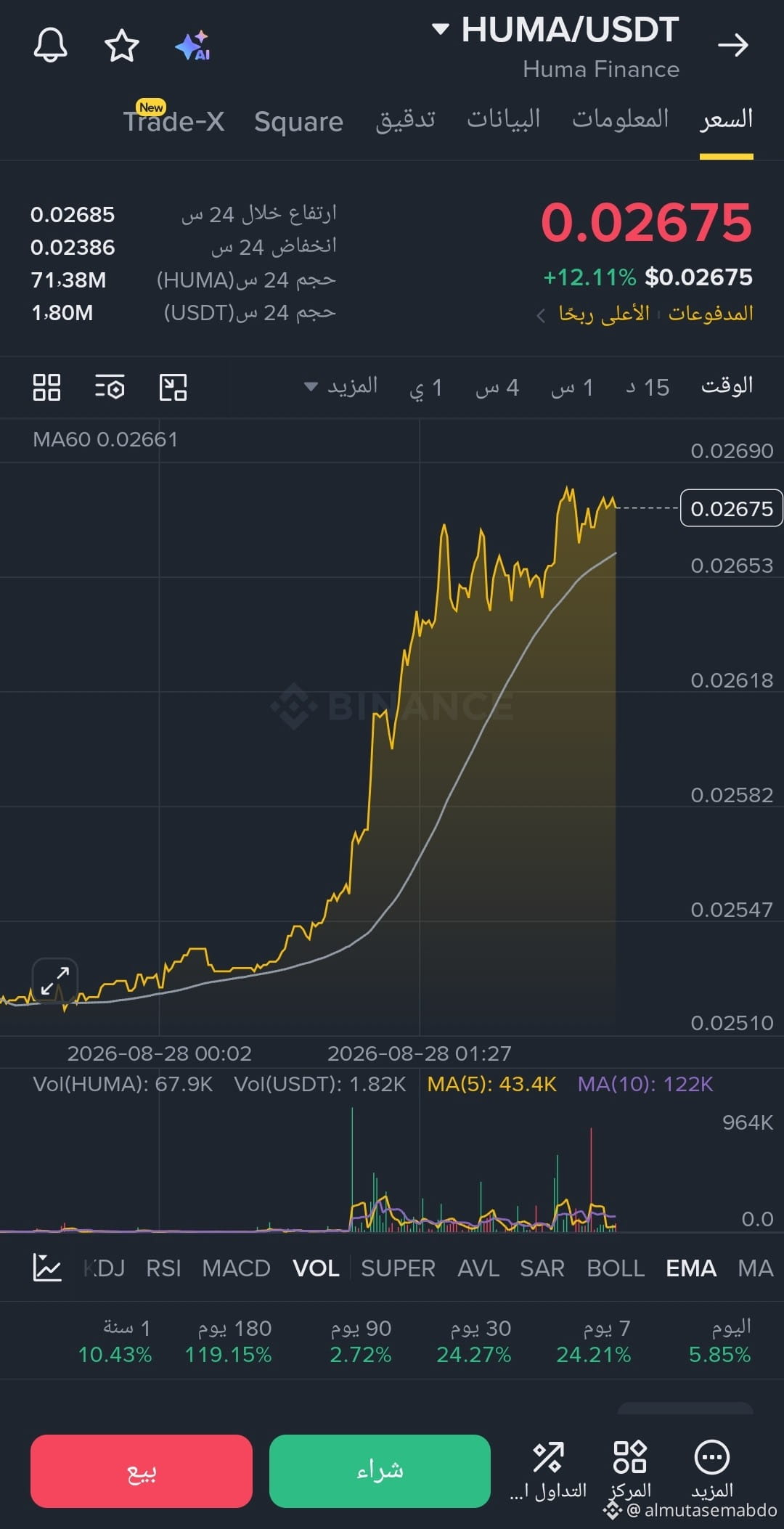
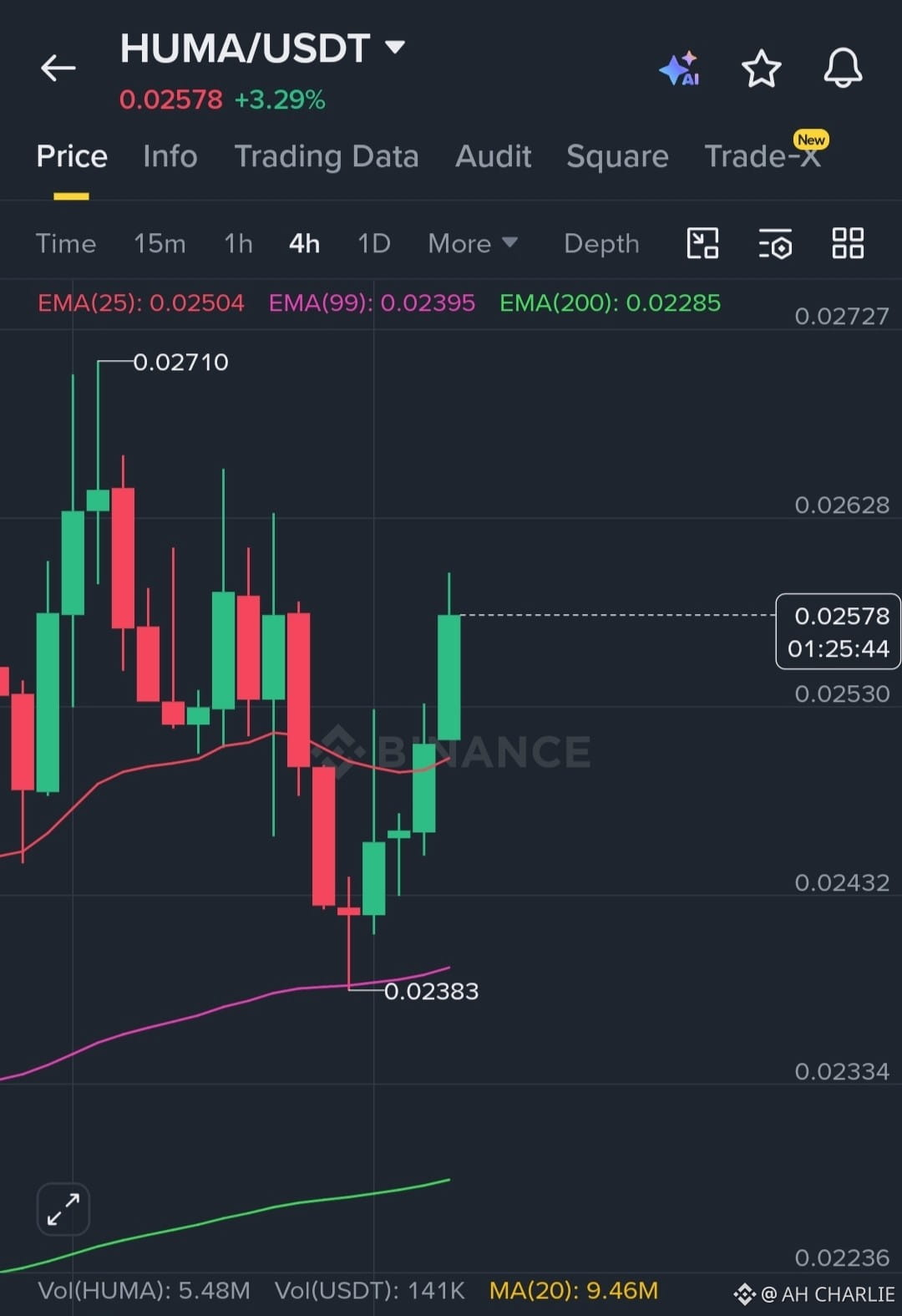
$HUMA - Slow & Steady Wins the Race! ⚙️ Gradual climb in motion — perfect for small scalps and steady gains. Buy Zone: 0.02665– 0.02570 🎯 Targets: • TP1: 0.030 • TP2: 0.0350 • TP3: 0.0370 🛑 Stop Loss: 0.0220 Low-risk setup — take profit stepwise and let the momentum work quietly 💹 $HUMA #HumaFinance #MarketPullback {spot}(HUMAUSDT)
$HUMA - Slow & Steady Wins the Race!
⚙️ Gradual climb in motion — perfect for small scalps and steady gains.
Buy Zone: 0.02665– 0.02570

🎯 Targets:
• TP1: 0.030
• TP2: 0.0350
• TP3: 0.0370
🛑 Stop Loss: 0.0220

Low-risk setup — take profit stepwise and let the momentum work quietly 💹

$HUMA #HumaFinance #MarketPullback
Article
Huma Finance: Unlocking the Future of PayFiHuma Finance is redefining how people and businesses access credit in the crypto space. Instead of relying on crypto-backed loans, Huma introduces the world’s first PayFi network — blending payments and financing to help users borrow against their future income streams. Think of it as turning your upcoming salary, invoices, or remittances into instant, on-chain liquidity. At its core, Huma leverages the Time Value of Money (TVM) model. By analyzing cash-flow patterns, the protocol can offer borrowers 70–90% of their expected future revenue, instantly and securely through smart contracts. This approach is revolutionary because it allows uncollateralized lending, opening up credit to people and businesses who would otherwise be excluded from traditional finance or crypto lending. The Problem Huma Solves In traditional finance, payments and settlements often take days or weeks to clear. Freelancers, small businesses, and even payment processors face cash-flow delays that can block growth. Huma sees the time embedded in receivables as real economic value. By tokenizing these future cash flows, Huma converts them into immediate liquidity, helping users access money without selling assets or waiting for traditional banks. How Huma Works 1. Tokenizing Future Cash Flows When a borrower has an upcoming payment — like a salary, invoice, or remittance — Huma represents it on-chain. This tokenized cash flow acts as proof for smart contracts to manage lending, repayment, and liquidity. 2. TVM Underwriting The protocol calculates the present value of future payments using the Time Value of Money principle. Then, it matches a portion of that value (70–90%) as immediate liquidity. The percentage depends on the reliability and timing of the cash flow. Short, predictable income streams get higher advance rates, while longer or riskier streams are slightly lower. 3. Liquidity Pools & Providers Liquidity comes from pools funded by individuals, institutions, or decentralized finance participants. @humafinance allows these liquidity providers to choose risk levels — from safer senior tranches to higher-risk, high-return junior tranches. Repayments, interest, and fees are automatically handled by smart contracts, making the system transparent and secure. 4. Stablecoin-Native Settlement All payments and advances use stablecoins (like USDC), minimizing volatility risks and simplifying integration with fintech and payment platforms. Users get immediate liquidity without worrying about crypto price swings. The PayFi Stack Huma’s architecture is modular, designed to scale across different use cases: On-Chain Protocol Modules: Loan pools, fee managers, and repayment trackers. SDKs & APIs: Allow partners, wallets, and apps to integrate seamlessly. Institutional Integrations: KYC/AML compliance, legal wrappers, and fiat on/off ramps. This stack makes it easy for Huma to support diverse financial flows — from freelance invoices to remittance financing and even card settlements. Token & Governance Huma’s native token, $HUMA, serves multiple purposes: Governance: Vote on protocol upgrades and risk parameters. Incentives: Reward liquidity providers and early partners. Fee Capture: Used to subsidize certain transactions or align ecosystem incentives. The token supply is carefully managed with multi-year vesting for teams, investors, and ecosystem participants, preventing sudden sell-offs. Security & Trust Security is central to Huma’s design. The protocol has undergone third-party audits from top firms and maintains a bug bounty program. Multi-signature wallets and minimized admin privileges ensure smart contracts are resilient against attacks. While the protocol has strong safeguards, users and liquidity providers should be aware of: Credit risk: Lending is based on expected future payments, not collateral. Oracle risk: Accurate data feeds are essential for smart contracts to work correctly. Regulatory risk: Financing future income intersects with legal and compliance requirements across jurisdictions. Real-World Use Cases Invoice Financing: Freelancers and SMEs can access funds immediately against unpaid invoices. Salary Advances: Employees can receive part of their salary early, backed by scheduled payroll. Remittance Financing: Cross-border payment processors can advance funds while settlement clears. Card Settlement Liquidity: Merchants or card networks can get immediate settlement without pre-funding. DePIN & Infrastructure: Node operators or service providers can monetize upcoming payments in real-time. Partnerships & Integrations Huma is actively collaborating with fintechs, payment processors, and stablecoin providers to expand adoption. Partnerships with platforms like Circle (USDC) allow seamless stablecoin flows for payments and financing. Pilot projects with remittance operators, merchants, and freelancers highlight real-world adoption potential. Conclusion Huma Finance is pioneering a new frontier in crypto lending by turning future income into instant liquidity. Its PayFi network blends smart contracts, stablecoin settlement, and TVM-based underwriting to unlock capital trapped in traditional payment systems. For borrowers, it’s a fast, collateral-free way to access funds. For liquidity providers, it’s an innovative model to earn returns on future cash flows. For developers and partners, Huma’s modular stack offers endless possibilities for integration. While risks like credit defaults, oracle failures, and regulatory challenges exist, Huma’s approach is practical, transparent, and forward-thinking, offering a glimpse into the next evolution of DeFi. $HUMA {spot}(HUMAUSDT) #HumaFinance

Huma Finance: Unlocking the Future of PayFi

Huma Finance is redefining how people and businesses access credit in the crypto space. Instead of relying on crypto-backed loans, Huma introduces the world’s first PayFi network — blending payments and financing to help users borrow against their future income streams. Think of it as turning your upcoming salary, invoices, or remittances into instant, on-chain liquidity.

At its core, Huma leverages the Time Value of Money (TVM) model. By analyzing cash-flow patterns, the protocol can offer borrowers 70–90% of their expected future revenue, instantly and securely through smart contracts. This approach is revolutionary because it allows uncollateralized lending, opening up credit to people and businesses who would otherwise be excluded from traditional finance or crypto lending.

The Problem Huma Solves

In traditional finance, payments and settlements often take days or weeks to clear. Freelancers, small businesses, and even payment processors face cash-flow delays that can block growth. Huma sees the time embedded in receivables as real economic value. By tokenizing these future cash flows, Huma converts them into immediate liquidity, helping users access money without selling assets or waiting for traditional banks.

How Huma Works

1. Tokenizing Future Cash Flows

When a borrower has an upcoming payment — like a salary, invoice, or remittance — Huma represents it on-chain. This tokenized cash flow acts as proof for smart contracts to manage lending, repayment, and liquidity.

2. TVM Underwriting

The protocol calculates the present value of future payments using the Time Value of Money principle. Then, it matches a portion of that value (70–90%) as immediate liquidity. The percentage depends on the reliability and timing of the cash flow. Short, predictable income streams get higher advance rates, while longer or riskier streams are slightly lower.

3. Liquidity Pools & Providers

Liquidity comes from pools funded by individuals, institutions, or decentralized finance participants. @Huma Finance 🟣 allows these liquidity providers to choose risk levels — from safer senior tranches to higher-risk, high-return junior tranches. Repayments, interest, and fees are automatically handled by smart contracts, making the system transparent and secure.

4. Stablecoin-Native Settlement

All payments and advances use stablecoins (like USDC), minimizing volatility risks and simplifying integration with fintech and payment platforms. Users get immediate liquidity without worrying about crypto price swings.

The PayFi Stack

Huma’s architecture is modular, designed to scale across different use cases:

On-Chain Protocol Modules: Loan pools, fee managers, and repayment trackers.
SDKs & APIs: Allow partners, wallets, and apps to integrate seamlessly.
Institutional Integrations: KYC/AML compliance, legal wrappers, and fiat on/off ramps.

This stack makes it easy for Huma to support diverse financial flows — from freelance invoices to remittance financing and even card settlements.

Token & Governance

Huma’s native token, $HUMA , serves multiple purposes:

Governance: Vote on protocol upgrades and risk parameters.
Incentives: Reward liquidity providers and early partners.
Fee Capture: Used to subsidize certain transactions or align ecosystem incentives.

The token supply is carefully managed with multi-year vesting for teams, investors, and ecosystem participants, preventing sudden sell-offs.

Security & Trust

Security is central to Huma’s design. The protocol has undergone third-party audits from top firms and maintains a bug bounty program. Multi-signature wallets and minimized admin privileges ensure smart contracts are resilient against attacks.

While the protocol has strong safeguards, users and liquidity providers should be aware of:

Credit risk: Lending is based on expected future payments, not collateral.
Oracle risk: Accurate data feeds are essential for smart contracts to work correctly.
Regulatory risk: Financing future income intersects with legal and compliance requirements across jurisdictions.

Real-World Use Cases

Invoice Financing: Freelancers and SMEs can access funds immediately against unpaid invoices.
Salary Advances: Employees can receive part of their salary early, backed by scheduled payroll.
Remittance Financing: Cross-border payment processors can advance funds while settlement clears.
Card Settlement Liquidity: Merchants or card networks can get immediate settlement without pre-funding.
DePIN & Infrastructure: Node operators or service providers can monetize upcoming payments in real-time.

Partnerships & Integrations

Huma is actively collaborating with fintechs, payment processors, and stablecoin providers to expand adoption. Partnerships with platforms like Circle (USDC) allow seamless stablecoin flows for payments and financing. Pilot projects with remittance operators, merchants, and freelancers highlight real-world adoption potential.

Conclusion

Huma Finance is pioneering a new frontier in crypto lending by turning future income into instant liquidity. Its PayFi network blends smart contracts, stablecoin settlement, and TVM-based underwriting to unlock capital trapped in traditional payment systems.

For borrowers, it’s a fast, collateral-free way to access funds. For liquidity providers, it’s an innovative model to earn returns on future cash flows. For developers and partners, Huma’s modular stack offers endless possibilities for integration.

While risks like credit defaults, oracle failures, and regulatory challenges exist, Huma’s approach is practical, transparent, and forward-thinking, offering a glimpse into the next evolution of DeFi.

$HUMA

#HumaFinance
Article
🚀 Huma Finance Launches on Solana: Real Yield for the Real WorldHuma Finance has officially launched on Solana, bringing a new wave of on-chain financial infrastructure designed to bridge real-world payments with DeFi-native yield. The move signals a major leap in the growth of Huma’s PayFi protocol and the rollout of Huma 2.0—a permissionless platform delivering sustainable, composable yield from real economic activity. 🌐 Why Solana? Huma chose Solana for its: ⚡ Ultra-fast finality (~400ms) 💸 Low transaction costs (~$0.00025)🧱 Robust DeFi ecosystem With these advantages, Huma can scale real-world payment financing globally and integrate into Solana-native apps like Jupiter, Kamino, Drift, Raydium, and Orca. 🔄 From PayFi to Huma 2.0 The Huma PayFi protocol, already responsible for over $2 billion in real-world payment financing, now powers a permissionless, yield-generating platform on Solana: Key Features of Huma 2.0: -World Yield: Powered by actual payment flows, not token emissions 💧 $PST Token (PayFi Strategy Token): Liquid LP token usable across Solana DeFi🎯 Two Investment Modes: Classic Mode: ~10.5% USDC APY + Feather rewardsMaxi Mode: No USDC yield, but boosted Feather rewards (up to 25×) 📊 Explosive Growth Post-Launc Since launching on Solana: 📈 Wallets surged 490% (from ~5.6K to 33K+) 💵 Transaction volume topped $4B+ 🤝 Huma joined the Global Dollar Network, working with Paxos, Kraken, and others to drive stablecoin adoption—particularly USDG on Solana. 🧠 Why It Matters Huma 2.0 represents a breakthrough for real yield in DeFi. By tokenizing business receivables and unlocking short-duration liquidity cycles (1–5 days), users earn yield that’s sourced from actual commerce, not speculation It combines the composability of DeFi with the credibility of real finance—creating an infrastructure where yield is both transparent and sustainable. 🧭 Final Thoughts With Huma 2.0 on Solana, we’re entering the next era of DeFi—where real-world money meets on-chain innovation. As stablecoins and PayFi continue to scale globally, Huma is positioned to be a core building block in the future of digital finance.#Humafinance $HUMA {future}(HUMAUSDT) @humafinance #BinanceSquareFamily

🚀 Huma Finance Launches on Solana: Real Yield for the Real World

Huma Finance has officially launched on Solana, bringing a new wave of on-chain financial infrastructure designed to bridge real-world payments with DeFi-native yield. The move signals a major leap in the growth of Huma’s PayFi protocol and the rollout of Huma 2.0—a permissionless platform delivering sustainable, composable yield from real economic activity.
🌐 Why Solana?
Huma chose Solana for its:
⚡ Ultra-fast finality (~400ms)
💸 Low transaction costs (~$0.00025)🧱 Robust DeFi ecosystem
With these advantages, Huma can scale real-world payment financing globally and integrate into Solana-native apps like Jupiter, Kamino, Drift, Raydium, and Orca.
🔄 From PayFi to Huma 2.0
The Huma PayFi protocol, already responsible for over $2 billion in real-world payment financing, now powers a permissionless, yield-generating platform on Solana:
Key Features of Huma 2.0:
-World Yield: Powered by actual payment flows, not token emissions

💧 $PST Token (PayFi Strategy Token): Liquid LP token usable across Solana DeFi🎯 Two Investment Modes:
Classic Mode: ~10.5% USDC APY + Feather rewardsMaxi Mode: No USDC yield, but boosted Feather rewards (up to 25×)
📊 Explosive Growth Post-Launc

Since launching on Solana:
📈 Wallets surged 490% (from ~5.6K to 33K+)
💵 Transaction volume topped $4B+
🤝 Huma joined the Global Dollar Network, working with Paxos, Kraken, and others to drive stablecoin adoption—particularly USDG on Solana.

🧠 Why It Matters
Huma 2.0 represents a breakthrough for real yield in DeFi. By tokenizing business receivables and unlocking short-duration liquidity cycles (1–5 days), users earn yield that’s sourced from actual commerce, not speculation

It combines the composability of DeFi with the credibility of real finance—creating an infrastructure where yield is both transparent and sustainable.
🧭 Final Thoughts
With Huma 2.0 on Solana, we’re entering the next era of DeFi—where real-world money meets on-chain innovation. As stablecoins and PayFi continue to scale globally, Huma is positioned to be a core building block in the future of digital finance.#Humafinance $HUMA
@Huma Finance 🟣
#BinanceSquareFamily
#HumaFinanceThe small business lending market reveals the fundamental failures of traditional finance more clearly than any other sector. Banks approve less than 20% of small business loan applications, forcing entrepreneurs to seek expensive alternatives or abandon growth opportunities entirely. Those fortunate enough to secure traditional loans face months-long approval processes, extensive documentation requirements, personal guarantees, and collateral demands that often exceed the loan value. Alternative lenders offer faster approval but charge 15-40% annual rates that make growth economically impossible. Invoice factoring companies provide working capital but extract 15-25% annually while requiring complex contractual arrangements. These barriers systematically exclude the small businesses that drive job creation and economic innovation globally. Huma Finance transforms small business lending through income-based credit that focuses on cash flow rather than collateral. A restaurant can access working capital against confirmed catering bookings without personal guarantees. A consulting firm can get immediate payment for completed work rather than waiting 30-60 days for client settlements. A manufacturing company can secure inventory financing against confirmed purchase orders. A service business can bridge seasonal cash flow gaps using predictable contract income. The protocol analyzes business income patterns to provide appropriate credit terms without requiring traditional collateral. Smart contracts automate the entire process from application to disbursement, reducing costs while eliminating human bias. $HUMA captures sustainable value from transaction fees while enabling small business growth that creates jobs and drives economic development. The ripple effects of improved small business access to capital extend throughout entire economic ecosystems. More available credit means increased hiring, expanded operations, and enhanced innovation capacity. Better cash flow management enables small businesses to compete more effectively with larger corporations. Reduced financing costs improve profitability and sustainability for entrepreneurs globally. The network effects compound as more small businesses succeed and become advocates for accessible financing. Successful borrowers provide testimonials that attract additional businesses to the platform. Improved risk models emerge from analyzing diverse small business income patterns across different industries and geographies. When small businesses finally get fair access to capital, it will transform economic opportunity for billions of entrepreneurs worldwide. Huma's infrastructure enables this transformation by recognizing that predictable income represents valuable collateral regardless of traditional asset ownership. @humafinance #HumaFinance The Cryptographic Cortex: How Succinct is Building the Nervous System for Autonomous Systems The endgame of cryptography is not privacy or scaling, but enabling autonomous intelligence to interact with verifiable truth. @SuccinctLabs is constructing the foundational layer for this future: a decentralized nervous system for machine-to-machine economies. The SP1 zkVM is far more than a developer tool; it is a universal verifier, a cryptographic cortex that allows any machine to prove the integrity of its computations to any other machine, without trust. This capability is the missing link for true autonomous agents. An AI model can prove it adhered to its training parameters. A drone swarm can verify it completed a surveillance pattern without revealing the footage. A decentralized AWS can bill a client with a proof of correct code execution. This moves ZKPs from a blockchain scaling tool to the core of a new computing paradigm: Verifiable Compute as a Universal Service. The Succinct Prover Network operates as a decentralized marketplace for truth, where a global network of hardware competes to generate these proofs efficiently. This creates a flywheel: more demand for verifiable compute drives more providers to the network, increasing decentralization and lowering costs, which in turn fuels more adoption. The four billion dollar valuation reflects an understanding that this is a market poised to eclipse traditional cloud computing. The NIST standardization in 2025 is the critical inflection point, providing the regulatory and institutional framework for this new machine economy. $PROVE is the native currency of this nervous system. It is the payment rail for verifiable truth and the stake that ensures the integrity of the provers themselves. Investing in $P a position on the infrastructure that will underpin the entire economy of autonomous things. #SuccinctLabs NOTCOIN The Social Graph Asset: How Notcoin Engineered the First Native Cryptocurrency of Attention Beyond the taps and the tokens, @notcoin achieved something profound: it successfully tokenized attention within a social graph. The project engineered a perfect closed loop where a user's time and social capital (sharing, inviting) were directly translated into a liquid, on-chain financial asset. This transforms the traditional Web2 model where user attention is monetized by platforms into a Web3 model where attention is owned and monetized by the user. The metrics are a testament to this breakthrough. The two hundred and twenty million dollar distribution was not an airdrop; it was a mass liquidation of user attention into a community owned asset. The two point eight million on chain holders represent not just investors, but a mapped social graph of engaged participants. This makes $NOT fundamentally different from other assets. Its value is not derived solely from utility or cash flows, but from the density and activity of its attention economy. It is the native currency of the TON social graph. This positions Notcoin as a meta protocol for user acquisition. Its evolution into explore to earn is a strategic masterstroke. It now functions as a programmable attention router, directing its massive user base to other projects and dApps within the TON ecosystem. Projects can effectively "rent" attention from the Notcoin community, paying in or other incentives. This creates a powerful new economic model where the community treasury, funded by these activities, can continuously reinvest in itself, ensuring long term sustainability and growth. Notcoin is not a game; it is a decentralized attention conglomerate. #Notcoin LAYER The Sovereign Cloud Thesis: Solayer as the Foundation for Solana's Vertical Integration Solana's ultimate competition is not other blockchains, but traditional cloud providers like AWS. @solayer_labs is the key weapon in this fight, enabling Solana to become a vertically integrated, sovereign cloud for high performance applications. Restaking is the mechanism that allows Solana's native capital (SOL) to be leveraged to bootstrap a parallel economy of specialized services that a monolithic chain cannot efficiently provide internally. This is not just shared security; it is shared sovereignty. Think of Solana as the kernel. Solayer then allows for the creation of specialized "drivers" or "daemons" that run with the kernel's authority but perform specific, high intensity tasks: a hyperfast oracle daemon, a secure randomness beacon daemon, a DePIN coordination daemon. These services, secured by restaked SOL, become native components of the Solana stack without congesting the main layer. InfiniSVM's target of one million TPS is the hardware accelerated backbone that makes this vertically integrated stack viable, outperforming traditional cloud vendors on cost, speed, and transparency. The five hundred million dollar TVL demonstrates that the market understands this thesis. Capital is flowing into the protocol to underwrite the security of this new sovereign cloud. The $LAYER token is the governance and fee capture mechanism for this entire economy. It decides which services become native components and benefits from their success. Solayer is not a sidechain or an L2; it is a hypervisor that allows Solana to expand its capabilities horizontally through a decentralized network of vertically integrated services. This is the blueprint for a true world computer. #BuiltonSolayer

#HumaFinance

The small business lending market reveals the fundamental failures of traditional finance more clearly than any other sector.

Banks approve less than 20% of small business loan applications, forcing entrepreneurs to seek expensive alternatives or abandon growth opportunities entirely.

Those fortunate enough to secure traditional loans face months-long approval processes, extensive documentation requirements, personal guarantees, and collateral demands that often exceed the loan value.

Alternative lenders offer faster approval but charge 15-40% annual rates that make growth economically impossible.

Invoice factoring companies provide working capital but extract 15-25% annually while requiring complex contractual arrangements.

These barriers systematically exclude the small businesses that drive job creation and economic innovation globally.

Huma Finance transforms small business lending through income-based credit that focuses on cash flow rather than collateral.

A restaurant can access working capital against confirmed catering bookings without personal guarantees.

A consulting firm can get immediate payment for completed work rather than waiting 30-60 days for client settlements.

A manufacturing company can secure inventory financing against confirmed purchase orders.

A service business can bridge seasonal cash flow gaps using predictable contract income.

The protocol analyzes business income patterns to provide appropriate credit terms without requiring traditional collateral.

Smart contracts automate the entire process from application to disbursement, reducing costs while eliminating human bias.

$HUMA captures sustainable value from transaction fees while enabling small business growth that creates jobs and drives economic development.

The ripple effects of improved small business access to capital extend throughout entire economic ecosystems.

More available credit means increased hiring, expanded operations, and enhanced innovation capacity.

Better cash flow management enables small businesses to compete more effectively with larger corporations.

Reduced financing costs improve profitability and sustainability for entrepreneurs globally.

The network effects compound as more small businesses succeed and become advocates for accessible financing.

Successful borrowers provide testimonials that attract additional businesses to the platform.

Improved risk models emerge from analyzing diverse small business income patterns across different industries and geographies.

When small businesses finally get fair access to capital, it will transform economic opportunity for billions of entrepreneurs worldwide.

Huma's infrastructure enables this transformation by recognizing that predictable income represents valuable collateral regardless of traditional asset ownership.

@Huma Finance 🟣 #HumaFinance
The Cryptographic Cortex: How Succinct is Building the Nervous System for Autonomous Systems
The endgame of cryptography is not privacy or scaling, but enabling autonomous intelligence to interact with verifiable truth. @SuccinctLabs is constructing the foundational layer for this future: a decentralized nervous system for machine-to-machine economies. The SP1 zkVM is far more than a developer tool; it is a universal verifier, a cryptographic cortex that allows any machine to prove the integrity of its computations to any other machine, without trust. This capability is the missing link for true autonomous agents. An AI model can prove it adhered to its training parameters. A drone swarm can verify it completed a surveillance pattern without revealing the footage. A decentralized AWS can bill a client with a proof of correct code execution.
This moves ZKPs from a blockchain scaling tool to the core of a new computing paradigm: Verifiable Compute as a Universal Service. The Succinct Prover Network operates as a decentralized marketplace for truth, where a global network of hardware competes to generate these proofs efficiently. This creates a flywheel: more demand for verifiable compute drives more providers to the network, increasing decentralization and lowering costs, which in turn fuels more adoption.
The four billion dollar valuation reflects an understanding that this is a market poised to eclipse traditional cloud computing. The NIST standardization in 2025 is the critical inflection point, providing the regulatory and institutional framework for this new machine economy. $PROVE is the native currency of this nervous system. It is the payment rail for verifiable truth and the stake that ensures the integrity of the provers themselves. Investing in $P a position on the infrastructure that will underpin the entire economy of autonomous things.
#SuccinctLabs
NOTCOIN
The Social Graph Asset: How Notcoin Engineered the First Native Cryptocurrency of Attention
Beyond the taps and the tokens, @notcoin achieved something profound: it successfully tokenized attention within a social graph. The project engineered a perfect closed loop where a user's time and social capital (sharing, inviting) were directly translated into a liquid, on-chain financial asset. This transforms the traditional Web2 model where user attention is monetized by platforms into a Web3 model where attention is owned and monetized by the user.
The metrics are a testament to this breakthrough. The two hundred and twenty million dollar distribution was not an airdrop; it was a mass liquidation of user attention into a community owned asset. The two point eight million on chain holders represent not just investors, but a mapped social graph of engaged participants. This makes $NOT fundamentally different from other assets. Its value is not derived solely from utility or cash flows, but from the density and activity of its attention economy. It is the native currency of the TON social graph.
This positions Notcoin as a meta protocol for user acquisition. Its evolution into explore to earn is a strategic masterstroke. It now functions as a programmable attention router, directing its massive user base to other projects and dApps within the TON ecosystem. Projects can effectively "rent" attention from the Notcoin community, paying in or other incentives. This creates a powerful new economic model where the community treasury, funded by these activities, can continuously reinvest in itself, ensuring long term sustainability and growth. Notcoin is not a game; it is a decentralized attention conglomerate.
#Notcoin
LAYER
The Sovereign Cloud Thesis: Solayer as the Foundation for Solana's Vertical Integration
Solana's ultimate competition is not other blockchains, but traditional cloud providers like AWS. @Solayer is the key weapon in this fight, enabling Solana to become a vertically integrated, sovereign cloud for high performance applications. Restaking is the mechanism that allows Solana's native capital (SOL) to be leveraged to bootstrap a parallel economy of specialized services that a monolithic chain cannot efficiently provide internally. This is not just shared security; it is shared sovereignty.
Think of Solana as the kernel. Solayer then allows for the creation of specialized "drivers" or "daemons" that run with the kernel's authority but perform specific, high intensity tasks: a hyperfast oracle daemon, a secure randomness beacon daemon, a DePIN coordination daemon. These services, secured by restaked SOL, become native components of the Solana stack without congesting the main layer. InfiniSVM's target of one million TPS is the hardware accelerated backbone that makes this vertically integrated stack viable, outperforming traditional cloud vendors on cost, speed, and transparency.
The five hundred million dollar TVL demonstrates that the market understands this thesis. Capital is flowing into the protocol to underwrite the security of this new sovereign cloud. The $LAYER token is the governance and fee capture mechanism for this entire economy. It decides which services become native components and benefits from their success. Solayer is not a sidechain or an L2; it is a hypervisor that allows Solana to expand its capabilities horizontally through a decentralized network of vertically integrated services. This is the blueprint for a true world computer.
#BuiltonSolayer
Huma Finance 2025 Redefining Payments with PayFi, Real Yield, and Same-Day SettlementsThe world runs on payments. Yet even in 2025, millions of merchants still wait days or even weeks to get paid after a sale. Huma Finance is tackling this gap with a bold approach: bring receivables on-chain, unlock instant liquidity, and reward DeFi participants with real, cash-flow-backed yield. From its beginnings as a protocol experimenting with on-chain credit, Huma has grown into a PayFi network that merges DeFi liquidity with traditional payment rails. And the past few months have been game-changing: the launch of HUMA staking, the start of Season 1 airdrops, and a partnership that makes same-day global payouts a reality. What Makes Huma Different? Most DeFi projects chase yield through points or emissions. Huma flips that script by anchoring yield in real-world payment flows. Here’s how it works: Platforms and merchants often wait for receivables (like e-commerce payouts).Huma advances them instant stablecoins.When receivables clear, capital is repaid with a fee.Liquidity providers recycle capital multiple times a year, turning short-term advances into steady, repeatable returns.This is the essence of PayFi merging payments and finance to make money flow faster for businesses, and more productively for DeFi LPs. The Latest Updates: $HUMA Staking Goes Live Staking adds governance rights and boosts LP rewards. A 14-day cooldown applies for unstaking. To celebrate launch, Huma introduced a 10× staking multiplier for early participants a strong incentive to stake and stay long-term. Season 1 Airdrop Claims opened in late August and run until October 26, 2025. This round includes a special allocation for top creators who stake $HUMA, with 12.5M tokens reserved for this segment. It builds on Season 0, where 5% of supply was airdropped to early LPs and community contributors. Same-Day Global Payouts (T+0) In partnership with Arf and Geoswift, Huma launched a service that pays international merchants in hours, not days. Think Amazon or marketplace sellers in Asia: instead of waiting 5–7 business days, they can now get stablecoin payouts almost instantly. This is the clearest proof of Huma’s utility — solving a real pain point for businesses. Huma 2.0 on Solana Introduced Classic (stable APY + feathers) and Maxi (yield sacrificed for max feathers) LP modes. Launched $PST (PayFi Strategy Token), a composable token that represents LP positions. $PST is already integrated into Jupiter (swaps) and Kamino (borrowing), making Huma liquidity part of Solana’s DeFi stack. Numbers That Stand Out $6B+ in processed payment flows across Huma’s PayFi rails. Over 100k WCT distributed in wallet rewards already (showing active treasury distribution). A growing base of global merchants and platforms tapping into same-day settlement. Why This Matters For merchants: Faster payouts mean better cash flow and the ability to scale without waiting for banks. For users/LPs: Yields come from real receivable fees, not token emissions offering durability. For ecosystems: With integrations on Solana (Jupiter, Kamino), Huma’s tokens are liquid and composable, strengthening its role in DeFi. In short, Huma bridges the gap between DeFi capital and real-world commerce. Challenges Ahead Scaling complexity: Global payout rails must handle compliance, regulations, and fraud checks. Sustainability of incentives: Staking multipliers and feathers are attractive, but must stay balanced to avoid short-term farming. Market cycles: Payment volumes depend on healthy e-commerce and cross-border trade. Slowdowns could soften yields. The Road Ahead Huma’s roadmap is clear: 1. Grow settlement volume through PayFi partnerships. 2. Deepen DeFi integrations so $PST becomes a core Solana primitive. 3. Activate governance with stakers shaping incentives, fees, and program expansions. 4. Reward creators and LPs to build a sticky, loyal community around $HUMA. Bottom Line Huma Finance isn’t chasing hype it’s building financial plumbing for the modern economy. With Season 1 airdrops, staking live, and real merchants already enjoying same-day payouts, Huma is proving that PayFi isn’t just a concept it’s operating right now. If adoption scales, $HUMA could become the native token of on-chain payments: powering liquidity, governance, and rewards in a network that moves money faster than banks ever could @humafinance $HUMA #HumaFinance

Huma Finance 2025 Redefining Payments with PayFi, Real Yield, and Same-Day Settlements

The world runs on payments. Yet even in 2025, millions of merchants still wait days or even weeks to get paid after a sale. Huma Finance is tackling this gap with a bold approach: bring receivables on-chain, unlock instant liquidity, and reward DeFi participants with real, cash-flow-backed yield.
From its beginnings as a protocol experimenting with on-chain credit, Huma has grown into a PayFi network that merges DeFi liquidity with traditional payment rails. And the past few months have been game-changing: the launch of HUMA staking, the start of Season 1 airdrops, and a partnership that makes same-day global payouts a reality.

What Makes Huma Different?
Most DeFi projects chase yield through points or emissions. Huma flips that script by anchoring yield in real-world payment flows. Here’s how it works:

Platforms and merchants often wait for receivables (like e-commerce payouts).Huma advances them instant stablecoins.When receivables clear, capital is repaid with a fee.Liquidity providers recycle capital multiple times a year, turning short-term advances into steady, repeatable returns.This is the essence of PayFi merging payments and finance to make money flow faster for businesses, and more productively for DeFi LPs.
The Latest Updates:

$HUMA Staking Goes Live
Staking adds governance rights and boosts LP rewards.
A 14-day cooldown applies for unstaking.
To celebrate launch, Huma introduced a 10× staking multiplier for early participants a strong incentive to stake and stay long-term.

Season 1 Airdrop
Claims opened in late August and run until October 26, 2025.
This round includes a special allocation for top creators who stake $HUMA , with 12.5M tokens reserved for this segment.
It builds on Season 0, where 5% of supply was airdropped to early LPs and community contributors.

Same-Day Global Payouts (T+0)
In partnership with Arf and Geoswift, Huma launched a service that pays international merchants in hours, not days.
Think Amazon or marketplace sellers in Asia: instead of waiting 5–7 business days, they can now get stablecoin payouts almost instantly.
This is the clearest proof of Huma’s utility — solving a real pain point for businesses.

Huma 2.0 on Solana
Introduced Classic (stable APY + feathers) and Maxi (yield sacrificed for max feathers) LP modes.
Launched $PST (PayFi Strategy Token), a composable token that represents LP positions.
$PST is already integrated into Jupiter (swaps) and Kamino (borrowing), making Huma liquidity part of Solana’s DeFi stack.

Numbers That Stand Out
$6B+ in processed payment flows across Huma’s PayFi rails.
Over 100k WCT distributed in wallet rewards already (showing active treasury distribution).
A growing base of global merchants and platforms tapping into same-day settlement.

Why This Matters
For merchants: Faster payouts mean better cash flow and the ability to scale without waiting for banks.
For users/LPs: Yields come from real receivable fees, not token emissions offering durability.
For ecosystems: With integrations on Solana (Jupiter, Kamino), Huma’s tokens are liquid and composable, strengthening its role in DeFi.
In short, Huma bridges the gap between DeFi capital and real-world commerce.

Challenges Ahead
Scaling complexity: Global payout rails must handle compliance, regulations, and fraud checks.
Sustainability of incentives: Staking multipliers and feathers are attractive, but must stay balanced to avoid short-term farming.
Market cycles: Payment volumes depend on healthy e-commerce and cross-border trade. Slowdowns could soften yields.

The Road Ahead

Huma’s roadmap is clear:
1. Grow settlement volume through PayFi partnerships.
2. Deepen DeFi integrations so $PST becomes a core Solana primitive.
3. Activate governance with stakers shaping incentives, fees, and program expansions.
4. Reward creators and LPs to build a sticky, loyal community around $HUMA .

Bottom Line
Huma Finance isn’t chasing hype it’s building financial plumbing for the modern economy. With Season 1 airdrops, staking live, and real merchants already enjoying same-day payouts, Huma is proving that PayFi isn’t just a concept it’s operating right now.
If adoption scales, $HUMA could become the native token of on-chain payments: powering liquidity, governance, and rewards in a network that moves money faster than banks ever could
@Huma Finance 🟣 $HUMA #HumaFinance
Huma Finance: Rewriting Credit.Where Your Future Income Powers On Chain Loans, NFTs & GlobalHow Huma’s PayFi Stack Works Huma’s infrastructure is neatly layered: 1. Transaction Layer – Super-fast, low-cost transfers via L1/L2 rails. 2. Currency Layer – Stablecoins and yield-bearing assets for clean settlements. 3. Custody Layer – Multi-party custody and smart contracts securing assets. 4. Compliance Layer – On-chain identity controls and global compliance. 5. Financing Layer – Tokenized income sources and flexible risk management. 6. Application Layer – Dev-friendly tools to build scalable financial apps. It’s like modern banking built for Web3—transparent, permissionless, and efficient. Real Traction with Real Results Huma is not theoretical—it’s delivering impact: $4.5 billion in transaction volume processed to date. $9 million annualized revenue generated. Zero credit defaults so far, even with undercollateralized lending. It’s PayFi in action—making credit universally accessible. Tokenomics & Launch Highlights Let’s talk $HUMA—the utility and governance token that powers this ecosystem: Total supply capped at 10 billion tokens. 5% allocated to early supporters via a Season 1 airdrop. 31% reserved for LP & ecosystem incentives, released quarterly with deflationary discipline. 50% of borrower fees go toward buyback & burn, fueling a deflationary cycle. Binance spotlight alert! Huma was Launchpool’s 70th project, letting users stake BNB, FDUSD, or USDC from May 23–25, 2025, and it listed on May 26 with pairs like HUMA/USDT, HUMA/BNB, HUMA/FDUSD, HUMA/TRY. There were 250 million HUMA tokens up for grabs—2.5% of the total supply. Market Snapshot – Live Binance Data (as of Sept 9, 2025) Price: ~$0.02664 USD, up ~0.21% in 24h. Market Cap: ~$59.8 million. 24h Volume: ~$26.2 million. Circulating Supply: ~2.24 billion HUMA (~22% of max supply). All-Time High: ~$0.06927. Recent Gain: Up ~10% over the past week. Why Huma Hits Different 1. Income-Driven Lending – Credit for more people, not just HODLers. 2. Real-World Integration – Fueled by payments, not speculation. 3. Token Sustainability – Built-in deflation with buyback & burn. 4. Permissionless Yield – Anyone can become an LP and earn real-world yields + HUMA. 5. Institution & Community Backing – From Launchpool to Solana, Stellar, Circle—Huma’s got the ecosystem. Final Vibes Huma Finance isn’t about chasing hype it’s about fixing real financial friction. It’s financial inclusion on blockchain lending built on credit, not collateral; liquidity based on future income, not crypto holdings; tokenomics designed for long-term value, not pump cycles. If you're a builder, biz owner, yield chaser, or Web3 visionary—keep your eyes here. Huma is quietly empowering global payments, rewriting credit, and making DeFi matter for everyone. #HumaFinance @humafinance $HUMA {spot}(HUMAUSDT)

Huma Finance: Rewriting Credit.Where Your Future Income Powers On Chain Loans, NFTs & Global

How Huma’s PayFi Stack Works
Huma’s infrastructure is neatly layered:
1. Transaction Layer – Super-fast, low-cost transfers via L1/L2 rails.
2. Currency Layer – Stablecoins and yield-bearing assets for clean settlements.
3. Custody Layer – Multi-party custody and smart contracts securing assets.
4. Compliance Layer – On-chain identity controls and global compliance.
5. Financing Layer – Tokenized income sources and flexible risk management.
6. Application Layer – Dev-friendly tools to build scalable financial apps.
It’s like modern banking built for Web3—transparent, permissionless, and efficient.

Real Traction with Real Results
Huma is not theoretical—it’s delivering impact:
$4.5 billion in transaction volume processed to date.
$9 million annualized revenue generated.
Zero credit defaults so far, even with undercollateralized lending.
It’s PayFi in action—making credit universally accessible.

Tokenomics & Launch Highlights
Let’s talk $HUMA —the utility and governance token that powers this ecosystem:
Total supply capped at 10 billion tokens.
5% allocated to early supporters via a Season 1 airdrop.
31% reserved for LP & ecosystem incentives, released quarterly with deflationary discipline.
50% of borrower fees go toward buyback & burn, fueling a deflationary cycle.
Binance spotlight alert! Huma was Launchpool’s 70th project, letting users stake BNB, FDUSD, or USDC from May 23–25, 2025, and it listed on May 26 with pairs like HUMA/USDT, HUMA/BNB, HUMA/FDUSD, HUMA/TRY. There were 250 million HUMA tokens up for grabs—2.5% of the total supply.

Market Snapshot – Live Binance Data (as of Sept 9, 2025)
Price: ~$0.02664 USD, up ~0.21% in 24h.
Market Cap: ~$59.8 million.
24h Volume: ~$26.2 million.
Circulating Supply: ~2.24 billion HUMA (~22% of max supply).
All-Time High: ~$0.06927.
Recent Gain: Up ~10% over the past week.

Why Huma Hits Different
1. Income-Driven Lending – Credit for more people, not just HODLers.
2. Real-World Integration – Fueled by payments, not speculation.
3. Token Sustainability – Built-in deflation with buyback & burn.
4. Permissionless Yield – Anyone can become an LP and earn real-world yields + HUMA.
5. Institution & Community Backing – From Launchpool to Solana, Stellar, Circle—Huma’s got the ecosystem.

Final Vibes
Huma Finance isn’t about chasing hype it’s about fixing real financial friction. It’s financial inclusion on blockchain lending built on credit, not collateral; liquidity based on future income, not crypto holdings; tokenomics designed for long-term value, not pump cycles.
If you're a builder, biz owner, yield chaser, or Web3 visionary—keep your eyes here. Huma is quietly empowering global payments, rewriting credit, and making DeFi matter for everyone.
#HumaFinance @Huma Finance 🟣 $HUMA
Article
Mapping the Future: Huma's Roadmap and Competitive Edge in the Multi-Trillion Dollar RWA ArenaThe race to bridge the multi trillion dollar world of traditional finance with the innovation of DeFi is well underway, and the Real World Asset (RWA) sector has become one of the most fiercely competitive arenas in all of crypto. Numerous projects are vying to become the dominant platform for bringing real world value on chain. In this crowded landscape, a clear strategy, a distinct competitive edge, and a forward looking roadmap are essential for survival and success. Huma Finance has carved out a unique position within this arena, and its roadmap reveals a deliberate strategy to not just compete, but to define a new category of on chain finance. This analysis will map Huma's competitive positioning and its path forward. The Competitive Landscape: Huma vs. The Field To understand Huma's strategy, one must first understand its place in the market. While often grouped under the broad "RWA" umbrella, Huma's focus on high velocity payment financing gives it a distinct profile compared to its peers. Its model is not a direct replication of others, but a specialized approach to a specific market need. A comparative analysis highlights these key differences. RWA Private Credit Protocol Comparison Huma FinancePrimary Use Case: Payment Financing (PayFi), T+0 SettlementTypical Collateral: Future Cash Flows (Invoices, Payroll)Target Borrower: Global Businesses, Payment InstitutionsKey Differentiator: Focus on high velocity, short duration credit to solve payment delays. CentrifugePrimary Use Case: Asset Backed SecuritizationTypical Collateral: Broad RWAs (Mortgages, Invoices, Royalties)Target Borrower: Asset OriginatorsKey Differentiator: General purpose infrastructure for securitizing and pooling diverse RWAs.GoldfinchPrimary Use Case: Private Credit to Emerging MarketsTypical Collateral: Uncollateralized (Reputation Based)Target Borrower: Fintechs, Credit FundsKey Differentiator: "Trust through consensus" model for undercollateralized lending.Maple FinancePrimary Use Case: On-chain Corporate Credit MarketTypical Collateral: Undercollateralized (Reputation Based)Target Borrower: Institutional Crypto Firms (Market Makers)Key Differentiator: Focus on providing working capital to crypto native institutions. As this illustrates, while all four protocols operate in the private credit space, their target markets and mechanisms differ significantly. Centrifuge is a broad, horizontal platform for securitizing many types of assets. Goldfinch has a specific focus on emerging market credit funds, utilizing a unique auditor and backer system. Maple Finance has carved out a niche as the go to credit market for crypto native institutions like market makers and hedge funds. Huma’s specialization is in "PayFi"—the financing of operational payment flows for a wide range of global businesses. Its competitive edge lies in its focus on solving the problem of settlement velocity, a universal pain point in global commerce.  #HumaFinance Short-Term Roadmap: Japan Expansion and Second Airdrop (Q3 2025) Huma's immediate roadmap is focused on two key pillars: strategic geographic expansion and continued community incentivization. In the third quarter of 2025, the protocol is making a significant push into the Japanese market, a fintech powerhouse with a market size exceeding $1.3 trillion. This initiative involves a series of strategic events and partnerships in Tokyo and Osaka, conducted alongside major local players like SBI Holdings and in conjunction with the broader Solana ecosystem. This targeted expansion is a deliberate move to capture a key Asian market and drive adoption among established financial institutions.   Running in parallel is the planned second airdrop, scheduled for August 2025. This event will distribute 2.1% of the total token supply, equivalent to 210 million $HUMA tokens, to active liquidity providers and engaged community members. This second wave of rewards is designed to further decentralize the token distribution, reward loyal participants who have continued to support the protocol post launch, and maintain momentum within the community. It is a strategic tool to foster continued engagement while carefully managing the potential for sell pressure. Mid-Term Roadmap: Governance, Mobile SDK, and Multi-Chain (Q3-Q4 2025) Looking toward the second half of 2025, Huma's roadmap shifts focus to foundational upgrades that will enhance decentralization and expand the protocol's capabilities. A major milestone in Q3 will be the launch of ve-HUMA, a vote escrowed governance model that will formalize the duration locked staking system and empower the community with greater control over the protocol. This will be accompanied by the rollout of auto compounding vaults for the protocol's yield bearing tokens, providing users with more sophisticated and capital efficient ways to earn.   In the fourth quarter, the focus will turn to ecosystem expansion with the planned release of a Mobile PayFi Software Development Kit (SDK). This is a critical piece of infrastructure that will make it significantly easier for merchants and mobile application developers to integrate Huma's payment financing solutions directly into their products. This has the potential to dramatically scale the number of use cases and the volume of transactions flowing through the network. This period will also see a continued push for growth, with the protocol publicly targeting the ambitious goal of achieving $10 billion in total transaction volume by the end of the year.   Long-Term Vision: A Permissionless, Cross-Chain Financial Future (2026 and Beyond) Huma's long term vision, stretching into 2026 and beyond, is to evolve from a curated protocol into a truly permissionless and cross chain financial infrastructure. A key goal for 2026 is to enable merchants to open their own permissionless liquidity pools, allowing any business to tap into decentralized financing without needing to go through a centralized partnership process. This would represent a significant step toward creating a fully open and accessible credit market. The roadmap also includes plans for a cross chain marketplace for Huma's "Feathers" rewards system and the initiation of DAO treasury funded grant programs to spur further ecosystem development.   The ultimate vision is to become a core pillar of the global decentralized payment and credit infrastructure. The goal is to make T+0 settlement a global standard, completely eliminating the capital inefficiencies of the legacy financial system. This long term ambition sees Huma as a fundamental protocol layer for a new generation of financial applications, a credibly neutral rail for the movement of value worldwide.   Huma's Ultimate Edge: Building the Rails, Not Just the Trains Analyzing Huma's competitive landscape and its detailed roadmap reveals a clear and coherent grand strategy. While many competitors are focused on building specific lending products—the "trains"—Huma is focused on building the foundational, modular, and interoperable infrastructure—the "rails." The PayFi Stack is designed to be a universal toolkit for on chain credit. This infrastructure first approach is powerful because it positions Huma not just to offer its own products, but to become the underlying protocol on which countless other financial applications can be built. The roadmap itself tells a story of progressive decentralization and adoption. It begins with centralized, partnership led growth to prove the model and build a stable foundation with trusted partners. It then progresses to decentralizing control and ownership to the community through a robust governance framework. Finally, it aims to empower that community to build and expand the ecosystem permissionlessly through tools like the Mobile SDK and permissionless pools. This logical, phased strategy—prove, decentralize, empower—is a mature approach to building a sustainable, long lasting protocol. It is this strategic vision that gives Huma Finance its ultimate edge in the race to build the future of finance. @humafinance This article is for informational purposes only and does not constitute financial advice. Drop your thoughts below and let’s discuss.

Mapping the Future: Huma's Roadmap and Competitive Edge in the Multi-Trillion Dollar RWA Arena

The race to bridge the multi trillion dollar world of traditional finance with the innovation of DeFi is well underway, and the Real World Asset (RWA) sector has become one of the most fiercely competitive arenas in all of crypto. Numerous projects are vying to become the dominant platform for bringing real world value on chain. In this crowded landscape, a clear strategy, a distinct competitive edge, and a forward looking roadmap are essential for survival and success. Huma Finance has carved out a unique position within this arena, and its roadmap reveals a deliberate strategy to not just compete, but to define a new category of on chain finance. This analysis will map Huma's competitive positioning and its path forward.

The Competitive Landscape: Huma vs. The Field

To understand Huma's strategy, one must first understand its place in the market. While often grouped under the broad "RWA" umbrella, Huma's focus on high velocity payment financing gives it a distinct profile compared to its peers. Its model is not a direct replication of others, but a specialized approach to a specific market need. A comparative analysis highlights these key differences.
RWA Private Credit Protocol Comparison
Huma FinancePrimary Use Case: Payment Financing (PayFi), T+0 SettlementTypical Collateral: Future Cash Flows (Invoices, Payroll)Target Borrower: Global Businesses, Payment InstitutionsKey Differentiator: Focus on high velocity, short duration credit to solve payment delays.
CentrifugePrimary Use Case: Asset Backed SecuritizationTypical Collateral: Broad RWAs (Mortgages, Invoices, Royalties)Target Borrower: Asset OriginatorsKey Differentiator: General purpose infrastructure for securitizing and pooling diverse RWAs.GoldfinchPrimary Use Case: Private Credit to Emerging MarketsTypical Collateral: Uncollateralized (Reputation Based)Target Borrower: Fintechs, Credit FundsKey Differentiator: "Trust through consensus" model for undercollateralized lending.Maple FinancePrimary Use Case: On-chain Corporate Credit MarketTypical Collateral: Undercollateralized (Reputation Based)Target Borrower: Institutional Crypto Firms (Market Makers)Key Differentiator: Focus on providing working capital to crypto native institutions.
As this illustrates, while all four protocols operate in the private credit space, their target markets and mechanisms differ significantly. Centrifuge is a broad, horizontal platform for securitizing many types of assets. Goldfinch has a specific focus on emerging market credit funds, utilizing a unique auditor and backer system. Maple Finance has carved out a niche as the go to credit market for crypto native institutions like market makers and hedge funds. Huma’s specialization is in "PayFi"—the financing of operational payment flows for a wide range of global businesses. Its competitive edge lies in its focus on solving the problem of settlement velocity, a universal pain point in global commerce.  #HumaFinance

Short-Term Roadmap: Japan Expansion and Second Airdrop (Q3 2025)

Huma's immediate roadmap is focused on two key pillars: strategic geographic expansion and continued community incentivization. In the third quarter of 2025, the protocol is making a significant push into the Japanese market, a fintech powerhouse with a market size exceeding $1.3 trillion. This initiative involves a series of strategic events and partnerships in Tokyo and Osaka, conducted alongside major local players like SBI Holdings and in conjunction with the broader Solana ecosystem. This targeted expansion is a deliberate move to capture a key Asian market and drive adoption among established financial institutions.  
Running in parallel is the planned second airdrop, scheduled for August 2025. This event will distribute 2.1% of the total token supply, equivalent to 210 million $HUMA tokens, to active liquidity providers and engaged community members. This second wave of rewards is designed to further decentralize the token distribution, reward loyal participants who have continued to support the protocol post launch, and maintain momentum within the community. It is a strategic tool to foster continued engagement while carefully managing the potential for sell pressure.

Mid-Term Roadmap: Governance, Mobile SDK, and Multi-Chain (Q3-Q4 2025)

Looking toward the second half of 2025, Huma's roadmap shifts focus to foundational upgrades that will enhance decentralization and expand the protocol's capabilities. A major milestone in Q3 will be the launch of ve-HUMA, a vote escrowed governance model that will formalize the duration locked staking system and empower the community with greater control over the protocol. This will be accompanied by the rollout of auto compounding vaults for the protocol's yield bearing tokens, providing users with more sophisticated and capital efficient ways to earn.  
In the fourth quarter, the focus will turn to ecosystem expansion with the planned release of a Mobile PayFi Software Development Kit (SDK). This is a critical piece of infrastructure that will make it significantly easier for merchants and mobile application developers to integrate Huma's payment financing solutions directly into their products. This has the potential to dramatically scale the number of use cases and the volume of transactions flowing through the network. This period will also see a continued push for growth, with the protocol publicly targeting the ambitious goal of achieving $10 billion in total transaction volume by the end of the year.  

Long-Term Vision: A Permissionless, Cross-Chain Financial Future (2026 and Beyond)

Huma's long term vision, stretching into 2026 and beyond, is to evolve from a curated protocol into a truly permissionless and cross chain financial infrastructure. A key goal for 2026 is to enable merchants to open their own permissionless liquidity pools, allowing any business to tap into decentralized financing without needing to go through a centralized partnership process. This would represent a significant step toward creating a fully open and accessible credit market. The roadmap also includes plans for a cross chain marketplace for Huma's "Feathers" rewards system and the initiation of DAO treasury funded grant programs to spur further ecosystem development.  
The ultimate vision is to become a core pillar of the global decentralized payment and credit infrastructure. The goal is to make T+0 settlement a global standard, completely eliminating the capital inefficiencies of the legacy financial system. This long term ambition sees Huma as a fundamental protocol layer for a new generation of financial applications, a credibly neutral rail for the movement of value worldwide.  

Huma's Ultimate Edge: Building the Rails, Not Just the Trains

Analyzing Huma's competitive landscape and its detailed roadmap reveals a clear and coherent grand strategy. While many competitors are focused on building specific lending products—the "trains"—Huma is focused on building the foundational, modular, and interoperable infrastructure—the "rails." The PayFi Stack is designed to be a universal toolkit for on chain credit. This infrastructure first approach is powerful because it positions Huma not just to offer its own products, but to become the underlying protocol on which countless other financial applications can be built.
The roadmap itself tells a story of progressive decentralization and adoption. It begins with centralized, partnership led growth to prove the model and build a stable foundation with trusted partners. It then progresses to decentralizing control and ownership to the community through a robust governance framework. Finally, it aims to empower that community to build and expand the ecosystem permissionlessly through tools like the Mobile SDK and permissionless pools. This logical, phased strategy—prove, decentralize, empower—is a mature approach to building a sustainable, long lasting protocol. It is this strategic vision that gives Huma Finance its ultimate edge in the race to build the future of finance. @Huma Finance 🟣
This article is for informational purposes only and does not constitute financial advice.

Drop your thoughts below and let’s discuss.
#Humafinance $HUMA @humafinance ##Huma Finance raises $38 M in Series A In their most recent funding round, Huma Finance secured $38 million led by Distributed Global, with contributions from Hashkey Capital, Circle, ParaFi, Fenbushi Capital, and others. They’re using this to expand their PayFi network on Solana and Stellar smart contract platforms and enhance RWA-based (Real‑World Asset) financing.
#Humafinance $HUMA @Huma Finance 🟣
##Huma Finance raises $38 M in Series A
In their most recent funding round, Huma Finance secured $38 million led by Distributed Global, with contributions from Hashkey Capital, Circle, ParaFi, Fenbushi Capital, and others. They’re using this to expand their PayFi network on Solana and Stellar smart contract platforms and enhance RWA-based (Real‑World Asset) financing.
Article
Huma Finance:PayFi网络到底解决了什么问题?在当今数字化浪潮席卷全球的时代,传统金融系统却显得力不从心。它们大多构建于过去,难以适应未来瞬息万变的金融需求。我们迫切需要一套全新的支付系统,具备可扩展性、即时性、可编程性以及无国界性,而Huma Finance(HUMA)正凭借其开创性的首个PayFi网络,为解决这一难题带来了曙光。 传统金融困境与PayFi的崛起 当下,即便处于“超连接的2024年”,全球大部分地区的资金流动速度仍远低于预期。漫长的结算时间、高昂的交易费用以及有限的信贷获取途径,依旧是传统金融领域的常态。传统金融系统诞生于中央银行集中化和基础设施静态的时代,如今已难以跟上超连接全球经济的快速发展步伐。我们急需一种新的金融范式,让支付和融资变得即时、可编程,并且人人可及、无处不在,而PayFi正是这一理想范式。 支付融资使企业和消费者能够在当下获取未来资金。PayFi借助区块链技术对支付融资进行革新,不仅改善了现有市场,还催生了新的创新成果。支付融资市场规模庞大,以信用卡行业为例,商家提前获得资金、消费者延迟付款的模式支撑起了一个超过16万亿美元的市场;贸易融资为全球贸易提供动力,市场规模达10万亿美元;此外,全球预融资账户中估计有4万亿美元资金被闲置,这些资金本可用于更具生产力的领域。 然而,这一愿景的实现充满挑战。将金融业务迁移至链上,需要克服全球合规框架缺失以及区块链网络技术复杂等诸多问题。若没有开放且标准化的框架,这一转型可能导致孤立生态系统的出现,进而阻碍采用与创新。 PayFi Stack:借鉴OSI模型的创新架构 过去40年,OSI模型为技术领域制定了统一、可互操作的标准,推动了互联网数据的指数级增长。如今,我们正步入“货币互联网”时代,Huma受OSI模型启发,开创了开放的PayFi Stack,供全球使用与拓展。 PayFi Stack与OSI模型类似,是一个开放且模块化的系统,为区块链上构建金融应用提供了通用的语言和架构。其目的在于确保未来的创新成果,如实时支付、去中心化借贷或资产通证化等,能够无缝融入这一生态系统。 OSI模型通过七层结构标准化了不同系统在互联网上的通信方式,从物理数据传输到网页浏览器等应用程序,各层分工明确,确保不同系统和平台能够无缝通信与交换信息。PayFi Stack同样将金融业务划分为模块化层级,每个层级专注于特定任务,如交易处理、合规管理、资产托管等,使开发者、企业和金融机构能够在其基础上构建应用,无需重复造轮子。 在Solana、Stellar和Circle的支持下,Huma于2024年7月推出了PayFi Stack。这一六层结构模型旨在引导生态系统发展,支持现有金融市场和Web3新创新,其目标是用快速、可编程且无国界的金融基础设施取代缓慢、昂贵的传统金融基础设施。 PayFi Stack的六层架构解析 交易层 交易层是PayFi Stack的基础,涵盖Layer 1(L1)和Layer 2(L2)区块链,负责管理网络的核心特性,包括吞吐量、延迟、交易成本和安全性。在支付融资领域,可扩展性是关键挑战。Solana和Stellar等高吞吐量、低延迟网络脱颖而出,它们提供极快的交易速度(区块时间约400毫秒)和低费用,对微支付和实时金融应用至关重要。该层的关键技术考量包括共识机制、最终确定时间和数据可用性挑战,开发者需在优化性能的同时,确保安全性和去中心化不受影响。 货币层 货币层主要处理交易中使用的数字货币,尤其是提供价格稳定性的稳定币,如USDC和PYUSD,它们对于支付场景至关重要,可降低传统加密货币的波动性风险。该层还整合了收益型稳定币(如USDM),既能消除交易成本,又能提供流动性。同时,确保货币基础设施符合并融入全球金融体系,包括欧洲、新加坡和日本等地区。此外,可编程稳定币也是该层的创新重点,允许将条件嵌入交易中。 托管层 托管是去中心化金融(DeFi)的基石。传统资金转移需要物理托管人之间的操作,而PayFi Stack的托管层利用加密货币托管解决方案满足多样化市场需求。不同PayFi应用需要不同的托管模式,对于企业和机构而言,共享托管是管理资金的常规方式,但传统共享托管会减缓资金拨付和结算速度。在区块链生态系统中,先进的共享托管功能使多方能够在不牺牲安全性的前提下,实时控制资产,实现T+0结算(实时交易结算)。Fireblocks和Cobo等解决方案通过多方计算(MPC)提供机构级托管,确保密钥安全管理;而Polyflow等去中心化托管方法则利用智能合约实现更高灵活性和可编程性。这些托管解决方案的关键功能是管理链上和链下资产,确保数据完整性,同时提供可编程资产锁定和可定制授权机制。 合规层 合规层对于确保监管合规至关重要,特别是在稳定币支付这一受严格监管的领域。该层处理特定司法管辖区的要求,如了解客户(KYC)、反洗钱(AML)和稳定币许可。例如,欧洲实施了加密资产市场法规(MiCA),为加密资产提供监管框架;新加坡和日本也制定了稳定币特定规则,促进更广泛采用。该层整合了合规API,实现实时检查,确保每笔交易合规的同时,不牺牲速度或用户体验。 融资层 融资层是PayFi的核心,连接资金供需双方,实现在链上的金融资产结构化、风险评估和定价。传统上,这一过程不透明,但区块链通过公开交易数据引入了透明度。在去中心化金融中,现实世界资产(RWA)的证券化涉及根据风险状况创建不同层级,如初级和高级债务层级,这些资产可打包成债券或特殊目的载体(SPV)等金融工具。通过智能合约,PayFi可利用预言机提供的实时市场数据进行自动化风险评估,使资产定价和结构化比传统金融更透明。安全性是该层的关键关注点,零知识证明(ZKP)等加密概念被探索用于平衡隐私与透明度,特别是对于敏感金融数据。该层涉及先进的智能合约设计、安全数据源(预言机)设置以及与可根据市场条件动态调整的风险模型集成。 应用层 应用层是PayFi Stack的顶层,使开发者能够构建面向用户的金融应用,涵盖支付网关、去中心化借贷平台和金融管理工具等。该层的应用可利用下层提供的安全性、速度和合规性。例如,去中心化金融平台可利用PayFi的基础设施提供无缝的加密货币到法定货币支付或即时信贷服务。该层还需关注用户体验(UX),使复杂的金融交易对终端用户简单直观。开发者需考虑账户抽象、多重签名钱包和去中心化治理等方面,挑战在于创建既强大又易用,同时保持高安全性和隐私标准的应用。 展望未来:PayFi Stack引领金融变革 正如OSI模型定义了互联网上数据的治理和传输方式,PayFi Stack为区块链上的金融交易奠定了基础。它确保在发展“货币互联网”的过程中,我们拥有支持可扩展、安全和高效金融解决方案的必要标准。 Huma在Solana基金会和Stellar等行业领导者的支持下,持续拓展PayFi Stack。通过举办PayFi峰会和发布信息文章等活动,Huma不断提升开发者和建设者的认知,加速支付系统的创新步伐。可以预见,在PayFi Stack的推动下,金融领域将迎来一场深刻的变革,一个更加高效、透明、包容的金融新时代正悄然来临。 @humafinance #HumaFinance

Huma Finance:PayFi网络到底解决了什么问题?

在当今数字化浪潮席卷全球的时代,传统金融系统却显得力不从心。它们大多构建于过去,难以适应未来瞬息万变的金融需求。我们迫切需要一套全新的支付系统,具备可扩展性、即时性、可编程性以及无国界性,而Huma Finance(HUMA)正凭借其开创性的首个PayFi网络,为解决这一难题带来了曙光。

传统金融困境与PayFi的崛起
当下,即便处于“超连接的2024年”,全球大部分地区的资金流动速度仍远低于预期。漫长的结算时间、高昂的交易费用以及有限的信贷获取途径,依旧是传统金融领域的常态。传统金融系统诞生于中央银行集中化和基础设施静态的时代,如今已难以跟上超连接全球经济的快速发展步伐。我们急需一种新的金融范式,让支付和融资变得即时、可编程,并且人人可及、无处不在,而PayFi正是这一理想范式。
支付融资使企业和消费者能够在当下获取未来资金。PayFi借助区块链技术对支付融资进行革新,不仅改善了现有市场,还催生了新的创新成果。支付融资市场规模庞大,以信用卡行业为例,商家提前获得资金、消费者延迟付款的模式支撑起了一个超过16万亿美元的市场;贸易融资为全球贸易提供动力,市场规模达10万亿美元;此外,全球预融资账户中估计有4万亿美元资金被闲置,这些资金本可用于更具生产力的领域。
然而,这一愿景的实现充满挑战。将金融业务迁移至链上,需要克服全球合规框架缺失以及区块链网络技术复杂等诸多问题。若没有开放且标准化的框架,这一转型可能导致孤立生态系统的出现,进而阻碍采用与创新。
PayFi Stack:借鉴OSI模型的创新架构
过去40年,OSI模型为技术领域制定了统一、可互操作的标准,推动了互联网数据的指数级增长。如今,我们正步入“货币互联网”时代,Huma受OSI模型启发,开创了开放的PayFi Stack,供全球使用与拓展。
PayFi Stack与OSI模型类似,是一个开放且模块化的系统,为区块链上构建金融应用提供了通用的语言和架构。其目的在于确保未来的创新成果,如实时支付、去中心化借贷或资产通证化等,能够无缝融入这一生态系统。
OSI模型通过七层结构标准化了不同系统在互联网上的通信方式,从物理数据传输到网页浏览器等应用程序,各层分工明确,确保不同系统和平台能够无缝通信与交换信息。PayFi Stack同样将金融业务划分为模块化层级,每个层级专注于特定任务,如交易处理、合规管理、资产托管等,使开发者、企业和金融机构能够在其基础上构建应用,无需重复造轮子。
在Solana、Stellar和Circle的支持下,Huma于2024年7月推出了PayFi Stack。这一六层结构模型旨在引导生态系统发展,支持现有金融市场和Web3新创新,其目标是用快速、可编程且无国界的金融基础设施取代缓慢、昂贵的传统金融基础设施。
PayFi Stack的六层架构解析
交易层
交易层是PayFi Stack的基础,涵盖Layer 1(L1)和Layer 2(L2)区块链,负责管理网络的核心特性,包括吞吐量、延迟、交易成本和安全性。在支付融资领域,可扩展性是关键挑战。Solana和Stellar等高吞吐量、低延迟网络脱颖而出,它们提供极快的交易速度(区块时间约400毫秒)和低费用,对微支付和实时金融应用至关重要。该层的关键技术考量包括共识机制、最终确定时间和数据可用性挑战,开发者需在优化性能的同时,确保安全性和去中心化不受影响。
货币层
货币层主要处理交易中使用的数字货币,尤其是提供价格稳定性的稳定币,如USDC和PYUSD,它们对于支付场景至关重要,可降低传统加密货币的波动性风险。该层还整合了收益型稳定币(如USDM),既能消除交易成本,又能提供流动性。同时,确保货币基础设施符合并融入全球金融体系,包括欧洲、新加坡和日本等地区。此外,可编程稳定币也是该层的创新重点,允许将条件嵌入交易中。
托管层
托管是去中心化金融(DeFi)的基石。传统资金转移需要物理托管人之间的操作,而PayFi Stack的托管层利用加密货币托管解决方案满足多样化市场需求。不同PayFi应用需要不同的托管模式,对于企业和机构而言,共享托管是管理资金的常规方式,但传统共享托管会减缓资金拨付和结算速度。在区块链生态系统中,先进的共享托管功能使多方能够在不牺牲安全性的前提下,实时控制资产,实现T+0结算(实时交易结算)。Fireblocks和Cobo等解决方案通过多方计算(MPC)提供机构级托管,确保密钥安全管理;而Polyflow等去中心化托管方法则利用智能合约实现更高灵活性和可编程性。这些托管解决方案的关键功能是管理链上和链下资产,确保数据完整性,同时提供可编程资产锁定和可定制授权机制。
合规层
合规层对于确保监管合规至关重要,特别是在稳定币支付这一受严格监管的领域。该层处理特定司法管辖区的要求,如了解客户(KYC)、反洗钱(AML)和稳定币许可。例如,欧洲实施了加密资产市场法规(MiCA),为加密资产提供监管框架;新加坡和日本也制定了稳定币特定规则,促进更广泛采用。该层整合了合规API,实现实时检查,确保每笔交易合规的同时,不牺牲速度或用户体验。
融资层
融资层是PayFi的核心,连接资金供需双方,实现在链上的金融资产结构化、风险评估和定价。传统上,这一过程不透明,但区块链通过公开交易数据引入了透明度。在去中心化金融中,现实世界资产(RWA)的证券化涉及根据风险状况创建不同层级,如初级和高级债务层级,这些资产可打包成债券或特殊目的载体(SPV)等金融工具。通过智能合约,PayFi可利用预言机提供的实时市场数据进行自动化风险评估,使资产定价和结构化比传统金融更透明。安全性是该层的关键关注点,零知识证明(ZKP)等加密概念被探索用于平衡隐私与透明度,特别是对于敏感金融数据。该层涉及先进的智能合约设计、安全数据源(预言机)设置以及与可根据市场条件动态调整的风险模型集成。
应用层
应用层是PayFi Stack的顶层,使开发者能够构建面向用户的金融应用,涵盖支付网关、去中心化借贷平台和金融管理工具等。该层的应用可利用下层提供的安全性、速度和合规性。例如,去中心化金融平台可利用PayFi的基础设施提供无缝的加密货币到法定货币支付或即时信贷服务。该层还需关注用户体验(UX),使复杂的金融交易对终端用户简单直观。开发者需考虑账户抽象、多重签名钱包和去中心化治理等方面,挑战在于创建既强大又易用,同时保持高安全性和隐私标准的应用。
展望未来:PayFi Stack引领金融变革
正如OSI模型定义了互联网上数据的治理和传输方式,PayFi Stack为区块链上的金融交易奠定了基础。它确保在发展“货币互联网”的过程中,我们拥有支持可扩展、安全和高效金融解决方案的必要标准。
Huma在Solana基金会和Stellar等行业领导者的支持下,持续拓展PayFi Stack。通过举办PayFi峰会和发布信息文章等活动,Huma不断提升开发者和建设者的认知,加速支付系统的创新步伐。可以预见,在PayFi Stack的推动下,金融领域将迎来一场深刻的变革,一个更加高效、透明、包容的金融新时代正悄然来临。 @Huma Finance 🟣 #HumaFinance
Connectez-vous pour découvrir d’autres contenus
Rejoignez la communauté mondiale des adeptes de cryptomonnaies sur Binance Square
⚡️ Suviez les dernières informations importantes sur les cryptomonnaies.
💬 Jugé digne de confiance par la plus grande plateforme d’échange de cryptomonnaies au monde.
👍 Découvrez les connaissances que partagent les créateurs vérifiés.
Adresse e-mail/Nº de téléphone