
麒麟送财
2.1k Posts

麒麟送财
Report
Block User
200 Following
2.9K+ Followers
5.3K+ Liked
Posts
All
Quotes
Live
·
--
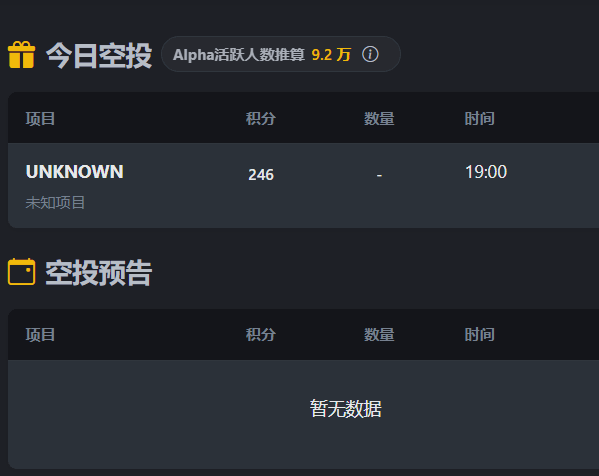
#ALPHA 9月10号, Alpha Airdrop Announcement! 9.2W participants!
📅 Today’s Airdrop
The box (blind box) airdrop is here—at 19:00, 246 minutes. I’m just guessing: old coins, worth around 30U. Do we all have enough spots?
Yesterday’s limit orders total成交 volume was 1,405,806,871, down 2.78% from the day before.
Alpha Trading Competition Data:
TMX: down nearly 26%. 24H成交 is a bit over 6.5M. Today limit orders: 0.57M; yesterday: 38M. Total赛量: 63.24M, with 6 days remaining. Rewards: 450, worth about 16U.
XPIN: down a little less, at 7.8%. Total赛量: 400M. Today limit orders: 0.43M. 2 days remaining; rewards: 55,000, roughly 50U.
COLLECT: down 23%, with nearly 6M成交 in 24H. Total赛量: 53.96M. The second round just started recently (started 09-09 21:00), with 7 days remaining. Rewards: 670, about 12U.
IN: the most ridiculous—total赛量 is already 456M, but today’s limit orders are only a little over 40k. Ends in 7 hours; rewards: 1508, roughly 48U.
CP: highest 24H成交 at 20.75M, but total赛量 is only 320k. Down 12%, with 6 days remaining. Rewards: 2000, about 29U.
Today’s Operation Suggestions:
KII: 3 days left, 200–500U.
#ALPHA 9月10号, Alpha Airdrop Announcement! 9.2W participants!
📅 Today’s Airdrop
The box (blind box) airdrop is here—at 19:00, 246 minutes. I’m just guessing: old coins, worth around 30U. Do we all have enough spots?
Yesterday’s limit orders total成交 volume was 1,405,806,871, down 2.78% from the day before.
Alpha Trading Competition Data:
TMX: down nearly 26%. 24H成交 is a bit over 6.5M. Today limit orders: 0.57M; yesterday: 38M. Total赛量: 63.24M, with 6 days remaining. Rewards: 450, worth about 16U.
XPIN: down a little less, at 7.8%. Total赛量: 400M. Today limit orders: 0.43M. 2 days remaining; rewards: 55,000, roughly 50U.
COLLECT: down 23%, with nearly 6M成交 in 24H. Total赛量: 53.96M. The second round just started recently (started 09-09 21:00), with 7 days remaining. Rewards: 670, about 12U.
IN: the most ridiculous—total赛量 is already 456M, but today’s limit orders are only a little over 40k. Ends in 7 hours; rewards: 1508, roughly 48U.
CP: highest 24H成交 at 20.75M, but total赛量 is only 320k. Down 12%, with 6 days remaining. Rewards: 2000, about 29U.
Today’s Operation Suggestions:
KII: 3 days left, 200–500U.
📅 Today’s Airdrop
The box (blind box) airdrop is here—at 19:00, 246 minutes. I’m just guessing: old coins, worth around 30U. Do we all have enough spots?
Yesterday’s limit orders total成交 volume was 1,405,806,871, down 2.78% from the day before.
Alpha Trading Competition Data:
TMX: down nearly 26%. 24H成交 is a bit over 6.5M. Today limit orders: 0.57M; yesterday: 38M. Total赛量: 63.24M, with 6 days remaining. Rewards: 450, worth about 16U.
XPIN: down a little less, at 7.8%. Total赛量: 400M. Today limit orders: 0.43M. 2 days remaining; rewards: 55,000, roughly 50U.
COLLECT: down 23%, with nearly 6M成交 in 24H. Total赛量: 53.96M. The second round just started recently (started 09-09 21:00), with 7 days remaining. Rewards: 670, about 12U.
IN: the most ridiculous—total赛量 is already 456M, but today’s limit orders are only a little over 40k. Ends in 7 hours; rewards: 1508, roughly 48U.
CP: highest 24H成交 at 20.75M, but total赛量 is only 320k. Down 12%, with 6 days remaining. Rewards: 2000, about 29U.
Today’s Operation Suggestions:
KII: 3 days left, 200–500U.
4
1
12
2.3k
·
--
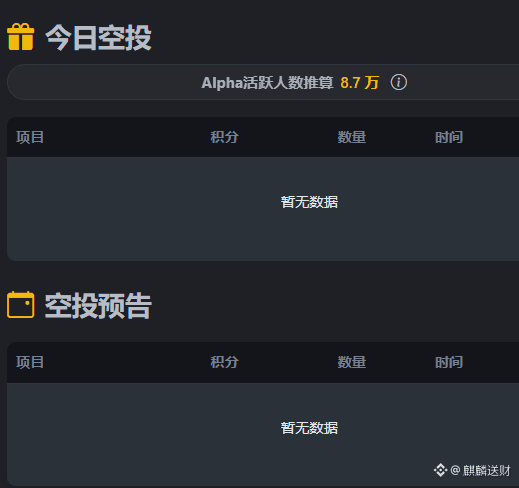
September 9, #ALPHA 9—Alpha Airdrop preview! Participants: 8.7W!
📅 Today’s airdrop
Good afternoon—no preview yet!
Yesterday’s capped-limit order total成交 (trades) was 1.446 billion, down 2.37% from the day before yesterday.
Alpha 24-hour trading competition—latest situation:
AIA: Current price 0.0927, up 3.33% in the last 24 hours. Today’s capped-limit成交 is only a bit over 440,000; yesterday it was 166 million—big drop. With 8 hours left, cumulative is 809 million. The top 2000 participants should receive about 714 tokens, roughly 66 U.
TMX: 24-hour成交 8.26 million. Price 0.0468, down 19%. Today’s capped-limit成交 is 410,000; yesterday it was 30.8 million. 7 days left, cumulative 24.27 million.
COLLECT: Down 24%, 24-hour成交 8.71 million. Today’s capped-limit is 160,000; yesterday it was 900,000. With 8 hours left, cumulative 5.34 million. Per person about 670 tokens, roughly a bit over 16 U.
XPIN: Price 0.000988, 4-hour成交 780,000. Today’s capped-limit is 55,000; yesterday it was 124 million—cliff-like drop. 3 days left, cumulative 385 million. 55,556 tokens roughly equal 55 U.
CP: Down 25.8%,成交 3.88 million. Today’s capped-limit is 50,000; yesterday it was 640,000. 7 days left, cumulative barely over 100,000. For 2000 tokens, about 33 U.
IN: Down 2.25%,成交 530,000. Today’s capped-limit is 45,000; yesterday it was 11.76 million. 2 days left, cumulative 453 million. 1508 tokens roughly equal 51 U.
Today’s operation suggestions:
Recommend KII—4 days left, place small amounts in multiple orders, 200–500 U each.
September 9, #ALPHA 9—Alpha Airdrop preview! Participants: 8.7W!
📅 Today’s airdrop
Good afternoon—no preview yet!
Yesterday’s capped-limit order total成交 (trades) was 1.446 billion, down 2.37% from the day before yesterday.
Alpha 24-hour trading competition—latest situation:
AIA: Current price 0.0927, up 3.33% in the last 24 hours. Today’s capped-limit成交 is only a bit over 440,000; yesterday it was 166 million—big drop. With 8 hours left, cumulative is 809 million. The top 2000 participants should receive about 714 tokens, roughly 66 U.
TMX: 24-hour成交 8.26 million. Price 0.0468, down 19%. Today’s capped-limit成交 is 410,000; yesterday it was 30.8 million. 7 days left, cumulative 24.27 million.
COLLECT: Down 24%, 24-hour成交 8.71 million. Today’s capped-limit is 160,000; yesterday it was 900,000. With 8 hours left, cumulative 5.34 million. Per person about 670 tokens, roughly a bit over 16 U.
XPIN: Price 0.000988, 4-hour成交 780,000. Today’s capped-limit is 55,000; yesterday it was 124 million—cliff-like drop. 3 days left, cumulative 385 million. 55,556 tokens roughly equal 55 U.
CP: Down 25.8%,成交 3.88 million. Today’s capped-limit is 50,000; yesterday it was 640,000. 7 days left, cumulative barely over 100,000. For 2000 tokens, about 33 U.
IN: Down 2.25%,成交 530,000. Today’s capped-limit is 45,000; yesterday it was 11.76 million. 2 days left, cumulative 453 million. 1508 tokens roughly equal 51 U.
Today’s operation suggestions:
Recommend KII—4 days left, place small amounts in multiple orders, 200–500 U each.
📅 Today’s airdrop
Good afternoon—no preview yet!
Yesterday’s capped-limit order total成交 (trades) was 1.446 billion, down 2.37% from the day before yesterday.
Alpha 24-hour trading competition—latest situation:
AIA: Current price 0.0927, up 3.33% in the last 24 hours. Today’s capped-limit成交 is only a bit over 440,000; yesterday it was 166 million—big drop. With 8 hours left, cumulative is 809 million. The top 2000 participants should receive about 714 tokens, roughly 66 U.
TMX: 24-hour成交 8.26 million. Price 0.0468, down 19%. Today’s capped-limit成交 is 410,000; yesterday it was 30.8 million. 7 days left, cumulative 24.27 million.
COLLECT: Down 24%, 24-hour成交 8.71 million. Today’s capped-limit is 160,000; yesterday it was 900,000. With 8 hours left, cumulative 5.34 million. Per person about 670 tokens, roughly a bit over 16 U.
XPIN: Price 0.000988, 4-hour成交 780,000. Today’s capped-limit is 55,000; yesterday it was 124 million—cliff-like drop. 3 days left, cumulative 385 million. 55,556 tokens roughly equal 55 U.
CP: Down 25.8%,成交 3.88 million. Today’s capped-limit is 50,000; yesterday it was 640,000. 7 days left, cumulative barely over 100,000. For 2000 tokens, about 33 U.
IN: Down 2.25%,成交 530,000. Today’s capped-limit is 45,000; yesterday it was 11.76 million. 2 days left, cumulative 453 million. 1508 tokens roughly equal 51 U.
Today’s operation suggestions:
Recommend KII—4 days left, place small amounts in multiple orders, 200–500 U each.
7
2.8k
·
--
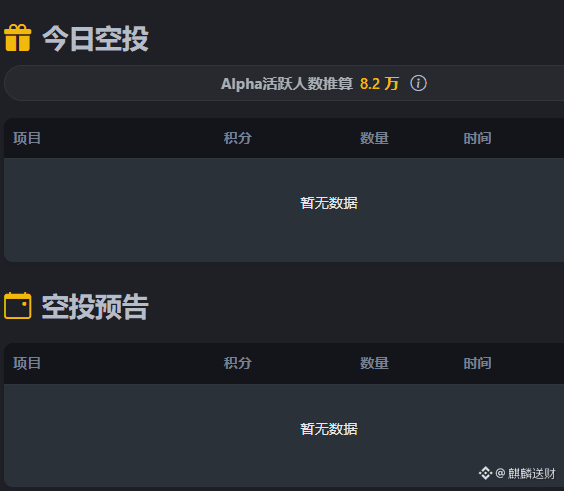
#ALPHA 9th August 8th, Alpha Airdrop Preview! 8.2W participants!
📅 Today’s Airdrop
Good afternoon—no airdrop preview today.
Yesterday’s limit orders totalled about 1.481 billion, up slightly by 2.29% compared to the day before.
Alpha 24-hour Trading Race updates:
TMX—today’s volume surged straight to 14 million, topping the list by a wide margin, but the price dropped 22%. Today’s limit orders were a bit over 750,000, whereas yesterday was over 17 million. Total trading volume: 737 million. The race started at Stage 1, and the first batch is nearly finished. 450 TMX is roughly just over 25U.
AIA—around 1.3 million; price rose by 2%. Yesterday’s limit orders成交led 220 million; total is 640 million. 714 AIA roughly equals about 64U.
XPIN—only 480,000 traded in 24 hours; total trading volume 260 million. Rewards are roughly around 55U.
COLLECT—today’s volume: 9.89 million; price down 6%. Total trading volume: 4.5 million; 670 coins are only about 22U.
IN—400,000 traded; price barely moved. Total: 440 million; 1508 IN is about 51U.
Suggested actions for today:
Use limit orders to run DOS; there are 1 day left—place multiple small orders of 200–500U each.
#ALPHA 9th August 8th, Alpha Airdrop Preview! 8.2W participants!
📅 Today’s Airdrop
Good afternoon—no airdrop preview today.
Yesterday’s limit orders totalled about 1.481 billion, up slightly by 2.29% compared to the day before.
Alpha 24-hour Trading Race updates:
TMX—today’s volume surged straight to 14 million, topping the list by a wide margin, but the price dropped 22%. Today’s limit orders were a bit over 750,000, whereas yesterday was over 17 million. Total trading volume: 737 million. The race started at Stage 1, and the first batch is nearly finished. 450 TMX is roughly just over 25U.
AIA—around 1.3 million; price rose by 2%. Yesterday’s limit orders成交led 220 million; total is 640 million. 714 AIA roughly equals about 64U.
XPIN—only 480,000 traded in 24 hours; total trading volume 260 million. Rewards are roughly around 55U.
COLLECT—today’s volume: 9.89 million; price down 6%. Total trading volume: 4.5 million; 670 coins are only about 22U.
IN—400,000 traded; price barely moved. Total: 440 million; 1508 IN is about 51U.
Suggested actions for today:
Use limit orders to run DOS; there are 1 day left—place multiple small orders of 200–500U each.
📅 Today’s Airdrop
Good afternoon—no airdrop preview today.
Yesterday’s limit orders totalled about 1.481 billion, up slightly by 2.29% compared to the day before.
Alpha 24-hour Trading Race updates:
TMX—today’s volume surged straight to 14 million, topping the list by a wide margin, but the price dropped 22%. Today’s limit orders were a bit over 750,000, whereas yesterday was over 17 million. Total trading volume: 737 million. The race started at Stage 1, and the first batch is nearly finished. 450 TMX is roughly just over 25U.
AIA—around 1.3 million; price rose by 2%. Yesterday’s limit orders成交led 220 million; total is 640 million. 714 AIA roughly equals about 64U.
XPIN—only 480,000 traded in 24 hours; total trading volume 260 million. Rewards are roughly around 55U.
COLLECT—today’s volume: 9.89 million; price down 6%. Total trading volume: 4.5 million; 670 coins are only about 22U.
IN—400,000 traded; price barely moved. Total: 440 million; 1508 IN is about 51U.
Suggested actions for today:
Use limit orders to run DOS; there are 1 day left—place multiple small orders of 200–500U each.
2
7
3.1k
·
--
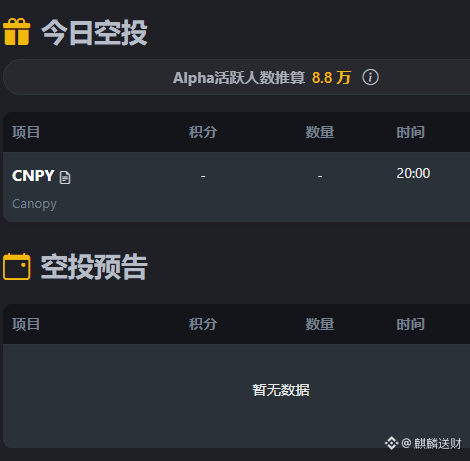
#ALPHA 9 on the 7th, Alpha airdrop preview! 88K participants!
📅 Today's Airdrop
Good afternoon, CNPY claim starts at 8:00 PM tonight, with an estimated score of around 240.
Yesterday's total limit order trading volume was 1.448 billion, up 2.78% from the day before.
Alpha 24-hour trading contest data:
First, looking at prices, among the five, only AIA is still holding up, up 5.48% over 24 hours. The others are a bit rough: TMX dropped straight off a cliff, -20%, COLLECT even worse at -26.5%. IN is basically flat, and XPIN dipped by 3 points.
As for trading volume, COLLECT was the strongest today, doing over 14 million in 24 hours, and TMX also had 9.3 million. AIA, IN, and XPIN were all around 400K to 500K.
But when you look at cumulative volume, the picture is very clear:
- TMX: 720 million, far ahead in first place
- AIA: 422 million, IN: 417 million
- XPIN: 127 million
- COLLECT: only 3.6 million
As for rewards, same old rule: if you make it into the top 2000, the average per person is roughly this:
- AIA: ≈61U
- IN: ≈52U
- XPIN: ≈55U
- TMX: ≈32U
- COLLECT: ≈22U
Today's suggested move:
Limit order DOS, 2 days left, 200-500U.
#ALPHA 9 on the 7th, Alpha airdrop preview! 88K participants!
📅 Today's Airdrop
Good afternoon, CNPY claim starts at 8:00 PM tonight, with an estimated score of around 240.
Yesterday's total limit order trading volume was 1.448 billion, up 2.78% from the day before.
Alpha 24-hour trading contest data:
First, looking at prices, among the five, only AIA is still holding up, up 5.48% over 24 hours. The others are a bit rough: TMX dropped straight off a cliff, -20%, COLLECT even worse at -26.5%. IN is basically flat, and XPIN dipped by 3 points.
As for trading volume, COLLECT was the strongest today, doing over 14 million in 24 hours, and TMX also had 9.3 million. AIA, IN, and XPIN were all around 400K to 500K.
But when you look at cumulative volume, the picture is very clear:
- TMX: 720 million, far ahead in first place
- AIA: 422 million, IN: 417 million
- XPIN: 127 million
- COLLECT: only 3.6 million
As for rewards, same old rule: if you make it into the top 2000, the average per person is roughly this:
- AIA: ≈61U
- IN: ≈52U
- XPIN: ≈55U
- TMX: ≈32U
- COLLECT: ≈22U
Today's suggested move:
Limit order DOS, 2 days left, 200-500U.
📅 Today's Airdrop
Good afternoon, CNPY claim starts at 8:00 PM tonight, with an estimated score of around 240.
Yesterday's total limit order trading volume was 1.448 billion, up 2.78% from the day before.
Alpha 24-hour trading contest data:
First, looking at prices, among the five, only AIA is still holding up, up 5.48% over 24 hours. The others are a bit rough: TMX dropped straight off a cliff, -20%, COLLECT even worse at -26.5%. IN is basically flat, and XPIN dipped by 3 points.
As for trading volume, COLLECT was the strongest today, doing over 14 million in 24 hours, and TMX also had 9.3 million. AIA, IN, and XPIN were all around 400K to 500K.
But when you look at cumulative volume, the picture is very clear:
- TMX: 720 million, far ahead in first place
- AIA: 422 million, IN: 417 million
- XPIN: 127 million
- COLLECT: only 3.6 million
As for rewards, same old rule: if you make it into the top 2000, the average per person is roughly this:
- AIA: ≈61U
- IN: ≈52U
- XPIN: ≈55U
- TMX: ≈32U
- COLLECT: ≈22U
Today's suggested move:
Limit order DOS, 2 days left, 200-500U.
3
5
2.9k
·
--
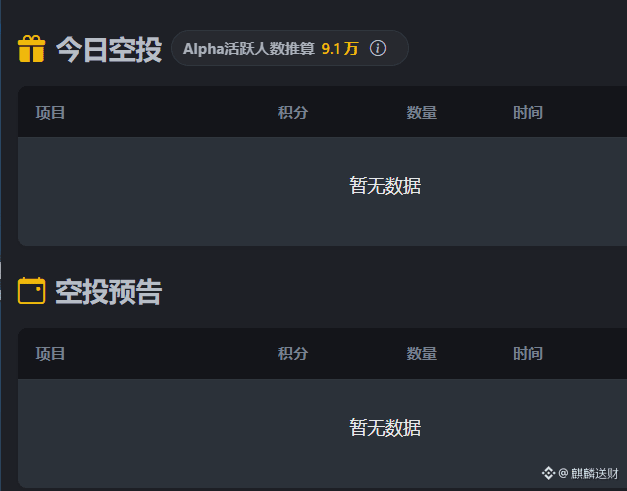
#ALPHA 9May 5, Alpha airdrop preview! 91k people!
📅 Today's airdrops
Good afternoon, no airdrop preview today. If it’s the weekend, rest when you should.
Yesterday’s total limit-order turnover was just over 14.4 billion, down 15% from the day before yesterday.
Alpha 24-hour trading contest leaderboard:
TMX, with more than 9 million in 24-hour turnover, price down 13%, limit orders shrank from 170 million yesterday to 7.6 million today. 4 days left, the top 2030 will share 450 TMX, which comes out to about forty U.
IN, today's trading volume is just over 1 million, up 4%. 6 days left, rewards of 1,508 IN, about fifty U.
XPIN, with only 680,000 in turnover, price up a little over 2%. Limit orders total 280,000. 7 days left, 55,000 coins to be shared, fifty U.
AIA, volume 700,000, basically flat. Yesterday's limit orders were over 100 million, today they're 60,000. 5 days left, 714 AIA, fifty U.
COLLECT, today’s turnover was 3.27 million, up nearly 4%. Limit orders are a little over 30,000. Total trading volume is around 1.1 million, 5 days left, 670 coins, fifty U.
Today's action suggestion:
Limit order, DOS, 4 days left, small amount 200-500 U.
#ALPHA 9May 5, Alpha airdrop preview! 91k people!
📅 Today's airdrops
Good afternoon, no airdrop preview today. If it’s the weekend, rest when you should.
Yesterday’s total limit-order turnover was just over 14.4 billion, down 15% from the day before yesterday.
Alpha 24-hour trading contest leaderboard:
TMX, with more than 9 million in 24-hour turnover, price down 13%, limit orders shrank from 170 million yesterday to 7.6 million today. 4 days left, the top 2030 will share 450 TMX, which comes out to about forty U.
IN, today's trading volume is just over 1 million, up 4%. 6 days left, rewards of 1,508 IN, about fifty U.
XPIN, with only 680,000 in turnover, price up a little over 2%. Limit orders total 280,000. 7 days left, 55,000 coins to be shared, fifty U.
AIA, volume 700,000, basically flat. Yesterday's limit orders were over 100 million, today they're 60,000. 5 days left, 714 AIA, fifty U.
COLLECT, today’s turnover was 3.27 million, up nearly 4%. Limit orders are a little over 30,000. Total trading volume is around 1.1 million, 5 days left, 670 coins, fifty U.
Today's action suggestion:
Limit order, DOS, 4 days left, small amount 200-500 U.
📅 Today's airdrops
Good afternoon, no airdrop preview today. If it’s the weekend, rest when you should.
Yesterday’s total limit-order turnover was just over 14.4 billion, down 15% from the day before yesterday.
Alpha 24-hour trading contest leaderboard:
TMX, with more than 9 million in 24-hour turnover, price down 13%, limit orders shrank from 170 million yesterday to 7.6 million today. 4 days left, the top 2030 will share 450 TMX, which comes out to about forty U.
IN, today's trading volume is just over 1 million, up 4%. 6 days left, rewards of 1,508 IN, about fifty U.
XPIN, with only 680,000 in turnover, price up a little over 2%. Limit orders total 280,000. 7 days left, 55,000 coins to be shared, fifty U.
AIA, volume 700,000, basically flat. Yesterday's limit orders were over 100 million, today they're 60,000. 5 days left, 714 AIA, fifty U.
COLLECT, today’s turnover was 3.27 million, up nearly 4%. Limit orders are a little over 30,000. Total trading volume is around 1.1 million, 5 days left, 670 coins, fifty U.
Today's action suggestion:
Limit order, DOS, 4 days left, small amount 200-500 U.
6
1.6k
·
--
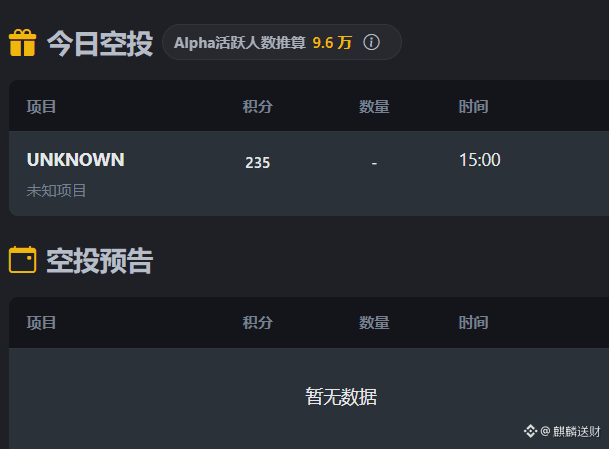
September 4th, #ALPHA 9 — Alpha Airdrop Preview! 9.6W participants!
📅 Today’s Airdrop
Good afternoon! At exactly 15:00 today, Alpha blind box airdrop will open. The entry threshold is 235 points—opens on time. Don’t miss it, everyone.
Yesterday’s limit order total成交(trading volume)was 1.696 billion, which is 12% more than the day before yesterday.
Alpha 24-hour Trading Race Rankings:
GWEI: Less than 8 hours left. Today’s limit orders成交 were 160k; yesterday was 560k. The price moved up by nearly 7 points.
TMX: Yesterday 250M; today so far 38M. 5 days remaining. Price down 3 points. FDV just passed 100M; 450 coins are roughly 49U.
IN: Yesterday 240M; today down to 13.9M so far, with 7 days remaining. Price slightly up. 1508 coins are roughly 50U.
AIA and COLLECT both have 6 days left. AIA is steady but not hot—around 100k per day. COLLECT spot trades: 9.5M in 24 hours, but in the competition stats it’s only 0.89M. Price slightly down; 670 coins are roughly 52U.
Suggested Actions for Today:
Recommend DOS—5 days remaining, 200–500U.
September 4th, #ALPHA 9 — Alpha Airdrop Preview! 9.6W participants!
📅 Today’s Airdrop
Good afternoon! At exactly 15:00 today, Alpha blind box airdrop will open. The entry threshold is 235 points—opens on time. Don’t miss it, everyone.
Yesterday’s limit order total成交(trading volume)was 1.696 billion, which is 12% more than the day before yesterday.
Alpha 24-hour Trading Race Rankings:
GWEI: Less than 8 hours left. Today’s limit orders成交 were 160k; yesterday was 560k. The price moved up by nearly 7 points.
TMX: Yesterday 250M; today so far 38M. 5 days remaining. Price down 3 points. FDV just passed 100M; 450 coins are roughly 49U.
IN: Yesterday 240M; today down to 13.9M so far, with 7 days remaining. Price slightly up. 1508 coins are roughly 50U.
AIA and COLLECT both have 6 days left. AIA is steady but not hot—around 100k per day. COLLECT spot trades: 9.5M in 24 hours, but in the competition stats it’s only 0.89M. Price slightly down; 670 coins are roughly 52U.
Suggested Actions for Today:
Recommend DOS—5 days remaining, 200–500U.
📅 Today’s Airdrop
Good afternoon! At exactly 15:00 today, Alpha blind box airdrop will open. The entry threshold is 235 points—opens on time. Don’t miss it, everyone.
Yesterday’s limit order total成交(trading volume)was 1.696 billion, which is 12% more than the day before yesterday.
Alpha 24-hour Trading Race Rankings:
GWEI: Less than 8 hours left. Today’s limit orders成交 were 160k; yesterday was 560k. The price moved up by nearly 7 points.
TMX: Yesterday 250M; today so far 38M. 5 days remaining. Price down 3 points. FDV just passed 100M; 450 coins are roughly 49U.
IN: Yesterday 240M; today down to 13.9M so far, with 7 days remaining. Price slightly up. 1508 coins are roughly 50U.
AIA and COLLECT both have 6 days left. AIA is steady but not hot—around 100k per day. COLLECT spot trades: 9.5M in 24 hours, but in the competition stats it’s only 0.89M. Price slightly down; 670 coins are roughly 52U.
Suggested Actions for Today:
Recommend DOS—5 days remaining, 200–500U.
5
4
2.8k
·
--
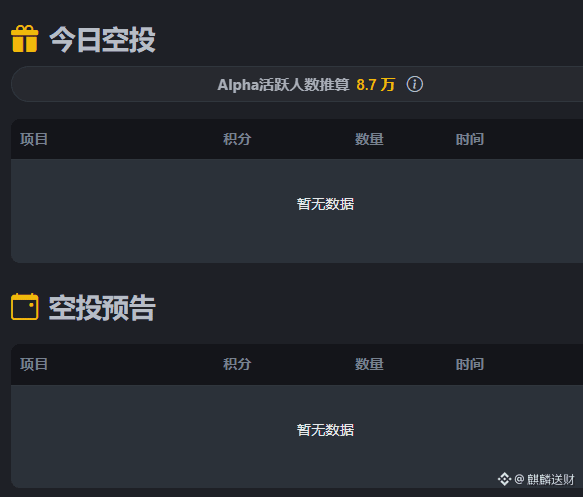
#ALPHA September 3rd, Alpha Airdrop teaser! 8.7W participants!
📅 Today’s Airdrop
Good afternoon—now there’s no teaser either. Is there none today?
Yesterday’s total成交 (limit orders) was 1.513 billion, up 0.06% from the day before yesterday.
Alpha Trading Competition latest data:
TMX: current price 0.1125; 24-hour volume 7.86 million; down 1.4 points. Today limit orders are 62 million; yesterday was 112 million. Total cumulative volume: 205 million—still #1. 6 days left; FDV is roughly 112 million.
KGEN: 0.1726; 24-hour volume just over 180k; down 1%. Today limit orders are 3.7 million; yesterday 2.6 million. Total cumulative volume: 382 million; 6 hours left.
IN: around 0.03; 24-hour volume 1.12 million; down 2.16%. Today limit orders are 2.6 million; yesterday 38 million. Total cumulative volume: 292 million; 6 hours left.
GWEI: 0.02/3; volume 1.66 million; down 3.19%. Today limit orders are 150k; yesterday 1 million. Total cumulative volume: 462 million; 2 days left.
AIA: 0.07/7; volume 2.32 million; down 2.89%. Today limit orders are 50k; yesterday 272 million. Total cumulative volume: 92.52 million; 7 days left.
COLLECT: 0.07/8; volume 7.03 million; up 2.8%. Today limit orders are 45k; yesterday 530k. Total cumulative volume is only 3.7 million; 7 days left.
Today’s trading suggestions:
For score farming, DOS is recommended, 200–500U, with 6 days left.
#ALPHA September 3rd, Alpha Airdrop teaser! 8.7W participants!
📅 Today’s Airdrop
Good afternoon—now there’s no teaser either. Is there none today?
Yesterday’s total成交 (limit orders) was 1.513 billion, up 0.06% from the day before yesterday.
Alpha Trading Competition latest data:
TMX: current price 0.1125; 24-hour volume 7.86 million; down 1.4 points. Today limit orders are 62 million; yesterday was 112 million. Total cumulative volume: 205 million—still #1. 6 days left; FDV is roughly 112 million.
KGEN: 0.1726; 24-hour volume just over 180k; down 1%. Today limit orders are 3.7 million; yesterday 2.6 million. Total cumulative volume: 382 million; 6 hours left.
IN: around 0.03; 24-hour volume 1.12 million; down 2.16%. Today limit orders are 2.6 million; yesterday 38 million. Total cumulative volume: 292 million; 6 hours left.
GWEI: 0.02/3; volume 1.66 million; down 3.19%. Today limit orders are 150k; yesterday 1 million. Total cumulative volume: 462 million; 2 days left.
AIA: 0.07/7; volume 2.32 million; down 2.89%. Today limit orders are 50k; yesterday 272 million. Total cumulative volume: 92.52 million; 7 days left.
COLLECT: 0.07/8; volume 7.03 million; up 2.8%. Today limit orders are 45k; yesterday 530k. Total cumulative volume is only 3.7 million; 7 days left.
Today’s trading suggestions:
For score farming, DOS is recommended, 200–500U, with 6 days left.
📅 Today’s Airdrop
Good afternoon—now there’s no teaser either. Is there none today?
Yesterday’s total成交 (limit orders) was 1.513 billion, up 0.06% from the day before yesterday.
Alpha Trading Competition latest data:
TMX: current price 0.1125; 24-hour volume 7.86 million; down 1.4 points. Today limit orders are 62 million; yesterday was 112 million. Total cumulative volume: 205 million—still #1. 6 days left; FDV is roughly 112 million.
KGEN: 0.1726; 24-hour volume just over 180k; down 1%. Today limit orders are 3.7 million; yesterday 2.6 million. Total cumulative volume: 382 million; 6 hours left.
IN: around 0.03; 24-hour volume 1.12 million; down 2.16%. Today limit orders are 2.6 million; yesterday 38 million. Total cumulative volume: 292 million; 6 hours left.
GWEI: 0.02/3; volume 1.66 million; down 3.19%. Today limit orders are 150k; yesterday 1 million. Total cumulative volume: 462 million; 2 days left.
AIA: 0.07/7; volume 2.32 million; down 2.89%. Today limit orders are 50k; yesterday 272 million. Total cumulative volume: 92.52 million; 7 days left.
COLLECT: 0.07/8; volume 7.03 million; up 2.8%. Today limit orders are 45k; yesterday 530k. Total cumulative volume is only 3.7 million; 7 days left.
Today’s trading suggestions:
For score farming, DOS is recommended, 200–500U, with 6 days left.
9
3
11
4.7k
·
--
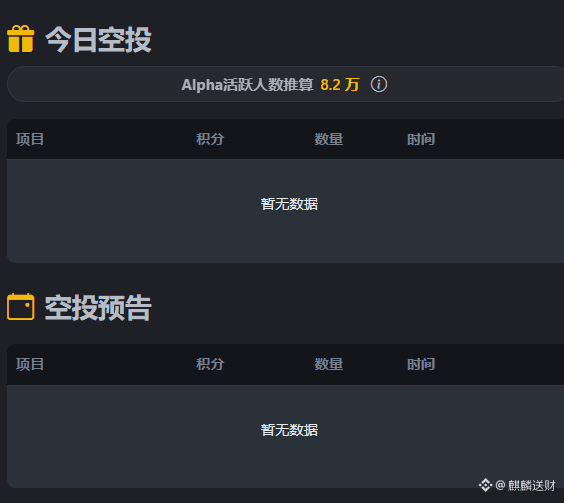
September 1st, #ALPHA 9 — Alpha Airdrop Announcement! 8.2W participants!
📅 Today’s Airdrop
Good afternoon. According to insider info, Cluster Protocol (CP, for short) will open at 23:00 tonight. It’s deployed on the Base chain. The neighboring Boost split 0.34% of the tokens, which might go to Alpha.
Yesterday’s total limit order trading volume was a bit over 1.5 billion, specifically 1,503,243,031 — up 8.61% from the day before.
Alpha 24-hour trading competition stats:
TMX is still the big boss, holding first place steadily. Current price is 0.1181, up 1.85% in the last 24 hours, with a trading value of over 13 million. Today’s limit orders are 7.66 million; yesterday it was over 30 million. The cumulative total is already 37.77 million. The competition has 7 days left, with 450 TMX as the reward, which comes to roughly 53U.
AIA has accumulated total trades of 686 million. Yesterday’s limit orders were 265 million, and today there’s only a bit over 1.8 million left. With 8 hours remaining, the reward is 714 AIA, roughly 56U.
IN is down 1.38% today, with a cumulative total of 251 million. KGEN has the smallest volume—only about 130,000+ in the last 24 hours, but its cumulative total is still 376 million. GWEI has accumulated 461 million, and today’s limit orders have shrunk to 260,000; yesterday it was still 4.39 million.
Today’s operation recommendations:
For points farming, DOS is recommended. Use limit orders for farming: 200–500U in small amounts across multiple transactions, and there are 6 days left.
September 1st, #ALPHA 9 — Alpha Airdrop Announcement! 8.2W participants!
📅 Today’s Airdrop
Good afternoon. According to insider info, Cluster Protocol (CP, for short) will open at 23:00 tonight. It’s deployed on the Base chain. The neighboring Boost split 0.34% of the tokens, which might go to Alpha.
Yesterday’s total limit order trading volume was a bit over 1.5 billion, specifically 1,503,243,031 — up 8.61% from the day before.
Alpha 24-hour trading competition stats:
TMX is still the big boss, holding first place steadily. Current price is 0.1181, up 1.85% in the last 24 hours, with a trading value of over 13 million. Today’s limit orders are 7.66 million; yesterday it was over 30 million. The cumulative total is already 37.77 million. The competition has 7 days left, with 450 TMX as the reward, which comes to roughly 53U.
AIA has accumulated total trades of 686 million. Yesterday’s limit orders were 265 million, and today there’s only a bit over 1.8 million left. With 8 hours remaining, the reward is 714 AIA, roughly 56U.
IN is down 1.38% today, with a cumulative total of 251 million. KGEN has the smallest volume—only about 130,000+ in the last 24 hours, but its cumulative total is still 376 million. GWEI has accumulated 461 million, and today’s limit orders have shrunk to 260,000; yesterday it was still 4.39 million.
Today’s operation recommendations:
For points farming, DOS is recommended. Use limit orders for farming: 200–500U in small amounts across multiple transactions, and there are 6 days left.
📅 Today’s Airdrop
Good afternoon. According to insider info, Cluster Protocol (CP, for short) will open at 23:00 tonight. It’s deployed on the Base chain. The neighboring Boost split 0.34% of the tokens, which might go to Alpha.
Yesterday’s total limit order trading volume was a bit over 1.5 billion, specifically 1,503,243,031 — up 8.61% from the day before.
Alpha 24-hour trading competition stats:
TMX is still the big boss, holding first place steadily. Current price is 0.1181, up 1.85% in the last 24 hours, with a trading value of over 13 million. Today’s limit orders are 7.66 million; yesterday it was over 30 million. The cumulative total is already 37.77 million. The competition has 7 days left, with 450 TMX as the reward, which comes to roughly 53U.
AIA has accumulated total trades of 686 million. Yesterday’s limit orders were 265 million, and today there’s only a bit over 1.8 million left. With 8 hours remaining, the reward is 714 AIA, roughly 56U.
IN is down 1.38% today, with a cumulative total of 251 million. KGEN has the smallest volume—only about 130,000+ in the last 24 hours, but its cumulative total is still 376 million. GWEI has accumulated 461 million, and today’s limit orders have shrunk to 260,000; yesterday it was still 4.39 million.
Today’s operation recommendations:
For points farming, DOS is recommended. Use limit orders for farming: 200–500U in small amounts across multiple transactions, and there are 6 days left.
11
15
55
8.9k
·
--
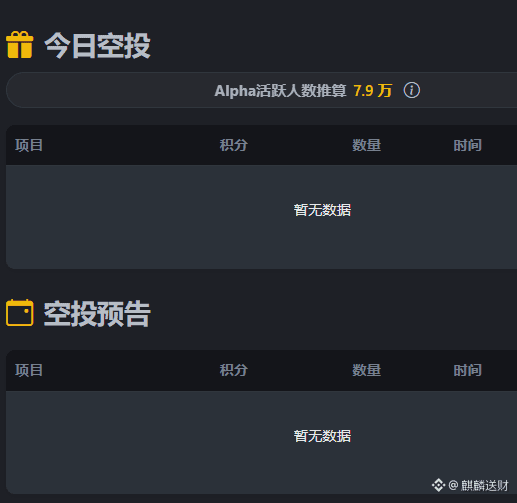
August 1st, #ALPHA 9 — Alpha Airdrop Preview! Participants: 7.9W!
📅 Today’s Airdrop
We’ve arranged a surprise airdrop: open a blind box—250 points—at 19:00 sharp. Guess the old coins (blind guess), about 30U!
Yesterday, the total trading volume of limit orders across the whole platform was 1.384 billion, up slightly by 1.4% compared to the day before yesterday—nothing major.
Alpha 24-hour trading contest data:
1st: AIA, current price 0.076, 24-hour volume 679,000, down 1.55%. Today’s limit orders are only 10.53M, yesterday’s were 201M—a big drop. Total cumulative volume is 430M, with 2 days left.
2nd: GWEI, 0.0246, volume 2.03M, up 1.18%. Today’s limit orders are 376K, yesterday’s were 14.31M. Highest total volume on the whole site: 457M, with 2 days left.
3rd: KGEN, 0.1726, volume 165K, up 1.44%. Today’s limit orders are 336K, yesterday’s were 1.13M. Total cumulative volume is 374M, with 3 days left.
4th: IN, 0.034, volume 1.08M, up 2.47%. Today’s limit orders are 200K, yesterday’s were 124M. Total cumulative volume is 125M, with 3 days left.
Suggestions for today’s actions:
For score farming, DOS is recommended. Slowly process limit orders—7 days remaining—with small multiple orders in the 200–500U range.
August 1st, #ALPHA 9 — Alpha Airdrop Preview! Participants: 7.9W!
📅 Today’s Airdrop
We’ve arranged a surprise airdrop: open a blind box—250 points—at 19:00 sharp. Guess the old coins (blind guess), about 30U!
Yesterday, the total trading volume of limit orders across the whole platform was 1.384 billion, up slightly by 1.4% compared to the day before yesterday—nothing major.
Alpha 24-hour trading contest data:
1st: AIA, current price 0.076, 24-hour volume 679,000, down 1.55%. Today’s limit orders are only 10.53M, yesterday’s were 201M—a big drop. Total cumulative volume is 430M, with 2 days left.
2nd: GWEI, 0.0246, volume 2.03M, up 1.18%. Today’s limit orders are 376K, yesterday’s were 14.31M. Highest total volume on the whole site: 457M, with 2 days left.
3rd: KGEN, 0.1726, volume 165K, up 1.44%. Today’s limit orders are 336K, yesterday’s were 1.13M. Total cumulative volume is 374M, with 3 days left.
4th: IN, 0.034, volume 1.08M, up 2.47%. Today’s limit orders are 200K, yesterday’s were 124M. Total cumulative volume is 125M, with 3 days left.
Suggestions for today’s actions:
For score farming, DOS is recommended. Slowly process limit orders—7 days remaining—with small multiple orders in the 200–500U range.
📅 Today’s Airdrop
We’ve arranged a surprise airdrop: open a blind box—250 points—at 19:00 sharp. Guess the old coins (blind guess), about 30U!
Yesterday, the total trading volume of limit orders across the whole platform was 1.384 billion, up slightly by 1.4% compared to the day before yesterday—nothing major.
Alpha 24-hour trading contest data:
1st: AIA, current price 0.076, 24-hour volume 679,000, down 1.55%. Today’s limit orders are only 10.53M, yesterday’s were 201M—a big drop. Total cumulative volume is 430M, with 2 days left.
2nd: GWEI, 0.0246, volume 2.03M, up 1.18%. Today’s limit orders are 376K, yesterday’s were 14.31M. Highest total volume on the whole site: 457M, with 2 days left.
3rd: KGEN, 0.1726, volume 165K, up 1.44%. Today’s limit orders are 336K, yesterday’s were 1.13M. Total cumulative volume is 374M, with 3 days left.
4th: IN, 0.034, volume 1.08M, up 2.47%. Today’s limit orders are 200K, yesterday’s were 124M. Total cumulative volume is 125M, with 3 days left.
Suggestions for today’s actions:
For score farming, DOS is recommended. Slowly process limit orders—7 days remaining—with small multiple orders in the 200–500U range.
2
10
3k
·
--
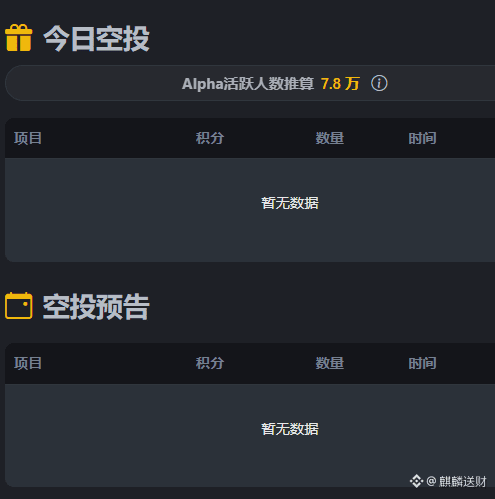
#ALPHA 8月31, Alpha airdrop preview! Number of people: 78K!
📅 Today's airdrop
It's the last day of August, and it's still at zero!
Looking at the data, yesterday's total trading volume of limit orders was just over 140.3 million, up slightly by 1.99% from the previous day.
Alpha trading competition data:
First place, AIA. Current price 0.077, 24-hour trading volume over 600,000, down 2.72%. Today's limit orders are about 2.5 million, previous day 217 million, and the cumulative total trading volume has already reached 220 million. There are 3 days left in the competition. So far, 714 AIA have been claimed, worth about 55U.
Second place, GWEI, price 0.0242, trading volume over 2 million. Today's limit orders 1.2 million, previous day 123 million, total trading volume has already reached 4.4 billion. 2200 GWEI have been claimed, worth about 53U.
Third, KGEN, current price 0.1698, trading volume 260,000, down 2.35%. Today's limit orders 65,000, previous day 11.75 million, total trading volume 370 million. 295 KGEN have been claimed, around 50U, with 4 days left.
Fourth, IN, current price 0.0331, trading volume 930,000, up 3.17%, but today's limit orders are just over 10,000, previous day 23,000, total trading volume 200,000. 1508 IN have been claimed, also close to 50U.
Today's operation suggestion:
Use limit orders to刷DOS, small amounts in multiple orders of 200-500U, with 9 days remaining.
#ALPHA 8月31, Alpha airdrop preview! Number of people: 78K!
📅 Today's airdrop
It's the last day of August, and it's still at zero!
Looking at the data, yesterday's total trading volume of limit orders was just over 140.3 million, up slightly by 1.99% from the previous day.
Alpha trading competition data:
First place, AIA. Current price 0.077, 24-hour trading volume over 600,000, down 2.72%. Today's limit orders are about 2.5 million, previous day 217 million, and the cumulative total trading volume has already reached 220 million. There are 3 days left in the competition. So far, 714 AIA have been claimed, worth about 55U.
Second place, GWEI, price 0.0242, trading volume over 2 million. Today's limit orders 1.2 million, previous day 123 million, total trading volume has already reached 4.4 billion. 2200 GWEI have been claimed, worth about 53U.
Third, KGEN, current price 0.1698, trading volume 260,000, down 2.35%. Today's limit orders 65,000, previous day 11.75 million, total trading volume 370 million. 295 KGEN have been claimed, around 50U, with 4 days left.
Fourth, IN, current price 0.0331, trading volume 930,000, up 3.17%, but today's limit orders are just over 10,000, previous day 23,000, total trading volume 200,000. 1508 IN have been claimed, also close to 50U.
Today's operation suggestion:
Use limit orders to刷DOS, small amounts in multiple orders of 200-500U, with 9 days remaining.
📅 Today's airdrop
It's the last day of August, and it's still at zero!
Looking at the data, yesterday's total trading volume of limit orders was just over 140.3 million, up slightly by 1.99% from the previous day.
Alpha trading competition data:
First place, AIA. Current price 0.077, 24-hour trading volume over 600,000, down 2.72%. Today's limit orders are about 2.5 million, previous day 217 million, and the cumulative total trading volume has already reached 220 million. There are 3 days left in the competition. So far, 714 AIA have been claimed, worth about 55U.
Second place, GWEI, price 0.0242, trading volume over 2 million. Today's limit orders 1.2 million, previous day 123 million, total trading volume has already reached 4.4 billion. 2200 GWEI have been claimed, worth about 53U.
Third, KGEN, current price 0.1698, trading volume 260,000, down 2.35%. Today's limit orders 65,000, previous day 11.75 million, total trading volume 370 million. 295 KGEN have been claimed, around 50U, with 4 days left.
Fourth, IN, current price 0.0331, trading volume 930,000, up 3.17%, but today's limit orders are just over 10,000, previous day 23,000, total trading volume 200,000. 1508 IN have been claimed, also close to 50U.
Today's operation suggestion:
Use limit orders to刷DOS, small amounts in multiple orders of 200-500U, with 9 days remaining.
20
40
8k
·
--
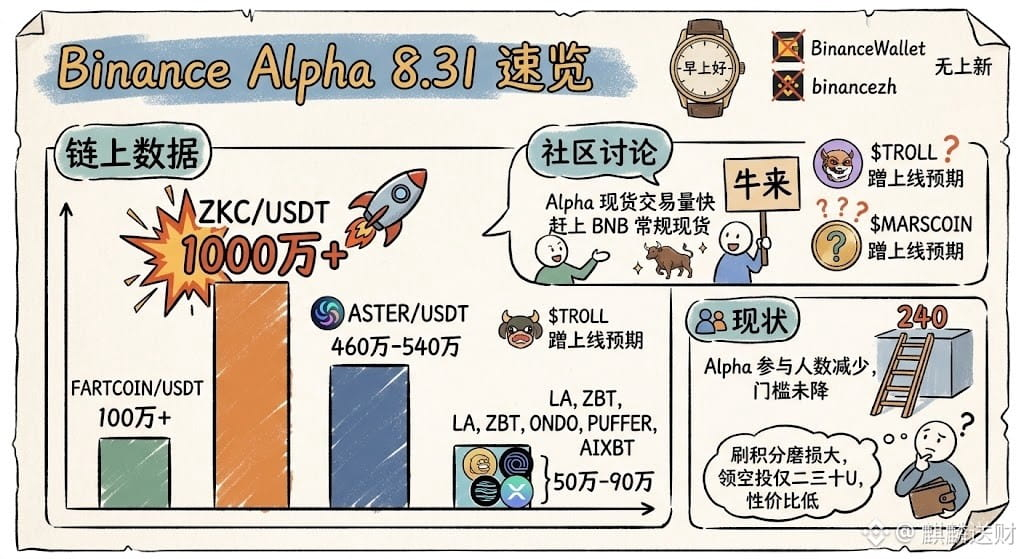
#ALPHA Binance Alpha 8.31 Quick Review: No major updates, ZKC stands out
Good morning. Over the past 8 hours, Binance has been pretty quiet—whether it’s BinanceWallet or binancezh—there hasn’t been much new Alpha launched or any airdrop announcements. It’s the last day of August; I guess projects are holding back big moves and waiting for September.
That said, things on-chain are still pretty lively. Let’s talk about a few points everyone cares about:
First, the heat ranking. The total trading volume over the past 24 hours has been fluctuating in the range of roughly $37M to $44M, and the leading coins have drained nearly half the liquidity.
ZKC/USDT is completely dominating—pushing 10M+ in traded volume. This one is genuinely impressive.
ASTER/USDT is also holding up fairly well, steady in the 4.6M to 5.4M range.
FARTCOIN/USDT is a bit over 1M, fairly standard.
LA, ZBT, ONDO, PUFFER, AIXBT are all somewhere between 0.5M and 0.9M.
The most-discussed thing in the community is Niu Lai. Some people say its Alpha spot trading volume is almost catching up to BNB’s usual spot volume—kind of absurd. Also, there are calls to trade for $TROLL and $MARSCOIN; people are wondering if they can ride on some listing expectations.
One more detail: the number of participants in Alpha has indeed decreased compared to before, and the threshold hasn’t come down—it’s still around 240. Some people complain that grinding points causes too much wear and tear. Claiming an airdrop nets only about 20–30U, so the value for money is getting worse. That’s pretty much how August ends; we’ll see what new tricks show up next month.
#ALPHA Binance Alpha 8.31 Quick Review: No major updates, ZKC stands out
Good morning. Over the past 8 hours, Binance has been pretty quiet—whether it’s BinanceWallet or binancezh—there hasn’t been much new Alpha launched or any airdrop announcements. It’s the last day of August; I guess projects are holding back big moves and waiting for September.
That said, things on-chain are still pretty lively. Let’s talk about a few points everyone cares about:
First, the heat ranking. The total trading volume over the past 24 hours has been fluctuating in the range of roughly $37M to $44M, and the leading coins have drained nearly half the liquidity.
ZKC/USDT is completely dominating—pushing 10M+ in traded volume. This one is genuinely impressive.
ASTER/USDT is also holding up fairly well, steady in the 4.6M to 5.4M range.
FARTCOIN/USDT is a bit over 1M, fairly standard.
LA, ZBT, ONDO, PUFFER, AIXBT are all somewhere between 0.5M and 0.9M.
The most-discussed thing in the community is Niu Lai. Some people say its Alpha spot trading volume is almost catching up to BNB’s usual spot volume—kind of absurd. Also, there are calls to trade for $TROLL and $MARSCOIN; people are wondering if they can ride on some listing expectations.
One more detail: the number of participants in Alpha has indeed decreased compared to before, and the threshold hasn’t come down—it’s still around 240. Some people complain that grinding points causes too much wear and tear. Claiming an airdrop nets only about 20–30U, so the value for money is getting worse. That’s pretty much how August ends; we’ll see what new tricks show up next month.
Good morning. Over the past 8 hours, Binance has been pretty quiet—whether it’s BinanceWallet or binancezh—there hasn’t been much new Alpha launched or any airdrop announcements. It’s the last day of August; I guess projects are holding back big moves and waiting for September.
That said, things on-chain are still pretty lively. Let’s talk about a few points everyone cares about:
First, the heat ranking. The total trading volume over the past 24 hours has been fluctuating in the range of roughly $37M to $44M, and the leading coins have drained nearly half the liquidity.
ZKC/USDT is completely dominating—pushing 10M+ in traded volume. This one is genuinely impressive.
ASTER/USDT is also holding up fairly well, steady in the 4.6M to 5.4M range.
FARTCOIN/USDT is a bit over 1M, fairly standard.
LA, ZBT, ONDO, PUFFER, AIXBT are all somewhere between 0.5M and 0.9M.
The most-discussed thing in the community is Niu Lai. Some people say its Alpha spot trading volume is almost catching up to BNB’s usual spot volume—kind of absurd. Also, there are calls to trade for $TROLL and $MARSCOIN; people are wondering if they can ride on some listing expectations.
One more detail: the number of participants in Alpha has indeed decreased compared to before, and the threshold hasn’t come down—it’s still around 240. Some people complain that grinding points causes too much wear and tear. Claiming an airdrop nets only about 20–30U, so the value for money is getting worse. That’s pretty much how August ends; we’ll see what new tricks show up next month.
2
833
·
--
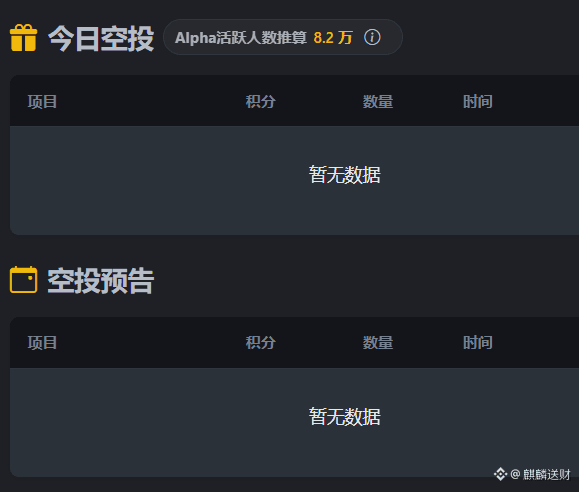
#ALPHA 8th August 29, Alpha Airdrop Teaser! 8.2W participants!
📅 Today’s Airdrop
Good afternoon. As usual, there are no airdrops on the weekend.
I’ve found that in life, being poor often means you’re stubborn and always fighting back; good fortune is hidden in patience and humility. If you really want to get rich by planning and strategy, destruction often starts with anger and recklessness. The same goes for boosting volumes—don’t go head-to-head with the order book, and don’t go against yourself. Stay calm and you can earn money.
Now back to the data. Yesterday, the total成交量 (limit orders) was 1.48B, which is 7.91% higher than the day before.
Alpha 24H Trading Contest:
GWEI: 6.56M in 24-hour volume, but the price dropped 6%. Now at 0.0248. The limit order volume for the day was only 1.29M. With 5 days left, the top 2000 split the rewards—2,200 coins per person, roughly 54U. This coin’s FDV is already 248M.
KGEN: Total 262M, 340k in 24H volume, down 1.72%. The day’s limit order volume was 1.24M, about the same level as GWEI. With 6 days left, the prize is 295 coins—around 53U.
AIA and IN are much smaller in size. AIA: 500k 24H volume, slight up 0.34%, with total volume only 680k. IN: 660k transactions, up 1.23%, with total volume just over 80k. With 5–6 days left, the per-person reward is around 48–57U.
This wave is a classic Alpha contest. The prize is around 50U, and it comes down to who gets the bonus first, who has a thinner order book, and who has lower wear-and-tear. GWEI is bustling like a market; IN is quiet like a library.
Today’s trading suggestions: (launched within 30 days, points ×4)
Boost DEBIT limit orders (27 days left) and DOS (11 days left), 200–500U.
#ALPHA 8th August 29, Alpha Airdrop Teaser! 8.2W participants!
📅 Today’s Airdrop
Good afternoon. As usual, there are no airdrops on the weekend.
I’ve found that in life, being poor often means you’re stubborn and always fighting back; good fortune is hidden in patience and humility. If you really want to get rich by planning and strategy, destruction often starts with anger and recklessness. The same goes for boosting volumes—don’t go head-to-head with the order book, and don’t go against yourself. Stay calm and you can earn money.
Now back to the data. Yesterday, the total成交量 (limit orders) was 1.48B, which is 7.91% higher than the day before.
Alpha 24H Trading Contest:
GWEI: 6.56M in 24-hour volume, but the price dropped 6%. Now at 0.0248. The limit order volume for the day was only 1.29M. With 5 days left, the top 2000 split the rewards—2,200 coins per person, roughly 54U. This coin’s FDV is already 248M.
KGEN: Total 262M, 340k in 24H volume, down 1.72%. The day’s limit order volume was 1.24M, about the same level as GWEI. With 6 days left, the prize is 295 coins—around 53U.
AIA and IN are much smaller in size. AIA: 500k 24H volume, slight up 0.34%, with total volume only 680k. IN: 660k transactions, up 1.23%, with total volume just over 80k. With 5–6 days left, the per-person reward is around 48–57U.
This wave is a classic Alpha contest. The prize is around 50U, and it comes down to who gets the bonus first, who has a thinner order book, and who has lower wear-and-tear. GWEI is bustling like a market; IN is quiet like a library.
Today’s trading suggestions: (launched within 30 days, points ×4)
Boost DEBIT limit orders (27 days left) and DOS (11 days left), 200–500U.
📅 Today’s Airdrop
Good afternoon. As usual, there are no airdrops on the weekend.
I’ve found that in life, being poor often means you’re stubborn and always fighting back; good fortune is hidden in patience and humility. If you really want to get rich by planning and strategy, destruction often starts with anger and recklessness. The same goes for boosting volumes—don’t go head-to-head with the order book, and don’t go against yourself. Stay calm and you can earn money.
Now back to the data. Yesterday, the total成交量 (limit orders) was 1.48B, which is 7.91% higher than the day before.
Alpha 24H Trading Contest:
GWEI: 6.56M in 24-hour volume, but the price dropped 6%. Now at 0.0248. The limit order volume for the day was only 1.29M. With 5 days left, the top 2000 split the rewards—2,200 coins per person, roughly 54U. This coin’s FDV is already 248M.
KGEN: Total 262M, 340k in 24H volume, down 1.72%. The day’s limit order volume was 1.24M, about the same level as GWEI. With 6 days left, the prize is 295 coins—around 53U.
AIA and IN are much smaller in size. AIA: 500k 24H volume, slight up 0.34%, with total volume only 680k. IN: 660k transactions, up 1.23%, with total volume just over 80k. With 5–6 days left, the per-person reward is around 48–57U.
This wave is a classic Alpha contest. The prize is around 50U, and it comes down to who gets the bonus first, who has a thinner order book, and who has lower wear-and-tear. GWEI is bustling like a market; IN is quiet like a library.
Today’s trading suggestions: (launched within 30 days, points ×4)
Boost DEBIT limit orders (27 days left) and DOS (11 days left), 200–500U.
1
16
4.3k
·
--
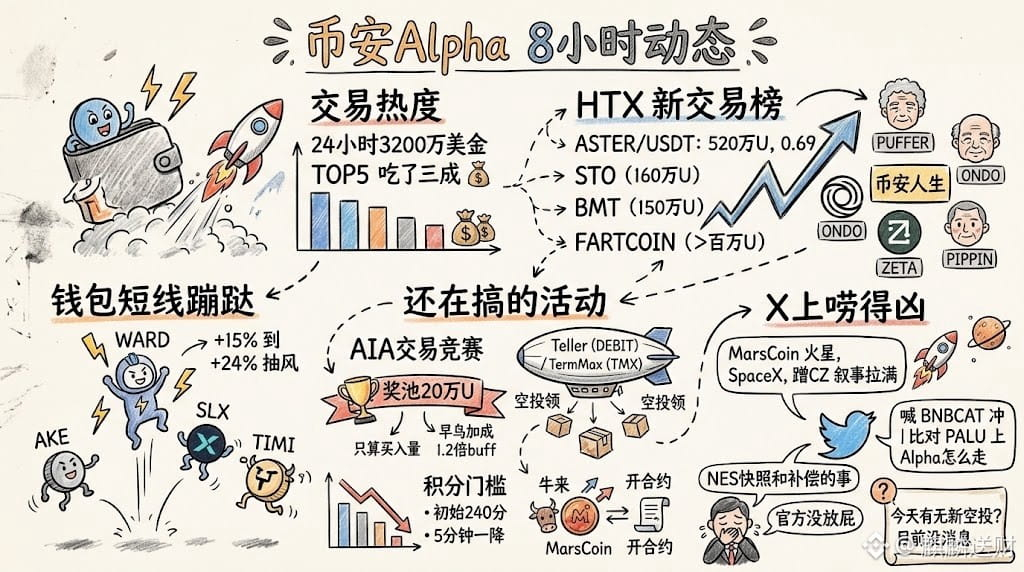
#ALPHA Binance Alpha 8-hour highlights: WARD makes one move and pulls 20 points; ASTER grabs 5 million USDT in total
In the past 8 hours, Binance Alpha didn’t really see any major moves. There’s been no official new-coin announcement, but trading activity hasn’t cooled off—$32 million in the last 24 hours, with the TOP5 taking 30%.
Take a look at HTX’s freshly updated trading leaderboard:
- ASTER/USDT goes straight up to $5.2 million, price at 0.69
- STO and BMT are both around $1.5–1.6 million
- FARTCOIN has also surpassed $1 million
And after that, you still see familiar faces like PUFFER, Binance Life, ONDO, ZETA, and PIPPIN.
For wallets that are hopping around on the short-term side, WARD keeps spiking from time to time, ranging from +15% to +24%—pretty wild. SLX and TIMI have also jumped. AKE, and even Niu Lai and others, are showing activity too.
Let’s talk about the ongoing event: the AIA trading competition prize pool is 200,000 USDT. It only counts purchase volume—there’s an early-bird bonus and a 1.2x buff, with payouts split into two batches. The Teller (DEBIT) and TermMax (TMX) airdrops that launched at the end of August are still claimable. Initially, you need 240 points to claim 50 tokens; but the points threshold keeps dropping—updated every 5 minutes—so keep an eye on it and don’t miss your window and lose out. Also, old-timers like Niu Lai and MarsCoin are trading too—some have opened contracts.
On X right now, the loudest topic is MarsCoin. Between “Mars” and “SpaceX” and even hitching a ride on CZ’s attention, the narrative is fully cranked up. Others are also calling for BNBCAT to push into Alpha, comparing how things went after PALU listed Alpha earlier. There are also people asking about NES snapshots and compensation—so far, the official side hasn’t said a word. No new airdrops today.
#ALPHA Binance Alpha 8-hour highlights: WARD makes one move and pulls 20 points; ASTER grabs 5 million USDT in total
In the past 8 hours, Binance Alpha didn’t really see any major moves. There’s been no official new-coin announcement, but trading activity hasn’t cooled off—$32 million in the last 24 hours, with the TOP5 taking 30%.
Take a look at HTX’s freshly updated trading leaderboard:
- ASTER/USDT goes straight up to $5.2 million, price at 0.69
- STO and BMT are both around $1.5–1.6 million
- FARTCOIN has also surpassed $1 million
And after that, you still see familiar faces like PUFFER, Binance Life, ONDO, ZETA, and PIPPIN.
For wallets that are hopping around on the short-term side, WARD keeps spiking from time to time, ranging from +15% to +24%—pretty wild. SLX and TIMI have also jumped. AKE, and even Niu Lai and others, are showing activity too.
Let’s talk about the ongoing event: the AIA trading competition prize pool is 200,000 USDT. It only counts purchase volume—there’s an early-bird bonus and a 1.2x buff, with payouts split into two batches. The Teller (DEBIT) and TermMax (TMX) airdrops that launched at the end of August are still claimable. Initially, you need 240 points to claim 50 tokens; but the points threshold keeps dropping—updated every 5 minutes—so keep an eye on it and don’t miss your window and lose out. Also, old-timers like Niu Lai and MarsCoin are trading too—some have opened contracts.
On X right now, the loudest topic is MarsCoin. Between “Mars” and “SpaceX” and even hitching a ride on CZ’s attention, the narrative is fully cranked up. Others are also calling for BNBCAT to push into Alpha, comparing how things went after PALU listed Alpha earlier. There are also people asking about NES snapshots and compensation—so far, the official side hasn’t said a word. No new airdrops today.
In the past 8 hours, Binance Alpha didn’t really see any major moves. There’s been no official new-coin announcement, but trading activity hasn’t cooled off—$32 million in the last 24 hours, with the TOP5 taking 30%.
Take a look at HTX’s freshly updated trading leaderboard:
- ASTER/USDT goes straight up to $5.2 million, price at 0.69
- STO and BMT are both around $1.5–1.6 million
- FARTCOIN has also surpassed $1 million
And after that, you still see familiar faces like PUFFER, Binance Life, ONDO, ZETA, and PIPPIN.
For wallets that are hopping around on the short-term side, WARD keeps spiking from time to time, ranging from +15% to +24%—pretty wild. SLX and TIMI have also jumped. AKE, and even Niu Lai and others, are showing activity too.
Let’s talk about the ongoing event: the AIA trading competition prize pool is 200,000 USDT. It only counts purchase volume—there’s an early-bird bonus and a 1.2x buff, with payouts split into two batches. The Teller (DEBIT) and TermMax (TMX) airdrops that launched at the end of August are still claimable. Initially, you need 240 points to claim 50 tokens; but the points threshold keeps dropping—updated every 5 minutes—so keep an eye on it and don’t miss your window and lose out. Also, old-timers like Niu Lai and MarsCoin are trading too—some have opened contracts.
On X right now, the loudest topic is MarsCoin. Between “Mars” and “SpaceX” and even hitching a ride on CZ’s attention, the narrative is fully cranked up. Others are also calling for BNBCAT to push into Alpha, comparing how things went after PALU listed Alpha earlier. There are also people asking about NES snapshots and compensation—so far, the official side hasn’t said a word. No new airdrops today.
1
1.6k
·
--
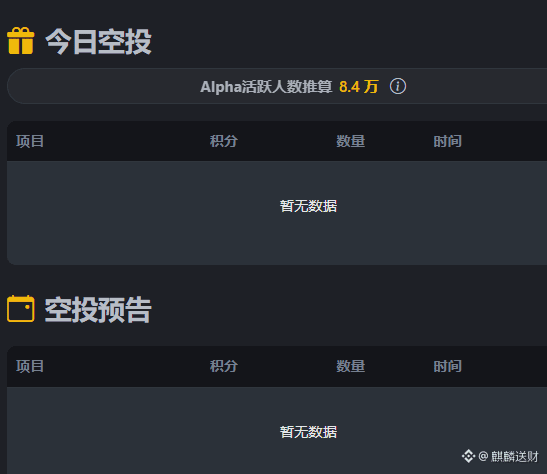
August 28, #ALPHA 8 — Alpha airdrop announcement! 8.4W participants!
📅 Today’s airdrop
It’s already afternoon and there’s still no announcement!
Yesterday, the total成交 volume of the limit order was 1.372 billion, which is 0.57% more than the day before.
Let’s focus on the latest data from the Alpha 24-hour trading contest:
GWEI is still in first place. Price: 0.028. In the past 24 hours it’s risen by 15 points, with a trading volume of 5.62 million. The total trading contest volume is now 362 million, with about 6 hours left. The top 2000 participants will share the rewards: each gets 2200 GWEI, which is about 61U at the current price.
2nd place: KGEN. Price: 0.1827, up 1.73% slightly. Total成交 volume: 158 million, with 7 days left. Each person gets 295 KGEN, about 53U.
APR has dropped by nearly 10 points, current price 0.2043. Total成交: 62.59 million, with about 6 hours left as well. Reward: 106 APR, which is only 21U equivalent.
AIA is down 1.71%, with total成交 of only 510k. Today’s limit orders are 94k, with 6 days left.
IN is up 1% slightly. Total成交: 54k. Today’s 34k, with 7 days left.
Today’s operating advice: (Token points ×4 for listing within 30 days)
For the exchange, spam the GRVT limit orders: 200–500U, multiple small transactions. 1 day left.
August 28, #ALPHA 8 — Alpha airdrop announcement! 8.4W participants!
📅 Today’s airdrop
It’s already afternoon and there’s still no announcement!
Yesterday, the total成交 volume of the limit order was 1.372 billion, which is 0.57% more than the day before.
Let’s focus on the latest data from the Alpha 24-hour trading contest:
GWEI is still in first place. Price: 0.028. In the past 24 hours it’s risen by 15 points, with a trading volume of 5.62 million. The total trading contest volume is now 362 million, with about 6 hours left. The top 2000 participants will share the rewards: each gets 2200 GWEI, which is about 61U at the current price.
2nd place: KGEN. Price: 0.1827, up 1.73% slightly. Total成交 volume: 158 million, with 7 days left. Each person gets 295 KGEN, about 53U.
APR has dropped by nearly 10 points, current price 0.2043. Total成交: 62.59 million, with about 6 hours left as well. Reward: 106 APR, which is only 21U equivalent.
AIA is down 1.71%, with total成交 of only 510k. Today’s limit orders are 94k, with 6 days left.
IN is up 1% slightly. Total成交: 54k. Today’s 34k, with 7 days left.
Today’s operating advice: (Token points ×4 for listing within 30 days)
For the exchange, spam the GRVT limit orders: 200–500U, multiple small transactions. 1 day left.
📅 Today’s airdrop
It’s already afternoon and there’s still no announcement!
Yesterday, the total成交 volume of the limit order was 1.372 billion, which is 0.57% more than the day before.
Let’s focus on the latest data from the Alpha 24-hour trading contest:
GWEI is still in first place. Price: 0.028. In the past 24 hours it’s risen by 15 points, with a trading volume of 5.62 million. The total trading contest volume is now 362 million, with about 6 hours left. The top 2000 participants will share the rewards: each gets 2200 GWEI, which is about 61U at the current price.
2nd place: KGEN. Price: 0.1827, up 1.73% slightly. Total成交 volume: 158 million, with 7 days left. Each person gets 295 KGEN, about 53U.
APR has dropped by nearly 10 points, current price 0.2043. Total成交: 62.59 million, with about 6 hours left as well. Reward: 106 APR, which is only 21U equivalent.
AIA is down 1.71%, with total成交 of only 510k. Today’s limit orders are 94k, with 6 days left.
IN is up 1% slightly. Total成交: 54k. Today’s 34k, with 7 days left.
Today’s operating advice: (Token points ×4 for listing within 30 days)
For the exchange, spam the GRVT limit orders: 200–500U, multiple small transactions. 1 day left.
3
5
6.5k
·
--
Partly True
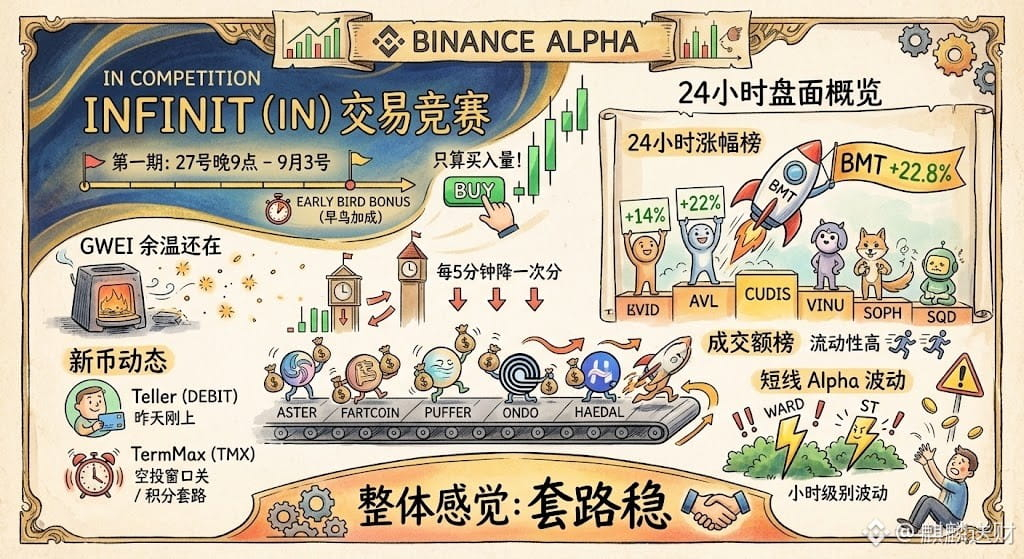
#ALPHA Binance Alpha 8-hour update: The IN competition opens—BMT leads the pump
Let’s get straight to the point. The INFINIT (IN) trading competition has just kicked off. Round one runs from 9 p.m. on the 27th (our local time) until September 3rd. There’s also an early-bird bonus—remember, only buy volume counts. As for GWEI, interest has cooled a bit, but the momentum is still there.
New coins: Teller (DEBIT) is a brand-new face added yesterday. TermMax (TMX) has just closed its airdrop window—it’s playing that points game: first come, first served, with points decreasing every 5 minutes.
Now, take another look at the charts.
On the 24-hour gainers list, BMT is putting in work—it’s up 22 percentage points. AVL, CUDIS, VINU, SOPH, and SQD are also hanging around the top, but BMT is definitely the most eye-catching. As for trading volume, ASTER, FARTCOIN, PUFFER, ONDO, HAEDAL, and the aforementioned BMT—these guys frequently trade places on the leaderboard. Liquidity is like a rocket, constantly moving around. For the short-term side, names like WARD and ST—those with hour-level volatility—pop up from time to time. That’s classic Alpha vibes: money comes in fast and leaves even faster. If you’re slow, you’ll literally end up getting left behind at the flagpole.
Overall, it boils down to two words: solid strategy.
#ALPHA Binance Alpha 8-hour update: The IN competition opens—BMT leads the pump
Let’s get straight to the point. The INFINIT (IN) trading competition has just kicked off. Round one runs from 9 p.m. on the 27th (our local time) until September 3rd. There’s also an early-bird bonus—remember, only buy volume counts. As for GWEI, interest has cooled a bit, but the momentum is still there.
New coins: Teller (DEBIT) is a brand-new face added yesterday. TermMax (TMX) has just closed its airdrop window—it’s playing that points game: first come, first served, with points decreasing every 5 minutes.
Now, take another look at the charts.
On the 24-hour gainers list, BMT is putting in work—it’s up 22 percentage points. AVL, CUDIS, VINU, SOPH, and SQD are also hanging around the top, but BMT is definitely the most eye-catching. As for trading volume, ASTER, FARTCOIN, PUFFER, ONDO, HAEDAL, and the aforementioned BMT—these guys frequently trade places on the leaderboard. Liquidity is like a rocket, constantly moving around. For the short-term side, names like WARD and ST—those with hour-level volatility—pop up from time to time. That’s classic Alpha vibes: money comes in fast and leaves even faster. If you’re slow, you’ll literally end up getting left behind at the flagpole.
Overall, it boils down to two words: solid strategy.
Let’s get straight to the point. The INFINIT (IN) trading competition has just kicked off. Round one runs from 9 p.m. on the 27th (our local time) until September 3rd. There’s also an early-bird bonus—remember, only buy volume counts. As for GWEI, interest has cooled a bit, but the momentum is still there.
New coins: Teller (DEBIT) is a brand-new face added yesterday. TermMax (TMX) has just closed its airdrop window—it’s playing that points game: first come, first served, with points decreasing every 5 minutes.
Now, take another look at the charts.
On the 24-hour gainers list, BMT is putting in work—it’s up 22 percentage points. AVL, CUDIS, VINU, SOPH, and SQD are also hanging around the top, but BMT is definitely the most eye-catching. As for trading volume, ASTER, FARTCOIN, PUFFER, ONDO, HAEDAL, and the aforementioned BMT—these guys frequently trade places on the leaderboard. Liquidity is like a rocket, constantly moving around. For the short-term side, names like WARD and ST—those with hour-level volatility—pop up from time to time. That’s classic Alpha vibes: money comes in fast and leaves even faster. If you’re slow, you’ll literally end up getting left behind at the flagpole.
Overall, it boils down to two words: solid strategy.
1
1.2k
·
--
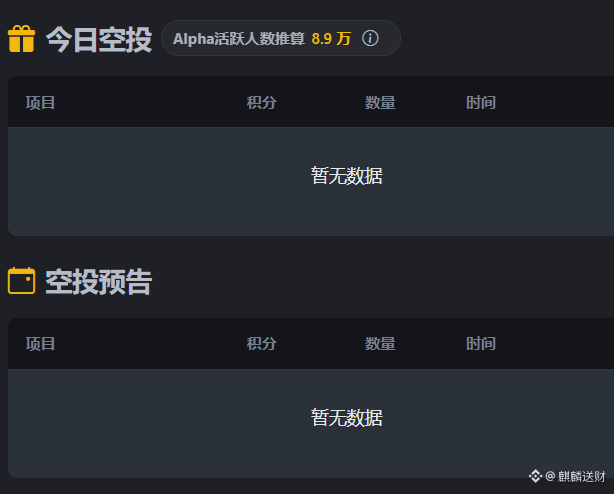
August 27, #ALPHA 8 — Alpha Airdrop Preview! 8.9W participants!
📅 Today’s Airdrop
Good afternoon. Up to now it’s been at zero; 2 have already been scheduled this week. Could there be a surprise?
Yesterday, the total trading volume of the limit-order set was about 1.364 billion, down 6.61% from the previous day.
Alpha 24-hour Trading Race Data:
KGEN ends tonight at 21:00. The leaderboard jumped from 287,000 yesterday to 362,000 today—an increase of a bit over 75,000 in one day.
GWEI is also rising. Yesterday the leaderboard was only a bit over one thousand; today it’s directly up to 19,000—an increase of nearly 18,000 in a day.
Trading Suggestions for Today:
Increase scores. Recommended: use the exchange’s limit-order to score GRVT. With two days left, do multiple small刷 (orders) of 200–500U each.
August 27, #ALPHA 8 — Alpha Airdrop Preview! 8.9W participants!
📅 Today’s Airdrop
Good afternoon. Up to now it’s been at zero; 2 have already been scheduled this week. Could there be a surprise?
Yesterday, the total trading volume of the limit-order set was about 1.364 billion, down 6.61% from the previous day.
Alpha 24-hour Trading Race Data:
KGEN ends tonight at 21:00. The leaderboard jumped from 287,000 yesterday to 362,000 today—an increase of a bit over 75,000 in one day.
GWEI is also rising. Yesterday the leaderboard was only a bit over one thousand; today it’s directly up to 19,000—an increase of nearly 18,000 in a day.
Trading Suggestions for Today:
Increase scores. Recommended: use the exchange’s limit-order to score GRVT. With two days left, do multiple small刷 (orders) of 200–500U each.
📅 Today’s Airdrop
Good afternoon. Up to now it’s been at zero; 2 have already been scheduled this week. Could there be a surprise?
Yesterday, the total trading volume of the limit-order set was about 1.364 billion, down 6.61% from the previous day.
Alpha 24-hour Trading Race Data:
KGEN ends tonight at 21:00. The leaderboard jumped from 287,000 yesterday to 362,000 today—an increase of a bit over 75,000 in one day.
GWEI is also rising. Yesterday the leaderboard was only a bit over one thousand; today it’s directly up to 19,000—an increase of nearly 18,000 in a day.
Trading Suggestions for Today:
Increase scores. Recommended: use the exchange’s limit-order to score GRVT. With two days left, do multiple small刷 (orders) of 200–500U each.
6
2.6k
·
--
Verified
#ALPHA Binance Alpha 8-hour update: New coin DEBIT surges by 180% at one point
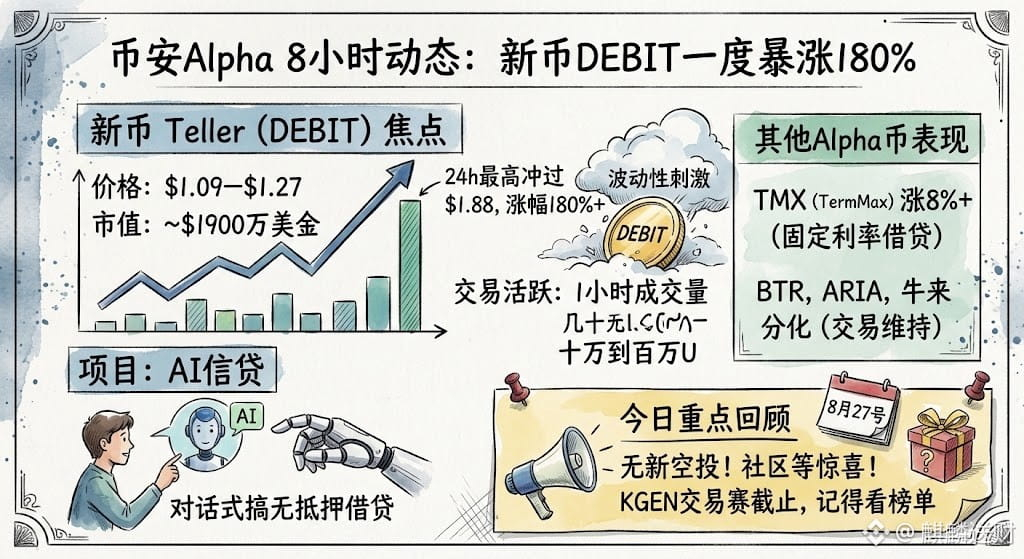
First, the highlights: Teller (DEBIT)! Yesterday at 18:00 (that is 18:00 on Aug 26, UTC+8), Binance Alpha launched. The initial airdrop requirement was 240 points to claim 50 DEBIT—first come, first served—at a cost of 15 points per claim. The threshold automatically dropped by 5 points every 5 minutes. Now looking at the chart, the price is fluctuating in the $1.09–$1.27 range. The 24h high pushed past $1.88, while the low dipped to around $0.45. When it hit the peak, the move ran up 180%+—pretty exciting, right? The market cap is around $19 million, give or take. Liquidity looks decent: 1-hour trading volume is in the hundreds of thousands to millions of “U”. Wallet addresses holding the coin are also rising fast.
The project talks about AI credit: a chat-based, unsecured lending concept—pretty fresh. Other exchanges like Bitget have also jumped in.
How are other Alpha coins performing?
TMX (TermMax) is up about 8%. Trading is fairly active, and it’s in the fixed-rate lending track, with a market cap around $25 million. BTR, ARIA, and Niulai (bull/lending-related names) are showing heavy divergence—some are up only a few points, but volume is staying healthy. Overall, the sector’s trading volume is still there. Limit and market order participants are plentiful. Points farming and trading competitions are still ongoing, and some events are nearing the finish line.
Key point:
Today (Aug 27) so far there are zero drops—no new airdrops yet. The community is all waiting for a surprise. Some trading competitions, like KGEN’s, are ending today—make sure to check the leaderboard.
#ALPHA Binance Alpha 8-hour update: New coin DEBIT surges by 180% at one point
First, the highlights: Teller (DEBIT)! Yesterday at 18:00 (that is 18:00 on Aug 26, UTC+8), Binance Alpha launched. The initial airdrop requirement was 240 points to claim 50 DEBIT—first come, first served—at a cost of 15 points per claim. The threshold automatically dropped by 5 points every 5 minutes. Now looking at the chart, the price is fluctuating in the $1.09–$1.27 range. The 24h high pushed past $1.88, while the low dipped to around $0.45. When it hit the peak, the move ran up 180%+—pretty exciting, right? The market cap is around $19 million, give or take. Liquidity looks decent: 1-hour trading volume is in the hundreds of thousands to millions of “U”. Wallet addresses holding the coin are also rising fast.
The project talks about AI credit: a chat-based, unsecured lending concept—pretty fresh. Other exchanges like Bitget have also jumped in.
How are other Alpha coins performing?
TMX (TermMax) is up about 8%. Trading is fairly active, and it’s in the fixed-rate lending track, with a market cap around $25 million. BTR, ARIA, and Niulai (bull/lending-related names) are showing heavy divergence—some are up only a few points, but volume is staying healthy. Overall, the sector’s trading volume is still there. Limit and market order participants are plentiful. Points farming and trading competitions are still ongoing, and some events are nearing the finish line.
Key point:
Today (Aug 27) so far there are zero drops—no new airdrops yet. The community is all waiting for a surprise. Some trading competitions, like KGEN’s, are ending today—make sure to check the leaderboard.
First, the highlights: Teller (DEBIT)! Yesterday at 18:00 (that is 18:00 on Aug 26, UTC+8), Binance Alpha launched. The initial airdrop requirement was 240 points to claim 50 DEBIT—first come, first served—at a cost of 15 points per claim. The threshold automatically dropped by 5 points every 5 minutes. Now looking at the chart, the price is fluctuating in the $1.09–$1.27 range. The 24h high pushed past $1.88, while the low dipped to around $0.45. When it hit the peak, the move ran up 180%+—pretty exciting, right? The market cap is around $19 million, give or take. Liquidity looks decent: 1-hour trading volume is in the hundreds of thousands to millions of “U”. Wallet addresses holding the coin are also rising fast.
The project talks about AI credit: a chat-based, unsecured lending concept—pretty fresh. Other exchanges like Bitget have also jumped in.
How are other Alpha coins performing?
TMX (TermMax) is up about 8%. Trading is fairly active, and it’s in the fixed-rate lending track, with a market cap around $25 million. BTR, ARIA, and Niulai (bull/lending-related names) are showing heavy divergence—some are up only a few points, but volume is staying healthy. Overall, the sector’s trading volume is still there. Limit and market order participants are plentiful. Points farming and trading competitions are still ongoing, and some events are nearing the finish line.
Key point:
Today (Aug 27) so far there are zero drops—no new airdrops yet. The community is all waiting for a surprise. Some trading competitions, like KGEN’s, are ending today—make sure to check the leaderboard.
6
2.6k
·
--
July 26th, #ALPHA 8 Alpha Airdrop announcement! 9.3W people!
📅 Today’s Airdrop
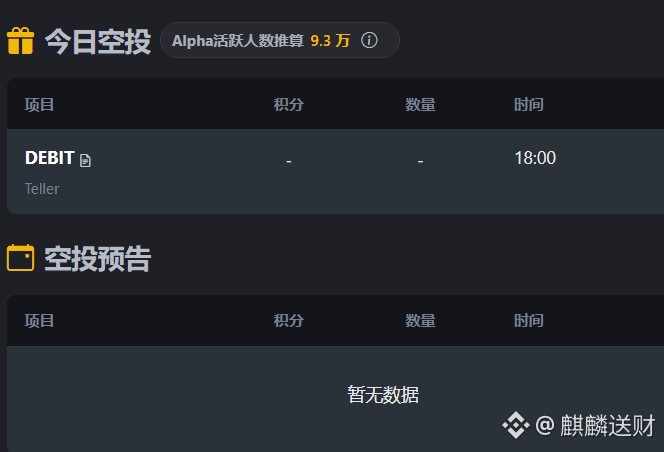
Brothers, good afternoon! Today at 18:00, DEBIT opens. Funding is $7.8–$8.7 million. Total token supply: 100 million. Fraction around 240. Estimated profit: about 30U–60U.
Yesterday, the total trading volume on the limit orders was a bit over 1.46 billion, down 4.83% from the day before yesterday.
Alpha Trading Competition Updates:
- DOS, finish at 21:00 tonight! The leaderboard jumped from 452,920 to 524,232—an increase of over 70,000 in one day.
- KGEN, 179,586 to 287,163—surged by over 100,000.
- GWEI, from 149 straight to 1,099—up by nearly 1,000.
Today’s strategy (new coins within 30 days, points are doubled):
Use limit orders to trade GRVT for 3 days—multiple small buys of 200–500U each.
July 26th, #ALPHA 8 Alpha Airdrop announcement! 9.3W people!
📅 Today’s Airdrop
Brothers, good afternoon! Today at 18:00, DEBIT opens. Funding is $7.8–$8.7 million. Total token supply: 100 million. Fraction around 240. Estimated profit: about 30U–60U.
Yesterday, the total trading volume on the limit orders was a bit over 1.46 billion, down 4.83% from the day before yesterday.
Alpha Trading Competition Updates:
- DOS, finish at 21:00 tonight! The leaderboard jumped from 452,920 to 524,232—an increase of over 70,000 in one day.
- KGEN, 179,586 to 287,163—surged by over 100,000.
- GWEI, from 149 straight to 1,099—up by nearly 1,000.
Today’s strategy (new coins within 30 days, points are doubled):
Use limit orders to trade GRVT for 3 days—multiple small buys of 200–500U each.
📅 Today’s Airdrop
Brothers, good afternoon! Today at 18:00, DEBIT opens. Funding is $7.8–$8.7 million. Total token supply: 100 million. Fraction around 240. Estimated profit: about 30U–60U.
Yesterday, the total trading volume on the limit orders was a bit over 1.46 billion, down 4.83% from the day before yesterday.
Alpha Trading Competition Updates:
- DOS, finish at 21:00 tonight! The leaderboard jumped from 452,920 to 524,232—an increase of over 70,000 in one day.
- KGEN, 179,586 to 287,163—surged by over 100,000.
- GWEI, from 149 straight to 1,099—up by nearly 1,000.
Today’s strategy (new coins within 30 days, points are doubled):
Use limit orders to trade GRVT for 3 days—multiple small buys of 200–500U each.
10
17
7k
·
--
To be honest, when that “instant settlement” slogan for @Dusk_Foundation first came out, I was actually a bit tempted. But once I sat down and looked closely at the first challenge, I calmed down: all trades have to be stuffed into DuskEVM’s sequencer first to queue up—like going through the subway gate during rush hour, just one narrow opening. The question is, who manages this “cashier counter”? Is it centralized? Can people cut the line? The docs don’t mention a single word. They made the on-chain order book so complicated to prevent manipulation, yet the sorting privilege at the entry is held by one party. The order itself is an information advantage. Deterministic settlement is decentralized, but sorting power is centralized—somehow, this deal doesn’t feel right.
Let’s talk about Gas too. It’s calculated as gas_used × gas_price, and the unit is LUX. 1 DUSK equals 1 billion LUX—pretty straightforward. The gas limit is a cap: you don’t pay for unused gas; if the transaction runs out of gas mid-way, it rolls back, but the portion already consumed is still charged. They say this is to prevent attackers from freeloading node compute power. So every time I confirm in my wallet, I have to break it down and check three things: is the limit enough, is the price reasonable, and did I enter the parameters correctly. If it fails, don’t just get emotional and try again with doubled values—first open the browser and figure out why.
Where the fees go also affects your judgment. The block reward is the newly issued $DUSK plus transaction fees, distributed to the block producer, the developer foundation fund, and the committee. Any undistributed portion is said to be possibly burned. But after I looked around, I didn’t see any fixed automatic payouts for ordinary token holders.
They’ve covered compliance and licenses pretty extensively—NPEX, 21X, Chainlink CCIP, DuskEVM are all listed by name—but the on-chain TVL is still low. There isn’t much real settlement data yet, and Dusk Pay is still in testing. Total supply is 1 billion: half is released at genesis, and the other half gradually gets diluted through long-term staking. Transaction fees are not burned; they flow back to the rewards pool. For me, real value capture isn’t in those license numbers—it depends on contract interaction volumes that are not for foundations, auditable on-chain settlement records, and whether the fees can sustain a sufficient security buffer for the network.
Instant settlement sounds like a smooth experience, but sorting power is an invisible form of control. Gas is the price you pay for computing resources. Compliance is a roadmap that hasn’t finished being walked yet. Once you sort all of that out, then consider boarding. #dusk
To be honest, when that “instant settlement” slogan for @Dusk first came out, I was actually a bit tempted. But once I sat down and looked closely at the first challenge, I calmed down: all trades have to be stuffed into DuskEVM’s sequencer first to queue up—like going through the subway gate during rush hour, just one narrow opening. The question is, who manages this “cashier counter”? Is it centralized? Can people cut the line? The docs don’t mention a single word. They made the on-chain order book so complicated to prevent manipulation, yet the sorting privilege at the entry is held by one party. The order itself is an information advantage. Deterministic settlement is decentralized, but sorting power is centralized—somehow, this deal doesn’t feel right.
Let’s talk about Gas too. It’s calculated as gas_used × gas_price, and the unit is LUX. 1 DUSK equals 1 billion LUX—pretty straightforward. The gas limit is a cap: you don’t pay for unused gas; if the transaction runs out of gas mid-way, it rolls back, but the portion already consumed is still charged. They say this is to prevent attackers from freeloading node compute power. So every time I confirm in my wallet, I have to break it down and check three things: is the limit enough, is the price reasonable, and did I enter the parameters correctly. If it fails, don’t just get emotional and try again with doubled values—first open the browser and figure out why.
Where the fees go also affects your judgment. The block reward is the newly issued $DUSK plus transaction fees, distributed to the block producer, the developer foundation fund, and the committee. Any undistributed portion is said to be possibly burned. But after I looked around, I didn’t see any fixed automatic payouts for ordinary token holders.
They’ve covered compliance and licenses pretty extensively—NPEX, 21X, Chainlink CCIP, DuskEVM are all listed by name—but the on-chain TVL is still low. There isn’t much real settlement data yet, and Dusk Pay is still in testing. Total supply is 1 billion: half is released at genesis, and the other half gradually gets diluted through long-term staking. Transaction fees are not burned; they flow back to the rewards pool. For me, real value capture isn’t in those license numbers—it depends on contract interaction volumes that are not for foundations, auditable on-chain settlement records, and whether the fees can sustain a sufficient security buffer for the network.
Instant settlement sounds like a smooth experience, but sorting power is an invisible form of control. Gas is the price you pay for computing resources. Compliance is a roadmap that hasn’t finished being walked yet. Once you sort all of that out, then consider boarding. #dusk
Let’s talk about Gas too. It’s calculated as gas_used × gas_price, and the unit is LUX. 1 DUSK equals 1 billion LUX—pretty straightforward. The gas limit is a cap: you don’t pay for unused gas; if the transaction runs out of gas mid-way, it rolls back, but the portion already consumed is still charged. They say this is to prevent attackers from freeloading node compute power. So every time I confirm in my wallet, I have to break it down and check three things: is the limit enough, is the price reasonable, and did I enter the parameters correctly. If it fails, don’t just get emotional and try again with doubled values—first open the browser and figure out why.
Where the fees go also affects your judgment. The block reward is the newly issued $DUSK plus transaction fees, distributed to the block producer, the developer foundation fund, and the committee. Any undistributed portion is said to be possibly burned. But after I looked around, I didn’t see any fixed automatic payouts for ordinary token holders.
They’ve covered compliance and licenses pretty extensively—NPEX, 21X, Chainlink CCIP, DuskEVM are all listed by name—but the on-chain TVL is still low. There isn’t much real settlement data yet, and Dusk Pay is still in testing. Total supply is 1 billion: half is released at genesis, and the other half gradually gets diluted through long-term staking. Transaction fees are not burned; they flow back to the rewards pool. For me, real value capture isn’t in those license numbers—it depends on contract interaction volumes that are not for foundations, auditable on-chain settlement records, and whether the fees can sustain a sufficient security buffer for the network.
Instant settlement sounds like a smooth experience, but sorting power is an invisible form of control. Gas is the price you pay for computing resources. Compliance is a roadmap that hasn’t finished being walked yet. Once you sort all of that out, then consider boarding. #dusk
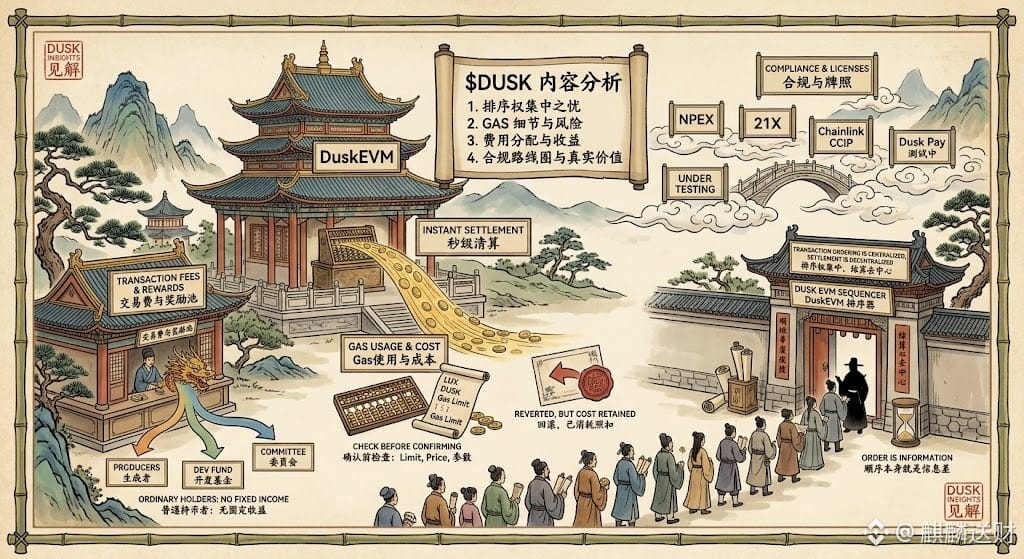
1
1
348
·
--
@termmax has been sent, and the pork knuckle rice is in hand.
@TermMax has been sent, and the pork knuckle rice is in hand.
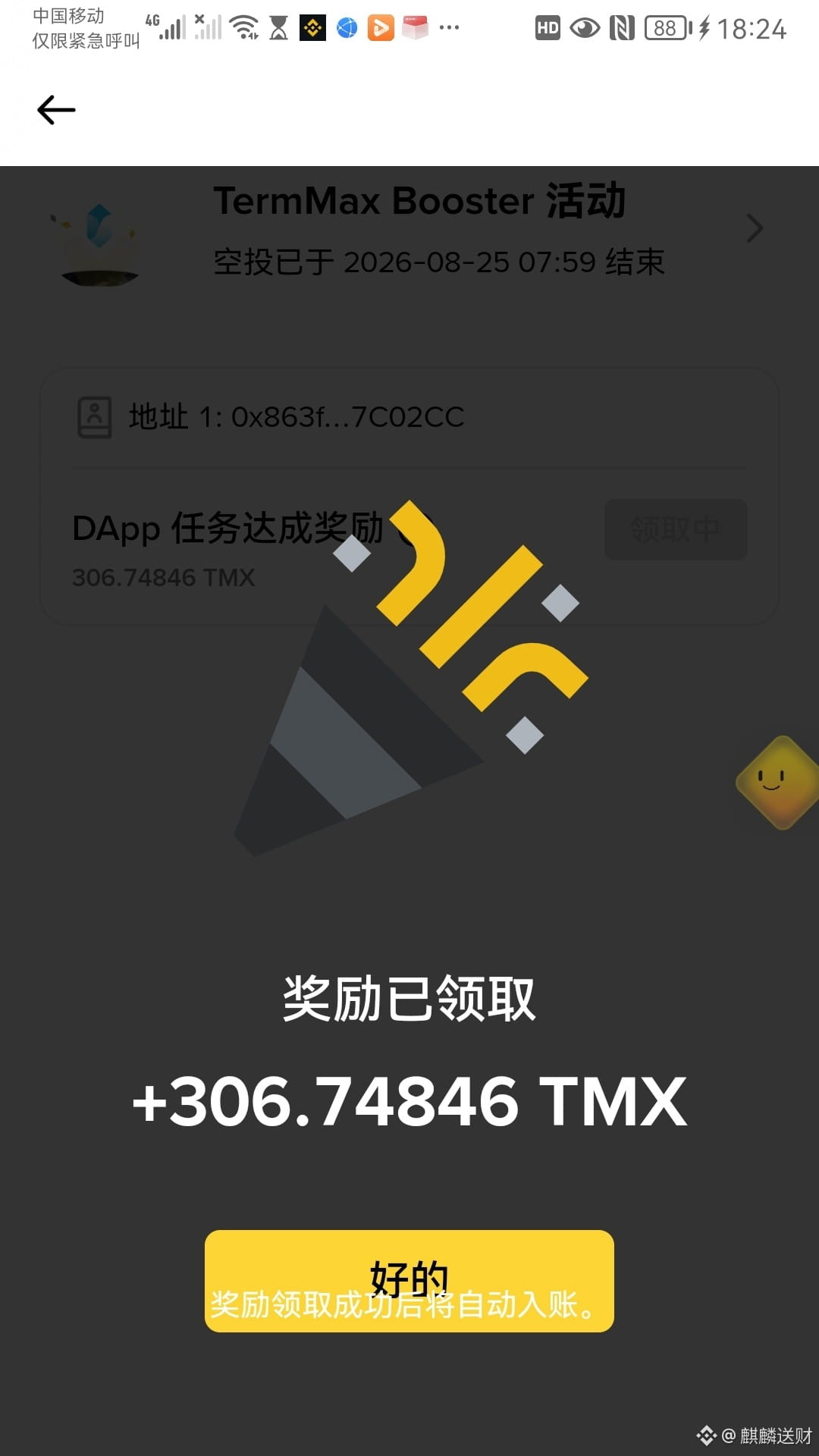
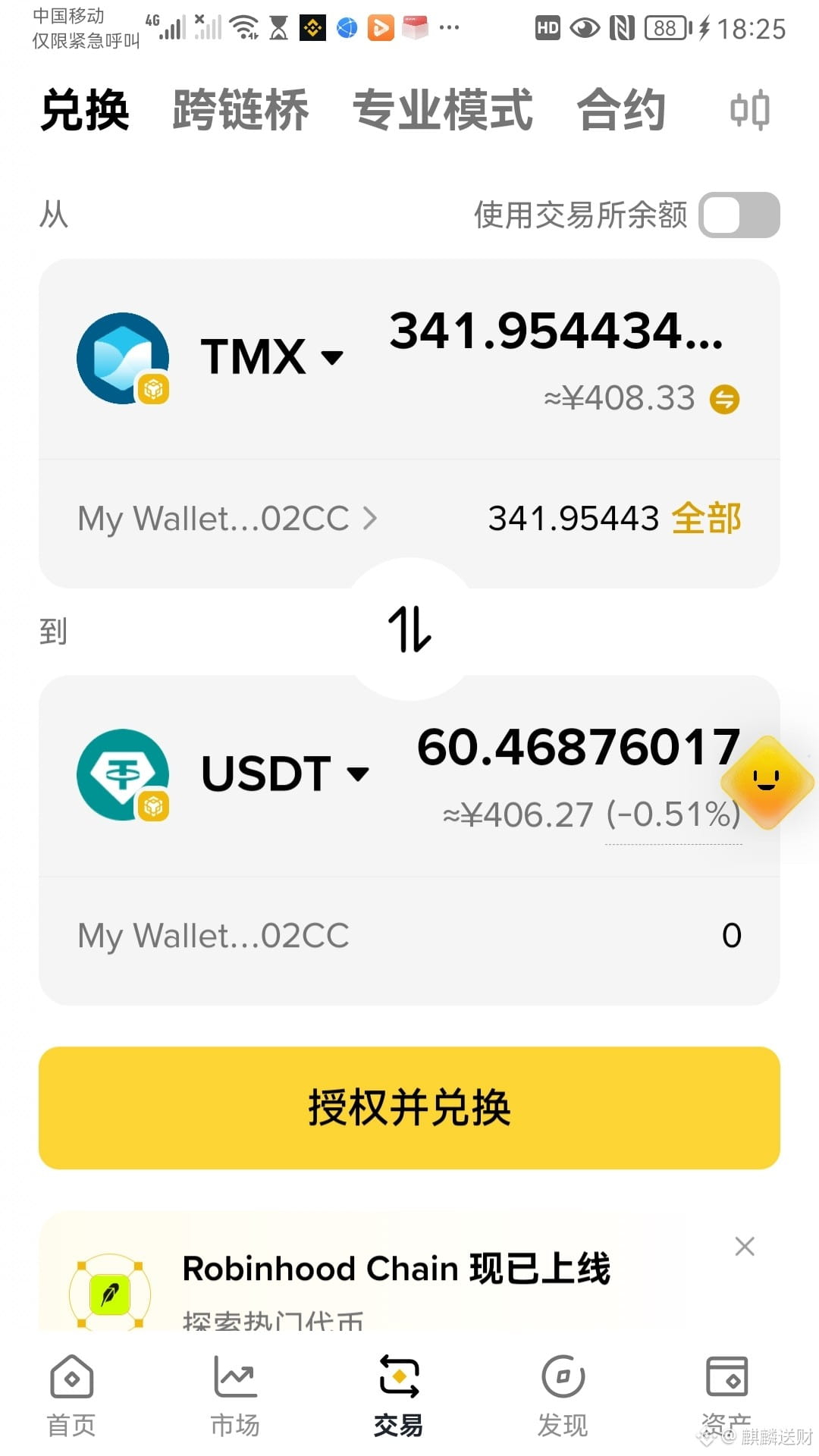
4
2
3.6k
Log in to explore more content
Join global crypto users on Binance Square
⚡️ Get latest and useful information about crypto.
💬 Trusted by the world’s largest crypto exchange.
👍 Discover real insights from verified creators.
Email / Phone number
Trending Topics
USAugustPPIRisesLessThanExpected
32,603 views
642 Discussing
🚨 US AUG PPI: Rises LESS Than Expected! Bullish for Crypto? 🚀
PPI +0.4% MoM as expected, but CORE PPI only +0.2% vs +0.3% expected - cooling!
What it means:
• Wholesale inflation softer than feared
• Fed rate hike chance now 62% - but dovish signals coming
• Core PCE revisions expected downward - bullish
• BTC usually pumps on softer PPI
Fed meeting Sep 15-16 - Market now expects pause, not hike?
Is this the green light for Q4 rally?
#Bitcoin #PPI #Fed #CryptoNews #BTC#usaugustppiriseslessthanexpected
True News
·1 Likes
·1.3k views
SECApprovesNasdaqTexasCommodityTrustRule
20,376 views
483 Discussing
ECBRaisesRatesSecondTimeTo2.5%
17,348 views
358 Discussing