
Zero-sum Gamer
565 Posts

Zero-sum Gamer
Report
Block User
Zero, algotrader.
I develop trading bots for crypto exchanges. In this blog, I’ll share my experience: screeners, bots, algorithms
👉@Pro_Crypto_Resources
6.7K+ Following
1.3K+ Followers
1.0K+ Liked
Posts
All
Quotes
PINNED
·
--
Bullish
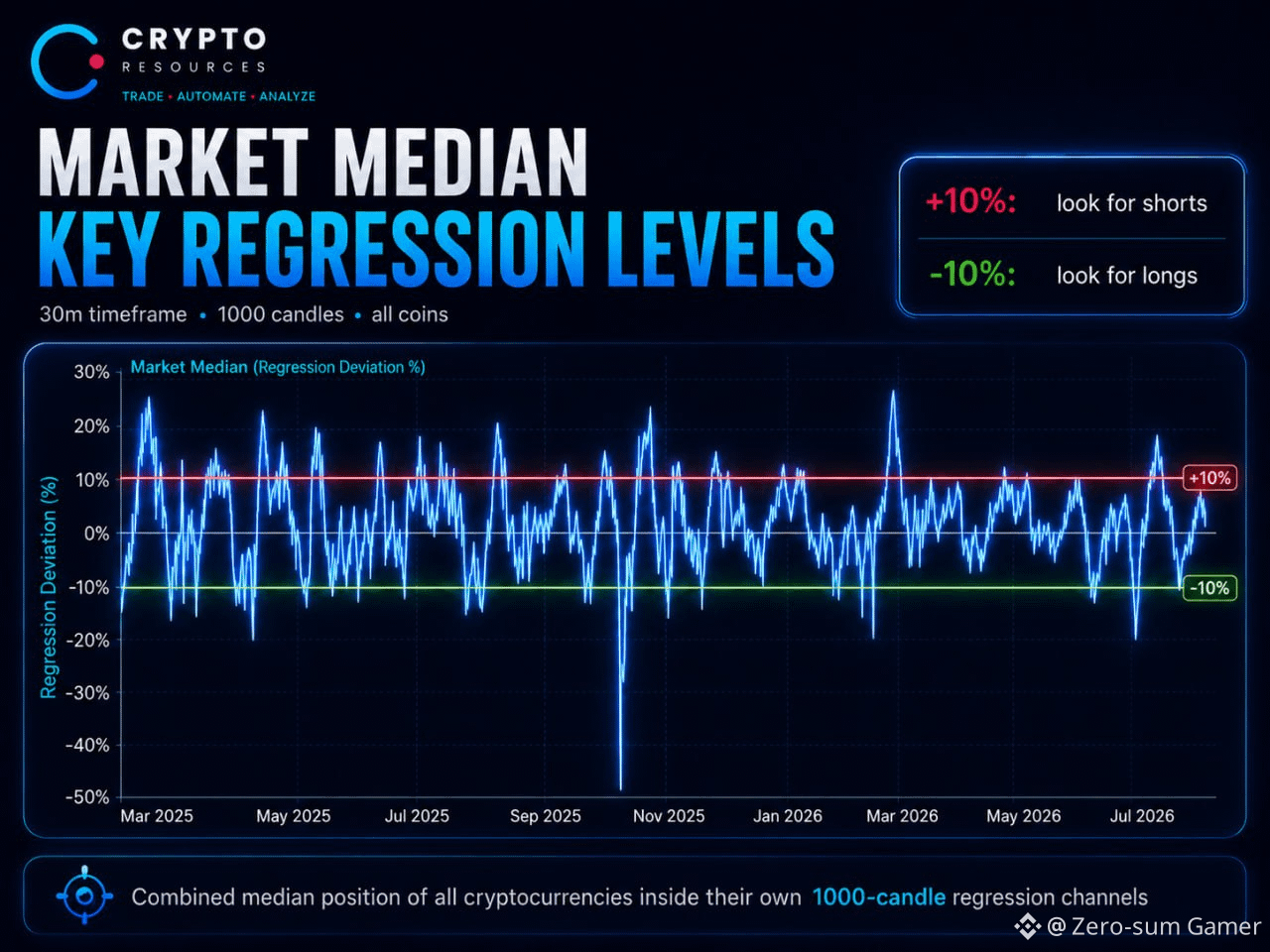
⚡️ Market Median: where crypto usually starts to react
Market Median is not a BTC chart and not an average market price.
It shows where a broad set of cryptocurrencies sits inside their own 1000-candle regression channels on the 30m timeframe, then compresses that into one median reading.
🟢 −10% zone
When the median moves toward −10%, many coins are already trading near the lower parts of their own channels.
That is where rebounds tend to appear more often: forced sellers are already washed out, shorts start closing, and weak hands stop pressing the move.
Still, no blind entries. A lower-zone reading needs confirmation: reaction from the level, local range hold, and reclaim above the nearest structure.
🔴 +10% zone
When the median moves toward +10%, many coins are already stretched near the upper parts of their own channels.
That is where cooling often starts: profit-taking, failed continuation, late buyers getting trapped, and momentum losing breadth.
No need to guess the top. Wait for weakness, failed impulse, and loss of market support.
📊 The working logic
Near −10% — look for rebound and long scenarios after confirmation.
Near +10% — look for rejection and reversal scenarios after confirmation.
Between the zones — less aggression, more filters.
The value is not in one candle. The value is in seeing where the whole crypto market sits relative to its own regression structure.
Most traders watch one chart. Market Median shows when the broader market is already stretched too far.
Market Median is available for free on Crypto Resources.
#rebound #long #short #pivot $MSTR $VELVET $ESPORTS
{future}(ESPORTSUSDT)
{future}(VELVETUSDT)
{future}(MSTRUSDT)
⚡️ Market Median: where crypto usually starts to react
Market Median is not a BTC chart and not an average market price.
It shows where a broad set of cryptocurrencies sits inside their own 1000-candle regression channels on the 30m timeframe, then compresses that into one median reading.
🟢 −10% zone
When the median moves toward −10%, many coins are already trading near the lower parts of their own channels.
That is where rebounds tend to appear more often: forced sellers are already washed out, shorts start closing, and weak hands stop pressing the move.
Still, no blind entries. A lower-zone reading needs confirmation: reaction from the level, local range hold, and reclaim above the nearest structure.
🔴 +10% zone
When the median moves toward +10%, many coins are already stretched near the upper parts of their own channels.
That is where cooling often starts: profit-taking, failed continuation, late buyers getting trapped, and momentum losing breadth.
No need to guess the top. Wait for weakness, failed impulse, and loss of market support.
📊 The working logic
Near −10% — look for rebound and long scenarios after confirmation.
Near +10% — look for rejection and reversal scenarios after confirmation.
Between the zones — less aggression, more filters.
The value is not in one candle. The value is in seeing where the whole crypto market sits relative to its own regression structure.
Most traders watch one chart. Market Median shows when the broader market is already stretched too far.
Market Median is available for free on Crypto Resources.
#rebound #long #short #pivot $MSTR $VELVET $ESPORTS
Market Median is not a BTC chart and not an average market price.
It shows where a broad set of cryptocurrencies sits inside their own 1000-candle regression channels on the 30m timeframe, then compresses that into one median reading.
🟢 −10% zone
When the median moves toward −10%, many coins are already trading near the lower parts of their own channels.
That is where rebounds tend to appear more often: forced sellers are already washed out, shorts start closing, and weak hands stop pressing the move.
Still, no blind entries. A lower-zone reading needs confirmation: reaction from the level, local range hold, and reclaim above the nearest structure.
🔴 +10% zone
When the median moves toward +10%, many coins are already stretched near the upper parts of their own channels.
That is where cooling often starts: profit-taking, failed continuation, late buyers getting trapped, and momentum losing breadth.
No need to guess the top. Wait for weakness, failed impulse, and loss of market support.
📊 The working logic
Near −10% — look for rebound and long scenarios after confirmation.
Near +10% — look for rejection and reversal scenarios after confirmation.
Between the zones — less aggression, more filters.
The value is not in one candle. The value is in seeing where the whole crypto market sits relative to its own regression structure.
Most traders watch one chart. Market Median shows when the broader market is already stretched too far.
Market Median is available for free on Crypto Resources.
#rebound #long #short #pivot $MSTR $VELVET $ESPORTS
6
53
366
PINNED
Article
Can You Become an Algo Trader From Scratch Without Coding?Yes.
But not in the “find a magic bot, switch it on, and forget about it” sense.
You do not need to write algorithms yourself. You need to run them properly.
An algo trader is not necessarily a programmer.
An algo trader is the person who:
chooses which algorithms to runsets risk limitsdecides what to enable, what to disable, and where to allocate capital
The code, signals, webhooks, and execution can already be handled by exchanges, platforms, and ready-made services.
There are usually three roles in algo trading:
Developer — writes the code and builds the strategyOperator — runs bots, adjusts risk, monitors reportsInvestor — provides capital and decides where it goes
If you are starting from zero, you can enter as an operator or investor. You do not need to build your own engine in Python.
There are several layers of automation.
1. Exchange bots and boxed solutions
Many exchanges already offer basic automation: DCA bots, grid bots, simple trend systems, trailing logic, and partial exits.
2. TradingView + alerts + webhooks
You set up indicators or strategies, create alerts, and let those alerts trigger execution on the exchange through a bot. That is already a real algo stack, even if you have never written a line of code.
3. Automating external signals
Some traders automate signals that used to be executed manually. A Telegram signal appears, and the system opens the same small position every time. Technically, that is still algo trading. You are following a rule set, not your mood.
But “no coding” does not mean “no understanding.”
You still need a minimum base:
risk managementbasic strategy typesAPI key safetyperformance stats and drawdown logic
Without that, any bot turns into a slightly more complicated Telegram signal: while conditions are favorable, everything looks easy; once drawdown starts, panic takes over.
A workable path into algo trading looks like this:
start with ready-made strategies and demolearn simple automationtest with small sizebuild a portfolio of algorithms instead of relying on one setup
This is where ready-made platforms become useful.
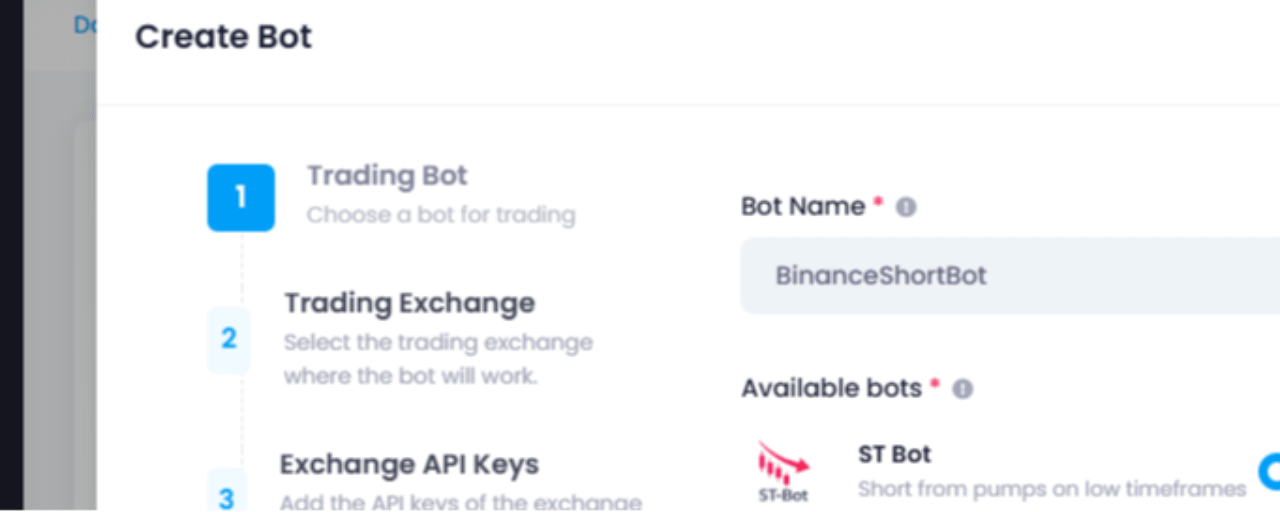
On crypto resource, you do not need to code. You choose strategies, define risk, connect through API without withdrawal rights, and manage the process as an operator.
So yes, you can enter algo trading from zero, and you can do it without programming.
Not because the work disappears.
Because the work shifts from writing code to selecting systems, controlling risk, and managing execution.
#Sign
Can You Become an Algo Trader From Scratch Without Coding?
Yes.
But not in the “find a magic bot, switch it on, and forget about it” sense.
You do not need to write algorithms yourself. You need to run them properly.
An algo trader is not necessarily a programmer.
An algo trader is the person who:
chooses which algorithms to runsets risk limitsdecides what to enable, what to disable, and where to allocate capital
The code, signals, webhooks, and execution can already be handled by exchanges, platforms, and ready-made services.
There are usually three roles in algo trading:
Developer — writes the code and builds the strategyOperator — runs bots, adjusts risk, monitors reportsInvestor — provides capital and decides where it goes
If you are starting from zero, you can enter as an operator or investor. You do not need to build your own engine in Python.
There are several layers of automation.
1. Exchange bots and boxed solutions
Many exchanges already offer basic automation: DCA bots, grid bots, simple trend systems, trailing logic, and partial exits.
2. TradingView + alerts + webhooks
You set up indicators or strategies, create alerts, and let those alerts trigger execution on the exchange through a bot. That is already a real algo stack, even if you have never written a line of code.
3. Automating external signals
Some traders automate signals that used to be executed manually. A Telegram signal appears, and the system opens the same small position every time. Technically, that is still algo trading. You are following a rule set, not your mood.
But “no coding” does not mean “no understanding.”
You still need a minimum base:
risk managementbasic strategy typesAPI key safetyperformance stats and drawdown logic
Without that, any bot turns into a slightly more complicated Telegram signal: while conditions are favorable, everything looks easy; once drawdown starts, panic takes over.
A workable path into algo trading looks like this:
start with ready-made strategies and demolearn simple automationtest with small sizebuild a portfolio of algorithms instead of relying on one setup
This is where ready-made platforms become useful.
On crypto resource, you do not need to code. You choose strategies, define risk, connect through API without withdrawal rights, and manage the process as an operator.
So yes, you can enter algo trading from zero, and you can do it without programming.
Not because the work disappears.
Because the work shifts from writing code to selecting systems, controlling risk, and managing execution.
#Sign
But not in the “find a magic bot, switch it on, and forget about it” sense.
You do not need to write algorithms yourself. You need to run them properly.
An algo trader is not necessarily a programmer.
An algo trader is the person who:
chooses which algorithms to runsets risk limitsdecides what to enable, what to disable, and where to allocate capital
The code, signals, webhooks, and execution can already be handled by exchanges, platforms, and ready-made services.
There are usually three roles in algo trading:
Developer — writes the code and builds the strategyOperator — runs bots, adjusts risk, monitors reportsInvestor — provides capital and decides where it goes
If you are starting from zero, you can enter as an operator or investor. You do not need to build your own engine in Python.
There are several layers of automation.
1. Exchange bots and boxed solutions
Many exchanges already offer basic automation: DCA bots, grid bots, simple trend systems, trailing logic, and partial exits.
2. TradingView + alerts + webhooks
You set up indicators or strategies, create alerts, and let those alerts trigger execution on the exchange through a bot. That is already a real algo stack, even if you have never written a line of code.
3. Automating external signals
Some traders automate signals that used to be executed manually. A Telegram signal appears, and the system opens the same small position every time. Technically, that is still algo trading. You are following a rule set, not your mood.
But “no coding” does not mean “no understanding.”
You still need a minimum base:
risk managementbasic strategy typesAPI key safetyperformance stats and drawdown logic
Without that, any bot turns into a slightly more complicated Telegram signal: while conditions are favorable, everything looks easy; once drawdown starts, panic takes over.
A workable path into algo trading looks like this:
start with ready-made strategies and demolearn simple automationtest with small sizebuild a portfolio of algorithms instead of relying on one setup
This is where ready-made platforms become useful.
On crypto resource, you do not need to code. You choose strategies, define risk, connect through API without withdrawal rights, and manage the process as an operator.
So yes, you can enter algo trading from zero, and you can do it without programming.
Not because the work disappears.
Because the work shifts from writing code to selecting systems, controlling risk, and managing execution.
#Sign
1
43
696
·
--
Bearish
#cpiwatch - 🔥 WHY MARKETS ARE PRICING A FED HIKE AGAIN
The Fed meets on September 16, and the market has shifted back toward a possible rate increase.
📊 August PPI: +0.4% MoM, +5.4% YoY.
📈 #cpi : +0.4% MoM, +3.4% YoY. Core inflation also came in stronger than expected.
That is a bad mix for the Fed.
🎯 Polymarket is now pricing roughly a 60%+ chance of a 25 bps hike.
Why hike if higher rates hurt the economy?
Because sticky inflation is the bigger problem.
Higher rates slow credit, housing and investment. They also pressure stocks and crypto.
But leaving policy too loose while inflation stays elevated risks another inflation wave.
🛢 #Oil above $100 makes the setup even worse. Expensive energy feeds inflation, while a strong labor market gives the Fed more room to stay restrictive.
For crypto, the transmission is straightforward:
higher rates → higher yields → tighter liquidity → less demand for risk
The key is not just whether the #Fed hikes.
If September is a one-off move, part of the damage may already be priced in.
If it becomes the start of a new tightening cycle, #BTC gets a harder macro regime and altcoins usually take the bigger hit. ⚠️
$LAB $LSK $RIVER
#cpiwatch - 🔥 WHY MARKETS ARE PRICING A FED HIKE AGAIN
The Fed meets on September 16, and the market has shifted back toward a possible rate increase.
📊 August PPI: +0.4% MoM, +5.4% YoY.
📈 #cpi : +0.4% MoM, +3.4% YoY. Core inflation also came in stronger than expected.
That is a bad mix for the Fed.
🎯 Polymarket is now pricing roughly a 60%+ chance of a 25 bps hike.
Why hike if higher rates hurt the economy?
Because sticky inflation is the bigger problem.
Higher rates slow credit, housing and investment. They also pressure stocks and crypto.
But leaving policy too loose while inflation stays elevated risks another inflation wave.
🛢 #Oil above $100 makes the setup even worse. Expensive energy feeds inflation, while a strong labor market gives the Fed more room to stay restrictive.
For crypto, the transmission is straightforward:
higher rates → higher yields → tighter liquidity → less demand for risk
The key is not just whether the #Fed hikes.
If September is a one-off move, part of the damage may already be priced in.
If it becomes the start of a new tightening cycle, #BTC gets a harder macro regime and altcoins usually take the bigger hit. ⚠️
$LAB $LSK $RIVER
The Fed meets on September 16, and the market has shifted back toward a possible rate increase.
📊 August PPI: +0.4% MoM, +5.4% YoY.
📈 #cpi : +0.4% MoM, +3.4% YoY. Core inflation also came in stronger than expected.
That is a bad mix for the Fed.
🎯 Polymarket is now pricing roughly a 60%+ chance of a 25 bps hike.
Why hike if higher rates hurt the economy?
Because sticky inflation is the bigger problem.
Higher rates slow credit, housing and investment. They also pressure stocks and crypto.
But leaving policy too loose while inflation stays elevated risks another inflation wave.
🛢 #Oil above $100 makes the setup even worse. Expensive energy feeds inflation, while a strong labor market gives the Fed more room to stay restrictive.
For crypto, the transmission is straightforward:
higher rates → higher yields → tighter liquidity → less demand for risk
The key is not just whether the #Fed hikes.
If September is a one-off move, part of the damage may already be priced in.
If it becomes the start of a new tightening cycle, #BTC gets a harder macro regime and altcoins usually take the bigger hit. ⚠️
$LAB $LSK $RIVER

2
93
📊 Market Median / September 12, 2026
📌 30m slice: RegDev −1.85%, above SMA200 29.81%, Median RSI 52.76.
Yesterday breadth was just 15.56%. Today it recovered to 29.81%, RSI rose from 50.55 to 52.76, and RegDev improved from −3.47% to −1.85%. The bounce continues, but there is still no broad reversal.
📊 RSI is back above 50, but roughly 70% of coins remain below SMA200. RegDev is still negative as well. No broad setup right now.
Trade plan: longs get more interesting if breadth recovers above 40–50% and RegDev keeps improving. Shorts return if RSI loses 50 and breadth starts weakening again.
⚠️ Common mistake: treating RSI above 50 as a full-market reversal while breadth is still below 30%.
#MarketSentimentToday #analysis $STORJ $LAB $LSK
📊 Market Median / September 12, 2026
📌 30m slice: RegDev −1.85%, above SMA200 29.81%, Median RSI 52.76.
Yesterday breadth was just 15.56%. Today it recovered to 29.81%, RSI rose from 50.55 to 52.76, and RegDev improved from −3.47% to −1.85%. The bounce continues, but there is still no broad reversal.
📊 RSI is back above 50, but roughly 70% of coins remain below SMA200. RegDev is still negative as well. No broad setup right now.
Trade plan: longs get more interesting if breadth recovers above 40–50% and RegDev keeps improving. Shorts return if RSI loses 50 and breadth starts weakening again.
⚠️ Common mistake: treating RSI above 50 as a full-market reversal while breadth is still below 30%.
#MarketSentimentToday #analysis $STORJ $LAB $LSK
📌 30m slice: RegDev −1.85%, above SMA200 29.81%, Median RSI 52.76.
Yesterday breadth was just 15.56%. Today it recovered to 29.81%, RSI rose from 50.55 to 52.76, and RegDev improved from −3.47% to −1.85%. The bounce continues, but there is still no broad reversal.
📊 RSI is back above 50, but roughly 70% of coins remain below SMA200. RegDev is still negative as well. No broad setup right now.
Trade plan: longs get more interesting if breadth recovers above 40–50% and RegDev keeps improving. Shorts return if RSI loses 50 and breadth starts weakening again.
⚠️ Common mistake: treating RSI above 50 as a full-market reversal while breadth is still below 30%.
#MarketSentimentToday #analysis $STORJ $LAB $LSK

2
90
·
--
Bearish
📊 Market Median / September 11, 2026
📌 30m slice: RegDev −3.47%, above SMA200 15.56%, Median RSI 50.55.
Yesterday’s short bias continued to work: RegDev fell from −1.75% to −3.47%, while breadth dropped from 22.01% to 15.56%. RSI, however, recovered from 41.57 to 50.55 as the market bounced from the flush.
📉 The structure is still weak, but blindly selling the bounce is late. Only 15.56% of coins are above SMA200, while oversold has already cooled to 0.63%.
Trade plan: shorts after weak bounces and another RSI drop below 45–50. Longs need breadth back above 40–50% and RegDev turning higher.
⚠️ Common mistake: treating RSI back above 50 as a full-market reversal while breadth sits at just 15.56%.
#MarketSentimentToday #analysis $PUFFER $LSK $FF
📊 Market Median / September 11, 2026
📌 30m slice: RegDev −3.47%, above SMA200 15.56%, Median RSI 50.55.
Yesterday’s short bias continued to work: RegDev fell from −1.75% to −3.47%, while breadth dropped from 22.01% to 15.56%. RSI, however, recovered from 41.57 to 50.55 as the market bounced from the flush.
📉 The structure is still weak, but blindly selling the bounce is late. Only 15.56% of coins are above SMA200, while oversold has already cooled to 0.63%.
Trade plan: shorts after weak bounces and another RSI drop below 45–50. Longs need breadth back above 40–50% and RegDev turning higher.
⚠️ Common mistake: treating RSI back above 50 as a full-market reversal while breadth sits at just 15.56%.
#MarketSentimentToday #analysis $PUFFER $LSK $FF
📌 30m slice: RegDev −3.47%, above SMA200 15.56%, Median RSI 50.55.
Yesterday’s short bias continued to work: RegDev fell from −1.75% to −3.47%, while breadth dropped from 22.01% to 15.56%. RSI, however, recovered from 41.57 to 50.55 as the market bounced from the flush.
📉 The structure is still weak, but blindly selling the bounce is late. Only 15.56% of coins are above SMA200, while oversold has already cooled to 0.63%.
Trade plan: shorts after weak bounces and another RSI drop below 45–50. Longs need breadth back above 40–50% and RegDev turning higher.
⚠️ Common mistake: treating RSI back above 50 as a full-market reversal while breadth sits at just 15.56%.
#MarketSentimentToday #analysis $PUFFER $LSK $FF

2
80
·
--
Bullish
📊 WHY YOU SHOULD USE MARKET MEDIAN IN MANUAL TRADING
Most traders look at one chart and try to read the entire market from it.
A coin can still look strong while the broader market is already overheated. Or it can keep dropping while most alts are already deeply oversold and starting to recover.
Market Median gives you the missing context.
It shows the condition of the market as a whole:
📈 How far the market is stretched from its average structure
📊 How many coins are trading above #SMA200
⚡ Where the median #RSI sits
🔥 What share of the #market is overbought or oversold
That helps you decide which type of trade is worth looking for first.
📉 Median deeply negative, RSI weak, oversold share elevated
Chasing fresh shorts becomes less attractive. Better to wait for stabilization and look for local long setups.
📈 #Median stretched higher and the market broadly overbought
Buying another pump becomes riskier. This is where profit-taking and confirmed short setups start making more sense.
⚖️ Market sitting in the middle of the range
There is often no reason to force a directional bias. Trade the structure of the individual asset instead.
The main value for manual trading is filtering out bad ideas.
Market Median does not tell you which button to press. It tells you what phase the market is in.
Then you combine that context with structure, VWAP, OI, #Liquidations , volume and RSI.
The same entry setup can be a completely different trade depending on the market phase.
📊 Check the current Market Median on Crypto Resources before your next trade.
$WLFI $PUFFER $B3
📊 WHY YOU SHOULD USE MARKET MEDIAN IN MANUAL TRADING
Most traders look at one chart and try to read the entire market from it.
A coin can still look strong while the broader market is already overheated. Or it can keep dropping while most alts are already deeply oversold and starting to recover.
Market Median gives you the missing context.
It shows the condition of the market as a whole:
📈 How far the market is stretched from its average structure
📊 How many coins are trading above #SMA200
⚡ Where the median #RSI sits
🔥 What share of the #market is overbought or oversold
That helps you decide which type of trade is worth looking for first.
📉 Median deeply negative, RSI weak, oversold share elevated
Chasing fresh shorts becomes less attractive. Better to wait for stabilization and look for local long setups.
📈 #Median stretched higher and the market broadly overbought
Buying another pump becomes riskier. This is where profit-taking and confirmed short setups start making more sense.
⚖️ Market sitting in the middle of the range
There is often no reason to force a directional bias. Trade the structure of the individual asset instead.
The main value for manual trading is filtering out bad ideas.
Market Median does not tell you which button to press. It tells you what phase the market is in.
Then you combine that context with structure, VWAP, OI, #Liquidations , volume and RSI.
The same entry setup can be a completely different trade depending on the market phase.
📊 Check the current Market Median on Crypto Resources before your next trade.
$WLFI $PUFFER $B3
Most traders look at one chart and try to read the entire market from it.
A coin can still look strong while the broader market is already overheated. Or it can keep dropping while most alts are already deeply oversold and starting to recover.
Market Median gives you the missing context.
It shows the condition of the market as a whole:
📈 How far the market is stretched from its average structure
📊 How many coins are trading above #SMA200
⚡ Where the median #RSI sits
🔥 What share of the #market is overbought or oversold
That helps you decide which type of trade is worth looking for first.
📉 Median deeply negative, RSI weak, oversold share elevated
Chasing fresh shorts becomes less attractive. Better to wait for stabilization and look for local long setups.
📈 #Median stretched higher and the market broadly overbought
Buying another pump becomes riskier. This is where profit-taking and confirmed short setups start making more sense.
⚖️ Market sitting in the middle of the range
There is often no reason to force a directional bias. Trade the structure of the individual asset instead.
The main value for manual trading is filtering out bad ideas.
Market Median does not tell you which button to press. It tells you what phase the market is in.
Then you combine that context with structure, VWAP, OI, #Liquidations , volume and RSI.
The same entry setup can be a completely different trade depending on the market phase.
📊 Check the current Market Median on Crypto Resources before your next trade.
$WLFI $PUFFER $B3

1
1
267
·
--
Bearish
#brentcrudetops$100 - ⚡ WHY CRYPTO DROPPED OVERNIGHT
The selloff from September 9 to 10 looks more like a macro risk-off move than a crypto-specific problem.
🛢 Oil pushed above $100, reviving inflation fears.
📈 US Treasury yields climbed, keeping pressure on risk assets and reinforcing expectations for a tighter Fed path.
💥 Then crypto derivatives accelerated the move: roughly $274M in long positions were liquidated.
All the liquidation spikes were clearly visible in real time on the free Crypto Resources crypto screeners.
The chain was simple:
oil ↑ → inflation risk ↑ → yields ↑ → Fed pressure ↑ → risk-off → long liquidations
BTC still held up better than most altcoins, so this looks more like position cleanup ahead of inflation data than a full crypto-specific breakdown.
#bitcoin #crypto #Liquidations
#brentcrudetops$100 - ⚡ WHY CRYPTO DROPPED OVERNIGHT
The selloff from September 9 to 10 looks more like a macro risk-off move than a crypto-specific problem.
🛢 Oil pushed above $100, reviving inflation fears.
📈 US Treasury yields climbed, keeping pressure on risk assets and reinforcing expectations for a tighter Fed path.
💥 Then crypto derivatives accelerated the move: roughly $274M in long positions were liquidated.
All the liquidation spikes were clearly visible in real time on the free Crypto Resources crypto screeners.
The chain was simple:
oil ↑ → inflation risk ↑ → yields ↑ → Fed pressure ↑ → risk-off → long liquidations
BTC still held up better than most altcoins, so this looks more like position cleanup ahead of inflation data than a full crypto-specific breakdown.
#bitcoin #crypto #Liquidations
The selloff from September 9 to 10 looks more like a macro risk-off move than a crypto-specific problem.
🛢 Oil pushed above $100, reviving inflation fears.
📈 US Treasury yields climbed, keeping pressure on risk assets and reinforcing expectations for a tighter Fed path.
💥 Then crypto derivatives accelerated the move: roughly $274M in long positions were liquidated.
All the liquidation spikes were clearly visible in real time on the free Crypto Resources crypto screeners.
The chain was simple:
oil ↑ → inflation risk ↑ → yields ↑ → Fed pressure ↑ → risk-off → long liquidations
BTC still held up better than most altcoins, so this looks more like position cleanup ahead of inflation data than a full crypto-specific breakdown.
#bitcoin #crypto #Liquidations

2
94
·
--
Bullish
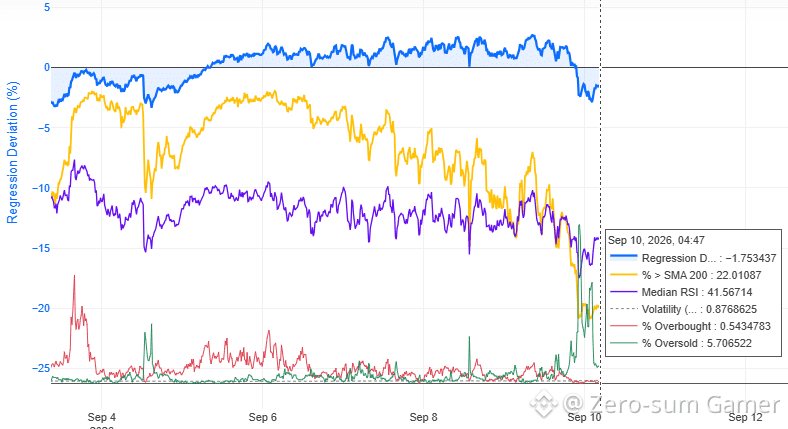
📊 Market Median / September 10, 2026
📌 30m slice: RegDev −1.75%, above SMA200 22.01%, Median RSI 41.57.
Yesterday we dropped the long bias and started looking for shorts. Overnight, the market went through a long squeeze, with roughly 45% of coins hitting oversold at the peak. The short setup played out: RegDev fell from +0.80% to −1.75%, while breadth collapsed from 42.72% to 22.01%.
📉 Sellers are firmly in control, but the overnight extreme has already cleared. RSI sits at 41.57, oversold has dropped back to 5.71%, and overbought is only 0.54%.
Trade plan: selective shorts after bounces in weak coins, not into red candles. Longs need RSI back above 50, breadth above 50%, and RegDev turning higher.
⚠️ Common mistake: buying just because oversold briefly reached 45% overnight. The broader structure is still bearish.
#MarketSentimentToday #analysis $ARIA $TOWN $BICO
📊 Market Median / September 10, 2026
📌 30m slice: RegDev −1.75%, above SMA200 22.01%, Median RSI 41.57.
Yesterday we dropped the long bias and started looking for shorts. Overnight, the market went through a long squeeze, with roughly 45% of coins hitting oversold at the peak. The short setup played out: RegDev fell from +0.80% to −1.75%, while breadth collapsed from 42.72% to 22.01%.
📉 Sellers are firmly in control, but the overnight extreme has already cleared. RSI sits at 41.57, oversold has dropped back to 5.71%, and overbought is only 0.54%.
Trade plan: selective shorts after bounces in weak coins, not into red candles. Longs need RSI back above 50, breadth above 50%, and RegDev turning higher.
⚠️ Common mistake: buying just because oversold briefly reached 45% overnight. The broader structure is still bearish.
#MarketSentimentToday #analysis $ARIA $TOWN $BICO
📌 30m slice: RegDev −1.75%, above SMA200 22.01%, Median RSI 41.57.
Yesterday we dropped the long bias and started looking for shorts. Overnight, the market went through a long squeeze, with roughly 45% of coins hitting oversold at the peak. The short setup played out: RegDev fell from +0.80% to −1.75%, while breadth collapsed from 42.72% to 22.01%.
📉 Sellers are firmly in control, but the overnight extreme has already cleared. RSI sits at 41.57, oversold has dropped back to 5.71%, and overbought is only 0.54%.
Trade plan: selective shorts after bounces in weak coins, not into red candles. Longs need RSI back above 50, breadth above 50%, and RegDev turning higher.
⚠️ Common mistake: buying just because oversold briefly reached 45% overnight. The broader structure is still bearish.
#MarketSentimentToday #analysis $ARIA $TOWN $BICO
2
448
Macro calendar for the next two weeks:
CPI 🤝 PPI 🤝 Fed 🤝 BoJ
Meanwhile my trading bots:
“Cool story. Is there volatility?” 🤖📈📉
#bitcoin #crypto #TradingBots
Macro calendar for the next two weeks:
CPI 🤝 PPI 🤝 Fed 🤝 BoJ
Meanwhile my trading bots:
“Cool story. Is there volatility?” 🤖📈📉
#bitcoin #crypto #TradingBots
CPI 🤝 PPI 🤝 Fed 🤝 BoJ
Meanwhile my trading bots:
“Cool story. Is there volatility?” 🤖📈📉
#bitcoin #crypto #TradingBots
3
102
·
--
Bullish
⚡ MACRO RISK IS BACK — AND CRYPTO IS ABOUT TO GET VOLATILE
The next two weeks are packed with events that can move yields, the dollar and liquidity.
Crypto won’t trade on charts alone.
📊 September 10–11 — #PPI and #cpi
This is the main filter before the Fed.
Softer inflation → lower pressure on yields and the dollar, better conditions for #BTC and especially altcoins.
Hot #Inflation → markets price a tighter #Fed path, yields move higher and risk assets come under pressure.
🏦 September 16 — Federal Reserve
The rate decision matters, but the new Fed projections matter just as much.
A pause combined with a softer rate path could trigger another risk-on move.
A hike or a more hawkish trajectory would hit altcoins much harder than BTC.
🇯🇵 September 17–18 — Bank of Japan
Japan remains another source of volatility.
Further tightening can strengthen the yen, pressure carry trades and force leveraged positions across global markets to unwind. Crypto usually feels that quickly.
🔎 What I’m watching
US 2Y and 10Y yields, DXY, oil, BTC and the Crypto Resources Market Median.
Falling yields after CPI + a Market Median that is not overheated = much better conditions for longs.
Rising yields + an already overheated market = a bad place to chase price.
🤖 And this is exactly why I automate execution
My Binance bots from Crypto Resources don’t need a quiet market.
Higher volatility simply means more movements, more dislocations and more setups for systems built around strict rules, filters and risk management.
The bots keep doing the same job regardless of headlines: scanning, entering, managing positions and taking profit automatically.
Macro can change the market regime.
The system adapts by trading the movement instead of trying to predict every headline.
$VVV $KAT $FF
⚡ MACRO RISK IS BACK — AND CRYPTO IS ABOUT TO GET VOLATILE
The next two weeks are packed with events that can move yields, the dollar and liquidity.
Crypto won’t trade on charts alone.
📊 September 10–11 — #PPI and #cpi
This is the main filter before the Fed.
Softer inflation → lower pressure on yields and the dollar, better conditions for #BTC and especially altcoins.
Hot #Inflation → markets price a tighter #Fed path, yields move higher and risk assets come under pressure.
🏦 September 16 — Federal Reserve
The rate decision matters, but the new Fed projections matter just as much.
A pause combined with a softer rate path could trigger another risk-on move.
A hike or a more hawkish trajectory would hit altcoins much harder than BTC.
🇯🇵 September 17–18 — Bank of Japan
Japan remains another source of volatility.
Further tightening can strengthen the yen, pressure carry trades and force leveraged positions across global markets to unwind. Crypto usually feels that quickly.
🔎 What I’m watching
US 2Y and 10Y yields, DXY, oil, BTC and the Crypto Resources Market Median.
Falling yields after CPI + a Market Median that is not overheated = much better conditions for longs.
Rising yields + an already overheated market = a bad place to chase price.
🤖 And this is exactly why I automate execution
My Binance bots from Crypto Resources don’t need a quiet market.
Higher volatility simply means more movements, more dislocations and more setups for systems built around strict rules, filters and risk management.
The bots keep doing the same job regardless of headlines: scanning, entering, managing positions and taking profit automatically.
Macro can change the market regime.
The system adapts by trading the movement instead of trying to predict every headline.
$VVV $KAT $FF
The next two weeks are packed with events that can move yields, the dollar and liquidity.
Crypto won’t trade on charts alone.
📊 September 10–11 — #PPI and #cpi
This is the main filter before the Fed.
Softer inflation → lower pressure on yields and the dollar, better conditions for #BTC and especially altcoins.
Hot #Inflation → markets price a tighter #Fed path, yields move higher and risk assets come under pressure.
🏦 September 16 — Federal Reserve
The rate decision matters, but the new Fed projections matter just as much.
A pause combined with a softer rate path could trigger another risk-on move.
A hike or a more hawkish trajectory would hit altcoins much harder than BTC.
🇯🇵 September 17–18 — Bank of Japan
Japan remains another source of volatility.
Further tightening can strengthen the yen, pressure carry trades and force leveraged positions across global markets to unwind. Crypto usually feels that quickly.
🔎 What I’m watching
US 2Y and 10Y yields, DXY, oil, BTC and the Crypto Resources Market Median.
Falling yields after CPI + a Market Median that is not overheated = much better conditions for longs.
Rising yields + an already overheated market = a bad place to chase price.
🤖 And this is exactly why I automate execution
My Binance bots from Crypto Resources don’t need a quiet market.
Higher volatility simply means more movements, more dislocations and more setups for systems built around strict rules, filters and risk management.
The bots keep doing the same job regardless of headlines: scanning, entering, managing positions and taking profit automatically.
Macro can change the market regime.
The system adapts by trading the movement instead of trying to predict every headline.
$VVV $KAT $FF

2
3
1.2k
·
--
Bullish
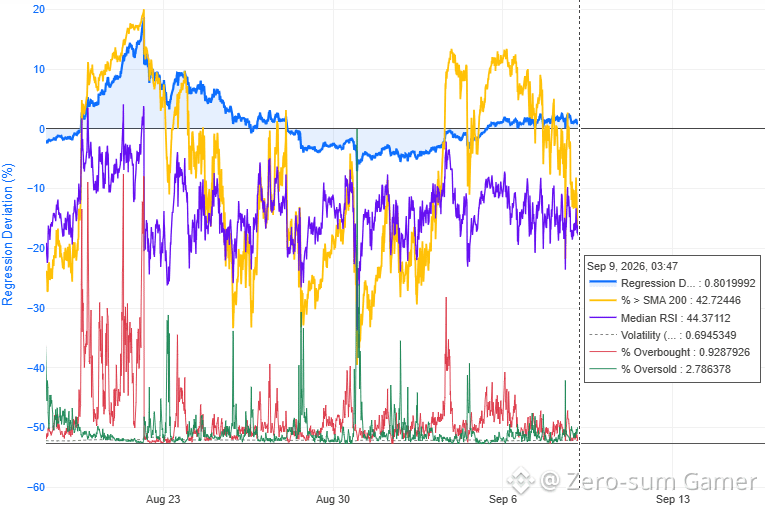
📊 Market Median / September 9, 2026
📌 30m slice: RegDev +0.80%, above SMA200 42.72%, Median RSI 44.37.
Yesterday’s long setup required RSI above 50 and breadth above 60%. Both are gone: RSI fell from 51.05 to 44.37, breadth from 68.15% to 42.72%, while RegDev slipped from +1.97% to +0.80%.
📉 Sellers now have the edge. RSI is below 45 and most coins are back under SMA200. RegDev is still positive, so the broader structure is not fully broken yet. Oversold is only 2.79%.
Trade plan: selective shorts after bounces in weak coins. The setup gets stronger if RegDev reaches zero or turns negative. Longs need RSI back above 50 and breadth above 50–55%.
⚠️ Common mistake: keeping a long bias after breadth has already dropped sharply below 50%.
#MarketSentimentToday #analysis $VVV $CAT $USELESS
📊 Market Median / September 9, 2026
📌 30m slice: RegDev +0.80%, above SMA200 42.72%, Median RSI 44.37.
Yesterday’s long setup required RSI above 50 and breadth above 60%. Both are gone: RSI fell from 51.05 to 44.37, breadth from 68.15% to 42.72%, while RegDev slipped from +1.97% to +0.80%.
📉 Sellers now have the edge. RSI is below 45 and most coins are back under SMA200. RegDev is still positive, so the broader structure is not fully broken yet. Oversold is only 2.79%.
Trade plan: selective shorts after bounces in weak coins. The setup gets stronger if RegDev reaches zero or turns negative. Longs need RSI back above 50 and breadth above 50–55%.
⚠️ Common mistake: keeping a long bias after breadth has already dropped sharply below 50%.
#MarketSentimentToday #analysis $VVV $CAT $USELESS
📌 30m slice: RegDev +0.80%, above SMA200 42.72%, Median RSI 44.37.
Yesterday’s long setup required RSI above 50 and breadth above 60%. Both are gone: RSI fell from 51.05 to 44.37, breadth from 68.15% to 42.72%, while RegDev slipped from +1.97% to +0.80%.
📉 Sellers now have the edge. RSI is below 45 and most coins are back under SMA200. RegDev is still positive, so the broader structure is not fully broken yet. Oversold is only 2.79%.
Trade plan: selective shorts after bounces in weak coins. The setup gets stronger if RegDev reaches zero or turns negative. Longs need RSI back above 50 and breadth above 50–55%.
⚠️ Common mistake: keeping a long bias after breadth has already dropped sharply below 50%.
#MarketSentimentToday #analysis $VVV $CAT $USELESS
1
93
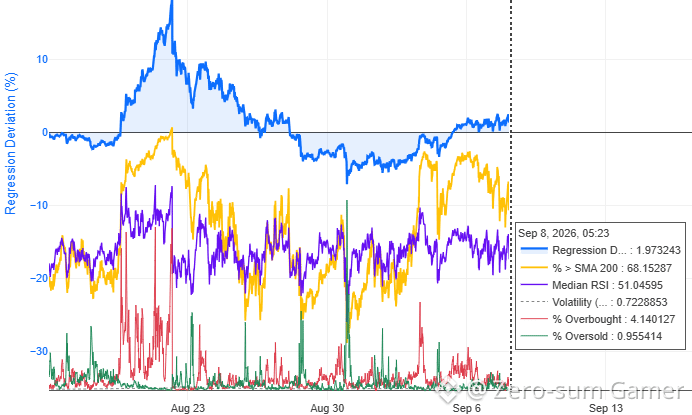
📊 Market Median / September 8, 2026
📌 30m slice: RegDev +1.97%, above SMA200 68.15%, Median RSI 51.05.
Yesterday there was no clean long setup: breadth stayed strong, but RSI was still below 50. Today RSI reclaimed 50 and RegDev improved from +1.15% to +1.97%. Breadth slipped slightly from 71.66% to 68.15%, but remains strong.
📈 The long setup is back in place. More than 68% of coins are above SMA200, RegDev is positive, and RSI is back on the buyers’ side. Overbought is 4.14%, oversold 0.96% — no broad overheating yet.
Trade plan: selective longs on pullbacks while RSI stays above 50, breadth holds above 60%, and RegDev remains positive. Shorts need RSI below 50, breadth under 60%, and RegDev fading back toward zero.
⚠️ Common mistake: shorting just because breadth eased a bit while ignoring positive RegDev and RSI back above 50.
#MarketSentimentToday #analysis $SOPH $IOST $UAI
📊 Market Median / September 8, 2026
📌 30m slice: RegDev +1.97%, above SMA200 68.15%, Median RSI 51.05.
Yesterday there was no clean long setup: breadth stayed strong, but RSI was still below 50. Today RSI reclaimed 50 and RegDev improved from +1.15% to +1.97%. Breadth slipped slightly from 71.66% to 68.15%, but remains strong.
📈 The long setup is back in place. More than 68% of coins are above SMA200, RegDev is positive, and RSI is back on the buyers’ side. Overbought is 4.14%, oversold 0.96% — no broad overheating yet.
Trade plan: selective longs on pullbacks while RSI stays above 50, breadth holds above 60%, and RegDev remains positive. Shorts need RSI below 50, breadth under 60%, and RegDev fading back toward zero.
⚠️ Common mistake: shorting just because breadth eased a bit while ignoring positive RegDev and RSI back above 50.
#MarketSentimentToday #analysis $SOPH $IOST $UAI
📌 30m slice: RegDev +1.97%, above SMA200 68.15%, Median RSI 51.05.
Yesterday there was no clean long setup: breadth stayed strong, but RSI was still below 50. Today RSI reclaimed 50 and RegDev improved from +1.15% to +1.97%. Breadth slipped slightly from 71.66% to 68.15%, but remains strong.
📈 The long setup is back in place. More than 68% of coins are above SMA200, RegDev is positive, and RSI is back on the buyers’ side. Overbought is 4.14%, oversold 0.96% — no broad overheating yet.
Trade plan: selective longs on pullbacks while RSI stays above 50, breadth holds above 60%, and RegDev remains positive. Shorts need RSI below 50, breadth under 60%, and RegDev fading back toward zero.
⚠️ Common mistake: shorting just because breadth eased a bit while ignoring positive RegDev and RSI back above 50.
#MarketSentimentToday #analysis $SOPH $IOST $UAI
1
5
106
·
--
Bullish
🔥 CPI IS THE NEXT BIG TEST FOR BITCOIN
After the strong US jobs report, markets are again pricing a possible Fed rate hike.
Now inflation matters most.
📅 Sept. 10 — #PPI
📅 Sept. 11 — #CPI
🏦 Sept. 15–16 — #FOMC
Current CPI expectations:
• Headline: +0.4% MoM
• Core: +0.2% MoM
📈 Hot CPI
→ hike odds rise
→ 2Y Treasury yield rises
→ real yields rise
→ USD strengthens
→ pressure on BTC and altcoins
📉 Soft CPI
→ hike odds fall
→ Treasury yields can move lower
→ cost of capital eases
→ BTC gets room to recover
But the CPI number itself is not enough.
Watch 2Y Treasury and real yields after the release. If CPI comes in soft but yields barely move, the market has not really changed its view of Fed policy.
⚠️ Altcoins can react much harder than BTC because of thinner liquidity and leverage. High Open Interest can turn the first move into a liquidation cascade.
CPI → #Fed expectations → Treasury yields → USD → Bitcoin → altcoins
NFP showed that the #US economy can handle high rates.
CPI will show whether the Fed has a reason to push them even higher.
$DOOD $XAN $NAORIS
🔥 CPI IS THE NEXT BIG TEST FOR BITCOIN
After the strong US jobs report, markets are again pricing a possible Fed rate hike.
Now inflation matters most.
📅 Sept. 10 — #PPI
📅 Sept. 11 — #CPI
🏦 Sept. 15–16 — #FOMC
Current CPI expectations:
• Headline: +0.4% MoM
• Core: +0.2% MoM
📈 Hot CPI
→ hike odds rise
→ 2Y Treasury yield rises
→ real yields rise
→ USD strengthens
→ pressure on BTC and altcoins
📉 Soft CPI
→ hike odds fall
→ Treasury yields can move lower
→ cost of capital eases
→ BTC gets room to recover
But the CPI number itself is not enough.
Watch 2Y Treasury and real yields after the release. If CPI comes in soft but yields barely move, the market has not really changed its view of Fed policy.
⚠️ Altcoins can react much harder than BTC because of thinner liquidity and leverage. High Open Interest can turn the first move into a liquidation cascade.
CPI → #Fed expectations → Treasury yields → USD → Bitcoin → altcoins
NFP showed that the #US economy can handle high rates.
CPI will show whether the Fed has a reason to push them even higher.
$DOOD $XAN $NAORIS
After the strong US jobs report, markets are again pricing a possible Fed rate hike.
Now inflation matters most.
📅 Sept. 10 — #PPI
📅 Sept. 11 — #CPI
🏦 Sept. 15–16 — #FOMC
Current CPI expectations:
• Headline: +0.4% MoM
• Core: +0.2% MoM
📈 Hot CPI
→ hike odds rise
→ 2Y Treasury yield rises
→ real yields rise
→ USD strengthens
→ pressure on BTC and altcoins
📉 Soft CPI
→ hike odds fall
→ Treasury yields can move lower
→ cost of capital eases
→ BTC gets room to recover
But the CPI number itself is not enough.
Watch 2Y Treasury and real yields after the release. If CPI comes in soft but yields barely move, the market has not really changed its view of Fed policy.
⚠️ Altcoins can react much harder than BTC because of thinner liquidity and leverage. High Open Interest can turn the first move into a liquidation cascade.
CPI → #Fed expectations → Treasury yields → USD → Bitcoin → altcoins
NFP showed that the #US economy can handle high rates.
CPI will show whether the Fed has a reason to push them even higher.
$DOOD $XAN $NAORIS

6
128
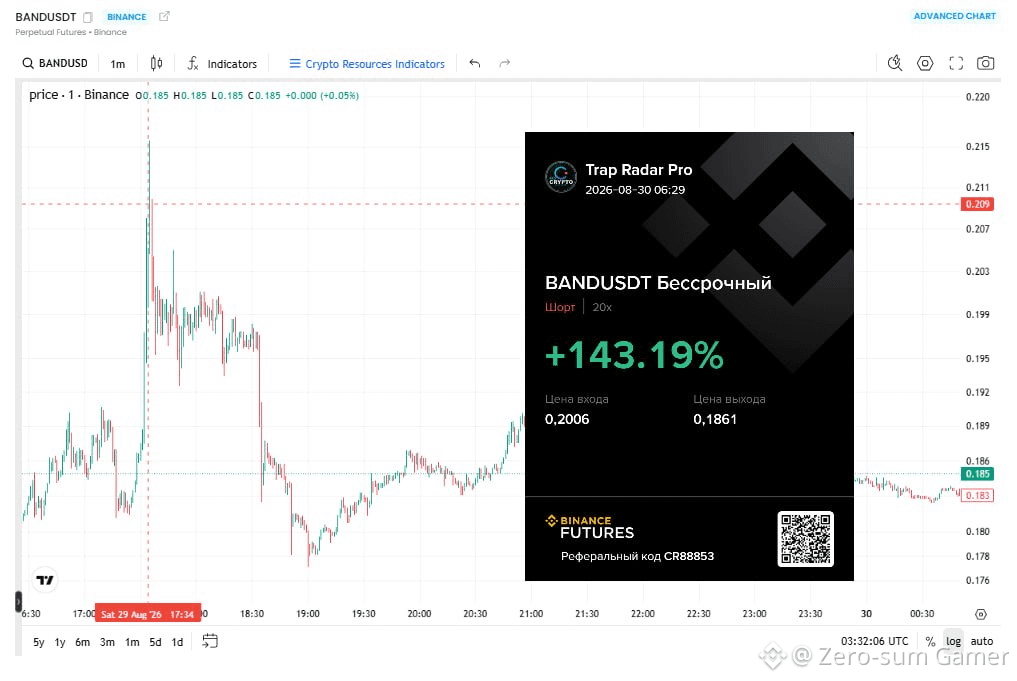
🕸 HOW I FIND STRUCTURAL WEAKNESS WITH TRAP RADAR BOTS
Screeners show me where the action is.
Trap Radar helps me decide whether that move is becoming vulnerable.
I’m looking for combinations, not one indicator flashing red.
📈 Price expansion — the coin has already pushed hard over the last few hours.
📊 Open Interest — fresh positions keep piling in while the move is already extended.
🔥 RSI — several timeframes are stretched at the same time.
💥 Liquidations — one side starts getting wiped while positioning becomes crowded.
⚡ Volume + VWAP deviation — volume jumps far above normal and price trades too far from its local mean.
Any one of these can mean nothing.
When 6–10 conditions line up at once, the setup changes. Now I have an overheated asset, crowded positioning and enough imbalance for a sharp unwind.
That’s the structural vulnerability I’m looking for.
I don’t try to guess the exact top. The bot waits until my rules match, then either alerts me or executes the trade automatically.
The same logic runs across #Binance #futures pairs and keeps checking the market 24/7.
🕸 Trap Radar Bot by Crypto-Resources.com lets me turn that logic into rules instead of watching #RSI , OI, #Liquidations and #VolumeTrade manually.
$DOOD $NAORIS $CATI
🕸 HOW I FIND STRUCTURAL WEAKNESS WITH TRAP RADAR BOTS
Screeners show me where the action is.
Trap Radar helps me decide whether that move is becoming vulnerable.
I’m looking for combinations, not one indicator flashing red.
📈 Price expansion — the coin has already pushed hard over the last few hours.
📊 Open Interest — fresh positions keep piling in while the move is already extended.
🔥 RSI — several timeframes are stretched at the same time.
💥 Liquidations — one side starts getting wiped while positioning becomes crowded.
⚡ Volume + VWAP deviation — volume jumps far above normal and price trades too far from its local mean.
Any one of these can mean nothing.
When 6–10 conditions line up at once, the setup changes. Now I have an overheated asset, crowded positioning and enough imbalance for a sharp unwind.
That’s the structural vulnerability I’m looking for.
I don’t try to guess the exact top. The bot waits until my rules match, then either alerts me or executes the trade automatically.
The same logic runs across #Binance #futures pairs and keeps checking the market 24/7.
🕸 Trap Radar Bot by Crypto-Resources.com lets me turn that logic into rules instead of watching #RSI , OI, #Liquidations and #VolumeTrade manually.
$DOOD $NAORIS $CATI
Screeners show me where the action is.
Trap Radar helps me decide whether that move is becoming vulnerable.
I’m looking for combinations, not one indicator flashing red.
📈 Price expansion — the coin has already pushed hard over the last few hours.
📊 Open Interest — fresh positions keep piling in while the move is already extended.
🔥 RSI — several timeframes are stretched at the same time.
💥 Liquidations — one side starts getting wiped while positioning becomes crowded.
⚡ Volume + VWAP deviation — volume jumps far above normal and price trades too far from its local mean.
Any one of these can mean nothing.
When 6–10 conditions line up at once, the setup changes. Now I have an overheated asset, crowded positioning and enough imbalance for a sharp unwind.
That’s the structural vulnerability I’m looking for.
I don’t try to guess the exact top. The bot waits until my rules match, then either alerts me or executes the trade automatically.
The same logic runs across #Binance #futures pairs and keeps checking the market 24/7.
🕸 Trap Radar Bot by Crypto-Resources.com lets me turn that logic into rules instead of watching #RSI , OI, #Liquidations and #VolumeTrade manually.
$DOOD $NAORIS $CATI
4
186
·
--
Bullish
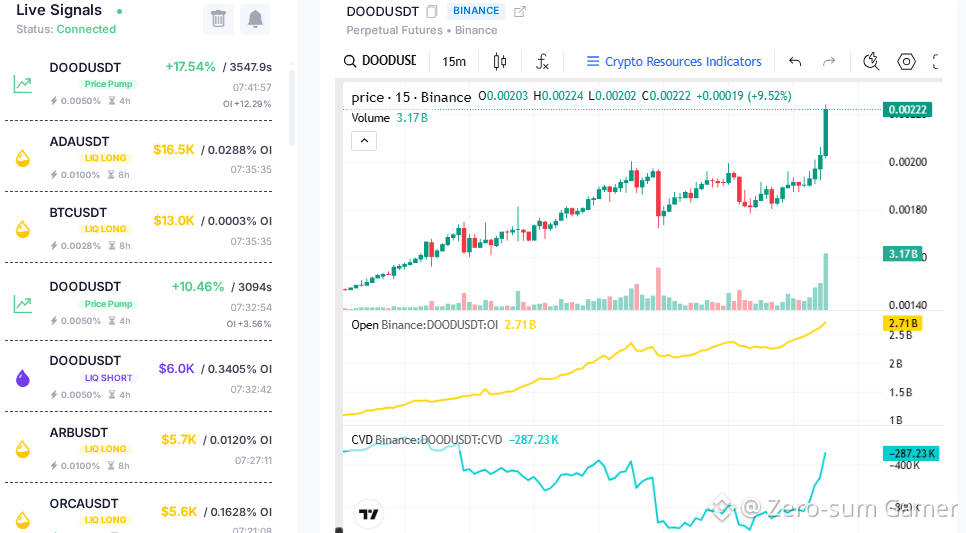
🔎 HOW I FIND TRADING OPPORTUNITIES WITH SCREENERS
I don’t scroll through hundreds of charts. I start with coins where something is already happening: price expansion, unusual volume, liquidations, or a sharp change in OI.
📊 Pump/Dump Screener shows where price and volume are starting to accelerate.
💥 Liquidation Screener shows where positions are already getting wiped. I’m not interested in the liquidation number alone. I want to see what happens next: continuation, a sharp rebound, or a break in structure.
📈 Open Interest helps me read positioning. Price and OI rising together means new positions are entering the move. OI expanding while price barely moves is a different setup — someone may be getting trapped.
⚡ Funding and Premium Index show how crowded derivatives positioning has become. The more one-sided the market gets, the more interesting the opposite setup becomes once structure confirms it.
After the #scan , I open the chart and check structure, local range, volume, liquidations, and the reaction after the #IMPULSE .
A screener doesn’t give me an entry. It removes hundreds of dead charts and leaves the few where there is actually something worth trading.
My workflow:
anomaly → structure → confirmation → entry → risk contro
l
🚀 Crypto Resources screeners are free: #pump /#dump , #Liquidations , OI and other tools for finding active setups faster.
$CFG $UAI $CATI
🔎 HOW I FIND TRADING OPPORTUNITIES WITH SCREENERS
I don’t scroll through hundreds of charts. I start with coins where something is already happening: price expansion, unusual volume, liquidations, or a sharp change in OI.
📊 Pump/Dump Screener shows where price and volume are starting to accelerate.
💥 Liquidation Screener shows where positions are already getting wiped. I’m not interested in the liquidation number alone. I want to see what happens next: continuation, a sharp rebound, or a break in structure.
📈 Open Interest helps me read positioning. Price and OI rising together means new positions are entering the move. OI expanding while price barely moves is a different setup — someone may be getting trapped.
⚡ Funding and Premium Index show how crowded derivatives positioning has become. The more one-sided the market gets, the more interesting the opposite setup becomes once structure confirms it.
After the #scan , I open the chart and check structure, local range, volume, liquidations, and the reaction after the #IMPULSE .
A screener doesn’t give me an entry. It removes hundreds of dead charts and leaves the few where there is actually something worth trading.
My workflow:
anomaly → structure → confirmation → entry → risk contro
l
🚀 Crypto Resources screeners are free: #pump /#dump , #Liquidations , OI and other tools for finding active setups faster.
$CFG $UAI $CATI
I don’t scroll through hundreds of charts. I start with coins where something is already happening: price expansion, unusual volume, liquidations, or a sharp change in OI.
📊 Pump/Dump Screener shows where price and volume are starting to accelerate.
💥 Liquidation Screener shows where positions are already getting wiped. I’m not interested in the liquidation number alone. I want to see what happens next: continuation, a sharp rebound, or a break in structure.
📈 Open Interest helps me read positioning. Price and OI rising together means new positions are entering the move. OI expanding while price barely moves is a different setup — someone may be getting trapped.
⚡ Funding and Premium Index show how crowded derivatives positioning has become. The more one-sided the market gets, the more interesting the opposite setup becomes once structure confirms it.
After the #scan , I open the chart and check structure, local range, volume, liquidations, and the reaction after the #IMPULSE .
A screener doesn’t give me an entry. It removes hundreds of dead charts and leaves the few where there is actually something worth trading.
My workflow:
anomaly → structure → confirmation → entry → risk contro
l
🚀 Crypto Resources screeners are free: #pump /#dump , #Liquidations , OI and other tools for finding active setups faster.
$CFG $UAI $CATI
2
315
·
--
Bearish
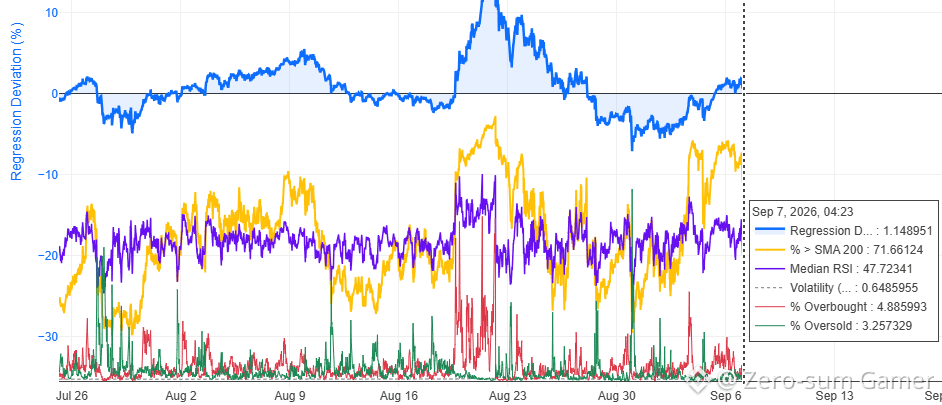
📊 Market Median / September 7, 2026
📌 30m slice: RegDev +1.15%, above SMA200 71.66%, Median RSI 47.72.
Yesterday’s long setup strengthened, but today the impulse cooled. RSI fell from 51.67 to 47.72, breadth slipped from 81.05% to 71.66%, and RegDev eased from +1.32% to +1.15%. Breadth is still strong, but RSI confirmation is gone.
📊 The market remains broad, but there is no clean long signal right now. More than 71% of coins are still above SMA200 and RegDev remains positive. At the same time, RSI is back below 50, with overbought at 4.89% and oversold at 3.26%. Signals are mixed here.
Trade plan: longs need RSI back above 50 while breadth stays above 60% and RegDev remains positive. Shorts become more interesting if breadth loses 60% and RegDev moves toward zero or negative.
⚠️ Common mistake: treating strong breadth as automatic continuation while RSI has already cooled.
#MarketSentimentToday #analysis $DOOD $XAN $NAORIS
📊 Market Median / September 7, 2026
📌 30m slice: RegDev +1.15%, above SMA200 71.66%, Median RSI 47.72.
Yesterday’s long setup strengthened, but today the impulse cooled. RSI fell from 51.67 to 47.72, breadth slipped from 81.05% to 71.66%, and RegDev eased from +1.32% to +1.15%. Breadth is still strong, but RSI confirmation is gone.
📊 The market remains broad, but there is no clean long signal right now. More than 71% of coins are still above SMA200 and RegDev remains positive. At the same time, RSI is back below 50, with overbought at 4.89% and oversold at 3.26%. Signals are mixed here.
Trade plan: longs need RSI back above 50 while breadth stays above 60% and RegDev remains positive. Shorts become more interesting if breadth loses 60% and RegDev moves toward zero or negative.
⚠️ Common mistake: treating strong breadth as automatic continuation while RSI has already cooled.
#MarketSentimentToday #analysis $DOOD $XAN $NAORIS
📌 30m slice: RegDev +1.15%, above SMA200 71.66%, Median RSI 47.72.
Yesterday’s long setup strengthened, but today the impulse cooled. RSI fell from 51.67 to 47.72, breadth slipped from 81.05% to 71.66%, and RegDev eased from +1.32% to +1.15%. Breadth is still strong, but RSI confirmation is gone.
📊 The market remains broad, but there is no clean long signal right now. More than 71% of coins are still above SMA200 and RegDev remains positive. At the same time, RSI is back below 50, with overbought at 4.89% and oversold at 3.26%. Signals are mixed here.
Trade plan: longs need RSI back above 50 while breadth stays above 60% and RegDev remains positive. Shorts become more interesting if breadth loses 60% and RegDev moves toward zero or negative.
⚠️ Common mistake: treating strong breadth as automatic continuation while RSI has already cooled.
#MarketSentimentToday #analysis $DOOD $XAN $NAORIS
2
182
·
--
Bullish
📊 Market Median / September 6, 2026
📌 30m slice: RegDev +1.32%, above SMA200 81.05%, Median RSI 51.67.
Yesterday’s long setup needed RegDev to turn positive. It did: RegDev rose from −0.55% to +1.32%, while breadth expanded from 73.10% to 81.05%. RSI eased from 53.33 to 51.67, but remains above 50.
📈 The long setup strengthened. More than 80% of coins are above SMA200 and RegDev is now positive. Overbought is only 7.02%, so broad overheating is still limited.
Trade plan: selective longs on pullbacks. As long as RSI stays above 50, breadth holds above 60–70%, and RegDev remains positive, buyers keep the edge. Shorts need a break of those conditions.
⚠️ Common mistake: chasing the move just because breadth is already above 80%.
#MarketSentimentToday #analysis $ARB $FLOCK $IOST
📊 Market Median / September 6, 2026
📌 30m slice: RegDev +1.32%, above SMA200 81.05%, Median RSI 51.67.
Yesterday’s long setup needed RegDev to turn positive. It did: RegDev rose from −0.55% to +1.32%, while breadth expanded from 73.10% to 81.05%. RSI eased from 53.33 to 51.67, but remains above 50.
📈 The long setup strengthened. More than 80% of coins are above SMA200 and RegDev is now positive. Overbought is only 7.02%, so broad overheating is still limited.
Trade plan: selective longs on pullbacks. As long as RSI stays above 50, breadth holds above 60–70%, and RegDev remains positive, buyers keep the edge. Shorts need a break of those conditions.
⚠️ Common mistake: chasing the move just because breadth is already above 80%.
#MarketSentimentToday #analysis $ARB $FLOCK $IOST
📌 30m slice: RegDev +1.32%, above SMA200 81.05%, Median RSI 51.67.
Yesterday’s long setup needed RegDev to turn positive. It did: RegDev rose from −0.55% to +1.32%, while breadth expanded from 73.10% to 81.05%. RSI eased from 53.33 to 51.67, but remains above 50.
📈 The long setup strengthened. More than 80% of coins are above SMA200 and RegDev is now positive. Overbought is only 7.02%, so broad overheating is still limited.
Trade plan: selective longs on pullbacks. As long as RSI stays above 50, breadth holds above 60–70%, and RegDev remains positive, buyers keep the edge. Shorts need a break of those conditions.
⚠️ Common mistake: chasing the move just because breadth is already above 80%.
#MarketSentimentToday #analysis $ARB $FLOCK $IOST
2
85
·
--
Bullish
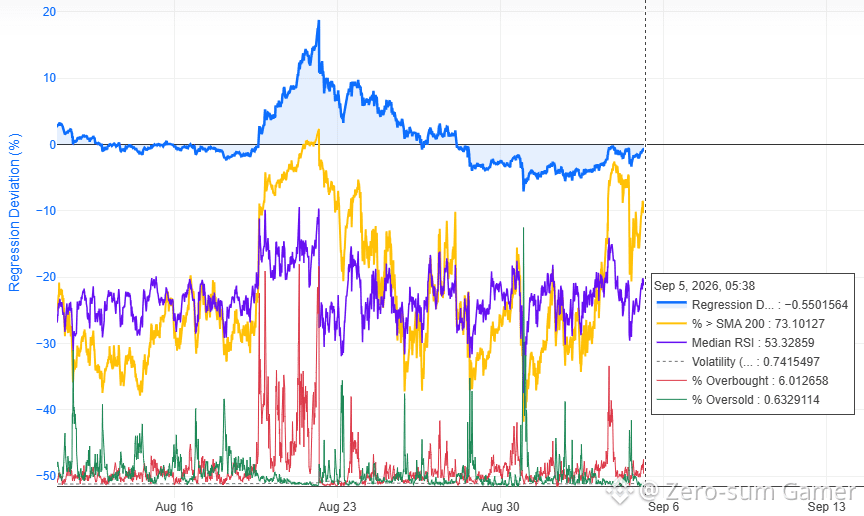
📊 Market Median / September 5, 2026
📌 30m slice: RegDev −0.55%, above SMA200 73.10%, Median RSI 53.33.
Yesterday, longs needed RSI back above 50 while breadth held above 60%. That setup is now active: RSI rose from 44.51 to 53.33, breadth remains strong at 73.10%, and RegDev improved from −2.02% to −0.55%.
📈 The long setup is back. Most coins remain above SMA200, RSI reclaimed 50, and RegDev is close to zero. Overbought is only 6.01%, so broad overheating is still limited.
Trade plan: selective longs on pullbacks. The setup gets stronger if RegDev turns positive. Shorts need RSI below 50, breadth losing 60%, and RegDev rolling over again.
⚠️ Common mistake: chasing green candles after the long setup has already confirmed instead of waiting for a pullback.
#MarketSentimentToday #analysis $ACX $DASH $NOM
📊 Market Median / September 5, 2026
📌 30m slice: RegDev −0.55%, above SMA200 73.10%, Median RSI 53.33.
Yesterday, longs needed RSI back above 50 while breadth held above 60%. That setup is now active: RSI rose from 44.51 to 53.33, breadth remains strong at 73.10%, and RegDev improved from −2.02% to −0.55%.
📈 The long setup is back. Most coins remain above SMA200, RSI reclaimed 50, and RegDev is close to zero. Overbought is only 6.01%, so broad overheating is still limited.
Trade plan: selective longs on pullbacks. The setup gets stronger if RegDev turns positive. Shorts need RSI below 50, breadth losing 60%, and RegDev rolling over again.
⚠️ Common mistake: chasing green candles after the long setup has already confirmed instead of waiting for a pullback.
#MarketSentimentToday #analysis $ACX $DASH $NOM
📌 30m slice: RegDev −0.55%, above SMA200 73.10%, Median RSI 53.33.
Yesterday, longs needed RSI back above 50 while breadth held above 60%. That setup is now active: RSI rose from 44.51 to 53.33, breadth remains strong at 73.10%, and RegDev improved from −2.02% to −0.55%.
📈 The long setup is back. Most coins remain above SMA200, RSI reclaimed 50, and RegDev is close to zero. Overbought is only 6.01%, so broad overheating is still limited.
Trade plan: selective longs on pullbacks. The setup gets stronger if RegDev turns positive. Shorts need RSI below 50, breadth losing 60%, and RegDev rolling over again.
⚠️ Common mistake: chasing green candles after the long setup has already confirmed instead of waiting for a pullback.
#MarketSentimentToday #analysis $ACX $DASH $NOM
2
110
·
--
Bearish
🔥 CRYPTO JUST GOT HIT BY THE JOBS REPORT
#U.S. . labor data came in much stronger than expected — and crypto sold off immediately.
📊 August #NFP : +162K vs roughly +55K expected.
Unemployment stayed at 4.1%.
For the #Fed , this means the economy is still holding up. Less pressure to ease, more room to keep policy tight — or even push rates higher if inflation stays hot.
The Fed meets on September 15–16.
📉 Strong jobs → higher rate expectations → higher short-term yields → pressure on risk assets.
BTC moved first. Altcoins got hit harder.
💥 Then the #liquidation cascade started.
Crypto Resources liquidation screeners showed mass long liquidations across the market.
Forced long closures become market sells. Price drops, the next layer gets liquidated, and the move accelerates.
That is why crypto can turn a normal macro reaction into a violent flush within minutes.
🤖 Short-side #bots handled the move automatically.
Positions were closed into profit by the system: predefined rules, risk control, automatic execution.
No need to guess the headline. The system reacts to the market structure.
Now the next key inputs are inflation data and the Fed decision.
$USELESS $AZTEC $TRIA
🔥 CRYPTO JUST GOT HIT BY THE JOBS REPORT
#U.S. . labor data came in much stronger than expected — and crypto sold off immediately.
📊 August #NFP : +162K vs roughly +55K expected.
Unemployment stayed at 4.1%.
For the #Fed , this means the economy is still holding up. Less pressure to ease, more room to keep policy tight — or even push rates higher if inflation stays hot.
The Fed meets on September 15–16.
📉 Strong jobs → higher rate expectations → higher short-term yields → pressure on risk assets.
BTC moved first. Altcoins got hit harder.
💥 Then the #liquidation cascade started.
Crypto Resources liquidation screeners showed mass long liquidations across the market.
Forced long closures become market sells. Price drops, the next layer gets liquidated, and the move accelerates.
That is why crypto can turn a normal macro reaction into a violent flush within minutes.
🤖 Short-side #bots handled the move automatically.
Positions were closed into profit by the system: predefined rules, risk control, automatic execution.
No need to guess the headline. The system reacts to the market structure.
Now the next key inputs are inflation data and the Fed decision.
$USELESS $AZTEC $TRIA
#U.S. . labor data came in much stronger than expected — and crypto sold off immediately.
📊 August #NFP : +162K vs roughly +55K expected.
Unemployment stayed at 4.1%.
For the #Fed , this means the economy is still holding up. Less pressure to ease, more room to keep policy tight — or even push rates higher if inflation stays hot.
The Fed meets on September 15–16.
📉 Strong jobs → higher rate expectations → higher short-term yields → pressure on risk assets.
BTC moved first. Altcoins got hit harder.
💥 Then the #liquidation cascade started.
Crypto Resources liquidation screeners showed mass long liquidations across the market.
Forced long closures become market sells. Price drops, the next layer gets liquidated, and the move accelerates.
That is why crypto can turn a normal macro reaction into a violent flush within minutes.
🤖 Short-side #bots handled the move automatically.
Positions were closed into profit by the system: predefined rules, risk control, automatic execution.
No need to guess the headline. The system reacts to the market structure.
Now the next key inputs are inflation data and the Fed decision.
$USELESS $AZTEC $TRIA

2
191
·
--
Bullish
#btctops$80k - 📈 WHY MARKETS RALLIED ON SEPTEMBER 3
There was a real macro catalyst behind yesterday’s move.
Fed Governor Christopher Waller said he would support keeping rates unchanged in September if August inflation confirms the recent cooling.
Markets immediately repriced the next FOMC meeting: the probability of a September rate hike dropped from roughly 63% to 50%.
That triggered the usual risk-asset chain:
📉 10Y Treasury yield: ~4.82% → ~4.76%
📉 2Y yield: toward 4.33%
📉 DXY: about −0.7%
📈 S&P 500: +1.06%
📈 Nasdaq: +1.40%
₿ Bitcoin: back above $80K
Crypto then amplified the macro move through short liquidations. Once BTC started breaking higher, forced buying added fuel to the rally.
The interesting part: #US data itself was not particularly dovish. Jobless claims remained low and services inflation was still hot.
So this was not #QE and not a #Fed pivot.
It was a repricing of rate expectations.
For #crypto , keep watching Treasury yields, DXY and September hike odds. If they reverse, yesterday’s squeeze loses part of its macro support.
$USELESS $REI $TRIA
#btctops$80k - 📈 WHY MARKETS RALLIED ON SEPTEMBER 3
There was a real macro catalyst behind yesterday’s move.
Fed Governor Christopher Waller said he would support keeping rates unchanged in September if August inflation confirms the recent cooling.
Markets immediately repriced the next FOMC meeting: the probability of a September rate hike dropped from roughly 63% to 50%.
That triggered the usual risk-asset chain:
📉 10Y Treasury yield: ~4.82% → ~4.76%
📉 2Y yield: toward 4.33%
📉 DXY: about −0.7%
📈 S&P 500: +1.06%
📈 Nasdaq: +1.40%
₿ Bitcoin: back above $80K
Crypto then amplified the macro move through short liquidations. Once BTC started breaking higher, forced buying added fuel to the rally.
The interesting part: #US data itself was not particularly dovish. Jobless claims remained low and services inflation was still hot.
So this was not #QE and not a #Fed pivot.
It was a repricing of rate expectations.
For #crypto , keep watching Treasury yields, DXY and September hike odds. If they reverse, yesterday’s squeeze loses part of its macro support.
$USELESS $REI $TRIA
There was a real macro catalyst behind yesterday’s move.
Fed Governor Christopher Waller said he would support keeping rates unchanged in September if August inflation confirms the recent cooling.
Markets immediately repriced the next FOMC meeting: the probability of a September rate hike dropped from roughly 63% to 50%.
That triggered the usual risk-asset chain:
📉 10Y Treasury yield: ~4.82% → ~4.76%
📉 2Y yield: toward 4.33%
📉 DXY: about −0.7%
📈 S&P 500: +1.06%
📈 Nasdaq: +1.40%
₿ Bitcoin: back above $80K
Crypto then amplified the macro move through short liquidations. Once BTC started breaking higher, forced buying added fuel to the rally.
The interesting part: #US data itself was not particularly dovish. Jobless claims remained low and services inflation was still hot.
So this was not #QE and not a #Fed pivot.
It was a repricing of rate expectations.
For #crypto , keep watching Treasury yields, DXY and September hike odds. If they reverse, yesterday’s squeeze loses part of its macro support.
$USELESS $REI $TRIA

4
157
Log in to explore more content
Join global crypto users on Binance Square
⚡️ Get latest and useful information about crypto.
💬 Trusted by the world’s largest crypto exchange.
👍 Discover real insights from verified creators.
Email / Phone number
Trending Topics
SECReceivesGrayscaleLitecoinTrustETFFiling
15,616 views
336 Discussing
💎 Institutional Attention Reaches Litecoin
Grayscale’s ETF filing has placed $LTC in a bigger conversation. For spot traders, developments like this are a reminder to study strong assets before making any entry.
#secreceivesgrayscalelitecointrustetffiling
CryptoMahibaloch
·1 Likes
·937 views
ClarityActFacesProceduralVoteSept15
113,923 views
1,314 Discussing
US10YearTreasuryYieldNears5%
39,307 views
673 Discussing