

Victor_TWN
647 Posts

Victor_TWN
Report
Block User
bnvry-t0e1CjJrM1X7DlHDTaTq-A

BTC Holder
Frequent Trader
7.2 Years
19 Following
3.6K+ Followers
806 Liked
Posts
All
Quotes
·
--
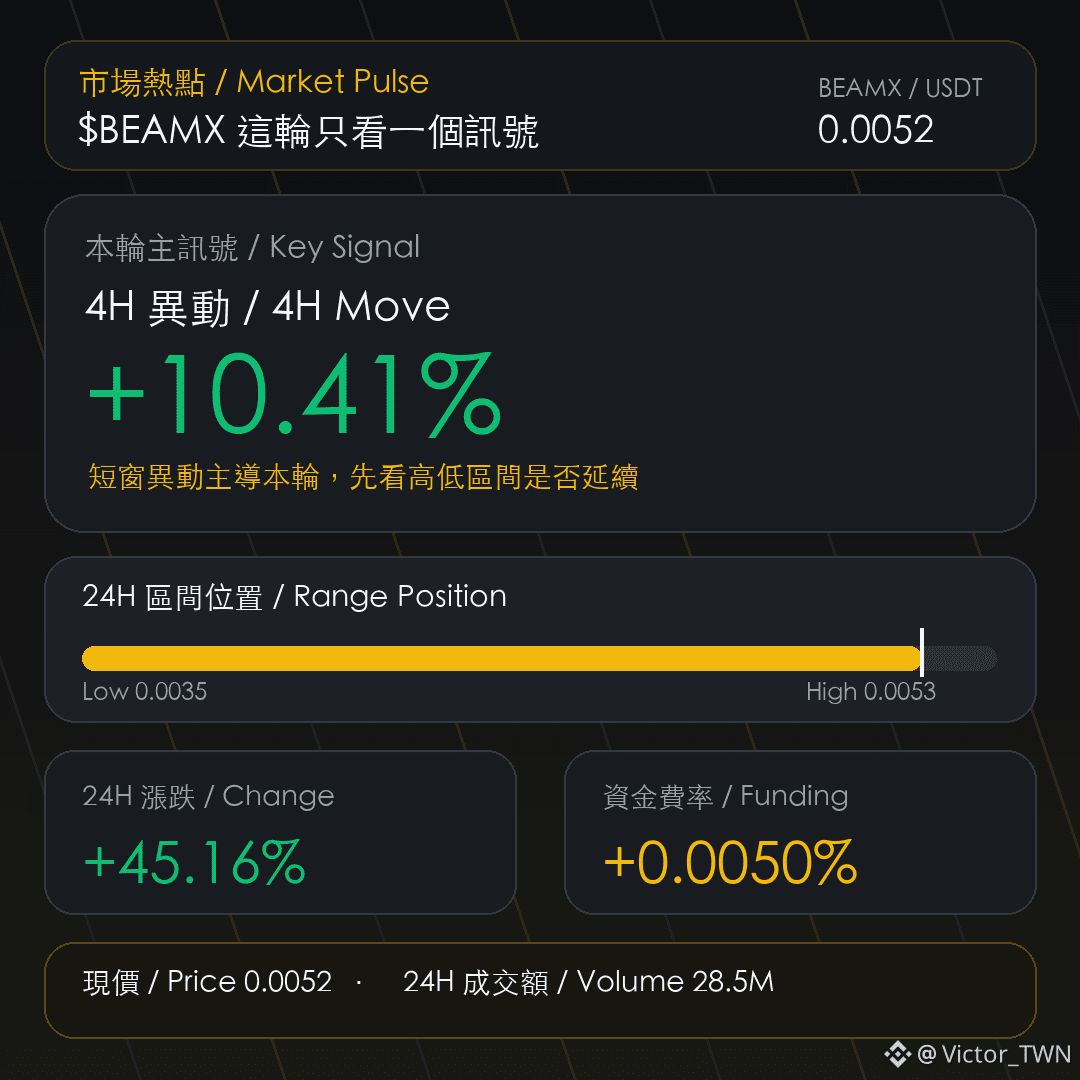
$BEAMX 24 hours +47.13%, with another +6.69% in the last hour and +11.31% over four hours. Closed at 0.005198 USDT, just 1.9% below the four-hour high of 0.0053. The full candle ranged from 0.004431 to 0.0053, with the close at 88% of the range.
Volume came in too. This four-hour candle traded 881 million tokens, with 391 million in the last hour alone—about 44%. 24-hour trading volume was about 28.58 million USDT. The push before the close wasn’t on thin volume.
What I’m more focused on is that funding stayed flat throughout. Price rose 47%, but the funding rate was only 0.005%, barely above zero; the mark price of 0.005192 was also about 0.12% below spot. Spot was pushing higher, while the perpetuals market wasn’t paying a premium for the move.
For this move to have another leg, it first needs to close above 0.0053 and hold there. If the hourly low of 0.004816 breaks, the last hour’s gains could be given back first, with 0.004431 below that. Keep the other possibility in mind too: the close is just 1.9% below the high, but the four-hour range is 19.6%, and the last hour alone moved 10.1%. A move like this can reverse again in a single four-hour candle.
#MarketAnalysis
168
·
--
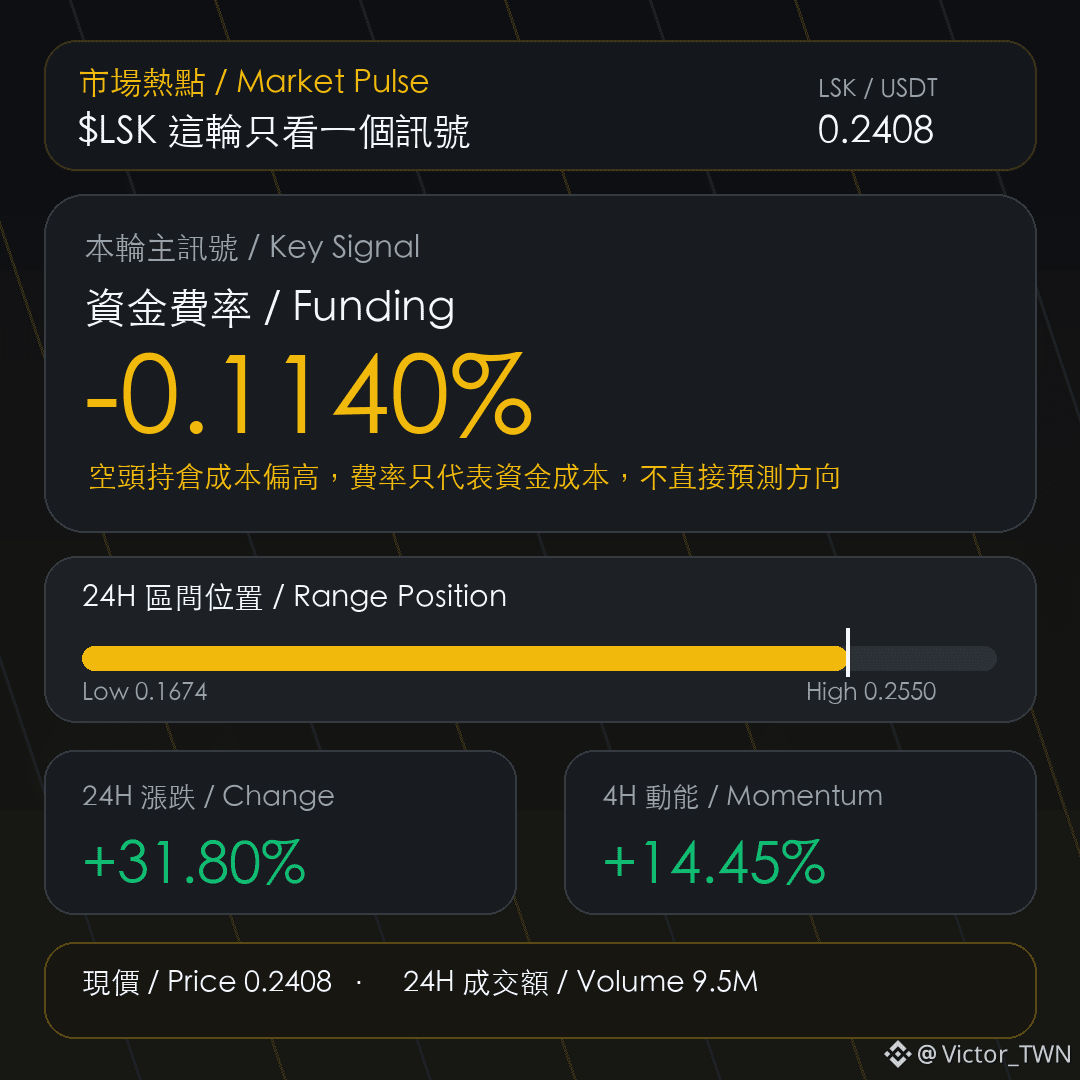
$LSK The two lines left by the previous post both got answers from this four-hour candle: 0.191 held, with a low of 0.2029; the upper boundary at 0.218 that needed to be reclaimed was taken back decisively, and price went on to reach 0.2534, closing at 0.2505 USDT—just 1.1% off the high and 23.5% above this candle’s low. 24-hour change: +36.89%.
More interestingly, nearly all of this 18.82% gain was crammed into the final hour. The four-hour range stretched from 0.2029 to 0.2534, a 24.89% swing, compared with just 14.14% in the previous candle. The first three hours were almost motionless, while the final hour alone moved 19.33%.
But two other things in the same candle did not follow price higher. The funding rate was still at -0.978% in the previous post; now it is -0.1088%. The negative reading has narrowed by about 90%, returning to almost flat at the zero line. Price has moved to the strong side, but the cost-side reading has retreated to the middle. 24-hour trading volume was about 9.41 million USDT, only around half of the 18.22 million at the time of the previous post. This rally has not brought rolling volume back to its previous level.
For this move to hold, price first needs to close above 0.2534. If 0.218 is breached again, the entire move made by this candle will be given back, with 0.2029 below that. The next funding rate settlement is at 12:00 Taipei time. If the reading is still near the zero line, this move is still being driven by price alone.
One counterpoint to keep in mind: the final hour itself covered a 23.25% range, rising from 0.2056 to the close. A move of this shape can happen within an hour—and reverse within an hour, too.
#MarketAnalysis
465
·
--
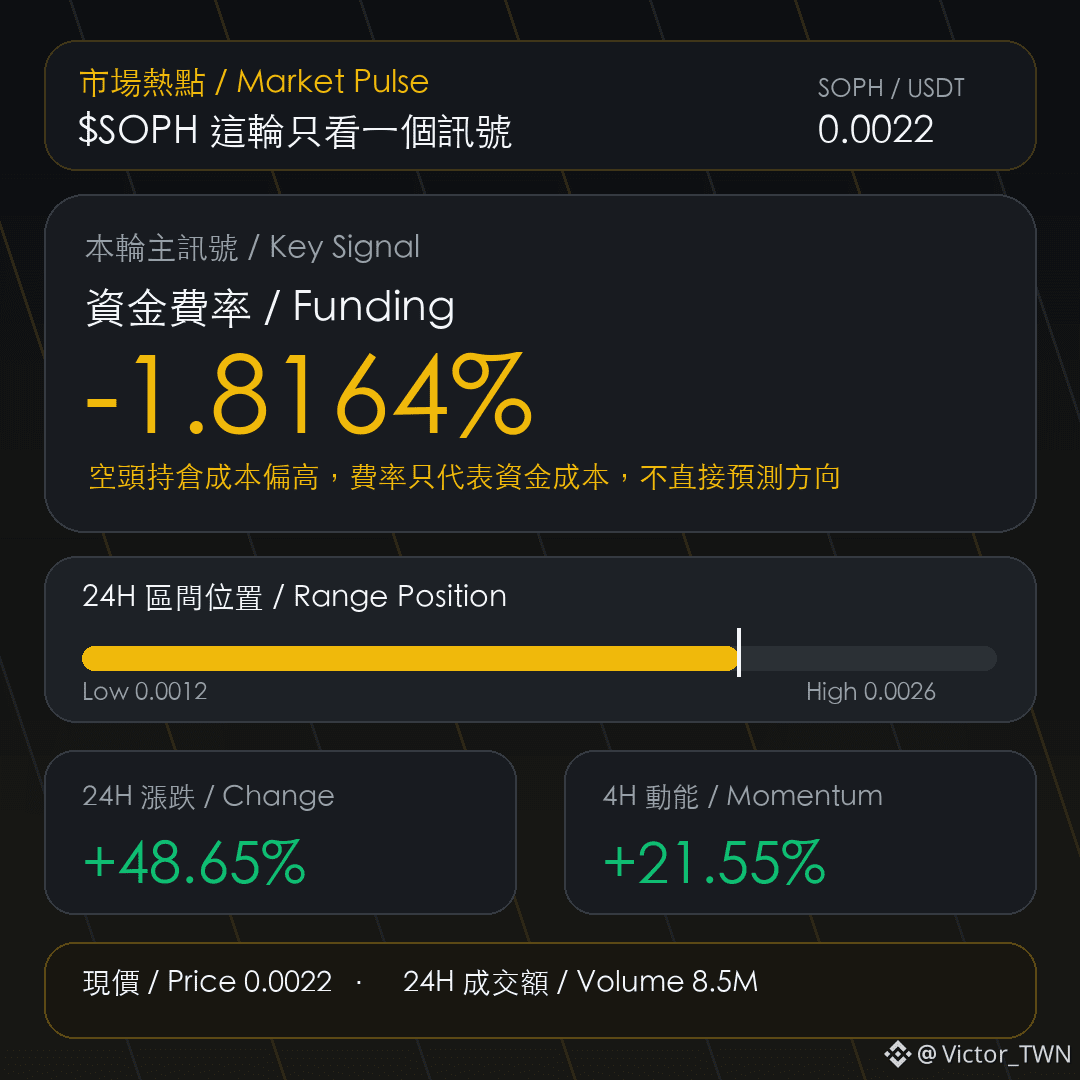
$SOPH 24 hours +49.66%, four hours +21.55%, but the most recent hour reversed: open 0.00235, high 0.00244, close 0.0022 USDT, -6.38%. The four-hour high of 0.0026 was touched, but price didn’t climb any further.
What concerns me more is that the cost side is moving in the opposite direction. The price rose nearly 50%, yet the funding rate is -1.8249%, deeply in negative territory; the mark price of 0.00215573 is about 2% below the spot price of 0.0022. Spot is pushing up, while the perpetual contract is still at a discount—the two aren’t moving in tandem.
Almost all the volume is concentrated in this one candle: four-hour trading volume was 1.565 billion tokens, equivalent to about 40% of 24-hour trading turnover, while 24-hour turnover itself was only around 8.42 million USDT.
The close landed near the midpoint of the four-hour range, 15.4% below the high. If the hourly low of 0.00216 breaks again, the gains from that final hour will be given back first. For this move to continue, price needs to close above 0.00244 and hold; beyond that, the next level is 0.0026. The next funding rate settlement is at 08:00 Taipei time. The reading is still deep in negative territory, so the cost side has yet to catch up with the price.
One counterpoint to keep in mind: the close rebounded from 0.00216, and the four-hour range was 43.65%. With this kind of pattern, a single four-hour candle could reverse it again.
#MarketAnalysis
40
·
--
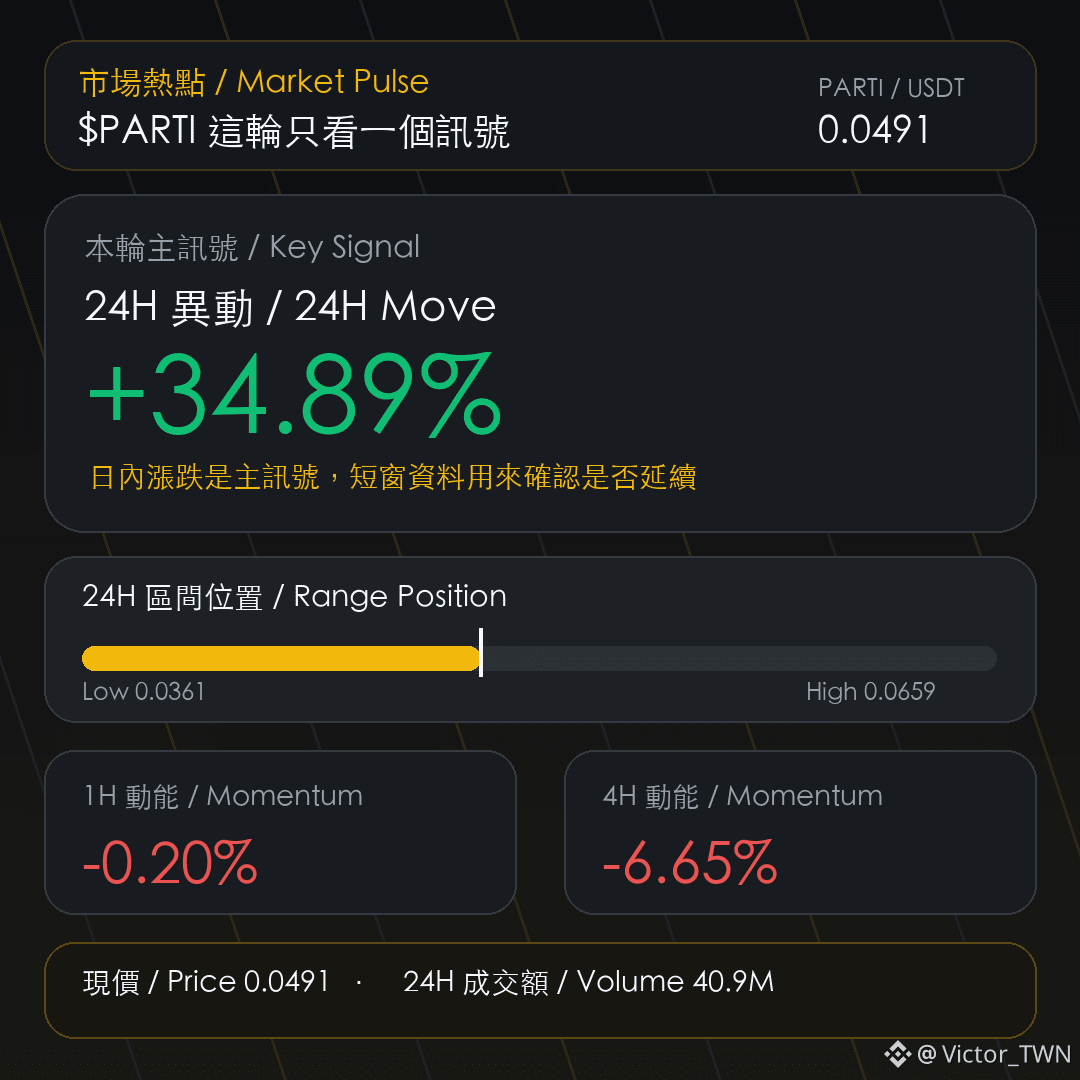
$PARTI The previous post said the chart and price were telling the same story for the first time, but eight hours later they’ve diverged again. The 24-hour chart is up 34.34%, which looks stronger than in the previous post, yet the price has retreated from 0.0496 to 0.0489 USDT, down 7.03% in four hours. It broke below the previous post’s low of 0.0490 and made a new low at 0.0479.
What’s stronger is the baseline, not the price. The price 24 hours ago has dropped from around 0.0389 to around 0.0364, a decline of 6.4%; most of the extra gain on the chart comes from the comparison baseline shifting lower. Over the same period, the price itself has retreated 1.4%.
Volume hasn’t picked up either. 24-hour trading volume is about 40.93 million USDT, roughly 5% lower than the 43.06 million at the time of the previous post. This four-hour candle traded 26.99 million tokens, down nearly 30% from the previous candle’s 37.62 million.
The cost side still isn’t taking a side. The funding rate is -0.004944%, almost identical to the previous post’s -0.00476%. For two consecutive settlements, it has hovered around the zero line, and the mark price is also nearly equal to spot. The price broke below the low, but the readings didn’t shift with it.
If 0.0479 breaks again, this cycle’s low is still ahead. To say this candle’s losses have been recovered, the price would first need to reclaim this candle’s open at 0.0526 and hold above it; beyond that, the next level is 0.0542. Another interpretation is still possible: the close has bounced from 0.0479, putting it 2.1% above the low, and the final hour was down just 0.61%, while the 24-hour chart still shows +34.34%. This kind of pattern can flip again within a single four-hour candle.
#MarketAnalysis
1.2k
·
--
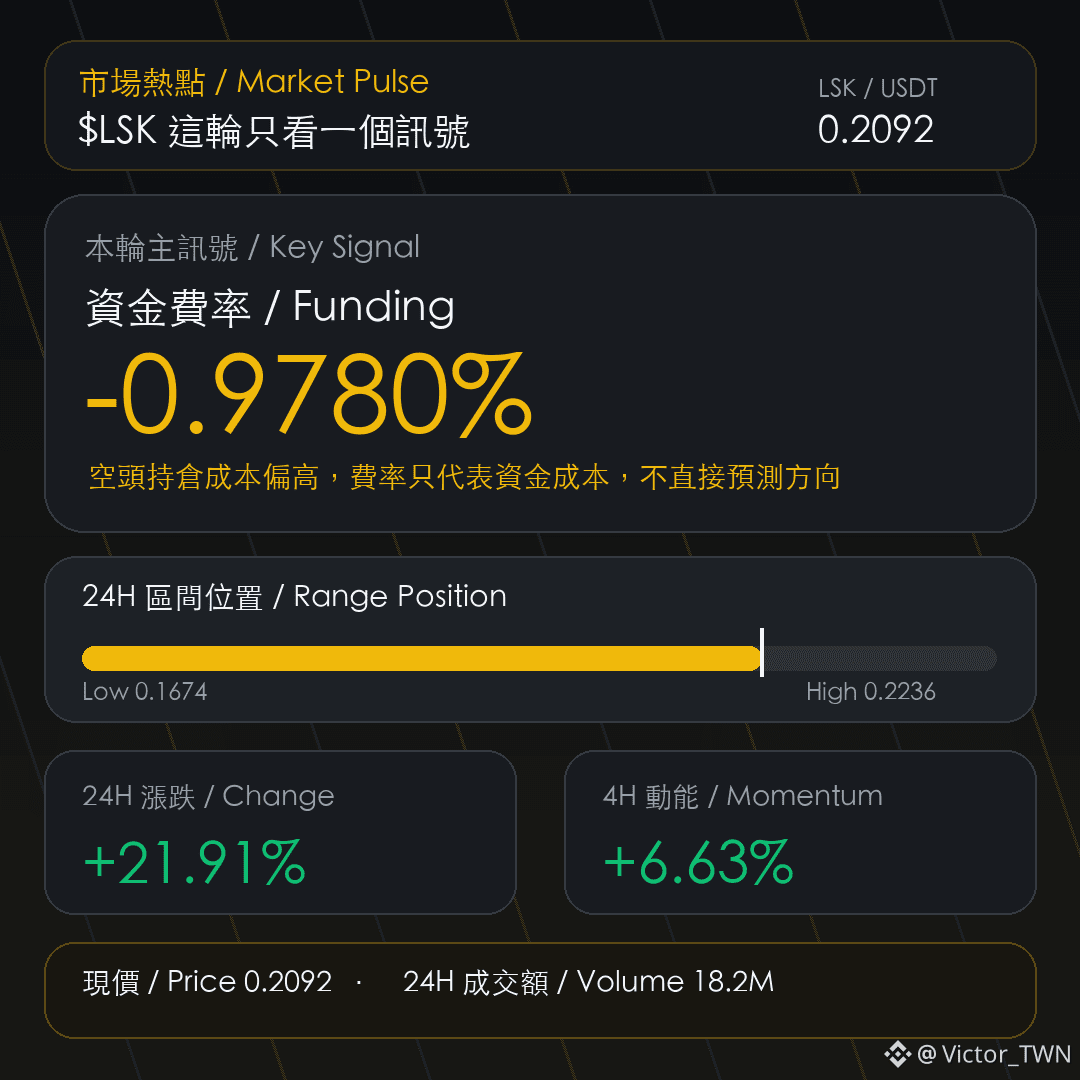
$LSK 24 hours +22.45%, up +6.78% over the last four hours, but the final hour reversed: opened at 0.2139 and closed at 0.2095 USDT, -2.06%. It touched 0.215 along the way, just 1.4% below the four-hour high of 0.218, but failed to hold above it, closing back in the middle of the range.
The cost side, however, is pointing the other way, and that’s the part I find harder to reconcile. The funding rate is -0.981%, a deeply negative reading that seems out of place for this stretch of price action; the mark price at 0.20645 is also about 1.45% below spot. Spot rose 22% over 24 hours, while the contract’s costs are signaling the opposite: price and cost are not moving in sync.
Volume wasn’t absent: 24-hour trading volume was about 18.22 million USDT, and the four-hour high-low range reached 14.1%.
To say the price is still holding up, first watch whether it can close above 0.218; if it breaks below the 0.191 low, the entire rally will have been given back. The next funding rate settlement is at 00:00 Taipei time. If the reading is still deeply negative, the cost side still hasn’t caught up with the price.
There’s another plausible read: the close rebounded from this hour’s low of 0.1978, up 5.9% from the low, while the hour itself covered an 8.7% range. A pattern that can play out in an hour can also reverse in an hour.
#MarketAnalysis
1
1
1.5k
·
--
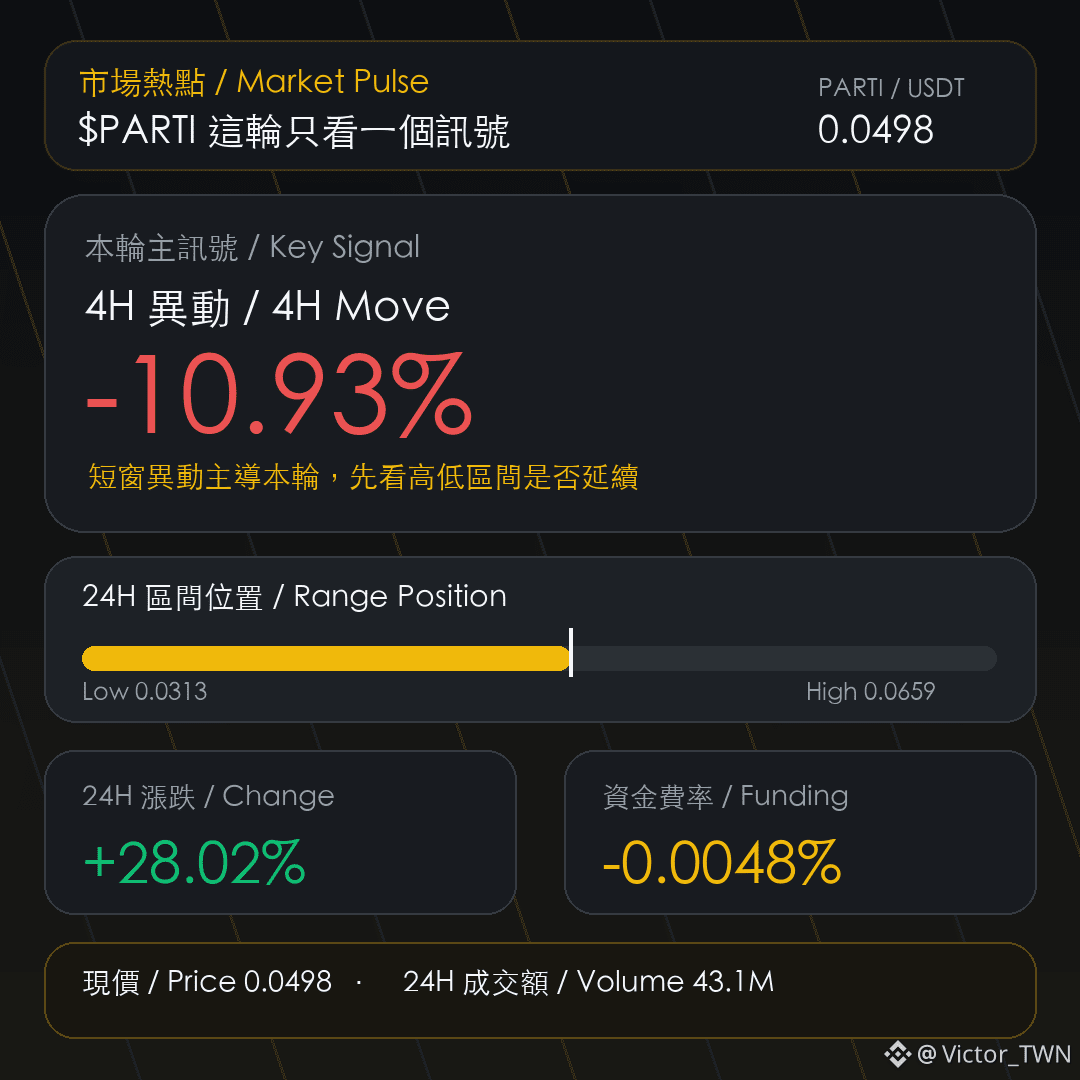
$PARTI The previous post said that if 0.0546 broke again, the entire lower end of this candle would be given back. This candle didn’t just break it—it plunged all the way to 0.0490, 10.3% below that line. It closed at 0.0496 USDT, just 1.2% above the candle’s low. Four-hour change: -11.11%. Both the high and low shifted from 0.0608 / 0.0546 to 0.0586 / 0.0490—the whole range moved down, not just a brief dip.
What matters more to me is that this time, the 24-hour figure doesn’t need to be discounted. In previous posts, I kept saying that most of the change on paper came from the rising baseline. This candle’s baseline only moved from about 0.0392 to 0.0390, barely changing. So the on-paper gain fell from over 40% to +27.18%; that drop corresponds to the price’s own 12.1% decline. At this point, for the first time, the on-paper figure and the price are telling the same story.
Volume didn’t follow: 24-hour trading volume was about 43.06 million USDT, only 4.6% higher than the 41.16 million at the time of the previous post. The price fell 12%, while volume stayed on the same line.
The cost side hasn’t picked a direction either. The funding rate was -0.00466%, hugging the zero line just like the +0.0019% reading at 12:00. Both settlements were within 0.005 percentage points of zero.
To say the downtrend has been contained, price first needs to reclaim 0.0546 and hold above it. If 0.0490 breaks again, the only lower reference point in this tracking series is the 0.0371 low where the rally began. There’s a counterpoint too: the close rebounded from 0.0490, and the 24-hour figure is still +27.18%. A shape like this can reverse again in a single four-hour candle.
#MarketAnalysis
1
2.6k
·
--
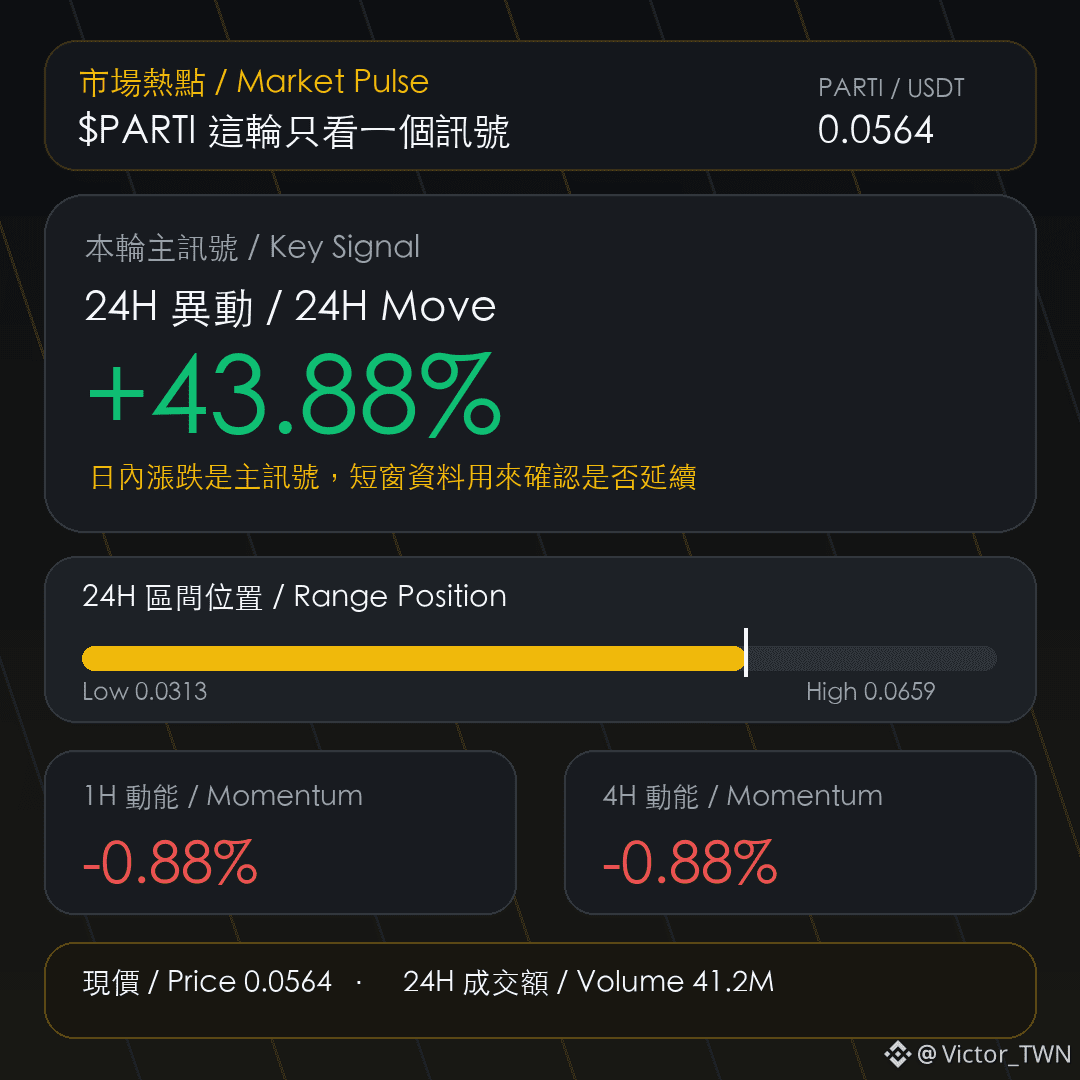
$PARTI The observation point left in the previous post was the funding rate settlement at 12:00 Taipei time. The reading is in: +0.0019%. The previous post was -0.0494%, and the one before that was -0.955%. This is the first time in this tracking series that it has crossed above zero, but the move is so small it’s practically flat—neither side has taken a position.
On price, it first broke through the lower boundary at 0.0559, reaching a low of 0.0546, 2.3% below it. The upper boundary at 0.063, meanwhile, was still 3.5% away and remained untouched; the high was 0.0608. The current price has returned to the opening price of 0.0569. The full 11.4% swing played out and then gave back all its gains, ending where it started.
24-hour turnover was about 41.16 million USDT, up 7.9% from the 38.14 million in the previous post. The swing narrowed from 12.7% to 11.4%, but volume didn’t retreat. Price went full circle, funding costs returned to zero, and turnover remained elevated. With all three happening at once, this candle hasn’t signaled a direction.
To say this stretch is still holding on the strong side, it first needs to close above 0.0608 and hold there; 0.063 is the next level above. If 0.0546 breaks again, the entire lower range of this candle will have been given back.
Here’s the counterpoint too: the current price has bounced from 0.0546 back to the opening price, and the 24-hour account is still showing +45.9%. This kind of pattern can open up again in a single four-hour candle.
#MarketAnalysis
219
·
--
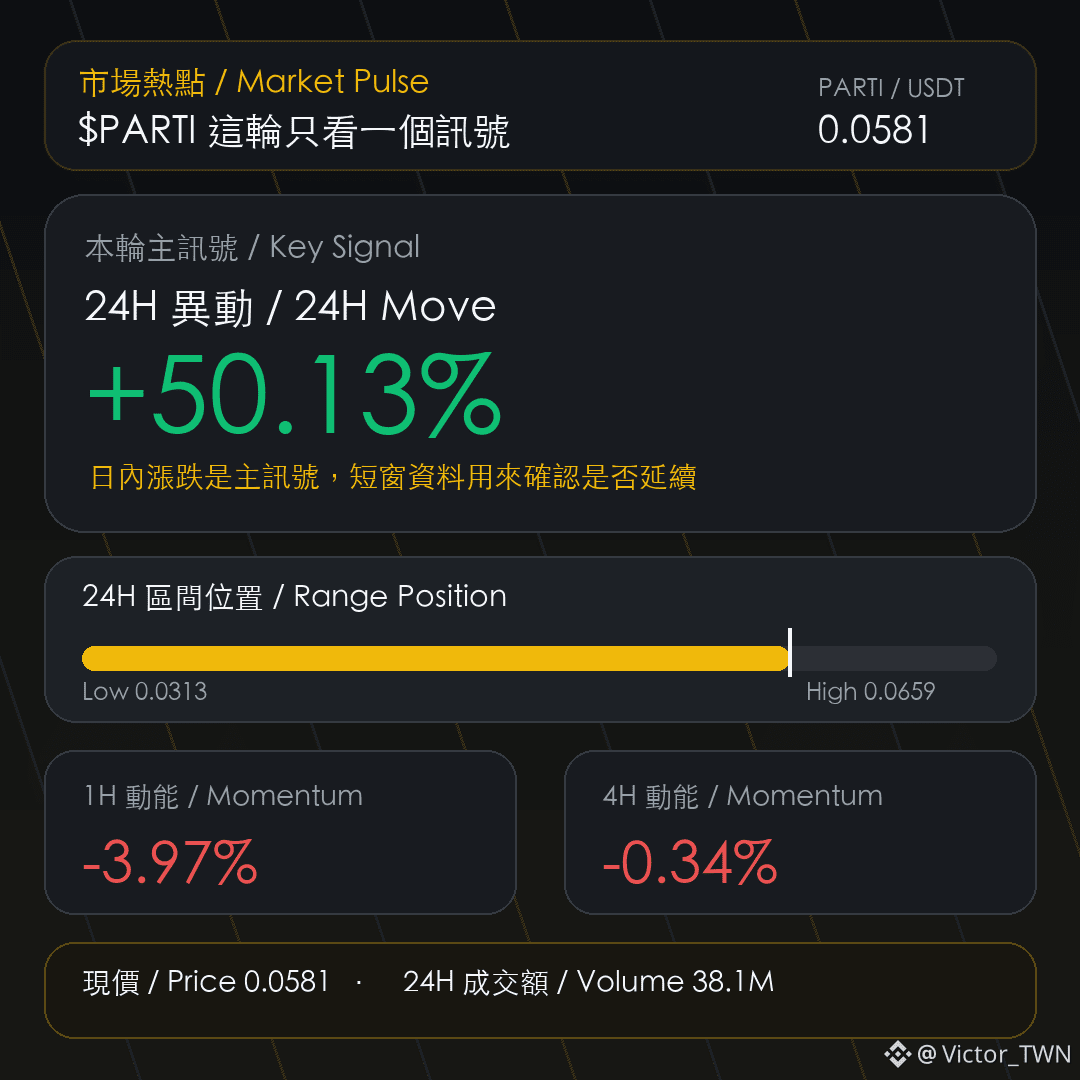
$PARTI The 0.0659 and 0.0549 levels from the previous post were both untouched in this four-hour candle: the high was 0.063, 4.4% short; the low was 0.0559, still 1.8% above the lower bound. The range narrowed from 77.6% to 12.7%. It closed at 0.0586 USDT, 1.6% higher than the 0.0577 at the time of the previous post.
Price held, but momentum didn’t. This four-hour candle traded 95 million tokens, compared with 470 million in the previous one—only about a fifth as much. Yet 24-hour trading volume was 38.01 million USDT, 18% higher than the previous post’s 32.31 million. The books look deep; this candle was thin.
Funding costs have eased even more. The funding rate recovered from -0.955% to -0.0494%, leaving the negative side at only about one-twentieth of its previous magnitude. The mark price at 0.05871 also flipped from a 0.90% discount to a 0.19% premium. Price is holding above the previous post’s level, but the readings have pulled all the way back toward the zero line.
To call this consolidation an upward pause, it first needs to close above 0.063 and hold there; beyond that is 0.0659. If 0.0559 breaks, the next stop is the previous post’s low of 0.0549, followed by 0.0371—the lowest level visible in this round of data. The next settlement is at 12:00 Taipei time. Only if the readings move away from the zero line in the same direction as price will the cost side have picked a direction.
Here’s the counterpoint too: the close was only 38% of the way up the range, 7.0% below the high, while the 24-hour figure still shows +51.4%. A shape like this can widen again in a single four-hour candle.
#MarketAnalysis
147
·
--
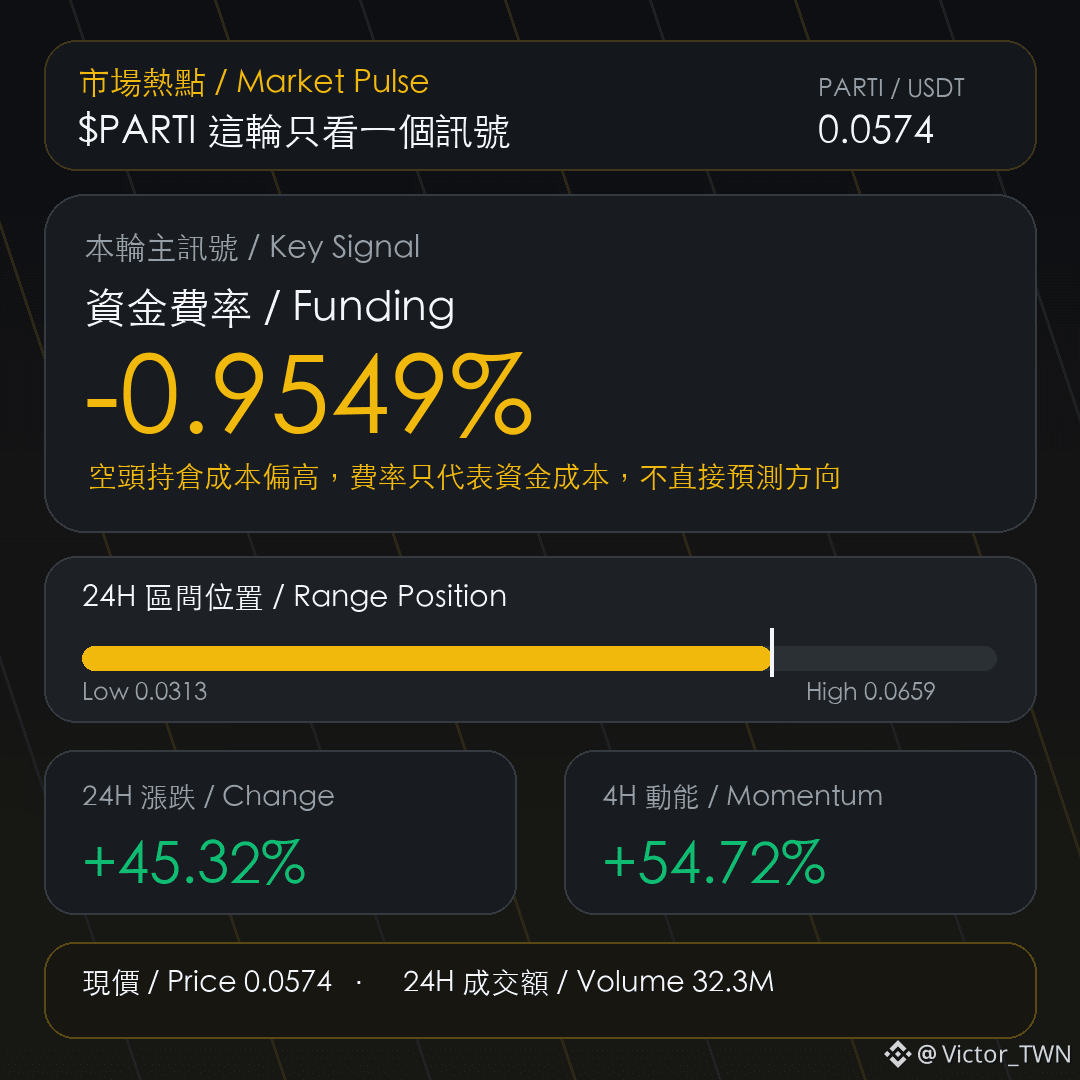
$PARTI This four-hour candle pushed from 0.0371 to 0.0659, then closed at 0.0577 USDT, up 55.5% in four hours. The move was real, but the close had retreated to about 70% of the way up the range, 12.4% below the candle’s high; in the final hour, it first touched 0.0639 before closing back at 0.0577.
I’m more focused on the cost side. The funding rate was -0.957%, deep in negative territory; the mark price at 0.05718 was also about 0.9% below the spot price of 0.0577. Price surged 55%, but the perpetual futures market didn’t trade at a premium—the move wasn’t reflected in the cost of holding positions.
Volume backed the move: 24-hour turnover was about 32.22 million USDT, and 469 million tokens traded in these four hours alone, concentrated in this candle.
For this move to continue, price first needs to close above 0.0659 and hold there. If the hourly low of 0.0549 breaks, the gains from the final hour would be given back first; below that, 0.0371 is the only lower level visible in the data for this run. There’s a counterpoint, too: the close rebounded from 0.0549, and the four-hour range was 77.6%—a move with this kind of shape can reverse again in a single four-hour candle.
#MarketHotspot
275
·
--
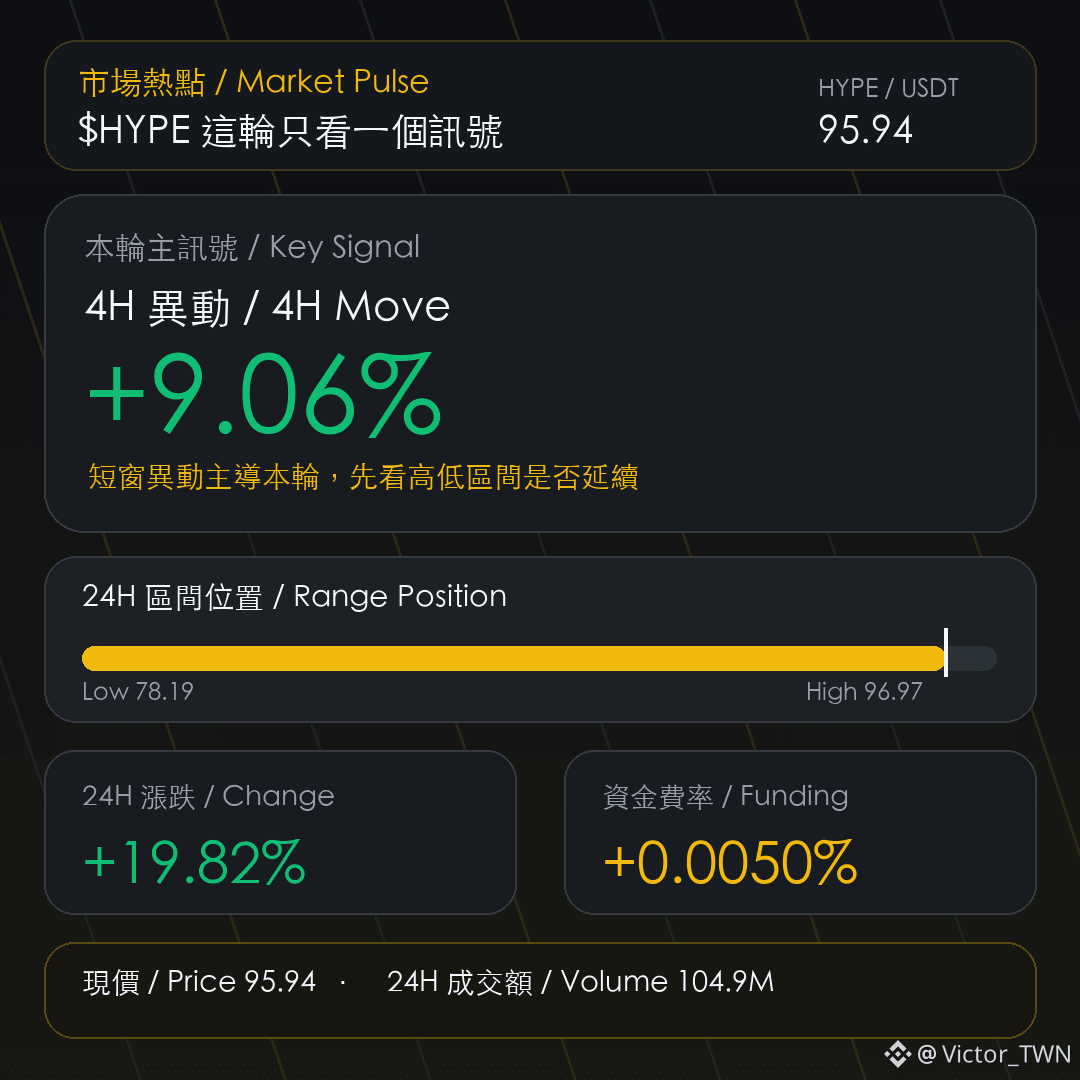
$HYPE rose +19.66% in one day. Breaking it down, it was up +8.97% over four hours and +2.79% in the final hour. All three timeframes moved in the same direction, with the shorter windows moving more sharply. The close at 95.86 USDT was 1.1% below the four-hour high of 96.97. The full range ran from 87.83 to 96.97, with the close at 88% of the way up the range; 24H trading volume was about 104 million USDT.
The real mismatch is on the cost side. After a rise of nearly 20%, the funding rate was only 0.005%, and the mark price at 95.756 was almost level with spot. The readings showed no bias in either direction throughout. This move was driven by price itself.
Once that momentum fades, the only thing left to verify is the price level: the current price is still 9.1% above the four-hour starting point of 87.83. That is how far the entire gain would have to unwind.
For the rally to keep going, price needs to close above 96.97 and hold there. First, a break below this hour’s low of 92.88 would give back the final hour’s gain; below that is 87.83.
There’s also another possibility to keep in mind: the close is only 1.1% below the high, and the final hour was still moving up. It may simply have shifted the entire trading range up a level rather than run out of momentum. This pattern could reverse again in a single four-hour candle.
#MarketHotTopics
399
·
--
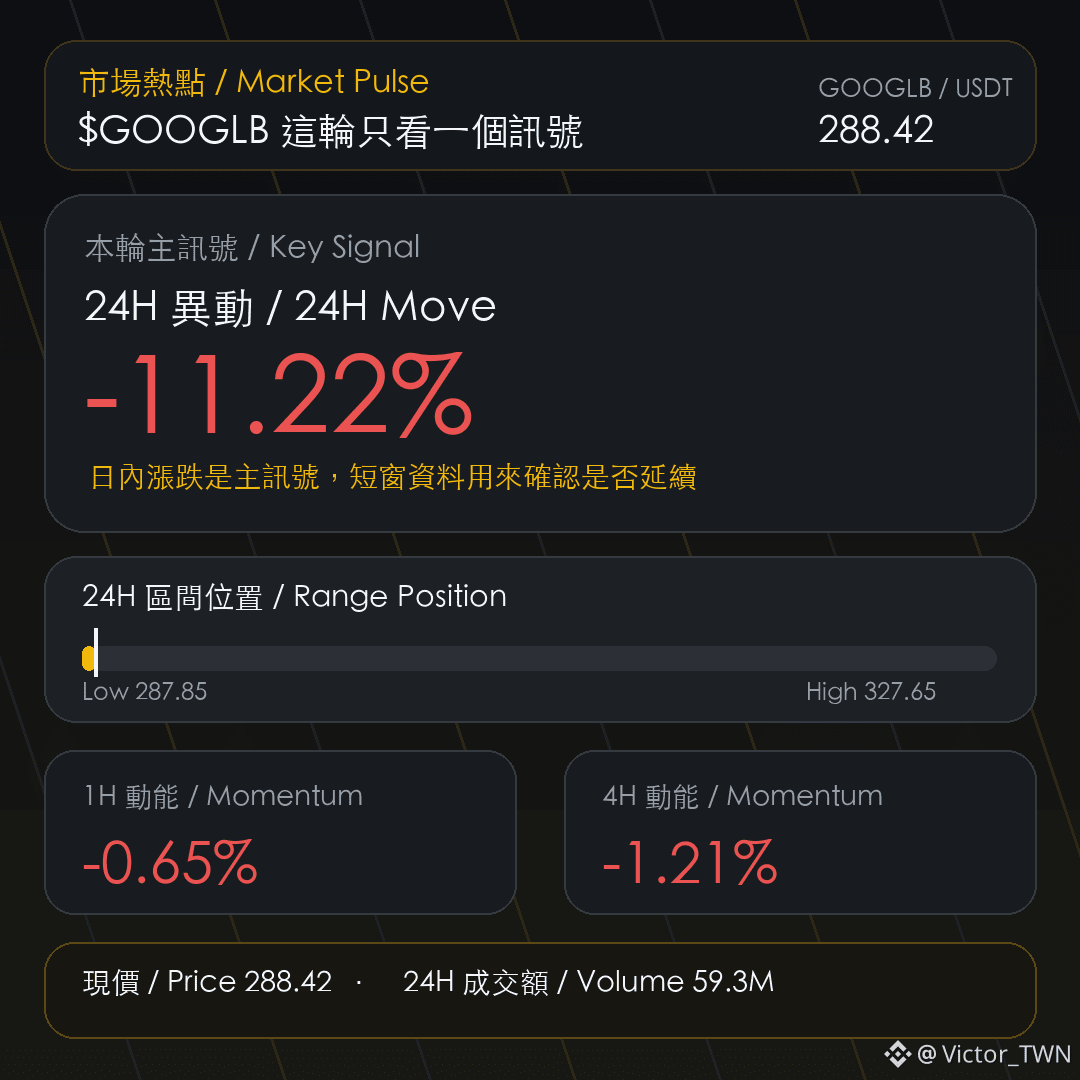
$GOOGLB 24 hours -11.10%. Converted back, it was around 325 USDT 24 hours ago. But over the past four hours, it has only fallen another 1.04%, with the last hour down 0.48%. The high-low range for the full four hours was 1.65%; the steepest part of the drop wasn’t during this period.
The sticking point is the closing price. The low of 288.56 was set only in the past hour, and the close at 288.92 is just 0.12% above it, while still 1.5% below the four-hour high of 293.31. The decline has lost momentum, but the price hasn’t moved away from the lows.
Over the same period, major cryptocurrencies fell by a completely different magnitude: BTC -1.06%, ETH -0.94%, BNB -2.18%, SOL -1.71%. Meanwhile, these three tokenized stocks were down MVLLB -21.08%, GOOGLB -11.10%, and MRVLB -10.33%. There’s no basis for the idea that “they’ll rise along with the market when it recovers” in this group. The 24-hour trading volumes of the other two were about 1.52 million and 3.6 million USDT—just one-sixteenth to one-thirty-ninth of this one’s—while their declines were steeper and their trading volumes smaller.
For this consolidation to break upward, it first needs to reclaim 293.31 and hold above it. If 288.56 is broken again, the interpretation that price is holding steady near the low is immediately invalidated—which would mean the low for these 24 hours is still ahead. Keep the opposite scenario in mind, too: the low was set only in the past hour, the close is right beside it, and the 1.65% range is still clustered near the bottom. A break in either direction wouldn’t be surprising.
#MarketHotspots
316
·
--
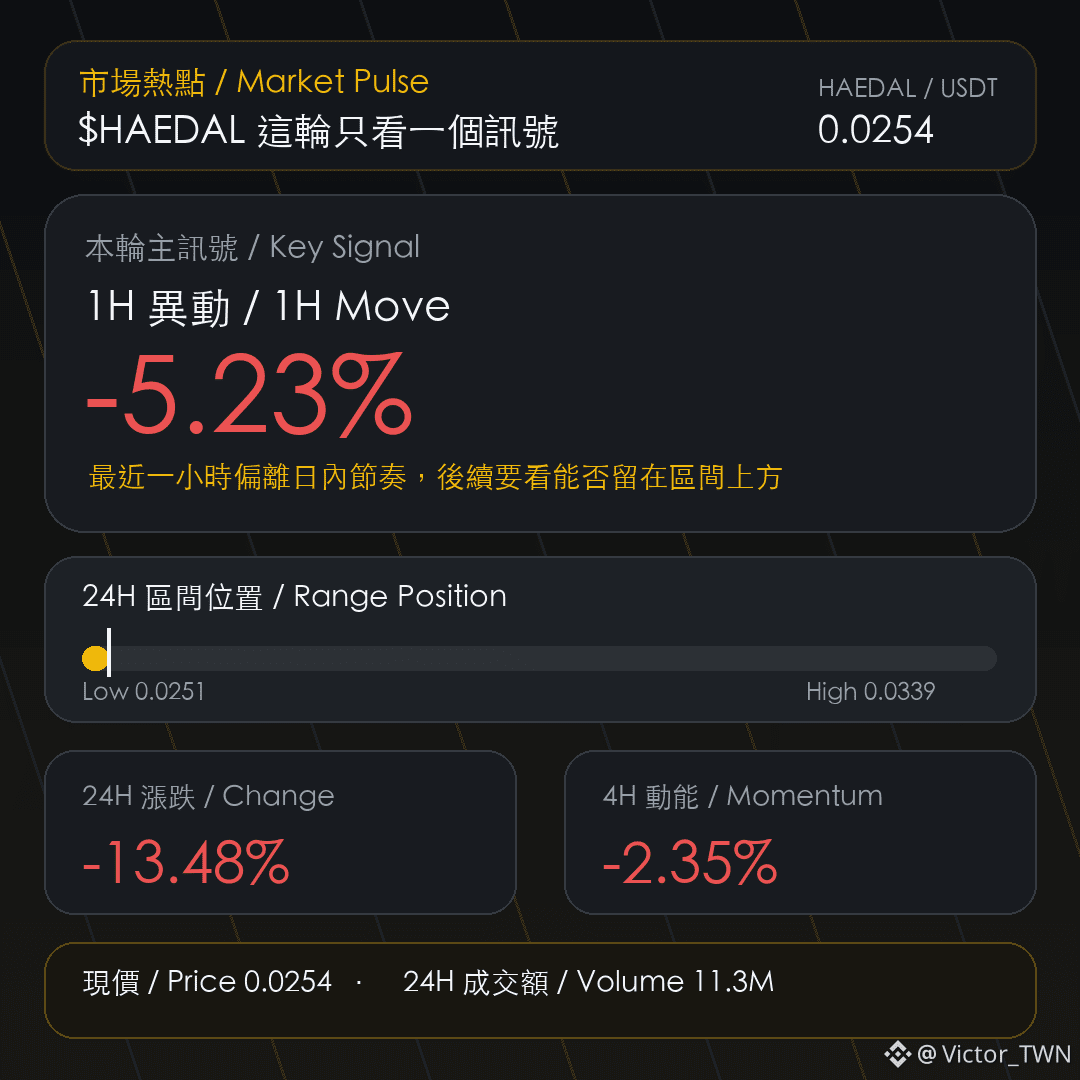
$HAEDAL Yesterday afternoon's post closed at 0.02886; now it's at 0.02521 USDT, down 12.47% in 24 hours. The price has pulled back 12.6%.
The two lines drawn yesterday were 0.02741 and 0.02656. This four-hour candle crossed both, once each. The sequence was up first, then down: the high was 0.02753, just 0.4% above 0.02741; it closed at 0.0252, only 0.2% above the low of 0.02515. It fell 2.93% over four hours, with the last hour down 5.79%; the low was made in that final hour.
Volume is another thing that doesn't add up. 24-hour trading volume is about 11.3 million USDT, half of yesterday's 22.37 million. Despite the price pulling back this much, trading volume was cut in half. The funding rate also moved from -0.0294% back to -0.0014%, almost flat at zero. During this stretch of declines, funding costs haven't shifted along with the price.
Further down is the October 28 low of 0.02448, 2.9% below the current price. To say the downtrend has been contained, the price first needs to reclaim and hold above 0.02656. If 0.02448 breaks, the range moves down another level.
I'll keep the reverse scenario in mind too: 0.02448 hasn't been touched yet, nearly all of the 12.6% drop came in the last hour, and volume was cut in half. With a drop like this, direction could flip again in a single four-hour candle.
#MarketAnalysis
102
·
--
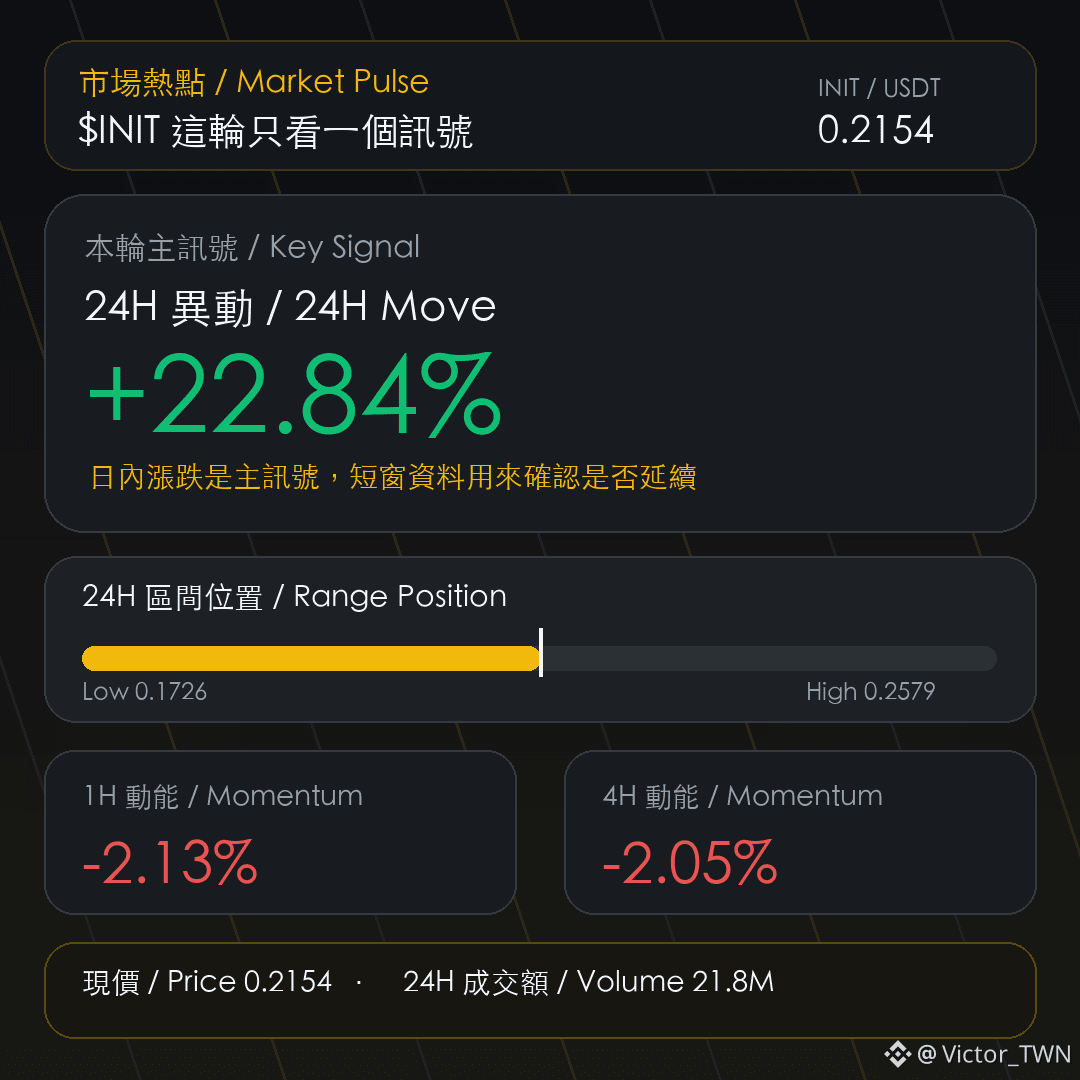
$INIT The two lines left by the previous post were each tested once by this four-hour candle, and neither side held. The upper boundary at 0.22902 wasn’t even touched—the high was 0.22698, 0.9% short. The lower boundary at 0.21045 was broken, with a low of 0.20588, 2.2% below; the close at 0.21529 USDT then moved back above that line by 2.3%.
The difference is where it closed. The candle in the early hours broke both boundaries and closed in the lower third of the range; this one broke only the lower boundary and closed at around the 45% mark of the range, rebounding from 0.20588.
The range as a whole is still shifting lower: this candle’s high of 0.22698 was below the previous candle’s 0.22902, and its low of 0.20588 was also below 0.21045. The range widened from 8.8% to 10.2%.
Volume is back, but funding costs haven’t moved. The 24-hour trading volume was about 21.8 million USDT, roughly 9% higher than the 19.98 million in the previous post. The funding rate was -0.0445%, only about 10% more negative than the previous post’s -0.0403%. The price fell 2.5%, while the reading barely budged. The mark price of 0.21542 was almost identical to spot.
The 24-hour return on paper went from +33.24% to +22.18%. Most of that wasn’t due to another leg down; it was because the 24-hour reference price rose from around 0.166 to around 0.176.
To say the lower boundary really held this time, we need to see the next candle close above 0.21045. If it breaks below 0.20588 again, the next level down is 0.20111. On the upside, it needs to close above 0.22698 before we can talk about reclaiming the range. The next funding-rate settlement is at 16:00 Taipei time; only when the reading moves away from the -0.04% area will the cost side have picked a direction.
The opposite view is worth keeping too: the low is lower than the previous candle’s, so the center of gravity is moving down. The close is only 4.6% above this candle’s low; with this kind of shape, a single four-hour candle could test the lower boundary again.
#MarketAnalysis
144
·
--
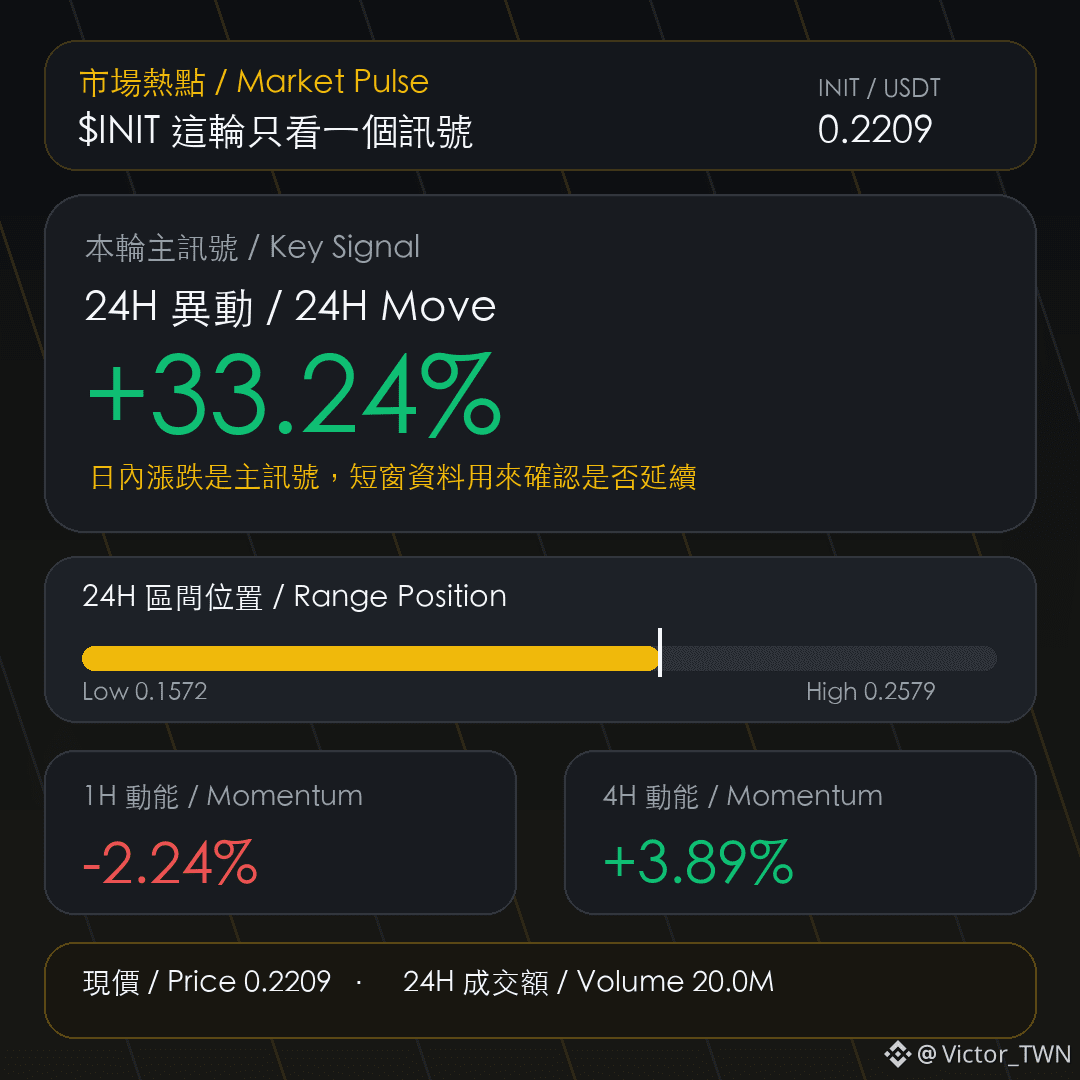
$INIT 24 The 24-hour figure on the books jumped from +15.65% in the previous post to +34.24%, while the price itself only moved from 0.2129 to 0.22265 USDT, about +4.6%. Most of the difference comes from the comparison baseline: the price 24 hours ago fell from around 0.184 to around 0.166. 24-hour trading volume was about 19.97 million USDT, almost unchanged from the 19.18 million at the time of the previous post; the figure on the books jumped substantially, but trading volume didn’t follow.
This leg of the rally did reach a higher level. The 0.22294 from the previous post was surpassed by this four-hour candle’s high of 0.22902, clearing it by 2.7%. But it closed at 0.22265, still 0.13% short of holding above that level, and the final hour was down 1.45%. Touching the level and holding above it—once again, this round only managed the former.
This time, the cost side offered a clue, and it moved in the opposite direction to the price. The previous post said to watch whether the reading would sink further into negative territory. The funding rate went from -0.0238% to -0.0407%, deepening on the negative side by about 70%. As the price rose, it fell; the two did not move in tandem. The next settlement is at 12:00 Taipei time.
To say the upper boundary has truly been reclaimed this time, it needs to close above 0.22902 and hold there. If 0.21045 breaks, the entire range gained in this move will be given back, with the previous candle’s 0.20111 as the next level below.
Another way to read it: the low rose from 0.20111 to 0.21045, and the close shifted from around the midpoint of the range to roughly two-thirds of the way up. It may simply mean the center of the range has moved up another level. The 24-hour figure is still showing a gain of 34%, and this kind of pattern could reverse again in a single four-hour candle.
#MarketAnalysis
131
·
--
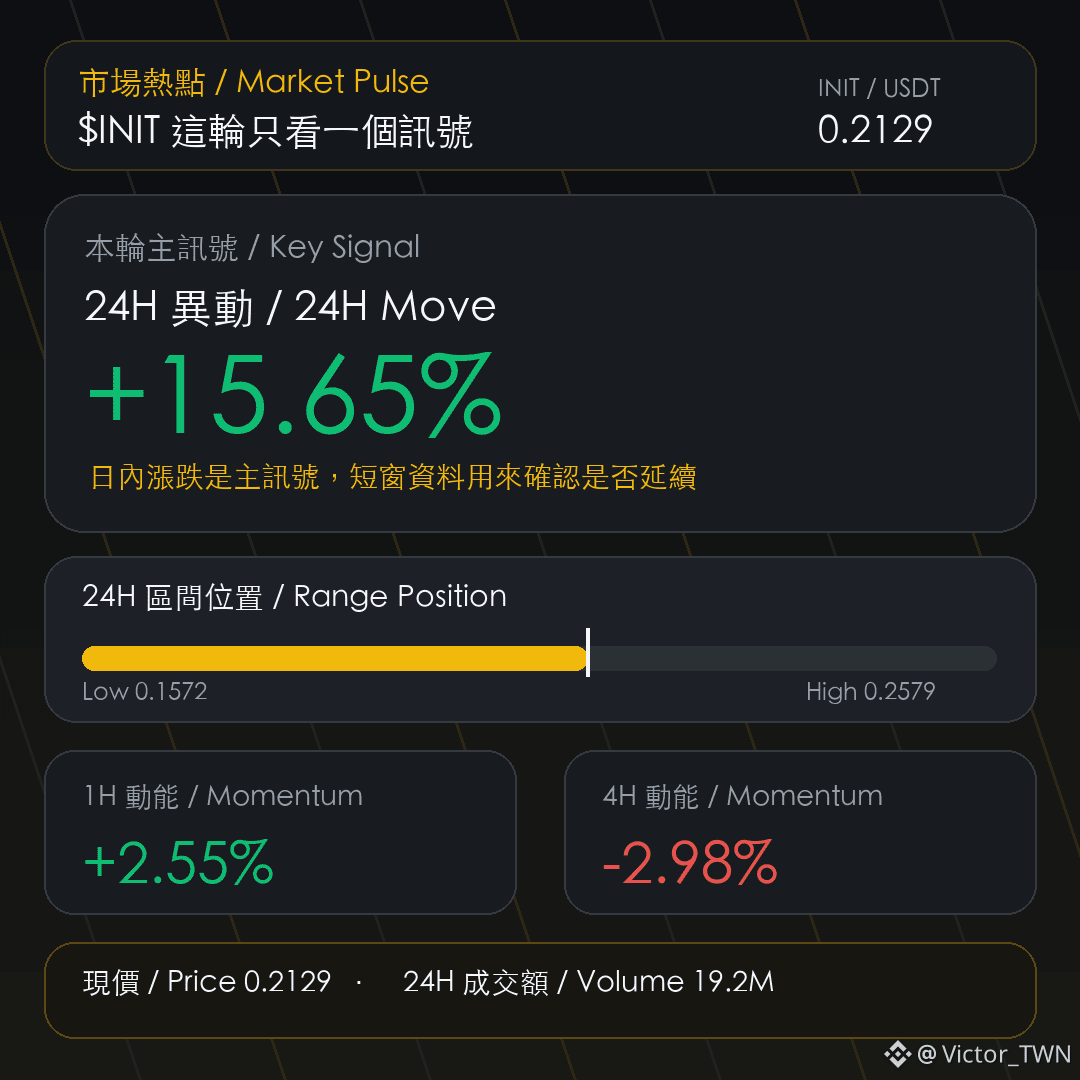
$INIT 24 The hourly figure fell from +27.60% to +15.16%, which looks like it gave back half its gains. But the price moved from 0.20932 USDT at the time of the previous post to 0.21188 USDT, up just 1.2%. What changed was the baseline: the price 24 hours ago rose from around 0.164 to around 0.184. Nearly all of that 12-percentage-point drop is arithmetic, not another leg down.
This candle marked a change in range. The previous range spanned 35.4% (0.1905 to 0.25793), while this one is just 10.9%: the upper bound of 0.22294 is only 0.26% above the 0.22237 left in the previous post, and the close at 0.21188 retreated again. The low was 0.20111, still 5.6% above 0.1905—it did not even come close.
Volume did not contract along with the range. 24-hour trading volume was about 19.18 million USDT, roughly 6% higher than the 18.11 million at the time of the previous post. With volatility cut by two-thirds while volume holds steady, this kind of compression looks different from simple sideways consolidation.
The funding rate recovered from -0.0636% to -0.0239%, narrowing the negative side by about 62%. The price barely moved, yet funding costs moved back toward zero on their own—both sides are pulling back from extremes at the same time.
To the downside, watch whether 0.20111 holds. If it breaks and price cannot reclaim it, the range will shift down another level. To the upside, price needs to close above 0.22294 and hold there to count as a recovery. The next funding-rate settlement is at 08:00 Taipei time; only if the reading turns more deeply negative again will the cost side have chosen a direction.
Keep the reverse scenario in mind too: if both sides are only tested without either move holding, and volume does not retreat, a single four-hour candle could be enough to widen the range again.
#MarketAnalysis
50
·
--
Article
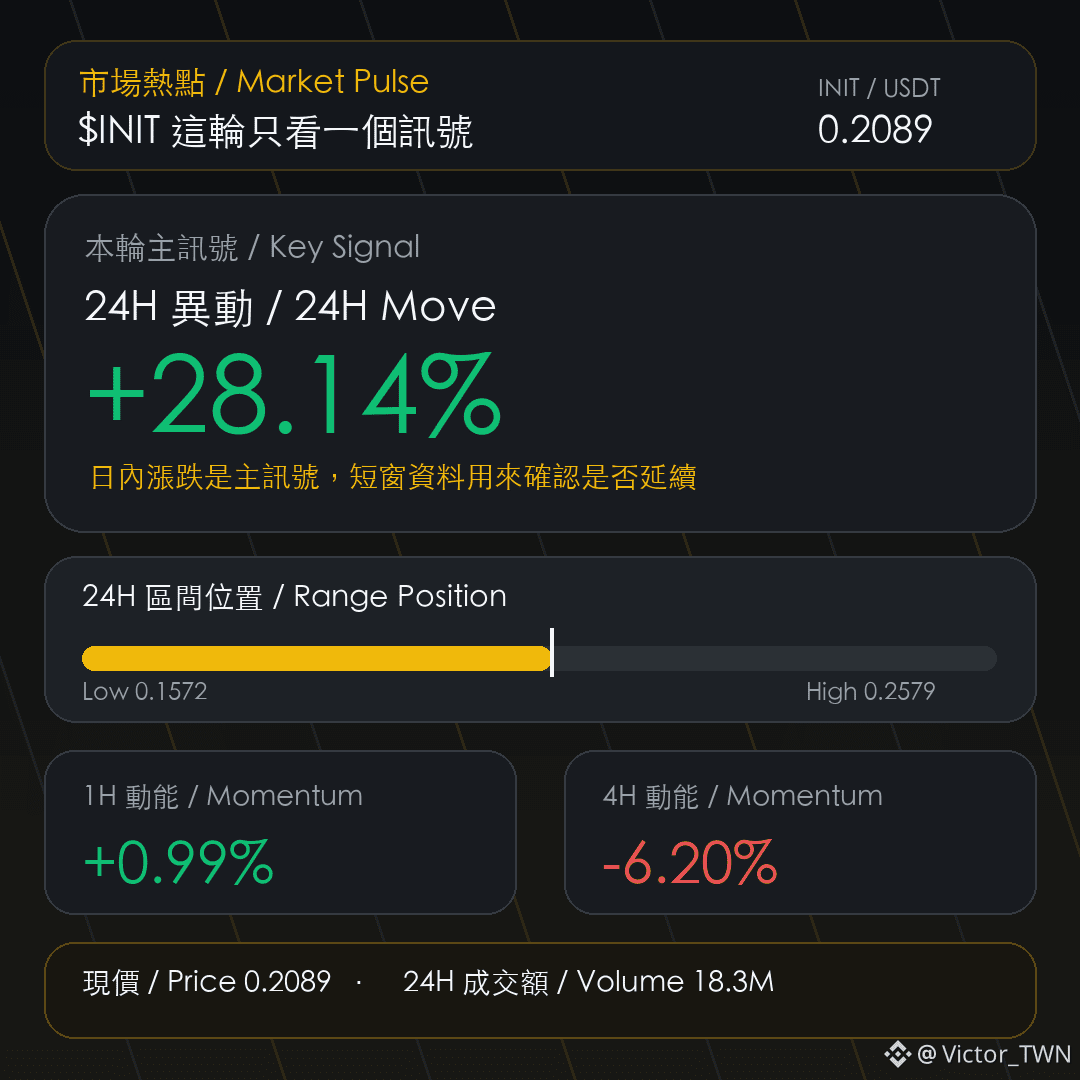
INIT broke above the upper level, then below the lower one—one full round trip in four hours$INIT The two levels left in my previous post were 0.22589 and 0.20656. Over the past four hours, price broke through both. First it pushed up to 0.25793, 14.2% above the upper level; then it fell all the way back to 0.1905, 7.8% below the lower level; finally it closed at 0.20932 USDT, down 5.87% over four hours. Compared with the 0.21213 at the time of my previous post, the close was 1.3% lower. In one evening, price moved through both sides and ended up almost back where it started.
This looks worse than what I said in my previous post: “It only counts as a follow-through if it closes above 0.22589.” The breakout did happen, and price pushed 14% above the upper level; four hours later, that same move had taken it down to 0.1905. The breakout was real, but the momentum wasn’t—both things were true this time. That 0.22589 level has also served its purpose; if I treat it as the upper level again, the line will be drawn in the wrong place.
INIT broke above the upper level, then below the lower one—one full round trip in four hours
$INIT The two levels left in my previous post were 0.22589 and 0.20656. Over the past four hours, price broke through both. First it pushed up to 0.25793, 14.2% above the upper level; then it fell all the way back to 0.1905, 7.8% below the lower level; finally it closed at 0.20932 USDT, down 5.87% over four hours. Compared with the 0.21213 at the time of my previous post, the close was 1.3% lower. In one evening, price moved through both sides and ended up almost back where it started.
This looks worse than what I said in my previous post: “It only counts as a follow-through if it closes above 0.22589.” The breakout did happen, and price pushed 14% above the upper level; four hours later, that same move had taken it down to 0.1905. The breakout was real, but the momentum wasn’t—both things were true this time. That 0.22589 level has also served its purpose; if I treat it as the upper level again, the line will be drawn in the wrong place.
This looks worse than what I said in my previous post: “It only counts as a follow-through if it closes above 0.22589.” The breakout did happen, and price pushed 14% above the upper level; four hours later, that same move had taken it down to 0.1905. The breakout was real, but the momentum wasn’t—both things were true this time. That 0.22589 level has also served its purpose; if I treat it as the upper level again, the line will be drawn in the wrong place.
205
·
--
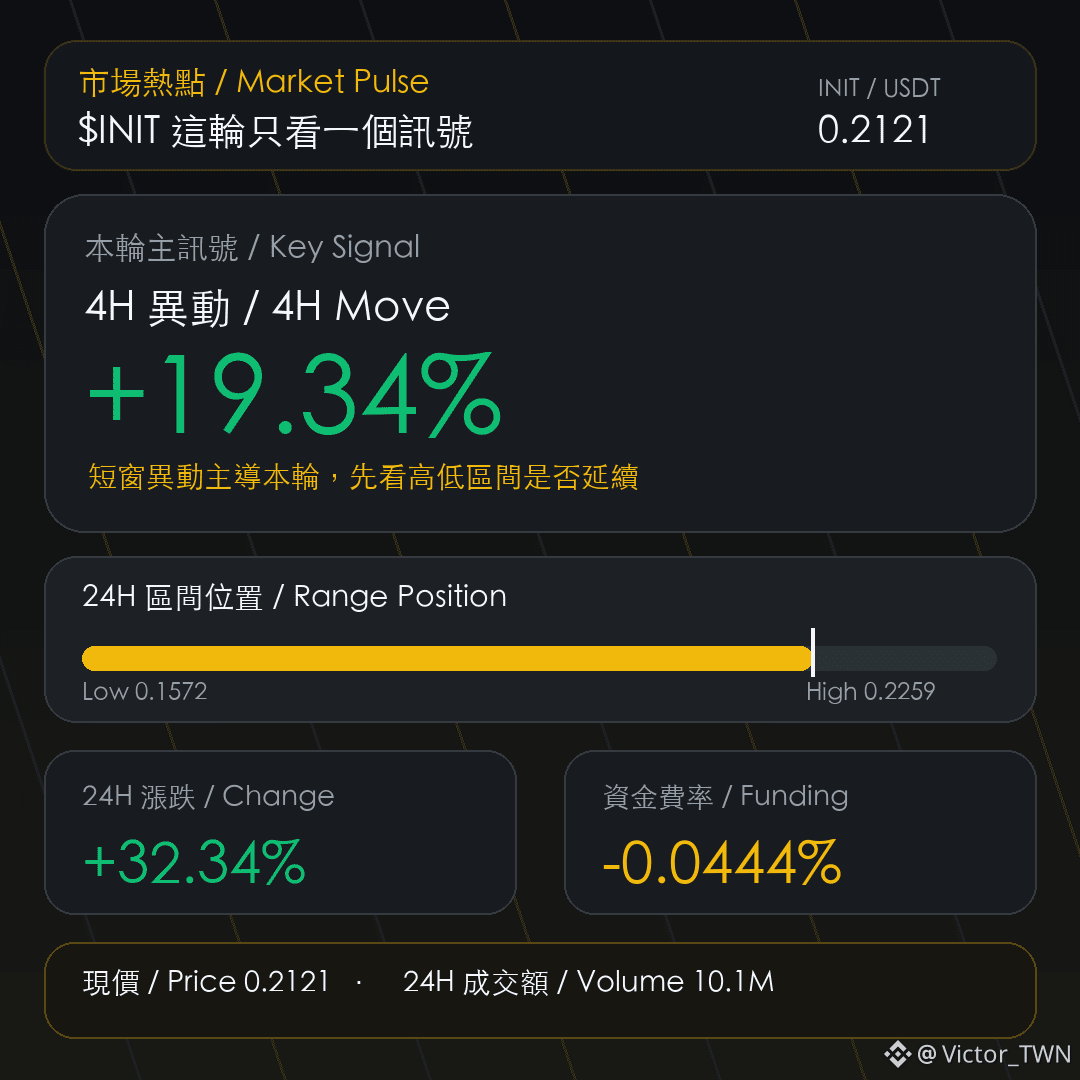
$INIT This four-hour candle rose from 0.17776 to 0.22589, 27.08% above its open, and closed at 0.21092 USDT; up 18.65% over four hours and 31.87% over 24 hours. It failed to hold the move higher: the close was 6.63% below the candle’s high, with nearly all of that giveback coming in the final stretch. In the last hour, price fell from 0.223 to 0.21092, down 5.42%, covering a range of 9.18% and closing 2.11% above the low of 0.20656.
Volume doesn’t line up: 24-hour trading volume was about 10.09 million USDT. For a market that surged 27% in one four-hour candle, that’s not much.
The funding rate is still negative at -0.0449%, though not by much; the mark price at 0.21090 is almost level with spot. Price has moved this far without costs moving in tandem. This leg was driven by price action alone.
For the rally to look sustainable, price first needs to close above 0.22589 and hold there. If 0.20656 breaks, the late-stage gains will be the first to be given back, with this candle’s low of 0.1766 next below.
Keep the other side in mind, too: the close recovered from 0.20656 rather than landing at the low, and the 24-hour figure is still up 32%. A single four-hour candle can change this pattern. The next funding rate settlement is at 00:00 Taipei time; only if the reading moves out of negative territory will the cost side have weighed in.
#MarketHotTopic
184
·
--
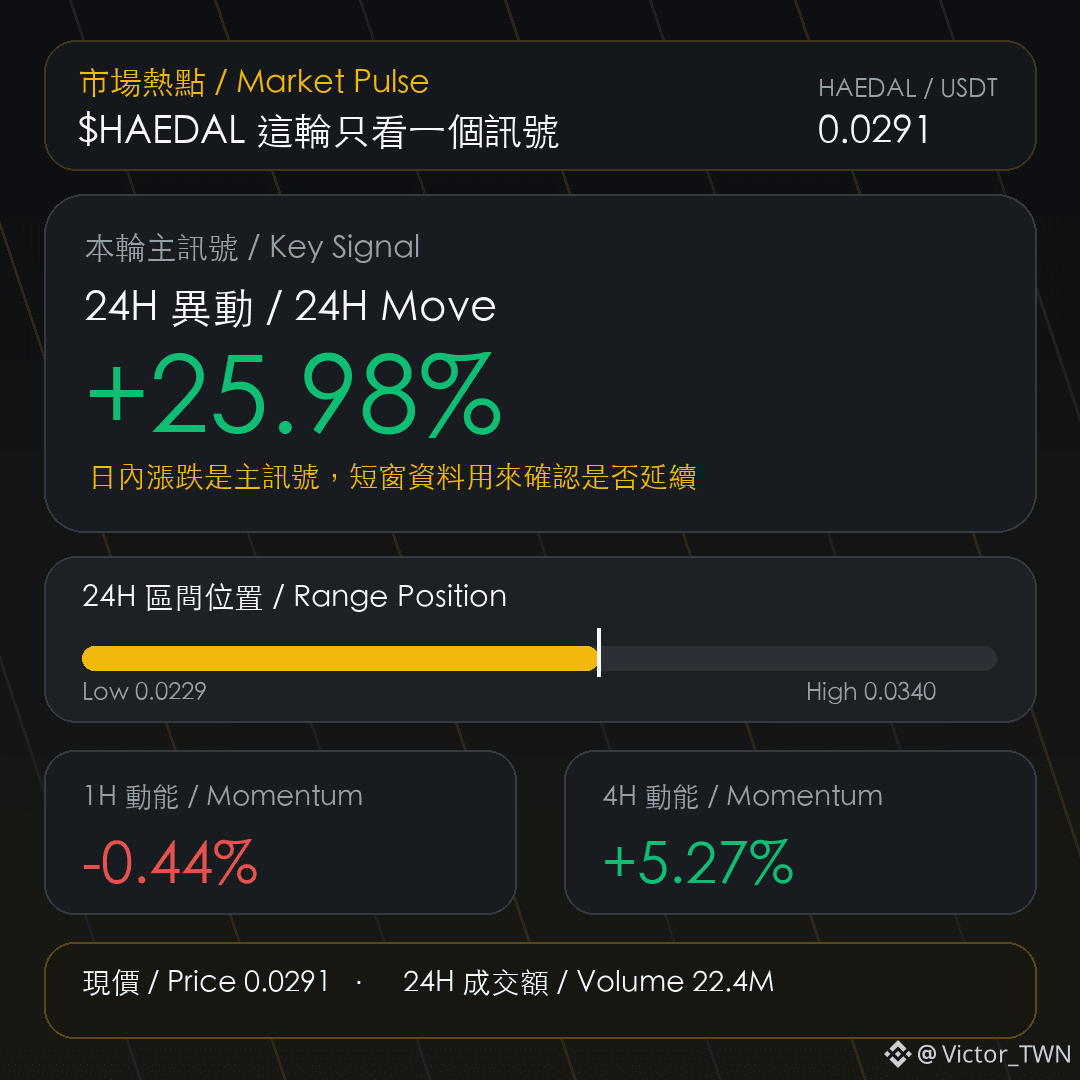
$HAEDAL The previous post left us with 0.02962: reclaim it and hold, and the pullback will finally be contained. This four-hour candle did push through it, reaching a high of 0.03015, 1.8% above that level; but it closed at 0.02886 USDT, back below 0.02962 and 4.3% off the candle’s high. This round, price only managed to touch the level—not hold above it.
Price rebounded from 0.02697 on the previous four-hour candle to 0.02886, up about 7.0%, while funding moved in the opposite direction: from -0.0106% in the previous post to -0.0300%, roughly 2.8 times as negative. In the previous few rounds, the reading hovered around 0.01% regardless of which way price moved. This time, price bounced, but funding moved even further out of line.
24-hour trading volume was about 22.36 million USDT, around 12% higher than the 19.98 million in the previous post. The candle’s low was 0.02741, and it didn’t revisit the previous candle’s 0.02656 low.
For the upper boundary to be truly reclaimed, price needs to close above 0.03015 and hold there. A break below 0.02741 would shift the range down a level, with 0.02656 below that. The next funding-rate settlement is at 20:00 Taipei time.
Here’s the counterpoint too: the low didn’t make a new low, and the close rallied from 0.02787. It may simply be that the whole consolidation range is shifting higher. The 24-hour change is still +24.76%, and a single four-hour candle can turn this pattern around again.
#MarketAnalysis
80
·
--
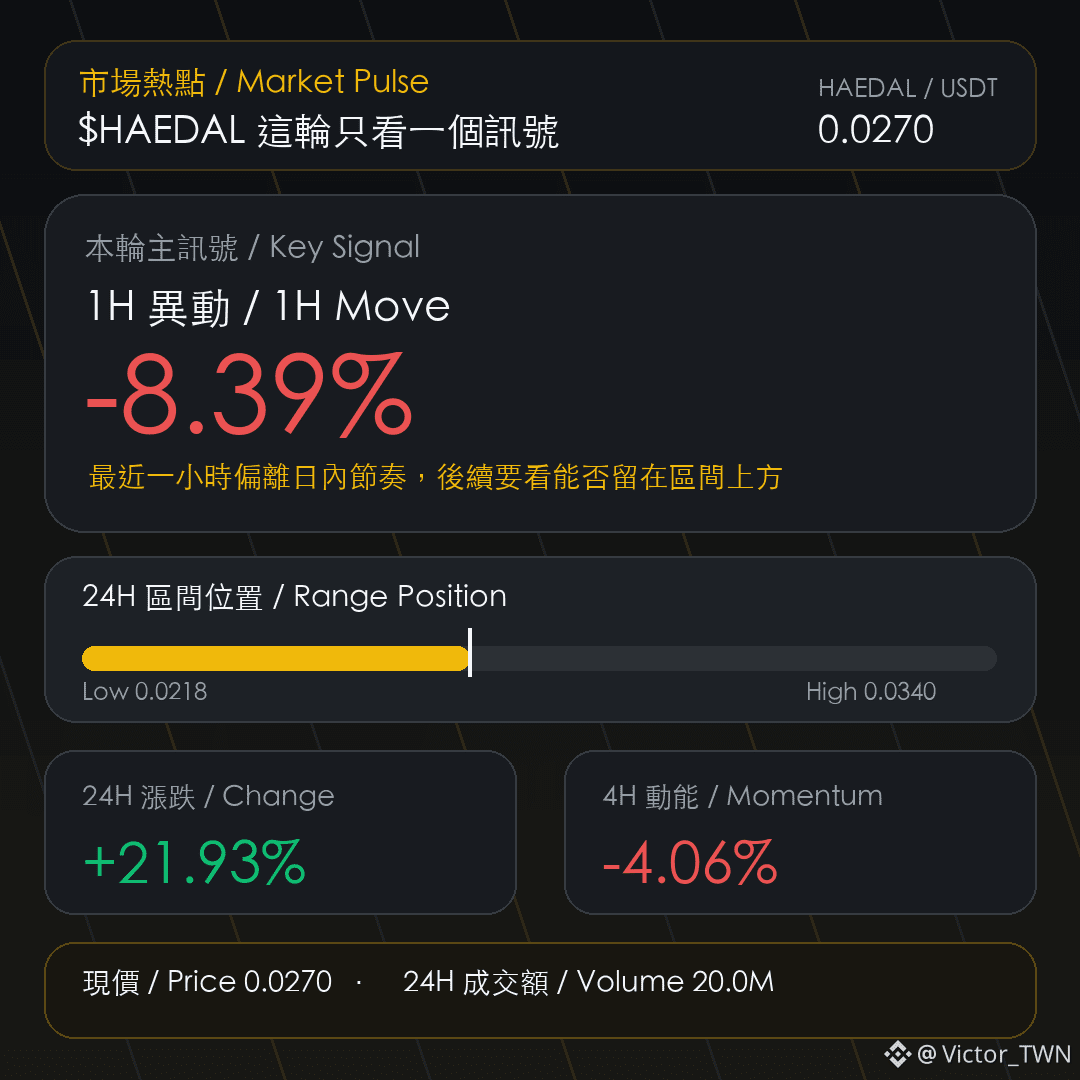
$HAEDAL The two levels left in the previous post were both touched by this four-hour candle. Price first pushed above 0.03097, reaching a high of 0.03266, then fell below 0.0275 to a low of 0.02656. It’s now at 0.02703 USDT, down 3.59% over four hours.
The move up didn’t hold: the four-hour range was 23%, and the candle closed near the bottom of the range, about 2% above the low. The previous post noted that the lows had risen for three consecutive candles, which might simply mean the center of the consolidation was shifting higher. This candle invalidated that read: the low was only 0.4% above 0.02645.
As price pulled back, 24-hour trading volume came in at around 19.98 million USDT—the highest in this series of updates, about 24% above the previous post’s 16.13 million. The funding rate flipped from +0.00245% to -0.0106%, still near zero, so funding costs haven’t favored either side throughout this move.
For the decline to be considered contained, price first needs to reclaim and hold above the hourly high at 0.02962; above that, the next level is 0.03097. If 0.02645 breaks, the next level down is 0.02448.
The counterpoint is worth keeping in mind: the 24-hour change is still +22.7%. This candle only gave back the late part of the move, and the close rebounded from 0.02656. A shape like this can reverse again in a single hourly candle.
#MarketAnalysis
167
·
--
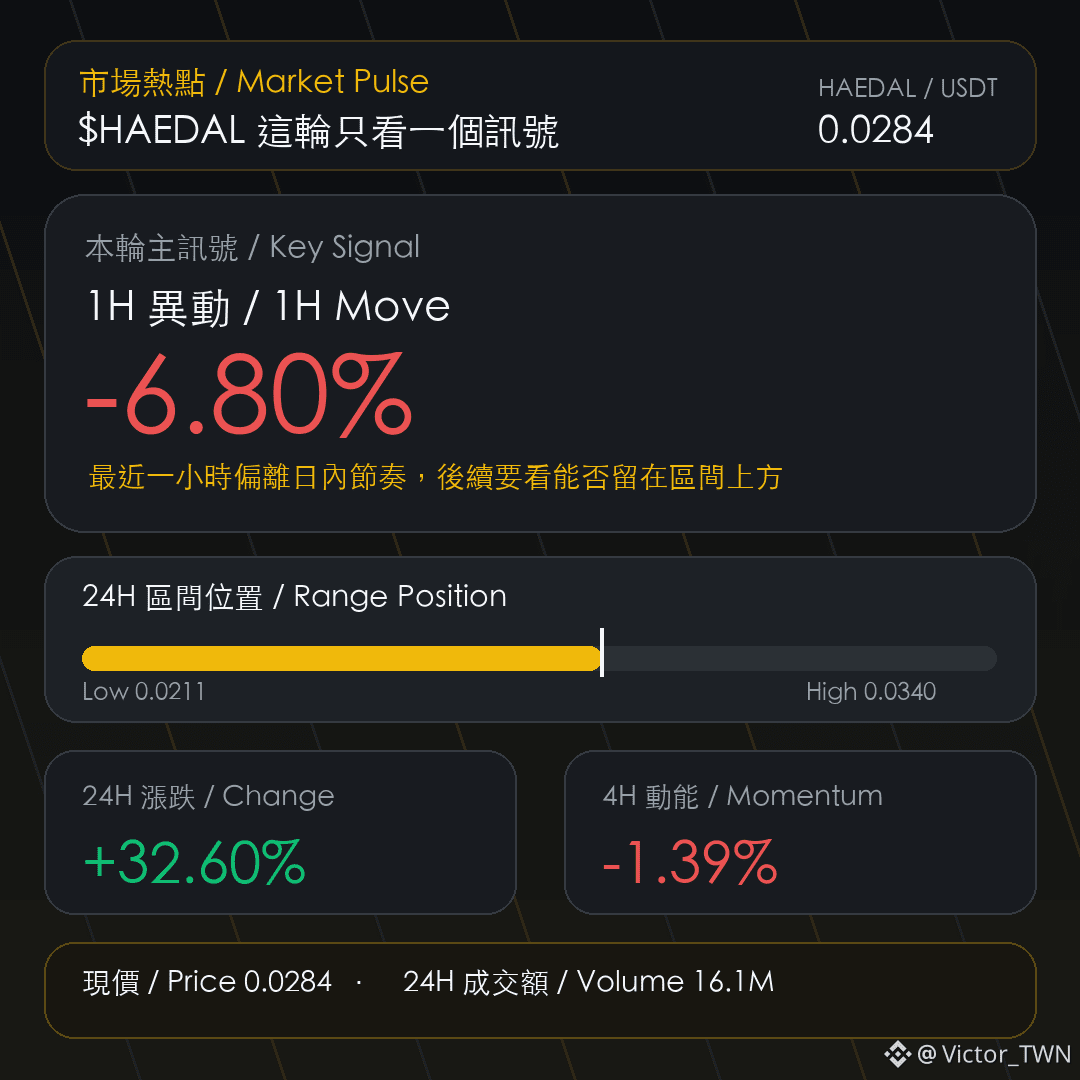
$HAEDAL The 0.02979 level mentioned in the previous post was pushed through during this four-hour candle. The high reached 0.03097, 4.0% above that line. But it closed at 0.02845 USDT, just 0.1% below the 0.02848 level at the time of the previous post. In the final hour, it fell all the way from 0.03046 to 0.02845, down 6.60% in a single hour, with the low dipping to 0.0275.
What I care about more is where the close landed within the range. The previous candle had a low of 0.02645 and a high of 0.02979; this one had a low of 0.0275 and a high of 0.03097. Both ends rose by about 4%, shifting the entire range up a notch. But the close dropped from 60% of the way up the range to less than 30%. It reached the upper boundary, but the close didn't follow through.
Volume picked up a little. 24-hour trading volume was about 16.11 million USDT, roughly 11% higher than the 14.52 million in the previous post. The funding rate fell from +0.005% to +0.00245%, still hovering near the zero line. The mark price of 0.02842 was almost identical to spot, so the cost side showed no preference either way.
For the upper boundary to be truly reclaimed this time, price needs to close above 0.03097 and hold there. If 0.0275 breaks, the previous candle's low of 0.02645 is next. The next funding rate settlement is at 12:00 Taipei time.
Here's the counterpoint, too: with the lows rising for three consecutive candles and the close landing near the bottom of the range, this could simply mean the center of the consolidation has shifted higher. A shape like this can reverse again in a single four-hour candle.
#MarketAnalysis
1
257
Log in to explore more content
Join global crypto users on Binance Square
⚡️ Get latest and useful information about crypto.
💬 Trusted by the world’s largest crypto exchange.
👍 Discover real insights from verified creators.
Email / Phone number
Trending Topics
BinanceReports80%Recoveryof$6.3BillioninLossesfromHackIncident
16 views
6 Discussing
Binance Covers 80% of Its $6.3 Billion Hack Losses : A Major Recovery Effort!
Gourav-S
·1 Likes
·67 views
TRMCambodianCasinosReceived$1.07BInCrypto
61 views
15 Discussing
IolePlansToSellAll151.21Bitcoin
2,164 views
121 Discussing