
WEB3KIID
28 Posts

WEB3KIID
Open Trade
Frequent Trader
2.8 Years
3 Following
23 Followers
45 Liked
Posts
Portfolio
Verified
Bitcoin is the perfect collateral asset. It is highly liquid, globally recognized, and institutionally adopted. Yet most BTC remains idle: underutilized and disconnected from onchain finance.
This is majorly because using BTC as collateral has usually meant giving up control and relying on intermediaries.
Historically, accessing DeFi meant choosing between centralized custodians or wrapped tokens, both of which introduce counterparty and smart contract risks that violate Bitcoin's core ethos.
How Trustless Bitcoin Vaults (TBV) solve this: Rather than pooling user funds, @BabylonLabs_io introduces individual, segregated vaults enforced directly by Bitcoin script primitives
1. Programmable Ownership: Smart contracts on destination chains (like Aave or Cosmos PoS networks) dictate collateral status, but the $BTC stays locked on the Bitcoin blockchain.
2. PreSet Claimers: Liquidations and repayments are executed through cryptographic proofs (SNARKs/BitVM logic) without third party arbitrators.
3. Non Rehypothecated: Your vaults aren't pooled with other users, preserving 100% selfcustody.
TBV doesn't attempt to make Bitcoin #behave like a high speed altcoin. It turns idle, cold $BTC into secure, productive collateral without forcing holders into risky bridge exploits.
@BabylonLabs_io #baby $BABY
This is majorly because using BTC as collateral has usually meant giving up control and relying on intermediaries.
Historically, accessing DeFi meant choosing between centralized custodians or wrapped tokens, both of which introduce counterparty and smart contract risks that violate Bitcoin's core ethos.
How Trustless Bitcoin Vaults (TBV) solve this: Rather than pooling user funds, @BabylonLabs_io introduces individual, segregated vaults enforced directly by Bitcoin script primitives
1. Programmable Ownership: Smart contracts on destination chains (like Aave or Cosmos PoS networks) dictate collateral status, but the $BTC stays locked on the Bitcoin blockchain.
2. PreSet Claimers: Liquidations and repayments are executed through cryptographic proofs (SNARKs/BitVM logic) without third party arbitrators.
3. Non Rehypothecated: Your vaults aren't pooled with other users, preserving 100% selfcustody.
TBV doesn't attempt to make Bitcoin #behave like a high speed altcoin. It turns idle, cold $BTC into secure, productive collateral without forcing holders into risky bridge exploits.
@BabylonLabs_io #baby $BABY
Why Native BTC Staking is the Ultimate Solution to the Trust Assumption Problem
Bridging Bitcoin to EVM chains via wrapped tokens like $WBTC or $tBTC always forces a painful compromise: you get yield, but you give up custody and inherit smart contract risks.
That’s where The Babylon's TBV approach flips the script.
Instead of wrapping tokens or relying on a centralized bridge custodian, Trustless Bitcoin Vaults (TBV) keep the primary asset on the native Bitcoin network. By combining Taproot scripts and UTXO timelocks with Extractable One-Time Signatures (EOTS), your BTC stays locked under your own keys on Layer 1 while backing external POS finality or DeFi collateral.
and If a validator double signs or misbehaves, slashing happens through pure Bitcoin cryptography, not an external smart contract bridge.
@BabylonLabs_io is basically building a native BTCFi model that doesn't ask you to ignore Bitcoin’s core security properties. and I believe this is the Ultimate Solution to the Trust Assumption Problem.
PS.. I’ve been running transactions on the testnet to see how smooth the minting and unbonding cycles actually feel under network congestion.
@BabylonLabs_io #baby $BABY #Bitcoin #DeFI
Bridging Bitcoin to EVM chains via wrapped tokens like $WBTC or $tBTC always forces a painful compromise: you get yield, but you give up custody and inherit smart contract risks.
That’s where The Babylon's TBV approach flips the script.
Instead of wrapping tokens or relying on a centralized bridge custodian, Trustless Bitcoin Vaults (TBV) keep the primary asset on the native Bitcoin network. By combining Taproot scripts and UTXO timelocks with Extractable One-Time Signatures (EOTS), your BTC stays locked under your own keys on Layer 1 while backing external POS finality or DeFi collateral.
and If a validator double signs or misbehaves, slashing happens through pure Bitcoin cryptography, not an external smart contract bridge.
@BabylonLabs_io is basically building a native BTCFi model that doesn't ask you to ignore Bitcoin’s core security properties. and I believe this is the Ultimate Solution to the Trust Assumption Problem.
PS.. I’ve been running transactions on the testnet to see how smooth the minting and unbonding cycles actually feel under network congestion.
@BabylonLabs_io #baby $BABY #Bitcoin #DeFI
Let's be honest, In 5 years time when people look back at this period in crypto, they probably won't remember every headline or every market cycle.
But they'll probably remember the projects that quietly built infrastructure capable of changing how blockchain technology is used. And that is one reason Babylon has caught my attention.
The concept of Trustless Bitcoin Vaults (TBV) highlights an important shift in thinking. Rather than asking Bitcoin holders to move away from the principles that makes Bitcoin trusted, TBV explores how native BTC can become more useful while preserving those core foundations.
It's obviously an ambitious direction, and like every new technology, it will need time, testing, and community feedback to prove itself. But meaningful innovation usually starts with asking difficult questions, not by following the easiest path.
And this is my advice whether you're a builder, researcher, or long-term Bitcoin supporter, I think Babylon and it's token baby is one of the ecosystems worth watching as this vision develops.
Quick Question if Bitcoin's next era is defined by utility, what role do you think $BABY and TBV will play in shaping it?
@BabylonLabs_io #baby $BABY
But they'll probably remember the projects that quietly built infrastructure capable of changing how blockchain technology is used. And that is one reason Babylon has caught my attention.
The concept of Trustless Bitcoin Vaults (TBV) highlights an important shift in thinking. Rather than asking Bitcoin holders to move away from the principles that makes Bitcoin trusted, TBV explores how native BTC can become more useful while preserving those core foundations.
It's obviously an ambitious direction, and like every new technology, it will need time, testing, and community feedback to prove itself. But meaningful innovation usually starts with asking difficult questions, not by following the easiest path.
And this is my advice whether you're a builder, researcher, or long-term Bitcoin supporter, I think Babylon and it's token baby is one of the ecosystems worth watching as this vision develops.
Quick Question if Bitcoin's next era is defined by utility, what role do you think $BABY and TBV will play in shaping it?
@BabylonLabs_io #baby $BABY
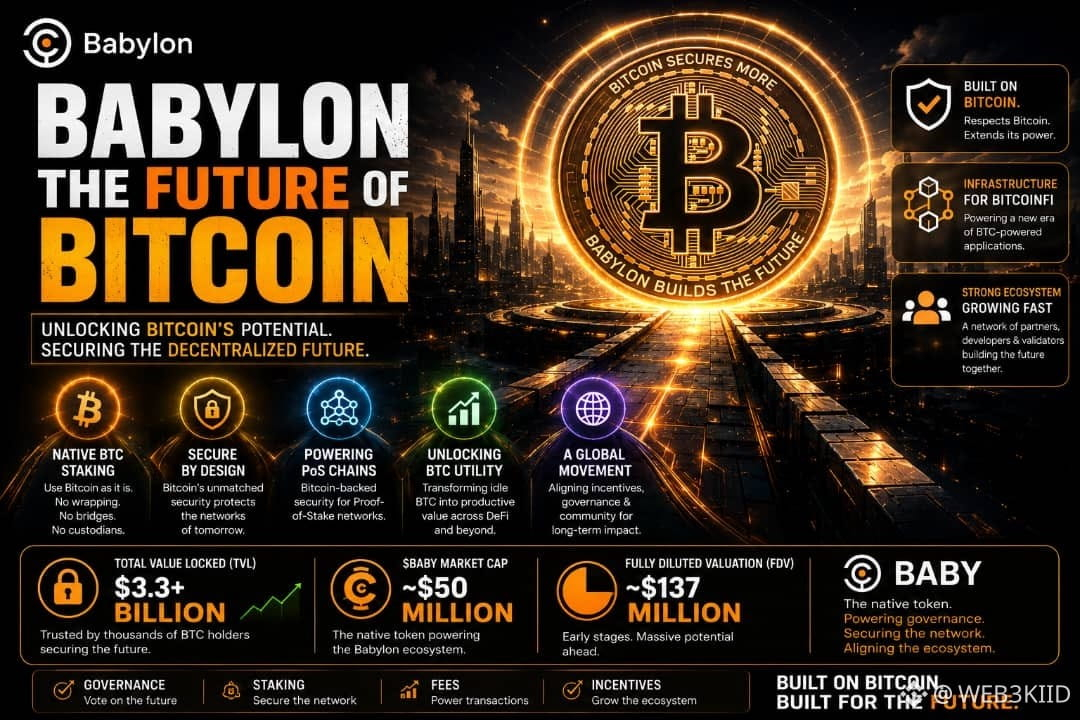
Ever wondered why @BabylonLabs_io is getting so much attention?🤔
Babylon is one of the leading projects in the growing BitcoinFi (BTCfi) ecosystem because it aims to make Bitcoin a productive asset while preserving its core security assumptions. Instead of changing Bitcoin itself, Babylon builds infrastructure around it allowing native BTC to secure Proof-of-Stake networks and, increasingly, power DeFi applications.
Another key part of the ecosystem is BABY, Babylon's native token $BABY is more than a governance token, it powers the Babylon Genesis network by paying transaction fees, enabling onchain governance, and participating in a dual-staking model alongside Bitcoin to help secure the network. As more Bitcoin-secured applications launch, BABY is designed to align incentives across Babylon ecosystem.
@BabylonLabs_io #baby $BABY
Babylon is one of the leading projects in the growing BitcoinFi (BTCfi) ecosystem because it aims to make Bitcoin a productive asset while preserving its core security assumptions. Instead of changing Bitcoin itself, Babylon builds infrastructure around it allowing native BTC to secure Proof-of-Stake networks and, increasingly, power DeFi applications.
Another key part of the ecosystem is BABY, Babylon's native token $BABY is more than a governance token, it powers the Babylon Genesis network by paying transaction fees, enabling onchain governance, and participating in a dual-staking model alongside Bitcoin to help secure the network. As more Bitcoin-secured applications launch, BABY is designed to align incentives across Babylon ecosystem.
@BabylonLabs_io #baby $BABY
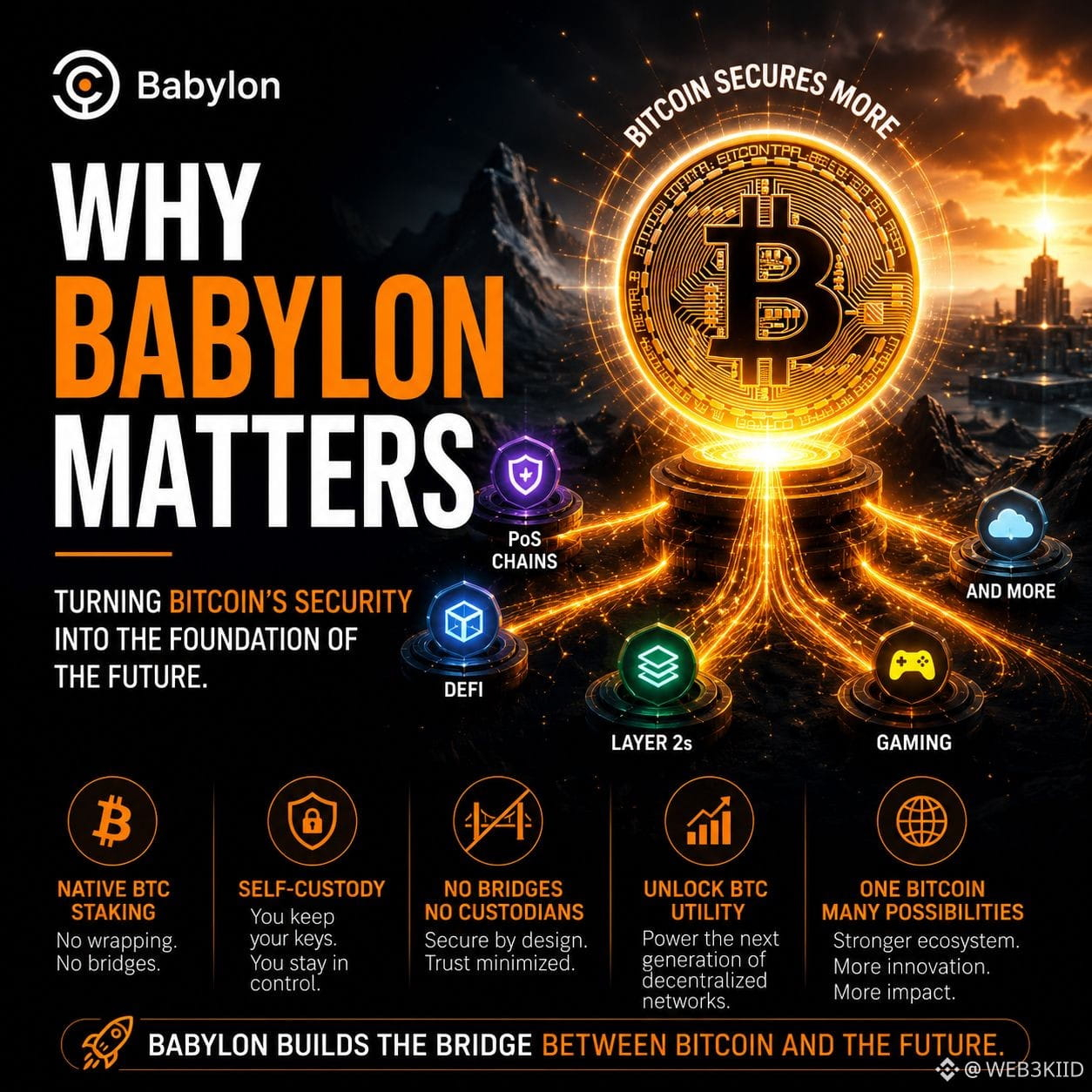
For years Bitcoin has earned its reputation as the most secure and decentralised blockchain. Yet one question has continued to shape the conversation around its future: Can Bitcoin become more useful without compromising the principles that made it successful?
And that's one of the reasons I've been following Babylon more closely. Babylon main goal is to let Bitcoin holders use their BTC to help secure other blockchain networks while keeping their coins native to the Bitcoin network.
The idea behind Trustless Bitcoin Vaults (TBV) isn't simply about introducing another financial product. It's about exploring how native Bitcoin can participate in new applications while staying true to Bitcoin's trust model instead of relying on wrapped assets or unnecessary intermediaries.
And to me, that's where the real innovation lies. Building around Bitcoin's strengths rather than asking it to change.
As the ecosystem evolves, I think the projects that focus on secure infrastructure instead of short term narratives will have the greatest long term impact. Babylon's TBV represents an interesting step in that direction, and I'm looking forward to seeing how the technology matures through community feedback and real world adoption.
Quick Question what aspect of Babylon interests you the most ?
@BabylonLabs_io #baby $BABY
And that's one of the reasons I've been following Babylon more closely. Babylon main goal is to let Bitcoin holders use their BTC to help secure other blockchain networks while keeping their coins native to the Bitcoin network.
The idea behind Trustless Bitcoin Vaults (TBV) isn't simply about introducing another financial product. It's about exploring how native Bitcoin can participate in new applications while staying true to Bitcoin's trust model instead of relying on wrapped assets or unnecessary intermediaries.
And to me, that's where the real innovation lies. Building around Bitcoin's strengths rather than asking it to change.
As the ecosystem evolves, I think the projects that focus on secure infrastructure instead of short term narratives will have the greatest long term impact. Babylon's TBV represents an interesting step in that direction, and I'm looking forward to seeing how the technology matures through community feedback and real world adoption.
Quick Question what aspect of Babylon interests you the most ?
@BabylonLabs_io #baby $BABY
Trustless Bitcoin Vaults (TBV)
100%
Bitcoin-backed borrowing
0%
the broader ecosystem vision
0%
1 votes • Voting closed
Bitcoin has always had an interesting trade-off.
The network is exceptional at preserving value, but using that value in broader financial applications often means introducing additional trust assumptions.
That's why I think Trustless Bitcoin Vaults (TBV) deserve attention, not because they promise higher yields, but because they're asking a more fundamental question: Can Bitcoin become more useful without asking users to trust more?
What I find interesting is that the conversation isn't centred on replacing Bitcoin's design, It's about extending what native BTC can do while keeping Bitcoin's security model at the core.
After reading about Babylon's approach and exploring the testnet, one thing stands out: the focus isn't simply on borrowing against Bitcoin. It's on building infrastructure that could make native BTC a more active asset in decentralised finance without relying on wrapped representations.
Of course, every new primitive has trade-offs, and the real test will be how TBV performs under real-world conditions and how the user experience evolves through community feedback.
I'm curious to see how @BabylonLabs_io develops this further.
@BabylonLabs_io #baby $BABY
The network is exceptional at preserving value, but using that value in broader financial applications often means introducing additional trust assumptions.
That's why I think Trustless Bitcoin Vaults (TBV) deserve attention, not because they promise higher yields, but because they're asking a more fundamental question: Can Bitcoin become more useful without asking users to trust more?
What I find interesting is that the conversation isn't centred on replacing Bitcoin's design, It's about extending what native BTC can do while keeping Bitcoin's security model at the core.
After reading about Babylon's approach and exploring the testnet, one thing stands out: the focus isn't simply on borrowing against Bitcoin. It's on building infrastructure that could make native BTC a more active asset in decentralised finance without relying on wrapped representations.
Of course, every new primitive has trade-offs, and the real test will be how TBV performs under real-world conditions and how the user experience evolves through community feedback.
I'm curious to see how @BabylonLabs_io develops this further.
@BabylonLabs_io #baby $BABY

Most Bitcoin holders have faced the same dilemma:
Keep BTC idle and preserve security, or bridge it elsewhere and accept additional trust assumptions.
That's why Trustless Bitcoin Vaults (TBV) feels like a meaningful direction rather than just another DeFi experiment.
Instead of asking Bitcoin to become something it isn't, TBV focuses on expanding what native BTC can do while respecting the principles that made Bitcoin valuable in the first place: security, transparency, and minimizing trust.
What interests me most isn't just it Bitcoin-backed borrowing, it's the possibility that infrastructure like TBV could unlock new financial use cases without requiring users to give up control of their assets.
I'm currently exploring the testnet, submitting detailed feedback, and seeing how this model evolves with community input.
A question for everyone :
If TBV becomes widely adopted, which use case do you think will have the biggest long-term impact?
• Bitcoin-backed borrowing
• Institutional treasury management
• DeFi liquidity
• Something else?
Let's discuss. 👇
@BabylonLabs_io #baby $BABY
Keep BTC idle and preserve security, or bridge it elsewhere and accept additional trust assumptions.
That's why Trustless Bitcoin Vaults (TBV) feels like a meaningful direction rather than just another DeFi experiment.
Instead of asking Bitcoin to become something it isn't, TBV focuses on expanding what native BTC can do while respecting the principles that made Bitcoin valuable in the first place: security, transparency, and minimizing trust.
What interests me most isn't just it Bitcoin-backed borrowing, it's the possibility that infrastructure like TBV could unlock new financial use cases without requiring users to give up control of their assets.
I'm currently exploring the testnet, submitting detailed feedback, and seeing how this model evolves with community input.
A question for everyone :
If TBV becomes widely adopted, which use case do you think will have the biggest long-term impact?
• Bitcoin-backed borrowing
• Institutional treasury management
• DeFi liquidity
• Something else?
Let's discuss. 👇
@BabylonLabs_io #baby $BABY
Bitcoin has always been the most secure blockchain, but unlocking its value without sacrificing self-custody has remained a major challenge.
That's why Trustless Bitcoin Vaults (TBV) caught my attention. Instead of relying on centralized custodians or wrapped assets, TBV explores a model where native BTC can become productive while preserving Bitcoin's core security assumptions.
I like that @BabylonLabs_io is pushing innovation without asking users to compromise on decentralization. If Bitcoin is going to power the next generation of DeFi and cross-chain applications, solutions that respect its trust model will matter the most.
I'm also excited to try the native Bitcoin-backed borrowing testnet and share feedback. Building with real user input is how strong protocols evolve.
What do you think will be the biggest use case for TBV in the future borrowing, staking, institutional custody, or something else?
@BabylonLabs_io #baby $BABY
That's why Trustless Bitcoin Vaults (TBV) caught my attention. Instead of relying on centralized custodians or wrapped assets, TBV explores a model where native BTC can become productive while preserving Bitcoin's core security assumptions.
I like that @BabylonLabs_io is pushing innovation without asking users to compromise on decentralization. If Bitcoin is going to power the next generation of DeFi and cross-chain applications, solutions that respect its trust model will matter the most.
I'm also excited to try the native Bitcoin-backed borrowing testnet and share feedback. Building with real user input is how strong protocols evolve.
What do you think will be the biggest use case for TBV in the future borrowing, staking, institutional custody, or something else?
@BabylonLabs_io #baby $BABY

One of the most underrated shifts happening in DeFi is the move from passive staking to productive capital.
Bedrock started by addressing liquidity limitations in staking, but Bedrock 2.0 pushes the idea further: how can the same capital contribute to network security, remain liquid, and participate in additional opportunities at the same time?
What interests me most isn't the potential yield, it's the long-term impact on capital efficiency.
If protocols can successfully combine staking, liquidity, and restaking without creating unnecessary complexity, it could reshape how users interact with DeFi altogether.
Bedrock 2.0 is part of a broader trend where idle assets are becoming increasingly productive, and it'll be interesting to see how this model evolves as adoption grows.
Do you think capital efficiency will be the main competitive advantage for DeFi protocols over the next few years?
#Bedrock #Bedrock20 #DEFİ #Restaking #Web3 #bedrock $BR
Bedrock started by addressing liquidity limitations in staking, but Bedrock 2.0 pushes the idea further: how can the same capital contribute to network security, remain liquid, and participate in additional opportunities at the same time?
What interests me most isn't the potential yield, it's the long-term impact on capital efficiency.
If protocols can successfully combine staking, liquidity, and restaking without creating unnecessary complexity, it could reshape how users interact with DeFi altogether.
Bedrock 2.0 is part of a broader trend where idle assets are becoming increasingly productive, and it'll be interesting to see how this model evolves as adoption grows.
Do you think capital efficiency will be the main competitive advantage for DeFi protocols over the next few years?
#Bedrock #Bedrock20 #DEFİ #Restaking #Web3 #bedrock $BR
How many NFT collections do you own ???
ETH or BNB or SOL.
ETH or BNB or SOL.


Log in to explore more content