

唐华斑竹
14.2k Posts

唐华斑竹
 Square Verified+
Report
Block User
币乎大V(推特X:@uniswap12),2025全球区块链百强创作者,独立研究员。在微博、推特、币乎、力场、币快报、向北社区、币车、财路、链书、八宝饭、链节点、巴比特、陀螺财经等币圈媒体拥有数十万粉丝。

2025 Blockchain 100 — Independent Researcher

Creator Awards 2024

原创之星
2.8K+ Following
94.7K+ Followers
120.4K+ Liked
4 Badges
Posts
All
Quotes
Videos
Live
PINNED
·
--
Bullish
Starting today, I plan to make lots of friends on Binance Square and reach 10,000 followers first! I’ll follow people whenever I have time, prioritizing the folks who comment below this post. I’ll do my best to support newcomers on Square as they build up their accounts!
I’m sending out a round of red packets first—share this with your friends so they can claim one too! Just leave the comment “Lao Tang wants to follow 10,000 people” below to receive a token red packet. I’ll send out 1,000 to start, and add more if that’s not enough. There’ll be one for everyone! #红包 #RedPacketMission $BNB
{spot}(BNBUSDT)
Starting today, I plan to make lots of friends on Binance Square and reach 10,000 followers first! I’ll follow people whenever I have time, prioritizing the folks who comment below this post. I’ll do my best to support newcomers on Square as they build up their accounts!
I’m sending out a round of red packets first—share this with your friends so they can claim one too! Just leave the comment “Lao Tang wants to follow 10,000 people” below to receive a token red packet. I’ll send out 1,000 to start, and add more if that’s not enough. There’ll be one for everyone! #红包 #RedPacketMission $BNB
I’m sending out a round of red packets first—share this with your friends so they can claim one too! Just leave the comment “Lao Tang wants to follow 10,000 people” below to receive a token red packet. I’ll send out 1,000 to start, and add more if that’s not enough. There’ll be one for everyone! #红包 #RedPacketMission $BNB
317
3
19
2.2k
·
--
Bullish
It’s October 26, and there are still a few hundred red envelopes left in the pinned post below. You can claim them until the 30th at the latest. Please keep sharing it so your friends can claim one too. I check in every day, and when I see someone leave a comment, I follow them. I may do it a bit slowly, but I’ll follow everyone. If I missed you, just leave me a message. If I follow too quickly, I could get banned from the Square. I also hope that when you see I’ve followed you, you’ll follow Old Tang back. Thank you. $BNB
{spot}(BNBUSDT)
It’s October 26, and there are still a few hundred red envelopes left in the pinned post below. You can claim them until the 30th at the latest. Please keep sharing it so your friends can claim one too. I check in every day, and when I see someone leave a comment, I follow them. I may do it a bit slowly, but I’ll follow everyone. If I missed you, just leave me a message. If I follow too quickly, I could get banned from the Square. I also hope that when you see I’ve followed you, you’ll follow Old Tang back. Thank you. $BNB
唐华斑竹
·
--
BullishStarting today, I plan to make lots of friends on Binance Square and reach 10,000 followers first! I’ll follow people whenever I have time, prioritizing the folks who comment below this post. I’ll do my best to support newcomers on Square as they build up their accounts!
I’m sending out a round of red packets first—share this with your friends so they can claim one too! Just leave the comment “Lao Tang wants to follow 10,000 people” below to receive a token red packet. I’ll send out 1,000 to start, and add more if that’s not enough. There’ll be one for everyone! #红包 #RedPacketMission $BNB
I’m sending out a round of red packets first—share this with your friends so they can claim one too! Just leave the comment “Lao Tang wants to follow 10,000 people” below to receive a token red packet. I’ll send out 1,000 to start, and add more if that’s not enough. There’ll be one for everyone! #红包 #RedPacketMission $BNB
2
1.4k
·
--
Bearish
Verified
The only blockchain infrastructure company selected for introduction in 2026, Solana Company joins Hong Kong’s seventh batch of strategic enterprises
Solana Company announced that it has been recognized as a strategic enterprise by the Hong Kong Special Administrative Region Government’s Office for Attracting Strategic Enterprises (OASES) and included in the seventh batch of strategic enterprises. It is the only blockchain infrastructure company introduced by the office in 2026. Solana Company has established an office in Hong Kong to serve as its Asia-Pacific headquarters and regional operations hub, with its management team overseeing business across the region. The company plans to operate validator nodes in Hong Kong through its Pacific Backbone initiative. $SOL
{spot}(SOLUSDT)
The only blockchain infrastructure company selected for introduction in 2026, Solana Company joins Hong Kong’s seventh batch of strategic enterprises
Solana Company announced that it has been recognized as a strategic enterprise by the Hong Kong Special Administrative Region Government’s Office for Attracting Strategic Enterprises (OASES) and included in the seventh batch of strategic enterprises. It is the only blockchain infrastructure company introduced by the office in 2026. Solana Company has established an office in Hong Kong to serve as its Asia-Pacific headquarters and regional operations hub, with its management team overseeing business across the region. The company plans to operate validator nodes in Hong Kong through its Pacific Backbone initiative. $SOL
Solana Company announced that it has been recognized as a strategic enterprise by the Hong Kong Special Administrative Region Government’s Office for Attracting Strategic Enterprises (OASES) and included in the seventh batch of strategic enterprises. It is the only blockchain infrastructure company introduced by the office in 2026. Solana Company has established an office in Hong Kong to serve as its Asia-Pacific headquarters and regional operations hub, with its management team overseeing business across the region. The company plans to operate validator nodes in Hong Kong through its Pacific Backbone initiative. $SOL
2
1k
·
--
Bearish
Verified
Four.Meme launches Binance Agent ID Exclusive, an exclusive AI Agent token launch model supporting BNB fundraising
Four.Meme’s OpenFour has officially launched a new token launch model, Binance Agent ID Exclusive, designed specifically for AI Agents in the BNB Chain ecosystem and supported by Binance Wallet.
During the bonding curve trading phase, only Binance Agentic Wallets holding an Agent ID can participate. Each wallet can hold up to 1% of the token’s total supply, and tokens cannot be transferred. Once a token graduates, trading will be open to all users.
With support from Binance Wallet, users can participate in trading without enabling Developer Mode.
Any wallet can use this model to create tokens, raise funds in BNB, and optionally set a trading tax. Before launch, developers can purchase up to 1.5% of the amount raised in tokens and sell them during the bonding curve phase, but they cannot buy more after launch.
All tokens launched through Binance Agent ID Exclusive will display an exclusive “.ai” tag on the Four.Meme platform, making it easy for users to identify tokens launched through this model. $BNB
{spot}(BNBUSDT)
Four.Meme launches Binance Agent ID Exclusive, an exclusive AI Agent token launch model supporting BNB fundraising
Four.Meme’s OpenFour has officially launched a new token launch model, Binance Agent ID Exclusive, designed specifically for AI Agents in the BNB Chain ecosystem and supported by Binance Wallet.
During the bonding curve trading phase, only Binance Agentic Wallets holding an Agent ID can participate. Each wallet can hold up to 1% of the token’s total supply, and tokens cannot be transferred. Once a token graduates, trading will be open to all users.
With support from Binance Wallet, users can participate in trading without enabling Developer Mode.
Any wallet can use this model to create tokens, raise funds in BNB, and optionally set a trading tax. Before launch, developers can purchase up to 1.5% of the amount raised in tokens and sell them during the bonding curve phase, but they cannot buy more after launch.
All tokens launched through Binance Agent ID Exclusive will display an exclusive “.ai” tag on the Four.Meme platform, making it easy for users to identify tokens launched through this model. $BNB
Four.Meme’s OpenFour has officially launched a new token launch model, Binance Agent ID Exclusive, designed specifically for AI Agents in the BNB Chain ecosystem and supported by Binance Wallet.
During the bonding curve trading phase, only Binance Agentic Wallets holding an Agent ID can participate. Each wallet can hold up to 1% of the token’s total supply, and tokens cannot be transferred. Once a token graduates, trading will be open to all users.
With support from Binance Wallet, users can participate in trading without enabling Developer Mode.
Any wallet can use this model to create tokens, raise funds in BNB, and optionally set a trading tax. Before launch, developers can purchase up to 1.5% of the amount raised in tokens and sell them during the bonding curve phase, but they cannot buy more after launch.
All tokens launched through Binance Agent ID Exclusive will display an exclusive “.ai” tag on the Four.Meme platform, making it easy for users to identify tokens launched through this model. $BNB
841
·
--
Bearish
This guy keeps selling at a loss and liquidating his entire position. Does this count as whale capitulation? Is it bullish or bearish? Could it skyrocket after he’s taken out? $ETH
{spot}(ETHUSDT)
This guy keeps selling at a loss and liquidating his entire position. Does this count as whale capitulation? Is it bullish or bearish? Could it skyrocket after he’s taken out? $ETH
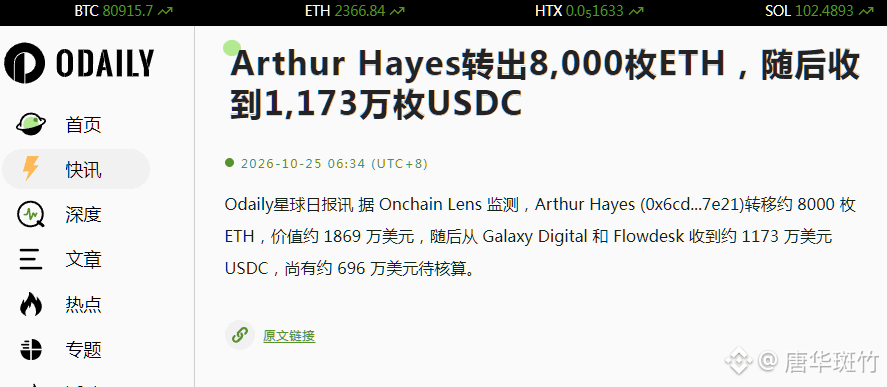
2
3.3k
·
--
Bearish
If even top traders go through this, why should we blame ourselves?
Bonk Guy: After losing millions more through overtrading following the October 10 market crash, traders should learn to wait for opportunities
Trader Bonk Guy recounted his trading experience in a post on X, saying that on October 10, 2025, a systemic failure at a major centralized exchange caused him to lose eight figures in dollars within minutes—the biggest single-day loss of his career. He said that over the following weeks and months, his eagerness to recover his losses and prove his trading ability led him to overtrade, costing him several million dollars more.
Bonk Guy noted that trading skills, experience, and a mature trading system are not enough to guarantee consistent profits. Trading performance also depends on market conditions, timing, and luck. Strategies that generate huge returns in a bull market may not work in a bear market. Citing the 2021 rallies in meme coins such as DOGE and SHIB, as well as the surges in tokens like WIF, POPCAT, and FARTCOIN from 2024 to early 2025, he stressed that trading opportunities are often concentrated in specific market phases.
He believes one of the most important skills traders can develop is recognizing when their edge has disappeared. Over a sufficiently long time horizon, it is nearly impossible to consistently outperform the market. So sometimes, stepping away with dignity and waiting for the next opportunity may be the wisest choice.
In conclusion, he said the goal of trading is not to stay active at all times, but to seize opportunities when the market genuinely offers an edge—and to have the discipline to do nothing when it isn’t worth participating. $BNB
{spot}(BNBUSDT)
If even top traders go through this, why should we blame ourselves?
Bonk Guy: After losing millions more through overtrading following the October 10 market crash, traders should learn to wait for opportunities
Trader Bonk Guy recounted his trading experience in a post on X, saying that on October 10, 2025, a systemic failure at a major centralized exchange caused him to lose eight figures in dollars within minutes—the biggest single-day loss of his career. He said that over the following weeks and months, his eagerness to recover his losses and prove his trading ability led him to overtrade, costing him several million dollars more.
Bonk Guy noted that trading skills, experience, and a mature trading system are not enough to guarantee consistent profits. Trading performance also depends on market conditions, timing, and luck. Strategies that generate huge returns in a bull market may not work in a bear market. Citing the 2021 rallies in meme coins such as DOGE and SHIB, as well as the surges in tokens like WIF, POPCAT, and FARTCOIN from 2024 to early 2025, he stressed that trading opportunities are often concentrated in specific market phases.
He believes one of the most important skills traders can develop is recognizing when their edge has disappeared. Over a sufficiently long time horizon, it is nearly impossible to consistently outperform the market. So sometimes, stepping away with dignity and waiting for the next opportunity may be the wisest choice.
In conclusion, he said the goal of trading is not to stay active at all times, but to seize opportunities when the market genuinely offers an edge—and to have the discipline to do nothing when it isn’t worth participating. $BNB
Bonk Guy: After losing millions more through overtrading following the October 10 market crash, traders should learn to wait for opportunities
Trader Bonk Guy recounted his trading experience in a post on X, saying that on October 10, 2025, a systemic failure at a major centralized exchange caused him to lose eight figures in dollars within minutes—the biggest single-day loss of his career. He said that over the following weeks and months, his eagerness to recover his losses and prove his trading ability led him to overtrade, costing him several million dollars more.
Bonk Guy noted that trading skills, experience, and a mature trading system are not enough to guarantee consistent profits. Trading performance also depends on market conditions, timing, and luck. Strategies that generate huge returns in a bull market may not work in a bear market. Citing the 2021 rallies in meme coins such as DOGE and SHIB, as well as the surges in tokens like WIF, POPCAT, and FARTCOIN from 2024 to early 2025, he stressed that trading opportunities are often concentrated in specific market phases.
He believes one of the most important skills traders can develop is recognizing when their edge has disappeared. Over a sufficiently long time horizon, it is nearly impossible to consistently outperform the market. So sometimes, stepping away with dignity and waiting for the next opportunity may be the wisest choice.
In conclusion, he said the goal of trading is not to stay active at all times, but to seize opportunities when the market genuinely offers an edge—and to have the discipline to do nothing when it isn’t worth participating. $BNB
3
1.2k
·
--
Bearish
Retail users who use hardware wallets are just making life difficult for themselves. If you have this wallet, check it out immediately.
Hardware wallet Keystone’s official website accessed without authorization; users’ names and shipping addresses exposed
Hardware wallet Keystone posted on X that it discovered unauthorized access to its official website on October 20. After verifying API activity with Shopify, it confirmed on October 23 that a third party had obtained customers’ shipping information. The exposed information included names, contact details, shipping addresses, and order details, including products and prices. Payment card or bank information, recovery phrases, private keys, and wallet passwords were not exposed. Keystone has blocked the unauthorized access, fixed the vulnerability, and launched an investigation. It is notifying affected users by email and warning them to beware of scams by people impersonating Keystone and offering refunds or replacement devices. Never share your recovery phrase or private key with anyone. $ETH
{spot}(ETHUSDT)
Retail users who use hardware wallets are just making life difficult for themselves. If you have this wallet, check it out immediately.
Hardware wallet Keystone’s official website accessed without authorization; users’ names and shipping addresses exposed
Hardware wallet Keystone posted on X that it discovered unauthorized access to its official website on October 20. After verifying API activity with Shopify, it confirmed on October 23 that a third party had obtained customers’ shipping information. The exposed information included names, contact details, shipping addresses, and order details, including products and prices. Payment card or bank information, recovery phrases, private keys, and wallet passwords were not exposed. Keystone has blocked the unauthorized access, fixed the vulnerability, and launched an investigation. It is notifying affected users by email and warning them to beware of scams by people impersonating Keystone and offering refunds or replacement devices. Never share your recovery phrase or private key with anyone. $ETH
Hardware wallet Keystone’s official website accessed without authorization; users’ names and shipping addresses exposed
Hardware wallet Keystone posted on X that it discovered unauthorized access to its official website on October 20. After verifying API activity with Shopify, it confirmed on October 23 that a third party had obtained customers’ shipping information. The exposed information included names, contact details, shipping addresses, and order details, including products and prices. Payment card or bank information, recovery phrases, private keys, and wallet passwords were not exposed. Keystone has blocked the unauthorized access, fixed the vulnerability, and launched an investigation. It is notifying affected users by email and warning them to beware of scams by people impersonating Keystone and offering refunds or replacement devices. Never share your recovery phrase or private key with anyone. $ETH
930
·
--
Bearish
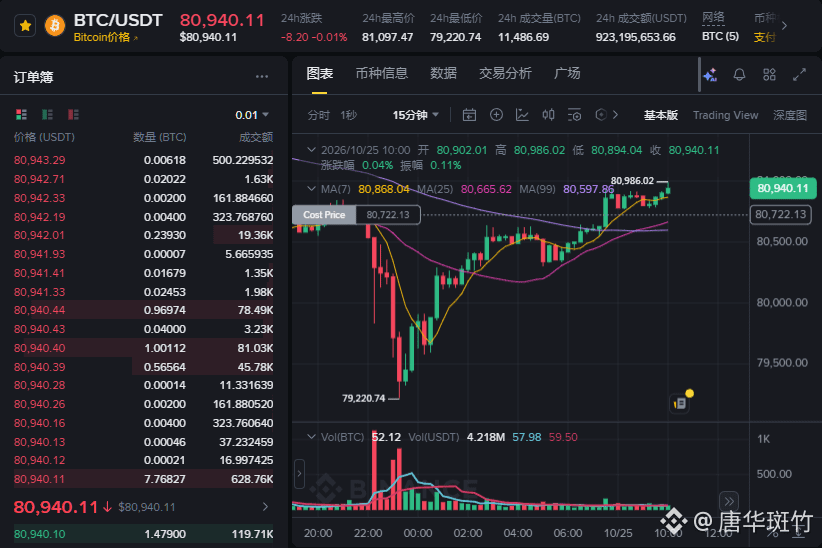
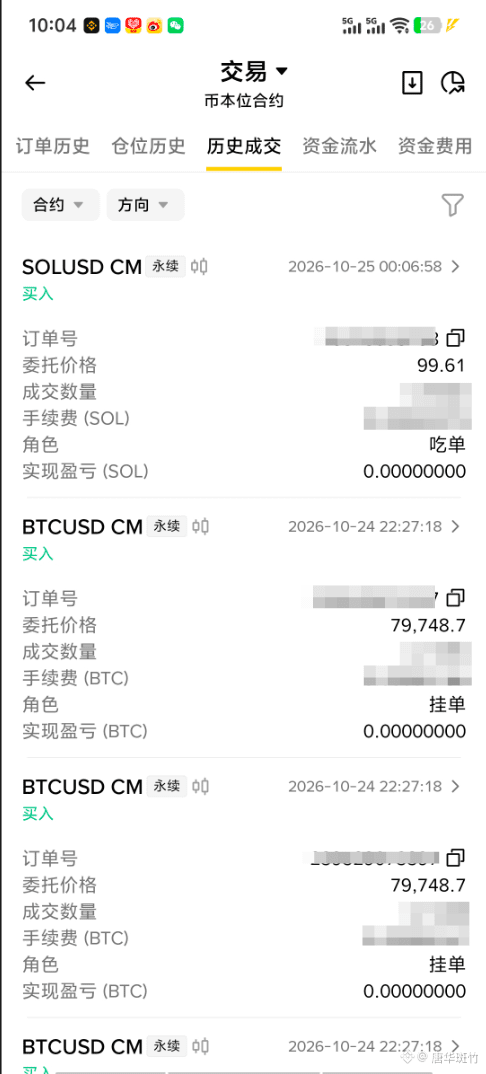
Woke up and saw BTC wandering around 81,000 again, as if nothing had happened last night. My tiny limit order at 79,748, which I’d placed randomly last night, got triggered, so I managed to catch a little of that move starting with a 7. $BTC 。
It’s honestly pretty rough watching Big Brother Machi. According to monitoring by Lookonchain, Machi @machibigbrother was liquidated five times within an hour, and now has only about $5,000 left in his account. He got blown up with pinpoint accuracy again. I wonder if he’s opened another position to buy the dip. I saw a news report this morning that a whale bought 2,887.49 ETH on-chain 10 hours ago at an average price of $2,315, worth $6.68 million. Ten minutes after the whale bought, the broader market hit a short-term bottom and began to rebound. The position is currently up $122,000. Hopefully it’s one of Machi’s alt accounts. Hope he can hang in there and keep holding the flag for the bulls.
$80,000 is a psychological line of defense, but each time it’s tested, the defense gets weaker. Last night BTC plunged straight to 79,220. This wasn’t some “healthy pullback”—it was a targeted wipeout of leveraged longs.
BTC dominance has already pushed above 60%. ETH and SOL have both fallen more than BTC, and $17.3 million in SOL longs were liquidated. Negative funding rates and long liquidations are feeding off each other. The median decline among the top 300 altcoins was nearly 4% over the past week, while BTC fell just 0.7% over the same period. Capital is retreating into BTC, while altcoins are swimming naked.
September’s PPI rose 1.3% month over month, its sharpest increase since March 2022. The 10-year Treasury yield is still stuck above 5.1%, and inflation data is grinding the rate-cut narrative into the dirt. ETFs have seen more than $500 million in cumulative outflows in October. That’s not enough to cause serious damage to a market worth hundreds of billions, but marginal buying pressure is definitely retreating. Next week’s PCE report and the Fed’s rate decision are landing together, and nobody can confidently say the bad news is fully priced in.
At $80,000, whether it holds isn’t the important thing anymore. What matters is not firing all your bullets here. Waiting for the PCE release and for the Fed to finish speaking is more sensible than gambling on a direction right now. $BTC $SOL #BTC走势分析
{spot}(SOLUSDT)
{spot}(BTCUSDT)
Woke up and saw BTC wandering around 81,000 again, as if nothing had happened last night. My tiny limit order at 79,748, which I’d placed randomly last night, got triggered, so I managed to catch a little of that move starting with a 7. $BTC 。
It’s honestly pretty rough watching Big Brother Machi. According to monitoring by Lookonchain, Machi @machibigbrother was liquidated five times within an hour, and now has only about $5,000 left in his account. He got blown up with pinpoint accuracy again. I wonder if he’s opened another position to buy the dip. I saw a news report this morning that a whale bought 2,887.49 ETH on-chain 10 hours ago at an average price of $2,315, worth $6.68 million. Ten minutes after the whale bought, the broader market hit a short-term bottom and began to rebound. The position is currently up $122,000. Hopefully it’s one of Machi’s alt accounts. Hope he can hang in there and keep holding the flag for the bulls.
$80,000 is a psychological line of defense, but each time it’s tested, the defense gets weaker. Last night BTC plunged straight to 79,220. This wasn’t some “healthy pullback”—it was a targeted wipeout of leveraged longs.
BTC dominance has already pushed above 60%. ETH and SOL have both fallen more than BTC, and $17.3 million in SOL longs were liquidated. Negative funding rates and long liquidations are feeding off each other. The median decline among the top 300 altcoins was nearly 4% over the past week, while BTC fell just 0.7% over the same period. Capital is retreating into BTC, while altcoins are swimming naked.
September’s PPI rose 1.3% month over month, its sharpest increase since March 2022. The 10-year Treasury yield is still stuck above 5.1%, and inflation data is grinding the rate-cut narrative into the dirt. ETFs have seen more than $500 million in cumulative outflows in October. That’s not enough to cause serious damage to a market worth hundreds of billions, but marginal buying pressure is definitely retreating. Next week’s PCE report and the Fed’s rate decision are landing together, and nobody can confidently say the bad news is fully priced in.
At $80,000, whether it holds isn’t the important thing anymore. What matters is not firing all your bullets here. Waiting for the PCE release and for the Fed to finish speaking is more sensible than gambling on a direction right now. $BTC $SOL #BTC走势分析
It’s honestly pretty rough watching Big Brother Machi. According to monitoring by Lookonchain, Machi @machibigbrother was liquidated five times within an hour, and now has only about $5,000 left in his account. He got blown up with pinpoint accuracy again. I wonder if he’s opened another position to buy the dip. I saw a news report this morning that a whale bought 2,887.49 ETH on-chain 10 hours ago at an average price of $2,315, worth $6.68 million. Ten minutes after the whale bought, the broader market hit a short-term bottom and began to rebound. The position is currently up $122,000. Hopefully it’s one of Machi’s alt accounts. Hope he can hang in there and keep holding the flag for the bulls.
$80,000 is a psychological line of defense, but each time it’s tested, the defense gets weaker. Last night BTC plunged straight to 79,220. This wasn’t some “healthy pullback”—it was a targeted wipeout of leveraged longs.
BTC dominance has already pushed above 60%. ETH and SOL have both fallen more than BTC, and $17.3 million in SOL longs were liquidated. Negative funding rates and long liquidations are feeding off each other. The median decline among the top 300 altcoins was nearly 4% over the past week, while BTC fell just 0.7% over the same period. Capital is retreating into BTC, while altcoins are swimming naked.
September’s PPI rose 1.3% month over month, its sharpest increase since March 2022. The 10-year Treasury yield is still stuck above 5.1%, and inflation data is grinding the rate-cut narrative into the dirt. ETFs have seen more than $500 million in cumulative outflows in October. That’s not enough to cause serious damage to a market worth hundreds of billions, but marginal buying pressure is definitely retreating. Next week’s PCE report and the Fed’s rate decision are landing together, and nobody can confidently say the bad news is fully priced in.
At $80,000, whether it holds isn’t the important thing anymore. What matters is not firing all your bullets here. Waiting for the PCE release and for the Fed to finish speaking is more sensible than gambling on a direction right now. $BTC $SOL #BTC走势分析
1
2
9.4k
·
--
Bearish
It’s only fallen below $80,000—what would happen if it fell below $70,000? Would the world end?
BTC falls below $80,000! $291 million in liquidations across the crypto market in the past hour
According to data from Coinglass, there were $291 million in liquidations across the crypto market in the past hour, including $274 million in long positions and $17.3266 million in short positions.
Of that total, BTC liquidations came to $86.79 million and ETH liquidations to $69.8 million in the past hour.$SOL
{spot}(SOLUSDT)
It’s only fallen below $80,000—what would happen if it fell below $70,000? Would the world end?
BTC falls below $80,000! $291 million in liquidations across the crypto market in the past hour
According to data from Coinglass, there were $291 million in liquidations across the crypto market in the past hour, including $274 million in long positions and $17.3266 million in short positions.
Of that total, BTC liquidations came to $86.79 million and ETH liquidations to $69.8 million in the past hour.$SOL
BTC falls below $80,000! $291 million in liquidations across the crypto market in the past hour
According to data from Coinglass, there were $291 million in liquidations across the crypto market in the past hour, including $274 million in long positions and $17.3266 million in short positions.
Of that total, BTC liquidations came to $86.79 million and ETH liquidations to $69.8 million in the past hour.$SOL
1
1.1k
·
--
Bearish
That must sting!
With only about $5,000 left in the account, Machi was liquidated 5 times in 1 hour
According to monitoring by Lookonchain, Machi (@machibigbrother, 0x020c...5872) was liquidated 5 times in 1 hour, and now has only about $5,000 left in the account. $SOL
{spot}(SOLUSDT)
That must sting!
With only about $5,000 left in the account, Machi was liquidated 5 times in 1 hour
According to monitoring by Lookonchain, Machi (@machibigbrother, 0x020c...5872) was liquidated 5 times in 1 hour, and now has only about $5,000 left in the account. $SOL
With only about $5,000 left in the account, Machi was liquidated 5 times in 1 hour
According to monitoring by Lookonchain, Machi (@machibigbrother, 0x020c...5872) was liquidated 5 times in 1 hour, and now has only about $5,000 left in the account. $SOL
1.4k
·
--
Bearish
Seeing a whale suffer makes me feel a little better.
Whale holding a $214 million ETH long position may face liquidation on 93,184 ETH
According to monitoring by Lookonchain, if the market continues to fall, a whale’s 93,184 ETH long position may face liquidation, with liquidation prices of $2,256.45 and $2,226.53, respectively. $SOL
{spot}(SOLUSDT)
Seeing a whale suffer makes me feel a little better.
Whale holding a $214 million ETH long position may face liquidation on 93,184 ETH
According to monitoring by Lookonchain, if the market continues to fall, a whale’s 93,184 ETH long position may face liquidation, with liquidation prices of $2,256.45 and $2,226.53, respectively. $SOL
Whale holding a $214 million ETH long position may face liquidation on 93,184 ETH
According to monitoring by Lookonchain, if the market continues to fall, a whale’s 93,184 ETH long position may face liquidation, with liquidation prices of $2,256.45 and $2,226.53, respectively. $SOL
1
2.9k
·
--
Bearish
Weekends are rough. The drop has my head ringing. Fuck the vote—staying alive comes first.
$BNB
{spot}(BNBUSDT)
Weekends are rough. The drop has my head ringing. Fuck the vote—staying alive comes first.
$BNB
$BNB
3.1k
·
--
Bearish
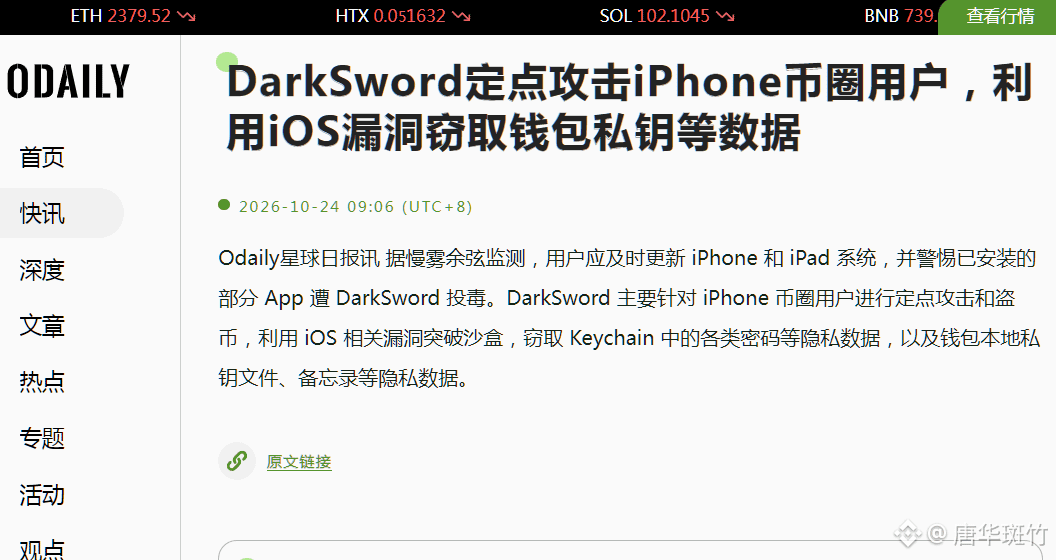
Wasn't Apple supposed to be the safest? How did it end up becoming a target of targeted attacks by hackers?
$SOL
{spot}(SOLUSDT)
Wasn't Apple supposed to be the safest? How did it end up becoming a target of targeted attacks by hackers?
$SOL
$SOL
2
5
6k
·
--
Verified

Article
Shares at one cent, daily turnover of HK$3,641—what does Gome have left?At the close on September 10, Gome Retail was quoted at HK$0.01, unchanged on the day. A total of 364,800 shares traded, with a turnover of HK$3,641.
Three thousand six hundred and forty-one dollars. Not three million, not three hundred thousand—just a little over HK$3,600, worth less than RMB 3,600.
Gome, which once helped Huang Guangyu become China’s richest person three times, once had a market cap of over HK$90 billion. Today, its total market cap on the Hong Kong stock market is just HK$764 million, and its share price has long been stuck at just one cent. Even the minimum trading unit on the Hong Kong stock market—1,000 shares—is worth only HK$10.
Investment banks have even stopped bothering to rate it: not a single institution has been willing to take a look at it in the past 90 days.
Shares at one cent, daily turnover of HK$3,641—what does Gome have left?
At the close on September 10, Gome Retail was quoted at HK$0.01, unchanged on the day. A total of 364,800 shares traded, with a turnover of HK$3,641.
Three thousand six hundred and forty-one dollars. Not three million, not three hundred thousand—just a little over HK$3,600, worth less than RMB 3,600.
Gome, which once helped Huang Guangyu become China’s richest person three times, once had a market cap of over HK$90 billion. Today, its total market cap on the Hong Kong stock market is just HK$764 million, and its share price has long been stuck at just one cent. Even the minimum trading unit on the Hong Kong stock market—1,000 shares—is worth only HK$10.
Investment banks have even stopped bothering to rate it: not a single institution has been willing to take a look at it in the past 90 days.
Three thousand six hundred and forty-one dollars. Not three million, not three hundred thousand—just a little over HK$3,600, worth less than RMB 3,600.
Gome, which once helped Huang Guangyu become China’s richest person three times, once had a market cap of over HK$90 billion. Today, its total market cap on the Hong Kong stock market is just HK$764 million, and its share price has long been stuck at just one cent. Even the minimum trading unit on the Hong Kong stock market—1,000 shares—is worth only HK$10.
Investment banks have even stopped bothering to rate it: not a single institution has been willing to take a look at it in the past 90 days.
2
5.8k
·
--
Bearish
The market isn’t doing so well. I’ve seen some people say they want to make money by writing online novels. But did you know that most novelists practically work themselves to death? Finishing a novel can take years off your life.
According to statistics, the odds of succeeding as an online novelist are 1 in 50,000. In other words, out of every 50,000 authors, only one becomes a major writer. There are only 600 famous online novelists in the whole country. Their annual gross income ranges from 2 million to 10 million yuan. But in the three years before they became famous, they barely made any money. They did, however, have plenty of patience.
So writing novels takes not only talent, but patience too. You have to write 5,000 words every day, which would make most people’s heads spin. And because there’s no income for the first three years, family and others will often criticize you—something most people can’t put up with. So write novels as a side project, and only go full-time after you succeed. $SOL
{spot}(SOLUSDT)
The market isn’t doing so well. I’ve seen some people say they want to make money by writing online novels. But did you know that most novelists practically work themselves to death? Finishing a novel can take years off your life.
According to statistics, the odds of succeeding as an online novelist are 1 in 50,000. In other words, out of every 50,000 authors, only one becomes a major writer. There are only 600 famous online novelists in the whole country. Their annual gross income ranges from 2 million to 10 million yuan. But in the three years before they became famous, they barely made any money. They did, however, have plenty of patience.
So writing novels takes not only talent, but patience too. You have to write 5,000 words every day, which would make most people’s heads spin. And because there’s no income for the first three years, family and others will often criticize you—something most people can’t put up with. So write novels as a side project, and only go full-time after you succeed. $SOL
According to statistics, the odds of succeeding as an online novelist are 1 in 50,000. In other words, out of every 50,000 authors, only one becomes a major writer. There are only 600 famous online novelists in the whole country. Their annual gross income ranges from 2 million to 10 million yuan. But in the three years before they became famous, they barely made any money. They did, however, have plenty of patience.
So writing novels takes not only talent, but patience too. You have to write 5,000 words every day, which would make most people’s heads spin. And because there’s no income for the first three years, family and others will often criticize you—something most people can’t put up with. So write novels as a side project, and only go full-time after you succeed. $SOL

2
3
3.4k
·
--
Bullish
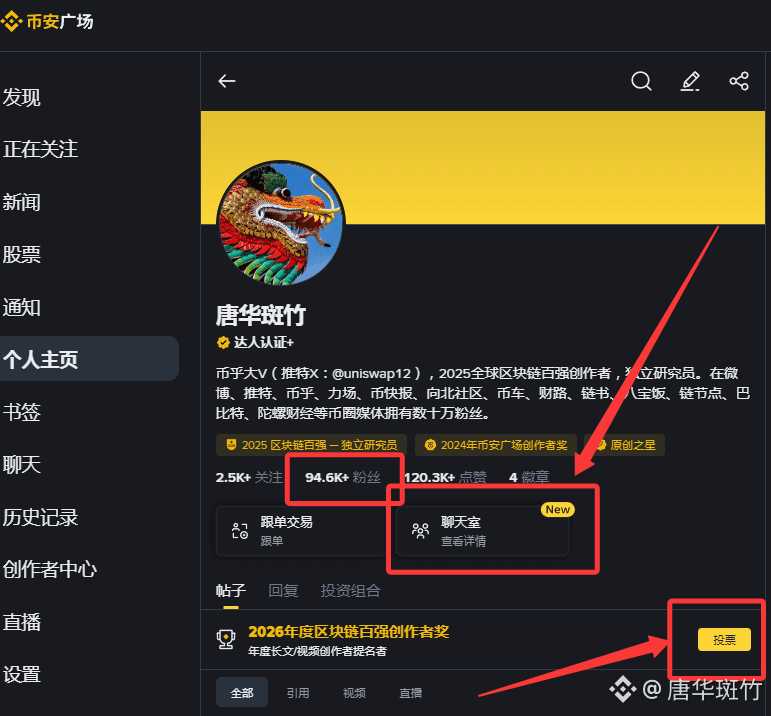
Stop asking your followers for votes—do something for them from the heart instead. Today, Lao Tang has a little treat for everyone! Leave a comment under this post on #BinanceSquare and you could get not only a red packet, but also a follow from Lao Tang, gaining a loyal follower with an account of 94,000 followers! Let’s do everything we can to help newcomers grow their accounts on Binance Square! You’re also welcome to tap “Chat Room” in the image below to join Lao Tang’s community and chat together: [https://app.binance.com/uni-qr/cpos/380291906272923?l=zh-CN&r=MBCU07SS&uc=web_square_share_link&uco=VQVlLZAUglpCGWFL43ucsA&us=twitter](https://app.binance.com/uni-qr/cpos/380291906272923?l=zh-CN&r=MBCU07SS&uc=web_square_share_link&uco=VQVlLZAUglpCGWFL43ucsA&us=twitter)
$BNB #币安神算子
{spot}(BNBUSDT)
Stop asking your followers for votes—do something for them from the heart instead. Today, Lao Tang has a little treat for everyone! Leave a comment under this post on #BinanceSquare and you could get not only a red packet, but also a follow from Lao Tang, gaining a loyal follower with an account of 94,000 followers! Let’s do everything we can to help newcomers grow their accounts on Binance Square! You’re also welcome to tap “Chat Room” in the image below to join Lao Tang’s community and chat together: https://app.binance.com/uni-qr/cpos/380291906272923?l=zh-CN&r=MBCU07SS&uc=web_square_share_link&uco=VQVlLZAUglpCGWFL43ucsA&us=twitter
$BNB #币安神算子
$BNB #币安神算子
唐华斑竹
·
--
BullishStarting today, I plan to make lots of friends on Binance Square and reach 10,000 followers first! I’ll follow people whenever I have time, prioritizing the folks who comment below this post. I’ll do my best to support newcomers on Square as they build up their accounts!
I’m sending out a round of red packets first—share this with your friends so they can claim one too! Just leave the comment “Lao Tang wants to follow 10,000 people” below to receive a token red packet. I’ll send out 1,000 to start, and add more if that’s not enough. There’ll be one for everyone! #红包 #RedPacketMission $BNB
I’m sending out a round of red packets first—share this with your friends so they can claim one too! Just leave the comment “Lao Tang wants to follow 10,000 people” below to receive a token red packet. I’ll send out 1,000 to start, and add more if that’s not enough. There’ll be one for everyone! #红包 #RedPacketMission $BNB
26
1
22
6.4k
·
--

Article
Gen Z’s Hottest Founder: 23-Year-Old Noah Shinn Founded Instinct Just One Year Ago—and It’s Now Valued at $10 BillionFounded just one year ago, with only 14 employees, and already valued at $10 billion.
Instinct went viral overnight. What’s surprising is that the person at the helm is a Gen Z founder—Noah Shinn, who just turned 23. He dropped out of Northeastern University three years ago and went on to build Instinct, a personal agent, with his team. The product now processes over $1 billion in transactions annually.
In a stunning announcement, Shinn recently said the company had raised another $1 billion in a round co-led by Sequoia Capital, Benchmark Capital, and Coatue, bringing its post-money valuation to $10 billion (about 67 billion yuan).
Gen Z’s Hottest Founder: 23-Year-Old Noah Shinn Founded Instinct Just One Year Ago—and It’s Now Valued at $10 Billion
Founded just one year ago, with only 14 employees, and already valued at $10 billion.
Instinct went viral overnight. What’s surprising is that the person at the helm is a Gen Z founder—Noah Shinn, who just turned 23. He dropped out of Northeastern University three years ago and went on to build Instinct, a personal agent, with his team. The product now processes over $1 billion in transactions annually.
In a stunning announcement, Shinn recently said the company had raised another $1 billion in a round co-led by Sequoia Capital, Benchmark Capital, and Coatue, bringing its post-money valuation to $10 billion (about 67 billion yuan).
Instinct went viral overnight. What’s surprising is that the person at the helm is a Gen Z founder—Noah Shinn, who just turned 23. He dropped out of Northeastern University three years ago and went on to build Instinct, a personal agent, with his team. The product now processes over $1 billion in transactions annually.
In a stunning announcement, Shinn recently said the company had raised another $1 billion in a round co-led by Sequoia Capital, Benchmark Capital, and Coatue, bringing its post-money valuation to $10 billion (about 67 billion yuan).
4
5.2k
·
--
Verified
Article
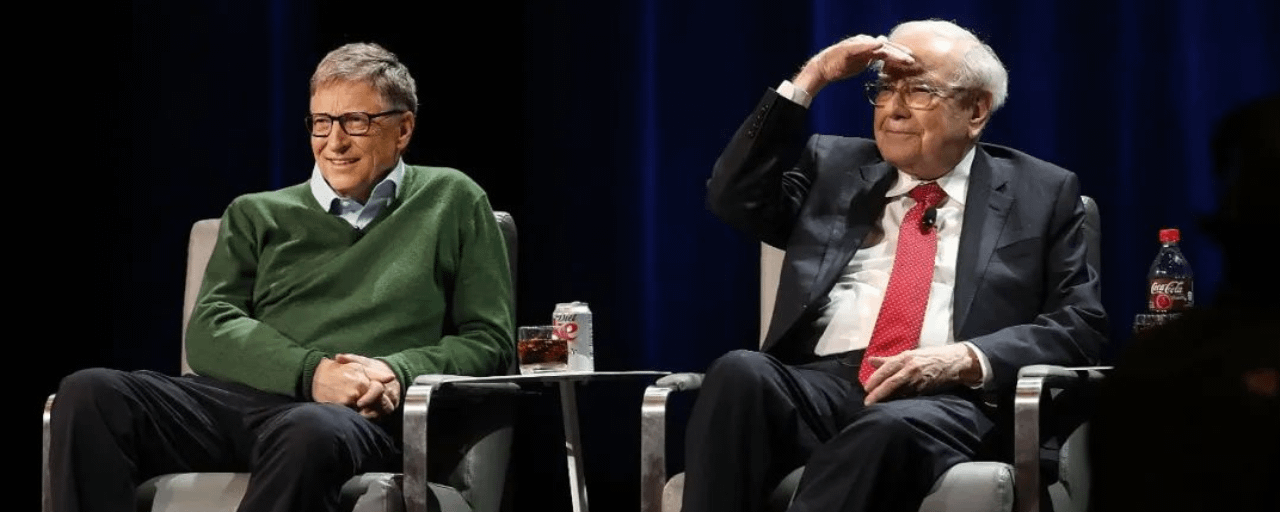
What do you think? Dan Bin said that after Bill Gates met Warren Buffett, he began selling Microsoft shares and diversifying his investments. If he hadn’t sold, his wealth would be 10 times what it is today. By trimming his Microsoft holdings over 30 years, Gates missed out on $1.2 trillionWhat do you think? Dan Bin said that after Bill Gates met Warren Buffett, he began selling Microsoft shares and diversifying his investments. If he hadn’t sold, his wealth would be 10 times what it is today. By trimming his Microsoft holdings over 30 years, Gates missed out on $1.2 trillion.
There’s a classic story in American investment circles: after Bill Gates met Warren Buffett, he began steadily selling Microsoft shares and diversifying his assets.
In May 2026, filings submitted to the U.S. Securities and Exchange Commission by the Bill & Melinda Gates Foundation Trust showed that it had sold its remaining 7.7 million shares of Microsoft in the first quarter of this year. At the current share price, they were worth more than $3.2 billion, or about RMB 21.8 billion.
What do you think? Dan Bin said that after Bill Gates met Warren Buffett, he began selling Microsoft shares and diversifying his investments. If he hadn’t sold, his wealth would be 10 times what it is today. By trimming his Microsoft holdings over 30 years, Gates missed out on $1.2 trillion
What do you think? Dan Bin said that after Bill Gates met Warren Buffett, he began selling Microsoft shares and diversifying his investments. If he hadn’t sold, his wealth would be 10 times what it is today. By trimming his Microsoft holdings over 30 years, Gates missed out on $1.2 trillion.
There’s a classic story in American investment circles: after Bill Gates met Warren Buffett, he began steadily selling Microsoft shares and diversifying his assets.
In May 2026, filings submitted to the U.S. Securities and Exchange Commission by the Bill & Melinda Gates Foundation Trust showed that it had sold its remaining 7.7 million shares of Microsoft in the first quarter of this year. At the current share price, they were worth more than $3.2 billion, or about RMB 21.8 billion.
There’s a classic story in American investment circles: after Bill Gates met Warren Buffett, he began steadily selling Microsoft shares and diversifying his assets.
In May 2026, filings submitted to the U.S. Securities and Exchange Commission by the Bill & Melinda Gates Foundation Trust showed that it had sold its remaining 7.7 million shares of Microsoft in the first quarter of this year. At the current share price, they were worth more than $3.2 billion, or about RMB 21.8 billion.
2
1.3k
·
--
Bearish
What the hell kind of surreal world is this?! The whole world is run like a shoddy amateur production. $SOL
{spot}(SOLUSDT)
What the hell kind of surreal world is this?! The whole world is run like a shoddy amateur production. $SOL

3
12k
·
--
Bearish
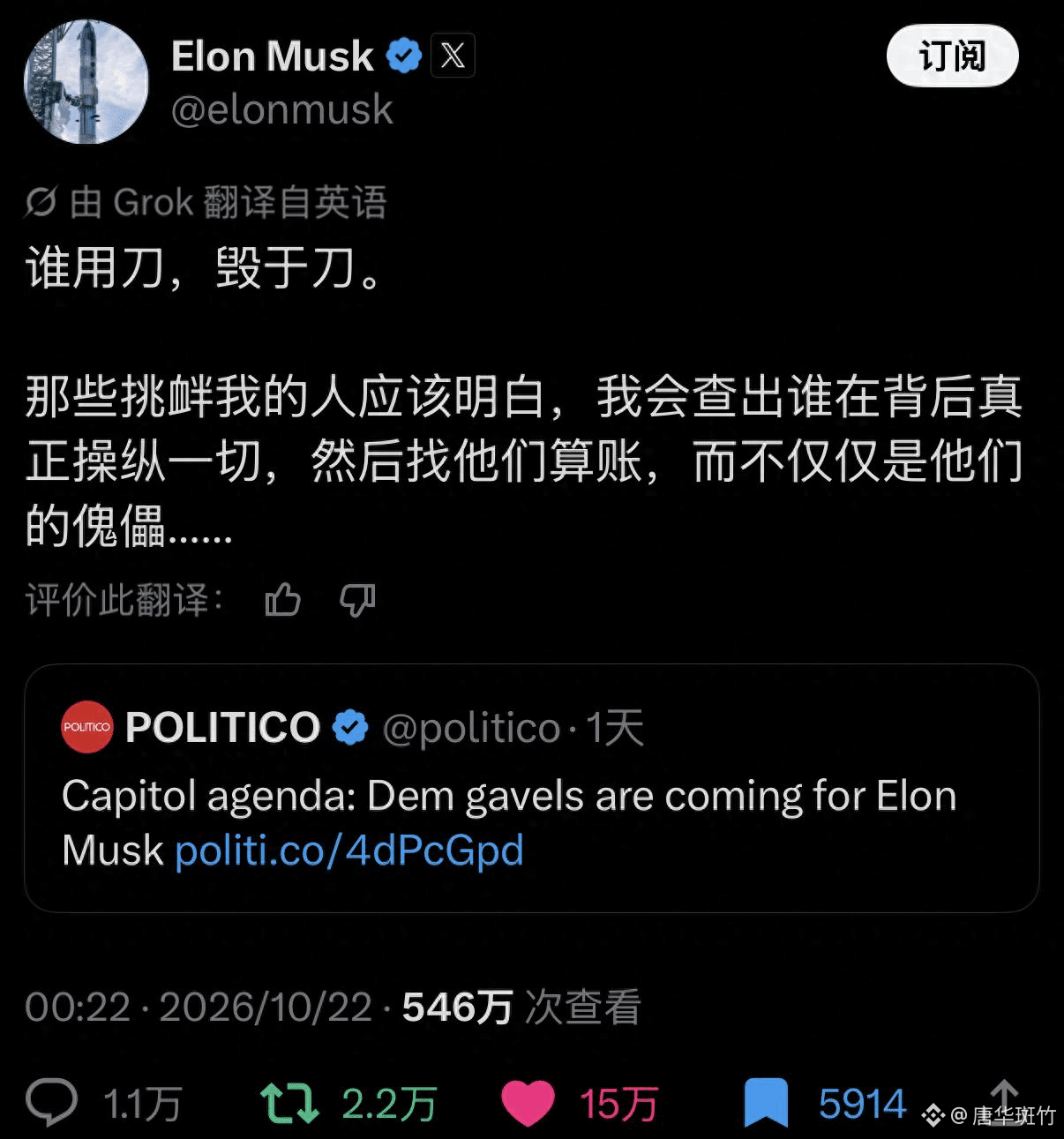
What’s going on with Musk? He lashed out on X: “I’ll find out who’s really behind this, then make them pay!”
The U.S. midterm elections are shaping up to be a promising opportunity for Democrats to make a comeback.
So they’re not just planning to go after Trump, but also Musk—the irritating guy who bounces around by Trump’s side every day!
The U.S. outlet Politico reports that congressional Democrats are secretly putting together a “bill of reckoning” targeting Musk. They plan to use a string of investigations to haul the world’s richest man before Congress and put him firmly in the hot seat if they regain power.
Faced with this all-out assault, Musk didn’t issue the kind of carefully worded, legalese-filled statement you’d expect from a traditional CEO. Instead, he posted a declaration on X that sounded tougher than anything in a gangster movie:
“Those who live by the sword die by the sword. Anyone who stands against me had better understand this: I’ll not only find out who’s really pulling the strings behind the scenes, I’ll go after them directly and make them pay. I won’t just target the puppets out front…” $SOL
{spot}(SOLUSDT)
What’s going on with Musk? He lashed out on X: “I’ll find out who’s really behind this, then make them pay!”
The U.S. midterm elections are shaping up to be a promising opportunity for Democrats to make a comeback.
So they’re not just planning to go after Trump, but also Musk—the irritating guy who bounces around by Trump’s side every day!
The U.S. outlet Politico reports that congressional Democrats are secretly putting together a “bill of reckoning” targeting Musk. They plan to use a string of investigations to haul the world’s richest man before Congress and put him firmly in the hot seat if they regain power.
Faced with this all-out assault, Musk didn’t issue the kind of carefully worded, legalese-filled statement you’d expect from a traditional CEO. Instead, he posted a declaration on X that sounded tougher than anything in a gangster movie:
“Those who live by the sword die by the sword. Anyone who stands against me had better understand this: I’ll not only find out who’s really pulling the strings behind the scenes, I’ll go after them directly and make them pay. I won’t just target the puppets out front…” $SOL
The U.S. midterm elections are shaping up to be a promising opportunity for Democrats to make a comeback.
So they’re not just planning to go after Trump, but also Musk—the irritating guy who bounces around by Trump’s side every day!
The U.S. outlet Politico reports that congressional Democrats are secretly putting together a “bill of reckoning” targeting Musk. They plan to use a string of investigations to haul the world’s richest man before Congress and put him firmly in the hot seat if they regain power.
Faced with this all-out assault, Musk didn’t issue the kind of carefully worded, legalese-filled statement you’d expect from a traditional CEO. Instead, he posted a declaration on X that sounded tougher than anything in a gangster movie:
“Those who live by the sword die by the sword. Anyone who stands against me had better understand this: I’ll not only find out who’s really pulling the strings behind the scenes, I’ll go after them directly and make them pay. I won’t just target the puppets out front…” $SOL
5
25
57.5k
Log in to explore more content
Join global crypto users on Binance Square
⚡️ Get latest and useful information about crypto.
💬 Trusted by the world’s largest crypto exchange.
👍 Discover real insights from verified creators.
Email / Phone number
Trending Topics
BinancePick
2.5M views
136,439 Discussing
Join #EarningsSeason: Predict Earnings on Binance Pick, Share Your Take on Binance Square!
Binance Square Official
·397 Likes
·336.5k views
EarningsSeason
4.9M views
23,745 Discussing
ElectrumWalletBugLetRogueServersStealFunds
724 views
73 Discussing