
Swing Strategy Trader
1.2k Posts
Posts
All
Quotes
Live

Why one server can watch only 15 traders at once.
Hyperliquid allows 15 unique wallets per IP on live subscriptions — and counts it per node behind the load balancer. Two connections give 30 only if they land on different nodes. We now re-connect until they do, and run a second relay from another IP. Infrastructure is part of the strategy.
Question: how many wallets does your tool really track?
#copytrading #hyperliquid #tradingjournal
For anyone copying via API, trading their own account or on Binance Copy Trading, the same trades go to our group: https://app.binance.com/uni-qr/DpuA7yYD
138
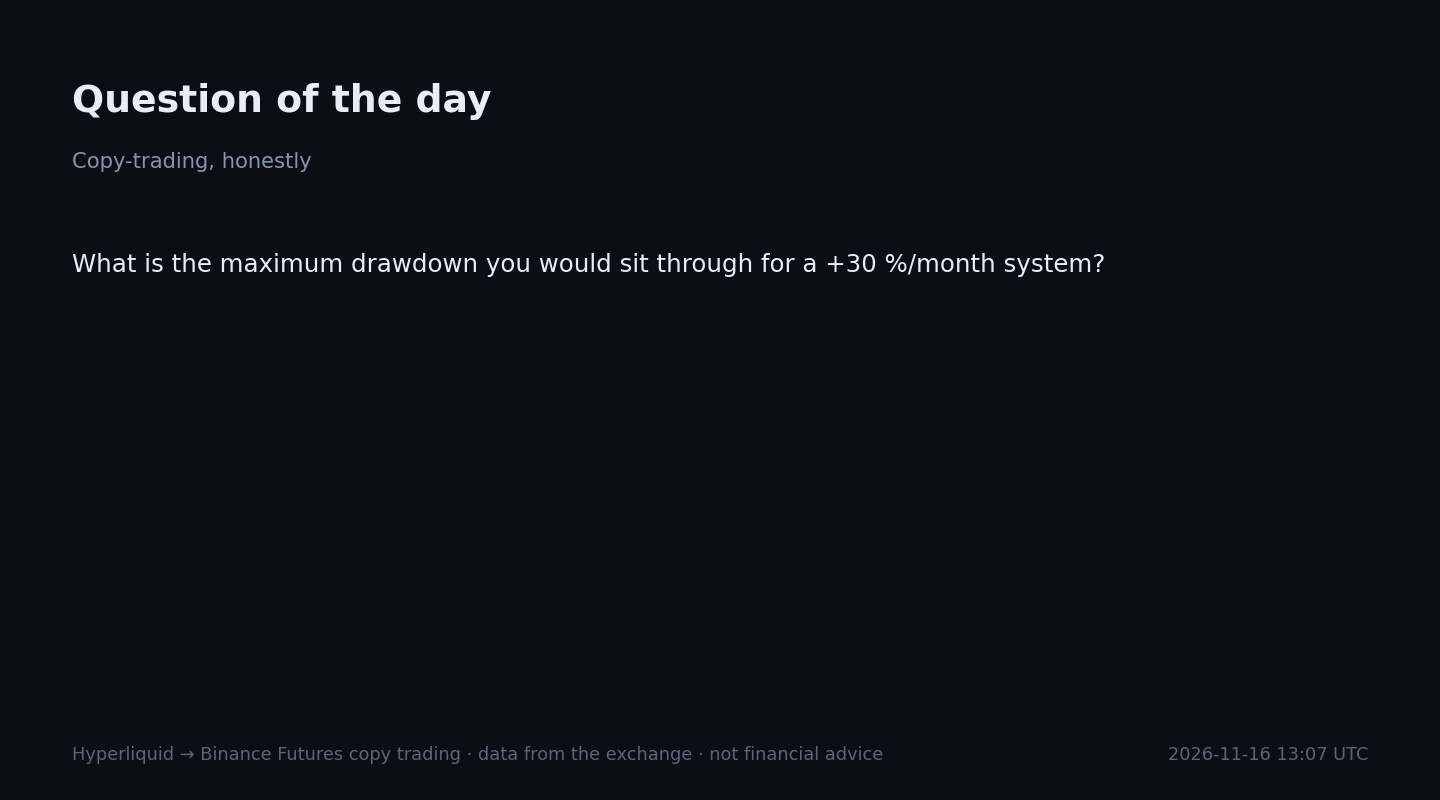
What is the maximum drawdown you would sit through for a +30 %/month system?
Our numbers are in the daily snapshot. #copytrading #hyperliquid
We run this on a Binance copy-trading account. The group where the trades land first: https://app.binance.com/uni-qr/DpuA7yYD
What is the maximum drawdown you would sit through for a +30 %/month system?
Our numbers are in the daily snapshot. #copytrading #hyperliquid
We run this on a Binance copy-trading account. The group where the trades land first: https://app.binance.com/uni-qr/DpuA7yYD
Our numbers are in the daily snapshot. #copytrading #hyperliquid
We run this on a Binance copy-trading account. The group where the trades land first: https://app.binance.com/uni-qr/DpuA7yYD
4
A hidden account made us close two good trades.
Hyperliquid keeps stock, oil and metal positions on a separate sub-exchange. Our position check only looked at the main one, saw 'flat' and closed our oil legs twice while the master still held them. Fixed the same night: now every check reads all sub-exchanges. Real money finds bugs paper never does.
Question: what did your first real week teach you?
#copytrading #hyperliquid #tradingjournal
If you would rather get these as they happen than scroll for them, the group is here: https://app.binance.com/uni-qr/DpuA7yYD
102
Two seconds of delay cost nothing. Thin pairs cost everything.
We measured our fill delay after the master: 1.9–2.8 seconds. Simulated cost of one extra second inside 2–5 seconds: near zero. Where the money leaks: pairs with thin books where the market order walks the book. Speed is not the edge; liquidity filters are.
Question: do you check the book before copying a coin?
#copytrading #hyperliquid #tradingjournal
If you copy by API like we do, or just want these entries and exits as they happen, we keep a small group on Binance: https://app.binance.com/uni-qr/DpuA7yYD
54
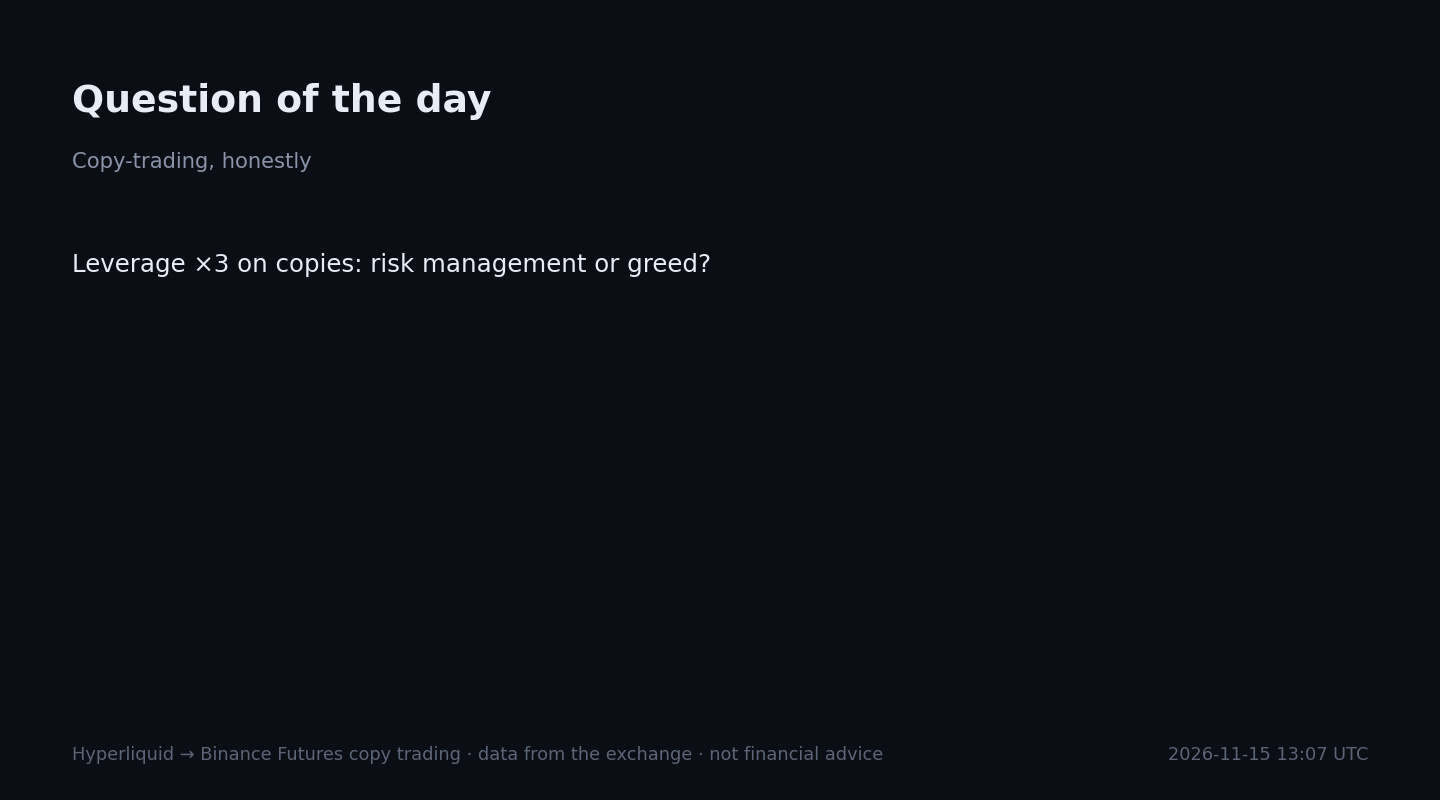
Leverage ×3 on copies: risk management or greed?
Our numbers are in the daily snapshot. #copytrading #hyperliquid
If you would rather get these as they happen than scroll for them, the group is here: https://app.binance.com/uni-qr/DpuA7yYD
Leverage ×3 on copies: risk management or greed?
Our numbers are in the daily snapshot. #copytrading #hyperliquid
If you would rather get these as they happen than scroll for them, the group is here: https://app.binance.com/uni-qr/DpuA7yYD
Our numbers are in the daily snapshot. #copytrading #hyperliquid
If you would rather get these as they happen than scroll for them, the group is here: https://app.binance.com/uni-qr/DpuA7yYD
56
Below $150 per trader the exchange minimum eats half the signals.
Binance requires about $5 per order. At $5,000 split over 28 traders with a 3× multiplier, our share is $535 of exposure per trader. Drop the share below $150 and half of the masters' orders fall under the minimum and get skipped. Diversification is limited by deposit, not by wish.
Question: how small is too small for your copy account?
#copytrading #hyperliquid #tradingjournal
For anyone copying via API, trading their own account or on Binance Copy Trading, the same trades go to our group: https://app.binance.com/uni-qr/DpuA7yYD
91
Copying bad traders in reverse does not work either.
Take the losers, do the opposite. Their loss is mostly fees and slippage, which do not reverse into your profit — you pay them too. You would need a trader losing 2.3× deeper than fees to make the mirror positive. Nobody stays that bad for long.
Question: tempted to inverse someone?
#copytrading #hyperliquid #tradingjournal
Same trades, same rules, in a Binance group for people who copy by API or trade them by hand: https://app.binance.com/uni-qr/DpuA7yYD
63
Stop-loss on the copy, or trust the master's exit?
Our numbers are in the daily snapshot. #copytrading #hyperliquid
For anyone copying via API, trading their own account or on Binance Copy Trading, the same trades go to our group: https://app.binance.com/uni-qr/DpuA7yYD
Stop-loss on the copy, or trust the master's exit?
Our numbers are in the daily snapshot. #copytrading #hyperliquid
For anyone copying via API, trading their own account or on Binance Copy Trading, the same trades go to our group: https://app.binance.com/uni-qr/DpuA7yYD
Our numbers are in the daily snapshot. #copytrading #hyperliquid
For anyone copying via API, trading their own account or on Binance Copy Trading, the same trades go to our group: https://app.binance.com/uni-qr/DpuA7yYD
50
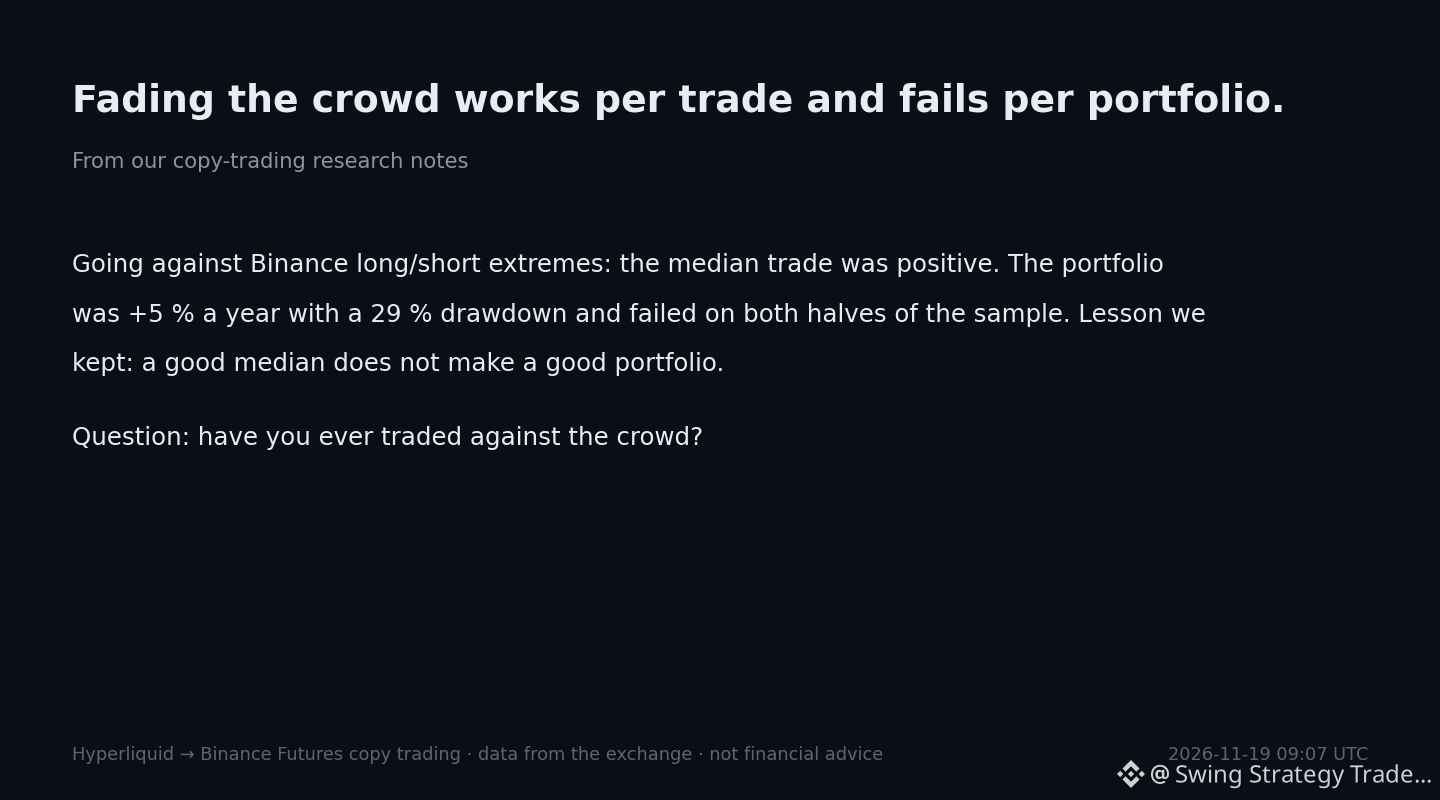
Fading the crowd works per trade and fails per portfolio.
Going against Binance long/short extremes: the median trade was positive. The portfolio was +5 % a year with a 29 % drawdown and failed on both halves of the sample. Lesson we kept: a good median does not make a good portfolio.
Question: have you ever traded against the crowd?
#copytrading #hyperliquid #tradingjournal
If you copy by API like we do, or just want these entries and exits as they happen, we keep a small group on Binance: https://app.binance.com/uni-qr/DpuA7yYD
71
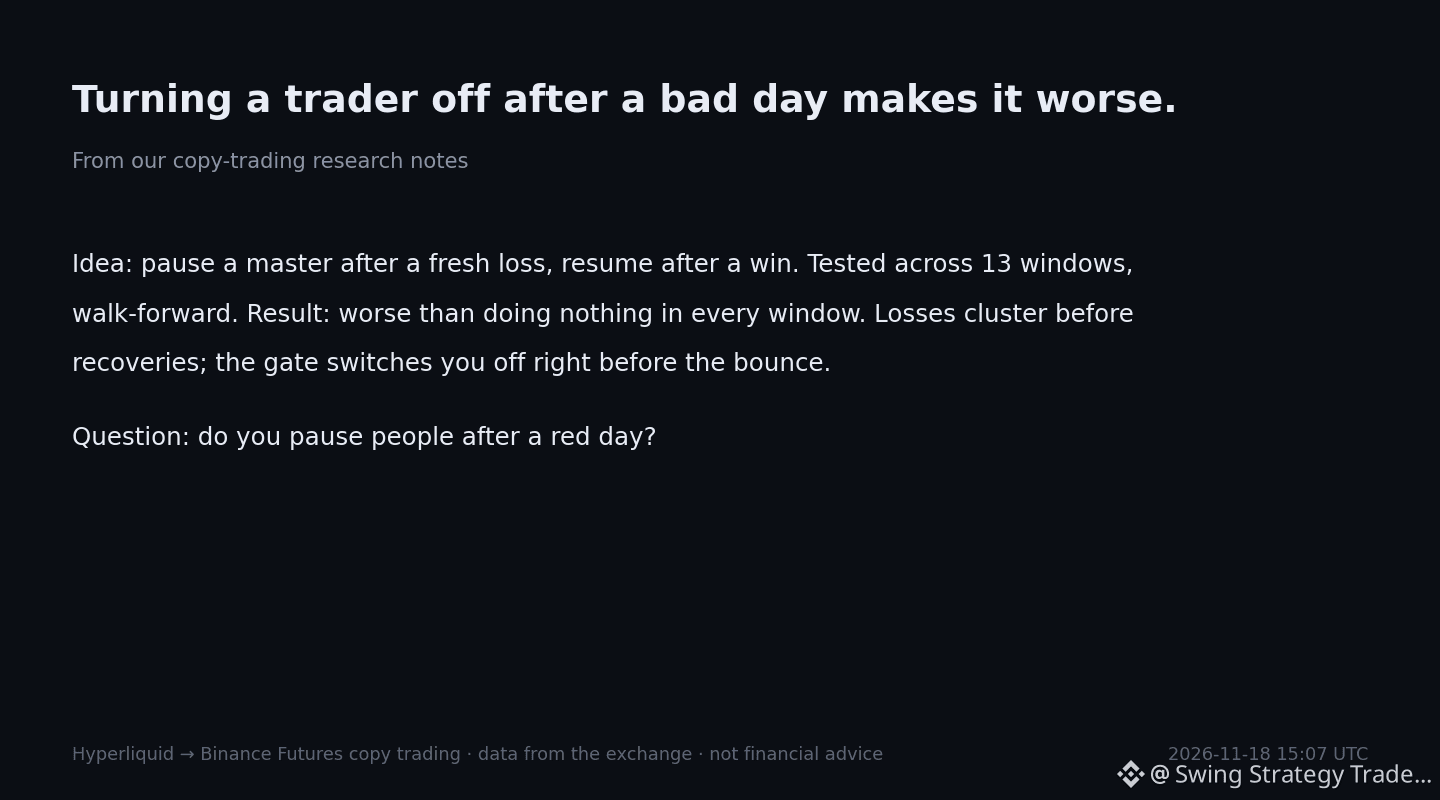
Turning a trader off after a bad day makes it worse.
Idea: pause a master after a fresh loss, resume after a win. Tested across 13 windows, walk-forward. Result: worse than doing nothing in every window. Losses cluster before recoveries; the gate switches you off right before the bounce.
Question: do you pause people after a red day?
#copytrading #hyperliquid #tradingjournal
We run this on a Binance copy-trading account. The group where the trades land first: https://app.binance.com/uni-qr/DpuA7yYD
67
Would you copy a trader with 44 % accuracy and a 3:1 payoff?
Our numbers are in the daily snapshot. #copytrading #hyperliquid
If you copy by API like we do, or just want these entries and exits as they happen, we keep a small group on Binance: https://app.binance.com/uni-qr/DpuA7yYD
Would you copy a trader with 44 % accuracy and a 3:1 payoff?
Our numbers are in the daily snapshot. #copytrading #hyperliquid
If you copy by API like we do, or just want these entries and exits as they happen, we keep a small group on Binance: https://app.binance.com/uni-qr/DpuA7yYD
Our numbers are in the daily snapshot. #copytrading #hyperliquid
If you copy by API like we do, or just want these entries and exits as they happen, we keep a small group on Binance: https://app.binance.com/uni-qr/DpuA7yYD
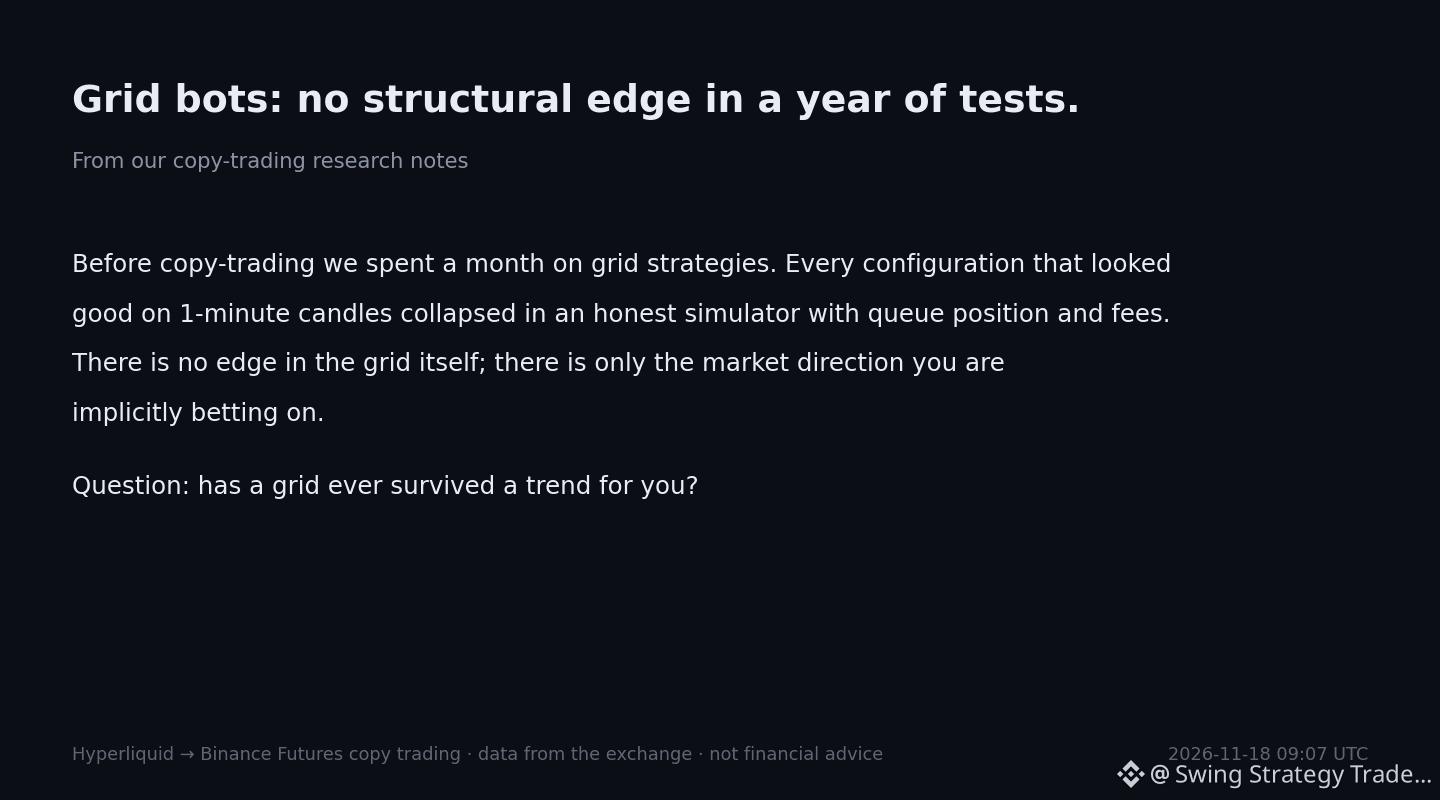
Grid bots: no structural edge in a year of tests.
Before copy-trading we spent a month on grid strategies. Every configuration that looked good on 1-minute candles collapsed in an honest simulator with queue position and fees. There is no edge in the grid itself; there is only the market direction you are implicitly betting on.
Question: has a grid ever survived a trend for you?
#copytrading #hyperliquid #tradingjournal
Same trades, same rules, in a Binance group for people who copy by API or trade them by hand: https://app.binance.com/uni-qr/DpuA7yYD
77
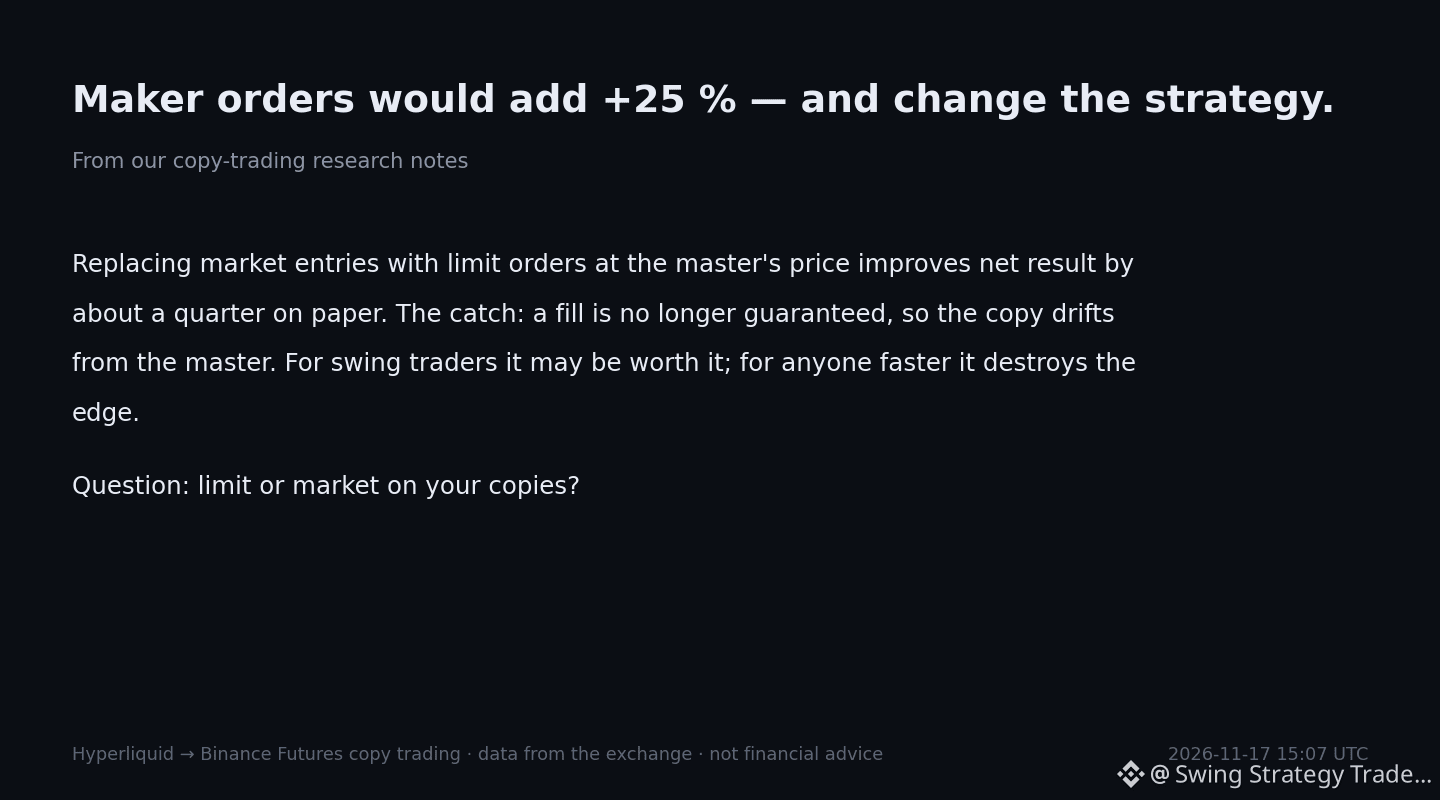
Maker orders would add +25 % — and change the strategy.
Replacing market entries with limit orders at the master's price improves net result by about a quarter on paper. The catch: a fill is no longer guaranteed, so the copy drifts from the master. For swing traders it may be worth it; for anyone faster it destroys the edge.
Question: limit or market on your copies?
#copytrading #hyperliquid #tradingjournal
If you would rather get these as they happen than scroll for them, the group is here: https://app.binance.com/uni-qr/DpuA7yYD
78
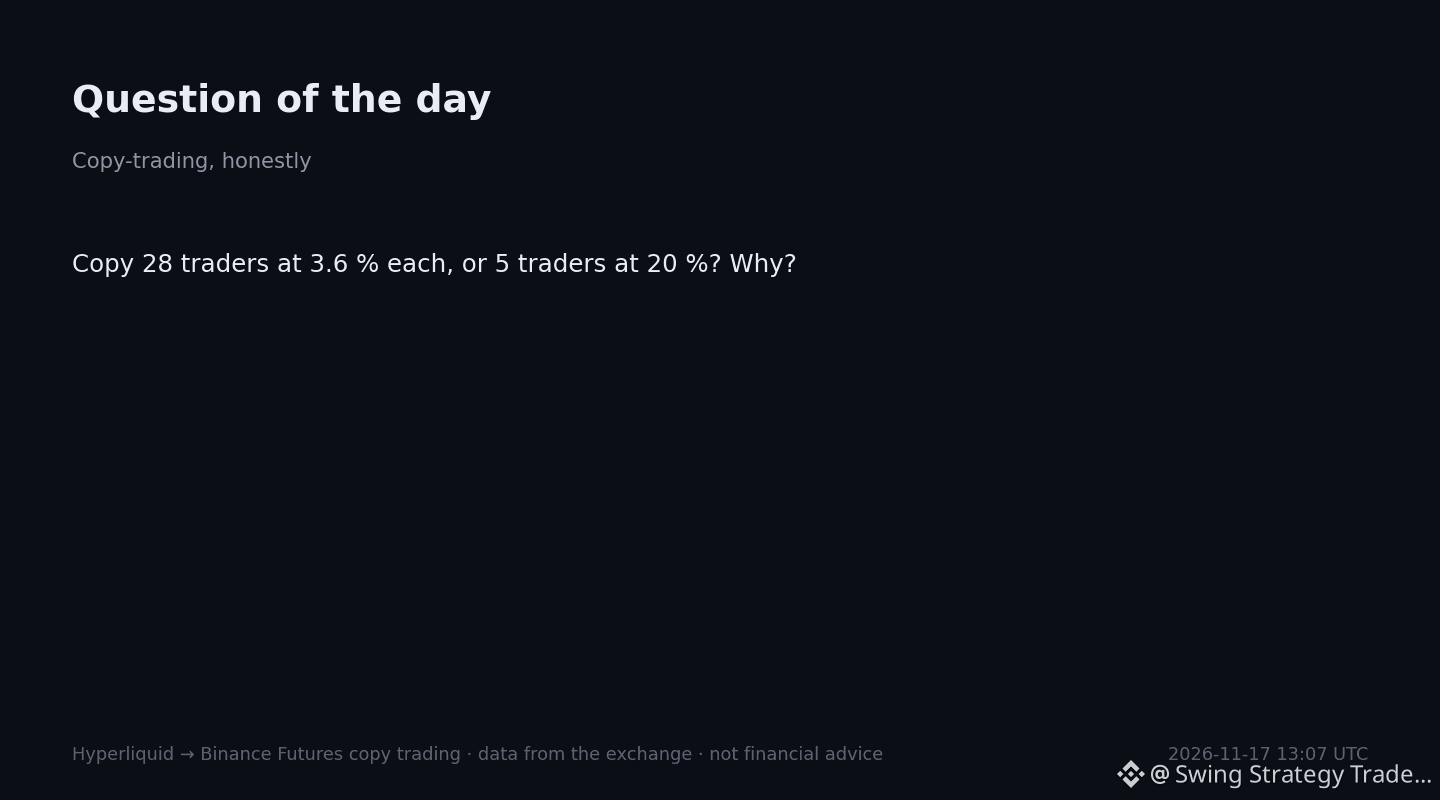
Copy 28 traders at 3.6 % each, or 5 traders at 20 %? Why?
Our numbers are in the daily snapshot. #copytrading #hyperliquid
Same trades, same rules, in a Binance group for people who copy by API or trade them by hand: https://app.binance.com/uni-qr/DpuA7yYD
Copy 28 traders at 3.6 % each, or 5 traders at 20 %? Why?
Our numbers are in the daily snapshot. #copytrading #hyperliquid
Same trades, same rules, in a Binance group for people who copy by API or trade them by hand: https://app.binance.com/uni-qr/DpuA7yYD
Our numbers are in the daily snapshot. #copytrading #hyperliquid
Same trades, same rules, in a Binance group for people who copy by API or trade them by hand: https://app.binance.com/uni-qr/DpuA7yYD
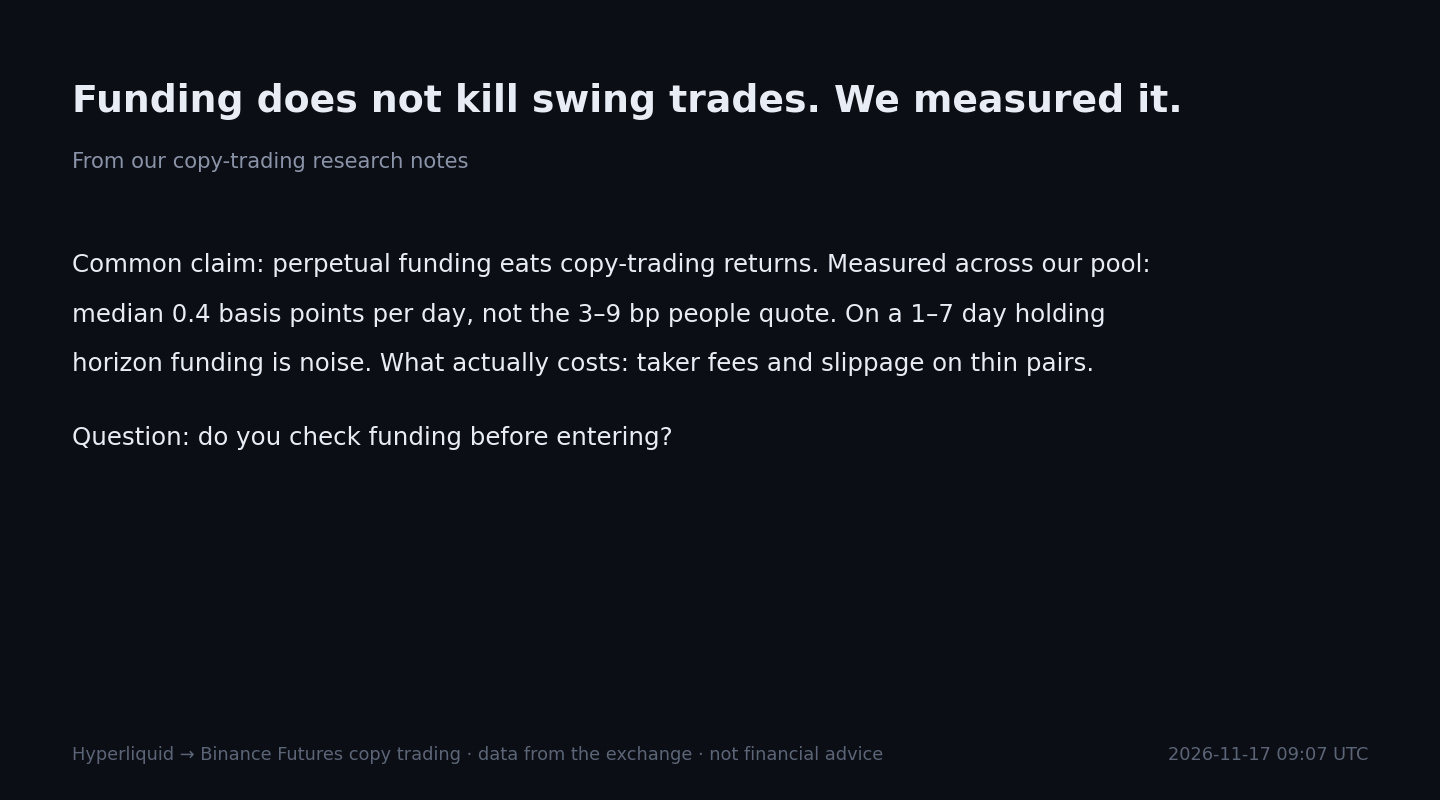
Funding does not kill swing trades. We measured it.
Common claim: perpetual funding eats copy-trading returns. Measured across our pool: median 0.4 basis points per day, not the 3–9 bp people quote. On a 1–7 day holding horizon funding is noise. What actually costs: taker fees and slippage on thin pairs.
Question: do you check funding before entering?
#copytrading #hyperliquid #tradingjournal
We run this on a Binance copy-trading account. The group where the trades land first: https://app.binance.com/uni-qr/DpuA7yYD
8
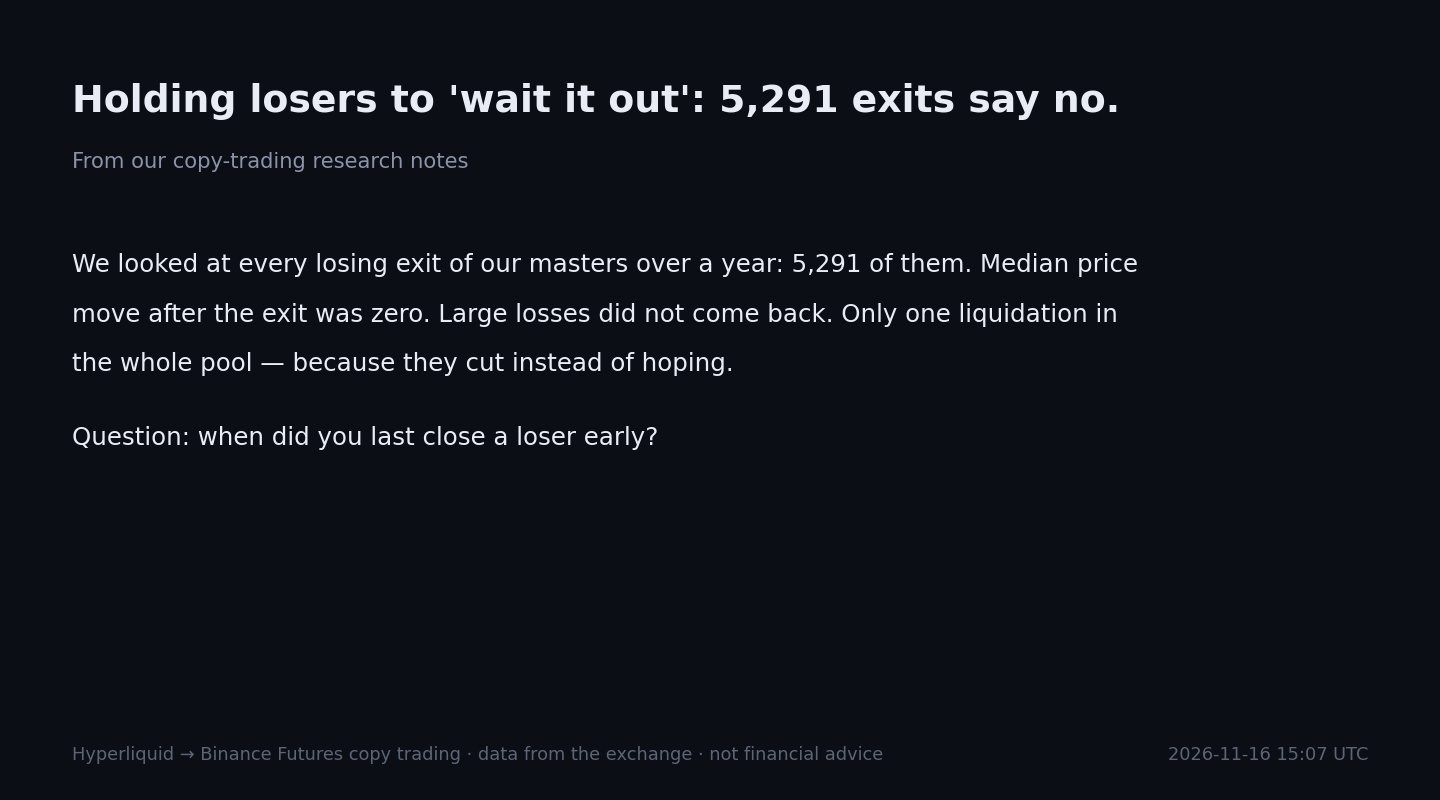
Holding losers to 'wait it out': 5,291 exits say no.
We looked at every losing exit of our masters over a year: 5,291 of them. Median price move after the exit was zero. Large losses did not come back. Only one liquidation in the whole pool — because they cut instead of hoping.
Question: when did you last close a loser early?
#copytrading #hyperliquid #tradingjournal
For anyone copying via API, trading their own account or on Binance Copy Trading, the same trades go to our group: https://app.binance.com/uni-qr/DpuA7yYD
95
What is the maximum drawdown you would sit through for a +30 %/month system?
Our numbers are in the daily snapshot. #copytrading #hyperliquid
We run this on a Binance copy-trading account. The group where the trades land first: https://app.binance.com/uni-qr/DpuA7yYD
What is the maximum drawdown you would sit through for a +30 %/month system?
Our numbers are in the daily snapshot. #copytrading #hyperliquid
We run this on a Binance copy-trading account. The group where the trades land first: https://app.binance.com/uni-qr/DpuA7yYD
Our numbers are in the daily snapshot. #copytrading #hyperliquid
We run this on a Binance copy-trading account. The group where the trades land first: https://app.binance.com/uni-qr/DpuA7yYD
11
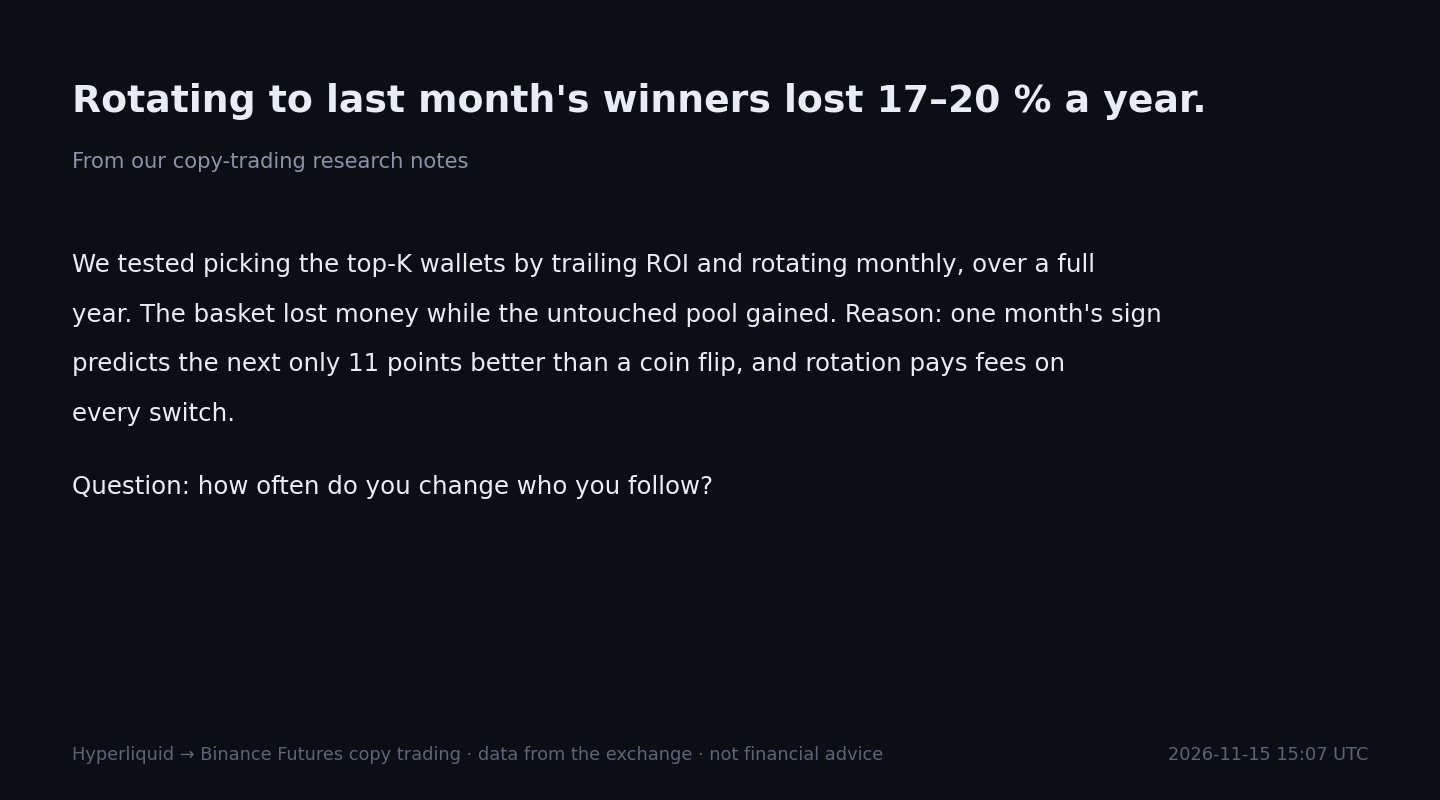
Rotating to last month's winners lost 17–20 % a year.
We tested picking the top-K wallets by trailing ROI and rotating monthly, over a full year. The basket lost money while the untouched pool gained. Reason: one month's sign predicts the next only 11 points better than a coin flip, and rotation pays fees on every switch.
Question: how often do you change who you follow?
#copytrading #hyperliquid #tradingjournal
If you copy by API like we do, or just want these entries and exits as they happen, we keep a small group on Binance: https://app.binance.com/uni-qr/DpuA7yYD
6
Leverage ×3 on copies: risk management or greed?
Our numbers are in the daily snapshot. #copytrading #hyperliquid
If you would rather get these as they happen than scroll for them, the group is here: https://app.binance.com/uni-qr/DpuA7yYD
Leverage ×3 on copies: risk management or greed?
Our numbers are in the daily snapshot. #copytrading #hyperliquid
If you would rather get these as they happen than scroll for them, the group is here: https://app.binance.com/uni-qr/DpuA7yYD
Our numbers are in the daily snapshot. #copytrading #hyperliquid
If you would rather get these as they happen than scroll for them, the group is here: https://app.binance.com/uni-qr/DpuA7yYD
79
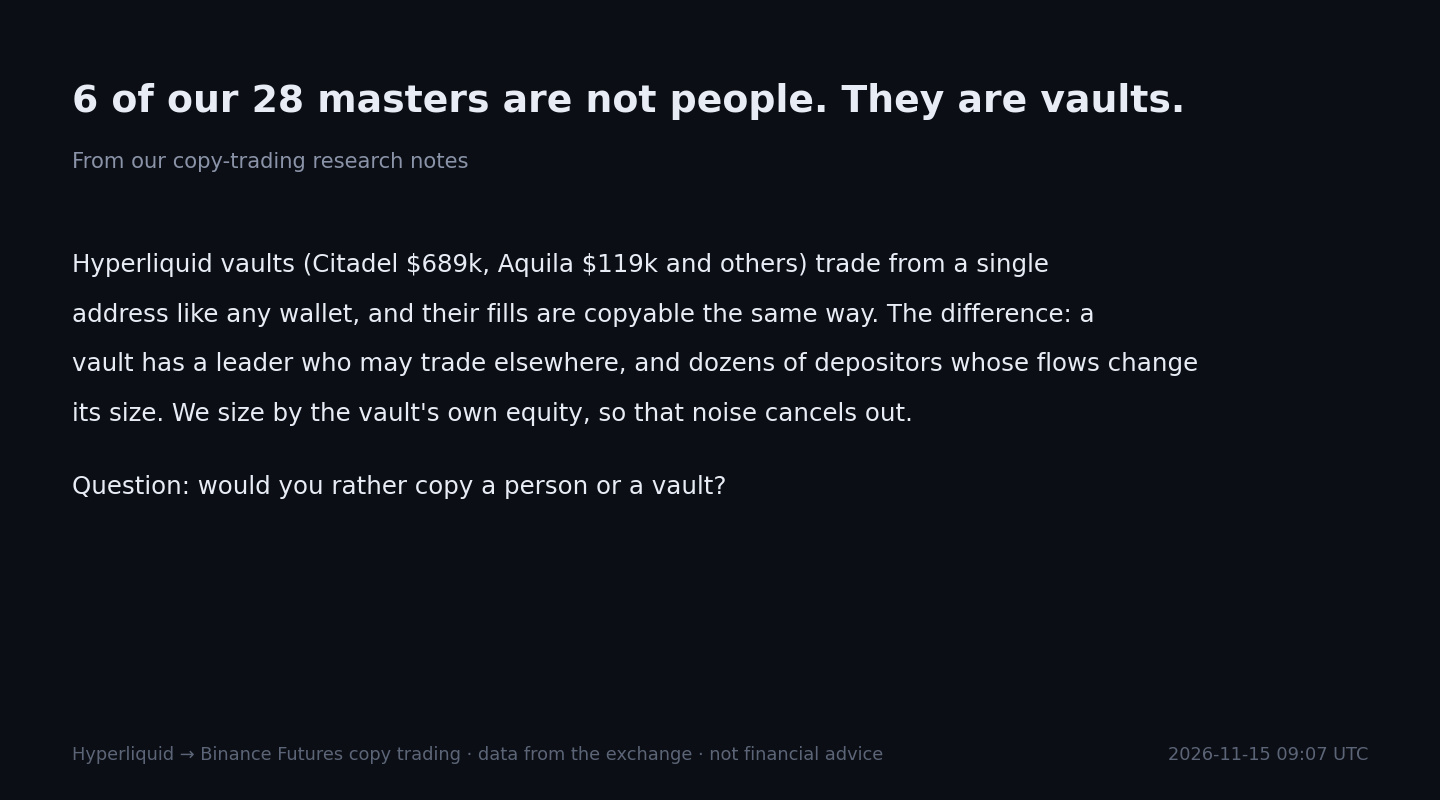
6 of our 28 masters are not people. They are vaults.
Hyperliquid vaults (Citadel $689k, Aquila $119k and others) trade from a single address like any wallet, and their fills are copyable the same way. The difference: a vault has a leader who may trade elsewhere, and dozens of depositors whose flows change its size. We size by the vault's own equity, so that noise cancels out.
Question: would you rather copy a person or a vault?
#copytrading #hyperliquid #tradingjournal
For anyone copying via API, trading their own account or on Binance Copy Trading, the same trades go to our group: https://app.binance.com/uni-qr/DpuA7yYD
153
Log in to explore more content
Join global crypto users on Binance Square
⚡️ Get latest and useful information about crypto.
💬 Trusted by the world’s largest crypto exchange.
👍 Discover real insights from verified creators.
Email / Phone number
Trending Topics
BTCReboundsAbove$60KAmidWhaleDipBuying
630 views
24 Discussing
Abraxas Capital, Other Whales Buy the BTC Dip as Bitcoin Briefly Reclaims $60,000
Binance News
·5 Likes
·3.5k views
NvidiaLoses$2.7TrillionInMonthAndAHalf
36,277 views
182 Discussing
GlobalStocksFaceLongestLosingStreakSince2023
359,270 views
2,330 Discussing