
Solana Diva
229 Posts

Solana Diva
Report
Block User
More curious than confident. I write about what the chart doesn’t tell you. BNB, Solana, RWA, whatever looks off. DYOR, NFA
Open Trade
Occasional Trader
3.9 Years
87 Following
1.3K+ Followers
478 Liked
Posts
Portfolio
All
Quotes
Live
PINNED
·
--
👑 THE NEXT 3 DIVAS
$YB → $0.0571
$DODO → $0.03912
$ENSO → $0.484
Three projects. One question:
Which one moves next? 👀🔥
I’m watching before the crowd.
Red Packet 🎁
Which one are you watching?
$YB $DODO $ENSO
#YB #DODO #ENSO #SolanaDiva
👑 THE NEXT 3 DIVAS
$YB → $0.0571
$DODO → $0.03912
$ENSO → $0.484
Three projects. One question:
Which one moves next? 👀🔥
I’m watching before the crowd.
Red Packet 🎁
Which one are you watching?
$YB $DODO $ENSO
#YB #DODO #ENSO #SolanaDiva
$YB → $0.0571
$DODO → $0.03912
$ENSO → $0.484
Three projects. One question:
Which one moves next? 👀🔥
I’m watching before the crowd.
Red Packet 🎁
Which one are you watching?
$YB $DODO $ENSO
#YB #DODO #ENSO #SolanaDiva

962
17
80
962
·
--
FRIENDS Claim Red Packet Now
$SSV
{future}(SSVUSDT)
$MMT
{future}(MMTUSDT)
$INIT
{future}(INITUSDT)
FRIENDS Claim Red Packet Now
$SSV
$MMT
$INIT
$SSV
$MMT
$INIT
Solana Diva
·
--
👑 THE NEXT 3 DIVAS
$YB → $0.0571
$DODO → $0.03912
$ENSO → $0.484
Three projects. One question:
Which one moves next? 👀🔥
I’m watching before the crowd.
Red Packet 🎁
Which one are you watching?
$YB $DODO $ENSO
#YB #DODO #ENSO #SolanaDiva
$YB → $0.0571
$DODO → $0.03912
$ENSO → $0.484
Three projects. One question:
Which one moves next? 👀🔥
I’m watching before the crowd.
Red Packet 🎁
Which one are you watching?
$YB $DODO $ENSO
#YB #DODO #ENSO #SolanaDiva

1
504
·
--
South Korea just asked crypto to show its receipts. 👀
And I think the bigger story is being missed.
Korea is proposing mandatory disclosure when something important happens to a digital asset.
Big transactions.
Token burns.
Airdrops.
Hacks.
Supply changes.
System failures.
Basically…
If something can materially change the story, the market should know.
Read that again.
Because crypto grew up on a very different idea.
Move fast.
Build quietly.
Let the market figure it out.
Now regulators are saying:
“Not so fast. Tell everyone what’s happening.”
And honestly?
I don't think that is automatically bad for crypto.
The serious projects may actually benefit from it.
Because when everyone has access to the same important information, the market has less room for rumors, hidden moves and surprise supply changes to control the narrative.
But there’s another side.
More transparency means more responsibility.
Projects that were comfortable operating in the shadows may suddenly have nowhere to hide.
And that could create a very interesting divide:
The projects that can explain themselves…
and the projects that depended on people not asking too many questions.
What makes this even more interesting is that Korea is also looking at rules that could reopen the door to ICO fundraising after a nine-year ban.
So this isn't simply:
“Crypto regulation is getting tougher.”
It looks more like:
“If you want access to the market, you may have to become more accountable.”
And maybe that’s where the next phase of crypto begins.
Not with fewer rules.
But with fewer unanswered questions.
Divas, what do you think?
Does mandatory transparency make crypto stronger…
or does too much regulation take away what made crypto different in the first place?
$BTC $LUNA $LUNC
#Crypto #Regulation #SolanaDiva
#SouthKoreaProposesMandatoryDigitalAssetTransactionDisclosure

1
416
·
--
We may be watching the beginning of something that sounds completely crazy.
What if the next AI data center…
isn’t on Earth?
The U.S. just gave SpaceX conditional approval for up to 1 MILLION orbital data-center satellites.
Read that again.
One million.
Not a new app.
Not another AI model.
An entirely different place to run the machines behind AI.
SpaceX wants computing power in orbit, using solar energy and laser links to move data back toward Earth.
And suddenly, I’m thinking about something bigger than SpaceX.
Think about what happened with AI on Earth.
More models.
More users.
More computing.
More data centers.
More chips.
And now the industry is asking:
What if Earth itself becomes the bottleneck?
That’s where this gets interesting.
SpaceX’s orbital system is being designed around advanced AI hardware, including Nvidia’s technology.
But the bigger story isn’t $NVDA.
It’s the possibility that the demand for AI compute keeps expanding into places we never considered before.
Of course…
I’m not saying one million satellites are about to appear in the sky tomorrow.
This is a long-term bet.
There are still enormous questions around launch costs, cooling, radiation, maintenance, debris and whether the economics actually work at scale. The FCC approval itself gives SpaceX years to reach the deployment milestones.
But that’s exactly why I find it fascinating.
Because the crazy ideas usually look ridiculous…
right before people start taking them seriously.
Today we’re asking whether data centers can work in space.
Tomorrow we might be asking why they ever stayed on Earth.
And if that future becomes real…
the AI chip story could be much bigger than what the market is pricing today.
Divas, tell me honestly:
**Is orbital AI the next giant infrastructure revolution…
or one of the most expensive ideas humanity has ever tried?** 👀
$NVDA $AMD $TSLA
#AI #SpaceX #SolanaDiva
#CouldSpaceX’sOrbitalDataCentersBoostAIChipDemand?
We may be watching the beginning of something that sounds completely crazy.
What if the next AI data center…
isn’t on Earth?
The U.S. just gave SpaceX conditional approval for up to 1 MILLION orbital data-center satellites.
Read that again.
One million.
Not a new app.
Not another AI model.
An entirely different place to run the machines behind AI.
SpaceX wants computing power in orbit, using solar energy and laser links to move data back toward Earth.
And suddenly, I’m thinking about something bigger than SpaceX.
Think about what happened with AI on Earth.
More models.
More users.
More computing.
More data centers.
More chips.
And now the industry is asking:
What if Earth itself becomes the bottleneck?
That’s where this gets interesting.
SpaceX’s orbital system is being designed around advanced AI hardware, including Nvidia’s technology.
But the bigger story isn’t $NVDA .
It’s the possibility that the demand for AI compute keeps expanding into places we never considered before.
Of course…
I’m not saying one million satellites are about to appear in the sky tomorrow.
This is a long-term bet.
There are still enormous questions around launch costs, cooling, radiation, maintenance, debris and whether the economics actually work at scale. The FCC approval itself gives SpaceX years to reach the deployment milestones.
But that’s exactly why I find it fascinating.
Because the crazy ideas usually look ridiculous…
right before people start taking them seriously.
Today we’re asking whether data centers can work in space.
Tomorrow we might be asking why they ever stayed on Earth.
And if that future becomes real…
the AI chip story could be much bigger than what the market is pricing today.
Divas, tell me honestly:
**Is orbital AI the next giant infrastructure revolution…
or one of the most expensive ideas humanity has ever tried?** 👀
$NVDA $AMD $TSLA
#AI #SpaceX #SolanaDiva
#CouldSpaceX’sOrbitalDataCentersBoostAIChipDemand?
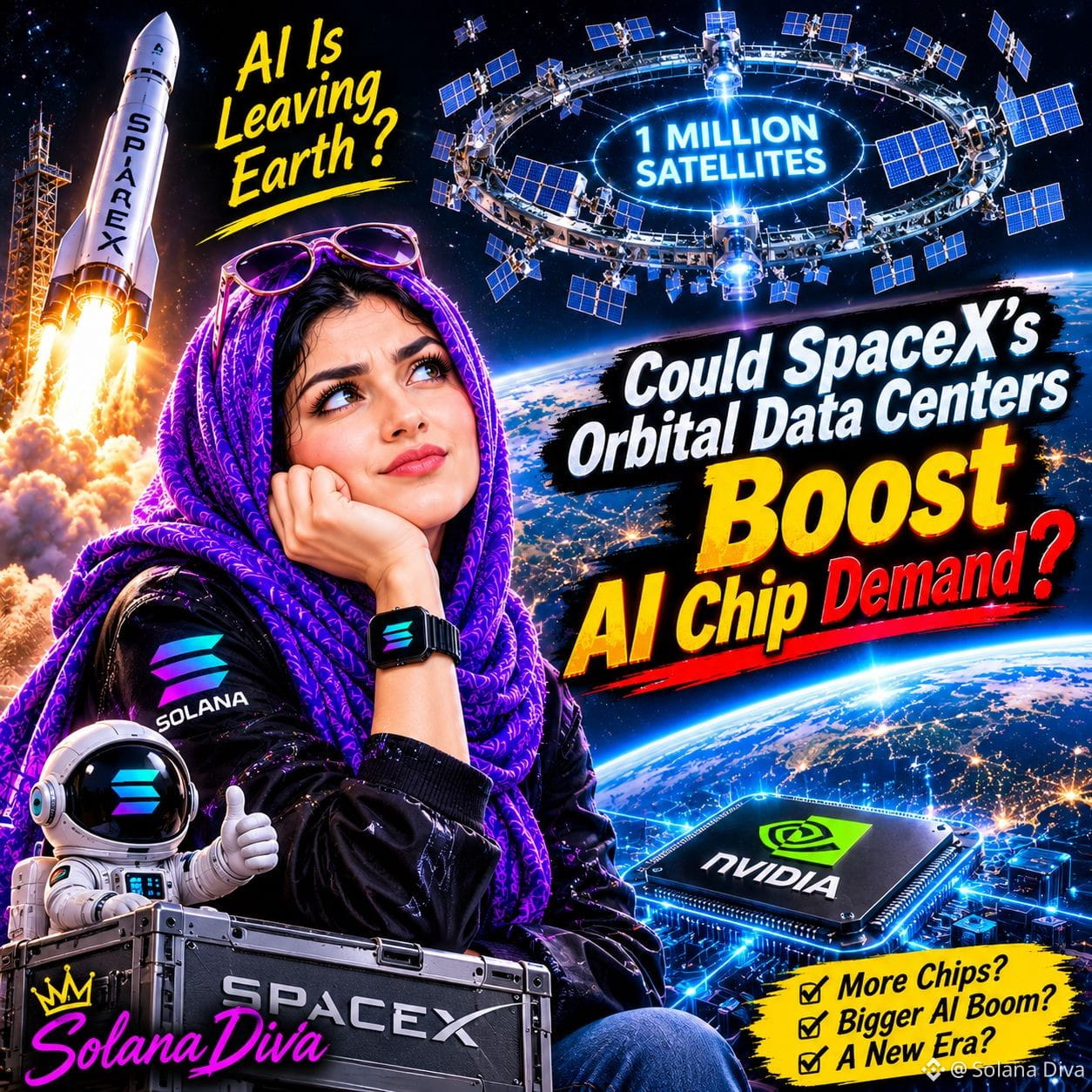
1
711
·
--
The market is trying to recover… but something still feels missing. 👀
And honestly, I think that's the part everyone should be watching.
Bitcoin bounced back above $60K.
Stocks tried to recover.
For a moment, it almost felt like the panic was finally over.
But look closer.
U.S. Bitcoin ETFs just recorded another $453 million in withdrawals.
That's seven consecutive days of money leaving.
Read that again.
Bitcoin is recovering in price, while institutional money is still walking away.
And that's a very different story.
Because a green candle can bring back excitement.
But it takes something much stronger to bring back confidence.
There's another problem.
The U.S. economy is still growing strongly, but inflation isn't cooling enough to make the Fed comfortable.
Add the AI stock selloff, tariff uncertainty and a nervous market…
and suddenly this rebound doesn't look so simple.
Here's what I find interesting:
Maybe investors aren't finished with Bitcoin.
Maybe they're simply not ready to trust the market again.
And that distinction matters more than most people realize.
I'm not calling another crash.
I'm not declaring a new bull run either.
I want to see what happens when normal market activity returns.
Do buyers come back?
Does institutional money finally stop leaving?
Or does this beautiful little rebound disappear as quickly as it arrived?
Because a recovery isn't proven when the market turns green. It's proven when people are willing to believe in it again.
So, Divas… 💅
Are we watching the beginning of a real comeback?
Or is everyone celebrating a little too early?
I want your honest opinion.
$BTC $NVDA $IBIT
#Bitcoin #Crypto #SolanaDiva
#CanMarketsReboundAfterThanksgiving?

2
721
·
--
AI may be running out of room on Earth.
So what if the next data center…
isn’t on Earth at all? 👀
SpaceX just got authorization for up to 1 million satellites for its Starmind orbital-computing plan.
Read that again.
1 MILLION.
The idea sounds almost ridiculous.
Put computing power in orbit.
Use solar energy.
Connect the satellites with high-speed laser links.
And let them process AI workloads above the Earth.
But here’s the part that caught my attention:
If this actually works…
the AI boom may need a completely new kind of infrastructure.
And that means one thing matters a lot:
Chips.
Every new AI data center needs computing power.
If part of that computing eventually moves into orbit, the demand for advanced AI hardware could become much bigger than today’s data-center story.
That doesn’t mean $NVDA suddenly gets a million-satellite order.
This is a long game.
SpaceX’s own timeline stretches years into the future, and there are still massive questions around launches, cooling, radiation, cost and reliability.
But think about the bigger picture.
First AI transformed software.
Then it transformed data centers.
Now people are asking whether AI infrastructure itself needs to leave the planet.
That’s when a crazy idea starts becoming an investment story.
Maybe this works.
Maybe it takes much longer than expected.
Maybe the economics never make sense.
But if orbital computing becomes real at scale…
the next AI chip cycle could be much bigger than the one we’re watching today.
And that’s the question I’m watching.
Would you invest in the AI-space story this early…
or wait until the first real orbital data center proves it can actually make money?
$AMDB $TSLA
#AI #SpaceX #SolanaDiva
#CouldSpaceX’sOrbitalDataCentersBoostAIChipDemand?

3
757
·
--
The market is green again… but I’m not celebrating yet. 👀💅
Because sometimes the hardest part of a selloff isn’t knowing when it ends.
It’s knowing whether the first bounce is real.
Bitcoin just climbed back toward $60K after getting crushed earlier this week.
Stocks are trying to breathe too.
And suddenly the mood feels a little less scary.
But here’s what makes me pause.
Wall Street is closed for Thanksgiving.
Friday is a shortened session.
Liquidity is thinner.
And Bitcoin is still dealing with serious money leaving the spot ETFs.
Read that again.
A green market doesn’t automatically mean buyers are back.
Sometimes it just means there are fewer people around to sell.
That’s why I’m more interested in what happens AFTER the holiday.
When the big players come back.
When the market gets its normal volume again.
When Bitcoin has to prove that people actually want to own the move…
not just chase it because the screen turned green.
Maybe this is the beginning of the rebound everyone has been waiting for.
Maybe it’s just a temporary breath before the next decision.
Either way, I don’t want to guess.
I want to see who shows up when the holiday is over.
Because that’s when the market has to answer the real question:
**Was this a recovery…
or just a pause in the fear?**
Divas, what are you watching?
Would you trust this bounce?
Or wait for the market to prove it after Thanksgiving? 👀
$BTC $NVDA $SOL
#Bitcoin #Crypto #SolanaDiva
#CanMarketsReboundAfterThanksgiving?

254
·
--
All Friends Claim Red Packet and Repost now please $MANTRA
{future}(MANTRAUSDT)
$PROM
{future}(PROMUSDT)
$MMT
{future}(MMTUSDT)
All Friends Claim Red Packet and Repost now please $MANTRA
$PROM
$MMT
$PROM
$MMT
Solana Diva
·
--
👑 THE NEXT 3 DIVAS
$YB → $0.0571
$DODO → $0.03912
$ENSO → $0.484
Three projects. One question:
Which one moves next? 👀🔥
I’m watching before the crowd.
Red Packet 🎁
Which one are you watching?
$YB $DODO $ENSO
#YB #DODO #ENSO #SolanaDiva
$YB → $0.0571
$DODO → $0.03912
$ENSO → $0.484
Three projects. One question:
Which one moves next? 👀🔥
I’m watching before the crowd.
Red Packet 🎁
Which one are you watching?
$YB $DODO $ENSO
#YB #DODO #ENSO #SolanaDiva
1
3
679
·
--
Nvidia just exposed a problem it doesn’t want the market to see.
Jensen Huang says Nvidia doesn’t need a succession plan.
He believes the company already has enough capable leaders.
Fair enough.
But then look at what happened when Jensen was gone.
Just 11 days.
More than $1 trillion in market value disappeared.
Then he came back…
and almost $1 trillion came rushing back into the story.
Read that again.
11 days.
That tells me something.
Nvidia may be bigger than one person on paper…
but the market clearly doesn’t treat Jensen like just another CEO.
He has become part of the confidence investors attach to Nvidia.
And that creates a very uncomfortable question.
If Nvidia really has 60 people capable of leading the company, as Jensen says…
why did the market react so dramatically when one person disappeared?
Maybe Jensen is right.
Maybe Nvidia’s unusual structure is exactly what made the company so powerful.
But there’s another possibility.
Maybe the market has quietly become too dependent on the man who built the story.
And we won’t know the answer while everything is going well.
We’ll know the next time Jensen isn’t there.
That’s the part I’m watching.
Not the next AI headline.
Not another chip announcement.
The moment Nvidia has to prove the story can stand without its storyteller.
So tell me honestly:
Is Nvidia bigger than Jensen?
Or has Jensen become too important to Nvidia?
$NVDA $AMDB $BTC
#Nvidia #AI #SolanaDiva
#JensenHuangSaysNvidiaDoesn’tNeedASuccessionPlan
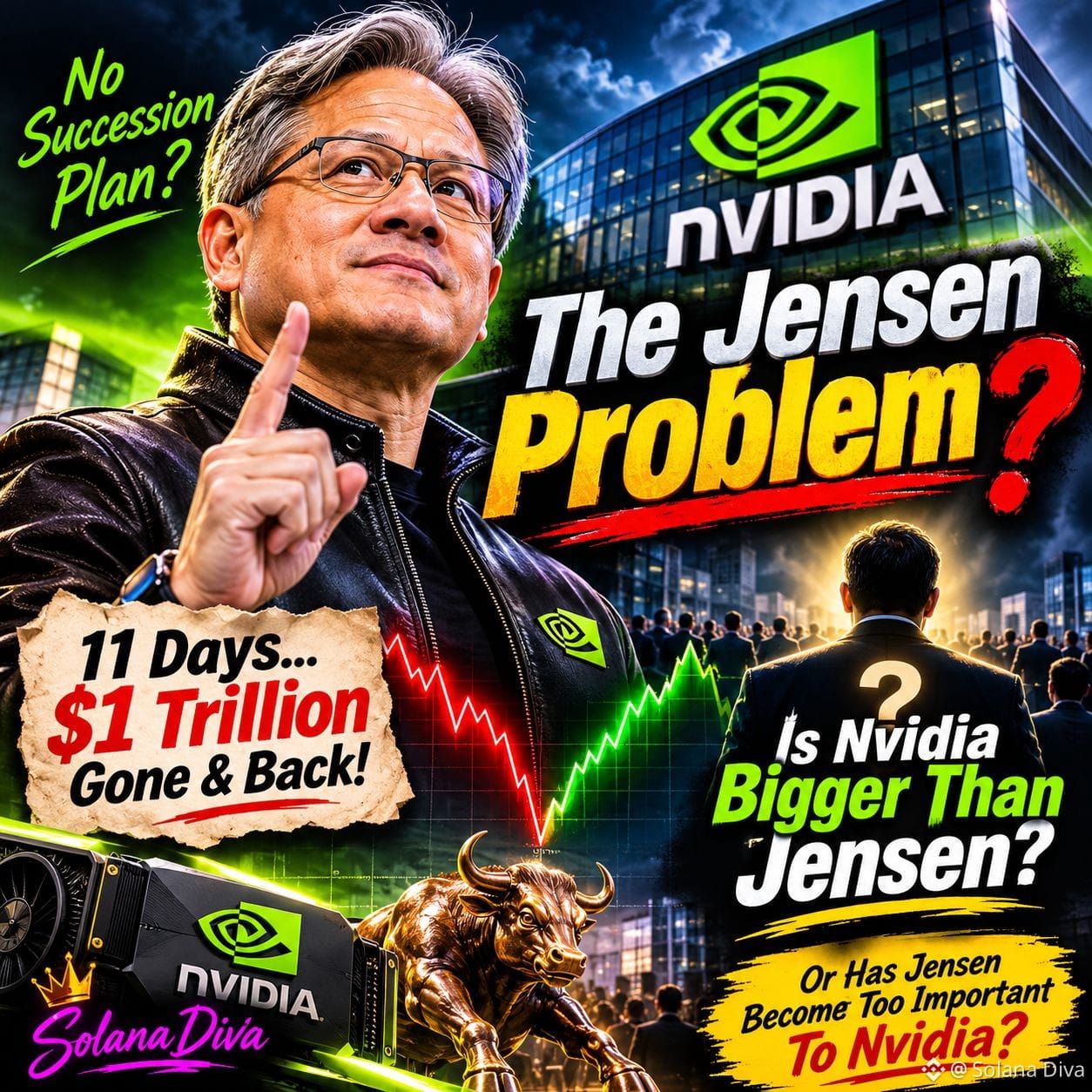
2
871
·
--
Verified
Bitcoin was trying to breathe… then inflation walked into the room. 👀💅
Core PCE came in hotter than expected.
3.3%.
GDP?
4.3%.
Jobless claims?
189K.
Put those three together and suddenly the Fed has a problem…
The economy isn’t looking weak enough to rescue.
Inflation isn’t cooling fast enough to relax.
And that’s exactly what Bitcoin didn’t want to hear.
BTC slipped back below $58K after the numbers hit.
But Divas, here’s what I find more interesting:
The market was already expecting a December hike.
So maybe the real question isn’t:
“Will the Fed hike?”
Maybe it’s:
“How many more times will they have to?”
That changes the whole mood.
Because if inflation stays stubborn while the economy keeps running hot, traders may have to rethink how quickly they expect easier money to arrive.
And Bitcoin?
Bitcoin hates uncertainty.
But there’s another side to this story.
If the market gets so scared that everyone starts expecting the worst…
what happens when the Fed eventually gives them something better than expected?
That’s where things can get very interesting. 👀
I’m not calling the bottom.
I’m not calling another crash either.
I’m watching the reaction.
Because sometimes the number matters less than what the market does AFTER the number.
So, Divas… 💅
**Is $58K the start of another leg lower…
or is the market finally pricing in the bad news it already knows?**
$BTC $ETH $SOL
{future}(SOLUSDT)
#Bitcoin #Crypto #SolanaDiva
#CorePCEBeatLiftsFedHikeOdds
Bitcoin was trying to breathe… then inflation walked into the room. 👀💅
Core PCE came in hotter than expected.
3.3%.
GDP?
4.3%.
Jobless claims?
189K.
Put those three together and suddenly the Fed has a problem…
The economy isn’t looking weak enough to rescue.
Inflation isn’t cooling fast enough to relax.
And that’s exactly what Bitcoin didn’t want to hear.
BTC slipped back below $58K after the numbers hit.
But Divas, here’s what I find more interesting:
The market was already expecting a December hike.
So maybe the real question isn’t:
“Will the Fed hike?”
Maybe it’s:
“How many more times will they have to?”
That changes the whole mood.
Because if inflation stays stubborn while the economy keeps running hot, traders may have to rethink how quickly they expect easier money to arrive.
And Bitcoin?
Bitcoin hates uncertainty.
But there’s another side to this story.
If the market gets so scared that everyone starts expecting the worst…
what happens when the Fed eventually gives them something better than expected?
That’s where things can get very interesting. 👀
I’m not calling the bottom.
I’m not calling another crash either.
I’m watching the reaction.
Because sometimes the number matters less than what the market does AFTER the number.
So, Divas… 💅
**Is $58K the start of another leg lower…
or is the market finally pricing in the bad news it already knows?**
$BTC $ETH $SOL
#Bitcoin #Crypto #SolanaDiva
#CorePCEBeatLiftsFedHikeOdds

3
1.1k
·
--
One headline just reminded the market how nervous it really is. 👀💅
Trump’s new tariff plans hit the headlines…
And suddenly the little bit of confidence coming back into markets started disappearing again.
Stocks slipped.
Bitcoin slipped back below $60K.
And the AI trade got hit again.
But Divas, I don’t think tariffs are the whole story.
They were the spark.
The market was already standing next to the gasoline. 🔥
AI valuations are being questioned.
Interest rates are still a concern.
Investors are becoming less comfortable taking big risks.
And now another round of tariff uncertainty walks into the room.
That combination can make people sell first…
and ask questions later.
That’s why I’m watching $BTC differently right now.
Bitcoin isn’t trading in its own little universe anymore.
When investors suddenly decide they want less risk, crypto feels it.
But here’s the question I actually care about:
If the fear keeps growing, who is willing to buy it?
Because the market can fall on bad news.
The interesting part comes when the bad news is already everywhere…
and sellers still can’t push it much lower.
That’s when I start paying attention. 👀
So, Divas… 💅
Are tariffs creating the next big risk-off wave?
Or is the market simply using the tariff headline as an excuse to release all the fear that was already there?
I want your honest take.
$NVDA $SOL
{future}(SOLUSDT)
#Bitcoin #Markets #SolanaDiva
#BitcoinAndStocksSlipAgainAmidTrump’sTariffPlans
One headline just reminded the market how nervous it really is. 👀💅
Trump’s new tariff plans hit the headlines…
And suddenly the little bit of confidence coming back into markets started disappearing again.
Stocks slipped.
Bitcoin slipped back below $60K.
And the AI trade got hit again.
But Divas, I don’t think tariffs are the whole story.
They were the spark.
The market was already standing next to the gasoline. 🔥
AI valuations are being questioned.
Interest rates are still a concern.
Investors are becoming less comfortable taking big risks.
And now another round of tariff uncertainty walks into the room.
That combination can make people sell first…
and ask questions later.
That’s why I’m watching $BTC differently right now.
Bitcoin isn’t trading in its own little universe anymore.
When investors suddenly decide they want less risk, crypto feels it.
But here’s the question I actually care about:
If the fear keeps growing, who is willing to buy it?
Because the market can fall on bad news.
The interesting part comes when the bad news is already everywhere…
and sellers still can’t push it much lower.
That’s when I start paying attention. 👀
So, Divas… 💅
Are tariffs creating the next big risk-off wave?
Or is the market simply using the tariff headline as an excuse to release all the fear that was already there?
I want your honest take.
$NVDA $SOL
#Bitcoin #Markets #SolanaDiva
#BitcoinAndStocksSlipAgainAmidTrump’sTariffPlans
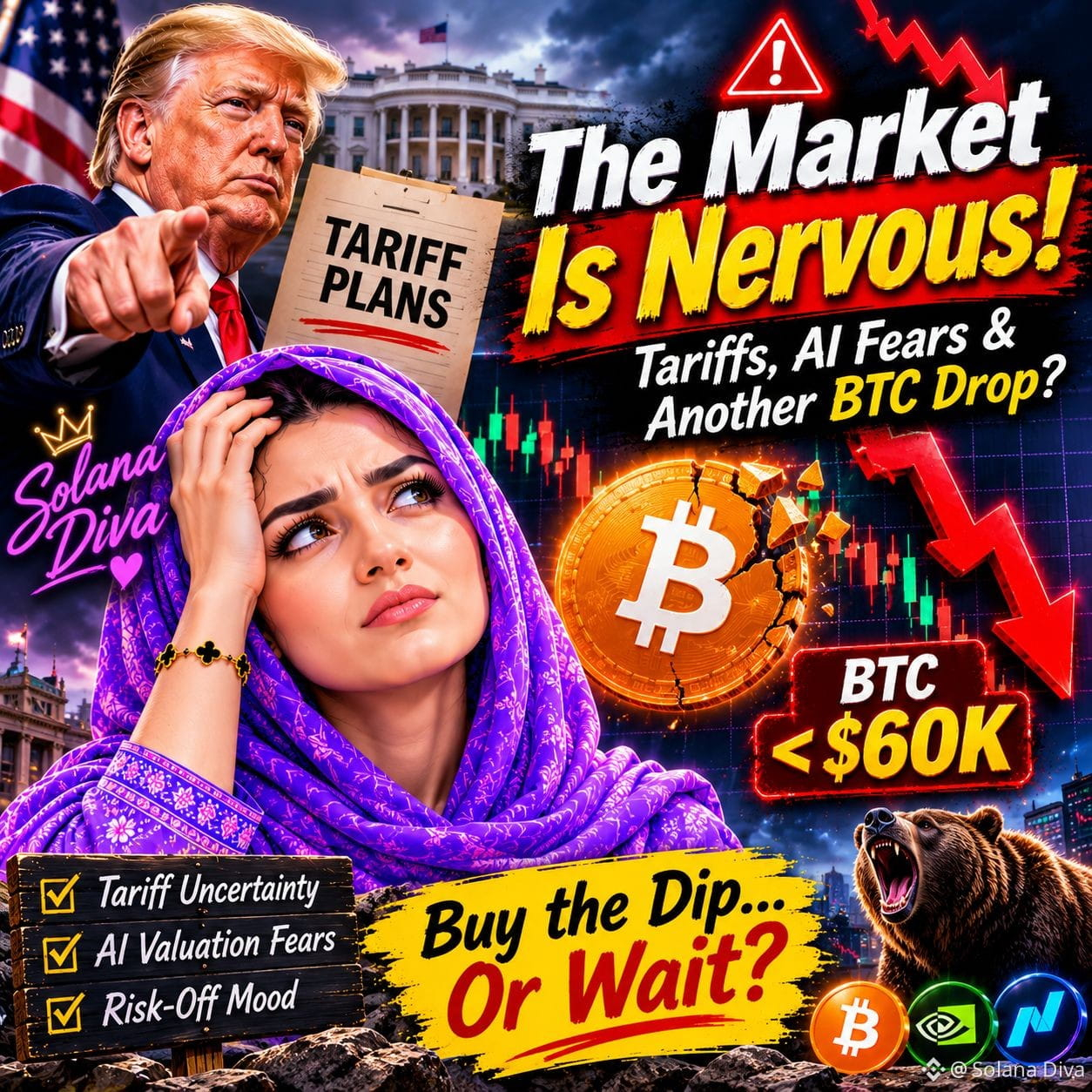
1
2
528
·
--
#Bitcoin'sReboundFadesBelow$60K
Bitcoin gave everyone hope… then took it back. 👀
For a moment, it looked like BTC was finally breathing again.
$55K area survived.
Bitcoin pushed back above $64K.
The mood changed.
And suddenly you could feel the “maybe the worst is over” feeling coming back.
Then…
Bitcoin slipped below $60K again.
That’s the part I’m watching.
Because a bounce is easy.
Making people believe the bounce is real?
That’s much harder.
And right now, the market still has a big question hanging over it:
Who is actually willing to keep buying?
U.S. Bitcoin ETFs just saw another huge wave of money leave, while BTC gave back most of its Nvidia-fueled recovery.
So I’m not calling this a bottom.
And I’m definitely not calling the end of Bitcoin.
I’m watching the battle between fear and conviction.
Because if buyers return while everyone is still nervous…
that could become very interesting.
But if every bounce keeps getting sold…
then maybe Bitcoin still has some unfinished business.
Divas, be honest with me. 💅
**Did this failed bounce make you more bullish because the fear is getting extreme…
or more bearish because buyers still can’t hold the move?**
$BTC $IBIT $NVDA
#Bitcoin #Crypto #SolanaDiva
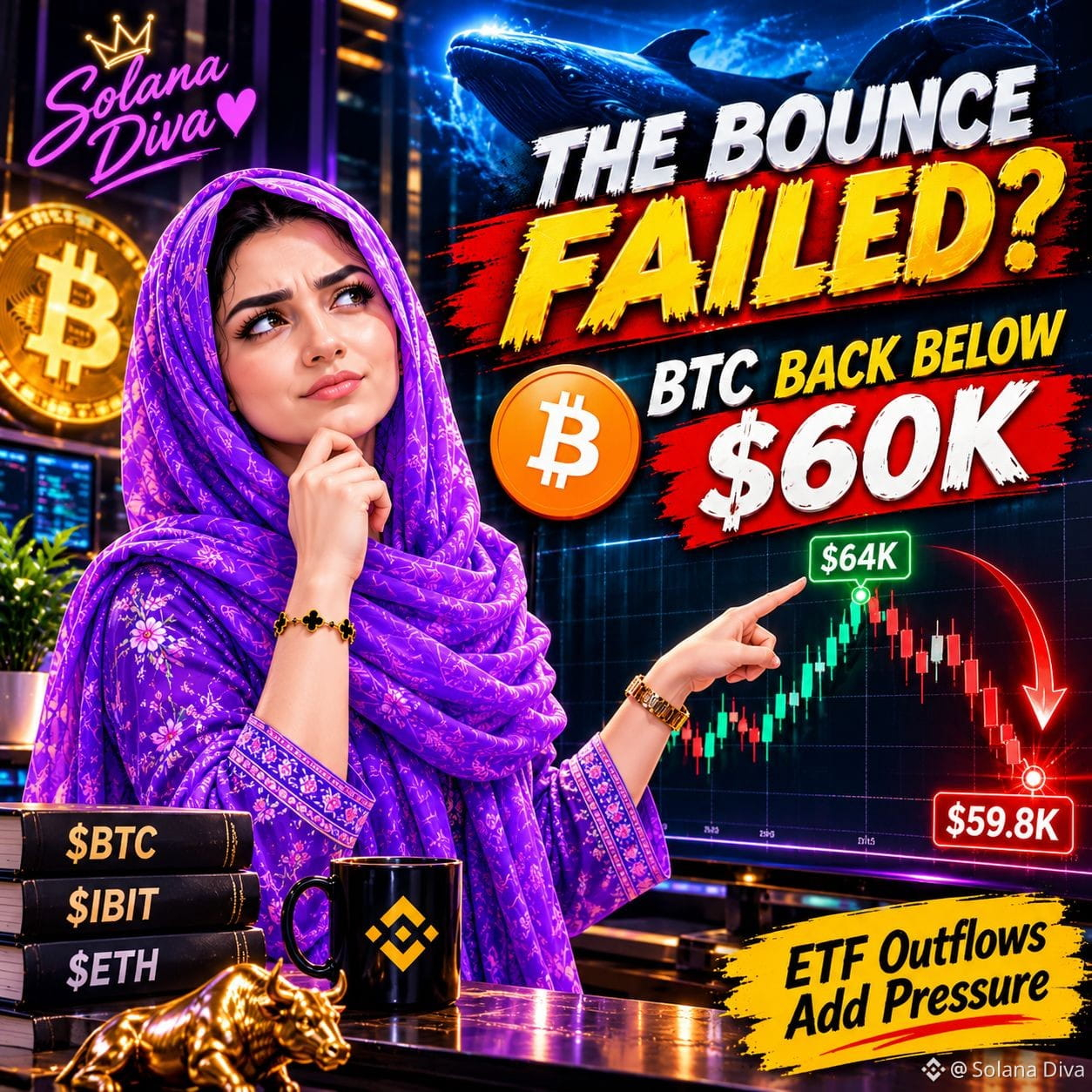
394
·
--
It’s time for CipherX $ANT $ACE
It’s time for CipherX $ANT $ACE


CipherX 零号
·
--
🟣 CIPHERX FLASH
Anthropic Breaks Below IPO Price; premarket trading put the stock at $82.00, down 6.44% from Monday's $87.64 close and $1.00 under its $83 debut price, with underwriters' stabilization firepower already exhausted last week.
9m ago$BTC
Anthropic Breaks Below IPO Price; premarket trading put the stock at $82.00, down 6.44% from Monday's $87.64 close and $1.00 under its $83 debut price, with underwriters' stabilization firepower already exhausted last week.
9m ago$BTC
853
·
--
509


·
--

saima 馬利克
·
--
🌱 Small Steps Today, Bigger Dreams Tomorrow! 🚀
The crypto journey is not about making money overnight. It's about learning, staying patient, understanding the market, and growing stronger with every experience. 💚
Some days bring profits, some days bring lessons — both are part of the journey.
✨ Learn smart. Stay consistent. Never stop growing!
Question of the day: What's more important in trading: Patience or Confidence? 🤔
#Binance #CryptoJourney #TradingMindset #CryptoLearning #Web3
ANT-0.14%
MSFTUS-0.91%
434
·
--
Verified
Wait… Anthropic is already below its IPO price? 👀💅
That happened FAST.
A few days ago, everyone wanted a piece of the AI story.
Anthropic opened around $111 after being priced at $83.
The excitement was everywhere.
Now?
The stock has fallen back below that original $83 IPO price.
And honestly, Divas…
the price drop is NOT the most interesting part to me.
The interesting part is how quickly the mood changed.
One minute:
“AI is the future.”
Next minute:
“Wait… are we paying too much for this future?”
😂
That’s how markets work.
People don’t suddenly stop believing in a technology.
They start questioning how much they should pay for the story.
And Anthropic may have just become one of the biggest tests of AI investor confidence.
Because if a company this hyped can lose its IPO premium this quickly…
I have to wonder what happens to the rest of the AI trade if fear keeps spreading.
But here’s the fun part:
Maybe this is the beginning of a much bigger AI reset.
Or maybe the market is simply giving everyone a chance to rethink their price.
Either way…
I’m watching. 👀💅
Divas, be honest:
Would you touch $ANT after this drop?
Or would you rather watch $NVDA and $AMD first to see where the AI money goes next?
I want your REAL take.
#AI #Stocks #SolanaDiva
#AnthropicBreaksBelowIPOPriceAmidAISlump

1
1
1.3k
·
--
They said Nvidia could move on without him…
The market had a very different answer. 👀💅
Jensen Huang is back as Nvidia’s CEO.
And suddenly, everyone is looking at Nvidia a little differently.
That’s what fascinates me.
Because this isn’t just a CEO story.
It’s a confidence story.
For a moment, the market had to imagine Nvidia without the person who built its AI empire.
Then he came back…
and the reaction was almost immediate.
That tells me something:
Sometimes investors aren’t just buying a company.
They’re buying the person they believe can keep the story alive.
And Jensen has become a HUGE part of Nvidia’s story.
But now comes the interesting part.
Was this just relief?
Or does Jensen’s return actually restart the AI trade?
Because if confidence comes back into $NVDA, I’ll be watching what happens to the rest of the AI names too.
$NVDA
{future}(NVDAUSDT)
$AMD $BTC
Divas… 💅
Be honest.
If you had been waiting on the sidelines, would Jensen’s return make you look at Nvidia again?
Or is the market getting too excited too quickly?
I want your real take. 👀
#Nvidia #AI #SolanaDiva
#NVIDIAReinstatesJensenHuangasCEO
They said Nvidia could move on without him…
The market had a very different answer. 👀💅
Jensen Huang is back as Nvidia’s CEO.
And suddenly, everyone is looking at Nvidia a little differently.
That’s what fascinates me.
Because this isn’t just a CEO story.
It’s a confidence story.
For a moment, the market had to imagine Nvidia without the person who built its AI empire.
Then he came back…
and the reaction was almost immediate.
That tells me something:
Sometimes investors aren’t just buying a company.
They’re buying the person they believe can keep the story alive.
And Jensen has become a HUGE part of Nvidia’s story.
But now comes the interesting part.
Was this just relief?
Or does Jensen’s return actually restart the AI trade?
Because if confidence comes back into $NVDA , I’ll be watching what happens to the rest of the AI names too.
$NVDA
$AMD $BTC
Divas… 💅
Be honest.
If you had been waiting on the sidelines, would Jensen’s return make you look at Nvidia again?
Or is the market getting too excited too quickly?
I want your real take. 👀
#Nvidia #AI #SolanaDiva
#NVIDIAReinstatesJensenHuangasCEO

5
774
Log in to explore more content
Join global crypto users on Binance Square
⚡️ Get latest and useful information about crypto.
💬 Trusted by the world’s largest crypto exchange.
👍 Discover real insights from verified creators.
Email / Phone number
Trending Topics
CanMarketsReboundAfterThanksgiving?
179,955 views
1,923 Discussing
Rate-Hike Bets Linger as US Markets Head Into Thanksgiving Closure
Binance News
·7 Likes
·5.5k views
CouldSpaceX’sOrbitalDataCentersBoostAIChipDemand?
88,170 views
1,162 Discussing
SouthKoreaProposesMandatoryDigitalAssetTransactionDisclosure
4,191 views
100 Discussing