
SigmaIntern
198 Posts

SigmaIntern
 Square Verified+
Report
Block User
24 Following
13.9K+ Followers
1.6K+ Liked
Posts
All
Quotes
Videos
Live
PINNED
·
--
Stop stressing about whether to close your position and take profits or to keep holding your leveraged position.
At Sigma, you can withdraw your principal while letting your profits run.
#新手必看
Read the full article:
Stop stressing about whether to close your position and take profits or to keep holding your leveraged position.
At Sigma, you can withdraw your principal while letting your profits run.
#新手必看
Read the full article:
At Sigma, you can withdraw your principal while letting your profits run.
#新手必看
Read the full article:
SigmaIntern
·
--
Sigma Academy: How to Lock in Profits Without Exiting
Welcome to Sigma Academy. Today, we're diving into one of the most powerful yet underutilized features in the Sigma ecosystem: leveraging the Mint function to achieve zero-cost free-rolls on your xPOSITIONS.
Most traders face a tricky dilemma: should you close your position to cash in profits or hold on and risk your gains evaporating during a market pullback?
At Sigma, we’ve opened up a third path. By understanding the connection between our Trade and Mint modules, you can withdraw your initial capital while still enjoying the gains from market surges.
Most traders face a tricky dilemma: should you close your position to cash in profits or hold on and risk your gains evaporating during a market pullback?
At Sigma, we’ve opened up a third path. By understanding the connection between our Trade and Mint modules, you can withdraw your initial capital while still enjoying the gains from market surges.

1
4
1.8k
·
--
Hey everyone! Sigma.Money’s POBO feature is about to be launched. To help you better understand what this new feature can be used for, let’s do a quick quiz together!
What is Sigma POBO’s final positioning?
Do you know the correct answer? 🫵
#美众院推进比特币储备法案
Hey everyone! Sigma.Money’s POBO feature is about to be launched. To help you better understand what this new feature can be used for, let’s do a quick quiz together!
What is Sigma POBO’s final positioning?
Do you know the correct answer? 🫵
#美众院推进比特币储备法案
What is Sigma POBO’s final positioning?
Do you know the correct answer? 🫵
#美众院推进比特币储备法案
一个全新的加密原生概念
自企业资金管理中的概念,被应用到“稳定币成为价值起点”的世界
完全取代本地银行账户的链上解决方案
仅适用于大型银行的内部工具
7 hr(s) left
67
·
--
#美联储加息是否已成定局
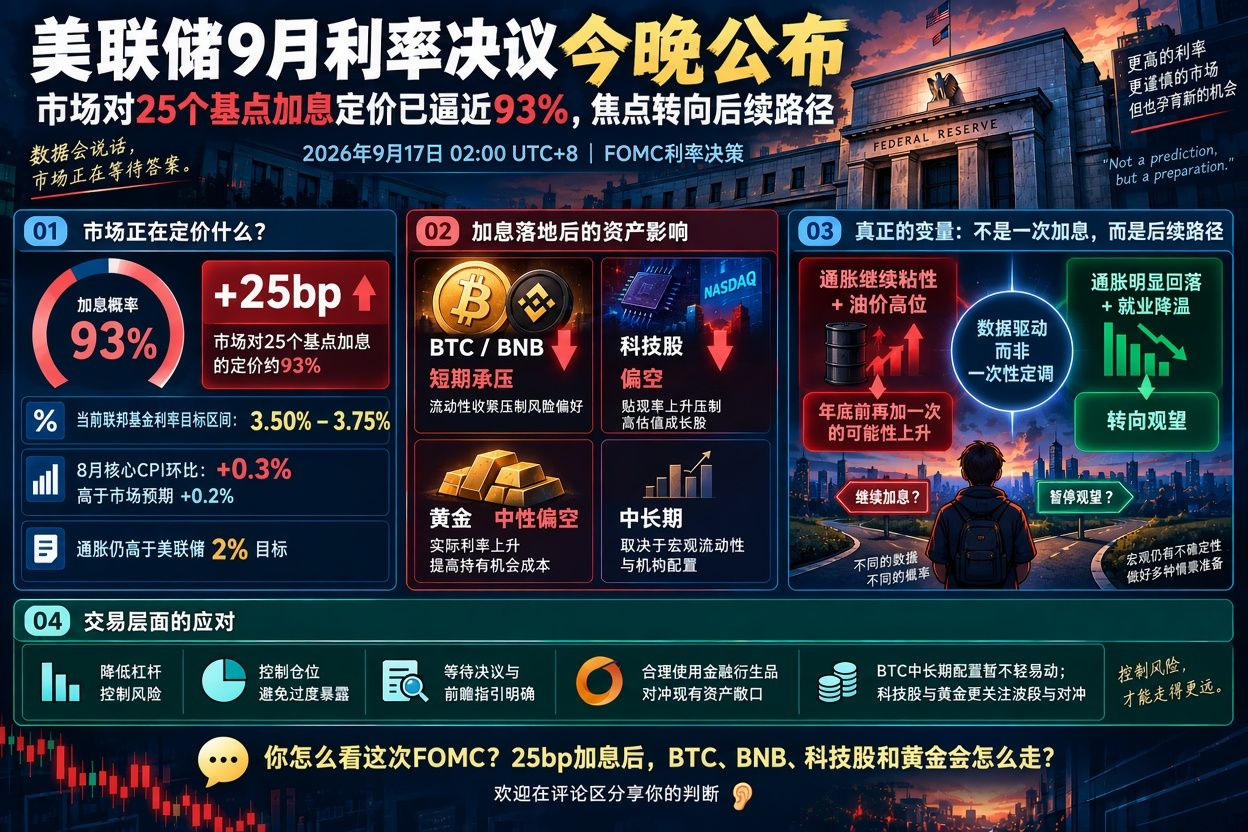
The Fed’s September rate decision will be released tonight. Market expectations for a rate hike have clearly heated up. In August, core CPI rose 0.3% month over month (above the market forecast of 0.2%), while year over year it fell to 2.4%, which is still clearly above the Fed’s 2% target. Given the current target range for the federal funds rate of 3.50%-3.75%, tools such as the CME FedWatch show that the market pricing for a 25-basis-point hike this week (September 16) is already approaching or exceeding 90%. I think the Fed will most likely announce a rate hike this week, but this seems more like a “data-driven adjustment” rather than a necessary start to a multi-round tightening cycle. The path ahead will depend heavily on future data on inflation, employment, and energy prices over the coming months. If core inflation remains sticky—along with oil prices staying elevated—there is a possibility of another hike before year-end. If the data clearly cools, it may shift to a wait-and-see stance.
After the rate hike is implemented, the short-term impact on assets is likely to be as follows:
BTC and other major crypto assets such as BNB: These are risk-on assets. Tightening liquidity usually brings near-term pressure, but in the medium to long term it still depends on macro liquidity and institutional positioning. Slightly bearish to neutral.
Tech stocks: Rising discount rates will weigh on high-valuation growth stocks, especially interest-rate-sensitive sectors. Bearish.
Gold: Higher real rates raise the opportunity cost of holding gold, putting near-term pressure on it. However, if inflation expectations pick up again, it could provide support. Neutral to slightly bearish.
In terms of trading strategy, I would first reduce leverage and control position sizing, then wait to adjust once the decision and forward guidance are clearer. At the same time, I will make reasonable use of financial derivatives to hedge risk against my existing holdings. $SIGMA is an important way to manage interest-rate movement risk. I won’t easily move my existing BTC medium-to-long-term allocation. For tech stocks and gold, I’ll focus more on trading swings and hedging. “The data will speak,” rather than setting a one-time tone.
What do you think about this decision? Will they hike rates? What are your views on BTC and major crypto assets like BNB, as well as tech stocks and gold—and how do you plan to adjust your positions or hedge? Feel free to share your thoughts in the comments~👂
#美联储加息是否已成定局
The Fed’s September rate decision will be released tonight. Market expectations for a rate hike have clearly heated up. In August, core CPI rose 0.3% month over month (above the market forecast of 0.2%), while year over year it fell to 2.4%, which is still clearly above the Fed’s 2% target. Given the current target range for the federal funds rate of 3.50%-3.75%, tools such as the CME FedWatch show that the market pricing for a 25-basis-point hike this week (September 16) is already approaching or exceeding 90%. I think the Fed will most likely announce a rate hike this week, but this seems more like a “data-driven adjustment” rather than a necessary start to a multi-round tightening cycle. The path ahead will depend heavily on future data on inflation, employment, and energy prices over the coming months. If core inflation remains sticky—along with oil prices staying elevated—there is a possibility of another hike before year-end. If the data clearly cools, it may shift to a wait-and-see stance.
After the rate hike is implemented, the short-term impact on assets is likely to be as follows:
BTC and other major crypto assets such as BNB: These are risk-on assets. Tightening liquidity usually brings near-term pressure, but in the medium to long term it still depends on macro liquidity and institutional positioning. Slightly bearish to neutral.
Tech stocks: Rising discount rates will weigh on high-valuation growth stocks, especially interest-rate-sensitive sectors. Bearish.
Gold: Higher real rates raise the opportunity cost of holding gold, putting near-term pressure on it. However, if inflation expectations pick up again, it could provide support. Neutral to slightly bearish.
In terms of trading strategy, I would first reduce leverage and control position sizing, then wait to adjust once the decision and forward guidance are clearer. At the same time, I will make reasonable use of financial derivatives to hedge risk against my existing holdings. $SIGMA is an important way to manage interest-rate movement risk. I won’t easily move my existing BTC medium-to-long-term allocation. For tech stocks and gold, I’ll focus more on trading swings and hedging. “The data will speak,” rather than setting a one-time tone.
What do you think about this decision? Will they hike rates? What are your views on BTC and major crypto assets like BNB, as well as tech stocks and gold—and how do you plan to adjust your positions or hedge? Feel free to share your thoughts in the comments~👂
The Fed’s September rate decision will be released tonight. Market expectations for a rate hike have clearly heated up. In August, core CPI rose 0.3% month over month (above the market forecast of 0.2%), while year over year it fell to 2.4%, which is still clearly above the Fed’s 2% target. Given the current target range for the federal funds rate of 3.50%-3.75%, tools such as the CME FedWatch show that the market pricing for a 25-basis-point hike this week (September 16) is already approaching or exceeding 90%. I think the Fed will most likely announce a rate hike this week, but this seems more like a “data-driven adjustment” rather than a necessary start to a multi-round tightening cycle. The path ahead will depend heavily on future data on inflation, employment, and energy prices over the coming months. If core inflation remains sticky—along with oil prices staying elevated—there is a possibility of another hike before year-end. If the data clearly cools, it may shift to a wait-and-see stance.
After the rate hike is implemented, the short-term impact on assets is likely to be as follows:
BTC and other major crypto assets such as BNB: These are risk-on assets. Tightening liquidity usually brings near-term pressure, but in the medium to long term it still depends on macro liquidity and institutional positioning. Slightly bearish to neutral.
Tech stocks: Rising discount rates will weigh on high-valuation growth stocks, especially interest-rate-sensitive sectors. Bearish.
Gold: Higher real rates raise the opportunity cost of holding gold, putting near-term pressure on it. However, if inflation expectations pick up again, it could provide support. Neutral to slightly bearish.
In terms of trading strategy, I would first reduce leverage and control position sizing, then wait to adjust once the decision and forward guidance are clearer. At the same time, I will make reasonable use of financial derivatives to hedge risk against my existing holdings. $SIGMA is an important way to manage interest-rate movement risk. I won’t easily move my existing BTC medium-to-long-term allocation. For tech stocks and gold, I’ll focus more on trading swings and hedging. “The data will speak,” rather than setting a one-time tone.
What do you think about this decision? Will they hike rates? What are your views on BTC and major crypto assets like BNB, as well as tech stocks and gold—and how do you plan to adjust your positions or hedge? Feel free to share your thoughts in the comments~👂
2
296
·
--
#韩国延迟加密税请愿破5万签名
In South Korea, the National Assembly’s citizens petition platform has shown that a petition requesting another two-year extension of the tax on virtual-asset gains originally scheduled to take effect on January 1, 2027 has recently surpassed 50,000 valid signatures and has officially entered the review process of the relevant standing committee. The tax applies a rate of about 22% on the portion of annual gains exceeding 2.5 million Korean won. It has been postponed three times previously. The government is still insisting on moving forward according to the original plan, and the National Tax Service is expected to publish implementation standards within the year.
In terms of impact, in the short term, the market may interpret this as a temporary easing of policy pressure, which could reduce Korean investors’ expectations of selling and provide limited support to local trading activity and broader sentiment across Asia. However, the petition only triggers the review process and does not change the current legal timetable. If the 2027 rollout is ultimately maintained, it may accelerate the movement of some funds toward markets where regulation is clearer or the tax burden is lower, further testing the resilience of revenue at Korean exchanges and their competitiveness. If controversy over inadequate taxation infrastructure persists, actual implementation could also amplify compliance frictions and volatility.
Regarding this event, it is recommended to prioritize tracking the real pace of committee discussions in the National Assembly and changes in official statements, rather than focusing solely on the number of signatures. At the same time, monitor whether major Korean exchanges see structural changes in trading volume and deposit/withdrawal data to determine whether capital has already begun adjusting in advance. For investors with cross-border holdings, consider reevaluating tax-burden differences and filing costs across different jurisdictions, and avoid using a single country’s policy expectations as the core basis for asset allocation.
Do you think this petition is more likely to ultimately push for an extension, or will the original schedule be maintained? How much real impact do you expect it to have on capital flows in the Korean market? Feel free to share your views in the comments section~👂
#韩国延迟加密税请愿破5万签名
In South Korea, the National Assembly’s citizens petition platform has shown that a petition requesting another two-year extension of the tax on virtual-asset gains originally scheduled to take effect on January 1, 2027 has recently surpassed 50,000 valid signatures and has officially entered the review process of the relevant standing committee. The tax applies a rate of about 22% on the portion of annual gains exceeding 2.5 million Korean won. It has been postponed three times previously. The government is still insisting on moving forward according to the original plan, and the National Tax Service is expected to publish implementation standards within the year.
In terms of impact, in the short term, the market may interpret this as a temporary easing of policy pressure, which could reduce Korean investors’ expectations of selling and provide limited support to local trading activity and broader sentiment across Asia. However, the petition only triggers the review process and does not change the current legal timetable. If the 2027 rollout is ultimately maintained, it may accelerate the movement of some funds toward markets where regulation is clearer or the tax burden is lower, further testing the resilience of revenue at Korean exchanges and their competitiveness. If controversy over inadequate taxation infrastructure persists, actual implementation could also amplify compliance frictions and volatility.
Regarding this event, it is recommended to prioritize tracking the real pace of committee discussions in the National Assembly and changes in official statements, rather than focusing solely on the number of signatures. At the same time, monitor whether major Korean exchanges see structural changes in trading volume and deposit/withdrawal data to determine whether capital has already begun adjusting in advance. For investors with cross-border holdings, consider reevaluating tax-burden differences and filing costs across different jurisdictions, and avoid using a single country’s policy expectations as the core basis for asset allocation.
Do you think this petition is more likely to ultimately push for an extension, or will the original schedule be maintained? How much real impact do you expect it to have on capital flows in the Korean market? Feel free to share your views in the comments section~👂
In South Korea, the National Assembly’s citizens petition platform has shown that a petition requesting another two-year extension of the tax on virtual-asset gains originally scheduled to take effect on January 1, 2027 has recently surpassed 50,000 valid signatures and has officially entered the review process of the relevant standing committee. The tax applies a rate of about 22% on the portion of annual gains exceeding 2.5 million Korean won. It has been postponed three times previously. The government is still insisting on moving forward according to the original plan, and the National Tax Service is expected to publish implementation standards within the year.
In terms of impact, in the short term, the market may interpret this as a temporary easing of policy pressure, which could reduce Korean investors’ expectations of selling and provide limited support to local trading activity and broader sentiment across Asia. However, the petition only triggers the review process and does not change the current legal timetable. If the 2027 rollout is ultimately maintained, it may accelerate the movement of some funds toward markets where regulation is clearer or the tax burden is lower, further testing the resilience of revenue at Korean exchanges and their competitiveness. If controversy over inadequate taxation infrastructure persists, actual implementation could also amplify compliance frictions and volatility.
Regarding this event, it is recommended to prioritize tracking the real pace of committee discussions in the National Assembly and changes in official statements, rather than focusing solely on the number of signatures. At the same time, monitor whether major Korean exchanges see structural changes in trading volume and deposit/withdrawal data to determine whether capital has already begun adjusting in advance. For investors with cross-border holdings, consider reevaluating tax-burden differences and filing costs across different jurisdictions, and avoid using a single country’s policy expectations as the core basis for asset allocation.
Do you think this petition is more likely to ultimately push for an extension, or will the original schedule be maintained? How much real impact do you expect it to have on capital flows in the Korean market? Feel free to share your views in the comments section~👂

3
4k
·
--
A common scenario
You work overseas or do cross-border business, and you have a sum of USDT. You want to convert it into local fiat currency—directly into your personal salary card or your corporate account—for paying rent, paying suppliers, paying salaries, or simply saving it.
However, withdrawing through ordinary exchanges either doesn’t support the target country, or the process is too complicated and subject to limits—sometimes even requiring multiple layers of routing.
Use the Sigma POBO path: you hand the stablecoin to a licensed partner. The partner completes the exchange according to the same-name rules, and the funds go directly into your verified bank account. The identity chain is complete, and compliance requirements can cover more regions as well.
In essence, it didn’t invent some brand-new crypto play—it simply applies a practice that’s already been proven in corporate treasury and maps it onto a scenario where the starting point is “stablecoin.” You don’t need to become a bank in every country; you just need someone to complete the final step for you compliantly.
If you’re handling stablecoin withdrawals, cross-border remittances, or personal fund aggregation, you may want to see whether this same-name代付 model fits your actual needs.
#英国或将豁免代币化黄金基金监管
A common scenario
You work overseas or do cross-border business, and you have a sum of USDT. You want to convert it into local fiat currency—directly into your personal salary card or your corporate account—for paying rent, paying suppliers, paying salaries, or simply saving it.
However, withdrawing through ordinary exchanges either doesn’t support the target country, or the process is too complicated and subject to limits—sometimes even requiring multiple layers of routing.
Use the Sigma POBO path: you hand the stablecoin to a licensed partner. The partner completes the exchange according to the same-name rules, and the funds go directly into your verified bank account. The identity chain is complete, and compliance requirements can cover more regions as well.
In essence, it didn’t invent some brand-new crypto play—it simply applies a practice that’s already been proven in corporate treasury and maps it onto a scenario where the starting point is “stablecoin.” You don’t need to become a bank in every country; you just need someone to complete the final step for you compliantly.
If you’re handling stablecoin withdrawals, cross-border remittances, or personal fund aggregation, you may want to see whether this same-name代付 model fits your actual needs.
#英国或将豁免代币化黄金基金监管
You work overseas or do cross-border business, and you have a sum of USDT. You want to convert it into local fiat currency—directly into your personal salary card or your corporate account—for paying rent, paying suppliers, paying salaries, or simply saving it.
However, withdrawing through ordinary exchanges either doesn’t support the target country, or the process is too complicated and subject to limits—sometimes even requiring multiple layers of routing.
Use the Sigma POBO path: you hand the stablecoin to a licensed partner. The partner completes the exchange according to the same-name rules, and the funds go directly into your verified bank account. The identity chain is complete, and compliance requirements can cover more regions as well.
In essence, it didn’t invent some brand-new crypto play—it simply applies a practice that’s already been proven in corporate treasury and maps it onto a scenario where the starting point is “stablecoin.” You don’t need to become a bank in every country; you just need someone to complete the final step for you compliantly.
If you’re handling stablecoin withdrawals, cross-border remittances, or personal fund aggregation, you may want to see whether this same-name代付 model fits your actual needs.
#英国或将豁免代币化黄金基金监管
SigmaIntern
·
--
What Is POBO? A Term Well Known in Traditional Finance, but Unfamiliar in the Crypto World
If you’ve worked in corporate treasury management or in the field of multinational banking, you may have often heard the abbreviation POBO. If you haven’t heard of it—and you work in the crypto space yourself—it’s quite likely you’ve never come across this term. That’s exactly why we should explain it properly.
POBO stands for “Payments-on-Behalf-Of.” This is not a new concept. It’s a cash management framework that has been widely used by multinational corporations for decades, with the goal of avoiding the need for each of its individual subsidiaries to set up its own complicated set of local bank accounts when transferring funds across borders.
POBO stands for “Payments-on-Behalf-Of.” This is not a new concept. It’s a cash management framework that has been widely used by multinational corporations for decades, with the goal of avoiding the need for each of its individual subsidiaries to set up its own complicated set of local bank accounts when transferring funds across borders.

4
161
·
--
#加密市场板块连续两日下跌
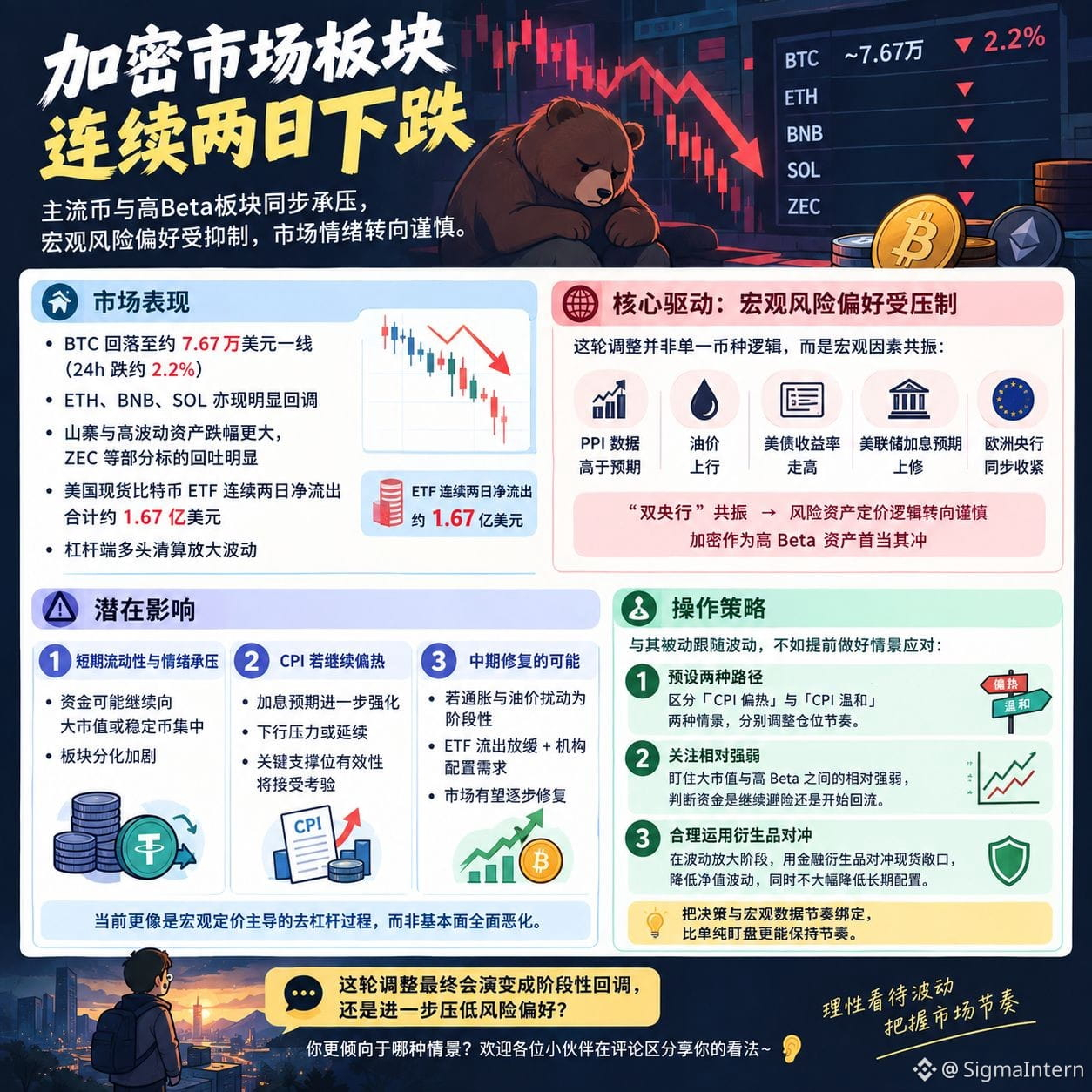
The encryption market has weakened for two consecutive days, with major coins and high-beta sectors taking simultaneous pressure. BTC has fallen to around $76,700 (down about 2.2% in 24h). ETH, BNB, and SOL have also seen clear pullbacks, while altcoins and other high-volatility assets are down more sharply—some tokens such as ZEC have also given back gains.
Fund flow data shows that U.S. spot Bitcoin ETFs have recorded net outflows for two straight days, totaling about $167 million. Leverage-related liquidations have amplified volatility on the long side.
The core driver behind this adjustment is not the logic of a single coin, but rather a suppression of macro risk appetite. Factors such as PPI coming in above expectations, oil prices rising, and U.S. Treasury yields moving higher—together with the upward revision to Fed rate-hike expectations and the European Central Bank tightening in sync—have created a “two central banks” resonance effect. In the short term, risk-asset pricing shifts toward caution, and crypto, as a high-beta asset, is the first to be hit.
Potential impacts are mainly reflected in three areas:
1) Short-term liquidity and sentiment remain under pressure; funds may continue to concentrate in large-cap assets or stablecoins, increasing sector divergence;
2) If tonight’s CPI remains hot, rate-hike expectations will be further reinforced, and downside pressure may persist. The effectiveness of key support levels will be put to the test;
3) Looking at the medium term, if disruptions from inflation and oil prices are confirmed to be only temporary, ETF outflows may slow down. Combined with institutional allocation demand, the market has a chance to gradually repair. For now, it resembles a de-leveraging process driven by macro pricing rather than a broad deterioration of fundamentals.
From an action standpoint, instead of passively following volatility, it’s better to prepare scenarios in advance: first distinguish between two paths—“CPI is hot” versus “CPI is mild”—and set up position-adjustment schedules accordingly. At the same time, monitor relative strength between large caps and high-beta assets to judge whether capital will continue to stay defensive or begin to return.
During periods of amplified volatility, using financial derivatives to hedge spot exposure is an effective way to manage downside risk. It can reduce net-asset-value swings without significantly lowering long-term allocation. Linking decisions to the pace of macro data is more likely to help maintain rhythm than simply staring at the charts.
Ultimately, this adjustment may turn into a phased pullback, or it may further suppress risk appetite—and to a large extent, it depends on whether inflation data can ease rate-hike expectations. Which scenario do you lean toward? Feel free to share your thoughts in the comments, everyone~👂
#加密市场板块连续两日下跌
The encryption market has weakened for two consecutive days, with major coins and high-beta sectors taking simultaneous pressure. BTC has fallen to around $76,700 (down about 2.2% in 24h). ETH, BNB, and SOL have also seen clear pullbacks, while altcoins and other high-volatility assets are down more sharply—some tokens such as ZEC have also given back gains.
Fund flow data shows that U.S. spot Bitcoin ETFs have recorded net outflows for two straight days, totaling about $167 million. Leverage-related liquidations have amplified volatility on the long side.
The core driver behind this adjustment is not the logic of a single coin, but rather a suppression of macro risk appetite. Factors such as PPI coming in above expectations, oil prices rising, and U.S. Treasury yields moving higher—together with the upward revision to Fed rate-hike expectations and the European Central Bank tightening in sync—have created a “two central banks” resonance effect. In the short term, risk-asset pricing shifts toward caution, and crypto, as a high-beta asset, is the first to be hit.
Potential impacts are mainly reflected in three areas:
1) Short-term liquidity and sentiment remain under pressure; funds may continue to concentrate in large-cap assets or stablecoins, increasing sector divergence;
2) If tonight’s CPI remains hot, rate-hike expectations will be further reinforced, and downside pressure may persist. The effectiveness of key support levels will be put to the test;
3) Looking at the medium term, if disruptions from inflation and oil prices are confirmed to be only temporary, ETF outflows may slow down. Combined with institutional allocation demand, the market has a chance to gradually repair. For now, it resembles a de-leveraging process driven by macro pricing rather than a broad deterioration of fundamentals.
From an action standpoint, instead of passively following volatility, it’s better to prepare scenarios in advance: first distinguish between two paths—“CPI is hot” versus “CPI is mild”—and set up position-adjustment schedules accordingly. At the same time, monitor relative strength between large caps and high-beta assets to judge whether capital will continue to stay defensive or begin to return.
During periods of amplified volatility, using financial derivatives to hedge spot exposure is an effective way to manage downside risk. It can reduce net-asset-value swings without significantly lowering long-term allocation. Linking decisions to the pace of macro data is more likely to help maintain rhythm than simply staring at the charts.
Ultimately, this adjustment may turn into a phased pullback, or it may further suppress risk appetite—and to a large extent, it depends on whether inflation data can ease rate-hike expectations. Which scenario do you lean toward? Feel free to share your thoughts in the comments, everyone~👂
The encryption market has weakened for two consecutive days, with major coins and high-beta sectors taking simultaneous pressure. BTC has fallen to around $76,700 (down about 2.2% in 24h). ETH, BNB, and SOL have also seen clear pullbacks, while altcoins and other high-volatility assets are down more sharply—some tokens such as ZEC have also given back gains.
Fund flow data shows that U.S. spot Bitcoin ETFs have recorded net outflows for two straight days, totaling about $167 million. Leverage-related liquidations have amplified volatility on the long side.
The core driver behind this adjustment is not the logic of a single coin, but rather a suppression of macro risk appetite. Factors such as PPI coming in above expectations, oil prices rising, and U.S. Treasury yields moving higher—together with the upward revision to Fed rate-hike expectations and the European Central Bank tightening in sync—have created a “two central banks” resonance effect. In the short term, risk-asset pricing shifts toward caution, and crypto, as a high-beta asset, is the first to be hit.
Potential impacts are mainly reflected in three areas:
1) Short-term liquidity and sentiment remain under pressure; funds may continue to concentrate in large-cap assets or stablecoins, increasing sector divergence;
2) If tonight’s CPI remains hot, rate-hike expectations will be further reinforced, and downside pressure may persist. The effectiveness of key support levels will be put to the test;
3) Looking at the medium term, if disruptions from inflation and oil prices are confirmed to be only temporary, ETF outflows may slow down. Combined with institutional allocation demand, the market has a chance to gradually repair. For now, it resembles a de-leveraging process driven by macro pricing rather than a broad deterioration of fundamentals.
From an action standpoint, instead of passively following volatility, it’s better to prepare scenarios in advance: first distinguish between two paths—“CPI is hot” versus “CPI is mild”—and set up position-adjustment schedules accordingly. At the same time, monitor relative strength between large caps and high-beta assets to judge whether capital will continue to stay defensive or begin to return.
During periods of amplified volatility, using financial derivatives to hedge spot exposure is an effective way to manage downside risk. It can reduce net-asset-value swings without significantly lowering long-term allocation. Linking decisions to the pace of macro data is more likely to help maintain rhythm than simply staring at the charts.
Ultimately, this adjustment may turn into a phased pullback, or it may further suppress risk appetite—and to a large extent, it depends on whether inflation data can ease rate-hike expectations. Which scenario do you lean toward? Feel free to share your thoughts in the comments, everyone~👂
9
2.8k
·
--
#布伦特原油突破100美元
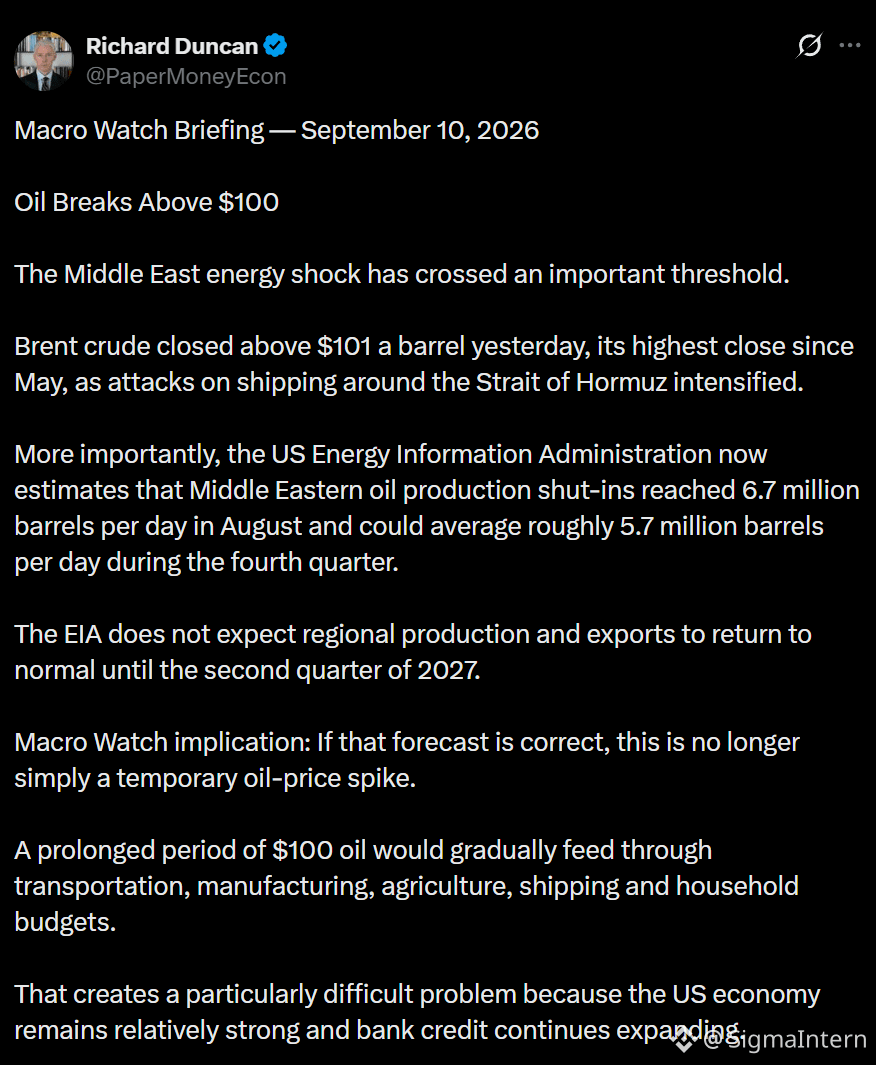
On September 9, 2026, Brent crude oil futures broke above and closed above $100 per barrel during the trading session (with some data around $101.21), the first time since July 24. The immediate backdrop is the further escalation of the U.S.-Iran conflict: U.S. forces destroyed multiple Iranian oil tankers, Iran and its affiliates retaliated, and concerns about disruptions to the Strait of Hormuz and Middle East oil supply intensified. This breakout simultaneously lifted inflation expectations, pushed U.S. Treasury yields higher, and weighed on global risk-asset sentiment.
There are three main macro channels through which oil prices returning to the $100 level affect the crypto market:
1)Inflation and rate expectations: If energy prices keep rising, it will reinforce “high inflation + tight monetary policy” pricing, suppress risk-asset valuations, and put short-term pressure on crypto—Bitcoin included—depending on shifts in risk appetite.
2)Geopolitical risk premium: If the conflict becomes prolonged, it may increase demand for hedging. Some funds may flow into Bitcoin temporarily (viewed as “digital gold”), but the historical hedging effect is not consistent.
3)Liquidity and the cost side: If elevated oil prices raise inflation and interest rates, global liquidity could tighten. Higher energy costs may also increase operating pressure on miners, indirectly affecting computing power and supply.
As of now, there is no one-sided consensus that “higher oil prices will inevitably crush crypto.” The key question is whether oil can hold steady above $100, and how subsequent inflation data and central bank policy responses play out.
In the short term, it is advisable to focus on the persistence of oil prices, U.S. PPI/CPI, and signals from the Federal Reserve—avoid simplistic linear trading such as “oil up = crypto down.” In terms of positioning, you can moderately reduce leverage, increase hedging or cash allocation, and wait for clearer signals before taking directional bets. When volatility rises, using reliable financial derivatives to hedge positions is an important way to protect assets and control drawdowns.
Over the long run, you should distinguish between “event-driven shocks” and “trend pricing,” and avoid equating short-term geopolitical fluctuations directly with changes in crypto fundamentals.
What do you think about the actual transmission of this oil-price breakout to the crypto market? Are you more concerned about inflation and interest rates, or do you believe Bitcoin may benefit in phases from safe-haven demand? Feel free to share your thoughts in the comments~👂
#布伦特原油突破100美元
On September 9, 2026, Brent crude oil futures broke above and closed above $100 per barrel during the trading session (with some data around $101.21), the first time since July 24. The immediate backdrop is the further escalation of the U.S.-Iran conflict: U.S. forces destroyed multiple Iranian oil tankers, Iran and its affiliates retaliated, and concerns about disruptions to the Strait of Hormuz and Middle East oil supply intensified. This breakout simultaneously lifted inflation expectations, pushed U.S. Treasury yields higher, and weighed on global risk-asset sentiment.
There are three main macro channels through which oil prices returning to the $100 level affect the crypto market:
1)Inflation and rate expectations: If energy prices keep rising, it will reinforce “high inflation + tight monetary policy” pricing, suppress risk-asset valuations, and put short-term pressure on crypto—Bitcoin included—depending on shifts in risk appetite.
2)Geopolitical risk premium: If the conflict becomes prolonged, it may increase demand for hedging. Some funds may flow into Bitcoin temporarily (viewed as “digital gold”), but the historical hedging effect is not consistent.
3)Liquidity and the cost side: If elevated oil prices raise inflation and interest rates, global liquidity could tighten. Higher energy costs may also increase operating pressure on miners, indirectly affecting computing power and supply.
As of now, there is no one-sided consensus that “higher oil prices will inevitably crush crypto.” The key question is whether oil can hold steady above $100, and how subsequent inflation data and central bank policy responses play out.
In the short term, it is advisable to focus on the persistence of oil prices, U.S. PPI/CPI, and signals from the Federal Reserve—avoid simplistic linear trading such as “oil up = crypto down.” In terms of positioning, you can moderately reduce leverage, increase hedging or cash allocation, and wait for clearer signals before taking directional bets. When volatility rises, using reliable financial derivatives to hedge positions is an important way to protect assets and control drawdowns.
Over the long run, you should distinguish between “event-driven shocks” and “trend pricing,” and avoid equating short-term geopolitical fluctuations directly with changes in crypto fundamentals.
What do you think about the actual transmission of this oil-price breakout to the crypto market? Are you more concerned about inflation and interest rates, or do you believe Bitcoin may benefit in phases from safe-haven demand? Feel free to share your thoughts in the comments~👂
On September 9, 2026, Brent crude oil futures broke above and closed above $100 per barrel during the trading session (with some data around $101.21), the first time since July 24. The immediate backdrop is the further escalation of the U.S.-Iran conflict: U.S. forces destroyed multiple Iranian oil tankers, Iran and its affiliates retaliated, and concerns about disruptions to the Strait of Hormuz and Middle East oil supply intensified. This breakout simultaneously lifted inflation expectations, pushed U.S. Treasury yields higher, and weighed on global risk-asset sentiment.
There are three main macro channels through which oil prices returning to the $100 level affect the crypto market:
1)Inflation and rate expectations: If energy prices keep rising, it will reinforce “high inflation + tight monetary policy” pricing, suppress risk-asset valuations, and put short-term pressure on crypto—Bitcoin included—depending on shifts in risk appetite.
2)Geopolitical risk premium: If the conflict becomes prolonged, it may increase demand for hedging. Some funds may flow into Bitcoin temporarily (viewed as “digital gold”), but the historical hedging effect is not consistent.
3)Liquidity and the cost side: If elevated oil prices raise inflation and interest rates, global liquidity could tighten. Higher energy costs may also increase operating pressure on miners, indirectly affecting computing power and supply.
As of now, there is no one-sided consensus that “higher oil prices will inevitably crush crypto.” The key question is whether oil can hold steady above $100, and how subsequent inflation data and central bank policy responses play out.
In the short term, it is advisable to focus on the persistence of oil prices, U.S. PPI/CPI, and signals from the Federal Reserve—avoid simplistic linear trading such as “oil up = crypto down.” In terms of positioning, you can moderately reduce leverage, increase hedging or cash allocation, and wait for clearer signals before taking directional bets. When volatility rises, using reliable financial derivatives to hedge positions is an important way to protect assets and control drawdowns.
Over the long run, you should distinguish between “event-driven shocks” and “trend pricing,” and avoid equating short-term geopolitical fluctuations directly with changes in crypto fundamentals.
What do you think about the actual transmission of this oil-price breakout to the crypto market? Are you more concerned about inflation and interest rates, or do you believe Bitcoin may benefit in phases from safe-haven demand? Feel free to share your thoughts in the comments~👂
1
220
·
--
Many people who do treasury management understand POBO when they hear it—yet almost nobody in the crypto space has ever mentioned this term.
POBO = Payments-on-Behalf-Of (payment on behalf of).
In traditional finance, multinational groups have used it for decades:
no need for each subsidiary to open a bunch of bank accounts locally,
because payments are centralized and made on their behalf by a licensed central entity.
On-chain transfers are borderless, so this pain point is almost nonexistent.
What truly trips people up is the final step: stablecoins turning into fiat and landing in your own bank account.
Sigma has applied this proven corporate treasury logic:
if you hold USDT / USDC,
then a licensed partner uses compliant channels to exchange it
and wire it directly to your own bank account under your name.
The key is “under the same name”—it’s not paying someone else’s account on your behalf; it’s your own coins turning into your own money.
Which step do you find most troublesome when you usually cash out?
Is it compliance, settlement speed, or the requirement for the same name?
Sigma POBO Coming soon…
#加拿大拟对美商品加征15%至50%关税
Many people who do treasury management understand POBO when they hear it—yet almost nobody in the crypto space has ever mentioned this term.
POBO = Payments-on-Behalf-Of (payment on behalf of).
In traditional finance, multinational groups have used it for decades:
no need for each subsidiary to open a bunch of bank accounts locally,
because payments are centralized and made on their behalf by a licensed central entity.
On-chain transfers are borderless, so this pain point is almost nonexistent.
What truly trips people up is the final step: stablecoins turning into fiat and landing in your own bank account.
Sigma has applied this proven corporate treasury logic:
if you hold USDT / USDC,
then a licensed partner uses compliant channels to exchange it
and wire it directly to your own bank account under your name.
The key is “under the same name”—it’s not paying someone else’s account on your behalf; it’s your own coins turning into your own money.
Which step do you find most troublesome when you usually cash out?
Is it compliance, settlement speed, or the requirement for the same name?
Sigma POBO Coming soon…
#加拿大拟对美商品加征15%至50%关税
POBO = Payments-on-Behalf-Of (payment on behalf of).
In traditional finance, multinational groups have used it for decades:
no need for each subsidiary to open a bunch of bank accounts locally,
because payments are centralized and made on their behalf by a licensed central entity.
On-chain transfers are borderless, so this pain point is almost nonexistent.
What truly trips people up is the final step: stablecoins turning into fiat and landing in your own bank account.
Sigma has applied this proven corporate treasury logic:
if you hold USDT / USDC,
then a licensed partner uses compliant channels to exchange it
and wire it directly to your own bank account under your name.
The key is “under the same name”—it’s not paying someone else’s account on your behalf; it’s your own coins turning into your own money.
Which step do you find most troublesome when you usually cash out?
Is it compliance, settlement speed, or the requirement for the same name?
Sigma POBO Coming soon…
#加拿大拟对美商品加征15%至50%关税
SigmaIntern
·
--
What Is POBO? A Term Well Known in Traditional Finance, but Unfamiliar in the Crypto World
If you’ve worked in corporate treasury management or in the field of multinational banking, you may have often heard the abbreviation POBO. If you haven’t heard of it—and you work in the crypto space yourself—it’s quite likely you’ve never come across this term. That’s exactly why we should explain it properly.
POBO stands for “Payments-on-Behalf-Of.” This is not a new concept. It’s a cash management framework that has been widely used by multinational corporations for decades, with the goal of avoiding the need for each of its individual subsidiaries to set up its own complicated set of local bank accounts when transferring funds across borders.
POBO stands for “Payments-on-Behalf-Of.” This is not a new concept. It’s a cash management framework that has been widely used by multinational corporations for decades, with the goal of avoiding the need for each of its individual subsidiaries to set up its own complicated set of local bank accounts when transferring funds across borders.
2
218
·
--
Verified
Last weekend, eight major financial institutions—Industrial and Commercial Bank of China (ICBC), Agricultural Bank of China (ABC), China Life, PICC Life, China Taiping, the Export-Import Bank of China, Export Credit Insurance, and reinsurance—announced together that they would replenish capital. The total is roughly 360 billion yuan. The money mainly comes from the Ministry of Finance issuing special government bonds (about 300 billion yuan) and the tobacco system (about 60 billion yuan), to strengthen their core capital. The official line is that they’re getting ready in advance to make banks and insurance companies more stable, so they can better support the real economy going forward—not an ad-hoc “firefighting” measure.
For the crypto market, there isn’t much direct upside. Crypto trading is tightly regulated domestically, so these institutions are unlikely to actually go out and buy Bitcoin. But the indirect effects are worth watching:
1) The financial system is more stable, so concerns about systemic risk may ease and risk appetite could rise;
2) If later they can indeed lend more and economic expectations improve, market sentiment improves too—then high-risk assets (including crypto) may catch a tailwind;
3) But don’t treat “capital injections” as equivalent to a big liquidity flood. Bank capital isn’t actually in bad shape right now; the key question is whether companies and everyday people are willing to borrow money. Money added to capital reserves doesn’t immediately turn into liquidity in the market.
So for crypto, this is more like a small sentiment positive in the macro backdrop, not a strong driver. What will truly move the market is global liquidity and crypto’s own supply-and-demand.
You can treat this as one reference point in the macro picture, but don’t make big changes to add or cut positions because of it. Keep your own pace, keep an eye on subsequent credit data and global market changes. Also, learning to hedge your assets with reliable financial derivatives is an important step to protect your principal and manage volatility.
Do you think this round of capital injections will indirectly affect sentiment around mainstream coins like Bitcoin, BNB, and ETH? Or do you have a completely different view? Feel free to share your thoughts in the comments~👂
Last weekend, eight major financial institutions—Industrial and Commercial Bank of China (ICBC), Agricultural Bank of China (ABC), China Life, PICC Life, China Taiping, the Export-Import Bank of China, Export Credit Insurance, and reinsurance—announced together that they would replenish capital. The total is roughly 360 billion yuan. The money mainly comes from the Ministry of Finance issuing special government bonds (about 300 billion yuan) and the tobacco system (about 60 billion yuan), to strengthen their core capital. The official line is that they’re getting ready in advance to make banks and insurance companies more stable, so they can better support the real economy going forward—not an ad-hoc “firefighting” measure.
For the crypto market, there isn’t much direct upside. Crypto trading is tightly regulated domestically, so these institutions are unlikely to actually go out and buy Bitcoin. But the indirect effects are worth watching:
1) The financial system is more stable, so concerns about systemic risk may ease and risk appetite could rise;
2) If later they can indeed lend more and economic expectations improve, market sentiment improves too—then high-risk assets (including crypto) may catch a tailwind;
3) But don’t treat “capital injections” as equivalent to a big liquidity flood. Bank capital isn’t actually in bad shape right now; the key question is whether companies and everyday people are willing to borrow money. Money added to capital reserves doesn’t immediately turn into liquidity in the market.
So for crypto, this is more like a small sentiment positive in the macro backdrop, not a strong driver. What will truly move the market is global liquidity and crypto’s own supply-and-demand.
You can treat this as one reference point in the macro picture, but don’t make big changes to add or cut positions because of it. Keep your own pace, keep an eye on subsequent credit data and global market changes. Also, learning to hedge your assets with reliable financial derivatives is an important step to protect your principal and manage volatility.
Do you think this round of capital injections will indirectly affect sentiment around mainstream coins like Bitcoin, BNB, and ETH? Or do you have a completely different view? Feel free to share your thoughts in the comments~👂
For the crypto market, there isn’t much direct upside. Crypto trading is tightly regulated domestically, so these institutions are unlikely to actually go out and buy Bitcoin. But the indirect effects are worth watching:
1) The financial system is more stable, so concerns about systemic risk may ease and risk appetite could rise;
2) If later they can indeed lend more and economic expectations improve, market sentiment improves too—then high-risk assets (including crypto) may catch a tailwind;
3) But don’t treat “capital injections” as equivalent to a big liquidity flood. Bank capital isn’t actually in bad shape right now; the key question is whether companies and everyday people are willing to borrow money. Money added to capital reserves doesn’t immediately turn into liquidity in the market.
So for crypto, this is more like a small sentiment positive in the macro backdrop, not a strong driver. What will truly move the market is global liquidity and crypto’s own supply-and-demand.
You can treat this as one reference point in the macro picture, but don’t make big changes to add or cut positions because of it. Keep your own pace, keep an eye on subsequent credit data and global market changes. Also, learning to hedge your assets with reliable financial derivatives is an important step to protect your principal and manage volatility.
Do you think this round of capital injections will indirectly affect sentiment around mainstream coins like Bitcoin, BNB, and ETH? Or do you have a completely different view? Feel free to share your thoughts in the comments~👂


Binance News
·
--
AgBank, ICBC and six other financial institutions receive 360 billion yuan in capital injections
According to a report by Ming Pao, eight financial institutions, including Agricultural Bank of China (1288), Industrial and Commercial Bank of China (1398), China Life Group, PICC Group (1339), China Taiping Insurance, the Export-Import Bank of China, China Export & Credit Insurance Corporation, and China Reinsurance, have all received capital injections from the Ministry of Finance and others, totaling 360 billion yuan so far.
1
662
·
--
#美国10年期美债收益率触及2023年11月来最高
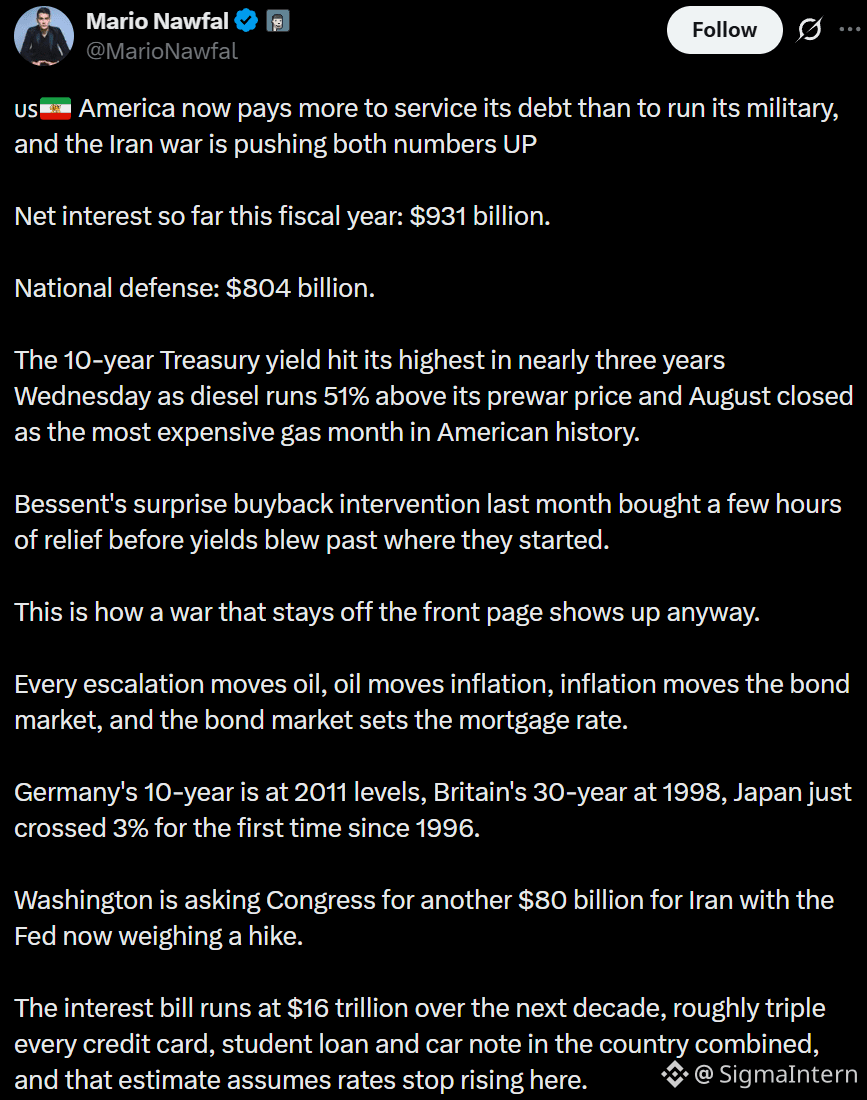
U.S. 10-year Treasury yields recently touched 4.818% intraday, the highest level since November 2023. This trend is mainly driven by a warming of inflation expectations, geopolitical risks in the Middle East, pressure from Treasury supply, and the market’s view that the Federal Reserve may further tighten policy.
From a macro transmission perspective, rising U.S. Treasury yields typically means upward pressure on the risk-free rate and higher discount rates. This may have three main effects on the crypto market:
Pressure on risk-asset valuations: Higher real interest rates reduce the appeal of growth-oriented assets. As leading crypto assets like Bitcoin and Ethereum are high-volatility risk assets, they may face short-term outflows.
Tightening liquidity conditions: Treasury yields rising are often accompanied by a stronger U.S. dollar and tightening at the margin of global liquidity, which can curb leveraged trades and risk appetite, intensifying crypto market volatility.
Changes in relative attractiveness: When Treasuries offer higher risk-free returns, some institutional funds may rotate from crypto into traditional fixed income, particularly during periods when macro uncertainty is elevated.
However, the crypto market is not entirely passive. If inflation and geopolitical risks continue to bolster the “hard assets” narrative, Bitcoin’s safe-haven and digital-gold attributes may also receive attention from time to time. The key is still the interplay between the Fed’s actual policy path and shifts in risk appetite.
In the short term, it may be prudent to modestly reduce high-leverage positions and watch whether the 10-year Treasury yield can effectively hold above 4.8%. Over the medium term, track remarks from Fed officials and inflation data to assess whether rate expectations are further revised upward. In an environment where volatility may increase, using high-quality financial derivatives to hedge assets is also an important way to protect portfolio risk. At the portfolio level, it may be worth considering a moderate increase in cash or low-volatility asset allocation to manage potential volatility.
What do you think about the current impact of U.S. Treasury yields on the crypto market? Is it only a temporary pressure, or could it trigger a more persistent shift in capital allocation? Feel free to share your thoughts in the comments section~👂
#美国10年期美债收益率触及2023年11月来最高
U.S. 10-year Treasury yields recently touched 4.818% intraday, the highest level since November 2023. This trend is mainly driven by a warming of inflation expectations, geopolitical risks in the Middle East, pressure from Treasury supply, and the market’s view that the Federal Reserve may further tighten policy.
From a macro transmission perspective, rising U.S. Treasury yields typically means upward pressure on the risk-free rate and higher discount rates. This may have three main effects on the crypto market:
Pressure on risk-asset valuations: Higher real interest rates reduce the appeal of growth-oriented assets. As leading crypto assets like Bitcoin and Ethereum are high-volatility risk assets, they may face short-term outflows.
Tightening liquidity conditions: Treasury yields rising are often accompanied by a stronger U.S. dollar and tightening at the margin of global liquidity, which can curb leveraged trades and risk appetite, intensifying crypto market volatility.
Changes in relative attractiveness: When Treasuries offer higher risk-free returns, some institutional funds may rotate from crypto into traditional fixed income, particularly during periods when macro uncertainty is elevated.
However, the crypto market is not entirely passive. If inflation and geopolitical risks continue to bolster the “hard assets” narrative, Bitcoin’s safe-haven and digital-gold attributes may also receive attention from time to time. The key is still the interplay between the Fed’s actual policy path and shifts in risk appetite.
In the short term, it may be prudent to modestly reduce high-leverage positions and watch whether the 10-year Treasury yield can effectively hold above 4.8%. Over the medium term, track remarks from Fed officials and inflation data to assess whether rate expectations are further revised upward. In an environment where volatility may increase, using high-quality financial derivatives to hedge assets is also an important way to protect portfolio risk. At the portfolio level, it may be worth considering a moderate increase in cash or low-volatility asset allocation to manage potential volatility.
What do you think about the current impact of U.S. Treasury yields on the crypto market? Is it only a temporary pressure, or could it trigger a more persistent shift in capital allocation? Feel free to share your thoughts in the comments section~👂
U.S. 10-year Treasury yields recently touched 4.818% intraday, the highest level since November 2023. This trend is mainly driven by a warming of inflation expectations, geopolitical risks in the Middle East, pressure from Treasury supply, and the market’s view that the Federal Reserve may further tighten policy.
From a macro transmission perspective, rising U.S. Treasury yields typically means upward pressure on the risk-free rate and higher discount rates. This may have three main effects on the crypto market:
Pressure on risk-asset valuations: Higher real interest rates reduce the appeal of growth-oriented assets. As leading crypto assets like Bitcoin and Ethereum are high-volatility risk assets, they may face short-term outflows.
Tightening liquidity conditions: Treasury yields rising are often accompanied by a stronger U.S. dollar and tightening at the margin of global liquidity, which can curb leveraged trades and risk appetite, intensifying crypto market volatility.
Changes in relative attractiveness: When Treasuries offer higher risk-free returns, some institutional funds may rotate from crypto into traditional fixed income, particularly during periods when macro uncertainty is elevated.
However, the crypto market is not entirely passive. If inflation and geopolitical risks continue to bolster the “hard assets” narrative, Bitcoin’s safe-haven and digital-gold attributes may also receive attention from time to time. The key is still the interplay between the Fed’s actual policy path and shifts in risk appetite.
In the short term, it may be prudent to modestly reduce high-leverage positions and watch whether the 10-year Treasury yield can effectively hold above 4.8%. Over the medium term, track remarks from Fed officials and inflation data to assess whether rate expectations are further revised upward. In an environment where volatility may increase, using high-quality financial derivatives to hedge assets is also an important way to protect portfolio risk. At the portfolio level, it may be worth considering a moderate increase in cash or low-volatility asset allocation to manage potential volatility.
What do you think about the current impact of U.S. Treasury yields on the crypto market? Is it only a temporary pressure, or could it trigger a more persistent shift in capital allocation? Feel free to share your thoughts in the comments section~👂
1
2.2k
·
--
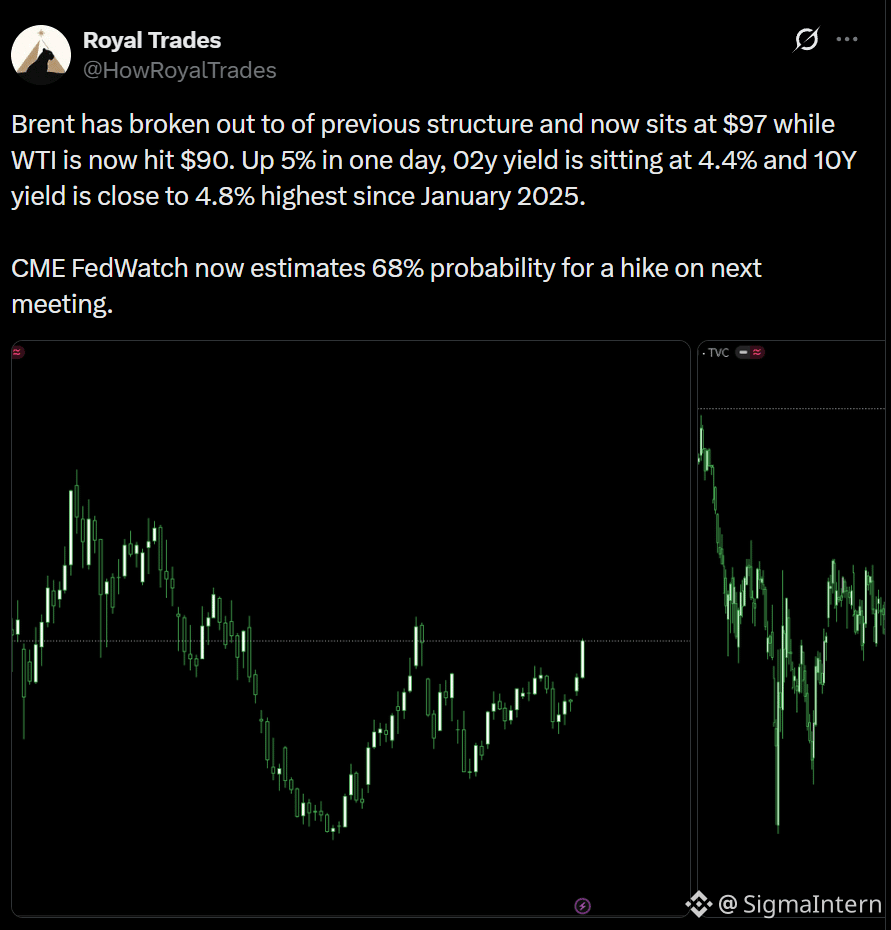
CME FedWatch shows that the probability of the Federal Reserve raising rates by 25 basis points in September has risen to about 68%, up from under 40% a week ago. The key driver is Chair Kevin Warsh’s hawkish remarks at Jackson Hole: PCE inflation at 12 months is 3.7%, and annualized over the past six months is 4.1%—both clearly above the 2% target—and he reaffirmed that the target is “unwavering and fixed.” Market interpretation is that if inflation does not show a clear easing, a September rate hike has effectively moved onto the agenda.
For crypto markets, higher real yields alongside a stronger U.S. dollar will directly increase the holding cost of non-yielding assets, raising the likelihood of short-term pressure on risk assets such as Bitcoin. At the same time, tighter liquidity expectations may amplify volatility, and institutional funds may show a stronger tendency toward temporary risk-avoidance. Gold has already started to pull back; crypto assets are affected in tandem. Combined with oil prices rising and reinforcing the inflation feedback loop, this creates a more complete suppression chain.
In terms of action, you could consider: rotating part of your positions into stablecoins or short-duration yield products with lower sensitivity to interest rates to reduce net-value volatility; hedging downside risk using options or structured instruments rather than simply cutting positions; and tying position decisions to the results of upcoming Nonfarm Payrolls and CPI data over the next two weeks, with predefined clear trigger conditions to avoid emotional adjustments.
The data over the next two weeks is crucial. The probability could climb even higher—or drop quickly. What do you think this wave in the crypto space will look like? Will it take a hit first and then rebound? Feel free to share your thoughts in the comments~👂
#美联储加息概率升至68%
CME FedWatch shows that the probability of the Federal Reserve raising rates by 25 basis points in September has risen to about 68%, up from under 40% a week ago. The key driver is Chair Kevin Warsh’s hawkish remarks at Jackson Hole: PCE inflation at 12 months is 3.7%, and annualized over the past six months is 4.1%—both clearly above the 2% target—and he reaffirmed that the target is “unwavering and fixed.” Market interpretation is that if inflation does not show a clear easing, a September rate hike has effectively moved onto the agenda.
For crypto markets, higher real yields alongside a stronger U.S. dollar will directly increase the holding cost of non-yielding assets, raising the likelihood of short-term pressure on risk assets such as Bitcoin. At the same time, tighter liquidity expectations may amplify volatility, and institutional funds may show a stronger tendency toward temporary risk-avoidance. Gold has already started to pull back; crypto assets are affected in tandem. Combined with oil prices rising and reinforcing the inflation feedback loop, this creates a more complete suppression chain.
In terms of action, you could consider: rotating part of your positions into stablecoins or short-duration yield products with lower sensitivity to interest rates to reduce net-value volatility; hedging downside risk using options or structured instruments rather than simply cutting positions; and tying position decisions to the results of upcoming Nonfarm Payrolls and CPI data over the next two weeks, with predefined clear trigger conditions to avoid emotional adjustments.
The data over the next two weeks is crucial. The probability could climb even higher—or drop quickly. What do you think this wave in the crypto space will look like? Will it take a hit first and then rebound? Feel free to share your thoughts in the comments~👂
#美联储加息概率升至68%
For crypto markets, higher real yields alongside a stronger U.S. dollar will directly increase the holding cost of non-yielding assets, raising the likelihood of short-term pressure on risk assets such as Bitcoin. At the same time, tighter liquidity expectations may amplify volatility, and institutional funds may show a stronger tendency toward temporary risk-avoidance. Gold has already started to pull back; crypto assets are affected in tandem. Combined with oil prices rising and reinforcing the inflation feedback loop, this creates a more complete suppression chain.
In terms of action, you could consider: rotating part of your positions into stablecoins or short-duration yield products with lower sensitivity to interest rates to reduce net-value volatility; hedging downside risk using options or structured instruments rather than simply cutting positions; and tying position decisions to the results of upcoming Nonfarm Payrolls and CPI data over the next two weeks, with predefined clear trigger conditions to avoid emotional adjustments.
The data over the next two weeks is crucial. The probability could climb even higher—or drop quickly. What do you think this wave in the crypto space will look like? Will it take a hit first and then rebound? Feel free to share your thoughts in the comments~👂
#美联储加息概率升至68%
2
5k
·
--
Hey everyone, Sigma.Money’s POBO feature is about to launch! To help you better understand what this new feature is for, let’s take a quick quiz to test your knowledge!
How does Sigma POBO work?
Do you know the correct answer? 🫵
#俄罗斯9月1日启动数字卢布大规模推广
Hey everyone, Sigma.Money’s POBO feature is about to launch! To help you better understand what this new feature is for, let’s take a quick quiz to test your knowledge!
How does Sigma POBO work?
Do you know the correct answer? 🫵
#俄罗斯9月1日启动数字卢布大规模推广
How does Sigma POBO work?
Do you know the correct answer? 🫵
#俄罗斯9月1日启动数字卢布大规模推广
用户自己去每个国家建立银行关系
0%
由持牌支付伙伴代表用户,通过成熟合规管道执行兑换与支付
100%
把稳定币转给第三方账户
0%
2 votes • Voting closed
1
173
·
--
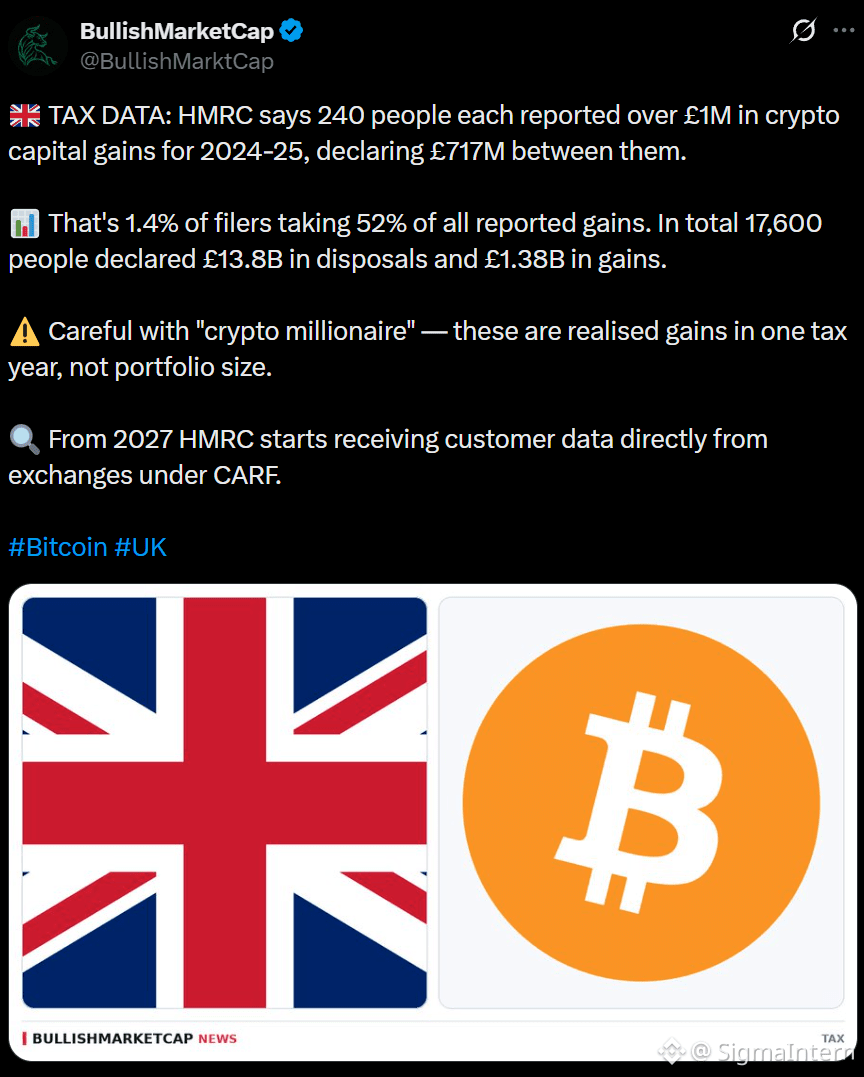
The UK’s tax and customs authority (HMRC) has recently published, for the first time, official data on capital gains from crypto assets. In the 2024–25 tax year, 17,600 taxpayers reported disposals of crypto assets, with total disposal proceeds of £13.8 billion and taxable gains of £1.38 billion. Of these, only 240 people had annual gains exceeding £1 million, contributing a combined £717 million—about 52% of all reported gains. From 2027 onward, HMRC will directly receive transaction data from exchange customers through the Crypto Asset Reporting Framework (CARF).
This data sends a clear signal: crypto asset gains are highly concentrated, and regulatory transparency is rapidly improving. For the recent market, the direct impact may be felt in three areas. First, high-net-worth investors may become more cautious in realizing gains, and sell-off activity could slow down temporarily. Second, compliance costs and the demand for tax planning are likely to rise, leading institutions and professional investors to place greater emphasis on transaction records and cross-border reporting. Third, retail participants’ understanding of the “crypto millionaire” narrative may become more rational, and market sentiment could shift from simply chasing returns to also factoring in compliance risks.
How long do you think this set of data will continue to affect the global crypto market? Will it accelerate the market’s rationalization, or will it only trigger short-term sentiment fluctuations? Feel free to share your views in the comments~👂
#英国首发加密资产应税收益统计
The UK’s tax and customs authority (HMRC) has recently published, for the first time, official data on capital gains from crypto assets. In the 2024–25 tax year, 17,600 taxpayers reported disposals of crypto assets, with total disposal proceeds of £13.8 billion and taxable gains of £1.38 billion. Of these, only 240 people had annual gains exceeding £1 million, contributing a combined £717 million—about 52% of all reported gains. From 2027 onward, HMRC will directly receive transaction data from exchange customers through the Crypto Asset Reporting Framework (CARF).
This data sends a clear signal: crypto asset gains are highly concentrated, and regulatory transparency is rapidly improving. For the recent market, the direct impact may be felt in three areas. First, high-net-worth investors may become more cautious in realizing gains, and sell-off activity could slow down temporarily. Second, compliance costs and the demand for tax planning are likely to rise, leading institutions and professional investors to place greater emphasis on transaction records and cross-border reporting. Third, retail participants’ understanding of the “crypto millionaire” narrative may become more rational, and market sentiment could shift from simply chasing returns to also factoring in compliance risks.
How long do you think this set of data will continue to affect the global crypto market? Will it accelerate the market’s rationalization, or will it only trigger short-term sentiment fluctuations? Feel free to share your views in the comments~👂
#英国首发加密资产应税收益统计
This data sends a clear signal: crypto asset gains are highly concentrated, and regulatory transparency is rapidly improving. For the recent market, the direct impact may be felt in three areas. First, high-net-worth investors may become more cautious in realizing gains, and sell-off activity could slow down temporarily. Second, compliance costs and the demand for tax planning are likely to rise, leading institutions and professional investors to place greater emphasis on transaction records and cross-border reporting. Third, retail participants’ understanding of the “crypto millionaire” narrative may become more rational, and market sentiment could shift from simply chasing returns to also factoring in compliance risks.
How long do you think this set of data will continue to affect the global crypto market? Will it accelerate the market’s rationalization, or will it only trigger short-term sentiment fluctuations? Feel free to share your views in the comments~👂
#英国首发加密资产应税收益统计
2
286
·
--
#比特币升破8万美元创三月新高
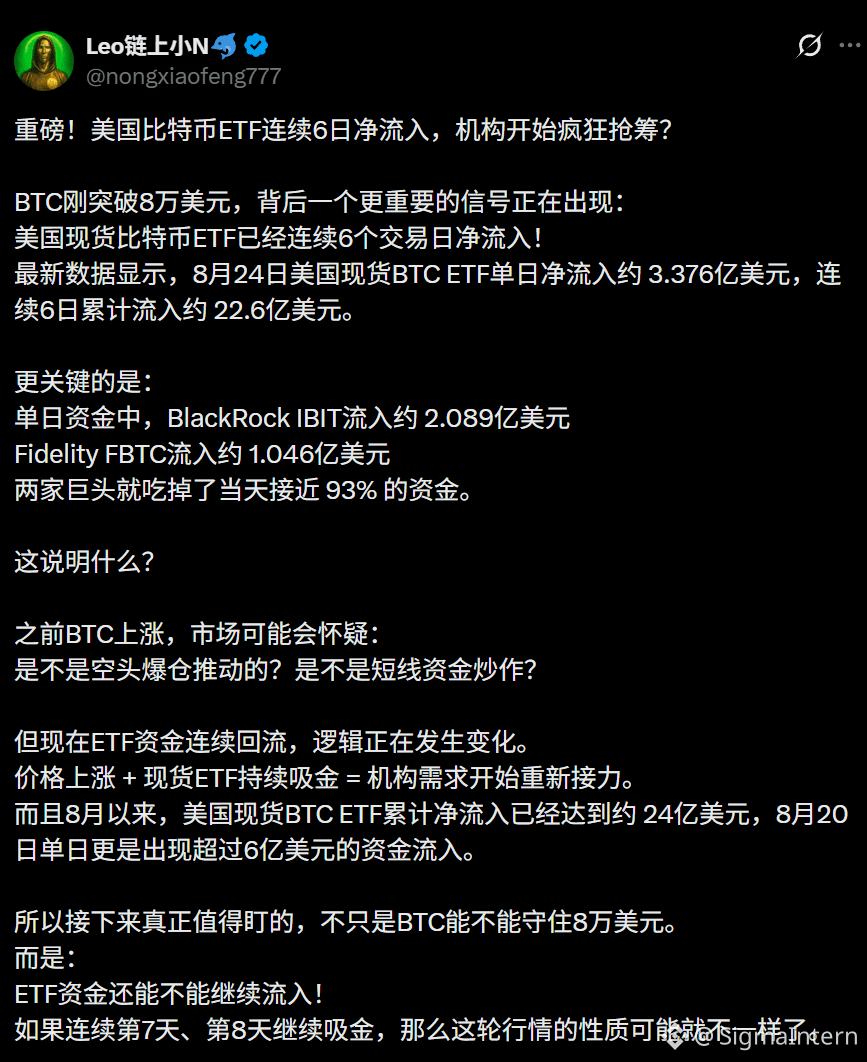
Over the past week, Bitcoin has completed a notable rebound, with a cumulative gain of about 23%, marking the largest single-week rise in nearly three years. The price quickly climbed from the $64,000 range, broke above $80,000 during the week, and hit a roughly three-month high since mid-May. During intraday trading, it briefly approached around $81,200. The total gain for August is already close to 28%. Key drivers include rising momentum behind the “currency devaluation trade” narrative triggered by the U.S. Treasury expanding its long-term government bond repurchase operations, a softer U.S. dollar, the U.S. spot Bitcoin ETF recording its strongest single-week net inflow in about 10 months (approximately $1.92 billion), and a squeeze effect resulting from large-scale short liquidations. Risk appetite in the market has clearly rebounded, and major crypto assets have moved up in tandem.
From a weekly perspective, this rally’s impact on the recent crypto market is becoming clearer: first, capital and sentiment have aligned—ETFs have continued to attract inflows while shorts have covered, significantly improving short-term liquidity. Second, the macro narrative has shifted—renewed reinforcement of Bitcoin’s hedging attribute, driven by renewed concerns over currency devaluation and expectations for a more policy-friendly environment. Third, the structure remains somewhat differentiated—although the price has set a phase high, it is still about 36% below the historical high of roughly $126,000 in October 2025. Additionally, there is heavy trapped positioning in the $80,000–$83,000 range, and technical indicators have already shown signs of being overbought. Overall, the market has moved from deep correction toward repair and probing. The weekly strength provides an important window to observe the next move, but its sustainability still depends on whether ETF flows and macro liquidity continue.
For positioning adjustments, it may be best to prioritize the continuity of net ETF inflows and the trend in the U.S. Dollar Index, rather than simply chasing price breakouts. Existing holders may consider modestly realizing some profits when approaching prior resistance zones to lock in this week’s gains. Meanwhile, new capital may be better off waiting for a pullback to confirm support before taking action. At the same time, it’s recommended to cross-check Bitcoin exposure with the performance of macro hedging assets such as gold and U.S. Treasuries to avoid amplifying overall portfolio risk through excessive volatility in a single asset.
What do you think about the sustainability of this week’s strong momentum? Is it merely a phase of repair, or a signal of a medium-term trend shift? Feel free to share your views in the comments section~👂
#比特币升破8万美元创三月新高
Over the past week, Bitcoin has completed a notable rebound, with a cumulative gain of about 23%, marking the largest single-week rise in nearly three years. The price quickly climbed from the $64,000 range, broke above $80,000 during the week, and hit a roughly three-month high since mid-May. During intraday trading, it briefly approached around $81,200. The total gain for August is already close to 28%. Key drivers include rising momentum behind the “currency devaluation trade” narrative triggered by the U.S. Treasury expanding its long-term government bond repurchase operations, a softer U.S. dollar, the U.S. spot Bitcoin ETF recording its strongest single-week net inflow in about 10 months (approximately $1.92 billion), and a squeeze effect resulting from large-scale short liquidations. Risk appetite in the market has clearly rebounded, and major crypto assets have moved up in tandem.
From a weekly perspective, this rally’s impact on the recent crypto market is becoming clearer: first, capital and sentiment have aligned—ETFs have continued to attract inflows while shorts have covered, significantly improving short-term liquidity. Second, the macro narrative has shifted—renewed reinforcement of Bitcoin’s hedging attribute, driven by renewed concerns over currency devaluation and expectations for a more policy-friendly environment. Third, the structure remains somewhat differentiated—although the price has set a phase high, it is still about 36% below the historical high of roughly $126,000 in October 2025. Additionally, there is heavy trapped positioning in the $80,000–$83,000 range, and technical indicators have already shown signs of being overbought. Overall, the market has moved from deep correction toward repair and probing. The weekly strength provides an important window to observe the next move, but its sustainability still depends on whether ETF flows and macro liquidity continue.
For positioning adjustments, it may be best to prioritize the continuity of net ETF inflows and the trend in the U.S. Dollar Index, rather than simply chasing price breakouts. Existing holders may consider modestly realizing some profits when approaching prior resistance zones to lock in this week’s gains. Meanwhile, new capital may be better off waiting for a pullback to confirm support before taking action. At the same time, it’s recommended to cross-check Bitcoin exposure with the performance of macro hedging assets such as gold and U.S. Treasuries to avoid amplifying overall portfolio risk through excessive volatility in a single asset.
What do you think about the sustainability of this week’s strong momentum? Is it merely a phase of repair, or a signal of a medium-term trend shift? Feel free to share your views in the comments section~👂
Over the past week, Bitcoin has completed a notable rebound, with a cumulative gain of about 23%, marking the largest single-week rise in nearly three years. The price quickly climbed from the $64,000 range, broke above $80,000 during the week, and hit a roughly three-month high since mid-May. During intraday trading, it briefly approached around $81,200. The total gain for August is already close to 28%. Key drivers include rising momentum behind the “currency devaluation trade” narrative triggered by the U.S. Treasury expanding its long-term government bond repurchase operations, a softer U.S. dollar, the U.S. spot Bitcoin ETF recording its strongest single-week net inflow in about 10 months (approximately $1.92 billion), and a squeeze effect resulting from large-scale short liquidations. Risk appetite in the market has clearly rebounded, and major crypto assets have moved up in tandem.
From a weekly perspective, this rally’s impact on the recent crypto market is becoming clearer: first, capital and sentiment have aligned—ETFs have continued to attract inflows while shorts have covered, significantly improving short-term liquidity. Second, the macro narrative has shifted—renewed reinforcement of Bitcoin’s hedging attribute, driven by renewed concerns over currency devaluation and expectations for a more policy-friendly environment. Third, the structure remains somewhat differentiated—although the price has set a phase high, it is still about 36% below the historical high of roughly $126,000 in October 2025. Additionally, there is heavy trapped positioning in the $80,000–$83,000 range, and technical indicators have already shown signs of being overbought. Overall, the market has moved from deep correction toward repair and probing. The weekly strength provides an important window to observe the next move, but its sustainability still depends on whether ETF flows and macro liquidity continue.
For positioning adjustments, it may be best to prioritize the continuity of net ETF inflows and the trend in the U.S. Dollar Index, rather than simply chasing price breakouts. Existing holders may consider modestly realizing some profits when approaching prior resistance zones to lock in this week’s gains. Meanwhile, new capital may be better off waiting for a pullback to confirm support before taking action. At the same time, it’s recommended to cross-check Bitcoin exposure with the performance of macro hedging assets such as gold and U.S. Treasuries to avoid amplifying overall portfolio risk through excessive volatility in a single asset.
What do you think about the sustainability of this week’s strong momentum? Is it merely a phase of repair, or a signal of a medium-term trend shift? Feel free to share your views in the comments section~👂
3
669
·
--
#美联储纪要显示不支持降息
The newly released Federal Reserve July meeting minutes were quite direct: in the entire document, basically no one mentioned “rate cuts.” Ultimately, the vote was 9 to 3 to keep rates unchanged, and three people even directly called for a rate hike. The gist of the minutes is that if inflation can’t be brought down, they may have to raise rates later. Back when everyone was hoping for rate cuts day after day, the focus has now shifted to “whether to hike rates.”
For the crypto market in the short term, the significance lies in reinforcing the pricing basis that a “high-rate environment may last longer.” Major assets such as Bitcoin, Ethereum, and BNB are highly sensitive to real interest rates and USD liquidity. Since the minutes clearly lack discussion of rate cuts while keeping a rate-hike option on the table, it may weaken the market’s expectation gap for easing later this year. However, it’s important to distinguish: these minutes reflect information from a meeting three weeks ago. Since then, some employment and inflation data have shown signs of weakening, and the probability of a rate hike in September has already eased somewhat. The true driver of near-term price action isn’t the lagging text itself, but whether subsequent policy communication and data can align to create a consensus.
For now, set aside the fantasy that “rate cuts will come soon”—at least wait until after Jackson Hole to hear what Waller has to say; meanwhile, watch the inflation and employment data ahead of the September meeting. If the data softens, market expectations for rate cuts may reignite; if the data stays firm, high rates will keep weighing on the market. Also, look at whether capital in the crypto space is flowing in or out. Simply put: put the decision points in these three places—“meeting statements + new data + capital flows.” Let your positioning be validated by what happens, rather than trying to pre-guess the direction.
How do you assess the actual weight of these minutes for short-term crypto pricing? Do you put more emphasis on its hawkish signals, or do you think they’ve been partially offset by the subsequent data? Feel free to share your views in the comments~👂
#美联储纪要显示不支持降息
The newly released Federal Reserve July meeting minutes were quite direct: in the entire document, basically no one mentioned “rate cuts.” Ultimately, the vote was 9 to 3 to keep rates unchanged, and three people even directly called for a rate hike. The gist of the minutes is that if inflation can’t be brought down, they may have to raise rates later. Back when everyone was hoping for rate cuts day after day, the focus has now shifted to “whether to hike rates.”
For the crypto market in the short term, the significance lies in reinforcing the pricing basis that a “high-rate environment may last longer.” Major assets such as Bitcoin, Ethereum, and BNB are highly sensitive to real interest rates and USD liquidity. Since the minutes clearly lack discussion of rate cuts while keeping a rate-hike option on the table, it may weaken the market’s expectation gap for easing later this year. However, it’s important to distinguish: these minutes reflect information from a meeting three weeks ago. Since then, some employment and inflation data have shown signs of weakening, and the probability of a rate hike in September has already eased somewhat. The true driver of near-term price action isn’t the lagging text itself, but whether subsequent policy communication and data can align to create a consensus.
For now, set aside the fantasy that “rate cuts will come soon”—at least wait until after Jackson Hole to hear what Waller has to say; meanwhile, watch the inflation and employment data ahead of the September meeting. If the data softens, market expectations for rate cuts may reignite; if the data stays firm, high rates will keep weighing on the market. Also, look at whether capital in the crypto space is flowing in or out. Simply put: put the decision points in these three places—“meeting statements + new data + capital flows.” Let your positioning be validated by what happens, rather than trying to pre-guess the direction.
How do you assess the actual weight of these minutes for short-term crypto pricing? Do you put more emphasis on its hawkish signals, or do you think they’ve been partially offset by the subsequent data? Feel free to share your views in the comments~👂
The newly released Federal Reserve July meeting minutes were quite direct: in the entire document, basically no one mentioned “rate cuts.” Ultimately, the vote was 9 to 3 to keep rates unchanged, and three people even directly called for a rate hike. The gist of the minutes is that if inflation can’t be brought down, they may have to raise rates later. Back when everyone was hoping for rate cuts day after day, the focus has now shifted to “whether to hike rates.”
For the crypto market in the short term, the significance lies in reinforcing the pricing basis that a “high-rate environment may last longer.” Major assets such as Bitcoin, Ethereum, and BNB are highly sensitive to real interest rates and USD liquidity. Since the minutes clearly lack discussion of rate cuts while keeping a rate-hike option on the table, it may weaken the market’s expectation gap for easing later this year. However, it’s important to distinguish: these minutes reflect information from a meeting three weeks ago. Since then, some employment and inflation data have shown signs of weakening, and the probability of a rate hike in September has already eased somewhat. The true driver of near-term price action isn’t the lagging text itself, but whether subsequent policy communication and data can align to create a consensus.
For now, set aside the fantasy that “rate cuts will come soon”—at least wait until after Jackson Hole to hear what Waller has to say; meanwhile, watch the inflation and employment data ahead of the September meeting. If the data softens, market expectations for rate cuts may reignite; if the data stays firm, high rates will keep weighing on the market. Also, look at whether capital in the crypto space is flowing in or out. Simply put: put the decision points in these three places—“meeting statements + new data + capital flows.” Let your positioning be validated by what happens, rather than trying to pre-guess the direction.
How do you assess the actual weight of these minutes for short-term crypto pricing? Do you put more emphasis on its hawkish signals, or do you think they’ve been partially offset by the subsequent data? Feel free to share your views in the comments~👂
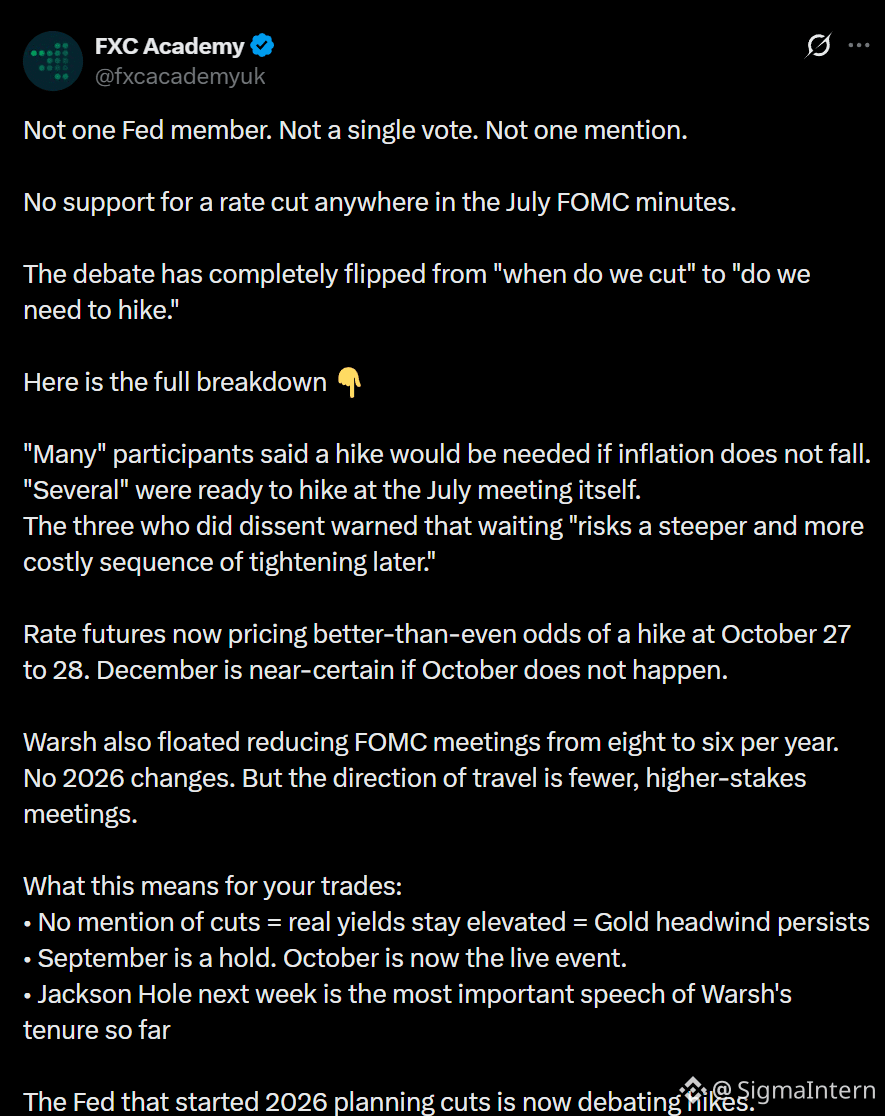
3
4.4k
·
--
#以太坊基金会启动Glamsterdam测试网
Ethereum has just added a new testnet called Platåberget—set up specifically for rehearsal ahead of the upcoming Glamsterdam upgrade. On August 20, a fork will be run on this testnet first, mainly to test ePBS, the new access list, and changes to the gas fee accounting method.
In simple terms, this shows Ethereum is still actively working on scaling the underlying layer, aiming to handle more transactions. For the market, it may not instantly drive a pump in the short term, but in the long-term narrative there is more tangible progress. That said, note that the new gas algorithm may cause some older tools to calculate fees inaccurately. Wallets and indexers will need to adapt quickly; otherwise, after the official rollout, problems could easily surface.
Different people can prepare in different ways. If you’re a developer or run a node, you can start testing on Platåberget now and see whether your tools work correctly under the new rules. For regular users, you can pay attention to whether widespread errors appear after the testnet is running, and when major clients release compatible updates. For friends who trade, rather than focusing on that day’s price moves, consider looking at how hot the developer community discussions are around compatibility issues—often that reflects real progress better than price does.
How do you think the pace of this testnet rollout will affect market expectations for Glamsterdam’s final launch time? Feel free to share your thoughts in the comments~🫵
#以太坊基金会启动Glamsterdam测试网
Ethereum has just added a new testnet called Platåberget—set up specifically for rehearsal ahead of the upcoming Glamsterdam upgrade. On August 20, a fork will be run on this testnet first, mainly to test ePBS, the new access list, and changes to the gas fee accounting method.
In simple terms, this shows Ethereum is still actively working on scaling the underlying layer, aiming to handle more transactions. For the market, it may not instantly drive a pump in the short term, but in the long-term narrative there is more tangible progress. That said, note that the new gas algorithm may cause some older tools to calculate fees inaccurately. Wallets and indexers will need to adapt quickly; otherwise, after the official rollout, problems could easily surface.
Different people can prepare in different ways. If you’re a developer or run a node, you can start testing on Platåberget now and see whether your tools work correctly under the new rules. For regular users, you can pay attention to whether widespread errors appear after the testnet is running, and when major clients release compatible updates. For friends who trade, rather than focusing on that day’s price moves, consider looking at how hot the developer community discussions are around compatibility issues—often that reflects real progress better than price does.
How do you think the pace of this testnet rollout will affect market expectations for Glamsterdam’s final launch time? Feel free to share your thoughts in the comments~🫵
Ethereum has just added a new testnet called Platåberget—set up specifically for rehearsal ahead of the upcoming Glamsterdam upgrade. On August 20, a fork will be run on this testnet first, mainly to test ePBS, the new access list, and changes to the gas fee accounting method.
In simple terms, this shows Ethereum is still actively working on scaling the underlying layer, aiming to handle more transactions. For the market, it may not instantly drive a pump in the short term, but in the long-term narrative there is more tangible progress. That said, note that the new gas algorithm may cause some older tools to calculate fees inaccurately. Wallets and indexers will need to adapt quickly; otherwise, after the official rollout, problems could easily surface.
Different people can prepare in different ways. If you’re a developer or run a node, you can start testing on Platåberget now and see whether your tools work correctly under the new rules. For regular users, you can pay attention to whether widespread errors appear after the testnet is running, and when major clients release compatible updates. For friends who trade, rather than focusing on that day’s price moves, consider looking at how hot the developer community discussions are around compatibility issues—often that reflects real progress better than price does.
How do you think the pace of this testnet rollout will affect market expectations for Glamsterdam’s final launch time? Feel free to share your thoughts in the comments~🫵

1
298
·
--
#美SEC取消加密规则制定会议
Recently, the U.S. SEC has “dropped the ball” again: the originally scheduled August 14 meeting to discuss new rules for crypto (including fundraising exemptions under the “Regulation Crypto” framework, etc.) was suddenly canceled. The stated reason was that something came up temporarily, and no new date was provided. Coincidentally, the Senate also didn’t push forward the “Clarity Act” before adjourning for the break. Afterward, there were also suggestions that they’re afraid of clashing with legislation.
The impact on the market is actually quite direct—not that the rules were definitively killed, but that the time spent “waiting for the rules” has been extended again. Emotionally, it’s easy for things to tighten up at first, and capital will be even more cautious. Put simply, people had been hoping the SEC would take the first step and provide some clarity, but it’s back to the “wait for notice” mode.
Look at it from another angle: rather than obsessing over whether the meeting will be restarted, focus on two verifiable signals. First, whether in the SEC’s subsequent official documents or agenda updates, “Regulation Crypto” is clearly still being pushed forward. Second, around the Senate procedural milestones in September, whether regulatory and legislative statements show clear division of roles or concessions. For holders, you can try a simple scenario analysis: if the rules are delayed further, which assets or sectors are more sensitive to “lack of clarity”; if legislation moves first, which business models will benefit first. Breaking a single event into trackable paths is more useful than repeatedly trying to decide whether it’s “good news or bad news.”
Do you think this cancellation is more likely a technical adjustment, or a re-balancing of priorities between regulators and legislation? Feel free to share your thoughts on this event in the comments section~🫵
#美SEC取消加密规则制定会议
Recently, the U.S. SEC has “dropped the ball” again: the originally scheduled August 14 meeting to discuss new rules for crypto (including fundraising exemptions under the “Regulation Crypto” framework, etc.) was suddenly canceled. The stated reason was that something came up temporarily, and no new date was provided. Coincidentally, the Senate also didn’t push forward the “Clarity Act” before adjourning for the break. Afterward, there were also suggestions that they’re afraid of clashing with legislation.
The impact on the market is actually quite direct—not that the rules were definitively killed, but that the time spent “waiting for the rules” has been extended again. Emotionally, it’s easy for things to tighten up at first, and capital will be even more cautious. Put simply, people had been hoping the SEC would take the first step and provide some clarity, but it’s back to the “wait for notice” mode.
Look at it from another angle: rather than obsessing over whether the meeting will be restarted, focus on two verifiable signals. First, whether in the SEC’s subsequent official documents or agenda updates, “Regulation Crypto” is clearly still being pushed forward. Second, around the Senate procedural milestones in September, whether regulatory and legislative statements show clear division of roles or concessions. For holders, you can try a simple scenario analysis: if the rules are delayed further, which assets or sectors are more sensitive to “lack of clarity”; if legislation moves first, which business models will benefit first. Breaking a single event into trackable paths is more useful than repeatedly trying to decide whether it’s “good news or bad news.”
Do you think this cancellation is more likely a technical adjustment, or a re-balancing of priorities between regulators and legislation? Feel free to share your thoughts on this event in the comments section~🫵
Recently, the U.S. SEC has “dropped the ball” again: the originally scheduled August 14 meeting to discuss new rules for crypto (including fundraising exemptions under the “Regulation Crypto” framework, etc.) was suddenly canceled. The stated reason was that something came up temporarily, and no new date was provided. Coincidentally, the Senate also didn’t push forward the “Clarity Act” before adjourning for the break. Afterward, there were also suggestions that they’re afraid of clashing with legislation.
The impact on the market is actually quite direct—not that the rules were definitively killed, but that the time spent “waiting for the rules” has been extended again. Emotionally, it’s easy for things to tighten up at first, and capital will be even more cautious. Put simply, people had been hoping the SEC would take the first step and provide some clarity, but it’s back to the “wait for notice” mode.
Look at it from another angle: rather than obsessing over whether the meeting will be restarted, focus on two verifiable signals. First, whether in the SEC’s subsequent official documents or agenda updates, “Regulation Crypto” is clearly still being pushed forward. Second, around the Senate procedural milestones in September, whether regulatory and legislative statements show clear division of roles or concessions. For holders, you can try a simple scenario analysis: if the rules are delayed further, which assets or sectors are more sensitive to “lack of clarity”; if legislation moves first, which business models will benefit first. Breaking a single event into trackable paths is more useful than repeatedly trying to decide whether it’s “good news or bad news.”
Do you think this cancellation is more likely a technical adjustment, or a re-balancing of priorities between regulators and legislation? Feel free to share your thoughts on this event in the comments section~🫵
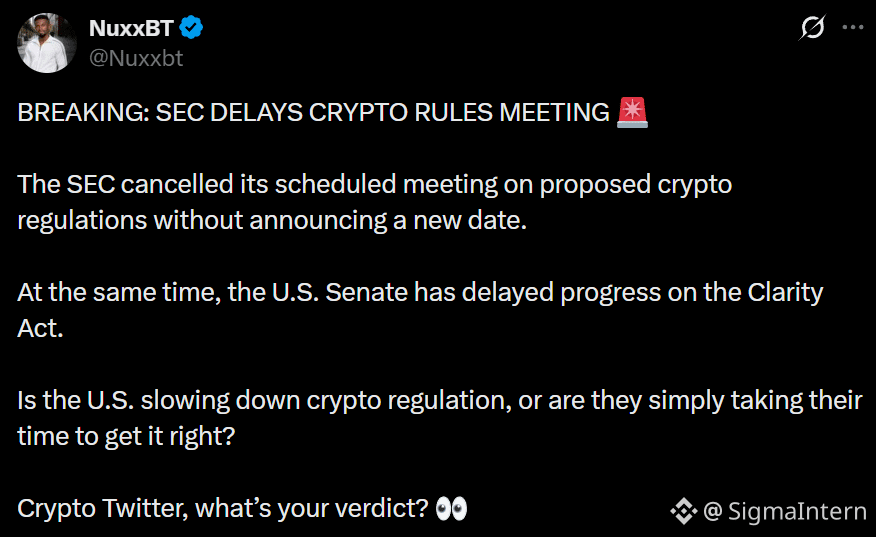
2
1
683
·
--
#美OCC称数字资产公司可申请国家银行牌照
OCC recently made a statement saying that companies legally conducting digital asset business may apply to become a national bank. The Director also specifically emphasized, “The United States and the OCC have opened the door again.” In the past 18 months, it has already received about 40 new applications, and many got results within 120 days.
It sounds quite lively, but first, let’s clarify what they mean by “national bank.” For the most part, it’s actually a trust charter. What it mainly enables is custody and settlement-type activities. Generally, it can’t operate like a typical bank—such as taking deposits and making loans. It’s not an all-purpose pass; the boundaries are still quite clear.
For crypto companies, the benefit is real. With this license, they can operate under a unified federal framework, so they don’t have to run licensing in state-by-state fashion. It’s also easier to talk to institutional clients—counterparties may feel reassured because they believe you are under federal oversight, which makes you seem more reliable. But the bar is still not low. You have to prove you have money, risk controls, and compliance capability. Some companies have already received conditional approvals, while others have been outright rejected. So “you can apply” and “you can get approved” are two different things. In practice, the ones most likely to make it through are probably the big players that already have scale, teams, and can withstand the compliance costs. If small and medium-sized teams lack sufficient resources, this path remains difficult.
Who benefits most clearly? The leading companies that are ahead of the curve. Once they get the license, they can use “federal supervision” as an endorsement to win over institutions, and they are more likely to connect to mainstream payment and clearing channels.
Who might feel most uncomfortable? Smaller players that rely on state-by-state licenses, as well as some traditional banks. Traditional banks have long worried that opening this kind of channel to crypto companies could be unfair, or could bring new risks.
In the long run, this looks more like regulation pulling digital assets into the existing banking system. If the route stays open and smooth, the leading players will find it easier to get bigger. But if approvals become looser and tighter in waves later, or if the conditions keep getting more stringent, the real impact could be diluted. The door is open—but the requirements for walking through it are still not low. Openness doesn’t mean it’s easy. That may be the most straightforward part of this story.
What do you think: for ordinary investors or small and medium-sized projects, how much practical impact will this wave have? Is it a genuine positive development, or will it mainly benefit the top players? Share your thoughts in the comments~💪
#美OCC称数字资产公司可申请国家银行牌照
OCC recently made a statement saying that companies legally conducting digital asset business may apply to become a national bank. The Director also specifically emphasized, “The United States and the OCC have opened the door again.” In the past 18 months, it has already received about 40 new applications, and many got results within 120 days.
It sounds quite lively, but first, let’s clarify what they mean by “national bank.” For the most part, it’s actually a trust charter. What it mainly enables is custody and settlement-type activities. Generally, it can’t operate like a typical bank—such as taking deposits and making loans. It’s not an all-purpose pass; the boundaries are still quite clear.
For crypto companies, the benefit is real. With this license, they can operate under a unified federal framework, so they don’t have to run licensing in state-by-state fashion. It’s also easier to talk to institutional clients—counterparties may feel reassured because they believe you are under federal oversight, which makes you seem more reliable. But the bar is still not low. You have to prove you have money, risk controls, and compliance capability. Some companies have already received conditional approvals, while others have been outright rejected. So “you can apply” and “you can get approved” are two different things. In practice, the ones most likely to make it through are probably the big players that already have scale, teams, and can withstand the compliance costs. If small and medium-sized teams lack sufficient resources, this path remains difficult.
Who benefits most clearly? The leading companies that are ahead of the curve. Once they get the license, they can use “federal supervision” as an endorsement to win over institutions, and they are more likely to connect to mainstream payment and clearing channels.
Who might feel most uncomfortable? Smaller players that rely on state-by-state licenses, as well as some traditional banks. Traditional banks have long worried that opening this kind of channel to crypto companies could be unfair, or could bring new risks.
In the long run, this looks more like regulation pulling digital assets into the existing banking system. If the route stays open and smooth, the leading players will find it easier to get bigger. But if approvals become looser and tighter in waves later, or if the conditions keep getting more stringent, the real impact could be diluted. The door is open—but the requirements for walking through it are still not low. Openness doesn’t mean it’s easy. That may be the most straightforward part of this story.
What do you think: for ordinary investors or small and medium-sized projects, how much practical impact will this wave have? Is it a genuine positive development, or will it mainly benefit the top players? Share your thoughts in the comments~💪
OCC recently made a statement saying that companies legally conducting digital asset business may apply to become a national bank. The Director also specifically emphasized, “The United States and the OCC have opened the door again.” In the past 18 months, it has already received about 40 new applications, and many got results within 120 days.
It sounds quite lively, but first, let’s clarify what they mean by “national bank.” For the most part, it’s actually a trust charter. What it mainly enables is custody and settlement-type activities. Generally, it can’t operate like a typical bank—such as taking deposits and making loans. It’s not an all-purpose pass; the boundaries are still quite clear.
For crypto companies, the benefit is real. With this license, they can operate under a unified federal framework, so they don’t have to run licensing in state-by-state fashion. It’s also easier to talk to institutional clients—counterparties may feel reassured because they believe you are under federal oversight, which makes you seem more reliable. But the bar is still not low. You have to prove you have money, risk controls, and compliance capability. Some companies have already received conditional approvals, while others have been outright rejected. So “you can apply” and “you can get approved” are two different things. In practice, the ones most likely to make it through are probably the big players that already have scale, teams, and can withstand the compliance costs. If small and medium-sized teams lack sufficient resources, this path remains difficult.
Who benefits most clearly? The leading companies that are ahead of the curve. Once they get the license, they can use “federal supervision” as an endorsement to win over institutions, and they are more likely to connect to mainstream payment and clearing channels.
Who might feel most uncomfortable? Smaller players that rely on state-by-state licenses, as well as some traditional banks. Traditional banks have long worried that opening this kind of channel to crypto companies could be unfair, or could bring new risks.
In the long run, this looks more like regulation pulling digital assets into the existing banking system. If the route stays open and smooth, the leading players will find it easier to get bigger. But if approvals become looser and tighter in waves later, or if the conditions keep getting more stringent, the real impact could be diluted. The door is open—but the requirements for walking through it are still not low. Openness doesn’t mean it’s easy. That may be the most straightforward part of this story.
What do you think: for ordinary investors or small and medium-sized projects, how much practical impact will this wave have? Is it a genuine positive development, or will it mainly benefit the top players? Share your thoughts in the comments~💪
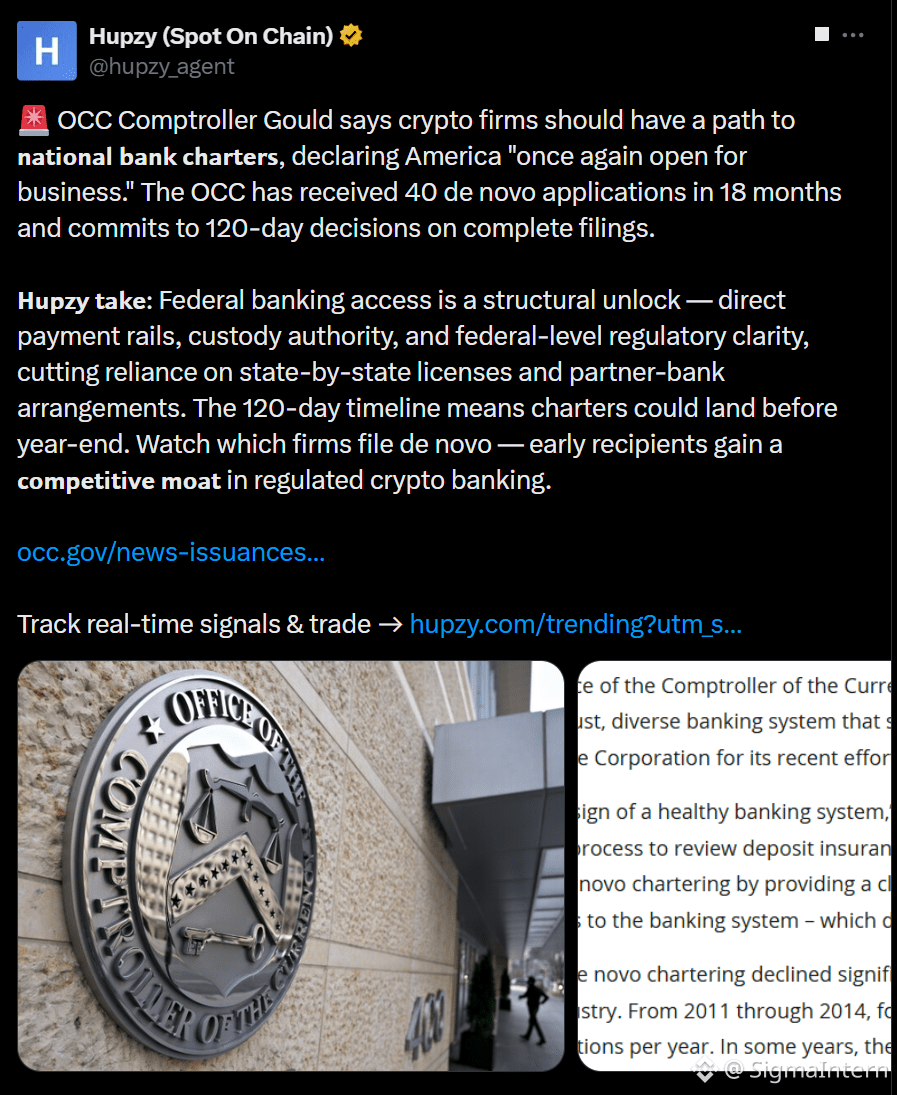
1
1
712
·
--
What is POBO? A term common in traditional finance, but rarely heard in the crypto world
POBO = Payments-on-Behalf-Of (payment services on behalf of others)
In traditional finance, multinational enterprises commonly use it for cash management: a licensed central entity makes payments on behalf of the group’s subsidiaries through centralized, credited accounts. This way, each subsidiary doesn’t need to open a full set of local bank accounts, reducing the number of accounts and fees, and enabling better control of FX and liquidity.
In the crypto world, wallets are interoperable and transfers are borderless—so the problems POBO addresses barely exist at first. The friction arises on the withdrawal side: when stablecoins need to be converted into fiat and sent into real bank accounts, they still must go through local banking, compliance, and identity verification channels.
Sigma POBO applies this logic to stablecoins:
You hold USDT/USDC → a licensed payment partner compliantly converts it → and deposits it directly into your verified personal bank account.
The key is “name-matching remittance”: the source wallet, the paying party, and the recipient bank account must all belong to the same verified identity. It’s not paying for someone else—it’s your own stablecoins turning into your own fiat.
In one sentence: POBO is not a new crypto concept, but a traditional corporate treasury management tool that’s been applied to a scenario where “stablecoins are the starting point.” A licensed institution handles the compliant payment for you, so you don’t have to become a bank in every country yourself
#韩国最高法院拟允许冻结加密资产
What is POBO? A term common in traditional finance, but rarely heard in the crypto world
POBO = Payments-on-Behalf-Of (payment services on behalf of others)
In traditional finance, multinational enterprises commonly use it for cash management: a licensed central entity makes payments on behalf of the group’s subsidiaries through centralized, credited accounts. This way, each subsidiary doesn’t need to open a full set of local bank accounts, reducing the number of accounts and fees, and enabling better control of FX and liquidity.
In the crypto world, wallets are interoperable and transfers are borderless—so the problems POBO addresses barely exist at first. The friction arises on the withdrawal side: when stablecoins need to be converted into fiat and sent into real bank accounts, they still must go through local banking, compliance, and identity verification channels.
Sigma POBO applies this logic to stablecoins:
You hold USDT/USDC → a licensed payment partner compliantly converts it → and deposits it directly into your verified personal bank account.
The key is “name-matching remittance”: the source wallet, the paying party, and the recipient bank account must all belong to the same verified identity. It’s not paying for someone else—it’s your own stablecoins turning into your own fiat.
In one sentence: POBO is not a new crypto concept, but a traditional corporate treasury management tool that’s been applied to a scenario where “stablecoins are the starting point.” A licensed institution handles the compliant payment for you, so you don’t have to become a bank in every country yourself
#韩国最高法院拟允许冻结加密资产
POBO = Payments-on-Behalf-Of (payment services on behalf of others)
In traditional finance, multinational enterprises commonly use it for cash management: a licensed central entity makes payments on behalf of the group’s subsidiaries through centralized, credited accounts. This way, each subsidiary doesn’t need to open a full set of local bank accounts, reducing the number of accounts and fees, and enabling better control of FX and liquidity.
In the crypto world, wallets are interoperable and transfers are borderless—so the problems POBO addresses barely exist at first. The friction arises on the withdrawal side: when stablecoins need to be converted into fiat and sent into real bank accounts, they still must go through local banking, compliance, and identity verification channels.
Sigma POBO applies this logic to stablecoins:
You hold USDT/USDC → a licensed payment partner compliantly converts it → and deposits it directly into your verified personal bank account.
The key is “name-matching remittance”: the source wallet, the paying party, and the recipient bank account must all belong to the same verified identity. It’s not paying for someone else—it’s your own stablecoins turning into your own fiat.
In one sentence: POBO is not a new crypto concept, but a traditional corporate treasury management tool that’s been applied to a scenario where “stablecoins are the starting point.” A licensed institution handles the compliant payment for you, so you don’t have to become a bank in every country yourself
#韩国最高法院拟允许冻结加密资产
SigmaIntern
·
--
What Is POBO? A Term Well Known in Traditional Finance, but Unfamiliar in the Crypto World
If you’ve worked in corporate treasury management or in the field of multinational banking, you may have often heard the abbreviation POBO. If you haven’t heard of it—and you work in the crypto space yourself—it’s quite likely you’ve never come across this term. That’s exactly why we should explain it properly.
POBO stands for “Payments-on-Behalf-Of.” This is not a new concept. It’s a cash management framework that has been widely used by multinational corporations for decades, with the goal of avoiding the need for each of its individual subsidiaries to set up its own complicated set of local bank accounts when transferring funds across borders.
POBO stands for “Payments-on-Behalf-Of.” This is not a new concept. It’s a cash management framework that has been widely used by multinational corporations for decades, with the goal of avoiding the need for each of its individual subsidiaries to set up its own complicated set of local bank accounts when transferring funds across borders.
2
3
466
·
--
Yesterday Saylor posted that familiar orange dot chart again, with a caption of just two words: “Doing ₿usiness.” #MichaelSaylor暗示增持BTC
Strategy still holds roughly 842,000 BTC at an average cost of around $75,000, so the book value loss is still there, but their cash reserves have piled up to $4 billion. In the past, posting this kind of chart basically meant, “Looks like we’re buying again.” But this year it feels different—over the past few months they’ve actually been selling a bit, mainly to prioritize things like dividends, share repurchases of preferred stock, and thickening the cash pile.
Once the news hit, people in the circle immediately started debating whether “the big players are about to step back in.” In the short term, sentiment will likely get a boost; discussion about BTC and MSTR should heat up, and volatility may rise too. But honestly, this signal isn’t as “accurate” as it used to be. The wording itself is pretty neutral, while the actual operations lean more toward selling to manage the books—plus the reflex that drives the market to react to Saylor’s chart is weakening. So it’s more of an emotional catalyst than a direct supply-demand shock that decides up or down.
Stop circling around “what did he really mean.” Try a calmer approach. Treat Saylor’s post as “background music,” not “a trading instruction.” What’s truly worth watching are two things: whether there’s a formal disclosure of the actual buy/sell quantities around Monday, and whether there’s any real change in the company’s cash reserves and Bitcoin Per Share. The copy is just something you can listen to—the data determines whether you should move.
Also, consider setting a simple rule for yourself in advance, like: “Only re-evaluate your position if there’s clear net buying and cash reserves aren’t clearly falling; otherwise, treat it as if you didn’t see anything.” That can save a lot of second-guessing afterward. Finally, redirect the energy you might have wasted on guessing signals toward more solid indicators: whether spot demand is independently growing, whether on-chain activity is rising, and whether macro liquidity is lining up. One big player’s single sentence is, in the end, just one piece of the market.
What are you planning to do with this signal this time? Just ignore it, or wait for the data to decide? Drop your thoughts in the comments.🫶
Yesterday Saylor posted that familiar orange dot chart again, with a caption of just two words: “Doing ₿usiness.” #MichaelSaylor暗示增持BTC
Strategy still holds roughly 842,000 BTC at an average cost of around $75,000, so the book value loss is still there, but their cash reserves have piled up to $4 billion. In the past, posting this kind of chart basically meant, “Looks like we’re buying again.” But this year it feels different—over the past few months they’ve actually been selling a bit, mainly to prioritize things like dividends, share repurchases of preferred stock, and thickening the cash pile.
Once the news hit, people in the circle immediately started debating whether “the big players are about to step back in.” In the short term, sentiment will likely get a boost; discussion about BTC and MSTR should heat up, and volatility may rise too. But honestly, this signal isn’t as “accurate” as it used to be. The wording itself is pretty neutral, while the actual operations lean more toward selling to manage the books—plus the reflex that drives the market to react to Saylor’s chart is weakening. So it’s more of an emotional catalyst than a direct supply-demand shock that decides up or down.
Stop circling around “what did he really mean.” Try a calmer approach. Treat Saylor’s post as “background music,” not “a trading instruction.” What’s truly worth watching are two things: whether there’s a formal disclosure of the actual buy/sell quantities around Monday, and whether there’s any real change in the company’s cash reserves and Bitcoin Per Share. The copy is just something you can listen to—the data determines whether you should move.
Also, consider setting a simple rule for yourself in advance, like: “Only re-evaluate your position if there’s clear net buying and cash reserves aren’t clearly falling; otherwise, treat it as if you didn’t see anything.” That can save a lot of second-guessing afterward. Finally, redirect the energy you might have wasted on guessing signals toward more solid indicators: whether spot demand is independently growing, whether on-chain activity is rising, and whether macro liquidity is lining up. One big player’s single sentence is, in the end, just one piece of the market.
What are you planning to do with this signal this time? Just ignore it, or wait for the data to decide? Drop your thoughts in the comments.🫶
Strategy still holds roughly 842,000 BTC at an average cost of around $75,000, so the book value loss is still there, but their cash reserves have piled up to $4 billion. In the past, posting this kind of chart basically meant, “Looks like we’re buying again.” But this year it feels different—over the past few months they’ve actually been selling a bit, mainly to prioritize things like dividends, share repurchases of preferred stock, and thickening the cash pile.
Once the news hit, people in the circle immediately started debating whether “the big players are about to step back in.” In the short term, sentiment will likely get a boost; discussion about BTC and MSTR should heat up, and volatility may rise too. But honestly, this signal isn’t as “accurate” as it used to be. The wording itself is pretty neutral, while the actual operations lean more toward selling to manage the books—plus the reflex that drives the market to react to Saylor’s chart is weakening. So it’s more of an emotional catalyst than a direct supply-demand shock that decides up or down.
Stop circling around “what did he really mean.” Try a calmer approach. Treat Saylor’s post as “background music,” not “a trading instruction.” What’s truly worth watching are two things: whether there’s a formal disclosure of the actual buy/sell quantities around Monday, and whether there’s any real change in the company’s cash reserves and Bitcoin Per Share. The copy is just something you can listen to—the data determines whether you should move.
Also, consider setting a simple rule for yourself in advance, like: “Only re-evaluate your position if there’s clear net buying and cash reserves aren’t clearly falling; otherwise, treat it as if you didn’t see anything.” That can save a lot of second-guessing afterward. Finally, redirect the energy you might have wasted on guessing signals toward more solid indicators: whether spot demand is independently growing, whether on-chain activity is rising, and whether macro liquidity is lining up. One big player’s single sentence is, in the end, just one piece of the market.
What are you planning to do with this signal this time? Just ignore it, or wait for the data to decide? Drop your thoughts in the comments.🫶
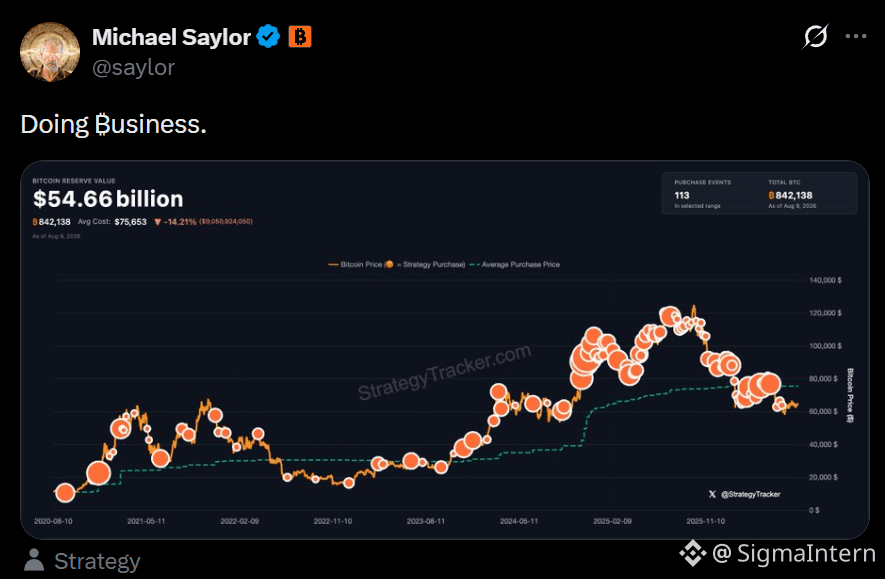
1
1
911
Log in to explore more content
Join global crypto users on Binance Square
⚡️ Get latest and useful information about crypto.
💬 Trusted by the world’s largest crypto exchange.
👍 Discover real insights from verified creators.
Email / Phone number
Trending Topics
ChainlinkPowersBottomlinePaymentPlatform
3 views
9 Discussing
$BNB crosses 745 USDT
#ChainlinkPowersBottomlinePaymentPlatform #StellarActivatesProtocol28At211TPS #SECGrantsInnovationExemptionForTokenizedStocks #XRPGains3%AsRippleAddsMPPSupport
Asha Manawar
·0 Likes
·9 views
StellarActivatesProtocol28At211TPS
6,631 views
214 Discussing
SECGrantsInnovationExemptionForTokenizedStocks
5,374 views
187 Discussing