
Shaun Huang
116 Posts

Shaun Huang
Report
Block User
0 Following
35 Followers
60 Liked
Posts
·
--
🚨 Anthropic’s valuation may be cut by 25%! A $1.5 trillion IPO—is the AI bubble starting to burst? 🤖📉
📅 2026/11/03|Wall Street is becoming more cautious about AI giants’ valuations!
Claude developer Anthropic is preparing to go public. Some institutional investors want its IPO valuation to come in at $1.5–$1.6 trillion, below the $2 trillion discussed earlier!
📊 ① Major disagreement over valuation
🔴 Previously discussed: About $2 trillion
🟡 Investors’ preference: $1.5–$1.6 trillion
📉 Valuation expectations have been revised down by about 20%–25%
⚠️ The IPO price has not yet been officially determined!
🤖 ② Is AI really underperforming?
In fact, revenue is still growing rapidly!
🟢 Q3 revenue: About $17 billion
🟢 Previous quarter’s revenue: About $11.6 billion
📈 Up about 46% quarter over quarter
But the company also faces enormous costs for AI computing power and infrastructure!
💰 ③ Why are investors becoming more cautious?
🔹 AI company valuations are already very high
🔹 Data center and computing costs are enormous
🔹 Tech stocks have recently faced sell-offs
🔹 The market is paying more attention to profits and cash flow
⚠️ Fast growth doesn’t mean a company is worth buying at any price!
📉 ④ What impact could this have on U.S. stocks and BTC?
If Anthropic prices its IPO conservatively, it could affect the market’s valuations of other AI companies.
🔴 High-valuation tech stocks could come under pressure
🟢 Reasonable pricing could also attract long-term investment
₿ BTC and ETH will depend on overall risk appetite and capital flows.
🎯 My take
I believe the AI technology revolution is still unfolding, but capital markets are shifting from chasing stories to scrutinizing actual returns.
AI isn’t necessarily a bubble, but AI companies’ valuations might be!
What really matters is whether companies can turn astonishing revenue growth into stable, long-term profits.
✨ “Technology can change the world, but investing can’t rely on imagination alone; even the greatest future needs a reasonable price.”
$BTC
$ETH
$HYPE
#anthropicipo遭投资者压价,估值盼降至1.5万亿美元

271
·
--
🚨 Trump Pledges a Whopping $5,000! If Republicans Win the Midterms, Will Every U.S. Adult Get Paid? 🇺🇸💰🔥
📅 2026/11/03|The U.S. midterm elections are here!
Trump has made a stunning promise: if Republicans hold on to both the Senate and the House in the midterms, every adult U.S. citizen will receive $5,000!
💵 ① How extraordinary is this cash giveaway plan?
🟢 Each adult citizen: $5,000
🟢 About 240 million people would meet the basic eligibility requirements
💰 Total cost: about $1.2 trillion!
🇺🇸 Trump says the money must be spent within the United States.
⚠️ ② Is the payout really guaranteed?
Not yet!
🔴 Republicans must hold on to both chambers of Congress
🔴 The issue of congressional approval still needs to be resolved
🔴 The funding source and distribution timeline have not been determined
🔴 It is still unclear how spending within the U.S. would be enforced
This is an election promise, not an approved aid program!
🏦 ③ Where would the money come from?
Trump proposes using the fruits of the U.S. economy and tariff revenue.
But analysts say current tariff revenues would fall far short of covering spending of about $1.2 trillion!
📈 ④ What impact could this have on U.S. stocks, BTC, and gold?
🟢 If implemented, the policy could benefit consumer spending and market liquidity.
₿ BTC and U.S. stocks could get support if risk appetite improves.
🔴 But massive fiscal spending could also push up inflation and Treasury yields, putting pressure on risk assets instead.
⚠️ A cash payout does not mean BTC will definitely skyrocket!
🎯 My take
I think what’s most worth watching this time isn’t just the $5,000—it’s Trump’s attempt to use fiscal policy to shift market and voter expectations.
If money can’t make the devil turn a millstone, I’m definitely convinced.
But the real questions are:
Where will the $1.2 trillion come from? Who will bear the cost? And how much of that money will actually flow into the market?
✨ “Cash giveaways can stimulate spending for a while, but what truly determines whether wealth can grow is the value created by capital—not how much money is printed.”
$BTC
$ETH
$HYPE
#美国大选

255
·
--
📈💹 Trading Matters 📊💰7
🔥 Why is it that even when you read the market correctly, you still end up losing money? 5 survival rules every trader must learn! 📉💰
The market never lacks opportunities; what it lacks are traders who can survive long term!
Trading is not just about predicting rises and falls; it is also a test of discipline, risk, and human nature! 🎯
📊 ① Be prepared for losses
No strategy can guarantee a 100% win rate!
🔹 Set a stop loss before entering
🔹 Control the risk of each trade
🔹 Evaluate the risk-reward ratio
💡 A mature trader is not someone who never loses, but someone who still has another chance after losing.
⚡ ② Execution matters more than prediction
Even the best strategy is meaningless without execution!
📈 Enter decisively when it is time
📉 Do not average down when you should stop out
💰 Do not be greedy when it is time to take profit
Your greatest enemy is often yourself, unable to follow the plan.
🧠 ③ Don’t let market noise control you
News and social media have people calling for gains and losses every day.
You can refer to others’ opinions, but trading must be based on your own judgment!
⚠️ ④ Avoid deadly trading traps
🔴 Overtrading
🔴 Emotional scaling in
🔴 Trying to win back losses quickly
🔴 High leverage with no risk control
🔴 Arbitrarily changing your stop-loss plan
One loss of control can erase countless efforts!
🎯 ⑤ Trust experience, don’t worship intuition
Intuition can come from experience, but it cannot replace analysis.
Every entry needs a basis, not just a guess about whether price will rise or fall!
🔥 My view
The hardest part of trading is not learning how many techniques there are, but whether you can truly align knowledge and action.
The market always has opportunities, but once capital, patience, and discipline are lost, they are hard to rebuild.
We cannot control the market, but we can control the risk we take.
✨ "Trading is not about proving how smart you are, but about learning to control yourself. Only those who can protect their capital and discipline have the chance to go further."
$BTC
$ETH
$HYPE
#交易训练

112
·
--
🚨 The Nasdaq 100 has officially entered correction territory! AI stocks are plunging—could BTC face a sell-off too? 📉🔥
📅 2026/11/03|Selling pressure on U.S. tech stocks continues to mount!
The Nasdaq 100 closed at 27,989.82, down 1.39% for the day and 10.4% from its October 6 high, officially entering a technical correction!
📊 ① What happened in the U.S. stock market?
🔴 Nasdaq 100: 27,989.82 (−1.39%)
🔴 Philadelphia Semiconductor Index: −3.35%
🔴 AMD: −7.52%
🔴 Intel: −8.80%
🔴 Micron: −5.78%
⚠️ This is the Nasdaq 100’s third correction this year!
🤖 ② Is the AI bubble starting to burst?
The market is beginning to question:
🔹 Is investment in AI infrastructure excessive?
🔹 When will massive capital spending translate into profits?
🔹 Have tech stock valuations already priced in too much growth?
Major tech companies continue to invest in AI, but investors are no longer willing to accept lofty valuations unconditionally!
💰 ③ Will BTC and ETH get dragged down too?
When tech stocks are sold off, institutions may reduce their exposure to risk assets at the same time.
🔴 A decline in U.S. stocks could weigh on BTC and ETH
🔴 Leveraged positions could amplify market volatility
🟢 A weakening U.S. dollar and Treasury yields could provide support
⚠️ But a drop in tech stocks doesn’t mean BTC will inevitably plunge in tandem!
🏛️ ④ Three key things to watch next
1️⃣ The U.S. midterm election results and the market reaction
2️⃣ AI companies’ earnings and capital spending outlook
3️⃣ Nonfarm payrolls, CPI, and Federal Reserve rate expectations
🎯 My take
I believe the real cause for concern this time isn’t just that the index has fallen more than 10%—it’s that the market is starting to question whether AI investment can generate sufficient returns.
When investors are no longer willing to pay too much for future growth, stock prices can fall even as companies continue to grow!
For BTC, pay close attention to whether selling pressure in U.S. stocks turns into cross-market deleveraging.
✨ “The market’s most dangerous moment isn’t necessarily when companies stop growing, but when investors suddenly refuse to pay yesterday’s price for growth.”
$BTC
$ETH
$HYPE
#纳斯达克100指数进入调整区间

614
·
--
Verified
🚨 Strategy repurchases $208 million in STRC! Buys another 811 BTC—what is the whale positioning for? 🐋🔥
📅 2026/11/03|Michael Saylor makes another move!
Strategy announced its latest asset allocation! It continues to accumulate BTC and has also spent more than $200 million repurchasing preferred shares!
📊 ① Bitcoin holdings revealed
🟢 Added 811 BTC
💰 Purchase amount: $65.5 million
📈 Average price this time: $80,846
₿ Total holdings: 849,327 BTC
💵 Cumulative cost: approximately $64.08 billion
🎯 Overall average price: $75,451
Its current holdings now exceed 4% of BTC’s maximum supply!
🏦 ② Why repurchase $208 million in STRC?
Strategy repurchased approximately 2.09 million STRC preferred shares.
Worth noting:
🔴 The repurchase amount was about 3.18 times the amount spent on BTC this time!
STRC is not a cryptocurrency; it is a preferred share issued by Strategy.
The repurchase may help manage the company’s capital structure and future dividend obligations, but the company has not explicitly stated a specific motive for the buyback.
💰 ③ Where did the money come from?
Strategy sold MSTR common stock, raising approximately $164 million.
🔹 $65.5 million went toward buying BTC
🔹 $98.5 million was added to cash
🏦 STRC was repurchased using existing cash.
As of 11/01, dollar reserves and cash totaled approximately $4.9 billion!
🔥 ④ Is this bullish for BTC?
Continued purchases show that Strategy’s long-term BTC holding strategy remains unchanged.
But issuing more shares may dilute shareholders’ equity, while buybacks and dividend payments require funding.
⚠️ Institutional buying doesn’t guarantee that BTC will go up!
🎯 My take
I think the most noteworthy thing this time isn’t the 811 BTC—it’s that Strategy is devoting more funds to managing its capital structure.
A truly large institution needs to know not only how to buy assets, but also how to manage its capital and liabilities!
✨ “How many assets you can buy demonstrates your financial firepower; holding on to those assets amid market volatility is what truly tests your financial discipline.”
$BTC
$ETH
$HYPE
#strategy回购2.08亿美元strc并增持811枚比特币

153
·
--
Verified
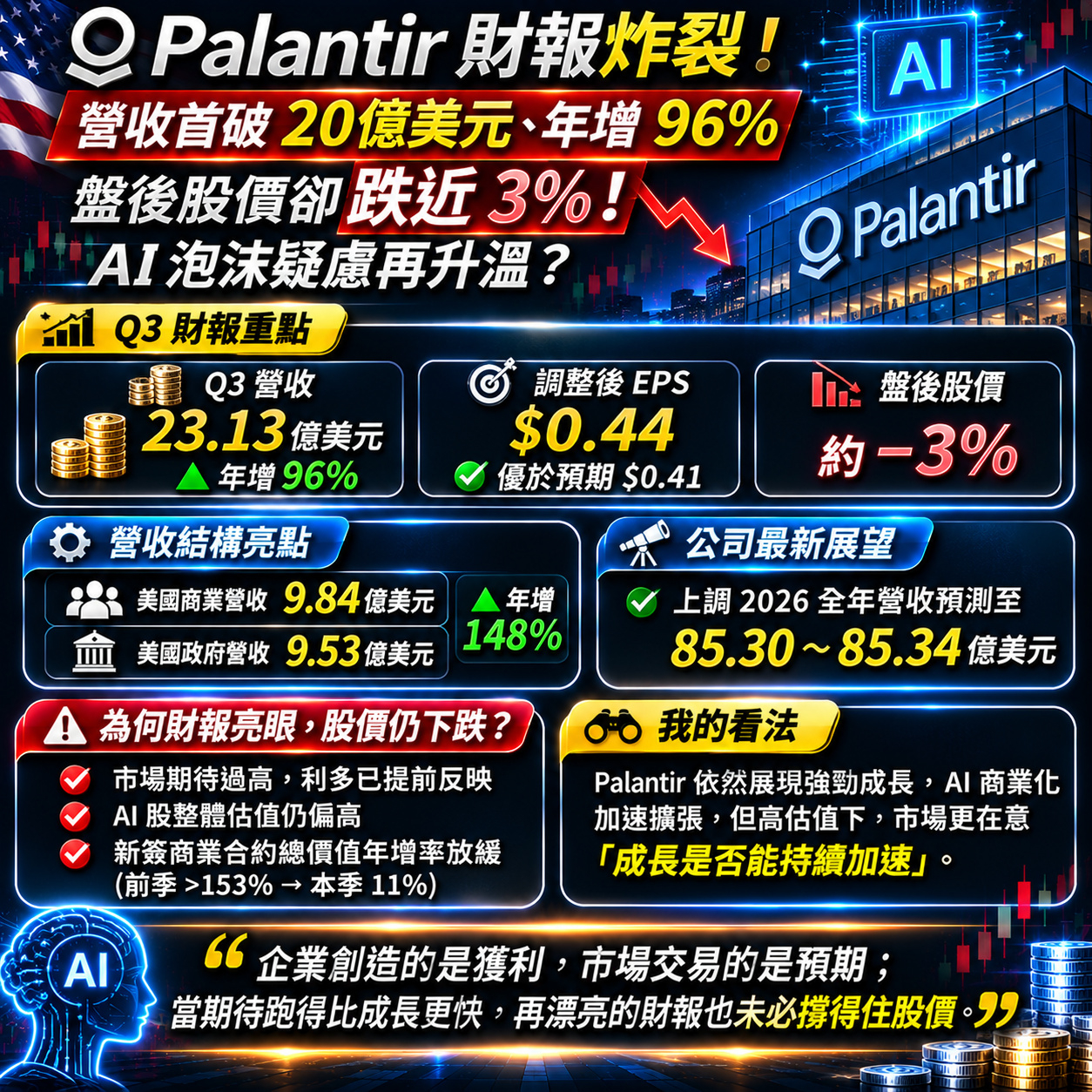
🚨 Palantir revenue surges 96%! But shares fall 3% after hours—what's happening to AI stocks? 🤖📉
🔥 2026/11/03|AI giant's earnings beat expectations, but the stock isn't responding!
U.S. AI software giant Palantir (PLTR) reported its third-quarter results, with revenue topping $2 billion for the first time—a major milestone!
📊 ① Earnings at a glance
🟢 Q3 revenue: $2.313 billion, up 96% year over year
🟢 Adjusted EPS: $0.44, beating expectations of $0.41
🟢 U.S. commercial revenue: $984 million, up 148% year over year
🟢 U.S. government revenue: $953 million
🔴 Shares fell about 3% after hours!
🚀 ② Is AI demand really that strong?
U.S. commercial revenue surpassed government revenue for the first time, signaling that Palantir's AI technology is gaining traction in the enterprise market!
The company also raised its full-year 2026 revenue forecast to $8.530–$8.534 billion.
⚠️ ③ With earnings this strong, why did the stock fall?
The key may not be revenue, but that market expectations were too high!
🔴 AI stocks are richly valued
🔴 Investors had already priced in growth expectations
🔴 Year-over-year growth in the total value of U.S. commercial contracts slowed to 11%, from over 153% in the previous quarter
Even with impressive earnings, the stock can still fall if some metrics fail to meet market expectations!
💰 ④ What impact could this have on NASDAQ and BTC?
If high-valuation AI stocks continue to face selling pressure, they could weigh on NASDAQ and overall risk appetite.
BTC and ETH could also be affected by market liquidity and risk aversion, but that doesn't mean they will necessarily fall in tandem.
🎯 My take
I think Palantir's earnings once again show that:
A great company isn't necessarily a great buy, and great earnings don't always lead to a rising stock price!
When the market has already priced in rapid growth, even stellar results may not be enough to meet investors' expectations.
✨ “Companies generate profits; markets trade expectations. When expectations grow faster than the business, even the most impressive earnings may not be enough to support the stock price.”
$BTC
$ETH
$HYPE
#palantir盘后跌3%营收破20亿美元
756
·
--
🚨 South Korea’s 11% tax on perpetual contracts takes a dramatic turn! Ministry of Finance officially denies report—traders, take note! 🇰🇷🔥
📅 2026/11/03|South Korean officials issue urgent clarification!
Just yesterday, reports claimed that South Korea would tax profits from U.S. stock perpetual contracts on overseas exchanges at 11% starting in 2027. Today, the Ministry of Economy and Finance officially denied those reports!
📊 ① Timeline
🔴 11/02|South Korean media reports
South Korea is considering taxing perpetual contracts on U.S. stocks such as TSLA, NVDA, and AAPL.
💰 Reported tax rate: 11%
💵 Annual basic deduction: 2.5 million won
📅 Reported start date: 2027
🟢 11/03|Ministry of Finance clarification
Officials stated:
❌ No decision has been made on whether to impose a tax
❌ The method of taxation has not been determined
❌ It cannot be said that the 11% proposal has been officially approved
⚠️ ② Does this mean perpetual contracts are tax-free?
No!
Officials denied that a decision to impose the tax had already been made; they did not announce a permanent tax exemption.
The relevant system may still be reconsidered in the future.
🏦 ③ South Korea’s crypto tax rules are still up in the air!
South Korea’s crypto-asset income tax, originally scheduled to take effect in 2027, is also facing discussions about a possible delay.
Some lawmakers are calling for a delay of around two years to improve relevant regulations and the oversight of cross-border trading.
💰 ④ What impact could this have on BTC and ETH?
In the short term, it may ease concerns that the new 11% tax will take effect immediately.
But this doesn’t mean BTC or ETH will necessarily rise, nor does it mean that all overseas contract trading is tax-free.
🎯 My take
Yesterday, the market was still discussing the 11% tax rate. Today, officials stepped in to deny the reports.
This is another reminder:
News can influence market sentiment, but rumors are not policy, and policy discussions are not the same as enacted laws!
When it comes to taxes and regulation in particular, traders should follow official announcements rather than relying only on headlines.
✨ “There’s never a shortage of market news. What truly matters isn’t who hears the rumor first, but who can separate fact from noise.”
$BTC
$ETH
$HYPE
#韩财政部否认永续合约征税报道

518
·
--
Verified
🚨 SBI’s Crypto Revenue in Japan Plunges 30.1%! Losses Nearly 11 Times Larger—What’s Happening in Crypto? 🇯🇵📉
🔥 2026/11/03|Japanese financial giant releases its latest earnings!
SBI Holdings’ crypto business declined sharply in the first half of its fiscal year (April–September), while the group’s overall revenue hit a record high for the same period!
📊 ① Earnings figures revealed
🔴 Crypto revenue: ¥23.083 billion, down 30.1% year over year
🔴 Pre-tax loss: ¥1.595 billion
🔴 Loss in the same period last year: ¥147 million
🟢 Group revenue: ¥1.0575 trillion, up 17.2% year over year
🟢 Group pre-tax profit: up 52.9% year over year
⚠️ The crypto business accounts for only about 2% of group revenue.
📉 ② Why did the crypto business decline?
Worth noting:
🔹 Revenue rose 25.9% year over year from April to June
🔹 But fell about 58.3% year over year from July to September
This means the decline was concentrated in the second quarter!
Market volatility, trading activity, and revenue composition are all worth monitoring, but for now, the decline cannot be directly attributed to BTC’s fall.
🏦 ③ Is SBI still expanding in the crypto market?
The answer is yes!
🇯🇵 Launched the JPYSC yen stablecoin
🏦 Completed its full acquisition of bitbank on October 1
💰 Continuing to expand its crypto trading infrastructure
Even as short-term profits come under pressure, SBI has not stopped building out its crypto business.
💰 ④ What impact could this have on BTC and ETH?
SBI’s earnings reflect operating pressures facing some crypto companies, but that doesn’t mean the overall market is necessarily entering a bear market.
Going forward, trading volumes, ETF fund flows, and market liquidity will remain important to watch.
🎯 My take
I think the most important question raised by these results is:
When market enthusiasm fades, will institutions with real staying power choose to retreat—or seize the opportunity to expand?
SBI’s choice is worth watching!
But continued investment doesn’t guarantee future profits; ultimately, it depends on whether the business can improve.
✨ “When markets are booming, everyone can talk about growth; when they cool down, that’s when it’s truly tested who can turn a vision into profit.”
$BTC
$ETH
$HYPE
#sbi上半财年加密业务收入下降30.1%

865
·
--
🚨 Nasdaq closes down 1.07%! Chip stocks plunge across the board as AI bubble fears mount! Will BTC and ETH get dragged down too? 📉🔥
🇺🇸 U.S. market close on 11/2: selling pressure on tech stocks flared up again! The Nasdaq reversed course and fell, while the Philadelphia Semiconductor Index plunged more than 3%. Investors continued pulling funds out of high-valuation tech stocks!
📊 ① Performance of the three major U.S. stock indexes
🔴 Nasdaq: 25,164.32 points, down 1.07%
🔴 S&P 500: 7,541.40 points, down 0.51%
🟢 Dow Jones Industrial Average: 51,983.98 points, up 0.41%
🔴 Philadelphia Semiconductor Index: down about 3.35%
⚠️ The Dow rose while the Nasdaq fell, reflecting a clear divergence between tech stocks and traditional industries!
💥 ② Chip stocks take the hardest hit
🔻 Intel (INTC): -8.80%
🔻 AMD: -7.52%
🔻 Micron (MU): -5.78%
🔻 Marvell (MRVL): -12.72%
🔻 NVIDIA (NVDA): about -1.26%
Selling pressure spread across semiconductor stocks. AI is no longer a guarantee of rising share prices!
🤖 ③ Why do tech stocks keep falling?
💰 Massive investment in AI infrastructure
🏦 Rising corporate debt and financing pressures
📉 Investment returns are slower than the market expected
⚠️ High-valuation stocks face repricing
Oracle plans to raise $20 billion, further fueling concerns about the cost of AI investments!
🪙 ④ What impact could this have on BTC and ETH?
🔴 Falling tech stocks could weaken risk appetite
🔴 Highly leveraged crypto positions face volatility risks
🟡 If the U.S. dollar and Treasury yields decline at the same time, that could provide support
🟢 BTC and ETH may only have a chance to improve if funds flow back into risk assets
⚠️ Falling tech stocks do not mean cryptocurrencies will necessarily fall in tandem!
🔍 ⑤ What should we watch next?
📌 Whether the semiconductor index can stabilize
📌 Whether buying interest emerges in NVIDIA and AMD
📌 The U.S. midterm election results
📌 U.S. nonfarm payrolls data on 11/6
📌 BTC and ETH trading volume and fund flows
🎯 My take
What’s really worth paying attention to in this downturn is not that AI technology has lost its value, but that the market is starting to demand proof that investments can generate real returns.
When investors are no longer willing to pay too much for future growth, the market reassesses risk.
🔥 The essence of trading and investing is not chasing the hottest trends, but recognizing genuinely valuable opportunities when market excitement fades!
$BTC
$ETH
$HYPE
#纳指收跌1.07%芯片股重挫

911
·
--
🚨 U.S. October nonfarm payrolls are about to be released! Is a rate cut still on the table? BTC, gold, and U.S. stocks may be in for a major move! 🇺🇸📊🔥
📅 On 11/6 at 9:30 PM (UTC+8), the U.S. will release its October nonfarm payrolls report! The market is watching not only the number of jobs added, but also whether the Federal Reserve will change its December interest rate policy!
📊 ① Market expectations for nonfarm payrolls
🔹 September job gains: 29,000
🔹 October market estimate: around 60,000–65,000
🔹 Estimated unemployment rate: 4.2%
🔹 Current Fed interest rate: 3.75%–4.00%
⚠️ These are estimates ahead of the release, not actual results!
🏦 ② Is a rate cut still possible?
🔴 Strong employment + accelerating wage growth: could support keeping rates high or even raising them.
🟢 Weak employment + cooling inflation: could bring rate-cut discussions back into focus.
🟡 Weak employment + persistently high inflation: the Fed will face a more difficult policy choice.
📉 ③ What impact could this have on BTC and ETH?
🚀 Weaker data and falling yields: could support a rebound in risk assets.
🔻 Strong data and a stronger U.S. dollar: could weigh on the crypto market.
⚠️ If the data comes in far below expectations, it could also spark recession fears—so it won't necessarily be directly bullish for BTC!
🥇 ④ How might gold and U.S. stocks react?
💰 Gold: watch the U.S. dollar and real Treasury yields.
📈 U.S. stocks: tech stocks are particularly sensitive to interest rate expectations.
🛢️ Oil: affected not only by the U.S. dollar, but also by expectations for global demand.
🎯 My take
What really matters in this nonfarm payrolls report isn't whether the numbers are good or bad, but whether they can change the market's view of the Fed's December policy.
After the report comes out, first watch the U.S. dollar, Treasury yields, and BTC trading volume, then assess whether the market move has staying power.
🔥 The essence of trading isn't guessing the data correctly in advance—it's identifying direction and risk as the market reprices!
$BTC
$ETH
$HYPE
#美国10月非农出炉:降息还有戏吗?

7
1
1.3k
·
--
Verified
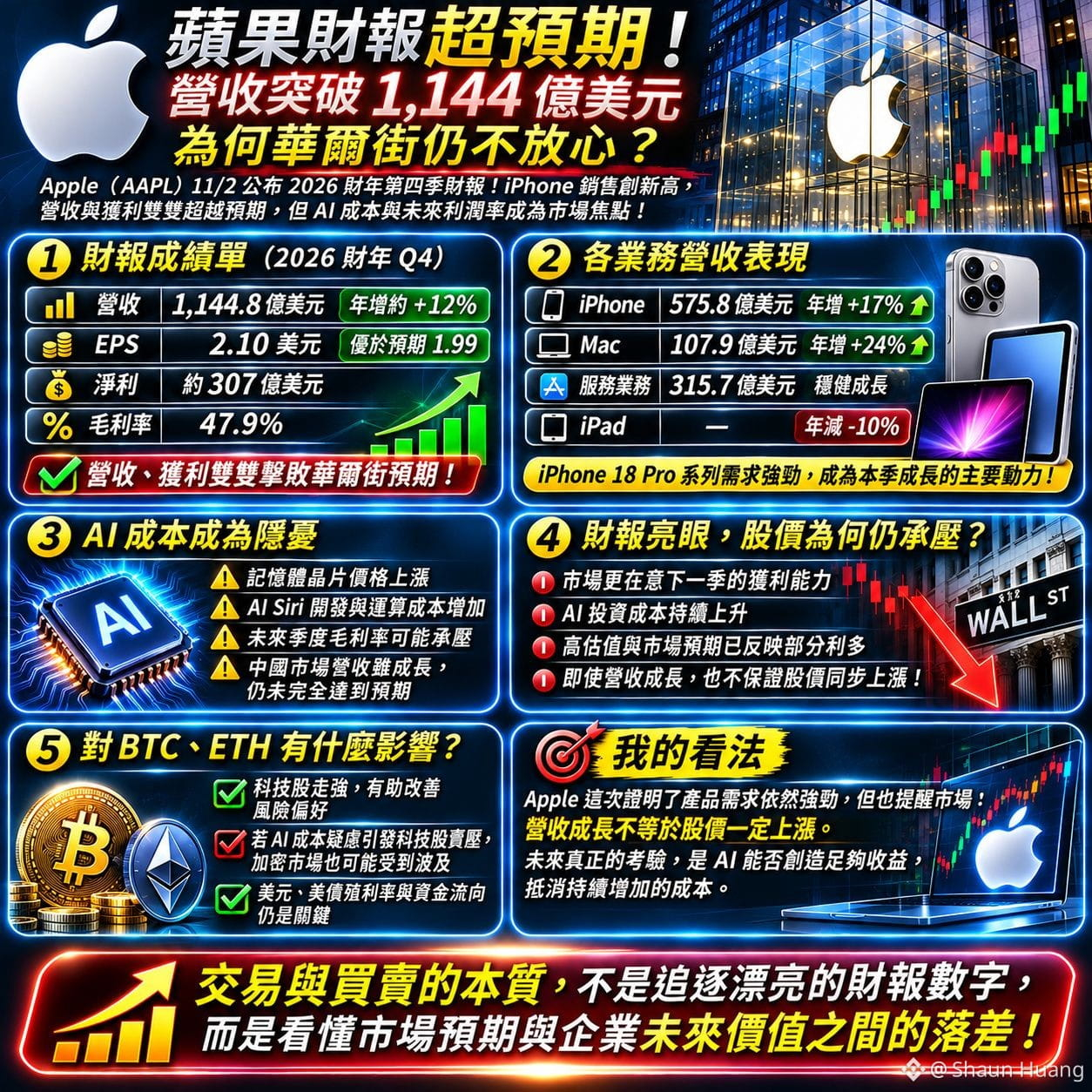
🚨 Apple earnings beat expectations! Revenue topped $114.4 billion—so why is Wall Street still uneasy? 🍎📊🔥
🔥 Apple (AAPL) reported its fourth-quarter fiscal 2026 results on 11/2! iPhone sales hit a record high, and both revenue and earnings beat expectations, but AI costs and future profit margins are now in the spotlight!
📊 ① Earnings at a glance
💰 Revenue: $114.48 billion, up about 12% year over year
📈 EPS: $2.10, above the $1.99 estimate
💵 Net income: about $30.7 billion
🏦 Gross margin: 47.9%
✅ Both revenue and earnings beat Wall Street expectations!
📱 ② The iPhone was the biggest contributor
🟢 iPhone revenue: $57.58 billion, up about 17% year over year
🟢 Mac revenue: $10.79 billion, up about 24% year over year
🟢 Services revenue: $31.57 billion
🔴 iPad revenue fell about 10% year over year
Strong demand for the iPhone 18 Pro lineup was a key driver of growth this quarter!
🤖 ③ AI costs raise concerns
⚠️ Memory chip prices are rising
⚠️ AI Siri development and computing costs are increasing
⚠️ Gross margins could come under pressure in future quarters
⚠️ Revenue in China grew, but still fell short of expectations
📉 ④ Strong earnings—so why is the stock still under pressure?
The market isn't just looking at how much the company earned this quarter; it's also focused on whether it can maintain its profitability next quarter.
As AI investment costs continue to rise, revenue growth alone doesn't guarantee the stock will rise too!
🌍 ⑤ What does this mean for BTC and ETH?
📈 Strength in tech stocks could help improve risk appetite
📉 If concerns about AI costs trigger selling in tech stocks, crypto markets could also be affected
💵 The dollar, Treasury yields, and capital flows remain key factors
⚠️ Apple's earnings won't directly determine whether BTC rises or falls; broader market fund flows still need to be watched.
🎯 My take
Apple's results show that demand for its products remains strong, but they also remind the market that revenue growth doesn't necessarily mean the stock will rise.
The real test ahead is whether AI can generate enough returns to offset its rising costs.
🔥 The essence of trading and investing isn't chasing impressive earnings figures—it's understanding the gap between market expectations and a company's future value!
$BTC
$ETH
$HYPE
#苹果财报发布在即,股价能否再创新高
961
·
--
🚨 Countdown to the U.S. midterm elections! Wall Street’s window for a high-stakes game is opening—are U.S. stocks and BTC about to shift direction? 🇺🇸📊🔥
📅 2026/11/03|The U.S. midterm elections are here!
The market is watching more than just changes in congressional seats. It’s also focused on post-election policy direction, Federal Reserve rate expectations, and how global capital will reposition!
📈 ① Historical trends around midterm elections
Historical data shows that U.S. stocks often perform strongly in the 6 to 12 months after midterm elections.
🟢 Political uncertainty gradually fades
🟢 Investors reassess the policy outlook
🟢 Institutional investors may adjust their holdings
⚠️ But historical trends don’t guarantee that stocks will rise this year!
🏛️ ② Three key areas of market focus
🔹 Changes in congressional control: Affect tax, fiscal, and cryptocurrency regulatory policies.
🔹 AI and semiconductors: The market continues to assess tech giants’ capital spending and profitability.
🔹 Federal Reserve policy: Employment, inflation, and the path of interest rates remain key market variables.
💰 ③ Will BTC rally along with U.S. stocks?
🟢 If risk appetite rebounds after the election, BTC could find support.
🔴 If the U.S. dollar and Treasury yields strengthen, BTC could remain under pressure.
⚠️ A rise in U.S. stocks doesn’t mean cryptocurrencies will necessarily rally too!
🎯 ④ What I’ll be watching
📊 Whether the S&P 500 and NASDAQ can hold key support levels
💵 Whether the U.S. Dollar Index and Treasury yields weaken
₿ Whether BTC can break through resistance on strong volume
🔥 My view
I think what really matters in this election isn’t which party wins, but how much the result differs from market expectations.
If uncertainty declines, capital may flow back into the market. But if the good news is already priced in, beware of post-election profit-taking!
✨ “The market’s sharpest swings often don’t happen when the answer is unknown, but after it’s revealed—when capital starts choosing a new direction.”
$BTC
$ETH
$HYPE
#美国中期选举倒计时,美股博弈窗口已开启?

520
·
--
🚨 U.S. October Nonfarm Payrolls Are Coming! Is a Rate Cut Still on the Table? BTC, U.S. Stocks, and Gold Face a Test! 📉🔥
📅 2026/11/06|Release at 21:30 Taiwan time!
The U.S. October jobs report is about to be released! The market is watching not only the number of jobs added, but also what the Fed will do next: cut rates, hold them steady, or hike them again!
📊 ① What are market expectations?
🔹 Some institutions forecast around 50,000 jobs added
🔹 Unemployment rate forecast at around 4.1%
🔹 Previous unemployment rate: 4.2%
⚠️ These are forecasts from individual institutions, not official figures.
🔥 ② Three possible scenarios
🟢 Employment comes in well below expectations
The economy cools, potentially boosting rate-cut expectations.
📈 Gold may benefit
📈 BTC and U.S. stocks may rebound, but watch out for recession fears.
🔴 Employment comes in well above expectations
The economy remains resilient, and the Fed may maintain a hawkish stance.
📈 The U.S. dollar and Treasury yields may strengthen
📉 BTC and gold may come under pressure.
🟡 Employment meets expectations
The market may refocus on inflation, wage growth, and remarks from Fed officials.
🏦 ③ Is a rate cut still possible?
The October FOMC held rates at 3.75%–4.00%.
Inflation remains elevated, and some officials even believe rate hikes may be needed in the future!
So, weaker employment does not necessarily mean a rate cut.
🎯 My take
I think the most important thing about this jobs report isn't the number itself, but how the market reprices rate expectations after its release.
BTC is particularly sensitive to market sentiment right now. If the data triggers sharp swings in the U.S. dollar and Treasury yields, leveraged traders should be especially alert to false breakouts and cascading liquidations!
✨ “What truly drives the market isn’t just whether the data is good or bad, but what the market believed beforehand—and how much of that expectation reality upends.”
$BTC
$ETH
$HYPE
#美国10月非农出炉:降息还有戏吗?

762
·
--
🚨 Bitcoin has held above the 50-week moving average for 7 consecutive weeks! Are BTC bulls preparing for a comeback? 📈🔥
📅 2026/11/02|BTC flashes an important technical signal!
Alex Thorn, Head of Research at Galaxy Research, notes that Bitcoin has closed above its 50-week moving average for 7 consecutive weeks. Even after major negative news recently hit the market, its technical structure has not been completely broken!
📊 ① What does the 50-week moving average mean?
The 50-week moving average (50W MA) is the average closing price over the past 50 weeks and an important indicator for tracking the medium- to long-term trend.
🟢 Holding above it: The medium- to long-term structure is relatively strong
🔴 Breaking below it and failing to recover: The risk of a weakening trend increases
⚠️ Holding above the moving average does not mean prices will rise every week, nor does it guarantee that a bull market has begun.
🔥 ② Why do 7 consecutive weeks matter?
BTC previously spent an extended period below its 50-week moving average. Now that it has reclaimed the average for 7 consecutive weeks, buyers appear to still have some support.
Even amid exchange security incidents, market panic, and concerns about leveraged liquidations, the weekly chart structure has remained resilient.
🎯 ③ Which price levels should we watch next?
🟢 50-week moving average: approximately $75,728
🟡 Short-term resistance: $78,800–$80,100
🔴 If the weekly price breaks below the 50-week moving average, watch for selling pressure to intensify.
These are technical reference levels cited in the report, not fixed support levels or guaranteed rebound prices.
💰 ④ What this means for the crypto market
If BTC can continue to hold above its medium- to long-term moving average and break through the resistance above, it could help improve market confidence.
However, if trading volume is insufficient and capital continues to flow out, this could also turn into a false breakout.
🎯 My take
I think what’s truly worth watching is not the figure of 7 consecutive weeks, but whether the market can hold its key technical structure despite major negative news.
Short-term volatility can be intense, but more signals are needed to confirm the medium- to long-term direction.
✨ “A true trend is not proven by a one-day surge. It is tested by the market time and again, yet still manages to hold its course.”
$BTC
$ETH
$HYPE
#比特币连续7周收于50周均线上方

1.2k
·
--
🚨 India’s central bank and FIU review offshore crypto cards! USDT payments may face restrictions! 🇮🇳💳
🔥 2026/11/02|India tightens oversight of cryptocurrency payments!
The Reserve Bank of India (RBI) and the Financial Intelligence Unit (FIU) are reviewing offshore crypto payment cards, focusing on stablecoin payments, cross-border fund flows, and anti-money laundering rules.
💳 ① Which crypto cards are under scrutiny?
🔹 Offshore crypto payment services such as RedotPay
🔹 Visa and Mastercard card networks
🔹 Stablecoin payment methods using USDT, USDC, and others
These cards can convert crypto assets into fiat currency for everyday purchases and cash withdrawals.
⚠️ ② Why is India stepping up its review?
🔴 Offshore fund flows and foreign exchange regulations
🔴 Whether local payment regulations are being bypassed
🔴 KYC identity verification and anti-money laundering measures
🔴 Tracking the origins and transactions of crypto assets
Some users have already reported service restrictions, but no blanket ban has been confirmed so far.
🌍 ③ What impact could this have on the crypto market?
📉 Use of offshore crypto cards may be restricted
💰 Converting between stablecoins and fiat currencies may become more challenging
🏦 Compliance costs for payment providers may rise
🌐 The development of Web3 payments may be affected
But this does not mean India is banning cryptocurrency outright.
🎯 My take
Perhaps some people still think of India as a relatively underdeveloped country.
But never forget: India is the most populous country in the world! 🇮🇳
A huge population means enormous market potential and collective strength.
💡 Leverage can magnify the power of capital, while consensus can unite the strength of countless people.
When enough people move in the same direction, even whales and large institutions cannot ignore that force.
Of course, population does not equal purchasing power, and consensus does not guarantee rising prices. But any major crypto policy in India is worth the global market’s attention!
✨ “Whales can stir up waves, and institutions can sway short-term trends. But when the consensus of tens of millions converges into an ocean, the market’s direction is no longer decided by just a few.” 🌊
$BTC
$ETH
$HYPE
#印度央行与fiu审查境外加密卡

7
2
3k
·
--
🚨 South Korea plans to impose an 11% tax on U.S. stock perpetual contracts! Binance traders, take note! 🇰🇷💰
🔥 2026/11/02|South Korea announces major tax changes!
According to Korean media reports, the South Korean government plans to bring “U.S. stock perpetual contracts” on overseas crypto exchanges within the scope of taxation starting in 2027!
📊 ① Tax rules revealed
🔴 Expected implementation: 2027
💰 Tax rate: 11%
💵 Annual basic tax exemption: 2.5 million won
📉 Tax rate on overseas spot stocks: 22%
⚠️ The tax applies only to annual taxable profits after deducting the tax exemption—not a direct 11% deduction from every trade.
🏦 ② Which products are affected?
These include U.S. stock perpetual contracts offered by overseas exchanges:
🔹 TSLA|Tesla
🔹 NVDA|Nvidia
🔹 AAPL|Apple
🔹 Other U.S. stock-related perpetual contracts
These products can be traded with leverage 24 hours a day, using stablecoins as collateral.
📈 ③ How large is the market?
Reports indicate that from January to August 2026, trading volume for these products across 19 global exchanges reached approximately $1 trillion!
The South Korean government also plans to track overseas trading records as a basis for taxation.
⚠️ ④ Will BTC and ETH contracts also be taxed at 11%?
For now, this proposed 11% tax mainly targets U.S. stock-related perpetual contracts and cannot be directly applied to cryptocurrency contracts such as BTC and ETH.
South Korea’s crypto asset taxation system is also still subject to policy and legislative changes.
🎯 My take
What’s really worth watching this time isn’t just the 11% tax rate—it’s that governments around the world are beginning to bring derivatives on overseas crypto trading platforms into their regulatory and tax frameworks.
Going forward, traders will need to understand tax and cross-border regulatory risks, in addition to keeping an eye on market trends, leverage, and funding rates.
📌 Official confirmation from the South Korean government is still pending.
✨ “Trading costs aren’t limited to fees and funding rates. When regulations change the rules of the game, what really matters is how much profit you get to keep in the end.”
$BTC
$ETH
$HYPE
#韩国拟对美股永续合约征11%税

13
1
5.7k
·
--
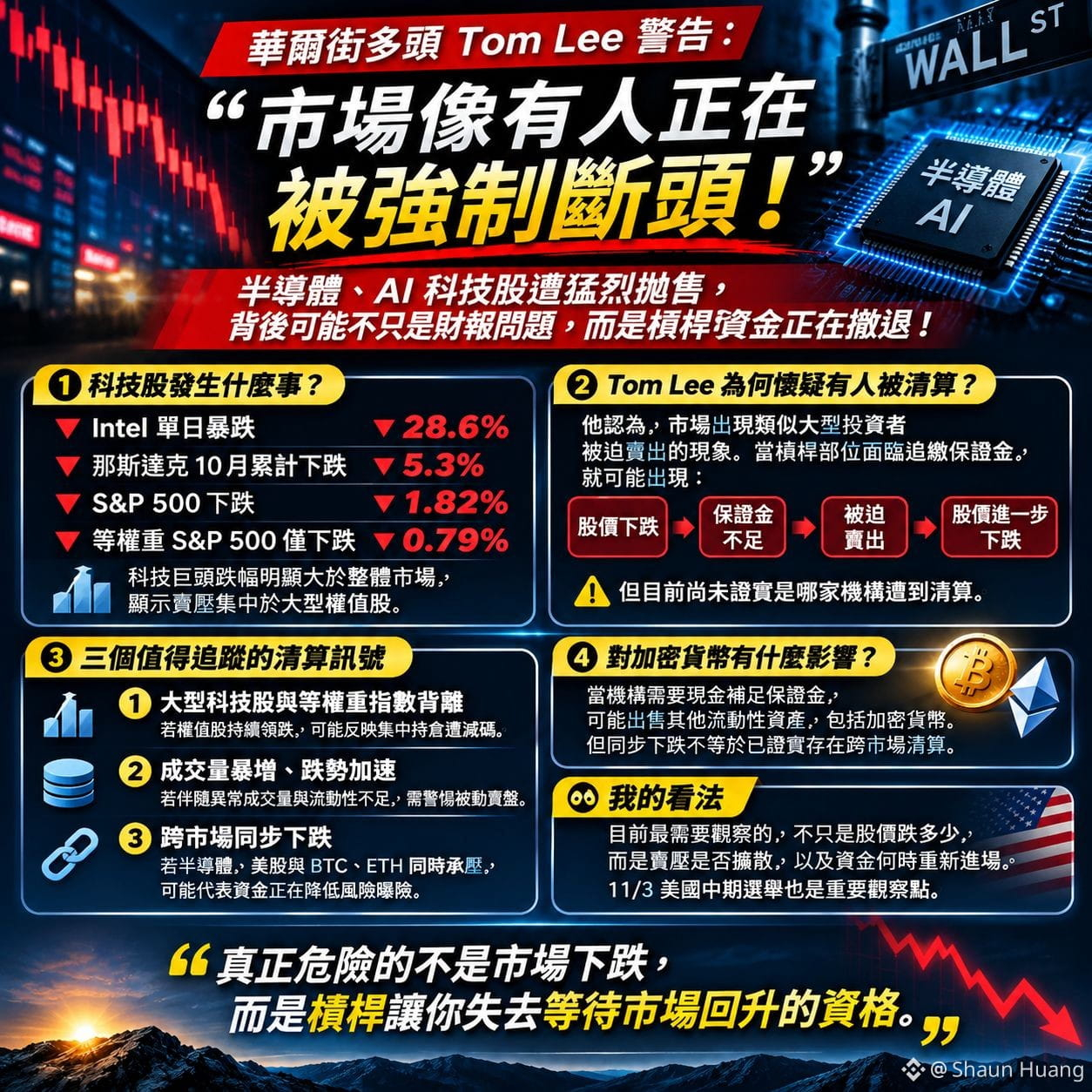
🚨 Wall Street bull Tom Lee warns: It looks like someone is being forcibly liquidated! 📉
🔥 Semiconductor and AI tech stocks are facing heavy selling. The reason may be more than just earnings—it could be leveraged investors pulling out!
📊 ① What’s happening with tech stocks?
🔴 Intel plunged 28.6% in a single day
🔴 The Nasdaq was down 5.3% in October
🔴 The S&P 500 fell 1.82%
🔴 The equal-weight S&P 500 fell just 0.79%
The declines in tech giants were much larger than those across the broader market, suggesting selling pressure was concentrated in large-cap stocks.
⚠️ ② Why does Tom Lee suspect someone is being liquidated?
He believes the market is showing signs of large investors being forced to sell.
When leveraged positions face margin calls, this can happen:
📉 Share prices fall → insufficient margin → forced selling → share prices fall further.
However, it has not yet been confirmed which institution, if any, has been liquidated.
🔎 ③ Three liquidation signals worth watching
1️⃣ Divergence between large-cap tech stocks and equal-weight indexes
If large-cap stocks continue to lead the declines, it could reflect concentrated positions being reduced.
2️⃣ Surging trading volume and accelerating declines
If accompanied by unusually high volume and insufficient liquidity, watch out for forced selling.
3️⃣ Synchronized declines across markets
If semiconductors, U.S. stocks, BTC, and ETH all come under pressure at the same time, it could mean investors are reducing their risk exposure.
💰 ④ How could this affect cryptocurrencies?
When institutions need cash to meet margin requirements, they may sell other liquid assets, including cryptocurrencies.
But synchronized declines do not prove that cross-market liquidations are taking place.
🎯 My take
The key things to watch right now aren’t just how far stock prices fall, but whether selling pressure spreads—and when investors return to the market.
The U.S. midterm elections on 11/3 are also an important event to watch.
✨ “The real danger isn’t a market downturn—it’s leverage robbing you of the ability to wait for a recovery.”
$BTC
$ETH
$HYPE
#Liquidations
1
635
·
--
🎙️ 2026/11/02 | A day to remember! 🚀
🔥 Today, I livestreamed with someone else on Binance for the very first time!
It might have been just an ordinary livestream to others, but for me, it was an important milestone in my trading journey! 🏆
Because I’m one step closer to my dream of hosting my own livestreams and sharing my trading insights and market analysis! 💪
📚 From constantly taking in information to bravely starting to share it.
I’ve spent a long time learning on my own, researching the market, and absorbing trading knowledge.
But I’ve gradually come to understand:
Taking in information without sharing it means progress is really slow!
Thinking you understand something doesn’t mean you truly do. Only by bravely sharing, welcoming questions, and accepting challenges can you discover where you need to improve.
📅 2026/02/06 | The day I first entered the crypto world.
In less than nine short months, I’ve experienced anticipation, losses, and setbacks, and even doubted myself. 📉
But every failure has made me reflect, and every fall has reminded me that there’s still so much to learn.
🌍 The world really is so, so big!
There’s so much knowledge I’ve yet to learn, so many experts I can learn from, and so many beautiful places waiting for me to see. 🌄
❤️ I’m so glad to have met all of you on this journey!
I’m no trading expert, and I haven’t made it yet. I’m just a learner working hard to be a little better today than I was yesterday.
I hope to keep sharing my market observations, trading logic, and real-life successes and failures. 📊
🤝 I hope you’ll follow and support me! ❤️
Every bit of support gives me the motivation to keep moving forward! I hope to achieve my goal of hosting my own livestreams soon, so we can connect, learn, and grow together! 🎙️🚀
✨ “True growth isn’t about never falling again; it’s about knowing a little better how to move forward each time you get back up.”
🌙 I’m off to bed feeling so happy and moved today! 😴
Another day of saying goodnight to the sunrise. 🌅
$BTC
$ETH
$HYPE
{future}(HYPEUSDT)
#Binance
🎙️ 2026/11/02 | A day to remember! 🚀
🔥 Today, I livestreamed with someone else on Binance for the very first time!
It might have been just an ordinary livestream to others, but for me, it was an important milestone in my trading journey! 🏆
Because I’m one step closer to my dream of hosting my own livestreams and sharing my trading insights and market analysis! 💪
📚 From constantly taking in information to bravely starting to share it.
I’ve spent a long time learning on my own, researching the market, and absorbing trading knowledge.
But I’ve gradually come to understand:
Taking in information without sharing it means progress is really slow!
Thinking you understand something doesn’t mean you truly do. Only by bravely sharing, welcoming questions, and accepting challenges can you discover where you need to improve.
📅 2026/02/06 | The day I first entered the crypto world.
In less than nine short months, I’ve experienced anticipation, losses, and setbacks, and even doubted myself. 📉
But every failure has made me reflect, and every fall has reminded me that there’s still so much to learn.
🌍 The world really is so, so big!
There’s so much knowledge I’ve yet to learn, so many experts I can learn from, and so many beautiful places waiting for me to see. 🌄
❤️ I’m so glad to have met all of you on this journey!
I’m no trading expert, and I haven’t made it yet. I’m just a learner working hard to be a little better today than I was yesterday.
I hope to keep sharing my market observations, trading logic, and real-life successes and failures. 📊
🤝 I hope you’ll follow and support me! ❤️
Every bit of support gives me the motivation to keep moving forward! I hope to achieve my goal of hosting my own livestreams soon, so we can connect, learn, and grow together! 🎙️🚀
✨ “True growth isn’t about never falling again; it’s about knowing a little better how to move forward each time you get back up.”
🌙 I’m off to bed feeling so happy and moved today! 😴
Another day of saying goodnight to the sunrise. 🌅
$BTC
$ETH
$HYPE
#Binance

2
536
·
--
🚨 FBI confirms North Korea's involvement in Binance's $6.3 billion theft! Are hackers moving funds through ETH and DeFi? 🔐💥
🔥 On 10/31, the U.S. FBI named the North Korea-linked hacking group TraderTraitor in connection with the major crypto asset theft from Binance on 10/29!
🚨 ① FBI announces investigation findings
📅 10/29: Large-scale asset theft from Binance
📅 10/31: FBI publicly names North Korea as being involved
💰 The FBI says the stolen assets exceed $6 billion
🔴 Market reports estimate the amount at around $6.3 billion
🕵️ Group involved: TraderTraitor
⚠️ This is the FBI's official attribution; it does not mean that everyone involved has been arrested.
💸 ② How are the hackers moving the funds?
Ξ Converting some of the stolen assets into ETH
🔄 Potentially swapping them further through DeFi platforms
🔐 Moving funds using instant exchange services
🔍 Law enforcement agencies are continuing to track the related on-chain addresses
🏦 ③ How is Binance responding?
✅ Announced that it has replenished around 90% of the stolen assets
✅ Pledged to cover the remaining losses
✅ Withdrawals to resume in phases starting 11/1
⚠️ Replenishing the assets does not mean the hackers' funds have been recovered!
📉 ④ What impact could this have on the crypto market?
🔴 The security of exchange assets is being called into question
🔴 BTC, ETH, and BNB are facing pressure on market confidence
🟡 Monitoring DeFi funds is becoming more important
🟢 The incident may prompt exchanges to strengthen security measures
🔍 ⑤ What should we watch next?
📌 Whether the stolen funds can continue to be frozen and recovered
📌 Whether Binance withdrawals and trading return fully to normal
📌 Whether the FBI releases more evidence from its investigation
📌 Whether market confidence in BTC and ETH can recover
🎯 My take
What's most worth paying attention to in this incident isn't just the $6.3 billion scale, but the chain reaction of risks involving centralized exchanges, DeFi, and the security of on-chain funds.
Even if an exchange covers the losses, that doesn't mean security vulnerabilities have been fixed or market confidence fully restored.
⚠️ The point of trading isn't to panic-sell at the first sign of bad news. It's to understand the real impact of events, manage risk, and wait for the market to rebuild confidence!
$BTC
$ETH
$HYPE
{future}(HYPEUSDT)
#fbi确认朝鲜应对币安被盗事件负责
🚨 FBI confirms North Korea's involvement in Binance's $6.3 billion theft! Are hackers moving funds through ETH and DeFi? 🔐💥
🔥 On 10/31, the U.S. FBI named the North Korea-linked hacking group TraderTraitor in connection with the major crypto asset theft from Binance on 10/29!
🚨 ① FBI announces investigation findings
📅 10/29: Large-scale asset theft from Binance
📅 10/31: FBI publicly names North Korea as being involved
💰 The FBI says the stolen assets exceed $6 billion
🔴 Market reports estimate the amount at around $6.3 billion
🕵️ Group involved: TraderTraitor
⚠️ This is the FBI's official attribution; it does not mean that everyone involved has been arrested.
💸 ② How are the hackers moving the funds?
Ξ Converting some of the stolen assets into ETH
🔄 Potentially swapping them further through DeFi platforms
🔐 Moving funds using instant exchange services
🔍 Law enforcement agencies are continuing to track the related on-chain addresses
🏦 ③ How is Binance responding?
✅ Announced that it has replenished around 90% of the stolen assets
✅ Pledged to cover the remaining losses
✅ Withdrawals to resume in phases starting 11/1
⚠️ Replenishing the assets does not mean the hackers' funds have been recovered!
📉 ④ What impact could this have on the crypto market?
🔴 The security of exchange assets is being called into question
🔴 BTC, ETH, and BNB are facing pressure on market confidence
🟡 Monitoring DeFi funds is becoming more important
🟢 The incident may prompt exchanges to strengthen security measures
🔍 ⑤ What should we watch next?
📌 Whether the stolen funds can continue to be frozen and recovered
📌 Whether Binance withdrawals and trading return fully to normal
📌 Whether the FBI releases more evidence from its investigation
📌 Whether market confidence in BTC and ETH can recover
🎯 My take
What's most worth paying attention to in this incident isn't just the $6.3 billion scale, but the chain reaction of risks involving centralized exchanges, DeFi, and the security of on-chain funds.
Even if an exchange covers the losses, that doesn't mean security vulnerabilities have been fixed or market confidence fully restored.
⚠️ The point of trading isn't to panic-sell at the first sign of bad news. It's to understand the real impact of events, manage risk, and wait for the market to rebuild confidence!
$BTC
$ETH
$HYPE
#fbi确认朝鲜应对币安被盗事件负责

1.1k
·
--
🚨 ETH ETF Fund Flow Alert! Around $1.6 billion in outflows in October—is institutional money leaving Ethereum? 📉🔥
🔥 U.S. spot ETH ETFs remain under pressure! Glassnode warns of an ongoing outflow trend, with net outflows recorded for 5 consecutive trading days at the end of October!
📊 ① Latest fund flows
🔴 Daily net outflow on 10/30: approximately $156 million
🔴 Over the last 5 trading days: approximately $431 million
🔴 For October as a whole: approximately $1.61 billion
⚠️ This reflects weakening investment demand for ETH from traditional financial markets.
🏦 ② Which ETFs saw outflows?
🔻 BlackRock ETHA: approximately $76.6 million
🔻 Grayscale ETH: approximately $34.1 million
🔻 Grayscale ETHE: approximately $21.5 million
📉 ③ Why is the 23-day figure drawing attention?
Glassnode points to a prolonged trend of outflows from ETH ETFs, with some media reports describing 23 consecutive days of net outflows.
⚠️ However, daily ETF data shows net inflows on 10/23, so the methodologies behind these two figures need to be distinguished!
🔍 ④ Why is ETH under pressure?
💵 The dollar and interest rate expectations are affecting risk appetite
📉 The broader crypto market is weakening
🏦 Institutions are adjusting their ETF holdings
💰 Funds may be shifting to other assets
📈 ⑤ What should we watch next?
✅ Whether ETFs return to net inflows
✅ Whether spot ETH trading volume recovers
✅ Shifts in fund flows between BTC and ETH
✅ Whether leverage in derivatives continues to decline
🎯 My take
Outflows from ETH ETFs are an important warning sign, but they don't mean Ethereum's long-term value has disappeared.
What really matters is whether the outflows can stop and whether the market sees sustained buying support.
⚠️ The essence of trading isn't to blindly turn bearish just because funds are flowing out. It's about distinguishing short-term panic from long-term trends and waiting for confirmation from the market!
$BTC
$ETH
$HYPE
{future}(HYPEUSDT)
#美国现货ethetf连续23日净流出
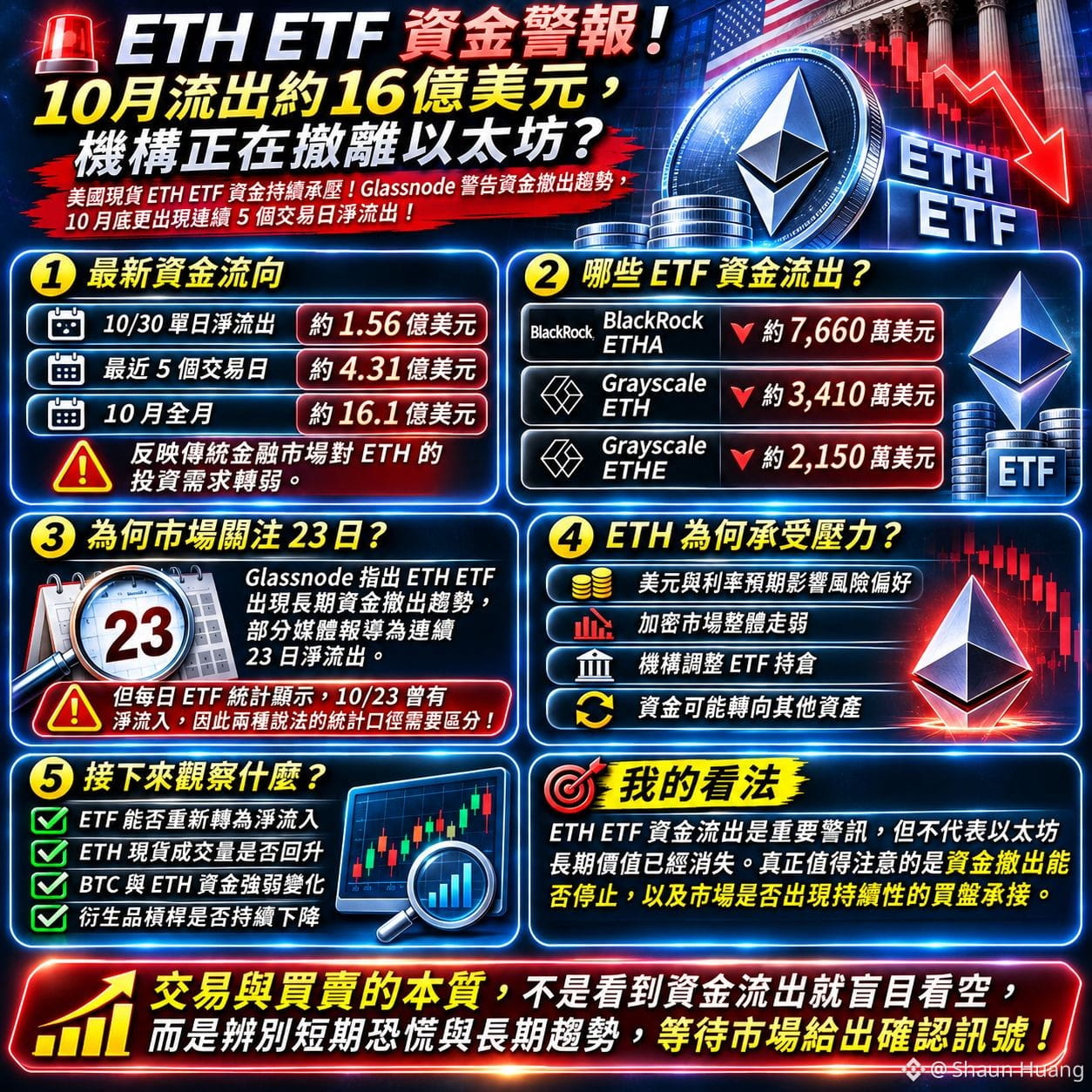
🚨 ETH ETF Fund Flow Alert! Around $1.6 billion in outflows in October—is institutional money leaving Ethereum? 📉🔥
🔥 U.S. spot ETH ETFs remain under pressure! Glassnode warns of an ongoing outflow trend, with net outflows recorded for 5 consecutive trading days at the end of October!
📊 ① Latest fund flows
🔴 Daily net outflow on 10/30: approximately $156 million
🔴 Over the last 5 trading days: approximately $431 million
🔴 For October as a whole: approximately $1.61 billion
⚠️ This reflects weakening investment demand for ETH from traditional financial markets.
🏦 ② Which ETFs saw outflows?
🔻 BlackRock ETHA: approximately $76.6 million
🔻 Grayscale ETH: approximately $34.1 million
🔻 Grayscale ETHE: approximately $21.5 million
📉 ③ Why is the 23-day figure drawing attention?
Glassnode points to a prolonged trend of outflows from ETH ETFs, with some media reports describing 23 consecutive days of net outflows.
⚠️ However, daily ETF data shows net inflows on 10/23, so the methodologies behind these two figures need to be distinguished!
🔍 ④ Why is ETH under pressure?
💵 The dollar and interest rate expectations are affecting risk appetite
📉 The broader crypto market is weakening
🏦 Institutions are adjusting their ETF holdings
💰 Funds may be shifting to other assets
📈 ⑤ What should we watch next?
✅ Whether ETFs return to net inflows
✅ Whether spot ETH trading volume recovers
✅ Shifts in fund flows between BTC and ETH
✅ Whether leverage in derivatives continues to decline
🎯 My take
Outflows from ETH ETFs are an important warning sign, but they don't mean Ethereum's long-term value has disappeared.
What really matters is whether the outflows can stop and whether the market sees sustained buying support.
⚠️ The essence of trading isn't to blindly turn bearish just because funds are flowing out. It's about distinguishing short-term panic from long-term trends and waiting for confirmation from the market!
$BTC
$ETH
$HYPE
#美国现货ethetf连续23日净流出
2.1k
Log in to explore more content
Join global crypto users on Binance Square
⚡️ Get latest and useful information about crypto.
💬 Trusted by the world’s largest crypto exchange.
👍 Discover real insights from verified creators.
Email / Phone number
Trending Topics
BinanceReopensWithdrawalsForMoreAssets
61,264 views
1,192 Discussing
Security Incident | Recovery Update #6: Withdrawals Reopen for More Assets (2026-11-03)
Binance Announcement
·180 Likes
·498.6k views
BinanceHourlyDepositsExceedWithdrawals
22,542 views
469 Discussing
AnthropicIPOPricedDownasInvestorsEye$1.5T
150 views
19 Discussing