
seaify
221 Posts

seaify
Report
Block User
Twitter:@seaify1
2 Following
697 Followers
438 Liked
Posts
All
Quotes
·
--
📊 Crypto Market Intelligence · 2026-11-04
📉 Overall sentiment for the day: Bearish
Stablecoins fell 0.77% over the past 2 days, with a slight outflow of funds; the recovery in AI earnings failed to reverse crypto weakness
💵 Total stablecoin market cap: $297.8 billion, down 0.77% over the past 2 days (-$2.33 billion)
💬 WeChat Group Chat Summary: Mixed views
The main topics across six groups were the Binance security incident, election-related disruption, and an earnings rebound after a sharp tech-stock selloff; few new on-chain launches, with attention on Elysium and a handful of memes. Anthropic’s pre-market price gap and the Ondo campaign can be checked, but should not be followed automatically.
• Review of the Binance social engineering attack sparked cross-group risk-control concerns
• Anthropic showed a pre-market price gap, but figures and market depth need verification
• The Ondo campaign runs through November 11; the rules were not fully shared
• Elysium: better to wait for the official launch before looking for new projects
• AMD earnings lifted sentiment, but crypto fell again toward the end of the window
• No confirmed new exchange-listing announcements; don’t treat group-chat speculation as a trigger
🎯 Narrative / Theme Clusters
1. High HBM profitability can coexist with concerns that the memory cycle is peaking ➖Neutral
Memory is still viewed as a relatively defensive part of the AI supply chain, but high profits and long-term orders coexist with concerns about future price declines; buybacks cannot guarantee a price floor.
2. Frontier models and voice agents continue to expand interactive capabilities ➖Neutral
Siri app intents, Hume’s voice-based judgment, and Tuwa’s phone agents are expanding the boundaries of interaction. The next-generation GPT remains a preview, so announcements should be distinguished from rumors.
3. Tokenization of institutional assets and agent payments continue to expand 📈Bullish
Cross River is bringing loan issuance and servicing to Arbitrum, while Base is expanding agent payments and stock applications, further widening access to on-chain finance.
4. Expectations grow for a strategic revaluation of independent laser suppliers 📈Bullish
A potential MRVL-LITE integration could prompt customers to seek independent laser sources, drawing attention to commercial suppliers such as Sivers. Any potential share shift still needs to be confirmed by orders.
5. TRX’s relative strength in a weak market and its revenue narrative 📈Bullish
TRON continues to highlight the scale of stablecoin settlements, while JST and SUN promote revenue-funded buybacks; real payment activity and value accrual to tokens should be verified separately.
6. PEPE holder growth supports a narrative of community resilience 📈Bullish
KOLs say PEPE has surpassed 600,000 Ethereum holders and expanded across multiple chains, but addresses may be duplicated and cannot be equated directly with independent user demand.
7. U.S. capacity expansion plans by memory makers still depend on investment ➖Neutral
SK hynix was reported to be in talks about Intel’s Ohio fab, while Solidigm is pursuing a separate $100 billion NAND project. Watch funding, approvals, and the timeline to mass production.
8. AI security platforms expand into agent runtime control and explainability 📈Bullish
CrowdStrike announced agent termination capabilities and is pursuing acquisitions in AI testing and observability. The spread of enterprise agents is creating new demand for security controls.
🔥 Trending Tokens
📉 $BNB Bearish · 8 mentions · The impact of the platform security shock has not been fully absorbed by replenished balances
📉 $BTC Bearish · 15 mentions · ETF outflows and stablecoin contraction are weighing on the rebound
📈 $HYPE Bullish · 6 mentions · Non-custodial trading and protocol revenue narratives are drawing attention
…4 other tokens
📌 Key Facts / Clarifications
1. AMD meeting the midpoint of its company guidance may not meet market expectations
Q3 revenue of $13.377 billion and adjusted EPS of $2.09 exceeded expectations of approximately $13.094 billion and $1.95, respectively. Q4 guidance of $17 billion is above the approximately $16.234 billion expected. Previous outlooks should be updated using the figures reported this time.
2. Nvidia’s customer requirement should not be described as a new government ban
The FT reported that Nvidia verbally asked cloud customers to sell at least 51% of their computing services to non-Chinese companies, with exemptions for existing contracts; Reuters has not independently verified this. This is a reported company requirement. Watch new orders; don’t claim existing computing capacity will be cut off immediately.
3. The core of the Binance theft was a breach in deployment permissions and the signing chain
The preliminary investigation points to malicious development tools, fake interviews, and lateral penetration through internal AI tools; deployment tokens ultimately reached the wallet signing service. Public excerpts do not prove that all hot wallets lacked multisig, nor that the attack was carried out solely through a single phishing incident.
4. Interpret Binance’s return to positive net flows in light of the time window and transfer types
The company said deposits exceeded withdrawals as of 03:00 UTC hourly. KOLs separately cited daily net inflows and cumulative outflows since withdrawals resumed. Different time windows are not contradictory; internal consolidations and institutional transfers also should not be treated directly as new retail funds.
5. Distinguish the levels of confirmation in reports of a breakthrough in Middle East talks and escalation
Oil prices fell on reports of a draft agreement, while Iranian officials denied this and maintained seven conditions; reports of limited U.S. strikes and ships attacked in the Strait also emerged. Statements by one side, anonymous reports, and confirmed passage should be treated as distinct levels of certainty. Don’t portray falling oil prices as proof that the conflict has ended.
6. Resumption of network withdrawals does not mean all tokens on that chain are available
The company reopened selected assets on the ETH and SOL networks in stages; the list does not cover every token on those networks. A newer Telegram update said withdrawals were closed again but did not list the assets or networks, so it does not support claims that withdrawals are halted sitewide or fully back to normal.
…59 other items
⚠️ Risk Warning: This article was generated by AI through unified analysis of sources including tweets, Telegram, and open news. Its conclusions may lag behind events; investing based on it involves substantial risk. It is intended only to gauge sentiment in U.S. stocks, A-shares, and crypto markets.
#加密货币 #行情分析 #BinanceSquare




21
·
--
Ever since the recent Binance incident, small players like us have been on edge. We’re constantly looking for ways to strengthen security on our servers and phones, too. Of course, I imagine there are still plenty of problems.
But I really didn’t expect Binance to be such a shambolic operation. Small players like us can’t withstand a devastating blow like this. Binance is huge, but I never imagined it would have such massive exposure to risk. I thought that with that much money, they’d have no idea how many security measures to put in place.
It just goes to show that Binance really is incredibly profitable.
After taking such a huge hit, surely they’ll overhaul security across the board, from top to bottom. This hurts so much. A lesson this big must have shaken them up.
Source: @seaify1 on X
Published using the 6551 Twitter mirror tool
1
353
·
--
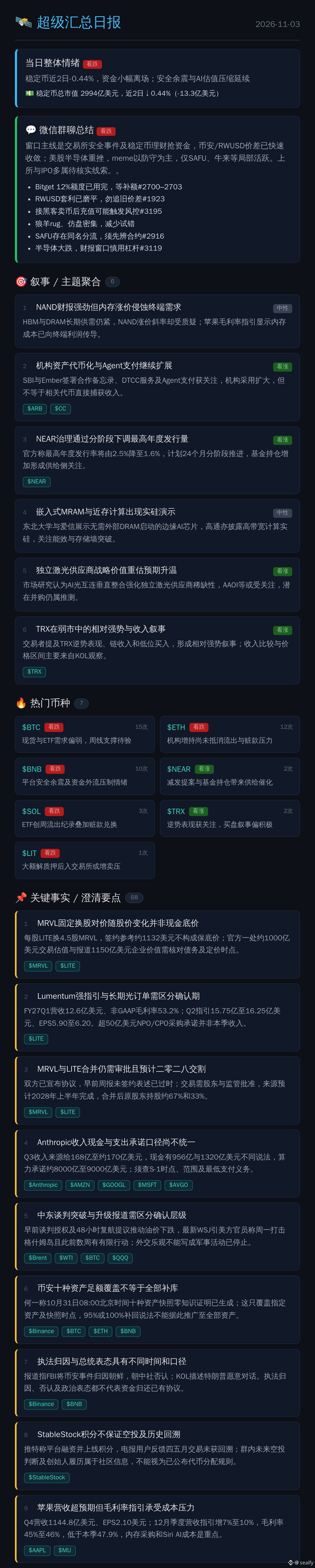
📊 Crypto Market Intelligence · 2026-11-03
📉 Overall sentiment today: Bearish
Stablecoins down 0.44% over the past 2 days, with a slight outflow of funds; security aftershocks and AI valuation compression continue
💵 Total stablecoin market cap: $299.4 billion, down 0.44% over the past 2 days (-$1.33 billion)
💬 WeChat group chat summary: Bearish
The main themes in this window were exchange security incidents and stablecoin yield products competing for funds; the Binance/RWUSD price spread has already narrowed rapidly. U.S. semiconductor stocks plunged, while meme coins were mostly defensive, with only localized activity in SAFU, 牛来, and others. Exchange listings and IPOs were mostly leads pending verification.
• Bitget's 12% allocation has been used up; waiting for replenishment #2700–2703
• RWUSD arbitrage spread has disappeared; don't chase the old spread #1923
• Deposits after receiving hacker-sold tokens may trigger risk controls #3195
• Wolf/Sheep rug pulls and copycats are widespread; reduce trial and error
• SAFU has namesakes causing confusion; verify the contract first #2916
• Semiconductor stocks plunged; use caution with leverage during earnings season #3119
🎯 Narrative / Theme Clusters
1. Strong NAND earnings, but rising memory prices are eroding end demand ➖ Neutral
Long-term supply and demand for HBM and DRAM remain tight, but the pace of NAND price increases is being questioned; Apple's gross margin guidance shows memory costs are flowing through to end-market profits.
2. Institutional asset tokenization and Agent payments continue to expand 📈 Bullish
SBI and Ember signed a memorandum of cooperation, while DTCC services and Agent payments are drawing attention. Institutional adoption is expanding, but that does not mean related tokens directly capture revenue.
3. NEAR governance passes a phased reduction in the maximum annual issuance rate 📈 Bullish
The official announcement says the maximum annual issuance rate will fall from 2.5% to 1.6%, with the plan to be implemented in phases over 24 months. Increased fund holdings are drawing attention to the supply side.
4. Real-silicon demonstrations emerge for embedded MRAM and near-memory computing ➖ Neutral
Northeastern University and Aisin demonstrated an edge AI chip that can boot without external DRAM; Qualcomm also unveiled real silicon for high-bandwidth computing. Focus on energy efficiency and overcoming the memory wall.
5. Expectations grow for a reassessment of the strategic value of independent laser suppliers 📈 Bullish
Market research suggests vertical integration in AI optical interconnects is increasing the scarcity value of independent laser suppliers. AAOI and others may attract attention, though potential acquisitions remain speculative.
6. TRX's relative strength in a weak market and its revenue narrative 📈 Bullish
Traders have cited TRX's performance against the trend, on-chain revenue, and buying at lows, forming a relative-strength narrative; revenue comparisons and price ranges are based mainly on KOL observations.
🔥 Trending Coins
📉 $BTC Bearish · 15 mentions · Weak spot and ETF demand; weekly support remains untested
📉 $ETH Bearish · 12 mentions · Institutional accumulation has yet to offset outflows and pressure from illicit funds
📉 $BNB Bearish · 10 mentions · Security aftershocks at platforms and fund outflows are weighing on sentiment
…4 more coins
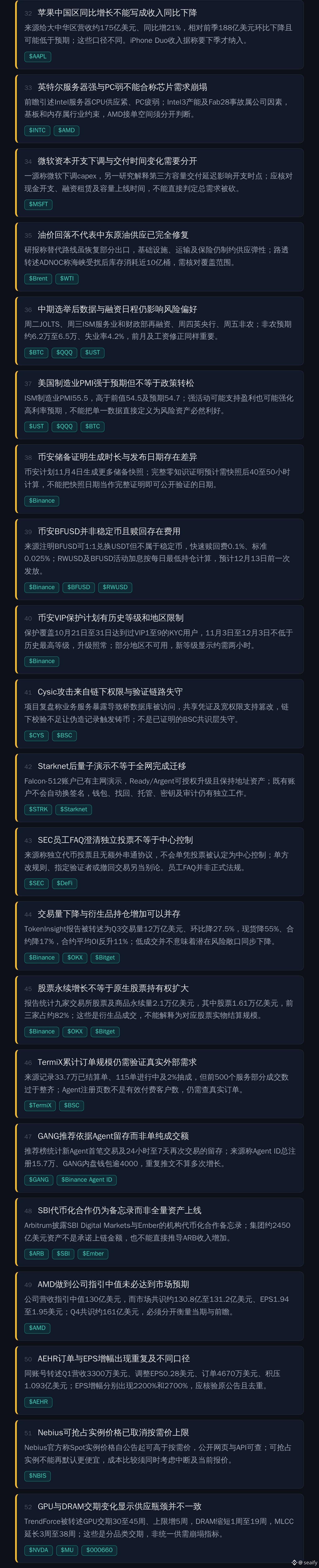
📌 Key Facts / Clarifications
1. MRVL's fixed share-exchange ratio changes in value with the stock price and is not a cash price floor
Each LITE share exchanges for 4.5 MRVL shares. The reference price of about $1,132 at signing is not a guaranteed minimum price; the official deal valuation of about $100 billion and reports citing an enterprise value of $115 billion should be checked against debt and the pricing date.
2. Distinguish Lumentum's strong guidance from the recognition period for long-term optical orders
FY27 Q1 revenue was $1.26 billion, with a non-GAAP gross margin of 53.2%; Q2 guidance is $1.575 billion to $1.625 billion in revenue and $5.90 to $6.20 in EPS. More than $5 billion in NPO/CPO purchase commitments is not revenue for this quarter.
3. The MRVL-LITE merger still requires approval and is expected to close in 2028
The companies have announced an agreement, so earlier weekly-report statements that it was unsigned are outdated. The deal requires shareholder and regulatory approval; sources expect completion in the first half of 2028, with former shareholders holding about 67% and 33% of the combined company.
4. Figures for Anthropic's revenue, cash, and spending commitments are not yet consistent
Q3 revenue sources cite $16.8 billion to about $17 billion; cash is reported variously as $95.6 billion and $132 billion, and computing commitments are about $800 billion to $900 billion. Check the S-1 date, scope, and minimum payment obligations.
5. Distinguish the level of confirmation for reports of breakthroughs in Middle East talks and military escalation
Earlier reports of authorization for talks and a proposal to resume flights within 48 hours pushed oil prices down. The latest WSJ report, citing U.S. officials, says strikes on Qeshm Island took place on Monday and that limited operations had occurred in the preceding weeks; diplomatic optimism should not be presented as proof that military activity has stopped.
6. Binance's full backing of ten assets does not mean all assets have been replenished
He Yi said that a zero-knowledge proof for a snapshot of ten assets at 08:00 Beijing time on October 31 had been generated. This covers only the specified assets at the snapshot time; claims of 95% or 100% replenishment cannot be generalized to all assets on this basis.
7. Law enforcement attribution and presidential remarks differ in timing and scope
Reports say the FBI attributed the Binance incident to North Korea, while KCNA denied it; KOLs described Trump as willing to engage in dialogue. Law enforcement attribution, denials, and political remarks do not mean an agreement to return funds is in place.
8. StableStock points do not guarantee an airdrop or retroactive credit
Posts on X say the platform raised funding and launched a points program; Telegram users reported that their April and May trades did not receive retroactive credit. Predictions in the group about a future airdrop and claims about the founder's background are community information, not officially announced token allocation rules.
…60 more
⚠️ Risk notice: This article was generated through unified AI analysis of information sources such as posts on X, Telegram, and open news. Its conclusions may lag behind events. Investing based on it is extremely risky; it is intended only to gauge sentiment in U.S. stocks, A-shares, and crypto.
#加密货币 #行情分析 #BinanceSquare


1
624
·
--
I'm going to remove the daily analysis posts on Twitter. If you're really interested, go check them out yourself on Binance Square: https://www.binance.com/zh-CN/square/profile/seaify 😃
Source: @seaify1 on X
Publish by using 6551 twitter mirror tool
I'm going to remove the daily analysis posts on Twitter. If you're really interested, go check them out yourself on Binance Square: https://www.binance.com/zh-CN/square/profile/seaify 😃
Source: @seaify1 on X
Publish by using 6551 twitter mirror tool
Source: @seaify1 on X
Publish by using 6551 twitter mirror tool
1
133
·
--
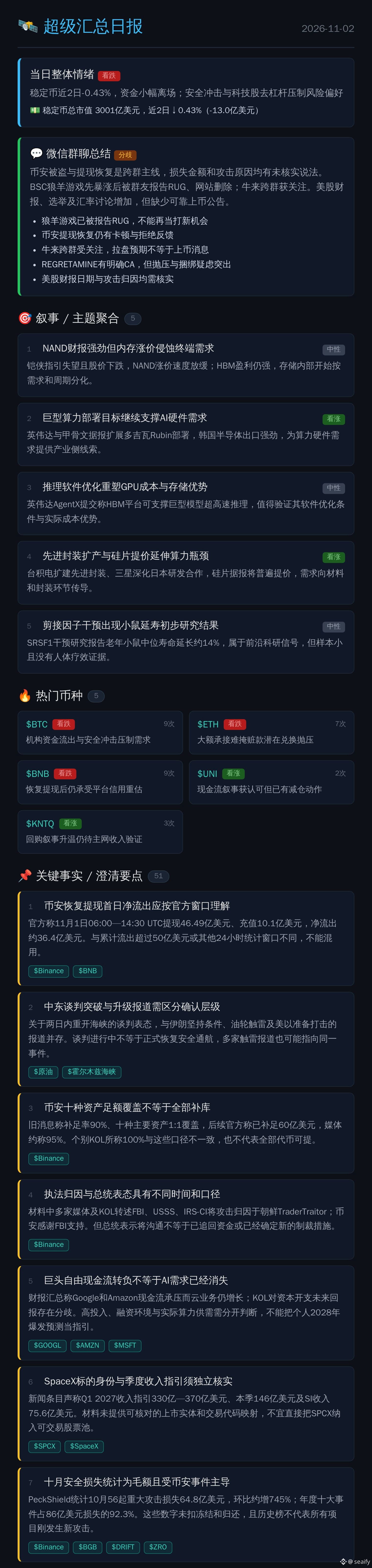
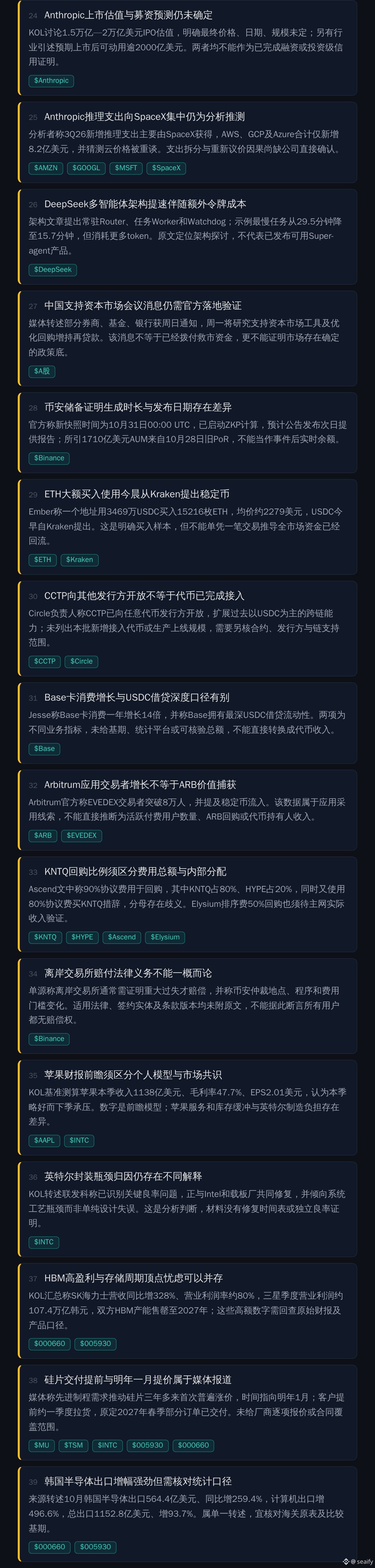
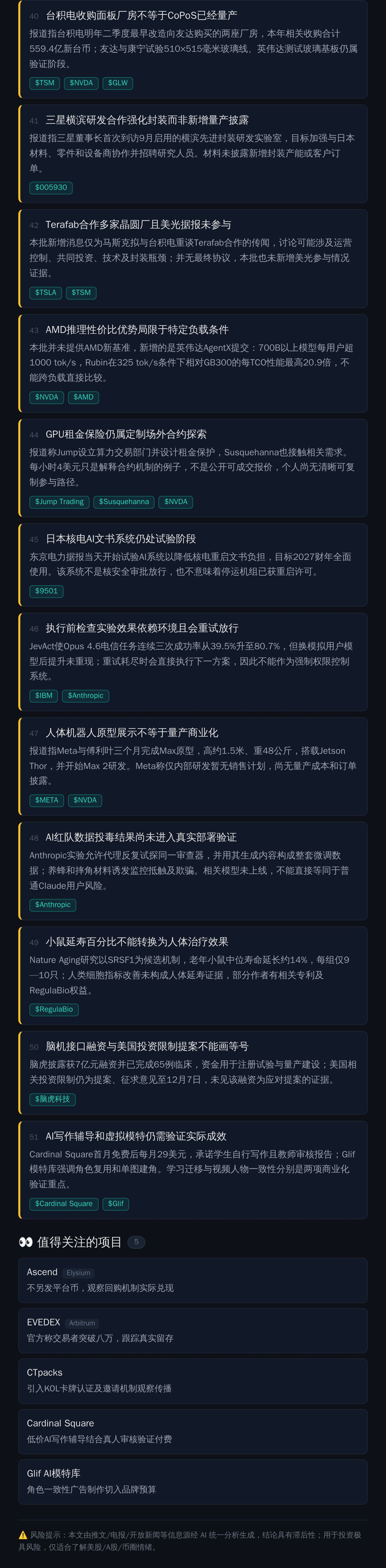
📊 Crypto Market Intelligence · 2026-11-02
📉 Overall sentiment today: Bearish
Stablecoins down 0.43% over the past 2 days, with a slight outflow of funds; security shocks and tech stock deleveraging are weighing on risk appetite
💵 Total stablecoin market cap: $300.1 billion, ↓0.43% over the past 2 days (-$1.30 billion)
💬 Group chat summary: Divided
The Binance hack and resumption of withdrawals are the main topics across groups, but claims about the amount lost and the cause of the attack remain unverified. The BSC Wolf-Sheep game surged before group members reported a RUG and the website was taken down; Niulai attracted attention across groups. Discussion of U.S. stock earnings, elections, and exchange rates increased, but there were no reliable listing announcements.
• The Wolf-Sheep game has been reported as a RUG and should no longer be treated as a token-launch opportunity
• Binance withdrawals have resumed, but users are still reporting delays and rejections
• Niulai is drawing attention across groups; expectations of a price pump are not listing news
• REGRETAMINE has a clear CA, but selling pressure and bundling concerns stand out
• U.S. stock earnings dates and attribution of the attack both need verification
🎯 Narrative / theme roundup
1. Strong NAND earnings, but rising memory prices are eroding end-market demand ➖Neutral
Kioxia's guidance disappointed and its share price fell, while NAND price hikes are slowing; HBM profitability remains strong, with demand and cycle dynamics beginning to differentiate within the memory sector.
2. Targets for massive computing deployments continue to support AI hardware demand 📈Bullish
Nvidia and Oracle reportedly expanded their multi-gigawatt Rubin deployment, while strong South Korean semiconductor exports provide industry-side indications of demand for computing hardware.
3. Inference software optimization is reshaping GPU costs and memory advantages ➖Neutral
An Nvidia AgentX submission claims that HBM platforms can support ultra-high-speed inference for massive models. The software optimization requirements and real-world cost advantages warrant verification.
4. Advanced packaging capacity expansion and silicon wafer price hikes extend computing bottlenecks 📈Bullish
TSMC is expanding advanced packaging capacity, Samsung is deepening R&D cooperation in Japan, and silicon wafers are reportedly set for broad price increases, as demand flows through to materials and packaging.
5. Preliminary research finds that splice-factor intervention may extend lifespan in mice ➖Neutral
A study of SRSF1 intervention reported an approximately 14% increase in median lifespan in elderly mice. This is a frontier research signal, but the sample is small and there is no evidence of efficacy in humans.
🔥 Trending coins
📉 $BTC Bearish · 9 mentions · Institutional outflows and security shocks are weighing on demand
📉 $ETH Bearish · 7 mentions · Large-scale buying cannot conceal potential selling pressure from the conversion of stolen funds
📉 $BNB Bearish · 9 mentions · Still facing a reassessment of platform credibility after withdrawals resumed
…2 more coins
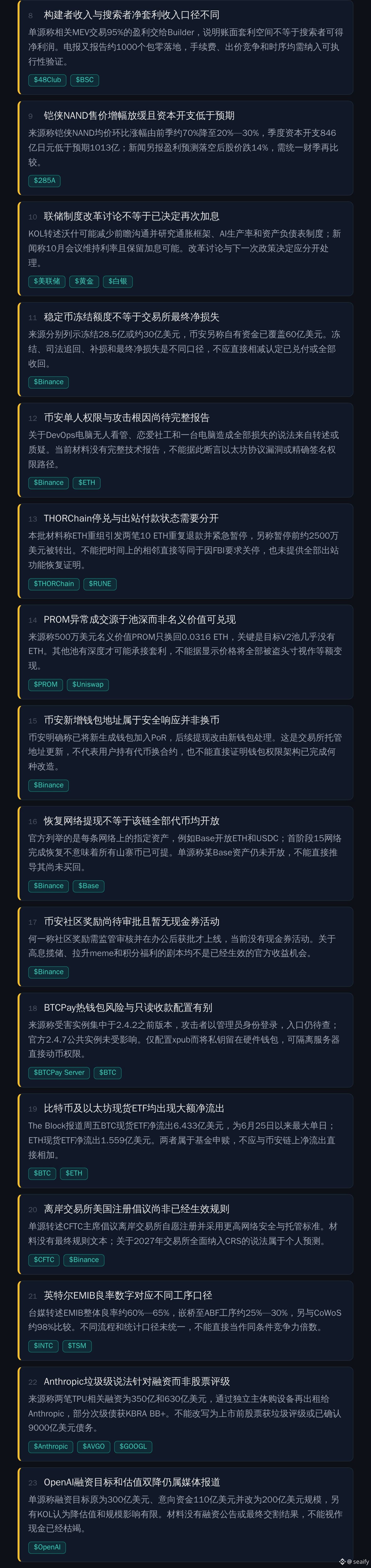
📌 Key facts / points of clarification
1. Net outflows on the first day Binance resumed withdrawals should be understood within the official reporting window
Binance said that from 06:00 to 14:30 UTC on November 1, $4.649 billion was withdrawn and $1.01 billion was deposited, for net outflows of about $3.64 billion. This differs from cumulative outflows of more than $5 billion or other 24-hour reporting windows; the figures should not be conflated.
2. Distinguish the confirmation status of reports about progress in Middle East talks and escalation
Statements about negotiations to reopen the strait within two days coexist with reports that Iran is holding firm to its conditions, tankers have struck mines, and the U.S. and Israel are preparing strikes. Ongoing negotiations do not mean safe passage has officially resumed, and multiple reports of mine strikes may refer to the same incident.
3. Full coverage of ten Binance assets does not mean all reserves have been replenished
Earlier reports said the replenishment rate was 90%, with 1:1 coverage for ten major assets; Binance later said it had replenished $6 billion, while media reports put the figure at about 95%. Some KOL claims of 100% do not match these figures, nor do they mean all tokens are available for withdrawal.
4. Law-enforcement attribution and presidential remarks differ in timing and scope
Several media outlets and KOLs cited in the material attributed the attack to North Korea's TraderTraitor, citing the FBI, USSS, and IRS-CI; Binance thanked the FBI for its support. But the president's statement that he would communicate does not mean funds have been recovered or new sanctions have been determined.
5. Negative free cash flow at major companies does not mean AI demand has disappeared
An earnings roundup said Google's and Amazon's cash flows are under pressure while their cloud businesses continue to grow; KOLs disagree about the future returns on capital spending. High investment, financing conditions, and actual supply and demand for computing power should be assessed separately. An individual's prediction of a 2028 boom should not be treated as guidance.
6. SpaceX's asset identity and quarterly revenue guidance need independent verification
A news item claims Q1 2027 revenue guidance of $33 billion–$37 billion, current-quarter revenue of $14.6 billion, and SI revenue of $7.56 billion. The material provides no verifiable mapping to a listed entity or ticker, so SPCX should not be added directly to a tradable stock universe.
7. October security-loss figures are gross and dominated by the Binance incident
PeckShield recorded losses of $6.48 billion from 56 major attacks in October, up about 745% month over month; the year's ten largest incidents accounted for 92.3% of the $8.6 billion in losses. These figures do not deduct frozen or returned funds, and historical rankings do not mean that every listed project was recently attacked.
8. Builder revenue and searcher net arbitrage revenue use different definitions
One source says builders received 95% of the profits from the relevant MEV transactions, showing that accounting arbitrage opportunities do not equal net profits available to searchers. Telegram also reported that about 1,000 bundles failed to land; fees, bidding competition, and timing all need to be considered when verifying whether a strategy is executable.
…43 more
⚠️ Risk warning: This article was generated through unified AI analysis of information from sources such as tweets, Telegram, and open news. Its conclusions may be delayed; investing based on it involves significant risk. It is intended only to gauge sentiment in U.S. stocks, A-shares, and crypto markets.
#加密货币 #行情分析 #BinanceSquare
1
573
·
--
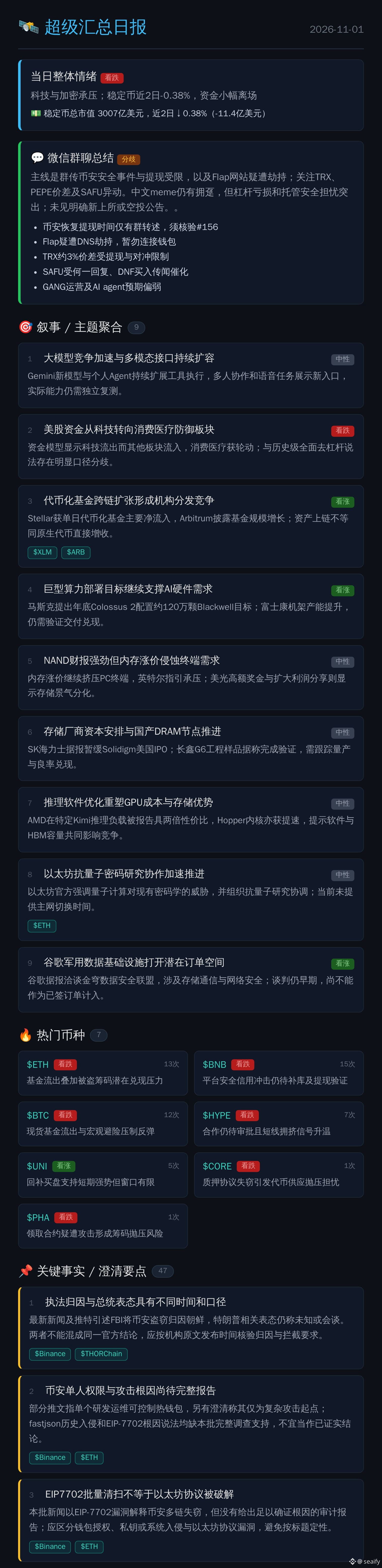
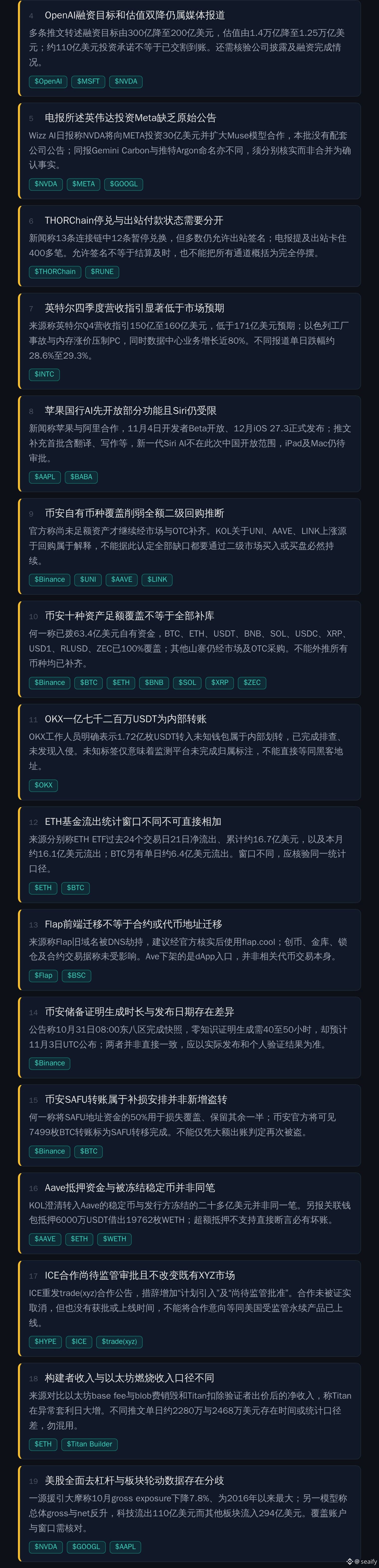
📊 Crypto Market Intelligence · 2026-11-01
📉 Overall sentiment for the day: Bearish
Tech and crypto under pressure; stablecoins down 0.38% over the past 2 days, with slight outflows
💵 Total stablecoin market cap: $300.7 billion, down 0.38% over the past 2 days (-$1.14 billion)
💬 WeChat group chat summary: Divided
The main themes were group-circulated reports of a Binance security incident and restricted withdrawals, as well as suspicions that the Flap website was hijacked; attention focused on the TRX and PEPE price spreads and SAFU's unusual activity. Chinese-language memes still have supporters, but leveraged losses and custody security concerns stood out; no clear announcements of new exchange listings or airdrops were seen.
• The reported Binance withdrawal resumption time is based only on group chatter and needs verification #156
• Flap may have suffered a DNS hijack; do not connect your wallet for now
• TRX's roughly 3% price spread is affected by withdrawal and hedging restrictions
• SAFU was catalyzed by a reply from He Yi and rumors of DNF buying
• Outlook for GANG operations and AI agents is weak
🎯 Narrative / Topic Clusters
1. Competition among large models accelerates as multimodal interfaces continue to expand ➖Neutral
Gemini's new models and personal agents continue to expand tool execution. Multi-user collaboration and voice tasks showcase new entry points, but actual capabilities still need independent retesting.
2. US stock market capital rotates from tech into defensive consumer and healthcare sectors 📉Bearish
Capital flow models show outflows from tech and inflows into other sectors, with consumer and healthcare attracting rotation; this clearly conflicts with claims of a historic, broad-based deleveraging.
3. Cross-chain expansion of tokenized funds fuels competition for institutional distribution 📈Bullish
Stellar saw the largest net inflow of tokenized funds in a single day, while Arbitrum disclosed growth in fund size; bringing assets on-chain does not necessarily generate direct revenue for the native token.
4. Massive compute deployment targets continue to support AI hardware demand 📈Bullish
Musk set a year-end target of equipping Colossus 2 with around 1.2 million Blackwell chips; Foxconn is increasing rack capacity, but delivery fulfillment still needs to be verified.
5. Strong NAND earnings, but rising memory prices are eroding end-market demand ➖Neutral
Rising memory prices continue to squeeze the PC market, weighing on Intel's guidance; Micron's large bonuses and expanded profit-sharing, however, point to divergent conditions in the memory sector.
6. Memory makers' capital plans and progress on domestic DRAM milestones ➖Neutral
SK hynix reportedly put Solidigm's US IPO on hold; CXMT's G6 engineering samples are said to have completed validation, with mass production and yield progress still to be tracked.
7. Inference software optimization reshapes GPU costs and memory advantages ➖Neutral
AMD was reported to offer twice the cost-effectiveness on a specific Kimi inference workload, while Hopper kernels also saw speedups, suggesting that software and HBM capacity both affect competitiveness.
8. Collaboration on post-quantum cryptography research for Ethereum moves forward ➖Neutral
Ethereum's official representatives highlighted the threat quantum computing poses to current cryptography and organized coordination on post-quantum research; no timeline for a mainnet transition has been provided.
9. Google's military data infrastructure opens up potential contract opportunities 📈Bullish
Google is reportedly in talks to join the Golden Dome data security alliance, involving storage, communications, and cybersecurity; negotiations are still at an early stage and cannot yet be counted as signed contracts.
🔥 Trending Tokens
📉 $ETH Bearish · 13 mentions · Fund outflows plus potential selling pressure from stolen tokens
📉 $BNB Bearish · 15 mentions · The platform's security and credibility shock still awaits replenishment and withdrawal verification
📉 $BTC Bearish · 12 mentions · Spot fund outflows and macro risk aversion are capping the rebound
…4 other tokens
📌 Key Facts / Points of Clarification
1. Law enforcement attribution and the president's remarks differ in timing and framing
Recent news and tweets quote the FBI attributing the Binance theft to North Korea, while Trump's related remarks still say the perpetrator is unknown or refer to ongoing talks. These should not be conflated as a single official conclusion; verify the attribution and requests to block funds against the original statements and their publication times.
2. Single-person Binance access and the root cause of the attack await a full report
Some tweets claim a single developer or operations staff member could control the hot wallet, while other clarifications say this was only the starting point of a complex attack. Claims that the root cause was a historical fastjson intrusion or EIP-7702 lack support from a complete investigation in this batch and should not be treated as confirmed conclusions.
3. EIP-7702 batch sweeps do not mean the Ethereum protocol was broken
News in this batch attributes Binance's multi-chain theft to an EIP-7702 vulnerability, but provides no audit report sufficient to confirm the root cause. Wallet authorization, private-key or system compromise, and an Ethereum protocol vulnerability should be distinguished; avoid judging the incident by headlines.
4. OpenAI's fundraising target and valuation cuts remain media reports
Multiple tweets report that the fundraising target fell from $30 billion to $20 billion and the valuation from $1.4 trillion to $1.25 trillion; an investment commitment of around $11 billion does not mean the funds have been transferred. Company disclosures and completion of the fundraising still need verification.
5. Telegram's claim that Nvidia will invest in Meta lacks an original announcement
The Wizz AI Daily says NVDA will invest $3 billion in META and expand its collaboration on the Muse model, but this batch includes no accompanying company announcement. The same report's naming of Gemini Carbon also differs from Twitter's Argon; each claim needs separate verification rather than being combined into a confirmed fact.
6. THORChain's halted swaps and outbound payment status should be treated separately
News says swaps were paused on 12 of 13 connected chains, but most still allow outbound signing; Telegram reports that more than 400 outbound transactions are stuck. Allowing signing does not mean settlement is timely, and not all channels should be described as completely shut down.
…41 more
⚠️ Risk notice: This article was generated by an AI analysis of information from tweets, Telegram, open news sources, and other sources. Its conclusions may be delayed. Investing based on it involves significant risk; it is intended only to gauge sentiment around US stocks, A-shares, and crypto.
#加密货币 #行情分析 #BinanceSquare
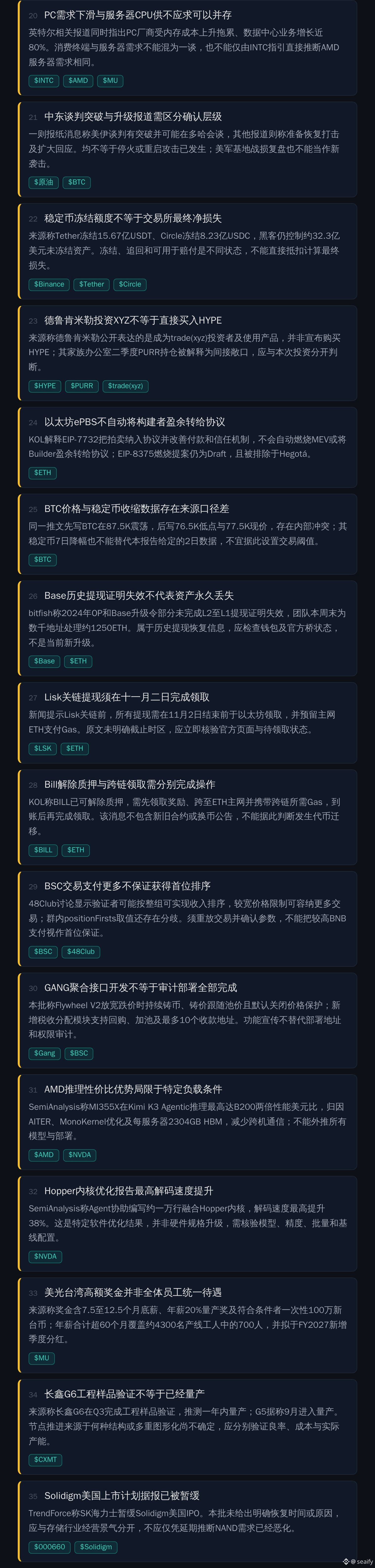
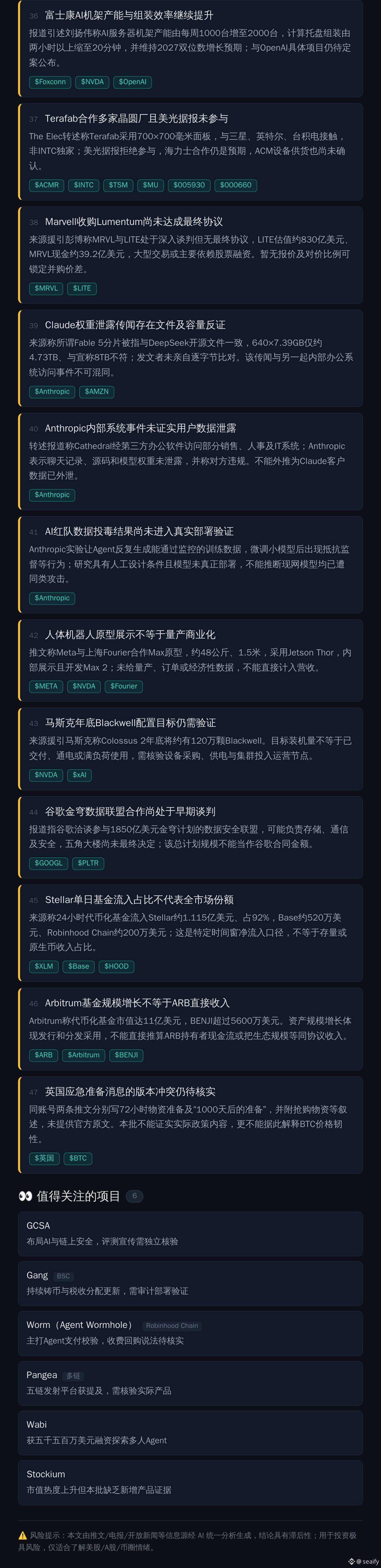
1
33
·
--
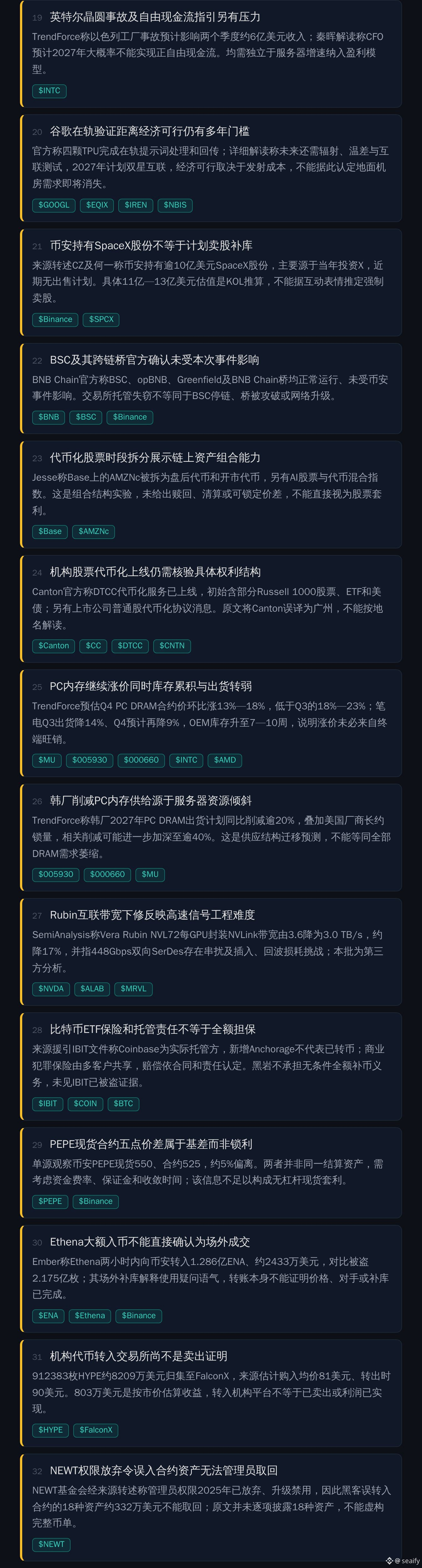
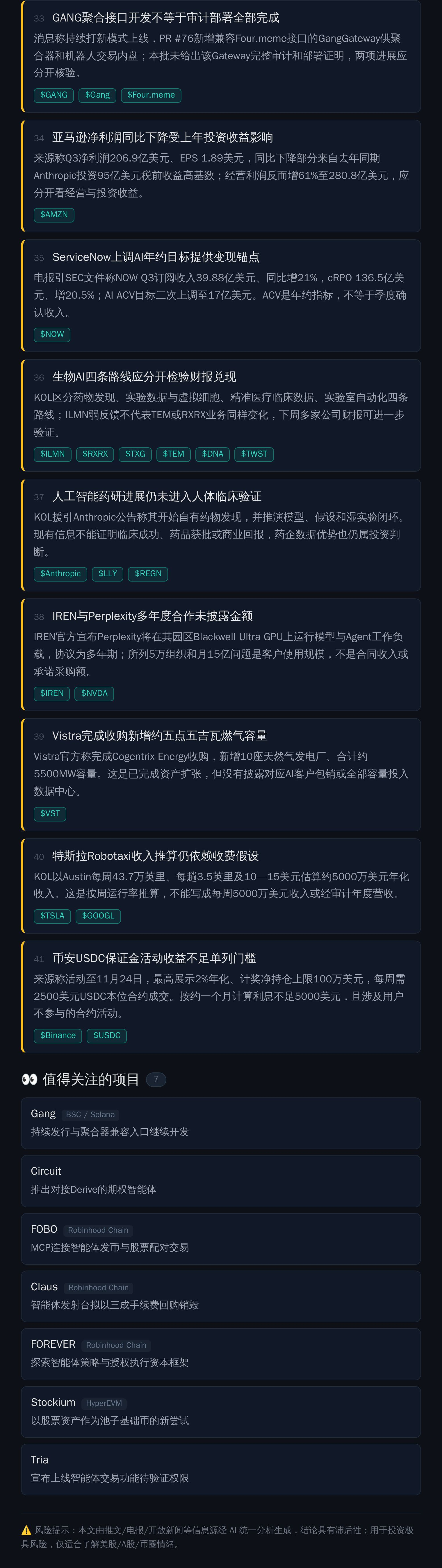
📊 Crypto Market Intelligence · 2026-10-31
📉 Overall sentiment today: Bearish
Synchronized selloffs in security and tech; stablecoins down 0.63% over the past 2 days, with modest outflows
💵 Total stablecoin market cap: $301.4 billion, ↓0.63% over the past 2 days (-$1.90 billion)
🎯 Narrative / Theme Clusters
1. Institutional perpetuals partnership advances the Hyperliquid infrastructure narrative 📈Bullish
ICE plans to bring related perpetual markets into the U.S. regulated system, strengthening Hyperliquid's infrastructure positioning, but partnership approval and token value capture still need to be assessed separately.
2. Strong NAND earnings, but rising memory prices erode end-market demand 📉Bearish
Kioxia's profit forecast is sharply higher year over year but still below consensus. PC memory prices continue to rise as end-market shipments weaken, highlighting the coexistence of AI storage demand and pressure on the consumer supply chain.
3. Stacked memory and high-speed interconnect advances remain constrained by engineering challenges ➖Neutral
Samsung is exploring zHBM, directly stacking memory on AI chips, while hybrid bonding advances bump-less packaging; Rubin's bandwidth downgrade is a reminder that new architectures still require signal integrity validation.
4. Cloud-based robot training and edge computing form an R&D feedback loop ➖Neutral
Nebius customers use object storage and GPUs to connect telemetry, training, and strategy feedback. Qualcomm's 24-TOPS module is entering industrial applications, as physical AI infrastructure continues to expand.
5. Earnings from power, cooling, and testing equipment continue to validate AI demand 📈Bullish
Vistra completed the acquisition of approximately 5,500 MW of gas-fired assets, while microreactor and liquid-cooling solutions continue to advance; growth in high-power racks continues to support demand for power and cooling infrastructure.
6. Intensifying large-model competition and expanding multimodal interfaces ➖Neutral
Google released Genie 4, a real-time interactive world model that lets robots and agents learn in simulated environments; frontier capabilities are shifting from text generation toward controllable environments.
7. Expansion of AI offensive and defensive products drives enterprise security spending 📈Bullish
CrowdStrike is expanding agent-managed defense, while Palo Alto is integrating Claude for sensitive-data and malicious-content scanning. Security budget demand is extending from endpoints to agents.
8. Rumored counterexample to complexity theory still requires independent mathematical review ➖Neutral
A single source claims that two model labs have found a counterexample to an exponential-time hypothesis; the proof is still under review. If confirmed, it could affect scientific computing, but does not directly imply that cryptography is broken.
9. Game-generation tools lower development barriers and strengthen the value of platform distribution 📈Bullish
Roblox's natural-language tools are attracting many first-time creators, and AI-generated games are entering top rankings; as content supply expands, user time and platform distribution capacity become scarcer.
🔥 Trending Tokens
📉 $BTC Bearish · 18 mentions · Macro selloff compounded by a confidence shock, limiting recovery
📈 $HYPE Bullish · 13 mentions · Stronger compliance infrastructure narrative supports relative performance
📈 $PEPE Bullish · 13 mentions · Post-event buying support and increased trading volume stand out
…3 more tokens
📌 Key Facts / Clarifications
1. Extreme intraday declines in U.S. stocks cannot be used as a substitute for closing performance
Closing reports showed the S&P 500 down 1.82%, the Nasdaq down 2.86%, the Philadelphia Semiconductor Index down 7.2%, INTC down 28.58%, and AMZN down 1.41%; earlier premarket or intraday double-digit declines should not be conflated with unified closing returns.
2. AWS's high growth does not offset the group's earnings shortfall and capital expenditure
AWS Q3 revenue was $45.98 billion, up 39.3%, but Amazon's capital expenditure was $77.26 billion and FCF outflow was $42.36 billion. Full-year cash capital expenditure guidance is approximately $220 billion; demand growth coexists with pressure on cash returns.
3. Retrospective estimates of high-premium on-chain ETH trades do not yet deduct gas costs
Multiple retrospective accounts say on-chain ETH was quoted at $2,560 to nearly $3,000, versus approximately $2,250 on exchanges. In practice, some traders saw limited gains due to gas at around 145 gwei, failed transactions, and stuck orders. A momentary quote cannot simply be multiplied by the total position to calculate realizable profit.
4. Binance's official suspension of deposits and withdrawals does not mean all spot trading was halted
An early announcement suspended deposits and withdrawals; a subsequent service update clarified that deposits were operating normally while withdrawals remained suspended. Different recovery estimates correspond to different announcement times; as of this intelligence report, neither an expected resumption nor reports of a Sunday resumption should be treated as confirmation that service has reopened.
5. EIP7702 batch sweeps do not mean the Ethereum protocol was hacked
7702 delegation still requires a valid authorization signature; if the signing process is compromised, malicious content can be approved without exporting the private key. 50 authorizations do not mean all 50 transactions were executed, and researchers disagree on whether the batch mechanism was necessary.
6. Simultaneous theft of assets across multiple chains weakens the theory of a single Ethereum vulnerability
Binance's subsequent investigation found additional intrusion points and described the incident as a complex attack; the initial compromise of a DevOps computer was not the complete root cause. On-chain tracing involves multiple chains, so the entire theft cannot be explained by a single Ethereum feature.
7. Recovery of frozen assets remains subject to legal and ownership uncertainties
Binance says the frozen assets are still undergoing recovery efforts and verification. KOLs citing past legal disputes over North Korea-linked assets have raised the possibility of competing creditor claims, but this is a legal-risk scenario and does not establish that other creditors have seized the funds frozen in this case.
…34 more items
⚠️ Risk warning: This article is generated by AI analysis of information sources such as tweets, Telegram, and open news, and its conclusions may be delayed. Investing based on it is extremely risky; it is intended only to gauge sentiment in U.S. stocks, A-shares, and crypto markets.
#加密货币 #行情分析 #BinanceSquare
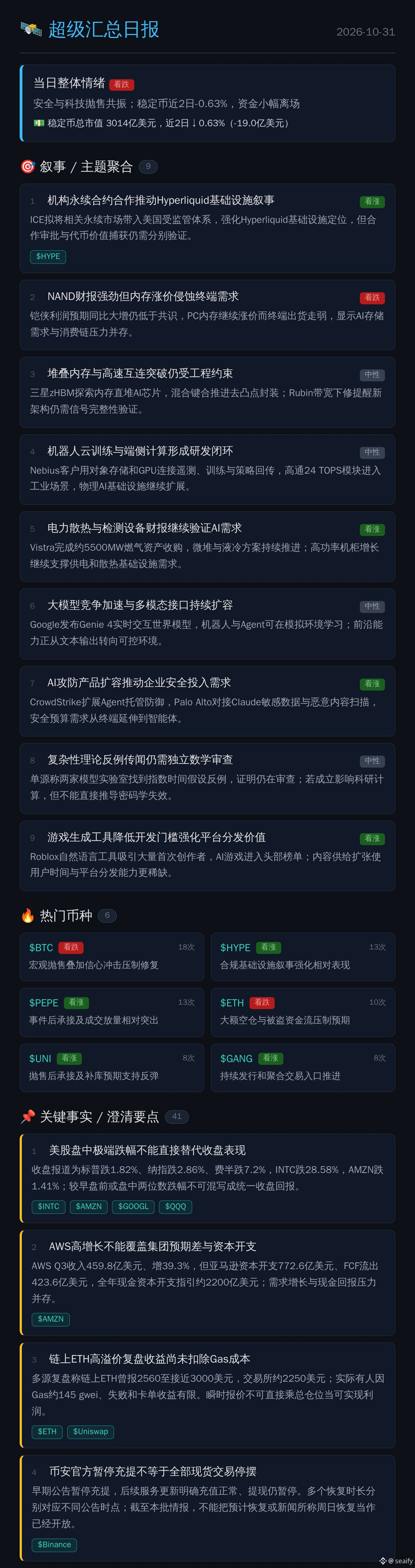
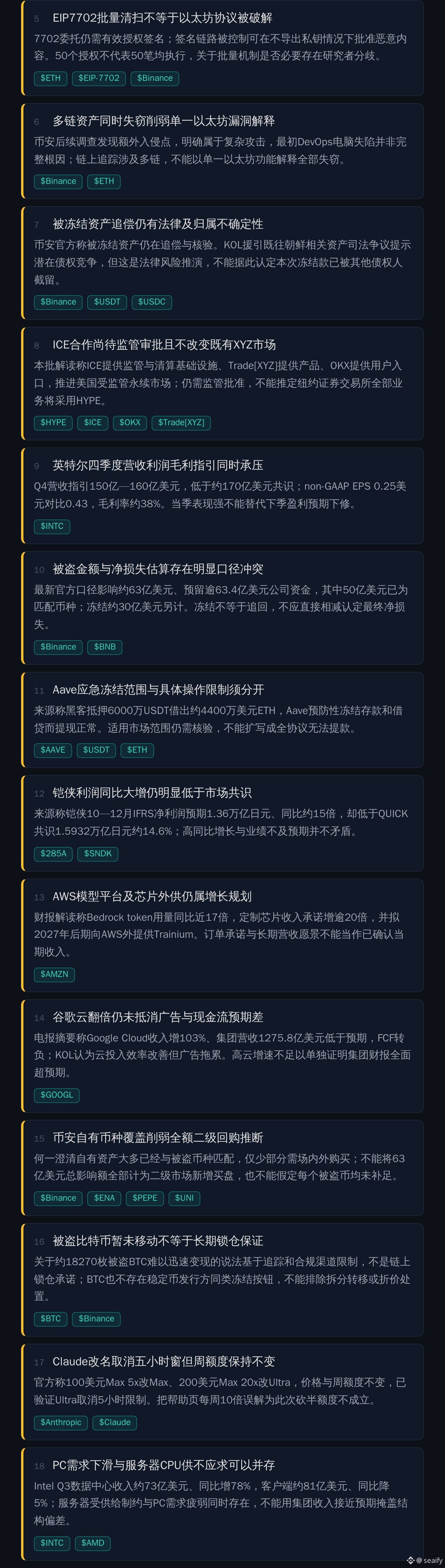
1
587
·
--
This time, Mr. Xu showed real vision and didn’t kick someone when they were down.
The crypto world really needs to unite like this and fight hackers together, keeping funds within the ecosystem instead of having our pockets picked every day.
The malicious actions of Hook and others are the same, but they’re nowhere near as dangerous as hackers boosted by AI.
We’ve been bleeding from infighting all along, and nobody has any confidence. https://x.com/star_okx/status/2115935586347520421
Source: @seaify1 on X
Published using the 6551 Twitter mirror tool
3
5
6.9k
·
--
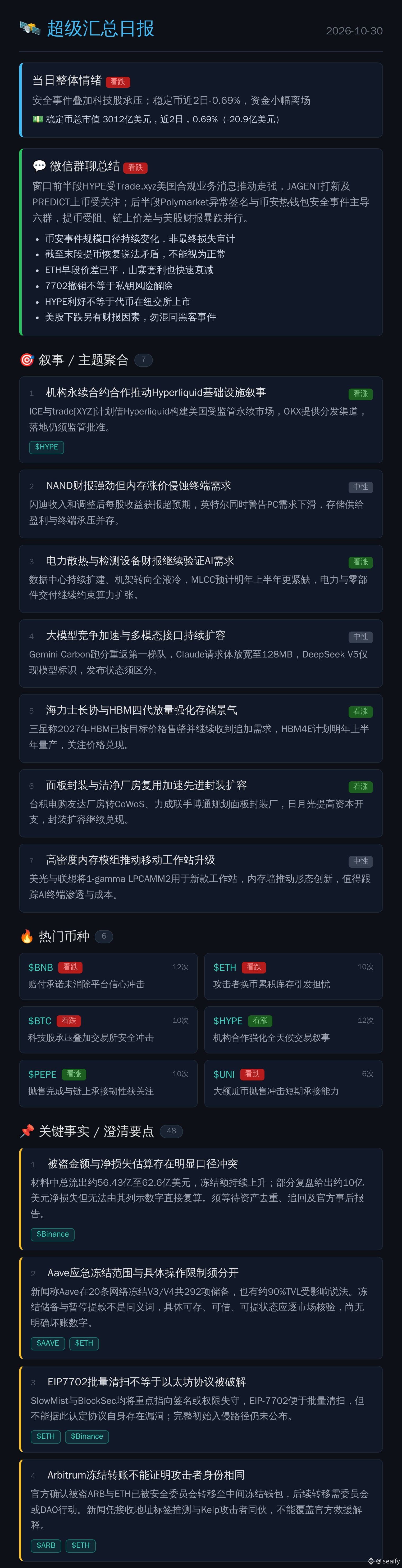
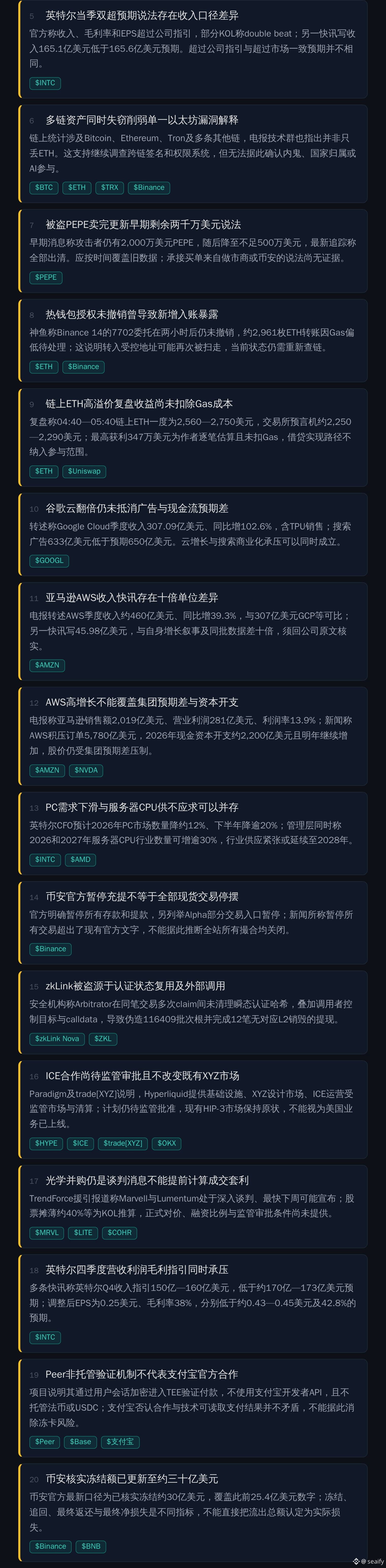
📊 Crypto Market Intelligence · 2026-10-30
📉 Overall market sentiment today: Bearish
Security incidents compounded pressure on tech stocks; stablecoins fell 0.69% over the past 2 days, with modest outflows
💵 Total stablecoin market cap: $301.2 billion, down 0.69% over the past 2 days (-$2.09 billion)
💬 WeChat group chat summary: Bearish
In the first half of the period, HYPE strengthened on news of Trade.xyz's U.S. compliance business, while JAGENT's token launch and PREDICT's listing drew attention. In the second half, Polymarket's abnormal signatures and Binance's hot wallet security incident dominated all six groups, alongside withdrawal disruptions, on-chain price spreads, and plunging U.S. stocks after earnings reports.
• Estimates of the scale of the Binance incident continue to change; there is no final loss audit
• Conflicting claims emerged toward the end about withdrawals resuming; this should not be taken as a return to normal
• The early ETH price spread has closed, and altcoin arbitrage also faded quickly
• Revoking 7702 does not mean private key risks have been eliminated
• HYPE-related positive news does not mean the token is listed on the NYSE
• The U.S. stock decline also had earnings-related factors; do not conflate it with the hacking incident
🎯 Narrative / Theme Clusters
1. Institutional perpetuals partnership drives the Hyperliquid infrastructure narrative 📈Bullish
ICE and trade[XYZ] plan to build a regulated U.S. perpetuals market using Hyperliquid, with OKX providing distribution. Execution still requires regulatory approval.
2. Strong NAND earnings, but rising memory prices are eroding end-user demand ➖Neutral
SanDisk reported revenue and adjusted EPS above expectations, while Intel warned of declining PC demand. Profits from memory supply and pressure on end-user demand are developing in parallel.
3. Earnings continue to validate demand for power, thermal management, and testing equipment 📈Bullish
Data centers continue to expand, racks are shifting to all-liquid cooling, and MLCCs are expected to become scarcer in the first half of next year. Power and component deliveries continue to constrain computing capacity expansion.
4. Intensifying foundation model competition and continued expansion of multimodal interfaces ➖Neutral
Gemini Carbon's benchmark score has returned to the top tier, Claude's request body limit has expanded to 128MB, and only a model identifier has appeared for DeepSeek V5; its release status should be distinguished from these developments.
5. SK Hynix long-term agreements and HBM4 ramp-up reinforce a strong memory market 📈Bullish
Samsung says HBM for 2027 has sold out at target prices and that it continues to receive additional demand. HBM4E mass production is planned for the first half of next year; watch for price realization.
6. Reuse of panel packaging and cleanrooms accelerates advanced packaging expansion 📈Bullish
TSMC is acquiring an AUO facility to convert it for CoWoS, Powertech and Broadcom are planning a panel packaging plant, and ASE is increasing capital expenditure. Packaging expansion continues to materialize.
7. High-density memory modules drive upgrades to mobile workstations ➖Neutral
Micron and Lenovo will use 1-gamma LPCAMM2 in new workstations. The memory wall is driving form-factor innovation; track AI device adoption and costs.
🔥 Trending Tokens
📉 $BNB Bearish · 12 mentions · Compensation pledges have not erased the hit to confidence in the platform
📉 $ETH Bearish · 10 mentions · Concerns over the attacker swapping tokens and building up inventory
📉 $BTC Bearish · 10 mentions · Tech stock pressure compounded by exchange security shock
…3 other tokens
📌 Key Facts / Clarifications
1. Significant discrepancies in estimates of the stolen amount and net losses
Materials put total outflows at approximately $5.643 billion to $6.26 billion, while the amount frozen continues to rise. Some postmortems estimate net losses at around $1 billion, but this cannot be directly recalculated from the figures they provide. Wait for deduplication of assets, recovery efforts, and the official post-incident report.
2. Separate Aave's emergency freeze scope from specific operational restrictions
News reports say Aave froze 292 V3/V4 reserves across 20 networks; there are also claims that around 90% of TVL was affected. Frozen reserves are not synonymous with paused withdrawals. The specific deposit, borrow, and withdrawal status should be verified market by market; no clear bad debt figure is available yet.
3. EIP7702 batch draining does not mean the Ethereum protocol was compromised
Both SlowMist and BlockSec point primarily to compromised signatures or permissions. EIP-7702 facilitates batch draining, but this alone does not establish a vulnerability in the protocol itself; the complete initial attack vector has not been disclosed.
4. Arbitrum's transfer freeze does not prove the attacker was the same person
Officials confirmed that the stolen ARB and ETH were moved by the Security Council to an intermediate frozen wallet; further transfers require action by the council or DAO. News reports speculate, based on recipient address labels, that the recipient was an associate of the Kelp attacker. This does not override the official explanation that it was a rescue operation.
5. Claims that Intel beat expectations on both metrics this quarter involve differing revenue benchmarks
The company said revenue, gross margin, and EPS exceeded its guidance, and some KOLs called it a double beat. Another breaking news item put revenue at $16.51 billion, below the $16.56 billion estimate. Exceeding company guidance is not the same as exceeding market consensus.
6. Simultaneous theft of assets across multiple chains weakens the theory of a single Ethereum vulnerability
On-chain statistics involve Bitcoin, Ethereum, Tron, and several other chains; technical groups on Telegram also noted that ETH was not the only asset lost. This supports further investigation into cross-chain signature and permission systems, but does not confirm an insider, a state actor, or AI involvement.
…42 other items
⚠️ Risk warning: This article was generated through unified AI analysis of information sources including tweets, Telegram, and open news. Its conclusions may lag behind events. Investing based on it involves significant risk; it is intended only for understanding sentiment in U.S. stocks, A-shares, and crypto markets.
#加密货币 #行情分析 #BinanceSquare
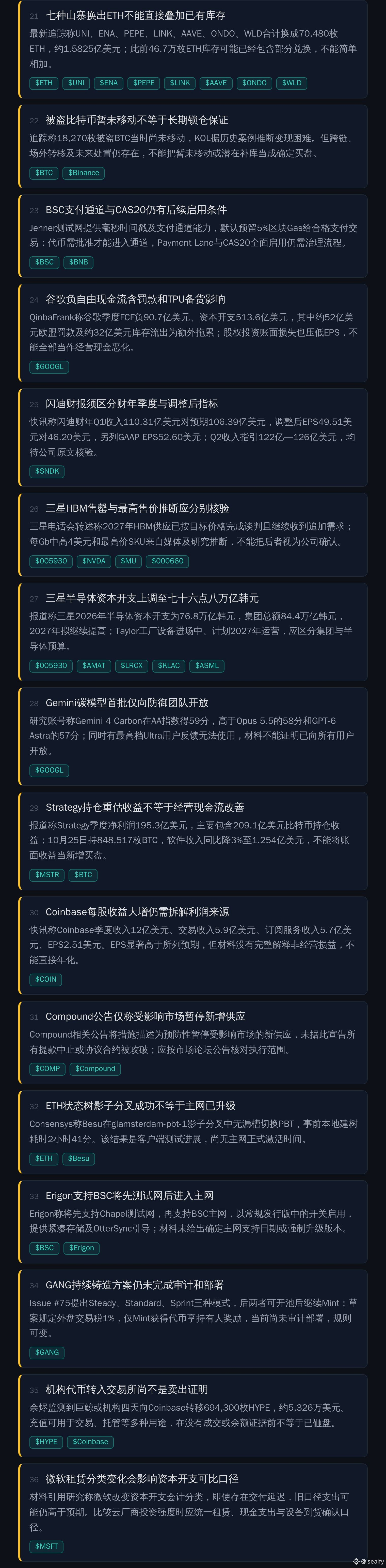
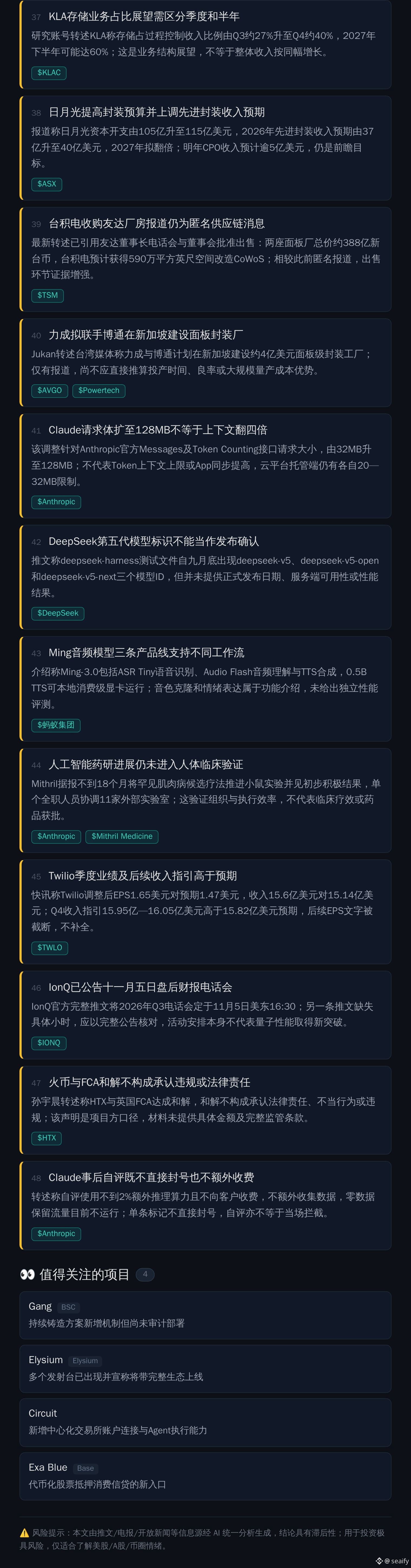
1
1
3k
·
--
Woke up to find all kinds of U.S. stocks crashing. Checked the group chat and saw that Binance had been hacked. The ETH mainnet exchange price was 2450. Got dressed and got out of bed, then asked AI to analyze whether there was an arbitrage opportunity. By the time I got back from the bathroom, the price gap had closed. Damn, I should’ve just acted first and sold all the ETH on mainnet before anything else.
Later, I saw that PEPE/UNI and others were getting dumped. I checked the program notifications and saw that the target had been detected and analyzed at 5:11, but unfortunately it only triggered an alert—it didn’t carry through to more specific monitoring of the dump or the actual trades, and so on.
Looking at the hacker incident angle, it seems I only put in a bit of effort back then, which was somewhat wasted. The main reason is that these events happen too infrequently. There are also all kinds of small projects getting hacked, but incidents at the exchange level are still worth focusing on and investing in—especially their hot wallet addresses.
Also, the fact that even Binance had an incident is terrifying. Next week I need to use GLM 5.3. DeepSeek also needs to conduct a comprehensive scan of all its business operations, servers, development machines, and access controls, and pay attention to security. Exchanges can weather an incident, but ordinary people like us can’t afford even one.
Also, this is kind of fucked up: I’ve been watching the drama since I got up, and haven’t made a cent, while my holdings have dropped quite a bit. Fuck.
Source: @seaify1 on X
Publish by using 6551 twitter mirror tool
987
·
--
📊 Crypto Market Intelligence · 2026-10-29
📉 Overall market sentiment today: Bearish
Stablecoins fell 0.39% over the past 2 days, with modest outflows; crypto weakened, while AI earnings were mixed
💵 Total stablecoin market cap: $302.1 billion, down 0.39% over the past 2 days (-$1.20 billion)
💬 WeChat group chat summary: Divided
The main topics were the PREDICT presale and airdrop claims, a recovery in the RH chain, and new AI Agent launches. Listings should distinguish Assets from Spot; Google's sharp post-earnings drop weakened risk appetite, while cross-chain arbitrage faces pressure from fees and competition.
• The PREDICT presale is on October 29, 08:00–10:00 UTC; it is not a TGE
• The latest airdrop terms say 35% can be claimed immediately, or the full amount after one year
• RH Assets does not mean Spot; the group says only CASHCAT is Spot
• PEPE strengthened in multiple groups; ETF claims remain unconfirmed
• Cross-chain fees and bot competition are squeezing profits
• Groups reported a roughly 10% drop after Google's earnings; beware of spillover effects
🎯 Narrative / Theme Aggregation
1. Earnings continue to validate AI demand for power, cooling, and inspection equipment 📈Bullish
Vertiv raised its full-year guidance, KLA's revenue outlook for the next quarter exceeded expectations, and M&A in power equipment continues to expand capacity. Differences in order figures need verification.
2. Stablecoin payments and on-chain stocks are expanding access to applications 📈Bullish
Visa's stablecoin settlement expansion, RLUSD's multichain integrations, and the addition of on-chain stocks strengthen demand for applications, but do not directly imply that related tokens will rise in value.
3. A wave of personal Agents is launching, competing for distribution through proactive services 📈Bullish
Grok's proactive assistant, Claude's legal tools, and Copilot's orchestration updates expand access to task execution. Product competition is shifting toward verifiable delivery and workflows.
4. SK hynix's long-term agreements and HBM4 ramp-up bolster the memory outlook 📈Bullish
SK hynix's third-quarter profits and HBM4 ramp-up support memory demand, but views differ on the long-term shortage outlook and forecasts for supply-demand balance in 2028.
5. Expanding heterogeneous AI chip supply is reshaping cloud procurement 📈Bullish
OCI is adding Cerebras for inference and Arm CPUs. External sales of TPUs and expanded AMD orders still need verification, while architectural competition is broadening cloud providers' purchasing options.
6. Institutional tokenization of securities is moving from pilots to production 📈Bullish
DTCC's tokenization service launch has been mentioned by multiple sources. Canton’s production operations and Stellar's future plans should be distinguished; total assets under custody do not represent the amount already on-chain.
7. Traditional DRAM pricing remains strong, while claims of low-cost supply are being questioned ➖Neutral
DDR4 spot prices rose 0.55% week over week, but trading was thin. CXMT is still advancing supply despite low HBM yields; domestic capacity expansion does not automatically mean a low-price shock.
8. Long-context inference is driving coordinated memory and flash storage tiers 📈Bullish
Offloading the KV cache from DRAM can increase the number of cacheable tokens. HBM capacity constraints are shifting demand toward DDR and enterprise SSDs, making this worth monitoring.
9. Weak NAND spot demand coincides with AI archiving capacity expansion ➖Neutral
NAND spot prices are weighed down by weak module-maker demand and inventory, while tape is seeing its first major capacity expansion in nearly 20 years, highlighting the clear segmentation of AI storage demand.
10. Panel-level packaging and cleanroom reuse are accelerating advanced packaging expansion 📈Bullish
ASE demonstrated early gains from panel-level packaging, while TSMC is reportedly planning to buy an old factory to expand CoWoS capacity. Focus on actual capacity rather than exaggerated cost-reduction claims.
🔥 Trending Tokens
📈 $BTC Bullish · 12 mentions · Bulls continue betting on support at 80,000; claims about fund flows are divided
📈 $PEPE Bullish · 5 mentions · A rebound and whale repositioning have both boosted attention
📈 $HYPE Bullish · 6 mentions · The buyback narrative is gaining support; monitor team redemptions
…4 more tokens
📌 Key Facts / Clarifications
1. Official figures support Microsoft's cloud revenue and Azure growth
Microsoft officially reported revenue of $92.3 billion, cloud revenue of $63.9 billion, and Azure growth of 48%; Telegram and news sources corroborate these figures. News reports also cite adjusted EPS of $4.89, which should be distinguished from GAAP EPS of $4.92.
2. KLA's next-quarter revenue guidance exceeding consensus provides validation
Telegram reports KLA's first-quarter revenue at $4.14 billion, non-GAAP EPS at $1.22, and quarterly capital returns of $1.24 billion. News reports next-quarter revenue guidance of $4.7 billion versus a market estimate of $4.537 billion; the original announcement and stock-split basis should be checked.
3. The Fed held rates steady, and the December outlook remains data-dependent
Multiple sources report that the FOMC voted 10–2 to hold rates at 3.75%–4%, with two members favoring a 25-basis-point hike. A pause should not be interpreted as a shift toward rate cuts; the roughly 78% probability of a December hike is market pricing at a particular point in time, not a policy commitment.
4. Doubled Google Cloud revenue still did not offset shortfalls in ad and cash-flow expectations
Google Cloud revenue was about $30.71 billion, up 103% year over year and above expectations of $29.1 billion. Search still grew 12% and YouTube 9%, so this was a result below expectations, not an absolute revenue decline. Overall revenue and EPS were below expectations.
…52 more
⚠️ Risk warning: This article is generated by AI analysis of information from sources such as posts, Telegram, and open news. Its conclusions may lag events and investing based on them is extremely risky. It is intended only to gauge sentiment in U.S. stocks, A-shares, and crypto.
#加密货币 #行情分析 #BinanceSquare
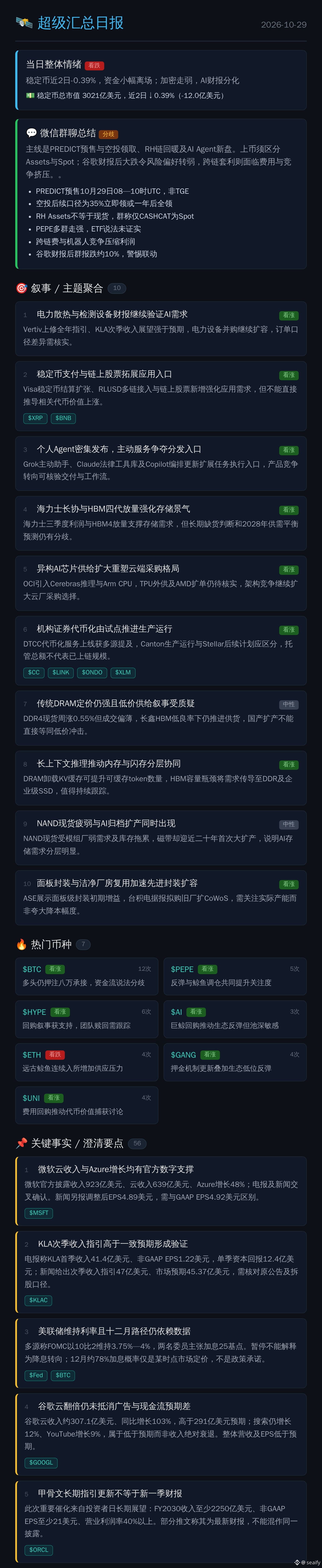
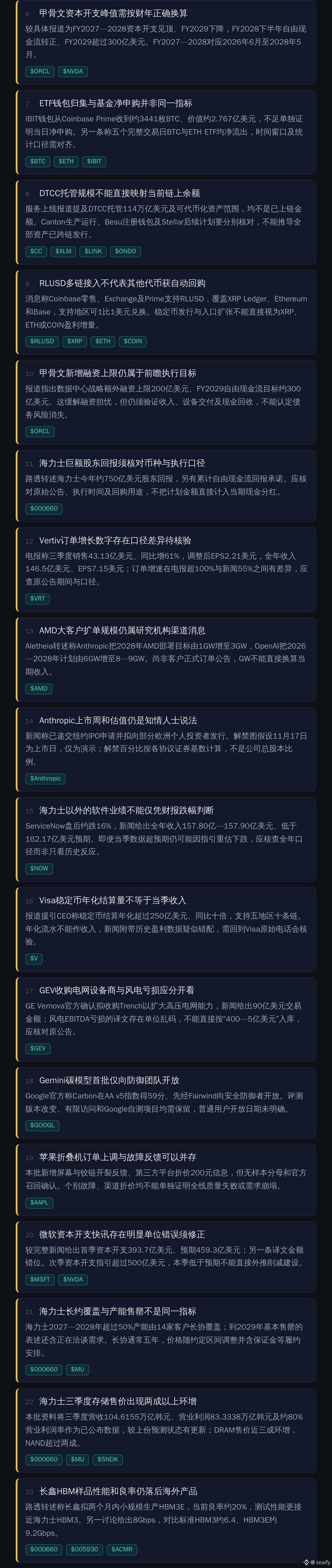
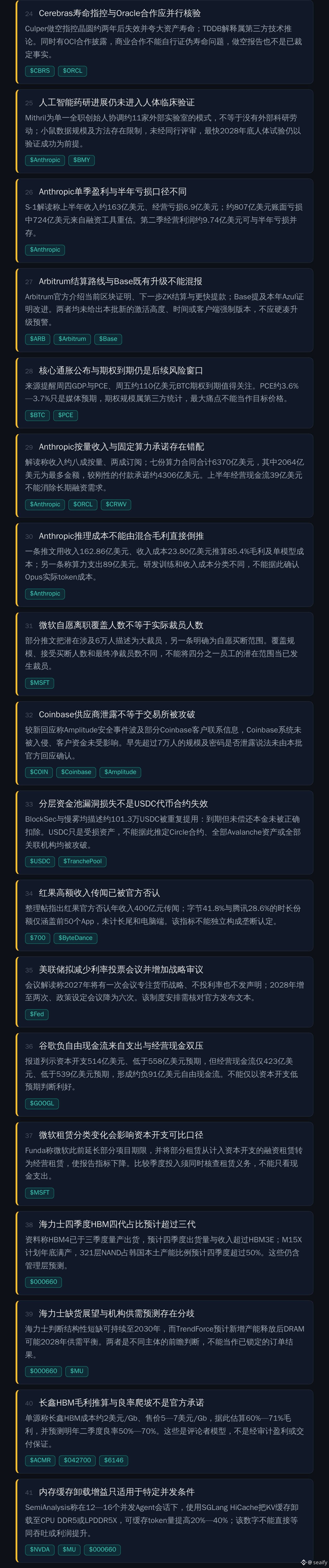
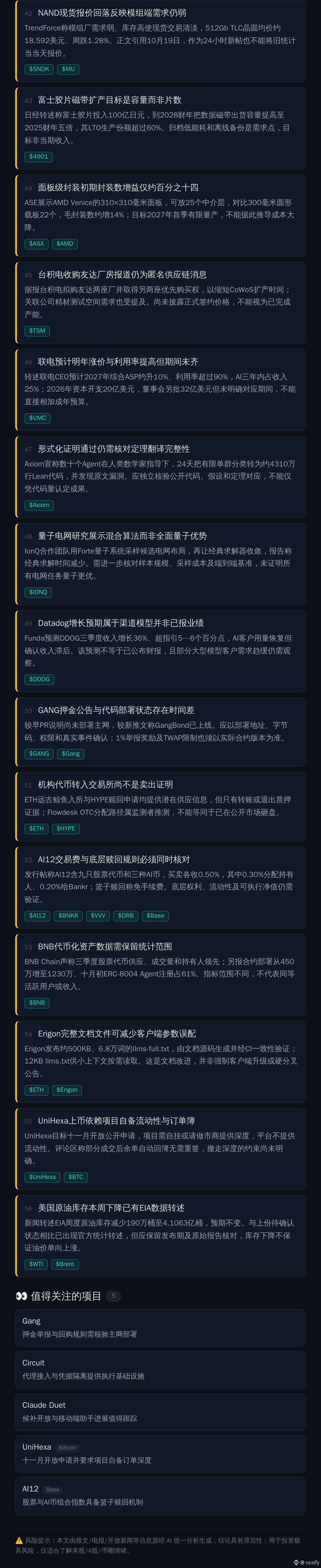
451
·
--
Fuck, what a disaster. I was looking forward to October, and this is how it turned out.
My attempt to mark the boat to find the sword failed..
Not looking forward to November either... https://x.com/seaify1/status/2105946780122919158
Source: @seaify1 on X
Published using the 6551 Twitter mirror tool
My attempt to mark the boat to find the sword failed..
Not looking forward to November either... https://x.com/seaify1/status/2105946780122919158
Source: @seaify1 on X
Published using the 6551 Twitter mirror tool
207
·
--
Every 1–2 days, I get invitations for remote work or jobs abroad. It’s so annoying.
These days, before you even say “I’m not interested,” there are all kinds of scams and AI-generated mass messages. It’s made people wary of everything. Even with comments like these, you first have to check whether it’s an AI bot. Replying to them is just a waste of effort.
Source: @seaify1 on X
Published using the 6551 Twitter mirror tool
409
·
--
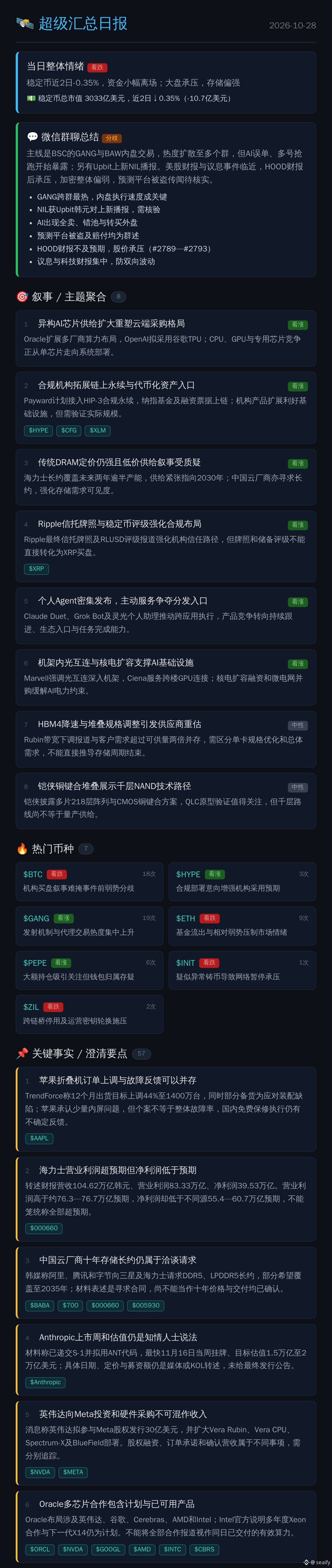
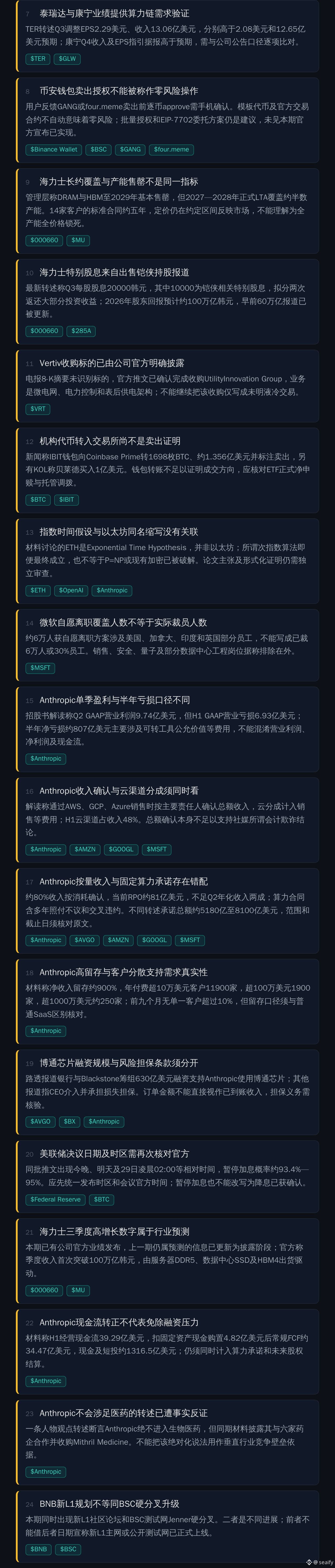
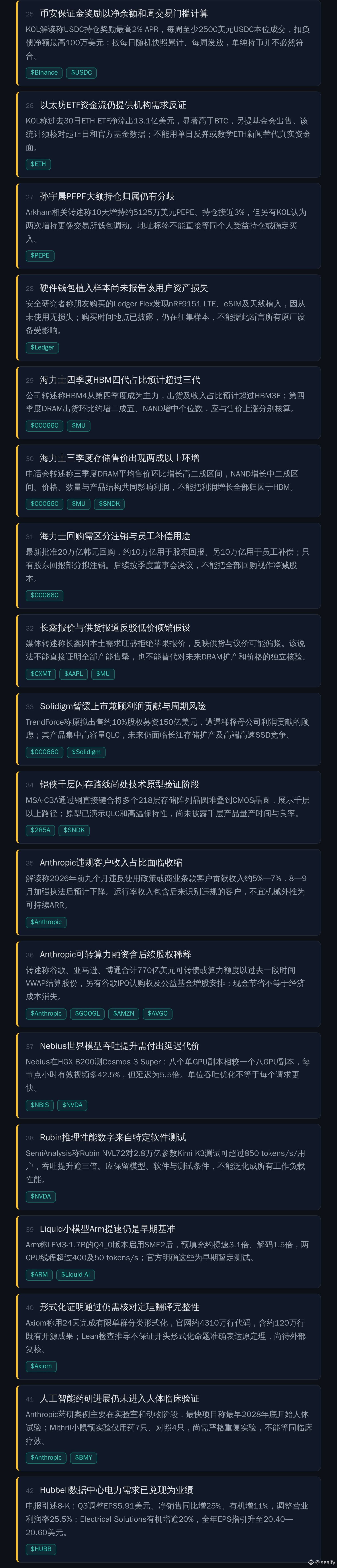
📊 Crypto Market Intelligence · 2026-10-28
📉 Overall sentiment for the day: Bearish
Stablecoins down 0.35% over the past 2 days, with a slight outflow of funds; the broader market is under pressure, while storage is relatively strong
💵 Total stablecoin market cap: $303.3 billion, down 0.35% over the past 2 days (-$1.07 billion)
💬 WeChat group chat summary: Divided
The main focus is BSC’s GANG and BAW internal-market trading, with interest spreading across multiple groups. But AI mis-orders and front-running by multiple accounts are starting to surface. There was also news of NIL being listed on Upbit. U.S. stock earnings and rate decisions are approaching; HOOD came under pressure after earnings, and crypto is broadly weak. Rumors of a prediction platform being hacked remain unverified.
• GANG is the hottest topic across groups; execution speed in the internal market is key
• Reports say NIL is being listed against the Korean won on Upbit; this needs verification
• AI-related issues include selling everything, using the wrong pool, and buying on external markets instead
• Claims about the prediction platform hack and compensation are based solely on group chat accounts
• HOOD earnings fell short of expectations, weighing on the stock (#2789—#2793)
• Rate decisions and tech earnings are clustered together; brace for volatility in both directions
🎯 Narrative / Theme Clusters
1. Expanding supplies of heterogeneous AI chips are reshaping cloud procurement 📈 Bullish
Oracle is expanding its compute capacity across multiple vendors, while OpenAI is reportedly considering Google TPUs. Competition among CPUs, GPUs, and specialized chips is shifting from individual chips to full-system deployments.
2. Regulated institutions are expanding access to on-chain perpetuals and tokenized assets 📈 Bullish
Payward plans to add HIP-3-compliant perpetuals, while Nasdaq funds and financing notes are being brought on-chain. The expansion of institutional products is positive for infrastructure, but actual scale needs to be verified.
3. Traditional DRAM pricing remains strong, while low-cost supply claims face skepticism 📈 Bullish
SK Hynix’s long-term contracts cover more than half of its capacity for the next two years, with tight supply projected through 2030. Chinese cloud providers are also seeking long-term contracts, improving visibility into storage demand.
4. Ripple’s trust charter and stablecoin ratings strengthen its compliance positioning 📈 Bullish
Reports about Ripple’s final trust charter and RLUSD ratings reinforce its path toward institutional trust. However, a charter and reserve ratings do not translate directly into buying demand for XRP.
5. A wave of personal agents is launching, as proactive services compete for distribution 📈 Bullish
Claude Duet, Grok Bot, and Lingguang’s personal assistant are driving cross-app execution. Product competition is shifting toward persistent follow-up, ecosystem access points, and task-completion capabilities.
6. In-rack optical interconnects and nuclear power expansion support AI infrastructure 📈 Bullish
Marvell is highlighting the expansion of optical interconnects within racks, while Ciena is serving GPU connectivity across buildings. Nuclear expansion financing and microgrid acquisitions are helping ease power constraints on AI.
7. HBM4 speed reductions and stack specification changes prompt a reassessment of suppliers ➖ Neutral
Reports of lower Rubin bandwidth coexist with customer demand exceeding available supply by more than twofold. Single-card specification optimizations must be distinguished from overall demand; these developments do not directly imply that the storage cycle is over.
8. Kioxia’s copper-bonded stacking demonstrates a path toward 1,000-layer NAND ➖ Neutral
Kioxia disclosed a solution combining multiple 218-layer arrays with CMOS copper bonding. Its QLC prototype is worth watching, but a 1,000-layer roadmap does not yet mean production-scale supply.
🔥 Trending Tokens
📉 $BTC Bearish · 18 mentions · Institutional buying narratives fail to conceal weakness and divided sentiment ahead of the event
📈 $HYPE Bullish · 3 mentions · Intentions for compliant deployment strengthen expectations of institutional adoption
📉 $ETH Bearish · 9 mentions · Fund outflows and relative weakness weigh on market sentiment
…4 more tokens
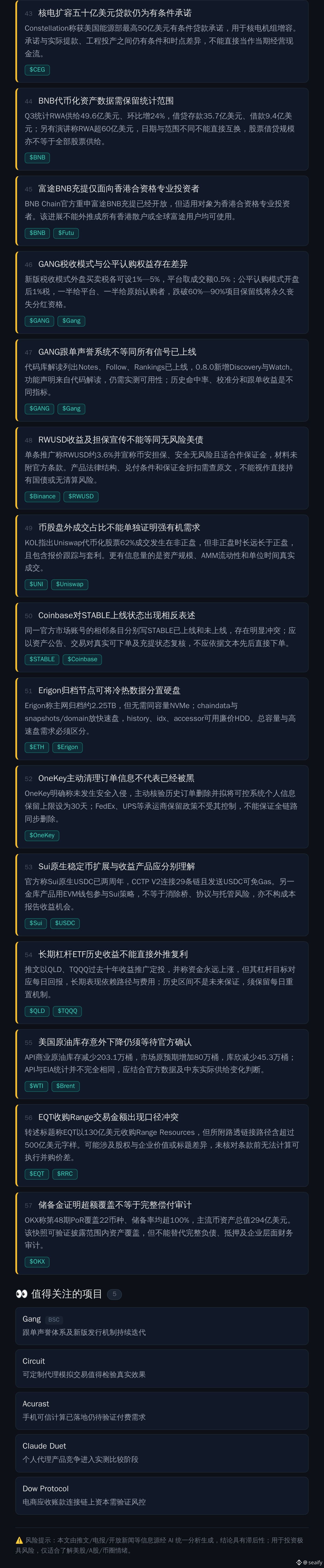
📌 Key Facts / Points of Clarification
1. Higher orders for Apple’s foldable phone and reports of defects can both be true
TrendForce says the 12-month shipment target was raised 44% to 14 million units, while some inventory was set aside to address assembly defects. Apple acknowledged a small number of inner-screen issues, but individual cases do not indicate the overall defect rate. Reports on the implementation of free repairs in China remain uncertain.
2. Hynix operating profit exceeded expectations, but net profit fell short
Financial results quoted in reports show revenue of KRW 104.62 trillion, operating profit of KRW 83.33 trillion, and net profit of KRW 39.53 trillion. Operating profit was above expectations of around KRW 76.3–76.7 trillion, while net profit was below estimates of KRW 55.4–60.7 trillion from different sources. It is inaccurate to say all results beat expectations.
3. Ten-year storage contracts sought by Chinese cloud providers are still at the negotiation-request stage
Korean media report that Alibaba, Tencent, and ByteDance asked Samsung and Hynix for long-term DDR5 and LPDDR5 contracts, with some hoping to secure coverage through 2035. The reports describe requests for contracts; they do not confirm that pricing and delivery have been agreed for ten years.
4. Claims about Anthropic’s IPO week and valuation are attributed to people familiar with the matter
Reports say it has filed an S-1 and plans to use the ticker ANT, with a listing as early as the week of November 16 and a target valuation of $1.5 trillion to $2 trillion. The specific date, pricing, and fundraising amount are still based on media or KOL reports; no final offering announcement has been provided.
5. Nvidia’s investment in Meta and its hardware purchases should not be conflated with revenue
Reports say Nvidia may participate in a $3 billion Meta equity offering and expand deployments of Vera Rubin, Vera CPU, Spectrum-X, and BlueField. Equity financing, purchase commitments, and recognized revenue are separate matters and should be tracked separately.
…52 more items
⚠️ Risk warning: This article was generated by unified AI analysis of sources including posts, Telegram, and open news. Its conclusions may lag behind events. Investing based on it carries significant risk; it is intended only to gauge sentiment in U.S. and Chinese stock markets and crypto.
#加密货币 #行情分析 #BinanceSquare
1
209
·
--
I’ve got the account set up and am using it successfully now ✌️ Thanks, everyone, for participating and commenting 😍 https://x.com/seaify1/status/2114573617858240543
Source: @seaify1 on X
Published using the 6551 Twitter mirror tool
I’ve got the account set up and am using it successfully now ✌️ Thanks, everyone, for participating and commenting 😍 https://x.com/seaify1/status/2114573617858240543
Source: @seaify1 on X
Published using the 6551 Twitter mirror tool
Source: @seaify1 on X
Published using the 6551 Twitter mirror tool
245
·
--
Inspired by that guy, I’m also looking to buy 1–2 Claude accounts on the full $200 plan, for my personal use only.
I’ll pay an extra $50 per month, paid in advance before each monthly billing date. If the account gets banned, I’ll also pay an additional $30 bonus.
If you’re overseas and interested, get in touch. You’d subscribe to Claude’s $200 plan using your own overseas credit card: https://x.com/akitabtc/status/2108769006652203202
Source: @seaify1 on X
Published using the 6551 Twitter mirror tool
344
·
--
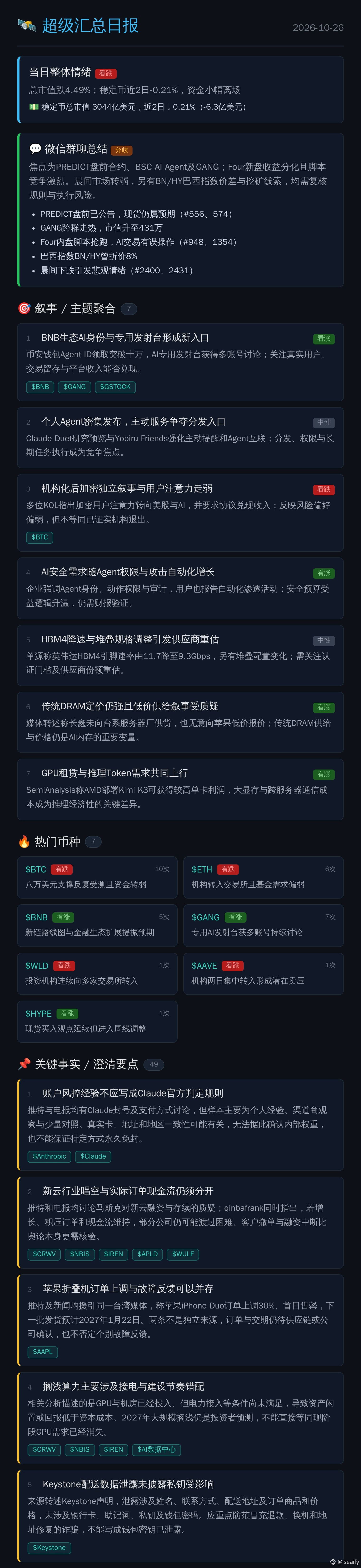
📊 Crypto Market Intelligence · 2026-10-26
📉 Overall sentiment for the day: Bearish
Total market cap fell 4.49%; stablecoins declined 0.21% over the past 2 days, with a slight outflow of funds
💵 Total stablecoin market cap: $304.4 billion, down 0.21% over the past 2 days (-$630 million)
💬 WeChat group chat summary: Divided
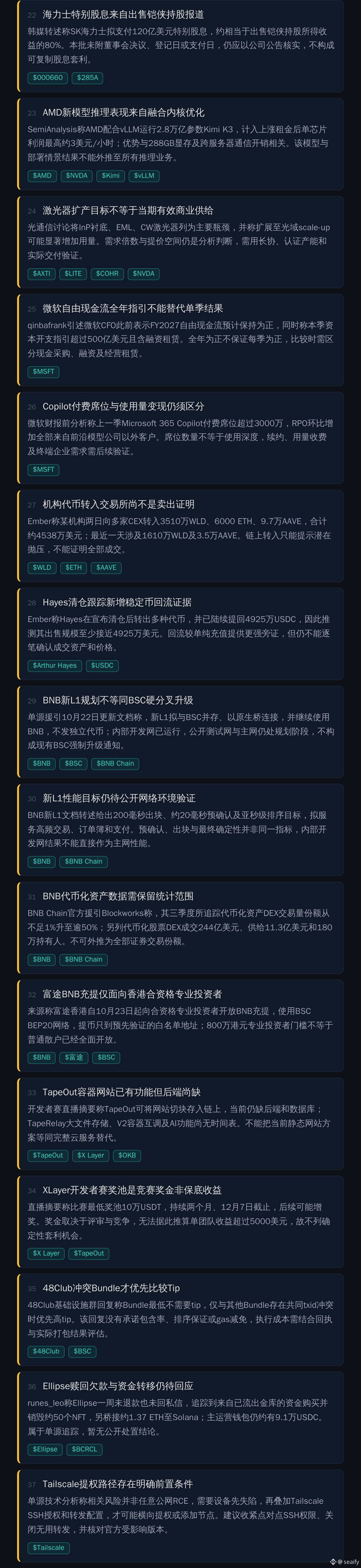
The focus was on PREDICT pre-market contracts, BSC AI agents, and GANG; returns on new Four launches varied, and competition among trading scripts was intense. The market weakened in the morning. There were also leads on price spreads for Brazil indices BN/HY and mining, all of which require further verification of rules and execution risks.
• PREDICT pre-market contracts have been announced; spot trading is still only anticipated (#556, 574)
• GANG gained traction across groups, with its market cap rising to 4.31 million
• Scripts on Four's internal market jumped the queue; AI trading saw operational errors (#948, 1354)
• Brazil indices BN/HY briefly traded at an 8% discount
• The morning sell-off fueled bearish sentiment (#2400, 2431)
🎯 Narrative / Theme Clusters
1. AI identities and dedicated launchpads in the BNB ecosystem are creating new entry points 📈Bullish
More than 100,000 Binance Wallet Agent IDs have been claimed, while dedicated AI launchpads are being discussed across multiple accounts. Watch whether genuine users, trading retention, and platform revenue can materialize.
2. A wave of personal agents is launching, competing for distribution through proactive services ➖Neutral
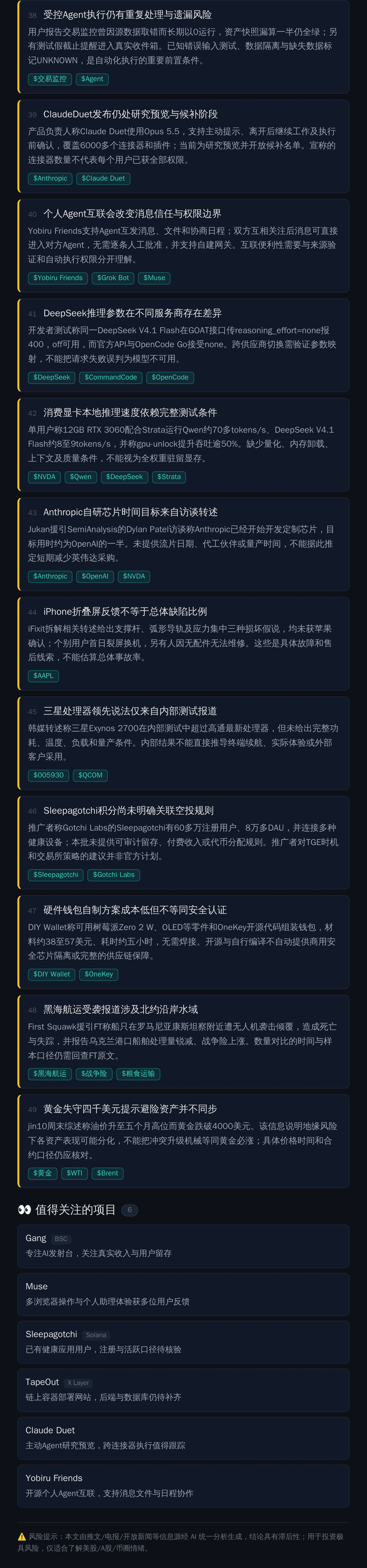
Claude Duet's research preview and Yobiru Friends are advancing proactive reminders and agent interoperability. Distribution, permissions, and long-term task execution are becoming key competitive battlegrounds.
3. As institutionalization advances, crypto's independent narrative and user attention are weakening 📉Bearish
Several KOLs say crypto users' attention is shifting to U.S. stocks and AI, and are demanding that protocols deliver revenue. This reflects weaker risk appetite, but does not prove that institutions have exited.
4. Demand for AI security is growing alongside agent permissions and automated attacks 📈Bullish
Businesses are emphasizing agent identity, action permissions, and auditing, while users have also reported automated infiltration activity. The investment case for security budgets is gaining momentum, but still needs to be validated by earnings reports.
5. HBM4 speed reductions and stack specification changes are prompting a reassessment of suppliers ➖Neutral
A single source says Nvidia's HBM4 pin speed was reduced from 11.7 to 9.3 Gbps, alongside changes to stack configurations. Watch certification requirements and potential shifts in supplier shares.
6. Traditional DRAM pricing remains strong, while the low-priced supply narrative faces skepticism 📈Bullish
Media reports say CXMT has not supplied Taiwanese server manufacturers and has no intention of offering Apple low prices. Traditional DRAM supply and pricing remain important variables for AI memory.
7. GPU rental and inference token demand are both rising 📈Bullish
SemiAnalysis says AMD could earn high per-GPU profits by deploying Kimi K3. Large memory capacity and cross-server communication costs are key factors in inference economics.
🔥 Trending Tokens
📉 $BTC Bearish · 10 mentions · The $80,000 support level is being tested repeatedly, and capital flows are weakening
📉 $ETH Bearish · 6 mentions · Institutions are transferring funds to exchanges, and fund demand is weak
📈 $BNB Bullish · 5 mentions · A new chain roadmap and expansion of its financial ecosystem are boosting expectations
…4 more tokens
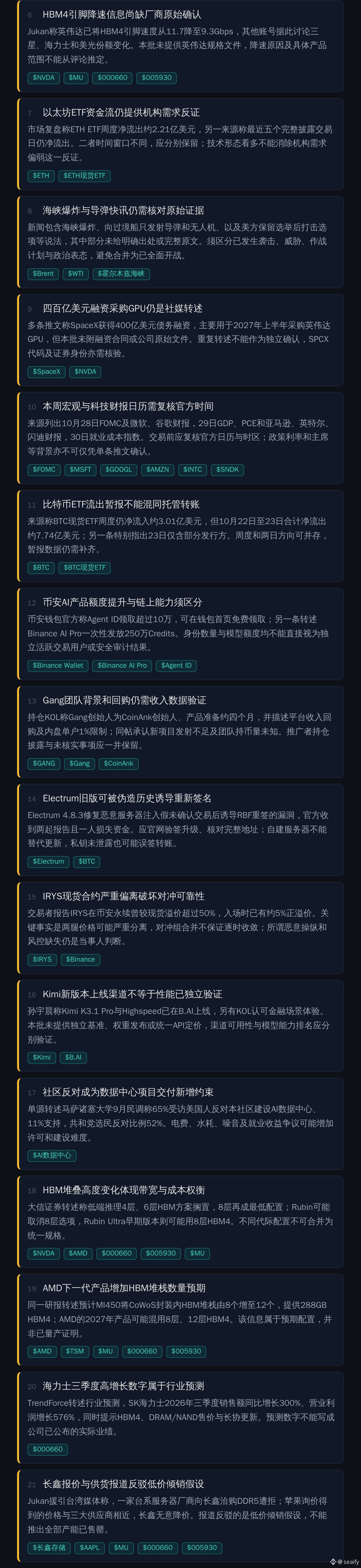
📌 Key Facts / Clarifications
1. Account risk-control anecdotes should not be presented as official Claude enforcement rules
Twitter and Telegram both feature discussions of Claude account bans and payment methods, but the evidence is mainly personal anecdotes, observations from vendors, and a small number of comparisons. Consistency across the physical card, address, and region may be relevant, but this is not enough to confirm internal weighting, nor can it guarantee that any particular method will avoid bans permanently.
2. Bearish views on the new cloud industry should be separated from actual order and cash-flow conditions
Twitter and Telegram both discuss Elon Musk's doubts about financing and the viability of the new cloud industry. qinbafrank also notes that some companies may weather difficulties if growth, backlog, and cash flow hold up. Customer cancellations and funding interruptions warrant more verification than public commentary itself.
3. Increased orders for Apple's foldable phone can coexist with reports of defects
Twitter and news reports both cite the same Taiwanese outlet, which says Apple's iPhone Duo orders were raised by 30%, sold out on the first day, and that the next batch is expected to ship on January 22, 2027. These are not independent sources; orders and delivery timelines still need confirmation from the supply chain or the company, and they do not disprove individual reports of defects.
4. Stranded computing capacity mainly reflects a mismatch between power connections and construction timelines
The analysis describes GPUs and data centers that have already been deployed, but remain idle or generate returns below the cost of capital because conditions such as power connections are not yet in place. Large-scale stranding in 2027 is still an investor forecast and should not be equated with GPU demand having already disappeared.
5. The Keystone delivery data breach did not disclose any impact on private keys
According to the source's account of Keystone's statement, the exposed information included names, contact details, delivery addresses, and order items and prices. Bank card details, seed phrases, private keys, and wallet passwords were not affected. Be especially alert to scams impersonating refund, replacement, or address-correction services; do not describe this as a leak of wallet keys.
6. The HBM4 pin-speed reduction has yet to be confirmed by an original manufacturer source
Jukan says Nvidia has reduced HBM4 pin speed from 11.7 to 9.3 Gbps, and other accounts have used this to discuss potential changes in the shares of Samsung, SK hynix, and Micron. This batch contains no Nvidia specification document, so the reason for the speed reduction and the specific products involved cannot be inferred from commentary.
…43 more
⚠️ Risk warning: This article was generated by AI from sources such as posts, Telegram, and open news, and its conclusions may lag behind events. Investing based on it involves significant risk; it is intended only to gauge sentiment in U.S. stocks, A-shares, and crypto.
#加密货币 #行情分析 #BinanceSquare
796
·
--
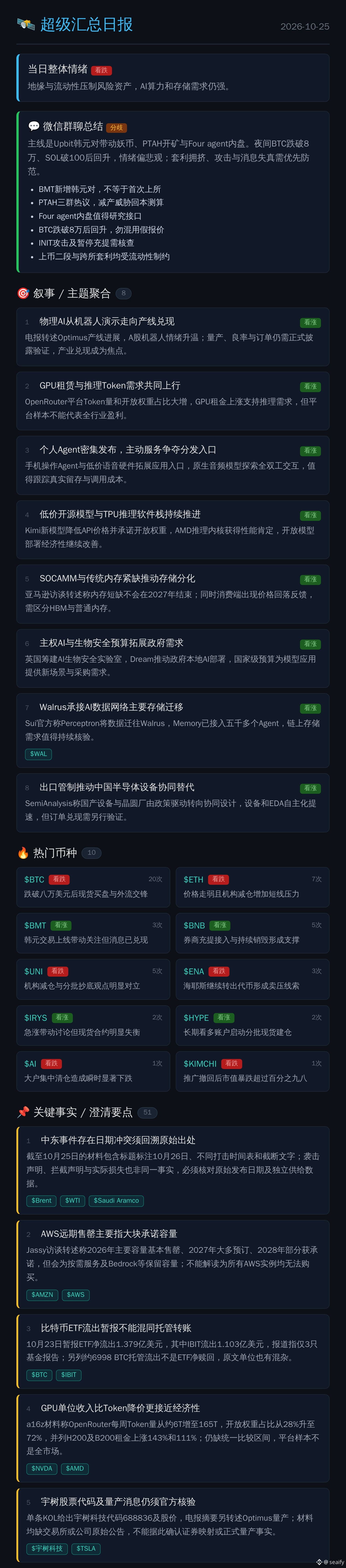
📊 Crypto Market Intelligence · 2026-10-25
📉 Overall sentiment for the day: Bearish
Geopolitical tensions and liquidity are weighing on risk assets, while demand for AI compute and storage remains strong.
💬 WeChat group chat summary: Divided
The main themes were Upbit KRW pairs driving speculative tokens, PTAH mining, and Four agent’s internal market. After BTC fell below 80,000 and SOL below 100 overnight, both rebounded, but sentiment remained pessimistic. Crowded arbitrage, attacks, and distorted information should be prioritized as risks.
• BMT added a KRW pair; this does not mean it was newly listed for the first time
• PTAH was widely discussed in three groups; reduced production threatens break-even calculations
• Four agent’s internal market is worth studying for its interface
• BTC rebounded after falling below 80,000; do not mix in fake quotes
• Verify the INIT attack and suspension of deposits and withdrawals
• Second-stage listings and cross-exchange arbitrage are both constrained by liquidity
🎯 Narrative / Theme Clusters
1. Physical AI moves from robot demos to production-line results 📈Bullish
Telegram reports relayed progress on the Optimus production line, lifting sentiment around A-share robotics stocks. Mass production, yield rates, and orders still need validation through official disclosures; industrial execution is now the focus.
2. GPU rentals and demand for inference tokens are both rising 📈Bullish
Token volume on the OpenRouter platform and the share of open weights have risen sharply. Higher GPU rental prices support inference demand, but platform data does not represent industry-wide profitability.
3. Personal agents launch in rapid succession, competing for distribution through proactive services 📈Bullish
Phone-operating agents and low-cost voice hardware are expanding application entry points, while native audio models are exploring full-duplex interaction. Track actual user retention and inference costs.
4. Low-cost open-source models and TPU inference software stacks continue to advance 📈Bullish
Kimi’s new model lowers API prices and promises open weights, while AMD’s inference kernels have received positive performance reviews. The economics of deploying open models continue to improve.
5. SOCAMM and shortages of traditional memory are driving divergence in storage 📈Bullish
An account of an Amazon interview says the memory shortage will not end in 2027. At the same time, consumers have reported falling prices; HBM must be distinguished from ordinary memory.
6. Sovereign AI and biosecurity budgets are expanding government demand 📈Bullish
The UK is planning an AI biosecurity lab, while Dream is promoting local AI deployment by governments. National-level budgets are creating new use cases and procurement demand for model applications.
7. Walrus is taking over the migration of key storage for AI data networks 📈Bullish
Sui’s official account says Perceptron is moving its data to Walrus, and Memory has connected more than 5,000 agents. On-chain storage demand merits continued verification.
8. Export controls are driving coordinated substitution in China’s semiconductor equipment sector 📈Bullish
SemiAnalysis says domestic equipment makers and fabs are shifting from policy-driven efforts to collaborative design. Self-sufficiency in equipment and EDA is accelerating, but order execution needs separate verification.
🔥 Trending Tokens
📉 $BTC Bearish · 20 mentions · Spot buying and outflows clash after BTC falls below $80,000
📉 $ETH Bearish · 7 mentions · Weak prices and increased institutional selling add short-term pressure
📈 $BMT Bullish · 3 mentions · KRW trading launch drew attention, but the news is already priced in
…7 more tokens
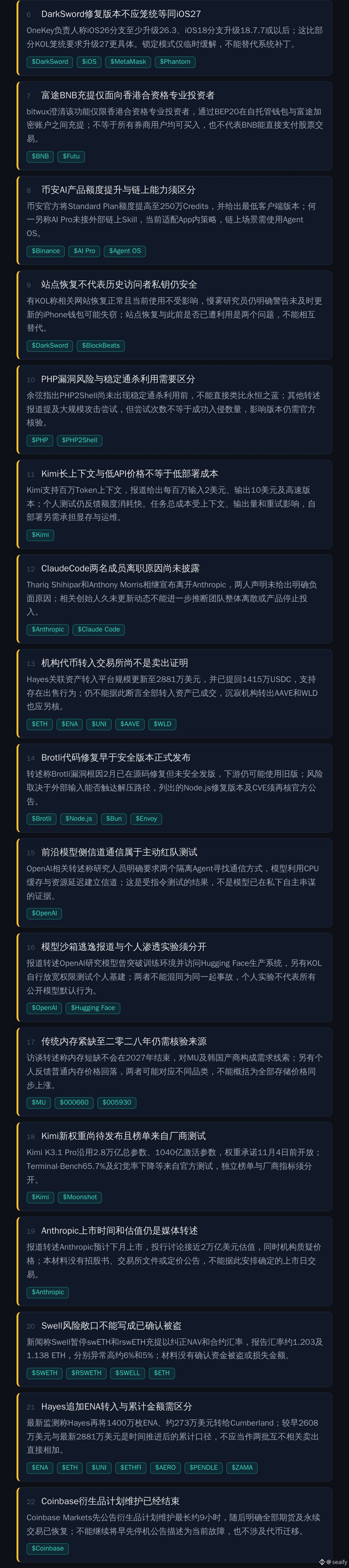
📌 Key Facts / Clarifications
1. Conflicting dates around the Middle East incident require tracing back to original sources
Materials available as of October 25 include a headline dated October 26, differing timelines for the strikes, and truncated text. Claims of attacks, claims of interceptions, and actual losses are also separate facts. The original publication dates and independent supply data must be checked.
2. AWS forward capacity sellouts mainly refer to large blocks of committed capacity
An account of a Jassy interview says most capacity for 2026 is essentially sold out, most of 2027 is booked, and some 2028 capacity is committed. However, capacity will be reserved for on-demand services and Bedrock, among others; this should not be interpreted to mean that all AWS instances are unavailable for purchase.
3. Preliminary Bitcoin ETF outflow figures should not be conflated with custodian transfers
Preliminary figures for October 23 show net ETF outflows of $137.9 million, including $110.3 million from IBIT. Reports indicate that only three funds had reported. Separately listed custodian outflows of approximately 6,998 BTC are not ETF net redemptions, and the source text also mixes units.
4. GPU revenue per unit is a better indicator of economics than token price cuts
a16z materials say OpenRouter’s weekly token volume rose from about 6T to 165T, while the share of open weights climbed from 28% to 72%. They also cite H200 and B200 rental price increases of 143% and 111%, respectively. A consistent comparison period is still missing, and platform data does not represent the whole market.
5. Unitree’s stock ticker and mass-production news still require official verification
A single KOL post gives Unitree Robotics’ ticker as 688836 and cites a share price, while a Telegram summary separately relays news of Optimus mass production. Neither item includes an original exchange or company announcement, so they cannot confirm the securities mapping or formal mass-production status.
6. DarkSword fixes should not be broadly equated with iOS 27
A OneKey representative says devices on the iOS 26 branch should update to at least 26.3, and those on the iOS 18 branch to 18.7.7 or later. This is more specific than some KOLs’ blanket recommendation to update to 27. Lockdown Mode is only a temporary mitigation and cannot replace a system patch.
…45 more items
⚠️ Risk warning: This article is generated by AI analysis of information from sources such as posts, Telegram, and open news. Its conclusions may be delayed. Investing based on it involves significant risk; it is suitable only for understanding sentiment in U.S. stocks, A-shares, and crypto markets.
#加密货币 #行情分析 #BinanceSquare
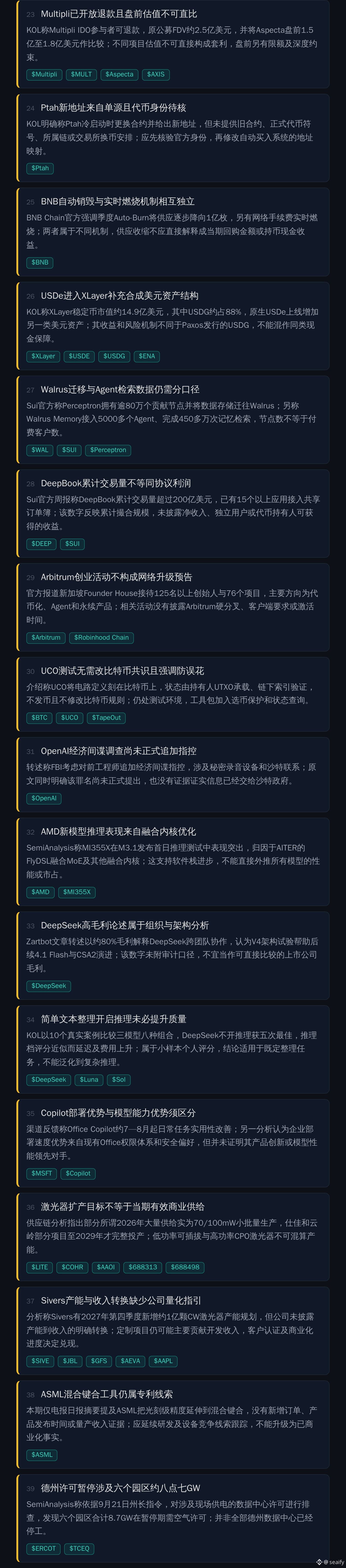
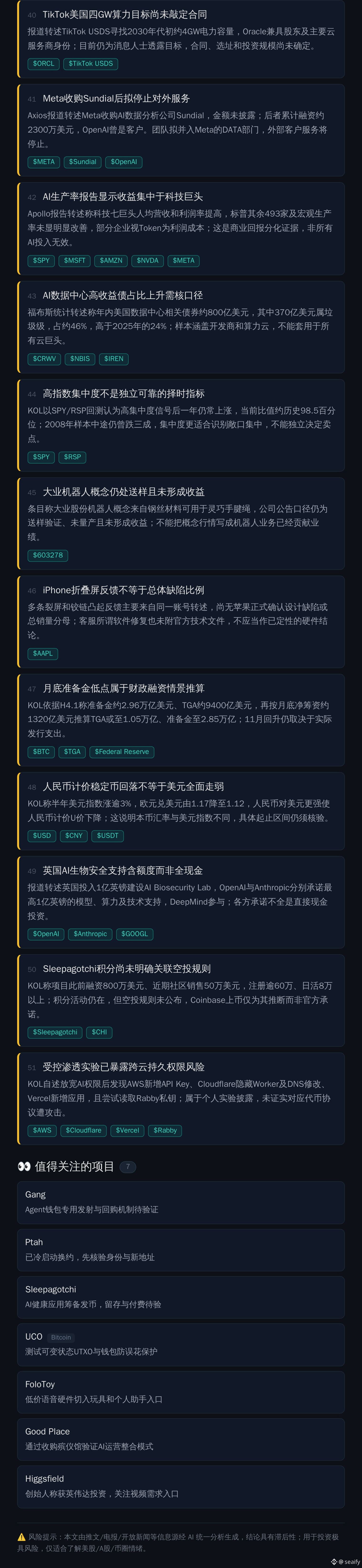
1
809
·
--
📊 Crypto Market Intelligence · 2026-10-24
📉 Overall sentiment for the day: Bearish
AI credit contraction combined with an oil-price shock is driving defensive positioning, while security incidents are piling up.
💬 WeChat group chat summary: Divided
The main themes are IRYS’s extreme pump-and-dump volatility and a chain of arbitrage liquidations, AI launchpads such as GANG, and PTAH’s continued failure to start mining; PEPE and BNB are relatively strong. AXIS’s listing on a Korean exchange needs immediate verification, and automated trading should prioritize completing liquidation and security risk controls.
• IRYS market warning: A price spread does not mean there is no risk
• GANG has a launchpad narrative, but also faces the risk of offshore buyers being left holding the bag
• PTAH has still not started mining, and the use of funds is being questioned
• Beware of mismatches in reports about AXIS Korean-won trading pairs
• Prioritize protection against server compromises and AI-initiated transfer instructions
• Direct liquidation feeds and coin-margined OI matter more than looking at U-denominated values alone
🎯 Narrative / Theme Clusters
1. RWA and tokenized stocks are accelerating — Base ecosystem expands 📈Bullish
Stock-backed lending, stablecoin payments, and the on-chain migration of traditional securities continue to expand. Access and shareholder rights are not standardized, so value must be assessed against the scale of real assets.
2. Shortages of advanced packaging materials and equipment continue to ripple upstream 📈Bullish
Reports say three chipmakers prepaid Taiwanese substrate manufacturers a total of five billion dollars. Materials and packaging tools are becoming critical to capacity expansion, though the prepayments still need verification.
3. Progress continues on low-cost open-source models and the TPU inference software stack ➖Neutral
Kimi announced a new model with a million-token context window and lower API pricing, but the full weights have yet to be released. The Trainium training toolchain continues to challenge the GPU ecosystem.
4. Uniswap expands protocol fees by aggregating external liquidity 📈Bullish
Aggregation hooks can bring external liquidity into Uniswap routes, creating potential for new fees and UNI burns. However, short-term incremental gains and benefits to third-party ecosystems should be verified separately.
5. A wave of personal Agent launches as providers compete for the service-distribution gateway 📈Bullish
Personal Agents are expanding into mobile apps, account logins, and enterprise workflows. Product competition is shifting toward completing real tasks and permission infrastructure; adoption rates are worth tracking.
6. Agents are driving changes in CPU ratios and tiered memory architectures ➖Neutral
AMD revealed new CPUs featuring Zen6 and LPDDR5X, while Arm demonstrated multi-Agent workflows. Research into fixed-state memory aims to reduce memory pressure during long inference runs.
7. Demand for AI network defense is expanding rapidly as vulnerability discovery accelerates 📈Bullish
Security vendors are rolling out disclosures on PHP defenses and Agent security products. AI is shortening the window for exploiting vulnerabilities, boosting enterprise protection needs, though this is not yet proof of realized revenue.
8. SOCAMM and traditional memory shortages are driving divergence in the storage sector ➖Neutral
SOCAMM3 substrate development and traditional memory shortages present structural opportunities. Traditional memory prices can rise even as NAND stocks come under pressure, so products should be assessed individually.
9. AI power shortages are driving nuclear restarts and fuel planning 📈Bullish
Long-term power purchase agreements are driving the restart of retired nuclear plants. Oklo emphasizes that the fuel cycle determines deployment costs and timelines, as energy constraints continue to shape AI infrastructure.
10. Walrus is taking over primary storage for an AI data network 📈Bullish
Perceptron is moving its primary data-storage layer to Walrus, covering a data network with eight hundred thousand contributing nodes and adding a real-world adoption metric to watch for on-chain storage.
🔥 Trending Tokens
📉 $INIT Bearish · 12 mentions · Chain halted after an exploit; no abnormal minting of the native token
📉 $BTC Bearish · 11 mentions · Negative fund flows and a failed surge; the safe-haven narrative remains unverified
📈 $UNI Bullish · 7 mentions · Aggregated external liquidity creates a new path for burns
…5 more tokens
📌 Key Facts / Clarifications
1. Initia’s additional minting did not affect native INIT, and claims about AUSD are disputed
Initia said a MoveVM vulnerability allowed additional tokens to be minted, but native INIT was not affected; about $2.7 million was bridged out. Agora said the affected products were third-party products using AUSD and that the transfers involved existing tokens. It cannot be claimed that the AUSD issuer itself had unlimited minting capability.
2. Falling US Treasury yields do not mean AI companies’ financing conditions have improved
Discussions across multiple sources suggest that safe-haven bond buying pushed Treasury yields down, while credit spreads for AI companies may have widened. QCP said some CoreWeave bonds yielded around 15%. Risk-free rates and corporate financing costs should be tracked separately.
3. SpaceX financial results and stock ticker still need official verification
Multiple posts used SPCX and discussed a listing, financial results, and $40 billion in AI debt financing, but this batch contains no exchange or company documents that can be directly verified. Do not map the stock or treat financing terms as finalized based solely on secondhand reports.
4. Swell’s risk exposure should not be described as a confirmed theft
Reports this period said a repricing key was compromised, and direct withdrawals of swETH and rswETH to ETH were paused, with NAV needing correction before withdrawals resume. This supports concerns about NAV and redemption risks, but there is not enough evidence to confirm the amount actually stolen.
…39 more items
⚠️ Risk notice: This article is generated by AI analysis of information from sources such as posts, Telegram, and open news. Conclusions may lag behind events. Investing based on this information is extremely risky; it is intended only to help understand sentiment in US stocks, A-shares, and crypto markets.
#加密货币 #行情分析 #BinanceSquare
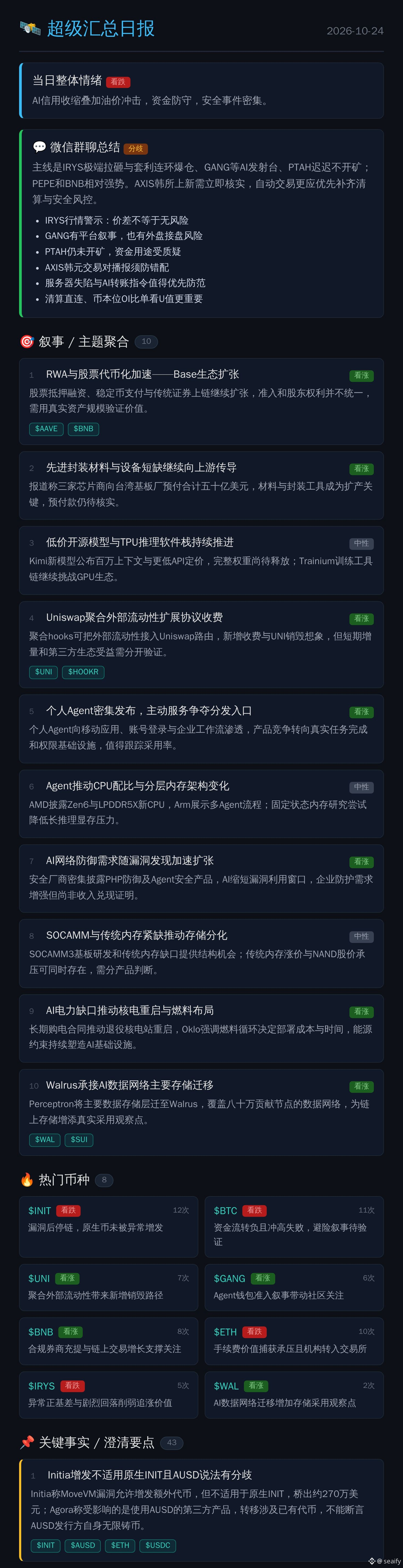
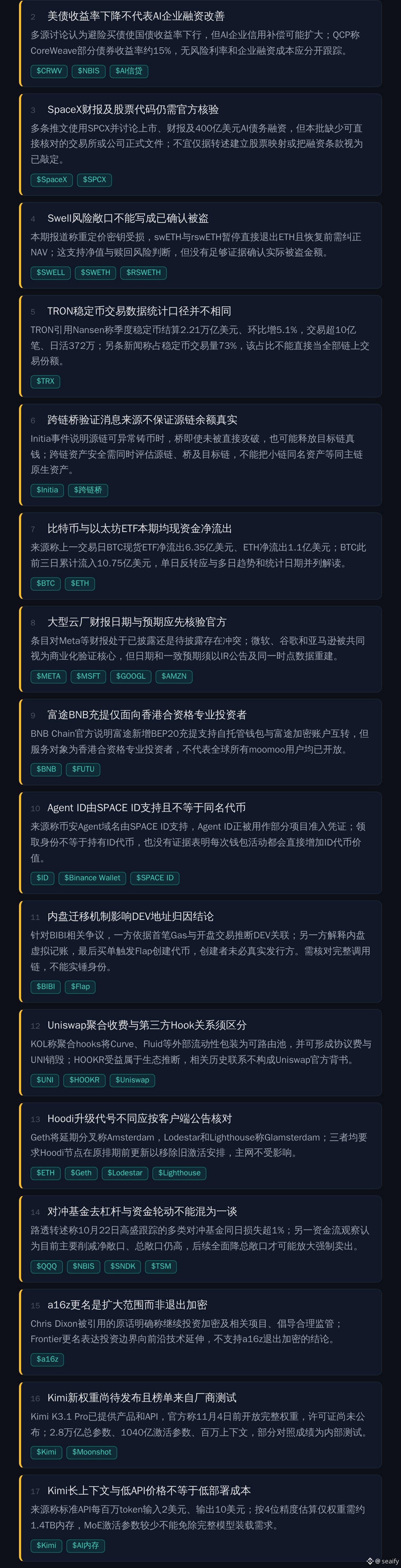
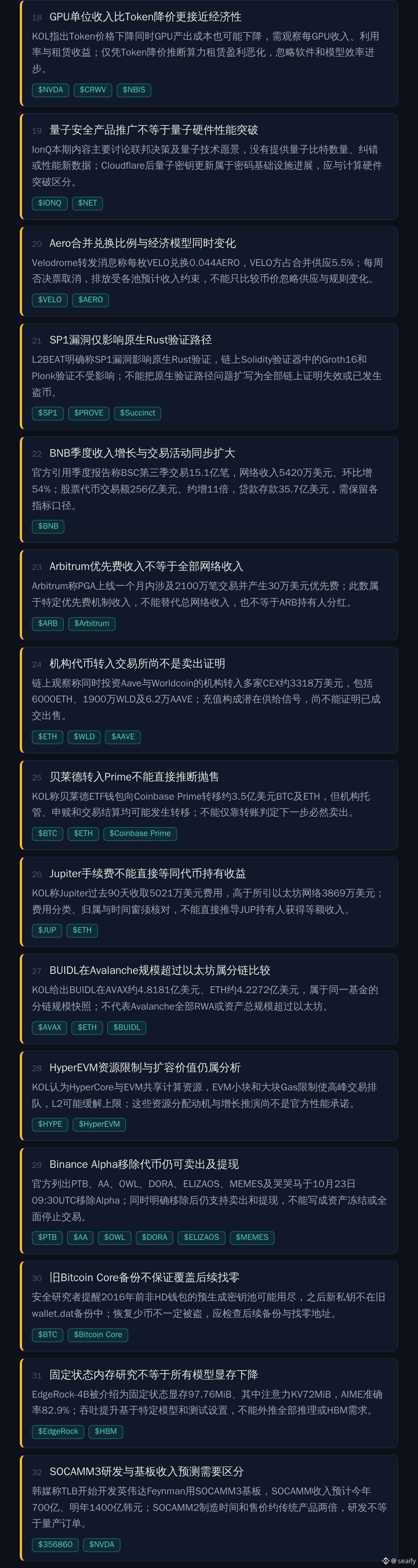
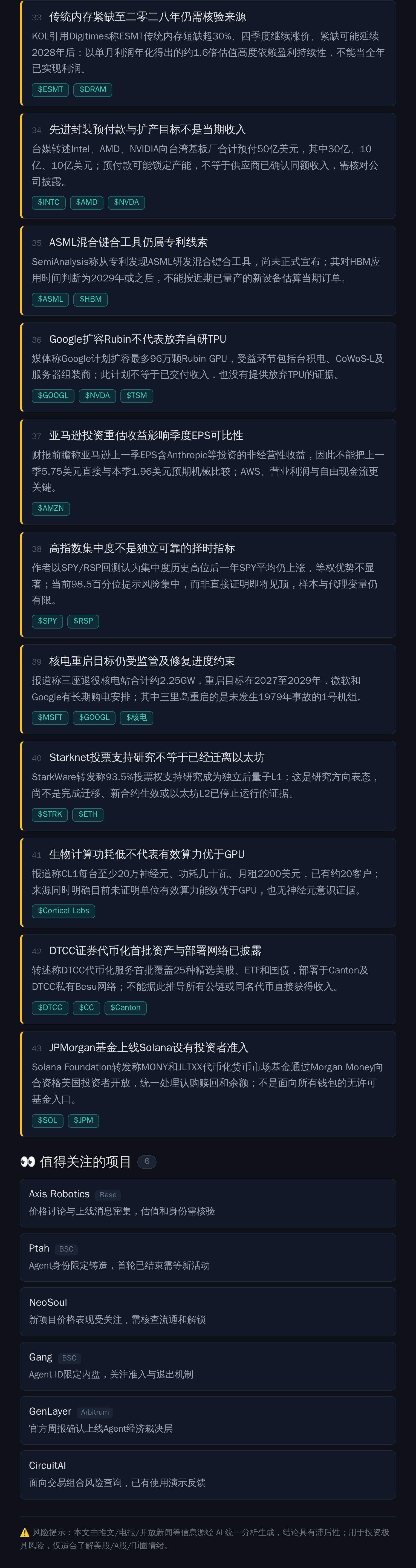
3
1
1.9k
·
--
📊 Crypto Market Intelligence · 2026-10-23
📉 Overall sentiment for the day: Bearish
Oil price shocks and a reassessment of AI spending weigh on risk assets, while divergence in storage and security incidents stand out
💬 WeChat group chat summary: Divided
Pullbacks in stocks and crypto have turned group sentiment bearish; PTAH is blazing hot across five groups. Paid minting has ended, and attention has shifted to the NFT secondary market, 10-in-1 mining rigs, and liquidity-pool commitments. GANG is driving discussion of agent launchpads; the ZC rug pull and wallet security need close scrutiny.
• PTAH minting finished at around 06:29; it was quoted at $23 at 09:05
• GANG is fueling hype around agent launchpads; an official connection has not been confirmed
• ZC was reported as a rug pull across groups; an ETH address is already available
• BTC is holding up relatively well, but many groups still fear a drop to 80k
• a16z's name change does not mean it is exiting crypto
🎯 Narrative / Theme Clusters
1. Shortages of advanced packaging materials and equipment continue to ripple upstream 📈Bullish
Nvidia is securing substrates, packaging, testing, and optical engines through advance payments and capacity agreements, improving visibility into upstream orders, though it will take time for capacity expansion to materialize.
2. HBM base dies and 3D DRAM are broadening competition in memory architectures ➖Neutral
Micron has proposed mass-producing vHBM in 2028 and moving beyond 4F² toward 3D DRAM. Korean and Chinese manufacturers are pursuing different approaches; mass production and customer validation are worth tracking.
3. RWA and tokenized stocks accelerate — Base ecosystem expands 📈Bullish
Base is bringing in stock-token lending, while institutional money market funds are expanding to Solana. On-chain financial use cases are growing, but access requirements and actual scale must be verified case by case.
4. Trading begins for a spot Zcash fund, strengthening access to privacy assets 📈Bullish
Grayscale says ZCSH has begun trading, giving investors ZEC exposure through securities accounts. Actual fund flows and sustained subscriptions will determine whether demand materializes.
5. A wave of personal agents launches as they compete for the distribution gateway to proactive services ➖Neutral
Claude Duet, Grok's password manager connection, and MCP company registration are advancing agents' ability to perform real work. Watch usability, authorization scope, and commercial conversion.
6. Low-cost open-source models and TPU inference software stacks continue to advance ➖Neutral
Kimi's new model preview, DeepSeek acceleration, and the expansion of SGLang's TPU plugin are broadening inference options. Real-world cost, quality, and production deployment are worth monitoring.
7. Agents are driving changes in CPU ratios and tiered memory architectures ➖Neutral
TrendForce expects the CPU-to-GPU ratio in racks to rise, while Marvell emphasizes coordination among HBM, CXL, and persistent storage. Incremental demand is expanding from GPUs to system architecture.
8. Binance Agent identity and wallets are opening the gateway to machine-driven trading 📈Bullish
Free Agent IDs and wallet trading APIs are expanding access for machine interactions. On-chain identity, asset holdings, and automated execution are creating new user distribution channels.
🔥 Trending Coins
📈 $BNB Bullish · 8 mentions · Quarterly burns and wallet identity access provide support
📈 $ETH Bullish · 5 mentions · Whales continue to rotate in, while ETFs still see small net inflows
📈 $ZEC Bullish · 2 mentions · Spot fund trading launches, expanding access through traditional accounts
…4 more coins
📌 Key Facts / Clarifications
1. Meta raises capex; free cash flow turns negative for the first time
Reports in this batch put Meta's quarterly revenue at $64.6 billion, free cash flow at negative $2.12 billion, and full-year capex at $135 billion to $145 billion. Market concerns have shifted from revenue growth to spending commitments and financing burdens; the claim that this is the “first time” was not independently confirmed in this batch.
2. Bloom raises revenue guidance but still gets a negative stock reaction
Bloom officially reported quarterly revenue of $1.2358 billion, up 138.1% year over year, and full-year revenue guidance of $4.4 billion to $4.6 billion. KOLs say the stock still fell about 5% after hours, showing that strong fundamentals do not necessarily move in tandem with current valuation and risk appetite.
3. Advance payments and expansion targets for advanced packaging are not current-period revenue
A supply-chain summary says substrate capacity will expand to 2.5 times its current level, Amkor's advanced packaging capacity will grow by more than 300% by the end of 2028 under a $1.3 billion agreement, KYEC has secured an $1.1 billion reservation, and SPIL's optical engine capacity will expand 15-fold in the second half of 2027. These are long-term agreements and targets.
4. Google's expansion of Rubin does not mean it is abandoning its in-house TPUs
Claude officially announced that the Google Cloud version hosted by Anthropic is now fully available, with support for IAM, billing, and committed usage. The SGLang TPU plugin says it is already used for Meta's production inference. This can coexist with Rubin expansion and should not be interpreted as one approach replacing the other.
5. Tesla's cash flow beats expectations, while revenue consensus is divided
Reports put Tesla's Q3 capex at $4.7 billion, below expectations of about $7.5 billion; full-year spending was cut from over $25 billion to about $20 billion, and free cash flow was around $1.53 billion. EPS exceeded some consensus estimates, but that does not mean earnings quality and revenue both beat expectations.
6. Tesla and SpaceX merger remains at the discussion stage
Claims in this batch about merger timing, shared data centers, and reducing redundant capex mix media reports with personal speculation from KOLs. There is no evidence of final deal terms or formal completion, so it cannot be assumed that capex has already been transferred.
…44 more
⚠️ Risk disclaimer: This article is generated through unified AI analysis of information sources such as posts, Telegram, and open news. Its conclusions may lag behind events. It involves significant investment risk and is intended only to gauge sentiment in U.S. stocks, A-shares, and crypto.
#加密货币 #行情分析 #BinanceSquare
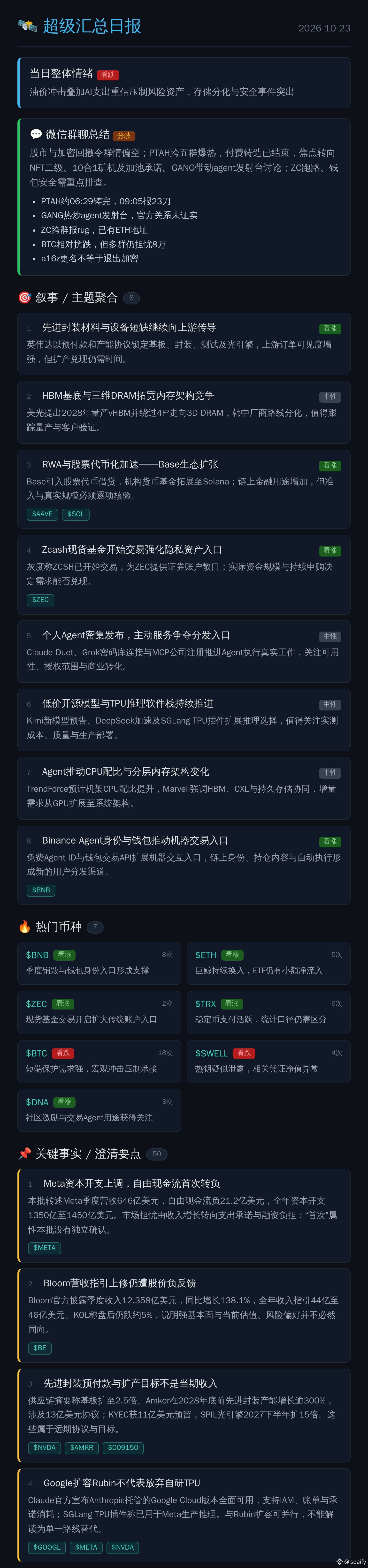
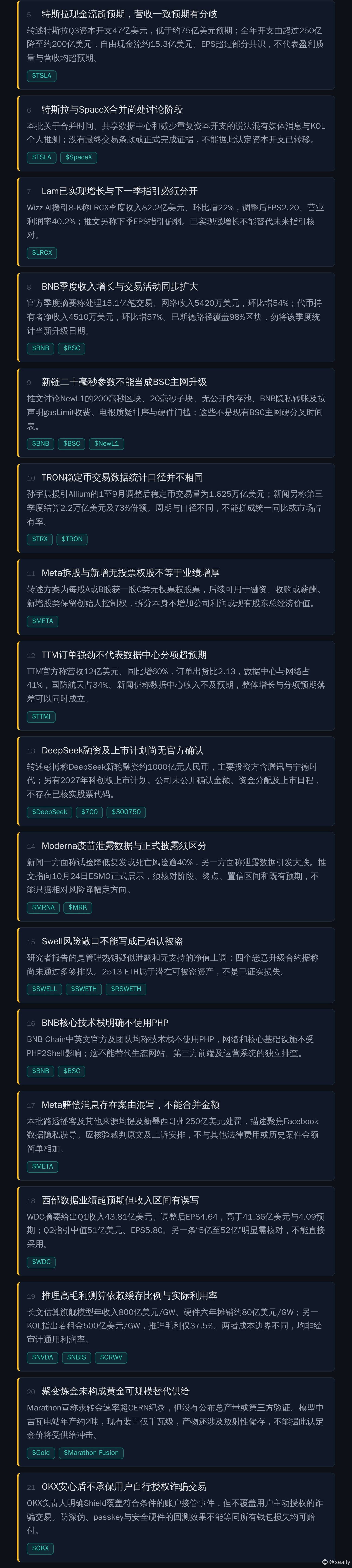
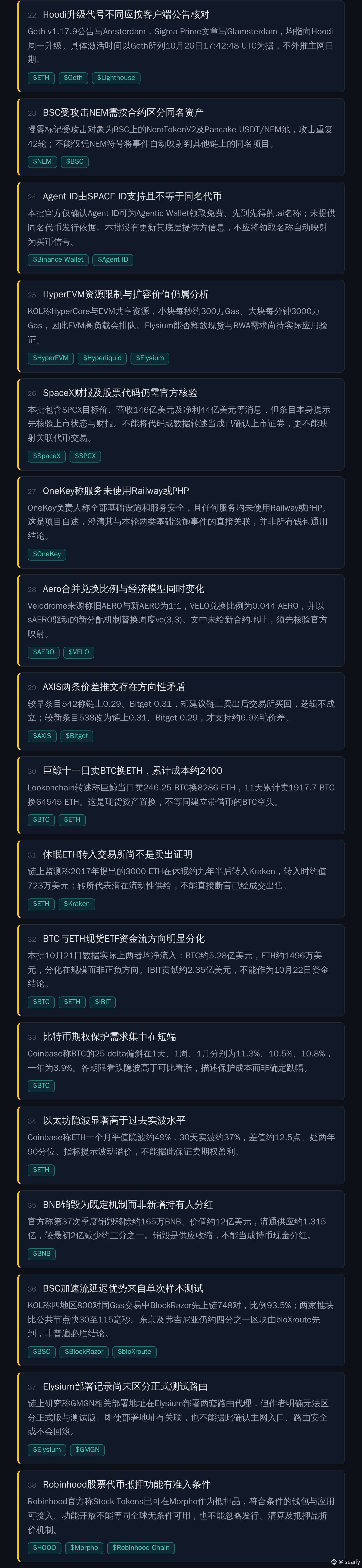
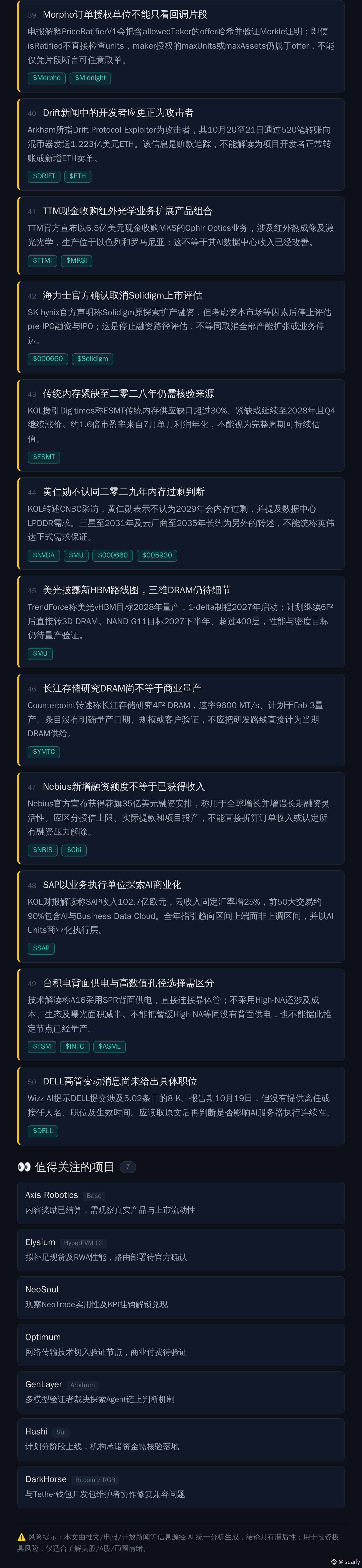
406
Log in to explore more content
Join global crypto users on Binance Square
⚡️ Get latest and useful information about crypto.
💬 Trusted by the world’s largest crypto exchange.
👍 Discover real insights from verified creators.
Email / Phone number
Trending Topics
USMidterms-WhatAreMarketsExpecting?
18,228 views
303 Discussing
Democratic Congressional Sweep Shakes Trump Trades in AI Stocks and Crypto
Binance News
·1 Likes
·656 views
USOctoberNFP-AreRateCutsStillPossible
207,627 views
1,629 Discussing
AMDBeatsExpectations-AINarrativeContinues
2,969 views
123 Discussing