

曦玥交易室
2.5k Posts

曦玥交易室
Report
Block User
0 Following
1.4K+ Followers
1.1K+ Liked
Posts
All
Quotes
Videos
PINNED
·
--
👇👇👇Add friends, the big brain strategy, free layout.
Qige usually lays out based on major mainstream coin futures contracts and popular altcoin contracts, with spot short-term trades as the focus. He’s good at catching “gold diggers,” and uncovering 100x coins. It’s better to share than to keep it all to yourself—if you reach out your hand, I’ll pull you ashore.
Qige usually lays out based on major mainstream coin futures contracts and popular altcoin contracts, with spot short-term trades as the focus. He’s good at catching “gold diggers,” and uncovering 100x coins. It’s better to share than to keep it all to yourself—if you reach out your hand, I’ll pull you ashore.


14
10
15
20k
PINNED
·
--
The turnaround battle in the crypto world👇
As the saying goes, if you dare to act, the chips will be in your own hands; if you hesitate and hold back, what you want will always slip away!
The opportunity has been given to you. Ask yourself—can I seize it?
The turnaround battle in the crypto world👇
As the saying goes, if you dare to act, the chips will be in your own hands; if you hesitate and hold back, what you want will always slip away!
The opportunity has been given to you. Ask yourself—can I seize it?
As the saying goes, if you dare to act, the chips will be in your own hands; if you hesitate and hold back, what you want will always slip away!
The opportunity has been given to you. Ask yourself—can I seize it?



46
26
62
38.7k
·
--
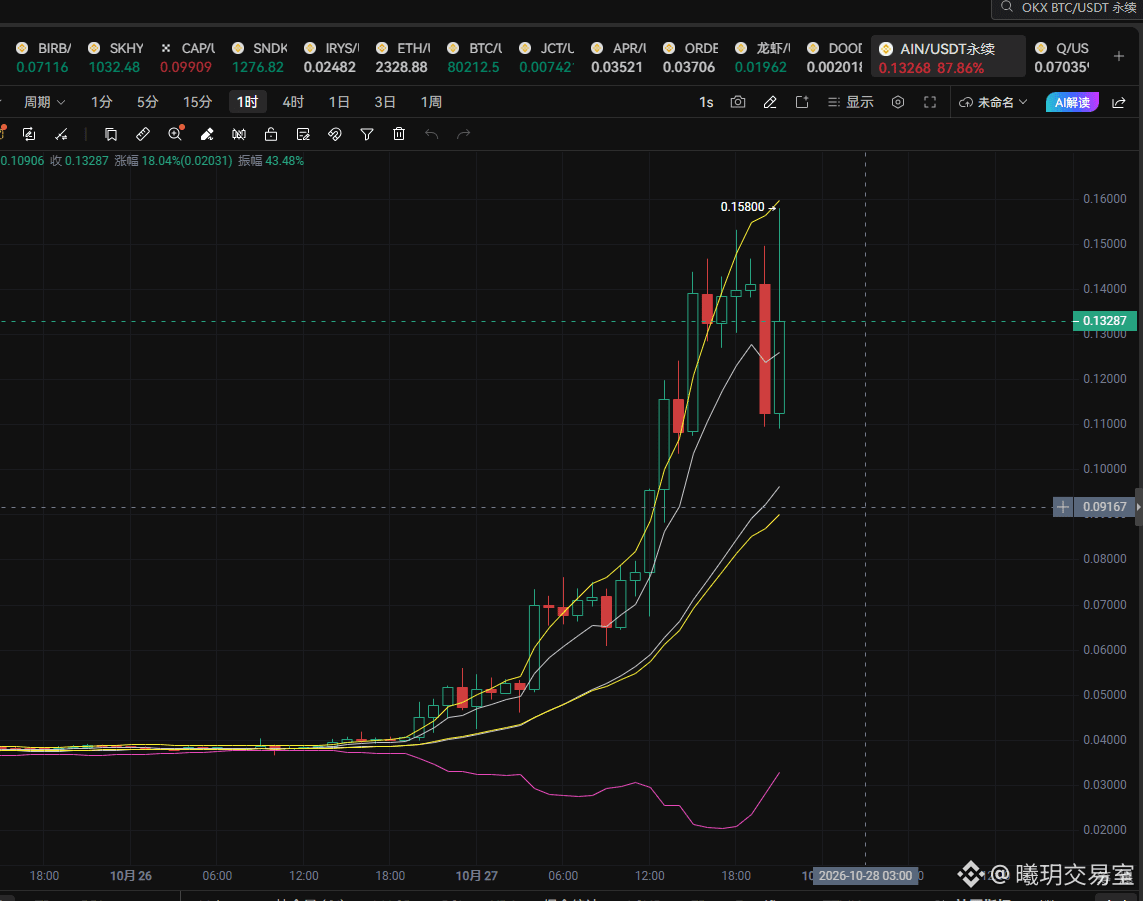
$AIN Don’t chase the highs right now! It’s still safer to wait for a pullback and see whether 0.14-0.15 can hold. If it holds, then enter; if it doesn’t, it’s a bull trap.
If it breaks the historical level of 0.02169, then go long; if it’s short, run.
Breaking the previous high now doesn’t mean it will fly straight up. The main players still need to shake out the weak hands before pushing it higher.
If it breaks the historical level of 0.02169, then go long; if it’s short, run.
Breaking the previous high now doesn’t mean it will fly straight up. The main players still need to shake out the weak hands before pushing it higher.
29
·
--
Three traps crypto beginners fall into most often.....$ZEC
When I first got into crypto, I was just like most people: glued to the 1-minute charts, chasing rises and panic-selling dips, placing more than ten trades a day. After three months, my account had shrunk from 10,000 USDT to 2,000. Today, I’m sharing these traps in the hope you won’t make the same mistakes.
Trap number one: always trying to buy at the bottom and sell at the top.
Do you do this too? The price dips a little, and you think, “It could go even lower,” so you wait to buy. It rises a little, and you think, “It could go even higher,” so you wait to sell. And what happens? You wait, and the price takes off; you wait, and you get stuck holding the bag. I’m not trying to discourage you, but there’s only one absolute bottom and one absolute top. What makes you think you’ll nail them every time? Try a different approach: enter in stages and take profits in stages. Catch the middle part of the move—that’s enough.
Trap number two: going all in and leaving yourself no way out.
You convince yourself you’ve “got it figured out” this time, so you bet everything on one trade. Then the market turns, and your account is wiped out. Ask yourself: when have you ever really been “sure” and gotten it right? Even if you’ve called the direction correctly, the market might move against you for a while before turning back. If you’re all in, you won’t be able to sit through that move. Remember: your capital is your lifeline. If you leave it no room to survive, it won’t leave you any chances.
Trap number three: making decisions when your emotions take over.#BitMine增持10452枚ETH
When you’re losing, you’re desperate to make it back, so you take bigger positions, refuse to cut losses, and add to losing trades. When you’re winning, you think you’re a genius, so you increase your stake, chase the price, and don’t take profits. Both states are warning signs of an impending liquidation. What should you do? Set firm rules: decide how much you’re willing to lose before exiting, and how much profit you’ll take. When you hit those levels, follow through. Don’t let your emotions place the trades for you.
Honestly, the people who make money in crypto aren’t the smartest—they’re the ones who can control themselves. Remember these traps, and you’ll avoid losing at least half as much.
Follow me. No bragging, no empty promises—just practical experience to help you survive in the crypto market. If you keep losing and starting over, come talk to me. I’ll show you how to simplify trading.

42
·
--
Though the journey of a thousand miles is arduous, when the wild sands are finally blown away, gold is what remains. $ETH
Making money in crypto isn’t difficult because of the methods—it’s about repeatedly doing simple things right.
I used one chart pattern to grow from 10,000 USDT to over 1 million USDT in a year, with a win rate that has stayed above 80% for five years. The method is simple: #以太坊跌破2300美元
Step 1: Add to your watchlist coins that appeared on the gainers’ list within the past 11 days. Exclude coins that have fallen for three consecutive days—the money may already have left.
Step 2: Check the monthly chart and only select coins with a MACD golden cross.
Step 3: Check the daily chart and focus only on the 60-day moving average. When the coin’s price pulls back near the 60-day moving average and a bullish candle appears on increased volume, enter with a large position.
Step 4: Hold above the line and exit below it. If the price rises more than 30% in a swing, sell one-third. If it rises more than 50%, sell another third. Most importantly, if the price unexpectedly drops below the 60-day moving average the day after you buy, exit your entire position. Don’t rely on wishful thinking.
If you want to make money, the hard part isn’t the method—it’s following through. Just this one rule, “Exit when the price falls below the 60-day moving average,” filters out 90% of people.
A reminder: With high leverage in futures trading, one large position that falls below the moving average could wipe you out. If you can’t handle losing everything, stay away.
Follow me. No bragging, no empty promises—just practical experience on how to survive in crypto. If you’re not sure what to do, come talk to me. I’ll show you how to make trading simple.
40
·
--
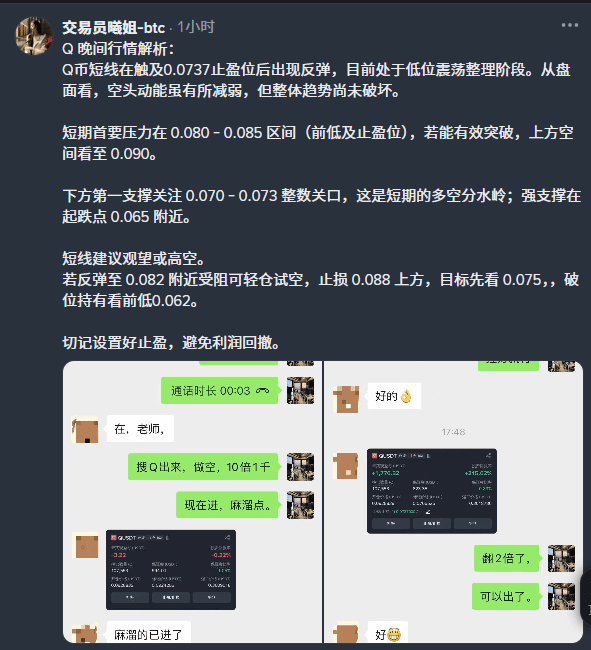
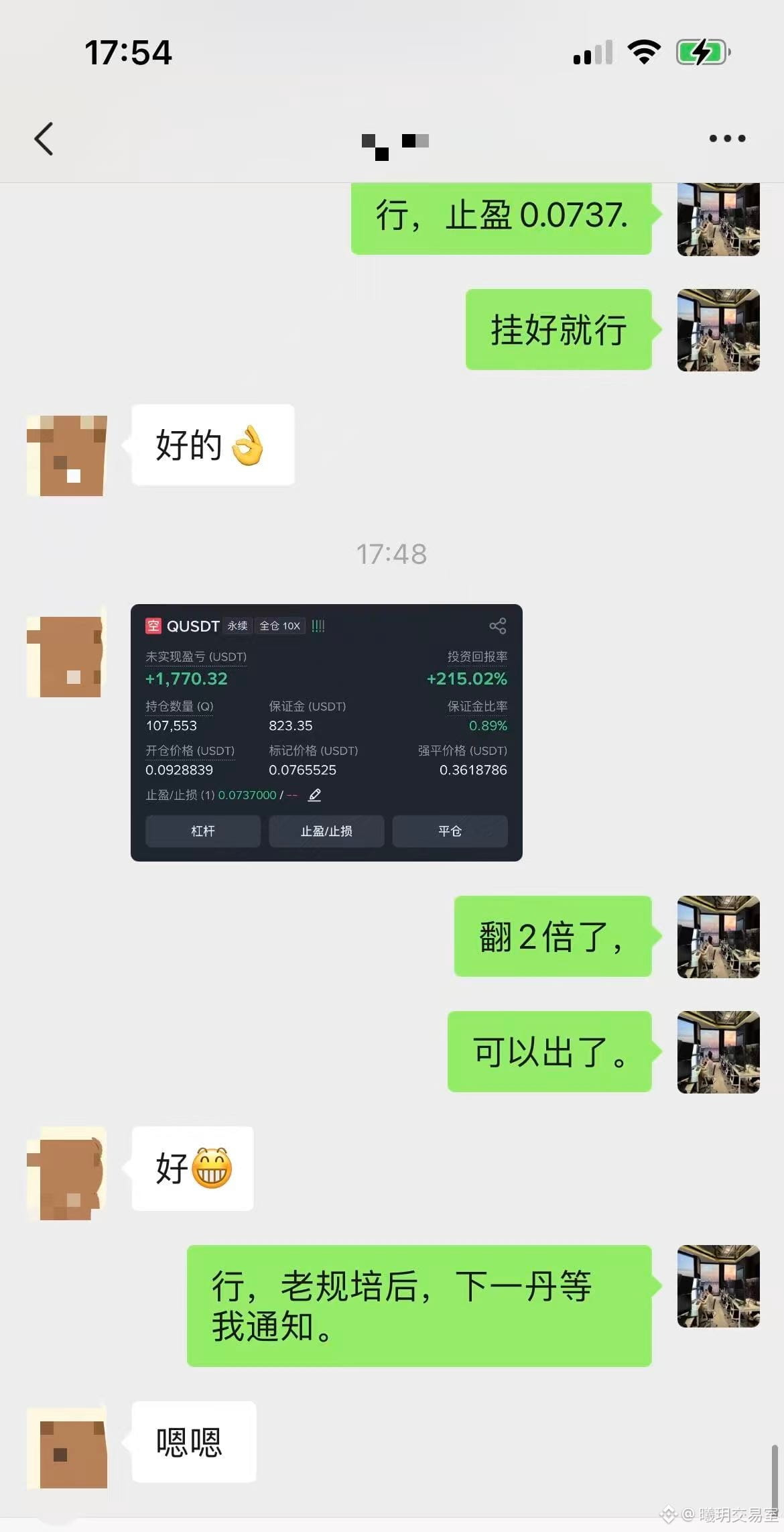
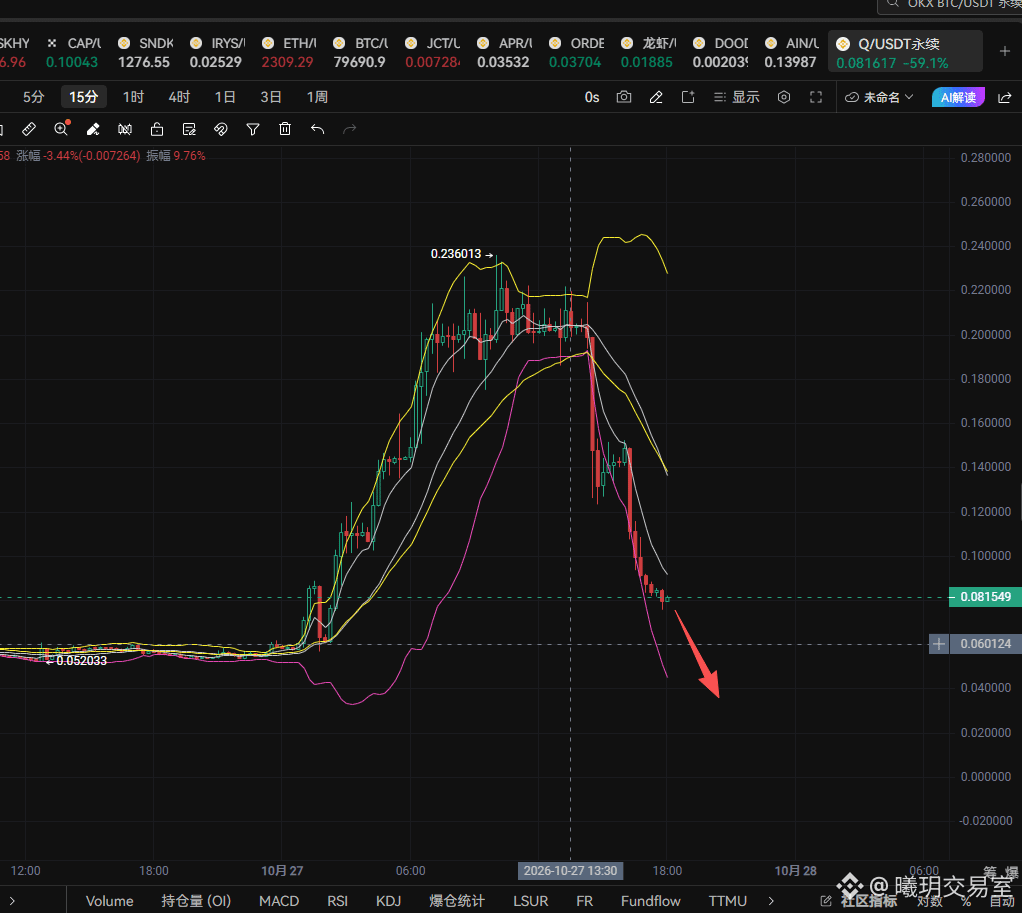
Q is awesome! Closed out the short position in the morning, then took down another wave of longs in the afternoon.
The analysis on our other account called for a rebound to 0.082, then to keep shorting, with strong support at 0.065. It just hit that level—those of you who were tuned in caught it again, right? Q really delivers, haha...
#BitMine增持10452枚ETH
The analysis on our other account called for a rebound to 0.082, then to keep shorting, with strong support at 0.065. It just hit that level—those of you who were tuned in caught it again, right? Q really delivers, haha...
#BitMine增持10452枚ETH
曦玥交易室
·
--
Finally, you showed up...
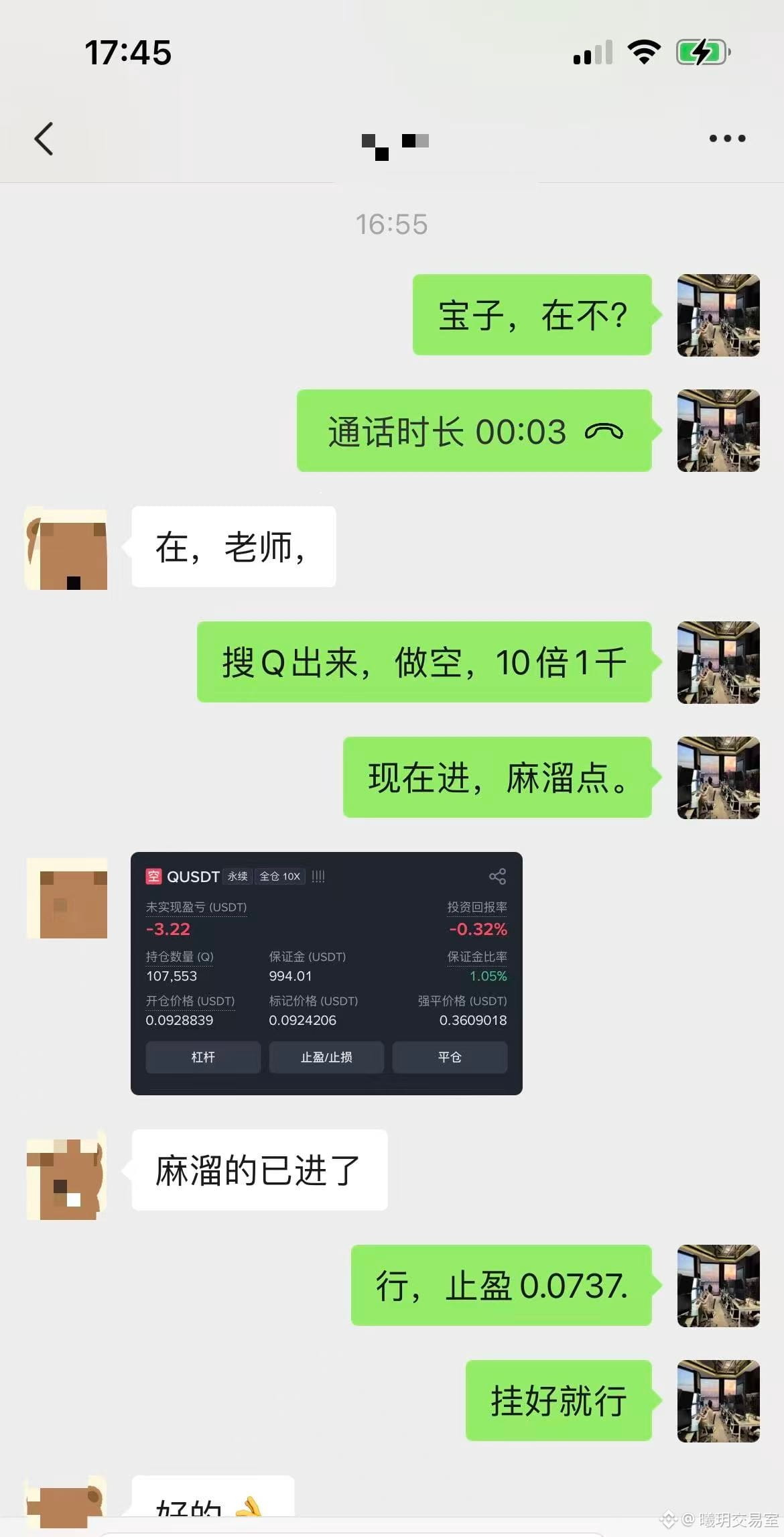
Q's short position doubled in 1 hour! Made 1770U.
#比特币再度跌破8万美元 #泰国推出WORPT稳定币QR支付应用
Q's short position doubled in 1 hour! Made 1770U.
#比特币再度跌破8万美元 #泰国推出WORPT稳定币QR支付应用
143
·
--
Finally, you showed up...
Q's short position doubled in 1 hour! Made 1770U.
#比特币再度跌破8万美元 #泰国推出WORPT稳定币QR支付应用
Finally, you showed up...
Q's short position doubled in 1 hour! Made 1770U.
#比特币再度跌破8万美元 #泰国推出WORPT稳定币QR支付应用
Q's short position doubled in 1 hour! Made 1770U.
#比特币再度跌破8万美元 #泰国推出WORPT稳定币QR支付应用
2
1
1
44
·
--
I searched for him a thousand times in the crowd; then I turned around, and there he was, in the dim light.
Trading is the same: the harder you try to seize every opportunity, the less likely you are to catch the one that truly matters.
The harder beginners try, the more they lose. The problem is mistaking noise for opportunity. A bullish candle appears on the 1-minute chart and they chase it; the price pulls back a little and they bail. They stay busy all day, rack up fees, and watch their account shrink.
Most market movements are just noise. Trying to catch every candle only means getting tossed around by the market. Many people lose money not because there are too few opportunities, but because they can’t keep their hands still.
People who consistently make money know how to wait. They watch their target like snipers and stay put until the opportunity comes. One or two trades a day—or even one every few days—often earns more than churning out a dozen trades in a day.
People always say they’re afraid of missing out. But think about it: if you try to catch everything, what do you end up catching? Missing an opportunity won’t make you lose money; jumping in impulsively will.
Set yourself a rule: no more than one trade in any one-hour period. Once it’s done, close the app.
When you stop chasing the market, your account may finally start to grow, little by little.
One reminder: with high-leverage contracts, frequent trading fees and slippage can quickly eat into your capital. If you can’t handle the risk of losing it all, stay away.
Follow me. No boasting, no empty promises—just practical experience to help you survive in this game. If you keep losing and starting over, come talk to me. I’ll show you how to keep trading simple.

61
·
--
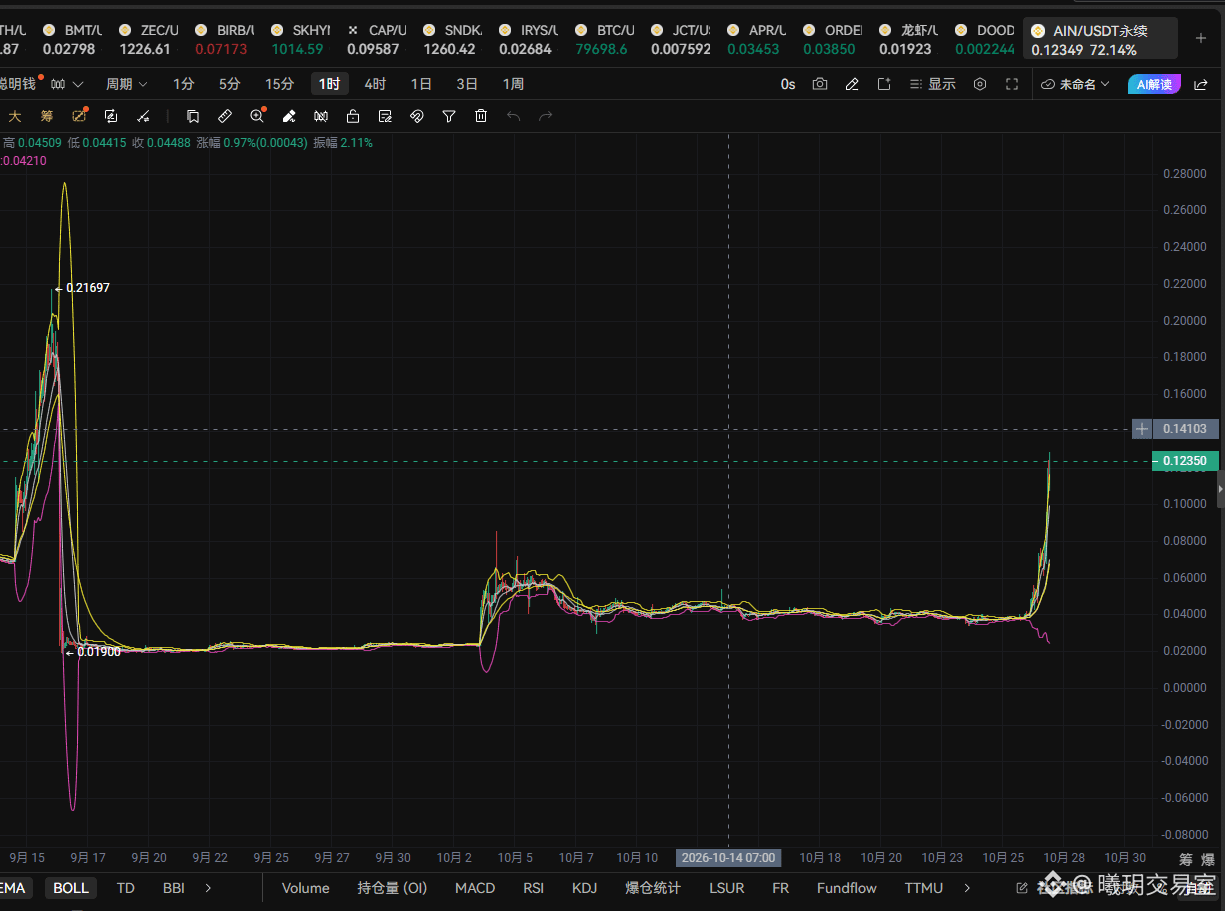
$AIN surged 72%! The major players, dormant for a month, have finally awakened!
This is a textbook stealth-bottom breakout! The price traded sideways around 0.04 for a whole month as buyers accumulated, shaking out all the weak hands. Today it suddenly shot straight up, and the moving averages are perfectly aligned in a bullish formation—showing that the major players have finished building their positions and the main rally is officially underway!
The current price of 0.1235 has broken above resistance at the previous trading range. The first target above is the previous high of 0.14; if momentum continues, it could challenge the 0.20 mark.
Breakouts after such a long consolidation can be explosive! Don’t be afraid of buying at a high— a pullback into the 0.10–0.11 range would be a great entry opportunity. Set a stop-loss below the starting point of the rally and take a chance on a second wave that could double!
#据报韩国考虑第四次推迟加密税
85
·
--
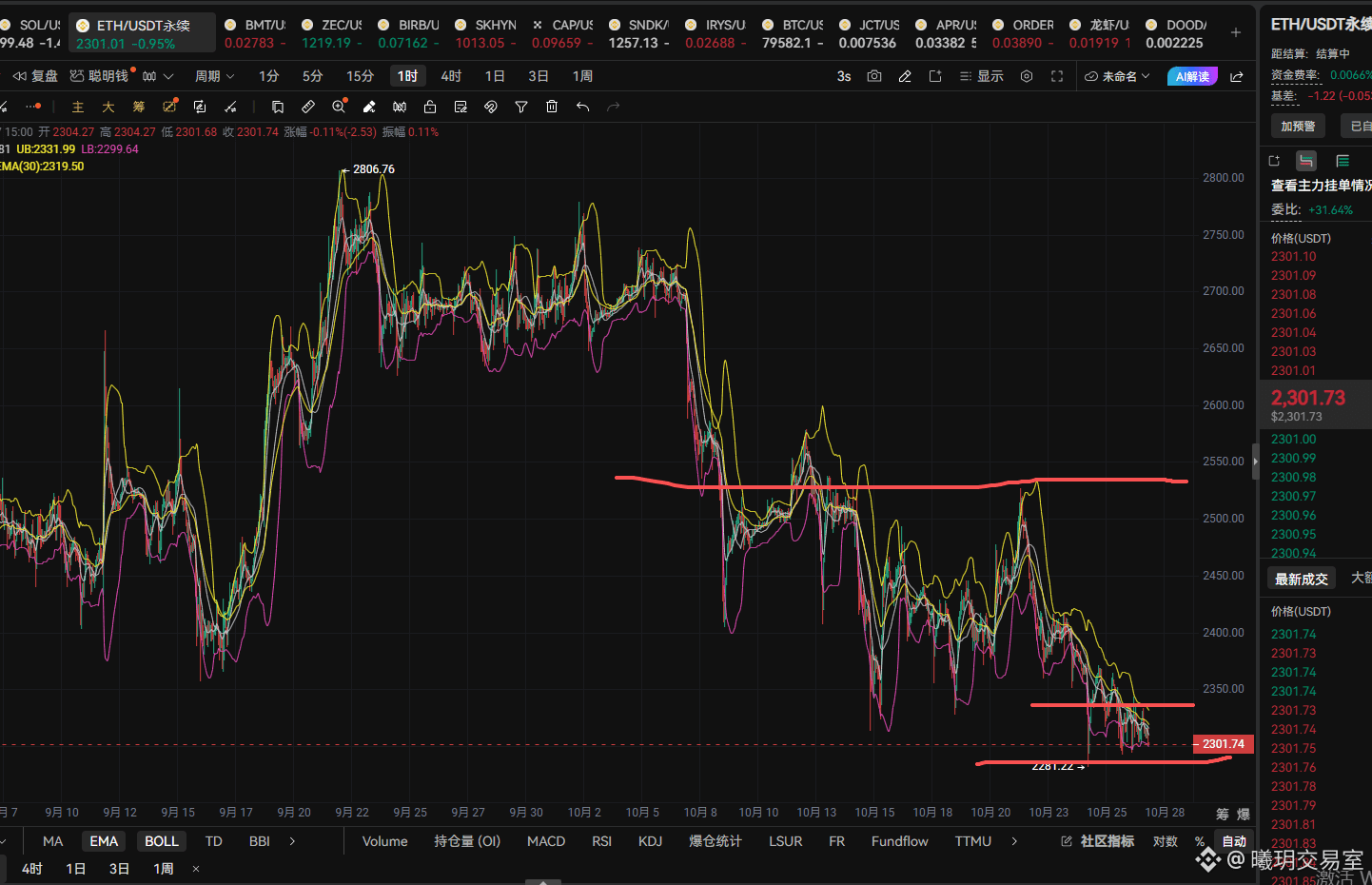
Hey everyone, if $ETH breaks below 2,300, will faith in the bull market collapse? 📉
First, let’s look at the technicals:
The moving averages on the 1-hour chart are in a bearish alignment, with the price firmly capped by the EMA. The Bollinger Bands are opening downward. Since peaking at 2,800, the price has been sliding steadily, with weak rebounds—a classic slow-boil decline.
The 2,303 support level has now broken, and the next support to watch is 2,281. If the price can’t quickly reclaim 2,350, there could be further downside.
Trading advice:
Don’t blindly buy the dip! Until the trend reverses, every rebound is a chance to get out.
Consider a small short position in line with the trend, or stay on the sidelines. Don’t try to catch a falling knife!
Very short-term traders could try to play a rebound。。。#BitMine增持10452枚ETH
64
·
--
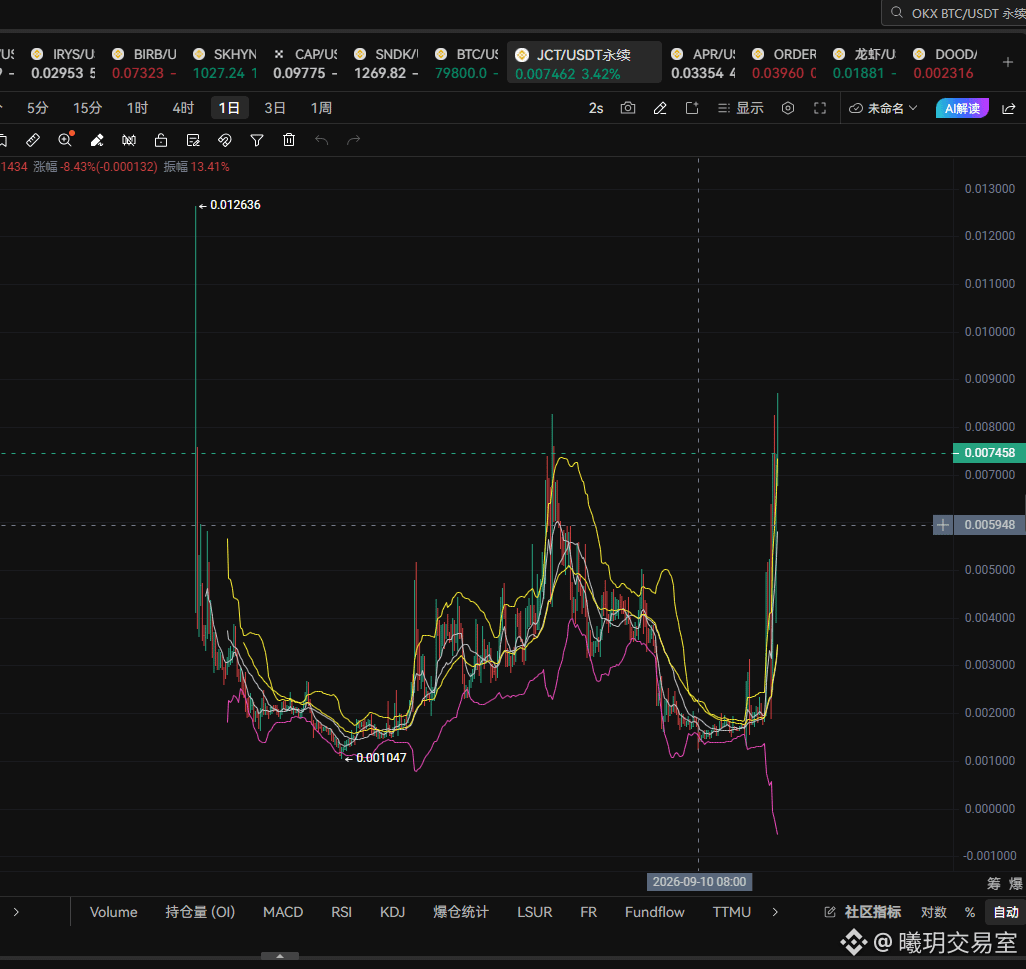
$JCT has exploded! A massive bullish candle on the daily chart has turned the market upside down, forcefully engulfing several bearish candles. The 15-minute chart is surging even more sharply, with the price instantly spiking to 0.00872.
What comes next?
Bullish sentiment is running high in the short term, but the price is approaching resistance near its previous high, so beware of a pullback after the surge. If it can hold above 0.0075, it may challenge the all-time high of 0.0126. If momentum stalls on declining volume, watch for a pullback to the 0.0059 support level.
Trading advice:
Those holding positions can set a trailing take-profit. If you haven't entered, don't chase the price; wait for a pullback and stabilization in the 0.0065–0.0070 range before entering. Place a stop-loss below 0.0055.
85
·
--
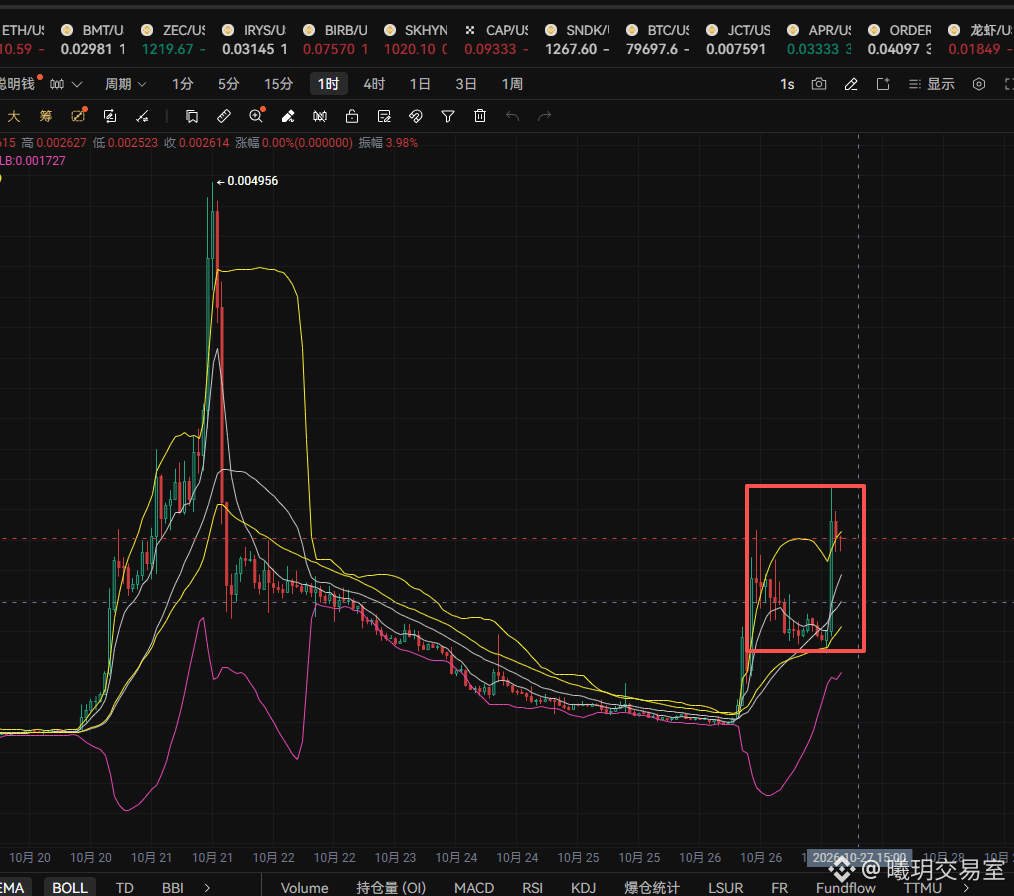
$DOOD A single bullish candle engulfed 16 bearish candles, then surged sharply from the bottom! Bulls mounted a strong comeback, but price met fierce resistance from bears as soon as it touched the previous high.
Aggressive entry: Go long directly once price holds above 0.0024, targeting a test of the previous high at 0.0049.
Conservative entry: Wait for a pullback to 0.0022 and enter only if it holds; stop-loss at 0.0018.
Aggressive entry: Go long directly once price holds above 0.0024, targeting a test of the previous high at 0.0049.
Conservative entry: Wait for a pullback to 0.0022 and enter only if it holds; stop-loss at 0.0018.
97
·
--
Bitcoin morning analysis:
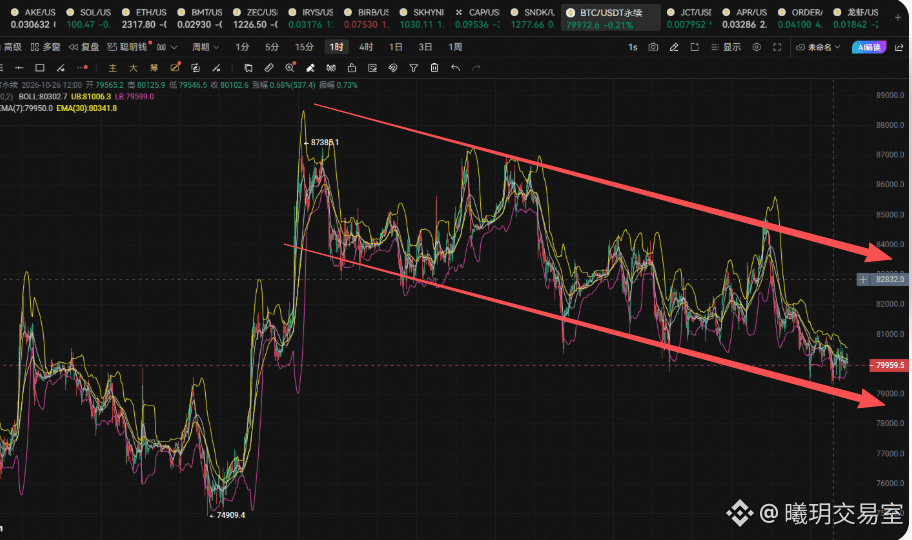
The current price of $BTC has continued to retreat after rising to 87385 and is now testing support from a position of weakness. The price is trading below the middle Bollinger Band, and the short-term trend is bearish.
Trend analysis: The moving averages are beginning to fan out downward, with the price facing resistance at the middle band. Bearish momentum is building, so watch for a possible further decline.
The primary support is near the lower Bollinger Band at 79599. If this level breaks, watch the previous low around 79000.
Short-term rebound resistance is near the middle Bollinger Band at 80302.
The preferred strategy is to sell on rallies. If the price rebounds into the 80300–81000 range and shows little strength in moving higher, consider opening a small short position, with a stop-loss above 81800 and targets in the 79600–79000 range.
115
·
--
$ETH Evening Analysis:
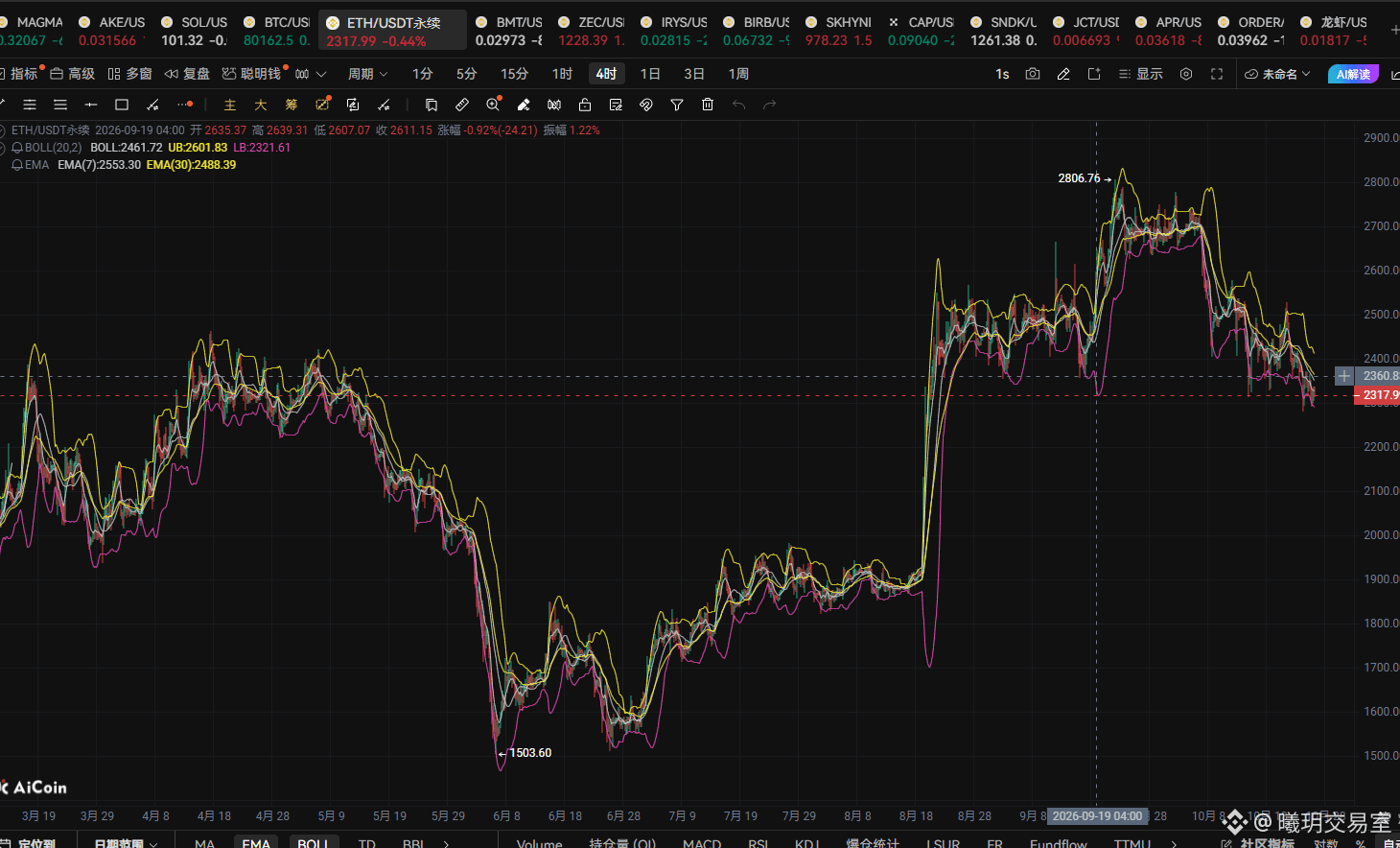
From 2800 down to 2300, the account has shrunk by 20%! This isn’t a pullback—it’s an ICU emergency for the bulls!
ETH is like a frog in slowly heating water right now, hovering around 2300. It looks like a bottom, but it’s really only halfway down the mountain.
Resistance: 2460–2500 is a danger zone, where both the Bollinger middle band and previous bagholders are waiting. If it rebounds here without volume, that’s your chance to get out.
Support: 2300 is the short-term psychological line in the sand. If it breaks, the 2100–2200 range below is the real bottom.
The moving averages have crossed bearishly and are heading down. Don’t rush to buy the dip—wait until it holds above 2300 before making a move, or you could end up catching it halfway down the mountain! Remember, it has to hold steady....
52
·
--
Growing from 3,000U to 30,000U comes down to one thing: make fewer mistakes and keep your account alive first.
A while ago, a follower reached out to me. His account was down to just 3,000U after a string of losses, and he’d completely lost his rhythm. Every day, he was hoping his next trade would win it all back.
I didn’t give him a complicated system. I just told him to split his funds into three parts—because the most dangerous stage for a small account is often when you’re in a hurry to grow it, only to wipe yourself out with one last trade.
Use the first portion for short-term trades, with a maximum of two trades a day. If your stop-loss is hit, exit. Don’t hold onto losing positions or keep adding to them. First, break the habit of trading too frequently.
Use the second portion only for following trends. Stay out unless the direction on the daily or weekly chart is clear. Wait for the structure to be confirmed before entering. It’s better to miss a trade than to keep losing money in a choppy market.
Leave the last portion untouched as a safety cushion for your account. If you make a string of mistakes or hit a drawdown, you’ll still have room to regroup.
I told him just one thing: You can make money slowly, but once your account is wiped out, even the best market opportunities won’t matter to you.
The rules from there were simple too: Don’t trade when the trend is unclear. Enter only after a high-volume breakout is confirmed. Before opening each trade, write down the maximum amount you’re willing to lose and the point at which you’ll start taking profits. If the loss reaches your planned limit, exit immediately. If your profit reaches its target, take some off the table first, then move your protective stop up and let the market decide what happens to the rest.
After he repeatedly followed this approach, he traded less and less, while his account slowly grew from 3,000U to 30,000U.
There’s never a shortage of opportunities in crypto. What’s truly rare are people willing to wait, able to stick to their position sizes, and brave enough to stop after making a mistake. How much you make on a single trade won’t determine your long-term results. Those who make fewer mistakes are the ones who can stay in the game and wait for the opportunities that are truly theirs.

104
·
--
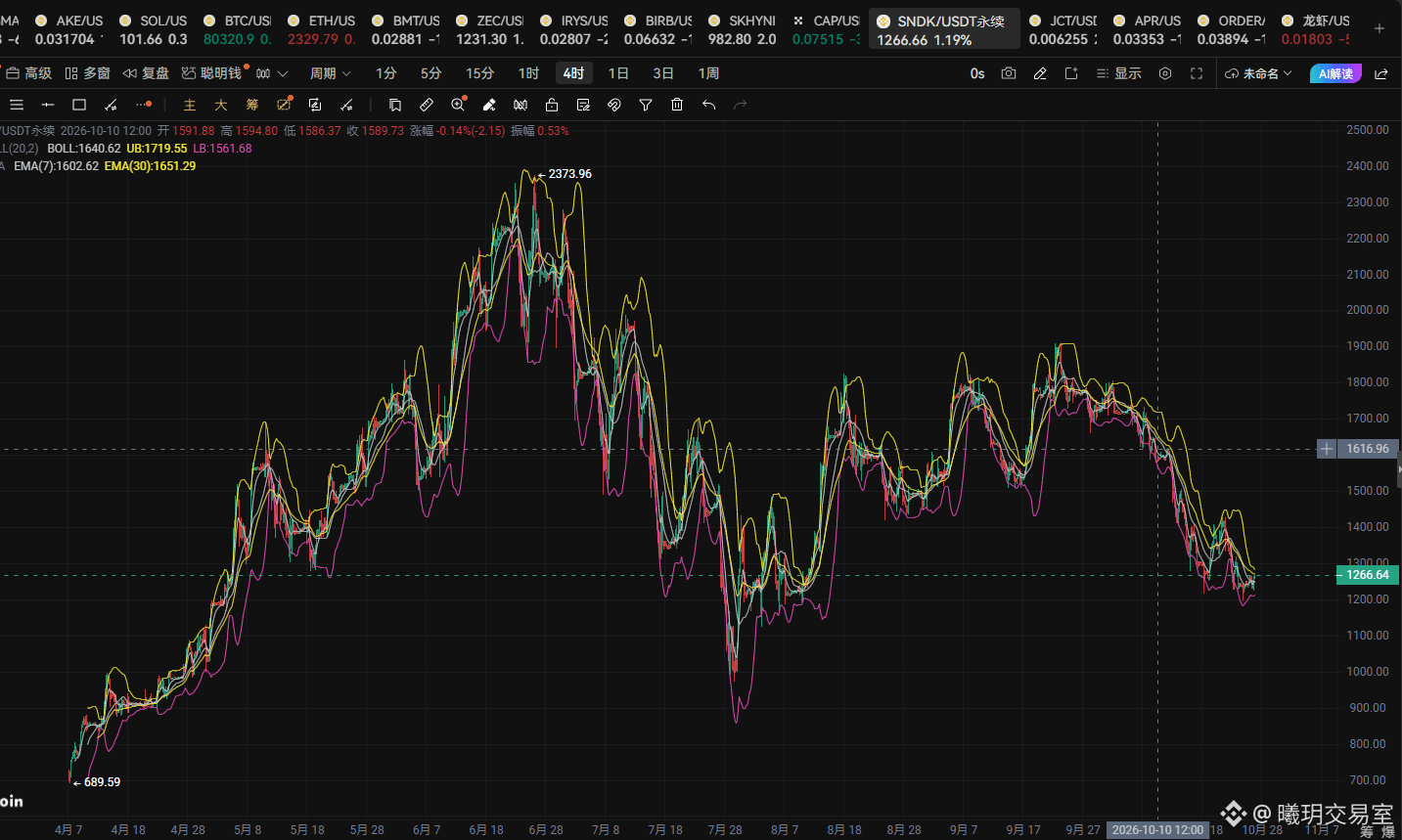
From 2373 down to 1266—your account has been cut in half! This isn’t a chart; it’s a multi-car pileup for the bulls!
$SNDK ’s chart is suffocating: a perfect descending channel on the 4-hour timeframe, with the moving averages stacked bearishly and flowing as smoothly as a waterfall. The price is stuck around 1266, right at the previous low support level. The Bollinger Bands are opening downward, and the MACD death cross shows no sign of converging.
Key levels:
Resistance: 1400–1500 is a dense zone of underwater holders. Any rebound to this area is the big players giving retail investors an escape route.
Support: 1200 is a psychological threshold. If it breaks, the next target is the round-number level of 1000.
Trading approach:
At this level, you’d be trying to catch a falling knife. It may look like a bottom—but what if it’s only halfway down? Don’t buy the dip just because it’s fallen a lot! Wait until it stabilizes above 1400. Remember: in a downtrend, every rebound is a bull trap. Keep your hands off the controls if you want to survive!
46
·
--
A journey of a thousand miles begins with a single step. If you want to grow a small account, it’s not about striking it rich on one trade—it’s about steadily building up profits, one step at a time.
Many people think they’re a long way from turning things around when they have only a small amount of capital. But whether your account can grow really comes down to whether you can manage your position size, pace, and emotions.
A follower once came to me with just 2,800U left in their account. They immediately wanted to go all in and take a shot. I didn’t let them risk everything on a large position. Instead, I gave them three strategies. Three months later, they had grown the account to 68,000U, without any major drawdowns along the way.
First, protect your account before thinking about growth. Split the 2,800U into four parts of 700U each: use one for short-term trades, with no more than two trades a day, and only take small moves you understand; use one to wait for trends, and stay out when the direction on the daily and weekly charts is unclear; save one for a genuine major move, and never enter unless the conditions are right; keep the last as a reserve, so even after a string of mistakes, you still have a chance to regroup. As long as your capital is intact, you’ll be able to take advantage of future market moves.
Second, only trade with the trend; stay out of choppy markets. Many people try to catch every swing, only to see their profits eaten away by fees and overtrading. The right approach is to wait for a clear trend and enter after the price breaks through a key level. Once your profits reach a certain level, take some off the table and set protection for the rest, letting your profits run with the market.
Third, let discipline make the decisions for you. Set your stop-loss and take-profit levels before every trade, and exit when either is hit. Once your profit target is reached, take some off the table. Set a fixed time to stop trading each day, and force yourself to take a break after a string of mistakes. If you really can’t control yourself, uninstall the app and take some time to cool off.
The crypto market never lacks opportunities. What’s scarce are people who are willing to wait, brave enough to cut their losses, and disciplined enough to hold on to their profits. Get these three things right first, and your account may have a chance to grow, little by little.
One reminder: with the high leverage used in crypto futures, splitting your position won’t save you if you stubbornly hold a position that’s too large. If you can’t handle the possibility of losing it all, stay away.

46
·
--
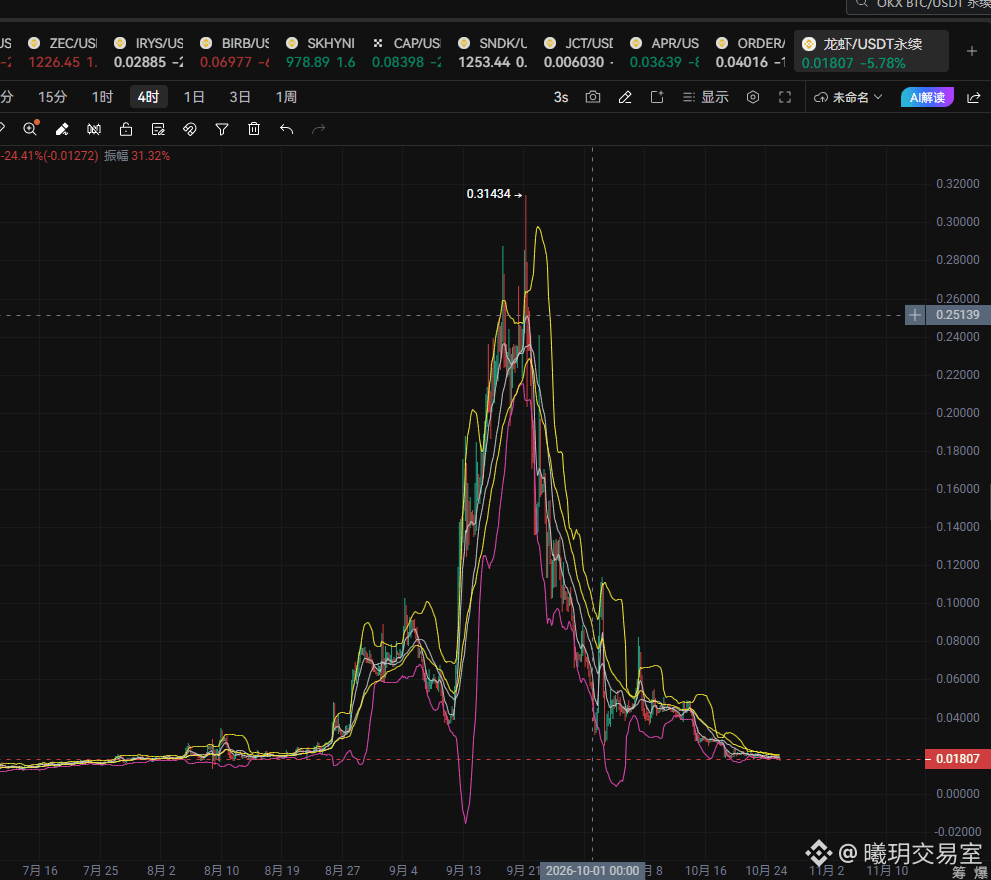
$龙虾 Guys, I almost got lured into another bull trap! The Lobster chart is clearly showing that the recovery rally is losing steam.
The price is currently hovering around 0.01786, with strong resistance from both the EMA lines and the Bollinger Band middle line above. The bulls are struggling to regain momentum, and blindly buying the dip could easily leave you stuck halfway up the hill.
Key support: 0.01600–0.01700; resistance above: 0.02200–0.02500. If the price falls below 0.016 support, it will most likely retest the previous low. Only a high-volume breakout above 0.025 would confirm a reversal signal.
Trading is about reacting, not predicting. Real profits come from patiently waiting for key levels. Keep a close eye on a breakout above 0.025, and only consider entering on the right side once both price and volume are rising.
17
·
--
“I once crossed mountains and seas, and passed through crowds of people,” but many people can’t even sit through a single candlestick. They jump in, then jump out, and after getting out, they jump right back in.
Beginners don’t lose money because they’re lazy, but because they’re too active.
The moment a one-minute candlestick turns bullish, they chase it. As soon as it pulls back a little, they bail. They’re busy all day long, barely hold positions for any time, rack up a pile of fees, and watch their account balance shrink.
Most of the market’s fluctuations are just noise. Try to catch every candlestick and take every opportunity, and you’ll just get tossed around by the market. Many people lose money not because there are too few opportunities, but because they can’t keep their hands still.
People who truly make money know how to wait. They watch their target like snipers and don’t move until the opportunity comes. One or two trades a day, or even one every few days, often earns more than churning out a dozen trades a day.
People always say they’re afraid of missing out. But think about it: if you try to catch everything, what do you end up catching? Missing an opportunity won’t make you lose money; jumping in impulsively will.
Set yourself a rule: no more than one trade per hour, and close the app when you’re done. When you stop chasing the market, your account may actually start to grow, little by little.
A reminder: With high leverage in futures, frequent trading burns through your money even faster through fees and slippage. If you can’t handle it, don’t force it. $ZEC #股票财报季

26
·
--
Everyone wants to ride the wind, but who expects a strong wind to capsize the boat? Many people see a positive funding rate and rush to go long, only to get swept away by the waves before they can catch the wind.
Many beginners go long when they see a positive funding rate and short when they see a negative one, yet still end up losing money. That’s because the funding rate isn’t a buy or sell signal—it’s just a barometer of market sentiment.
When the rate is positive, longs pay shorts; when it’s negative, shorts pay longs. The mechanism is designed to keep the futures price from straying too far from the spot price.
The higher the rate, the more crowded the bullish side usually is. If you jump in at that point, you not only have to weather a pullback, but also keep paying funding fees. If the market turns down, longs may rush for the exits, making the drop even faster.
The same goes for a negative rate: it signals strong bearish sentiment. Going long may earn you funding fees, but the market can still fall. If you buy the dip just to collect those fees, you’ll often lose far more than you earn.
So how should you read it? If the rate is unusually high, the market may be overheated—stay alert and don’t blindly chase longs. If it’s unusually low, the market may be oversold; you can watch for a rebound, but always use a stop-loss. If it’s within the normal range, don’t fixate on it—stick to your plan.
In short, the funding rate reflects sentiment, not direction. It can tell you whether the market is hot or cold, but not whether the next candlestick will rise or fall.
One more reminder: high leverage on futures, combined with funding fees over time, can slowly grind you down. If you can’t afford to lose it all, stay away. $SKHYNIX #SK海力士据报拟派特别股息

21
Log in to explore more content
Join global crypto users on Binance Square
⚡️ Get latest and useful information about crypto.
💬 Trusted by the world’s largest crypto exchange.
👍 Discover real insights from verified creators.
Email / Phone number