
Onaso
50 Posts

Onaso
数字创业者,Web3 投资者。热爱生活,也对 Crypto 市场保持好奇与敬畏。日常分享 AI 提效经验、实用的网格交易心得以及技术避坑指南。Let's connect!
Occasional Trader
1.3 Years
37 Following
22 Followers
83 Liked
Posts
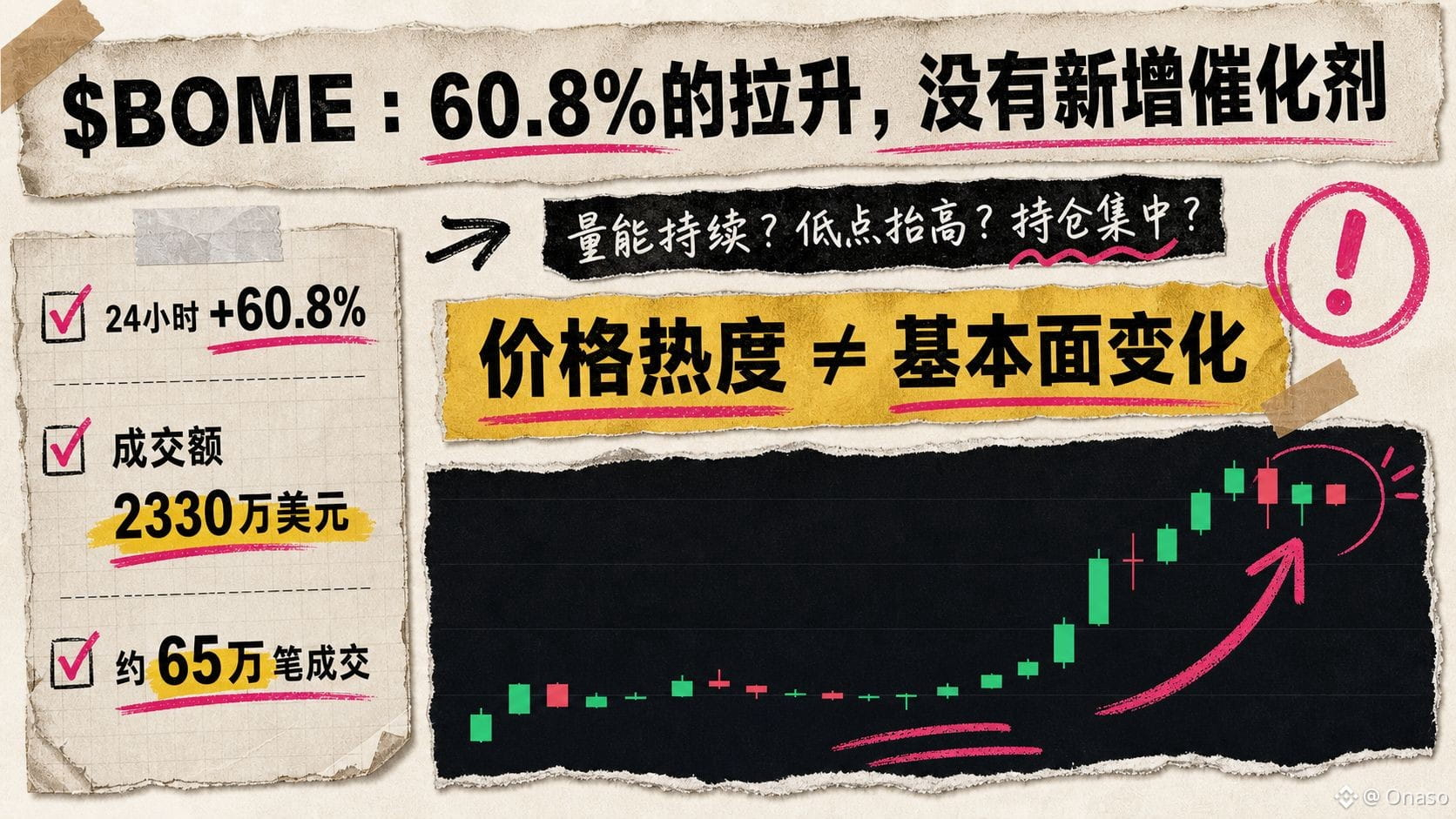
$BOME Binance 24-hour rise of 60.8%, trading volume of about $23.3 million with around 650,000 trades. In the 1-hour candlestick chart, the price has been stepping up in a staircase pattern, and the late segment has already shown a spike-and-retrace. Almost all of the real-time discussions on X are talking about breakout levels and price targets. Today, creator Darkfarms only posted routine images and greetings, with no announcements about products, collaborations, revenue, or token utility. Therefore, the only verifiable conclusion is that capital and attention suddenly concentrated, with no new catalyst. With this kind of price action, I will watch three things: whether the trading volume can be maintained continuously; whether the lows during pullbacks are getting higher; and whether on-chain positions are overly concentrated. $BTC is used only to assess overall risk appetite; if momentum fades and the price falls back into the initial breakout area, the heat-driven logic will fail.
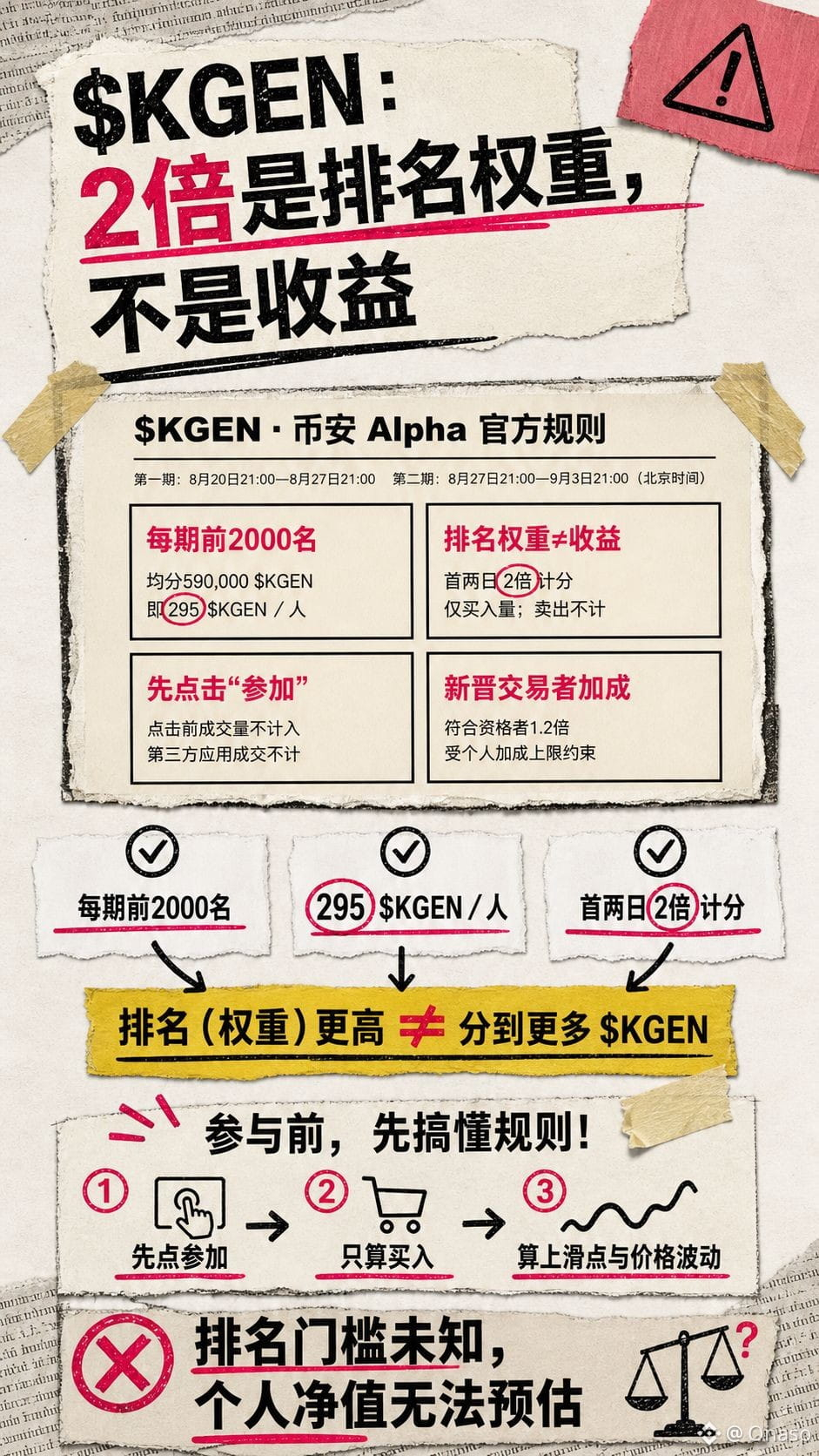
Binance Alpha launches a trading contest today with $KGEN transactions. The official rules set two rounds, each lasting 7 days: the first round is from 21:00 Beijing time on August 20 to 21:00 on August 27, and the second round follows the next week. Each round is ranked by “effective buy volume.” The top 2000 participants split 590,000 $KGEN , meaning 295 $KGEN per person. The easiest thing to misread is the multiplier: during the first two days it’s 2x; eligible newly qualified traders receive an additional 1.2x. What increases is the ranking’s executed volume, not that your 295 reward becomes doubled. The new-trader bonus has an individual cap, and eligibility is determined by the number of historical winning times in the first three days of the event.
Before participating, do three things: on the event page click “Participate”—any trades before clicking do not count; confirm that only buy volume is valid—sales, cross-chain transactions, and third-party app trades do not count; confirm that trades between Alpha coin pairs are also excluded. This means that trying to “game” the ranking comes with the risk of holding $KGEN while its price fluctuates; the buy-sell spread, slippage, and on-chain fees will not be compensated by the ranking multipliers.
My algorithm is: theoretical reward value = 295 tokens × the price you can actually realize when claiming. Your personal net worth must then be reduced by the price changes from building the position to exiting, as well as fees and slippage. The official says the total prize pool is about $200,000, but without knowing your entry threshold and real costs, you can’t directly treat it as profit. Rewards that are not claimed within 14 days after opening are void. $BNB only indicates the chain onramp background for the Binance Wallet. If you can’t estimate the buy volume needed to place in the top 2000, the reasonable conclusion is that the profit can’t be calculated—not that “2x is more worthwhile.”
Before participating, do three things: on the event page click “Participate”—any trades before clicking do not count; confirm that only buy volume is valid—sales, cross-chain transactions, and third-party app trades do not count; confirm that trades between Alpha coin pairs are also excluded. This means that trying to “game” the ranking comes with the risk of holding $KGEN while its price fluctuates; the buy-sell spread, slippage, and on-chain fees will not be compensated by the ranking multipliers.
My algorithm is: theoretical reward value = 295 tokens × the price you can actually realize when claiming. Your personal net worth must then be reduced by the price changes from building the position to exiting, as well as fees and slippage. The official says the total prize pool is about $200,000, but without knowing your entry threshold and real costs, you can’t directly treat it as profit. Rewards that are not claimed within 14 days after opening are void. $BNB only indicates the chain onramp background for the Binance Wallet. If you can’t estimate the buy volume needed to place in the top 2000, the reasonable conclusion is that the profit can’t be calculated—not that “2x is more worthwhile.”
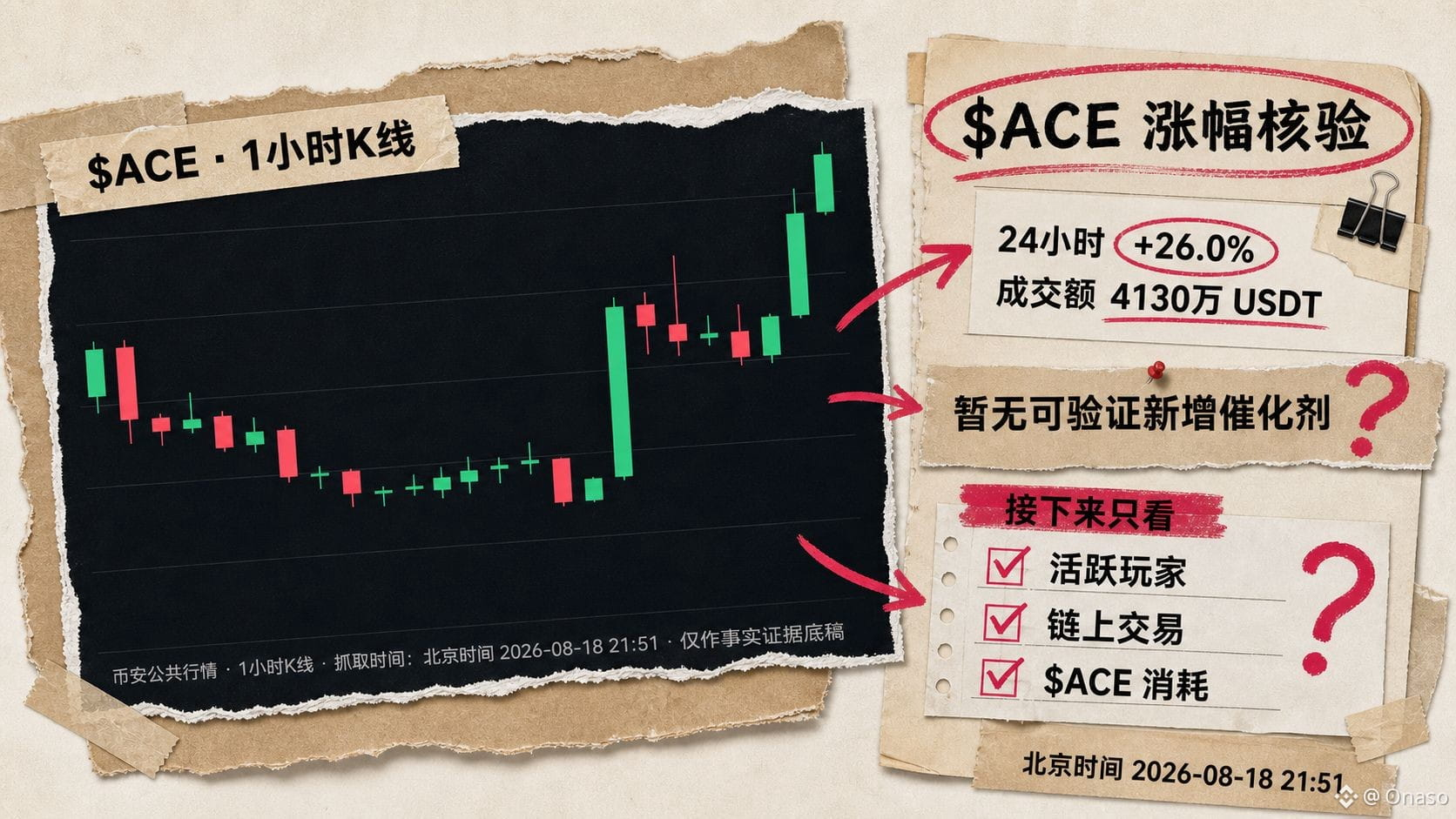
$ACE Binance 24-hour increase is about 26.0%, with trading volume around 41.3 million USDT. The 1-hour candlestick chart has been continuously surging in the latter half. What can be verified is that Fusionist is still running the Endurance game and its staking system. The official documentation states that standard validators need to stake 32 ACE. However, today the official has not released any announcements about new products, partnerships, revenue, or token utility. Real-time discussion on X is also mainly focused on “breakthrough” and “surge”-type viewpoints. Therefore, this time I can only write: the price and attention are warming up, and there is no verifiable new catalyst. Next, I’ll look at active players, on-chain transactions, changes in validators, and ACE consumption within the game. $BTC is only used to cross-check overall risk appetite; if these usage data do not move in sync, the price increase cannot be used to infer an improvement in fundamentals.
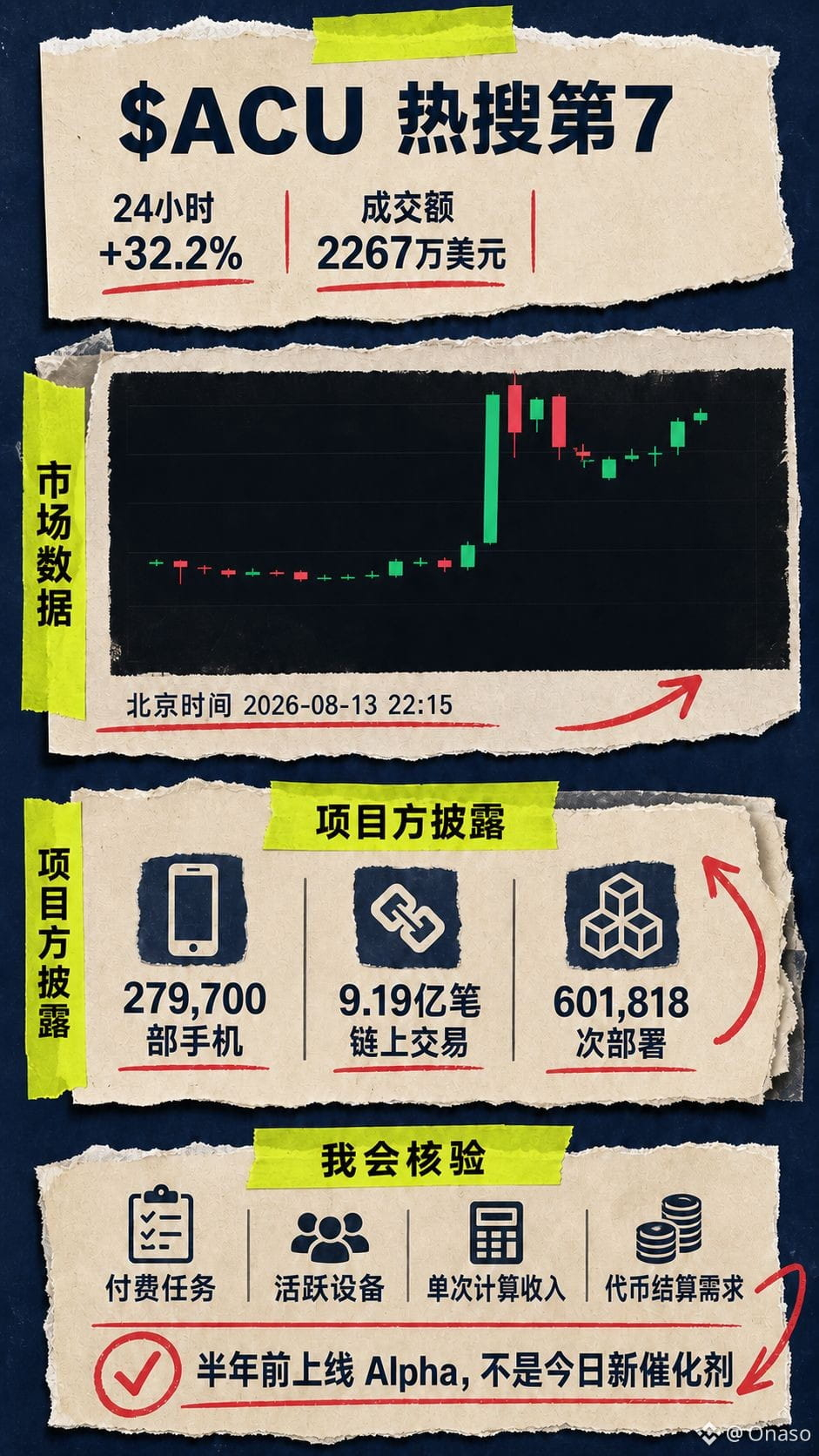
$ACU Today Acurast is ranked 7th on CoinGecko’s trending search, up about 32.2% in the past 24 hours, with trading volume of about $22.67 million; Binance does not have an $ACU spot pair, and the chart uses CoinGecko’s publicly aggregated price data. Binance Alpha launched $ACU in January this year—so this is not a new catalyst from today. What can be verified today is: the official preview announced an August 13th Korean-language community exchange and introduced an AI agent that can continuously run over mobile networks; real-time discussion on X is mostly on the gainers list, leverage, and group-call signals, which only indicates attention heating up—it cannot prove that demand has increased.
Acurast turns idle phones into computing nodes, like connecting many small kitchens into the same food-delivery platform; but phone computing is still constrained by online rate, secure environment, task scheduling, and the need for payment. The project team has disclosed 279,700 phones, 919 million on-chain transactions, and 601,818 deployments, which cannot directly be equated with continuously online devices, real paid tasks, or protocol revenue.
I will validate with four data points: paid tasks, daily active devices, per-computation revenue, and real demand for settlement or staking using $ACU . $BNB B is only used to explain the background of Alpha distribution. If devices and deployments increase but paid tasks, revenue, and token settlement do not move in sync, then growth is more like supply expansion; only if all four improve at the same time could the decentralized computing narrative potentially solidify into measurable usage.
Acurast turns idle phones into computing nodes, like connecting many small kitchens into the same food-delivery platform; but phone computing is still constrained by online rate, secure environment, task scheduling, and the need for payment. The project team has disclosed 279,700 phones, 919 million on-chain transactions, and 601,818 deployments, which cannot directly be equated with continuously online devices, real paid tasks, or protocol revenue.
I will validate with four data points: paid tasks, daily active devices, per-computation revenue, and real demand for settlement or staking using $ACU . $BNB B is only used to explain the background of Alpha distribution. If devices and deployments increase but paid tasks, revenue, and token settlement do not move in sync, then growth is more like supply expansion; only if all four improve at the same time could the decentralized computing narrative potentially solidify into measurable usage.
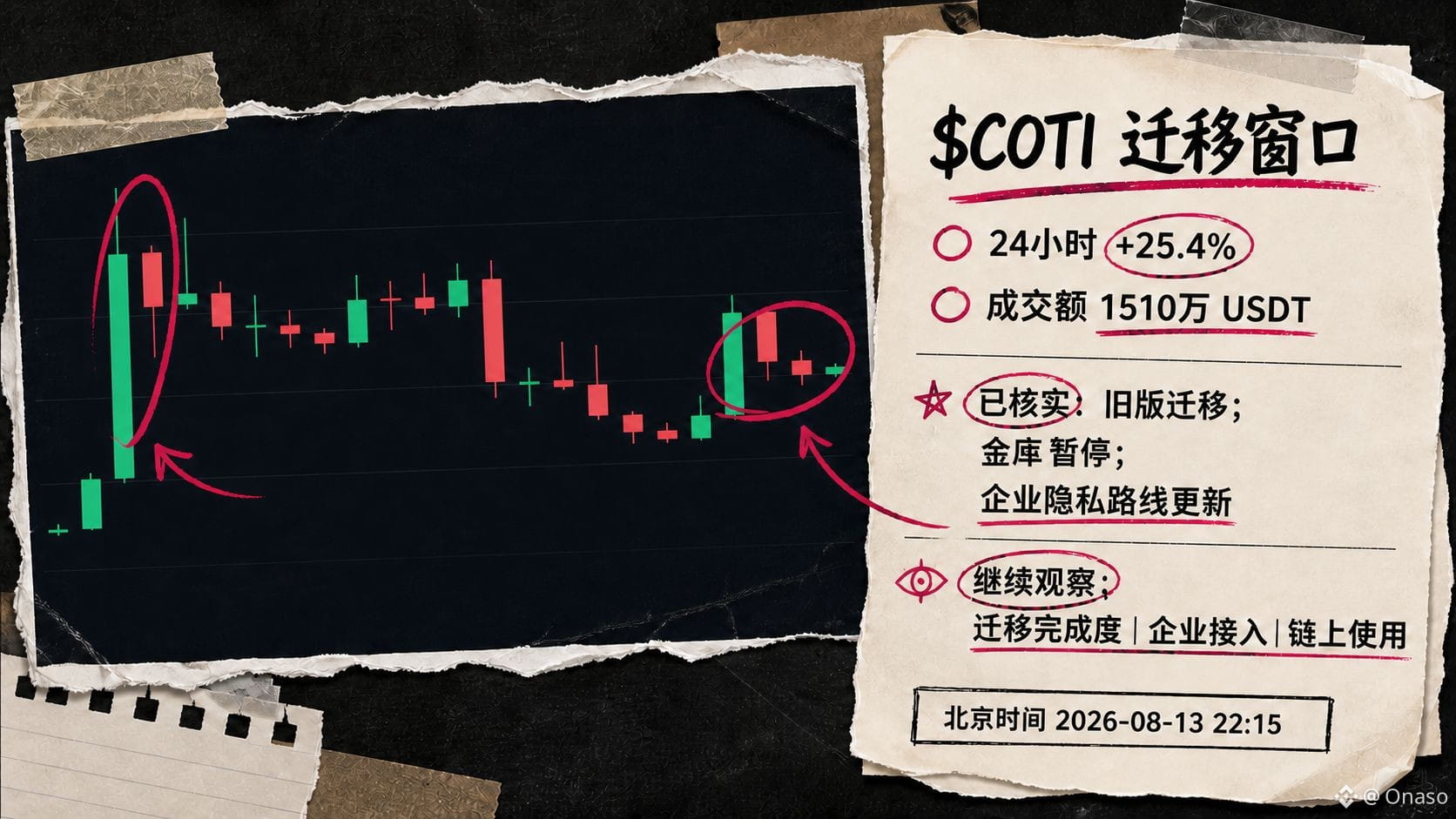
$COTI Binance’s 24-hour surge is about 25.4%, with trading volume of roughly 15.10 million USDT. Today, there are two layers of verifiable catalysts: an official notice reminding holders of older versions to migrate, and stating that the vault will be paused at 10:00 (Coordinated Universal Time); meanwhile, it also updates the route, emphasizing enterprise privacy. Note that the migration is a technical and asset-conversion window, not new revenue, and the route update is also merely project disclosure. After the 1-hour candlestick spikes higher, it clearly gives back gains, indicating that both the news and the switching of positions are amplifying volatility. Next, I’ll only watch three things: migration completion rate, actual enterprise onboarding, and on-chain calls and fees.$ETH is only provided as background for a public chain where a privacy application might potentially be implemented; if there’s only migration progress without real customers and usage, then the fundamental explanation for this uptrend is incomplete.
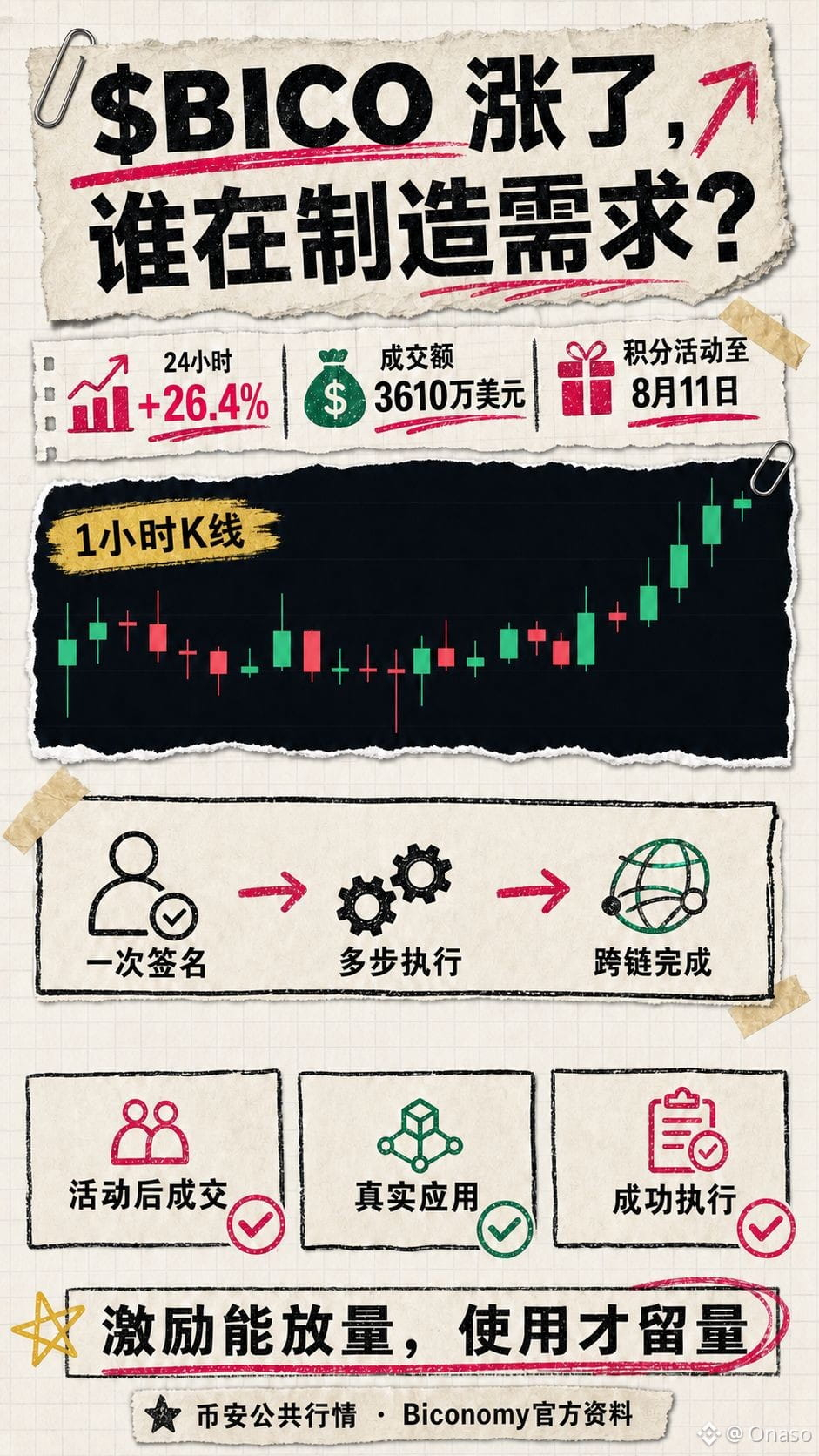
$BICO Binance 24-hour rise is about 26.4%, with trading volume of about $36.1 million. Verifiable events are: Aster launched a $BICO perpetual contract with a maximum 5x leverage on August 4, and offered 1.2x trading points. The promotion runs until 23:59 on August 11 (UTC). Incentives may amplify trading, but there is no evidence proving it is the only reason for today’s rise; the official side also did not release any new partnership or revenue announcements today.
What Biconomy really wants to solve isn’t “adding another chain,” but compressing multi-step operations such as approvals, swaps, cross-chain transfers, deposits, etc. into a single signature. Like a ride-hailing car where the user only states the destination, and the backend arranges the route. The official documentation says its modular execution environment supports orchestrating multi-chain actions with a single signature, and allows paying gas fees with multiple tokens. This is product capability, not proof of existing large-scale paid demand.
I’ll separate “trading incentives” from “product usage.”
First, after the points end, does the trading volume clearly drop?
Second, do the number of integrated apps and successful execution counts increase?
Third, can costs or node requirements be transmitted to BICO?
$ETH is only an important background for its multi-chain interactions, not proof of demand. If after the campaign ends only price and leveraged trading remain, it suggests short-term hype rather than usage; if real application, successful executions, and fee flows rise in sync, then the infrastructure story would have stronger evidence.
What Biconomy really wants to solve isn’t “adding another chain,” but compressing multi-step operations such as approvals, swaps, cross-chain transfers, deposits, etc. into a single signature. Like a ride-hailing car where the user only states the destination, and the backend arranges the route. The official documentation says its modular execution environment supports orchestrating multi-chain actions with a single signature, and allows paying gas fees with multiple tokens. This is product capability, not proof of existing large-scale paid demand.
I’ll separate “trading incentives” from “product usage.”
First, after the points end, does the trading volume clearly drop?
Second, do the number of integrated apps and successful execution counts increase?
Third, can costs or node requirements be transmitted to BICO?
$ETH is only an important background for its multi-chain interactions, not proof of demand. If after the campaign ends only price and leveraged trading remain, it suggests short-term hype rather than usage; if real application, successful executions, and fee flows rise in sync, then the infrastructure story would have stronger evidence.
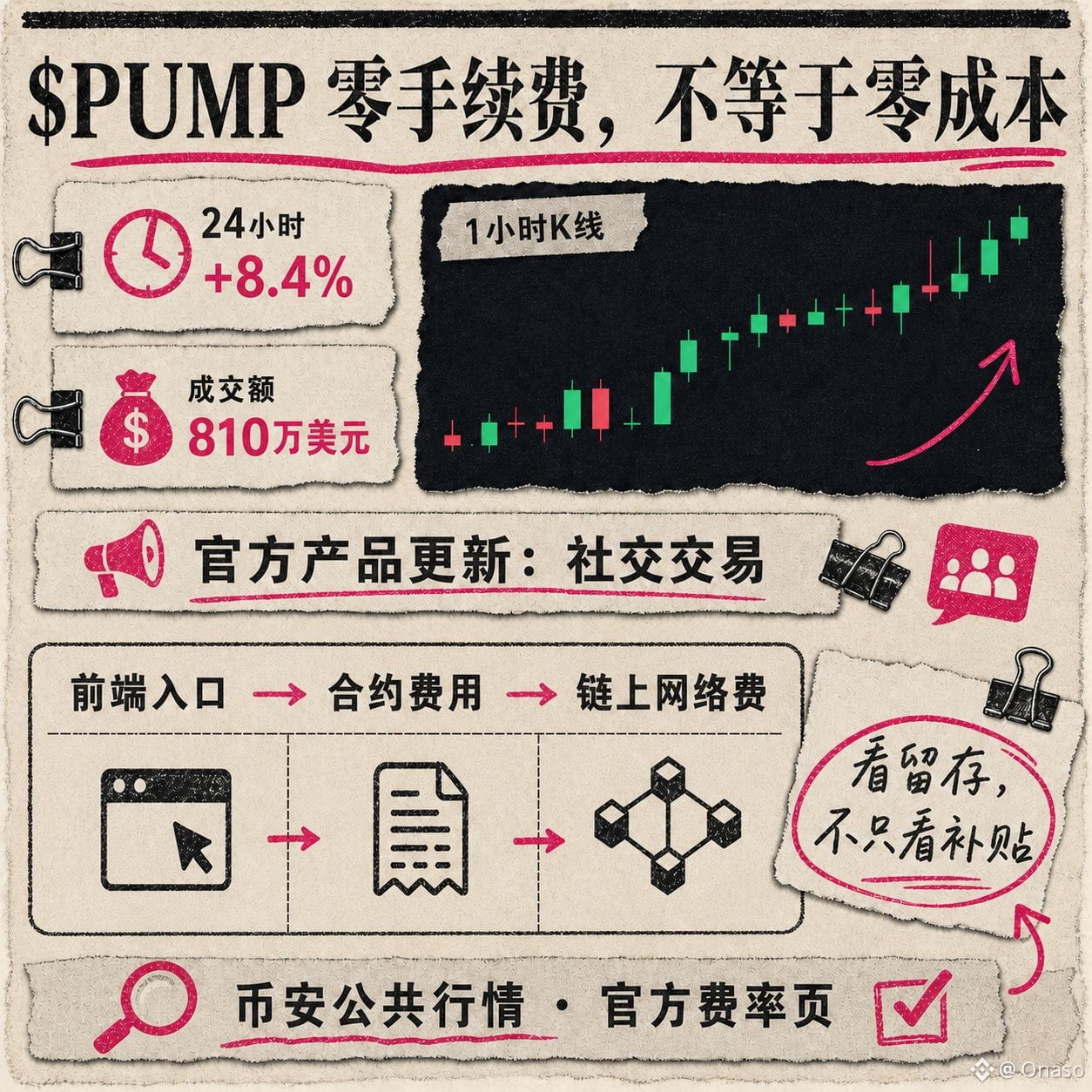
$PUMP Binance’s 24-hour rise is about 8.4%, with trading volume of roughly $81 million. On August 7, the official launched social trading functionality, highlighting token alerts, zero trading fees, and cross-chain settlement. Today, the official account is still showcasing related experiences; however, I couldn’t find any announcement substantial enough to separately explain that day’s surge. The easiest thing to misunderstand is that “zero fees” equals “zero cost.” The official fee page states very clearly: there is no additional front-end charge, but it does not mean smart contract fees, on-chain network fees, or third-party costs disappear. To judge whether a product has truly retained users, I look at the active user count after the initial feature hype fades, whether cross-chain trading remains sustained, and whether protocol and creator fees still have real sources. $BTC is only used to observe overall risk appetite and cannot replace these product-specific data.
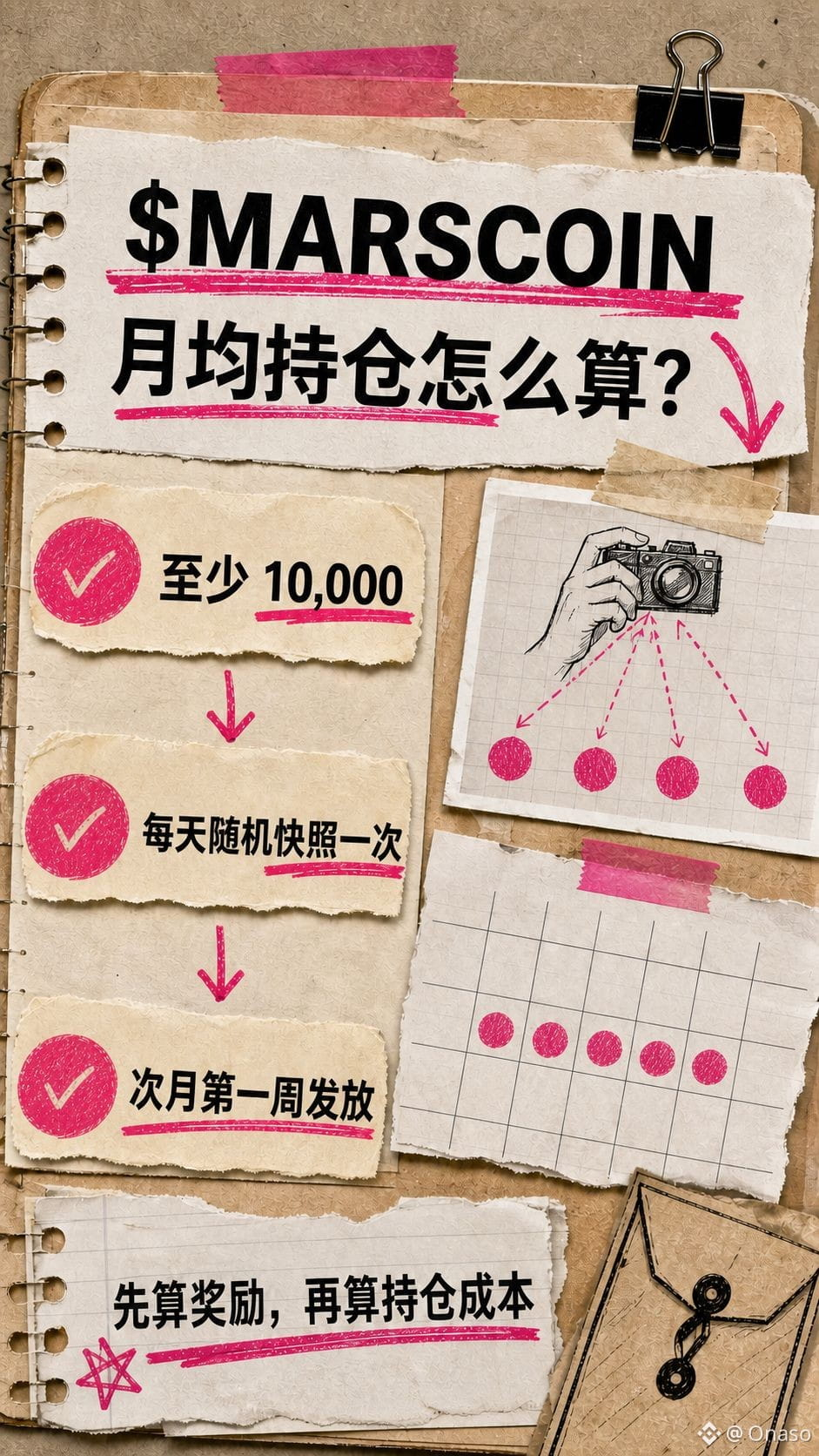
$MarsCoin This time, Alpha holding rewards: the key isn’t “just hold and get,” but rather the monthly average holding and the random snapshots taken each day. Official rules: Alpha 2.0 users must hold at least 10,000 units on a monthly average basis. The system takes one random snapshot every day. Rewards for the previous month, if you meet the criteria, are distributed to your spot account during the first week of the next month. On August 7, the official confirmed the first round is completed. Future rounds may not be announced monthly anymore, so you may need to check your spot transaction history yourself.
How should you understand “monthly average”? It’s like calculating a bonus based on full-month attendance—it’s not just checking in for a single day at the end of the month. If you sell in the middle of the month, the lower balance afterward will still drag down the average value. Also, since the snapshot time is unknown, the certainty of “timing the borrow” with a temporary coin is very low.
What really matters is net profit, not the number of reward tokens received. You can use a simple framework: the realizable value of the reward tokens when they arrive, minus the price fluctuations of holding $MarsCoin during the holding period, the capital lock-up, and trading costs. For example, if you expect the reward to be worth only 2% of your principal but your position drawdown is 8%, then even though you “received an airdrop” on paper, it could still be a loss. Also pay attention to eligibility constraints: Binance is only a distribution helper—reward rules are determined by Flap or the token/deployer, and they are affected by your region and eligibility for the bStock product.
My approach is to record my holding cost and monthly-average estimate every week, and split the rewards into three columns: “already received,” “tradeable,” and “valued at the current price.” $bnb is only background for the Binance ecosystem; whether it’s worth it ultimately depends on whether the actual rewards can outweigh the fluctuations of $MarsCoin .
How should you understand “monthly average”? It’s like calculating a bonus based on full-month attendance—it’s not just checking in for a single day at the end of the month. If you sell in the middle of the month, the lower balance afterward will still drag down the average value. Also, since the snapshot time is unknown, the certainty of “timing the borrow” with a temporary coin is very low.
What really matters is net profit, not the number of reward tokens received. You can use a simple framework: the realizable value of the reward tokens when they arrive, minus the price fluctuations of holding $MarsCoin during the holding period, the capital lock-up, and trading costs. For example, if you expect the reward to be worth only 2% of your principal but your position drawdown is 8%, then even though you “received an airdrop” on paper, it could still be a loss. Also pay attention to eligibility constraints: Binance is only a distribution helper—reward rules are determined by Flap or the token/deployer, and they are affected by your region and eligibility for the bStock product.
My approach is to record my holding cost and monthly-average estimate every week, and split the rewards into three columns: “already received,” “tradeable,” and “valued at the current price.” $bnb is only background for the Binance ecosystem; whether it’s worth it ultimately depends on whether the actual rewards can outweigh the fluctuations of $MarsCoin .
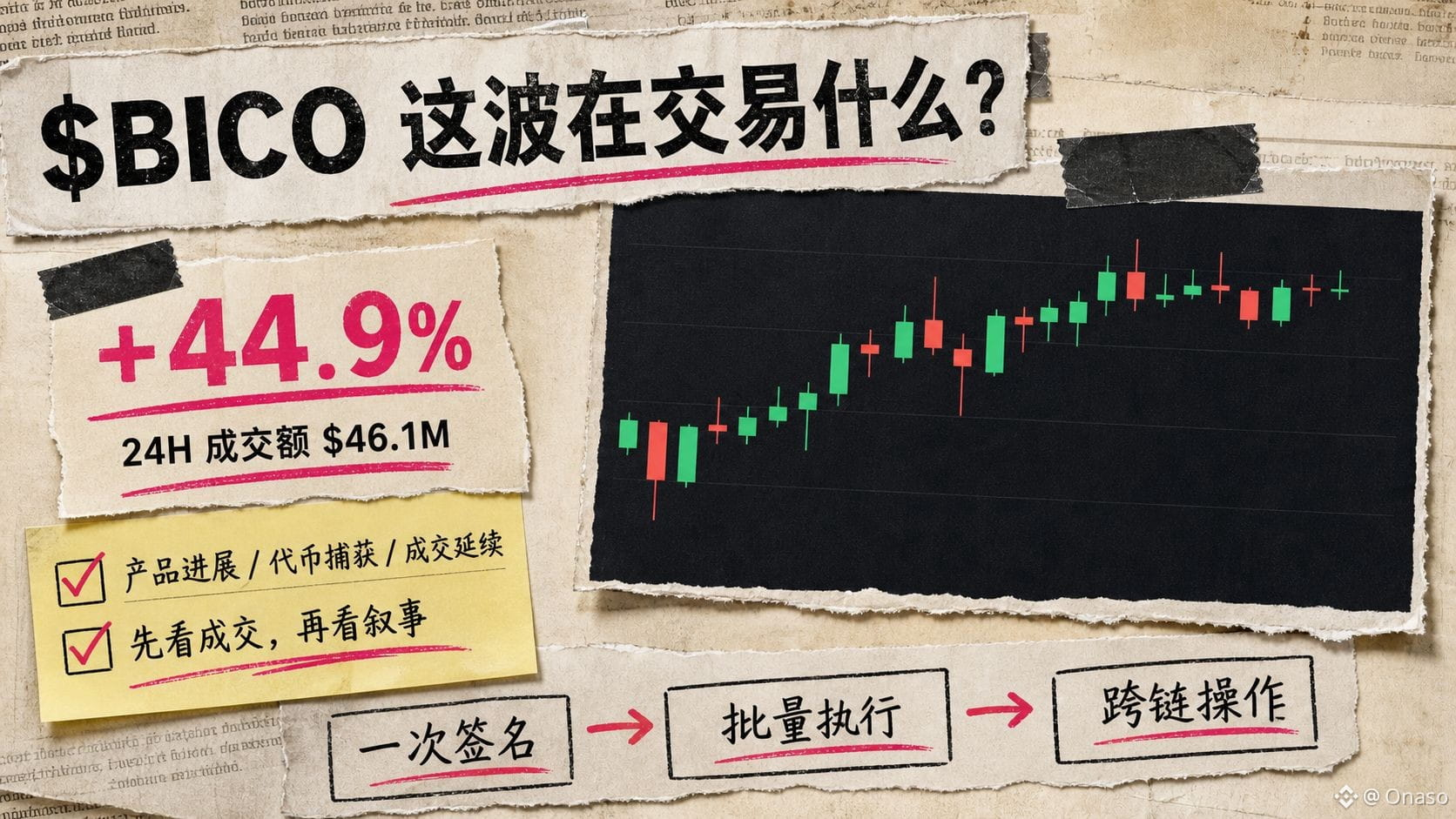
On today’s biggest gainer leaderboard, the most likely token to be driven along by a single long bullish candle is $BICO . When I captured the market data on the morning of August 8 Beijing time, BICO/USDT was up about 44.9% over the past 24 hours, with trading volume around $46.1 million. The intraday range was $0.03123 to $0.05911. It also shows up on CoinGecko’s trending search leaderboard. In other words, price, volume, and search attention all rise together—so the hype isn’t an illusion.
#Biconomy is not just an empty shell. It currently focuses on smart accounts and on-chain orchestration, hiding as much as possible—Gas costs, batched transactions, cross-chain steps, and even restricted permissions—behind a single signature. The project’s official documentation homepage states that its underlying infrastructure has processed more than 70 million transactions and deployed more than 4.5 million smart accounts. These are figures from the team, which can indicate the product is actually deployed, but you still need to cross-check with third-party on-chain data. The Smart Batching SDK released in May was built around ERC-8211: a group of transactions can read balances at execution time, check conditions, and pass the output of one step to the next. For DeFi, automation, and AI agents, this is indeed more practical than “hard-coding every parameter in advance.”
What really needs to be separated is product value versus token value. If developers use the SDK, APIs, or smart accounts, will demand that must go through BICO continue to be created? BICO currently has roles in staking, delegation, and network coordination, but as product usage grows, token demand doesn’t necessarily increase at the same ratio. A lot of infrastructure projects don’t lack users—the issue is that there’s a layer between user growth and token capture.
So I’d look at three things: whether trading volume can be sustained after the surge; whether the new products translate into a real increase in execution volume; and whether BICO’s role in fees, staking, and security has become more rigid. You can look at short-term momentum for the heat, but any fundamental conclusions should take longer. Don’t assume any price is automatically reasonable just because the product is real. $BTC
#Biconomy is not just an empty shell. It currently focuses on smart accounts and on-chain orchestration, hiding as much as possible—Gas costs, batched transactions, cross-chain steps, and even restricted permissions—behind a single signature. The project’s official documentation homepage states that its underlying infrastructure has processed more than 70 million transactions and deployed more than 4.5 million smart accounts. These are figures from the team, which can indicate the product is actually deployed, but you still need to cross-check with third-party on-chain data. The Smart Batching SDK released in May was built around ERC-8211: a group of transactions can read balances at execution time, check conditions, and pass the output of one step to the next. For DeFi, automation, and AI agents, this is indeed more practical than “hard-coding every parameter in advance.”
What really needs to be separated is product value versus token value. If developers use the SDK, APIs, or smart accounts, will demand that must go through BICO continue to be created? BICO currently has roles in staking, delegation, and network coordination, but as product usage grows, token demand doesn’t necessarily increase at the same ratio. A lot of infrastructure projects don’t lack users—the issue is that there’s a layer between user growth and token capture.
So I’d look at three things: whether trading volume can be sustained after the surge; whether the new products translate into a real increase in execution volume; and whether BICO’s role in fees, staking, and security has become more rigid. You can look at short-term momentum for the heat, but any fundamental conclusions should take longer. Don’t assume any price is automatically reasonable just because the product is real. $BTC
Verified
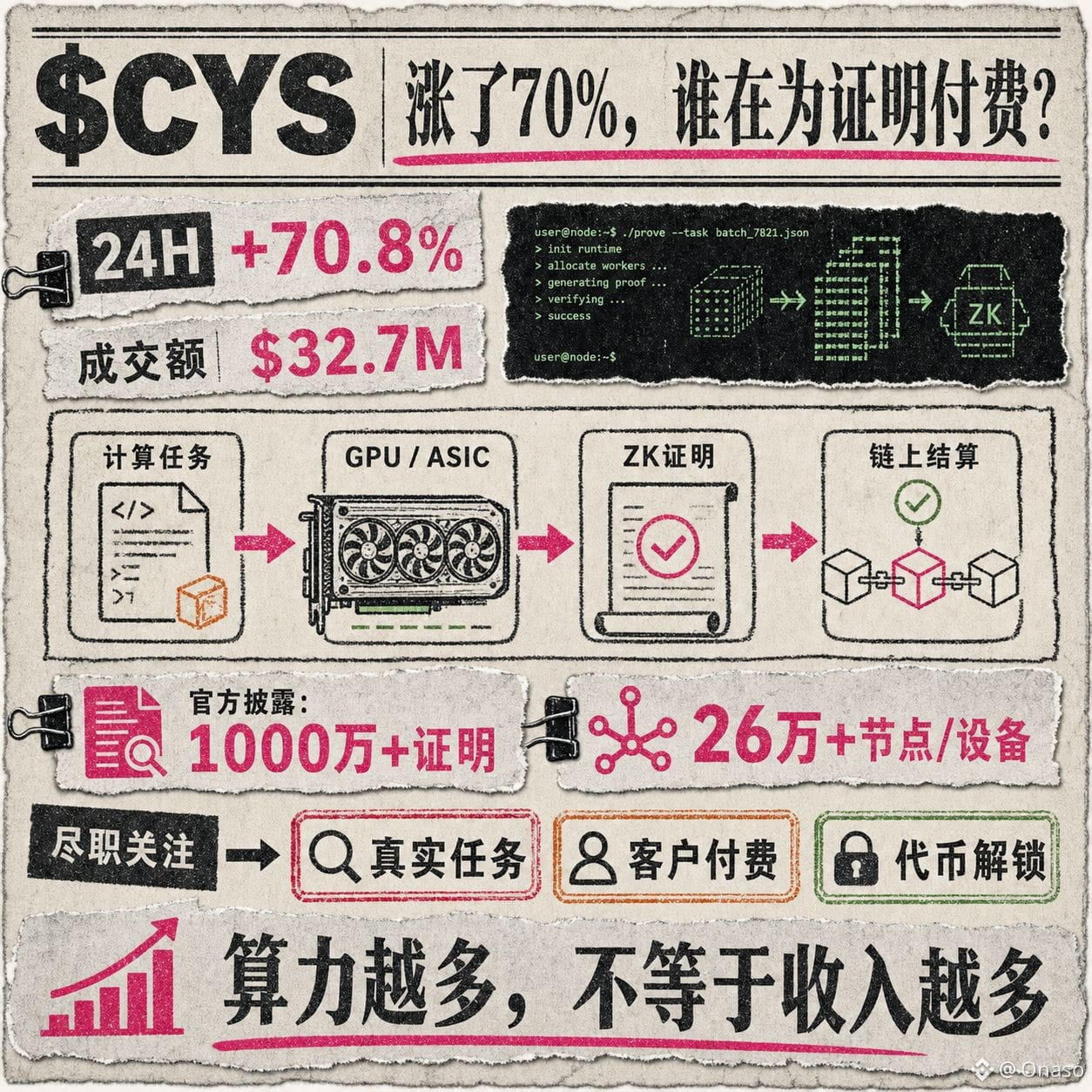
$CYS Today it surged into CoinGecko’s trending search list; as of the time of writing, the price increase over the past 24 hours is about 70.8%, with trading volume around $32.69 million and circulating market cap around $80.11 million. This kind of rise is enough to draw attention, but what I’m more interested in is the question behind it: when two hot narratives—“AI computing power” and “zero-knowledge proofs”—overlap, how do we tell whether it’s infrastructure with revenue potential or a round of emotion trading with high-tech packaging?
#Cysic It’s building a verifiable computation network. Simply put, blockchain and AI systems delegate computation tasks to GPUs, ASICs, or specialized nodes. Once a node completes the computation, it submits a proof, and others don’t need to rerun the entire process to verify whether the result is correct. The official term for this model is ComputeFi, aiming to turn computing power into an on-chain resource that is priced, scheduled, and settled. The mainnet materials claim the network has already delivered over 10 million ZK proofs and has been integrated with more than 260,000 nodes or devices, serving ecosystems such as Scroll, Aleo, and Succinct. These are disclosed figures from the project team—evidence that it’s more than just a whitepaper—but it still needs continuous validation with on-chain and customer data.
Within this system, CYS is used for paying computation services, staking nodes, securing Proof-of-Compute, and rewarding contributors. Governance power is obtained by staking CYS to receive non-transferable CGT. This dual-token design has a sensible point: economic utility and governance credibility are separated. But it also brings the most practical problem: where do the rewards sent to nodes actually come from—real customer payments, or mainly from token emissions? If paid task growth lags behind reward releases, then the more compute power there is, the less it may be worth.
The supply side also can’t be ignored. With a total supply of 1 billion CYS, the official allocation is roughly 40.19% for ecosystem incentives, about 23.62% for investors, and about 12.11% for contributors. Investors see linear release after a one-year cliff, while contributors get a one-year cliff plus an even longer vesting period. The current market cap isn’t large, so it can rise quickly—but when future supply enters circulation, real computation demand must expand in parallel to absorb selling pressure.
#Cysic It’s building a verifiable computation network. Simply put, blockchain and AI systems delegate computation tasks to GPUs, ASICs, or specialized nodes. Once a node completes the computation, it submits a proof, and others don’t need to rerun the entire process to verify whether the result is correct. The official term for this model is ComputeFi, aiming to turn computing power into an on-chain resource that is priced, scheduled, and settled. The mainnet materials claim the network has already delivered over 10 million ZK proofs and has been integrated with more than 260,000 nodes or devices, serving ecosystems such as Scroll, Aleo, and Succinct. These are disclosed figures from the project team—evidence that it’s more than just a whitepaper—but it still needs continuous validation with on-chain and customer data.
Within this system, CYS is used for paying computation services, staking nodes, securing Proof-of-Compute, and rewarding contributors. Governance power is obtained by staking CYS to receive non-transferable CGT. This dual-token design has a sensible point: economic utility and governance credibility are separated. But it also brings the most practical problem: where do the rewards sent to nodes actually come from—real customer payments, or mainly from token emissions? If paid task growth lags behind reward releases, then the more compute power there is, the less it may be worth.
The supply side also can’t be ignored. With a total supply of 1 billion CYS, the official allocation is roughly 40.19% for ecosystem incentives, about 23.62% for investors, and about 12.11% for contributors. Investors see linear release after a one-year cliff, while contributors get a one-year cliff plus an even longer vesting period. The current market cap isn’t large, so it can rise quickly—but when future supply enters circulation, real computation demand must expand in parallel to absorb selling pressure.
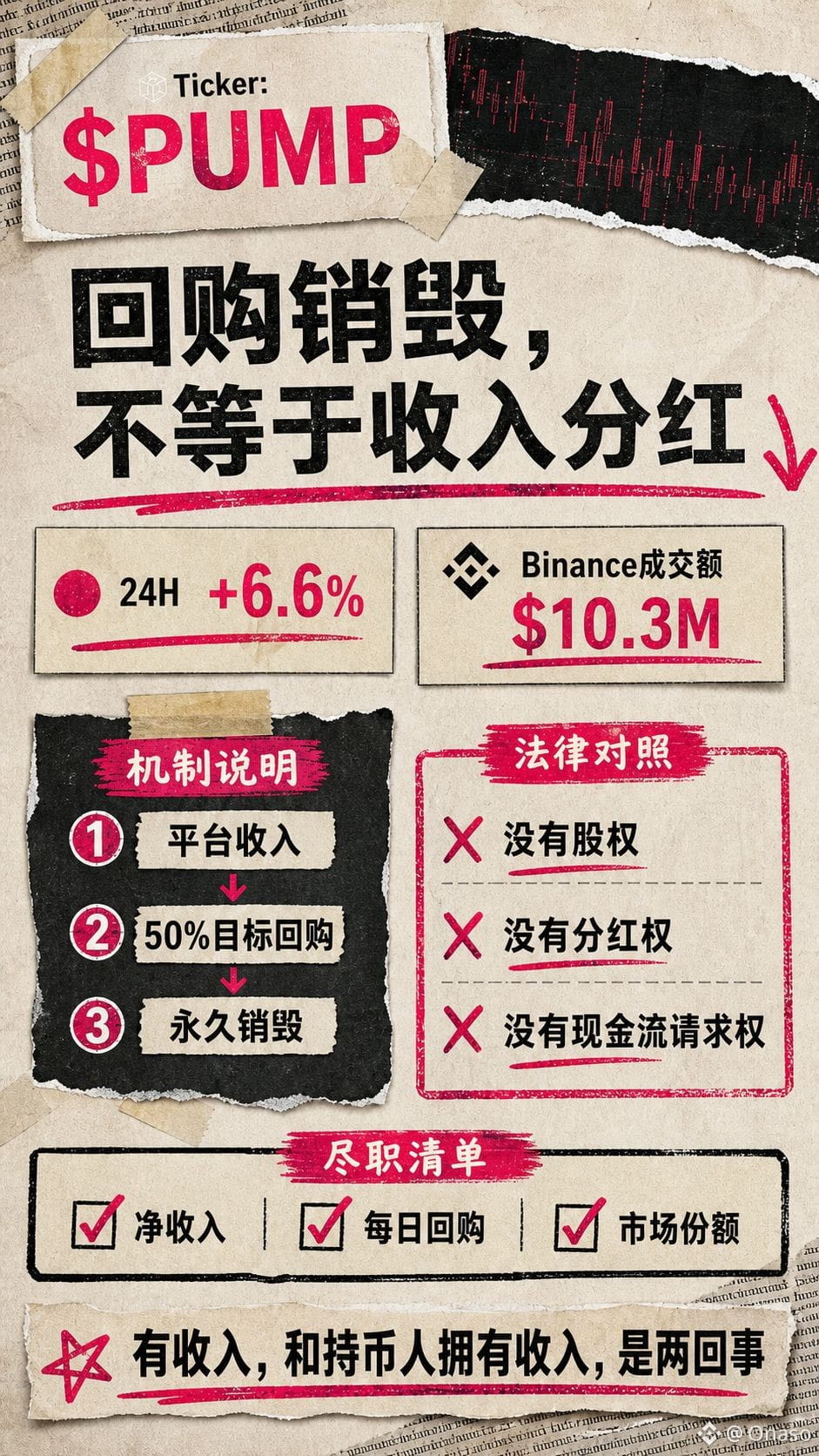
$PUMP Today we’re back into CoinGecko’s trending search list. As of the time of this report, PUMP/USDT is up about 6.6% over the past 24 hours on Binance, with trading volume of roughly $10.28 million. The total market trading volume compiled by CoinGecko is close to $96.5 million. Compared with meme-driven pumps of dozens of percentage points seen in projects like HOME and CYS, PUMP’s increase isn’t particularly extreme—but both attention and liquidity are stronger. The reason is also quite straightforward: it turns the Meme platform’s revenue, buybacks, and burns into a narrative that anyone can understand.
On Pump.fun’s official page, the platform’s goal is to use 50% of daily revenue to buy PUMP on the market, and permanently burn the tokens that are bought back. This structure is compelling because the more active the platform trading is, the more—at least in theory—will be used for purchases and burns, which continually reduces the token supply. Compared with many projects that only talk about “future utility,” PUMP at least links platform revenue and token supply in an observable way, and buyback records can also be verified on-chain.
But we must draw a very clear line here: buyback-and-burn does not mean token holders have any claim to platform revenue. The official legal disclosure explicitly states that PUMP does not represent equity, debt, or give holders any right to demand revenue, profits, dividends, or cash flows. Apart from portions that are already arranged in advance via smart contracts, future purchase behavior may also be modified, paused, or terminated. Therefore, you can’t simply multiply platform revenue by some factor and treat it as a traditional company’s stock valuation.
Another risk comes from the business itself. Pump.fun’s advantage is that anyone can quickly create a token, trade it, and get attention—but the low barrier also means many tokens have extremely short lifecycles. Sniping bots, associated wallets, and creators dumping are common. The platform can continuously collect trading fees from high-frequency speculation, but whether users benefit long-term is another question. For PUMP, the most important thing isn’t how many new Memes are created every day; it’s whether platform revenue can hold up as competition increases, and whether the proportion of revenue spent on buybacks continues to be executed.
I’m watching four indicators: the platform’s net revenue, the actual daily buyback amount, changes in circulating supply after burns, and #PumpSwap ’s share in Meme trading. If revenue declines while the market still prices it as though buybacks will stay high, the risk will quickly compound.
On Pump.fun’s official page, the platform’s goal is to use 50% of daily revenue to buy PUMP on the market, and permanently burn the tokens that are bought back. This structure is compelling because the more active the platform trading is, the more—at least in theory—will be used for purchases and burns, which continually reduces the token supply. Compared with many projects that only talk about “future utility,” PUMP at least links platform revenue and token supply in an observable way, and buyback records can also be verified on-chain.
But we must draw a very clear line here: buyback-and-burn does not mean token holders have any claim to platform revenue. The official legal disclosure explicitly states that PUMP does not represent equity, debt, or give holders any right to demand revenue, profits, dividends, or cash flows. Apart from portions that are already arranged in advance via smart contracts, future purchase behavior may also be modified, paused, or terminated. Therefore, you can’t simply multiply platform revenue by some factor and treat it as a traditional company’s stock valuation.
Another risk comes from the business itself. Pump.fun’s advantage is that anyone can quickly create a token, trade it, and get attention—but the low barrier also means many tokens have extremely short lifecycles. Sniping bots, associated wallets, and creators dumping are common. The platform can continuously collect trading fees from high-frequency speculation, but whether users benefit long-term is another question. For PUMP, the most important thing isn’t how many new Memes are created every day; it’s whether platform revenue can hold up as competition increases, and whether the proportion of revenue spent on buybacks continues to be executed.
I’m watching four indicators: the platform’s net revenue, the actual daily buyback amount, changes in circulating supply after burns, and #PumpSwap ’s share in Meme trading. If revenue declines while the market still prices it as though buybacks will stay high, the risk will quickly compound.
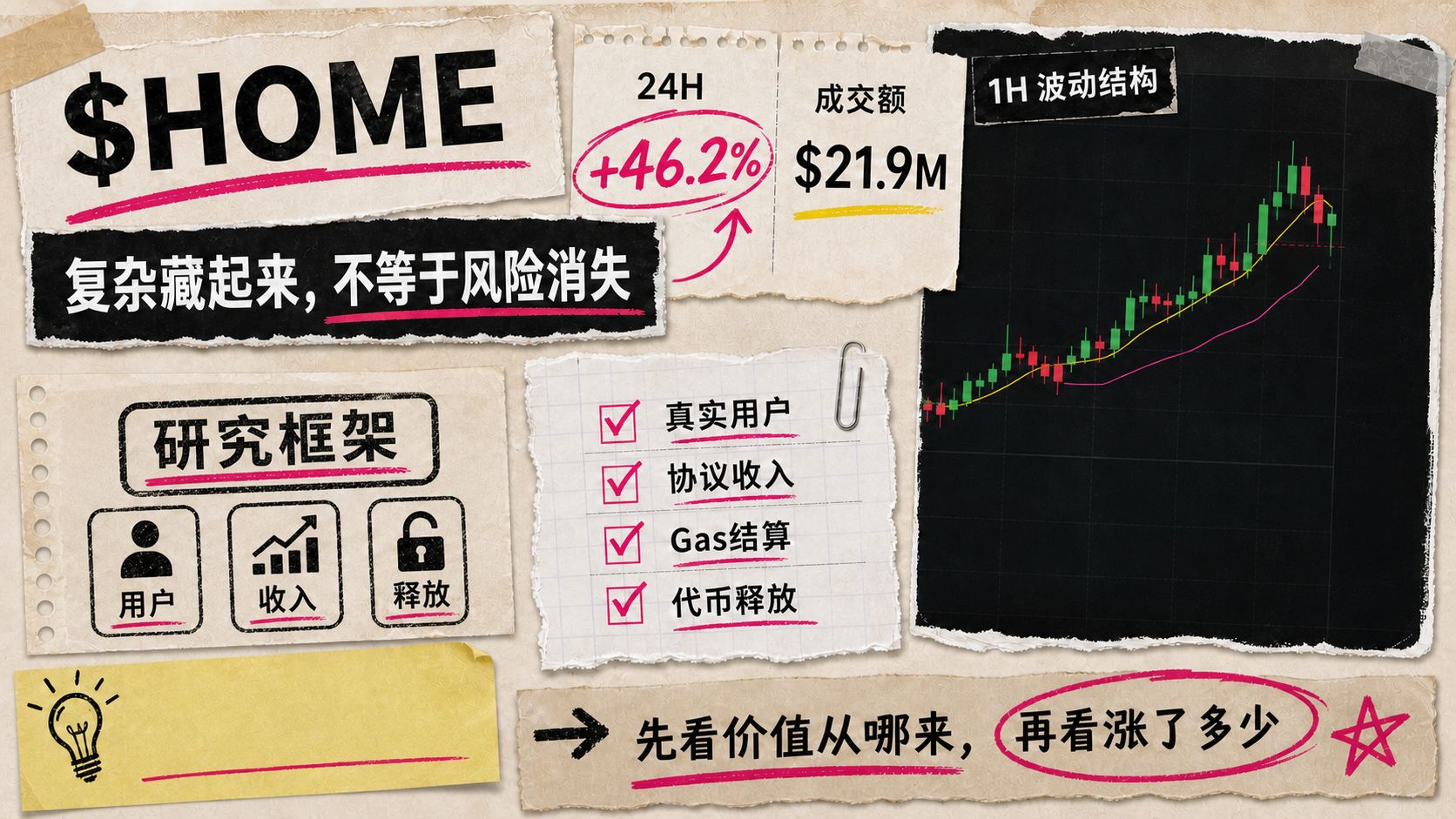
Today, the most eye-catching on Binance’s top gainers list isn’t an old-school layer-1 chain—it’s $HOME . Its 24-hour price increase once topped 40%, with trading volume around 21.9 million USDT. The price climbed from about 0.0056 all the way to 0.0086. The rally is lively, but I think what’s truly worth discussing about HOME isn’t this single candlestick—it’s the industry problem it aims to solve: why does using DeFi still feel like operating unfinished products for ordinary people?
The idea behind a DeFi app is to bundle wallet, cross-chain, swaps, and gas management into one entry point. Users don’t have to prepare gas tokens like ETH or SOL separately, and they don’t have to figure out which bridge to use each time. Through account abstraction and backend routing, the platform hides those technical steps. This approach may not sound “hardcore,” but it might be closer to real needs than building yet another high-TPS blockchain. Most users don’t care how many contract calls happen behind the scenes—they only care whether everything completes smoothly, whether fees are transparent, and whether their assets are still controlled by them.
And the problem is right there. Hiding complexity doesn’t mean the risks disappear—it just moves risk from user操作 to routing, smart contracts, and the platform’s design. I want to verify three things: when cross-chain fails, who is responsible for recovery? What exactly does “gas-free” mean—protocol subsidies, or is it settled through HOME and then converted back to cover the underlying gas? Can the transaction routing provide users with a reasonable price, and can it be proven?
If usage is driven mainly by XP and rewards incentives, active users may leave quickly when incentives decline.
The token side also can’t be judged only by “use cases.” Official materials show HOME has a total supply of 10 billion coins. Community and ecosystem hold 47%, while core contributors and early supporters account for 20% and 10%, respectively. These allocations come with a 12-month cliff, after which releases enter the next phase. We’ve already passed the initial lockup window, so changes in future supply should be monitored continuously.
So my view is that HOME won’t just be judged by price momentum. It should be evaluated by four data points: real transaction users, cross-chain and swap volume, protocol revenue, and net token releases. If the product can truly make DeFi feel as smooth as a normal financial app, the value could be significant. But if growth is mainly driven by subsidies, today’s big green candle may just be front-loading future expectations.
The idea behind a DeFi app is to bundle wallet, cross-chain, swaps, and gas management into one entry point. Users don’t have to prepare gas tokens like ETH or SOL separately, and they don’t have to figure out which bridge to use each time. Through account abstraction and backend routing, the platform hides those technical steps. This approach may not sound “hardcore,” but it might be closer to real needs than building yet another high-TPS blockchain. Most users don’t care how many contract calls happen behind the scenes—they only care whether everything completes smoothly, whether fees are transparent, and whether their assets are still controlled by them.
And the problem is right there. Hiding complexity doesn’t mean the risks disappear—it just moves risk from user操作 to routing, smart contracts, and the platform’s design. I want to verify three things: when cross-chain fails, who is responsible for recovery? What exactly does “gas-free” mean—protocol subsidies, or is it settled through HOME and then converted back to cover the underlying gas? Can the transaction routing provide users with a reasonable price, and can it be proven?
If usage is driven mainly by XP and rewards incentives, active users may leave quickly when incentives decline.
The token side also can’t be judged only by “use cases.” Official materials show HOME has a total supply of 10 billion coins. Community and ecosystem hold 47%, while core contributors and early supporters account for 20% and 10%, respectively. These allocations come with a 12-month cliff, after which releases enter the next phase. We’ve already passed the initial lockup window, so changes in future supply should be monitored continuously.
So my view is that HOME won’t just be judged by price momentum. It should be evaluated by four data points: real transaction users, cross-chain and swap volume, protocol revenue, and net token releases. If the product can truly make DeFi feel as smooth as a normal financial app, the value could be significant. But if growth is mainly driven by subsidies, today’s big green candle may just be front-loading future expectations.
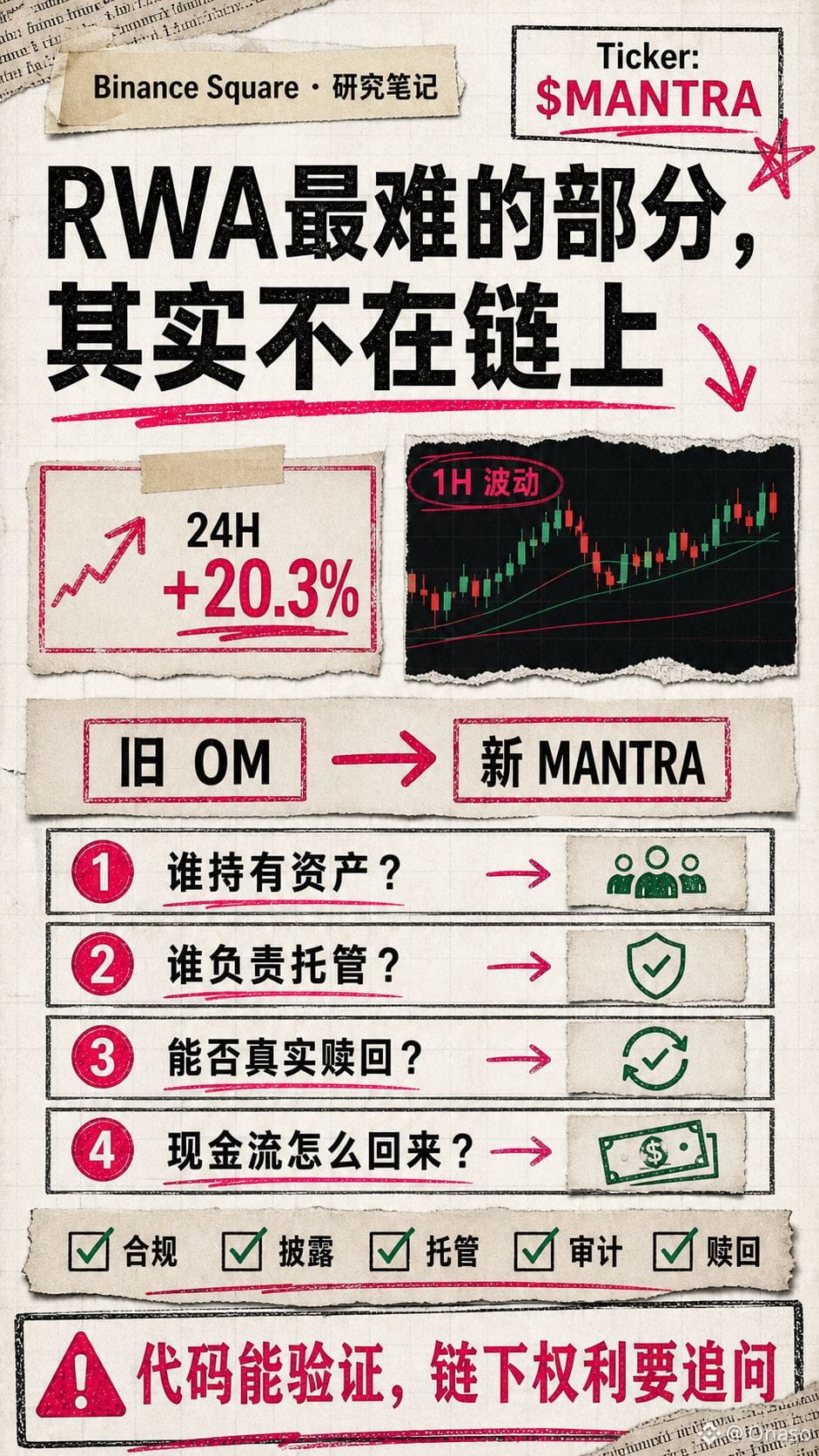
#MANTRA Today, it entered the top ranks of Binance’s price increase leaderboard, up about 22% over the past 24 hours, with trading volume around $8 million USDT. It originally used OM code; after completing the migration and unifying the brand, it switched to MANTRA. It’s completely normal that the new code is drawing attention again, but if you only understand it as “another RWA concept coin,” you’ll miss the truly difficult part of this track.
MANTRA Chain is an EVM Layer 1 designed for real-world assets, emphasizing compliance, identity, and permissioned applications. For institutions, these features are indeed important: fund shares, bond or real-estate equity can’t be transferred freely by any address like meme coins. The issuer needs to restrict investors’ regions, identities, and transfer conditions. The public chain can record ownership and execute rules, making issuance, allocation, and secondary circulation more automated.
But a chain can only solve the determinism on-chain; it can’t automatically ensure off-chain authenticity. When an RWA project claims “a value of one hundred million dollars,” I still ask: who is the underlying asset registered under? Who holds custody? How do收益 and fees flow into the token? Do token holders have a direct redemption right? Which jurisdiction applies if the assets default? How often are audit reports updated? As long as these questions don’t have answers, even the most advanced compliant smart contract is only moving an opaque rights certificate onto the blockchain.
This is also the core framework I see in MANTRA. The first layer looks at infrastructure: whether the native chain is stable and whether EVM applications are truly being used. The second layer looks at asset quality: how much of the on-chain volume consists of assets that are verifiable, redeemable, and continuously generate cash flow. Only the third layer looks at tokens: whether staking, security, Gas, and ecosystem incentives can create real demand—not relying on nonstop new RWA announcements to maintain attention.
The migration itself also carries operational risk. Before trading, you need to confirm that what you’re seeing is the new MANTRA code and the native network. The old ERC-20 assets have been marked by the project as deprecated—you can’t mix old contracts, old charts, and the new token and compare them. Today’s bullish K-line indicates that capital is repricing the asset, but it doesn’t mean all past issues have been solved by the brand upgrade.
#RWA The most valuable thing isn’t just writing the words “real-world assets” into the whitepaper, but ensuring that an on-chain token has a clear real-world counterpart in terms of law and cash flow.
MANTRA Chain is an EVM Layer 1 designed for real-world assets, emphasizing compliance, identity, and permissioned applications. For institutions, these features are indeed important: fund shares, bond or real-estate equity can’t be transferred freely by any address like meme coins. The issuer needs to restrict investors’ regions, identities, and transfer conditions. The public chain can record ownership and execute rules, making issuance, allocation, and secondary circulation more automated.
But a chain can only solve the determinism on-chain; it can’t automatically ensure off-chain authenticity. When an RWA project claims “a value of one hundred million dollars,” I still ask: who is the underlying asset registered under? Who holds custody? How do收益 and fees flow into the token? Do token holders have a direct redemption right? Which jurisdiction applies if the assets default? How often are audit reports updated? As long as these questions don’t have answers, even the most advanced compliant smart contract is only moving an opaque rights certificate onto the blockchain.
This is also the core framework I see in MANTRA. The first layer looks at infrastructure: whether the native chain is stable and whether EVM applications are truly being used. The second layer looks at asset quality: how much of the on-chain volume consists of assets that are verifiable, redeemable, and continuously generate cash flow. Only the third layer looks at tokens: whether staking, security, Gas, and ecosystem incentives can create real demand—not relying on nonstop new RWA announcements to maintain attention.
The migration itself also carries operational risk. Before trading, you need to confirm that what you’re seeing is the new MANTRA code and the native network. The old ERC-20 assets have been marked by the project as deprecated—you can’t mix old contracts, old charts, and the new token and compare them. Today’s bullish K-line indicates that capital is repricing the asset, but it doesn’t mean all past issues have been solved by the brand upgrade.
#RWA The most valuable thing isn’t just writing the words “real-world assets” into the whitepaper, but ensuring that an on-chain token has a clear real-world counterpart in terms of law and cash flow.
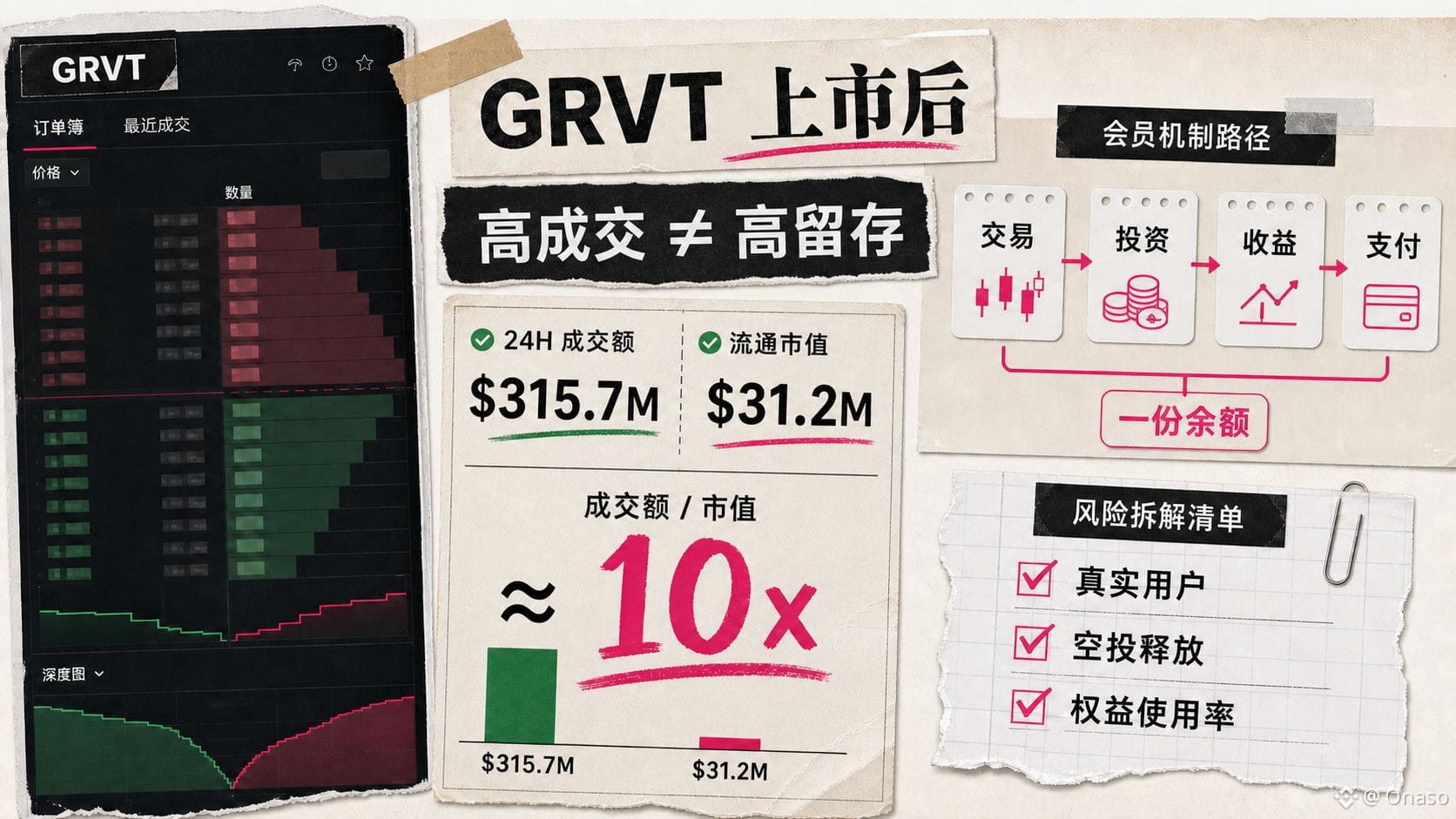
$GRVT Just launched and surged to the trending charts, but my first reaction wasn’t to chase—it was to look at this set of data first: in the last 24 hours, trading volume is about $316 million, while the circulating market cap is only about $31.2 million, with turnover roughly 10 times higher. It’s definitely lively, and the liquidity is pretty restless.
The project turns GRVT into a membership key that covers trading, investing, earnings, and payments. The story is easy to understand: use the same balance to do more things and improve capital efficiency. But whether the token can truly hold up ultimately depends on whether real users stick around, whether membership benefits are actually being used, and how much sell pressure comes after the token releases through airdrops.
So in this stage, I’ll watch the data—not guess a target price. High volume doesn’t necessarily mean high retention. Especially with new coins, don’t let the first week’s candlestick charts dictate your rhythm.$GRVT #GRVT
The project turns GRVT into a membership key that covers trading, investing, earnings, and payments. The story is easy to understand: use the same balance to do more things and improve capital efficiency. But whether the token can truly hold up ultimately depends on whether real users stick around, whether membership benefits are actually being used, and how much sell pressure comes after the token releases through airdrops.
So in this stage, I’ll watch the data—not guess a target price. High volume doesn’t necessarily mean high retention. Especially with new coins, don’t let the first week’s candlestick charts dictate your rhythm.$GRVT #GRVT
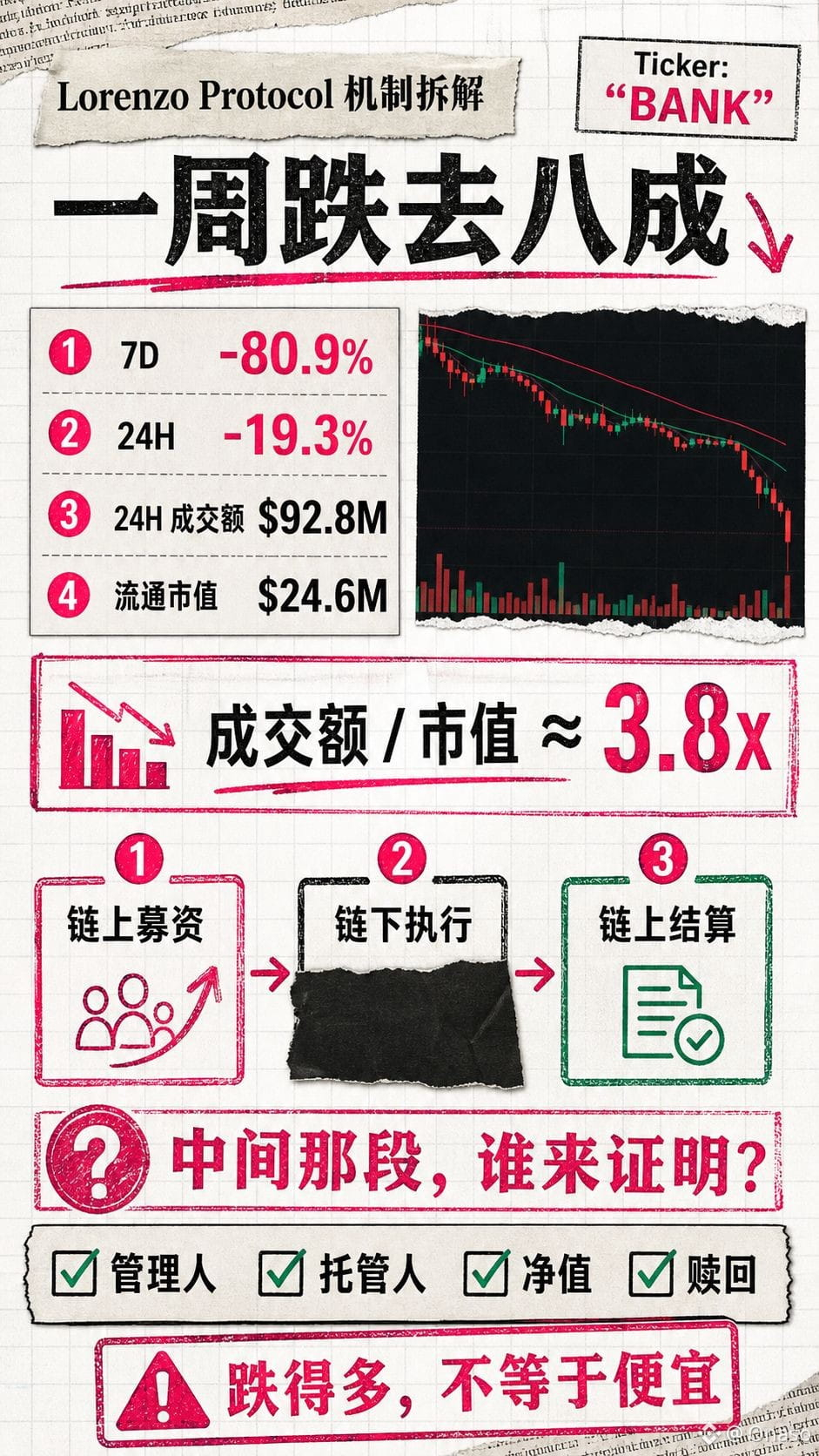
$BANK This surge in popularity is a bit brutal: in 24 hours it’s down about 19%, in 7 days about 81%, yet trading volume is around $92.8 million—roughly 3.8 times the circulating market cap. It’s popular for sure, but this is intense turnover, not a positive signal.
Lorenzo’s model is easy to understand: on-chain fundraising, the funds are handed to a manager to execute strategies offline or on a trading platform, and then everything is settled back on-chain. The real risk is in the middle part: who manages the money, how NAV is calculated, who discloses losses, and when withdrawals/redemptions can be made?
So even if it’s down 80%, it doesn’t automatically mean it’s cheap. I’ll first check the manager, custodian, NAV, and the redemption rules before considering the token. Don’t mistake bottom-fishing impulse for a research conclusion.$BANK #LorenzoProtocol
Lorenzo’s model is easy to understand: on-chain fundraising, the funds are handed to a manager to execute strategies offline or on a trading platform, and then everything is settled back on-chain. The real risk is in the middle part: who manages the money, how NAV is calculated, who discloses losses, and when withdrawals/redemptions can be made?
So even if it’s down 80%, it doesn’t automatically mean it’s cheap. I’ll first check the manager, custodian, NAV, and the redemption rules before considering the token. Don’t mistake bottom-fishing impulse for a research conclusion.$BANK #LorenzoProtocol
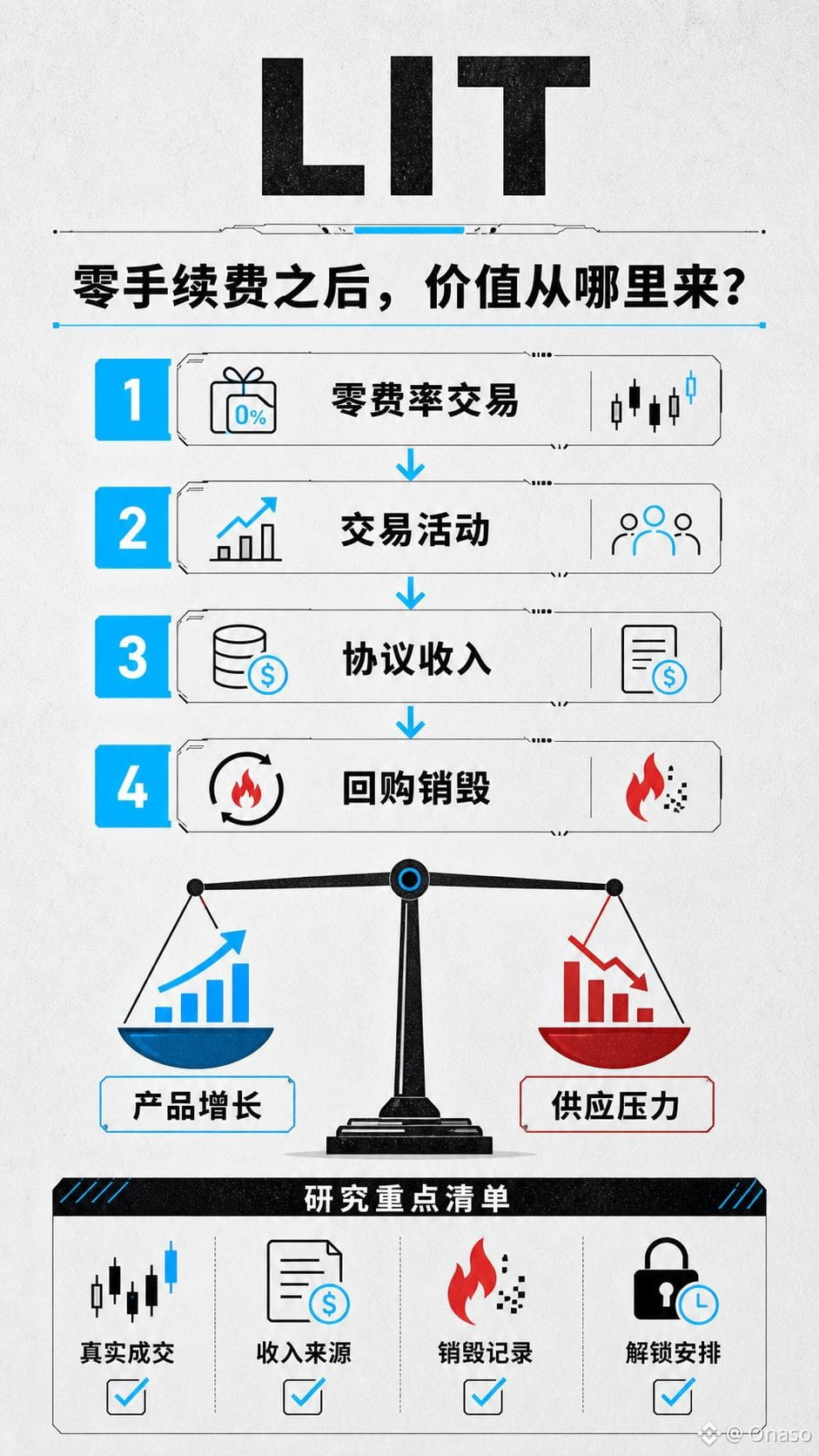
Today $LIT , appearing simultaneously in CoinGecko’s Trending and Most Viewed again—the page shows a roughly 5.6% rise over 24 hours. The most eye-catching label for Lighter is “zero-fee perpetual contract trading,” but precisely for that reason, research can’t stop at the layer of user growth: if retail traders don’t pay, where does the protocol’s revenue come from, where does the buyback-and-burn money come from, and in the end, how much value can actually enter LIT?
Lighter’s product foundation isn’t just a typical trading frontend. It places matching and settlement on a zero-knowledge infrastructure optimized for trading, generates proofs for key actions, and inherits Ethereum’s security and composability. For users, the core experience is near-centrally-exchange speed and an order book—while still preserving on-chain verifiability. Zero fee rates can reduce the cost of high-frequency orders, and also help the platform quickly accumulate liquidity and active traders.
But “zero fees” has never meant “no business model.” The protocol can still earn revenue from professional or high-frequency participants, specific trading services, settlement, capital efficiency, and ecosystem partnerships. Another recent reason the market has turned its attention to LIT is that the project supports buybacks with trading fees and is pushing forward a burn mechanism. If buyback funds truly come from sustainable protocol revenue—not from token reserves or short-term subsidies—then there is a verifiable link between product growth and token supply.
Risks also need to be viewed on the same table. Retail free trading may produce large volumes of low-quality or incentive-driven fills, so it’s necessary to distinguish nominal trading volume from real user retention. Buyback amounts must correspond to the protocol’s net revenue, not just the announced token quantities. Future unlocks will add supply and could offset the tightness created by burns. In addition, competition among perpetual DEXs is extremely real—traders will quickly move to platforms with better depth, lower slippage, and stronger incentives.
I look at four things regarding LIT: real trading activity, the source of revenue, on-chain burn records, and the unlock schedule. As long as these four items can keep lining up, zero fees may be an acquisition strategy; if trading volume relies on subsidies, revenue is opaque, and supply continues to be released, it may just be an expensive growth story. Between product growth and token value, you need cash flow—not arrows.
Lighter’s product foundation isn’t just a typical trading frontend. It places matching and settlement on a zero-knowledge infrastructure optimized for trading, generates proofs for key actions, and inherits Ethereum’s security and composability. For users, the core experience is near-centrally-exchange speed and an order book—while still preserving on-chain verifiability. Zero fee rates can reduce the cost of high-frequency orders, and also help the platform quickly accumulate liquidity and active traders.
But “zero fees” has never meant “no business model.” The protocol can still earn revenue from professional or high-frequency participants, specific trading services, settlement, capital efficiency, and ecosystem partnerships. Another recent reason the market has turned its attention to LIT is that the project supports buybacks with trading fees and is pushing forward a burn mechanism. If buyback funds truly come from sustainable protocol revenue—not from token reserves or short-term subsidies—then there is a verifiable link between product growth and token supply.
Risks also need to be viewed on the same table. Retail free trading may produce large volumes of low-quality or incentive-driven fills, so it’s necessary to distinguish nominal trading volume from real user retention. Buyback amounts must correspond to the protocol’s net revenue, not just the announced token quantities. Future unlocks will add supply and could offset the tightness created by burns. In addition, competition among perpetual DEXs is extremely real—traders will quickly move to platforms with better depth, lower slippage, and stronger incentives.
I look at four things regarding LIT: real trading activity, the source of revenue, on-chain burn records, and the unlock schedule. As long as these four items can keep lining up, zero fees may be an acquisition strategy; if trading volume relies on subsidies, revenue is opaque, and supply continues to be released, it may just be an expensive growth story. Between product growth and token value, you need cash flow—not arrows.
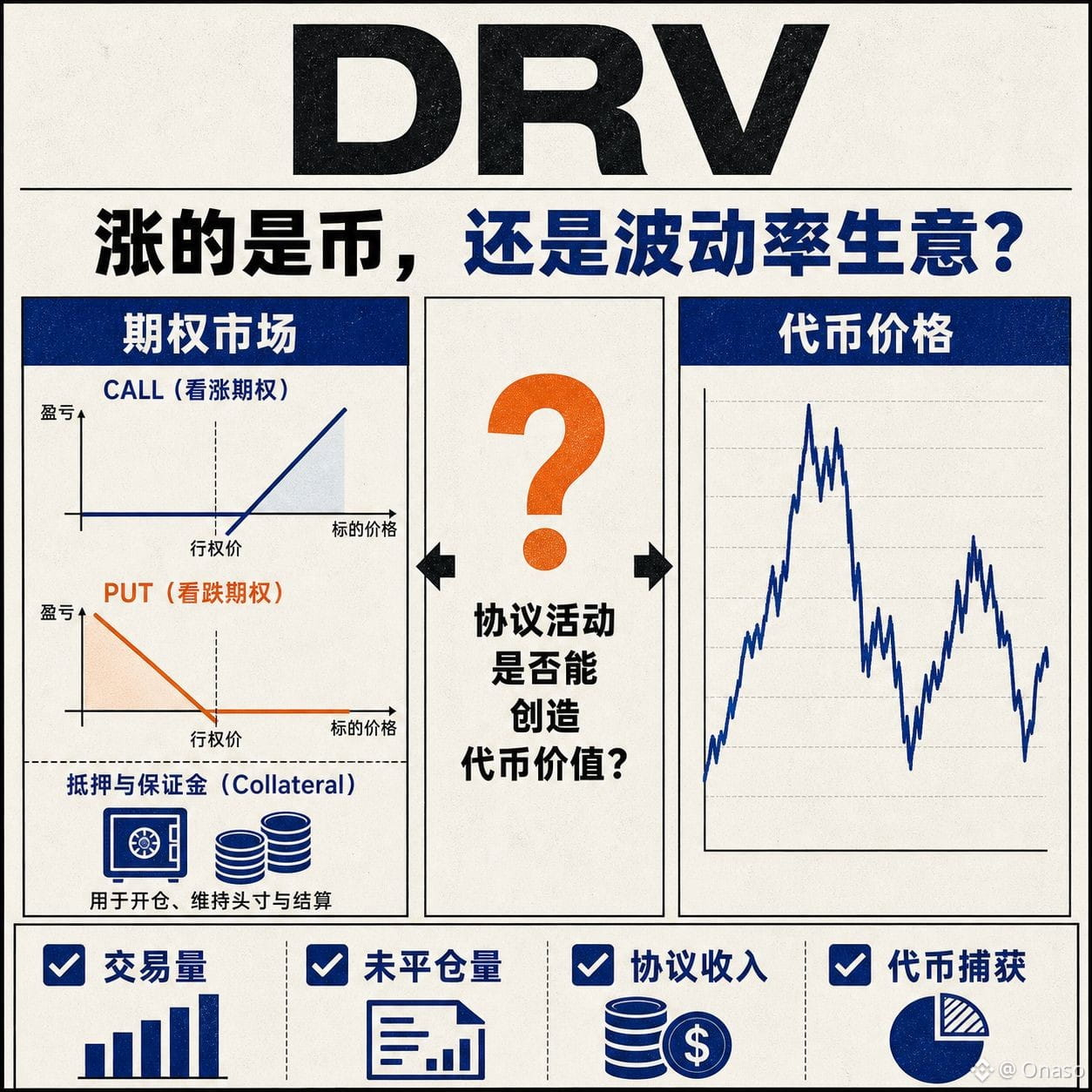
One of the most eye-catching gainers on today’s hot list is the professional-grade project $DRV. CoinGecko currently lists Derive under both Trending and Most Viewed, with the page showing an about 39.5% increase over the past 24 hours. Compared with a typical meme coin, behind #DRV there’s at least a clearly defined product: on-chain options, perpetual contracts, portfolio margin, RFQ quotes, and automated strategy vaults. The product looks professional—but that doesn’t necessarily mean the token price rise is driven by fundamentals. In fact, it’s even more important to analyze the “volatility business” and the token price separately.
In the options market, what’s being sold isn’t just a simple direction, but the price of future uncertainty. Users can buy calls or puts, or earn premiums by selling options. Market makers, meanwhile, need to manage implied volatility, Delta, margin, and liquidation risk. A mature on-chain options platform’s value isn’t just the “place trade” button—it’s whether it can continuously provide deep liquidity, reasonable quotes, and reliable settlement. Derive also lowers the barrier to professional trading through RFQ and strategy vaults, which is closer to a long-term product than simply handing out liquidity mining incentives.
But whether DRV deserves a reassessment can’t be determined by coin price alone. First, check whether options trading volume and open interest are growing in sync—short-term trades that are “manufactured” can’t represent sustained demand for risk. Second, see whether protocol revenue comes from genuine trading or from subsidies. Third, evaluate how the vault performs—its drawdowns and liquidation outcomes—during extreme market conditions. Fourth, look at DRV’s role in fees, governance, staking, or incentives, and whether that role is strong enough to support platform activity.
Today’s nearly 40% rally also brings typical risks: derivatives protocols understand leverage very well, and that doesn’t mean the token can’t be leveraged too. When market depth is limited, chasing spot upside and squeeze effects from perpetual contracts can amplify each other. Once funding rates and the position structure reverse, the product’s fundamentals won’t “catch” short-term positions. Especially when no single clear event can explain the entire surge, you should scrutinize the source of trades instead of stitching together a perfect story after the fact.
I’m going to treat DRV as an observation sample for the on-chain volatility market. The real bull-market signal isn’t how much the coin price jumped on one day, but whether more traders are willing to commit long-term risk pricing, margin, and settlement to the chain. Is the thing rising the coin, or the volatility business? The data will give different answers.
In the options market, what’s being sold isn’t just a simple direction, but the price of future uncertainty. Users can buy calls or puts, or earn premiums by selling options. Market makers, meanwhile, need to manage implied volatility, Delta, margin, and liquidation risk. A mature on-chain options platform’s value isn’t just the “place trade” button—it’s whether it can continuously provide deep liquidity, reasonable quotes, and reliable settlement. Derive also lowers the barrier to professional trading through RFQ and strategy vaults, which is closer to a long-term product than simply handing out liquidity mining incentives.
But whether DRV deserves a reassessment can’t be determined by coin price alone. First, check whether options trading volume and open interest are growing in sync—short-term trades that are “manufactured” can’t represent sustained demand for risk. Second, see whether protocol revenue comes from genuine trading or from subsidies. Third, evaluate how the vault performs—its drawdowns and liquidation outcomes—during extreme market conditions. Fourth, look at DRV’s role in fees, governance, staking, or incentives, and whether that role is strong enough to support platform activity.
Today’s nearly 40% rally also brings typical risks: derivatives protocols understand leverage very well, and that doesn’t mean the token can’t be leveraged too. When market depth is limited, chasing spot upside and squeeze effects from perpetual contracts can amplify each other. Once funding rates and the position structure reverse, the product’s fundamentals won’t “catch” short-term positions. Especially when no single clear event can explain the entire surge, you should scrutinize the source of trades instead of stitching together a perfect story after the fact.
I’m going to treat DRV as an observation sample for the on-chain volatility market. The real bull-market signal isn’t how much the coin price jumped on one day, but whether more traders are willing to commit long-term risk pricing, margin, and settlement to the chain. Is the thing rising the coin, or the volatility business? The data will give different answers.
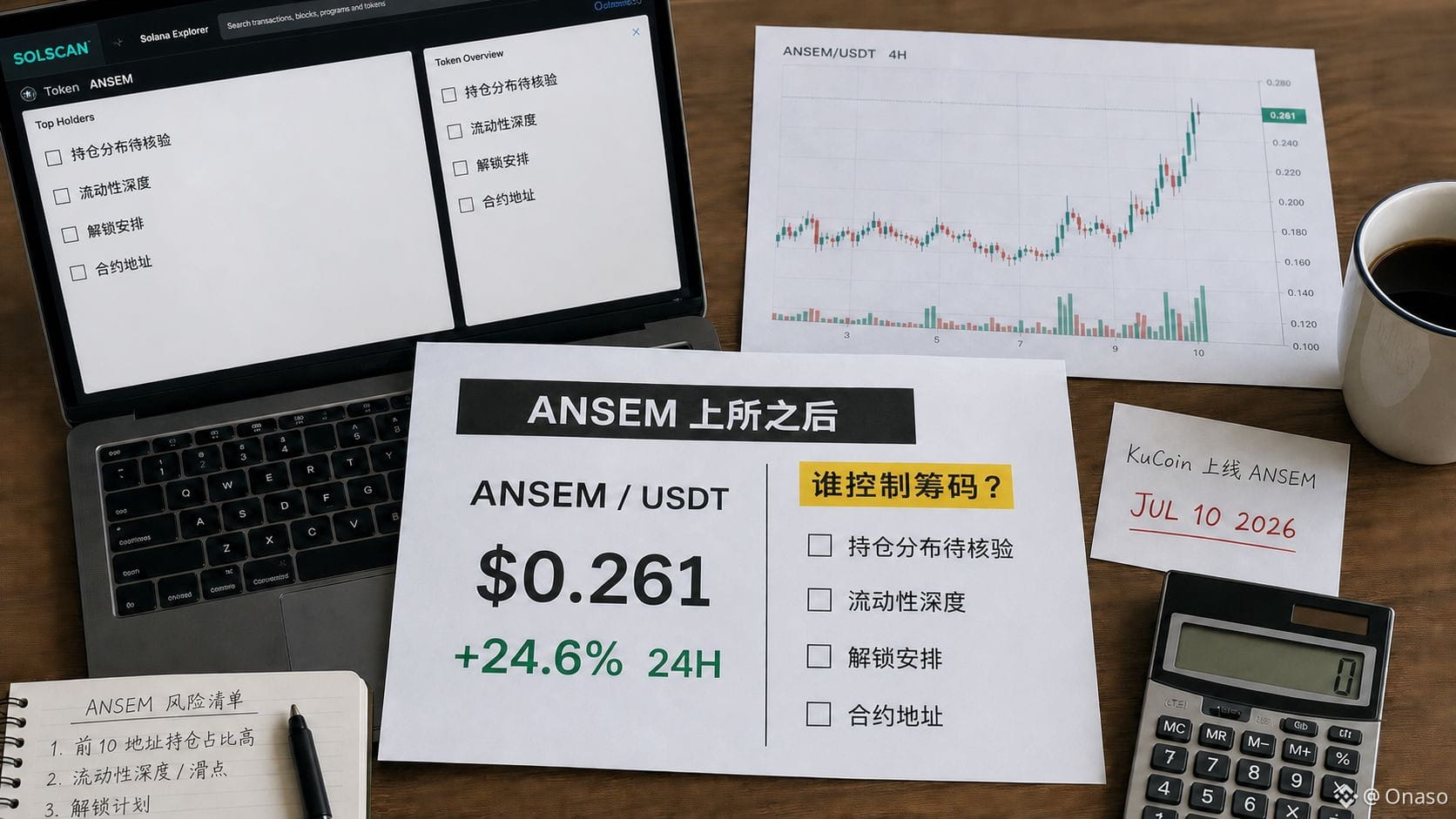
In the new-coin hot rankings, $ANSEM is the most worth doing a “heat breakdown” on. CoinGecko currently places The Black Bull in both Trending and Most Viewed; the page shows it is up about 24.6% over the past 24 hours. KuCoin, meanwhile, officially opened ANSEM/USDT spot trading on July 10. The new trading entry, the price increase, and proactive searches form a typical attention loop, but we need to judge separately whether this means the product has started to be seen—or whether the token’s chips are being repriced through liquidity expansion.
In the project introduction for #ANSEM , there’s a selling point that’s different from ordinary memes: the website directly reads Solana’s on-chain and market data to display price, liquidity, trading volume, market cap, and holder distribution. It also offers a hot-spots radar, non-custodial community liquidity Pods, and a browser-based meme terminal. This direction at least acknowledges something important: the meme market lacks slogans less than it lacks tools that help ordinary traders understand contracts, pools, and token holdings.
But “verifiable on the front end” doesn’t mean “asset risk is already solved.” A page can show your position distribution, but it doesn’t mean the distribution is necessarily healthy. Liquidity pools can be found, but that doesn’t guarantee that large orders won’t cause severe slippage when they move in and out. Listing on a centralized exchange also doesn’t mean the real depth between #DEX and #CEX is enough to absorb a market reversal. Transparency makes problems easier to spot—it doesn’t automatically make them disappear.
When I look at ANSEM now, I would prioritize verifying four things: whether the official confirmed $Solana contract matches, whether the leading addresses are related to the pool, the exchange, or any lockup contracts, whether the buy/sell depth in major markets can match the market cap, and whether there will be any unlocks, migrations, or liquidity adjustments in the future. For a new meme, these four items often get closer to real risk than how “hot the community is.”
ANSEM’s attention today is real, and the liquidity improvements from being listed are real too. But after the price rises, the most valuable questions aren’t how much more it can go up—it’s who controls the chips, who provides exit liquidity, and whether people are continuously using the product tools. Verifiability is a good habit, not a safety certificate.
In the project introduction for #ANSEM , there’s a selling point that’s different from ordinary memes: the website directly reads Solana’s on-chain and market data to display price, liquidity, trading volume, market cap, and holder distribution. It also offers a hot-spots radar, non-custodial community liquidity Pods, and a browser-based meme terminal. This direction at least acknowledges something important: the meme market lacks slogans less than it lacks tools that help ordinary traders understand contracts, pools, and token holdings.
But “verifiable on the front end” doesn’t mean “asset risk is already solved.” A page can show your position distribution, but it doesn’t mean the distribution is necessarily healthy. Liquidity pools can be found, but that doesn’t guarantee that large orders won’t cause severe slippage when they move in and out. Listing on a centralized exchange also doesn’t mean the real depth between #DEX and #CEX is enough to absorb a market reversal. Transparency makes problems easier to spot—it doesn’t automatically make them disappear.
When I look at ANSEM now, I would prioritize verifying four things: whether the official confirmed $Solana contract matches, whether the leading addresses are related to the pool, the exchange, or any lockup contracts, whether the buy/sell depth in major markets can match the market cap, and whether there will be any unlocks, migrations, or liquidity adjustments in the future. For a new meme, these four items often get closer to real risk than how “hot the community is.”
ANSEM’s attention today is real, and the liquidity improvements from being listed are real too. But after the price rises, the most valuable questions aren’t how much more it can go up—it’s who controls the chips, who provides exit liquidity, and whether people are continuously using the product tools. Verifiability is a good habit, not a safety certificate.
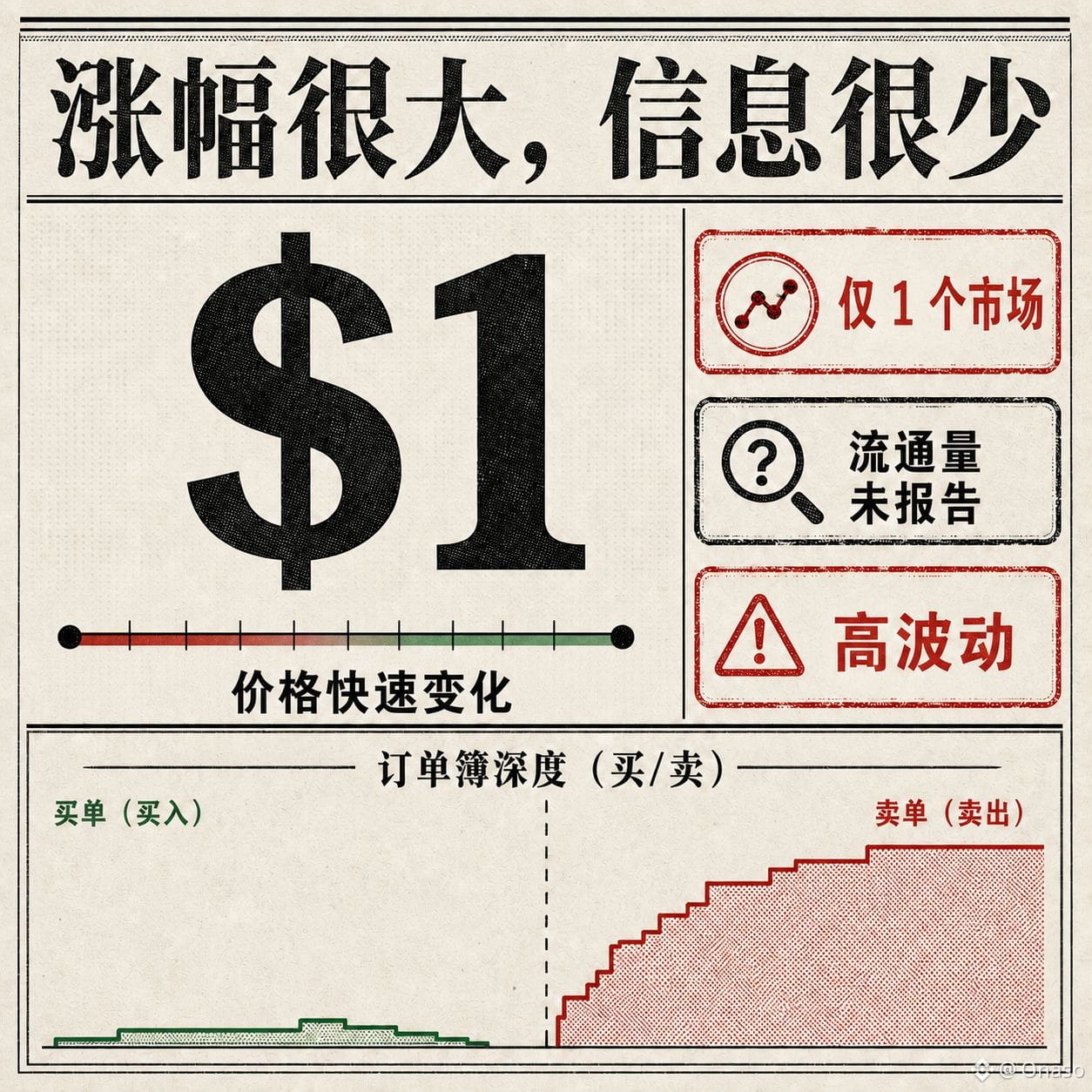
Today, one of the most exaggerated names on the #CoinGecko leaderboard is "$1 is all you need." It appeared in both Trending and Most Viewed, and the leaderboard shows a 24-hour swing of more than a thousand percentage points. Numbers like this are naturally suited for spreading, but what is really worth writing about is not "how many times it was missed," but why a market can generate such a huge price move so quickly when information is extremely limited.
From the public details, $1 is mainly traded in a Uniswap V2 market on Robinhood Chain, and the number of markets is very limited; more importantly, the circulating supply has not yet been reliably reported. Without circulating supply, it is difficult to calculate circulating market cap accurately; without multiple independent markets, it is hard to judge whether the current quote can represent a broader price consensus. You can see the price, but you may not be able to see how much capital it would take to push the price there, and you may not know how many tokens could enter the market at any time.
This kind of new coin most easily creates a cognitive illusion: the percentage gain is precise to the decimal point and looks like very solid data, but in reality the most important denominator may still be blank. When the price is pushed up from a very low level by a small amount of trading, the percentage can be astonishing; if buy-side depth is very thin, a sell order of the same size can also make the rise reverse quickly. The leaderboard records "how big the change was," not "how healthy the market is."
If I were to study it, the first step would not be to find a target price, but to confirm the correct contract, the pool creation time, the liquidity provider, whether the LP is locked, the structure of the top addresses, and the actual executable depth. Only then would I look at whether the project has a product, a community, or a mechanism. As long as these basic pieces of information are incomplete, any market-cap projection is more like guessing than valuation.
That does not mean every suddenly exploding new coin has no chance, but opportunity and verifiability must be priced separately. What $1 is most valuable for today is a reminder: the market can price attention instantly, but it will not do due diligence for traders. Big gains with little information are, by themselves, a risk signal. $BTC
From the public details, $1 is mainly traded in a Uniswap V2 market on Robinhood Chain, and the number of markets is very limited; more importantly, the circulating supply has not yet been reliably reported. Without circulating supply, it is difficult to calculate circulating market cap accurately; without multiple independent markets, it is hard to judge whether the current quote can represent a broader price consensus. You can see the price, but you may not be able to see how much capital it would take to push the price there, and you may not know how many tokens could enter the market at any time.
This kind of new coin most easily creates a cognitive illusion: the percentage gain is precise to the decimal point and looks like very solid data, but in reality the most important denominator may still be blank. When the price is pushed up from a very low level by a small amount of trading, the percentage can be astonishing; if buy-side depth is very thin, a sell order of the same size can also make the rise reverse quickly. The leaderboard records "how big the change was," not "how healthy the market is."
If I were to study it, the first step would not be to find a target price, but to confirm the correct contract, the pool creation time, the liquidity provider, whether the LP is locked, the structure of the top addresses, and the actual executable depth. Only then would I look at whether the project has a product, a community, or a mechanism. As long as these basic pieces of information are incomplete, any market-cap projection is more like guessing than valuation.
That does not mean every suddenly exploding new coin has no chance, but opportunity and verifiability must be priced separately. What $1 is most valuable for today is a reminder: the market can price attention instantly, but it will not do due diligence for traders. Big gains with little information are, by themselves, a risk signal. $BTC
In today’s trending hot list, I actually want to talk about something else: $UNI with more modest gains. CoinGecko has currently put Uniswap into Trending, with its 24-hour price change at about 3.1%. What’s really worth paying attention to isn’t just those percentage points of upside, but the product data on the Robinhood Chain and how the UNI value-capture mechanism ties together—this is the first time they’ve become meaningfully connected in a clearer way.
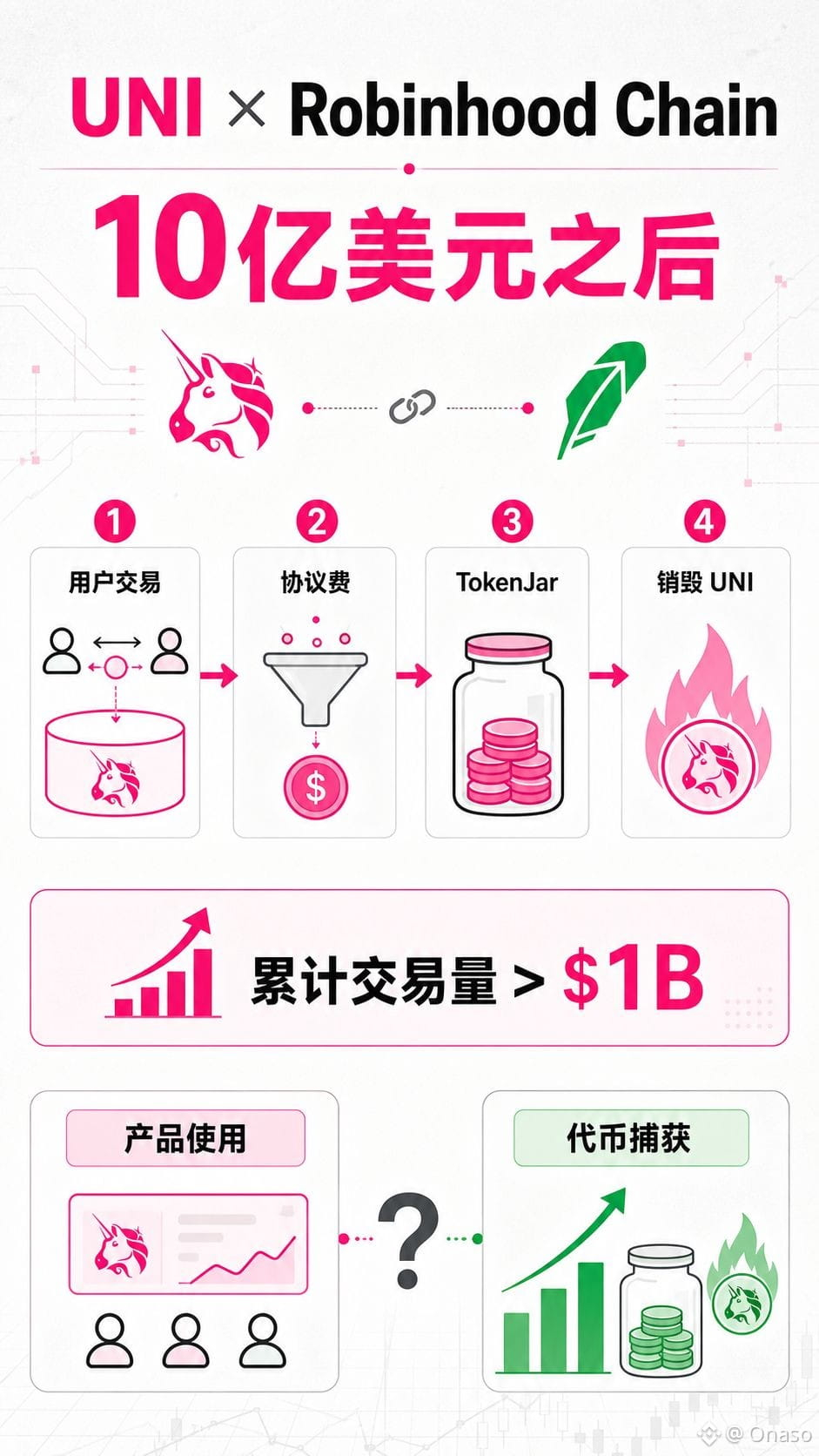
#Uniswap v2, v3, v4, and UniswapX have all launched alongside the Robinhood Chain mainnet. According to the official governance materials, as of July 10, the cumulative transaction volume of these deployments has already exceeded $1 billion. On Robinhood Chain, it’s not only ordinary tokens—stock tokens, on-chain trades, and future Agent transactions are all placed on the same underlying infrastructure. As a major public AMM, Uniswap becomes one of the most core entry points for the new chain: to exchange assets, you must first have liquidity and a place for pricing.
However, a “busy protocol” in the past doesn’t necessarily mean “UNI holders benefit.” That’s exactly why the latest protocol fee proposal matters: it plans to have the v2, v3, and v4 on Robinhood Chain charge protocol fees. The fees would go into that chain’s TokenJar first, then searchers can claim those fees, with the rewards being UNI burned in return. In simple terms: user trades generate fees, the fees form claimable value, and the claimant must bridge the UNI back to the mainnet and send it to a burn address. If the mechanism executes as planned, it adds a verifiable transmission path between product usage and token supply.
But $1 billion in cumulative transaction volume doesn’t directly equal $1 billion in value captured. We still need to look at the real protocol fee rate, the net fee size, how much searchers participate, the amount burned, and whether transaction volume depends on new-chain incentives. If transaction volume stays strong, protocol fees remain steady, and burns are verifiable, UNI’s valuation logic moves from pure governance rights further toward actual network usage rights. If transaction volume quickly falls, even a beautiful mechanism lacks fuel.
I think what’s worth studying about UNI this time isn’t “old DeFi is rotating again,” but that the market can finally assess it with more concrete questions: how much protocol value is created per trade, and how much of that returns to token holders through public mechanisms. Between product usage and token capture, you can’t just equate them with narrative. After $1 billion, the real test is only just beginning.
#Uniswap v2, v3, v4, and UniswapX have all launched alongside the Robinhood Chain mainnet. According to the official governance materials, as of July 10, the cumulative transaction volume of these deployments has already exceeded $1 billion. On Robinhood Chain, it’s not only ordinary tokens—stock tokens, on-chain trades, and future Agent transactions are all placed on the same underlying infrastructure. As a major public AMM, Uniswap becomes one of the most core entry points for the new chain: to exchange assets, you must first have liquidity and a place for pricing.
However, a “busy protocol” in the past doesn’t necessarily mean “UNI holders benefit.” That’s exactly why the latest protocol fee proposal matters: it plans to have the v2, v3, and v4 on Robinhood Chain charge protocol fees. The fees would go into that chain’s TokenJar first, then searchers can claim those fees, with the rewards being UNI burned in return. In simple terms: user trades generate fees, the fees form claimable value, and the claimant must bridge the UNI back to the mainnet and send it to a burn address. If the mechanism executes as planned, it adds a verifiable transmission path between product usage and token supply.
But $1 billion in cumulative transaction volume doesn’t directly equal $1 billion in value captured. We still need to look at the real protocol fee rate, the net fee size, how much searchers participate, the amount burned, and whether transaction volume depends on new-chain incentives. If transaction volume stays strong, protocol fees remain steady, and burns are verifiable, UNI’s valuation logic moves from pure governance rights further toward actual network usage rights. If transaction volume quickly falls, even a beautiful mechanism lacks fuel.
I think what’s worth studying about UNI this time isn’t “old DeFi is rotating again,” but that the market can finally assess it with more concrete questions: how much protocol value is created per trade, and how much of that returns to token holders through public mechanisms. Between product usage and token capture, you can’t just equate them with narrative. After $1 billion, the real test is only just beginning.
Log in to explore more content