
Cruise橘子哥
875 Posts

Cruise橘子哥
Report
Block User
web3 builder|碎碎念,热爱搞钱,又菜又爱玩|加密「破产」后 2025 年重新开始|不做投资建议,只分享亲身体验的产品🔸🔶
Open Trade

MEGA Holder
Frequent Trader
9.1 Years
200 Following
2.9K+ Followers
751 Liked
Posts
Portfolio
All
Quotes
Videos
Live
·
--
The coins that have the most heat haven’t even made it to Alpha. What a hassle, bro. There’s also a 💨.
The coins that have the most heat haven’t even made it to Alpha. What a hassle, bro. There’s also a 💨.
1
193
·
--
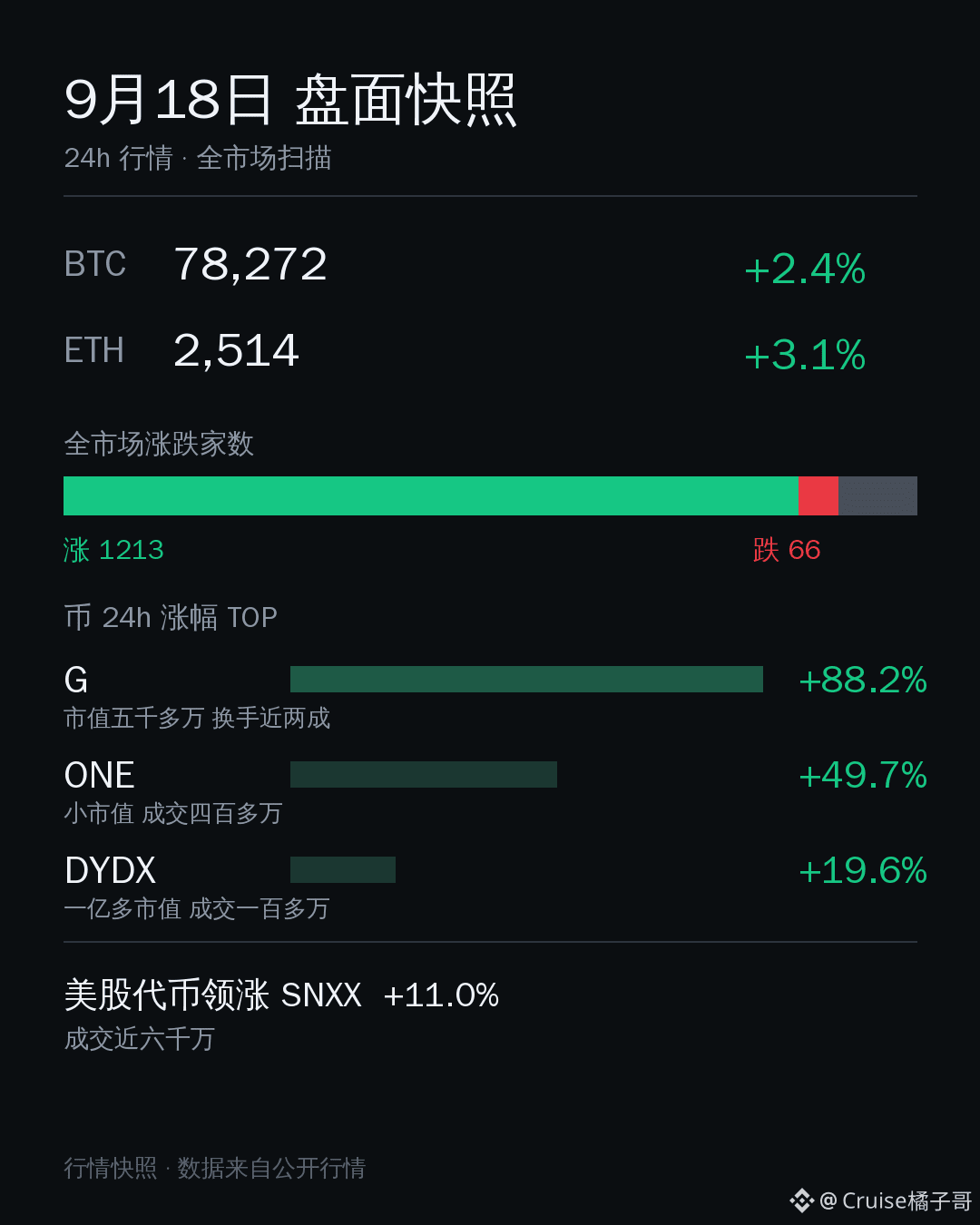
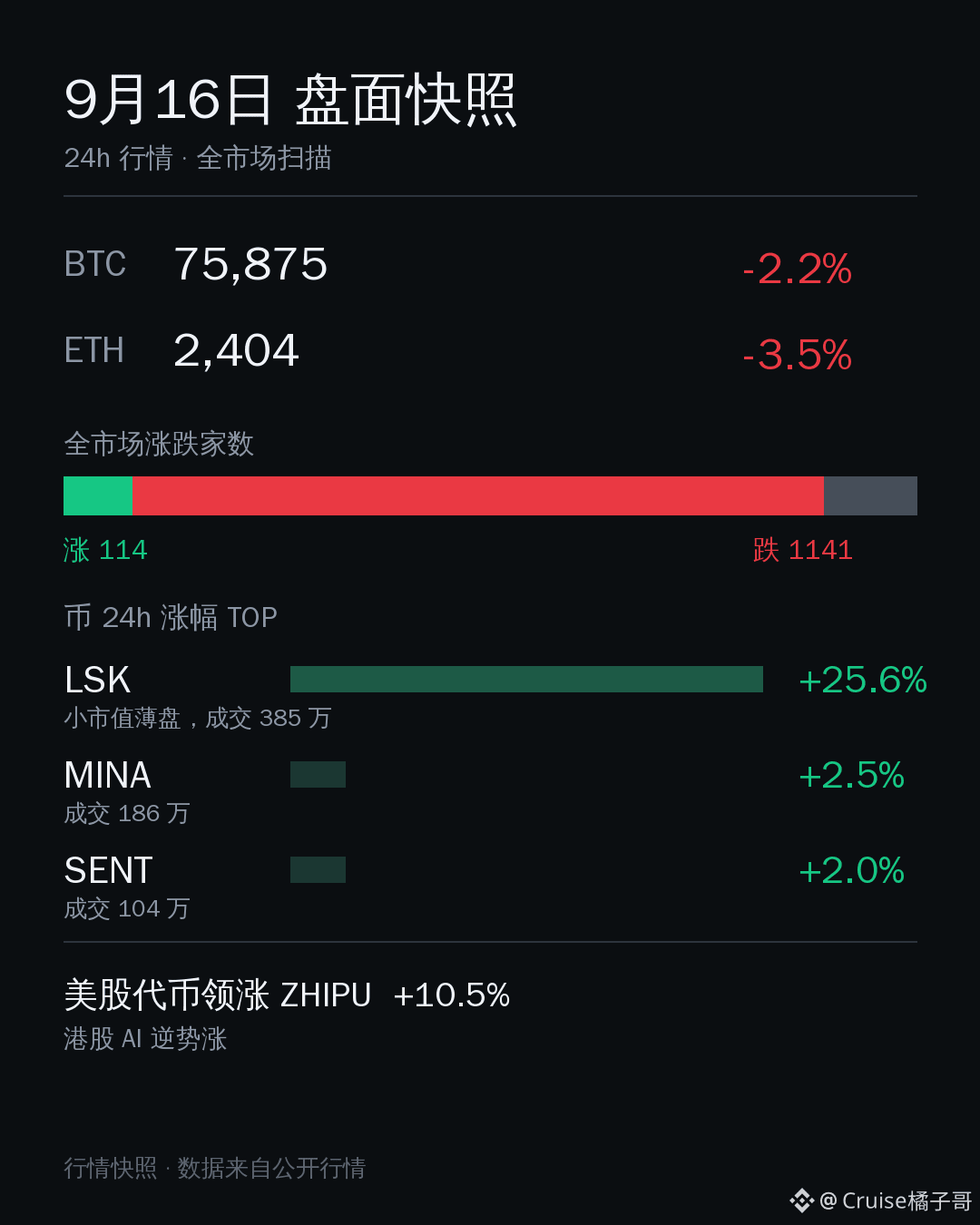
G up 88% in 24 hours, yet the market cap is only a bit over fifty million. Trading volume is over nine million—over the course of a day, roughly 20% of the float has already turned over.
The float is small, and the volatility depends entirely on money coming in and out. The orders on the book are so thin you can count them—when it’s rising you don’t feel it, but when you want to exit, there may not be someone to take it.
Right now it’s at the very top of the leaderboard. Whether this bit of volume can be sustained tonight is the key for this move.
G up 88% in 24 hours, yet the market cap is only a bit over fifty million. Trading volume is over nine million—over the course of a day, roughly 20% of the float has already turned over.
The float is small, and the volatility depends entirely on money coming in and out. The orders on the book are so thin you can count them—when it’s rising you don’t feel it, but when you want to exit, there may not be someone to take it.
Right now it’s at the very top of the leaderboard. Whether this bit of volume can be sustained tonight is the key for this move.
The float is small, and the volatility depends entirely on money coming in and out. The orders on the book are so thin you can count them—when it’s rising you don’t feel it, but when you want to exit, there may not be someone to take it.
Right now it’s at the very top of the leaderboard. Whether this bit of volume can be sustained tonight is the key for this move.
1
1k
·
--
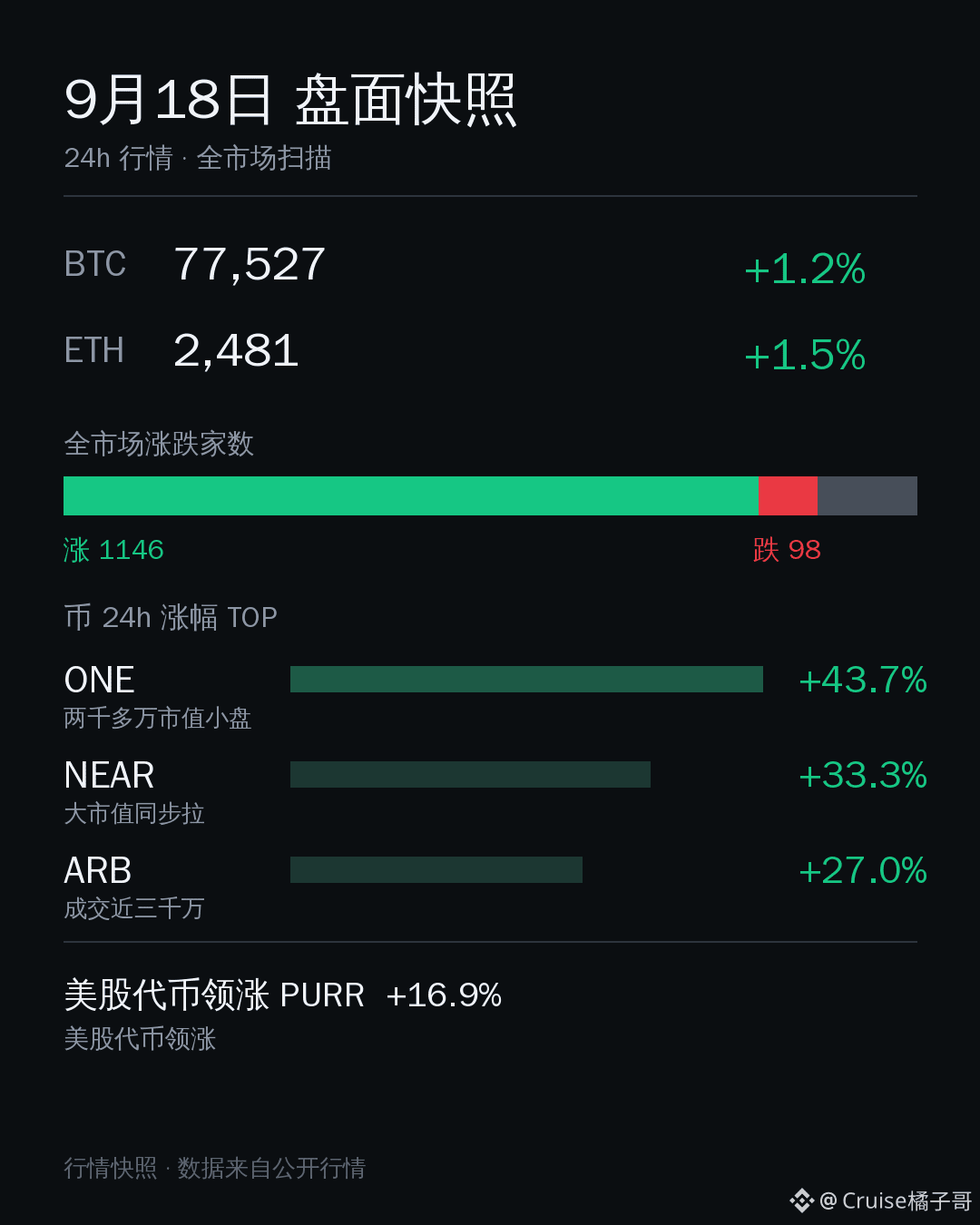
In the gain leaderboard, the most aggressive is still ARB—day one, it’s nearly $30 million thrown in, and it’s up 27 percentage points.
An L2 old coin with a market cap of $1.4 billion—normally you’d have to accumulate this volume over several days, but today it all gets released at once.
Is someone really buying in aggressively, or are they using the broader market bounce to give it a push and then leave—whether tomorrow’s volume can keep up is obvious at a glance.
In the gain leaderboard, the most aggressive is still ARB—day one, it’s nearly $30 million thrown in, and it’s up 27 percentage points.
An L2 old coin with a market cap of $1.4 billion—normally you’d have to accumulate this volume over several days, but today it all gets released at once.
Is someone really buying in aggressively, or are they using the broader market bounce to give it a push and then leave—whether tomorrow’s volume can keep up is obvious at a glance.
An L2 old coin with a market cap of $1.4 billion—normally you’d have to accumulate this volume over several days, but today it all gets released at once.
Is someone really buying in aggressively, or are they using the broader market bounce to give it a push and then leave—whether tomorrow’s volume can keep up is obvious at a glance.
543
·
--
Verified
The Federal Reserve’s first rate hike in three years, 25 basis points, with a hawkish tone to match. By conventional logic, risky assets should have fallen—but the next day the U.S. stock market surged across the board. The Nasdaq jumped 1.7%, and the chip stocks were the strongest: both Intel and AMD rose more than 6%. The day before they were dropping, and the next day they snapped back with a reversal—what a quick change of face.
The reason behind the rally was pinned on Jensen Huang. At an AI forum convened by the King of the United Kingdom, he said Nvidia’s chip shipments next year should reach double this year’s level. What’s limiting them right now is capacity, while demand is not lacking. On the same day, several other AI industry leaders were also calling for the pace to slow down—his take was that safety is safety, but shipments still continue. The market bought it.
Tonight, it’s also the “triple witching” day again—stock index futures, stock index options, and a batch of individual stock options are all expiring, and as usual the end-of-day action can be a bit erratic.
The Federal Reserve’s first rate hike in three years, 25 basis points, with a hawkish tone to match. By conventional logic, risky assets should have fallen—but the next day the U.S. stock market surged across the board. The Nasdaq jumped 1.7%, and the chip stocks were the strongest: both Intel and AMD rose more than 6%. The day before they were dropping, and the next day they snapped back with a reversal—what a quick change of face.
The reason behind the rally was pinned on Jensen Huang. At an AI forum convened by the King of the United Kingdom, he said Nvidia’s chip shipments next year should reach double this year’s level. What’s limiting them right now is capacity, while demand is not lacking. On the same day, several other AI industry leaders were also calling for the pace to slow down—his take was that safety is safety, but shipments still continue. The market bought it.
Tonight, it’s also the “triple witching” day again—stock index futures, stock index options, and a batch of individual stock options are all expiring, and as usual the end-of-day action can be a bit erratic.
The reason behind the rally was pinned on Jensen Huang. At an AI forum convened by the King of the United Kingdom, he said Nvidia’s chip shipments next year should reach double this year’s level. What’s limiting them right now is capacity, while demand is not lacking. On the same day, several other AI industry leaders were also calling for the pace to slow down—his take was that safety is safety, but shipments still continue. The market bought it.
Tonight, it’s also the “triple witching” day again—stock index futures, stock index options, and a batch of individual stock options are all expiring, and as usual the end-of-day action can be a bit erratic.
1k
·
--
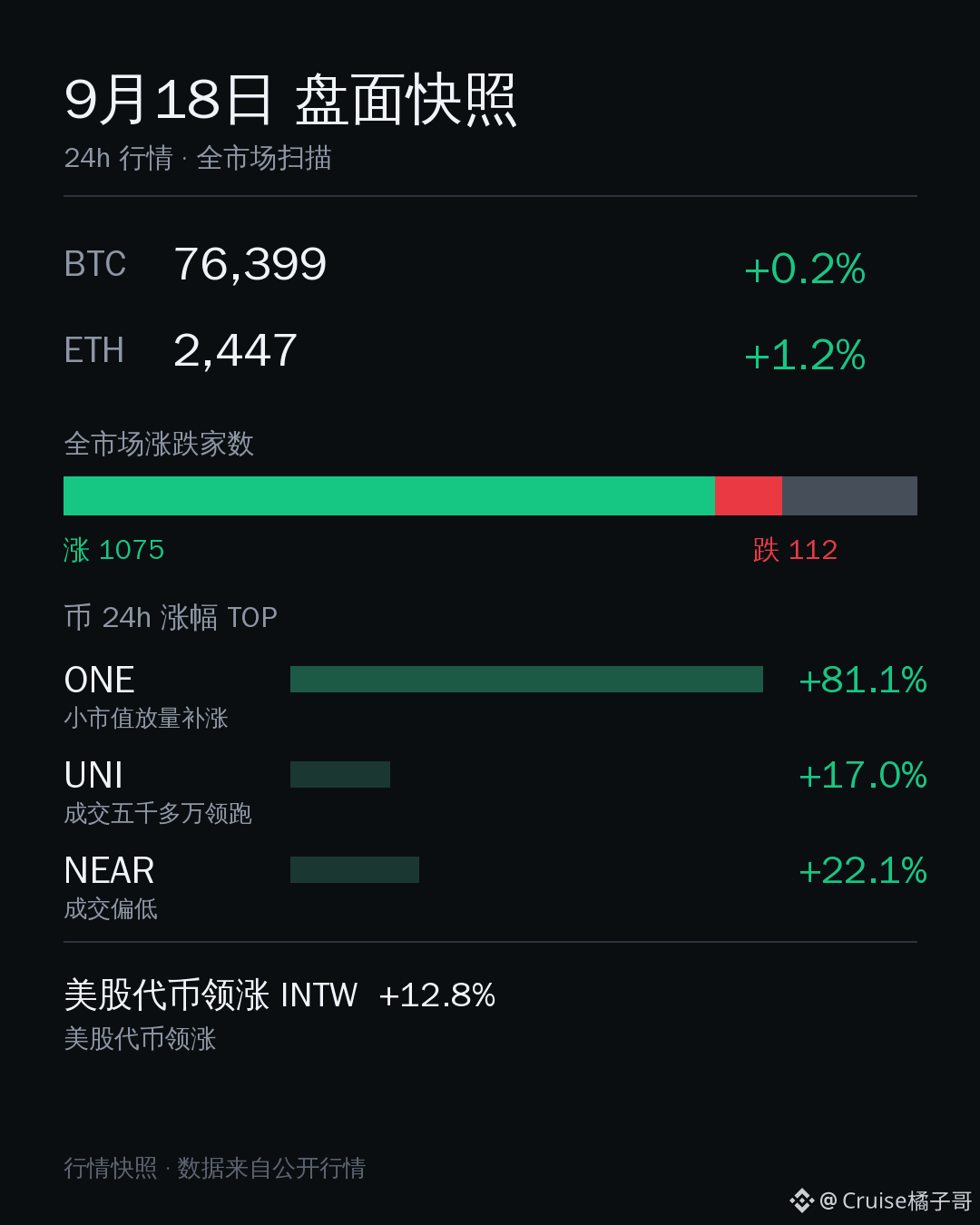
UNI rose 17% in a single day to 7.8, with trading volume of more than 50 million. On the volume leaderboard, the combined trading volumes of the remaining coins are still less than this.
With a blue-chip of this size, its usual daily volume is only a few million. Today, it suddenly expanded that much. I was stunned for a moment—my first reaction was to look for what’s behind it in the news. But in the public information, I didn’t see anything substantial. So that means it was purely driven by funds.
UNI rose 17% in a single day to 7.8, with trading volume of more than 50 million. On the volume leaderboard, the combined trading volumes of the remaining coins are still less than this.
With a blue-chip of this size, its usual daily volume is only a few million. Today, it suddenly expanded that much. I was stunned for a moment—my first reaction was to look for what’s behind it in the news. But in the public information, I didn’t see anything substantial. So that means it was purely driven by funds.
With a blue-chip of this size, its usual daily volume is only a few million. Today, it suddenly expanded that much. I was stunned for a moment—my first reaction was to look for what’s behind it in the news. But in the public information, I didn’t see anything substantial. So that means it was purely driven by funds.
1
1
3.2k
·
--
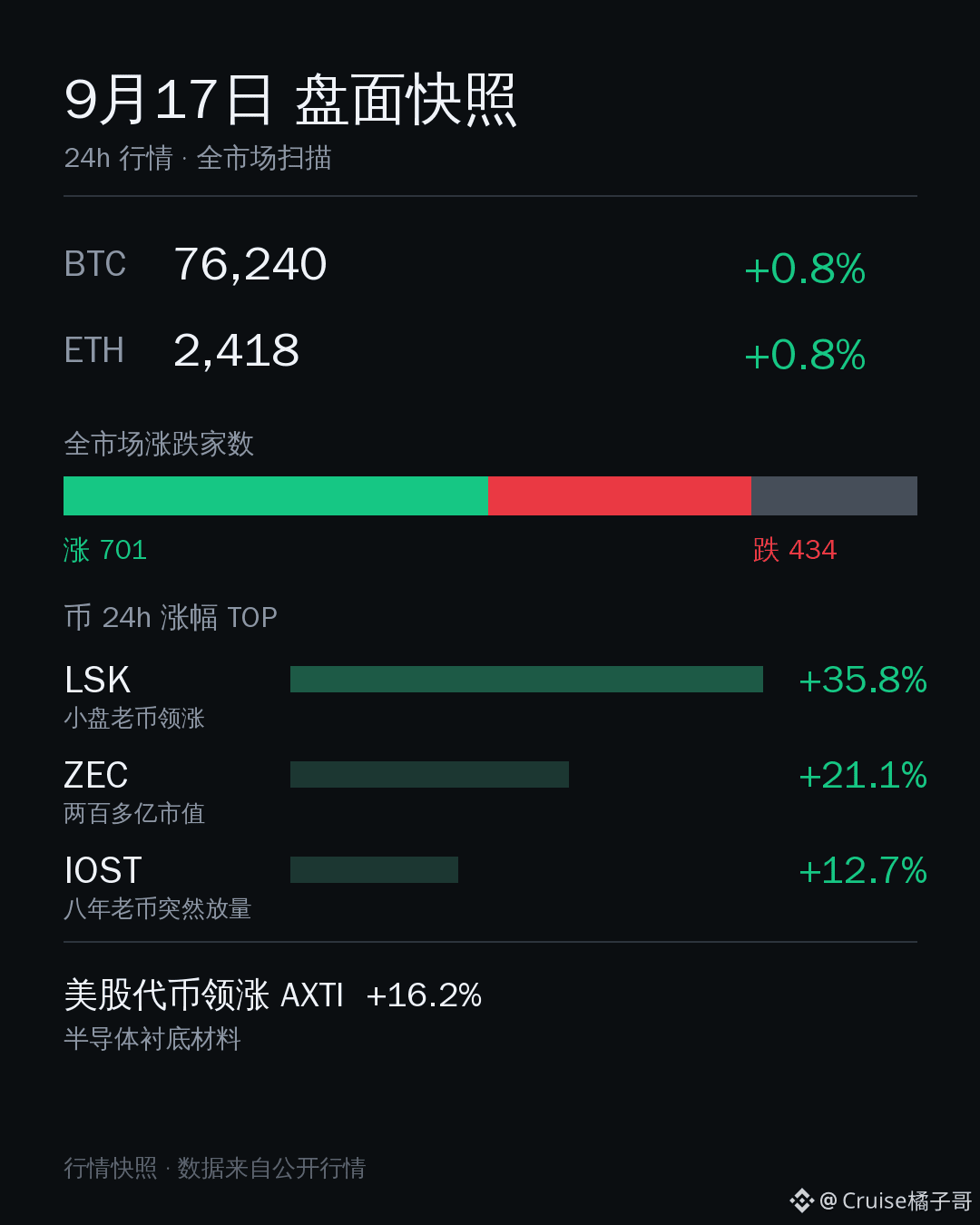
On Wednesday, U.S. stocks’ three major indexes all fell, and the Nasdaq was basically flat. On the AI optical communications theme, AXT surged against the trend, jumping 14%; the price went above $67, and in one night it成交 topped over $10 million.
AXT makes compound-semiconductor substrates—it's a materials supplier upstream for optical modules. There are only a few companies worldwide that can do this. Its leveraged ETF, at twice the leverage, rose more than 22% in a single day—this kind of rally was built up overnight. Last time it moved like this, it was pushed back down by about half at the open the next day. This time the volume is even stronger, and it still makes you feel a bit itchy to chase.
During the day, the optical module chain in China’s A-shares had just gotten hot for a round. At night, it continued to rally here—the chain is connected. By the time it squeezed into the top few spots on the gainers list, the price was already lifted. Whether to chase or not, the trading screen’s answer doesn’t come that quickly.
On Wednesday, U.S. stocks’ three major indexes all fell, and the Nasdaq was basically flat. On the AI optical communications theme, AXT surged against the trend, jumping 14%; the price went above $67, and in one night it成交 topped over $10 million.
AXT makes compound-semiconductor substrates—it's a materials supplier upstream for optical modules. There are only a few companies worldwide that can do this. Its leveraged ETF, at twice the leverage, rose more than 22% in a single day—this kind of rally was built up overnight. Last time it moved like this, it was pushed back down by about half at the open the next day. This time the volume is even stronger, and it still makes you feel a bit itchy to chase.
During the day, the optical module chain in China’s A-shares had just gotten hot for a round. At night, it continued to rally here—the chain is connected. By the time it squeezed into the top few spots on the gainers list, the price was already lifted. Whether to chase or not, the trading screen’s answer doesn’t come that quickly.
AXT makes compound-semiconductor substrates—it's a materials supplier upstream for optical modules. There are only a few companies worldwide that can do this. Its leveraged ETF, at twice the leverage, rose more than 22% in a single day—this kind of rally was built up overnight. Last time it moved like this, it was pushed back down by about half at the open the next day. This time the volume is even stronger, and it still makes you feel a bit itchy to chase.
During the day, the optical module chain in China’s A-shares had just gotten hot for a round. At night, it continued to rally here—the chain is connected. By the time it squeezed into the top few spots on the gainers list, the price was already lifted. Whether to chase or not, the trading screen’s answer doesn’t come that quickly.
1
261
·
--
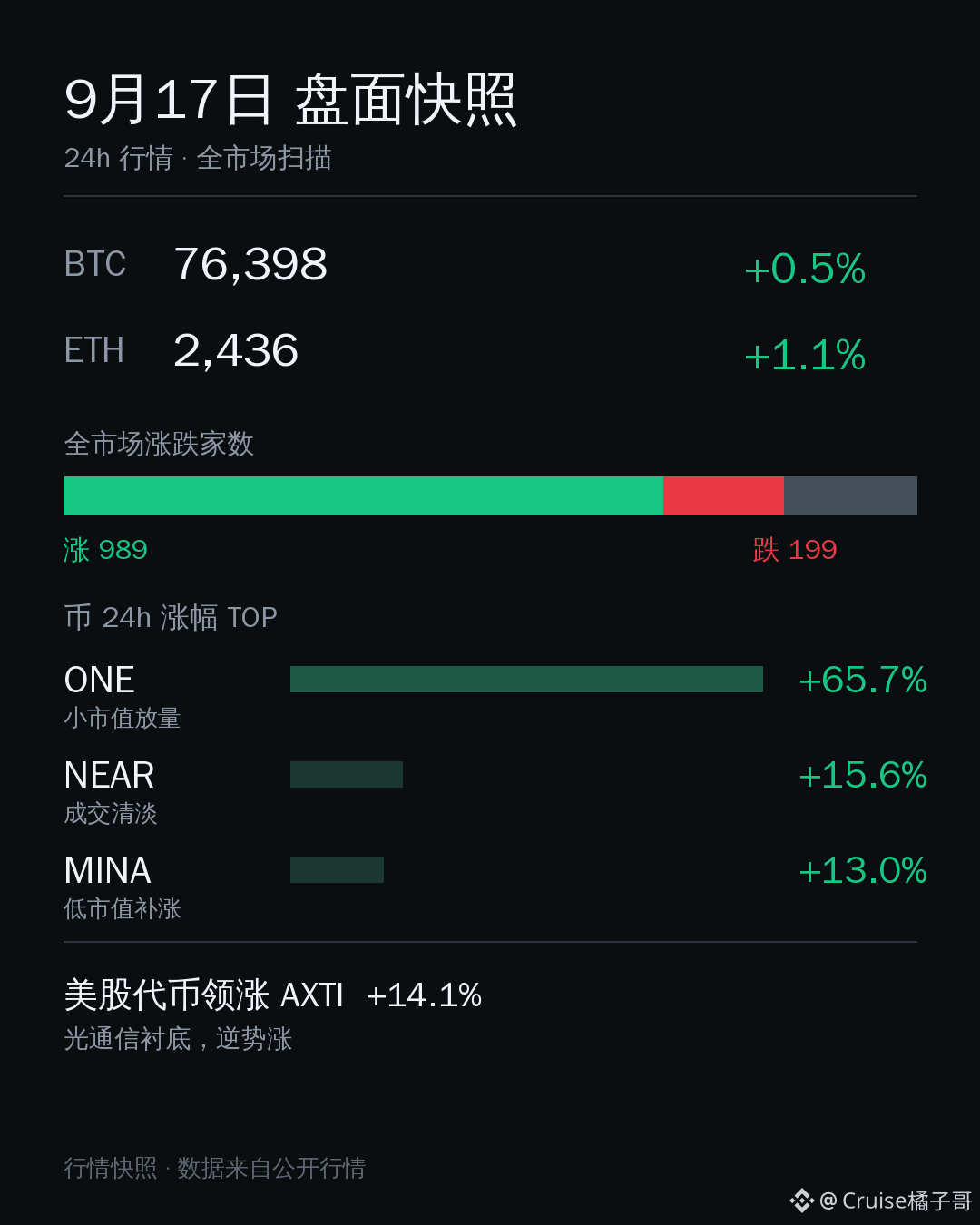
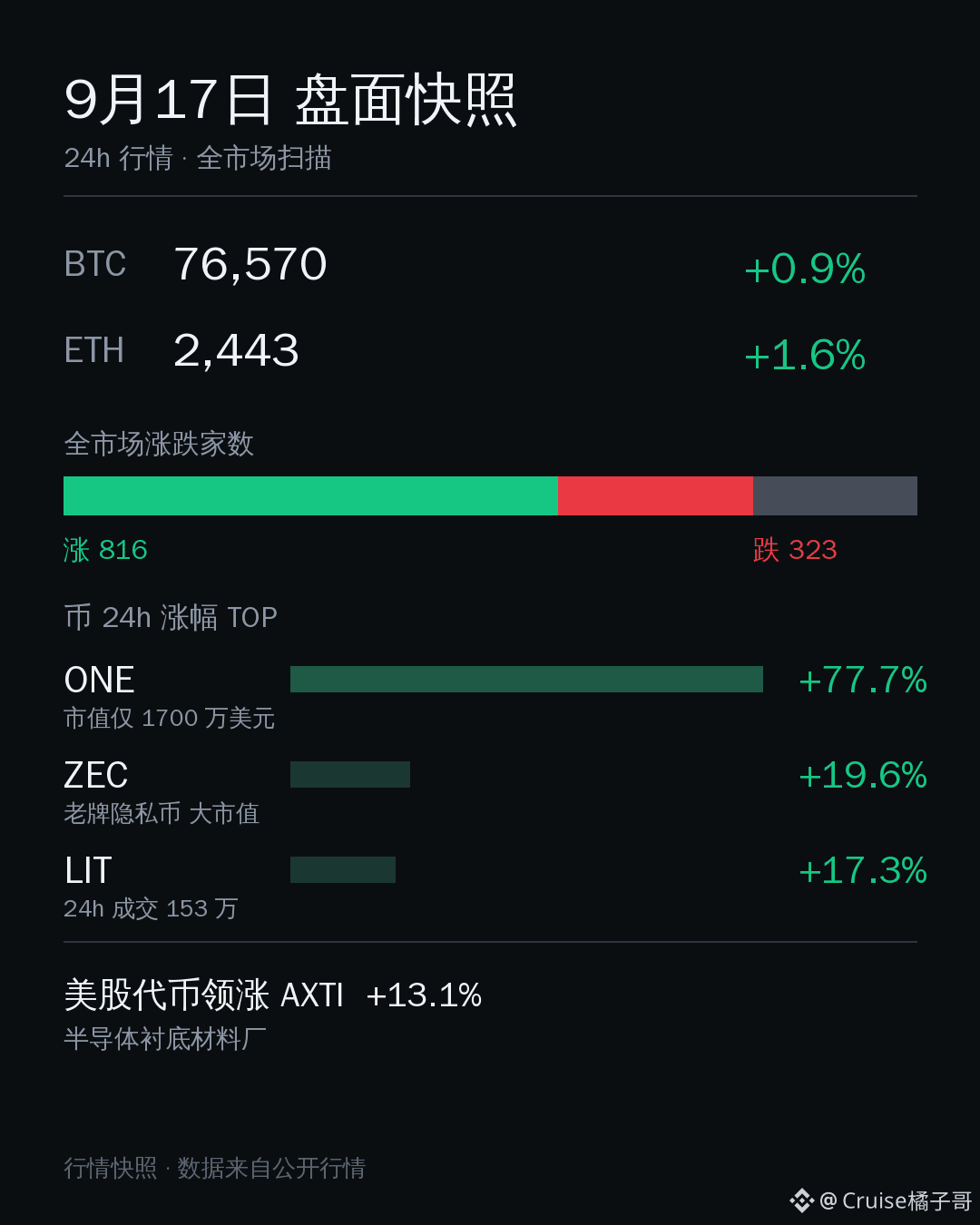
ONE One day surged 77%, and the quoted price is still in the range of one-thousandth of a US dollar. Market cap is $17 million. This size belongs to the smallest group on the gainers list—within 24 hours, it turned over more than 2.5 million in trades.
The order book is thin. One large order can jump a tick, and once you hit it, it falls tick by tick. I don’t dare touch small-cap “weird coins.” Once before, I chased after a rally and got buried—that incident is still fresh in my mind.
There’s a long string of zeros after the decimal point; if you’re thinking of a turnaround, you’d better take a hard look first.
ONE One day surged 77%, and the quoted price is still in the range of one-thousandth of a US dollar. Market cap is $17 million. This size belongs to the smallest group on the gainers list—within 24 hours, it turned over more than 2.5 million in trades.
The order book is thin. One large order can jump a tick, and once you hit it, it falls tick by tick. I don’t dare touch small-cap “weird coins.” Once before, I chased after a rally and got buried—that incident is still fresh in my mind.
There’s a long string of zeros after the decimal point; if you’re thinking of a turnaround, you’d better take a hard look first.
The order book is thin. One large order can jump a tick, and once you hit it, it falls tick by tick. I don’t dare touch small-cap “weird coins.” Once before, I chased after a rally and got buried—that incident is still fresh in my mind.
There’s a long string of zeros after the decimal point; if you’re thinking of a turnaround, you’d better take a hard look first.
1
811
·
--
Verified
The night the Fed raised rates, the biggest after-hours jump came from a backup power generator company. Amazon signed a long-term supply agreement with Generac to provide backup generator sets for its data centers. The first batch deliveries in 2027 and 2028 total $2.4 billion. Once the news broke, the stock surged more than 40% in after-hours trading.
What’s really interesting is how this deal was structured. Amazon didn’t negotiate a discount; instead, it took warrants. The exercise price was a little over $200, which was higher than the closing price before the news by a noticeable margin. The shares vest in batches according to the procurement payment schedule, with a total procurement cap of $8 billion tied to it. Buy more, get more shares—the supplier’s production expansion schedule is effectively linked to Amazon’s data center expansion. This kind of after-hours blowout is the most painful: any price you see during the daytime orders won’t get filled at all; if you chase it after the overnight gap-up open, how much of that “40% gain” is left is down to luck.
Delivery lead times for standby generator sets are already long. This batch is scheduled to be delivered through 2028. The real issue going forward will be whether they can deliver on time.
The night the Fed raised rates, the biggest after-hours jump came from a backup power generator company. Amazon signed a long-term supply agreement with Generac to provide backup generator sets for its data centers. The first batch deliveries in 2027 and 2028 total $2.4 billion. Once the news broke, the stock surged more than 40% in after-hours trading.
What’s really interesting is how this deal was structured. Amazon didn’t negotiate a discount; instead, it took warrants. The exercise price was a little over $200, which was higher than the closing price before the news by a noticeable margin. The shares vest in batches according to the procurement payment schedule, with a total procurement cap of $8 billion tied to it. Buy more, get more shares—the supplier’s production expansion schedule is effectively linked to Amazon’s data center expansion. This kind of after-hours blowout is the most painful: any price you see during the daytime orders won’t get filled at all; if you chase it after the overnight gap-up open, how much of that “40% gain” is left is down to luck.
Delivery lead times for standby generator sets are already long. This batch is scheduled to be delivered through 2028. The real issue going forward will be whether they can deliver on time.
What’s really interesting is how this deal was structured. Amazon didn’t negotiate a discount; instead, it took warrants. The exercise price was a little over $200, which was higher than the closing price before the news by a noticeable margin. The shares vest in batches according to the procurement payment schedule, with a total procurement cap of $8 billion tied to it. Buy more, get more shares—the supplier’s production expansion schedule is effectively linked to Amazon’s data center expansion. This kind of after-hours blowout is the most painful: any price you see during the daytime orders won’t get filled at all; if you chase it after the overnight gap-up open, how much of that “40% gain” is left is down to luck.
Delivery lead times for standby generator sets are already long. This batch is scheduled to be delivered through 2028. The real issue going forward will be whether they can deliver on time.
2
1
686
·
--
IOST, which came up in the 2018 wave of interest in the Nabo public chain, rose 13% in 24 hours. With a market cap in the tens-of-millions range, it’s a small-cap coin—about 2.1 million in daily trading volume. In recent years, I basically haven’t seen this name on the boards.
Small-cap old coins that catch up usually move in much the same way: the float is light, so even this amount of volume can lift the price by a large margin, and the order book depth can’t really withstand a big order being dumped on it. This kind of move has been buried on me several times over the past few years—I always hesitate when an old coin suddenly goes into action.
Whether it can be held tomorrow depends on whether there’s still someone to take the second baton with this volume.
IOST, which came up in the 2018 wave of interest in the Nabo public chain, rose 13% in 24 hours. With a market cap in the tens-of-millions range, it’s a small-cap coin—about 2.1 million in daily trading volume. In recent years, I basically haven’t seen this name on the boards.
Small-cap old coins that catch up usually move in much the same way: the float is light, so even this amount of volume can lift the price by a large margin, and the order book depth can’t really withstand a big order being dumped on it. This kind of move has been buried on me several times over the past few years—I always hesitate when an old coin suddenly goes into action.
Whether it can be held tomorrow depends on whether there’s still someone to take the second baton with this volume.
Small-cap old coins that catch up usually move in much the same way: the float is light, so even this amount of volume can lift the price by a large margin, and the order book depth can’t really withstand a big order being dumped on it. This kind of move has been buried on me several times over the past few years—I always hesitate when an old coin suddenly goes into action.
Whether it can be held tomorrow depends on whether there’s still someone to take the second baton with this volume.
542
·
--
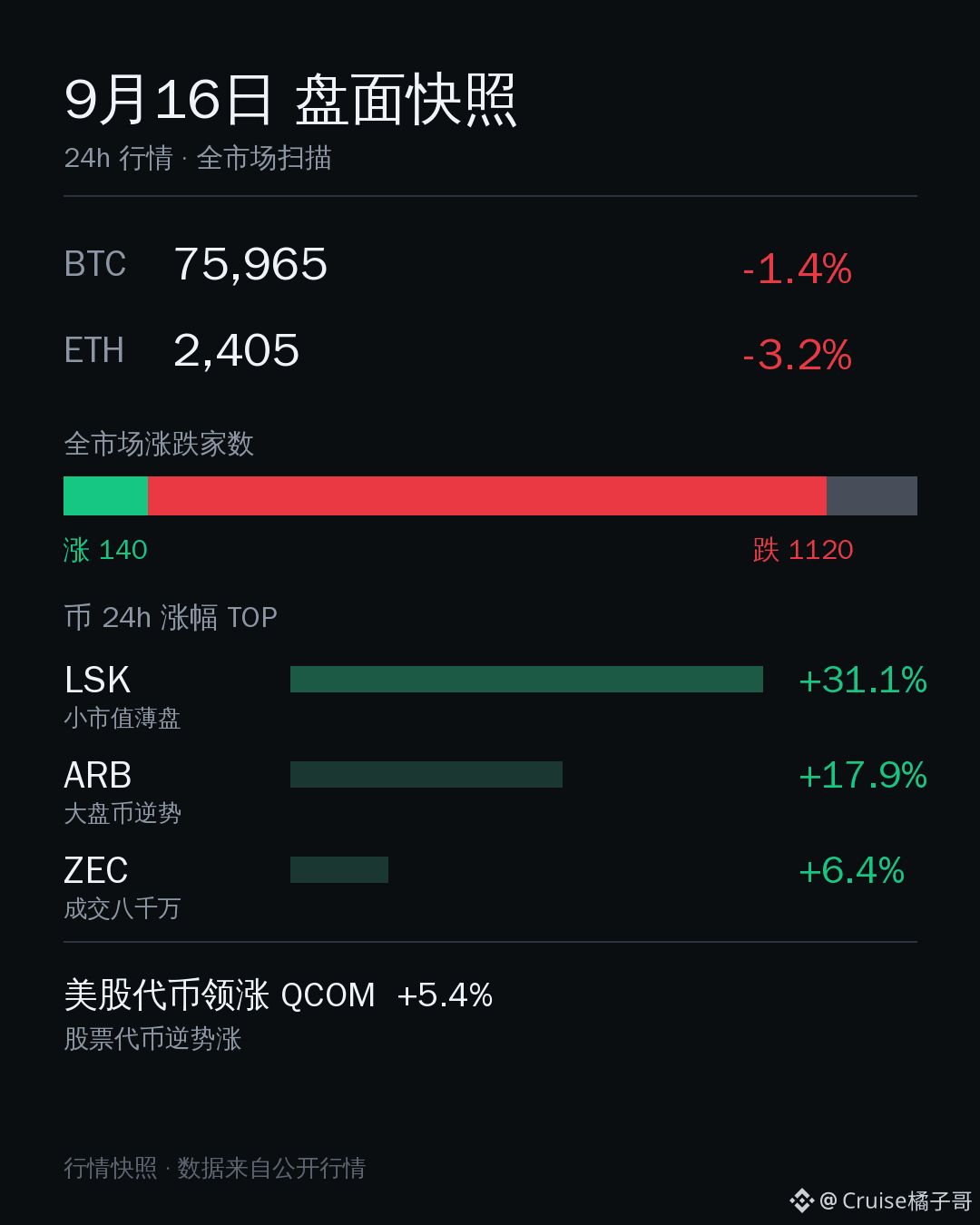
Only this one is green across the whole board. ZEC is up 6.4% over 24 hours; the price is now above 1,200, with trading volume of $80 million and a market cap around the 20 billion level.
For a market like that to push higher against the overall trend, there has to be big money behind it. Everything on the screen is falling, and it’s the only one pushing up. It’s easy to forget that the broader market is still dumping. The last time I chased a contrarian strong coin like this, the next day I got pinned to the ground. It’s still rising now, and its trading volume hasn’t shrunk.
Only this one is green across the whole board. ZEC is up 6.4% over 24 hours; the price is now above 1,200, with trading volume of $80 million and a market cap around the 20 billion level.
For a market like that to push higher against the overall trend, there has to be big money behind it. Everything on the screen is falling, and it’s the only one pushing up. It’s easy to forget that the broader market is still dumping. The last time I chased a contrarian strong coin like this, the next day I got pinned to the ground. It’s still rising now, and its trading volume hasn’t shrunk.
For a market like that to push higher against the overall trend, there has to be big money behind it. Everything on the screen is falling, and it’s the only one pushing up. It’s easy to forget that the broader market is still dumping. The last time I chased a contrarian strong coin like this, the next day I got pinned to the ground. It’s still rising now, and its trading volume hasn’t shrunk.
2k
·
--
Verified
In the crypto market, everything seems to be dropping, but that Zhipu token is up by 10%. It sees about 25 million in daily trading volume. Among stock tokens, it has the largest volume.
What’s moving is the Hong Kong stocks side. Yesterday, southbound capital net-bought Zhipu by more than HK$700 million. A few days ago, the company just announced a financing of about US$5 billion for its next-generation GLM model. Today, the company’s actual Hong Kong stock is also rising.
Between the token and the underlying stock, there’s a trading session gap, so the price increase here can’t be reflected in the order book in real time. We’ll have to wait for the market open to see whether the price difference is filled and how much it closes.
In the crypto market, everything seems to be dropping, but that Zhipu token is up by 10%. It sees about 25 million in daily trading volume. Among stock tokens, it has the largest volume.
What’s moving is the Hong Kong stocks side. Yesterday, southbound capital net-bought Zhipu by more than HK$700 million. A few days ago, the company just announced a financing of about US$5 billion for its next-generation GLM model. Today, the company’s actual Hong Kong stock is also rising.
Between the token and the underlying stock, there’s a trading session gap, so the price increase here can’t be reflected in the order book in real time. We’ll have to wait for the market open to see whether the price difference is filled and how much it closes.
What’s moving is the Hong Kong stocks side. Yesterday, southbound capital net-bought Zhipu by more than HK$700 million. A few days ago, the company just announced a financing of about US$5 billion for its next-generation GLM model. Today, the company’s actual Hong Kong stock is also rising.
Between the token and the underlying stock, there’s a trading session gap, so the price increase here can’t be reflected in the order book in real time. We’ll have to wait for the market open to see whether the price difference is filled and how much it closes.
604
·
--
Down 11 votes: the <清晰法案> failed to pass the Senate in a procedural vote, and the crypto sector collectively plunged. Coinbase closed down 10%, while Circle fell even harder. Bitcoin briefly slipped below $75,000 during the day, and in the past 24 hours, more than 100,000 people worldwide were liquidated.
The bill has been in the works for years. Its core is to clarify which tokens are treated as securities and which as commodities, and to also draw a line between the SEC and the CFTC over their respective responsibilities. Lobbying money was poured in heavily, but the end result was that all Democrats, along with a handful of Republicans, voted against it. The reasons also couldn’t avoid the issue of conflicts of interest tied to Trump’s own crypto business. The vote count seems somewhat unexpected—markets were pricing this in as the most meaningful regulatory progress this year.
The trouble is timing. Tonight the U.S. Federal Reserve will release its interest-rate decision. The market is betting on another rate hike. The yield on the 10-year U.S. Treasury just touched a nearly 20-year high, and oil prices are also still near a recent peak. Risk assets were already struggling to hold up, and the bill adds more pressure. Whether $75,000 can be defended will be decided tonight—watch the FOMC.
Down 11 votes: the <清晰法案> failed to pass the Senate in a procedural vote, and the crypto sector collectively plunged. Coinbase closed down 10%, while Circle fell even harder. Bitcoin briefly slipped below $75,000 during the day, and in the past 24 hours, more than 100,000 people worldwide were liquidated.
The bill has been in the works for years. Its core is to clarify which tokens are treated as securities and which as commodities, and to also draw a line between the SEC and the CFTC over their respective responsibilities. Lobbying money was poured in heavily, but the end result was that all Democrats, along with a handful of Republicans, voted against it. The reasons also couldn’t avoid the issue of conflicts of interest tied to Trump’s own crypto business. The vote count seems somewhat unexpected—markets were pricing this in as the most meaningful regulatory progress this year.
The trouble is timing. Tonight the U.S. Federal Reserve will release its interest-rate decision. The market is betting on another rate hike. The yield on the 10-year U.S. Treasury just touched a nearly 20-year high, and oil prices are also still near a recent peak. Risk assets were already struggling to hold up, and the bill adds more pressure. Whether $75,000 can be defended will be decided tonight—watch the FOMC.
The bill has been in the works for years. Its core is to clarify which tokens are treated as securities and which as commodities, and to also draw a line between the SEC and the CFTC over their respective responsibilities. Lobbying money was poured in heavily, but the end result was that all Democrats, along with a handful of Republicans, voted against it. The reasons also couldn’t avoid the issue of conflicts of interest tied to Trump’s own crypto business. The vote count seems somewhat unexpected—markets were pricing this in as the most meaningful regulatory progress this year.
The trouble is timing. Tonight the U.S. Federal Reserve will release its interest-rate decision. The market is betting on another rate hike. The yield on the 10-year U.S. Treasury just touched a nearly 20-year high, and oil prices are also still near a recent peak. Risk assets were already struggling to hold up, and the bill adds more pressure. Whether $75,000 can be defended will be decided tonight—watch the FOMC.
2
439
·
--
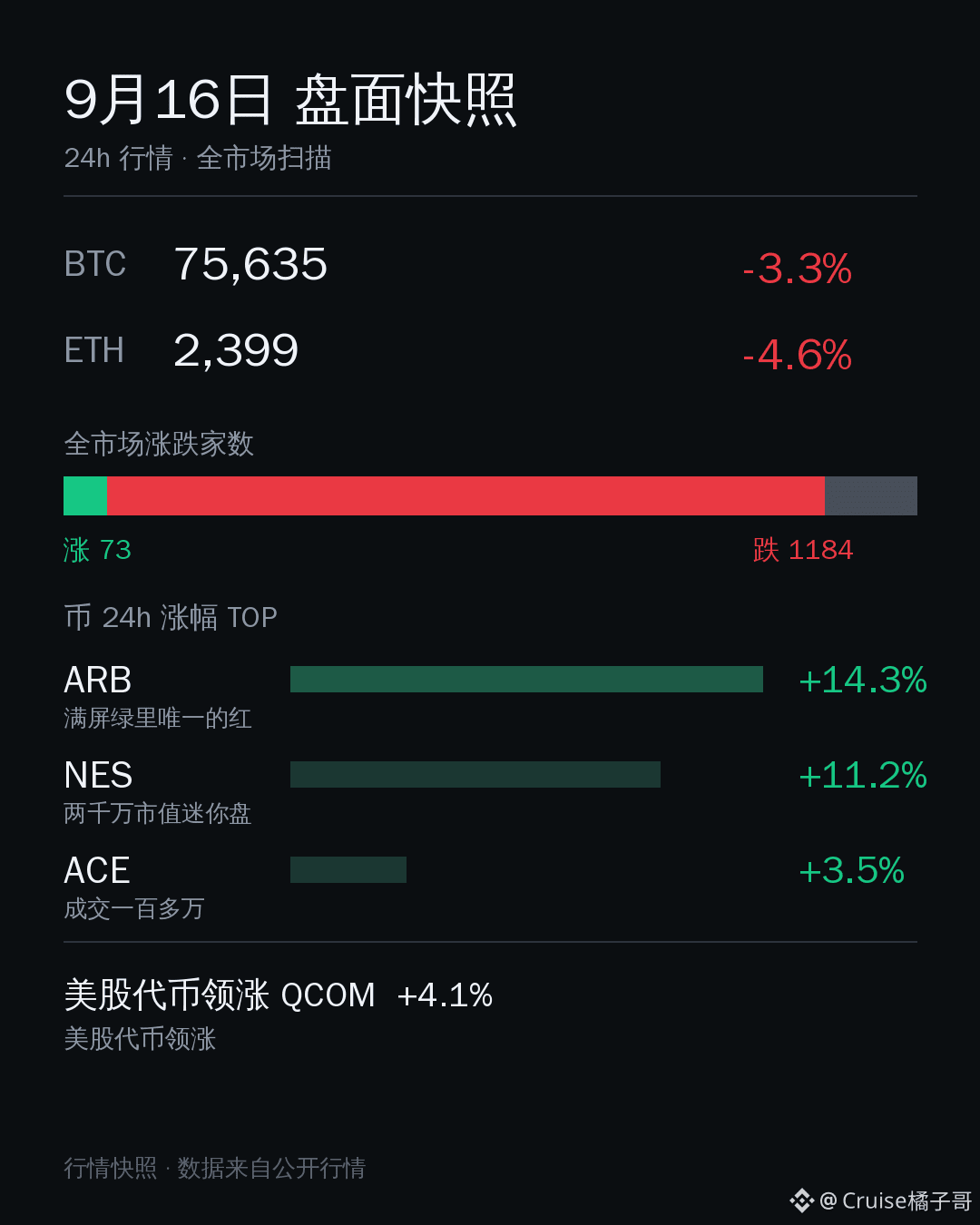
ARB is up 14%—the only big-cap in the whole market that still has room to keep climbing. It’s for Ethereum’s layer-2 scaling, while ETH itself is down by nearly 5% in a day; it does the opposite—normally these two basically move in the same direction.
It’s a bit confusing to look at. The entire screen is green; there aren’t many that flip back to red. ARB is the biggest by market cap among them—on the billion-dollar scale—while the rest are all small caps.
A lone red candle usually has a story behind it; it just depends on when the news comes to light.
ARB is up 14%—the only big-cap in the whole market that still has room to keep climbing. It’s for Ethereum’s layer-2 scaling, while ETH itself is down by nearly 5% in a day; it does the opposite—normally these two basically move in the same direction.
It’s a bit confusing to look at. The entire screen is green; there aren’t many that flip back to red. ARB is the biggest by market cap among them—on the billion-dollar scale—while the rest are all small caps.
A lone red candle usually has a story behind it; it just depends on when the news comes to light.
It’s a bit confusing to look at. The entire screen is green; there aren’t many that flip back to red. ARB is the biggest by market cap among them—on the billion-dollar scale—while the rest are all small caps.
A lone red candle usually has a story behind it; it just depends on when the news comes to light.
1.4k
·
--
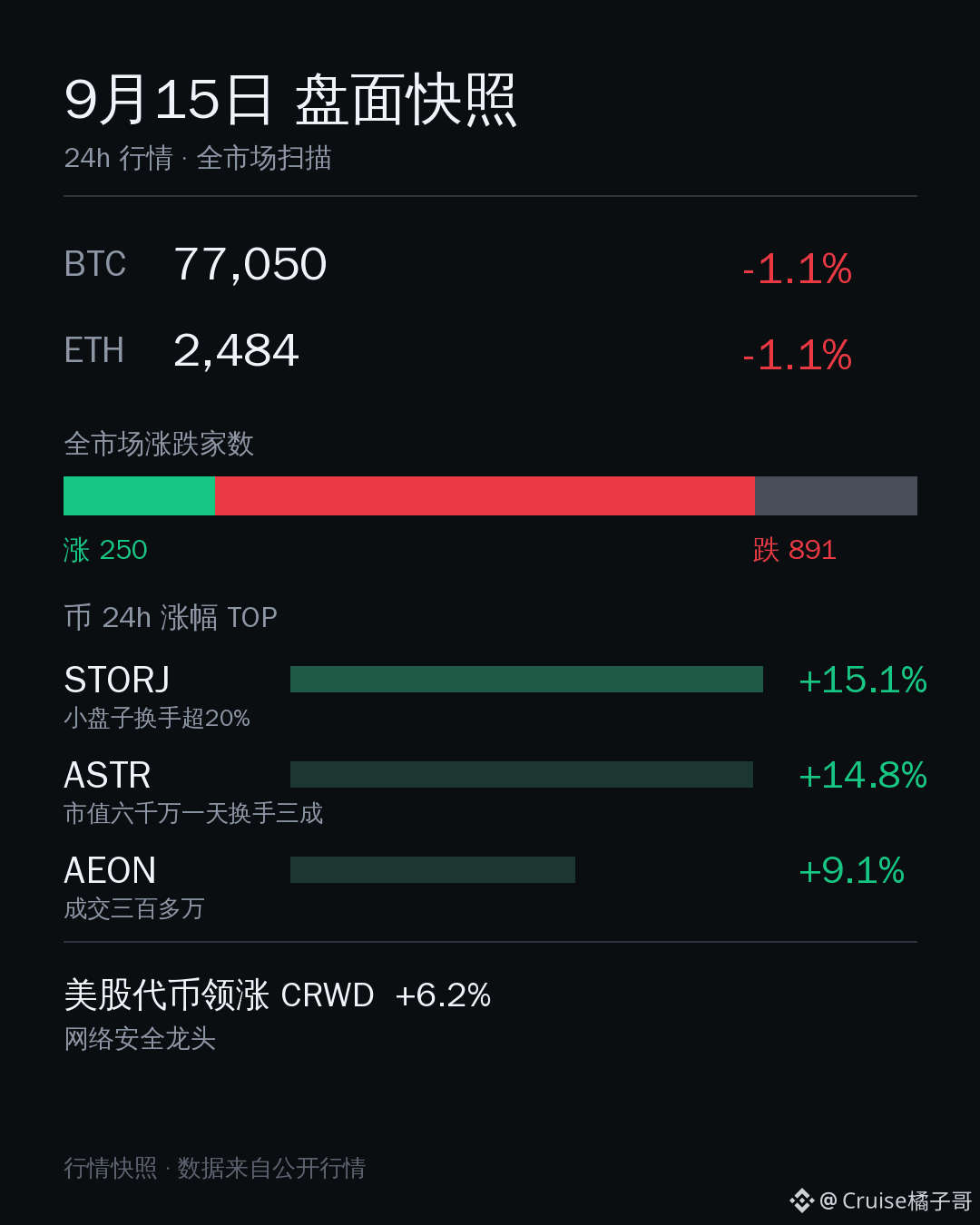
ASTR has risen 15% in 24 hours, and the price is still at less than a cent. With a market cap just over sixty million and a daily turnover of thirty percent, that turnover is pretty wild for a small-cap.
It’s the chain in the Polkadot ecosystem that’s building cross-chain and dApps. What’s most worrying when it pumps this hard is that the order book is too thin—so thin you can count the orders. One big order can push the price up several points. You might be able to get in, but you may not necessarily get out.
ASTR has risen 15% in 24 hours, and the price is still at less than a cent. With a market cap just over sixty million and a daily turnover of thirty percent, that turnover is pretty wild for a small-cap.
It’s the chain in the Polkadot ecosystem that’s building cross-chain and dApps. What’s most worrying when it pumps this hard is that the order book is too thin—so thin you can count the orders. One big order can push the price up several points. You might be able to get in, but you may not necessarily get out.
It’s the chain in the Polkadot ecosystem that’s building cross-chain and dApps. What’s most worrying when it pumps this hard is that the order book is too thin—so thin you can count the orders. One big order can push the price up several points. You might be able to get in, but you may not necessarily get out.
184
·
--
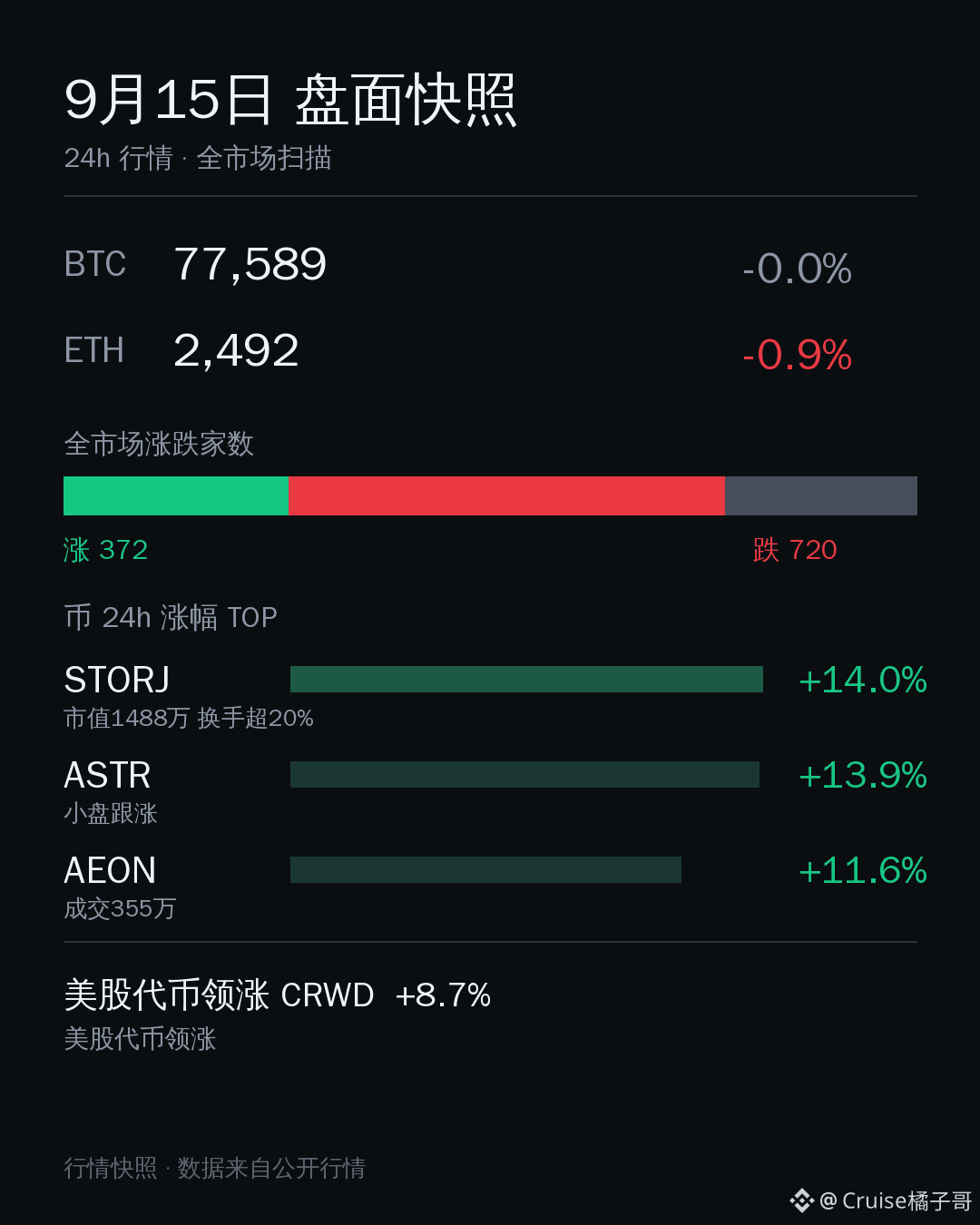
STORJ surges 14% in 24 hours; current price is 0.0348. In one day, trading volume hits $3.04 million, while the total market cap is only $14.88 million. Based on turnover, it’s over 20%—the circulating supply has basically been turned over about once.
For an old project doing decentralized cloud storage, it usually stays quiet. The sudden spike in volume likely means small capital is igniting and pushing it upward. The advantage of a shallow order book is that it can be pumped fast; the downside is that when it dumps, it drops just as quickly. I can’t hold a coin like this. A turnover of 20% means the money that entered today could turn around and fall tomorrow at any time. With a market cap of just $14.88 million, a few large orders can easily knock the price back to how it was.
STORJ surges 14% in 24 hours; current price is 0.0348. In one day, trading volume hits $3.04 million, while the total market cap is only $14.88 million. Based on turnover, it’s over 20%—the circulating supply has basically been turned over about once.
For an old project doing decentralized cloud storage, it usually stays quiet. The sudden spike in volume likely means small capital is igniting and pushing it upward. The advantage of a shallow order book is that it can be pumped fast; the downside is that when it dumps, it drops just as quickly. I can’t hold a coin like this. A turnover of 20% means the money that entered today could turn around and fall tomorrow at any time. With a market cap of just $14.88 million, a few large orders can easily knock the price back to how it was.
For an old project doing decentralized cloud storage, it usually stays quiet. The sudden spike in volume likely means small capital is igniting and pushing it upward. The advantage of a shallow order book is that it can be pumped fast; the downside is that when it dumps, it drops just as quickly. I can’t hold a coin like this. A turnover of 20% means the money that entered today could turn around and fall tomorrow at any time. With a market cap of just $14.88 million, a few large orders can easily knock the price back to how it was.
281
·
--
Philadelphia semiconductor index falls 5.86%, its largest drop since July 1. Nvidia closes at $210.96, down 3.36%. For those so-called cutting-edge model companies—some are talking about slowing down. Anthropic has also changed its data retention policy again. Nvidia and Palantir have both tightened the use of their flagship models. Along the same lines, expectations for AI compute spending have been downgraded by one tier.
On the other side of the market, someone was snatching up shares. CrowdStrike jumps 13.85% to close at $235.38, setting a new all-time closing high. Zscaler rises 16.5%, and the cybersecurity ETF also posts its biggest single-day gain in history. The market’s worries flipped—after being disrupted by AI for a whole year, the software security stocks that were hit hardest suddenly caught their breath. I stared at Zscaler’s big bullish candle for a long time and didn’t dare move. With the whole sector gapping up together, chasing in is easy to end up standing watch.
The yield on the 10-year U.S. Treasury touched 5% during the day. Oil prices move above $105. The CME’s September rate-hike probability prints 94.5%. Before the Fed speaks on Wednesday, this chip move—has it been continued liquidation, or will someone come back overnight to pick it up? Hard to say.
Philadelphia semiconductor index falls 5.86%, its largest drop since July 1. Nvidia closes at $210.96, down 3.36%. For those so-called cutting-edge model companies—some are talking about slowing down. Anthropic has also changed its data retention policy again. Nvidia and Palantir have both tightened the use of their flagship models. Along the same lines, expectations for AI compute spending have been downgraded by one tier.
On the other side of the market, someone was snatching up shares. CrowdStrike jumps 13.85% to close at $235.38, setting a new all-time closing high. Zscaler rises 16.5%, and the cybersecurity ETF also posts its biggest single-day gain in history. The market’s worries flipped—after being disrupted by AI for a whole year, the software security stocks that were hit hardest suddenly caught their breath. I stared at Zscaler’s big bullish candle for a long time and didn’t dare move. With the whole sector gapping up together, chasing in is easy to end up standing watch.
The yield on the 10-year U.S. Treasury touched 5% during the day. Oil prices move above $105. The CME’s September rate-hike probability prints 94.5%. Before the Fed speaks on Wednesday, this chip move—has it been continued liquidation, or will someone come back overnight to pick it up? Hard to say.
On the other side of the market, someone was snatching up shares. CrowdStrike jumps 13.85% to close at $235.38, setting a new all-time closing high. Zscaler rises 16.5%, and the cybersecurity ETF also posts its biggest single-day gain in history. The market’s worries flipped—after being disrupted by AI for a whole year, the software security stocks that were hit hardest suddenly caught their breath. I stared at Zscaler’s big bullish candle for a long time and didn’t dare move. With the whole sector gapping up together, chasing in is easy to end up standing watch.
The yield on the 10-year U.S. Treasury touched 5% during the day. Oil prices move above $105. The CME’s September rate-hike probability prints 94.5%. Before the Fed speaks on Wednesday, this chip move—has it been continued liquidation, or will someone come back overnight to pick it up? Hard to say.
147
·
--
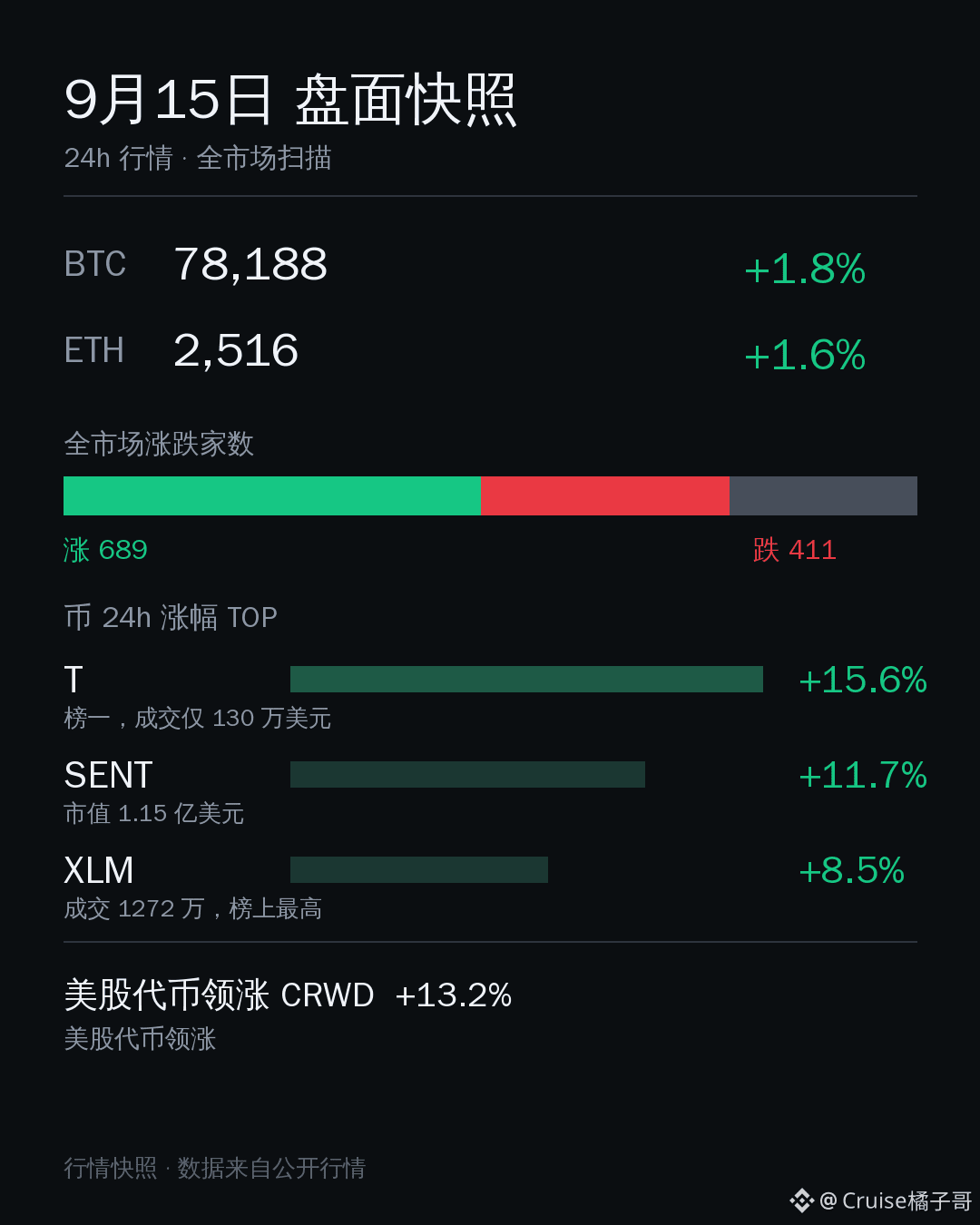
XLM rises 8.5% in 24 hours, with the price just over 0.19 and a market cap of about six to seven billion USD. On the gainers list, the 8.5% increase isn’t the most eye-catching, but its trading volume of over 12 million USD is the highest on the list—nearly ten times more than first-place T.
A coin with a market cap of sixty to seventy billion needs real money to push it like that. It doesn’t feel like small coins that can produce a double-digit surge with just a few million USD. With this kind of volume, I’m willing to look twice.
I’ve taken losses like this too. In the last cycle, I chased a small “妖币” that was pumping a few million in trading volume and topping the list—and the very next day it got trapped in the dump, and I was forced to cut out. Now when I look at the rankings, I check the trading volume column first, then how much it rose. More than 12 million USD piled into the 0.19 range contains more information than the rank itself.
XLM rises 8.5% in 24 hours, with the price just over 0.19 and a market cap of about six to seven billion USD. On the gainers list, the 8.5% increase isn’t the most eye-catching, but its trading volume of over 12 million USD is the highest on the list—nearly ten times more than first-place T.
A coin with a market cap of sixty to seventy billion needs real money to push it like that. It doesn’t feel like small coins that can produce a double-digit surge with just a few million USD. With this kind of volume, I’m willing to look twice.
I’ve taken losses like this too. In the last cycle, I chased a small “妖币” that was pumping a few million in trading volume and topping the list—and the very next day it got trapped in the dump, and I was forced to cut out. Now when I look at the rankings, I check the trading volume column first, then how much it rose. More than 12 million USD piled into the 0.19 range contains more information than the rank itself.
A coin with a market cap of sixty to seventy billion needs real money to push it like that. It doesn’t feel like small coins that can produce a double-digit surge with just a few million USD. With this kind of volume, I’m willing to look twice.
I’ve taken losses like this too. In the last cycle, I chased a small “妖币” that was pumping a few million in trading volume and topping the list—and the very next day it got trapped in the dump, and I was forced to cut out. Now when I look at the rankings, I check the trading volume column first, then how much it rose. More than 12 million USD piled into the 0.19 range contains more information than the rank itself.
1
2.6k
·
--
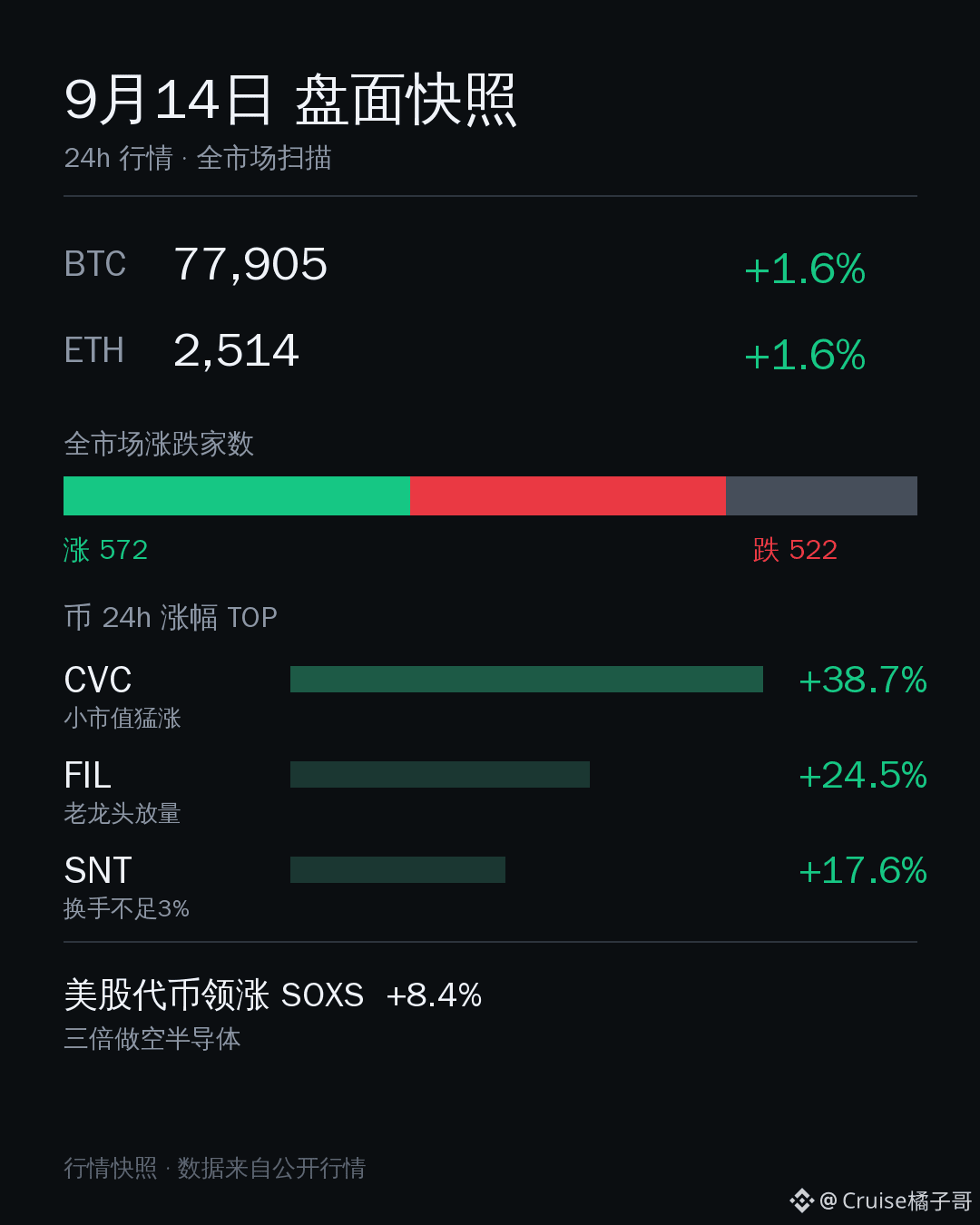
Turnover is less than 3%. SNT is up 17.6%. The price is $0.0086. Market cap is $41.7 million. Total trading volume for the day is only $1.17 million. This kind of small-cap gets pulled up so much, but the volume simply hasn’t kept up. I’ve seen this kind of move a few times—it surges quickly, then it drops even faster. With only a few orders stacked on top, it can punch right through. The order book is so thin that the gain shown on the board and the gains you can actually get your hands on aren’t the same thing.
Turnover is less than 3%. SNT is up 17.6%. The price is $0.0086. Market cap is $41.7 million. Total trading volume for the day is only $1.17 million. This kind of small-cap gets pulled up so much, but the volume simply hasn’t kept up. I’ve seen this kind of move a few times—it surges quickly, then it drops even faster. With only a few orders stacked on top, it can punch right through. The order book is so thin that the gain shown on the board and the gains you can actually get your hands on aren’t the same thing.
251
·
--
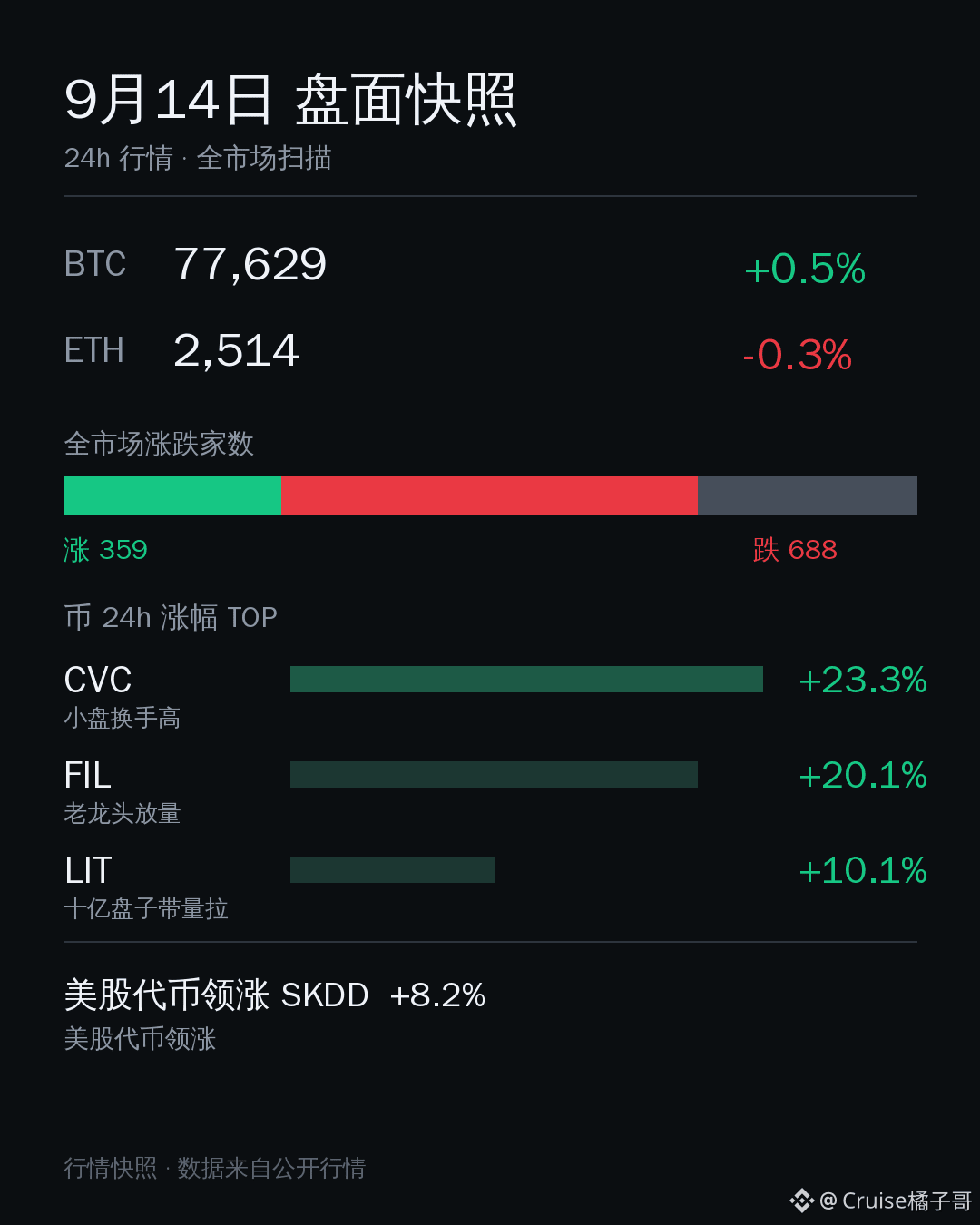
LIT is up 10.1% over 24 hours; the price is $4.61, with trading volume of $10.24 million and a market cap of $1.15 billion. Looking at these figures on the gainers list, they seem a bit out of place. Most on the list are small-cap stocks with market caps in the tens of millions, trading volumes in the millions—yet they’re pumped hard, and as soon as you sell, the price slides. LIT is one of the few coins I came across today with a market cap in the billions that can still rise by more than a dozen percentage points with volume. The last time I chased a small-cap “monster” coin, it spiked impressively during the day—once I got in, the order book got slammed and I was immediately cut in half. Since then, when looking at the gainers list, I’ve prioritized trading volume first. With this kind of size, even if someone wants to exit, it shouldn’t be able to smash through the chart with a single line.
LIT is up 10.1% over 24 hours; the price is $4.61, with trading volume of $10.24 million and a market cap of $1.15 billion. Looking at these figures on the gainers list, they seem a bit out of place. Most on the list are small-cap stocks with market caps in the tens of millions, trading volumes in the millions—yet they’re pumped hard, and as soon as you sell, the price slides. LIT is one of the few coins I came across today with a market cap in the billions that can still rise by more than a dozen percentage points with volume. The last time I chased a small-cap “monster” coin, it spiked impressively during the day—once I got in, the order book got slammed and I was immediately cut in half. Since then, when looking at the gainers list, I’ve prioritized trading volume first. With this kind of size, even if someone wants to exit, it shouldn’t be able to smash through the chart with a single line.
351
·
--
This morning, the Korean and Japanese stock markets opened lower across the board. In South Korea, the KOSPI composite index opened down more than 3%; Japan’s Nikkei 225 widened its decline from being down 0.55% at the open to as much as down 2%; and SoftBank Group fell 10% in the early session. The spark was a long post that Anthropic CEO Dario Amodei wrote on Saturday. He urged the industry to slow down the pace of capabilities improvement for frontier models. Musk then replied with a line saying Ray Dalio was right, and Altman also said he agreed.
The funny part is that the same group is both calling for “slowing down” and stepping on the gas. Anthropic plans to list on Nasdaq in October, aiming to raise up to $100 billion, valuing it at around $2 trillion. Nvidia is already in talks about investing up to $10 billion. On Altman’s side, he said that OpenAI will not go public this year and will first focus on solving safety issues.
Trump’s stance was even more straightforward: whoever wins the AI race wins the world—fences and guardrails can wait.
I really can’t make sense of this kind of market action. A few bosses are all shouting “slow down,” yet what gets hit first at the open is semiconductors and storage—the very area where the $10 billion or $10 billion-plus investment is still something they have to pay. SoftBank’s 10% drop is still just the early-session number; the Nikkei’s decline is still widening. When the U.S. stock market opens tonight, how the AI supply chain will connect is when the truth will be seen.
This morning, the Korean and Japanese stock markets opened lower across the board. In South Korea, the KOSPI composite index opened down more than 3%; Japan’s Nikkei 225 widened its decline from being down 0.55% at the open to as much as down 2%; and SoftBank Group fell 10% in the early session. The spark was a long post that Anthropic CEO Dario Amodei wrote on Saturday. He urged the industry to slow down the pace of capabilities improvement for frontier models. Musk then replied with a line saying Ray Dalio was right, and Altman also said he agreed.
The funny part is that the same group is both calling for “slowing down” and stepping on the gas. Anthropic plans to list on Nasdaq in October, aiming to raise up to $100 billion, valuing it at around $2 trillion. Nvidia is already in talks about investing up to $10 billion. On Altman’s side, he said that OpenAI will not go public this year and will first focus on solving safety issues.
Trump’s stance was even more straightforward: whoever wins the AI race wins the world—fences and guardrails can wait.
I really can’t make sense of this kind of market action. A few bosses are all shouting “slow down,” yet what gets hit first at the open is semiconductors and storage—the very area where the $10 billion or $10 billion-plus investment is still something they have to pay. SoftBank’s 10% drop is still just the early-session number; the Nikkei’s decline is still widening. When the U.S. stock market opens tonight, how the AI supply chain will connect is when the truth will be seen.
The funny part is that the same group is both calling for “slowing down” and stepping on the gas. Anthropic plans to list on Nasdaq in October, aiming to raise up to $100 billion, valuing it at around $2 trillion. Nvidia is already in talks about investing up to $10 billion. On Altman’s side, he said that OpenAI will not go public this year and will first focus on solving safety issues.
Trump’s stance was even more straightforward: whoever wins the AI race wins the world—fences and guardrails can wait.
I really can’t make sense of this kind of market action. A few bosses are all shouting “slow down,” yet what gets hit first at the open is semiconductors and storage—the very area where the $10 billion or $10 billion-plus investment is still something they have to pay. SoftBank’s 10% drop is still just the early-session number; the Nikkei’s decline is still widening. When the U.S. stock market opens tonight, how the AI supply chain will connect is when the truth will be seen.
94
Log in to explore more content
Join global crypto users on Binance Square
⚡️ Get latest and useful information about crypto.
💬 Trusted by the world’s largest crypto exchange.
👍 Discover real insights from verified creators.
Email / Phone number
Trending Topics
BTCBreaks80K
87,341 views
1,589 Discussing
$BTC
What price is BTC going to hit in 2026?
Spot is sitting at $80,748. 104 days to go
↑ $90k - 58%
↑ $100k - 24%
↓ $70k dip first - 48%
The bull case floating around the floor:
>August had a proper run from $62,275 up to $81,479 — up 31% bottom to top
>The CLARITY Act flopped its Senate cloture vote 49-50 on 15 Sept. BTC was already sliding well before the vote, touched $74,968 in that hour, and won it all back inside three days
>The Fed hiked rates on 16 Sept — first time since July 2023. Spot is currently floating 7.4% above that day's low
>The altcoins are proper outrunning it. 30-day view: SOL up 38%, XRP up 35%, ETH up 32% versus BTC up 23%
>The timeline is still packed with reasons why this ought to break down — and that’s precisely the wall of worry bull markets tend to climb
>The midterms land on 3 Nov, right smack in the middle of this market window
So, what would you put down for a punt at +24% in 104 days?
$ETH
$SOL
#BTCBreaks80K #solonapumping #ETH🔥🔥🔥🔥🔥🔥 #BullMarket📈
Wealthy bloke
·5 Likes
·4.9k views
BuffettBecomesBerkshireChairmanEmeritus
22,423 views
552 Discussing
ZcashSpotETFTops$230MMonthlyInflow
5,791 views
82 Discussing