
ISMAIL Crypto 加油
1.7k Posts

ISMAIL Crypto 加油
Report
Block User
Crypto enthusiast 📈 Learning, analyzing, improving every day.💖
High-Frequency Trader
1.4 Years
207 Following
10.3K+ Followers
1.3K+ Liked
Posts
All
Quotes
Videos
Live
$DEBIT New but very strong coin 🪙👇👇
$DEBIT New but very strong coin 🪙👇👇
368
#fedratewatch
#FedRateWatch — Is This the Start of a New Hiking Cycle?
The September FOMC meeting (Sept 15-16) has flipped from "will they cut" to "will they hike" in just a few weeks. August core CPI came in hot, and CME FedWatch now prices roughly 90% odds of a 25bp hike to 3.75%-4.00% — the first hike since 2023. Fed Chair Warsh's hawkish Jackson Hole tone, sticky inflation, and Iran-driven energy costs pushed the bar down for action. I don't see this as one-and-done — Barclays and BNP Paribas are already penciling in follow-through hikes into December and beyond, so the dot plot released alongside this decision matters as much as the headline move.
Market impact: BTC has been resilient near $80K on strong ETF inflows, but it's more liquidity-sensitive than gold — a hawkish surprise could hit it harder short-term, though some argue the hike is more about anchoring yields than real tightening, which could limit downside. Gold faces headwind from higher real yields but geopolitical demand cushions it. Tech stocks are the most rate-sensitive of the three, given valuation compression risk.
My plan: trimming leverage into the decision, keeping core BTC spot position, and watching the dot plot for December signal before adding back risk.
#FedRateWatch #FOMC #BTC
#fedratewatch
#FedRateWatch — Is This the Start of a New Hiking Cycle?
The September FOMC meeting (Sept 15-16) has flipped from "will they cut" to "will they hike" in just a few weeks. August core CPI came in hot, and CME FedWatch now prices roughly 90% odds of a 25bp hike to 3.75%-4.00% — the first hike since 2023. Fed Chair Warsh's hawkish Jackson Hole tone, sticky inflation, and Iran-driven energy costs pushed the bar down for action. I don't see this as one-and-done — Barclays and BNP Paribas are already penciling in follow-through hikes into December and beyond, so the dot plot released alongside this decision matters as much as the headline move.
Market impact: BTC has been resilient near $80K on strong ETF inflows, but it's more liquidity-sensitive than gold — a hawkish surprise could hit it harder short-term, though some argue the hike is more about anchoring yields than real tightening, which could limit downside. Gold faces headwind from higher real yields but geopolitical demand cushions it. Tech stocks are the most rate-sensitive of the three, given valuation compression risk.
My plan: trimming leverage into the decision, keeping core BTC spot position, and watching the dot plot for December signal before adding back risk.
#FedRateWatch #FOMC #BTC
#FedRateWatch — Is This the Start of a New Hiking Cycle?
The September FOMC meeting (Sept 15-16) has flipped from "will they cut" to "will they hike" in just a few weeks. August core CPI came in hot, and CME FedWatch now prices roughly 90% odds of a 25bp hike to 3.75%-4.00% — the first hike since 2023. Fed Chair Warsh's hawkish Jackson Hole tone, sticky inflation, and Iran-driven energy costs pushed the bar down for action. I don't see this as one-and-done — Barclays and BNP Paribas are already penciling in follow-through hikes into December and beyond, so the dot plot released alongside this decision matters as much as the headline move.
Market impact: BTC has been resilient near $80K on strong ETF inflows, but it's more liquidity-sensitive than gold — a hawkish surprise could hit it harder short-term, though some argue the hike is more about anchoring yields than real tightening, which could limit downside. Gold faces headwind from higher real yields but geopolitical demand cushions it. Tech stocks are the most rate-sensitive of the three, given valuation compression risk.
My plan: trimming leverage into the decision, keeping core BTC spot position, and watching the dot plot for December signal before adding back risk.
#FedRateWatch #FOMC #BTC
1
841
hello my lovely friend
trade here 🙂 👇👇👇
$ACE
$OPG
$SUI
hello my lovely friend
trade here 🙂 👇👇👇
$ACE
$OPG
$SUI
trade here 🙂 👇👇👇
$ACE
$OPG
$SUI
1
178
2
46
Follow me and earn reward 🎁🎁🎁🎁🎁🧧🧧🧧🎁🎁
$ACE
{spot}(ACEUSDT)
$TMX
Follow me and earn reward 🎁🎁🎁🎁🎁🧧🧧🧧🎁🎁
$ACE
$TMX
$ACE
$TMX

8
3
37
Hello everyone 🤗
$ACE down now 🫵👇👇👇
{spot}(ACEUSDT)
$TMX
{alpha}(560x3c2f61f2e27c865981d2e7aaf6b2cdf823030039)
Hello everyone 🤗
$ACE down now 🫵👇👇👇
$TMX
$ACE down now 🫵👇👇👇
$TMX
1
215
#dusk $DUSK @Dusk_Foundation
Was walking back home tonight, city winding down, and a thought I'd been circling all week finally settled enough to write down: what actually happens to "privacy" as a concept once real regulation catches up to crypto instead of chasing after it.
The usual read is that MiCA and the broader EU crackdown on mixers and anonymous wallets basically kills privacy-focused chains. Fair assumption if privacy only means one thing, hide everything from everyone, no exceptions. That's the definition regulators are cracking down on, and honestly, they're not wrong to.
But that's not the only version of privacy that exists. Dusk's Citadel protocol is built around a different idea entirely, prove you're compliant without revealing what you're actually doing. A wallet can show a regulator "this checks out, nothing illicit here" through a zero-knowledge proof, without exposing trade positions, deal terms, or business logic to the public or to competitors. That's not evading oversight, it's satisfying it while keeping commercial details out of public view, which is a completely different problem than what mixers were built for.
Framed that way, Dusk isn't fighting the regulatory wave, it's positioning itself as the infrastructure that survives it. While anonymity-first projects get regulated into irrelevance, a compliance-first privacy model becomes one of the few paths still open for real institutional money to touch crypto legally.
Where I get less certain is the retail side of this. A lot of people are here specifically because crypto promised freedom from exactly this kind of oversight. If Dusk's whole pitch is built around regulatory approval, does that alienate the crowd that provides early liquidity and hype, or does it just mean Dusk was never really building for that crowd in the first place?
Genuinely curious where people land on this: is compliant privacy the only realistic future for institutional Web3, or is there still room for something closer to the old, uncompromising version of crypto privacy?
$ACE
{spot}(ACEUSDT)
#dusk $DUSK @Dusk
Was walking back home tonight, city winding down, and a thought I'd been circling all week finally settled enough to write down: what actually happens to "privacy" as a concept once real regulation catches up to crypto instead of chasing after it.
The usual read is that MiCA and the broader EU crackdown on mixers and anonymous wallets basically kills privacy-focused chains. Fair assumption if privacy only means one thing, hide everything from everyone, no exceptions. That's the definition regulators are cracking down on, and honestly, they're not wrong to.
But that's not the only version of privacy that exists. Dusk's Citadel protocol is built around a different idea entirely, prove you're compliant without revealing what you're actually doing. A wallet can show a regulator "this checks out, nothing illicit here" through a zero-knowledge proof, without exposing trade positions, deal terms, or business logic to the public or to competitors. That's not evading oversight, it's satisfying it while keeping commercial details out of public view, which is a completely different problem than what mixers were built for.
Framed that way, Dusk isn't fighting the regulatory wave, it's positioning itself as the infrastructure that survives it. While anonymity-first projects get regulated into irrelevance, a compliance-first privacy model becomes one of the few paths still open for real institutional money to touch crypto legally.
Where I get less certain is the retail side of this. A lot of people are here specifically because crypto promised freedom from exactly this kind of oversight. If Dusk's whole pitch is built around regulatory approval, does that alienate the crowd that provides early liquidity and hype, or does it just mean Dusk was never really building for that crowd in the first place?
Genuinely curious where people land on this: is compliant privacy the only realistic future for institutional Web3, or is there still room for something closer to the old, uncompromising version of crypto privacy?
$ACE
Was walking back home tonight, city winding down, and a thought I'd been circling all week finally settled enough to write down: what actually happens to "privacy" as a concept once real regulation catches up to crypto instead of chasing after it.
The usual read is that MiCA and the broader EU crackdown on mixers and anonymous wallets basically kills privacy-focused chains. Fair assumption if privacy only means one thing, hide everything from everyone, no exceptions. That's the definition regulators are cracking down on, and honestly, they're not wrong to.
But that's not the only version of privacy that exists. Dusk's Citadel protocol is built around a different idea entirely, prove you're compliant without revealing what you're actually doing. A wallet can show a regulator "this checks out, nothing illicit here" through a zero-knowledge proof, without exposing trade positions, deal terms, or business logic to the public or to competitors. That's not evading oversight, it's satisfying it while keeping commercial details out of public view, which is a completely different problem than what mixers were built for.
Framed that way, Dusk isn't fighting the regulatory wave, it's positioning itself as the infrastructure that survives it. While anonymity-first projects get regulated into irrelevance, a compliance-first privacy model becomes one of the few paths still open for real institutional money to touch crypto legally.
Where I get less certain is the retail side of this. A lot of people are here specifically because crypto promised freedom from exactly this kind of oversight. If Dusk's whole pitch is built around regulatory approval, does that alienate the crowd that provides early liquidity and hype, or does it just mean Dusk was never really building for that crowd in the first place?
Genuinely curious where people land on this: is compliant privacy the only realistic future for institutional Web3, or is there still room for something closer to the old, uncompromising version of crypto privacy?
$ACE

2
1
265
#dusk $DUSK @Dusk_Foundation
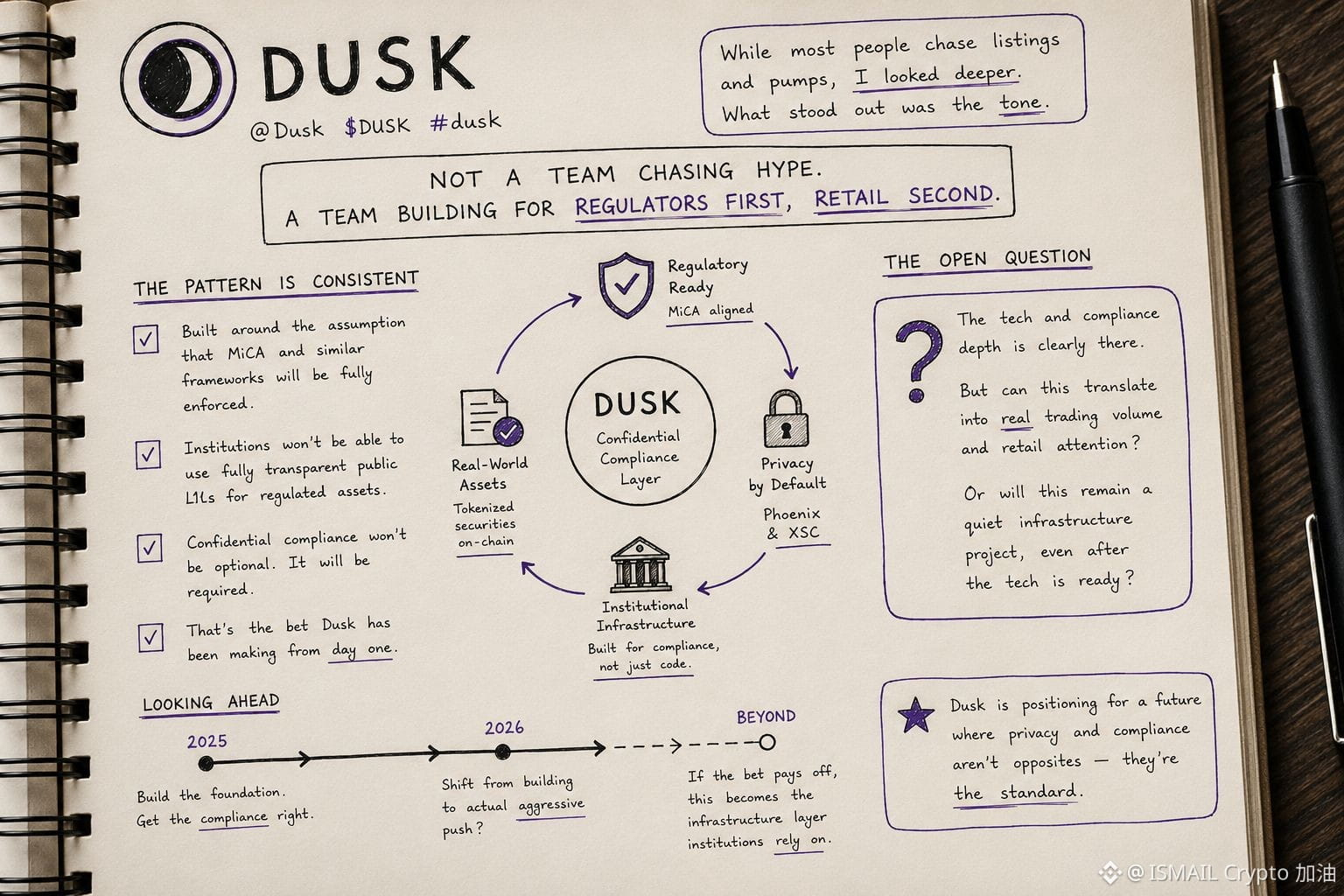
Something kept sitting with me after work today, so I sat down and actually went through Dusk's public communications properly, away from the noise, instead of skimming for a headline.
While most people scanning these things are hunting for listing news or a short-term pump signal, what stood out to me was the tone. It doesn't read like a team chasing hype. It reads like a team building for regulators first, retail second.
The pattern is consistent, not one-off. Dusk keeps positioning itself around the assumption that once frameworks like MiCA are fully enforced across Europe, institutions simply won't have the option of using a fully transparent public L1 for regulated assets. They'll need confidential compliance baked in, not bolted on. That's the bet Dusk has been making from day one.
What I can't tell yet is whether that same discipline extends to the go-to-market side. The engineering and compliance depth is obviously there. Whether the team can translate that into real trading volume and retail attention, or whether this stays a "quiet infrastructure project" long after the tech is ready, is the open question for me.
Curious if others think 2026 is the year that shifts from pure building to actual aggressive push, or if that's just not how this team operates.
$DUSK
{spot}(DUSKUSDT)
$DEXE
{spot}(DEXEUSDT)
#dusk $DUSK @Dusk
Something kept sitting with me after work today, so I sat down and actually went through Dusk's public communications properly, away from the noise, instead of skimming for a headline.
While most people scanning these things are hunting for listing news or a short-term pump signal, what stood out to me was the tone. It doesn't read like a team chasing hype. It reads like a team building for regulators first, retail second.
The pattern is consistent, not one-off. Dusk keeps positioning itself around the assumption that once frameworks like MiCA are fully enforced across Europe, institutions simply won't have the option of using a fully transparent public L1 for regulated assets. They'll need confidential compliance baked in, not bolted on. That's the bet Dusk has been making from day one.
What I can't tell yet is whether that same discipline extends to the go-to-market side. The engineering and compliance depth is obviously there. Whether the team can translate that into real trading volume and retail attention, or whether this stays a "quiet infrastructure project" long after the tech is ready, is the open question for me.
Curious if others think 2026 is the year that shifts from pure building to actual aggressive push, or if that's just not how this team operates.
$DUSK
$DEXE
Something kept sitting with me after work today, so I sat down and actually went through Dusk's public communications properly, away from the noise, instead of skimming for a headline.
While most people scanning these things are hunting for listing news or a short-term pump signal, what stood out to me was the tone. It doesn't read like a team chasing hype. It reads like a team building for regulators first, retail second.
The pattern is consistent, not one-off. Dusk keeps positioning itself around the assumption that once frameworks like MiCA are fully enforced across Europe, institutions simply won't have the option of using a fully transparent public L1 for regulated assets. They'll need confidential compliance baked in, not bolted on. That's the bet Dusk has been making from day one.
What I can't tell yet is whether that same discipline extends to the go-to-market side. The engineering and compliance depth is obviously there. Whether the team can translate that into real trading volume and retail attention, or whether this stays a "quiet infrastructure project" long after the tech is ready, is the open question for me.
Curious if others think 2026 is the year that shifts from pure building to actual aggressive push, or if that's just not how this team operates.
$DUSK
$DEXE
1
282
#dusk $DUSK @Dusk_Foundation
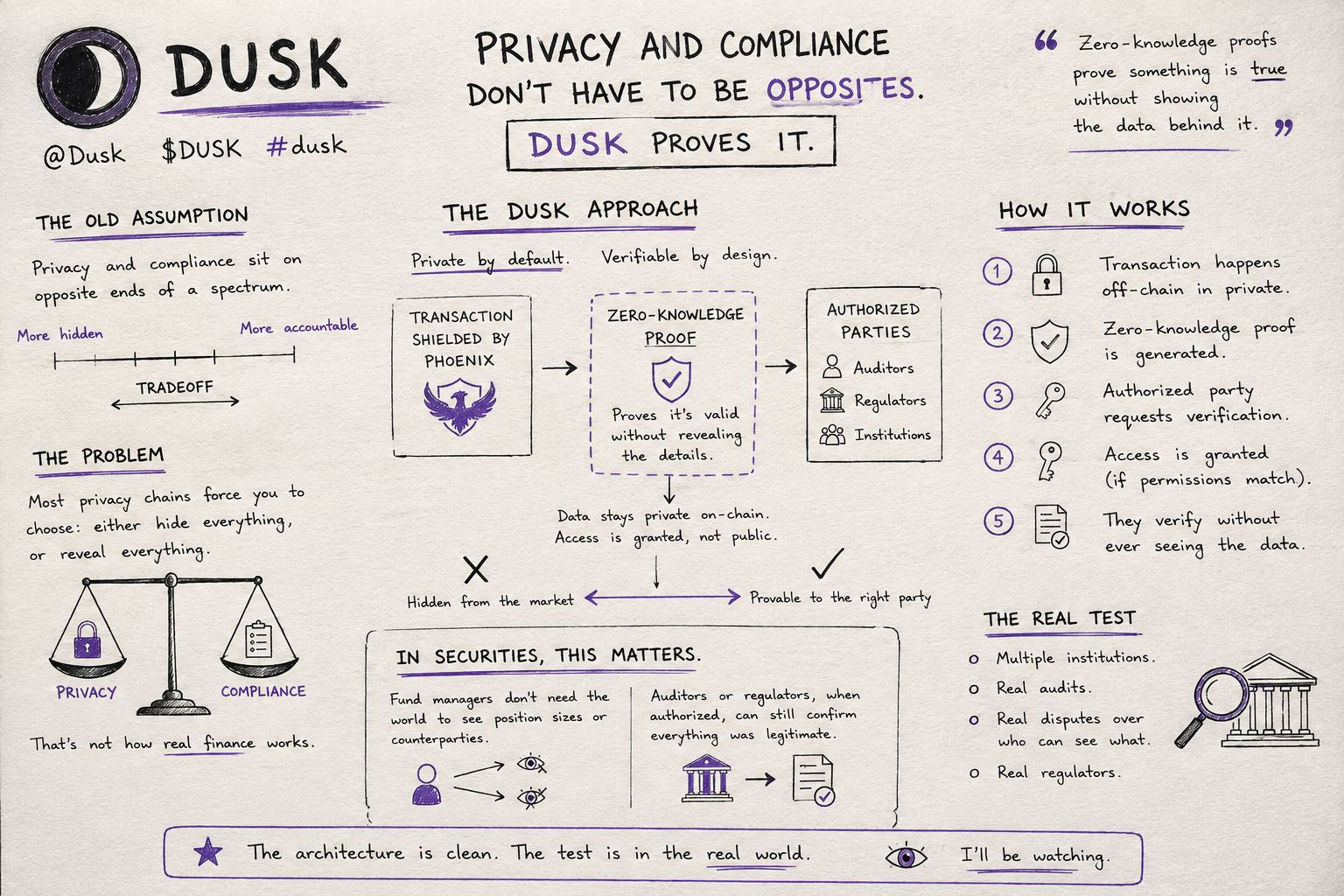
I used to assume privacy and compliance basically sit on opposite ends of a spectrum. More hidden meant less accountable, that was the tradeoff I took for granted with any privacy-focused chain.
Looking closer at how Dusk actually structures this, that framing doesn't quite hold. It's not offering one setting of "private" or "public." Transactions can be shielded through Phoenix, but the system still allows specific, authorized parties to verify what happened, without that information ever becoming visible to the wider network. The zero-knowledge proof isn't just hiding data, it's proving something is true without showing the data behind it. That's a different problem than simple concealment.
Thinking about this in a securities context makes it click. A fund manager settling a transaction doesn't need the general public seeing position sizes or counterparties. But an auditor or regulator, if there's a legitimate reason, still needs a way to confirm the transaction was legitimate. A blockchain that can't separate "hidden from the market" from "provable to the right party" isn't really solving finance's actual privacy problem, it's just picking one extreme over the other.
What I keep coming back to is that this only means something once it's tested against real friction, multiple institutions, real audits, real disputes over who was authorized to see what. The architecture reads cleanly in the docs. Whether the access model holds up once actual money and actual regulators are involved is the part I want to watch play out.
@Dusk_Foundation $DUSK $OPG
{spot}(OPGUSDT)
{future}(OUSDT)
#dusk $DUSK @Dusk
I used to assume privacy and compliance basically sit on opposite ends of a spectrum. More hidden meant less accountable, that was the tradeoff I took for granted with any privacy-focused chain.
Looking closer at how Dusk actually structures this, that framing doesn't quite hold. It's not offering one setting of "private" or "public." Transactions can be shielded through Phoenix, but the system still allows specific, authorized parties to verify what happened, without that information ever becoming visible to the wider network. The zero-knowledge proof isn't just hiding data, it's proving something is true without showing the data behind it. That's a different problem than simple concealment.
Thinking about this in a securities context makes it click. A fund manager settling a transaction doesn't need the general public seeing position sizes or counterparties. But an auditor or regulator, if there's a legitimate reason, still needs a way to confirm the transaction was legitimate. A blockchain that can't separate "hidden from the market" from "provable to the right party" isn't really solving finance's actual privacy problem, it's just picking one extreme over the other.
What I keep coming back to is that this only means something once it's tested against real friction, multiple institutions, real audits, real disputes over who was authorized to see what. The architecture reads cleanly in the docs. Whether the access model holds up once actual money and actual regulators are involved is the part I want to watch play out.
@Dusk $DUSK $OPG
I used to assume privacy and compliance basically sit on opposite ends of a spectrum. More hidden meant less accountable, that was the tradeoff I took for granted with any privacy-focused chain.
Looking closer at how Dusk actually structures this, that framing doesn't quite hold. It's not offering one setting of "private" or "public." Transactions can be shielded through Phoenix, but the system still allows specific, authorized parties to verify what happened, without that information ever becoming visible to the wider network. The zero-knowledge proof isn't just hiding data, it's proving something is true without showing the data behind it. That's a different problem than simple concealment.
Thinking about this in a securities context makes it click. A fund manager settling a transaction doesn't need the general public seeing position sizes or counterparties. But an auditor or regulator, if there's a legitimate reason, still needs a way to confirm the transaction was legitimate. A blockchain that can't separate "hidden from the market" from "provable to the right party" isn't really solving finance's actual privacy problem, it's just picking one extreme over the other.
What I keep coming back to is that this only means something once it's tested against real friction, multiple institutions, real audits, real disputes over who was authorized to see what. The architecture reads cleanly in the docs. Whether the access model holds up once actual money and actual regulators are involved is the part I want to watch play out.
@Dusk $DUSK $OPG
6
4
281
#termmax @termmax
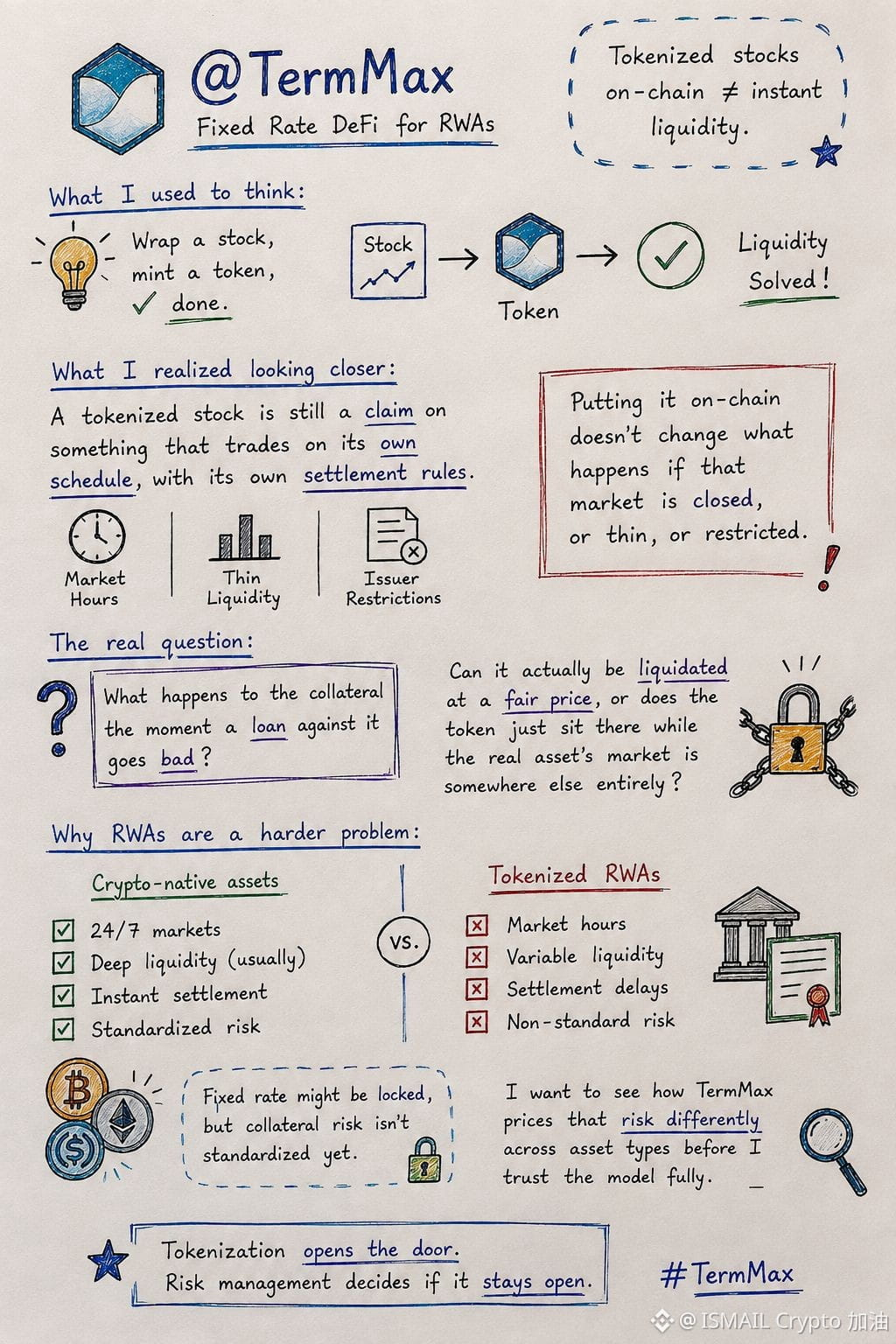
I kept assuming tokenized real-world assets solved liquidity the moment they went on-chain. Wrap a stock, mint a token, done, right?
Looking at @termmax 's move to accept Ondo Global Markets tokens as collateral made me question that. A tokenized stock is still, underneath, a claim on something that trades on its own schedule, with its own settlement rules. Putting it on-chain doesn't change what happens if that market is closed, or thin, or the underlying issuer has restrictions.
So the real question isn't "can this asset be tokenized," it's "what happens to the collateral the moment a loan against it goes bad." Can it actually be liquidated at a fair price, or does the token just sit there while the real asset's market is somewhere else entirely.
This is why I think fixed-rate lending against RWAs is a harder problem than fixed-rate lending against crypto-native assets. The rate might be locked, but the collateral risk underneath isn't standardized yet. I want to see how TermMax prices that risk differently across asset types before I trust the model fully. #TermMax $ACE
{spot}(ACEUSDT)
$OPG
{spot}(OPGUSDT)
#termmax @TermMax
I kept assuming tokenized real-world assets solved liquidity the moment they went on-chain. Wrap a stock, mint a token, done, right?
Looking at @TermMax 's move to accept Ondo Global Markets tokens as collateral made me question that. A tokenized stock is still, underneath, a claim on something that trades on its own schedule, with its own settlement rules. Putting it on-chain doesn't change what happens if that market is closed, or thin, or the underlying issuer has restrictions.
So the real question isn't "can this asset be tokenized," it's "what happens to the collateral the moment a loan against it goes bad." Can it actually be liquidated at a fair price, or does the token just sit there while the real asset's market is somewhere else entirely.
This is why I think fixed-rate lending against RWAs is a harder problem than fixed-rate lending against crypto-native assets. The rate might be locked, but the collateral risk underneath isn't standardized yet. I want to see how TermMax prices that risk differently across asset types before I trust the model fully. #TermMax $ACE
$OPG
I kept assuming tokenized real-world assets solved liquidity the moment they went on-chain. Wrap a stock, mint a token, done, right?
Looking at @TermMax 's move to accept Ondo Global Markets tokens as collateral made me question that. A tokenized stock is still, underneath, a claim on something that trades on its own schedule, with its own settlement rules. Putting it on-chain doesn't change what happens if that market is closed, or thin, or the underlying issuer has restrictions.
So the real question isn't "can this asset be tokenized," it's "what happens to the collateral the moment a loan against it goes bad." Can it actually be liquidated at a fair price, or does the token just sit there while the real asset's market is somewhere else entirely.
This is why I think fixed-rate lending against RWAs is a harder problem than fixed-rate lending against crypto-native assets. The rate might be locked, but the collateral risk underneath isn't standardized yet. I want to see how TermMax prices that risk differently across asset types before I trust the model fully. #TermMax $ACE
$OPG
4
2
301
#dusk $DUSK @Dusk_Foundation
I used to think settlement finality on a blockchain was a yes or no question, either your transaction is confirmed or it isn't. Most chains I'd looked at treated it that way, wait for enough blocks, call it done.
Reading into Dusk's consensus changed that assumption. A block there actually moves through four distinct states before it's considered truly final: Accepted once it clears proposal, validation and ratification in a round, Confirmed once later blocks build on it, Stable once it's buried deep enough to be practically irreversible, and only then Final, meaning cryptographically guaranteed and unable to be reversed under any circumstance.
That layered definition felt unnecessary at first. But thinking about it from a financial settlement angle, not a crypto trading angle, it made more sense. A retail swap probably doesn't care about the difference between Stable and Final. A regulated security transfer, or a bank settling an asset against another institution, very much does. Being able to point to a specific, provable state of finality instead of a vague "it's probably fine by now" is closer to how traditional clearing systems already think about settlement risk.
What I'm still not sure about is how long it actually takes in practice to move from Accepted to Final under real network conditions, and whether institutions end up treating "Stable" as good enough anyway, the same way people already treat six confirmations as good enough elsewhere.
@Dusk_Foundation $DUSK #dusk $ACE
#dusk $DUSK @Dusk
I used to think settlement finality on a blockchain was a yes or no question, either your transaction is confirmed or it isn't. Most chains I'd looked at treated it that way, wait for enough blocks, call it done.
Reading into Dusk's consensus changed that assumption. A block there actually moves through four distinct states before it's considered truly final: Accepted once it clears proposal, validation and ratification in a round, Confirmed once later blocks build on it, Stable once it's buried deep enough to be practically irreversible, and only then Final, meaning cryptographically guaranteed and unable to be reversed under any circumstance.
That layered definition felt unnecessary at first. But thinking about it from a financial settlement angle, not a crypto trading angle, it made more sense. A retail swap probably doesn't care about the difference between Stable and Final. A regulated security transfer, or a bank settling an asset against another institution, very much does. Being able to point to a specific, provable state of finality instead of a vague "it's probably fine by now" is closer to how traditional clearing systems already think about settlement risk.
What I'm still not sure about is how long it actually takes in practice to move from Accepted to Final under real network conditions, and whether institutions end up treating "Stable" as good enough anyway, the same way people already treat six confirmations as good enough elsewhere.
@Dusk $DUSK #dusk $ACE
I used to think settlement finality on a blockchain was a yes or no question, either your transaction is confirmed or it isn't. Most chains I'd looked at treated it that way, wait for enough blocks, call it done.
Reading into Dusk's consensus changed that assumption. A block there actually moves through four distinct states before it's considered truly final: Accepted once it clears proposal, validation and ratification in a round, Confirmed once later blocks build on it, Stable once it's buried deep enough to be practically irreversible, and only then Final, meaning cryptographically guaranteed and unable to be reversed under any circumstance.
That layered definition felt unnecessary at first. But thinking about it from a financial settlement angle, not a crypto trading angle, it made more sense. A retail swap probably doesn't care about the difference between Stable and Final. A regulated security transfer, or a bank settling an asset against another institution, very much does. Being able to point to a specific, provable state of finality instead of a vague "it's probably fine by now" is closer to how traditional clearing systems already think about settlement risk.
What I'm still not sure about is how long it actually takes in practice to move from Accepted to Final under real network conditions, and whether institutions end up treating "Stable" as good enough anyway, the same way people already treat six confirmations as good enough elsewhere.
@Dusk $DUSK #dusk $ACE

4
3
99
#termmax @termmax
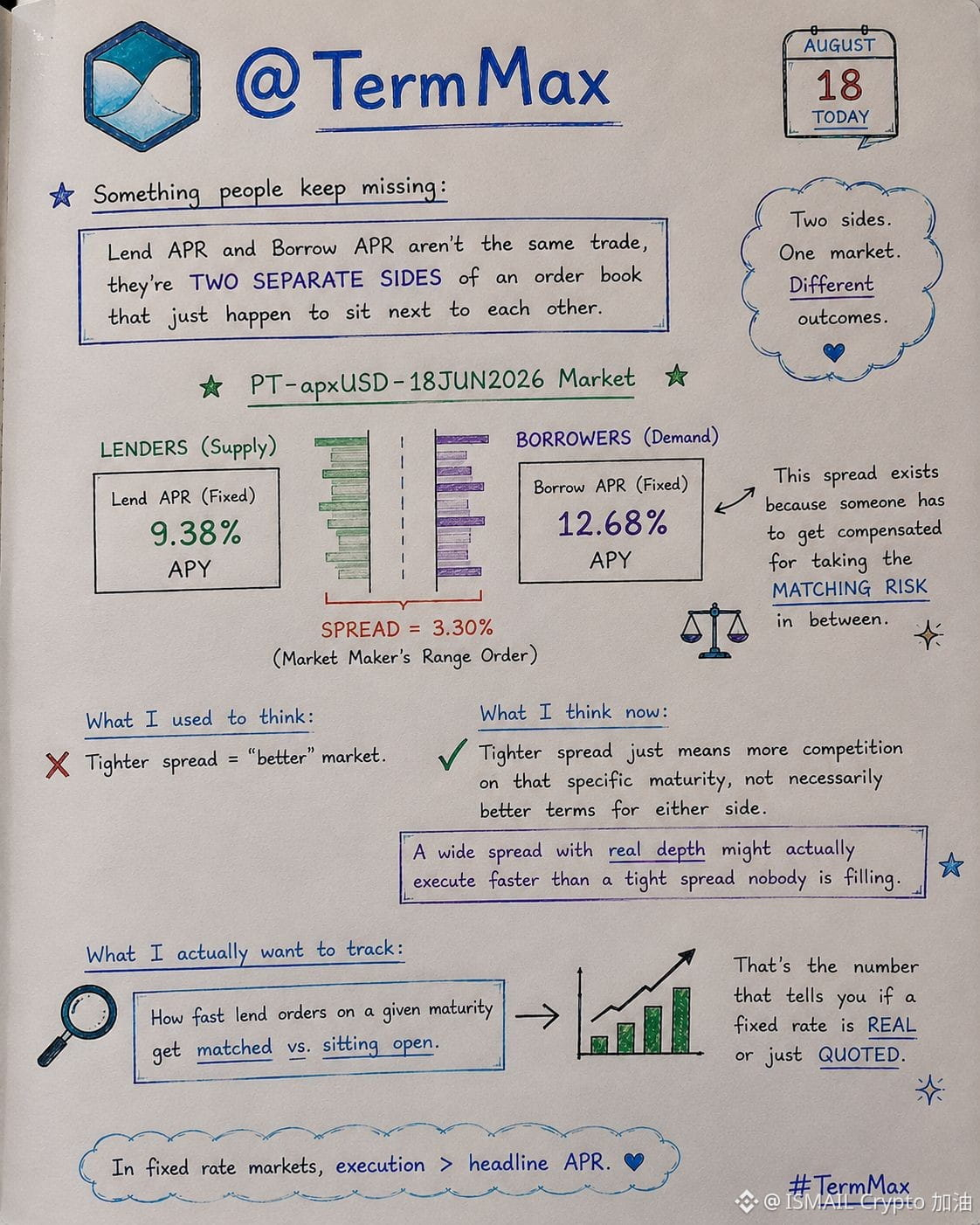
Something people keep missing on @TermMax is that Lend APR and Borrow APR aren't the same trade, they're two separate sides of an order book that just happen to sit next to each other on screen.
Take the PT-apxUSD-18JUN2026 market. Borrowers can lock in 12.68% fixed APY against that collateral. Lenders on the same market only get 9.38% fixed APY. That's not a typo, it's the spread the market maker's range order is quoting, and it exists because someone has to get compensated for taking the matching risk in between.
I used to assume a tighter spread meant a "better" market. Now I think it just means more competition on that specific maturity, not necessarily better terms for either side individually. A wide spread with real depth might actually execute faster than a tight spread nobody is filling.
What I'd actually want to track over time isn't the APR headline, it's how fast lend orders on a given maturity get matched versus sitting open. That's the number that tells you if a fixed rate is real or just quoted.
#termmax $AXL $OPG
#termmax @TermMax
Something people keep missing on @TermMax is that Lend APR and Borrow APR aren't the same trade, they're two separate sides of an order book that just happen to sit next to each other on screen.
Take the PT-apxUSD-18JUN2026 market. Borrowers can lock in 12.68% fixed APY against that collateral. Lenders on the same market only get 9.38% fixed APY. That's not a typo, it's the spread the market maker's range order is quoting, and it exists because someone has to get compensated for taking the matching risk in between.
I used to assume a tighter spread meant a "better" market. Now I think it just means more competition on that specific maturity, not necessarily better terms for either side individually. A wide spread with real depth might actually execute faster than a tight spread nobody is filling.
What I'd actually want to track over time isn't the APR headline, it's how fast lend orders on a given maturity get matched versus sitting open. That's the number that tells you if a fixed rate is real or just quoted.
#termmax $AXL $OPG
Something people keep missing on @TermMax is that Lend APR and Borrow APR aren't the same trade, they're two separate sides of an order book that just happen to sit next to each other on screen.
Take the PT-apxUSD-18JUN2026 market. Borrowers can lock in 12.68% fixed APY against that collateral. Lenders on the same market only get 9.38% fixed APY. That's not a typo, it's the spread the market maker's range order is quoting, and it exists because someone has to get compensated for taking the matching risk in between.
I used to assume a tighter spread meant a "better" market. Now I think it just means more competition on that specific maturity, not necessarily better terms for either side individually. A wide spread with real depth might actually execute faster than a tight spread nobody is filling.
What I'd actually want to track over time isn't the APR headline, it's how fast lend orders on a given maturity get matched versus sitting open. That's the number that tells you if a fixed rate is real or just quoted.
#termmax $AXL $OPG
6
5
576
#dusk $DUSK @Dusk_Foundation
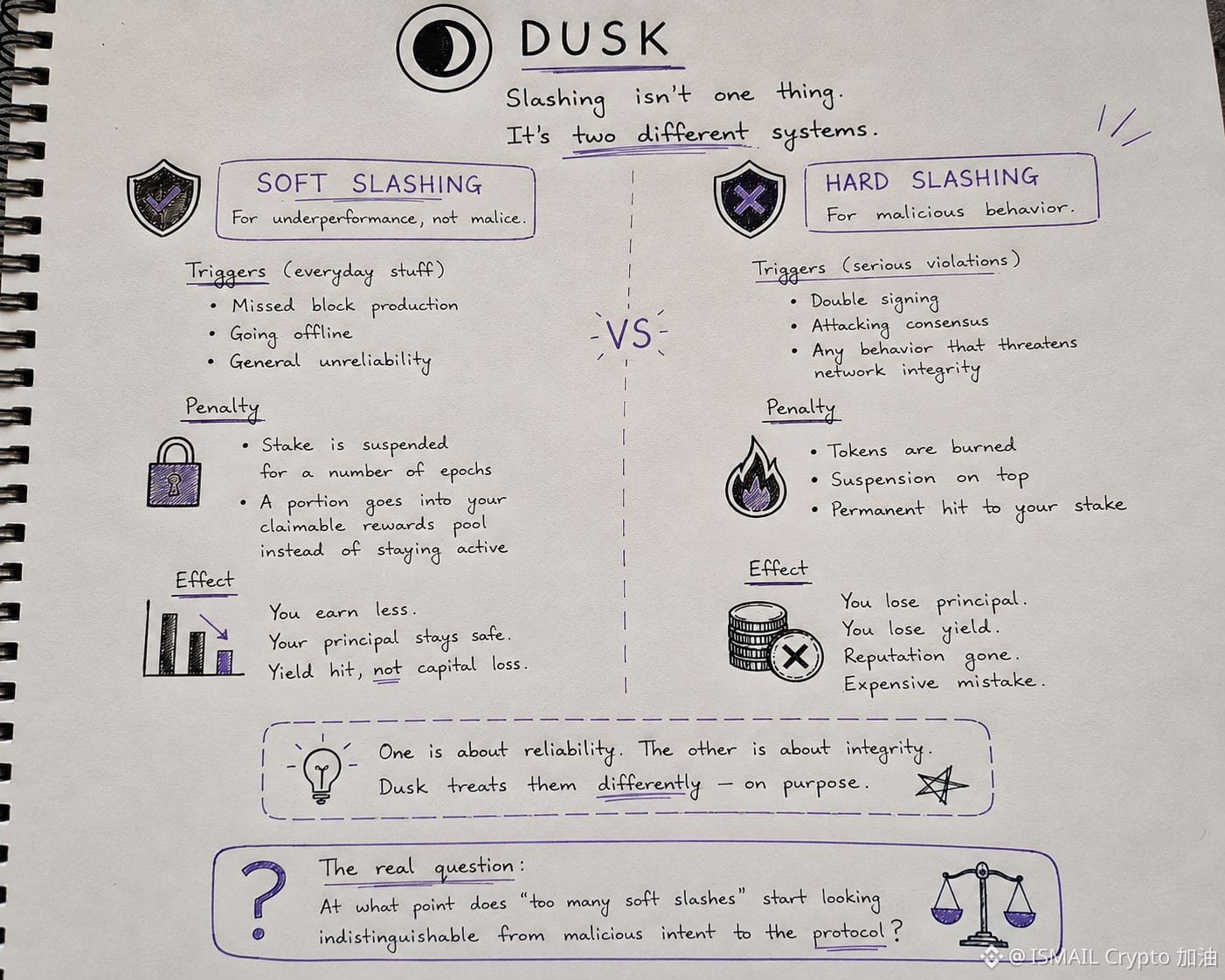
Kept assuming slashing on $DUSK meant one thing, break the rules, lose your stake. Turns out it's split into two very different systems, and the difference actually matters if you're staking.
Soft slashing kicks in for the everyday stuff, a provisioner missing their turn to produce a block, going offline, general unreliability. Nothing malicious about it, just underperformance. The penalty isn't burning, it's suspension. Your stake gets sidelined for a number of epochs and a slice of it moves into your claimable rewards pool instead of staying active, so you're earning less without losing your principal.
Hard slashing is the other track entirely, reserved for actual malicious behavior that threatens network integrity. That's where tokens get burned outright, plus a suspension on top.
What stuck with me is how deliberate that separation is. A node having a bad week from downtime and a node actively trying to break consensus aren't treated the same way, one costs you yield temporarily, the other costs you principal permanently. Most PoS chains I've looked at just have one blunt slashing rule for everything.
Makes me wonder how they're tuning the line between the two in practice, at what point does "too many soft slashes" start looking indistinguishable from malicious intent to the protocol?
$GPS
{spot}(GPSUSDT)
#dusk $DUSK @Dusk
Kept assuming slashing on $DUSK meant one thing, break the rules, lose your stake. Turns out it's split into two very different systems, and the difference actually matters if you're staking.
Soft slashing kicks in for the everyday stuff, a provisioner missing their turn to produce a block, going offline, general unreliability. Nothing malicious about it, just underperformance. The penalty isn't burning, it's suspension. Your stake gets sidelined for a number of epochs and a slice of it moves into your claimable rewards pool instead of staying active, so you're earning less without losing your principal.
Hard slashing is the other track entirely, reserved for actual malicious behavior that threatens network integrity. That's where tokens get burned outright, plus a suspension on top.
What stuck with me is how deliberate that separation is. A node having a bad week from downtime and a node actively trying to break consensus aren't treated the same way, one costs you yield temporarily, the other costs you principal permanently. Most PoS chains I've looked at just have one blunt slashing rule for everything.
Makes me wonder how they're tuning the line between the two in practice, at what point does "too many soft slashes" start looking indistinguishable from malicious intent to the protocol?
$GPS
Kept assuming slashing on $DUSK meant one thing, break the rules, lose your stake. Turns out it's split into two very different systems, and the difference actually matters if you're staking.
Soft slashing kicks in for the everyday stuff, a provisioner missing their turn to produce a block, going offline, general unreliability. Nothing malicious about it, just underperformance. The penalty isn't burning, it's suspension. Your stake gets sidelined for a number of epochs and a slice of it moves into your claimable rewards pool instead of staying active, so you're earning less without losing your principal.
Hard slashing is the other track entirely, reserved for actual malicious behavior that threatens network integrity. That's where tokens get burned outright, plus a suspension on top.
What stuck with me is how deliberate that separation is. A node having a bad week from downtime and a node actively trying to break consensus aren't treated the same way, one costs you yield temporarily, the other costs you principal permanently. Most PoS chains I've looked at just have one blunt slashing rule for everything.
Makes me wonder how they're tuning the line between the two in practice, at what point does "too many soft slashes" start looking indistinguishable from malicious intent to the protocol?
$GPS
11
3
283
#termmax @termmax
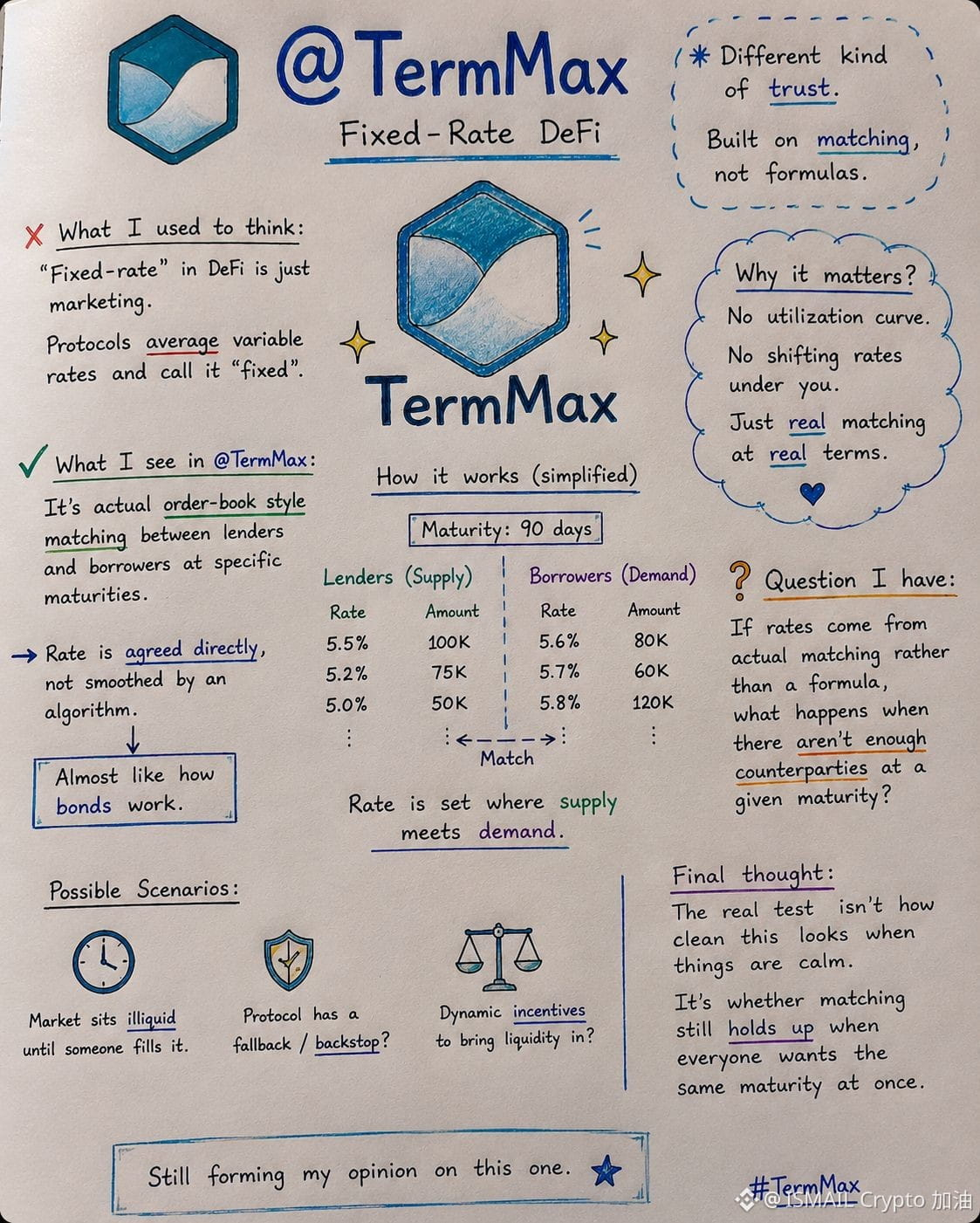
I always assumed fixed-rate lending in DeFi was basically a marketing term—protocols just average out variable rates and call it "fixed." Looking closer at @termmax changed that view a bit.
What's actually happening is an order-book style matching between lenders and borrowers at specific maturities. So the rate isn't smoothed out by an algorithm, it's agreed upon directly, almost like how bonds work. That's a different kind of trust than what I'm used to in DeFi, where most protocols rely on utilization curves that shift under you.
It made me question something I hadn't thought about before: if rates come from actual matching rather than a formula, what happens when there aren't enough counterparties at a given maturity? Does the market just sit illiquid until someone fills it, or does the protocol have a fallback?
I don't have a full answer yet. I think the real test isn't how clean this looks when things are calm, it's whether matching still holds up when everyone wants the same maturity at once. Still forming my opinion on this one. #TermMax $ACE $GPS
#termmax @TermMax
I always assumed fixed-rate lending in DeFi was basically a marketing term—protocols just average out variable rates and call it "fixed." Looking closer at @TermMax changed that view a bit.
What's actually happening is an order-book style matching between lenders and borrowers at specific maturities. So the rate isn't smoothed out by an algorithm, it's agreed upon directly, almost like how bonds work. That's a different kind of trust than what I'm used to in DeFi, where most protocols rely on utilization curves that shift under you.
It made me question something I hadn't thought about before: if rates come from actual matching rather than a formula, what happens when there aren't enough counterparties at a given maturity? Does the market just sit illiquid until someone fills it, or does the protocol have a fallback?
I don't have a full answer yet. I think the real test isn't how clean this looks when things are calm, it's whether matching still holds up when everyone wants the same maturity at once. Still forming my opinion on this one. #TermMax $ACE $GPS
I always assumed fixed-rate lending in DeFi was basically a marketing term—protocols just average out variable rates and call it "fixed." Looking closer at @TermMax changed that view a bit.
What's actually happening is an order-book style matching between lenders and borrowers at specific maturities. So the rate isn't smoothed out by an algorithm, it's agreed upon directly, almost like how bonds work. That's a different kind of trust than what I'm used to in DeFi, where most protocols rely on utilization curves that shift under you.
It made me question something I hadn't thought about before: if rates come from actual matching rather than a formula, what happens when there aren't enough counterparties at a given maturity? Does the market just sit illiquid until someone fills it, or does the protocol have a fallback?
I don't have a full answer yet. I think the real test isn't how clean this looks when things are calm, it's whether matching still holds up when everyone wants the same maturity at once. Still forming my opinion on this one. #TermMax $ACE $GPS
6
4
194
Bitcoin Market Update — August 19, 2026
Bitcoin is trading around $64,100, up modestly from the mid-$62,000s low it touched earlier this month, but still well below its 2026 high near $126,000. The price has climbed roughly $875 from the previous morning, though it remains far off where it stood a year ago. The broader picture: BTC entered 2026 above $93,000 and has drifted lower through most of the year, now consolidating in a range between roughly $62,500 support and $65,000–$70,000 resistance.
What's driving price action
Choppy ETF flows. Institutional demand has been volatile this month. Spot Bitcoin ETFs pulled in their strongest weekly inflows since mid-April in early August, around $853 million, as BTC broke above the $65,000 level. That momentum reversed fast: the following week saw about $390 million in net outflows, the largest weekly drawdown since late June. BlackRock's IBIT continues to dominate flows on both sides of that swing.
Macro headwinds. A hotter-than-expected CPI print at 3.4% and jobless claims rising to 209,000 have added a new layer of uncertainty for risk assets. On the flip side, Goldman Sachs has said a September Fed rate hike looks very unlikely, which is helping cap the downside.
Security jitters. A cold-wallet hack earlier this month reignited debate around self-custody versus regulated custodial vehicles, though it hasn't translated into a sustained rotation into ETFs.
The bigger picture
Bitcoin's roughly 30% pullback from its yearly high is steep but not unusual — corrections of that size have happened repeatedly even during bull cycles. With over 95% of total supply already mined, the scarcity narrative remains intact, and market watchers are largely focused on whether BTC can reclaim its 100-day and 200-day moving averages to signal a more durable trend reversal.
Key levels to watch: support near $62,500–$62,800; resistance in the $65,000–$70,000 zone.
This is a market summary for informational purposes, not financial advice. Always do your own research (DYOR).
$BTC
{spot}(BTCUSDT)
$OPG
{spot}(OPGUSDT)
Bitcoin Market Update — August 19, 2026
Bitcoin is trading around $64,100, up modestly from the mid-$62,000s low it touched earlier this month, but still well below its 2026 high near $126,000. The price has climbed roughly $875 from the previous morning, though it remains far off where it stood a year ago. The broader picture: BTC entered 2026 above $93,000 and has drifted lower through most of the year, now consolidating in a range between roughly $62,500 support and $65,000–$70,000 resistance.
What's driving price action
Choppy ETF flows. Institutional demand has been volatile this month. Spot Bitcoin ETFs pulled in their strongest weekly inflows since mid-April in early August, around $853 million, as BTC broke above the $65,000 level. That momentum reversed fast: the following week saw about $390 million in net outflows, the largest weekly drawdown since late June. BlackRock's IBIT continues to dominate flows on both sides of that swing.
Macro headwinds. A hotter-than-expected CPI print at 3.4% and jobless claims rising to 209,000 have added a new layer of uncertainty for risk assets. On the flip side, Goldman Sachs has said a September Fed rate hike looks very unlikely, which is helping cap the downside.
Security jitters. A cold-wallet hack earlier this month reignited debate around self-custody versus regulated custodial vehicles, though it hasn't translated into a sustained rotation into ETFs.
The bigger picture
Bitcoin's roughly 30% pullback from its yearly high is steep but not unusual — corrections of that size have happened repeatedly even during bull cycles. With over 95% of total supply already mined, the scarcity narrative remains intact, and market watchers are largely focused on whether BTC can reclaim its 100-day and 200-day moving averages to signal a more durable trend reversal.
Key levels to watch: support near $62,500–$62,800; resistance in the $65,000–$70,000 zone.
This is a market summary for informational purposes, not financial advice. Always do your own research (DYOR).
$BTC
$OPG
Bitcoin is trading around $64,100, up modestly from the mid-$62,000s low it touched earlier this month, but still well below its 2026 high near $126,000. The price has climbed roughly $875 from the previous morning, though it remains far off where it stood a year ago. The broader picture: BTC entered 2026 above $93,000 and has drifted lower through most of the year, now consolidating in a range between roughly $62,500 support and $65,000–$70,000 resistance.
What's driving price action
Choppy ETF flows. Institutional demand has been volatile this month. Spot Bitcoin ETFs pulled in their strongest weekly inflows since mid-April in early August, around $853 million, as BTC broke above the $65,000 level. That momentum reversed fast: the following week saw about $390 million in net outflows, the largest weekly drawdown since late June. BlackRock's IBIT continues to dominate flows on both sides of that swing.
Macro headwinds. A hotter-than-expected CPI print at 3.4% and jobless claims rising to 209,000 have added a new layer of uncertainty for risk assets. On the flip side, Goldman Sachs has said a September Fed rate hike looks very unlikely, which is helping cap the downside.
Security jitters. A cold-wallet hack earlier this month reignited debate around self-custody versus regulated custodial vehicles, though it hasn't translated into a sustained rotation into ETFs.
The bigger picture
Bitcoin's roughly 30% pullback from its yearly high is steep but not unusual — corrections of that size have happened repeatedly even during bull cycles. With over 95% of total supply already mined, the scarcity narrative remains intact, and market watchers are largely focused on whether BTC can reclaim its 100-day and 200-day moving averages to signal a more durable trend reversal.
Key levels to watch: support near $62,500–$62,800; resistance in the $65,000–$70,000 zone.
This is a market summary for informational purposes, not financial advice. Always do your own research (DYOR).
$BTC
$OPG


1
2
89
Verified
#dusk $DUSK @Dusk_Foundation
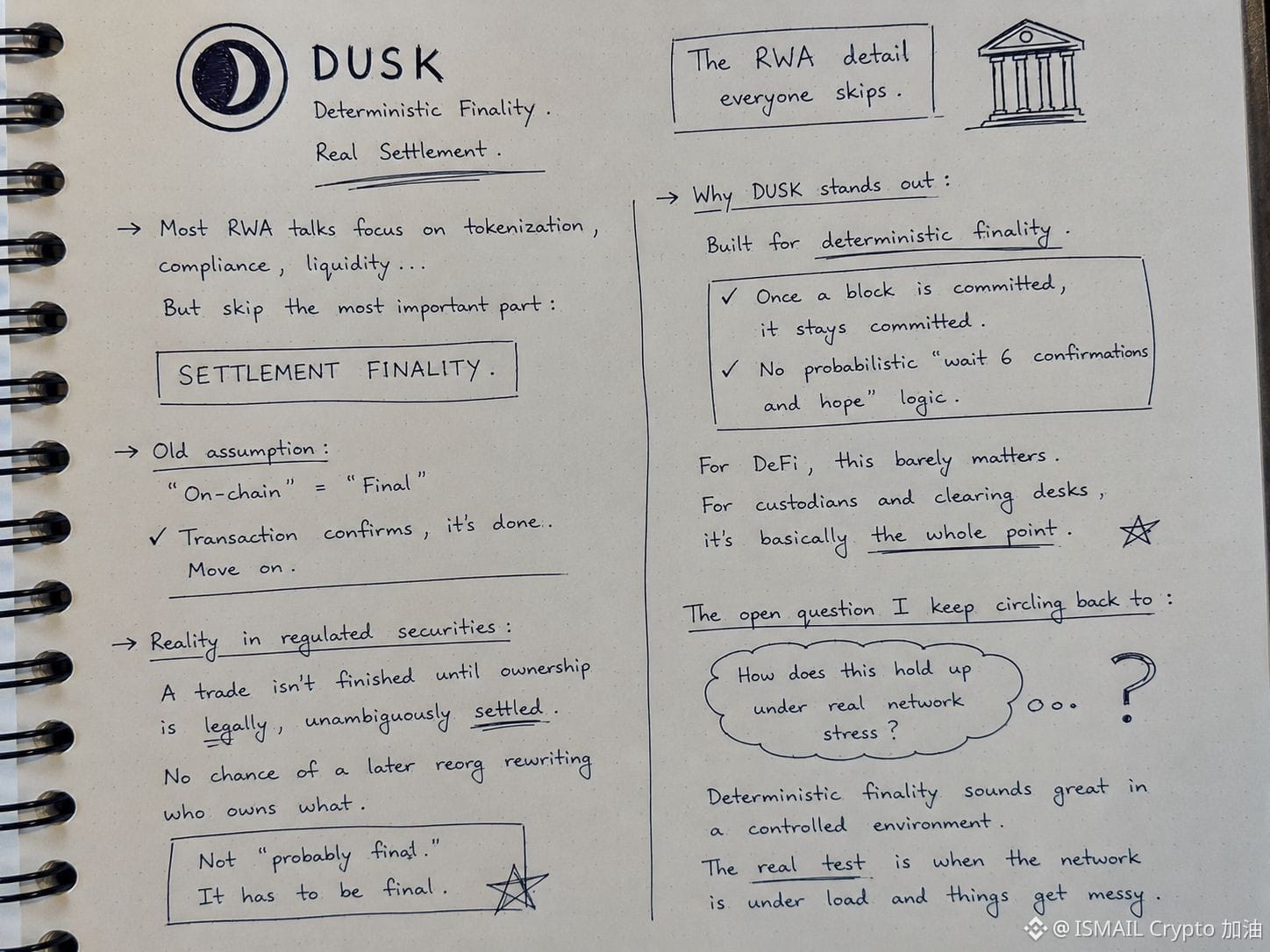
Been thinking about something most RWA discussions skip entirely: settlement finality.
For a long time I assumed "on-chain" automatically meant "final." A transaction confirms, it's done, move on. That assumption held up fine for simple transfers, but it started falling apart once I thought about it in the context of regulated securities — where a trade isn't really finished until ownership is legally, unambiguously settled, with no chance of a later reorg quietly rewriting who owns what.
That's the detail that made me look closer at Dusk's consensus design. It's built for deterministic finality — once a block is committed, it stays committed, no probabilistic "wait six confirmations and hope" logic. For everyday DeFi that difference barely matters. For custodians and clearing desks, it's basically the whole point. You can't run institutional settlement on "probably final."
What I still don't have a good read on is how this holds up under real network stress, not just clean testnet conditions. Deterministic finality sounds great in a controlled environment — the real test is whether it stays deterministic when the network is under load and things get messy.
Not claiming an answer here, just the question I keep circling back to. #dusk $DUSK
{spot}(DUSKUSDT)
@Dusk_Foundation
$ACE
{spot}(ACEUSDT)
#dusk $DUSK @Dusk
Been thinking about something most RWA discussions skip entirely: settlement finality.
For a long time I assumed "on-chain" automatically meant "final." A transaction confirms, it's done, move on. That assumption held up fine for simple transfers, but it started falling apart once I thought about it in the context of regulated securities — where a trade isn't really finished until ownership is legally, unambiguously settled, with no chance of a later reorg quietly rewriting who owns what.
That's the detail that made me look closer at Dusk's consensus design. It's built for deterministic finality — once a block is committed, it stays committed, no probabilistic "wait six confirmations and hope" logic. For everyday DeFi that difference barely matters. For custodians and clearing desks, it's basically the whole point. You can't run institutional settlement on "probably final."
What I still don't have a good read on is how this holds up under real network stress, not just clean testnet conditions. Deterministic finality sounds great in a controlled environment — the real test is whether it stays deterministic when the network is under load and things get messy.
Not claiming an answer here, just the question I keep circling back to. #dusk $DUSK
@Dusk
$ACE
Been thinking about something most RWA discussions skip entirely: settlement finality.
For a long time I assumed "on-chain" automatically meant "final." A transaction confirms, it's done, move on. That assumption held up fine for simple transfers, but it started falling apart once I thought about it in the context of regulated securities — where a trade isn't really finished until ownership is legally, unambiguously settled, with no chance of a later reorg quietly rewriting who owns what.
That's the detail that made me look closer at Dusk's consensus design. It's built for deterministic finality — once a block is committed, it stays committed, no probabilistic "wait six confirmations and hope" logic. For everyday DeFi that difference barely matters. For custodians and clearing desks, it's basically the whole point. You can't run institutional settlement on "probably final."
What I still don't have a good read on is how this holds up under real network stress, not just clean testnet conditions. Deterministic finality sounds great in a controlled environment — the real test is whether it stays deterministic when the network is under load and things get messy.
Not claiming an answer here, just the question I keep circling back to. #dusk $DUSK
@Dusk
$ACE
6
3
302
SHIBINHOOD ($WOOF): The 16,000X Opportunity Hiding in Plain Sight
Let's talk numbers. SHIB all-time high: $40,000,000,000. SHIB today: $2,000,000,000. SHIBINHOOD today: $2,500,000. SHIB — the token that turned $1,000 into $50,000,000 — is currently 800x larger than WOOF. At SHIB's current price, WOOF needs 800x just to catch where SHIB is right now. At SHIB's ATH? 16,000x. And the on-chain data says the same hands that built SHIB are behind WOOF.
THE PROOF: July 24, 2020, the SHIB deployer sent 200 KARMA directly to the WOOF deployer. Two days after the SHIB deployer's first Karma DAO interaction. The WOOF deployer was in the inner circle before SHIB was public. Both wallets funded by the same FTX address — 47 seconds apart. Then the WOOF deployer went dormant for 6 years. On July 27, 2026 — day 26 of Robinhood Chain — it launched SHIBINHOOD. What kind of operator sits on a 6-year connection to the SHIB deployer, survives an entire crypto cycle, and launches a dog token on a brand new chain the moment it goes live? The same kind that knew SHIB before the world did.
THE MATH: If WOOF catches SHIB's current $2B market cap, $100 becomes $80,000 and $1,000 becomes $800,000. If WOOF ever touches SHIB's $40B ATH, $100 becomes $1,600,000 and $1,000 becomes $16,000,000. This is not a prediction. This is a map of what's mathematically possible when pedigree meets timing.
You missed SHIB at $1M market cap. You missed DOGE at sub-penny. You missed PEPE before it hit CoinGecko. Now there's a token at $2.5M with direct on-chain ties to the SHIB deployer, a 6-year dormant wallet that screams OG discipline, launch on Robinhood Chain with 40M+ potential retail users, and pre-bull market positioning. https://x.com/moon_or_doom/status/2084667186094989800
🔗 Research: https://thecryptobasic.com/2026/08/03/on-chain-data-exposes-link-between-the-shiba-inu-and-shibinhood-deployers/
🔗 Contract: https://robinhoodchain.blockscout.com/address/0xe15db7C8547A0adD11eB26A700246cCa08aEfCe5
$WOOF.US F @shibinhoodx
#SHIBINHOOD #WOOF #RobinhoodChain #SHIB #1000xGem
SHIBINHOOD ($WOOF): The 16,000X Opportunity Hiding in Plain Sight
Let's talk numbers. SHIB all-time high: $40,000,000,000. SHIB today: $2,000,000,000. SHIBINHOOD today: $2,500,000. SHIB — the token that turned $1,000 into $50,000,000 — is currently 800x larger than WOOF. At SHIB's current price, WOOF needs 800x just to catch where SHIB is right now. At SHIB's ATH? 16,000x. And the on-chain data says the same hands that built SHIB are behind WOOF.
THE PROOF: July 24, 2020, the SHIB deployer sent 200 KARMA directly to the WOOF deployer. Two days after the SHIB deployer's first Karma DAO interaction. The WOOF deployer was in the inner circle before SHIB was public. Both wallets funded by the same FTX address — 47 seconds apart. Then the WOOF deployer went dormant for 6 years. On July 27, 2026 — day 26 of Robinhood Chain — it launched SHIBINHOOD. What kind of operator sits on a 6-year connection to the SHIB deployer, survives an entire crypto cycle, and launches a dog token on a brand new chain the moment it goes live? The same kind that knew SHIB before the world did.
THE MATH: If WOOF catches SHIB's current $2B market cap, $100 becomes $80,000 and $1,000 becomes $800,000. If WOOF ever touches SHIB's $40B ATH, $100 becomes $1,600,000 and $1,000 becomes $16,000,000. This is not a prediction. This is a map of what's mathematically possible when pedigree meets timing.
You missed SHIB at $1M market cap. You missed DOGE at sub-penny. You missed PEPE before it hit CoinGecko. Now there's a token at $2.5M with direct on-chain ties to the SHIB deployer, a 6-year dormant wallet that screams OG discipline, launch on Robinhood Chain with 40M+ potential retail users, and pre-bull market positioning. https://x.com/moon_or_doom/status/2084667186094989800
🔗 Research: https://thecryptobasic.com/2026/08/03/on-chain-data-exposes-link-between-the-shiba-inu-and-shibinhood-deployers/
🔗 Contract: https://robinhoodchain.blockscout.com/address/0xe15db7C8547A0adD11eB26A700246cCa08aEfCe5
$WOOF.US F @shibinhoodx
#SHIBINHOOD #WOOF #RobinhoodChain #SHIB #1000xGem
Let's talk numbers. SHIB all-time high: $40,000,000,000. SHIB today: $2,000,000,000. SHIBINHOOD today: $2,500,000. SHIB — the token that turned $1,000 into $50,000,000 — is currently 800x larger than WOOF. At SHIB's current price, WOOF needs 800x just to catch where SHIB is right now. At SHIB's ATH? 16,000x. And the on-chain data says the same hands that built SHIB are behind WOOF.
THE PROOF: July 24, 2020, the SHIB deployer sent 200 KARMA directly to the WOOF deployer. Two days after the SHIB deployer's first Karma DAO interaction. The WOOF deployer was in the inner circle before SHIB was public. Both wallets funded by the same FTX address — 47 seconds apart. Then the WOOF deployer went dormant for 6 years. On July 27, 2026 — day 26 of Robinhood Chain — it launched SHIBINHOOD. What kind of operator sits on a 6-year connection to the SHIB deployer, survives an entire crypto cycle, and launches a dog token on a brand new chain the moment it goes live? The same kind that knew SHIB before the world did.
THE MATH: If WOOF catches SHIB's current $2B market cap, $100 becomes $80,000 and $1,000 becomes $800,000. If WOOF ever touches SHIB's $40B ATH, $100 becomes $1,600,000 and $1,000 becomes $16,000,000. This is not a prediction. This is a map of what's mathematically possible when pedigree meets timing.
You missed SHIB at $1M market cap. You missed DOGE at sub-penny. You missed PEPE before it hit CoinGecko. Now there's a token at $2.5M with direct on-chain ties to the SHIB deployer, a 6-year dormant wallet that screams OG discipline, launch on Robinhood Chain with 40M+ potential retail users, and pre-bull market positioning. https://x.com/moon_or_doom/status/2084667186094989800
🔗 Research: https://thecryptobasic.com/2026/08/03/on-chain-data-exposes-link-between-the-shiba-inu-and-shibinhood-deployers/
🔗 Contract: https://robinhoodchain.blockscout.com/address/0xe15db7C8547A0adD11eB26A700246cCa08aEfCe5
$WOOF.US F @shibinhoodx
#SHIBINHOOD #WOOF #RobinhoodChain #SHIB #1000xGem

SHIB+5.70%
WOOFUS+0.41%
1
2
119
Verified
30D trade $DUSK 2K USDT
#dusk $DUSK @Dusk_Foundation
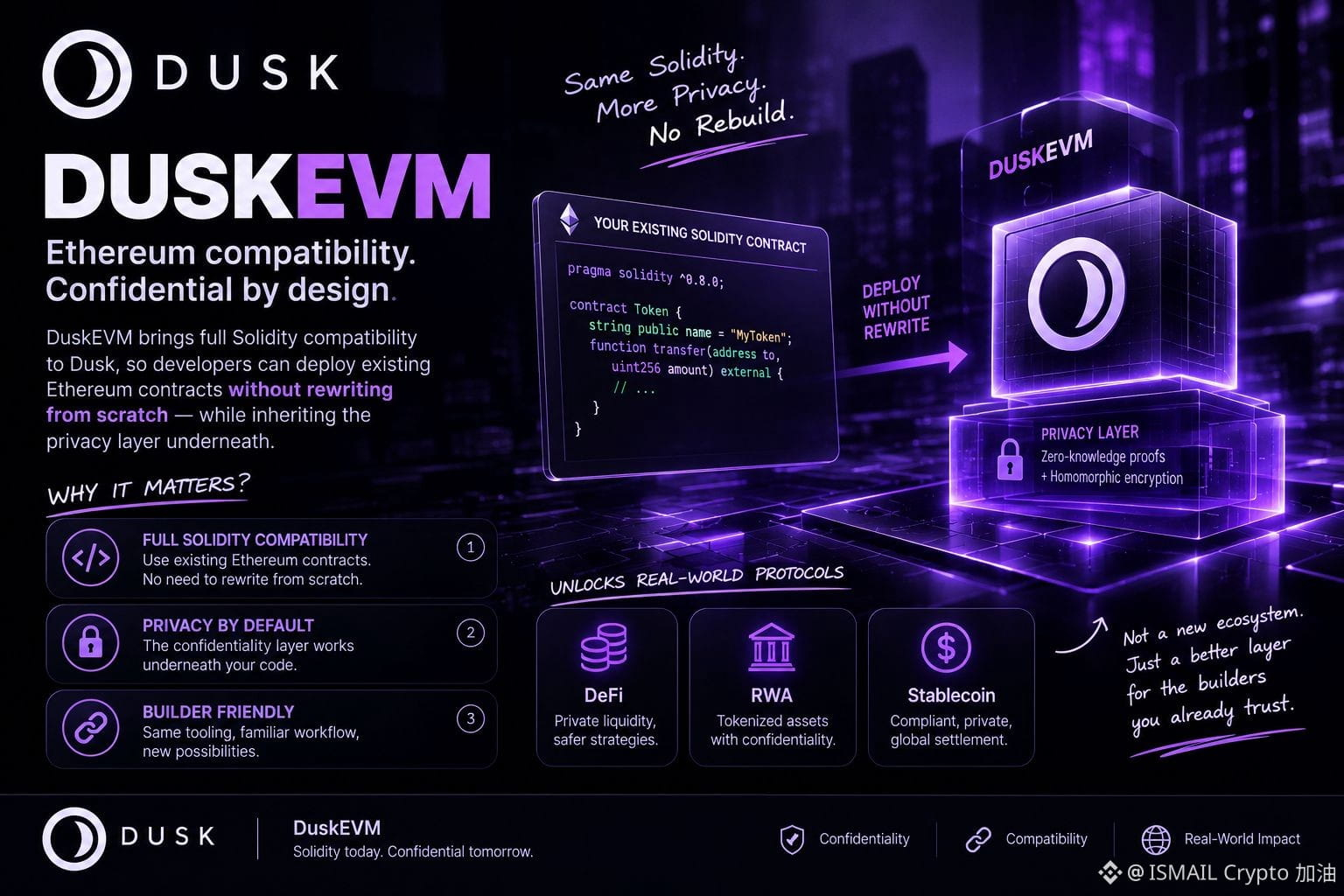
For a while I assumed privacy chains and developer adoption were basically at odds. Privacy usually means custom tooling, custom languages, a smaller ecosystem — which is fine for a niche use case, but not something builders would migrate to at scale. That was my mental model going into Dusk.
DuskEVM changed that assumption for me. It's fully Solidity-compatible, so existing Ethereum contracts can, in theory, be redeployed without being rewritten from scratch. That's not a small detail — it means the privacy layer isn't something you opt into by learning a whole new stack, it's something that sits underneath code you already know how to write.
What I keep coming back to is what this actually unlocks. A lot of DeFi, RWA, and stablecoin protocols were never built with confidentiality in mind, because the tooling to do it without sacrificing compatibility didn't really exist. If DuskEVM holds up under real usage, it lowers the barrier for exactly those protocols to add privacy without a full rebuild.
I'm not treating this as a settled win yet — compatibility claims are easy to make and harder to prove once contracts get complex. But it's the first time I've seen a privacy-focused L1 make a serious case for "you don't have to start over" rather than "come build in our new ecosystem."
$DUSK
{spot}(DUSKUSDT)
$OPG
{spot}(OPGUSDT)
#dusk $DUSK @Dusk
For a while I assumed privacy chains and developer adoption were basically at odds. Privacy usually means custom tooling, custom languages, a smaller ecosystem — which is fine for a niche use case, but not something builders would migrate to at scale. That was my mental model going into Dusk.
DuskEVM changed that assumption for me. It's fully Solidity-compatible, so existing Ethereum contracts can, in theory, be redeployed without being rewritten from scratch. That's not a small detail — it means the privacy layer isn't something you opt into by learning a whole new stack, it's something that sits underneath code you already know how to write.
What I keep coming back to is what this actually unlocks. A lot of DeFi, RWA, and stablecoin protocols were never built with confidentiality in mind, because the tooling to do it without sacrificing compatibility didn't really exist. If DuskEVM holds up under real usage, it lowers the barrier for exactly those protocols to add privacy without a full rebuild.
I'm not treating this as a settled win yet — compatibility claims are easy to make and harder to prove once contracts get complex. But it's the first time I've seen a privacy-focused L1 make a serious case for "you don't have to start over" rather than "come build in our new ecosystem."
$DUSK
$OPG
For a while I assumed privacy chains and developer adoption were basically at odds. Privacy usually means custom tooling, custom languages, a smaller ecosystem — which is fine for a niche use case, but not something builders would migrate to at scale. That was my mental model going into Dusk.
DuskEVM changed that assumption for me. It's fully Solidity-compatible, so existing Ethereum contracts can, in theory, be redeployed without being rewritten from scratch. That's not a small detail — it means the privacy layer isn't something you opt into by learning a whole new stack, it's something that sits underneath code you already know how to write.
What I keep coming back to is what this actually unlocks. A lot of DeFi, RWA, and stablecoin protocols were never built with confidentiality in mind, because the tooling to do it without sacrificing compatibility didn't really exist. If DuskEVM holds up under real usage, it lowers the barrier for exactly those protocols to add privacy without a full rebuild.
I'm not treating this as a settled win yet — compatibility claims are easy to make and harder to prove once contracts get complex. But it's the first time I've seen a privacy-focused L1 make a serious case for "you don't have to start over" rather than "come build in our new ecosystem."
$DUSK
$OPG
2
4
372
🚀 $ZEC USDT — LONG SIGNAL
📍 ENTRY: $509.05 – $510.77
🎯 TARGETS:
TP1: $523.15
TP2: $531.98
TP3: $545.22
🛑 STOP LOSS: $492.26
📈 SETUP:
ZEC is showing solid bullish momentum, with the 4H trend confirmed and the 1D bias remaining bullish.
The entry zone offers a clean setup, while holding support could open the way toward the higher targets.
💎 Pair: $ZECUSDT
$AR
{spot}(ARUSDT)
$POL
{spot}(POLUSDT)
⚠️ Manage risk and trade with a proper position size.
🚀 $ZEC USDT — LONG SIGNAL
📍 ENTRY: $509.05 – $510.77
🎯 TARGETS:
TP1: $523.15
TP2: $531.98
TP3: $545.22
🛑 STOP LOSS: $492.26
📈 SETUP:
ZEC is showing solid bullish momentum, with the 4H trend confirmed and the 1D bias remaining bullish.
The entry zone offers a clean setup, while holding support could open the way toward the higher targets.
💎 Pair: $ZECUSDT
$AR
$POL
⚠️ Manage risk and trade with a proper position size.
📍 ENTRY: $509.05 – $510.77
🎯 TARGETS:
TP1: $523.15
TP2: $531.98
TP3: $545.22
🛑 STOP LOSS: $492.26
📈 SETUP:
ZEC is showing solid bullish momentum, with the 4H trend confirmed and the 1D bias remaining bullish.
The entry zone offers a clean setup, while holding support could open the way toward the higher targets.
💎 Pair: $ZECUSDT
$AR
$POL
⚠️ Manage risk and trade with a proper position size.
1
106
Log in to explore more content
Join global crypto users on Binance Square
⚡️ Get latest and useful information about crypto.
💬 Trusted by the world’s largest crypto exchange.
👍 Discover real insights from verified creators.
Email / Phone number
Trending Topics
HYPEJumpsOver11%
1,539 views
102 Discussing
🚨 HYPE JUST FLIPPED THE MARKET
$HYPE +11% in 7 Days
While $XRP and $ETH were bleeding...
HYPE broke into TOP 10 and kicked out Cardano.
Why?
-> $1.3B+ Open Interest
-> ETF inflows beating BTC & ETH ETFs
-> Massive supply burn in progress
This is not just a pump. This is dominance.
Are you watching or ARE YOU IN? 👇
#HYPE #Hyperliquid #Crypto #BinanceSquare#hypejumpsover11%
True News
·2 Likes
·1.3k views
BitcoinSpotETFsNetInflow$159M
459 views
39 Discussing
HKMAPlansWholesaleCBDCByYearEnd
9,791 views
345 Discussing