
Mr_Haseeb_
193 Posts

Mr_Haseeb_
If you think i'm wrong then correct yourself 😉
Open Trade
Frequent Trader
1.9 Years
23 Following
36 Followers
63 Liked
Posts
Portfolio
#dusk $DUSK @Dusk Most blockchains try to simplify things with one signature system. Dusk took a different path: it uses both Schnorr and BLS signatures.
The reason is not duplication, but specialization. Schnorr signatures are designed for efficient transaction signing, while BLS signatures allow aggregation of multiple signatures, making them useful for validator-related processes where many approvals need to be combined.
This separation shows an important design choice by @Dusk: cryptographic tools should be selected based on the problem they solve, not because one solution looks simpler on paper.
The implication is a more purpose-built architecture, where different parts of the protocol can use primitives optimized for their specific role.
The trade-off is that using multiple cryptographic systems increases implementation complexity and requires careful security review.
For me, this highlights a deeper point: good blockchain design is often about making precise engineering decisions behind the scenes, not just adding more features.
The reason is not duplication, but specialization. Schnorr signatures are designed for efficient transaction signing, while BLS signatures allow aggregation of multiple signatures, making them useful for validator-related processes where many approvals need to be combined.
This separation shows an important design choice by @Dusk: cryptographic tools should be selected based on the problem they solve, not because one solution looks simpler on paper.
The implication is a more purpose-built architecture, where different parts of the protocol can use primitives optimized for their specific role.
The trade-off is that using multiple cryptographic systems increases implementation complexity and requires careful security review.
For me, this highlights a deeper point: good blockchain design is often about making precise engineering decisions behind the scenes, not just adding more features.
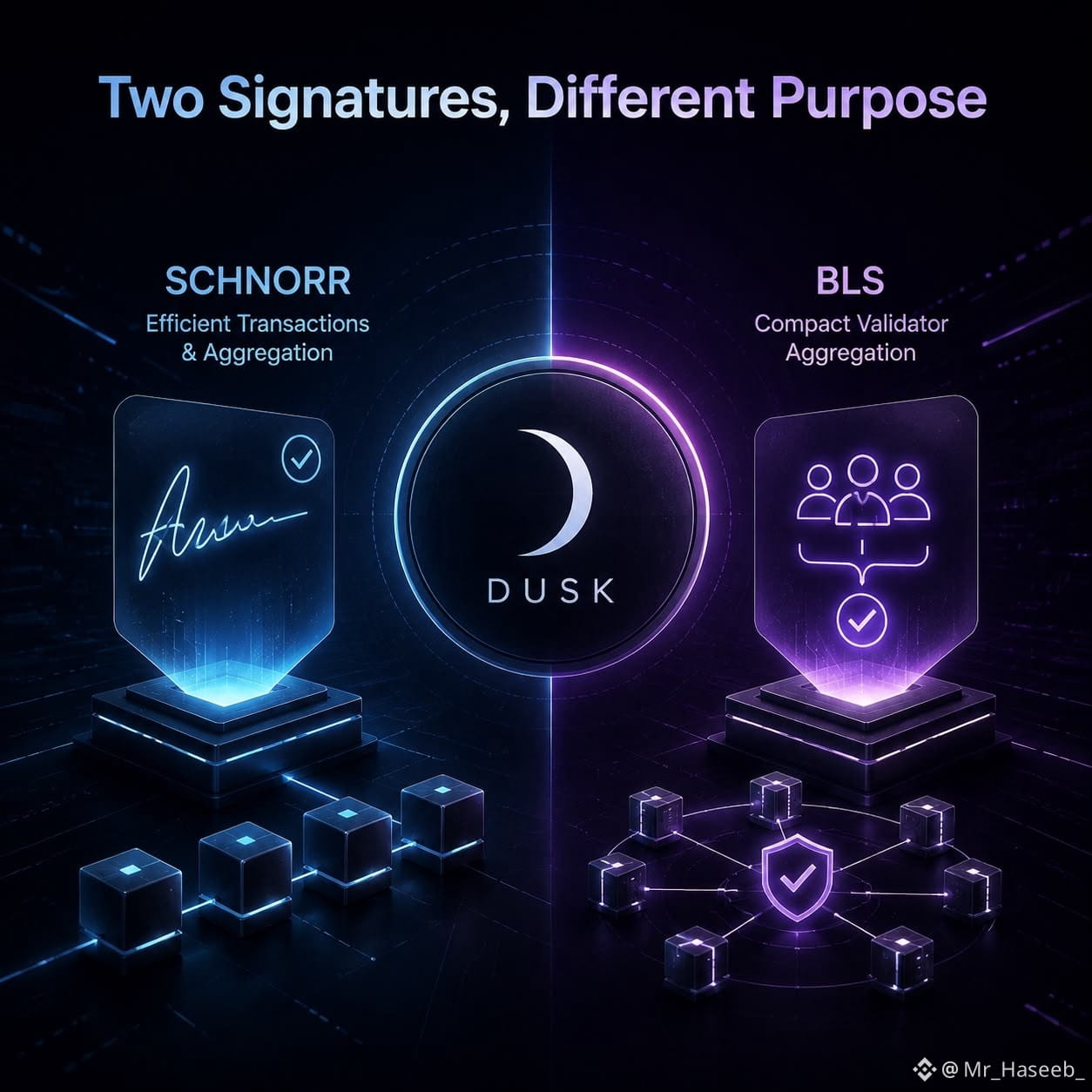
#dusk takes a different route. Its stack uses Schnorr and BLS signatures, because they fit different parts of the protocol rather than being treated as interchangeable tools. Dusk documents Schnorr as part of the foundation for signing and verifying protocol actions, while BLS12-381 is used where signature aggregation is valuable.
That distinction matters more than it first sounds. A less obvious detail is that Dusk’s consensus work has specifically dealt with aggregated agreement messages and optimizing BLS public-key handling.
My takeaway: this looks less like “two signature systems” and more like choosing the right tool for different verification workloads. BLS can reduce the data needed when signatures are aggregated, while Schnorr gives Dusk a compact signing scheme for other actions.
The trade-off is extra cryptographic complexity. But in a blockchain, one universal primitive isn’t automatically the simplest design. $DUSK @Dusk
That distinction matters more than it first sounds. A less obvious detail is that Dusk’s consensus work has specifically dealt with aggregated agreement messages and optimizing BLS public-key handling.
My takeaway: this looks less like “two signature systems” and more like choosing the right tool for different verification workloads. BLS can reduce the data needed when signatures are aggregated, while Schnorr gives Dusk a compact signing scheme for other actions.
The trade-off is extra cryptographic complexity. But in a blockchain, one universal primitive isn’t automatically the simplest design. $DUSK @Dusk
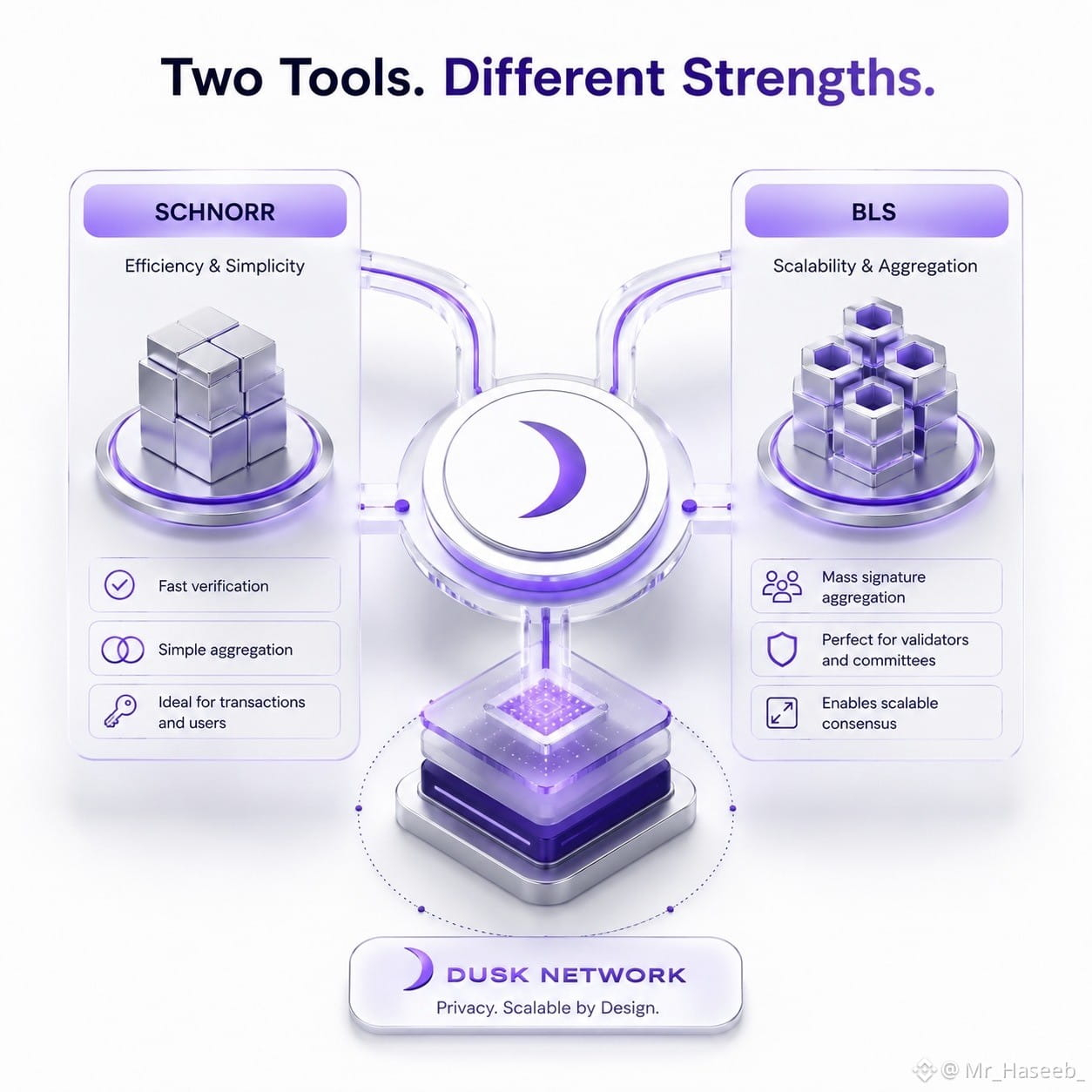
Using one hash function everywhere sounds simpler. DUSK deliberately doesn’t.
Dusk assigns Blake2b and Poseidon different jobs because ordinary blockchain computation and zero-knowledge proofs have different efficiency requirements.
Blake2b handles general-purpose hashing, including structures such as conventional Merkle trees. Poseidon is used where computations need to work efficiently inside zero-knowledge proofs, including ZK-friendly Merkle structures.
That separation is more important than it first appears.
A hash function that works well in normal software isn’t automatically efficient inside a zero-knowledge circuit. Forcing one algorithm across both environments could optimize simplicity at the expense of specialized performance.
So Dusk’s architecture effectively chooses the cryptographic tool according to the computational environment rather than demanding one primitive do everything.
It’s a small design decision, but it shows how deeply zero-knowledge requirements influence DUSK
infrastructure. #dusk $DUSK @Dusk
Dusk assigns Blake2b and Poseidon different jobs because ordinary blockchain computation and zero-knowledge proofs have different efficiency requirements.
Blake2b handles general-purpose hashing, including structures such as conventional Merkle trees. Poseidon is used where computations need to work efficiently inside zero-knowledge proofs, including ZK-friendly Merkle structures.
That separation is more important than it first appears.
A hash function that works well in normal software isn’t automatically efficient inside a zero-knowledge circuit. Forcing one algorithm across both environments could optimize simplicity at the expense of specialized performance.
So Dusk’s architecture effectively chooses the cryptographic tool according to the computational environment rather than demanding one primitive do everything.
It’s a small design decision, but it shows how deeply zero-knowledge requirements influence DUSK
infrastructure. #dusk $DUSK @Dusk
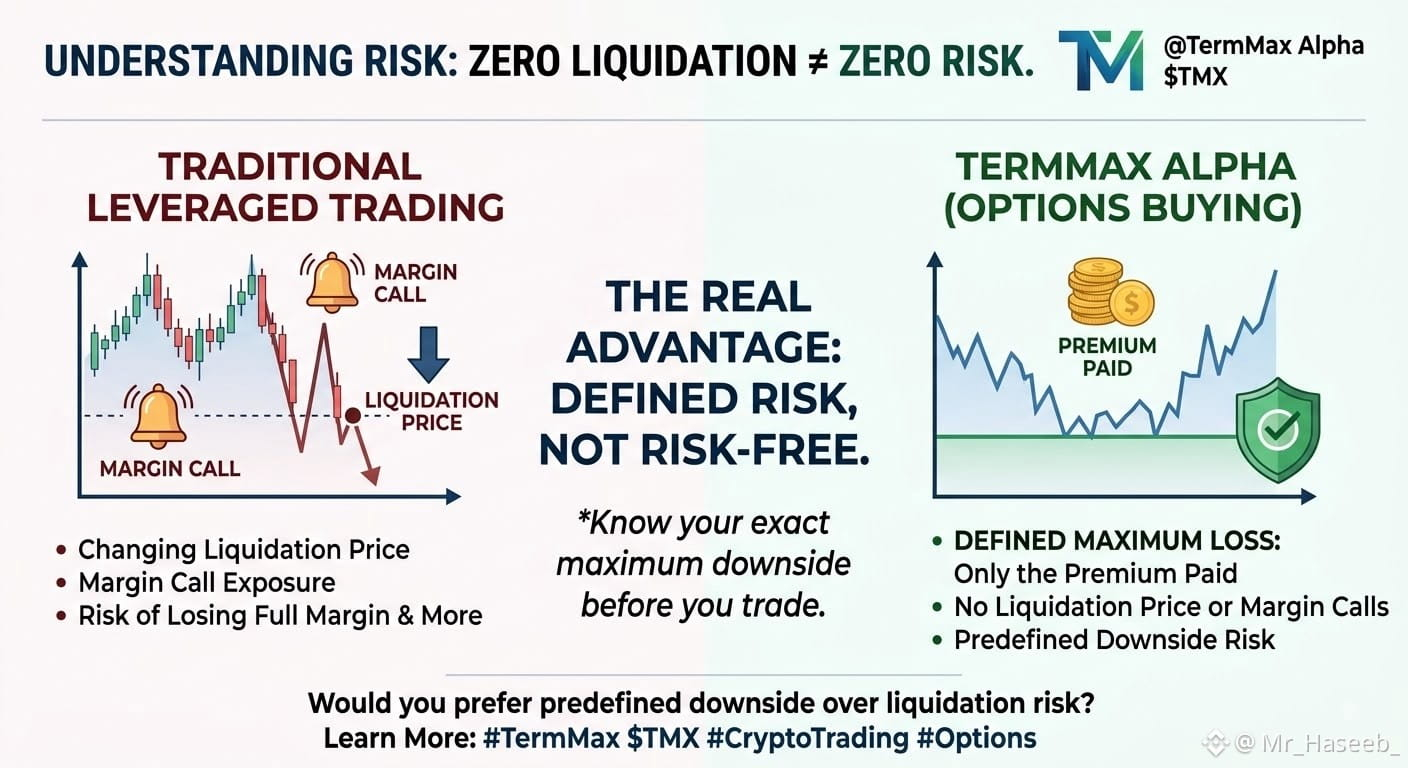
One of DUSK is more interesting design choices is hidden inside something called the Crossover note.
$DUSK operates across a private transactional layer and a generalized compute layer. The Crossover acts as the bridge between them: it carries a committed amount of DUSK from a transaction into contract execution, while the underlying value can remain protected through cryptographic commitments and encrypted data.
Why does this matter?
Private transfers and programmable contracts are far more useful when value can move between those environments without forcing the protocol to treat them as disconnected systems.
There is also a subtle efficiency detail: contract execution has a gas allowance, and unused allocated gas can be refunded through the transaction mechanism.
That makes Crossover less of a headline feature and more of an architectural connector — a small mechanism helping private value interact with programmable computation while preserving Dusk’s transaction model.
Sometimes the most important infrastructure is the part users never notice. #dusk $DUSK @Dusk
$DUSK operates across a private transactional layer and a generalized compute layer. The Crossover acts as the bridge between them: it carries a committed amount of DUSK from a transaction into contract execution, while the underlying value can remain protected through cryptographic commitments and encrypted data.
Why does this matter?
Private transfers and programmable contracts are far more useful when value can move between those environments without forcing the protocol to treat them as disconnected systems.
There is also a subtle efficiency detail: contract execution has a gas allowance, and unused allocated gas can be refunded through the transaction mechanism.
That makes Crossover less of a headline feature and more of an architectural connector — a small mechanism helping private value interact with programmable computation while preserving Dusk’s transaction model.
Sometimes the most important infrastructure is the part users never notice. #dusk $DUSK @Dusk
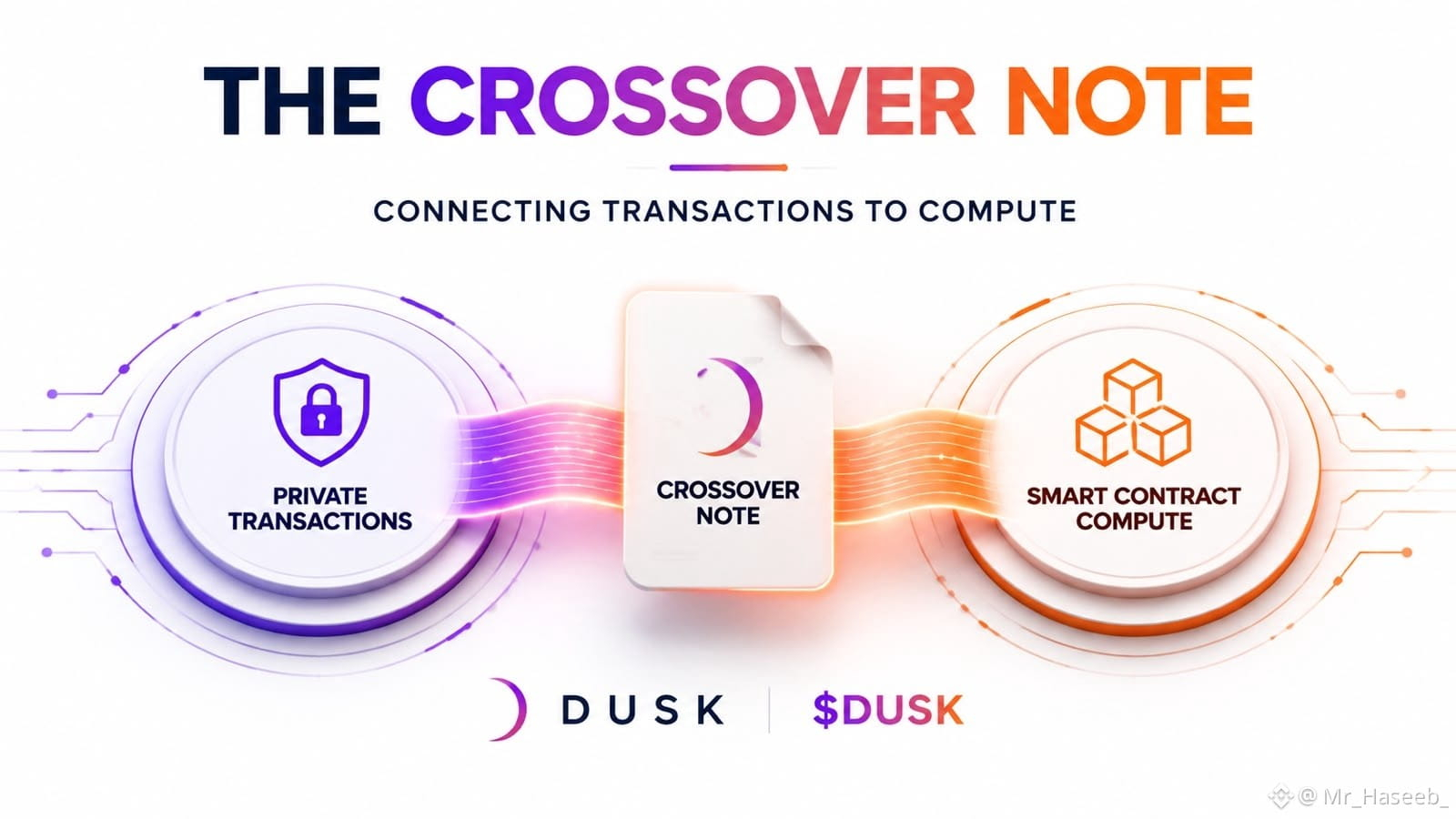
The Dusk campaign is getting interesting 👀
I’m not here to just farm points blindly. I’m trying to actually stay active and make every interaction count. Small moves add up.
A little engagement here. A bit of research there. Staying consistent instead of disappearing for days.
That’s the game I’m playing with Dusk. If you’re also farming points what’s your strategy? Are you going all in or taking the steady approach?
Let’s see who plays it smarter this time 🔥 #dusk $DUSK @Dusk
I’m not here to just farm points blindly. I’m trying to actually stay active and make every interaction count. Small moves add up.
A little engagement here. A bit of research there. Staying consistent instead of disappearing for days.
That’s the game I’m playing with Dusk. If you’re also farming points what’s your strategy? Are you going all in or taking the steady approach?
Let’s see who plays it smarter this time 🔥 #dusk $DUSK @Dusk
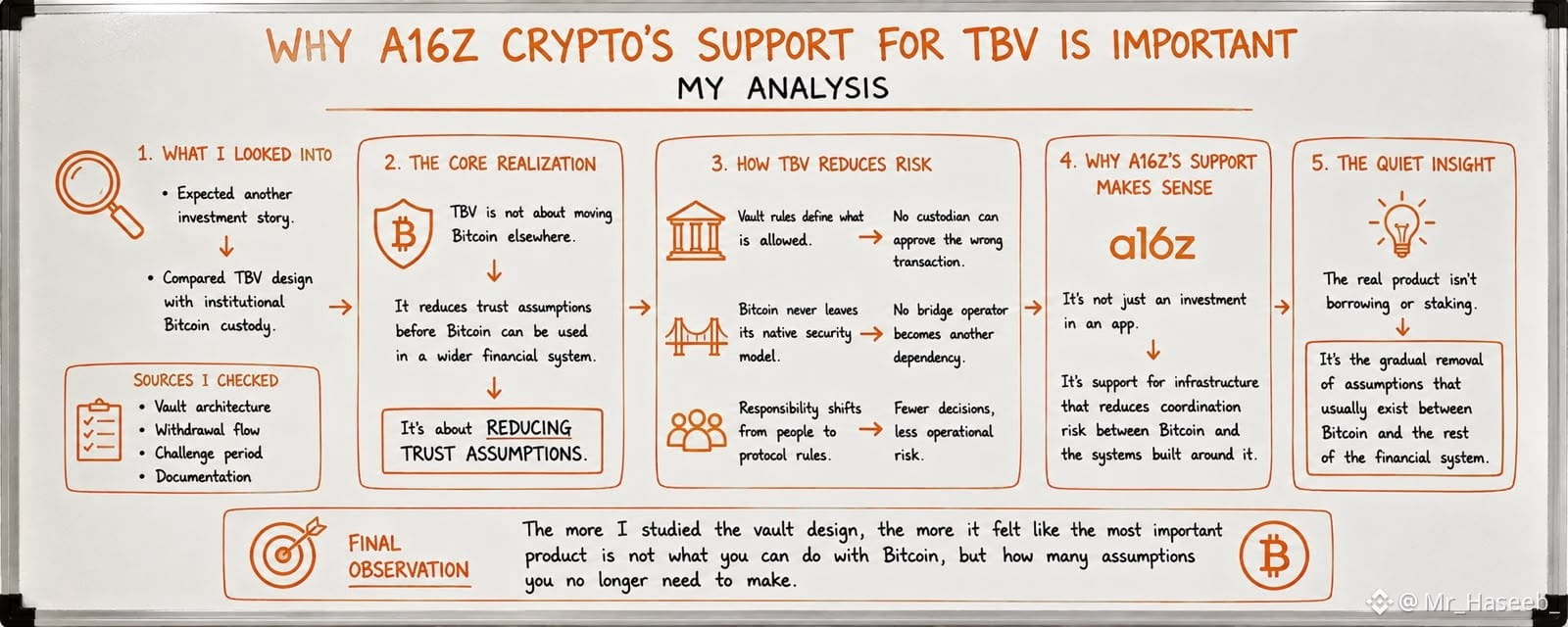
I started reading about a16z crypto supporting Babylon Trustless Bitcoin Vaults because I expected another investment story. Instead I kept comparing the vault design with the way institutions usually approach Bitcoin custody and one detail stayed with me.
TBV is not trying to make Bitcoin more productive by moving it somewhere else. It is trying to reduce how many trust assumptions exist before Bitcoin can be used inside a wider financial system. That became more interesting after I looked at the vault architecture alongside the withdrawal flow and the challenge period. Those parts only make sense when they are viewed as one security model instead of separate features.
The part I did not expect was how much operational risk depends on removing decisions that people normally have to make. A custodian cannot accidentally approve the wrong transaction if the vault rules already define what is allowed. A bridge operator cannot become another dependency if Bitcoin never leaves its native security model. That changes where responsibility sits inside the system.
After looking through the documentation again I stopped thinking about why a16z supported the project and started thinking about what they were actually supporting. The investment makes more sense if the long term opportunity is infrastructure that reduces coordination risk instead of another application that competes for liquidity. The more time I spent following the vault design the more it felt like the important product is not borrowing or staking. It is the gradual removal of assumptions that usually exist between Bitcoin and everything built around it. @BabylonLabs_io #baby $BABY
TBV is not trying to make Bitcoin more productive by moving it somewhere else. It is trying to reduce how many trust assumptions exist before Bitcoin can be used inside a wider financial system. That became more interesting after I looked at the vault architecture alongside the withdrawal flow and the challenge period. Those parts only make sense when they are viewed as one security model instead of separate features.
The part I did not expect was how much operational risk depends on removing decisions that people normally have to make. A custodian cannot accidentally approve the wrong transaction if the vault rules already define what is allowed. A bridge operator cannot become another dependency if Bitcoin never leaves its native security model. That changes where responsibility sits inside the system.
After looking through the documentation again I stopped thinking about why a16z supported the project and started thinking about what they were actually supporting. The investment makes more sense if the long term opportunity is infrastructure that reduces coordination risk instead of another application that competes for liquidity. The more time I spent following the vault design the more it felt like the important product is not borrowing or staking. It is the gradual removal of assumptions that usually exist between Bitcoin and everything built around it. @BabylonLabs_io #baby $BABY
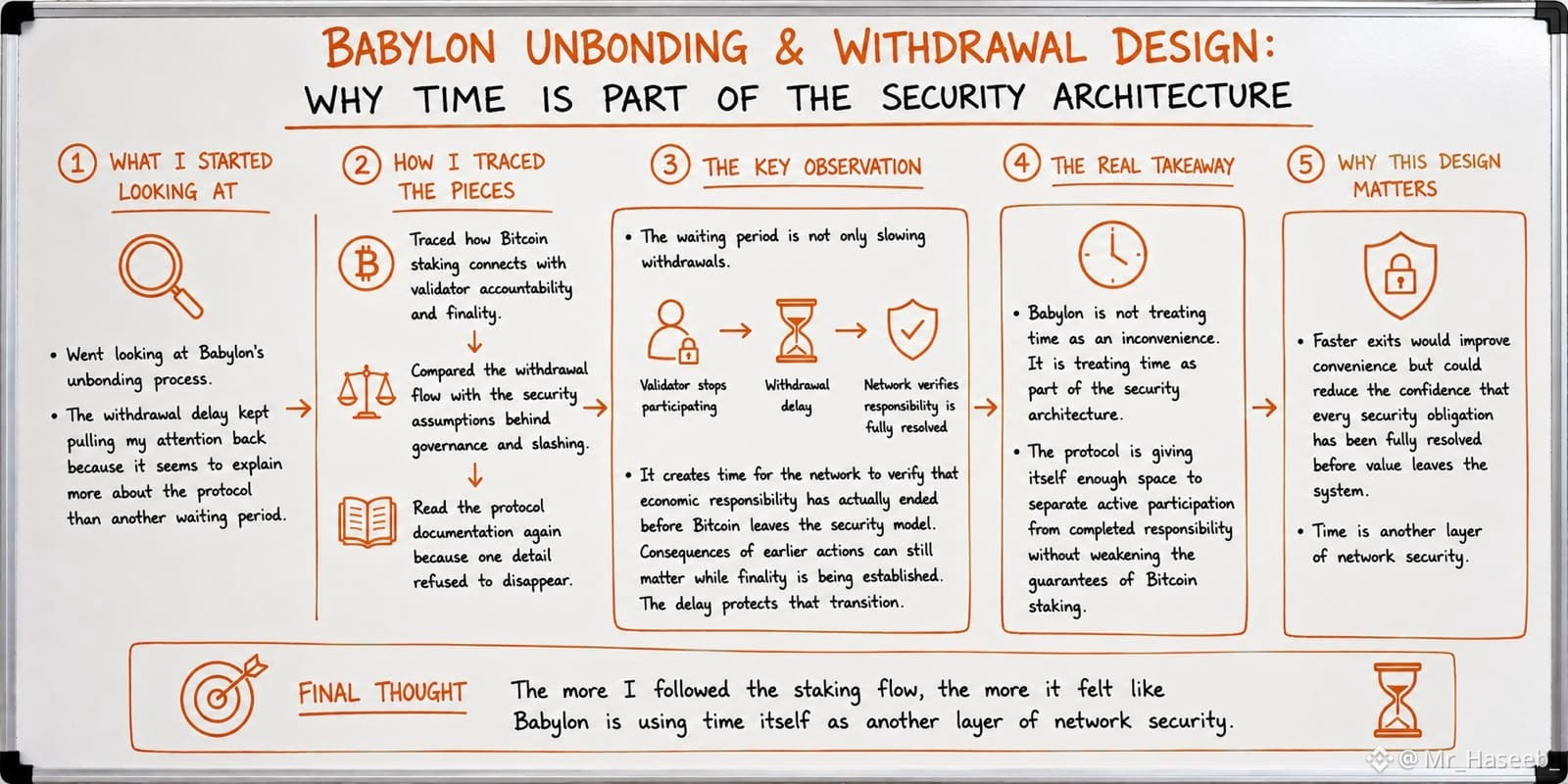
Went looking at Babylon’s unbonding process and ended up thinking about something much quieter. The withdrawal delay kept pulling my attention back because it seems to explain more about the protocol than another waiting period.
I started tracing how Bitcoin staking connects with validator accountability and finality. Then I compared the withdrawal flow with the security assumptions behind governance and slashing. After that I found myself reading the protocol documentation again because one detail refused to disappear.
The interesting part is that the waiting period is not only slowing withdrawals. It creates time for the network to verify that economic responsibility has actually ended before Bitcoin leaves the security model. A validator may stop participating but the consequences of earlier actions can still matter while finality is being established. The delay protects that transition instead of simply delaying access to funds.
That slowly became the real observation. Babylon is not treating time as an inconvenience. It is treating time as part of the security architecture. The protocol is giving itself enough space to separate active participation from completed responsibility without weakening the guarantees that Bitcoin staking is supposed to provide.
Maybe that is why the withdrawal design feels more deliberate than restrictive. Faster exits would improve convenience but they could also reduce the confidence that every security obligation has been fully resolved before value leaves the system.
The more I followed the staking flow the more it felt like Babylon is using time itself as another layer of network security. @BabylonLabs_io #baby $BABY
I started tracing how Bitcoin staking connects with validator accountability and finality. Then I compared the withdrawal flow with the security assumptions behind governance and slashing. After that I found myself reading the protocol documentation again because one detail refused to disappear.
The interesting part is that the waiting period is not only slowing withdrawals. It creates time for the network to verify that economic responsibility has actually ended before Bitcoin leaves the security model. A validator may stop participating but the consequences of earlier actions can still matter while finality is being established. The delay protects that transition instead of simply delaying access to funds.
That slowly became the real observation. Babylon is not treating time as an inconvenience. It is treating time as part of the security architecture. The protocol is giving itself enough space to separate active participation from completed responsibility without weakening the guarantees that Bitcoin staking is supposed to provide.
Maybe that is why the withdrawal design feels more deliberate than restrictive. Faster exits would improve convenience but they could also reduce the confidence that every security obligation has been fully resolved before value leaves the system.
The more I followed the staking flow the more it felt like Babylon is using time itself as another layer of network security. @BabylonLabs_io #baby $BABY
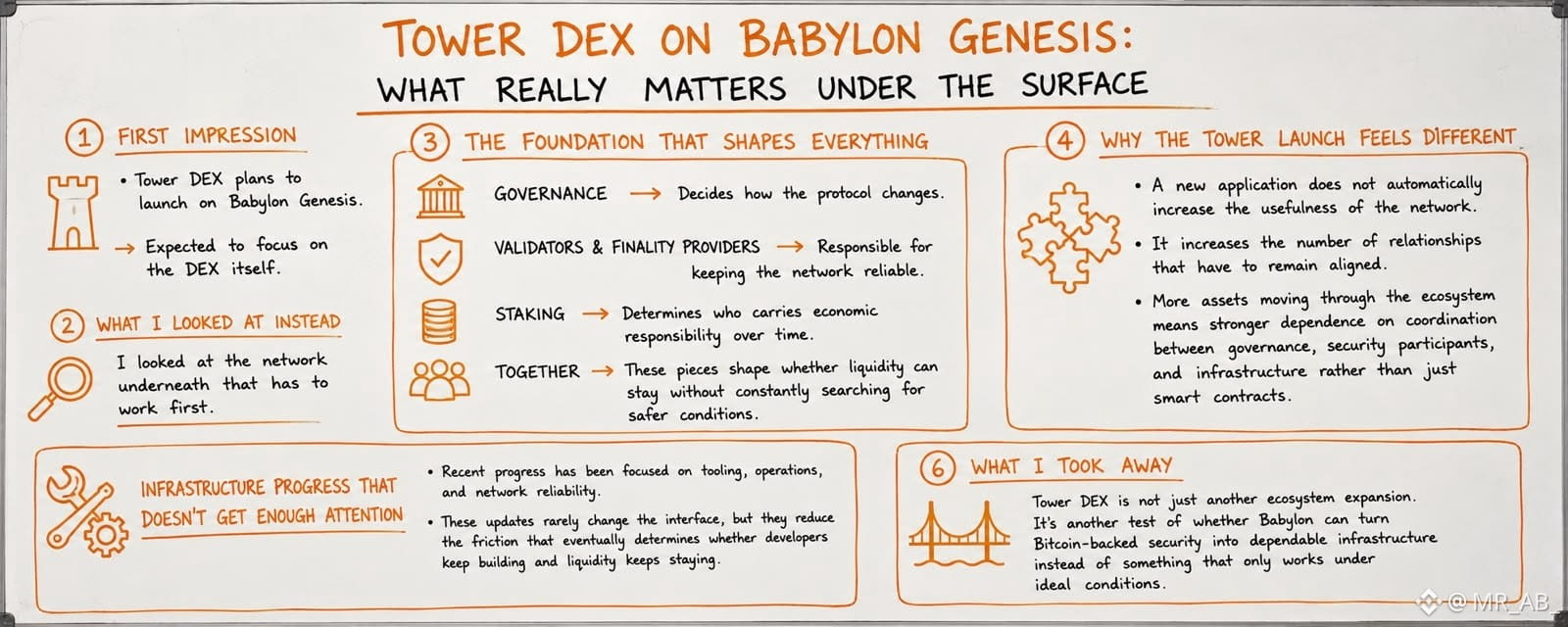
While going through the Tower DEX announcement I expected to spend most of my time thinking about the exchange itself. What ended up holding my attention was everything underneath it that has to work first.
A DEX is usually discussed in terms of trading volume and liquidity. After reading more about Babylon I started looking at the network underneath instead. Governance decides how the protocol changes. Validators and finality providers are responsible for keeping the network reliable. Staking determines who carries economic responsibility over time. None of those pieces look exciting on their own but together they shape whether liquidity can stay where it is without constantly searching for safer conditions.
That made the Tower announcement feel different. A new application does not automatically increase the usefulness of the network. It increases the number of relationships that have to remain aligned. More assets moving through the ecosystem means stronger dependence on coordination between governance security participants and infrastructure rather than just smart contracts.
I also noticed how much of the recent progress has been focused on tooling operations and network reliability instead of features users immediately see. Those updates are easy to ignore because they rarely change the interface but they reduce the friction that eventually determines whether developers keep building and liquidity keeps staying.
After connecting those pieces I stopped seeing Tower DEX as another ecosystem expansion. It looked more like another test of whether Babylon can turn Bitcoin backed security into dependable infrastructure instead of something that only works under ideal conditions. #baby $BABY @BabylonLabs_io
A DEX is usually discussed in terms of trading volume and liquidity. After reading more about Babylon I started looking at the network underneath instead. Governance decides how the protocol changes. Validators and finality providers are responsible for keeping the network reliable. Staking determines who carries economic responsibility over time. None of those pieces look exciting on their own but together they shape whether liquidity can stay where it is without constantly searching for safer conditions.
That made the Tower announcement feel different. A new application does not automatically increase the usefulness of the network. It increases the number of relationships that have to remain aligned. More assets moving through the ecosystem means stronger dependence on coordination between governance security participants and infrastructure rather than just smart contracts.
I also noticed how much of the recent progress has been focused on tooling operations and network reliability instead of features users immediately see. Those updates are easy to ignore because they rarely change the interface but they reduce the friction that eventually determines whether developers keep building and liquidity keeps staying.
After connecting those pieces I stopped seeing Tower DEX as another ecosystem expansion. It looked more like another test of whether Babylon can turn Bitcoin backed security into dependable infrastructure instead of something that only works under ideal conditions. #baby $BABY @BabylonLabs_io
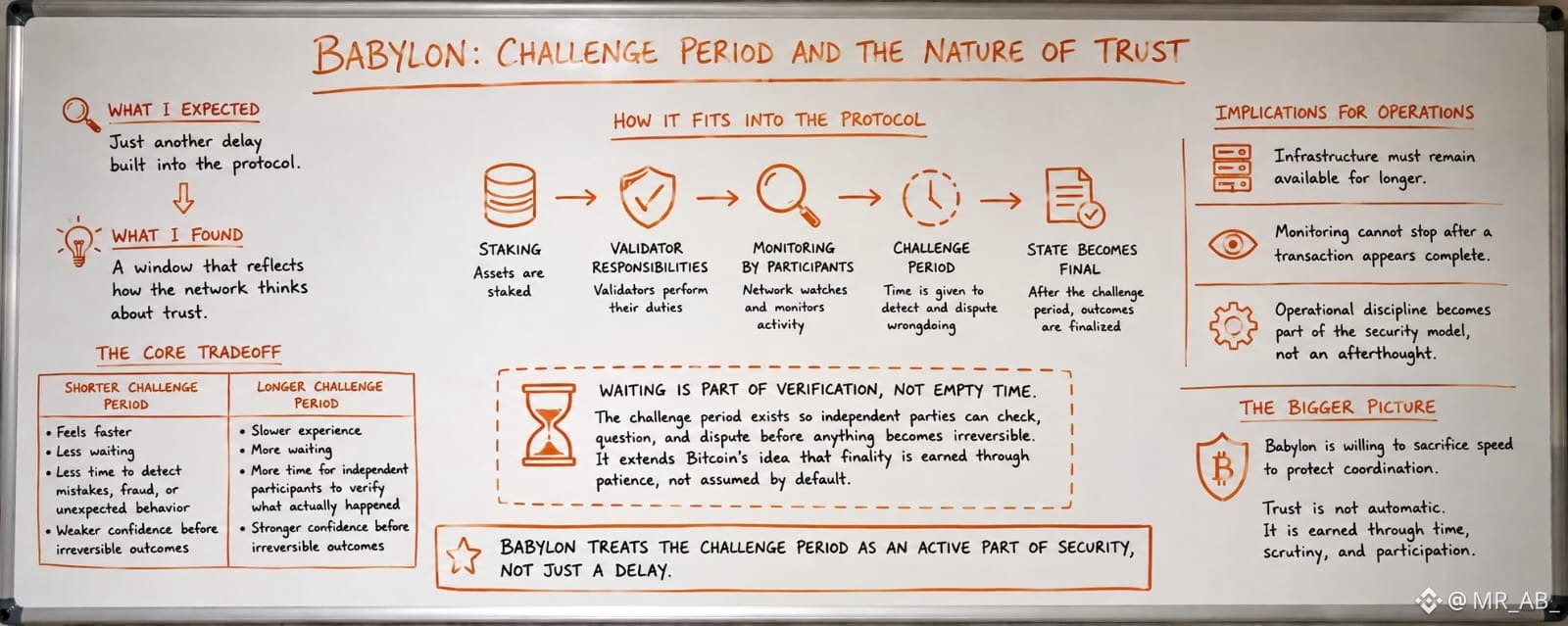
I thought the interesting part would be Babylon's challenge period. It turned out to be what the waiting time says about the network's view of trust.
I started by reading how the challenge period works. At first it looked like another delay built into the protocol. Then I compared it with the staking flow the validator responsibilities and the way disputes are handled. The pattern became much harder to ignore.
A shorter challenge period would make the system feel faster. It would also reduce the amount of time available to detect mistakes fraud or unexpected behavior before state changes become final. A longer one slows everything down but gives independent participants more room to verify what actually happened. That tradeoff is not about user experience. It is about how much confidence the protocol requires before it accepts irreversible outcomes.
The more I read the more it seemed that Babylon is willing to sacrifice speed to protect coordination. Bitcoin already teaches that finality is something earned through patience instead of assumed by default. The challenge period extends that same idea into the protocol itself.
What also stood out was how this interacts with validator operations. Infrastructure has to remain available for longer. Monitoring cannot stop after a transaction appears complete. Operational discipline becomes part of the security model instead of an afterthought.
I expected to learn about a security feature. I ended up seeing a protocol that treats waiting as an active part of verification rather than empty time.#baby $BABY @BabylonLabs_io
I started by reading how the challenge period works. At first it looked like another delay built into the protocol. Then I compared it with the staking flow the validator responsibilities and the way disputes are handled. The pattern became much harder to ignore.
A shorter challenge period would make the system feel faster. It would also reduce the amount of time available to detect mistakes fraud or unexpected behavior before state changes become final. A longer one slows everything down but gives independent participants more room to verify what actually happened. That tradeoff is not about user experience. It is about how much confidence the protocol requires before it accepts irreversible outcomes.
The more I read the more it seemed that Babylon is willing to sacrifice speed to protect coordination. Bitcoin already teaches that finality is something earned through patience instead of assumed by default. The challenge period extends that same idea into the protocol itself.
What also stood out was how this interacts with validator operations. Infrastructure has to remain available for longer. Monitoring cannot stop after a transaction appears complete. Operational discipline becomes part of the security model instead of an afterthought.
I expected to learn about a security feature. I ended up seeing a protocol that treats waiting as an active part of verification rather than empty time.#baby $BABY @BabylonLabs_io
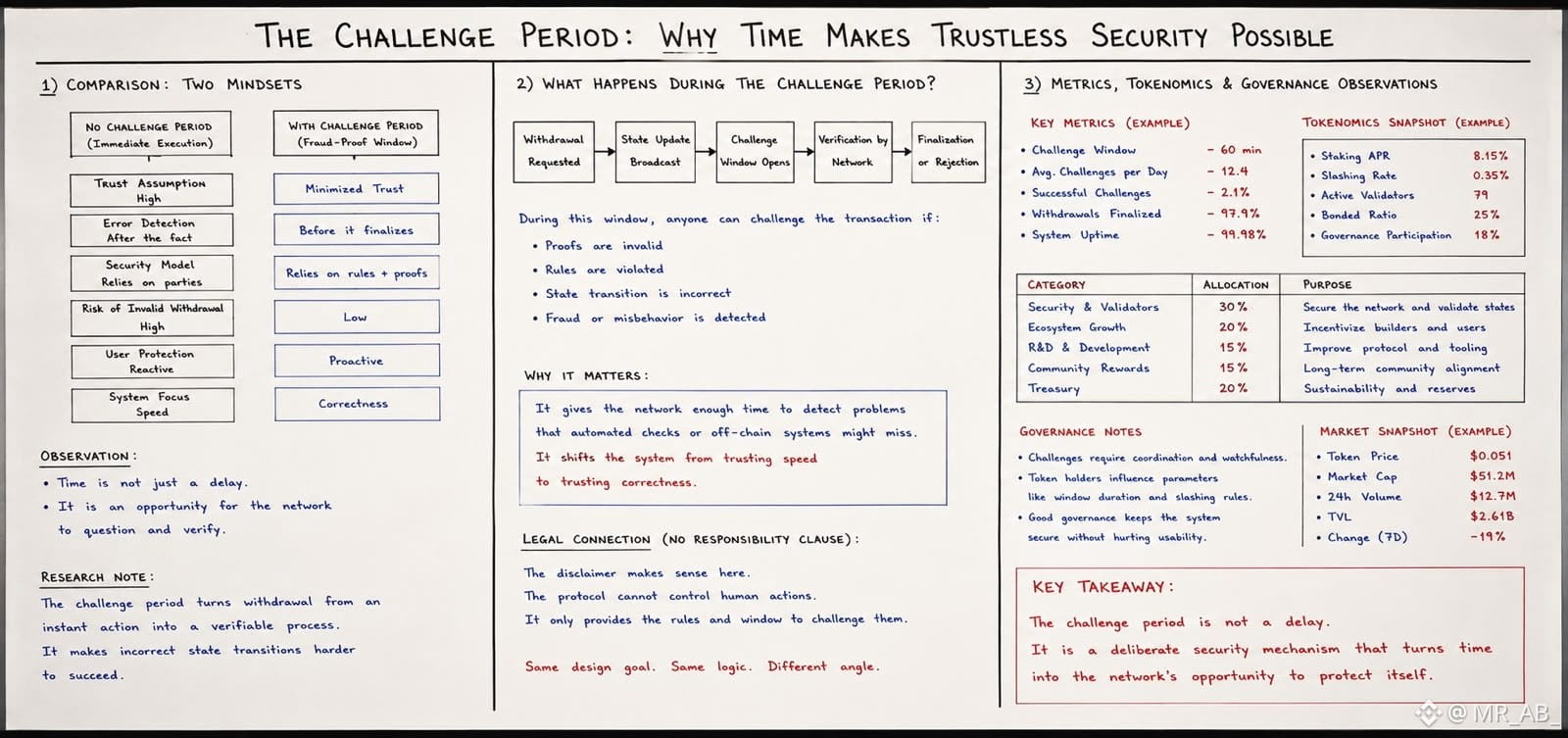
I expected the withdrawal delay to be the least interesting part of Babylon’s design. Instead, I kept coming back to the challenge period because it quietly explains how the protocol decides when it should refuse to trust itself.
At first the delay looked like a simple waiting period before Bitcoin could leave the vault. Then I started reading it together with the verification rules and fraud-proof mechanism. Those looked like separate components until I realized they were solving the same problem from different directions.
A challenge period is not simply extra time before redemption. It creates an opportunity for the protocol to reject invalid state transitions before they become final. Instead of assuming every withdrawal request is correct, the system assumes it can still be questioned until the verification window closes. That changes the role of time from being an inconvenience into becoming part of the security model.
That also explains why Babylon combines cryptographic proofs with predefined verification rules instead of relying on immediate execution. The protocol is not trying to make withdrawals as fast as possible. It is trying to make incorrect withdrawals as difficult as possible. The waiting period exists because security sometimes depends on giving the network enough time to prove that something should not happen.
The more I thought about it, the more the challenge period felt like an engineering solution rather than a user experience feature. Speed is measured in minutes or hours, but confidence is measured by how many opportunities the system has to detect mistakes before assets move.
The most interesting part was realizing that the delay is not a compromise with trustlessness. It is one of the mechanisms that makes trustlessness believable in the first place. #baby $BABY @BabylonLabs_io
At first the delay looked like a simple waiting period before Bitcoin could leave the vault. Then I started reading it together with the verification rules and fraud-proof mechanism. Those looked like separate components until I realized they were solving the same problem from different directions.
A challenge period is not simply extra time before redemption. It creates an opportunity for the protocol to reject invalid state transitions before they become final. Instead of assuming every withdrawal request is correct, the system assumes it can still be questioned until the verification window closes. That changes the role of time from being an inconvenience into becoming part of the security model.
That also explains why Babylon combines cryptographic proofs with predefined verification rules instead of relying on immediate execution. The protocol is not trying to make withdrawals as fast as possible. It is trying to make incorrect withdrawals as difficult as possible. The waiting period exists because security sometimes depends on giving the network enough time to prove that something should not happen.
The more I thought about it, the more the challenge period felt like an engineering solution rather than a user experience feature. Speed is measured in minutes or hours, but confidence is measured by how many opportunities the system has to detect mistakes before assets move.
The most interesting part was realizing that the delay is not a compromise with trustlessness. It is one of the mechanisms that makes trustlessness believable in the first place. #baby $BABY @BabylonLabs_io
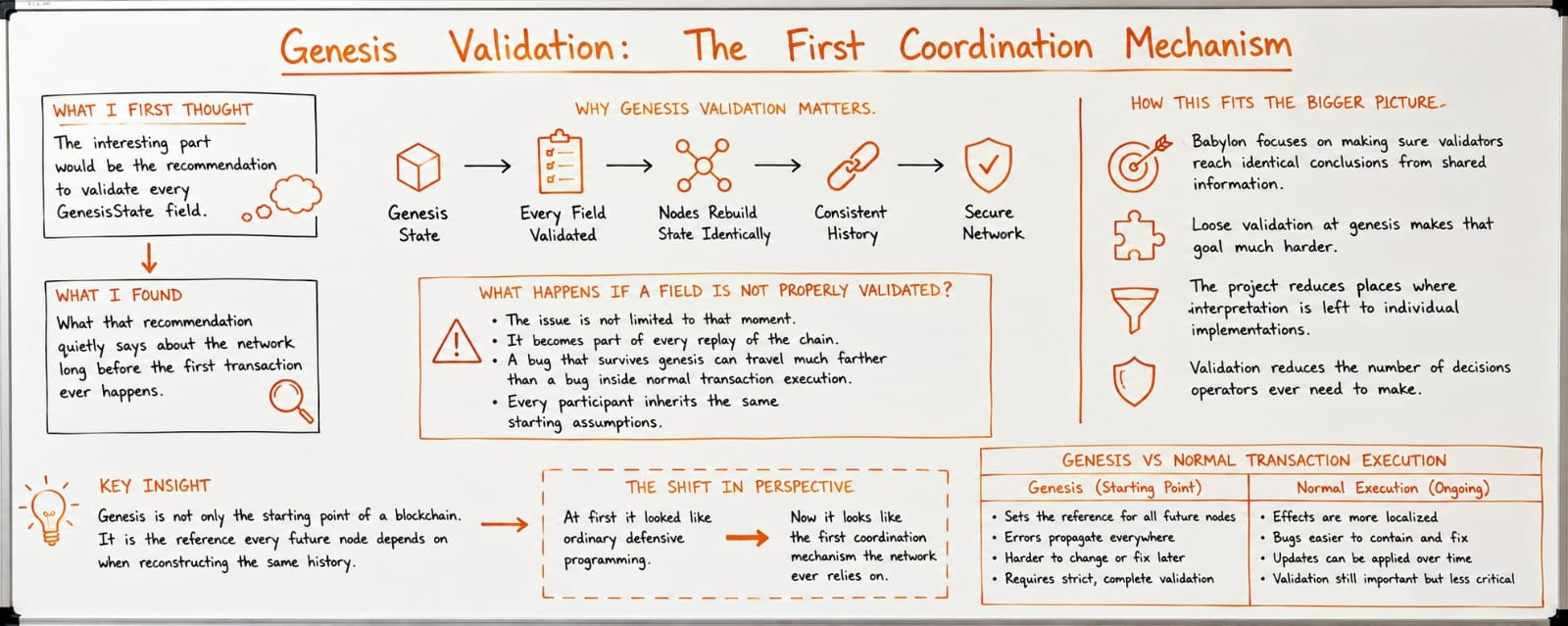
I thought the interesting part would be the recommendation to validate every GenesisState field. It turned out to be what that recommendation quietly says about the network long before the first transaction ever happens.
At first it looked like ordinary defensive programming. Then I spent more time comparing the validation logic with checkpoint handling and the way nodes rebuild state from genesis. That changed how I looked at it.
Genesis is not only the starting point of a blockchain. It is the reference every future node depends on when reconstructing the same history. If one field slips through without proper validation the problem is not limited to that moment. It becomes part of every replay of the chain. A bug that survives genesis can travel much farther than a bug inside normal transaction execution because every participant inherits the same starting assumptions.
That became even more interesting after reading the security notes alongside the emphasis on checkpoint consistency and deterministic state reconstruction. Babylon spends a lot of effort making sure validators reach identical conclusions from shared information. That goal becomes harder if the very first state contains values that were never checked as carefully as later updates.
I also noticed how this fits with the broader pattern in the codebase. The project keeps reducing places where interpretation is left to individual implementations. Validation is doing more than rejecting bad data. It is reducing the number of decisions operators ever need to make.
The more I read the less Genesis looked like initialization. It started looking like the first coordination mechanism the network ever relies on.#baby $BABY @BabylonLabs_io
At first it looked like ordinary defensive programming. Then I spent more time comparing the validation logic with checkpoint handling and the way nodes rebuild state from genesis. That changed how I looked at it.
Genesis is not only the starting point of a blockchain. It is the reference every future node depends on when reconstructing the same history. If one field slips through without proper validation the problem is not limited to that moment. It becomes part of every replay of the chain. A bug that survives genesis can travel much farther than a bug inside normal transaction execution because every participant inherits the same starting assumptions.
That became even more interesting after reading the security notes alongside the emphasis on checkpoint consistency and deterministic state reconstruction. Babylon spends a lot of effort making sure validators reach identical conclusions from shared information. That goal becomes harder if the very first state contains values that were never checked as carefully as later updates.
I also noticed how this fits with the broader pattern in the codebase. The project keeps reducing places where interpretation is left to individual implementations. Validation is doing more than rejecting bad data. It is reducing the number of decisions operators ever need to make.
The more I read the less Genesis looked like initialization. It started looking like the first coordination mechanism the network ever relies on.#baby $BABY @BabylonLabs_io
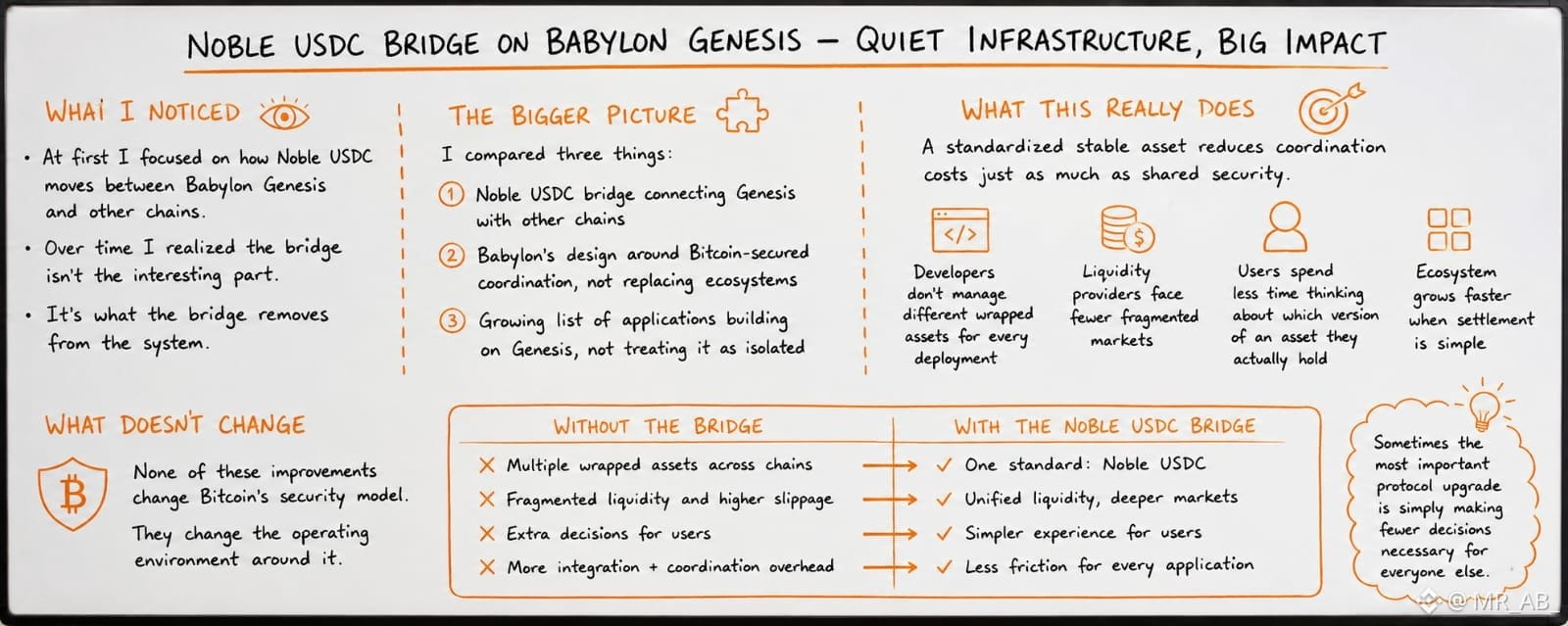
I kept looking into how Noble USDC moves between Babylon Genesis and other chains. After a while I realized the transfers were not the part holding my attention. It was everything the bridge quietly removes from the system.
Babylon is usually discussed through Bitcoin staking and finality. Those are the parts that attract attention. But once a network begins moving stable liquidity across ecosystems the operational picture changes. Security can exist without usable liquidity but an ecosystem cannot grow very far if every application has to solve settlement differently.
That made me compare three separate pieces. First was the Noble USDC bridge connecting Genesis with other chains. Second was Babylon's design around Bitcoin secured coordination rather than replacing existing ecosystems. Third was the growing list of applications building on Genesis instead of treating it as an isolated chain.
The interesting part is that a standardized stable asset reduces coordination costs just as much as shared security does. Developers no longer need to manage different wrapped assets for every deployment. Liquidity providers face fewer fragmented markets. Users spend less time thinking about which version of an asset they actually hold before interacting with an application.
None of those improvements change Bitcoin's security model. They change the operating environment around it.
I expected the bridge to be another interoperability feature. Instead it looked more like infrastructure that quietly removes friction from every application built after it. Sometimes the most important protocol upgrade is simply making fewer decisions necessary for everyone else. #baby $BABY @BabylonLabs_io
Babylon is usually discussed through Bitcoin staking and finality. Those are the parts that attract attention. But once a network begins moving stable liquidity across ecosystems the operational picture changes. Security can exist without usable liquidity but an ecosystem cannot grow very far if every application has to solve settlement differently.
That made me compare three separate pieces. First was the Noble USDC bridge connecting Genesis with other chains. Second was Babylon's design around Bitcoin secured coordination rather than replacing existing ecosystems. Third was the growing list of applications building on Genesis instead of treating it as an isolated chain.
The interesting part is that a standardized stable asset reduces coordination costs just as much as shared security does. Developers no longer need to manage different wrapped assets for every deployment. Liquidity providers face fewer fragmented markets. Users spend less time thinking about which version of an asset they actually hold before interacting with an application.
None of those improvements change Bitcoin's security model. They change the operating environment around it.
I expected the bridge to be another interoperability feature. Instead it looked more like infrastructure that quietly removes friction from every application built after it. Sometimes the most important protocol upgrade is simply making fewer decisions necessary for everyone else. #baby $BABY @BabylonLabs_io
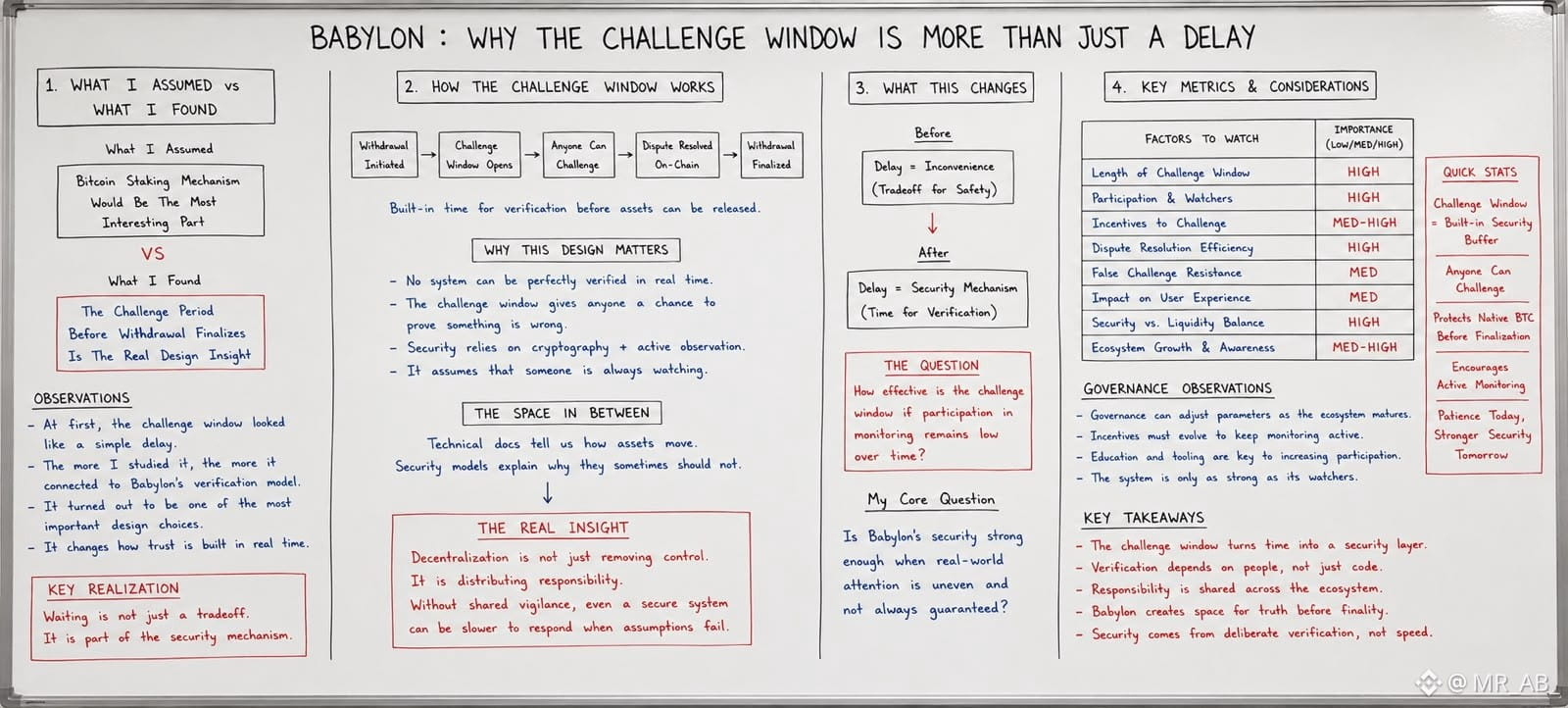
I expected the Bitcoin staking mechanism to be the most interesting part of Babylon. Instead I kept thinking about the challenge period before a withdrawal is finalized. At first it looked like nothing more than a waiting period. The more I explored the protocol the more I realized it plays a much bigger role in the security model.
Technical documents often explain how assets move. Security models explain why assets sometimes should not move yet. The space between those ideas is where verification quietly replaces trust.
Babylon keeps Bitcoin native while allowing it to interact with another network. At the same time it accepts that no verification system can confirm everything instantly. The challenge window gives anyone the chance to prove that something is wrong before a withdrawal becomes final. This means security depends on cryptography and on people who actively watch the network and respond when needed.
That changed the way I looked at decentralization. It is not only about removing central control. It is also about sharing responsibility across many participants. The protocol works best when independent observers continue checking that the rules are being followed and remain ready to challenge unexpected behavior before value leaves the system.
The waiting period no longer feels like a compromise. It becomes part of the protection itself because it gives the network enough time to verify events before value is released.
I started reading about Bitcoin backed liquidity but I ended up thinking about patience instead.
The more I explored Babylon the more I felt that its strongest security feature is not speed. It is the careful way the protocol creates time for verification before irreversible actions take place. Sometimes the strongest protection comes from giving the network enough time to question itself before making a permanent decision for everyone involved together. #baby $BABY #on $ON #Coti $COTI @BabylonLabs_io #USTreasuryYieldsRetreat #BitcoinRecoversFromAsianSessionLows
Technical documents often explain how assets move. Security models explain why assets sometimes should not move yet. The space between those ideas is where verification quietly replaces trust.
Babylon keeps Bitcoin native while allowing it to interact with another network. At the same time it accepts that no verification system can confirm everything instantly. The challenge window gives anyone the chance to prove that something is wrong before a withdrawal becomes final. This means security depends on cryptography and on people who actively watch the network and respond when needed.
That changed the way I looked at decentralization. It is not only about removing central control. It is also about sharing responsibility across many participants. The protocol works best when independent observers continue checking that the rules are being followed and remain ready to challenge unexpected behavior before value leaves the system.
The waiting period no longer feels like a compromise. It becomes part of the protection itself because it gives the network enough time to verify events before value is released.
I started reading about Bitcoin backed liquidity but I ended up thinking about patience instead.
The more I explored Babylon the more I felt that its strongest security feature is not speed. It is the careful way the protocol creates time for verification before irreversible actions take place. Sometimes the strongest protection comes from giving the network enough time to question itself before making a permanent decision for everyone involved together. #baby $BABY #on $ON #Coti $COTI @BabylonLabs_io #USTreasuryYieldsRetreat #BitcoinRecoversFromAsianSessionLows
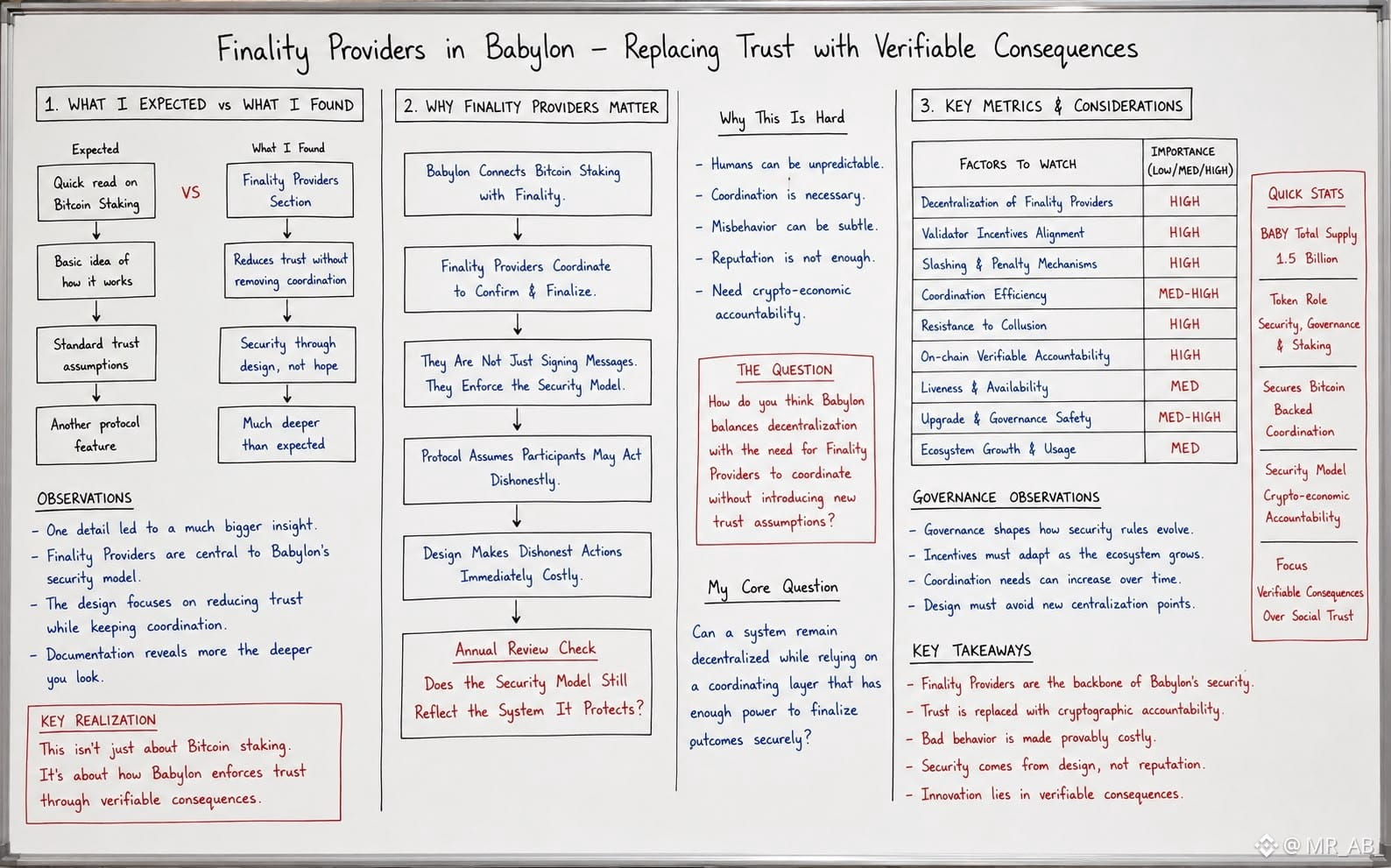
I opened Babylon expecting to spend a few minutes reading about Bitcoin staking, but one small detail kept pulling me in. The section describing Finality Providers ended up being far more interesting than I expected because it explains how trust is reduced without trying to remove coordination altogether.
I started following how Bitcoin staking connects with finality, then traced the role of Finality Providers across the protocol. After that I found myself reading the same documentation twice because one idea kept coming back in a different way.
What stood out is that Finality Providers are not simply signing messages. They become part of a security model where honest behavior is encouraged through cryptographic accountability rather than reputation alone. The interesting part is that the protocol assumes participants may eventually act against the network, so the design focuses on making dishonest actions immediately costly instead of hoping they never happen.
That changed how I looked at the system. Babylon is not only extending Bitcoin’s security to other networks. It is also trying to replace trust with verifiable consequences, where the protocol itself enforces the rules instead of relying on human intervention whenever something goes wrong.
It makes me wonder whether the real innovation is not Bitcoin staking itself, but the idea that security can come from making bad behavior mathematically provable instead of socially debatable. As the network grows and more participants join, that principle may become even more valuable than any single feature.
How do you think Babylon balances decentralization with the need for Finality Providers to coordinate without introducing new trust assumptions?
#baby $BABY #on $ON #AKE $LA #la #WTICrudeFuturesFall8% @BabylonLabs_io
I started following how Bitcoin staking connects with finality, then traced the role of Finality Providers across the protocol. After that I found myself reading the same documentation twice because one idea kept coming back in a different way.
What stood out is that Finality Providers are not simply signing messages. They become part of a security model where honest behavior is encouraged through cryptographic accountability rather than reputation alone. The interesting part is that the protocol assumes participants may eventually act against the network, so the design focuses on making dishonest actions immediately costly instead of hoping they never happen.
That changed how I looked at the system. Babylon is not only extending Bitcoin’s security to other networks. It is also trying to replace trust with verifiable consequences, where the protocol itself enforces the rules instead of relying on human intervention whenever something goes wrong.
It makes me wonder whether the real innovation is not Bitcoin staking itself, but the idea that security can come from making bad behavior mathematically provable instead of socially debatable. As the network grows and more participants join, that principle may become even more valuable than any single feature.
How do you think Babylon balances decentralization with the need for Finality Providers to coordinate without introducing new trust assumptions?
#baby $BABY #on $ON #AKE $LA #la #WTICrudeFuturesFall8% @BabylonLabs_io
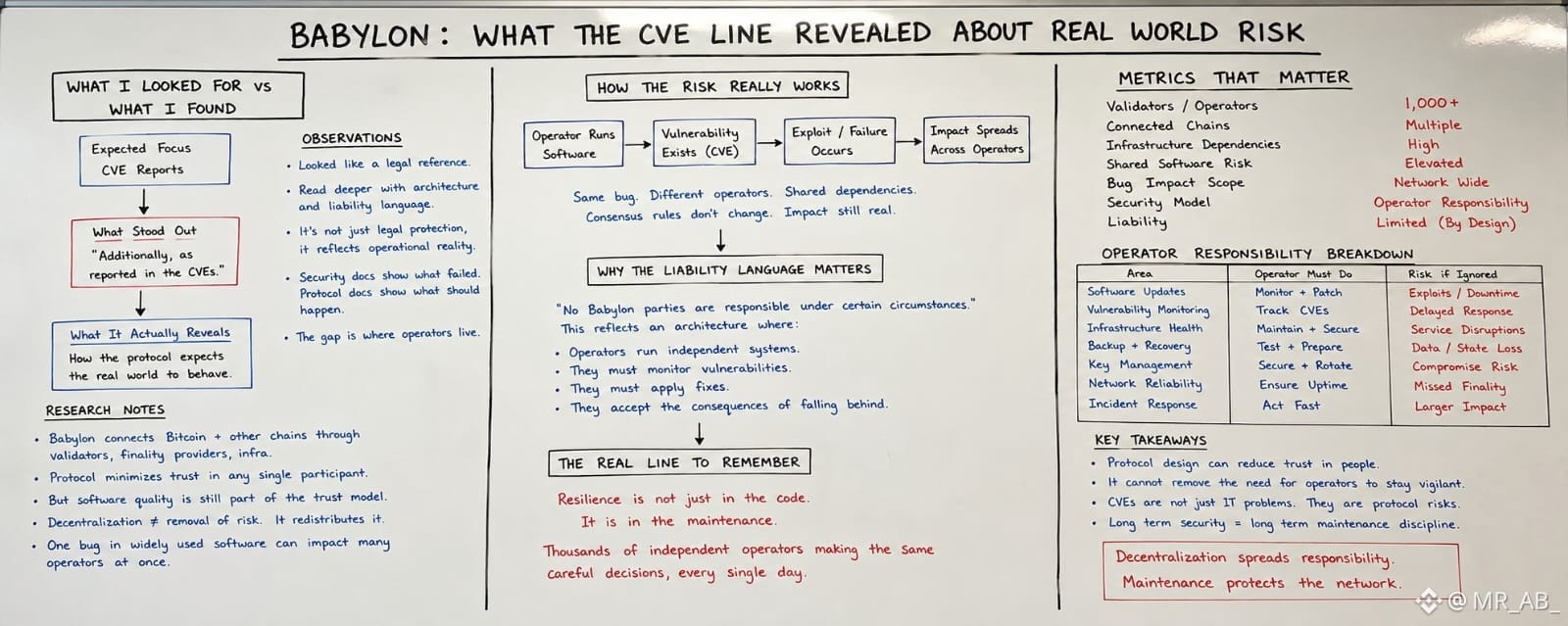
I thought the interesting part would be the CVE reports. Instead I kept coming back to one sentence that looked almost routine. "Additionally, as reported in the CVEs." It sounded like a legal reference at first, but after reading it alongside Babylon's architecture and liability language, it started to feel like a window into how the protocol expects the real world to behave.
Security documents usually describe what failed. Protocol documentation usually describes what should happen. The gap between those two is where operators actually live.
Babylon asks validators, finality providers, and supporting infrastructure to coordinate across Bitcoin and another network while remaining available under difficult conditions. That means software quality becomes part of the trust model even when the protocol itself is designed to minimize trust in any single participant.
The CVE references reminded me that decentralization does not remove operational risk. It redistributes it. One implementation bug can affect multiple operators at the same time if they depend on similar software, even though the consensus rules remain unchanged.
That also made the legal disclaimer look different. Saying that no Babylon parties are responsible under certain circumstances is not simply about limiting liability. It reflects an architecture where security depends on independent operators maintaining their own systems, monitoring vulnerabilities, applying fixes, and accepting the consequences of falling behind.
I went looking for protocol economics. I ended up thinking about maintenance instead.
The longer I read, the more it seemed that resilience is determined less by elegant consensus rules and more by whether thousands of independent operators keep making the same careful decisions long after the launch excitement fades. #baby $BABY @BabylonLabs_io
Security documents usually describe what failed. Protocol documentation usually describes what should happen. The gap between those two is where operators actually live.
Babylon asks validators, finality providers, and supporting infrastructure to coordinate across Bitcoin and another network while remaining available under difficult conditions. That means software quality becomes part of the trust model even when the protocol itself is designed to minimize trust in any single participant.
The CVE references reminded me that decentralization does not remove operational risk. It redistributes it. One implementation bug can affect multiple operators at the same time if they depend on similar software, even though the consensus rules remain unchanged.
That also made the legal disclaimer look different. Saying that no Babylon parties are responsible under certain circumstances is not simply about limiting liability. It reflects an architecture where security depends on independent operators maintaining their own systems, monitoring vulnerabilities, applying fixes, and accepting the consequences of falling behind.
I went looking for protocol economics. I ended up thinking about maintenance instead.
The longer I read, the more it seemed that resilience is determined less by elegant consensus rules and more by whether thousands of independent operators keep making the same careful decisions long after the launch excitement fades. #baby $BABY @BabylonLabs_io
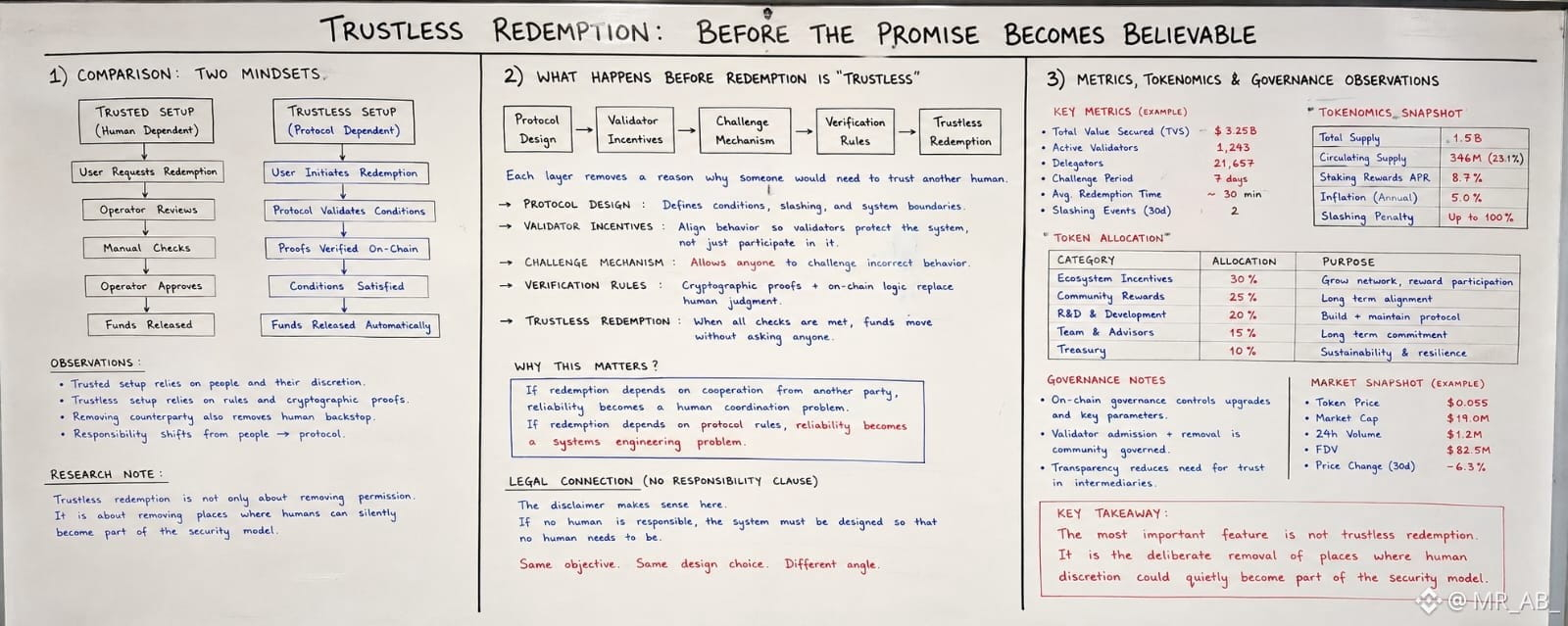
I thought the interesting part would be that Bitcoin can be redeemed without asking anyone for permission. It turned out to be everything that has to happen before that promise becomes believable.
I kept reading the redemption flow alongside the protocol architecture and the legal language saying that Babylon Parties will not be responsible for what happens. At first those looked like completely separate topics. After a while they started describing the same design choice from different angles.
A trustless redemption mechanism is not only about removing a counterparty from the transaction. It also removes someone who can step in when something goes wrong. That changes where responsibility lives. Instead of relying on an operator, support team, or administrator, the protocol pushes responsibility into cryptographic proofs, validator behavior, predefined conditions, and software that either satisfies those conditions or does not.
That also explains why the documentation spends so much attention on validator incentives, challenge procedures, and verification rules. If redemption depends on cooperation from another party, operational reliability becomes a human coordination problem. If redemption depends on protocol rules alone, operational reliability becomes a systems engineering problem.
The legal disclaimer made more sense after I looked at it this way. It did not feel disconnected from the protocol. It reflected the same objective as the architecture, which is to reduce situations where trust in people is expected to replace trust in the protocol itself.
The more I compared those documents, the more it seemed that the most important feature was not trustless redemption. It was the deliberate removal of places where human discretion could quietly become part of the security model.
#baby $BABY @BabylonLabs_io
I kept reading the redemption flow alongside the protocol architecture and the legal language saying that Babylon Parties will not be responsible for what happens. At first those looked like completely separate topics. After a while they started describing the same design choice from different angles.
A trustless redemption mechanism is not only about removing a counterparty from the transaction. It also removes someone who can step in when something goes wrong. That changes where responsibility lives. Instead of relying on an operator, support team, or administrator, the protocol pushes responsibility into cryptographic proofs, validator behavior, predefined conditions, and software that either satisfies those conditions or does not.
That also explains why the documentation spends so much attention on validator incentives, challenge procedures, and verification rules. If redemption depends on cooperation from another party, operational reliability becomes a human coordination problem. If redemption depends on protocol rules alone, operational reliability becomes a systems engineering problem.
The legal disclaimer made more sense after I looked at it this way. It did not feel disconnected from the protocol. It reflected the same objective as the architecture, which is to reduce situations where trust in people is expected to replace trust in the protocol itself.
The more I compared those documents, the more it seemed that the most important feature was not trustless redemption. It was the deliberate removal of places where human discretion could quietly become part of the security model.
#baby $BABY @BabylonLabs_io
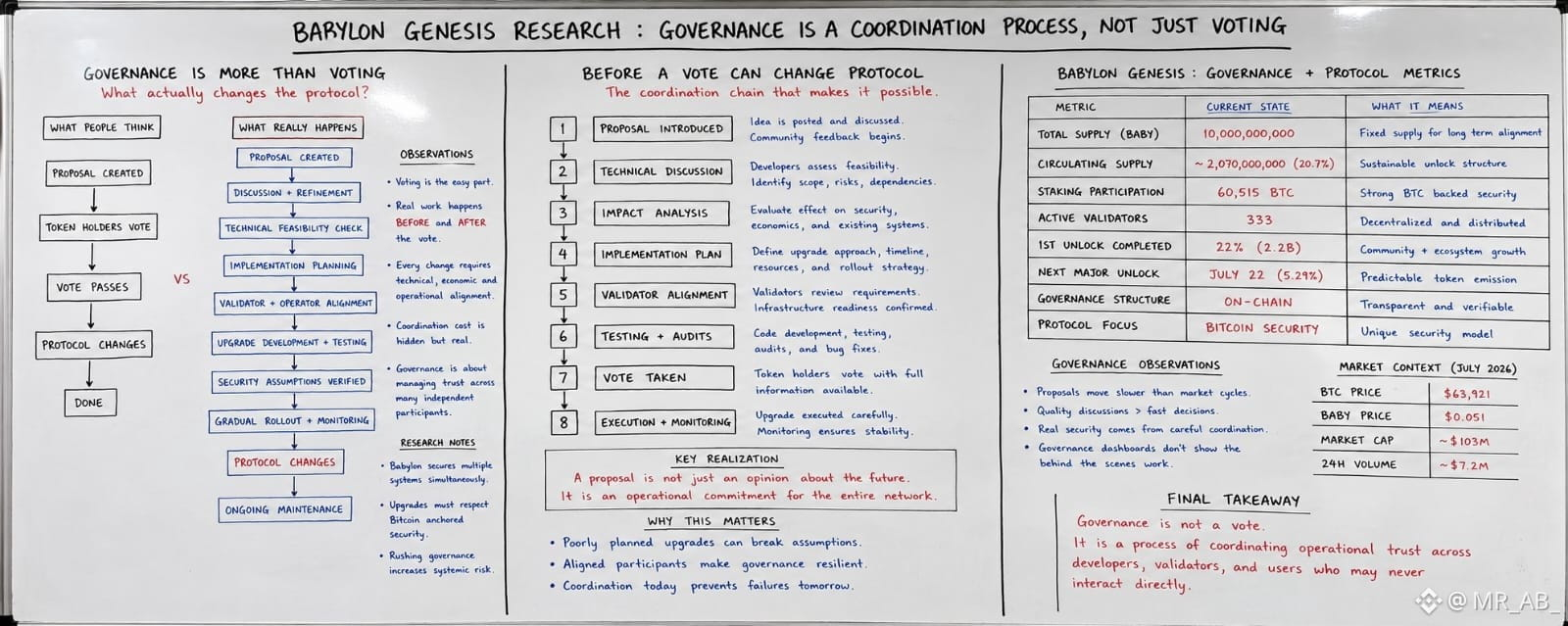
I thought the interesting part would be governance voting. It turned out to be everything that has to happen before a vote can actually change the protocol.
The more I read through Babylon's architecture the more I stopped thinking about governance as a simple token weighted decision. Every proposal depends on a chain of coordination that starts long before anyone casts a vote. Validators need to stay aligned with protocol upgrades developers need to maintain compatible software and Bitcoin anchored security has to keep providing a stable foundation while those changes are introduced.
That made me look differently at the governance process. A proposal is not just an opinion about the future. It becomes an operational commitment for everyone responsible for running the network. Even a well designed upgrade creates costs that never appear in governance dashboards. Node operators prepare new infrastructure developers spend time testing compatibility and participants need confidence that the transition will not weaken the assumptions the protocol already depends on.
I also noticed that governance moves at a very different pace than market attention. Prices react within minutes while protocol direction can take weeks of discussion implementation testing and coordination before users experience any visible change. That gap explains why governance activity often looks quiet even when important work is happening underneath.
After sitting with all of that I started seeing governance less as a voting system and more as a process for coordinating operational trust across people who may never interact directly. The proposal is only the visible part. The real work begins after the decision is made.
#baby $BABY @BabylonLabs_io
The more I read through Babylon's architecture the more I stopped thinking about governance as a simple token weighted decision. Every proposal depends on a chain of coordination that starts long before anyone casts a vote. Validators need to stay aligned with protocol upgrades developers need to maintain compatible software and Bitcoin anchored security has to keep providing a stable foundation while those changes are introduced.
That made me look differently at the governance process. A proposal is not just an opinion about the future. It becomes an operational commitment for everyone responsible for running the network. Even a well designed upgrade creates costs that never appear in governance dashboards. Node operators prepare new infrastructure developers spend time testing compatibility and participants need confidence that the transition will not weaken the assumptions the protocol already depends on.
I also noticed that governance moves at a very different pace than market attention. Prices react within minutes while protocol direction can take weeks of discussion implementation testing and coordination before users experience any visible change. That gap explains why governance activity often looks quiet even when important work is happening underneath.
After sitting with all of that I started seeing governance less as a voting system and more as a process for coordinating operational trust across people who may never interact directly. The proposal is only the visible part. The real work begins after the decision is made.
#baby $BABY @BabylonLabs_io
In the early ’90s, the internet was a patchwork of walled gardens.
AOL talked to AOL.
CompuServe talked to CompuServe.
Then TCP/IP said: “Any network, any device, one language. No gatekeepers.”
It didn’t add features, it removed friction. And the world changed.
Web3 is living that same moment right now.
We’ve got DeFi, tokenized real estate, AI agents trading at machine speed.
But compliance? Still pre‑internet.
Every protocol builds its own off‑chain check. Jurisdictions don’t talk. Sanctioned wallets are hunted after the money moves.
@NewtonProtocol fixes this exactly the way TCP/IP fixed networking.
Not a new chain. Not a custody wrapper.
A neutral, decentralized authorization layer that evaluates every action before it settles at transaction speed, secured by EigenLayer restaking.
Sanctions? KYC? Accreditation? Travel Rule?
Encoded as policies, enforced by operators who never see your data.
Cross‑chain. Pre‑execution. Cryptographically provable.
This isn’t “compliance theatre.”
This is the invisible middleware that lets institutions, protocols, and regulators finally trust the same system without trusting each other.
So here’s the genuine question and I want the skeptics loudest:
Is @NewtonProtocol really the TCP/IP moment for Web3 compliance, or am I mistaking plumbing for a breakthrough?
Drop your take. Convince me I’m wrong. The best criticism builds the best infrastructure.
$NEWT #Newt
@NewtonProtocol $POWER #power $LAB #Labs $BLUAI #newt $NEWT #BLUAI
The @NewtonProtocol debate is open.
Which statement do you back? 👇
AOL talked to AOL.
CompuServe talked to CompuServe.
Then TCP/IP said: “Any network, any device, one language. No gatekeepers.”
It didn’t add features, it removed friction. And the world changed.
Web3 is living that same moment right now.
We’ve got DeFi, tokenized real estate, AI agents trading at machine speed.
But compliance? Still pre‑internet.
Every protocol builds its own off‑chain check. Jurisdictions don’t talk. Sanctioned wallets are hunted after the money moves.
@NewtonProtocol fixes this exactly the way TCP/IP fixed networking.
Not a new chain. Not a custody wrapper.
A neutral, decentralized authorization layer that evaluates every action before it settles at transaction speed, secured by EigenLayer restaking.
Sanctions? KYC? Accreditation? Travel Rule?
Encoded as policies, enforced by operators who never see your data.
Cross‑chain. Pre‑execution. Cryptographically provable.
This isn’t “compliance theatre.”
This is the invisible middleware that lets institutions, protocols, and regulators finally trust the same system without trusting each other.
So here’s the genuine question and I want the skeptics loudest:
Is @NewtonProtocol really the TCP/IP moment for Web3 compliance, or am I mistaking plumbing for a breakthrough?
Drop your take. Convince me I’m wrong. The best criticism builds the best infrastructure.
$NEWT #Newt
@NewtonProtocol $POWER #power $LAB #Labs $BLUAI #newt $NEWT #BLUAI
The @NewtonProtocol debate is open.
Which statement do you back? 👇
🔌 The TCP/IP Moment
100%
🛠️ Vital But Unsexy Plumbing
0%
LAB manipulated?
0%
🤖 It’s About AI Agents
0%
1 votes • Voting closed
🌊 $LDO is back in the spotlight.
One of today's strongest performers, LDO is showing renewed strength as buyers step in.
Price action like this always gets the crypto community talking. The question now is whether this momentum can carry into the next resistance level.
📊 Bullish continuation or time for a cooldown?
#ldo $LDO #Ethereum #LiquidStaking #crypto #TopGainers
One of today's strongest performers, LDO is showing renewed strength as buyers step in.
Price action like this always gets the crypto community talking. The question now is whether this momentum can carry into the next resistance level.
📊 Bullish continuation or time for a cooldown?
#ldo $LDO #Ethereum #LiquidStaking #crypto #TopGainers
Log in to explore more content