
GiGiZ 發財豬
1k Posts

GiGiZ 發財豬
 Square Verified
Report
Block User
🤍Founder of G Club🤍 我是爱美食但更爱学习的💰 元宇宙探险家GiGi吉吉 分享与交流web3和元宇宙资讯 💗 🤍
77 Following
1.5K+ Followers
1.6K+ Liked
Posts
All
Quotes
Videos
Live
·
--
Tech stocks and China concept stocks collectively fell this time—are they just bursting a bubble, or is this normal “shakeout” during the main uptrend?
During the trading session, all three major U.S. stock indexes moved lower. The Nasdaq broke below 26,000. The Dow fell 0.44% intraday, the Nasdaq fell 1.26% intraday, and the S&P 500 fell 0.64% intraday. The Dow opened down 0.17%, the Nasdaq down 0.88%, and the S&P 500 down 0.55%. Among high-profile tech stocks, Intel dropped 3.57%, Qualcomm fell 2.42%, and U.S. Steel? Wait—actually, the U.S. company mentioned, Super Micro (Super Micro Computer), dropped 2.31%.
The Nasdaq China Golden Dragon Index fell 0.51%. Bilibili (BILI) fell 2.89%, and NIO fell 2.16%.
From the market picture, all three indexes and the chip leaders are under pressure. Even the Nasdaq briefly slipped below a key level. But instead of panicking over intraday fluctuations, it’s better to look at the disagreements and rotation rhythm behind the capital.
First, there’s a split between AI “hard tech” and the software end. Although companies like Intel and Qualcomm saw short-term pullbacks, the underlying logic of hardware infrastructure hasn’t fundamentally changed. The selling pressure from profit-taking recently has mainly concentrated on application-side software stocks with relatively high valuations. The market is accelerating the redeployment of capital from the software sectors lacking certainty, back into chips and the compute-power supply chain that are supported by real orders.
Second, macro conditions are weighing on sentiment. International crude oil prices have recently surged and crossed the $100 mark, directly boosting inflation expectations and pushing U.S. Treasury yields higher again. With the Fed’s interest-rate cut “shoe” still not dropping, investors are choosing to stay cautious and step aside before major economic data announcements. This is also the main catalyst behind the broad market pressure.
As for the next direction, we expect the broader market to maintain a high-level consolidation and shakeout pattern in the short term. But this kind of short-term selloff triggered by crude oil and inflation expectations often serves as a “testing stone” for high-quality tech stocks. Once the squeeze-out of excess from high valuations ends, capital will very likely regroup around semiconductor giants with solid fundamentals.
As for China concept stocks, they’ve recently shown the typical pattern of “dragging down but not catching up.” The key is still the intensity of how domestic macro-stimulus policies are implemented afterward.
$INTC
$QCOM
$AMD
$BILI
$NIO.US
DYOR
{future}(QCOMUSDT)
{future}(INTCUSDT)
Tech stocks and China concept stocks collectively fell this time—are they just bursting a bubble, or is this normal “shakeout” during the main uptrend?
During the trading session, all three major U.S. stock indexes moved lower. The Nasdaq broke below 26,000. The Dow fell 0.44% intraday, the Nasdaq fell 1.26% intraday, and the S&P 500 fell 0.64% intraday. The Dow opened down 0.17%, the Nasdaq down 0.88%, and the S&P 500 down 0.55%. Among high-profile tech stocks, Intel dropped 3.57%, Qualcomm fell 2.42%, and U.S. Steel? Wait—actually, the U.S. company mentioned, Super Micro (Super Micro Computer), dropped 2.31%.
The Nasdaq China Golden Dragon Index fell 0.51%. Bilibili (BILI) fell 2.89%, and NIO fell 2.16%.
From the market picture, all three indexes and the chip leaders are under pressure. Even the Nasdaq briefly slipped below a key level. But instead of panicking over intraday fluctuations, it’s better to look at the disagreements and rotation rhythm behind the capital.
First, there’s a split between AI “hard tech” and the software end. Although companies like Intel and Qualcomm saw short-term pullbacks, the underlying logic of hardware infrastructure hasn’t fundamentally changed. The selling pressure from profit-taking recently has mainly concentrated on application-side software stocks with relatively high valuations. The market is accelerating the redeployment of capital from the software sectors lacking certainty, back into chips and the compute-power supply chain that are supported by real orders.
Second, macro conditions are weighing on sentiment. International crude oil prices have recently surged and crossed the $100 mark, directly boosting inflation expectations and pushing U.S. Treasury yields higher again. With the Fed’s interest-rate cut “shoe” still not dropping, investors are choosing to stay cautious and step aside before major economic data announcements. This is also the main catalyst behind the broad market pressure.
As for the next direction, we expect the broader market to maintain a high-level consolidation and shakeout pattern in the short term. But this kind of short-term selloff triggered by crude oil and inflation expectations often serves as a “testing stone” for high-quality tech stocks. Once the squeeze-out of excess from high valuations ends, capital will very likely regroup around semiconductor giants with solid fundamentals.
As for China concept stocks, they’ve recently shown the typical pattern of “dragging down but not catching up.” The key is still the intensity of how domestic macro-stimulus policies are implemented afterward.
$INTC
$QCOM
$AMD
$BILI
$NIO.US
DYOR
During the trading session, all three major U.S. stock indexes moved lower. The Nasdaq broke below 26,000. The Dow fell 0.44% intraday, the Nasdaq fell 1.26% intraday, and the S&P 500 fell 0.64% intraday. The Dow opened down 0.17%, the Nasdaq down 0.88%, and the S&P 500 down 0.55%. Among high-profile tech stocks, Intel dropped 3.57%, Qualcomm fell 2.42%, and U.S. Steel? Wait—actually, the U.S. company mentioned, Super Micro (Super Micro Computer), dropped 2.31%.
The Nasdaq China Golden Dragon Index fell 0.51%. Bilibili (BILI) fell 2.89%, and NIO fell 2.16%.
From the market picture, all three indexes and the chip leaders are under pressure. Even the Nasdaq briefly slipped below a key level. But instead of panicking over intraday fluctuations, it’s better to look at the disagreements and rotation rhythm behind the capital.
First, there’s a split between AI “hard tech” and the software end. Although companies like Intel and Qualcomm saw short-term pullbacks, the underlying logic of hardware infrastructure hasn’t fundamentally changed. The selling pressure from profit-taking recently has mainly concentrated on application-side software stocks with relatively high valuations. The market is accelerating the redeployment of capital from the software sectors lacking certainty, back into chips and the compute-power supply chain that are supported by real orders.
Second, macro conditions are weighing on sentiment. International crude oil prices have recently surged and crossed the $100 mark, directly boosting inflation expectations and pushing U.S. Treasury yields higher again. With the Fed’s interest-rate cut “shoe” still not dropping, investors are choosing to stay cautious and step aside before major economic data announcements. This is also the main catalyst behind the broad market pressure.
As for the next direction, we expect the broader market to maintain a high-level consolidation and shakeout pattern in the short term. But this kind of short-term selloff triggered by crude oil and inflation expectations often serves as a “testing stone” for high-quality tech stocks. Once the squeeze-out of excess from high valuations ends, capital will very likely regroup around semiconductor giants with solid fundamentals.
As for China concept stocks, they’ve recently shown the typical pattern of “dragging down but not catching up.” The key is still the intensity of how domestic macro-stimulus policies are implemented afterward.
$INTC
$QCOM
$AMD
$BILI
$NIO.US
DYOR

263
·
--
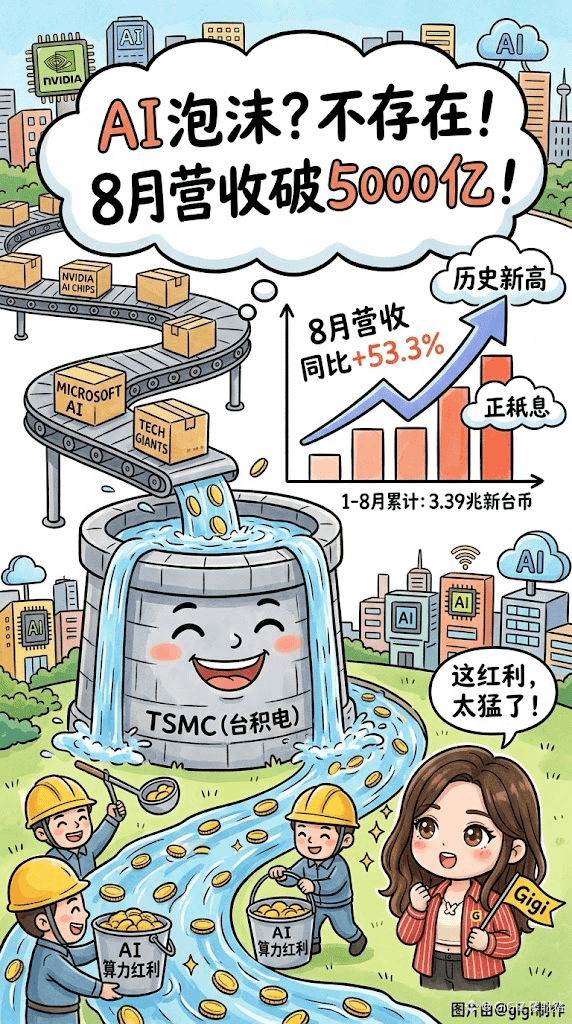
When everyone around the world is hyping an AI bubble, does TSMC’s revenue of over NT$510 billion in a single month count as the most hard-core slap in the face?
TSMC has just released its August results: single-month revenue surged to NT$514.8 billion, a year-over-year jump of 53.3%. Revenue accumulated over the first eight months has reached nearly NT$3.39 trillion. Breaking through the five-hundred-billion mark in a single month isn’t just setting a new historical high—it directly tears apart the so-called lie that AI compute demand has peaked.
People often debate whether NVIDIA or Microsoft can capture this windfall better, but the one that has truly turned the compute monetization logic into reality is still TSMC. Whether it’s cloud-based large model training or major tech giants designing their own AI chips, everyone is scrambling to secure its capacity for leading-edge process technology and advanced packaging. This is no longer a mere chip-cycle recovery—it’s the inevitable outcome of the entire industry shifting decisively toward AI compute infrastructure.
As for the outlook, TSMC’s dominance in the short term is almost impossible to challenge. With the 2-nanometer node accelerating and with overseas fabs plus its pricing power, its moat in foundry services will keep widening. But there are also two hidden risks. One is that capital expenditures have already hit the US$60 billion ceiling, and depreciation pressure will gradually creep up. The other is that geopolitical forces compelling production to be dispersed will drive up costs.
In the near term, no new challenger is likely to dislodge it. In this round of AI revelry, the “water sellers” are still the ones who laugh last. How many more years do you think we can keep eating the benefits of the AI capacity boom?
DYOR
When everyone around the world is hyping an AI bubble, does TSMC’s revenue of over NT$510 billion in a single month count as the most hard-core slap in the face?
TSMC has just released its August results: single-month revenue surged to NT$514.8 billion, a year-over-year jump of 53.3%. Revenue accumulated over the first eight months has reached nearly NT$3.39 trillion. Breaking through the five-hundred-billion mark in a single month isn’t just setting a new historical high—it directly tears apart the so-called lie that AI compute demand has peaked.
People often debate whether NVIDIA or Microsoft can capture this windfall better, but the one that has truly turned the compute monetization logic into reality is still TSMC. Whether it’s cloud-based large model training or major tech giants designing their own AI chips, everyone is scrambling to secure its capacity for leading-edge process technology and advanced packaging. This is no longer a mere chip-cycle recovery—it’s the inevitable outcome of the entire industry shifting decisively toward AI compute infrastructure.
As for the outlook, TSMC’s dominance in the short term is almost impossible to challenge. With the 2-nanometer node accelerating and with overseas fabs plus its pricing power, its moat in foundry services will keep widening. But there are also two hidden risks. One is that capital expenditures have already hit the US$60 billion ceiling, and depreciation pressure will gradually creep up. The other is that geopolitical forces compelling production to be dispersed will drive up costs.
In the near term, no new challenger is likely to dislodge it. In this round of AI revelry, the “water sellers” are still the ones who laugh last. How many more years do you think we can keep eating the benefits of the AI capacity boom?
DYOR
TSMC has just released its August results: single-month revenue surged to NT$514.8 billion, a year-over-year jump of 53.3%. Revenue accumulated over the first eight months has reached nearly NT$3.39 trillion. Breaking through the five-hundred-billion mark in a single month isn’t just setting a new historical high—it directly tears apart the so-called lie that AI compute demand has peaked.
People often debate whether NVIDIA or Microsoft can capture this windfall better, but the one that has truly turned the compute monetization logic into reality is still TSMC. Whether it’s cloud-based large model training or major tech giants designing their own AI chips, everyone is scrambling to secure its capacity for leading-edge process technology and advanced packaging. This is no longer a mere chip-cycle recovery—it’s the inevitable outcome of the entire industry shifting decisively toward AI compute infrastructure.
As for the outlook, TSMC’s dominance in the short term is almost impossible to challenge. With the 2-nanometer node accelerating and with overseas fabs plus its pricing power, its moat in foundry services will keep widening. But there are also two hidden risks. One is that capital expenditures have already hit the US$60 billion ceiling, and depreciation pressure will gradually creep up. The other is that geopolitical forces compelling production to be dispersed will drive up costs.
In the near term, no new challenger is likely to dislodge it. In this round of AI revelry, the “water sellers” are still the ones who laugh last. How many more years do you think we can keep eating the benefits of the AI capacity boom?
DYOR
257
·
--
Verified
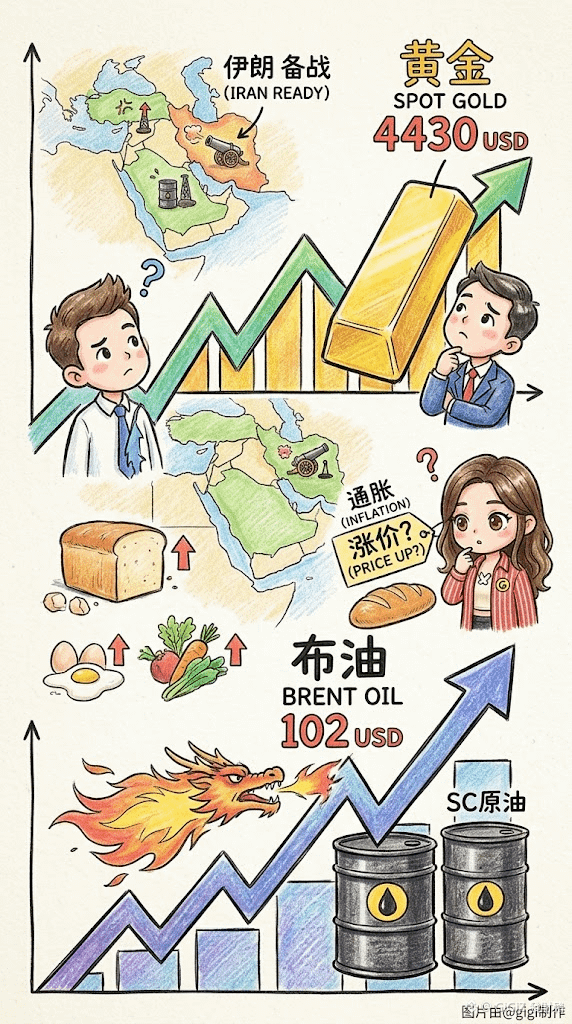
If the geopolitical powder keg is truly fully ignited, are you ready for what it could do to your wallet?
The market is indeed smelling an extremely dangerous odor right now. The US and Brent crude are surging, with Brent breaking above the $102 mark; gold has also climbed to a recent high around $4,430. This isn’t just capital stoking sentiment—it’s funds desperately running from risk, rushing to safety.
Crude oil rally
Once the Middle East enters strong confrontation, the Strait of Hormuz—one of the world’s key oil arteries—faces the risk of being shut down at any time. As long as the transportation lines are even slightly disrupted, the supply gap of tens of millions of barrels per day is something no country can immediately fill. Pushing oil prices above $100 is only the first step $CL $BZ
{future}(BZUSDT)
{future}(CLUSDT)
Gold rockets to more than $4,430
This reveals deep-seated panic. The market isn’t only worried about localized conflict—it’s also worried that an inflation rebound will squeeze the space for central banks to cut rates, or even trigger a second-round inflation nightmare. Capital has chosen to abandon risk assets and cling tightly to gold $XAUT
{future}(XAUTUSDT)
Outlook / predictions
In the short term, it all hinges on sentiment. The key is whether the conflict involves core oil fields or a blockade of the strait. If the situation deteriorates further, it’s almost certain that crude oil will head toward $110 and gold will continue to set new record highs. But if it’s only verbal standoffs or short-lived localized conflict, then after a sharp surge in commodities, there will likely be a violent pullback in the near term.
For ordinary people, this is absolutely not “just a headline.” Crude oil is the mother of industry. A rapid spike in oil prices will quickly transmit along the industrial chain to freight rates, chemical products, and even everyday consumer goods. If inflation pressure returns, people’s purchasing power will be squeezed again. In the short term, when dealing with high-risk assets like stocks, it’s best to exercise extra restraint. Cash flow and defensive allocations are the steadiest cards you can play right now
DYOR
#布伦特原油突破100美元 #伊朗称已准备升级对美战争
If the geopolitical powder keg is truly fully ignited, are you ready for what it could do to your wallet?
The market is indeed smelling an extremely dangerous odor right now. The US and Brent crude are surging, with Brent breaking above the $102 mark; gold has also climbed to a recent high around $4,430. This isn’t just capital stoking sentiment—it’s funds desperately running from risk, rushing to safety.
Crude oil rally
Once the Middle East enters strong confrontation, the Strait of Hormuz—one of the world’s key oil arteries—faces the risk of being shut down at any time. As long as the transportation lines are even slightly disrupted, the supply gap of tens of millions of barrels per day is something no country can immediately fill. Pushing oil prices above $100 is only the first step $CL $BZ
Gold rockets to more than $4,430
This reveals deep-seated panic. The market isn’t only worried about localized conflict—it’s also worried that an inflation rebound will squeeze the space for central banks to cut rates, or even trigger a second-round inflation nightmare. Capital has chosen to abandon risk assets and cling tightly to gold $XAUT
Outlook / predictions
In the short term, it all hinges on sentiment. The key is whether the conflict involves core oil fields or a blockade of the strait. If the situation deteriorates further, it’s almost certain that crude oil will head toward $110 and gold will continue to set new record highs. But if it’s only verbal standoffs or short-lived localized conflict, then after a sharp surge in commodities, there will likely be a violent pullback in the near term.
For ordinary people, this is absolutely not “just a headline.” Crude oil is the mother of industry. A rapid spike in oil prices will quickly transmit along the industrial chain to freight rates, chemical products, and even everyday consumer goods. If inflation pressure returns, people’s purchasing power will be squeezed again. In the short term, when dealing with high-risk assets like stocks, it’s best to exercise extra restraint. Cash flow and defensive allocations are the steadiest cards you can play right now
DYOR
#布伦特原油突破100美元 #伊朗称已准备升级对美战争
The market is indeed smelling an extremely dangerous odor right now. The US and Brent crude are surging, with Brent breaking above the $102 mark; gold has also climbed to a recent high around $4,430. This isn’t just capital stoking sentiment—it’s funds desperately running from risk, rushing to safety.
Crude oil rally
Once the Middle East enters strong confrontation, the Strait of Hormuz—one of the world’s key oil arteries—faces the risk of being shut down at any time. As long as the transportation lines are even slightly disrupted, the supply gap of tens of millions of barrels per day is something no country can immediately fill. Pushing oil prices above $100 is only the first step $CL $BZ
Gold rockets to more than $4,430
This reveals deep-seated panic. The market isn’t only worried about localized conflict—it’s also worried that an inflation rebound will squeeze the space for central banks to cut rates, or even trigger a second-round inflation nightmare. Capital has chosen to abandon risk assets and cling tightly to gold $XAUT
Outlook / predictions
In the short term, it all hinges on sentiment. The key is whether the conflict involves core oil fields or a blockade of the strait. If the situation deteriorates further, it’s almost certain that crude oil will head toward $110 and gold will continue to set new record highs. But if it’s only verbal standoffs or short-lived localized conflict, then after a sharp surge in commodities, there will likely be a violent pullback in the near term.
For ordinary people, this is absolutely not “just a headline.” Crude oil is the mother of industry. A rapid spike in oil prices will quickly transmit along the industrial chain to freight rates, chemical products, and even everyday consumer goods. If inflation pressure returns, people’s purchasing power will be squeezed again. In the short term, when dealing with high-risk assets like stocks, it’s best to exercise extra restraint. Cash flow and defensive allocations are the steadiest cards you can play right now
DYOR
#布伦特原油突破100美元 #伊朗称已准备升级对美战争
1.8k
·
--
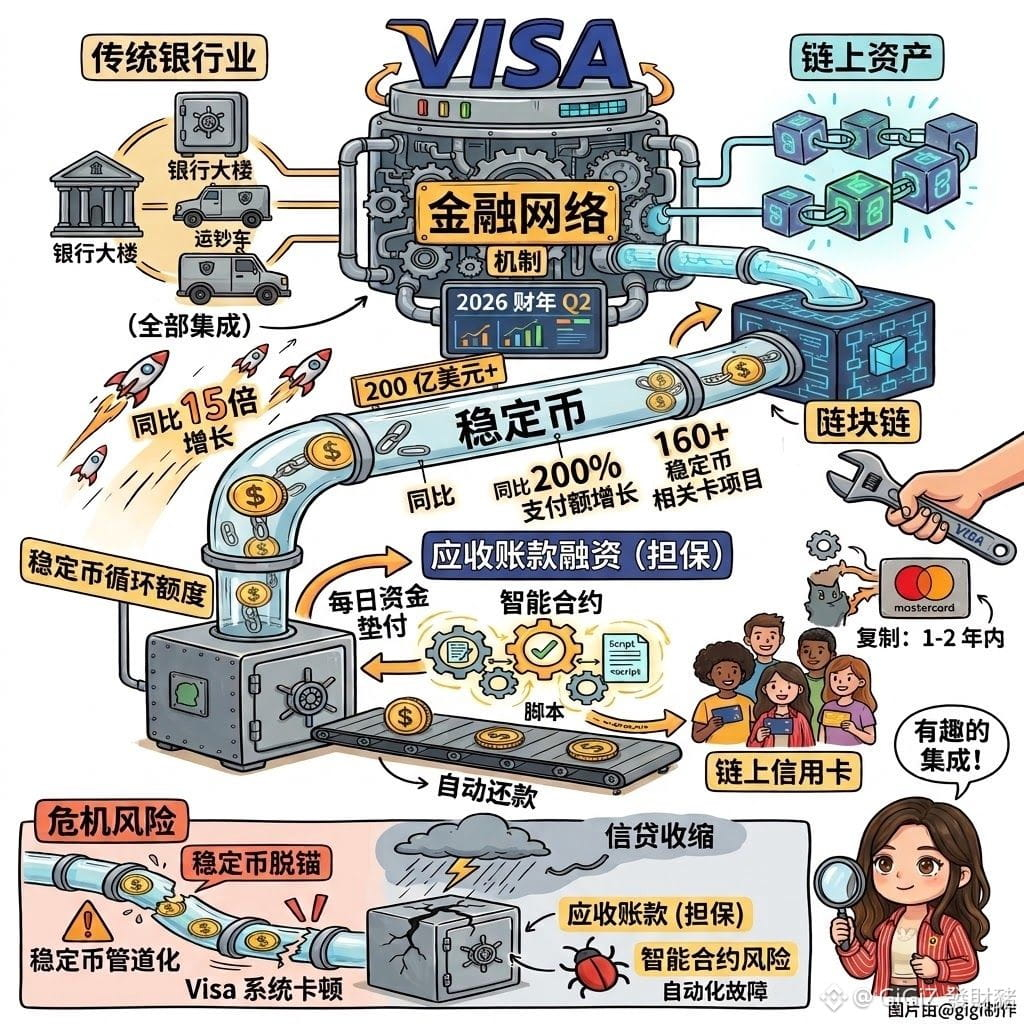
Visa’s annual settlement volume for stablecoins surpasses $20 billion
Stablecoins are starting to act as standby working capital for credit cards—traditional finance is being restructured, or is crypto “invading in reverse”?
On the surface, Visa is embracing Web3. In reality, the card network has obtained the ultimate weapon for cost reduction and efficiency gains. Previously, cross-border settlement had to go through SWIFT: more nodes, higher fees, and the funds were tied up for days. Now, with stablecoins and smart contracts, funds move into place in seconds, and cash-flow turnaround efficiency skyrockets—directly hitting the fatal weakness of traditional supply-chain finance where receivables take too long to be repaid.
This is effectively forcing on-chain assets into the rules of traditional card networks’ systems—it’s not a break from the old regime. Visa controls risk management and the card issuance entry points; stablecoins serve as the pipeline; and smart contracts devolve into a settlement tool. Crypto didn’t overthrow Visa—it became a silent workforce helping Visa improve efficiency.
But this model hasn’t yet gone through a real “freeze period”
Credit risk becomes chain-linked
Putting assets on-chain doesn’t mean risk disappears. If off-chain accounts receivable turn into bad debts, then no matter how automatically the on-chain smart contract attempts to debit payments, it’s still effectively “pulling air out of thin space.”
Black swans transmit extremely fast
If a stablecoin depegs, the entire settlement chain can instantly shut down. Liquidity crises in the crypto market would then directly carry over to real-world card spending.
Over the next 1 to 2 years, this playbook will be quickly copied by giants like Mastercard. Stablecoins will be fully de-commoditized and stripped of hype, becoming basic financial infrastructure. In the future, the stablecoin issuers that truly survive won’t be determined by who gets hyped the most, but by who can plug into more real-world scenarios like Visa’s. When compliance becomes the bottom line, the boundary between on-chain and off-chain finance will be completely blurred.
DYOR
Visa’s annual settlement volume for stablecoins surpasses $20 billion
Stablecoins are starting to act as standby working capital for credit cards—traditional finance is being restructured, or is crypto “invading in reverse”?
On the surface, Visa is embracing Web3. In reality, the card network has obtained the ultimate weapon for cost reduction and efficiency gains. Previously, cross-border settlement had to go through SWIFT: more nodes, higher fees, and the funds were tied up for days. Now, with stablecoins and smart contracts, funds move into place in seconds, and cash-flow turnaround efficiency skyrockets—directly hitting the fatal weakness of traditional supply-chain finance where receivables take too long to be repaid.
This is effectively forcing on-chain assets into the rules of traditional card networks’ systems—it’s not a break from the old regime. Visa controls risk management and the card issuance entry points; stablecoins serve as the pipeline; and smart contracts devolve into a settlement tool. Crypto didn’t overthrow Visa—it became a silent workforce helping Visa improve efficiency.
But this model hasn’t yet gone through a real “freeze period”
Credit risk becomes chain-linked
Putting assets on-chain doesn’t mean risk disappears. If off-chain accounts receivable turn into bad debts, then no matter how automatically the on-chain smart contract attempts to debit payments, it’s still effectively “pulling air out of thin space.”
Black swans transmit extremely fast
If a stablecoin depegs, the entire settlement chain can instantly shut down. Liquidity crises in the crypto market would then directly carry over to real-world card spending.
Over the next 1 to 2 years, this playbook will be quickly copied by giants like Mastercard. Stablecoins will be fully de-commoditized and stripped of hype, becoming basic financial infrastructure. In the future, the stablecoin issuers that truly survive won’t be determined by who gets hyped the most, but by who can plug into more real-world scenarios like Visa’s. When compliance becomes the bottom line, the boundary between on-chain and off-chain finance will be completely blurred.
DYOR
Stablecoins are starting to act as standby working capital for credit cards—traditional finance is being restructured, or is crypto “invading in reverse”?
On the surface, Visa is embracing Web3. In reality, the card network has obtained the ultimate weapon for cost reduction and efficiency gains. Previously, cross-border settlement had to go through SWIFT: more nodes, higher fees, and the funds were tied up for days. Now, with stablecoins and smart contracts, funds move into place in seconds, and cash-flow turnaround efficiency skyrockets—directly hitting the fatal weakness of traditional supply-chain finance where receivables take too long to be repaid.
This is effectively forcing on-chain assets into the rules of traditional card networks’ systems—it’s not a break from the old regime. Visa controls risk management and the card issuance entry points; stablecoins serve as the pipeline; and smart contracts devolve into a settlement tool. Crypto didn’t overthrow Visa—it became a silent workforce helping Visa improve efficiency.
But this model hasn’t yet gone through a real “freeze period”
Credit risk becomes chain-linked
Putting assets on-chain doesn’t mean risk disappears. If off-chain accounts receivable turn into bad debts, then no matter how automatically the on-chain smart contract attempts to debit payments, it’s still effectively “pulling air out of thin space.”
Black swans transmit extremely fast
If a stablecoin depegs, the entire settlement chain can instantly shut down. Liquidity crises in the crypto market would then directly carry over to real-world card spending.
Over the next 1 to 2 years, this playbook will be quickly copied by giants like Mastercard. Stablecoins will be fully de-commoditized and stripped of hype, becoming basic financial infrastructure. In the future, the stablecoin issuers that truly survive won’t be determined by who gets hyped the most, but by who can plug into more real-world scenarios like Visa’s. When compliance becomes the bottom line, the boundary between on-chain and off-chain finance will be completely blurred.
DYOR
364
·
--
Iran allows $BTC to settle foreign trade with USDT—will this move really help it get out from Western sanctions?
At first glance, this hardline counterattack against de-dollarization and bypassing SWIFT isn’t just a change of settlement tools—it’s a high-stakes financial tightrope walk with extreme uncertainty.
From an institutional logic standpoint, Iran finds itself caught in a dilemma paradox. The more the government officially endorses BTC and USDT, the more the on-chain transparency will expose the transaction routes. While blockchains are decentralized, the ledger is publicly transparent. The U.S. Treasury and on-chain analytics firms only need to monitor wallet addresses of major exchanges to accurately trace and freeze the relevant assets—especially for USDT issued by Tether, which has a blacklist mechanism.
Look deeper into the broader impact: Iran’s domestic currency has been severely devalued. Once exporters receive BTC or Tether, they’re likely to hoard crypto for value preservation rather than convert it back into the local currency. This would further drain the country’s foreign exchange reserves and worsen inflation.
In the short term, this may indeed provide breathing room for some small and mid-sized private foreign trade businesses. But in the long run, the U.S.’ on-chain blockade will quickly follow, pushing this settlement method toward full-on dark-net use and P2P “geek” modes.
In the end, cryptocurrency is only a decentralized underlying tool. It can provide a covert channel, but it can’t single-handedly carry a country’s macro credibility for its fiat currency or the scale of bulk trade.
DYOR
{future}(BTCUSDT)
Iran allows $BTC to settle foreign trade with USDT—will this move really help it get out from Western sanctions?
At first glance, this hardline counterattack against de-dollarization and bypassing SWIFT isn’t just a change of settlement tools—it’s a high-stakes financial tightrope walk with extreme uncertainty.
From an institutional logic standpoint, Iran finds itself caught in a dilemma paradox. The more the government officially endorses BTC and USDT, the more the on-chain transparency will expose the transaction routes. While blockchains are decentralized, the ledger is publicly transparent. The U.S. Treasury and on-chain analytics firms only need to monitor wallet addresses of major exchanges to accurately trace and freeze the relevant assets—especially for USDT issued by Tether, which has a blacklist mechanism.
Look deeper into the broader impact: Iran’s domestic currency has been severely devalued. Once exporters receive BTC or Tether, they’re likely to hoard crypto for value preservation rather than convert it back into the local currency. This would further drain the country’s foreign exchange reserves and worsen inflation.
In the short term, this may indeed provide breathing room for some small and mid-sized private foreign trade businesses. But in the long run, the U.S.’ on-chain blockade will quickly follow, pushing this settlement method toward full-on dark-net use and P2P “geek” modes.
In the end, cryptocurrency is only a decentralized underlying tool. It can provide a covert channel, but it can’t single-handedly carry a country’s macro credibility for its fiat currency or the scale of bulk trade.
DYOR
At first glance, this hardline counterattack against de-dollarization and bypassing SWIFT isn’t just a change of settlement tools—it’s a high-stakes financial tightrope walk with extreme uncertainty.
From an institutional logic standpoint, Iran finds itself caught in a dilemma paradox. The more the government officially endorses BTC and USDT, the more the on-chain transparency will expose the transaction routes. While blockchains are decentralized, the ledger is publicly transparent. The U.S. Treasury and on-chain analytics firms only need to monitor wallet addresses of major exchanges to accurately trace and freeze the relevant assets—especially for USDT issued by Tether, which has a blacklist mechanism.
Look deeper into the broader impact: Iran’s domestic currency has been severely devalued. Once exporters receive BTC or Tether, they’re likely to hoard crypto for value preservation rather than convert it back into the local currency. This would further drain the country’s foreign exchange reserves and worsen inflation.
In the short term, this may indeed provide breathing room for some small and mid-sized private foreign trade businesses. But in the long run, the U.S.’ on-chain blockade will quickly follow, pushing this settlement method toward full-on dark-net use and P2P “geek” modes.
In the end, cryptocurrency is only a decentralized underlying tool. It can provide a covert channel, but it can’t single-handedly carry a country’s macro credibility for its fiat currency or the scale of bulk trade.
DYOR

180
·
--
It looks like Apple has pulled out a big move at this release, but its stock price only dipped slightly—so is it holding something back, or is it really not strong enough to drive demand anymore? $AAPL
Honestly, with the iPhone Duo priced starting at $1,999, it was never meant to be a mass-market product. It’s more about Apple demonstrating its innovation capability to the capital markets, and also helping the new CEO, John Ternus, establish his influence.
The capital market’s reaction has been muted, suggesting this product can’t contribute much profit to the financial reports in the near term.
This is now the 8th year for foldable screens. Even though the supply chain has matured, yield rates and costs are still the hard constraints. The hinge and materials Apple is showing now are indeed good, but to spark a wave of replacements on the scale of over a hundred million units, a threshold of more than RMB 14,000 is simply too high.
Breaking it down: Apple’s stock price is currently trading at a high level and consolidating sideways. The real highlights aren’t the hardware form factor itself, but two things.
Hardware gross margin and software ecosystem monetization
Whether this new form-factor device can drive premium users to upgrade to higher-tier iCloud and AI subscription plans.
Supply chain influence
When Apple enters the market, it usually means the foldable-screen supply chain—such as titanium-alloy hinges and the cost of flexible panels—will see an industry-wide round of cost declines. That, in turn, sets the stage for future mid-range products.
So where does AAPL go next?
In the short term, based on the release meeting expectations and any bad news being “worked through,” the stock price will likely keep trading in a tug-of-war between $310 and $320.
In the medium term, it depends on the real reservation data after the October 23 on-sale date. As long as the initial inventory is snapped up—and coupled with the new CEO’s follow-through on AI deployment—this downtrend will likely be quickly reversed. Over the long term, it should still follow a steady upward trend.
DYOR
{future}(AAPLUSDT)
It looks like Apple has pulled out a big move at this release, but its stock price only dipped slightly—so is it holding something back, or is it really not strong enough to drive demand anymore? $AAPL
Honestly, with the iPhone Duo priced starting at $1,999, it was never meant to be a mass-market product. It’s more about Apple demonstrating its innovation capability to the capital markets, and also helping the new CEO, John Ternus, establish his influence.
The capital market’s reaction has been muted, suggesting this product can’t contribute much profit to the financial reports in the near term.
This is now the 8th year for foldable screens. Even though the supply chain has matured, yield rates and costs are still the hard constraints. The hinge and materials Apple is showing now are indeed good, but to spark a wave of replacements on the scale of over a hundred million units, a threshold of more than RMB 14,000 is simply too high.
Breaking it down: Apple’s stock price is currently trading at a high level and consolidating sideways. The real highlights aren’t the hardware form factor itself, but two things.
Hardware gross margin and software ecosystem monetization
Whether this new form-factor device can drive premium users to upgrade to higher-tier iCloud and AI subscription plans.
Supply chain influence
When Apple enters the market, it usually means the foldable-screen supply chain—such as titanium-alloy hinges and the cost of flexible panels—will see an industry-wide round of cost declines. That, in turn, sets the stage for future mid-range products.
So where does AAPL go next?
In the short term, based on the release meeting expectations and any bad news being “worked through,” the stock price will likely keep trading in a tug-of-war between $310 and $320.
In the medium term, it depends on the real reservation data after the October 23 on-sale date. As long as the initial inventory is snapped up—and coupled with the new CEO’s follow-through on AI deployment—this downtrend will likely be quickly reversed. Over the long term, it should still follow a steady upward trend.
DYOR
Honestly, with the iPhone Duo priced starting at $1,999, it was never meant to be a mass-market product. It’s more about Apple demonstrating its innovation capability to the capital markets, and also helping the new CEO, John Ternus, establish his influence.
The capital market’s reaction has been muted, suggesting this product can’t contribute much profit to the financial reports in the near term.
This is now the 8th year for foldable screens. Even though the supply chain has matured, yield rates and costs are still the hard constraints. The hinge and materials Apple is showing now are indeed good, but to spark a wave of replacements on the scale of over a hundred million units, a threshold of more than RMB 14,000 is simply too high.
Breaking it down: Apple’s stock price is currently trading at a high level and consolidating sideways. The real highlights aren’t the hardware form factor itself, but two things.
Hardware gross margin and software ecosystem monetization
Whether this new form-factor device can drive premium users to upgrade to higher-tier iCloud and AI subscription plans.
Supply chain influence
When Apple enters the market, it usually means the foldable-screen supply chain—such as titanium-alloy hinges and the cost of flexible panels—will see an industry-wide round of cost declines. That, in turn, sets the stage for future mid-range products.
So where does AAPL go next?
In the short term, based on the release meeting expectations and any bad news being “worked through,” the stock price will likely keep trading in a tug-of-war between $310 and $320.
In the medium term, it depends on the real reservation data after the October 23 on-sale date. As long as the initial inventory is snapped up—and coupled with the new CEO’s follow-through on AI deployment—this downtrend will likely be quickly reversed. Over the long term, it should still follow a steady upward trend.
DYOR


1
1
2.4k
·
--
Verified
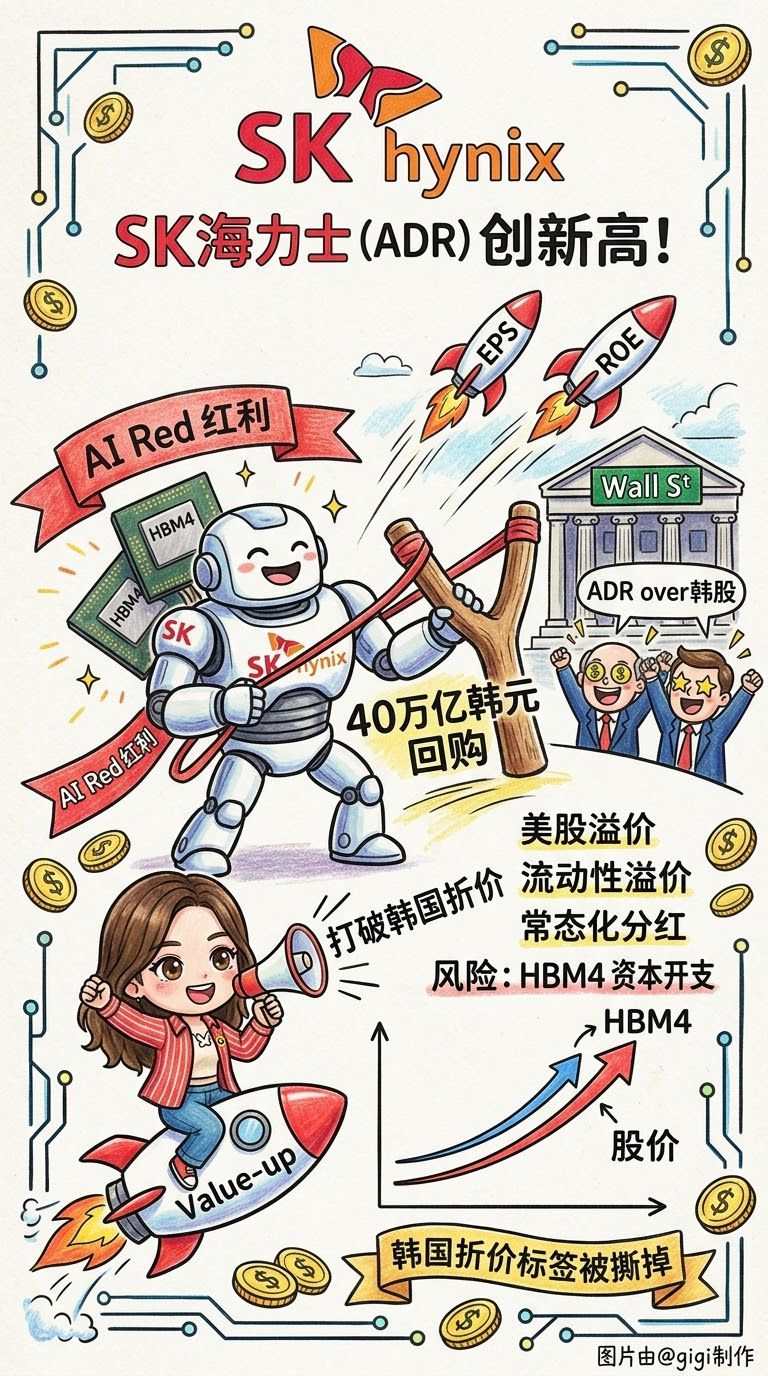
SK hynix ADR surges to a historic high, and with buyback expectations as high as 400 trillion won, what hidden twists are behind this combo?
$SKHY
With US-stock ADRs breaking to new highs and massive buybacks, this is by no means a simple positive catalyst—it’s a deep chess match involving capital operations.
US-stock premium forces Korean stocks to catch up
SK hynix ADRs in the US market face limited liquidity and a shortage of shares, so Wall Street directly pushes up the premium to secure the AI-memory leader. The frenzy of US capital creates a “siphon effect,” which in turn pulls up the price of the company’s shares in Korea.
US-style market-cap management breaks the discount
Paired with massive buybacks and normalized dividends, the essence is using the methods the US market does best to boost EPS and ROE. This not only turns the industry dividends from HBM into shareholder returns, but also seizes the chance to completely tear off the “Korean discount” label.
Concerns about cash flow and technological iteration
Using most of free cash flow for buybacks suggests expansion is extremely precise and rational—avoiding a price war. But as future HBM4 and customized-memory capital expenditures grow sharply, overly aggressive buybacks may squeeze room for follow-on R&D redundancy.
Forward-looking judgment
In the short term, high US ADR premiums and buyback commitments build an extremely strong valuation floor. Over the medium to long term, investors should watch for the “stampede” risk caused by ADR premium convergence, as well as any potential impact on technological iteration if capital expenditures decline. This double celebration is the sharpest card it plays to lock in high valuation during the AI boom.
DYOR
{future}(SKHYUSDT)
SK hynix ADR surges to a historic high, and with buyback expectations as high as 400 trillion won, what hidden twists are behind this combo?
$SKHY
With US-stock ADRs breaking to new highs and massive buybacks, this is by no means a simple positive catalyst—it’s a deep chess match involving capital operations.
US-stock premium forces Korean stocks to catch up
SK hynix ADRs in the US market face limited liquidity and a shortage of shares, so Wall Street directly pushes up the premium to secure the AI-memory leader. The frenzy of US capital creates a “siphon effect,” which in turn pulls up the price of the company’s shares in Korea.
US-style market-cap management breaks the discount
Paired with massive buybacks and normalized dividends, the essence is using the methods the US market does best to boost EPS and ROE. This not only turns the industry dividends from HBM into shareholder returns, but also seizes the chance to completely tear off the “Korean discount” label.
Concerns about cash flow and technological iteration
Using most of free cash flow for buybacks suggests expansion is extremely precise and rational—avoiding a price war. But as future HBM4 and customized-memory capital expenditures grow sharply, overly aggressive buybacks may squeeze room for follow-on R&D redundancy.
Forward-looking judgment
In the short term, high US ADR premiums and buyback commitments build an extremely strong valuation floor. Over the medium to long term, investors should watch for the “stampede” risk caused by ADR premium convergence, as well as any potential impact on technological iteration if capital expenditures decline. This double celebration is the sharpest card it plays to lock in high valuation during the AI boom.
DYOR
$SKHY
With US-stock ADRs breaking to new highs and massive buybacks, this is by no means a simple positive catalyst—it’s a deep chess match involving capital operations.
US-stock premium forces Korean stocks to catch up
SK hynix ADRs in the US market face limited liquidity and a shortage of shares, so Wall Street directly pushes up the premium to secure the AI-memory leader. The frenzy of US capital creates a “siphon effect,” which in turn pulls up the price of the company’s shares in Korea.
US-style market-cap management breaks the discount
Paired with massive buybacks and normalized dividends, the essence is using the methods the US market does best to boost EPS and ROE. This not only turns the industry dividends from HBM into shareholder returns, but also seizes the chance to completely tear off the “Korean discount” label.
Concerns about cash flow and technological iteration
Using most of free cash flow for buybacks suggests expansion is extremely precise and rational—avoiding a price war. But as future HBM4 and customized-memory capital expenditures grow sharply, overly aggressive buybacks may squeeze room for follow-on R&D redundancy.
Forward-looking judgment
In the short term, high US ADR premiums and buyback commitments build an extremely strong valuation floor. Over the medium to long term, investors should watch for the “stampede” risk caused by ADR premium convergence, as well as any potential impact on technological iteration if capital expenditures decline. This double celebration is the sharpest card it plays to lock in high valuation during the AI boom.
DYOR
1
2
4.7k
·
--
Verified
#中国8月cpi同比涨0.8%
The National Bureau of Statistics has released the latest data. In August this year, China’s CPI rose 0.8% year-on-year and increased 0.4% month-on-month. Core CPI rebounded to 1.0%, reaching the highest level in nearly a year.
Prices are finally showing signs of warming up—so does this mean our wallets will get thinner, or does the economy truly have a chance to pick up momentum?
Who is the main driver behind this uptick?
It’s mainly energy and gold electronic products.
A rebound in international oil prices drove a jump in transportation energy costs. Meanwhile, gold prices kept climbing, pushing gold jewelry up by more than 30%. On top of that, a new round of electronics upgrade cycle boosted the figures straight upward.
On the other hand, when it comes to the “vegetable basket,” which everyone cares about most, food prices are still falling year-on-year—especially pork, which remains down by more than 10% year-on-year. So when you go to the market in day-to-day life, the impact doesn’t feel that obvious.
In my view, this points to two things.
First, terminal consumption is still showing structural divergence.
People are extremely cautious about spending on everyday necessities like food, clothing, and household basics—they tend to save wherever they can. But when it comes to safe-haven assets like gold, rigid transportation needs, and hard-core upgrades for electronics, consumer resilience remains.
Second, the risk of deflation has indeed eased somewhat.
But we’re still one breath away from a full, strong rebound in domestic demand. The current mild rise is more driven by costs and specific categories, rather than the result of residents actively going on a spending spree.
Predictions for what comes next:
In the next three to four quarters, CPI will most likely continue to fluctuate within a mild range of 0.5% to 1.2%. With consumption peak seasons such as Double 11 and the Double Holidays coming, along with the combined effects of earlier policies to stimulate consumption, service and retail prices may receive some support. However, a major surge in inflation is unlikely.
For ordinary people, the main theme is that money should remain increasingly “durable.” For big-ticket purchases, focus on genuine demand before entering the market. For investment and wealth management, keep protecting principal and prioritize “getting your money safely back” (taking profits and securing gains).
DYOR
#中国8月cpi同比涨0.8%
The National Bureau of Statistics has released the latest data. In August this year, China’s CPI rose 0.8% year-on-year and increased 0.4% month-on-month. Core CPI rebounded to 1.0%, reaching the highest level in nearly a year.
Prices are finally showing signs of warming up—so does this mean our wallets will get thinner, or does the economy truly have a chance to pick up momentum?
Who is the main driver behind this uptick?
It’s mainly energy and gold electronic products.
A rebound in international oil prices drove a jump in transportation energy costs. Meanwhile, gold prices kept climbing, pushing gold jewelry up by more than 30%. On top of that, a new round of electronics upgrade cycle boosted the figures straight upward.
On the other hand, when it comes to the “vegetable basket,” which everyone cares about most, food prices are still falling year-on-year—especially pork, which remains down by more than 10% year-on-year. So when you go to the market in day-to-day life, the impact doesn’t feel that obvious.
In my view, this points to two things.
First, terminal consumption is still showing structural divergence.
People are extremely cautious about spending on everyday necessities like food, clothing, and household basics—they tend to save wherever they can. But when it comes to safe-haven assets like gold, rigid transportation needs, and hard-core upgrades for electronics, consumer resilience remains.
Second, the risk of deflation has indeed eased somewhat.
But we’re still one breath away from a full, strong rebound in domestic demand. The current mild rise is more driven by costs and specific categories, rather than the result of residents actively going on a spending spree.
Predictions for what comes next:
In the next three to four quarters, CPI will most likely continue to fluctuate within a mild range of 0.5% to 1.2%. With consumption peak seasons such as Double 11 and the Double Holidays coming, along with the combined effects of earlier policies to stimulate consumption, service and retail prices may receive some support. However, a major surge in inflation is unlikely.
For ordinary people, the main theme is that money should remain increasingly “durable.” For big-ticket purchases, focus on genuine demand before entering the market. For investment and wealth management, keep protecting principal and prioritize “getting your money safely back” (taking profits and securing gains).
DYOR
The National Bureau of Statistics has released the latest data. In August this year, China’s CPI rose 0.8% year-on-year and increased 0.4% month-on-month. Core CPI rebounded to 1.0%, reaching the highest level in nearly a year.
Prices are finally showing signs of warming up—so does this mean our wallets will get thinner, or does the economy truly have a chance to pick up momentum?
Who is the main driver behind this uptick?
It’s mainly energy and gold electronic products.
A rebound in international oil prices drove a jump in transportation energy costs. Meanwhile, gold prices kept climbing, pushing gold jewelry up by more than 30%. On top of that, a new round of electronics upgrade cycle boosted the figures straight upward.
On the other hand, when it comes to the “vegetable basket,” which everyone cares about most, food prices are still falling year-on-year—especially pork, which remains down by more than 10% year-on-year. So when you go to the market in day-to-day life, the impact doesn’t feel that obvious.
In my view, this points to two things.
First, terminal consumption is still showing structural divergence.
People are extremely cautious about spending on everyday necessities like food, clothing, and household basics—they tend to save wherever they can. But when it comes to safe-haven assets like gold, rigid transportation needs, and hard-core upgrades for electronics, consumer resilience remains.
Second, the risk of deflation has indeed eased somewhat.
But we’re still one breath away from a full, strong rebound in domestic demand. The current mild rise is more driven by costs and specific categories, rather than the result of residents actively going on a spending spree.
Predictions for what comes next:
In the next three to four quarters, CPI will most likely continue to fluctuate within a mild range of 0.5% to 1.2%. With consumption peak seasons such as Double 11 and the Double Holidays coming, along with the combined effects of earlier policies to stimulate consumption, service and retail prices may receive some support. However, a major surge in inflation is unlikely.
For ordinary people, the main theme is that money should remain increasingly “durable.” For big-ticket purchases, focus on genuine demand before entering the market. For investment and wealth management, keep protecting principal and prioritize “getting your money safely back” (taking profits and securing gains).
DYOR

1
3
1.3k
·
--
Partly True
#道指下跌超600点
U.S. stocks suddenly plummet: the Dow falls by more than 600 points—how is your wallet doing?
This morning’s closing data for U.S. stocks shows the Dow plunged 628 points, a drop of 1.18%. Besides the Dow, the S&P 500 and the Nasdaq also declined. The direct trigger for this rout is mainly that the latest economic data came in below expectations, intensifying concerns about an economic slowdown. In addition, expectations for rate cuts have cooled, and funds have begun to flee quickly from cyclicals and overvalued sectors.
In my view, this selloff is definitely not a coincidence—it’s the result of multiple pressures converging and breaking out at once.
▶️ The signals of cooling are too obvious
Weak data on both the manufacturing and consumer sides has led the market to worry that the Fed may be moving too slowly, and that a “soft landing” could turn into a “hard landing.”
▶️ Overvalued stocks can’t withstand any disturbance
U.S. stocks have run too high, especially valuations in technology and blue-chip shares, which have been stretched very tight. Any negative “whiff” of bad news will cause investors to choose to lock in gains.
▶️ The gap in rate-cut expectations
The market had already priced in rate-cut expectations too fully. Once the policy pace falls short of expectations, profit-taking positions can trigger a stampede-style exit.
As for where things go next, I predict the market will likely experience one to two more weeks of intense volatility in the short term. This probably isn’t a collapse ending the bull market, but a delayed, healthy pullback.
In the next stage, focus on two key indicators:
One is the Non-Farm Payrolls employment data to be released this week.
If the data continues to weaken, market panic may persist.
The other is the Fed’s stance.
In terms of trading, it’s very risky to blindly bottom-fish right now. Wait until panic sentiment has been released sufficiently and the broader market stabilizes at key support levels, then gradually build positions in batches—that’s the safer choice.
DYOR
#道指下跌超600点
U.S. stocks suddenly plummet: the Dow falls by more than 600 points—how is your wallet doing?
This morning’s closing data for U.S. stocks shows the Dow plunged 628 points, a drop of 1.18%. Besides the Dow, the S&P 500 and the Nasdaq also declined. The direct trigger for this rout is mainly that the latest economic data came in below expectations, intensifying concerns about an economic slowdown. In addition, expectations for rate cuts have cooled, and funds have begun to flee quickly from cyclicals and overvalued sectors.
In my view, this selloff is definitely not a coincidence—it’s the result of multiple pressures converging and breaking out at once.
▶️ The signals of cooling are too obvious
Weak data on both the manufacturing and consumer sides has led the market to worry that the Fed may be moving too slowly, and that a “soft landing” could turn into a “hard landing.”
▶️ Overvalued stocks can’t withstand any disturbance
U.S. stocks have run too high, especially valuations in technology and blue-chip shares, which have been stretched very tight. Any negative “whiff” of bad news will cause investors to choose to lock in gains.
▶️ The gap in rate-cut expectations
The market had already priced in rate-cut expectations too fully. Once the policy pace falls short of expectations, profit-taking positions can trigger a stampede-style exit.
As for where things go next, I predict the market will likely experience one to two more weeks of intense volatility in the short term. This probably isn’t a collapse ending the bull market, but a delayed, healthy pullback.
In the next stage, focus on two key indicators:
One is the Non-Farm Payrolls employment data to be released this week.
If the data continues to weaken, market panic may persist.
The other is the Fed’s stance.
In terms of trading, it’s very risky to blindly bottom-fish right now. Wait until panic sentiment has been released sufficiently and the broader market stabilizes at key support levels, then gradually build positions in batches—that’s the safer choice.
DYOR
U.S. stocks suddenly plummet: the Dow falls by more than 600 points—how is your wallet doing?
This morning’s closing data for U.S. stocks shows the Dow plunged 628 points, a drop of 1.18%. Besides the Dow, the S&P 500 and the Nasdaq also declined. The direct trigger for this rout is mainly that the latest economic data came in below expectations, intensifying concerns about an economic slowdown. In addition, expectations for rate cuts have cooled, and funds have begun to flee quickly from cyclicals and overvalued sectors.
In my view, this selloff is definitely not a coincidence—it’s the result of multiple pressures converging and breaking out at once.
▶️ The signals of cooling are too obvious
Weak data on both the manufacturing and consumer sides has led the market to worry that the Fed may be moving too slowly, and that a “soft landing” could turn into a “hard landing.”
▶️ Overvalued stocks can’t withstand any disturbance
U.S. stocks have run too high, especially valuations in technology and blue-chip shares, which have been stretched very tight. Any negative “whiff” of bad news will cause investors to choose to lock in gains.
▶️ The gap in rate-cut expectations
The market had already priced in rate-cut expectations too fully. Once the policy pace falls short of expectations, profit-taking positions can trigger a stampede-style exit.
As for where things go next, I predict the market will likely experience one to two more weeks of intense volatility in the short term. This probably isn’t a collapse ending the bull market, but a delayed, healthy pullback.
In the next stage, focus on two key indicators:
One is the Non-Farm Payrolls employment data to be released this week.
If the data continues to weaken, market panic may persist.
The other is the Fed’s stance.
In terms of trading, it’s very risky to blindly bottom-fish right now. Wait until panic sentiment has been released sufficiently and the broader market stabilizes at key support levels, then gradually build positions in batches—that’s the safer choice.
DYOR

1
1.5k
·
--
#灰度zcashetf资产突破5亿美元
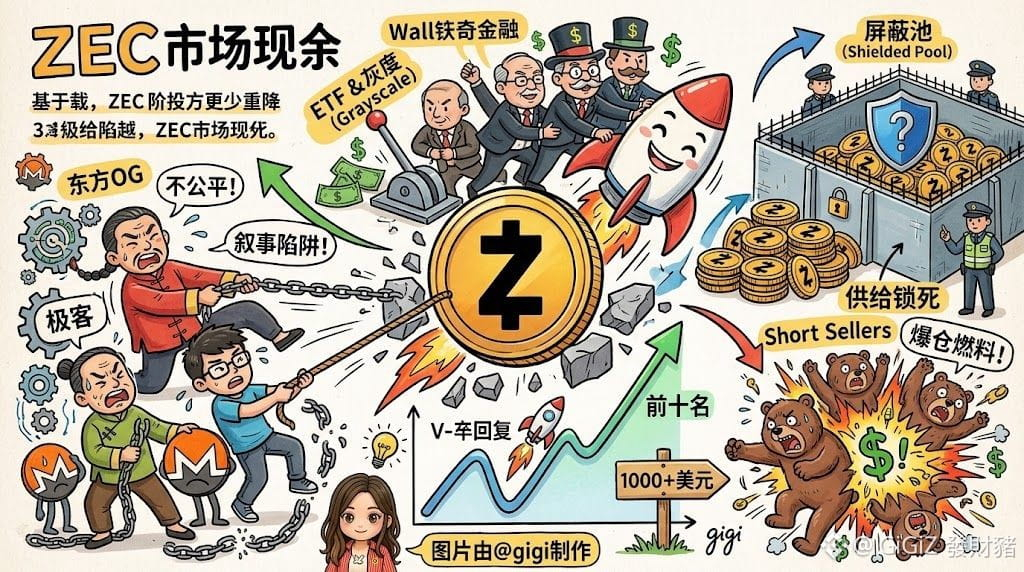
ZEC unleashes a狂暴行情, breaking through the $1,000 mark and pushing its market cap into the global top ten—what exactly gives it the power to withstand the denouncements from Eastern OG? $ZEC
{future}(ZECUSDT)
The truth is simple: this is not a revival of privacy faith, but a typical Wall Street capital “takeover” plus extreme supply squeeze.
What is Wall Street buying?
Grayscale has packaged ZEC as a privacy-enabled version of Bitcoin, with a 21 million supply cap and PoW. With its spot ETF meeting the “more than $500 million” threshold within two weeks, plus the SEC this year lifting the regulatory cloud by closing cases, it perfectly hits the institutional need for privacy as AI monitoring becomes the norm.
Why does Eastern OG pour cold water?
Veteran players like Wang Chun and Shen Yu prioritize original, unadulterated decentralization. In the early days, ZEC’s 20% developer allocation, non-default privacy, team instability, and historical vulnerabilities don’t seem “pure” to hardcore geeks. But precisely because it retains transparent addresses, it hasn’t been delisted by major exchanges—leaving Wall Street with abundant liquidity and room to control the market.
Outlook for what comes next
Currently, nearly 30% of ZEC has been locked in pools meant to shield activity, causing the circulating supply to shrink sharply. At the same time, massive short positions in the derivatives market keep getting liquidated—this has become entirely a capital game where the market makers force a squeeze.
In the near term, as long as Grayscale ETF inflows keep coming and the shorts keep bleeding out, a surge upward will be difficult to abruptly stop. But be sure to watch out: once the shorts are all but wiped out and Wall Street’s good news has been fully priced in, the “narrative premium” that lacks real-world application support could trigger a sharp pullback at any time. Understand the share-allocation game clearly—don’t blindly follow faith.
DYOR
#灰度zcashetf资产突破5亿美元
ZEC unleashes a狂暴行情, breaking through the $1,000 mark and pushing its market cap into the global top ten—what exactly gives it the power to withstand the denouncements from Eastern OG? $ZEC
The truth is simple: this is not a revival of privacy faith, but a typical Wall Street capital “takeover” plus extreme supply squeeze.
What is Wall Street buying?
Grayscale has packaged ZEC as a privacy-enabled version of Bitcoin, with a 21 million supply cap and PoW. With its spot ETF meeting the “more than $500 million” threshold within two weeks, plus the SEC this year lifting the regulatory cloud by closing cases, it perfectly hits the institutional need for privacy as AI monitoring becomes the norm.
Why does Eastern OG pour cold water?
Veteran players like Wang Chun and Shen Yu prioritize original, unadulterated decentralization. In the early days, ZEC’s 20% developer allocation, non-default privacy, team instability, and historical vulnerabilities don’t seem “pure” to hardcore geeks. But precisely because it retains transparent addresses, it hasn’t been delisted by major exchanges—leaving Wall Street with abundant liquidity and room to control the market.
Outlook for what comes next
Currently, nearly 30% of ZEC has been locked in pools meant to shield activity, causing the circulating supply to shrink sharply. At the same time, massive short positions in the derivatives market keep getting liquidated—this has become entirely a capital game where the market makers force a squeeze.
In the near term, as long as Grayscale ETF inflows keep coming and the shorts keep bleeding out, a surge upward will be difficult to abruptly stop. But be sure to watch out: once the shorts are all but wiped out and Wall Street’s good news has been fully priced in, the “narrative premium” that lacks real-world application support could trigger a sharp pullback at any time. Understand the share-allocation game clearly—don’t blindly follow faith.
DYOR
ZEC unleashes a狂暴行情, breaking through the $1,000 mark and pushing its market cap into the global top ten—what exactly gives it the power to withstand the denouncements from Eastern OG? $ZEC
The truth is simple: this is not a revival of privacy faith, but a typical Wall Street capital “takeover” plus extreme supply squeeze.
What is Wall Street buying?
Grayscale has packaged ZEC as a privacy-enabled version of Bitcoin, with a 21 million supply cap and PoW. With its spot ETF meeting the “more than $500 million” threshold within two weeks, plus the SEC this year lifting the regulatory cloud by closing cases, it perfectly hits the institutional need for privacy as AI monitoring becomes the norm.
Why does Eastern OG pour cold water?
Veteran players like Wang Chun and Shen Yu prioritize original, unadulterated decentralization. In the early days, ZEC’s 20% developer allocation, non-default privacy, team instability, and historical vulnerabilities don’t seem “pure” to hardcore geeks. But precisely because it retains transparent addresses, it hasn’t been delisted by major exchanges—leaving Wall Street with abundant liquidity and room to control the market.
Outlook for what comes next
Currently, nearly 30% of ZEC has been locked in pools meant to shield activity, causing the circulating supply to shrink sharply. At the same time, massive short positions in the derivatives market keep getting liquidated—this has become entirely a capital game where the market makers force a squeeze.
In the near term, as long as Grayscale ETF inflows keep coming and the shorts keep bleeding out, a surge upward will be difficult to abruptly stop. But be sure to watch out: once the shorts are all but wiped out and Wall Street’s good news has been fully priced in, the “narrative premium” that lacks real-world application support could trigger a sharp pullback at any time. Understand the share-allocation game clearly—don’t blindly follow faith.
DYOR
249
·
--

Article
Money Is Getting More Valuable! Hold on to Cash! If You Save More, Are You Really Getting Richer?Do you know? Lately, quite a few friends around me have been chatting and coming up with the exact same sigh: This is really strange. In the past, people always said that money would lose value—so why does it feel like the money in my hands is actually getting more expensive now?
It’s not an illusion. We may really be going through a shift in the underlying economic logic.
In the past, the familiar playbook was: Put money in the bank and it’s basically a slow death. Hurry up and buy a home with leverage—turn cash into assets! Back then, the overall environment kept rising, and that logic really held. But now the wind has changed. We’re entering a new cycle of asset contraction, where cash is king.
Money Is Getting More Valuable! Hold on to Cash! If You Save More, Are You Really Getting Richer?
Do you know? Lately, quite a few friends around me have been chatting and coming up with the exact same sigh: This is really strange. In the past, people always said that money would lose value—so why does it feel like the money in my hands is actually getting more expensive now?
It’s not an illusion. We may really be going through a shift in the underlying economic logic.
In the past, the familiar playbook was: Put money in the bank and it’s basically a slow death. Hurry up and buy a home with leverage—turn cash into assets! Back then, the overall environment kept rising, and that logic really held. But now the wind has changed. We’re entering a new cycle of asset contraction, where cash is king.
It’s not an illusion. We may really be going through a shift in the underlying economic logic.
In the past, the familiar playbook was: Put money in the bank and it’s basically a slow death. Hurry up and buy a home with leverage—turn cash into assets! Back then, the overall environment kept rising, and that logic really held. But now the wind has changed. We’re entering a new cycle of asset contraction, where cash is king.
2
976
·
--
Verified
#美股收跌英特尔涨9%
US stock market indices all fell sharply. Why did Intel surge 9% against the trend? $INTC
{future}(INTCUSDT)
▶️ Secured pricing power
Industry supply-chain reports indicate that due to the explosive growth of AI inference and agent computing, there is a severe shortage of CPU capacity in compute servers. Intel plans to raise prices for PC and server CPUs by about 10% in October. Being able to proactively raise prices in the industry suggests the market is truly short of supply.
▶️ Institutional endorsement and partnerships with industry giants
Wall Street institutions upgraded the stock to Overweight, with a target price raised to $120. Combined with breakthroughs in the foundry business, Intel not only used ASML’s latest equipment to mass-produce over one million wafers, but also tied in with Elon Musk’s Terafab superchip project.
From a logical standpoint, Intel has transformed from a laggard in AI over the past few years into a beneficiary of the shortage.
As for the next trend, my view is:
In the short term, there is still momentum for an upward push—especially before the October price increases take effect and before the Q3 earnings report comes out, as capital is still rushing in to accumulate.
But in the medium to long term, chasing the stock blindly carries significant risk. The share price has already risen to around $104, and the P/E ratio is nearing 50—valuation has become somewhat expensive. While price hikes can boost profits, it’s uncertain whether end-market demand can continue to absorb the higher prices.
If you already hold a position, you can continue to benefit from this rebound.
But if you’re thinking of chasing the rally now, I suggest waiting for a pullback and confirmation of support before deciding. After all, when the broader market is correcting, relying solely on a “stock price hike” thesis makes it hard for one company to enjoy the party independently for too long.
DYOR
#美股收跌英特尔涨9%
US stock market indices all fell sharply. Why did Intel surge 9% against the trend? $INTC
▶️ Secured pricing power
Industry supply-chain reports indicate that due to the explosive growth of AI inference and agent computing, there is a severe shortage of CPU capacity in compute servers. Intel plans to raise prices for PC and server CPUs by about 10% in October. Being able to proactively raise prices in the industry suggests the market is truly short of supply.
▶️ Institutional endorsement and partnerships with industry giants
Wall Street institutions upgraded the stock to Overweight, with a target price raised to $120. Combined with breakthroughs in the foundry business, Intel not only used ASML’s latest equipment to mass-produce over one million wafers, but also tied in with Elon Musk’s Terafab superchip project.
From a logical standpoint, Intel has transformed from a laggard in AI over the past few years into a beneficiary of the shortage.
As for the next trend, my view is:
In the short term, there is still momentum for an upward push—especially before the October price increases take effect and before the Q3 earnings report comes out, as capital is still rushing in to accumulate.
But in the medium to long term, chasing the stock blindly carries significant risk. The share price has already risen to around $104, and the P/E ratio is nearing 50—valuation has become somewhat expensive. While price hikes can boost profits, it’s uncertain whether end-market demand can continue to absorb the higher prices.
If you already hold a position, you can continue to benefit from this rebound.
But if you’re thinking of chasing the rally now, I suggest waiting for a pullback and confirmation of support before deciding. After all, when the broader market is correcting, relying solely on a “stock price hike” thesis makes it hard for one company to enjoy the party independently for too long.
DYOR
US stock market indices all fell sharply. Why did Intel surge 9% against the trend? $INTC
▶️ Secured pricing power
Industry supply-chain reports indicate that due to the explosive growth of AI inference and agent computing, there is a severe shortage of CPU capacity in compute servers. Intel plans to raise prices for PC and server CPUs by about 10% in October. Being able to proactively raise prices in the industry suggests the market is truly short of supply.
▶️ Institutional endorsement and partnerships with industry giants
Wall Street institutions upgraded the stock to Overweight, with a target price raised to $120. Combined with breakthroughs in the foundry business, Intel not only used ASML’s latest equipment to mass-produce over one million wafers, but also tied in with Elon Musk’s Terafab superchip project.
From a logical standpoint, Intel has transformed from a laggard in AI over the past few years into a beneficiary of the shortage.
As for the next trend, my view is:
In the short term, there is still momentum for an upward push—especially before the October price increases take effect and before the Q3 earnings report comes out, as capital is still rushing in to accumulate.
But in the medium to long term, chasing the stock blindly carries significant risk. The share price has already risen to around $104, and the P/E ratio is nearing 50—valuation has become somewhat expensive. While price hikes can boost profits, it’s uncertain whether end-market demand can continue to absorb the higher prices.
If you already hold a position, you can continue to benefit from this rebound.
But if you’re thinking of chasing the rally now, I suggest waiting for a pullback and confirmation of support before deciding. After all, when the broader market is correcting, relying solely on a “stock price hike” thesis makes it hard for one company to enjoy the party independently for too long.
DYOR

1.3k
·
--
Under the shadow of inflation as oil prices inch toward $100, will Asian stocks be dragged down across the board—or can AI chips alone keep them afloat to the very end?
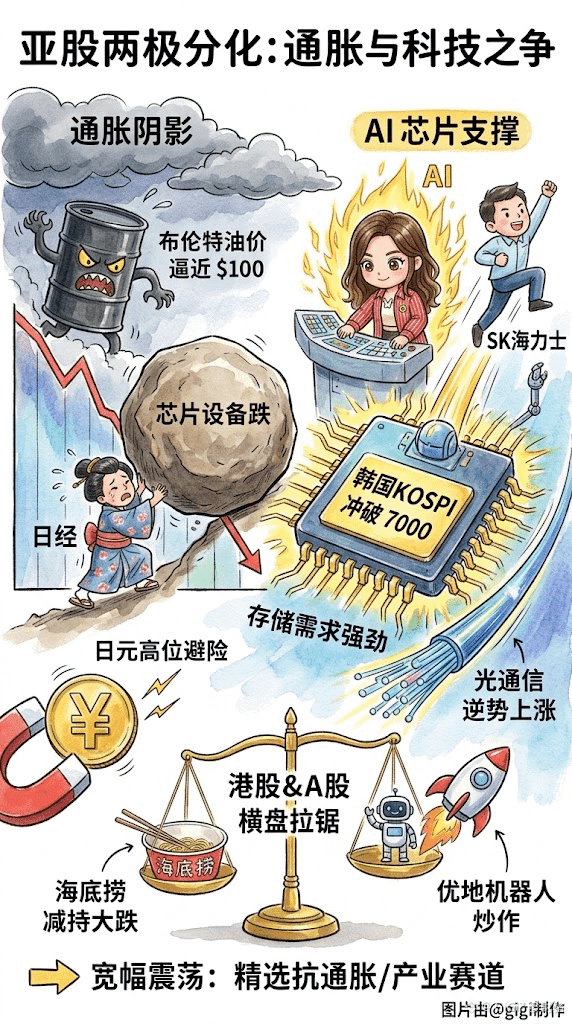
The market is now showing a classic case of polarization.
One camp is propped up by AI and the hardware cycle, providing strong support.
The Korean KOSPI index surged more than 1% against the trend, breaking through the 7,000-point mark, largely thanks to storage powerhouses such as SK hynix and Samsung.
Demand for memory chips remains strong, and the optical communications sector strengthened against the trend as well—boosted by the Optics Expo.
This suggests that as long as investors can see a hard-core implementation logic, they still dare to place aggressive bets.
The other camp is quietly being undermined by cost pressure and a risk-off mindset.
The Nikkei index meets resistance above 65,000 points and pulls back.
Equipment stocks like Advantest and Tokyo Electron lead the adjustment.
If oil prices stay elevated, countries like Japan—highly dependent on imported energy—feel the impact most directly.
Add that the yen is still high, and risk-averse capital begins choosing to lock in gains.
Hong Kong and A-shares are stuck in a range-bound tug-of-war.
Sector divergence is extremely severe internally.
Consumer bellwethers such as Haidilao have seen large-scale selloffs and sharp declines, while tech and robotics IPOs can be bid up to the sky.
This indicates that market funds are highly sensitive: they would rather chase the new than catch the high-priced “old” deals at the top.
Where do things go from here?
In the near term, the main theme remains geopolitical risk driving energy inflation versus the earnings certainty of technology and AI.
If Brent crude truly breaks through the $100 mark, overall risk appetite will almost certainly face further pressure.
Speculative theme stocks lacking earnings support will likely go through a round of clearing.
But as long as the AI hardware chain’s profit realization doesn’t break down, tech-weighted stocks will continue to play the role of a backstop.
In the coming weeks, Asian markets will most likely maintain wide-range volatility.
Compared with the index’s up-and-down direction, selecting sub-sectors that can resist inflation—or have absolute, coherent industry logic—will be the key.
DYOR $CL $SKHY
{future}(SKHYUSDT)
{future}(CLUSDT)
Under the shadow of inflation as oil prices inch toward $100, will Asian stocks be dragged down across the board—or can AI chips alone keep them afloat to the very end?
The market is now showing a classic case of polarization.
One camp is propped up by AI and the hardware cycle, providing strong support.
The Korean KOSPI index surged more than 1% against the trend, breaking through the 7,000-point mark, largely thanks to storage powerhouses such as SK hynix and Samsung.
Demand for memory chips remains strong, and the optical communications sector strengthened against the trend as well—boosted by the Optics Expo.
This suggests that as long as investors can see a hard-core implementation logic, they still dare to place aggressive bets.
The other camp is quietly being undermined by cost pressure and a risk-off mindset.
The Nikkei index meets resistance above 65,000 points and pulls back.
Equipment stocks like Advantest and Tokyo Electron lead the adjustment.
If oil prices stay elevated, countries like Japan—highly dependent on imported energy—feel the impact most directly.
Add that the yen is still high, and risk-averse capital begins choosing to lock in gains.
Hong Kong and A-shares are stuck in a range-bound tug-of-war.
Sector divergence is extremely severe internally.
Consumer bellwethers such as Haidilao have seen large-scale selloffs and sharp declines, while tech and robotics IPOs can be bid up to the sky.
This indicates that market funds are highly sensitive: they would rather chase the new than catch the high-priced “old” deals at the top.
Where do things go from here?
In the near term, the main theme remains geopolitical risk driving energy inflation versus the earnings certainty of technology and AI.
If Brent crude truly breaks through the $100 mark, overall risk appetite will almost certainly face further pressure.
Speculative theme stocks lacking earnings support will likely go through a round of clearing.
But as long as the AI hardware chain’s profit realization doesn’t break down, tech-weighted stocks will continue to play the role of a backstop.
In the coming weeks, Asian markets will most likely maintain wide-range volatility.
Compared with the index’s up-and-down direction, selecting sub-sectors that can resist inflation—or have absolute, coherent industry logic—will be the key.
DYOR $CL $SKHY
The market is now showing a classic case of polarization.
One camp is propped up by AI and the hardware cycle, providing strong support.
The Korean KOSPI index surged more than 1% against the trend, breaking through the 7,000-point mark, largely thanks to storage powerhouses such as SK hynix and Samsung.
Demand for memory chips remains strong, and the optical communications sector strengthened against the trend as well—boosted by the Optics Expo.
This suggests that as long as investors can see a hard-core implementation logic, they still dare to place aggressive bets.
The other camp is quietly being undermined by cost pressure and a risk-off mindset.
The Nikkei index meets resistance above 65,000 points and pulls back.
Equipment stocks like Advantest and Tokyo Electron lead the adjustment.
If oil prices stay elevated, countries like Japan—highly dependent on imported energy—feel the impact most directly.
Add that the yen is still high, and risk-averse capital begins choosing to lock in gains.
Hong Kong and A-shares are stuck in a range-bound tug-of-war.
Sector divergence is extremely severe internally.
Consumer bellwethers such as Haidilao have seen large-scale selloffs and sharp declines, while tech and robotics IPOs can be bid up to the sky.
This indicates that market funds are highly sensitive: they would rather chase the new than catch the high-priced “old” deals at the top.
Where do things go from here?
In the near term, the main theme remains geopolitical risk driving energy inflation versus the earnings certainty of technology and AI.
If Brent crude truly breaks through the $100 mark, overall risk appetite will almost certainly face further pressure.
Speculative theme stocks lacking earnings support will likely go through a round of clearing.
But as long as the AI hardware chain’s profit realization doesn’t break down, tech-weighted stocks will continue to play the role of a backstop.
In the coming weeks, Asian markets will most likely maintain wide-range volatility.
Compared with the index’s up-and-down direction, selecting sub-sectors that can resist inflation—or have absolute, coherent industry logic—will be the key.
DYOR $CL $SKHY
477
·
--
The U.S. Crypto Bill Faces a Life-or-Death Test—Will It Succeed This Time?
The highly anticipated CLARITY Act is about to enter a procedural vote. Many people mistakenly think this is the final judgment, but in reality it’s only about whether it can secure the 60 votes needed to begin debate. The Republican Party has just 53 seats, so it must win over 7 Democrats to defect. According to the latest prediction market estimates, the passage rate has dropped to around 20%, and the situation is extremely grim.
The core reason for the stalemate is that, on the surface, everyone is arguing about DeFi liability and stablecoin yield. In truth, the deadlock is caused by a moral provision targeting conflicts of interest involving officials—one that directly threatens the interests of certain top-level players. Add to that the fact that the election sprint is coming immediately afterward, and if this hurdle isn’t cleared, legislation within the year is essentially dead on arrival.
At a deeper level, this isn’t simply a fight over a bill. It’s a battle for control over crypto pricing power between traditional finance’s old guard and Web3-compliance-backed capital.
In the short term, it’s negative news. But in the long run, it may actually help “clean up” the market. If the regulatory “shoe” doesn’t drop and the guidance isn’t finalized, major institutions and large funds won’t dare to truly step in. If the vote fails and altcoins pull back, it could end up giving long-term capital a high-quality buying opportunity. If it unexpectedly clears the hurdle and the compliance pathway opens, the market could directly kick off a new round of strong-regulation bull market. It all depends on how far the two parties can go in trading interests next.
$BTC
DYOR
{future}(BTCUSDT)
The U.S. Crypto Bill Faces a Life-or-Death Test—Will It Succeed This Time?
The highly anticipated CLARITY Act is about to enter a procedural vote. Many people mistakenly think this is the final judgment, but in reality it’s only about whether it can secure the 60 votes needed to begin debate. The Republican Party has just 53 seats, so it must win over 7 Democrats to defect. According to the latest prediction market estimates, the passage rate has dropped to around 20%, and the situation is extremely grim.
The core reason for the stalemate is that, on the surface, everyone is arguing about DeFi liability and stablecoin yield. In truth, the deadlock is caused by a moral provision targeting conflicts of interest involving officials—one that directly threatens the interests of certain top-level players. Add to that the fact that the election sprint is coming immediately afterward, and if this hurdle isn’t cleared, legislation within the year is essentially dead on arrival.
At a deeper level, this isn’t simply a fight over a bill. It’s a battle for control over crypto pricing power between traditional finance’s old guard and Web3-compliance-backed capital.
In the short term, it’s negative news. But in the long run, it may actually help “clean up” the market. If the regulatory “shoe” doesn’t drop and the guidance isn’t finalized, major institutions and large funds won’t dare to truly step in. If the vote fails and altcoins pull back, it could end up giving long-term capital a high-quality buying opportunity. If it unexpectedly clears the hurdle and the compliance pathway opens, the market could directly kick off a new round of strong-regulation bull market. It all depends on how far the two parties can go in trading interests next.
$BTC
DYOR
The highly anticipated CLARITY Act is about to enter a procedural vote. Many people mistakenly think this is the final judgment, but in reality it’s only about whether it can secure the 60 votes needed to begin debate. The Republican Party has just 53 seats, so it must win over 7 Democrats to defect. According to the latest prediction market estimates, the passage rate has dropped to around 20%, and the situation is extremely grim.
The core reason for the stalemate is that, on the surface, everyone is arguing about DeFi liability and stablecoin yield. In truth, the deadlock is caused by a moral provision targeting conflicts of interest involving officials—one that directly threatens the interests of certain top-level players. Add to that the fact that the election sprint is coming immediately afterward, and if this hurdle isn’t cleared, legislation within the year is essentially dead on arrival.
At a deeper level, this isn’t simply a fight over a bill. It’s a battle for control over crypto pricing power between traditional finance’s old guard and Web3-compliance-backed capital.
In the short term, it’s negative news. But in the long run, it may actually help “clean up” the market. If the regulatory “shoe” doesn’t drop and the guidance isn’t finalized, major institutions and large funds won’t dare to truly step in. If the vote fails and altcoins pull back, it could end up giving long-term capital a high-quality buying opportunity. If it unexpectedly clears the hurdle and the compliance pathway opens, the market could directly kick off a new round of strong-regulation bull market. It all depends on how far the two parties can go in trading interests next.
$BTC
DYOR
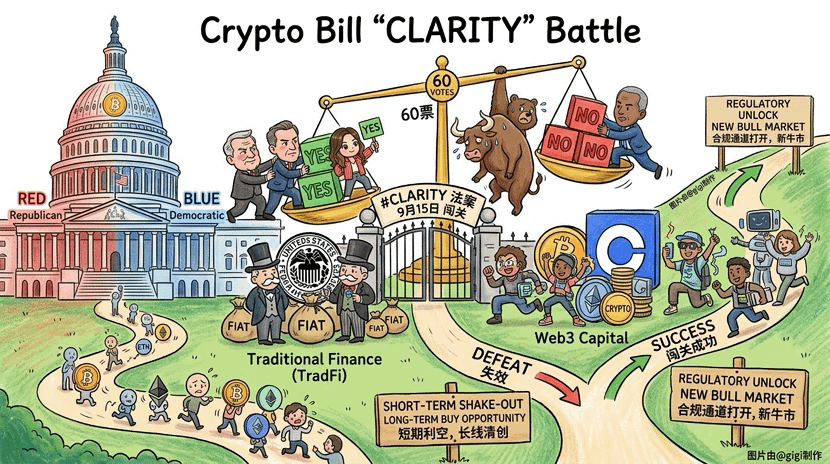
2
3
2.9k
·
--
Why has everyone been talking recently about the split in crypto treasuries? Those publicly listed companies that used to grab attention by buying coins—how did they suddenly turn around and start repurchasing shares?
Because the era of mindless, brute-force coin hoarding has ended. Today’s crypto treasuries are playing the game of capital efficiency.
Although Strive is still borrowing money to add to its position—$BTC —and BitMine $BMNP has also put nearly 90% of $ETH into staking to earn on-chain interest, what really stands out is that Strategy paused buying coins and instead poured $176 million into repurchasing its own discounted preferred shares—$STRC —and raised the repurchase cap to $2 billion.
This looks like a detour from the core business, but it’s actually a very shrewd financial maneuver. Buying back discounted preferred shares not only eliminates future high-interest debt, but also dilutes equity risk, effectively boosting the value of the crypto assets backing each share.
Looking ahead, the path of relying solely on leveraged schemes—issuing shares or debt to buy coins—will get harder and harder. The coming split will be extremely pronounced: in bear markets or sideways periods, restructuring debt and repurchasing equity. In bull markets, staking yields and dynamic arbitrage will be sufficient to sustain the strategy.
In the future, the ones truly able to outperform the market won’t be the coin-buying heroes anymore, but rather capital experts who master financial leverage and cash-flow operations. Which play do you like more?
DYOR
{future}(STRCUSDT)
{future}(ETHUSDT)
{future}(BTCUSDT)
Why has everyone been talking recently about the split in crypto treasuries? Those publicly listed companies that used to grab attention by buying coins—how did they suddenly turn around and start repurchasing shares?
Because the era of mindless, brute-force coin hoarding has ended. Today’s crypto treasuries are playing the game of capital efficiency.
Although Strive is still borrowing money to add to its position—$BTC —and BitMine $BMNP has also put nearly 90% of $ETH into staking to earn on-chain interest, what really stands out is that Strategy paused buying coins and instead poured $176 million into repurchasing its own discounted preferred shares—$STRC —and raised the repurchase cap to $2 billion.
This looks like a detour from the core business, but it’s actually a very shrewd financial maneuver. Buying back discounted preferred shares not only eliminates future high-interest debt, but also dilutes equity risk, effectively boosting the value of the crypto assets backing each share.
Looking ahead, the path of relying solely on leveraged schemes—issuing shares or debt to buy coins—will get harder and harder. The coming split will be extremely pronounced: in bear markets or sideways periods, restructuring debt and repurchasing equity. In bull markets, staking yields and dynamic arbitrage will be sufficient to sustain the strategy.
In the future, the ones truly able to outperform the market won’t be the coin-buying heroes anymore, but rather capital experts who master financial leverage and cash-flow operations. Which play do you like more?
DYOR
Because the era of mindless, brute-force coin hoarding has ended. Today’s crypto treasuries are playing the game of capital efficiency.
Although Strive is still borrowing money to add to its position—$BTC —and BitMine $BMNP has also put nearly 90% of $ETH into staking to earn on-chain interest, what really stands out is that Strategy paused buying coins and instead poured $176 million into repurchasing its own discounted preferred shares—$STRC —and raised the repurchase cap to $2 billion.
This looks like a detour from the core business, but it’s actually a very shrewd financial maneuver. Buying back discounted preferred shares not only eliminates future high-interest debt, but also dilutes equity risk, effectively boosting the value of the crypto assets backing each share.
Looking ahead, the path of relying solely on leveraged schemes—issuing shares or debt to buy coins—will get harder and harder. The coming split will be extremely pronounced: in bear markets or sideways periods, restructuring debt and repurchasing equity. In bull markets, staking yields and dynamic arbitrage will be sufficient to sustain the strategy.
In the future, the ones truly able to outperform the market won’t be the coin-buying heroes anymore, but rather capital experts who master financial leverage and cash-flow operations. Which play do you like more?
DYOR

172
·
--
Crude oil suddenly surges, and stocks tumble at the end of trading—how long will this geopolitical shake-up lift oil prices?
On the surface, it looks like a surprise “black swan” caused by an attack on Saudi facilities. Crude oil then catches up, and capital takes the opportunity to lock in profits and sell off, dragging down the stock markets of Japan and South Korea
Geopolitical risk premium gets repriced
The attack lands directly on physical facilities and causes shutdowns. Oil is already in tight balance, so any minor disturbance on the supply side can instantly amplify bullish sentiment in the market
The stock selloff is taking advantage of the situation
While an upward revision to Japan’s GDP is a positive, the central bank’s policy meeting is just around the corner. Funds sitting at high levels are struggling to find a reason to hold onto gains, and the geopolitical conflict becomes the best pretext to dump positions
Outlook and possible paths ahead:
Oil
In the short term, it’s about sentiment. If Saudi Arabia quickly restores production, prices may spike and then pull back. If the conflict escalates, holding Brent at around $100 is only a matter of time
Stocks
Higher costs on top of expected tightening, along with continued pressure on overvalued tech stocks. Funds will likely rotate toward energy and high-dividend sectors as a hedge
The next hidden thread is the secondary shock of global inflation triggered by crude oil trading at elevated levels
DYOR
Crude oil suddenly surges, and stocks tumble at the end of trading—how long will this geopolitical shake-up lift oil prices?
On the surface, it looks like a surprise “black swan” caused by an attack on Saudi facilities. Crude oil then catches up, and capital takes the opportunity to lock in profits and sell off, dragging down the stock markets of Japan and South Korea
Geopolitical risk premium gets repriced
The attack lands directly on physical facilities and causes shutdowns. Oil is already in tight balance, so any minor disturbance on the supply side can instantly amplify bullish sentiment in the market
The stock selloff is taking advantage of the situation
While an upward revision to Japan’s GDP is a positive, the central bank’s policy meeting is just around the corner. Funds sitting at high levels are struggling to find a reason to hold onto gains, and the geopolitical conflict becomes the best pretext to dump positions
Outlook and possible paths ahead:
Oil
In the short term, it’s about sentiment. If Saudi Arabia quickly restores production, prices may spike and then pull back. If the conflict escalates, holding Brent at around $100 is only a matter of time
Stocks
Higher costs on top of expected tightening, along with continued pressure on overvalued tech stocks. Funds will likely rotate toward energy and high-dividend sectors as a hedge
The next hidden thread is the secondary shock of global inflation triggered by crude oil trading at elevated levels
DYOR
On the surface, it looks like a surprise “black swan” caused by an attack on Saudi facilities. Crude oil then catches up, and capital takes the opportunity to lock in profits and sell off, dragging down the stock markets of Japan and South Korea
Geopolitical risk premium gets repriced
The attack lands directly on physical facilities and causes shutdowns. Oil is already in tight balance, so any minor disturbance on the supply side can instantly amplify bullish sentiment in the market
The stock selloff is taking advantage of the situation
While an upward revision to Japan’s GDP is a positive, the central bank’s policy meeting is just around the corner. Funds sitting at high levels are struggling to find a reason to hold onto gains, and the geopolitical conflict becomes the best pretext to dump positions
Outlook and possible paths ahead:
Oil
In the short term, it’s about sentiment. If Saudi Arabia quickly restores production, prices may spike and then pull back. If the conflict escalates, holding Brent at around $100 is only a matter of time
Stocks
Higher costs on top of expected tightening, along with continued pressure on overvalued tech stocks. Funds will likely rotate toward energy and high-dividend sectors as a hedge
The next hidden thread is the secondary shock of global inflation triggered by crude oil trading at elevated levels
DYOR
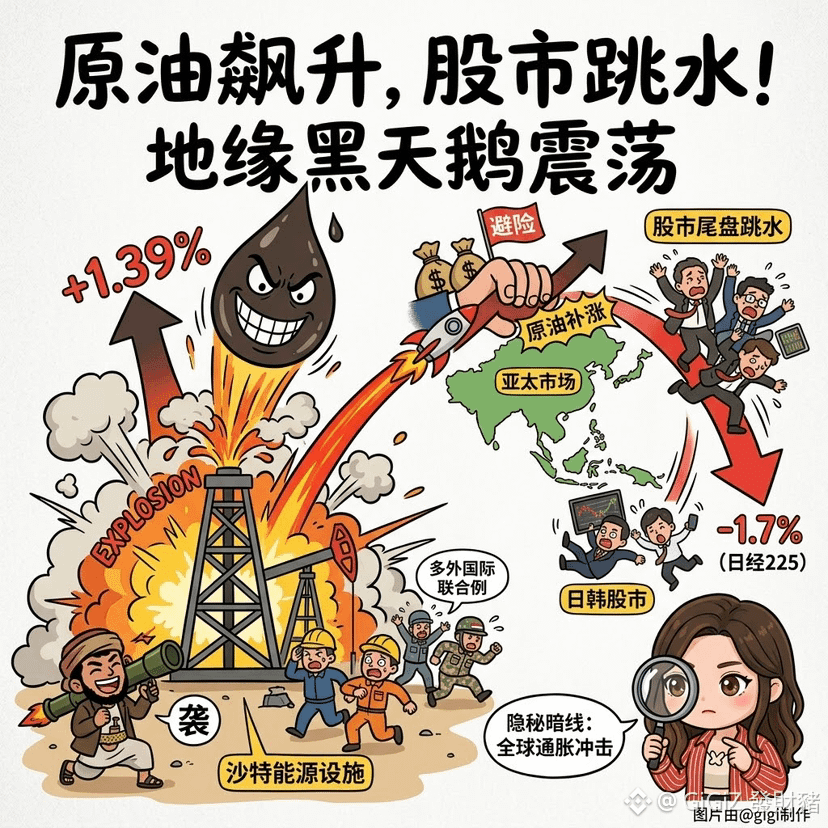
1
465
·
--
The Canada–U.S. tariff war has reached a new high—have you had a Canadiano-style coffee today? ☕️
Canada has officially imposed retaliatory tariffs of 15% to 50% on about $20 billion worth of U.S. goods, directly targeting steel, agricultural products, and appliances.
The two countries’ relationship has deteriorated so badly that grassroots resistance to American elements has emerged across the public—even some cafés have renamed Americano as “Canadiano” 😂
🔹 Impact on the market
▶️ Macro economy: a lose–lose situation
An ultra-integrated supply chain has been cut off. Canada faces inflation and a weaker Canadian dollar, while U.S. farms and manufacturers are hit as well
▶️ Stock market: some rejoice, others grieve
Cross-border retail, auto, and steel stocks take a beating, while Canada-based supply-chain replacement concept stocks are instead being chased despite the downturn
▶️ Crypto market: a new safe-haven favorite
As the trade war escalates fiat currency depreciation and settlement barriers, decentralized assets like BTC act as a financial safety valve
This isn’t just a trade dispute—it’s a signal that North American integration is unraveling. After contract-based trust is broken, global supply chains have shifted from chasing efficiency to prioritizing security and confrontation
In the short term, both sides—trapped by election dynamics and public opinion—will continue to hardline, possibly even spilling into the energy sector
In the long run, as companies and the public’s pain index keeps soaring, both sides will eventually return to the negotiating table through exemption lists
DYOR
#加拿大对美关税正式生效
#Canada plans to impose 15% to 50% tariffs on U.S. goods
The Canada–U.S. tariff war has reached a new high—have you had a Canadiano-style coffee today? ☕️
Canada has officially imposed retaliatory tariffs of 15% to 50% on about $20 billion worth of U.S. goods, directly targeting steel, agricultural products, and appliances.
The two countries’ relationship has deteriorated so badly that grassroots resistance to American elements has emerged across the public—even some cafés have renamed Americano as “Canadiano” 😂
🔹 Impact on the market
▶️ Macro economy: a lose–lose situation
An ultra-integrated supply chain has been cut off. Canada faces inflation and a weaker Canadian dollar, while U.S. farms and manufacturers are hit as well
▶️ Stock market: some rejoice, others grieve
Cross-border retail, auto, and steel stocks take a beating, while Canada-based supply-chain replacement concept stocks are instead being chased despite the downturn
▶️ Crypto market: a new safe-haven favorite
As the trade war escalates fiat currency depreciation and settlement barriers, decentralized assets like BTC act as a financial safety valve
This isn’t just a trade dispute—it’s a signal that North American integration is unraveling. After contract-based trust is broken, global supply chains have shifted from chasing efficiency to prioritizing security and confrontation
In the short term, both sides—trapped by election dynamics and public opinion—will continue to hardline, possibly even spilling into the energy sector
In the long run, as companies and the public’s pain index keeps soaring, both sides will eventually return to the negotiating table through exemption lists
DYOR
#加拿大对美关税正式生效
#Canada plans to impose 15% to 50% tariffs on U.S. goods
Canada has officially imposed retaliatory tariffs of 15% to 50% on about $20 billion worth of U.S. goods, directly targeting steel, agricultural products, and appliances.
The two countries’ relationship has deteriorated so badly that grassroots resistance to American elements has emerged across the public—even some cafés have renamed Americano as “Canadiano” 😂
🔹 Impact on the market
▶️ Macro economy: a lose–lose situation
An ultra-integrated supply chain has been cut off. Canada faces inflation and a weaker Canadian dollar, while U.S. farms and manufacturers are hit as well
▶️ Stock market: some rejoice, others grieve
Cross-border retail, auto, and steel stocks take a beating, while Canada-based supply-chain replacement concept stocks are instead being chased despite the downturn
▶️ Crypto market: a new safe-haven favorite
As the trade war escalates fiat currency depreciation and settlement barriers, decentralized assets like BTC act as a financial safety valve
This isn’t just a trade dispute—it’s a signal that North American integration is unraveling. After contract-based trust is broken, global supply chains have shifted from chasing efficiency to prioritizing security and confrontation
In the short term, both sides—trapped by election dynamics and public opinion—will continue to hardline, possibly even spilling into the energy sector
In the long run, as companies and the public’s pain index keeps soaring, both sides will eventually return to the negotiating table through exemption lists
DYOR
#加拿大对美关税正式生效
#Canada plans to impose 15% to 50% tariffs on U.S. goods
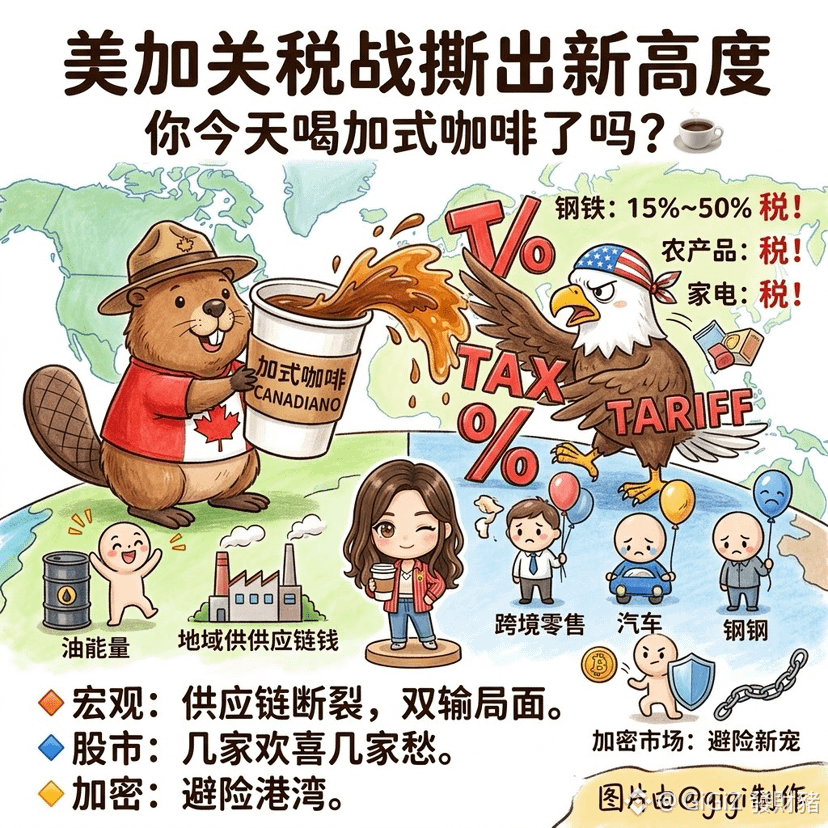
206
·
--
Asia chip stocks and the yen suddenly surge—are semiconductors really about to run out?
Supply and demand inversion is nearing its limit, and a valuation re-rating has begun
Samsung and SK hynix inventories have fallen below 10 days—this is a structural shortage triggered by imbalanced capacity allocation
AI infrastructure is consuming too many resources. To ramp up production of HBM4 with full force, chipmakers have to sacrifice traditional DRAM capacity, directly causing a shortage across server DDR5 and enterprise SSDs
Previously, these two giants’ share prices pulled back by more than 30%, and their forecast P/E was smashed to around 3x. But as global AI compute infrastructure rolls out, spot inventory has been squeezed dry, and the extremely undervalued stock prices are poised for a strong rebound and repair
The yen’s rate-hike tailwind is exhausted—hard to turn a big wave
Japan’s July wages saw the largest increase in nearly 30 years. The market has fully priced in a 25-basis-point rate hike in September. However, this rally is mainly propped up by one-time summer bonuses, with limited growth in base salaries. Even if the Bank of Japan hikes rates as scheduled, there is little room for further tightening afterward, so it won’t trigger a dramatic wave of carry-trade unwinds
Market outlook going forward
Semiconductors
A frenzy to grab supply begins—tech giants will spare no effort to lock in DRAM capacity. Memory chips will enter a seller’s market, and the entire global memory industry chain will see a valuation re-rating
The yen and Japanese stocks
Spike first, then range-bound in the short term. The yen strengthens briefly due to rate hikes, but lacks long-term support. Japanese stocks are held back by the rate-hike drag, yet the strong momentum of the AI industry chain will offset the impact of rising interest rates
DYOR
Asia chip stocks and the yen suddenly surge—are semiconductors really about to run out?
Supply and demand inversion is nearing its limit, and a valuation re-rating has begun
Samsung and SK hynix inventories have fallen below 10 days—this is a structural shortage triggered by imbalanced capacity allocation
AI infrastructure is consuming too many resources. To ramp up production of HBM4 with full force, chipmakers have to sacrifice traditional DRAM capacity, directly causing a shortage across server DDR5 and enterprise SSDs
Previously, these two giants’ share prices pulled back by more than 30%, and their forecast P/E was smashed to around 3x. But as global AI compute infrastructure rolls out, spot inventory has been squeezed dry, and the extremely undervalued stock prices are poised for a strong rebound and repair
The yen’s rate-hike tailwind is exhausted—hard to turn a big wave
Japan’s July wages saw the largest increase in nearly 30 years. The market has fully priced in a 25-basis-point rate hike in September. However, this rally is mainly propped up by one-time summer bonuses, with limited growth in base salaries. Even if the Bank of Japan hikes rates as scheduled, there is little room for further tightening afterward, so it won’t trigger a dramatic wave of carry-trade unwinds
Market outlook going forward
Semiconductors
A frenzy to grab supply begins—tech giants will spare no effort to lock in DRAM capacity. Memory chips will enter a seller’s market, and the entire global memory industry chain will see a valuation re-rating
The yen and Japanese stocks
Spike first, then range-bound in the short term. The yen strengthens briefly due to rate hikes, but lacks long-term support. Japanese stocks are held back by the rate-hike drag, yet the strong momentum of the AI industry chain will offset the impact of rising interest rates
DYOR
Supply and demand inversion is nearing its limit, and a valuation re-rating has begun
Samsung and SK hynix inventories have fallen below 10 days—this is a structural shortage triggered by imbalanced capacity allocation
AI infrastructure is consuming too many resources. To ramp up production of HBM4 with full force, chipmakers have to sacrifice traditional DRAM capacity, directly causing a shortage across server DDR5 and enterprise SSDs
Previously, these two giants’ share prices pulled back by more than 30%, and their forecast P/E was smashed to around 3x. But as global AI compute infrastructure rolls out, spot inventory has been squeezed dry, and the extremely undervalued stock prices are poised for a strong rebound and repair
The yen’s rate-hike tailwind is exhausted—hard to turn a big wave
Japan’s July wages saw the largest increase in nearly 30 years. The market has fully priced in a 25-basis-point rate hike in September. However, this rally is mainly propped up by one-time summer bonuses, with limited growth in base salaries. Even if the Bank of Japan hikes rates as scheduled, there is little room for further tightening afterward, so it won’t trigger a dramatic wave of carry-trade unwinds
Market outlook going forward
Semiconductors
A frenzy to grab supply begins—tech giants will spare no effort to lock in DRAM capacity. Memory chips will enter a seller’s market, and the entire global memory industry chain will see a valuation re-rating
The yen and Japanese stocks
Spike first, then range-bound in the short term. The yen strengthens briefly due to rate hikes, but lacks long-term support. Japanese stocks are held back by the rate-hike drag, yet the strong momentum of the AI industry chain will offset the impact of rising interest rates
DYOR
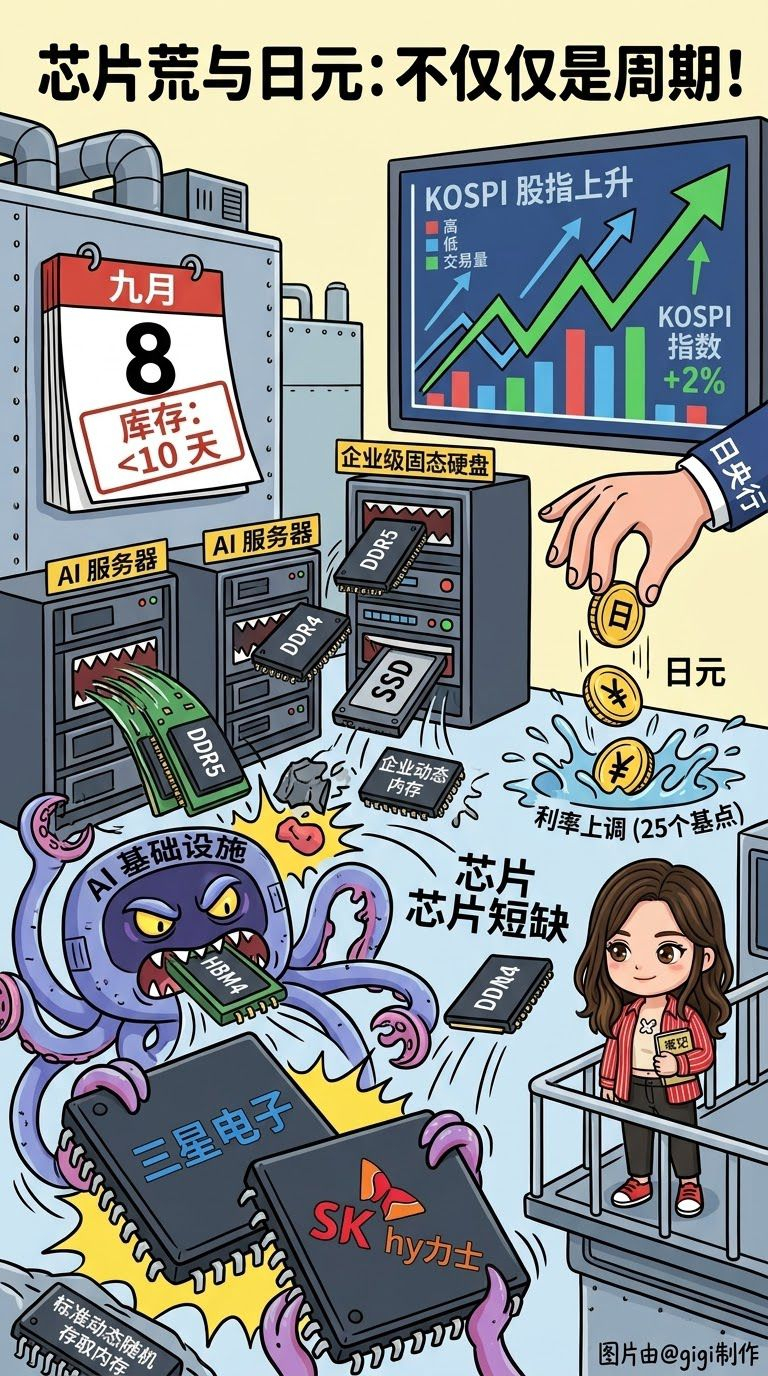
309
·
--
Hunter Biden, $17 million in debt—can he really pay it off by issuing a meme coin?
This is outrageous, and yet very American satire. HunterBiden posted on X teasing the release of $LAPTOP, launching on the Base chain on September 9.
Political dirt turned into a cash-out tool
He directly uses the “laptop” scandal that has plagued him for years as the token name, and even allocates 2% of the airdrop to retail traders who lost money on $TRUMP . It looks like political performance art, but in reality it’s monetizing massive attention—while also striking back at his opponents.
Dumping the blame on an offshore island, pocketing the profits
The whitepaper states that it has no utility whatsoever. Any disputes must be arbitrated in the British Virgin Islands, and liability is capped at just $100. But the project’s net profits will be transferred entirely into a company controlled by his team. After 30% of the team allocation vests, once they pump up the sell pressure, they can easily cover his debts.
Forward-looking predictions
In the short term, hype will trigger extremely high attention and wild pump-and-dump swings. Now copycats are already flooding the market.
In the long run, with no value support and heavy sell pressure from large unlocks, it will very likely end up at zero—following the old path of $TRUMP : a 97% crash.
Hunter doesn’t really care about Web3. He just discovered that retail traders’ money can not only help him pay off debt, but also serve as his political leverage.
DYOR
{future}(TRUMPUSDT)
Hunter Biden, $17 million in debt—can he really pay it off by issuing a meme coin?
This is outrageous, and yet very American satire. HunterBiden posted on X teasing the release of $LAPTOP, launching on the Base chain on September 9.
Political dirt turned into a cash-out tool
He directly uses the “laptop” scandal that has plagued him for years as the token name, and even allocates 2% of the airdrop to retail traders who lost money on $TRUMP . It looks like political performance art, but in reality it’s monetizing massive attention—while also striking back at his opponents.
Dumping the blame on an offshore island, pocketing the profits
The whitepaper states that it has no utility whatsoever. Any disputes must be arbitrated in the British Virgin Islands, and liability is capped at just $100. But the project’s net profits will be transferred entirely into a company controlled by his team. After 30% of the team allocation vests, once they pump up the sell pressure, they can easily cover his debts.
Forward-looking predictions
In the short term, hype will trigger extremely high attention and wild pump-and-dump swings. Now copycats are already flooding the market.
In the long run, with no value support and heavy sell pressure from large unlocks, it will very likely end up at zero—following the old path of $TRUMP : a 97% crash.
Hunter doesn’t really care about Web3. He just discovered that retail traders’ money can not only help him pay off debt, but also serve as his political leverage.
DYOR
This is outrageous, and yet very American satire. HunterBiden posted on X teasing the release of $LAPTOP, launching on the Base chain on September 9.
Political dirt turned into a cash-out tool
He directly uses the “laptop” scandal that has plagued him for years as the token name, and even allocates 2% of the airdrop to retail traders who lost money on $TRUMP . It looks like political performance art, but in reality it’s monetizing massive attention—while also striking back at his opponents.
Dumping the blame on an offshore island, pocketing the profits
The whitepaper states that it has no utility whatsoever. Any disputes must be arbitrated in the British Virgin Islands, and liability is capped at just $100. But the project’s net profits will be transferred entirely into a company controlled by his team. After 30% of the team allocation vests, once they pump up the sell pressure, they can easily cover his debts.
Forward-looking predictions
In the short term, hype will trigger extremely high attention and wild pump-and-dump swings. Now copycats are already flooding the market.
In the long run, with no value support and heavy sell pressure from large unlocks, it will very likely end up at zero—following the old path of $TRUMP : a 97% crash.
Hunter doesn’t really care about Web3. He just discovered that retail traders’ money can not only help him pay off debt, but also serve as his political leverage.
DYOR

2
1
3
12.3k
·
--
A chip the size of a fingernail cramps in trillions of transistors—are silicon-based chips really about to reach their physical limits?
IBM’s presentation of its 0.7-nanometer technology is indeed quite impressive. It stacks transistors vertically like building blocks, pushing density to a new high. But let’s look at it rationally: lab results and what can actually be manufactured at scale and used in phones are completely different things.
From the lab to mass commercial production typically takes more than five years. This kind of vertical stacking is not only extremely difficult to solve for heat dissipation, but yields are also a huge challenge—and costs are frighteningly high.
As for the semiconductor market and where things go next, there are a few very clear trends:
▶️ TSMC vs. Samsung in the fight for leading-edge manufacturing
In the high-end foundry market, TSMC is still firmly dominant. With solid yields and advanced packaging, it has secured the vast majority of AI chip orders. Although both TSMC and Samsung have moved into the 2-nanometer era, Samsung still struggles with yield ramp-up. Even recently, its 1.4-nanometer mass-production target was pushed back to around 2029. This means that in the short term, TSMC still holds the upper hand in terms of pricing power and premium capture in leading-edge foundry services.
▶️ The breakthrough point for domestic chips
In the face of restrictions on advanced process technology, the industry in China doesn’t need to fall into node anxiety. As traditional silicon-based approaches become increasingly expensive and see diminishing returns, it creates room for other routes. For example, using new two-dimensional semiconductor materials, advanced packaging techniques, or even photonic computing—these can deliver practical computing power that is just as capable without chasing absolute extreme nodes. Besides, most automotive, industrial, and consumer electronics chips aim for “useful, affordable, and high-yield,” not for blindly chasing the lowest numbers.
Overall market outlook
In the next few years, the semiconductor market will shift completely from simply competing on physical line width to an integrated contest involving 3D stacking, new materials, and system-level packaging. Advanced processes will become an expensive game only a small number of giants can afford, while most companies will choose mature nodes combined with advanced packaging to improve cost-effectiveness. In this long race, it won’t be about who can make the node smallest—it will be about who can drive down total cost the most.
DYOR
A chip the size of a fingernail cramps in trillions of transistors—are silicon-based chips really about to reach their physical limits?
IBM’s presentation of its 0.7-nanometer technology is indeed quite impressive. It stacks transistors vertically like building blocks, pushing density to a new high. But let’s look at it rationally: lab results and what can actually be manufactured at scale and used in phones are completely different things.
From the lab to mass commercial production typically takes more than five years. This kind of vertical stacking is not only extremely difficult to solve for heat dissipation, but yields are also a huge challenge—and costs are frighteningly high.
As for the semiconductor market and where things go next, there are a few very clear trends:
▶️ TSMC vs. Samsung in the fight for leading-edge manufacturing
In the high-end foundry market, TSMC is still firmly dominant. With solid yields and advanced packaging, it has secured the vast majority of AI chip orders. Although both TSMC and Samsung have moved into the 2-nanometer era, Samsung still struggles with yield ramp-up. Even recently, its 1.4-nanometer mass-production target was pushed back to around 2029. This means that in the short term, TSMC still holds the upper hand in terms of pricing power and premium capture in leading-edge foundry services.
▶️ The breakthrough point for domestic chips
In the face of restrictions on advanced process technology, the industry in China doesn’t need to fall into node anxiety. As traditional silicon-based approaches become increasingly expensive and see diminishing returns, it creates room for other routes. For example, using new two-dimensional semiconductor materials, advanced packaging techniques, or even photonic computing—these can deliver practical computing power that is just as capable without chasing absolute extreme nodes. Besides, most automotive, industrial, and consumer electronics chips aim for “useful, affordable, and high-yield,” not for blindly chasing the lowest numbers.
Overall market outlook
In the next few years, the semiconductor market will shift completely from simply competing on physical line width to an integrated contest involving 3D stacking, new materials, and system-level packaging. Advanced processes will become an expensive game only a small number of giants can afford, while most companies will choose mature nodes combined with advanced packaging to improve cost-effectiveness. In this long race, it won’t be about who can make the node smallest—it will be about who can drive down total cost the most.
DYOR
IBM’s presentation of its 0.7-nanometer technology is indeed quite impressive. It stacks transistors vertically like building blocks, pushing density to a new high. But let’s look at it rationally: lab results and what can actually be manufactured at scale and used in phones are completely different things.
From the lab to mass commercial production typically takes more than five years. This kind of vertical stacking is not only extremely difficult to solve for heat dissipation, but yields are also a huge challenge—and costs are frighteningly high.
As for the semiconductor market and where things go next, there are a few very clear trends:
▶️ TSMC vs. Samsung in the fight for leading-edge manufacturing
In the high-end foundry market, TSMC is still firmly dominant. With solid yields and advanced packaging, it has secured the vast majority of AI chip orders. Although both TSMC and Samsung have moved into the 2-nanometer era, Samsung still struggles with yield ramp-up. Even recently, its 1.4-nanometer mass-production target was pushed back to around 2029. This means that in the short term, TSMC still holds the upper hand in terms of pricing power and premium capture in leading-edge foundry services.
▶️ The breakthrough point for domestic chips
In the face of restrictions on advanced process technology, the industry in China doesn’t need to fall into node anxiety. As traditional silicon-based approaches become increasingly expensive and see diminishing returns, it creates room for other routes. For example, using new two-dimensional semiconductor materials, advanced packaging techniques, or even photonic computing—these can deliver practical computing power that is just as capable without chasing absolute extreme nodes. Besides, most automotive, industrial, and consumer electronics chips aim for “useful, affordable, and high-yield,” not for blindly chasing the lowest numbers.
Overall market outlook
In the next few years, the semiconductor market will shift completely from simply competing on physical line width to an integrated contest involving 3D stacking, new materials, and system-level packaging. Advanced processes will become an expensive game only a small number of giants can afford, while most companies will choose mature nodes combined with advanced packaging to improve cost-effectiveness. In this long race, it won’t be about who can make the node smallest—it will be about who can drive down total cost the most.
DYOR
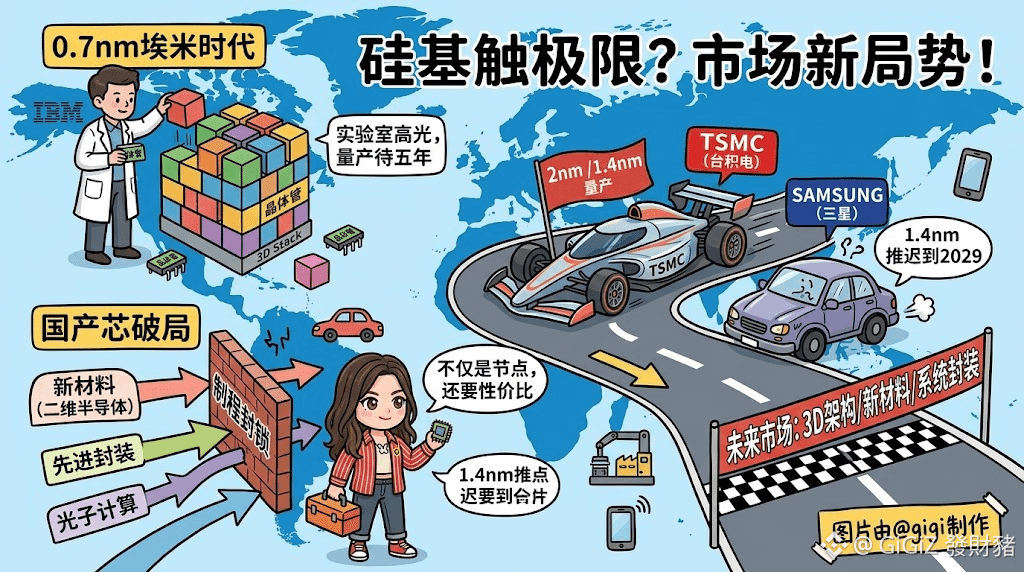
1
2
2.4k
Log in to explore more content
Join global crypto users on Binance Square
⚡️ Get latest and useful information about crypto.
💬 Trusted by the world’s largest crypto exchange.
👍 Discover real insights from verified creators.
Email / Phone number
Trending Topics
USAugustPPIRisesLessThanExpected
52,374 views
827 Discussing
🚨 US AUG PPI: Rises LESS Than Expected! Bullish for Crypto? 🚀
PPI +0.4% MoM as expected, but CORE PPI only +0.2% vs +0.3% expected - cooling!
What it means:
• Wholesale inflation softer than feared
• Fed rate hike chance now 62% - but dovish signals coming
• Core PCE revisions expected downward - bullish
• BTC usually pumps on softer PPI
Fed meeting Sep 15-16 - Market now expects pause, not hike?
Is this the green light for Q4 rally?
#Bitcoin #PPI #Fed #CryptoNews #BTC#usaugustppiriseslessthanexpected
True News
·1 Likes
·1.4k views
SECApprovesNasdaqTexasCommodityTrustRule
28,143 views
603 Discussing
ECBRaisesRatesSecondTimeTo2.5%
25,804 views
430 Discussing