
dtai93
34 Posts

dtai93
Report
Block User
I love crypto
Open Trade
Frequent Trader
8.9 Years
15 Following
20 Followers
31 Liked
Posts
Portfolio
All
Quotes
·
--
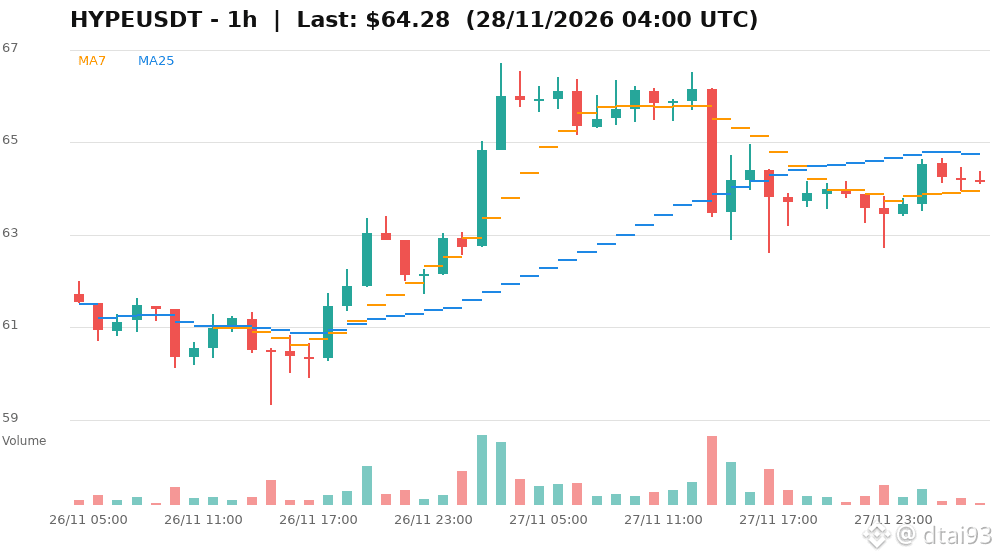
Friday's bounce is already giving it all back — and the tape is telling you why.
HYPE ran 6.1% on Friday afternoon. By this morning it is down 2.8% on the day. SOL went from around $73 to $71.65. FET is the only one still green, up 1.6%. Bitcoin is back at $60,001 — right where the whole argument started.
The crowd is calling this a dip to buy. The liquidations say otherwise. 77% of Bitcoin liquidations were shorts — the bounce was shorts closing, not buyers arriving. Funding has drifted back to neutral, and futures volume is down 40% from Friday's flush. When a rally is built on shorts covering, it ends the moment the covering stops. There is no fresh money behind it to keep it going.
That is the difference between a bounce and a base. A bounce built on short covering looks the same as a real turn for a few hours — until the covering runs out and price has nothing underneath it. Friday's move had no follow-through because there was no one to follow through.
So watch what happens next, not what happened Friday. If the next push comes with rising volume and funding turning positive, someone is actually buying. If it comes on the same thin volume, it is the same trade, one more time.
This is my personal opinion, not investment advice. DYOR.
Disclaimer: This content is for informational purposes only, not investment advice. I am not responsible for any losses incurred.
$HYPE $SOL $FET
187
·
--
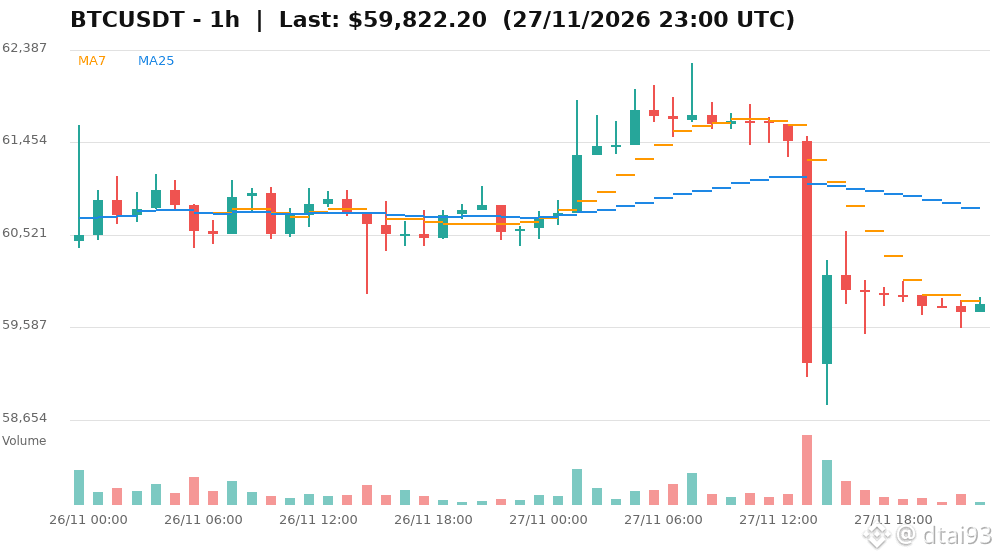
Bitcoin failed $60,000 twice on Friday. The second time, nobody noticed.
The first failure was loud. In the hour Wall Street reopened, Bitcoin fell from $61,460 to $59,083 and printed a $58,792 low. That is the one everyone wrote about.
The second failure was quiet. In the seven hours after that flush, every hourly close stayed below $60,000. Price poked above it twice — $60,066, then $60,047 — and both pokes were sold inside the hour. The evening drift ran on roughly an eighth of the hourly volume of the Wall Street flush. Bitcoin closed the last hour at $59,822, still under the level.
The difference matters. The first failure was selling. The second one is the absence of buying. A dip nobody buys back is not a dip being defended — it is a level being abandoned.
And the $62,000 breakout everyone celebrated on Friday morning? It already happened — $62,248 at 08:00 UTC — and it already failed. Anyone buying that headline now is buying yesterday's news.
The rest of the board agrees this is not a broad turn. Ether is $1,658, down 1.8% on the day. Solana is $71.31, barely green. Fear & Greed reads 12 — still extreme fear — and November's ETF bleed is past $5 billion.
So the question Friday's close left open is still open: does $58,800 hold, or does the market go back to Wednesday's $57,300 low? A level defended on volume is support. A level nobody bothers to retake is just a number on the way down.
This is my personal opinion, not investment advice. DYOR.
Disclaimer: This content is for informational purposes only, not investment advice. I am not responsible for any losses incurred.
$BTC $ETH $SOL
92
·
--
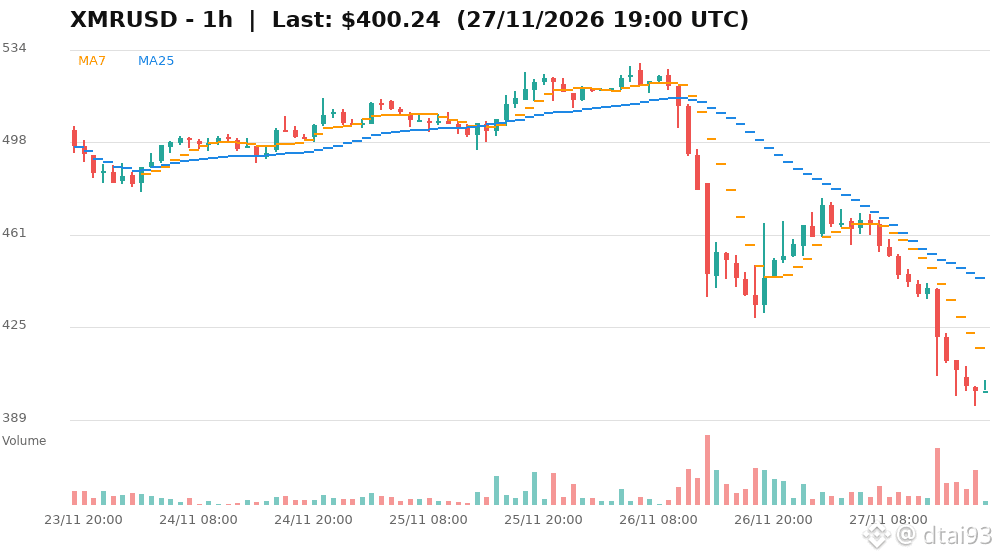
Everyone is counting down to November 30. That is the wrong deadline.
KuCoin ends Monero trading on Monday at 08:00 UTC, and XMR has already paid for it: about $400 now, down 24% from the $529 peak on Thursday and 37% below early November. KuCoin carried more than half of all tracked XMR spot volume, so once its door closes, the price has to be discovered on thinner books. MEXC left earlier this month. The selling is real, and it is mechanical — holders must withdraw or sell before the cutoff, and borrowers who pledged XMR as collateral have to find something else.
But November 30 is a plumbing deadline, not a verdict. Once it passes, the forced selling stops. There is no one left who has to sell that day.
The date that actually reprices privacy coins is July 10, 2027. That is when the EU's anti-money-laundering regulation bars regulated firms from touching anonymity-enhancing coins. KuCoin just moved first. Every exchange that answers to European rules faces the same calendar. Self-custody stays legal — the coin does not die, its doors do.
And the market is already sorting privacy into two kinds. The same week Monero lost its biggest venue, Grayscale's Zcash ETF still holds about $406 million. Zcash has optional shielding and viewing keys — a version of privacy a regulator can look at. Monero has privacy by default and no regulated door. One has an ETF. The other just lost its largest exchange. Monero's developers are even working on a zero-knowledge upgrade to replace ring signatures. The technology is adapting. The open question is whether the market waits for it.
So watch what happens after Monday. If the tape quiets down once the deadline passes, the drop was the deadline doing its work. If it does not, the market is already pricing 2027.
This is my personal opinion, not investment advice. DYOR.
Disclaimer: This content is for informational purposes only, not investment advice. I am not responsible for any losses incurred.
$XMR $ZEC
51
·
--
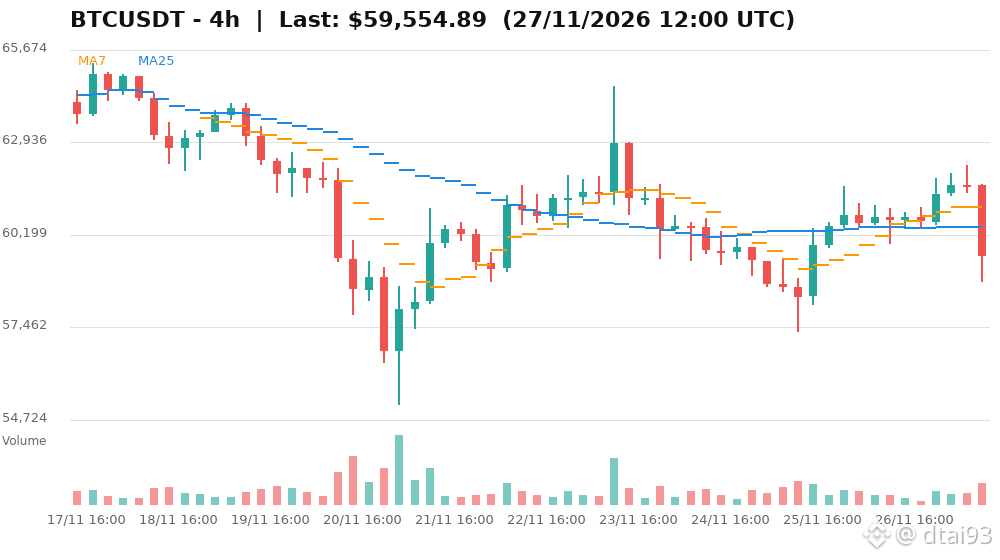
Bitcoin's bounce just failed its first real test — and it only took an hour.
Everyone spent Thanksgiving asking whether the bounce would hold $60,000 when Wall Street reopened. It didn't wait for the question. In the hour Wall Street reopened, Bitcoin fell from $61,460 to $59,083, printing a $58,792 low. The $61,600 level is gone. So is $60,000.
The crowd keeps treating $60,000 as a wall to defend. It isn't a wall. It is a line drawn through a bounce built on short covering. Spot Bitcoin ETFs have bled more than $5 billion in November, and Fear & Greed sits at 10 — extreme fear. A bounce built on shorts covering doesn't need bad news to reverse. It just needs the covering to stop. Friday's open supplied the volume, and the sellers were still there.
And the Fed hike isn't the story either. Markets price a December hike at roughly 95%. Bitcoin fell while those odds were already near-certain — the hike was priced before the bounce, not after it. What isn't priced is what comes next: the December 9 dot plot, January hike odds near 55%, and the December 4 jobs report.
More than $7 billion in options expire today, which adds noise. The signal comes Monday, when full liquidity returns: does $58,800 hold, or does the market retest the $57,300 low from Wednesday?
The rebound was real. So is the failure. The difference between a bounce and a base is what happens the second time price visits the lows.
This is my personal opinion, not investment advice. DYOR.
Disclaimer: This content is for informational purposes only, not investment advice. I am not responsible for any losses incurred.
$BTC $ETH $SOL
152
·
--
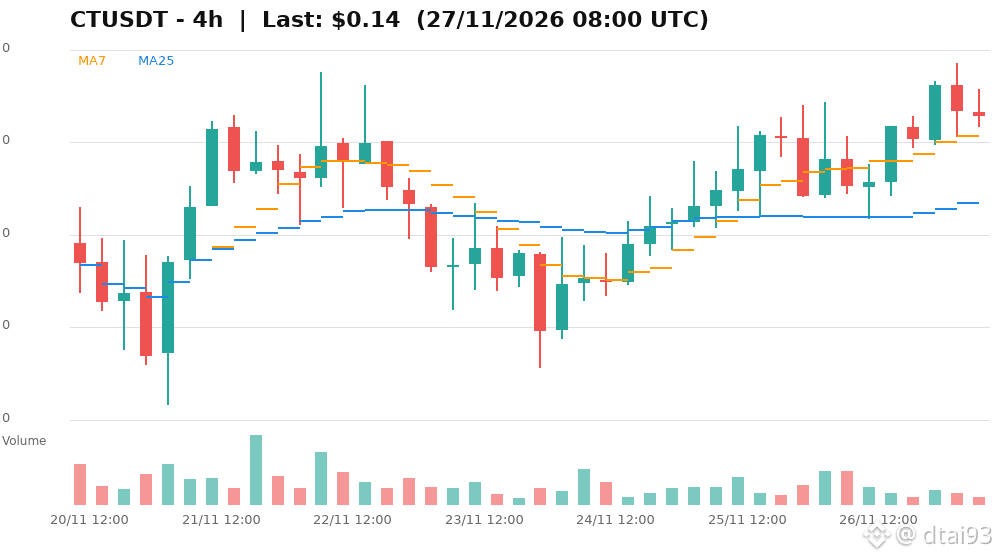
Binance Alpha just opened a trading competition for Concrete (CT) — and the structure says more than the prize.
The pool is $200,000 in CT: 834,000 CT split equally among the top 2,000 buyers by volume, 417 CT each. Round one runs from 13:00 UTC today until December 4, with a 2.0x Early Bird Boost on day one.
Equal splits change the game. There is no jackpot for the biggest wallet — the 2,000th buyer earns the same as the first. That pushes the competition toward breadth: many participants, each buying enough to make the cut, rather than a few whales farming the top.
That is also the risk to watch. A flat reward invites volume that exists only for the reward, and volume that exists only for the reward tends to leave the moment the round ends. The first day, boosted 2.0x, will be the loudest — and the least informative.
Alpha competitions are a good place to learn how a new token trades. They are not a reason to buy one.
This is my personal opinion, not investment advice. DYOR.
Disclaimer: This content is for informational purposes only, not investment advice. I am not responsible for any losses incurred.
$CT
1
237
·
--
Two coins, one warning — and the same clock is ticking on both.
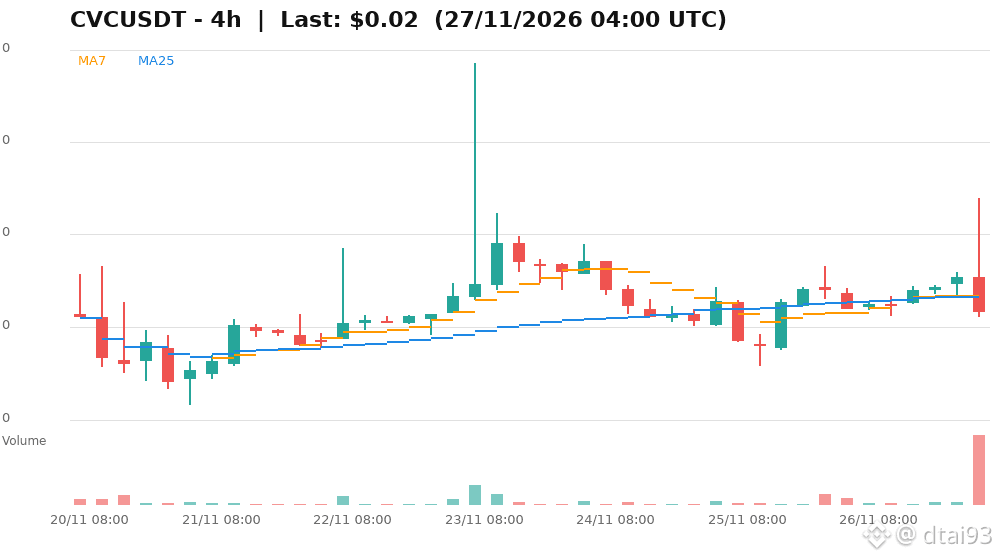
Upbit has tagged Civic (CVC) and REI Network (REI) with investment warnings and suspended deposits from 15:30 KST today. The exchange will review both until mid-December, and the outcome can be an extension, a removal of the warning — or a delisting.
For REI, Upbit points to the business itself: promises of high returns without clear funding, plus weak on-chain holder trends, volume and liquidity. For CVC, the issue is disclosure: the issuer's information and the token's purpose and functions are incomplete. Two different reasons, one message — the exchange is not confident enough in either project to keep the door open as it is.
Bithumb moved the same day, designating both CVC and REI as cautionary trading items. When two Korean exchanges flag the same two names on the same day, it is not a coincidence. It is a shared read of the same risk.
A warning is not a delisting. But a warning with a deposit freeze and a four-week review window is the market's way of saying the burden of proof has shifted to the projects.
This is my personal opinion, not investment advice. DYOR.
Disclaimer: This content is for informational purposes only, not investment advice. I am not responsible for any losses incurred.
$CVC $REI
162
·
--
Upbit stocked three names in one morning — and they all point at the same theme.
KGeN (KGEN) and Flare (FLR) join the BTC and USDT markets today, trading from 11:00 and 11:30 VN time. Both are AI data and compute plays: KGEN verifies gamer identity, activity and reputation through Proof of Gamer and feeds that data into AI training; FLR puts AI models, data, GPU compute and agents behind one interface with on-chain payments. Reference prices: KGEN near $0.0858 (prev close $0.0814), FLR near $0.00507 ($0.00503).
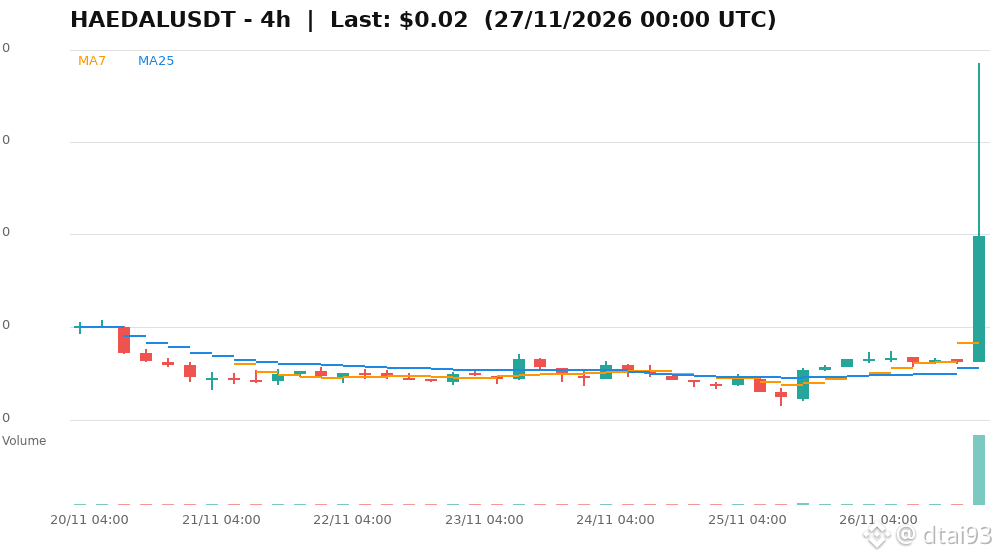
Haedal (HAEDAL) gets a KRW pair at 10:20 VN today — not a first listing, it already trades on the BTC market (prev close 0.00000029 BTC, ~23.85 KRW). Haedal is Sui liquid staking: stake SUI, get haSUI, deploy it across DeFi while still earning rewards. The KRW pair is a bet on local demand for Sui DeFi.
Two listings, both tied to AI data and compute, both on BTC and USDT rather than KRW — plus a KRW pair for Sui DeFi. Upbit is not chasing a single narrative. It is stocking the shelf for a theme. Whether the market cares beyond the first hour is a different question, and the first hour is usually noise.
This is my personal opinion, not investment advice. DYOR.
Disclaimer: This content is for informational purposes only, not investment advice. I am not responsible for any losses incurred.
$KGEN $FLR $HAEDAL
331
·
--
The market read the Zcash warning backwards.
On Thursday, Zcash developers urged holders to move about 400,000 ZEC - roughly $300 million, 2% of supply - out of Sapling, the 2018 privacy pool, into Ironwood. Sapling's proofs use pairings, a shortcut a future math breakthrough or a big enough quantum computer could one day forge. Ironwood's Halo 2 proofs don't use pairings.
Nothing was hacked, nothing was lost, no attack exists. Zakura, the team behind the call, says so itself: "practical pairing breaks are highly speculative." The plan: block new deposits, keep withdrawals open, freeze only if credible attack signs appear. No date has even been set.
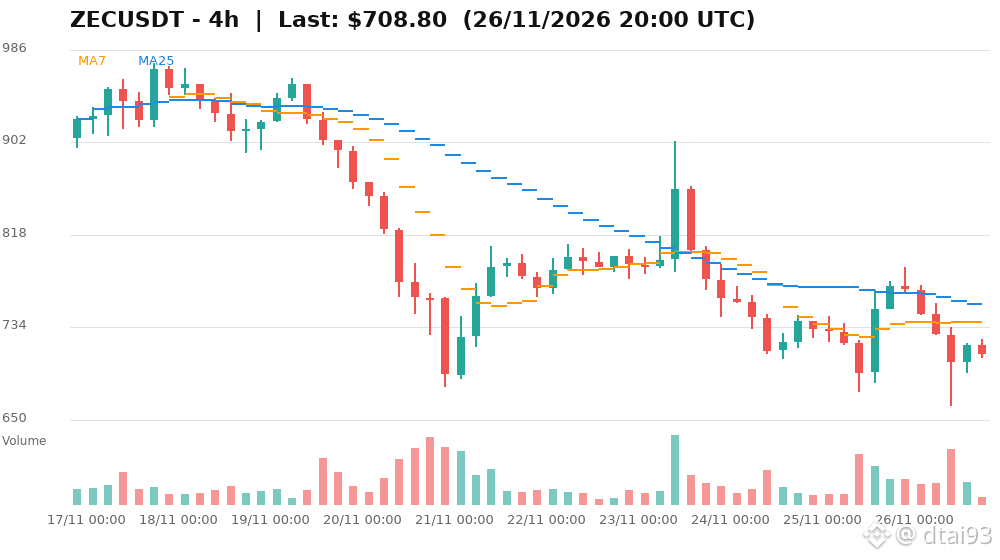
The market sold it anyway. ZEC fell 6.7% to about $709, touching $663 intraday, while Bitcoin bounced and 93 of the CoinDesk 100 went green - the weakest of the ten largest tokens. The warning itself became the sell signal.
That is backwards. Zcash is doing in public what almost no other chain does at all: retiring its own cryptography before it breaks. Bitcoin's earliest coins still sit in addresses with exposed public keys, with no migration plan. Zcash has a written plan, a new pool holding 85% of shielded funds, and a freeze-and-recover path. The migration is 85% done. The remaining 2% is the story, not the risk.
Watch the right things: does the deposit cutoff land in NU7.1 or wait for NU8? And notice the same week - Bitwise filed for a spot ZEC ETF Nov 18, Gemini switched on shielded deposits Nov 24. Institutions filed to own this asset while traders sold a precaution.
ZEC is down about 58% from its September peak near $1,700. A falling price is not a broken protocol. A chain that warns you about its own 2018 math, in public, before anything happens - that is not the red flag. That is the feature.
This is my personal opinion, not investment advice. DYOR.
Disclaimer: This content is for informational purposes only, not investment advice. I am not responsible for any losses incurred.
$ZEC $BTC
1
1
367
·
--
"1 million satellites" sounds like a chip-demand supercycle. It isn't — not yet.
The FCC just authorized SpaceX's Starmind: up to 1 million orbital compute satellites for AI. Read the fine print: SpaceX must launch just ONE satellite by November 2033, 100,000 by 2035, half by 2038. A million is a license ceiling, not a launch plan.
Do the launch math. SpaceX plans about 60 Starlink V3 satellites per Starship flight. One million satellites means roughly 16,700 Starship flights. At 100 flights a year — a cadence Starship has never come close to — that is 167 years of launches. The bottleneck was never chips. It is rockets.
The chips are already counted, on the ground. SpaceX's $44B Vera Rubin financing, priced November 20 — the largest GPU financing ever — buys terrestrial GPUs, not orbital ones. Nvidia's "exclusive supplier" role was a verbal line on an August earnings call, not a disclosed contract with volumes. The first Starmind satellite is targeted for 2027, with no operational service date at all.
And SpaceX isn't even first to orbital compute. Google flew an experimental TPU satellite in October and got the first AI response generated in orbit.
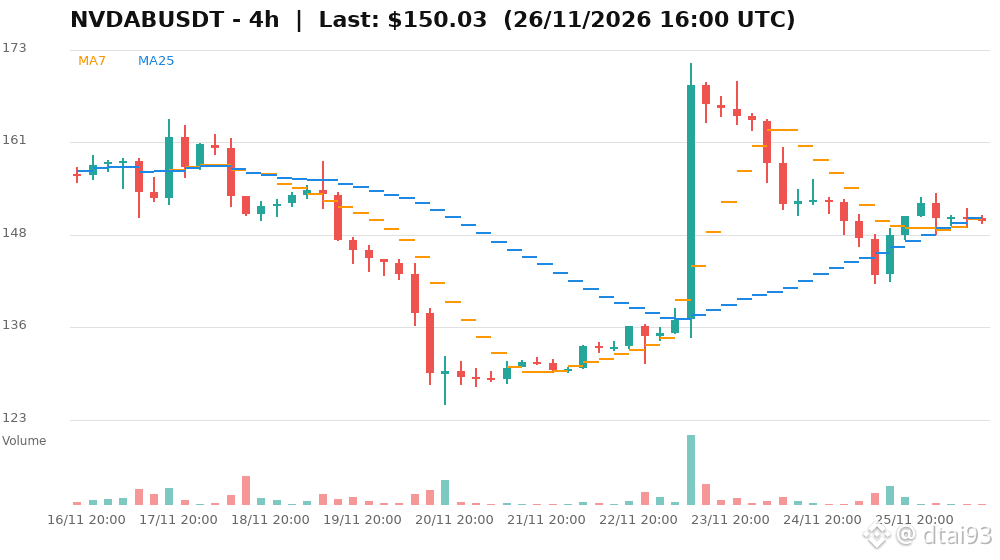
So the near-term trade isn't chip demand. It is launch monopoly: only SpaceX can attempt this at scale. Nvidia already got paid for the terrestrial buildout. Orbital adds roughly zero chip volume before 2028 — while Nvidia's tokenized shares sit at $150.03 after falling 3.9% to $149.30 on Wednesday in the AI premium repricing.
The story to watch is the rockets, not the headline number.
This is my personal opinion, not investment advice. DYOR.
Disclaimer: This content is for informational purposes only, not investment advice. I am not responsible for any losses incurred.
$NVDA $NVDAB
202
·
--
Square keeps asking: can markets rebound after Thanksgiving?
Wrong question. The rebound already happened — on Wednesday, while everyone was watching the crash.
The Dow fell more than 1,100 points intraday, then closed UP 0.33% at 50,183 — a 1,260-point reversal, the biggest intraday comeback since April 2025. The Nasdaq fell 4.6%, briefly touching its bear-market line, then closed down just 0.62%. The S&P 500 erased a 3.2% drop to close -0.25%.
And the money didn't leave. It rotated. Eight of eleven S&P sectors closed green. The Russell 2000 gained 0.7%. Advancers beat decliners 356 to 139. HP jumped 11.5% while Nvidia fell 3.9% to $149.30. This wasn't a market crash. It was an AI premium repricing.
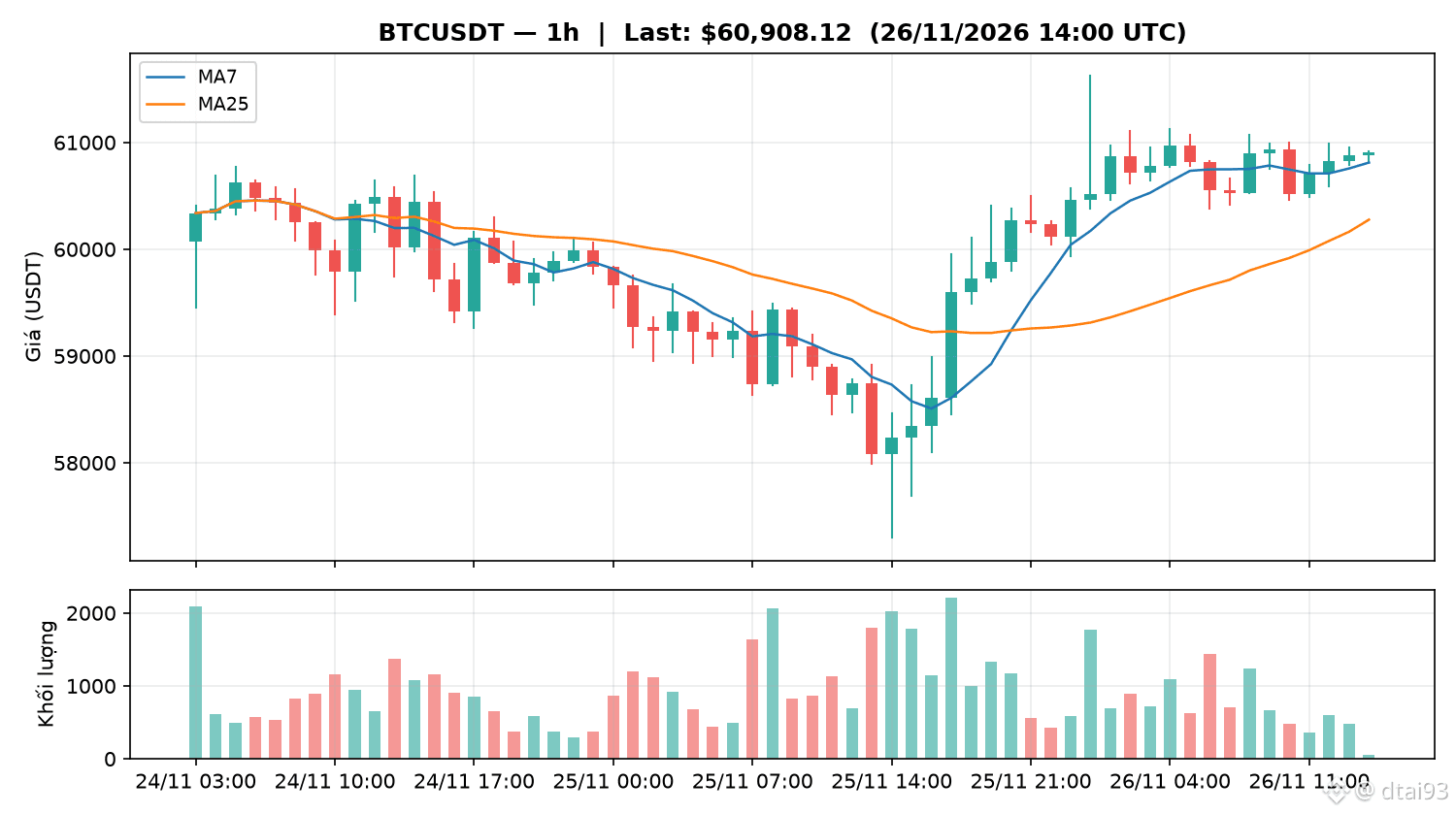
Bitcoin did the same trade: $57,300 on Wednesday morning, then $61,622 overnight. A 7.5% round trip in about a day.
But don't confuse a rebound with a reversal. The bounce ran on short-covering and falling yields, while spot Bitcoin ETFs bled for a sixth straight session and November outflows near $5 billion. Fear & Greed sits at 11 — extreme fear for eight straight days.
The real test isn't Thanksgiving. It's December 9. Polymarket puts a Fed hike to 4.25% at 94.7%. The market has priced the hike. What it hasn't priced is whether this rotation survives it.
Until Monday, Wall Street sleeps and Bitcoin trades alone. $57,300 is the line to hold. $61,600 is the next test.
This is my personal opinion, not investment advice. DYOR.
Disclaimer: This content is for informational purposes only, not investment advice. I am not responsible for any losses incurred.
$BTC $NVDA
135
·
--
SK Hynix is about to pay a record dividend — and if you hold the perp, that money does not reach you the way you think.
Binance has flagged the dividend adjustment for the $SKHYNIX and $SKHY perpetuals, ex-date November 27. The payout is large: a Q3 dividend of 20,000 won per share — 10,000 regular plus 10,000 special from its Kioxia stake sale — about 14.1 trillion won in total. The previous quarter paid just 375 won. Record date: November 30.
Holding the perpetual gives you no shares, no dividend, no vote. Instead, Binance runs a one-off special funding settlement around the ex-date. The share price drops by roughly the dividend on the ex-date, so shorts pay longs a special funding fee to close the gap. On November 27, funding goes hourly from 03:30 KST, the contract goes reduce-only at 07:30 KST, and the special funding settles at 08:00 KST — 06:00 in Vietnam — before trading resumes a minute later.
Do not read the ex-date dip as a crash. The product is working as designed: the perp falls by roughly the dividend, and longs are paid through funding, not a payout.
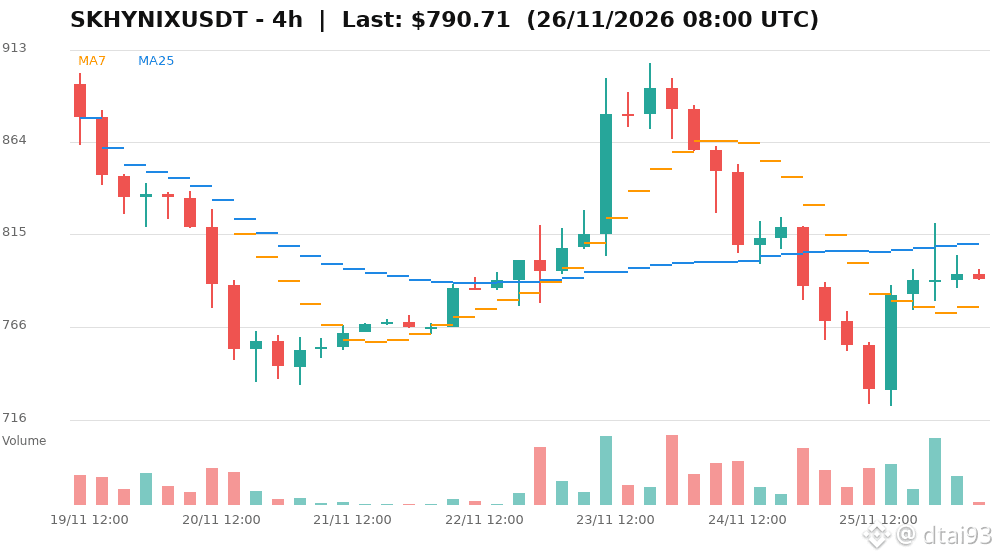
The flow is already heavy: SKHYNIX perps traded about $3.51B in 24 hours, open interest $715M, up 24% on the day, Binance handling roughly 60% of that volume. Last 4h candle: $790.71 (08:00 UTC, Nov 26). Yet the stock fell 11% in a day even as the record payout was confirmed — the dividend story was priced in back in October, when the plan leaked. What the market debates now is not the payout, but whether AI memory demand stays strong enough to justify the run.
A record dividend is good news for shareholders. For perp traders, tomorrow is a mechanics event, not free money — know which side of that funding you are on.
This is my personal opinion, not investment advice. DYOR.
Disclaimer: This content is for informational purposes only, not investment advice. I am not responsible for any losses incurred.
$SKHYNIX $SKHY
89
·
--
Square's #oversold feed is one big buy-the-dip party: RSI under 30, must be the bottom.
Read the signal again. On November 20, gold, Bitcoin and Nasdaq-100 futures all printed 3-day RSI(14) of 30 or below at the same time. Daniel Yan of Kryptanium Capital flagged it: the first time this century that has happened. Gold and Nasdaq futures had never been oversold together since 2000. Now all three are.
That is not a buy signal. That is the whole board selling at once.
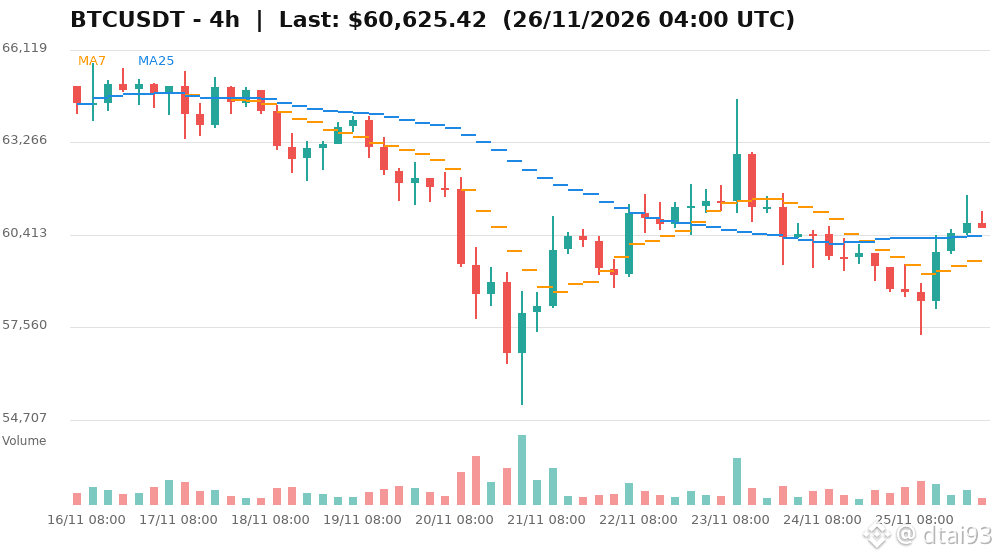
Oversold measures how fast something fell, not where it stops. Backtest: Bitcoin's first daily RSI under 30 since 2018 — price higher a month later in only 2 of 10 cases. The first oversold print is rarely the low. The bounce is real, but bounces in a downtrend are the market's oldest trap: Bitcoin fell to $57,300 Wednesday, ripped to $61,622 overnight, closed at $60,458 — still down 23% in November, its worst month since June 2022.
The rotation story has a hole. Money is rotating out of Bitcoin ETFs — six straight outflow sessions, $231.4M on Tuesday alone, $4.94B for November. Rotating where? The Nasdaq 100 is 20% below its October record. That is a bear market. Gold, the haven itself, is oversold too. If the destination is down 20% and the haven is oversold, this is not rotation. It is everything selling together.
Same names keep flashing: $ETH rejected at $1,840, $XRP flushed to $0.87 with $18M liquidated. The crowd is buying every dip of the same dip.
Watch the levels, not the label. $57,300 has to hold when Wall Street reopens — today the US market is closed for Thanksgiving, so this bounce trades on thin air. Friday brings a $6.9B Bitcoin options expiry. "Oversold" says the selling was violent. It never promised it was finished.
This is my personal opinion, not investment advice. DYOR.
Disclaimer: This content is for informational purposes only, not investment advice. I am not responsible for any losses incurred.
$BTC $ETH $XRP
#oversold
105
·
--
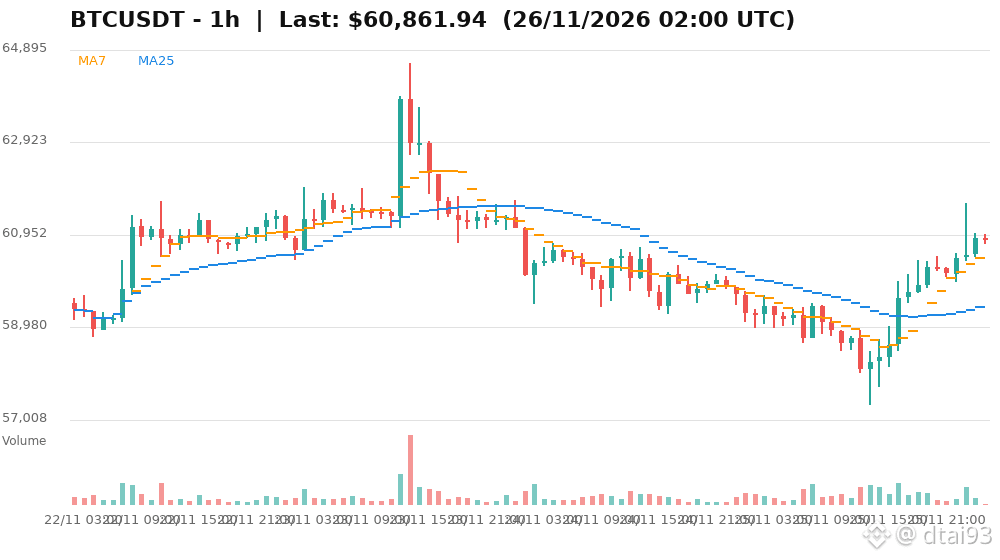
Square is calling the $4.94B ETF outflow the verdict on Bitcoin.
The number is real. The verdict is wrong. Read the three numbers inside it.
First, it is one fund. BlackRock's IBIT accounts for about $4.2 billion of November's outflows — roughly 85% of the total. Through November 19, the other eleven funds combined had lost just $527 million, while IBIT alone had already lost $2.94 billion. IBIT has now seen outflows on 15 of the first 16 November sessions, including a record single day of $541 million on November 19. This is not "institutions leaving Bitcoin." It is one fund's holders redeeming.
Second, the scale. US spot Bitcoin ETFs have still taken in a net $52 billion since they launched in January 2024. The worst month in their history erased less than 10% of that. A record outflow month — and the funds are still up more than $47 billion net since launch.
Third, the price refused the script. Bitcoin fell to $57,300 on Wednesday, then closed the day at $60,458 — back above $60,000 — and is holding near $60,900 this morning. The Saturday low of $55,130 held. It did all that while the ETF bleed was still running.
And the money didn't vanish. It rotated. Pure-play AI ETFs have taken in about $20 billion this year, while Bitcoin ETFs are down $4.48 billion in 2026. Ether ETFs tell the same story on a smaller scale: $1.22 billion out in November, after a record $1.61 billion in October. The market isn't leaving risk. It's picking a different story.
So the real test isn't November's total. November 25th's flows aren't even published yet, and the US market is closed today for Thanksgiving. The test is what happens when trading resumes: does the daily outflow slow, and does IBIT's red streak break? A record month tells you where the money went. It doesn't tell you where it goes next.
This is my personal opinion, not investment advice. DYOR.
$BTC $ETH
#BitcoinETFsPostRecord$4.94BNovemberOutflows
102
·
--
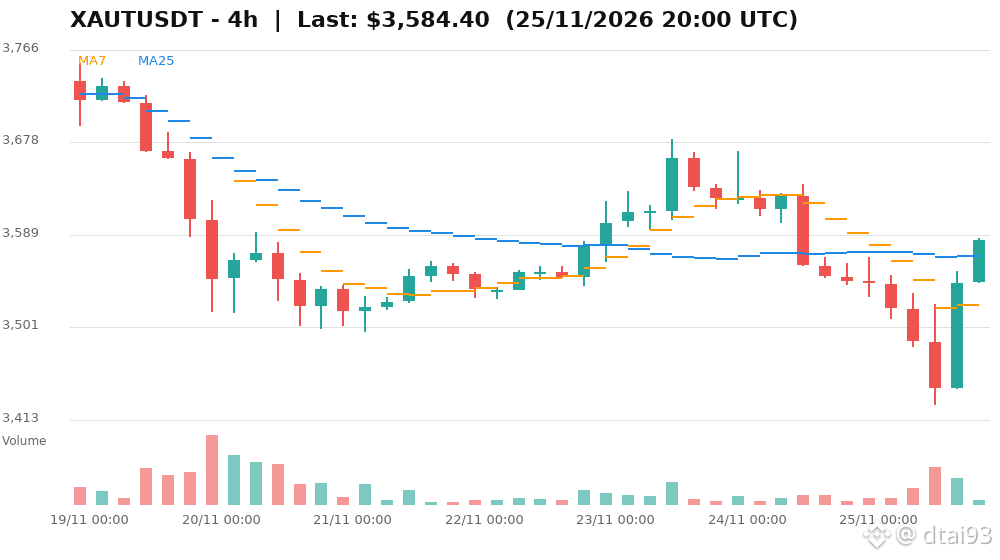
Square's most-searched list just told you where the money is running: $XAUT and $PAXG are the fastest-rising searches on Square right now. Everyone is fleeing to gold.
Check what gold actually did first.
Gold is 33% below its January record of $5,318 an ounce. It just printed its second-lowest futures settlement of the year — $3,534.70. Tokenized gold on Binance tells the same story: $XAUT closed near $3,850 nine days ago. Tonight it is around $3,584. That is a 7% drop in nine days — for the asset people buy when they want safety.
Gold didn't fall despite the panic. It fell because of the same thing that hit everything else: the market repricing a December Fed hike after a hot PCE print. A hike means higher yields, and gold pays nothing. The "safe haven" is a rates trade, same as the rest.
Now look at the asset everyone fled: $BTC fell to $57,300 on Wednesday — then took back $60,000 overnight while America slept. The Saturday low of $55,130 held. The level everyone buried yesterday is back.
So the flight to safety is a story, not a trade. The thing people ran to is near its yearly low. The thing they ran from just reclaimed the level that mattered.
This is my personal opinion, not investment advice. DYOR.
$XAUT $PAXG $BTC
162
·
--
Square is debating whether Nvidia needs a succession plan. Stop debating — the token already voted.
The 11 days without Huang: $173.73 → $125.53, down 27.7%. In the middle of it, Nvidia reported a record quarter — $115.8B revenue, up 103% YoY. The business was fine. The stock wasn't. That is what key-man risk looks like.
Monday: +31.5% to $165.05, about $952B of value back in one day, the best day since 2003. Tuesday: -5.9% to $155.38.
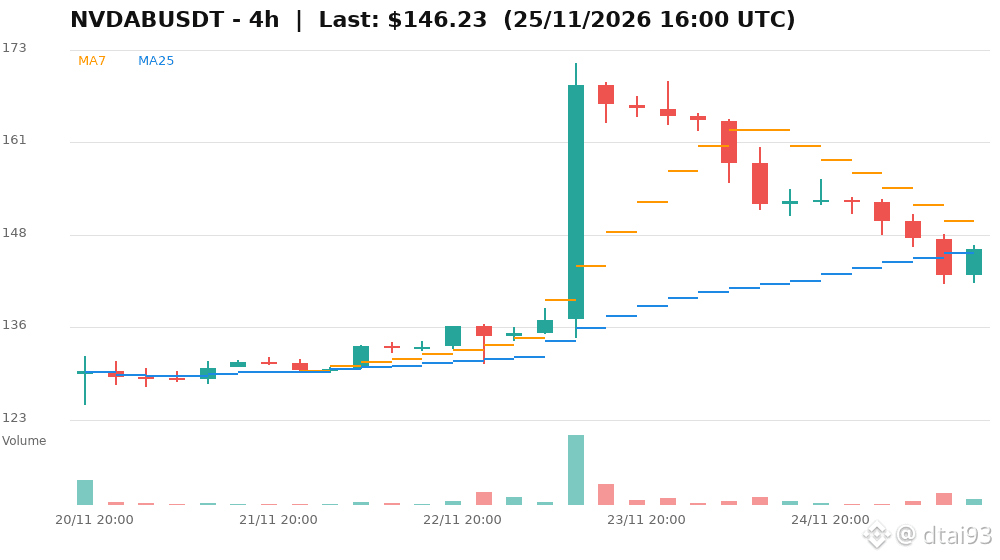
Here is the part nobody posted: $NVDAB, tokenized Nvidia on Binance, trades 24/7. After Nasdaq closed Tuesday, it kept sliding — $152.73, then a low of $141.40, now around $146. Nearly half of Monday's historic gain is already gone, before Thanksgiving.
The board answered the succession question twice in six days: no return on Nov 17, unanimous reinstatement on Nov 23. That is not a plan. That is dependence — and Nvidia's own annual report warns the company is highly dependent on its executive team.
Congress gets its turn next week. While Nasdaq goes dark for Thanksgiving, the token is the only live price on this story. Watch it, not the debate.
This is my personal opinion, not investment advice. DYOR.
$NVDAB $BTC
#JensenHuangSaysNvidiaDoesn’tNeedASuccessionPlan
Square is debating whether Nvidia needs a succession plan. Stop debating — the token already voted.
The 11 days without Huang: $173.73 → $125.53, down 27.7%. In the middle of it, Nvidia reported a record quarter — $115.8B revenue, up 103% YoY. The business was fine. The stock wasn't. That is what key-man risk looks like.
Monday: +31.5% to $165.05, about $952B of value back in one day, the best day since 2003. Tuesday: -5.9% to $155.38.
Here is the part nobody posted: $NVDAB , tokenized Nvidia on Binance, trades 24/7. After Nasdaq closed Tuesday, it kept sliding — $152.73, then a low of $141.40, now around $146. Nearly half of Monday's historic gain is already gone, before Thanksgiving.
The board answered the succession question twice in six days: no return on Nov 17, unanimous reinstatement on Nov 23. That is not a plan. That is dependence — and Nvidia's own annual report warns the company is highly dependent on its executive team.
Congress gets its turn next week. While Nasdaq goes dark for Thanksgiving, the token is the only live price on this story. Watch it, not the debate.
This is my personal opinion, not investment advice. DYOR.
$NVDAB $BTC
#JensenHuangSaysNvidiaDoesn’tNeedASuccessionPlan
155
·
--
Everyone on Square is blaming tonight's PCE print for Bitcoin losing $60,000.
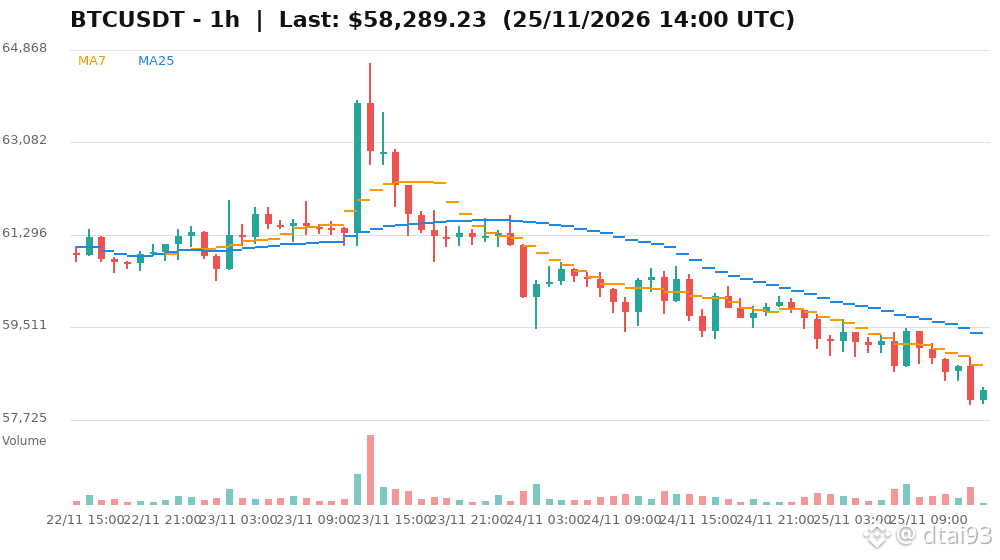
Check the clock first. Bitcoin closed Tuesday at $59,832 — already below $60,000 — and slipped to about $58,938 in Asian hours. PCE only came out at 08:30 ET. The $60K break happened hours before the print was even released.
What actually broke it was a different headline: reports of new US tariffs on $2.4 trillion of imports from 16 economies. The Kospi fell more than 6%. Nasdaq-100 futures dropped 2.1%. Bitcoin went with them.
The print was nearly as expected: headline PCE 3.8%, exactly as forecast; core PCE 3.3% vs 3.2% expected. The market then dipped to about $58,000 — but the level was already gone.
The two shocks behave differently. A hike is a known event with a date — December is ~94% priced for 25bp, and once it happens, it is done. Tariffs are open-ended: they escalate, they hit earnings, and nobody knows the final number. And they land as the US market closes for Thanksgiving, into the thinnest liquidity of the year.
So the question all over Square — was $55,130 the bottom, is a Thanksgiving relief rally coming? — looks at the wrong thing. A relief rally needs buyers willing to step in front of a headline that can get worse overnight. ETF flows say the same: US spot Bitcoin ETFs have now seen six straight days of outflows, $231 million on Tuesday after $570 million on Monday.
I'm not calling a bottom or a crash. I'm saying: stop grading this market on the PCE print. It is out, it was nearly as expected, and the market still sits near $58,300. What breaks or saves this week is whether the tariff story escalates while America is on holiday.
This is my personal opinion, not investment advice. DYOR.
$BTC $ETH $SOL
#WillMarketsStageAThanksgivingReliefRally?
54
·
--
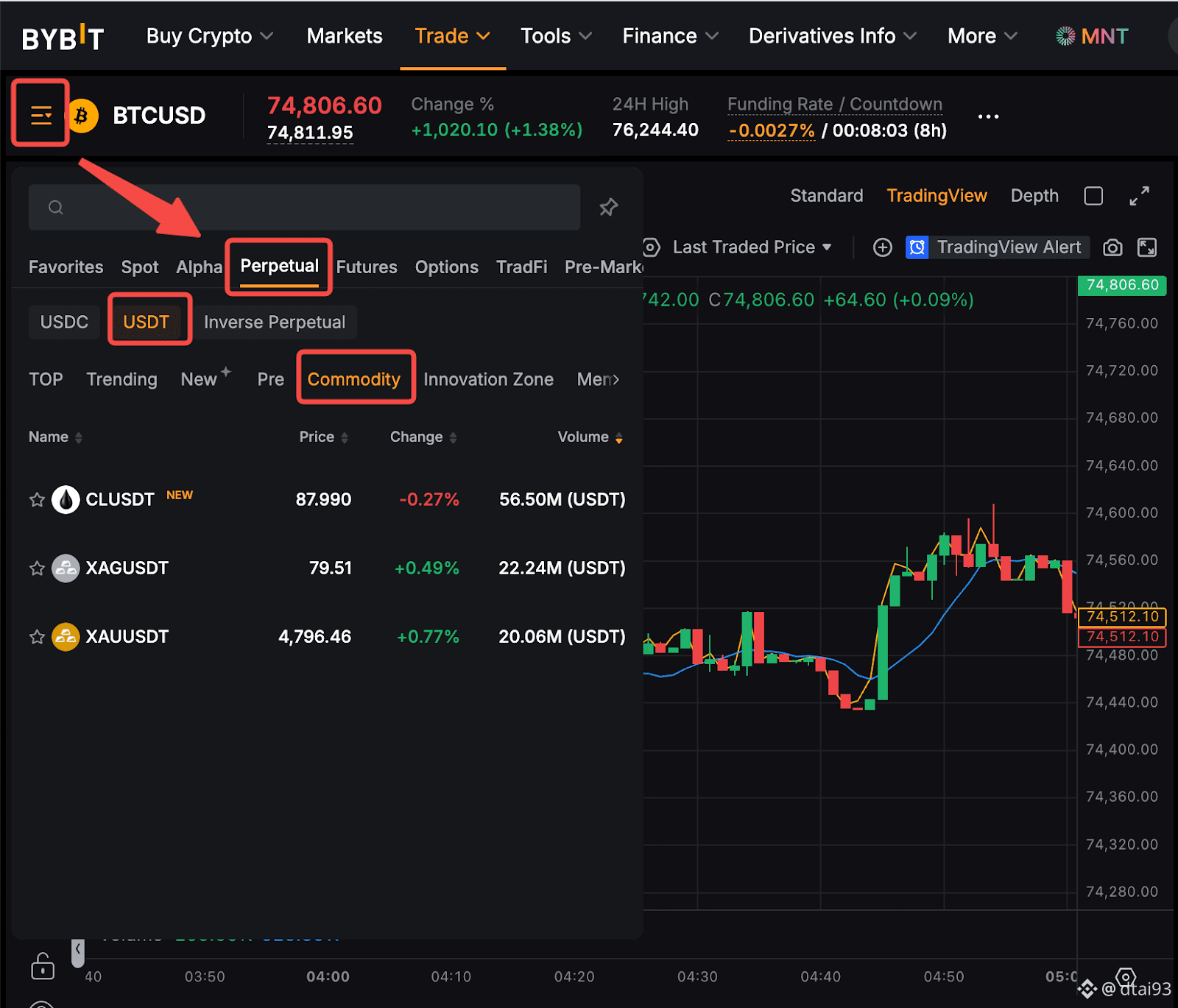
Bybit is adding four more TradFi perpetuals today at 11:30 UTC: $TJX (The TJX Companies), $TGT (Target), KRUSDT (The Kroger Co), and $ANDD — a 2x Short Anthropic Daily ETF. All USDT-settled, up to 25x leverage, trading 24/7.
The eye-catcher is ANDD: leveraged inverse exposure to Anthropic, the AI company behind Claude, now tradeable as a perp. The other three are a straight US retail basket — off-price retail, Target, and groceries.
Same reminder as always with TradFi perps: these are synthetic contracts tracking the underlying, not the shares themselves — no ownership, no dividends, no voting rights.
The direction is hard to miss. Bybit just delisted the STORJ and TOWNS perps for low activity, and Binance added tokenized stocks to spot this morning. Exchanges are quietly rotating shelf space from thin crypto contracts toward TradFi names. Whether that brings new flows or just new tickers to watch is the open question.
Personal opinion only, not financial advice. DYOR.
TJXUS-0.62%
KRUS-0.54%
18
·
--
Binance just put 5,000,000 NIGHT behind a spot trading tournament — Season 11, running from Nov 25 to Dec 2.
The pairs are NIGHT/USDT and XRP/USDC. Minimum qualifying volume is $500, and the split tells you who this is really for: 1st place takes 150,000 NIGHT, the top 1,000 split most of the pool, and everyone else shares proportionally, capped at 600 NIGHT per user. There is also a separate "Sprint Reward" for the first two rounds, Nov 25–27 and Nov 27–29.
What catches my eye is the fine print: the campaign is subject to the successful listing of the relevant token on Binance Spot. In other words, this is not just a promo — it is Binance putting volume incentives behind NIGHT (Midnight) at the exact moment it gets the spot spotlight.
So expect NIGHT volume to look very busy for the next seven days. The question is what that volume actually means. Tournament volume is driven by the prize table, not necessarily by conviction — the leaderboard rewards size, and the cap for the rest of the field is small by design. A volume spike under these conditions is interesting, but I would not read it as organic demand on its own.
I will be watching whether NIGHT holds attention after Dec 2, when the incentive ends, rather than during the week when everyone is chasing the table.
This is my personal opinion, not investment advice. DYOR.
$NIGHT $XRP

3
·
--
Everyone on Square is asking whether tonight's core PCE will save this market.
I think that's the wrong question.
The December hike is already ~95% priced in — CME FedWatch puts a 25bp hike at about 95%, a 50bp hike at about 5%, and effectively zero chance of no hike at all. A data print cannot 'cause' what the market has already bought. Even a hot print — say 3.3% core PCE vs 3.2% expected — is a 0.1-point surprise. The market has spent a week panicking over a tenth of a percent.
Look at what actually describes this week instead:
— US spot Bitcoin ETFs lost ~$570M on Monday alone, a fifth straight day of outflows. November is already a record month: ~$4.71B out.
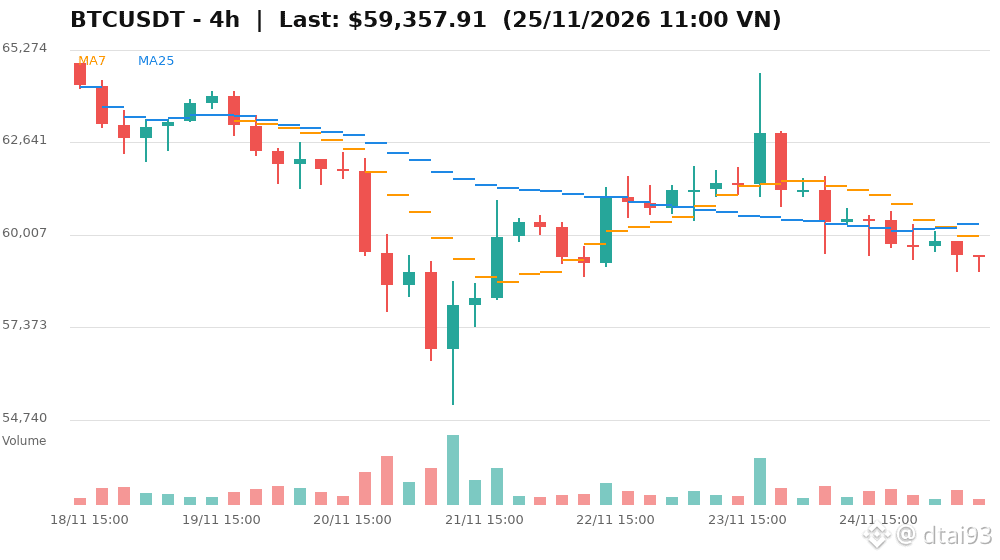
— $BTC ran to ~$64,600 on Monday, then gave it all back and dipped to ~$59,300 on Tuesday. It is down ~26% in 30 days, and the daily RSI sits around 24 — oversold by any textbook definition.
— Fear & Greed is at 13. Extreme fear.
— And Friday at 08:00 UTC, ~112,000 BTC options (~$6.6B) expire on Deribit, with ~75% of puts in the money and max pain way up at $73,000. Thursday the US market is closed for Thanksgiving, so that expiry lands in a holiday-thinned market.
So tonight's print is an hour of volatility. Friday's expiry, in thin liquidity, with positioning this one-sided — that is the event that decides the week.
I'm not calling a bottom, and I'm not saying the print doesn't matter. I'm saying: don't trade the headline. Watch the positioning. When everyone is watching the same number, the edge is never in the number — it's in what everyone already did about it.
This is my personal opinion, not investment advice. DYOR.
$BTC $ETH $SOL
#WillOctCorePCEShiftFedHikeExpectations?
33
·
--
Binance Adds 5 bStocks as Margin Collateral — What It Changes, and What It Doesn't
Binance will add five bStocks tokens — $IBITB, $SOXXB, $ARTYB, IGVB and FRHCB — as eligible collateral on Cross Margin, Portfolio Margin and Portfolio Margin Pro from 12:00 UTC today (25 Nov).
In my view, the interesting part is not a new listing. It is capital efficiency: tokenized exposure to Bitcoin, semiconductors and AI/tech can now sit inside a margin account as collateral, instead of sitting idle on the side.
What it does not change: borrowing is not supported yet, eligibility is limited by region, and Regular / VIP 1 / VIP 2 users need to complete a suitability assessment first. Margin still amplifies losses as much as it amplifies exposure, and collateral can be liquidated when risk limits are hit.
I see this as Binance gradually connecting tokenized traditional-market exposure with its margin system, step by step, rather than a single big launch. Whether traders actually use it will depend on haircuts, liquidity and how strict the risk controls turn out to be.
This is my personal opinion, not investment advice. DYOR.
27
Log in to explore more content
Join global crypto users on Binance Square
⚡️ Get latest and useful information about crypto.
💬 Trusted by the world’s largest crypto exchange.
👍 Discover real insights from verified creators.
Email / Phone number
Trending Topics
EvolveAtBinanceBlockchainWeek
1.5M views
16,034 Discussing
Binance Blockchain Week is officially underway! 🌍
On November 28–29, whether you’re in Bangkok or joining from afar, tune in to the livestreams and join the conversation on Binance Square!
Here’s what’s in store 👇
📺 Watch the main stage live
Tune in throughout both days as industry speakers share their perspectives on this year’s theme, “Evolve” From technological innovation to real-world applications, explore what’s next for crypto.
⚔️ Watch two trading competitions
The Aster Open Qualifier and the Binance Trading Master Tournament will both be streamed live. Tune in to follow the traders in action.
🏆 Watch The Blockchain 100 Awards Ceremony
The Blockchain 100 list was selected by the community. Join us in celebrating the creators and the ideas they share!
💬 Join the community conversation
Use #EvolveAtBinanceBlockchainWeek in a post with a photo to share what you’re looking forward to, your views on the industry, or your favorite moments from the event.
The event page is now live! Subscribe to all livestreams with one click so you don’t miss a moment 👏
Binance Blockchain Week
·318 Likes
·273.8k views
VitalikWantsWalletChipDesignsOpened
11,901 views
220 Discussing
ChainflipVaultTheftHaltsProtocol
4,909 views
115 Discussing