
330号交易员
394 Posts

330号交易员
Report
Block User
交易相关的技术 | 策略 | 品种选择 | 热门提醒 |人物故事 | 行情分析 | X:dajiji44
High-Frequency Trader
11.7 Months
39 Following
137 Followers
221 Liked
Posts
All
Quotes
·
--
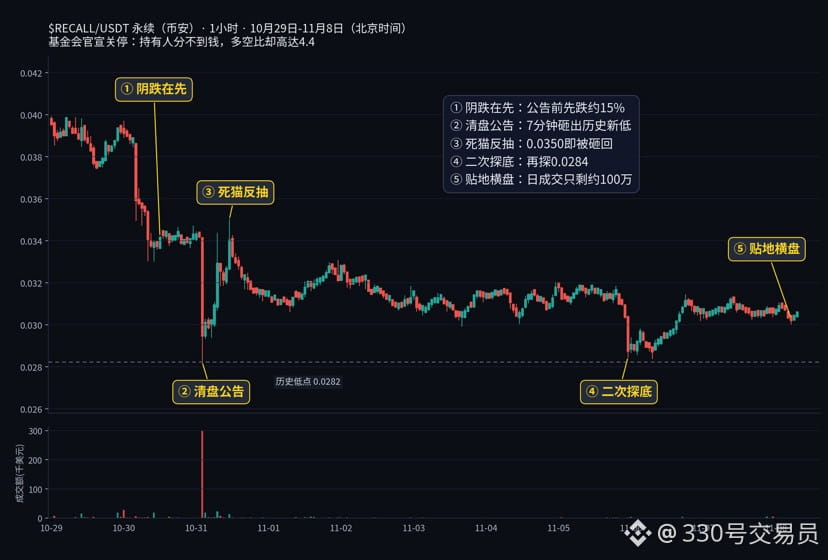
$RECALL , Recall’s token, which ranks AI agent competitions, launched last October and touched $0.82 on its first day. A year later, on October 30, the foundation announced it was shutting down and liquidating: the treasury held about $3.7 million, holders would get nothing, and the expected remainder was $0.
Seven minutes after the announcement, the price hit an all-time low of $0.0285, then stayed near the bottom for the following week: it’s now $0.0305, down 96% from its peak, with a market cap of just $8.65 million. It had already dropped 15% during the day before the announcement.
The strangest part is positioning: the project has shut down, but the long-short ratio is still as high as 4.4, the most crowded in the market. Everyone is betting on the burn mentioned in the announcement—359 million tokens, or 35.86% of the supply. But an on-chain check shows only about 87 tokens at the burn address so far; the burn hasn’t happened.
The main bet is on a slow bleed near the bottom: if $0.0284 breaks, watch for $0.024. If the burn actually goes through, there may be a brief bounce—but that’s an exit rally, not a reversal.
There’s only one thing to watch: the burn address. Has it reached 359 million tokens? If so, the bulls win a round; if not, that 4.4 long-short ratio is a list of positions waiting to be liquidated.
{future}(RECALLUSDT)
$RECALL , Recall’s token, which ranks AI agent competitions, launched last October and touched $0.82 on its first day. A year later, on October 30, the foundation announced it was shutting down and liquidating: the treasury held about $3.7 million, holders would get nothing, and the expected remainder was $0.
Seven minutes after the announcement, the price hit an all-time low of $0.0285, then stayed near the bottom for the following week: it’s now $0.0305, down 96% from its peak, with a market cap of just $8.65 million. It had already dropped 15% during the day before the announcement.
The strangest part is positioning: the project has shut down, but the long-short ratio is still as high as 4.4, the most crowded in the market. Everyone is betting on the burn mentioned in the announcement—359 million tokens, or 35.86% of the supply. But an on-chain check shows only about 87 tokens at the burn address so far; the burn hasn’t happened.
The main bet is on a slow bleed near the bottom: if $0.0284 breaks, watch for $0.024. If the burn actually goes through, there may be a brief bounce—but that’s an exit rally, not a reversal.
There’s only one thing to watch: the burn address. Has it reached 359 million tokens? If so, the bulls win a round; if not, that 4.4 long-short ratio is a list of positions waiting to be liquidated.
72
·
--
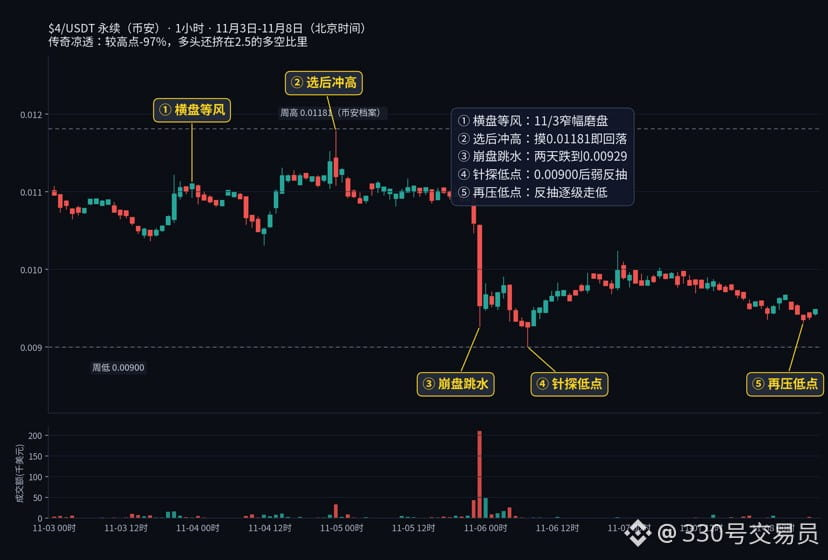
$4 is called “4,” and its origin story is a classic: Last October, a hacker stole the BNB Chain official account, used phishing to scam about $8,000, then launched a token, dumped it for $4,000, and ran. The community hit back by buying it up fivefold to mock him. CZ called it “the funniest counterattack,” and one person turned $3,000 into $2 million.
Binance subsequently listed perpetual futures. The token touched a high of 0.2921 that day, which was also its final moment in the spotlight. A year later, it’s at 0.00943, down 97% from its peak, with a market cap of just $9.4 million.
There’s only one thing left on the charts: longs holding on through a steady decline. The long-short ratio is 2.5, and open interest is 40% of market cap. On the crash day, positions increased instead of falling, but rebound highs have kept stepping down: 0.0104, 0.0100, 0.0096. It’s now grinding toward 0.009.
The base case is a slow bottoming process: no catalyst, and the stair-step decline hasn’t reversed. A break below 0.009 could trigger a long squeeze, with 0.008 in sight. The only reversal catalyst would be CZ mentioning it again—and that’s unpredictable.
Watch positions for confirmation: look for an hourly close at 0.009, whether open interest starts to fall, and whether the long-short ratio drops back below 2. If the longs haven’t been cleared out, the bottom isn’t in.
{future}(4USDT)
$4 is called “4,” and its origin story is a classic: Last October, a hacker stole the BNB Chain official account, used phishing to scam about $8,000, then launched a token, dumped it for $4 ,000, and ran. The community hit back by buying it up fivefold to mock him. CZ called it “the funniest counterattack,” and one person turned $3,000 into $2 million.
Binance subsequently listed perpetual futures. The token touched a high of 0.2921 that day, which was also its final moment in the spotlight. A year later, it’s at 0.00943, down 97% from its peak, with a market cap of just $9.4 million.
There’s only one thing left on the charts: longs holding on through a steady decline. The long-short ratio is 2.5, and open interest is 40% of market cap. On the crash day, positions increased instead of falling, but rebound highs have kept stepping down: 0.0104, 0.0100, 0.0096. It’s now grinding toward 0.009.
The base case is a slow bottoming process: no catalyst, and the stair-step decline hasn’t reversed. A break below 0.009 could trigger a long squeeze, with 0.008 in sight. The only reversal catalyst would be CZ mentioning it again—and that’s unpredictable.
Watch positions for confirmation: look for an hourly close at 0.009, whether open interest starts to fall, and whether the long-short ratio drops back below 2. If the longs haven’t been cleared out, the bottom isn’t in.
2
·
--
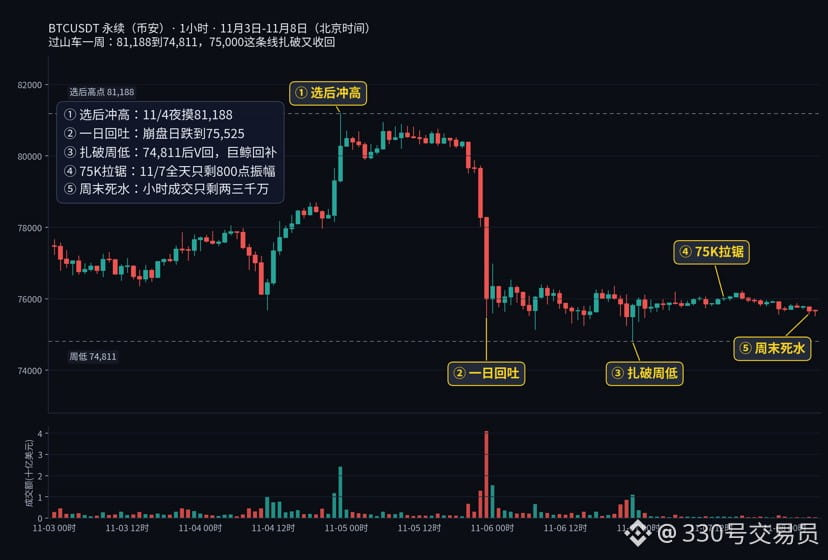
$BTC It was a roller-coaster week: surged to 81,188 on election night, U.S. stocks crashed the next day and it gave back gains to 75,525, then on Friday it wicked down to 74,811, dipping below 75,000 before recovering.
On the day of the sell-off, one on-chain address was going against the crowd: (The trade is only a guess; the activity is real.) A whale that sold everything at 89,291 a year ago and had been silent all year bought back 3,009 coins in five transactions, worth about 228 million—roughly 15% cheaper than the selling price. ETFs also saw net outflows of 430 million that day: institutions pulled out, while the whale scooped up coins.
Then things went quiet: leverage was flushed out, and the price stayed above 75,000 for three days. Weekend hourly volume dwindled to just 20–30 million. The weekend won’t give us a clear direction: 75,000 is the dividing line; the price wicked below it, but never broke through.
My main bet is that it will build a base within a range: first grind between 74,811 and 77,000. 78,300 is a resistance band where holders are trapped; only after breaking through can we talk about 80,000. If 74,811 breaks again on rising volume, watch for 73,000.
The key test is Monday: after the U.S. market opens, will $BTC move with the Nasdaq, and will it retest 74,811?
One more detail: Binance’s top-trader long/short ratio surged from 1.72 to 3.31 on the night of the crash—large accounts were clearly leaning bullish during the drop. That’s one reason I’m betting on a base forming first, rather than an immediate breakdown. But ETFs are still seeing outflows, so the two forces are offsetting each other; the price could grind within this range for quite a while.
{future}(BTCUSDT)
$BTC It was a roller-coaster week: surged to 81,188 on election night, U.S. stocks crashed the next day and it gave back gains to 75,525, then on Friday it wicked down to 74,811, dipping below 75,000 before recovering.
On the day of the sell-off, one on-chain address was going against the crowd: (The trade is only a guess; the activity is real.) A whale that sold everything at 89,291 a year ago and had been silent all year bought back 3,009 coins in five transactions, worth about 228 million—roughly 15% cheaper than the selling price. ETFs also saw net outflows of 430 million that day: institutions pulled out, while the whale scooped up coins.
Then things went quiet: leverage was flushed out, and the price stayed above 75,000 for three days. Weekend hourly volume dwindled to just 20–30 million. The weekend won’t give us a clear direction: 75,000 is the dividing line; the price wicked below it, but never broke through.
My main bet is that it will build a base within a range: first grind between 74,811 and 77,000. 78,300 is a resistance band where holders are trapped; only after breaking through can we talk about 80,000. If 74,811 breaks again on rising volume, watch for 73,000.
The key test is Monday: after the U.S. market opens, will $BTC move with the Nasdaq, and will it retest 74,811?
One more detail: Binance’s top-trader long/short ratio surged from 1.72 to 3.31 on the night of the crash—large accounts were clearly leaning bullish during the drop. That’s one reason I’m betting on a base forming first, rather than an immediate breakdown. But ETFs are still seeing outflows, so the two forces are offsetting each other; the price could grind within this range for quite a while.
214
·
--
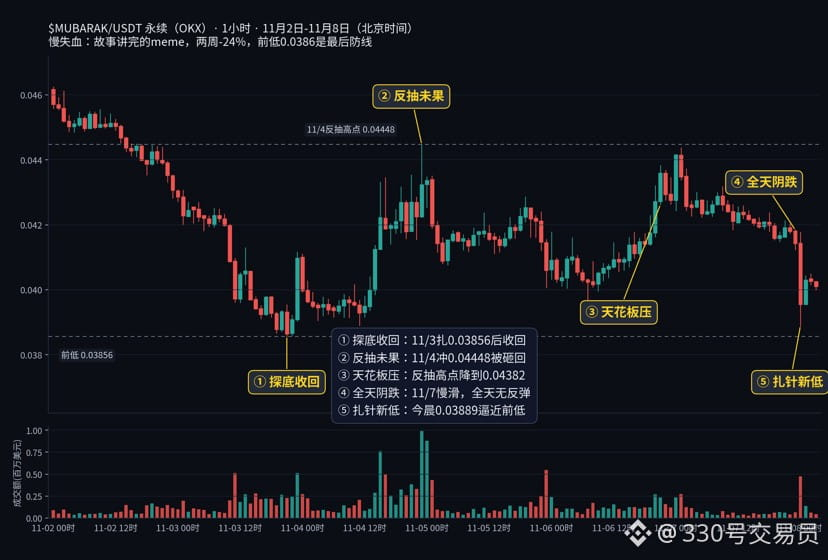
$MUBARAK was the star meme of March 2025: “blessed” was the idea, and CZ bought about $600 worth with 1 BNB. It surged 200% in two days, with its market cap topping $200 million. Now its market cap is down to just $40 million.
For the past two weeks, it’s done only one thing: bleed. It drifted down from 0.0525 to 0.040—not a crash, not a black swan, just no buyers stepping in. Daily volume shrank from $6 million to $1.78 million, while resistance kept moving lower: 0.0445, then 0.0438. Each bounce has been weaker than the last.
At 00:00 this morning, a sharp wick plunged to 0.03889—the largest single-hour volume in days—nearing the November 3 low of 0.03856 before a weak bounce back to 0.040. The project team has made no new moves, and CZ hasn’t engaged again. The story is over; all that’s left is existing holders watching one another.
The real risk here isn’t how far it falls, but that if volume dries up further, it’ll break straight through the previous low on a retest. The base case is continued weakness while it tries to form a bottom, with a downside break more likely: if 0.0386 doesn’t hold, watch 0.034–0.035.
Watch volume to confirm: will it pick up after this wick, and can daily volume get back above $3 million? Bounces without volume are fake. Don’t talk about a recovery until it holds above 0.0438.
{future}(MUBARAKUSDT)
$MUBARAK was the star meme of March 2025: “blessed” was the idea, and CZ bought about $600 worth with 1 BNB. It surged 200% in two days, with its market cap topping $200 million. Now its market cap is down to just $40 million.
For the past two weeks, it’s done only one thing: bleed. It drifted down from 0.0525 to 0.040—not a crash, not a black swan, just no buyers stepping in. Daily volume shrank from $6 million to $1.78 million, while resistance kept moving lower: 0.0445, then 0.0438. Each bounce has been weaker than the last.
At 00:00 this morning, a sharp wick plunged to 0.03889—the largest single-hour volume in days—nearing the November 3 low of 0.03856 before a weak bounce back to 0.040. The project team has made no new moves, and CZ hasn’t engaged again. The story is over; all that’s left is existing holders watching one another.
The real risk here isn’t how far it falls, but that if volume dries up further, it’ll break straight through the previous low on a retest. The base case is continued weakness while it tries to form a bottom, with a downside break more likely: if 0.0386 doesn’t hold, watch 0.034–0.035.
Watch volume to confirm: will it pick up after this wick, and can daily volume get back above $3 million? Bounces without volume are fake. Don’t talk about a recovery until it holds above 0.0438.
1
552
·
--
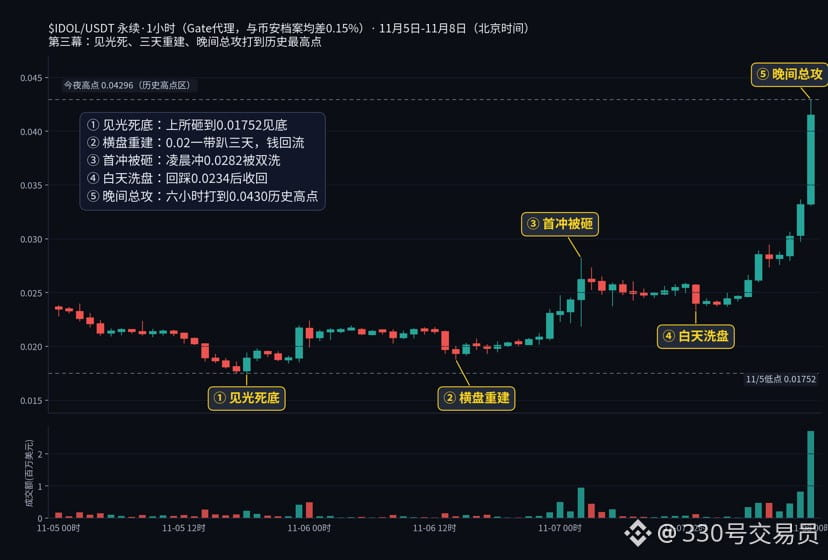
$IDOL is MEET48's coin, focused on AI idol fan economies and backed by SNH48. Total supply is 4.8 billion, with 900 million in circulation and a market cap of over 30 million.
A complete roller coaster: up 208% in one week at the end of October, then a classic sell-the-news drop after listing on November 3, falling 30%; it bottomed around 0.02 and consolidated for three days. Last night’s attempted breakout was pushed back down, followed by daytime shakeout and an evening assault, surging from 0.0246 to 0.0430—an all-time high.
There’s no project-level catalyst. Like $AKE and $ONE over the past couple of days, this is a rotation-driven short squeeze. What you can see on Binance: the long/short ratio slid from 1.08 to 0.90, with shorts adding to their positions as the price rose—fuel for another squeeze. Token holdings are also highly concentrated, with the top three wallets holding nearly 60%.
At an all-time high, there’s no overhead supply and no reference point; it all depends on how holders choose to take profits. My main bet is on a deep pullback first: 0.033 is the launch point, and it needs to hold for a second leg. Only a sustained move above 0.043 would open the door to price discovery.
The key confirmation is tonight’s close: can it hold 0.036? If not, expect a retest of 0.033 tomorrow to test support. There’s no room for error when chasing at this level.
Over these three days, 、$ONE ake idol have all been lit up one by one by the same rotating capital. The common thread is positioning, not sector—the order changes daily, and those chasing the leader can easily end up holding the last baton.
{future}(AKEUSDT)
{future}(IDOLUSDT)
$IDOL is MEET48's coin, focused on AI idol fan economies and backed by SNH48. Total supply is 4.8 billion, with 900 million in circulation and a market cap of over 30 million.
A complete roller coaster: up 208% in one week at the end of October, then a classic sell-the-news drop after listing on November 3, falling 30%; it bottomed around 0.02 and consolidated for three days. Last night’s attempted breakout was pushed back down, followed by daytime shakeout and an evening assault, surging from 0.0246 to 0.0430—an all-time high.
There’s no project-level catalyst. Like $AKE and $ONE over the past couple of days, this is a rotation-driven short squeeze. What you can see on Binance: the long/short ratio slid from 1.08 to 0.90, with shorts adding to their positions as the price rose—fuel for another squeeze. Token holdings are also highly concentrated, with the top three wallets holding nearly 60%.
At an all-time high, there’s no overhead supply and no reference point; it all depends on how holders choose to take profits. My main bet is on a deep pullback first: 0.033 is the launch point, and it needs to hold for a second leg. Only a sustained move above 0.043 would open the door to price discovery.
The key confirmation is tonight’s close: can it hold 0.036? If not, expect a retest of 0.033 tomorrow to test support. There’s no room for error when chasing at this level.
Over these three days, 、$ONE ake idol have all been lit up one by one by the same rotating capital. The common thread is positioning, not sector—the order changes daily, and those chasing the leader can easily end up holding the last baton.
1
866
·
--
$ONE is Harmony’s token, from a once-star public chain in the last bull market. It peaked at $0.379, but now it’s worth just a fraction of that—the project team has even proposed shutting down the mainnet and migrating to Ethereum. And this coin, which is supposedly “getting ready to shut up shop,” has surged 143% in two days.
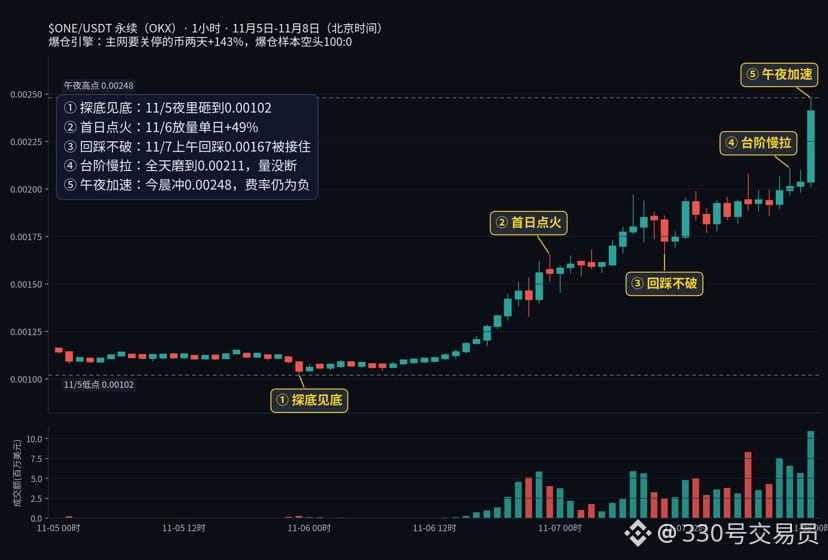
How it happened: It bottomed at 0.00102 on November 5. The next day, trading volume surged and the price rose 49%. Yesterday, it ground steadily higher in a series of steps all day, with volume never letting up. At midnight today, it accelerated again, reaching 0.00248. The project team has made no announcements; there’s no news to speak of.
The impact is all in the contracts: liquidation data is overwhelmingly skewed toward shorts, with no long liquidations. Open interest has nearly tripled in two days, while funding rates are still negative—shorts keep piling in, and the fuel hasn’t run out. One analyst calls this a “liquidation engine fueled by derivatives”; it’s not spot buying.
This move has nothing to do with fundamentals; it’s purely a positioning game. The main scenario is a wide-ranging consolidation at elevated levels, with a pullback to test support first: if 0.0019–0.0020 holds, there’s still room for more action; if it breaks, the price could return to 0.00156.
Two things to watch: whether 0.00248 can hold with strong volume, and when the funding rate turns positive. A positive funding rate means longs are starting to crowd in and take over—often a sign that the squeeze is nearing its end.
{future}(ONEUSDT)
$ONE is Harmony’s token, from a once-star public chain in the last bull market. It peaked at $0.379, but now it’s worth just a fraction of that—the project team has even proposed shutting down the mainnet and migrating to Ethereum. And this coin, which is supposedly “getting ready to shut up shop,” has surged 143% in two days.
How it happened: It bottomed at 0.00102 on November 5. The next day, trading volume surged and the price rose 49%. Yesterday, it ground steadily higher in a series of steps all day, with volume never letting up. At midnight today, it accelerated again, reaching 0.00248. The project team has made no announcements; there’s no news to speak of.
The impact is all in the contracts: liquidation data is overwhelmingly skewed toward shorts, with no long liquidations. Open interest has nearly tripled in two days, while funding rates are still negative—shorts keep piling in, and the fuel hasn’t run out. One analyst calls this a “liquidation engine fueled by derivatives”; it’s not spot buying.
This move has nothing to do with fundamentals; it’s purely a positioning game. The main scenario is a wide-ranging consolidation at elevated levels, with a pullback to test support first: if 0.0019–0.0020 holds, there’s still room for more action; if it breaks, the price could return to 0.00156.
Two things to watch: whether 0.00248 can hold with strong volume, and when the funding rate turns positive. A positive funding rate means longs are starting to crowd in and take over—often a sign that the squeeze is nearing its end.
2
1.5k
·
--
#币安神算子 I shouldn't have started playing the 5-minute up/down game. Now there's no hope of getting my money back. None of the predictions are accurate.
#币安神算子 I shouldn't have started playing the 5-minute up/down game. Now there's no hope of getting my money back. None of the predictions are accurate.

·
--
#币安神算子 I haven't had any luck for several days now. It's so hard. I can't stop hoping for a big win, but there's nothing I can do—I'll just keep earning a hundred at a time.
#币安神算子 I haven't had any luck for several days now. It's so hard. I can't stop hoping for a big win, but there's nothing I can do—I'll just keep earning a hundred at a time.

2
·
--
$AKE is Akedo’s coin, an AI game-creation platform. Just yesterday, people were saying it had structurally collapsed, down 98.5% from its high. Today, it’s turned around.
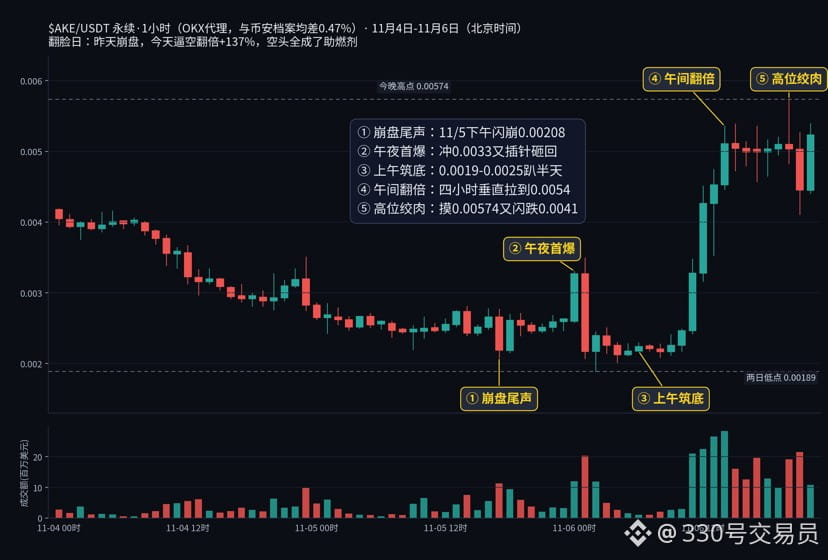
Here’s what happened: it surged sharply around midnight, then got knocked back down; a spike wiped out a batch of traders. In the morning, it hovered around 0.0021–0.0025, then shot straight up at midday, doubling in four hours and gaining 137% in 24 hours. The team had a small update today: point redemptions have resumed. But that alone couldn’t fuel a doubling—the real fuel was yesterday’s shorts. As the price crashed, short positions piled up, bunching together and becoming fuel for the rally.
The impact is immediate: short sellers got liquidated in a cascade, while buyers chasing the rally have also been shaken out by two wicks of around 20%. It’s a meat grinder now. But the overhang hasn’t changed: 2.1 billion tokens are still set to unlock on November 21.
The main bet is on a pullback after the meat grinder: 0.0035–0.0038 was the midday launch zone, and holding there would signal a successful change of hands. If it stabilizes above 0.00574, then watch 0.0065.
Tonight’s key test: can it hold 0.0045? If it can’t, and drops below 0.0041, this rally was just a one-day short squeeze, with token unlocks still waiting below.
{future}(AKEUSDT)
$AKE is Akedo’s coin, an AI game-creation platform. Just yesterday, people were saying it had structurally collapsed, down 98.5% from its high. Today, it’s turned around.
Here’s what happened: it surged sharply around midnight, then got knocked back down; a spike wiped out a batch of traders. In the morning, it hovered around 0.0021–0.0025, then shot straight up at midday, doubling in four hours and gaining 137% in 24 hours. The team had a small update today: point redemptions have resumed. But that alone couldn’t fuel a doubling—the real fuel was yesterday’s shorts. As the price crashed, short positions piled up, bunching together and becoming fuel for the rally.
The impact is immediate: short sellers got liquidated in a cascade, while buyers chasing the rally have also been shaken out by two wicks of around 20%. It’s a meat grinder now. But the overhang hasn’t changed: 2.1 billion tokens are still set to unlock on November 21.
The main bet is on a pullback after the meat grinder: 0.0035–0.0038 was the midday launch zone, and holding there would signal a successful change of hands. If it stabilizes above 0.00574, then watch 0.0065.
Tonight’s key test: can it hold 0.0045? If it can’t, and drops below 0.0041, this rally was just a one-day short squeeze, with token unlocks still waiting below.
388
·
--
$DOOD is the token of Doodles, a well-established NFT project, launched in 2025. Since launch, it has steadily drifted downward, with its market cap now down to just $14 million—a fraction of its all-time high.
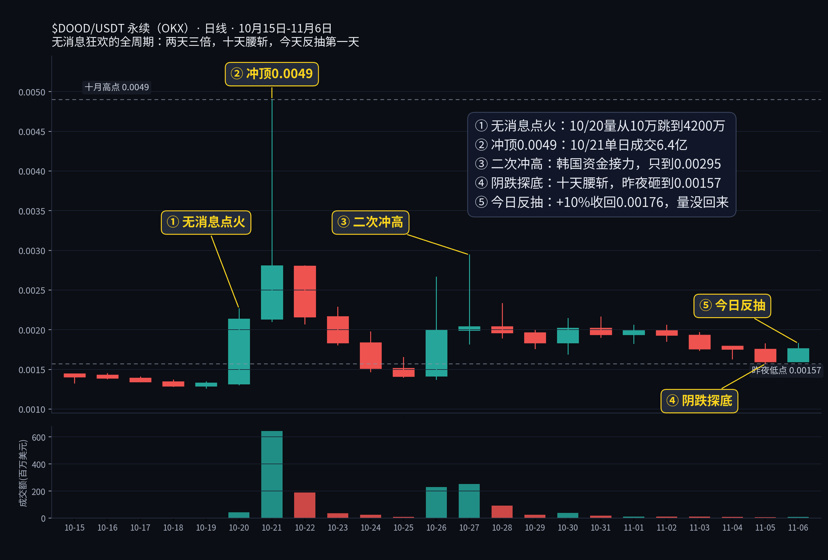
A major move happened more than ten days ago: with no official news, it nearly tripled in two days. Daily trading volume hit $640 million, 45 times its market cap. The money came fast and left even faster: it fell back to where it started within four days. Then Korean funds led a second wave, but momentum fizzled before it could reach the previous high. Over the next ten days, it halved again, crashing to 0.00157 last night.
Today is its first bounce since bottoming out: it climbed back to 0.00176 over the day, up 10%, while most tokens in the same sector posted modest gains. But trading volume is only a fraction of the peak—this is existing holders trying to bail themselves out, not fresh money coming in. There’s also a treasury overhang: around 690 million tokens were previously transferred to exchanges, nearly 7% of the total supply.
In this kind of market, the first day of a bounce is the easiest time to get fooled. For the main position, start scaling out around 0.0019–0.0020; only a high-volume move above and a hold over 0.0020 would make a second wave plausible.
Watch the next day or two: can it break above the intraday high of 0.00183 on strong volume? If it does, the bounce is gaining strength; if it fails, this is still just an oversold rebound. A drop below 0.0016 would put last night’s low back to the test.
{future}(DOODUSDT)
$DOOD is the token of Doodles, a well-established NFT project, launched in 2025. Since launch, it has steadily drifted downward, with its market cap now down to just $14 million—a fraction of its all-time high.
A major move happened more than ten days ago: with no official news, it nearly tripled in two days. Daily trading volume hit $640 million, 45 times its market cap. The money came fast and left even faster: it fell back to where it started within four days. Then Korean funds led a second wave, but momentum fizzled before it could reach the previous high. Over the next ten days, it halved again, crashing to 0.00157 last night.
Today is its first bounce since bottoming out: it climbed back to 0.00176 over the day, up 10%, while most tokens in the same sector posted modest gains. But trading volume is only a fraction of the peak—this is existing holders trying to bail themselves out, not fresh money coming in. There’s also a treasury overhang: around 690 million tokens were previously transferred to exchanges, nearly 7% of the total supply.
In this kind of market, the first day of a bounce is the easiest time to get fooled. For the main position, start scaling out around 0.0019–0.0020; only a high-volume move above and a hold over 0.0020 would make a second wave plausible.
Watch the next day or two: can it break above the intraday high of 0.00183 on strong volume? If it does, the bounce is gaining strength; if it fails, this is still just an oversold rebound. A drop below 0.0016 would put last night’s low back to the test.
1
1
1.3k
·
--
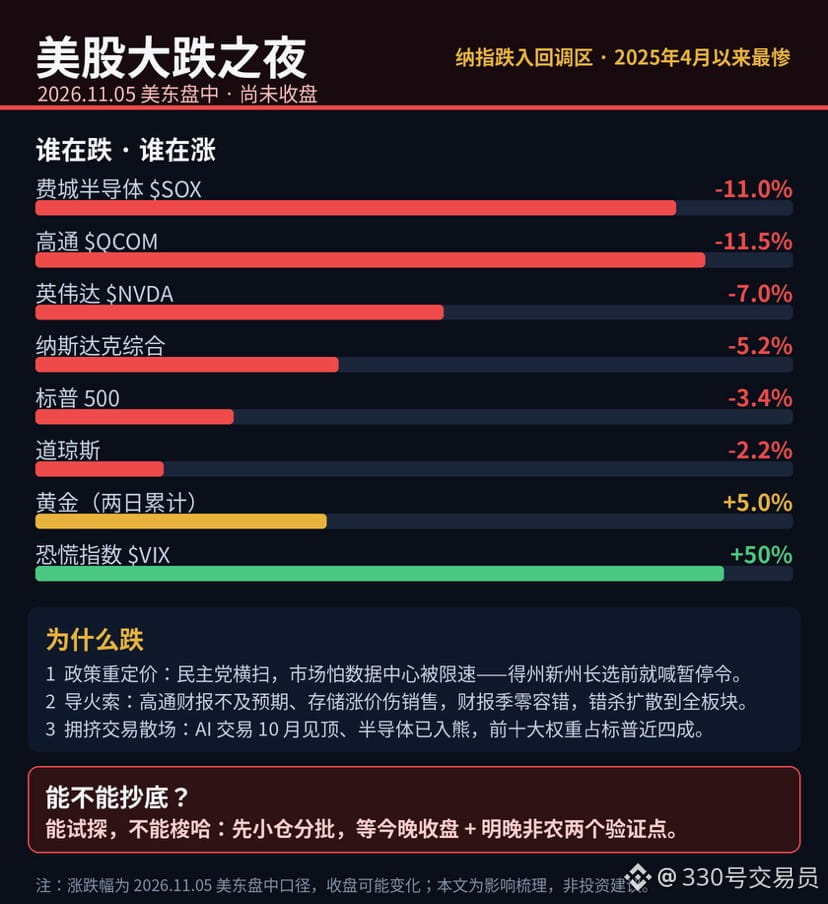
U.S. stocks plunged tonight—can you buy the dip?
It’s still Thursday midday in the U.S. market, and trading hasn’t closed yet. The Nasdaq was down as much as 5.7%, entering correction territory, while the Philadelphia Semiconductor Index fell about 11%—its biggest intraday drop since March 2020.
Why the sell-off: ① After the Democrats swept the elections, markets worried that data center construction could be slowed. Texas’s new governor had advocated pausing data center projects and ending tax breaks even before the election, triggering a broad repricing of the AI infrastructure chain; ② Qualcomm’s earnings missed expectations, and higher memory prices hurt sales. Its stock fell 11.5%—there’s zero room for error this earnings season; ③ The AI trade was already crowded, and semiconductors have been in a bear market since peaking in October. Once the big names fell, everything else followed. $VIX surged about 50%, while gold rose roughly 5% in two days and held above $4,100—this is panic, but not yet a liquidity-crisis-style capitulation.
241
·
--
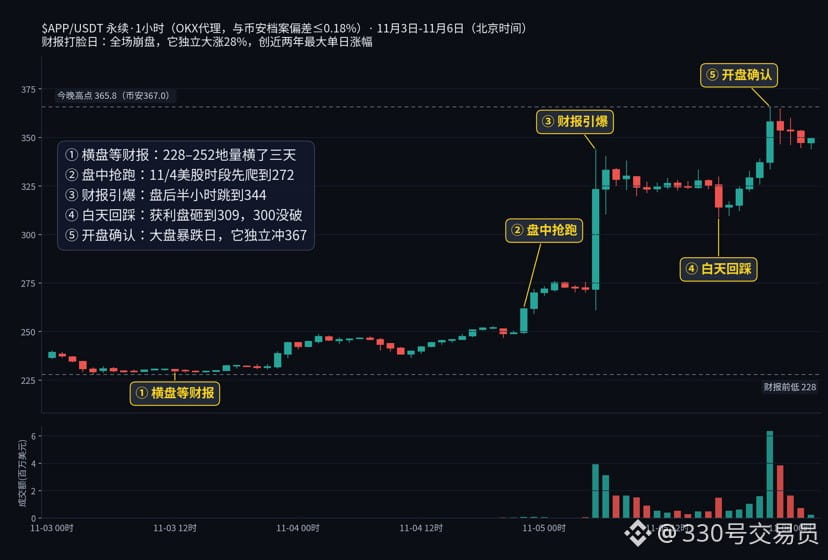
$APP is AppLovin, an AI-powered advertising company. Its stock has fallen 60% this year, and the market had already declared its growth had peaked, just waiting for earnings to confirm it.
Then the earnings report proved everyone wrong: revenue was up 55% year over year, and the company raised its fourth-quarter guidance. It surged after yesterday’s close, but tonight’s regular session was the real show—the broader market was crashing, the semiconductor index was down 8.3%, yet AppLovin defied the entire market and soared 28%, its biggest single-day gain in nearly two years.
Short sellers who had bet on a collapse in growth ahead of earnings became fuel overnight.
Investment banks rushed to change their tune overnight: Goldman Sachs, Morgan Stanley, and BTIG all raised their price targets, with the highest at 600. The contracts market played along, too: the stock retested 309 during the day without breaking below 300, then shot straight up to 367 after the evening open.
But after such a huge two-day rally, it’s worth being clear-eyed about the risks of chasing it higher: the stock is still down 40% for the year, with layers of investors who bought at higher prices waiting to sell. The base case is consolidation at elevated levels: if it holds 330, there’s still a chance; if it stays above 367, 390–400 is in sight. If it breaks below 330, it could turn back and fill the gap at that 309 low.
{future}(APPUSDT)
$APP is AppLovin, an AI-powered advertising company. Its stock has fallen 60% this year, and the market had already declared its growth had peaked, just waiting for earnings to confirm it.
Then the earnings report proved everyone wrong: revenue was up 55% year over year, and the company raised its fourth-quarter guidance. It surged after yesterday’s close, but tonight’s regular session was the real show—the broader market was crashing, the semiconductor index was down 8.3%, yet AppLovin defied the entire market and soared 28%, its biggest single-day gain in nearly two years.
Short sellers who had bet on a collapse in growth ahead of earnings became fuel overnight.
Investment banks rushed to change their tune overnight: Goldman Sachs, Morgan Stanley, and BTIG all raised their price targets, with the highest at 600. The contracts market played along, too: the stock retested 309 during the day without breaking below 300, then shot straight up to 367 after the evening open.
But after such a huge two-day rally, it’s worth being clear-eyed about the risks of chasing it higher: the stock is still down 40% for the year, with layers of investors who bought at higher prices waiting to sell. The base case is consolidation at elevated levels: if it holds 330, there’s still a chance; if it stays above 367, 390–400 is in sight. If it breaks below 330, it could turn back and fill the gap at that 309 low.
281
·
--
Partly True
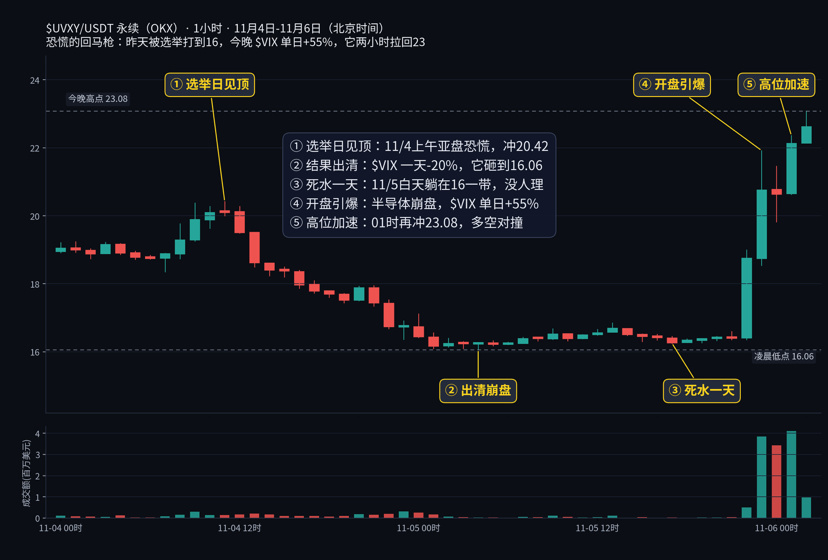
$UVXY is a tool for going long volatility: the more U.S. stocks fall, the harder it rises. Yesterday, we just said the election had knocked it back down to earth. Tonight, it made a comeback.
Things reversed quickly: once the election results were in, the panic faded within a day. $VIX fell to 16.61, and UVXY plunged to 16.06. Everyone thought the volatility story was over. It languished around 16 all day today, ignored by everyone.
Then U.S. markets opened tonight, and semiconductors led the selloff: the Philadelphia Semiconductor Index fell 8.3%, with selling spreading across the market. Panic returned in an instant—$VIX surged 55% in a single day to 25.69. UVXY jumped from 16.4 to 23 in two hours, up 39% in 24 hours.
The impact was immediate: those who bet yesterday that volatility had peaked and those who chased shorts tonight were both caught out, with shorts accounting for most of the liquidations. Positions surged nearly 60% in three hours, as bulls and bears clashed above 20.
What comes next: these panic spikes usually don’t last more than a few days. Mean reversion and built-in decay will both pull it lower, but don’t bet against it before U.S. markets close tonight. The main scenario is choppy trading at elevated levels, followed by a downward shift; if it can’t hold 20, it could fall back to 18–19. If stocks plunge again tonight, it could still spike to 26–28. Don’t hold a large position overnight on either side.
{future}(UVXYUSDT)
$UVXY is a tool for going long volatility: the more U.S. stocks fall, the harder it rises. Yesterday, we just said the election had knocked it back down to earth. Tonight, it made a comeback.
Things reversed quickly: once the election results were in, the panic faded within a day. $VIX fell to 16.61, and UVXY plunged to 16.06. Everyone thought the volatility story was over. It languished around 16 all day today, ignored by everyone.
Then U.S. markets opened tonight, and semiconductors led the selloff: the Philadelphia Semiconductor Index fell 8.3%, with selling spreading across the market. Panic returned in an instant—$VIX surged 55% in a single day to 25.69. UVXY jumped from 16.4 to 23 in two hours, up 39% in 24 hours.
The impact was immediate: those who bet yesterday that volatility had peaked and those who chased shorts tonight were both caught out, with shorts accounting for most of the liquidations. Positions surged nearly 60% in three hours, as bulls and bears clashed above 20.
What comes next: these panic spikes usually don’t last more than a few days. Mean reversion and built-in decay will both pull it lower, but don’t bet against it before U.S. markets close tonight. The main scenario is choppy trading at elevated levels, followed by a downward shift; if it can’t hold 20, it could fall back to 18–19. If stocks plunge again tonight, it could still spike to 26–28. Don’t hold a large position overnight on either side.
1
675
·
--
Partly True
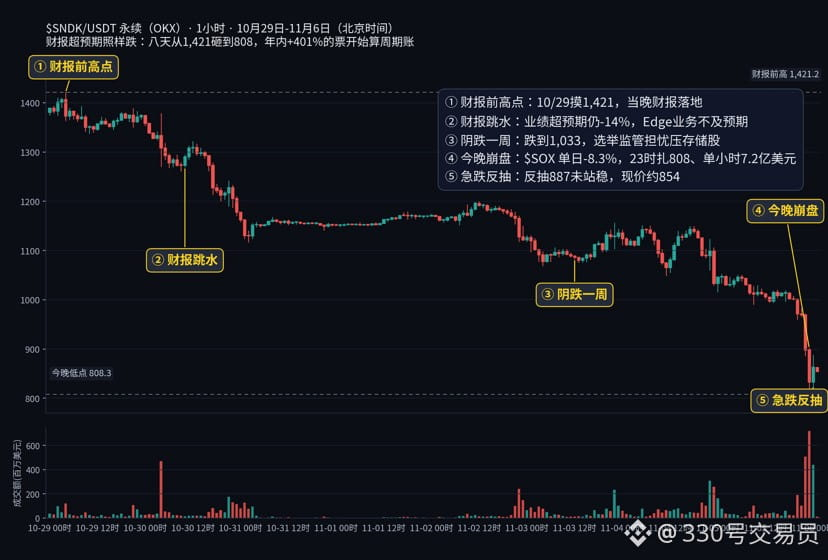
$SNDK isn't a coin; it's a contract tracking SanDisk stock in the U.S. market: a NAND manufacturer, up as much as 401% year to date.
News: The 10/29 earnings were good (revenue of $11 billion, with both figures beating expectations), but Edge fell short of expectations and growth slowed to +23%. The market is selling the “peak” narrative. Tonight, $SOX is down 8.3%, and SNDK is the worst performer.
Price action: Peaked at 1,421 before earnings, fell 14% the next day, then slid for a week to 1,033. Tonight it plunged at the open, hitting 808.3 at 23:00—down 43% from the high—and is now around 854.
Flows: 99 long liquidations versus 1 short liquidation—a pure capitulation. Open interest is about $119 million, up 58% before the crash, so positions haven’t been cleared out. Funding is +0.045%; spot is selling.
Sector: Memory stocks are all wiped out: $WDC -15.7%, $STX -13.2%, $MU -12.2%. SNDK rose the most and is falling the hardest.
Forecast: 50% chance of weak, range-bound trading, with 800 as support and 970–1,000 as resistance; 20% chance it reclaims 900 and holds, then rebounds to 1,030–1,100; 30% chance it breaks below 800, with 700 in sight.
Approach: Don’t catch a falling knife; wait for confirmation at the close. There’s an 8-for-1 stock split on 11/19, so the price will be divided by 8.
1
1.5k
·
--
#币安神算子 Binance prediction genius—free bonus with no investment. Participating doesn’t guarantee you’ll get one, but if you don’t participate, you definitely won’t. Come make a prediction and see if you’re a prediction genius. I know I’m not!
#币安神算子 Binance prediction genius—free bonus with no investment. Participating doesn’t guarantee you’ll get one, but if you don’t participate, you definitely won’t. Come make a prediction and see if you’re a prediction genius. I know I’m not!

·
--
Verified
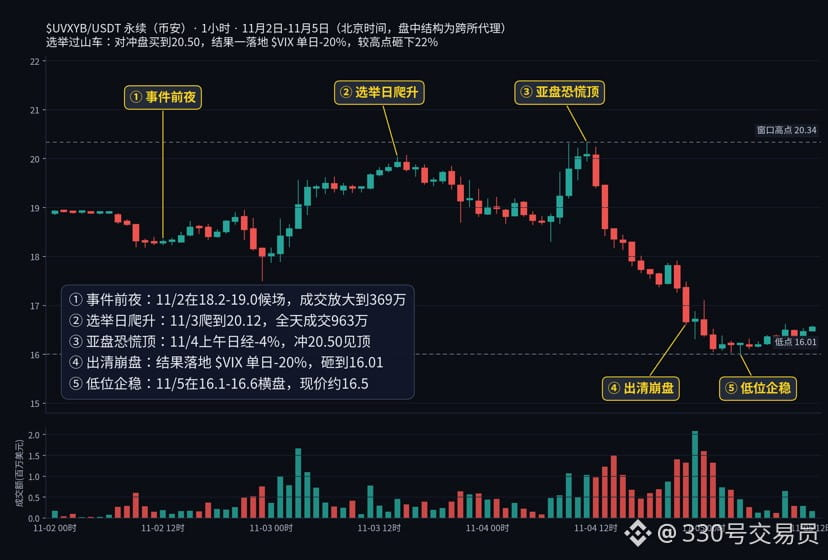
$UVXY is a U.S. stock token on Binance, backed by $UVXY, which provides 1.5x leveraged long exposure to $VIX futures. It just came off an election roller coaster.
News: Democrats swept the midterms, clearing uncertainty. On 11/4, the Dow rose 3.2% and $VIX fell 20% in a day to 16.61.
Positioning: Before the election, $VIX rose from 17.2 to 21.15 as hedgers piled into event bets; open interest was around 2 million.
Price + flows: It climbed to 20.12 on 11/3. On the morning of 11/4, an Asia-Pacific selloff (Nikkei -4%) pushed it to a peak of 20.50, before it crashed in the afternoon to 16.01 by this morning (-22%). Volume jumped from 300K to 9.63M.
Comparison: Its mirror is the index: the S&P 500 gained 1.58% that day, and the premium evaporated in half a day.
Forecast: A 60% chance it drifts lower after the uncertainty clears, grinding between 15 and 17.5; a 25% chance new risks push $VIX back above 19, with a rebound to 18.5; a 15% chance $VIX falls toward 14–15, with 14.5 in sight if it breaks below 16.
View: The event trade is over—don’t overstay. It has built-in decay; don’t try to call the bottom.
584
·
--
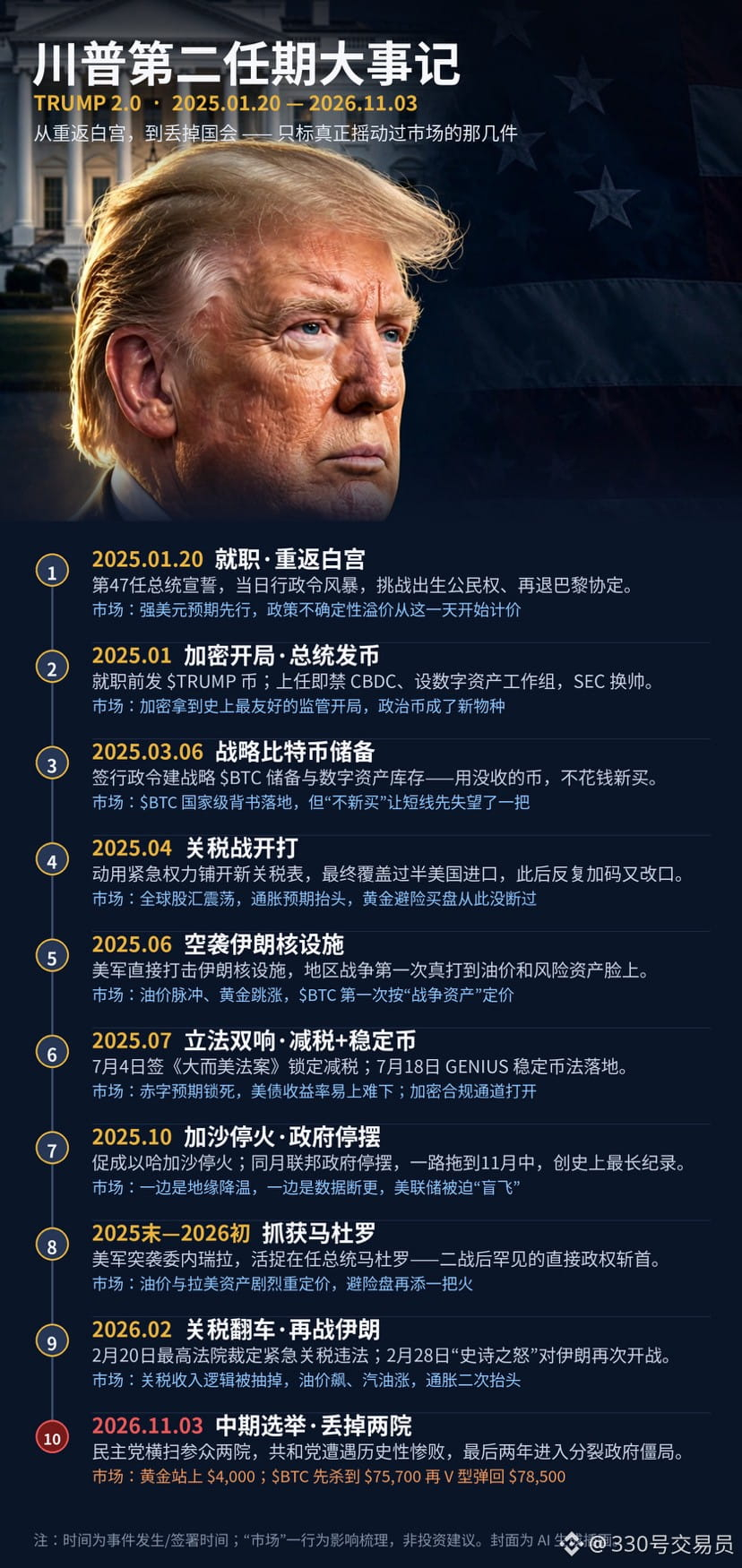
The Republican loss this time is essentially a shift in the U.S. from “one party calling all the shots” to “division and gridlock.”
Trump is still in the White House, but Democrats control Congress. Over the next two years, it will be much harder for him to push through tax cuts, deregulation, and crypto-friendly legislation.
Why did gold rise so decisively?
After the Democratic sweep, the dollar fell and Treasury yields dropped, while markets grew concerned about investigations, fiscal negotiations, and policy standoffs. Gold thrives on all three: a weak dollar, low real interest rates, and political uncertainty. It doesn’t need to care about any company’s earnings—it simply climbed above $4,000.
Why did $BTC fall first and then rebound?
The initial drop came from selling it as a risk asset: a Democratic-controlled Congress means the crypto market structure bill, CLARITY, will most likely be delayed until 2027, the regulatory stance will tighten, and Trump-themed coins will take a direct hit.
The rebound that followed came from buying it as a macro asset: election uncertainty faded, the dollar weakened, and it joined the Nasdaq in a V-shaped recovery.
In a nutshell: gold benefits purely from “a weak dollar + uncertainty,” while $BTC is caught between “positive macro factors” and “negative regulatory factors.” That’s why gold’s trend is smoother, while $BTC is more prone to getting whipsawed.
From here, don’t just focus on party slogans. Watch three real variables: where the dollar and Treasury yields are headed, whether Friday’s nonfarm payrolls report will change expectations for the Fed, and whether $BTC can truly hold above $82,000.
472
·
--

Article
After Trump Loses Congress: A Shift in the Investment ClimateHow the event affects tradable assets: What exactly does a Republican defeat mean for markets?
1. First, understand the event itself
In these midterm elections, Democrats won both the House and the Senate. Trump has two years left in his term, but he has lost Congress, his most important tool for passing legislation.
This doesn’t mean Democrats can raise taxes, rewrite crypto laws, or ban AI tomorrow. The president still has veto power, and the new Congress won’t take office until January 2027. In practice, legislation is likely to hit a stalemate, not become a one-sided rout.
What markets fear most has never been any one party, but two things: first, whether policy will suddenly take a sharp turn, and second, whether that turn has already been priced in. Before the election, prediction markets had already put the odds of Democrats winning the House at 94.5%, and the Senate at 76.5%. So this was a “bad news, but one most people had already anticipated” event. That explains why the market didn’t crash, but fell first and then rose.
After Trump Loses Congress: A Shift in the Investment Climate
How the event affects tradable assets: What exactly does a Republican defeat mean for markets?
1. First, understand the event itself
In these midterm elections, Democrats won both the House and the Senate. Trump has two years left in his term, but he has lost Congress, his most important tool for passing legislation.
This doesn’t mean Democrats can raise taxes, rewrite crypto laws, or ban AI tomorrow. The president still has veto power, and the new Congress won’t take office until January 2027. In practice, legislation is likely to hit a stalemate, not become a one-sided rout.
What markets fear most has never been any one party, but two things: first, whether policy will suddenly take a sharp turn, and second, whether that turn has already been priced in. Before the election, prediction markets had already put the odds of Democrats winning the House at 94.5%, and the Senate at 76.5%. So this was a “bad news, but one most people had already anticipated” event. That explains why the market didn’t crash, but fell first and then rose.
·
--
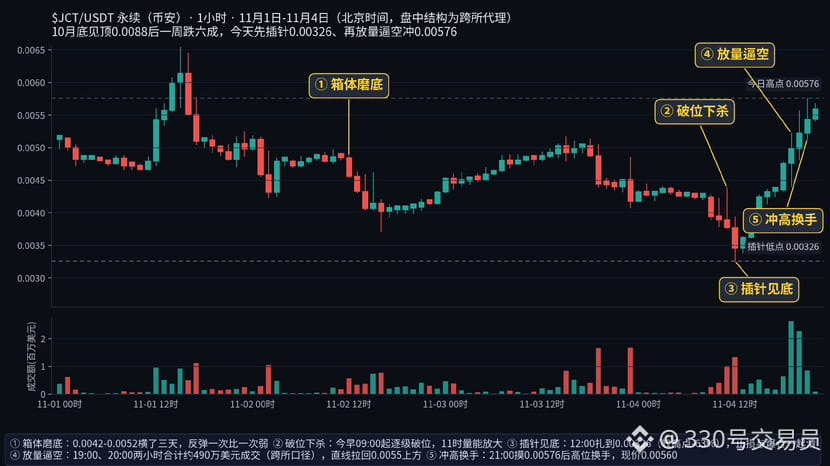
$JCT squeeze-driven rebound surge: down 60% in a week, first a wick down, then an evening short squeeze—with an unlock cliff in 6 days.
News: Rendering services to be commercialized on November 2, fees charged in yen; $JCT not required. No new announcements today.
An AI computing network incubated by Jasmy: 50 billion supply, 23% circulating, market cap of 64 million, with 77% yet to be unlocked.
After three days of bottoming, it broke down this morning. At 12:00, it wicked down to 0.00326 (−63%); in the evening, 4.9 million in volume over two hours triggered a short squeeze, with a high of 0.00576 and a current price of 0.00559. OI halved in a week to 14.76 million; the light positioning is what allowed the rally.
The sector hasn't followed: $JASMY is up 0.6% and barely moved; $RENDER and others followed only slightly. This is purely a single-token move.
Base case: choppy drift lower (50%): range-bound trading, with heavier pressure as the unlock approaches. A second rally is possible (30%) only if it holds above 0.0061 and $JASMY also rises. A break below 0.0044 could retest the wick low (20%).
Don't chase at the current price; try a small position on a pullback. Shorts should wait for the rally to stall and the unlock—don't try to catch a falling knife.
429
·
--
Partly True
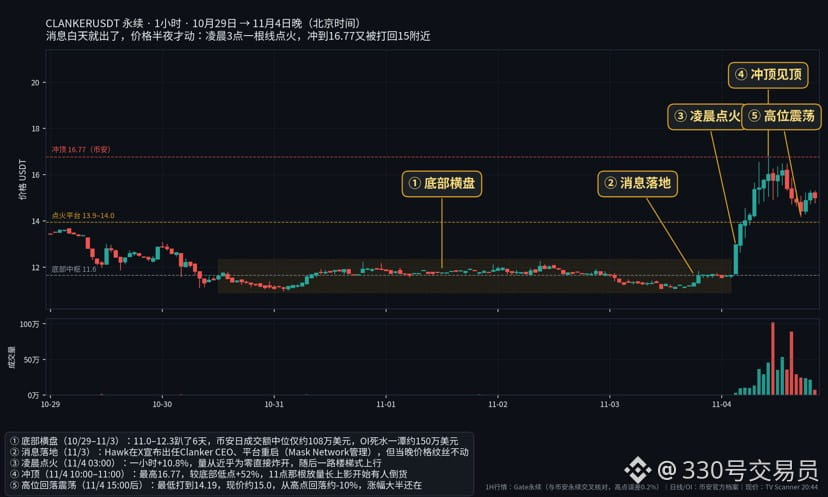
$CLANKER News-driven breakout: new CEO takes over + platform relaunch + buyback.
Supply: 1 million tokens, market cap: 15 million; low float.
It bottomed around 11–12 for two months. The news broke, but the price didn't move at first; then it took off in the early hours, reaching a high of 16.77 (+52%). Current price: 15.04. OI rose 138% in a single day to 3.52 million, with money chasing the price.
The sector didn't follow; this is a single-stock move.
Going forward, it may fluctuate and pull back. Watch for support at 13.9–14 on a retest. A second wave is possible only if it holds above 16.77 and breaks through 17.52; a drop below 13.9 ends the move.
Don't chase at these levels; 15 is halfway up the mountain.
{future}(CLANKERUSDT)
$CLANKER News-driven breakout: new CEO takes over + platform relaunch + buyback.
Supply: 1 million tokens, market cap: 15 million; low float.
It bottomed around 11–12 for two months. The news broke, but the price didn't move at first; then it took off in the early hours, reaching a high of 16.77 (+52%). Current price: 15.04. OI rose 138% in a single day to 3.52 million, with money chasing the price.
The sector didn't follow; this is a single-stock move.
Going forward, it may fluctuate and pull back. Watch for support at 13.9–14 on a retest. A second wave is possible only if it holds above 16.77 and breaks through 17.52; a drop below 13.9 ends the move.
Don't chase at these levels; 15 is halfway up the mountain.
167
Log in to explore more content
Join global crypto users on Binance Square
⚡️ Get latest and useful information about crypto.
💬 Trusted by the world’s largest crypto exchange.
👍 Discover real insights from verified creators.
Email / Phone number
Trending Topics
KeplrAdvisesSocialLoginUsersToTransferAssets
0 views
8 Discussing
🚨 $ONE Is Waking Up… Don't Miss The Next Move!
$ONE is showing strong buying pressure after bouncing from the 0.00180 support zone. Bulls are trying to reclaim 0.00200, and if buyers keep the momentum, this could be the start of another leg higher.
📈 Trade Plan
✅ Entry: 0.00198 – 0.00202 (or on a confirmed breakout above 0.00205)
🛑 Stop Loss: 0.00188
🎯 TP1: 0.00215
🎯 TP2: 0.00230
🎯 TP3: 0.00247
⚠️ If price loses 0.00188, wait for a fresh setup instead of forcing the trade.
This setup offers a solid risk-to-reward if the breakout confirms. Manage your risk and never enter without a stop loss.
Are you LONG or waiting for confirmation? 👇
#one #KeplrAdvisesSocialLoginUsersToTransferAssets #TetherPlans€28.8MForJuventusCapitalIncrease #JobsReportRaisesHikeOdds
Adeem Jutt
·1 Likes
·135 views
TetherPlans€28.8MForJuventusCapitalIncrease
7 views
12 Discussing
JobsReportRaisesHikeOdds
613,504 views
3,825 Discussing