

Cryptoreach
688 Posts

Cryptoreach
Report
Block User
Activateur Web3 | Builder d’écosystèmes décentralisés | Tokenisation & Adoption RWA
1.2K+ Following
693 Followers
905 Liked
Posts
All
Quotes
Videos
·
--
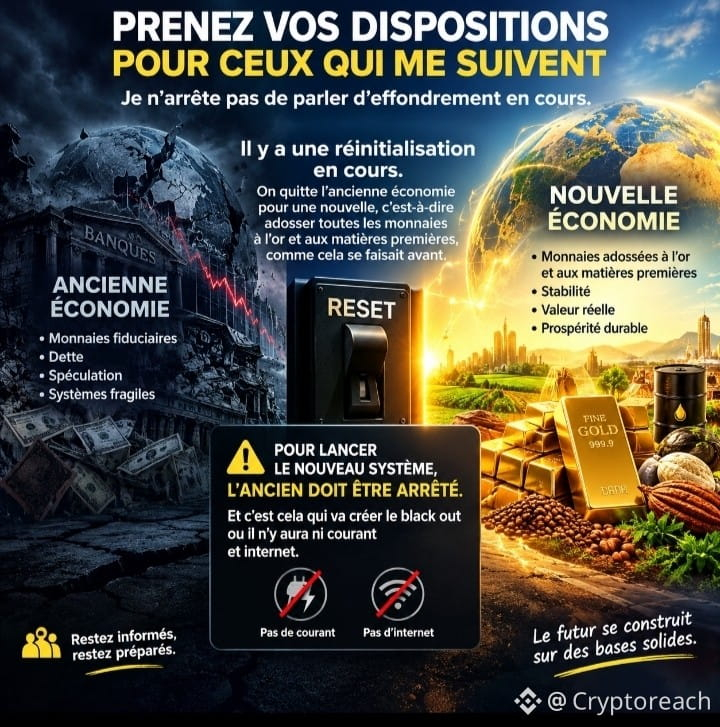
⚠️ PREPARE FOR MAJOR ECONOMIC TRANSFORMATIONS
To those who follow me, I never stop drawing attention to the vulnerabilities of the global economic and financial system.
We are witnessing a profound transformation of the economy: changes in monetary systems, the rise of digital assets, the tokenization of real-world assets, and the search for new forms of financial stability.
Gold, commodities, and tangible assets play an important role in discussions about preserving value. But a widespread return to a monetary system backed by these assets is not, as of today, a confirmed reality.
Should we prepare for disruptions? Yes. Should we give in to panic? No.
A power or internet outage may occur, but nothing supports the claim that a global blackout will be orchestrated to impose a new monetary system.
My advice: broaden your knowledge, secure your digital accounts, keep alternative payment methods, and follow information from reliable sources.
The world is changing. The best preparation remains knowledge, caution, and foresight.
#Economy #Blockchain #CryptoAssets #Tokenization #Gold #Finance #DigitalResilience
⚠️ PREPARE FOR MAJOR ECONOMIC TRANSFORMATIONS
To those who follow me, I never stop drawing attention to the vulnerabilities of the global economic and financial system.
We are witnessing a profound transformation of the economy: changes in monetary systems, the rise of digital assets, the tokenization of real-world assets, and the search for new forms of financial stability.
Gold, commodities, and tangible assets play an important role in discussions about preserving value. But a widespread return to a monetary system backed by these assets is not, as of today, a confirmed reality.
Should we prepare for disruptions? Yes. Should we give in to panic? No.
A power or internet outage may occur, but nothing supports the claim that a global blackout will be orchestrated to impose a new monetary system.
My advice: broaden your knowledge, secure your digital accounts, keep alternative payment methods, and follow information from reliable sources.
The world is changing. The best preparation remains knowledge, caution, and foresight.
#Economy #Blockchain #CryptoAssets #Tokenization #Gold #Finance #DigitalResilience
To those who follow me, I never stop drawing attention to the vulnerabilities of the global economic and financial system.
We are witnessing a profound transformation of the economy: changes in monetary systems, the rise of digital assets, the tokenization of real-world assets, and the search for new forms of financial stability.
Gold, commodities, and tangible assets play an important role in discussions about preserving value. But a widespread return to a monetary system backed by these assets is not, as of today, a confirmed reality.
Should we prepare for disruptions? Yes. Should we give in to panic? No.
A power or internet outage may occur, but nothing supports the claim that a global blackout will be orchestrated to impose a new monetary system.
My advice: broaden your knowledge, secure your digital accounts, keep alternative payment methods, and follow information from reliable sources.
The world is changing. The best preparation remains knowledge, caution, and foresight.
#Economy #Blockchain #CryptoAssets #Tokenization #Gold #Finance #DigitalResilience
72
·
--
Things are simple, but poof, the system caused a lot of damage, huh.
This is not investment advice. DYOR in all things.$BNB
Things are simple, but poof, the system caused a lot of damage, huh.
This is not investment advice. DYOR in all things.$BNB
This is not investment advice. DYOR in all things.$BNB

257
·
--
Today's crypto topic:
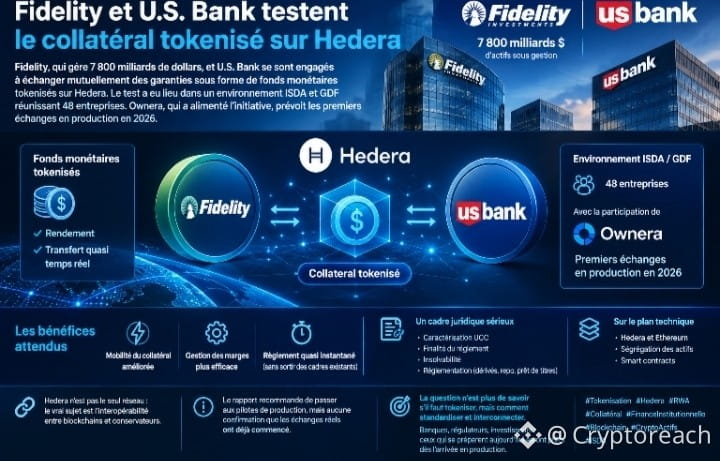
Fidelity and U.S. Bank test tokenized collateral on Hedera
Fidelity, which manages $7.8 trillion, and U.S. Bank have committed to exchanging collateral with each other in the form of tokenized money market funds on Hedera. The test took place in an ISDA and GDF environment involving 48 companies. Ownera, which powered the initiative, expects the first live transactions in 2026.
In derivatives markets, every margin call requires assets to be moved quickly and unambiguously. The idea is for a tokenized money market fund to play two roles at once: generate a yield and transfer in near real time. According to the ISDA/GDF report, this could improve collateral mobility, make margin management more efficient, and enable near-instant settlement without stepping outside existing frameworks.
The exercise is notable for its legal rigor. The work examines UCC characterization, settlement finality, treatment in the event of insolvency, and regulatory issues relating to derivatives, repo, and securities lending. Technically, the scenarios moved tokenized collateral between Hedera and Ethereum, with asset segregation and smart-contract automation. In other words, tokenization fits within the current framework rather than requiring it to be rewritten.
Two caveats are in order. Hedera is not the only network involved: the real issue is interoperability between blockchains and custodians. And although the report recommends moving on to production pilots, I found no confirmation that live transactions have already begun.
For banks, regulators, and investors, the question is no longer whether to tokenize, but how to standardize and connect these systems. Those who prepare their collateral management, custodians, and legal frameworks now will be ready when production begins.
#Tokenization #Hedera #RWA #Collatéral
Today's crypto topic:
Fidelity and U.S. Bank test tokenized collateral on Hedera
Fidelity, which manages $7.8 trillion, and U.S. Bank have committed to exchanging collateral with each other in the form of tokenized money market funds on Hedera. The test took place in an ISDA and GDF environment involving 48 companies. Ownera, which powered the initiative, expects the first live transactions in 2026.
In derivatives markets, every margin call requires assets to be moved quickly and unambiguously. The idea is for a tokenized money market fund to play two roles at once: generate a yield and transfer in near real time. According to the ISDA/GDF report, this could improve collateral mobility, make margin management more efficient, and enable near-instant settlement without stepping outside existing frameworks.
The exercise is notable for its legal rigor. The work examines UCC characterization, settlement finality, treatment in the event of insolvency, and regulatory issues relating to derivatives, repo, and securities lending. Technically, the scenarios moved tokenized collateral between Hedera and Ethereum, with asset segregation and smart-contract automation. In other words, tokenization fits within the current framework rather than requiring it to be rewritten.
Two caveats are in order. Hedera is not the only network involved: the real issue is interoperability between blockchains and custodians. And although the report recommends moving on to production pilots, I found no confirmation that live transactions have already begun.
For banks, regulators, and investors, the question is no longer whether to tokenize, but how to standardize and connect these systems. Those who prepare their collateral management, custodians, and legal frameworks now will be ready when production begins.
#Tokenization #Hedera #RWA #Collatéral
Fidelity and U.S. Bank test tokenized collateral on Hedera
Fidelity, which manages $7.8 trillion, and U.S. Bank have committed to exchanging collateral with each other in the form of tokenized money market funds on Hedera. The test took place in an ISDA and GDF environment involving 48 companies. Ownera, which powered the initiative, expects the first live transactions in 2026.
In derivatives markets, every margin call requires assets to be moved quickly and unambiguously. The idea is for a tokenized money market fund to play two roles at once: generate a yield and transfer in near real time. According to the ISDA/GDF report, this could improve collateral mobility, make margin management more efficient, and enable near-instant settlement without stepping outside existing frameworks.
The exercise is notable for its legal rigor. The work examines UCC characterization, settlement finality, treatment in the event of insolvency, and regulatory issues relating to derivatives, repo, and securities lending. Technically, the scenarios moved tokenized collateral between Hedera and Ethereum, with asset segregation and smart-contract automation. In other words, tokenization fits within the current framework rather than requiring it to be rewritten.
Two caveats are in order. Hedera is not the only network involved: the real issue is interoperability between blockchains and custodians. And although the report recommends moving on to production pilots, I found no confirmation that live transactions have already begun.
For banks, regulators, and investors, the question is no longer whether to tokenize, but how to standardize and connect these systems. Those who prepare their collateral management, custodians, and legal frameworks now will be ready when production begins.
#Tokenization #Hedera #RWA #Collatéral
245
·
--
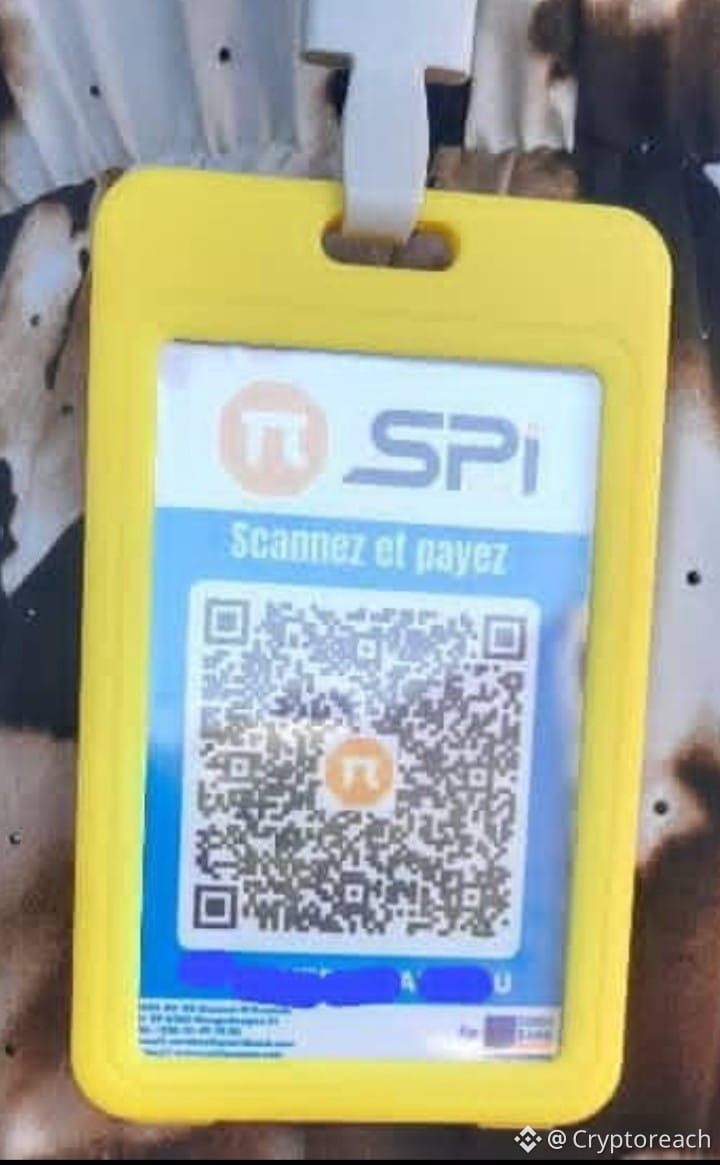
📲 Scan and pay with SPI!
The BCEAO’s Instant Payment System (SPI) is coming to merchants. A simple QR code displayed on a badge, and customers can pay in seconds using their payment app.
✅ Instant payments, 24/7
✅ Easy for small businesses
✅ The BCEAO’s payment rail, serving all of WAEMU
@featured
#SPI #BCEAO #InstantPayments #ScanAndPay #WAEMU #IvoryCoast #Fintech
📲 Scan and pay with SPI!
The BCEAO’s Instant Payment System (SPI) is coming to merchants. A simple QR code displayed on a badge, and customers can pay in seconds using their payment app.
✅ Instant payments, 24/7
✅ Easy for small businesses
✅ The BCEAO’s payment rail, serving all of WAEMU
@featured
#SPI #BCEAO #InstantPayments #ScanAndPay #WAEMU #IvoryCoast #Fintech
The BCEAO’s Instant Payment System (SPI) is coming to merchants. A simple QR code displayed on a badge, and customers can pay in seconds using their payment app.
✅ Instant payments, 24/7
✅ Easy for small businesses
✅ The BCEAO’s payment rail, serving all of WAEMU
@featured
#SPI #BCEAO #InstantPayments #ScanAndPay #WAEMU #IvoryCoast #Fintech
7
·
--
Today's crypto topic:
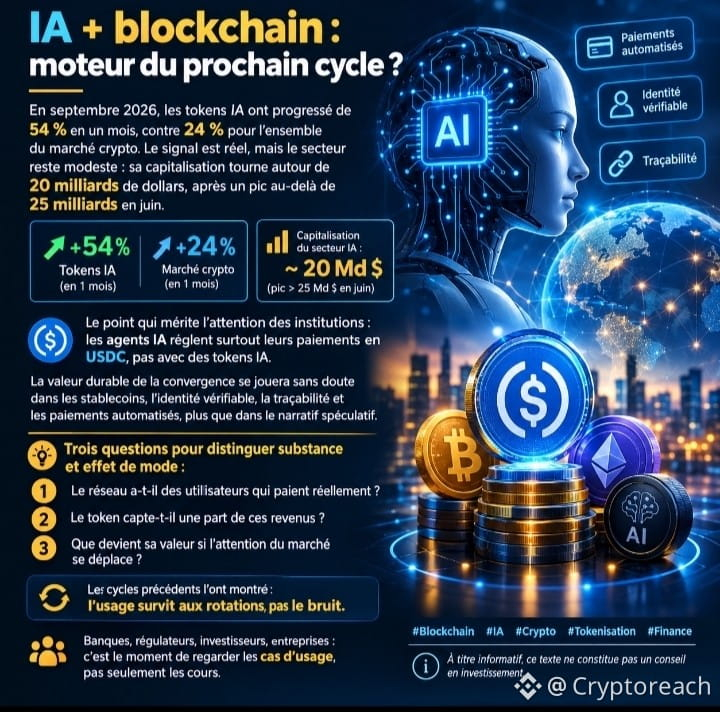
In September 2026, AI tokens rose 54% in a month, compared with 24% for the crypto market as a whole. The signal is real, but the sector remains modest: its market capitalization is around $20 billion, after peaking above $25 billion in June.
The point institutions should pay attention to: AI agents settle most of their payments in USDC, not AI tokens. The lasting value of this convergence will likely lie in stablecoins, verifiable identity, traceability, and automated payments, rather than in speculative narratives.
Three questions to distinguish substance from hype:
1. Does the network have users who actually pay?
2. Does the token capture a share of that revenue?
3. What happens to its value if market attention shifts elsewhere?
Previous cycles have shown that usage survives rotations; hype does not.
Banks, regulators, investors, businesses: now is the time to look at use cases, not just prices.
#Blockchain #AI #Crypto #Tokenization #Finance $BNB $ETH
For informational purposes only; this text does not constitute investment advice.
Today's crypto topic:
In September 2026, AI tokens rose 54% in a month, compared with 24% for the crypto market as a whole. The signal is real, but the sector remains modest: its market capitalization is around $20 billion, after peaking above $25 billion in June.
The point institutions should pay attention to: AI agents settle most of their payments in USDC, not AI tokens. The lasting value of this convergence will likely lie in stablecoins, verifiable identity, traceability, and automated payments, rather than in speculative narratives.
Three questions to distinguish substance from hype:
1. Does the network have users who actually pay?
2. Does the token capture a share of that revenue?
3. What happens to its value if market attention shifts elsewhere?
Previous cycles have shown that usage survives rotations; hype does not.
Banks, regulators, investors, businesses: now is the time to look at use cases, not just prices.
#Blockchain #AI #Crypto #Tokenization #Finance $BNB $ETH
For informational purposes only; this text does not constitute investment advice.
In September 2026, AI tokens rose 54% in a month, compared with 24% for the crypto market as a whole. The signal is real, but the sector remains modest: its market capitalization is around $20 billion, after peaking above $25 billion in June.
The point institutions should pay attention to: AI agents settle most of their payments in USDC, not AI tokens. The lasting value of this convergence will likely lie in stablecoins, verifiable identity, traceability, and automated payments, rather than in speculative narratives.
Three questions to distinguish substance from hype:
1. Does the network have users who actually pay?
2. Does the token capture a share of that revenue?
3. What happens to its value if market attention shifts elsewhere?
Previous cycles have shown that usage survives rotations; hype does not.
Banks, regulators, investors, businesses: now is the time to look at use cases, not just prices.
#Blockchain #AI #Crypto #Tokenization #Finance $BNB $ETH
For informational purposes only; this text does not constitute investment advice.
73
·
--
A critical vulnerability has just been discovered in PHP, the language that powers 80% of the internet
Severity score: 9.2 out of 10. It’s about as bad as it gets
What can an attacker do with it? Take full administrator control of a server. Steal entire databases. Passwords, credit cards, payment histories. Install malware and use the server to attack other systems
But here’s the terrifying part most people missed
As soon as the patch is released tonight, attackers are expected to use AI to reverse-engineer what was fixed in 15 minutes
15 minutes. That’s the window between the patch going live and automated attacks launching around the world
Every online store, booking site, and business system that uses PHP and doesn’t update within those 15 minutes becomes a target
This isn’t just a developer problem. If you’ve ever signed up for a website, entered your card details, or created an online account, your data is stored on servers that could be vulnerable right now
And someone just publicly posted the working exploit on Twitter before the patch was even ready. That gives every attacker on the planet a head start
Engineers around the world are pulling all-nighters tonight to patch their systems before the attacks begin
Change your passwords on all the services that matter to you. Enable two-factor authentication everywhere. And watch out for fake “maintenance” or “password reset” emails over the next few days
The internet is about to have a very long night
A critical vulnerability has just been discovered in PHP, the language that powers 80% of the internet
Severity score: 9.2 out of 10. It’s about as bad as it gets
What can an attacker do with it? Take full administrator control of a server. Steal entire databases. Passwords, credit cards, payment histories. Install malware and use the server to attack other systems
But here’s the terrifying part most people missed
As soon as the patch is released tonight, attackers are expected to use AI to reverse-engineer what was fixed in 15 minutes
15 minutes. That’s the window between the patch going live and automated attacks launching around the world
Every online store, booking site, and business system that uses PHP and doesn’t update within those 15 minutes becomes a target
This isn’t just a developer problem. If you’ve ever signed up for a website, entered your card details, or created an online account, your data is stored on servers that could be vulnerable right now
And someone just publicly posted the working exploit on Twitter before the patch was even ready. That gives every attacker on the planet a head start
Engineers around the world are pulling all-nighters tonight to patch their systems before the attacks begin
Change your passwords on all the services that matter to you. Enable two-factor authentication everywhere. And watch out for fake “maintenance” or “password reset” emails over the next few days
The internet is about to have a very long night
Severity score: 9.2 out of 10. It’s about as bad as it gets
What can an attacker do with it? Take full administrator control of a server. Steal entire databases. Passwords, credit cards, payment histories. Install malware and use the server to attack other systems
But here’s the terrifying part most people missed
As soon as the patch is released tonight, attackers are expected to use AI to reverse-engineer what was fixed in 15 minutes
15 minutes. That’s the window between the patch going live and automated attacks launching around the world
Every online store, booking site, and business system that uses PHP and doesn’t update within those 15 minutes becomes a target
This isn’t just a developer problem. If you’ve ever signed up for a website, entered your card details, or created an online account, your data is stored on servers that could be vulnerable right now
And someone just publicly posted the working exploit on Twitter before the patch was even ready. That gives every attacker on the planet a head start
Engineers around the world are pulling all-nighters tonight to patch their systems before the attacks begin
Change your passwords on all the services that matter to you. Enable two-factor authentication everywhere. And watch out for fake “maintenance” or “password reset” emails over the next few days
The internet is about to have a very long night

238
·
--
Today's crypto topic:
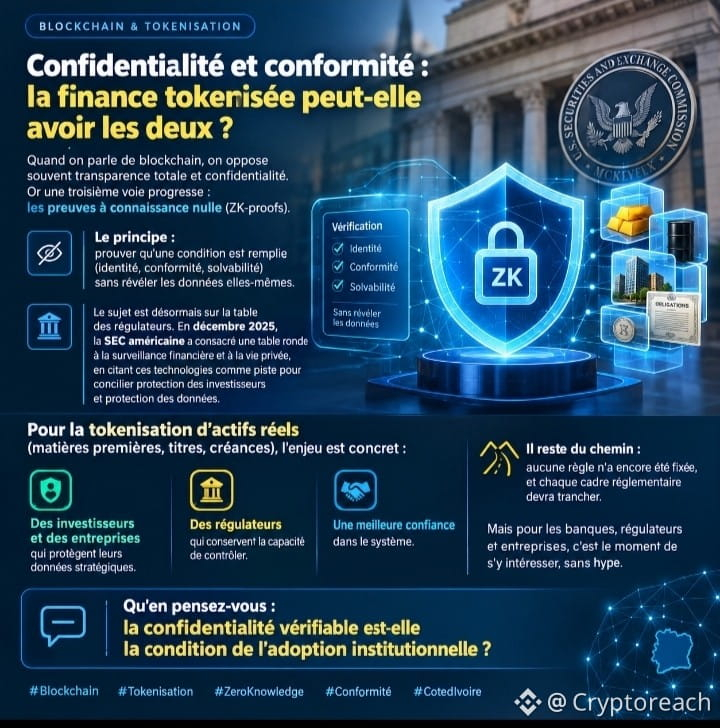
Privacy and compliance: can tokenized finance have both?
When we talk about blockchain, total transparency and privacy are often portrayed as opposites. But a third way is gaining ground: zero-knowledge proofs (ZK proofs).
The principle: prove that a condition is met (identity, compliance, solvency) without revealing the data itself.
The topic is now on regulators’ agendas. In December 2025, the U.S. SEC held a roundtable on financial oversight and privacy, citing these technologies as a potential way to reconcile investor protection with data protection.
For the tokenization of real-world assets (commodities, securities, receivables), the stakes are tangible:
✔ investors and businesses can protect their strategic data
✔ regulators retain the ability to conduct oversight
✔ greater trust in the system
There’s still a way to go: no rules have been established yet, and each regulatory framework will have to make its own decisions. But for banks, regulators, and businesses, now is the time to take an interest—without the hype.
What do you think: is verifiable privacy a prerequisite for institutional adoption?
#Blockchain #Tokenization #ZeroKnowledge #Compliance #CotedIvoire $BNB
Today's crypto topic:
Privacy and compliance: can tokenized finance have both?
When we talk about blockchain, total transparency and privacy are often portrayed as opposites. But a third way is gaining ground: zero-knowledge proofs (ZK proofs).
The principle: prove that a condition is met (identity, compliance, solvency) without revealing the data itself.
The topic is now on regulators’ agendas. In December 2025, the U.S. SEC held a roundtable on financial oversight and privacy, citing these technologies as a potential way to reconcile investor protection with data protection.
For the tokenization of real-world assets (commodities, securities, receivables), the stakes are tangible:
✔ investors and businesses can protect their strategic data
✔ regulators retain the ability to conduct oversight
✔ greater trust in the system
There’s still a way to go: no rules have been established yet, and each regulatory framework will have to make its own decisions. But for banks, regulators, and businesses, now is the time to take an interest—without the hype.
What do you think: is verifiable privacy a prerequisite for institutional adoption?
#Blockchain #Tokenization #ZeroKnowledge #Compliance #CotedIvoire $BNB
Privacy and compliance: can tokenized finance have both?
When we talk about blockchain, total transparency and privacy are often portrayed as opposites. But a third way is gaining ground: zero-knowledge proofs (ZK proofs).
The principle: prove that a condition is met (identity, compliance, solvency) without revealing the data itself.
The topic is now on regulators’ agendas. In December 2025, the U.S. SEC held a roundtable on financial oversight and privacy, citing these technologies as a potential way to reconcile investor protection with data protection.
For the tokenization of real-world assets (commodities, securities, receivables), the stakes are tangible:
✔ investors and businesses can protect their strategic data
✔ regulators retain the ability to conduct oversight
✔ greater trust in the system
There’s still a way to go: no rules have been established yet, and each regulatory framework will have to make its own decisions. But for banks, regulators, and businesses, now is the time to take an interest—without the hype.
What do you think: is verifiable privacy a prerequisite for institutional adoption?
#Blockchain #Tokenization #ZeroKnowledge #Compliance #CotedIvoire $BNB
79
·
--
Today's cryptocurrency topic:
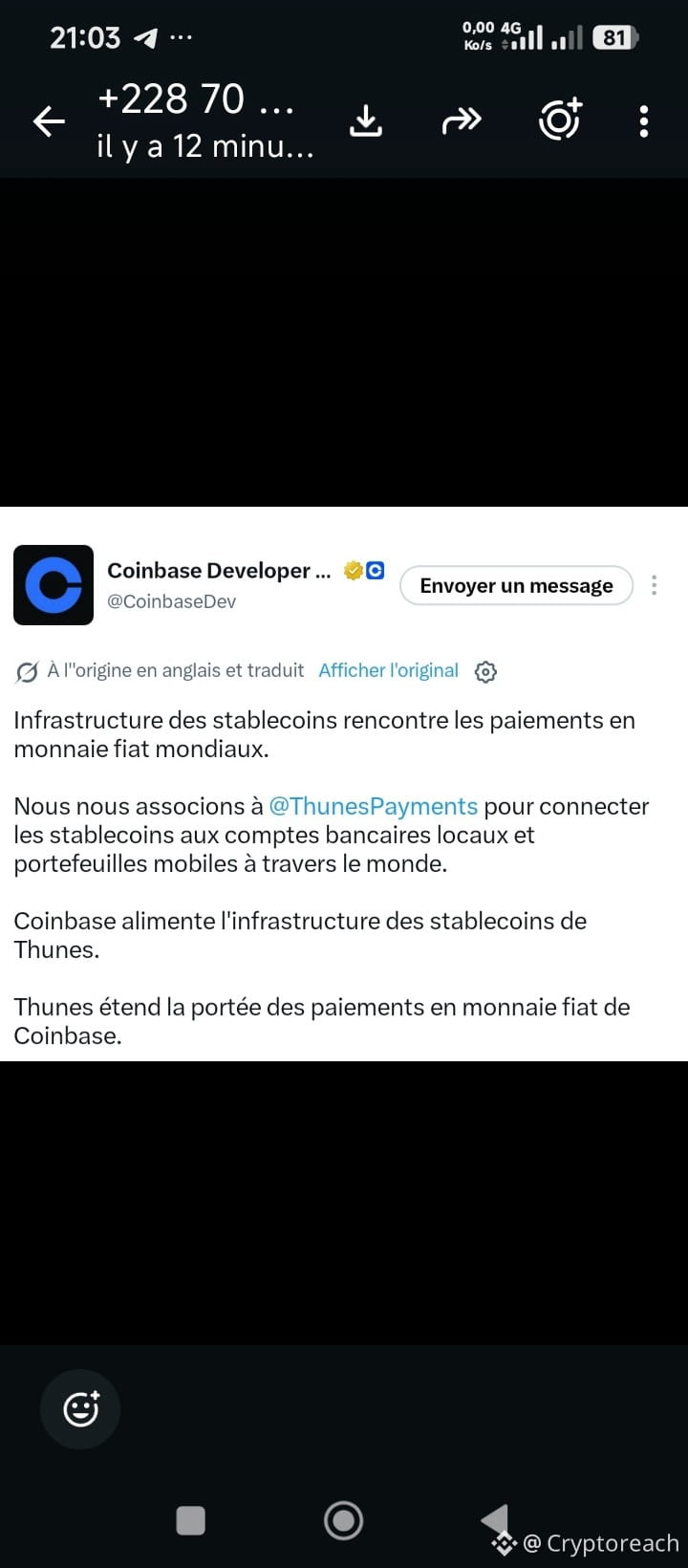
Finance & Economy: Anticipate transformation rather than simply react to it.
A closer look at this visual highlights the major changes taking place in the financial sector. We are witnessing an inevitable structural evolution.
For all professionals in accounting, bookkeeping (SYSCOHADA) and economics, the message is clear: relying on yesterday's models is becoming a risk. The future belongs to those who embrace today's innovations.
Take the lead, upskill, and become an agent of this transformation!
@featured
#FinancialRevolution #FutureOfFinance #FinanceOfTomorrow #DigitalTransformation #Upskilling #FinancialAgility
#SYSCOHADA #Accounting #CorporateFinance #Economics #OHADA #FinancialManagement
#Web3 #Blockchain #DeFi #Fintech #CryptoFinance #DigitalAssets
#AfricanFinance #AfricanEconomy #EmergingAfrica #UEMOA #Africa
Today's cryptocurrency topic:
Finance & Economy: Anticipate transformation rather than simply react to it.
A closer look at this visual highlights the major changes taking place in the financial sector. We are witnessing an inevitable structural evolution.
For all professionals in accounting, bookkeeping (SYSCOHADA) and economics, the message is clear: relying on yesterday's models is becoming a risk. The future belongs to those who embrace today's innovations.
Take the lead, upskill, and become an agent of this transformation!
@featured
#FinancialRevolution #FutureOfFinance #FinanceOfTomorrow #DigitalTransformation #Upskilling #FinancialAgility
#SYSCOHADA #Accounting #CorporateFinance #Economics #OHADA #FinancialManagement
#Web3 #Blockchain #DeFi #Fintech #CryptoFinance #DigitalAssets
#AfricanFinance #AfricanEconomy #EmergingAfrica #UEMOA #Africa
Finance & Economy: Anticipate transformation rather than simply react to it.
A closer look at this visual highlights the major changes taking place in the financial sector. We are witnessing an inevitable structural evolution.
For all professionals in accounting, bookkeeping (SYSCOHADA) and economics, the message is clear: relying on yesterday's models is becoming a risk. The future belongs to those who embrace today's innovations.
Take the lead, upskill, and become an agent of this transformation!
@featured
#FinancialRevolution #FutureOfFinance #FinanceOfTomorrow #DigitalTransformation #Upskilling #FinancialAgility
#SYSCOHADA #Accounting #CorporateFinance #Economics #OHADA #FinancialManagement
#Web3 #Blockchain #DeFi #Fintech #CryptoFinance #DigitalAssets
#AfricanFinance #AfricanEconomy #EmergingAfrica #UEMOA #Africa
36
·
--
Article
Today’s cryptocurrency topicToday’s cryptocurrency topic:
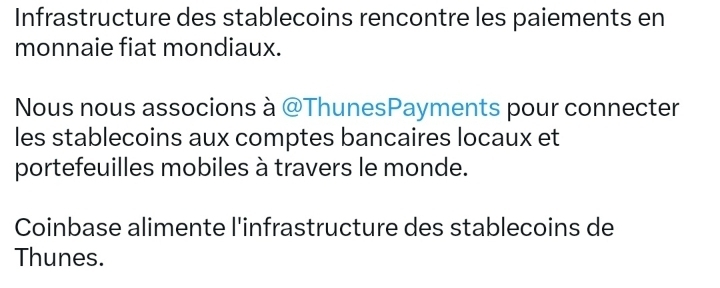
Finance & Economics: Anticipate the transformation rather than endure it.
A careful reading of this visual highlights the major transformations taking place in the financial sector. We are witnessing an unavoidable structural shift.
For all professionals in finance, accounting (SYSCOHADA), and economics, the message is clear: relying on yesterday’s models is becoming a risk. The future belongs to those who embrace today’s innovations.
Today’s cryptocurrency topic
Today’s cryptocurrency topic:
Finance & Economics: Anticipate the transformation rather than endure it.
A careful reading of this visual highlights the major transformations taking place in the financial sector. We are witnessing an unavoidable structural shift.
For all professionals in finance, accounting (SYSCOHADA), and economics, the message is clear: relying on yesterday’s models is becoming a risk. The future belongs to those who embrace today’s innovations.
Finance & Economics: Anticipate the transformation rather than endure it.
A careful reading of this visual highlights the major transformations taking place in the financial sector. We are witnessing an unavoidable structural shift.
For all professionals in finance, accounting (SYSCOHADA), and economics, the message is clear: relying on yesterday’s models is becoming a risk. The future belongs to those who embrace today’s innovations.
48
·
--
Today's cryptocurrency topic:
Finance & Economy: Anticipate transformation rather than simply react to it.
A closer look at this visual highlights the major changes taking place in the financial sector. We are witnessing an inevitable structural evolution.
For all professionals in accounting, bookkeeping (SYSCOHADA) and economics, the message is clear: relying on yesterday's models is becoming a risk. The future belongs to those who embrace today's innovations.
Take the lead, upskill, and become an agent of this transformation!
@featured
#FinancialRevolution #FutureOfFinance #FinanceOfTomorrow #DigitalTransformation #Upskilling #FinancialAgility
#SYSCOHADA #Accounting #CorporateFinance #Economics #OHADA #FinancialManagement
#Web3 #Blockchain #DeFi #Fintech #CryptoFinance #DigitalAssets
#AfricanFinance #AfricanEconomy #EmergingAfrica #UEMOA #Africa
Today's cryptocurrency topic:
Finance & Economy: Anticipate transformation rather than simply react to it.
A closer look at this visual highlights the major changes taking place in the financial sector. We are witnessing an inevitable structural evolution.
For all professionals in accounting, bookkeeping (SYSCOHADA) and economics, the message is clear: relying on yesterday's models is becoming a risk. The future belongs to those who embrace today's innovations.
Take the lead, upskill, and become an agent of this transformation!
@featured
#FinancialRevolution #FutureOfFinance #FinanceOfTomorrow #DigitalTransformation #Upskilling #FinancialAgility
#SYSCOHADA #Accounting #CorporateFinance #Economics #OHADA #FinancialManagement
#Web3 #Blockchain #DeFi #Fintech #CryptoFinance #DigitalAssets
#AfricanFinance #AfricanEconomy #EmergingAfrica #UEMOA #Africa
Finance & Economy: Anticipate transformation rather than simply react to it.
A closer look at this visual highlights the major changes taking place in the financial sector. We are witnessing an inevitable structural evolution.
For all professionals in accounting, bookkeeping (SYSCOHADA) and economics, the message is clear: relying on yesterday's models is becoming a risk. The future belongs to those who embrace today's innovations.
Take the lead, upskill, and become an agent of this transformation!
@featured
#FinancialRevolution #FutureOfFinance #FinanceOfTomorrow #DigitalTransformation #Upskilling #FinancialAgility
#SYSCOHADA #Accounting #CorporateFinance #Economics #OHADA #FinancialManagement
#Web3 #Blockchain #DeFi #Fintech #CryptoFinance #DigitalAssets
#AfricanFinance #AfricanEconomy #EmergingAfrica #UEMOA #Africa
70
·
--
Today's crypto topic:
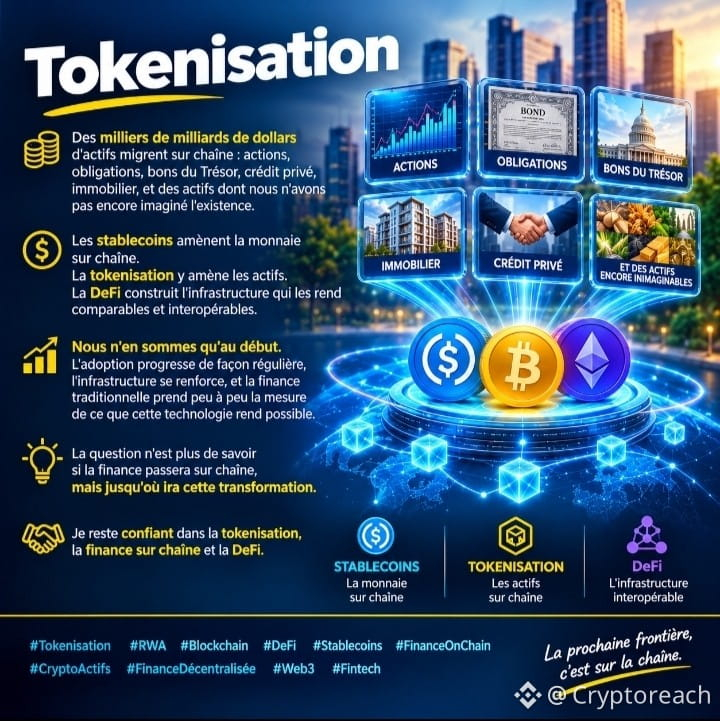
Trillions of dollars in assets are moving on-chain: stocks, bonds, Treasury bills, private credit, real estate, and assets we haven't even imagined yet.
Stablecoins bring money on-chain. Tokenization brings assets on-chain. DeFi builds the infrastructure that makes them comparable and interoperable.
We're only at the beginning. Adoption is growing steadily, infrastructure is strengthening, and traditional finance is gradually realizing what this technology makes possible.
The question is no longer whether finance will move on-chain, but how far this transformation will go.
I'm still confident in tokenization, on-chain finance, and DeFi.
@featured
#Tokenization #RWA #Blockchain #DeFi #Stablecoins #FinanceOnChain #CryptoAssets #DecentralizedFinance #Web3 #Fintech $BNB
Today's crypto topic:
Trillions of dollars in assets are moving on-chain: stocks, bonds, Treasury bills, private credit, real estate, and assets we haven't even imagined yet.
Stablecoins bring money on-chain. Tokenization brings assets on-chain. DeFi builds the infrastructure that makes them comparable and interoperable.
We're only at the beginning. Adoption is growing steadily, infrastructure is strengthening, and traditional finance is gradually realizing what this technology makes possible.
The question is no longer whether finance will move on-chain, but how far this transformation will go.
I'm still confident in tokenization, on-chain finance, and DeFi.
@featured
#Tokenization #RWA #Blockchain #DeFi #Stablecoins #FinanceOnChain #CryptoAssets #DecentralizedFinance #Web3 #Fintech $BNB
Trillions of dollars in assets are moving on-chain: stocks, bonds, Treasury bills, private credit, real estate, and assets we haven't even imagined yet.
Stablecoins bring money on-chain. Tokenization brings assets on-chain. DeFi builds the infrastructure that makes them comparable and interoperable.
We're only at the beginning. Adoption is growing steadily, infrastructure is strengthening, and traditional finance is gradually realizing what this technology makes possible.
The question is no longer whether finance will move on-chain, but how far this transformation will go.
I'm still confident in tokenization, on-chain finance, and DeFi.
@featured
#Tokenization #RWA #Blockchain #DeFi #Stablecoins #FinanceOnChain #CryptoAssets #DecentralizedFinance #Web3 #Fintech $BNB
93
·
--
Today’s cryptocurrency topic:
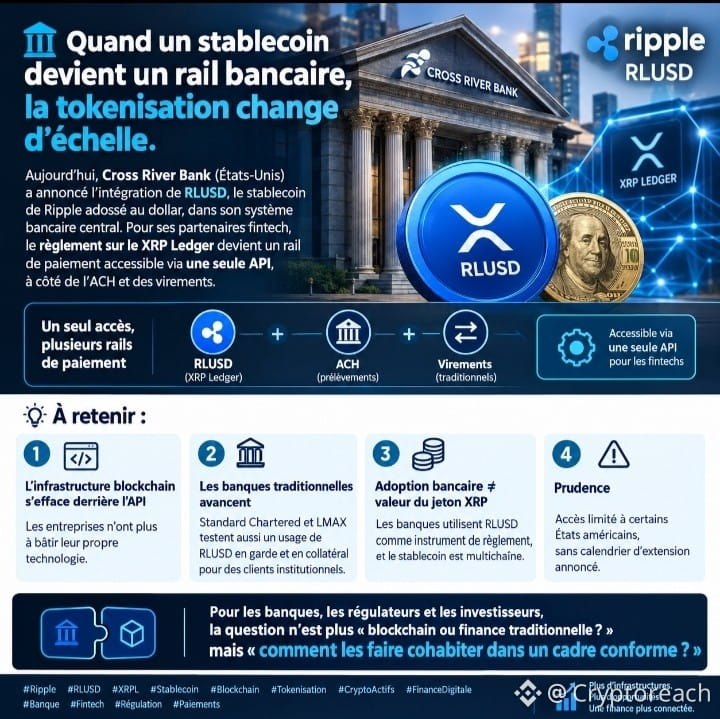
When a stablecoin becomes a banking rail, tokenization moves to a new scale.
Today, Cross River Bank (United States) announced the integration of RLUSD, Ripple’s dollar-backed stablecoin, into its core banking system. For its fintech partners, settlement on the XRP Ledger becomes a payment rail accessible through a single API, alongside ACH and wire transfers.
Key takeaways:
1️⃣ Blockchain infrastructure fades into the background behind the API: businesses no longer have to build their own technology.
2️⃣ Traditional banks are moving forward: Standard Chartered and LMAX are also testing the use of RLUSD for custody and collateral for institutional clients.
3️⃣ Banking adoption ≠ XRP token value: banks use RLUSD as a settlement instrument, and the stablecoin operates across multiple blockchains.
4️⃣ Caution: access is limited to certain U.S. states, with no expansion timeline announced.
For banks, regulators, and investors, the question is no longer “blockchain or traditional finance?” but “how can they coexist within a compliant framework?”
$BNB
What do you think?
#Ripple #RLUSD #XRPL #Stablecoin #Blockchain #Tokenization #CryptoAssets #DigitalFinance #Banking #Fintech #Regulation #Payments
Today’s cryptocurrency topic:
When a stablecoin becomes a banking rail, tokenization moves to a new scale.
Today, Cross River Bank (United States) announced the integration of RLUSD, Ripple’s dollar-backed stablecoin, into its core banking system. For its fintech partners, settlement on the XRP Ledger becomes a payment rail accessible through a single API, alongside ACH and wire transfers.
Key takeaways:
1️⃣ Blockchain infrastructure fades into the background behind the API: businesses no longer have to build their own technology.
2️⃣ Traditional banks are moving forward: Standard Chartered and LMAX are also testing the use of RLUSD for custody and collateral for institutional clients.
3️⃣ Banking adoption ≠ XRP token value: banks use RLUSD as a settlement instrument, and the stablecoin operates across multiple blockchains.
4️⃣ Caution: access is limited to certain U.S. states, with no expansion timeline announced.
For banks, regulators, and investors, the question is no longer “blockchain or traditional finance?” but “how can they coexist within a compliant framework?”
$BNB
What do you think?
#Ripple #RLUSD #XRPL #Stablecoin #Blockchain #Tokenization #CryptoAssets #DigitalFinance #Banking #Fintech #Regulation #Payments
When a stablecoin becomes a banking rail, tokenization moves to a new scale.
Today, Cross River Bank (United States) announced the integration of RLUSD, Ripple’s dollar-backed stablecoin, into its core banking system. For its fintech partners, settlement on the XRP Ledger becomes a payment rail accessible through a single API, alongside ACH and wire transfers.
Key takeaways:
1️⃣ Blockchain infrastructure fades into the background behind the API: businesses no longer have to build their own technology.
2️⃣ Traditional banks are moving forward: Standard Chartered and LMAX are also testing the use of RLUSD for custody and collateral for institutional clients.
3️⃣ Banking adoption ≠ XRP token value: banks use RLUSD as a settlement instrument, and the stablecoin operates across multiple blockchains.
4️⃣ Caution: access is limited to certain U.S. states, with no expansion timeline announced.
For banks, regulators, and investors, the question is no longer “blockchain or traditional finance?” but “how can they coexist within a compliant framework?”
$BNB
What do you think?
#Ripple #RLUSD #XRPL #Stablecoin #Blockchain #Tokenization #CryptoAssets #DigitalFinance #Banking #Fintech #Regulation #Payments
1
3
175
·
--
Stocks are collapsing.
Crypto is in a nosedive.
Gold and silver have wiped out hundreds of billions.
Here’s exactly where all that money is flowing:
Nowhere.
Money was never real in the first place. Most of it was paper.
#Crypto #Bitcoin #FinancialMarkets #StockMarket #Gold #Silver #GlobalEconomy #Liquidity #Finance #Investing #Blockchain #Web3
$BNB
Stocks are collapsing.
Crypto is in a nosedive.
Gold and silver have wiped out hundreds of billions.
Here’s exactly where all that money is flowing:
Nowhere.
Money was never real in the first place. Most of it was paper.
#Crypto #Bitcoin #FinancialMarkets #StockMarket #Gold #Silver #GlobalEconomy #Liquidity #Finance #Investing #Blockchain #Web3
$BNB
Crypto is in a nosedive.
Gold and silver have wiped out hundreds of billions.
Here’s exactly where all that money is flowing:
Nowhere.
Money was never real in the first place. Most of it was paper.
#Crypto #Bitcoin #FinancialMarkets #StockMarket #Gold #Silver #GlobalEconomy #Liquidity #Finance #Investing #Blockchain #Web3
$BNB

2
256
·
--
Today's crypto topic:
How do retail investors benefit from tokenization?
Tokenization: what does the retail investor really gain?
This is the question I get asked most often. Two answers:
1. Access
Assets, markets, and financial products long reserved for institutions and the wealthy are gradually opening up to everyone, with lower entry costs and fewer intermediaries.
2. Opportunity
You don't need to invest directly in tokenized assets. The entire RWA stack is a field of opportunity: putting assets on-chain, distribution, tradability, liquidity, and then utility.
At every layer, players will compete for market share. If tokenization advances, even modestly, the potential is considerable—not only in the assets themselves, but also among those building tomorrow's financial infrastructure.
The real question is no longer whether tokenization is coming, but where value will be created.
This opinion does not constitute investment advice.
#Tokenization #RWA #Blockchain #DigitalFinance #Web3 $BNB $ETH
Today's crypto topic:
How do retail investors benefit from tokenization?
Tokenization: what does the retail investor really gain?
This is the question I get asked most often. Two answers:
1. Access
Assets, markets, and financial products long reserved for institutions and the wealthy are gradually opening up to everyone, with lower entry costs and fewer intermediaries.
2. Opportunity
You don't need to invest directly in tokenized assets. The entire RWA stack is a field of opportunity: putting assets on-chain, distribution, tradability, liquidity, and then utility.
At every layer, players will compete for market share. If tokenization advances, even modestly, the potential is considerable—not only in the assets themselves, but also among those building tomorrow's financial infrastructure.
The real question is no longer whether tokenization is coming, but where value will be created.
This opinion does not constitute investment advice.
#Tokenization #RWA #Blockchain #DigitalFinance #Web3 $BNB $ETH
How do retail investors benefit from tokenization?
Tokenization: what does the retail investor really gain?
This is the question I get asked most often. Two answers:
1. Access
Assets, markets, and financial products long reserved for institutions and the wealthy are gradually opening up to everyone, with lower entry costs and fewer intermediaries.
2. Opportunity
You don't need to invest directly in tokenized assets. The entire RWA stack is a field of opportunity: putting assets on-chain, distribution, tradability, liquidity, and then utility.
At every layer, players will compete for market share. If tokenization advances, even modestly, the potential is considerable—not only in the assets themselves, but also among those building tomorrow's financial infrastructure.
The real question is no longer whether tokenization is coming, but where value will be created.
This opinion does not constitute investment advice.
#Tokenization #RWA #Blockchain #DigitalFinance #Web3 $BNB $ETH

1
127
·
--
Today's crypto topic:
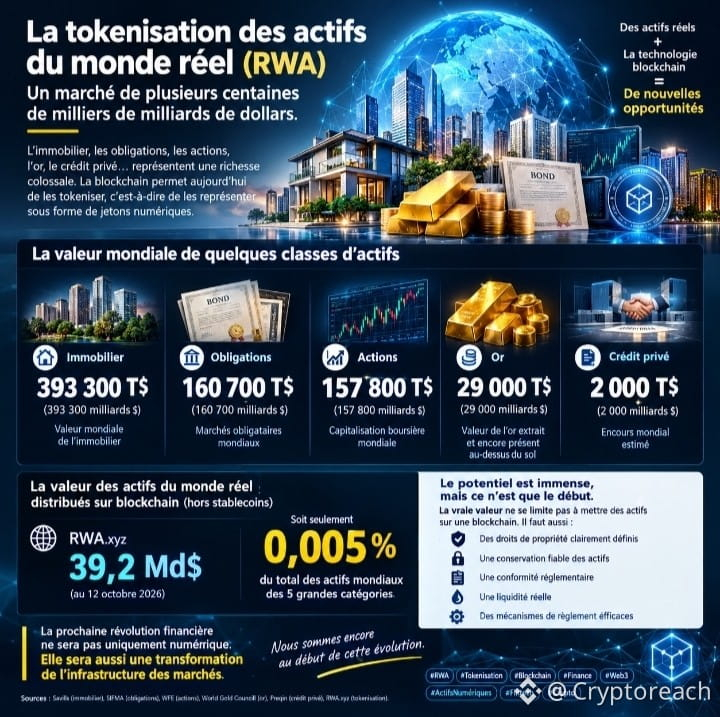
The tokenization of global assets: a market worth hundreds of trillions of dollars.
Global real estate alone represents $393.3 trillion. Global bond markets are worth approximately $160.7 trillion, and global market capitalization stands at $157.8 trillion.
Yet according to RWA.xyz, the value of real-world assets distributed on blockchain is around $39.2 billion as of October 12, 2026, excluding stablecoins.
The gap is enormous. But bear in mind: this $39.2 billion does not represent all tokenized assets or every form of tokenization.
The real challenge is not just putting assets on a blockchain. It is building markets with:
• Clearly defined ownership rights
• Reliable custody of assets
• Regulatory compliance
• Genuine liquidity
• Efficient settlement mechanisms
The next financial revolution will not be digital alone. It will also transform market infrastructure.
We are still at the beginning of this evolution.
Sources: Savills, SIFMA, and RWA.xyz — market data published in 2025 and October 2026.
#RWA #Tokenization #Blockchain #Finance #Web3 #DigitalAssets #Fintech #Crypto $ETH $BNB
Today's crypto topic:
The tokenization of global assets: a market worth hundreds of trillions of dollars.
Global real estate alone represents $393.3 trillion. Global bond markets are worth approximately $160.7 trillion, and global market capitalization stands at $157.8 trillion.
Yet according to RWA.xyz, the value of real-world assets distributed on blockchain is around $39.2 billion as of October 12, 2026, excluding stablecoins.
The gap is enormous. But bear in mind: this $39.2 billion does not represent all tokenized assets or every form of tokenization.
The real challenge is not just putting assets on a blockchain. It is building markets with:
• Clearly defined ownership rights
• Reliable custody of assets
• Regulatory compliance
• Genuine liquidity
• Efficient settlement mechanisms
The next financial revolution will not be digital alone. It will also transform market infrastructure.
We are still at the beginning of this evolution.
Sources: Savills, SIFMA, and RWA.xyz — market data published in 2025 and October 2026.
#RWA #Tokenization #Blockchain #Finance #Web3 #DigitalAssets #Fintech #Crypto $ETH $BNB
The tokenization of global assets: a market worth hundreds of trillions of dollars.
Global real estate alone represents $393.3 trillion. Global bond markets are worth approximately $160.7 trillion, and global market capitalization stands at $157.8 trillion.
Yet according to RWA.xyz, the value of real-world assets distributed on blockchain is around $39.2 billion as of October 12, 2026, excluding stablecoins.
The gap is enormous. But bear in mind: this $39.2 billion does not represent all tokenized assets or every form of tokenization.
The real challenge is not just putting assets on a blockchain. It is building markets with:
• Clearly defined ownership rights
• Reliable custody of assets
• Regulatory compliance
• Genuine liquidity
• Efficient settlement mechanisms
The next financial revolution will not be digital alone. It will also transform market infrastructure.
We are still at the beginning of this evolution.
Sources: Savills, SIFMA, and RWA.xyz — market data published in 2025 and October 2026.
#RWA #Tokenization #Blockchain #Finance #Web3 #DigitalAssets #Fintech #Crypto $ETH $BNB
1
105
·
--
Today’s crypto topic:
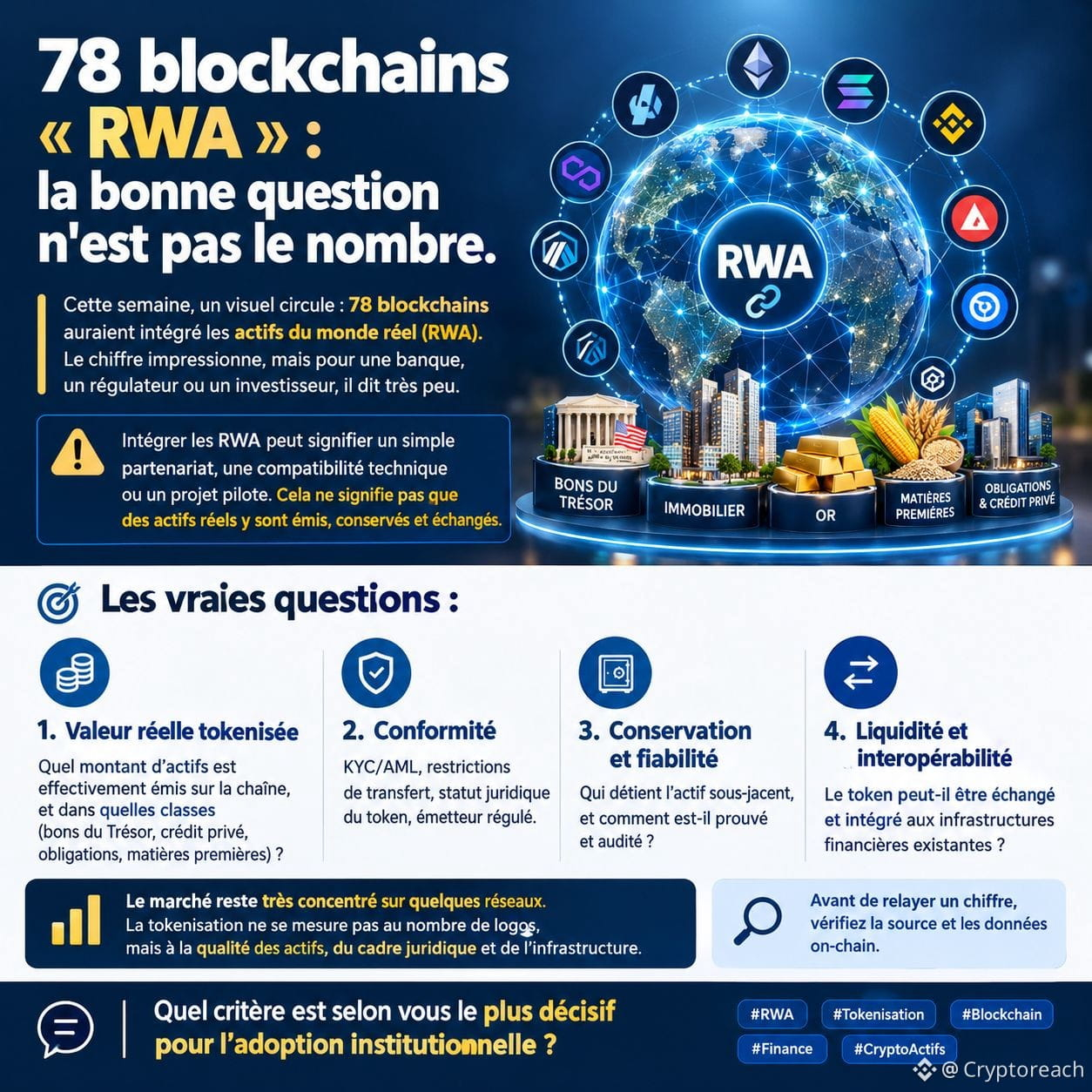
78 “RWA” blockchains: the right question isn’t how many.
This week, an infographic has been circulating claiming that 78 blockchains have integrated real-world assets (RWAs). The figure is impressive, but it tells a bank, regulator, or investor very little.
Integrating RWAs can mean a simple partnership, technical compatibility, or a pilot project. It doesn’t mean that real assets are being issued, held, and traded on the blockchain.
The real questions:
- Actual tokenized value: What value of assets has actually been issued on-chain, and in which asset classes (Treasury bills, private credit, bonds, commodities)?
- Compliance: KYC/AML, transfer restrictions, the token’s legal status, and a regulated issuer.
- Custody and reliability: Who holds the underlying asset, and how is it verified and audited?
- Liquidity and interoperability: Can the token be traded and integrated into existing financial infrastructure?
The market remains highly concentrated across a few networks. Tokenization isn’t measured by the number of logos, but by the quality of the assets, the legal framework, and the infrastructure.
Before sharing a figure, check the source and the on-chain data.
Which criterion do you think is most crucial for institutional adoption?
#RWA #Tokenization #Blockchain #Finance #CryptoAssets
$BNB $ETH $ADA
Today’s crypto topic:
78 “RWA” blockchains: the right question isn’t how many.
This week, an infographic has been circulating claiming that 78 blockchains have integrated real-world assets (RWAs). The figure is impressive, but it tells a bank, regulator, or investor very little.
Integrating RWAs can mean a simple partnership, technical compatibility, or a pilot project. It doesn’t mean that real assets are being issued, held, and traded on the blockchain.
The real questions:
- Actual tokenized value: What value of assets has actually been issued on-chain, and in which asset classes (Treasury bills, private credit, bonds, commodities)?
- Compliance: KYC/AML, transfer restrictions, the token’s legal status, and a regulated issuer.
- Custody and reliability: Who holds the underlying asset, and how is it verified and audited?
- Liquidity and interoperability: Can the token be traded and integrated into existing financial infrastructure?
The market remains highly concentrated across a few networks. Tokenization isn’t measured by the number of logos, but by the quality of the assets, the legal framework, and the infrastructure.
Before sharing a figure, check the source and the on-chain data.
Which criterion do you think is most crucial for institutional adoption?
#RWA #Tokenization #Blockchain #Finance #CryptoAssets
$BNB $ETH $ADA
78 “RWA” blockchains: the right question isn’t how many.
This week, an infographic has been circulating claiming that 78 blockchains have integrated real-world assets (RWAs). The figure is impressive, but it tells a bank, regulator, or investor very little.
Integrating RWAs can mean a simple partnership, technical compatibility, or a pilot project. It doesn’t mean that real assets are being issued, held, and traded on the blockchain.
The real questions:
- Actual tokenized value: What value of assets has actually been issued on-chain, and in which asset classes (Treasury bills, private credit, bonds, commodities)?
- Compliance: KYC/AML, transfer restrictions, the token’s legal status, and a regulated issuer.
- Custody and reliability: Who holds the underlying asset, and how is it verified and audited?
- Liquidity and interoperability: Can the token be traded and integrated into existing financial infrastructure?
The market remains highly concentrated across a few networks. Tokenization isn’t measured by the number of logos, but by the quality of the assets, the legal framework, and the infrastructure.
Before sharing a figure, check the source and the on-chain data.
Which criterion do you think is most crucial for institutional adoption?
#RWA #Tokenization #Blockchain #Finance #CryptoAssets
$BNB $ETH $ADA
89
·
--
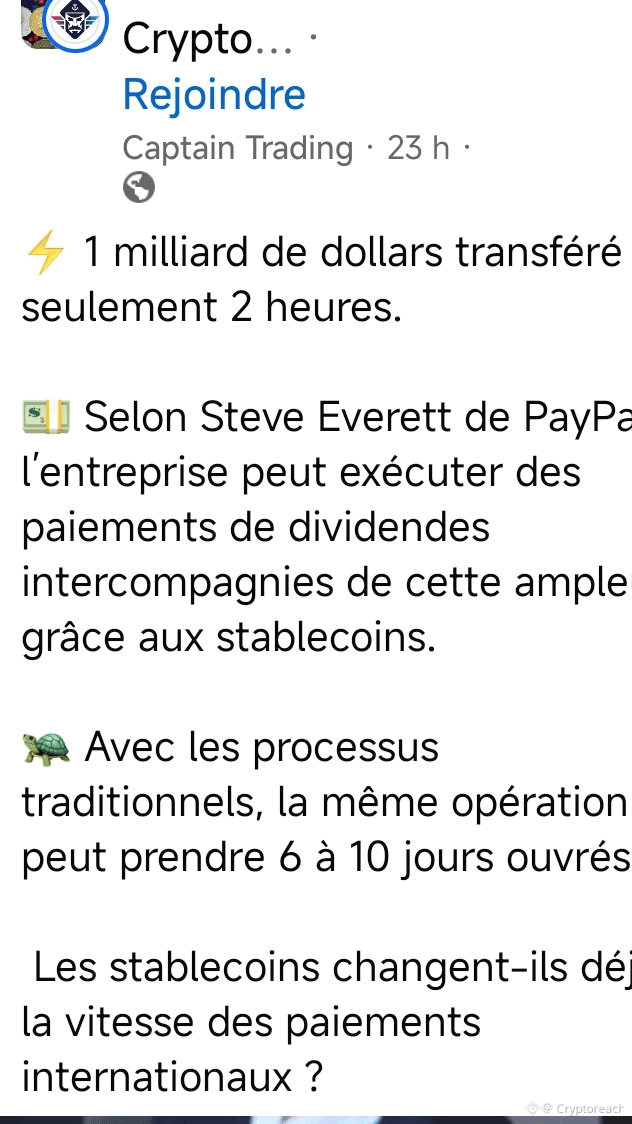
Crypto or nothing, here's a concrete example in a screenshot.
@featured
#Crypto
#blockchain
#stablecoin $BTC #
$BNB $ETH
Crypto or nothing, here's a concrete example in a screenshot.
@featured
#Crypto
#blockchain
#stablecoin $BTC #
$BNB $ETH
@featured
#Crypto
#blockchain
#stablecoin $BTC #
$BNB $ETH
178
·
--
I don't know if anyone sees what will happen with tokenization, especially after the economic collapse.
Wall Street stocks come to the blockchain
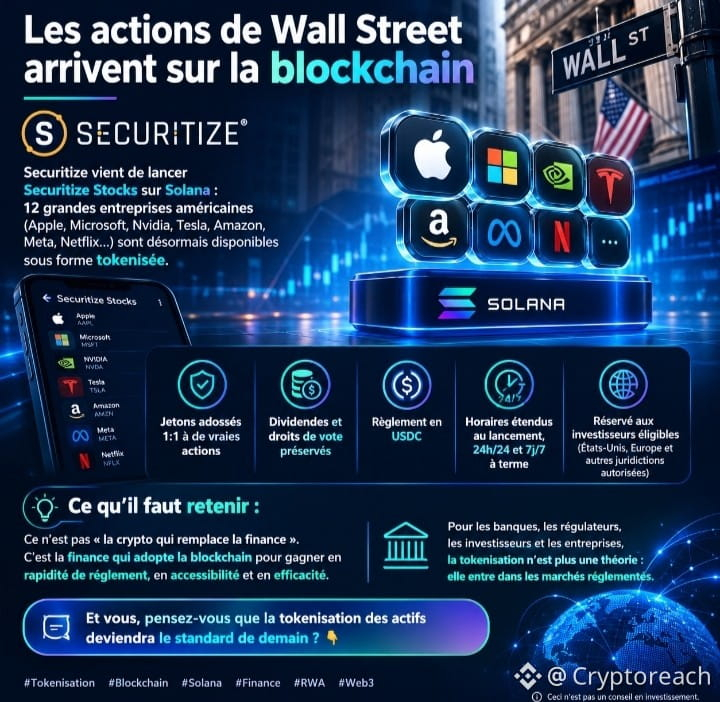
Securitize has launched Securitize Stocks on Solana: 12 major U.S. companies (Apple, Microsoft, Nvidia, Tesla, Amazon, Meta, Netflix…) are now available in tokenized form.
* Tokens backed 1:1 by real shares
* Dividends and voting rights preserved
* Settlement in USDC
Extended hours at launch, 24/7 and 7 days a week in the long run, and soon 24/7 days
For eligible investors only (United States, Europe, and other authorized jurisdictions)
Key takeaways:
It's not “crypto that replaces finance.” It's finance adopting blockchain to gain faster settlement, greater accessibility, and better efficiency.
For banks, regulators, investors, and companies, tokenization is no longer a theory: it’s entering regulated markets.
And you, do you think tokenization of assets will become tomorrow’s standard?
#Tokenization #Blockchain #Solana #Finance #RWA #Web3
This is not investment advice.$BNB $ETH $SOL
I don't know if anyone sees what will happen with tokenization, especially after the economic collapse.
Wall Street stocks come to the blockchain
Securitize has launched Securitize Stocks on Solana: 12 major U.S. companies (Apple, Microsoft, Nvidia, Tesla, Amazon, Meta, Netflix…) are now available in tokenized form.
* Tokens backed 1:1 by real shares
* Dividends and voting rights preserved
* Settlement in USDC
Extended hours at launch, 24/7 and 7 days a week in the long run, and soon 24/7 days
For eligible investors only (United States, Europe, and other authorized jurisdictions)
Key takeaways:
It's not “crypto that replaces finance.” It's finance adopting blockchain to gain faster settlement, greater accessibility, and better efficiency.
For banks, regulators, investors, and companies, tokenization is no longer a theory: it’s entering regulated markets.
And you, do you think tokenization of assets will become tomorrow’s standard?
#Tokenization #Blockchain #Solana #Finance #RWA #Web3
This is not investment advice.$BNB $ETH $SOL
Wall Street stocks come to the blockchain
Securitize has launched Securitize Stocks on Solana: 12 major U.S. companies (Apple, Microsoft, Nvidia, Tesla, Amazon, Meta, Netflix…) are now available in tokenized form.
* Tokens backed 1:1 by real shares
* Dividends and voting rights preserved
* Settlement in USDC
Extended hours at launch, 24/7 and 7 days a week in the long run, and soon 24/7 days
For eligible investors only (United States, Europe, and other authorized jurisdictions)
Key takeaways:
It's not “crypto that replaces finance.” It's finance adopting blockchain to gain faster settlement, greater accessibility, and better efficiency.
For banks, regulators, investors, and companies, tokenization is no longer a theory: it’s entering regulated markets.
And you, do you think tokenization of assets will become tomorrow’s standard?
#Tokenization #Blockchain #Solana #Finance #RWA #Web3
This is not investment advice.$BNB $ETH $SOL
124
·
--
Tokenization makes assets accessible in all countries
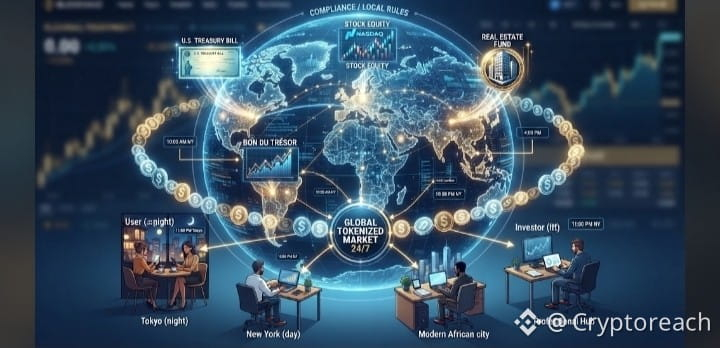
A tokenized Treasury bill, a share, or a fund is not limited to the opening hours of a single country. Anyone with a portfolio, wherever they are, can access the same market, subject to local rules.
Web3 is just at the start of its force behind tokenization.
$BNB $BTC $ETH
#Tokenization #RWA #Blockchain #Web3 #Crypto #DigitalAssets #Finance #FinancialMarkets #TokenizedAssets #DigitalAssets #DeFi #FinancialInnovation #Investment #Stablecoins #CôteDIvoire #Africa #AfricaWeb3 #FutureOfFinance
Tokenization makes assets accessible in all countries
A tokenized Treasury bill, a share, or a fund is not limited to the opening hours of a single country. Anyone with a portfolio, wherever they are, can access the same market, subject to local rules.
Web3 is just at the start of its force behind tokenization.
$BNB $BTC $ETH
#Tokenization #RWA #Blockchain #Web3 #Crypto #DigitalAssets #Finance #FinancialMarkets #TokenizedAssets #DigitalAssets #DeFi #FinancialInnovation #Investment #Stablecoins #CôteDIvoire #Africa #AfricaWeb3 #FutureOfFinance
A tokenized Treasury bill, a share, or a fund is not limited to the opening hours of a single country. Anyone with a portfolio, wherever they are, can access the same market, subject to local rules.
Web3 is just at the start of its force behind tokenization.
$BNB $BTC $ETH
#Tokenization #RWA #Blockchain #Web3 #Crypto #DigitalAssets #Finance #FinancialMarkets #TokenizedAssets #DigitalAssets #DeFi #FinancialInnovation #Investment #Stablecoins #CôteDIvoire #Africa #AfricaWeb3 #FutureOfFinance
1
1.1k
·
--

Article
the story of crypto and blockchainHere’s what they’ll say about blockchain and crypto-assets.
At first, they’ll say it’s a scam.
Then they’ll say it’s the technology driving the future of finance.
Oh yes, it will even revolutionize finance as a whole, and with this new revolution, we’ll have a very prosperous economy.
Here are 5 relevant hashtags to accompany this post:
#Blockchain
#CryptoAssets
#FutureOfFinance
#FinancialInnovation
#DigitalEconomy
#BlockchainRevolution
#CryptoAdoption
the story of crypto and blockchain
Here’s what they’ll say about blockchain and crypto-assets.
At first, they’ll say it’s a scam.
Then they’ll say it’s the technology driving the future of finance.
Oh yes, it will even revolutionize finance as a whole, and with this new revolution, we’ll have a very prosperous economy.
Here are 5 relevant hashtags to accompany this post:
#Blockchain
#CryptoAssets
#FutureOfFinance
#FinancialInnovation
#DigitalEconomy
#BlockchainRevolution
#CryptoAdoption
At first, they’ll say it’s a scam.
Then they’ll say it’s the technology driving the future of finance.
Oh yes, it will even revolutionize finance as a whole, and with this new revolution, we’ll have a very prosperous economy.
Here are 5 relevant hashtags to accompany this post:
#Blockchain
#CryptoAssets
#FutureOfFinance
#FinancialInnovation
#DigitalEconomy
#BlockchainRevolution
#CryptoAdoption
129
Log in to explore more content
Join global crypto users on Binance Square
⚡️ Get latest and useful information about crypto.
💬 Trusted by the world’s largest crypto exchange.
👍 Discover real insights from verified creators.
Email / Phone number