
Crypto Jrawan-前CEX研究员
687 Posts

Crypto Jrawan-前CEX研究员
X(Twitter)同广场用户名|交易系统用AI来打造|前KOL、CEX研究员,目前为独立交易者,帮助你少走交易辛苦路与减少踩坑 | 定期直播|每日分享技术分析

BNB Holder
Frequent Trader
5.6 Years
9 Following
448 Followers
503 Liked
Posts
All
Quotes
Live
PINNED
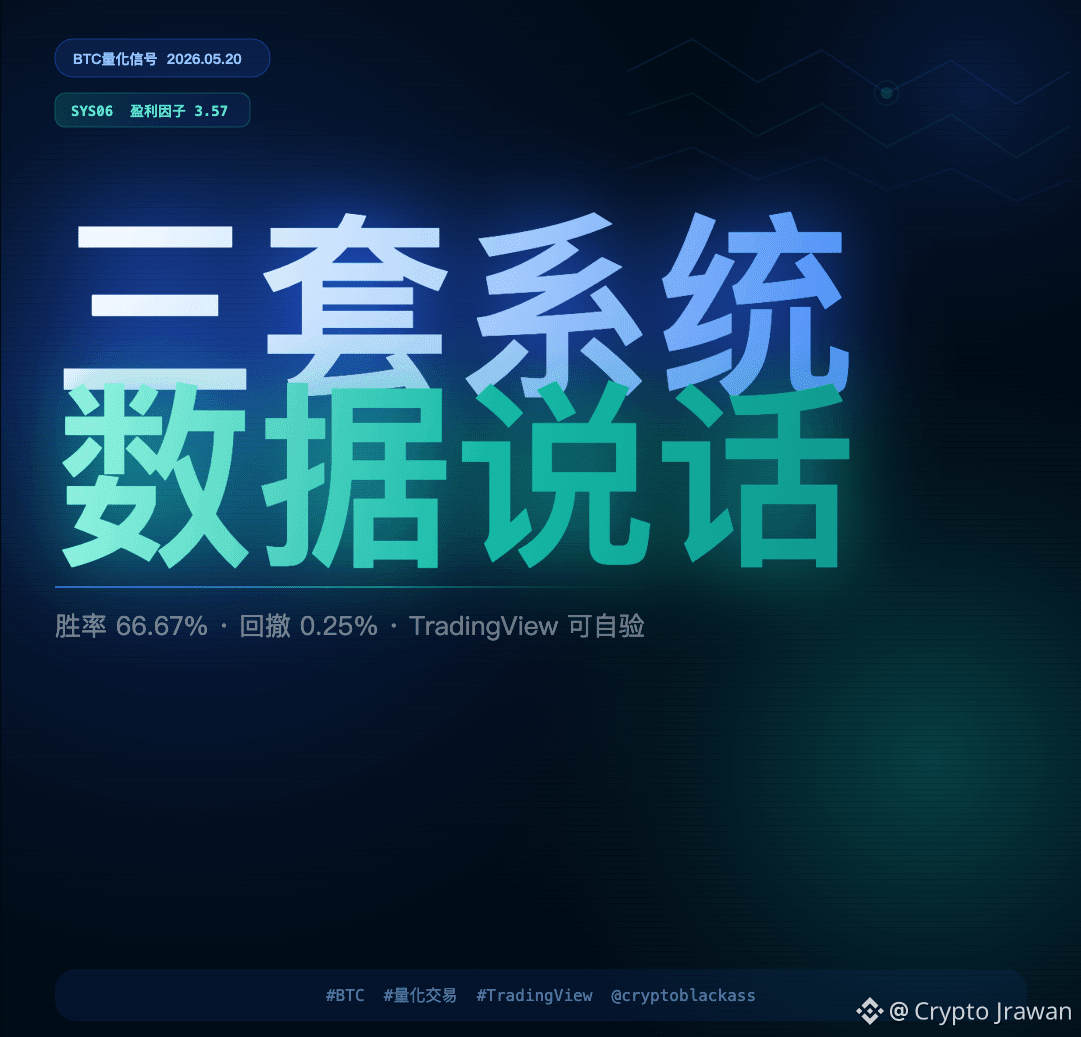
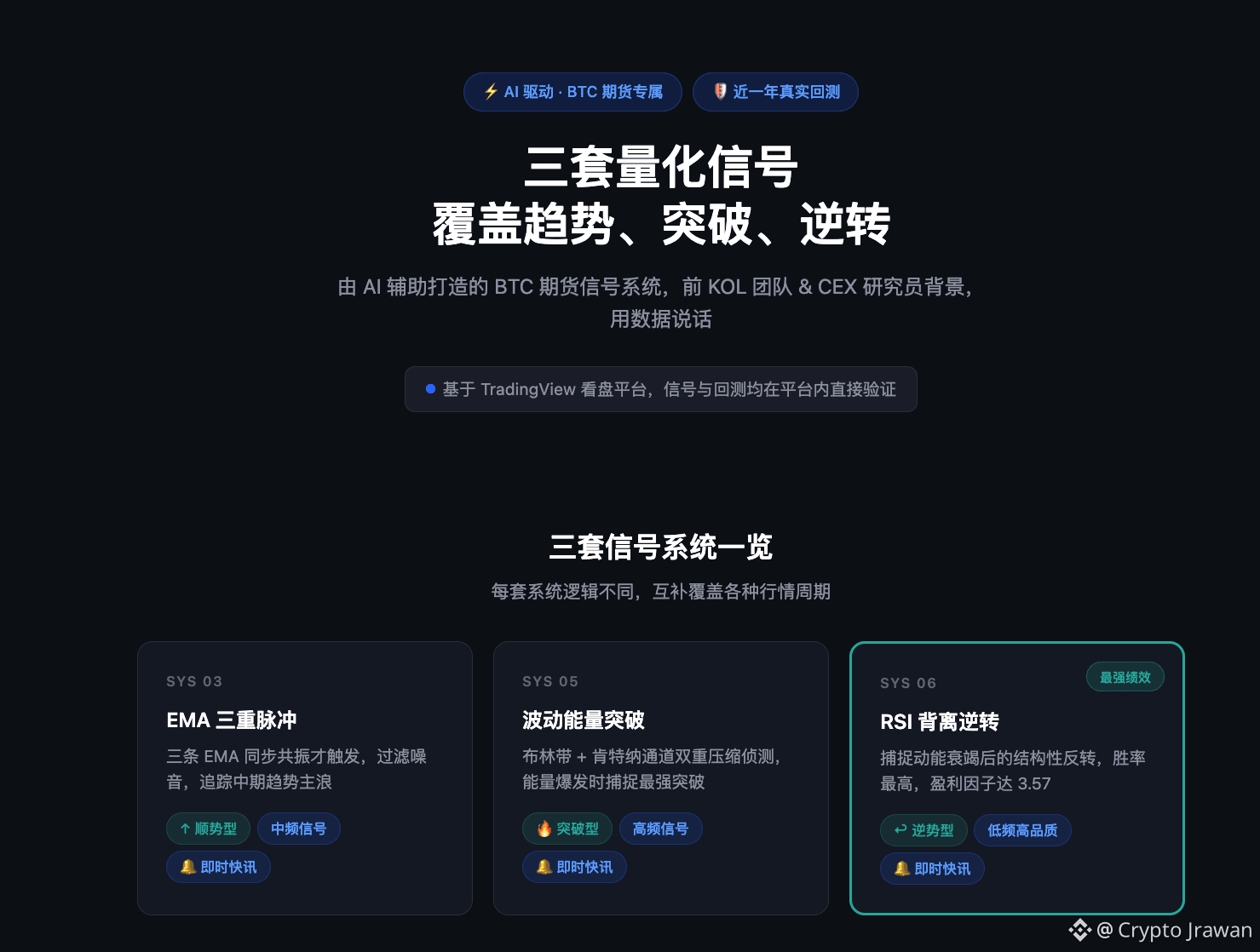
After months of work, I’ve leveraged AI to craft 3 BTC futures quant signals, and today they’re officially open for subscription.
Each strategy has its own role:
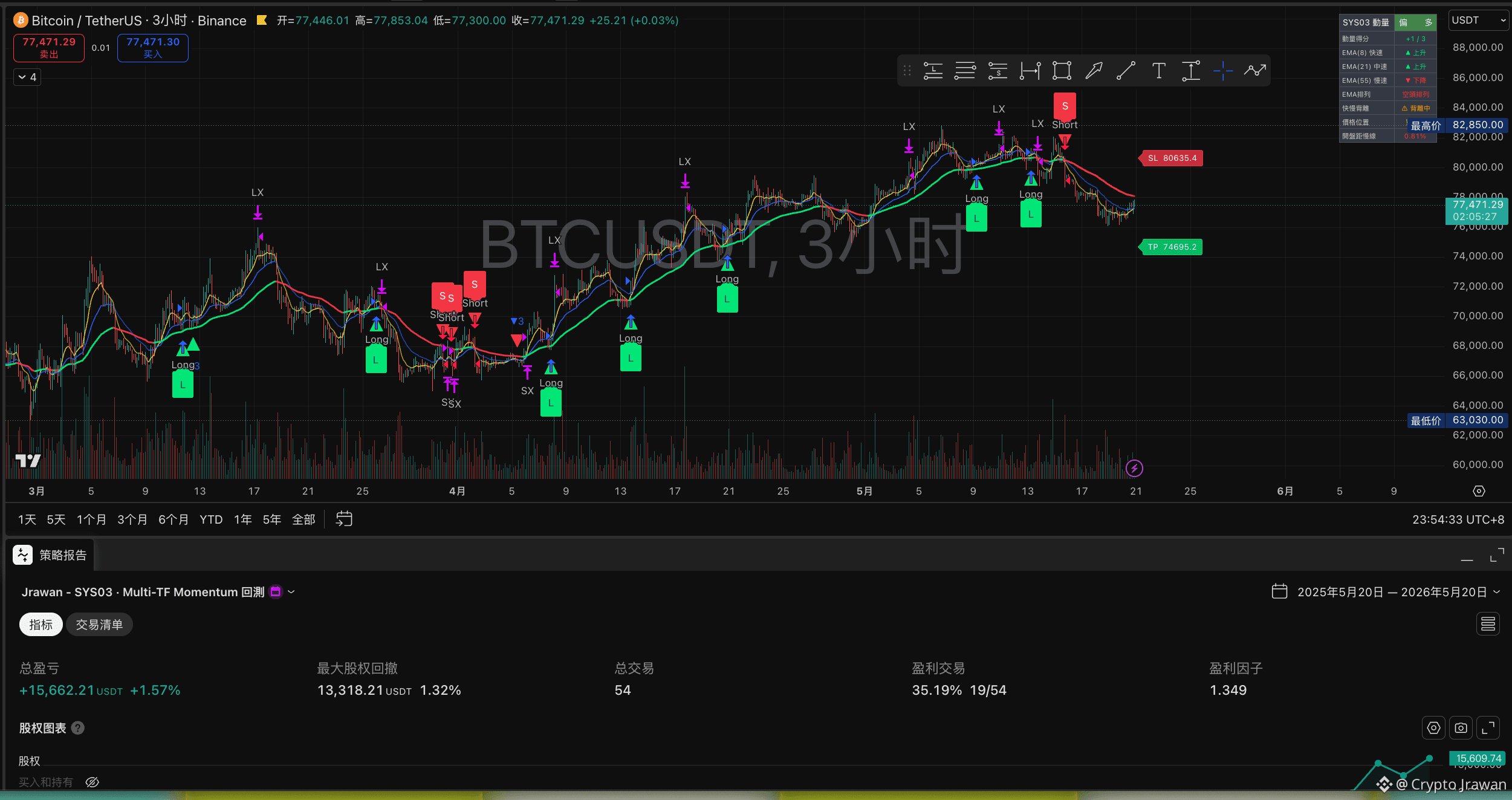
· SYS03 EMA Triple Pulse — Tracks mid-term trend waves, with 54 trades over the past year, profit factor of 1.46
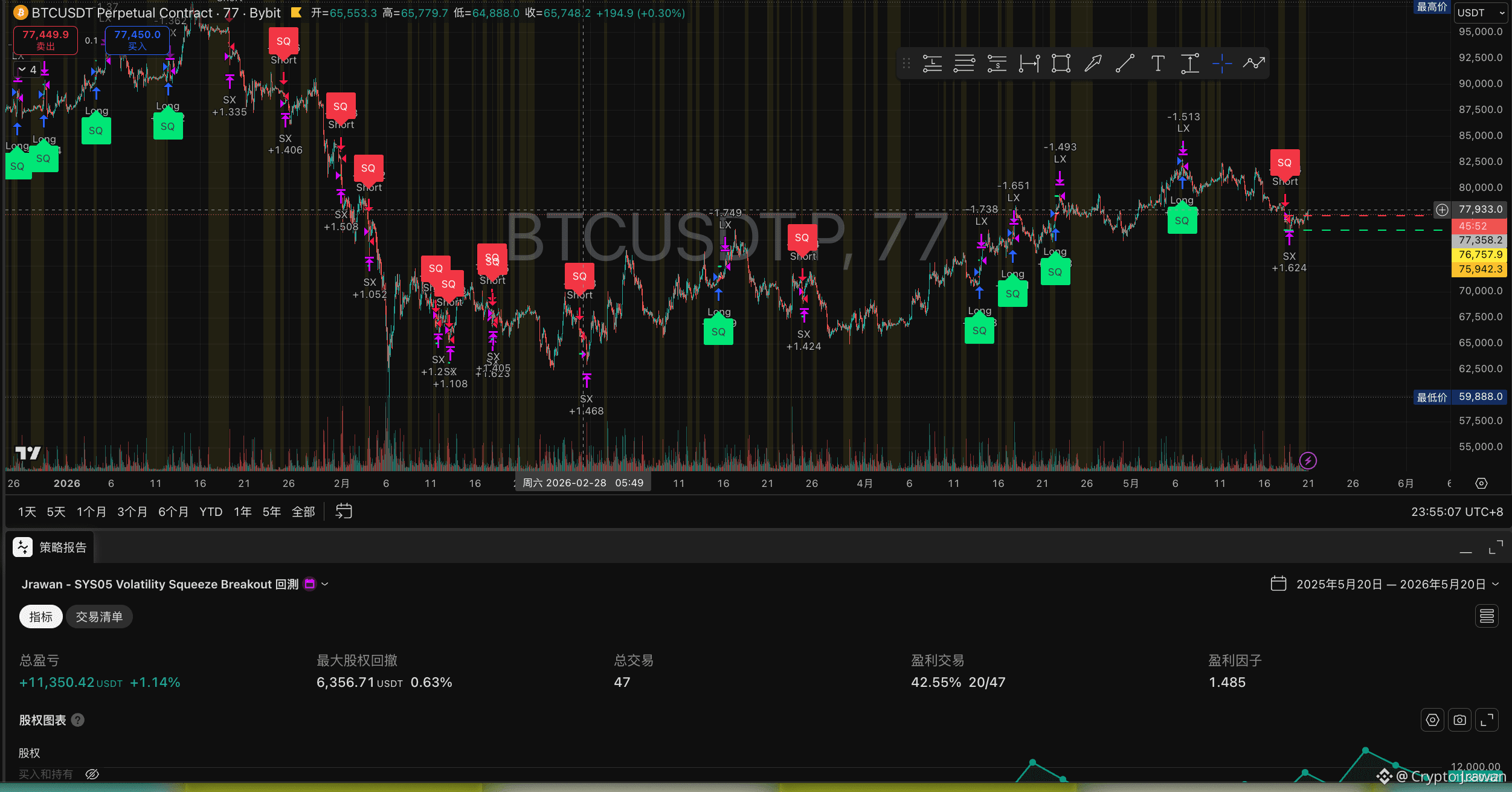
· SYS05 Volatility Energy Breakout — Bollinger Bands + Keltner Double Compression, capturing energy explosions, profit factor of 1.49
· SYS06 RSI Divergence Reversal — Only 15 trades in the past year, win rate of 66.67%, profit factor of 3.57, with a max drawdown of just 0.25%
All backtested on TradingView, so you can replicate the numbers yourself, no need to take my word for it.
Each signal includes:
✓ Real-time annotations for entry direction + SL / TP levels
✓ TradingView alerts pushed directly, getting notified of entry price / stop-loss / take-profit without having to watch the charts
✓ Backtest version for historical performance verification
Background: Former KOL team & CEX researcher, now independently developing trading systems.
If you're interested, DM me on X (Twitter) to learn about the subscription options, spots are limited, first come, first served.
#量化交易 #TradingView #量化信号
Each strategy has its own role:
· SYS03 EMA Triple Pulse — Tracks mid-term trend waves, with 54 trades over the past year, profit factor of 1.46
· SYS05 Volatility Energy Breakout — Bollinger Bands + Keltner Double Compression, capturing energy explosions, profit factor of 1.49
· SYS06 RSI Divergence Reversal — Only 15 trades in the past year, win rate of 66.67%, profit factor of 3.57, with a max drawdown of just 0.25%
All backtested on TradingView, so you can replicate the numbers yourself, no need to take my word for it.
Each signal includes:
✓ Real-time annotations for entry direction + SL / TP levels
✓ TradingView alerts pushed directly, getting notified of entry price / stop-loss / take-profit without having to watch the charts
✓ Backtest version for historical performance verification
Background: Former KOL team & CEX researcher, now independently developing trading systems.
If you're interested, DM me on X (Twitter) to learn about the subscription options, spots are limited, first come, first served.
#量化交易 #TradingView #量化信号
PINNED
We'll be going live here from time to time to stream the charts + signal interpretations, no fluff.
Last time, folks said they gained a lot—but those who didn’t follow missed out.
I won’t give too much notice before going live, so make sure to follow to catch the action.
🔔 Follow → Don’t miss me!
Last time, folks said they gained a lot—but those who didn’t follow missed out.
I won’t give too much notice before going live, so make sure to follow to catch the action.
🔔 Follow → Don’t miss me!

Today's Market Watch 09/10
BTC is currently consolidating around $78,261.
Volume is the most important key today.
If the price rises but volume doesn’t follow, that’s a fake breakout—don’t chase.
Let volume come first, then talk about direction.
Today's strategy:
Wait for volume confirmation → then decide on direction
If there’s no volume → stay out of the market and wait; cash is also a position
Stay calm and don’t rush—wait for the right moment.
$BTC
#市场观察 #BTC #Trading Strategy
$BTC $XAUT $HYPE
BTC is currently consolidating around $78,261.
Volume is the most important key today.
If the price rises but volume doesn’t follow, that’s a fake breakout—don’t chase.
Let volume come first, then talk about direction.
Today's strategy:
Wait for volume confirmation → then decide on direction
If there’s no volume → stay out of the market and wait; cash is also a position
Stay calm and don’t rush—wait for the right moment.
$BTC
#市场观察 #BTC #Trading Strategy
$BTC $XAUT $HYPE
Today the market closed, so here’s a quick summary.
Trading doesn’t have signals every day, and not every day is suitable for placing trades.
If you didn’t trade today—
that may be the most correct decision.
Preserving your capital is preparing for the next opportunity.
See you tomorrow.
$BTC #系统交易 #Trading discipline
$BTC $XAUT $HYPE
Trading doesn’t have signals every day, and not every day is suitable for placing trades.
If you didn’t trade today—
that may be the most correct decision.
Preserving your capital is preparing for the next opportunity.
See you tomorrow.
$BTC #系统交易 #Trading discipline
$BTC $XAUT $HYPE
If you could go back to the first day of trading, what would you most want to tell yourself?
My answer:
“First learn position/risk management, then learn technical analysis.”
Most people do it in the wrong order—learn candlesticks, indicators, and patterns first.
In the end, you can sometimes see the direction correctly, but you still lose money.
The reason is simple: you haven’t done risk management.
Even if your win rate is only 60%, and you pair it with a 2R risk-reward ratio,
long term it will still produce a positive expected value.
What’s your answer?
#交易心法 #交易心理 #cryptocurrency
$BTC $XAUT $HYPE
My answer:
“First learn position/risk management, then learn technical analysis.”
Most people do it in the wrong order—learn candlesticks, indicators, and patterns first.
In the end, you can sometimes see the direction correctly, but you still lose money.
The reason is simple: you haven’t done risk management.
Even if your win rate is only 60%, and you pair it with a 2R risk-reward ratio,
long term it will still produce a positive expected value.
What’s your answer?
#交易心法 #交易心理 #cryptocurrency
$BTC $XAUT $HYPE
Stop-loss—does it mean conceding?
Many people are unwilling to stop-loss,
because “as long as you haven’t sold, it doesn’t count as a real loss.”
But the market doesn’t care about your psychological account.
A stop-loss is not admitting defeat—
it’s carrying out the rules you set before letting your emotions take over.
You’re not losing to the market—you’re winning by regaining control over yourself.
Only those who can stop-loss can keep surviving in the market.
Those who don’t will eventually give back all their profits, sooner or later.
Which kind of person are you?
#CryptoTrading #交易心理 $BTC
$BTC $XAUT $HYPE
Many people are unwilling to stop-loss,
because “as long as you haven’t sold, it doesn’t count as a real loss.”
But the market doesn’t care about your psychological account.
A stop-loss is not admitting defeat—
it’s carrying out the rules you set before letting your emotions take over.
You’re not losing to the market—you’re winning by regaining control over yourself.
Only those who can stop-loss can keep surviving in the market.
Those who don’t will eventually give back all their profits, sooner or later.
Which kind of person are you?
#CryptoTrading #交易心理 $BTC
$BTC $XAUT $HYPE
In 2023, my account hit zero once.
Not because I got the direction wrong, but because I used leverage—and I didn’t stop-loss.
At the time, my logic was: “I analyzed it very clearly. It’s definitely going to rebound.”
But it just didn’t rebound.
That time cost me two years’ worth of savings.
Someone asked me how I faced my family back then.
I said: I didn’t tell them.
I carried it alone for three months. Those three months, every day I couldn’t sleep,
my mind was all about: how to earn the money back.
Later, I didn’t rush to get it back. Instead, I spent half a year rebuilding the system.
And it turned out to be more stable.
Liquidation isn’t the end—it’s a way of forcing you to learn.
Have you had an experience like this?
#真实分享 #交易故事 #CryptoTrading
$BTC $XAUT $HYPE
Not because I got the direction wrong, but because I used leverage—and I didn’t stop-loss.
At the time, my logic was: “I analyzed it very clearly. It’s definitely going to rebound.”
But it just didn’t rebound.
That time cost me two years’ worth of savings.
Someone asked me how I faced my family back then.
I said: I didn’t tell them.
I carried it alone for three months. Those three months, every day I couldn’t sleep,
my mind was all about: how to earn the money back.
Later, I didn’t rush to get it back. Instead, I spent half a year rebuilding the system.
And it turned out to be more stable.
Liquidation isn’t the end—it’s a way of forcing you to learn.
Have you had an experience like this?
#真实分享 #交易故事 #CryptoTrading
$BTC $XAUT $HYPE
Many people ask me: Quant trading or manual trading—which is better?
My answer: It depends on who you are.
If you can do:
✓ Strictly follow stop-loss
✓ Not let emotions affect your decisions
✓ Maintain discipline in the long run
→ Then manual trading can work too.
But if you find that you:
✗ Often “wait a little longer” before taking your stop-loss
✗ Add to your position when you win, and try to win it back when you lose
✗ Chase after others’ profits
→ Then you need a system to help keep you accountable.
Quant trading isn’t smarter—it’s more disciplined.
#量化交易 #交易心理 #system trading
$BTC $XAUT $HYPE
My answer: It depends on who you are.
If you can do:
✓ Strictly follow stop-loss
✓ Not let emotions affect your decisions
✓ Maintain discipline in the long run
→ Then manual trading can work too.
But if you find that you:
✗ Often “wait a little longer” before taking your stop-loss
✗ Add to your position when you win, and try to win it back when you lose
✗ Chase after others’ profits
→ Then you need a system to help keep you accountable.
Quant trading isn’t smarter—it’s more disciplined.
#量化交易 #交易心理 #system trading
$BTC $XAUT $HYPE
Today’s Market Watch 09/09
BTC is currently consolidating around $78,438.
Volume is the most important key today.
Price is rising but volume isn’t keeping up—that’s a fake breakout, don’t chase.
Let volume come out first, then decide on the direction.
Today’s strategy:
Wait for volume to confirm → then decide on direction
No volume → wait on the sidelines; cash is also a position
Stay calm and don’t rush—wait for the right timing.
$BTC
#市场观察 #BTC #Trading Strategy
$BTC $XAUT $HYPE
BTC is currently consolidating around $78,438.
Volume is the most important key today.
Price is rising but volume isn’t keeping up—that’s a fake breakout, don’t chase.
Let volume come out first, then decide on the direction.
Today’s strategy:
Wait for volume to confirm → then decide on direction
No volume → wait on the sidelines; cash is also a position
Stay calm and don’t rush—wait for the right timing.
$BTC
#市场观察 #BTC #Trading Strategy
$BTC $XAUT $HYPE
Today’s Market Watch 09/09
BTC is currently consolidating around $78,438.
Volume is the most important key today.
If price is rising but volume isn’t keeping up—that’s a fake breakout, don’t chase.
Let the volume come first, then decide the direction.
Today’s strategy:
Wait for volume confirmation → then decide the direction
No volume → stay on the sidelines; cash is also a position
No rush, no panic—wait for the right opportunity.
$BTC
#市场观察 #BTC #Trading Strategy
$BTC $XAUT $HYPE
BTC is currently consolidating around $78,438.
Volume is the most important key today.
If price is rising but volume isn’t keeping up—that’s a fake breakout, don’t chase.
Let the volume come first, then decide the direction.
Today’s strategy:
Wait for volume confirmation → then decide the direction
No volume → stay on the sidelines; cash is also a position
No rush, no panic—wait for the right opportunity.
$BTC
#市场观察 #BTC #Trading Strategy
$BTC $XAUT $HYPE
Today, the market closed—let’s do a quick recap.
Trading doesn’t have signals every day, and not every day is suitable for making a trade.
If you didn’t trade today—
maybe it was the most correct decision.
Preserving your principal is preparing for the next opportunity.
Continue tomorrow.
$BTC #系统交易 #Trading discipline
$BTC $XAUT $HYPE
Trading doesn’t have signals every day, and not every day is suitable for making a trade.
If you didn’t trade today—
maybe it was the most correct decision.
Preserving your principal is preparing for the next opportunity.
Continue tomorrow.
$BTC #系统交易 #Trading discipline
$BTC $XAUT $HYPE
After trading for so long, I want to ask you a question.
Right now, on your trading journey, what is the biggest obstacle?
A. I can’t understand technical analysis
B. I understand it, but I can’t control my impulses
C. Position management has no rules
D. Once my mindset takes a hit, I fall apart
Leave a comment and tell me—I’ll definitely see it.
I’m not trying to sell a course. I’m just genuinely curious, and I also want to see where everyone gets stuck.
#交易心理 #加密货币 #互动
$BTC $XAUT $HYPE
Right now, on your trading journey, what is the biggest obstacle?
A. I can’t understand technical analysis
B. I understand it, but I can’t control my impulses
C. Position management has no rules
D. Once my mindset takes a hit, I fall apart
Leave a comment and tell me—I’ll definitely see it.
I’m not trying to sell a course. I’m just genuinely curious, and I also want to see where everyone gets stuck.
#交易心理 #加密货币 #互动
$BTC $XAUT $HYPE
Let me tell you a story about a friend.
He traded for three years and kept losing.
Not because his technical skills were bad—he analyzed everything clearly.
It was because whenever he got it right, he was unwilling to take profit.
Whenever he got it wrong, he was unwilling to cut losses.
So what was the outcome?
He made a little when he was right, but lost a lot when he was wrong.
His expected value was negative.
Later, he started using a fixed mechanism: take profit at 1.5R and stop loss at 0.5R—
no matter how he felt, no matter “this time might be different.”
By the third month, his account finally returned to positive.
Not because his analysis got more accurate, but because his expected value finally became positive.
Have you calculated your expected value?
#交易心理 #期望值 #System trading
$BTC $XAUT $HYPE
He traded for three years and kept losing.
Not because his technical skills were bad—he analyzed everything clearly.
It was because whenever he got it right, he was unwilling to take profit.
Whenever he got it wrong, he was unwilling to cut losses.
So what was the outcome?
He made a little when he was right, but lost a lot when he was wrong.
His expected value was negative.
Later, he started using a fixed mechanism: take profit at 1.5R and stop loss at 0.5R—
no matter how he felt, no matter “this time might be different.”
By the third month, his account finally returned to positive.
Not because his analysis got more accurate, but because his expected value finally became positive.
Have you calculated your expected value?
#交易心理 #期望值 #System trading
$BTC $XAUT $HYPE
For a while, I almost gave up trading.
That was after six consecutive months of losses.
I remember that day, sitting in front of my computer, looking at the numbers on my account, thinking: “Maybe this market just isn’t right for me.”
Later, I did something: I went through every single trade from those six months carefully.
I found that 80% of the losses came from the same problem—
I was placing trades “based on feeling” when there were no signals.
It wasn’t that the market wasn’t right for me. My approach was wrong.
That review session was a turning point in my trading career.
Every time you lose in a row, the market is telling you: “Something in you needs to be corrected.”
When was the last time you did a serious post-trade review?
#交易故事 #真实分享 #Growth
$BTC $XAUT $HYPE
That was after six consecutive months of losses.
I remember that day, sitting in front of my computer, looking at the numbers on my account, thinking: “Maybe this market just isn’t right for me.”
Later, I did something: I went through every single trade from those six months carefully.
I found that 80% of the losses came from the same problem—
I was placing trades “based on feeling” when there were no signals.
It wasn’t that the market wasn’t right for me. My approach was wrong.
That review session was a turning point in my trading career.
Every time you lose in a row, the market is telling you: “Something in you needs to be corrected.”
When was the last time you did a serious post-trade review?
#交易故事 #真实分享 #Growth
$BTC $XAUT $HYPE
When I built the first quantitative trading system, I stepped into three pitfalls.
Pitfall 1: Overfitting
Backtests looked ridiculously good, but once deployed live, it collapsed.
Reason: The parameters were tuned too closely to historical data.
Pitfall 2: Ignoring trading fees
In the backtest, each trade made $50, but after fees in live trading, it was only $15.
That cut returns by 70% straight away.
Pitfall 3: No stop-loss logic
“Quant systems won’t go crazy and place bad trades.”
Until one time the market move wiped out 20% in a single swing—I realized quant systems can still blow up.
The SYS series was built slowly only after stepping into those three pitfalls.
No pitfalls, no system.
#TradingView #量化交易 #CryptoTrading
$BTC $XAUT $HYPE
Pitfall 1: Overfitting
Backtests looked ridiculously good, but once deployed live, it collapsed.
Reason: The parameters were tuned too closely to historical data.
Pitfall 2: Ignoring trading fees
In the backtest, each trade made $50, but after fees in live trading, it was only $15.
That cut returns by 70% straight away.
Pitfall 3: No stop-loss logic
“Quant systems won’t go crazy and place bad trades.”
Until one time the market move wiped out 20% in a single swing—I realized quant systems can still blow up.
The SYS series was built slowly only after stepping into those three pitfalls.
No pitfalls, no system.
#TradingView #量化交易 #CryptoTrading
$BTC $XAUT $HYPE
Today's Market Watch 09/08
BTC is currently consolidating near ~$103,000.
Volume is the most important key today.
If the price is rising but volume isn’t keeping up—that’s a fake breakout, don’t chase.
Let the volume come first, then decide the direction.
Today's strategy:
Wait for volume confirmation → then decide the direction
If there’s no volume → stay on the sidelines; cash is also a position
No rush, no panic—wait for the right moment.
$BTC
#市场观察 #BTC #Trading Strategy
$BTC $XAUT $HYPE
BTC is currently consolidating near ~$103,000.
Volume is the most important key today.
If the price is rising but volume isn’t keeping up—that’s a fake breakout, don’t chase.
Let the volume come first, then decide the direction.
Today's strategy:
Wait for volume confirmation → then decide the direction
If there’s no volume → stay on the sidelines; cash is also a position
No rush, no panic—wait for the right moment.
$BTC
#市场观察 #BTC #Trading Strategy
$BTC $XAUT $HYPE
After trading for so long, I want to ask you a question.
Right now, on your trading path, what is the biggest obstacle?
A. I can’t understand technical analysis
B. I understand it, but I can’t control my hands
C. Position sizing has no rules
D. The moment your mindset takes a hit, you fall apart
Leave a comment and tell me—I'll definitely read it.
Not trying to sell a course. I’m just genuinely curious, and I also want to see where everyone gets stuck.
#交易心理 #加密货币 #互动
$BTC $XAUT $HYPE
Right now, on your trading path, what is the biggest obstacle?
A. I can’t understand technical analysis
B. I understand it, but I can’t control my hands
C. Position sizing has no rules
D. The moment your mindset takes a hit, you fall apart
Leave a comment and tell me—I'll definitely read it.
Not trying to sell a course. I’m just genuinely curious, and I also want to see where everyone gets stuck.
#交易心理 #加密货币 #互动
$BTC $XAUT $HYPE
Today I received a private message.
Someone said: «I’m always in a liquidation, or on the way to one. I just want to learn from you.»
These words made me think for a long time.
Because I’ve walked that road too.
That feeling of resetting to zero again and again, and telling yourself, «Next time for sure»—I completely understand it.
But what he said—«I’m not that greedy, I just want to learn»—
In a market full of leverage dreams, anyone who can say that has already won half the battle in mindset.
The people who truly manage to survive in the market are never the most brilliant or the most willing to gamble.
It’s the ones who stay low-key and are willing to admit when they’re wrong.
If you’re also on the road, leave a comment and tell me which part you’re stuck at.
#交易心法 #加密货币 #真实分享
$BTC $XAUT $HYPE
Someone said: «I’m always in a liquidation, or on the way to one. I just want to learn from you.»
These words made me think for a long time.
Because I’ve walked that road too.
That feeling of resetting to zero again and again, and telling yourself, «Next time for sure»—I completely understand it.
But what he said—«I’m not that greedy, I just want to learn»—
In a market full of leverage dreams, anyone who can say that has already won half the battle in mindset.
The people who truly manage to survive in the market are never the most brilliant or the most willing to gamble.
It’s the ones who stay low-key and are willing to admit when they’re wrong.
If you’re also on the road, leave a comment and tell me which part you’re stuck at.
#交易心法 #加密货币 #真实分享
$BTC $XAUT $HYPE
In 2023, my account hit zero once.
Not because I took the wrong direction, but because I used leverage and then didn’t set a stop-loss.
At the time, my logic was: “I analyzed it very clearly—it’s definitely going to bounce back.”
But it just didn’t.
That time cost me two years’ worth of savings.
Someone asked me how I dealt with my family back then.
I said: “I didn’t tell them.”
I carried it all by myself for three months. Those three months, I couldn’t sleep at all every day.
My mind was consumed with: how to earn the money back.
Later, I didn’t rush to get it back. Instead, I spent half a year rebuilding the system.
As a result, I became more stable.
Liquidation isn’t the end—it’s the way it forces you to learn.
Have you had an experience like this?
#真实分享 #交易故事 #CryptoTrading
$BTC $XAUT $HYPE
Not because I took the wrong direction, but because I used leverage and then didn’t set a stop-loss.
At the time, my logic was: “I analyzed it very clearly—it’s definitely going to bounce back.”
But it just didn’t.
That time cost me two years’ worth of savings.
Someone asked me how I dealt with my family back then.
I said: “I didn’t tell them.”
I carried it all by myself for three months. Those three months, I couldn’t sleep at all every day.
My mind was consumed with: how to earn the money back.
Later, I didn’t rush to get it back. Instead, I spent half a year rebuilding the system.
As a result, I became more stable.
Liquidation isn’t the end—it’s the way it forces you to learn.
Have you had an experience like this?
#真实分享 #交易故事 #CryptoTrading
$BTC $XAUT $HYPE
Log in to explore more content