

密智君 Crypto Plus AI
2k Posts

密智君 Crypto Plus AI
Report
Block User
分享AI Crypto创新洞见,AI实用工具 & 技巧分享,心得,热门话题探讨#CryptoAGI
111 Following
1.0K+ Followers
2.0K+ Liked
Posts
All
Quotes
Videos
Live
PINNED
Whoa, I just saw this chart in the square, and I'm completely stunned. This isn't trading; it's practically a real-life 'suicidal attack'.
Brothers, did you see clearly? This dude went short on $LAB at 0.68, and now the price has skyrocketed to 4.7. He's sitting on a paper loss of $487,000, with a return rate of negative 85.95%. What's heartbreaking is his message: he's mortgaged his house and car, and has been margin-calling ever since; he really can't borrow any more money now. The liquidation price is at 5.29, just a step away from the current price.
Honestly, looking at this chart really reminds me of my past self. That desperate feeling of watching the price jump toward the liquidation line while being completely powerless is enough to drive anyone insane. This isn't shorting; it's like playing a 'life swap' game with the market makers. You thought 0.68 was a high point, but the market makers are telling you there's always a higher high.
What I admire (and feel sorry for) is his obsession. Going all-in short with 1x leverage, enduring nearly a 7x increase. That takes some serious 'courage' and a thick wallet, huh? But the trading market doesn’t care about tears, and definitely doesn’t believe in 'holding on for dear life'. You try to reason with the market makers, but they just want to drain your last drop of blood. $BTC #LAB
Whoa, I just saw this chart in the square, and I'm completely stunned. This isn't trading; it's practically a real-life 'suicidal attack'.
Brothers, did you see clearly? This dude went short on $LAB at 0.68, and now the price has skyrocketed to 4.7. He's sitting on a paper loss of $487,000, with a return rate of negative 85.95%. What's heartbreaking is his message: he's mortgaged his house and car, and has been margin-calling ever since; he really can't borrow any more money now. The liquidation price is at 5.29, just a step away from the current price.
Honestly, looking at this chart really reminds me of my past self. That desperate feeling of watching the price jump toward the liquidation line while being completely powerless is enough to drive anyone insane. This isn't shorting; it's like playing a 'life swap' game with the market makers. You thought 0.68 was a high point, but the market makers are telling you there's always a higher high.
What I admire (and feel sorry for) is his obsession. Going all-in short with 1x leverage, enduring nearly a 7x increase. That takes some serious 'courage' and a thick wallet, huh? But the trading market doesn’t care about tears, and definitely doesn’t believe in 'holding on for dear life'. You try to reason with the market makers, but they just want to drain your last drop of blood. $BTC #LAB
Brothers, did you see clearly? This dude went short on $LAB at 0.68, and now the price has skyrocketed to 4.7. He's sitting on a paper loss of $487,000, with a return rate of negative 85.95%. What's heartbreaking is his message: he's mortgaged his house and car, and has been margin-calling ever since; he really can't borrow any more money now. The liquidation price is at 5.29, just a step away from the current price.
Honestly, looking at this chart really reminds me of my past self. That desperate feeling of watching the price jump toward the liquidation line while being completely powerless is enough to drive anyone insane. This isn't shorting; it's like playing a 'life swap' game with the market makers. You thought 0.68 was a high point, but the market makers are telling you there's always a higher high.
What I admire (and feel sorry for) is his obsession. Going all-in short with 1x leverage, enduring nearly a 7x increase. That takes some serious 'courage' and a thick wallet, huh? But the trading market doesn’t care about tears, and definitely doesn’t believe in 'holding on for dear life'. You try to reason with the market makers, but they just want to drain your last drop of blood. $BTC #LAB
116
6
50
178.6k
PINNED
Wow, this guy made 140,000 times his investment in 14 years. Who else can be as awesome as him? In 2011, he spent less than $8,000 to buy 10,000 $BTC, when one Bitcoin was only $0.78.
So what happened? He just held on for 14 years! By October 2025, when Bitcoin broke through $109,000, he sold everything and cashed out over $1 billion. A 140,000 times return, this is not just investment, this is simply like cultivating immortality.
To be honest, what I admire most is not that he bought early, but that he was able to hold on. Over these 14 years, he experienced hundreds of crashes and endured four long bear markets lasting several years. How many times did the market halve, how many times did the media shout 'Bitcoin will go to zero', and he never wavered once. This kind of determination is really not something ordinary people can possess.
I used to have quite a few good stocks, but I sold when they rose two or three times, and cut losses when they fell by 20%. Seeing others get a 140,000 times increase, I can only mock myself: people like us who can't hold on deserve to miss out on big money.
Risk Warning: This kind of 'get rich quick myth' is an extreme case of survivor bias. Just because he made a fortune after 14 years, don’t think you can do the same. Investment requires caution; first, ask yourself if you can withstand a 90% drawdown.
What do you think? If you bought 10,000 Bitcoins in 2011, could you still hold on until now? Be honest in the comments, at which point would you get off the ride?
$BTC
Wow, this guy made 140,000 times his investment in 14 years. Who else can be as awesome as him? In 2011, he spent less than $8,000 to buy 10,000 $BTC , when one Bitcoin was only $0.78.
So what happened? He just held on for 14 years! By October 2025, when Bitcoin broke through $109,000, he sold everything and cashed out over $1 billion. A 140,000 times return, this is not just investment, this is simply like cultivating immortality.
To be honest, what I admire most is not that he bought early, but that he was able to hold on. Over these 14 years, he experienced hundreds of crashes and endured four long bear markets lasting several years. How many times did the market halve, how many times did the media shout 'Bitcoin will go to zero', and he never wavered once. This kind of determination is really not something ordinary people can possess.
I used to have quite a few good stocks, but I sold when they rose two or three times, and cut losses when they fell by 20%. Seeing others get a 140,000 times increase, I can only mock myself: people like us who can't hold on deserve to miss out on big money.
Risk Warning: This kind of 'get rich quick myth' is an extreme case of survivor bias. Just because he made a fortune after 14 years, don’t think you can do the same. Investment requires caution; first, ask yourself if you can withstand a 90% drawdown.
What do you think? If you bought 10,000 Bitcoins in 2011, could you still hold on until now? Be honest in the comments, at which point would you get off the ride?
$BTC
So what happened? He just held on for 14 years! By October 2025, when Bitcoin broke through $109,000, he sold everything and cashed out over $1 billion. A 140,000 times return, this is not just investment, this is simply like cultivating immortality.
To be honest, what I admire most is not that he bought early, but that he was able to hold on. Over these 14 years, he experienced hundreds of crashes and endured four long bear markets lasting several years. How many times did the market halve, how many times did the media shout 'Bitcoin will go to zero', and he never wavered once. This kind of determination is really not something ordinary people can possess.
I used to have quite a few good stocks, but I sold when they rose two or three times, and cut losses when they fell by 20%. Seeing others get a 140,000 times increase, I can only mock myself: people like us who can't hold on deserve to miss out on big money.
Risk Warning: This kind of 'get rich quick myth' is an extreme case of survivor bias. Just because he made a fortune after 14 years, don’t think you can do the same. Investment requires caution; first, ask yourself if you can withstand a 90% drawdown.
What do you think? If you bought 10,000 Bitcoins in 2011, could you still hold on until now? Be honest in the comments, at which point would you get off the ride?
$BTC
49
2
52
97.8k
October 23, 2026 | Today’s Market Analysis: Oil Prices Rise, Gold and Crypto Assets Fall; A16z Announces a New Crypto Investment—Is the Primary Market Dead?
Guys, gold and BTC both fell yesterday. Safe-haven demand driven by the war was outweighed by energy inflation and the cost of capital.
The Nasdaq fell 2.6% last night, and the semiconductor index dropped 6.7%. The Dow edged higher, and most U.S. stocks rose, with selling concentrated in the tech sector. Whether AI investment can deliver profits is facing increasingly rigorous scrutiny, while high-valuation crypto assets are also exposed to a pullback in risk appetite.
BTC fell 2.56%, and $ETH fell 2.34%; $UNI and $NEAR dropped nearly 5%, with altcoins under even greater pressure. Fund flows remain mixed: BTC ETFs saw combined inflows of $1.075 billion from October 19–21; ETH ETFs saw combined outflows of $129 million on October 19–20.
Gold (XAU) fell to around $4,041 during U.S. trading on the 22nd. Attacks in the Middle East pushed oil prices higher, extending expectations of high interest rates and weighing on non-yielding gold. The simultaneous weakness in gold, tech stocks, and crypto markets shows that even safe-haven money is being selective.
Today, watch for ETF demand after BTC’s pullback, whether ETH/BTC can find a floor, and buying interest around gold’s $4,000 level. If oil prices keep rising and none of the three finds support, who will bring in fresh capital for the next rebound? #股票财报季 #a16z合伙人AliYahya将离职创业
October 23, 2026 | Today’s Market Analysis: Oil Prices Rise, Gold and Crypto Assets Fall; A16z Announces a New Crypto Investment—Is the Primary Market Dead?
Guys, gold and BTC both fell yesterday. Safe-haven demand driven by the war was outweighed by energy inflation and the cost of capital.
The Nasdaq fell 2.6% last night, and the semiconductor index dropped 6.7%. The Dow edged higher, and most U.S. stocks rose, with selling concentrated in the tech sector. Whether AI investment can deliver profits is facing increasingly rigorous scrutiny, while high-valuation crypto assets are also exposed to a pullback in risk appetite.
BTC fell 2.56%, and $ETH fell 2.34%; $UNI and $NEAR dropped nearly 5%, with altcoins under even greater pressure. Fund flows remain mixed: BTC ETFs saw combined inflows of $1.075 billion from October 19–21; ETH ETFs saw combined outflows of $129 million on October 19–20.
Gold (XAU) fell to around $4,041 during U.S. trading on the 22nd. Attacks in the Middle East pushed oil prices higher, extending expectations of high interest rates and weighing on non-yielding gold. The simultaneous weakness in gold, tech stocks, and crypto markets shows that even safe-haven money is being selective.
Today, watch for ETF demand after BTC’s pullback, whether ETH/BTC can find a floor, and buying interest around gold’s $4,000 level. If oil prices keep rising and none of the three finds support, who will bring in fresh capital for the next rebound? #股票财报季 #a16z合伙人AliYahya将离职创业
Guys, gold and BTC both fell yesterday. Safe-haven demand driven by the war was outweighed by energy inflation and the cost of capital.
The Nasdaq fell 2.6% last night, and the semiconductor index dropped 6.7%. The Dow edged higher, and most U.S. stocks rose, with selling concentrated in the tech sector. Whether AI investment can deliver profits is facing increasingly rigorous scrutiny, while high-valuation crypto assets are also exposed to a pullback in risk appetite.
BTC fell 2.56%, and $ETH fell 2.34%; $UNI and $NEAR dropped nearly 5%, with altcoins under even greater pressure. Fund flows remain mixed: BTC ETFs saw combined inflows of $1.075 billion from October 19–21; ETH ETFs saw combined outflows of $129 million on October 19–20.
Gold (XAU) fell to around $4,041 during U.S. trading on the 22nd. Attacks in the Middle East pushed oil prices higher, extending expectations of high interest rates and weighing on non-yielding gold. The simultaneous weakness in gold, tech stocks, and crypto markets shows that even safe-haven money is being selective.
Today, watch for ETF demand after BTC’s pullback, whether ETH/BTC can find a floor, and buying interest around gold’s $4,000 level. If oil prices keep rising and none of the three finds support, who will bring in fresh capital for the next rebound? #股票财报季 #a16z合伙人AliYahya将离职创业
407
Holy shit, the fire in Indonesia is terrifying. Has it still not stopped? #印尼火灾
Holy shit, the fire in Indonesia is terrifying. Has it still not stopped? #印尼火灾
51
October 22, 2026 | $93.45 million $BTC transferred to new wallets as leveraged whales were liquidated on both sides
Today's anomaly: spot transfers and futures liquidations both intensified.
According to the latest disclosure from Lookonchain, four new wallets received 1,127 BTC from Wintermute, worth approximately $93.45 million. The traceable addresses are bc1q8scg…f7kyw, bc1qa289…j30x3, bc1qk0ng…xmca7, and bc1qru9x…xg4g. The recipients' identities and acquisition costs have not yet been disclosed; over-the-counter settlement and custody transfers still need to be investigated.
Things were more intense on the futures side. According to TradingBeats, six Hyperliquid whales with $HYPE were liquidated for a combined $25.91 million from last night through today, including $18.5 million in short positions and $7.41 million in long positions. The BTC long position of 0x1f25… was partially liquidated four times in a row. After 0x4b62… was liquidated on its short position, it still held a BTC short position worth approximately $29.19 million. These are monitoring snapshots; positions will continue to change.
Liquidations on both sides expose the fragility of leverage; the trend still depends on spot demand. Next, watch whether the four new wallets continue accumulating coins, whether they transfer them to exchanges, and whether the price can hold its rebound after liquidations cool. A single transfer cannot prove that new buying demand has emerged, and liquidation amounts reflect position sizes, not actual losses. $
In the next rally, would you rather follow wallets that keep accumulating coins, or chase a futures move that has just squeezed traders out? #比特币跌破8.4万美元
October 22, 2026 | $93.45 million $BTC transferred to new wallets as leveraged whales were liquidated on both sides
Today's anomaly: spot transfers and futures liquidations both intensified.
According to the latest disclosure from Lookonchain, four new wallets received 1,127 BTC from Wintermute, worth approximately $93.45 million. The traceable addresses are bc1q8scg…f7kyw, bc1qa289…j30x3, bc1qk0ng…xmca7, and bc1qru9x…xg4g. The recipients' identities and acquisition costs have not yet been disclosed; over-the-counter settlement and custody transfers still need to be investigated.
Things were more intense on the futures side. According to TradingBeats, six Hyperliquid whales with $HYPE were liquidated for a combined $25.91 million from last night through today, including $18.5 million in short positions and $7.41 million in long positions. The BTC long position of 0x1f25… was partially liquidated four times in a row. After 0x4b62… was liquidated on its short position, it still held a BTC short position worth approximately $29.19 million. These are monitoring snapshots; positions will continue to change.
Liquidations on both sides expose the fragility of leverage; the trend still depends on spot demand. Next, watch whether the four new wallets continue accumulating coins, whether they transfer them to exchanges, and whether the price can hold its rebound after liquidations cool. A single transfer cannot prove that new buying demand has emerged, and liquidation amounts reflect position sizes, not actual losses. $
In the next rally, would you rather follow wallets that keep accumulating coins, or chase a futures move that has just squeezed traders out? #比特币跌破8.4万美元
Today's anomaly: spot transfers and futures liquidations both intensified.
According to the latest disclosure from Lookonchain, four new wallets received 1,127 BTC from Wintermute, worth approximately $93.45 million. The traceable addresses are bc1q8scg…f7kyw, bc1qa289…j30x3, bc1qk0ng…xmca7, and bc1qru9x…xg4g. The recipients' identities and acquisition costs have not yet been disclosed; over-the-counter settlement and custody transfers still need to be investigated.
Things were more intense on the futures side. According to TradingBeats, six Hyperliquid whales with $HYPE were liquidated for a combined $25.91 million from last night through today, including $18.5 million in short positions and $7.41 million in long positions. The BTC long position of 0x1f25… was partially liquidated four times in a row. After 0x4b62… was liquidated on its short position, it still held a BTC short position worth approximately $29.19 million. These are monitoring snapshots; positions will continue to change.
Liquidations on both sides expose the fragility of leverage; the trend still depends on spot demand. Next, watch whether the four new wallets continue accumulating coins, whether they transfer them to exchanges, and whether the price can hold its rebound after liquidations cool. A single transfer cannot prove that new buying demand has emerged, and liquidation amounts reflect position sizes, not actual losses. $
In the next rally, would you rather follow wallets that keep accumulating coins, or chase a futures move that has just squeezed traders out? #比特币跌破8.4万美元
311
Damn, I’m ancient now. I must give off nothing but a tacky, old-fashioned vibe.$BNB
Damn, I’m ancient now. I must give off nothing but a tacky, old-fashioned vibe.$BNB
184
October 22, 2026 | Today’s latest market analysis: How much longer can $ZEC and $NEAR hold up?
Guys, those who chased the rally yesterday are now facing a split market: NEAR is up 2.88% and ZEC is up 2.84%, while UNI is down 3.55%, WLD is down 2.43%, and SUI is down 2.04%. Capital rotation is becoming more evident.
BTC is slightly stronger now, while ETH is relatively weak, suggesting that even major assets lack a clear consensus on direction. ZEC and NEAR are holding on to their relative strength for now. If BTC continues to move sideways and the stronger coins start pulling back after surging, rotation could easily turn into profit-taking.
Stock-related quotes are also weakening: $SNDKB is down 5.18%, SKHYNIX is down 4.28%, and SPCX is down 2.37%. Technology assets and most altcoins are under pressure at the same time, which is another reason to view this recovery cautiously.
Gold (XAU), silver, and crude oil are all weak at the same time. Gold hasn’t risen, so at least for now, we’re not seeing the full combination of falling risk assets and a handoff to safe havens.
For now, let’s watch for choppy, divergent trading. A bullish scenario would require BTC to remain stable, ETH to strengthen, and more coins to follow suit. A bearish scenario would be BTC turning lower, with ZEC and NEAR also losing their relative strength. If only two or three coins are holding the market up, chasing the rally could mean buying at the tail end of the rotation.
Are you buying strength that can continue to attract buyers, or just coins that haven’t had their turn to fall yet? #Zcash开发者确认11月NU7升级 #OCC发布GENIUS法案首个最终规则
October 22, 2026 | Today’s latest market analysis: How much longer can $ZEC and $NEAR hold up?
Guys, those who chased the rally yesterday are now facing a split market: NEAR is up 2.88% and ZEC is up 2.84%, while UNI is down 3.55%, WLD is down 2.43%, and SUI is down 2.04%. Capital rotation is becoming more evident.
BTC is slightly stronger now, while ETH is relatively weak, suggesting that even major assets lack a clear consensus on direction. ZEC and NEAR are holding on to their relative strength for now. If BTC continues to move sideways and the stronger coins start pulling back after surging, rotation could easily turn into profit-taking.
Stock-related quotes are also weakening: $SNDKB is down 5.18%, SKHYNIX is down 4.28%, and SPCX is down 2.37%. Technology assets and most altcoins are under pressure at the same time, which is another reason to view this recovery cautiously.
Gold (XAU), silver, and crude oil are all weak at the same time. Gold hasn’t risen, so at least for now, we’re not seeing the full combination of falling risk assets and a handoff to safe havens.
For now, let’s watch for choppy, divergent trading. A bullish scenario would require BTC to remain stable, ETH to strengthen, and more coins to follow suit. A bearish scenario would be BTC turning lower, with ZEC and NEAR also losing their relative strength. If only two or three coins are holding the market up, chasing the rally could mean buying at the tail end of the rotation.
Are you buying strength that can continue to attract buyers, or just coins that haven’t had their turn to fall yet? #Zcash开发者确认11月NU7升级 #OCC发布GENIUS法案首个最终规则
Guys, those who chased the rally yesterday are now facing a split market: NEAR is up 2.88% and ZEC is up 2.84%, while UNI is down 3.55%, WLD is down 2.43%, and SUI is down 2.04%. Capital rotation is becoming more evident.
BTC is slightly stronger now, while ETH is relatively weak, suggesting that even major assets lack a clear consensus on direction. ZEC and NEAR are holding on to their relative strength for now. If BTC continues to move sideways and the stronger coins start pulling back after surging, rotation could easily turn into profit-taking.
Stock-related quotes are also weakening: $SNDKB is down 5.18%, SKHYNIX is down 4.28%, and SPCX is down 2.37%. Technology assets and most altcoins are under pressure at the same time, which is another reason to view this recovery cautiously.
Gold (XAU), silver, and crude oil are all weak at the same time. Gold hasn’t risen, so at least for now, we’re not seeing the full combination of falling risk assets and a handoff to safe havens.
For now, let’s watch for choppy, divergent trading. A bullish scenario would require BTC to remain stable, ETH to strengthen, and more coins to follow suit. A bearish scenario would be BTC turning lower, with ZEC and NEAR also losing their relative strength. If only two or three coins are holding the market up, chasing the rally could mean buying at the tail end of the rotation.
Are you buying strength that can continue to attract buyers, or just coins that haven’t had their turn to fall yet? #Zcash开发者确认11月NU7升级 #OCC发布GENIUS法案首个最终规则
1
1.4k
The most outrageous news of the year: telling a 93-year-old to pay social insurance contributions! I’ve never seen anyone so shameless. These people are squeezing ordinary folks for every last penny!
The most outrageous news of the year: telling a 93-year-old to pay social insurance contributions! I’ve never seen anyone so shameless. These people are squeezing ordinary folks for every last penny!
103
JPMorgan Asset Management released its "2027 Long-Term Capital Market Assumptions" report on October 19, and for the first time included $BTC Bitcoin in its long-term return forecast, estimating its compound annual growth rate (CAGR) over the next 10 to 15 years at 10%. Do you think BTC will take off? #股票财报季
JPMorgan Asset Management released its "2027 Long-Term Capital Market Assumptions" report on October 19, and for the first time included $BTC Bitcoin in its long-term return forecast, estimating its compound annual growth rate (CAGR) over the next 10 to 15 years at 10%. Do you think BTC will take off? #股票财报季
118
Incredibly powerful—put it to use: Grok Bot 18 bps Arbitrage Strategy Blueprint:
1. Rules: Sufficient capital and a basis of ≥18 basis points.
2. Trading platforms: Arbitrage across Binance, Bybit, and Hyperliquid.
3. Capital: Grew from $2,500 to $11,420 in 14 hours (a 4.57x increase).
4. Trades: Recorded 47 trades (39 wins, 8 losses / 83% win rate).
5. Capital recovery: Recouped $340 in losses within 22 minutes.
6. Position sizing: Gradually increased trade size from $210 to $948.
7. Advantage: Strict entry criteria effectively prevent overtrading!
#ai交易 $HYPE
Incredibly powerful—put it to use: Grok Bot 18 bps Arbitrage Strategy Blueprint:
1. Rules: Sufficient capital and a basis of ≥18 basis points.
2. Trading platforms: Arbitrage across Binance, Bybit, and Hyperliquid.
3. Capital: Grew from $2,500 to $11,420 in 14 hours (a 4.57x increase).
4. Trades: Recorded 47 trades (39 wins, 8 losses / 83% win rate).
5. Capital recovery: Recouped $340 in losses within 22 minutes.
6. Position sizing: Gradually increased trade size from $210 to $948.
7. Advantage: Strict entry criteria effectively prevent overtrading!
#ai交易 $HYPE
1. Rules: Sufficient capital and a basis of ≥18 basis points.
2. Trading platforms: Arbitrage across Binance, Bybit, and Hyperliquid.
3. Capital: Grew from $2,500 to $11,420 in 14 hours (a 4.57x increase).
4. Trades: Recorded 47 trades (39 wins, 8 losses / 83% win rate).
5. Capital recovery: Recouped $340 in losses within 22 minutes.
6. Position sizing: Gradually increased trade size from $210 to $948.
7. Advantage: Strict entry criteria effectively prevent overtrading!
#ai交易 $HYPE
1
407
Damn! $BTC , last round
Lowest price: 15480
Highest price: 126200
Total increase: 7.15 times
How much do you want to buy at this price? #摩根大通预测比特币十年领跑
Damn! $BTC , last round
Lowest price: 15480
Highest price: 126200
Total increase: 7.15 times
How much do you want to buy at this price? #摩根大通预测比特币十年领跑
Lowest price: 15480
Highest price: 126200
Total increase: 7.15 times
How much do you want to buy at this price? #摩根大通预测比特币十年领跑
110
🎙️ ZEC Is Up 11% Today—Has the Altcoin Spring Arrived?
End
02 h 04 m 39 s
3
0
0
October 21, 2026 | Latest market analysis: $BTC saw major institutional buying.
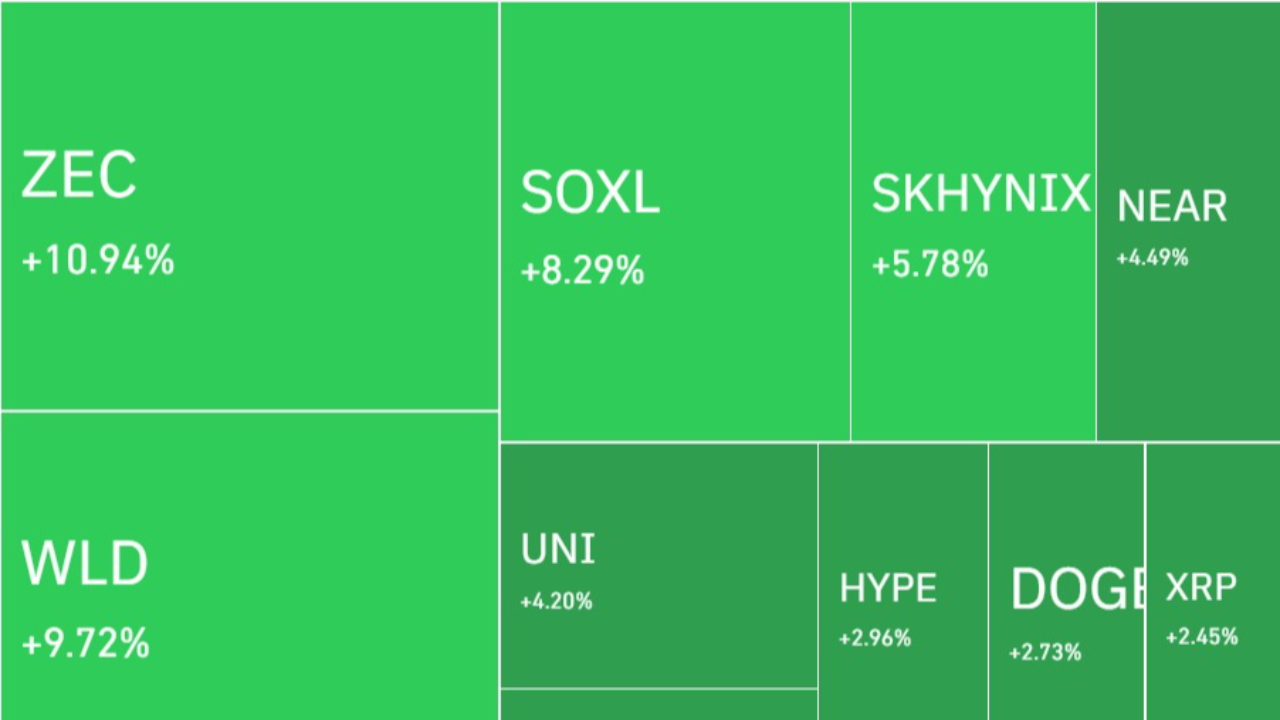
Folks, BTC is back at $82,670 and ETH is around $2,445, up 1.29% and 2.11% respectively over the past 24 hours; $ZEC rose 10.94%, while $WLD gained 9.72%. The rebound is spreading, but institutional capital is still clearly tilted toward BTC.
The latest complete ETF data, through the 19th, shows net inflows of $527 million for BTC, while ETH saw outflows of $103 million. BTC buying was mainly driven by IBIT, while some other funds continued to see redemptions. This looks more like a return to core-asset allocation, not enough yet to confirm an altcoin rally.
Last night, Brent crude fell from nearly $112 to $108.79 a barrel. Mediation talks between Iran and Pakistan eased supply concerns, and US Treasury yields fell as a result. The Dow rose 1%, while the Nasdaq was nearly flat, suggesting energy pressures have eased for now, but disagreements over AI financing and returns remain unresolved. This morning, oil prices moved back toward $110, and war risks could still repeatedly interrupt the recovery.
Gold (XAU) fell to around $4,126 last night: markets expect rates to remain unchanged in October, but are still betting on a tightening in December, so the interest-rate cost of holding gold has not gone away.
Today, watch whether BTC can hold above $83,250 and whether ETH can reclaim $2,470. If prices retreat after a rally to around $81,300 and $2,380, respectively, continue to treat the market as range-bound. Institutions have already bought BTC—will you follow them into core assets, or chase the altcoins with bigger gains? #Zcash24小时上涨8.5%
October 21, 2026 | Latest market analysis: $BTC saw major institutional buying.
Folks, BTC is back at $82,670 and ETH is around $2,445, up 1.29% and 2.11% respectively over the past 24 hours; $ZEC rose 10.94%, while $WLD gained 9.72%. The rebound is spreading, but institutional capital is still clearly tilted toward BTC.
The latest complete ETF data, through the 19th, shows net inflows of $527 million for BTC, while ETH saw outflows of $103 million. BTC buying was mainly driven by IBIT, while some other funds continued to see redemptions. This looks more like a return to core-asset allocation, not enough yet to confirm an altcoin rally.
Last night, Brent crude fell from nearly $112 to $108.79 a barrel. Mediation talks between Iran and Pakistan eased supply concerns, and US Treasury yields fell as a result. The Dow rose 1%, while the Nasdaq was nearly flat, suggesting energy pressures have eased for now, but disagreements over AI financing and returns remain unresolved. This morning, oil prices moved back toward $110, and war risks could still repeatedly interrupt the recovery.
Gold (XAU) fell to around $4,126 last night: markets expect rates to remain unchanged in October, but are still betting on a tightening in December, so the interest-rate cost of holding gold has not gone away.
Today, watch whether BTC can hold above $83,250 and whether ETH can reclaim $2,470. If prices retreat after a rally to around $81,300 and $2,380, respectively, continue to treat the market as range-bound. Institutions have already bought BTC—will you follow them into core assets, or chase the altcoins with bigger gains? #Zcash24小时上涨8.5%
Folks, BTC is back at $82,670 and ETH is around $2,445, up 1.29% and 2.11% respectively over the past 24 hours; $ZEC rose 10.94%, while $WLD gained 9.72%. The rebound is spreading, but institutional capital is still clearly tilted toward BTC.
The latest complete ETF data, through the 19th, shows net inflows of $527 million for BTC, while ETH saw outflows of $103 million. BTC buying was mainly driven by IBIT, while some other funds continued to see redemptions. This looks more like a return to core-asset allocation, not enough yet to confirm an altcoin rally.
Last night, Brent crude fell from nearly $112 to $108.79 a barrel. Mediation talks between Iran and Pakistan eased supply concerns, and US Treasury yields fell as a result. The Dow rose 1%, while the Nasdaq was nearly flat, suggesting energy pressures have eased for now, but disagreements over AI financing and returns remain unresolved. This morning, oil prices moved back toward $110, and war risks could still repeatedly interrupt the recovery.
Gold (XAU) fell to around $4,126 last night: markets expect rates to remain unchanged in October, but are still betting on a tightening in December, so the interest-rate cost of holding gold has not gone away.
Today, watch whether BTC can hold above $83,250 and whether ETH can reclaim $2,470. If prices retreat after a rally to around $81,300 and $2,380, respectively, continue to treat the market as range-bound. Institutions have already bought BTC—will you follow them into core assets, or chase the altcoins with bigger gains? #Zcash24小时上涨8.5%
412
🎙️ Binance Square Algorithm Update: How Can Creators Earn More?

End
15 m 38 s
3

BNB
Holding
-449.23
0
0
October 19, 2026 | Today’s latest market analysis: 30-day experiment turns 100U into 10,000U!
Hey everyone, as of this morning, BTC is back at $82,420 and ETH is around $2,424, up 1% and 0.8% respectively over the past 24 hours. $ZEC , $NEAR , and SUI are up around 2%–3%, but whether the rebound can continue depends on whether spot buyers step in once energy pressures ease.
The U.S. is discussing easing some sanctions on Russia. Brent crude fell to around $108 in early trading, while Nasdaq futures rose about 0.8%. However, reports of tankers striking mines in the Strait of Hormuz persist. For now, the drop in oil prices can only ease inflation concerns; the risk of war remains.
This week, $METAB and Tesla’s earnings reports will test whether AI investments can translate into revenue. A recovery in tech stocks could also affect risk appetite in the crypto market.
Last week’s fund flows: BTC and ETH spot ETFs saw net outflows of $228 million and $320 million, respectively. On Binance, the share of BTC long accounts recovered to around 65%, and funding rates were positive. Prices edged up, while leverage rebounded first—chasing the rally could still lead to a bumpy ride.
Gold (XAU) rose to around $4,181 as U.S. Treasury yields fell, showing that safe-haven positioning remains in place. For BTC, watch whether it can reclaim $82,800 with increased volume; for ETH, watch whether it can hold above $2,430. A break below the recent lows of $80,600 and $2,330 would weaken the recovery thesis.
After ETF trading resumes tonight, will institutions absorb the weekend’s positions, or have leveraged traders simply pushed prices up for everyone else? #纳指道指周度差距创2002年7月来最大
October 19, 2026 | Today’s latest market analysis: 30-day experiment turns 100U into 10,000U!
Hey everyone, as of this morning, BTC is back at $82,420 and ETH is around $2,424, up 1% and 0.8% respectively over the past 24 hours. $ZEC , $NEAR , and SUI are up around 2%–3%, but whether the rebound can continue depends on whether spot buyers step in once energy pressures ease.
The U.S. is discussing easing some sanctions on Russia. Brent crude fell to around $108 in early trading, while Nasdaq futures rose about 0.8%. However, reports of tankers striking mines in the Strait of Hormuz persist. For now, the drop in oil prices can only ease inflation concerns; the risk of war remains.
This week, $METAB and Tesla’s earnings reports will test whether AI investments can translate into revenue. A recovery in tech stocks could also affect risk appetite in the crypto market.
Last week’s fund flows: BTC and ETH spot ETFs saw net outflows of $228 million and $320 million, respectively. On Binance, the share of BTC long accounts recovered to around 65%, and funding rates were positive. Prices edged up, while leverage rebounded first—chasing the rally could still lead to a bumpy ride.
Gold (XAU) rose to around $4,181 as U.S. Treasury yields fell, showing that safe-haven positioning remains in place. For BTC, watch whether it can reclaim $82,800 with increased volume; for ETH, watch whether it can hold above $2,430. A break below the recent lows of $80,600 and $2,330 would weaken the recovery thesis.
After ETF trading resumes tonight, will institutions absorb the weekend’s positions, or have leveraged traders simply pushed prices up for everyone else? #纳指道指周度差距创2002年7月来最大
Hey everyone, as of this morning, BTC is back at $82,420 and ETH is around $2,424, up 1% and 0.8% respectively over the past 24 hours. $ZEC , $NEAR , and SUI are up around 2%–3%, but whether the rebound can continue depends on whether spot buyers step in once energy pressures ease.
The U.S. is discussing easing some sanctions on Russia. Brent crude fell to around $108 in early trading, while Nasdaq futures rose about 0.8%. However, reports of tankers striking mines in the Strait of Hormuz persist. For now, the drop in oil prices can only ease inflation concerns; the risk of war remains.
This week, $METAB and Tesla’s earnings reports will test whether AI investments can translate into revenue. A recovery in tech stocks could also affect risk appetite in the crypto market.
Last week’s fund flows: BTC and ETH spot ETFs saw net outflows of $228 million and $320 million, respectively. On Binance, the share of BTC long accounts recovered to around 65%, and funding rates were positive. Prices edged up, while leverage rebounded first—chasing the rally could still lead to a bumpy ride.
Gold (XAU) rose to around $4,181 as U.S. Treasury yields fell, showing that safe-haven positioning remains in place. For BTC, watch whether it can reclaim $82,800 with increased volume; for ETH, watch whether it can hold above $2,430. A break below the recent lows of $80,600 and $2,330 would weaken the recovery thesis.
After ETF trading resumes tonight, will institutions absorb the weekend’s positions, or have leveraged traders simply pushed prices up for everyone else? #纳指道指周度差距创2002年7月来最大
547
October 17, 2026|Today’s latest market update: The dollar weakened, but crypto markets failed to rally. What do you think?
Brothers and sisters, the dollar weakened overnight, yet the Nasdaq fell 2.1%, down 4.5% for the week. The market is worried about more than just rate hikes: after AI expansion is financed by borrowing, will revenues be enough to cover financing costs? $MU Micron fell 5.6%, while the Direxion Daily Semiconductor Bull 3X ETF (SOXL) dropped 10.28%. A slight dip in interest rates is no longer enough to bring investors back to chasing prices higher.
Risks to Middle Eastern shipping and concerns over Russian energy supplies pushed Brent crude up 3.7% overnight to $109.86. War squeezes corporate profits through higher energy costs and also limits the Fed’s room to ease. Gold $XAUT edged up to around $4,160 as the dollar retreated, but its gains were far weaker than oil’s, with safe-haven demand still constrained by high interest rates.
In early trading, BTC was around $81,460 and ETH around $2,420; ZEC fell 6.19%, NEAR 4.87%, and SUI 3.07%. The coins that led gains yesterday are leading losses again, showing the rebound lacks staying power. ETFs also lack confirmation: the latest complete figures, through the 15th, show just $5.1 million in BTC inflows and $60.3 million in ETH outflows. Data for the 16th is not yet complete, so missing figures should not be treated as zero outflows.
Over the weekend, watch whether BTC can hold above its recent low of $79,800 and reclaim $82,800; for ETH, first watch the $2,390–$2,490 range. If the dollar keeps falling but crypto prices still can’t get back on their feet, would you still call it a shakeout, or would you start doubting the buyers behind this rebound? #布伦特原油自5月来首次触及110美元
October 17, 2026|Today’s latest market update: The dollar weakened, but crypto markets failed to rally. What do you think?
Brothers and sisters, the dollar weakened overnight, yet the Nasdaq fell 2.1%, down 4.5% for the week. The market is worried about more than just rate hikes: after AI expansion is financed by borrowing, will revenues be enough to cover financing costs? $MU Micron fell 5.6%, while the Direxion Daily Semiconductor Bull 3X ETF (SOXL) dropped 10.28%. A slight dip in interest rates is no longer enough to bring investors back to chasing prices higher.
Risks to Middle Eastern shipping and concerns over Russian energy supplies pushed Brent crude up 3.7% overnight to $109.86. War squeezes corporate profits through higher energy costs and also limits the Fed’s room to ease. Gold $XAUT edged up to around $4,160 as the dollar retreated, but its gains were far weaker than oil’s, with safe-haven demand still constrained by high interest rates.
In early trading, BTC was around $81,460 and ETH around $2,420; ZEC fell 6.19%, NEAR 4.87%, and SUI 3.07%. The coins that led gains yesterday are leading losses again, showing the rebound lacks staying power. ETFs also lack confirmation: the latest complete figures, through the 15th, show just $5.1 million in BTC inflows and $60.3 million in ETH outflows. Data for the 16th is not yet complete, so missing figures should not be treated as zero outflows.
Over the weekend, watch whether BTC can hold above its recent low of $79,800 and reclaim $82,800; for ETH, first watch the $2,390–$2,490 range. If the dollar keeps falling but crypto prices still can’t get back on their feet, would you still call it a shakeout, or would you start doubting the buyers behind this rebound? #布伦特原油自5月来首次触及110美元
Brothers and sisters, the dollar weakened overnight, yet the Nasdaq fell 2.1%, down 4.5% for the week. The market is worried about more than just rate hikes: after AI expansion is financed by borrowing, will revenues be enough to cover financing costs? $MU Micron fell 5.6%, while the Direxion Daily Semiconductor Bull 3X ETF (SOXL) dropped 10.28%. A slight dip in interest rates is no longer enough to bring investors back to chasing prices higher.
Risks to Middle Eastern shipping and concerns over Russian energy supplies pushed Brent crude up 3.7% overnight to $109.86. War squeezes corporate profits through higher energy costs and also limits the Fed’s room to ease. Gold $XAUT edged up to around $4,160 as the dollar retreated, but its gains were far weaker than oil’s, with safe-haven demand still constrained by high interest rates.
In early trading, BTC was around $81,460 and ETH around $2,420; ZEC fell 6.19%, NEAR 4.87%, and SUI 3.07%. The coins that led gains yesterday are leading losses again, showing the rebound lacks staying power. ETFs also lack confirmation: the latest complete figures, through the 15th, show just $5.1 million in BTC inflows and $60.3 million in ETH outflows. Data for the 16th is not yet complete, so missing figures should not be treated as zero outflows.
Over the weekend, watch whether BTC can hold above its recent low of $79,800 and reclaim $82,800; for ETH, first watch the $2,390–$2,490 range. If the dollar keeps falling but crypto prices still can’t get back on their feet, would you still call it a shakeout, or would you start doubting the buyers behind this rebound? #布伦特原油自5月来首次触及110美元
963
WTF! Is This Guy Real?This guy claims he held Bitcoin since 2013, made a 1000x return and recreated his old viral video 11 years later. Pretty insane if true.But is this story actually real? Anyone know who he is? #比特币现货ETF单日净流出2.61亿美元 $BTC
WTF! Is This Guy Real?This guy claims he held Bitcoin since 2013, made a 1000x return and recreated his old viral video 11 years later. Pretty insane if true.But is this story actually real? Anyone know who he is? #比特币现货ETF单日净流出2.61亿美元 $BTC
2
99
Is Software dead? I would consider myself very tech savvy. I've built computers, I repair stuff, I can microsolder, I self host all my own services, I've written scripts to automate tasks.
I wouldn't even know where to start vibe-coding my own software.
Everyday people aren't building their own software. That's an absurd proposition.
Edit - for clarity, I'm in no way suggesting everyday people aren't or can't vibecode their own stuff. I'm saying that the proposition "everyone just builds their own software" is incorrect. It's a statement from someone living in a bubble.
If I run a golf shop, and see people buying golf clubs all day, does that mean everyone is buying golf clubs? Or does that just mean I'm in an environment where the people I interact with are more likely to be buying golf clubs? how do u think? #Aİ $NEAR
{spot}(AAPLBUSDT)
Is Software dead? I would consider myself very tech savvy. I've built computers, I repair stuff, I can microsolder, I self host all my own services, I've written scripts to automate tasks.
I wouldn't even know where to start vibe-coding my own software.
Everyday people aren't building their own software. That's an absurd proposition.
Edit - for clarity, I'm in no way suggesting everyday people aren't or can't vibecode their own stuff. I'm saying that the proposition "everyone just builds their own software" is incorrect. It's a statement from someone living in a bubble.
If I run a golf shop, and see people buying golf clubs all day, does that mean everyone is buying golf clubs? Or does that just mean I'm in an environment where the people I interact with are more likely to be buying golf clubs? how do u think? #Aİ $NEAR
I wouldn't even know where to start vibe-coding my own software.
Everyday people aren't building their own software. That's an absurd proposition.
Edit - for clarity, I'm in no way suggesting everyday people aren't or can't vibecode their own stuff. I'm saying that the proposition "everyone just builds their own software" is incorrect. It's a statement from someone living in a bubble.
If I run a golf shop, and see people buying golf clubs all day, does that mean everyone is buying golf clubs? Or does that just mean I'm in an environment where the people I interact with are more likely to be buying golf clubs? how do u think? #Aİ $NEAR
249
October 16, 2026 | Today’s market update: Global inflation continues to heat up. U.S. September PPI surged 1.3% month over month, its biggest increase in four and a half years, while retail sales rose 0.8%, also above the 0.3% forecast. Strangely, Treasury yields and the dollar fell instead, while the Dow gained 1.1% and the S&P 500 rose 0.3%. The reason isn’t that inflation risks have disappeared, but that Fed officials signaled there’s no need for an immediate rate hike. The market is starting to price in policymakers’ tolerance for the situation, rather than simply chasing the data with rate hikes.
$BTC briefly fell below $80,000 before recovering to $82,100, while $ETH returned to $2,430. $NEAR rose 10.82%, $ZEC gained 7.53%, and $UNI climbed 4.16%—a high-beta recovery following liquidations. Around $916 million in positions were liquidated across the market over the past 24 hours, including roughly $748 million in longs. Meanwhile, spot BTC and ETH ETFs saw outflows of $7.6 million and $18.3 million, respectively, so the rebound still lacks sustained spot buying.
Gold rebounded 1.2% to $4,153, helped by the retreat in the dollar and yields. The Middle East conflict continues to escalate: Houthi forces attacked Yemeni government facilities and Saudi infrastructure, while Brent crude remains elevated at $104–$106. Energy-driven inflation is still in play.
Today, I’ll be watching BTC’s $80,000 support and $82,500 resistance. If bad news keeps failing to push prices down, the market may be entering a recovery phase. But if ETF outflows grow, last night’s rebound may have been just another chance for trapped holders to exit. Would you trust the price action or the fund flows? #以太坊清算额占加密市场60%
October 16, 2026 | Today’s market update: Global inflation continues to heat up. U.S. September PPI surged 1.3% month over month, its biggest increase in four and a half years, while retail sales rose 0.8%, also above the 0.3% forecast. Strangely, Treasury yields and the dollar fell instead, while the Dow gained 1.1% and the S&P 500 rose 0.3%. The reason isn’t that inflation risks have disappeared, but that Fed officials signaled there’s no need for an immediate rate hike. The market is starting to price in policymakers’ tolerance for the situation, rather than simply chasing the data with rate hikes.
$BTC briefly fell below $80,000 before recovering to $82,100, while $ETH returned to $2,430. $NEAR rose 10.82%, $ZEC gained 7.53%, and $UNI climbed 4.16%—a high-beta recovery following liquidations. Around $916 million in positions were liquidated across the market over the past 24 hours, including roughly $748 million in longs. Meanwhile, spot BTC and ETH ETFs saw outflows of $7.6 million and $18.3 million, respectively, so the rebound still lacks sustained spot buying.
Gold rebounded 1.2% to $4,153, helped by the retreat in the dollar and yields. The Middle East conflict continues to escalate: Houthi forces attacked Yemeni government facilities and Saudi infrastructure, while Brent crude remains elevated at $104–$106. Energy-driven inflation is still in play.
Today, I’ll be watching BTC’s $80,000 support and $82,500 resistance. If bad news keeps failing to push prices down, the market may be entering a recovery phase. But if ETF outflows grow, last night’s rebound may have been just another chance for trapped holders to exit. Would you trust the price action or the fund flows? #以太坊清算额占加密市场60%
$BTC briefly fell below $80,000 before recovering to $82,100, while $ETH returned to $2,430. $NEAR rose 10.82%, $ZEC gained 7.53%, and $UNI climbed 4.16%—a high-beta recovery following liquidations. Around $916 million in positions were liquidated across the market over the past 24 hours, including roughly $748 million in longs. Meanwhile, spot BTC and ETH ETFs saw outflows of $7.6 million and $18.3 million, respectively, so the rebound still lacks sustained spot buying.
Gold rebounded 1.2% to $4,153, helped by the retreat in the dollar and yields. The Middle East conflict continues to escalate: Houthi forces attacked Yemeni government facilities and Saudi infrastructure, while Brent crude remains elevated at $104–$106. Energy-driven inflation is still in play.
Today, I’ll be watching BTC’s $80,000 support and $82,500 resistance. If bad news keeps failing to push prices down, the market may be entering a recovery phase. But if ETF outflows grow, last night’s rebound may have been just another chance for trapped holders to exit. Would you trust the price action or the fund flows? #以太坊清算额占加密市场60%
592
October 15, 2026 | Inflation and war pressures are pushing markets to price in higher rates again
Guys, last night's drop wasn't just a shakeout. U.S. headline CPI rose to 3.7% year over year in September, while core CPI came in at 2.6%; both were above expectations. The 2-year Treasury yield jumped 7.2 basis points to 4.87%, and the Nasdaq fell 1.9%. Investors cut valuations on tech stocks and reduced their Crypto risk exposure at the same time, sending $BTC down to $80,860 and $ETH down to $2,360.
Tensions in the Middle East added to inflationary pressure. Houthi militants attacked Saudi Aramco headquarters, and two ships were attacked in the Strait of Hormuz. Brent crude rose to $106.06 overnight. It has since eased to $104.67 this morning, but the risk premium on transport and energy has yet to disappear.
Across the market, $ZEC fell 14.55%, $UNI dropped 9.61%, and $ENA slid 13.40%—a sign that selling is still concentrated in coins that had previously rallied strongly. Around $214 million in positions were liquidated over the past 24 hours, including $175 million in long positions. BTC funding rates have turned negative and open interest has declined, suggesting leverage is being flushed out. But spot ETFs saw inflows of just $2.2 million, so buying support remains weak.
Gold also failed to act as a safe haven, falling 1.8% to $4,084 under pressure from the dollar and yields. Today, watch whether BTC can hold $80,000 and ETH can hold $2,350. If PPI comes in hot again tonight, which will buckle first—high-valuation tech stocks, or Crypto just after a round of liquidations? #9月CPI来袭原油美债走势如何 #美国9月CPI升至3.7%
October 15, 2026 | Inflation and war pressures are pushing markets to price in higher rates again
Guys, last night's drop wasn't just a shakeout. U.S. headline CPI rose to 3.7% year over year in September, while core CPI came in at 2.6%; both were above expectations. The 2-year Treasury yield jumped 7.2 basis points to 4.87%, and the Nasdaq fell 1.9%. Investors cut valuations on tech stocks and reduced their Crypto risk exposure at the same time, sending $BTC down to $80,860 and $ETH down to $2,360.
Tensions in the Middle East added to inflationary pressure. Houthi militants attacked Saudi Aramco headquarters, and two ships were attacked in the Strait of Hormuz. Brent crude rose to $106.06 overnight. It has since eased to $104.67 this morning, but the risk premium on transport and energy has yet to disappear.
Across the market, $ZEC fell 14.55%, $UNI dropped 9.61%, and $ENA slid 13.40%—a sign that selling is still concentrated in coins that had previously rallied strongly. Around $214 million in positions were liquidated over the past 24 hours, including $175 million in long positions. BTC funding rates have turned negative and open interest has declined, suggesting leverage is being flushed out. But spot ETFs saw inflows of just $2.2 million, so buying support remains weak.
Gold also failed to act as a safe haven, falling 1.8% to $4,084 under pressure from the dollar and yields. Today, watch whether BTC can hold $80,000 and ETH can hold $2,350. If PPI comes in hot again tonight, which will buckle first—high-valuation tech stocks, or Crypto just after a round of liquidations? #9月CPI来袭原油美债走势如何 #美国9月CPI升至3.7%
Guys, last night's drop wasn't just a shakeout. U.S. headline CPI rose to 3.7% year over year in September, while core CPI came in at 2.6%; both were above expectations. The 2-year Treasury yield jumped 7.2 basis points to 4.87%, and the Nasdaq fell 1.9%. Investors cut valuations on tech stocks and reduced their Crypto risk exposure at the same time, sending $BTC down to $80,860 and $ETH down to $2,360.
Tensions in the Middle East added to inflationary pressure. Houthi militants attacked Saudi Aramco headquarters, and two ships were attacked in the Strait of Hormuz. Brent crude rose to $106.06 overnight. It has since eased to $104.67 this morning, but the risk premium on transport and energy has yet to disappear.
Across the market, $ZEC fell 14.55%, $UNI dropped 9.61%, and $ENA slid 13.40%—a sign that selling is still concentrated in coins that had previously rallied strongly. Around $214 million in positions were liquidated over the past 24 hours, including $175 million in long positions. BTC funding rates have turned negative and open interest has declined, suggesting leverage is being flushed out. But spot ETFs saw inflows of just $2.2 million, so buying support remains weak.
Gold also failed to act as a safe haven, falling 1.8% to $4,084 under pressure from the dollar and yields. Today, watch whether BTC can hold $80,000 and ETH can hold $2,350. If PPI comes in hot again tonight, which will buckle first—high-valuation tech stocks, or Crypto just after a round of liquidations? #9月CPI来袭原油美债走势如何 #美国9月CPI升至3.7%
215
Log in to explore more content
Join global crypto users on Binance Square
⚡️ Get latest and useful information about crypto.
💬 Trusted by the world’s largest crypto exchange.
👍 Discover real insights from verified creators.
Email / Phone number