
追逐梦想得熊猫
306 Posts

追逐梦想得熊猫
Report
Block User
我相信趋势的力量与时间的沉淀,利润源于耐心的积累。在波动中寻求机会,始终坚持“慢即是快”的交易理念,情绪稳定,冷静应对市场变化,让每一次决策都成为成功的基石。(关注必回,互关)
9.2K+ Following
5.5K+ Followers
353 Liked
Posts
All
Quotes
Videos
·
--
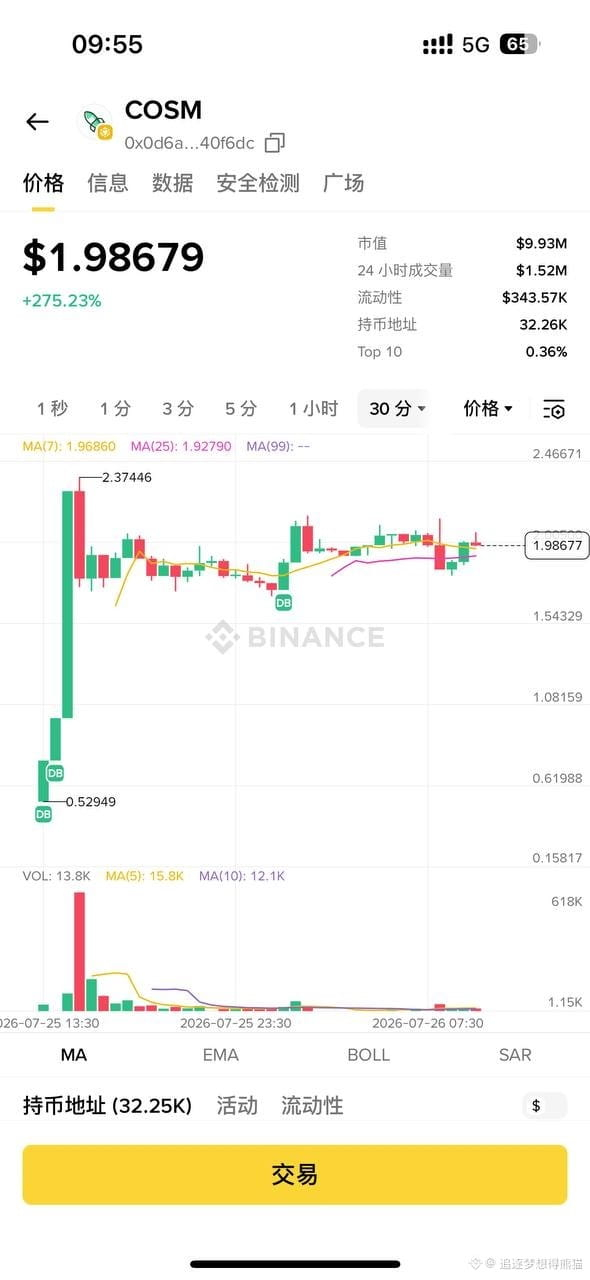
🏃 During the ecosystem’s launch phase, whether you enter or not makes a difference that isn’t slight.
COSM’s early-mover advantages are starting to take shape:
🔹 The earlier a native credential is activated, the higher the identity weight
🔹 The earlier you participate in the rewards pool, the more obvious the cumulative effect
🔹 The earlier you keep up with benefit activities, the richer the stacked rewards
🔹 The earlier you secure ecosystem resources, the more at ease later conversions become
The first arrivals take the spots, while the later arrivals look for spots.
As the ecosystem matures, the barriers for early participants have already been built.
This is the moment when the positions haven’t been fully taken yet.
#COSM #BTC
🏃 During the ecosystem’s launch phase, whether you enter or not makes a difference that isn’t slight.
COSM’s early-mover advantages are starting to take shape:
🔹 The earlier a native credential is activated, the higher the identity weight
🔹 The earlier you participate in the rewards pool, the more obvious the cumulative effect
🔹 The earlier you keep up with benefit activities, the richer the stacked rewards
🔹 The earlier you secure ecosystem resources, the more at ease later conversions become
The first arrivals take the spots, while the later arrivals look for spots.
As the ecosystem matures, the barriers for early participants have already been built.
This is the moment when the positions haven’t been fully taken yet.
#COSM #BTC
COSM’s early-mover advantages are starting to take shape:
🔹 The earlier a native credential is activated, the higher the identity weight
🔹 The earlier you participate in the rewards pool, the more obvious the cumulative effect
🔹 The earlier you keep up with benefit activities, the richer the stacked rewards
🔹 The earlier you secure ecosystem resources, the more at ease later conversions become
The first arrivals take the spots, while the later arrivals look for spots.
As the ecosystem matures, the barriers for early participants have already been built.
This is the moment when the positions haven’t been fully taken yet.
#COSM #BTC
1
120
·
--
In these past few years in the crypto world, I’ve changed my deposit and withdrawal channels quite a few times.
I’ve stepped into traps and paid tuition. Some platforms looked convenient at first, but in the end, they either got stuck because of risk control and withdrawal issues—or even just ran away. It has made me increasingly realize one thing: capital safety always comes first.
Now I’m more inclined to choose platforms that are compliant and have been operating for a longer time.
Recently I tried BiyaPay and these are the parts I like most:
• USDT can be used directly to invest in US stocks, without first converting it to fiat money and then going through multiple transfers;
• 0 commission for US stock trading, which is friendlier for users with smaller amounts;
• For my current withdrawals, I use a Hong Kong card—the overall speed meets my expectations, and the process is also fairly smooth.
One more habit I’d like to share: before every deposit or withdrawal, I check the platform’s Help Center or the latest announcements first. Rules and supported channels may change, so confirming in advance can help you avoid a lot of trouble.
What channels do you usually use for deposits and withdrawals? Feel free to share and exchange ideas. But no matter which platform you choose, safety matters more than speed.
In these past few years in the crypto world, I’ve changed my deposit and withdrawal channels quite a few times.
I’ve stepped into traps and paid tuition. Some platforms looked convenient at first, but in the end, they either got stuck because of risk control and withdrawal issues—or even just ran away. It has made me increasingly realize one thing: capital safety always comes first.
Now I’m more inclined to choose platforms that are compliant and have been operating for a longer time.
Recently I tried BiyaPay and these are the parts I like most:
• USDT can be used directly to invest in US stocks, without first converting it to fiat money and then going through multiple transfers;
• 0 commission for US stock trading, which is friendlier for users with smaller amounts;
• For my current withdrawals, I use a Hong Kong card—the overall speed meets my expectations, and the process is also fairly smooth.
One more habit I’d like to share: before every deposit or withdrawal, I check the platform’s Help Center or the latest announcements first. Rules and supported channels may change, so confirming in advance can help you avoid a lot of trouble.
What channels do you usually use for deposits and withdrawals? Feel free to share and exchange ideas. But no matter which platform you choose, safety matters more than speed.
I’ve stepped into traps and paid tuition. Some platforms looked convenient at first, but in the end, they either got stuck because of risk control and withdrawal issues—or even just ran away. It has made me increasingly realize one thing: capital safety always comes first.
Now I’m more inclined to choose platforms that are compliant and have been operating for a longer time.
Recently I tried BiyaPay and these are the parts I like most:
• USDT can be used directly to invest in US stocks, without first converting it to fiat money and then going through multiple transfers;
• 0 commission for US stock trading, which is friendlier for users with smaller amounts;
• For my current withdrawals, I use a Hong Kong card—the overall speed meets my expectations, and the process is also fairly smooth.
One more habit I’d like to share: before every deposit or withdrawal, I check the platform’s Help Center or the latest announcements first. Rules and supported channels may change, so confirming in advance can help you avoid a lot of trouble.
What channels do you usually use for deposits and withdrawals? Feel free to share and exchange ideas. But no matter which platform you choose, safety matters more than speed.

1
137
·
--
Let’s tally it up: over the past six months, I made at least five calls on the market, but didn’t make any money.
The reason is simple: the money wasn’t in the right place at the right time.
Crypto withdrawals to the U.S. stock market take as fast as two days, or as long as a week. By the time the funds are enough, the market move is already over.
Later, I put part of my assets on BiyaPay. The biggest change I noticed was:
Near real-time capital switching (directly swap USDT to U.S. stocks—no overseas account required)
Controllable costs (U.S. stocks with 0 commission + crypto limit orders with 0 commission)
Unified management across multiple markets (no need to check three different apps to piece together your positions)
Plus, there are now World Cup promotions— the more you trade, the more rewards you get, further reducing trading costs.
In the long run, improving prediction accuracy consistently is hard, but trading efficiency can be actively optimized.
That’s the kind of “competitive advantage” ordinary people can actually control.
Let’s tally it up: over the past six months, I made at least five calls on the market, but didn’t make any money.
The reason is simple: the money wasn’t in the right place at the right time.
Crypto withdrawals to the U.S. stock market take as fast as two days, or as long as a week. By the time the funds are enough, the market move is already over.
Later, I put part of my assets on BiyaPay. The biggest change I noticed was:
Near real-time capital switching (directly swap USDT to U.S. stocks—no overseas account required)
Controllable costs (U.S. stocks with 0 commission + crypto limit orders with 0 commission)
Unified management across multiple markets (no need to check three different apps to piece together your positions)
Plus, there are now World Cup promotions— the more you trade, the more rewards you get, further reducing trading costs.
In the long run, improving prediction accuracy consistently is hard, but trading efficiency can be actively optimized.
That’s the kind of “competitive advantage” ordinary people can actually control.
The reason is simple: the money wasn’t in the right place at the right time.
Crypto withdrawals to the U.S. stock market take as fast as two days, or as long as a week. By the time the funds are enough, the market move is already over.
Later, I put part of my assets on BiyaPay. The biggest change I noticed was:
Near real-time capital switching (directly swap USDT to U.S. stocks—no overseas account required)
Controllable costs (U.S. stocks with 0 commission + crypto limit orders with 0 commission)
Unified management across multiple markets (no need to check three different apps to piece together your positions)
Plus, there are now World Cup promotions— the more you trade, the more rewards you get, further reducing trading costs.
In the long run, improving prediction accuracy consistently is hard, but trading efficiency can be actively optimized.
That’s the kind of “competitive advantage” ordinary people can actually control.
1
1
103
·
--
The World Cup is here—watch the games and maybe grab a little bonus along the way.
While watching, I suddenly thought of something: during the World Cup, market volatility isn’t small, and USDT sitting in your account is just sitting there.
Recently I’ve been using a platform called BiyaPay, and I found that it has a World Cup promotion:
Top up or trade up to a certain amount, and you’ll be rewarded with USDC. The popular prizes include VIP box viewing passes for the World Cup final.
To be honest, I’ve been using this platform for a while, and my biggest takeaway is: swapping USDT to USD, HKD, and US stocks doesn’t require withdrawals—you can handle it directly within the platform.
It’s suitable for people who don’t want to convert crypto into fiat and then make a remittance. Deposit/withdrawal efficiency is a bit higher.
The platform also offers TradFi perpetual futures, digital-asset spot trading, and international remittance, as well as a debit card.
I’m not sure when the promotion ends—if you’re interested, check the event details for yourself.
Not a call to trade, just sharing—do a little something while watching the games. After all, the USDC is in your own wallet.
@BIYAPAYOFFICIAL
The World Cup is here—watch the games and maybe grab a little bonus along the way.
While watching, I suddenly thought of something: during the World Cup, market volatility isn’t small, and USDT sitting in your account is just sitting there.
Recently I’ve been using a platform called BiyaPay, and I found that it has a World Cup promotion:
Top up or trade up to a certain amount, and you’ll be rewarded with USDC. The popular prizes include VIP box viewing passes for the World Cup final.
To be honest, I’ve been using this platform for a while, and my biggest takeaway is: swapping USDT to USD, HKD, and US stocks doesn’t require withdrawals—you can handle it directly within the platform.
It’s suitable for people who don’t want to convert crypto into fiat and then make a remittance. Deposit/withdrawal efficiency is a bit higher.
The platform also offers TradFi perpetual futures, digital-asset spot trading, and international remittance, as well as a debit card.
I’m not sure when the promotion ends—if you’re interested, check the event details for yourself.
Not a call to trade, just sharing—do a little something while watching the games. After all, the USDC is in your own wallet.
@BIYAPAYOFFICIAL
While watching, I suddenly thought of something: during the World Cup, market volatility isn’t small, and USDT sitting in your account is just sitting there.
Recently I’ve been using a platform called BiyaPay, and I found that it has a World Cup promotion:
Top up or trade up to a certain amount, and you’ll be rewarded with USDC. The popular prizes include VIP box viewing passes for the World Cup final.
To be honest, I’ve been using this platform for a while, and my biggest takeaway is: swapping USDT to USD, HKD, and US stocks doesn’t require withdrawals—you can handle it directly within the platform.
It’s suitable for people who don’t want to convert crypto into fiat and then make a remittance. Deposit/withdrawal efficiency is a bit higher.
The platform also offers TradFi perpetual futures, digital-asset spot trading, and international remittance, as well as a debit card.
I’m not sure when the promotion ends—if you’re interested, check the event details for yourself.
Not a call to trade, just sharing—do a little something while watching the games. After all, the USDC is in your own wallet.
@BIYAPAYOFFICIAL

1
102
·
--
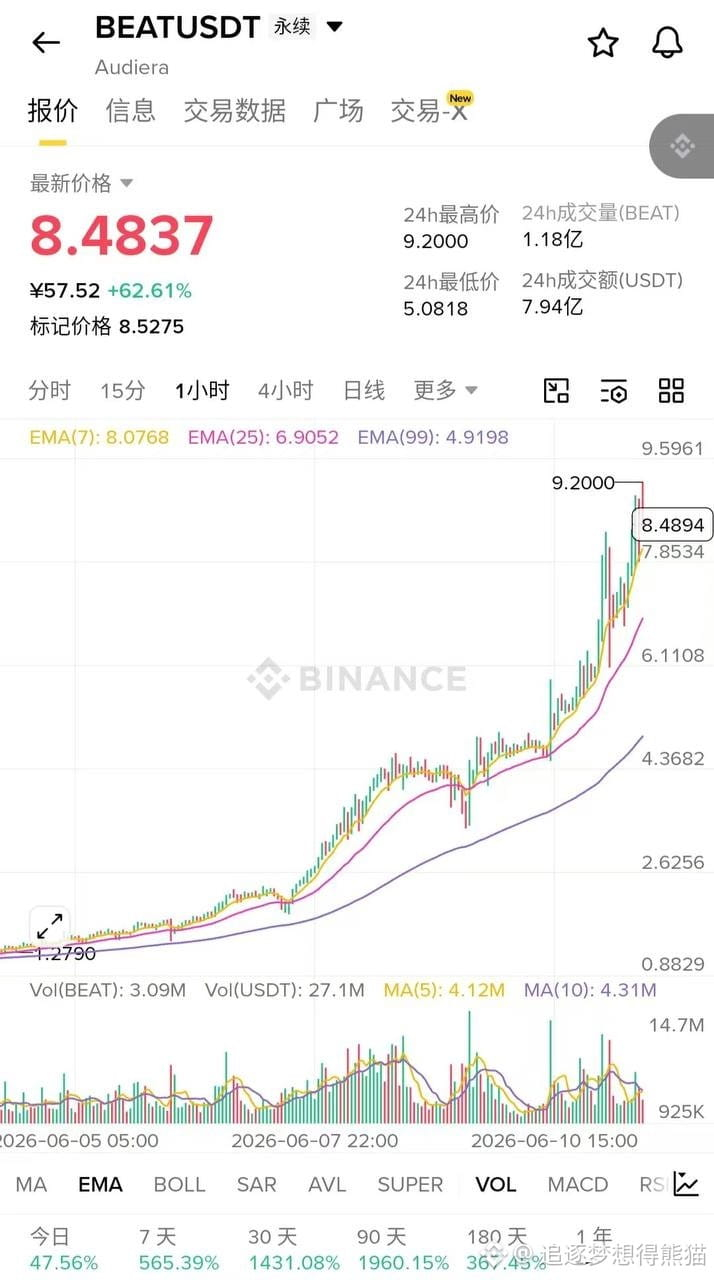
I've always believed that the biggest allure of the market is that it consistently outpaces the understanding of most traders. When everyone starts to talk about a project, the price has often already pumped significantly. Right now, $BEAT is hitting $8. This is a classic example of the market leading the narrative. $BNB #binance $BEAT
I've always believed that the biggest allure of the market is that it consistently outpaces the understanding of most traders. When everyone starts to talk about a project, the price has often already pumped significantly. Right now, $BEAT is hitting $8. This is a classic example of the market leading the narrative. $BNB #binance $BEAT
1
3
306
·
--
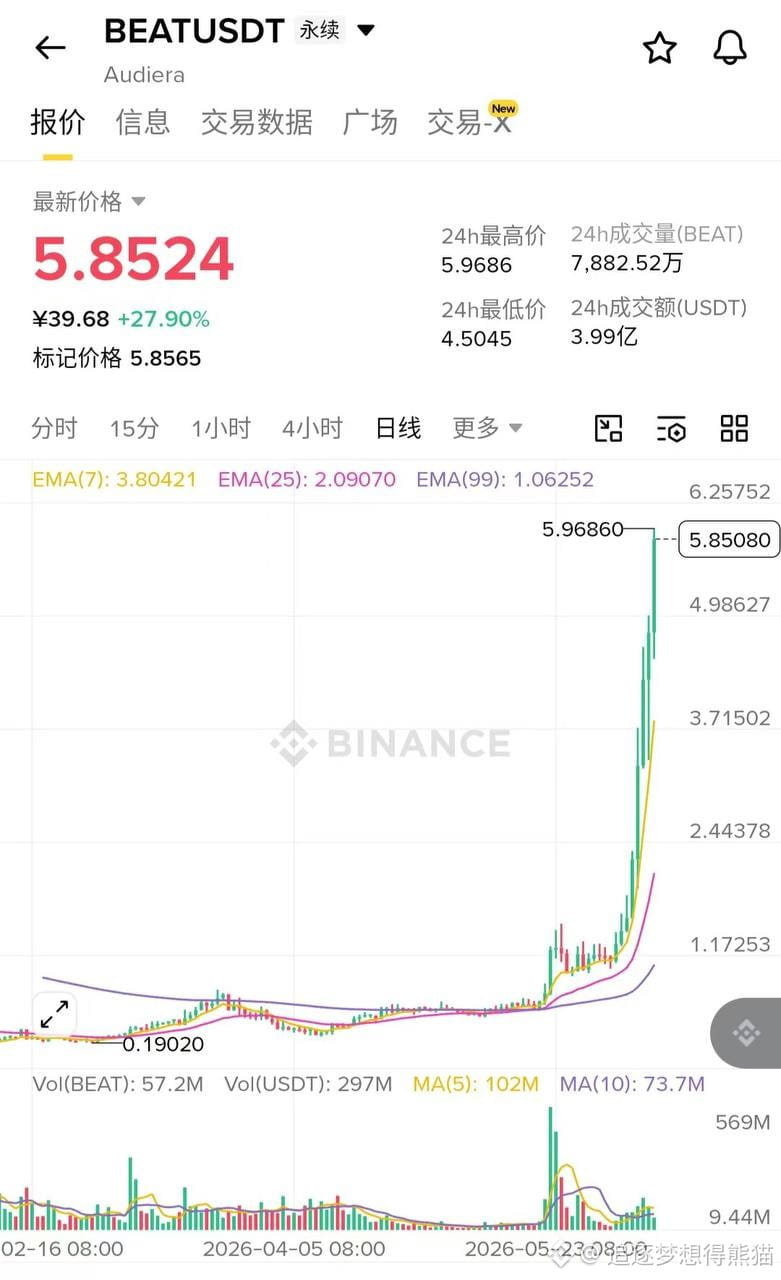
The most magical part about hitting an all-time high:
Yesterday it looked pricey.
Today, looking back, it seems cheap again.
$BEAT is right at this stage.
$BNB #binance $BEAT
The most magical part about hitting an all-time high:
Yesterday it looked pricey.
Today, looking back, it seems cheap again.
$BEAT is right at this stage.
$BNB #binance $BEAT
Yesterday it looked pricey.
Today, looking back, it seems cheap again.
$BEAT is right at this stage.
$BNB #binance $BEAT
1
324
·
--
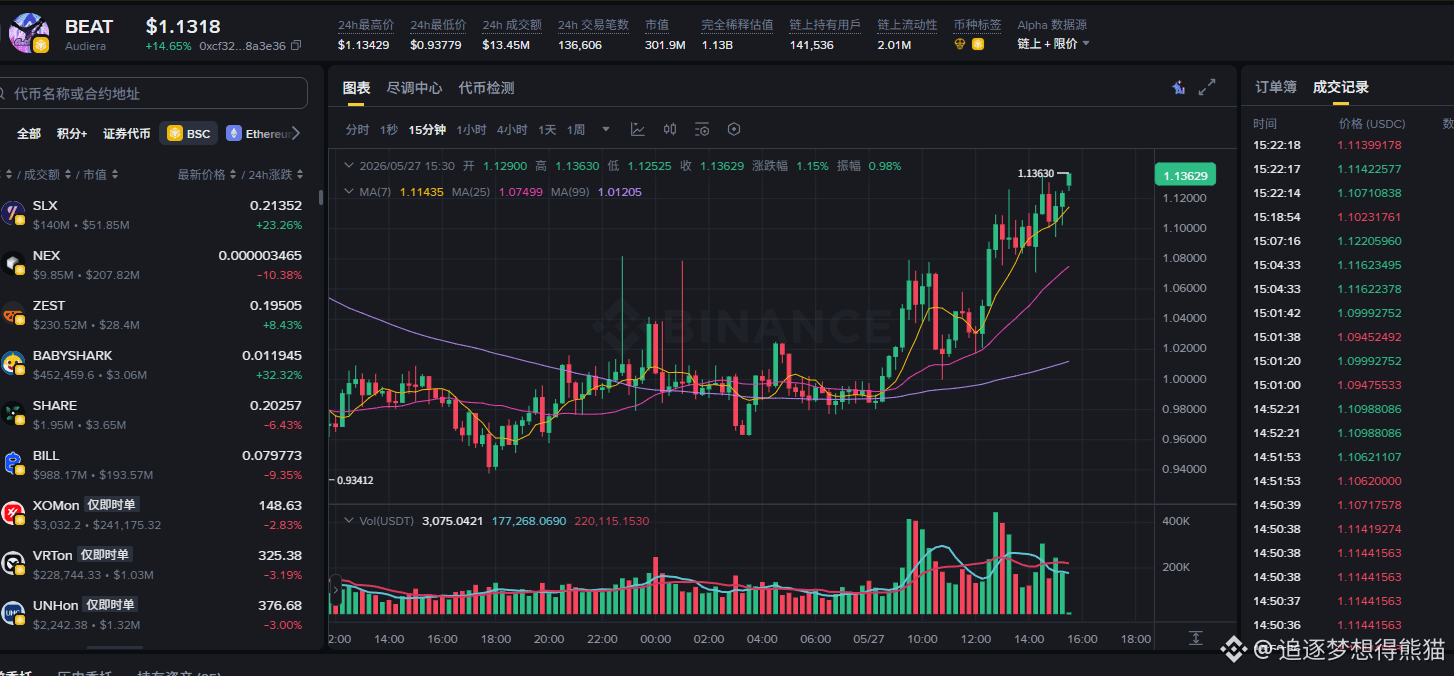
$BEAT The recent on-chain data is pretty interesting.
During the upward trend, retail investors have been continuously piling in, with multiple cycles of buy orders connecting smoothly, showing no significant gaps.
Looking at Buyer Retention: 74.39%.
In plain English, this data basically says:
Most of the folks who bought in haven't sold out.
Not only haven't they sold, but many are still participating and adding to their positions.
Market sentiment is like a fire that hasn't gone out, still pushing the heat higher. 🔥
$BEAT
{alpha}(560xcf3232b85b43bca90e51d38cc06cc8bb8c8a3e36)
$BEAT The recent on-chain data is pretty interesting.
During the upward trend, retail investors have been continuously piling in, with multiple cycles of buy orders connecting smoothly, showing no significant gaps.
Looking at Buyer Retention: 74.39%.
In plain English, this data basically says:
Most of the folks who bought in haven't sold out.
Not only haven't they sold, but many are still participating and adding to their positions.
Market sentiment is like a fire that hasn't gone out, still pushing the heat higher. 🔥
$BEAT
During the upward trend, retail investors have been continuously piling in, with multiple cycles of buy orders connecting smoothly, showing no significant gaps.
Looking at Buyer Retention: 74.39%.
In plain English, this data basically says:
Most of the folks who bought in haven't sold out.
Not only haven't they sold, but many are still participating and adding to their positions.
Market sentiment is like a fire that hasn't gone out, still pushing the heat higher. 🔥
$BEAT
3
606
·
--
Tonight, the presale of Clutch DEX officially starts at 21:00. I briefly looked at the rules, and the structure this time is quite attractive: Soft Cap 1500 BNB + 1 million community fund, plus an insurance pool mechanism, making the overall design more oriented towards long-term ecological sustainability rather than short-term hype. Additionally, the project combines prediction markets with World Cup scenarios, which is relatively rare in DeFi, and community participation may be quite high in the future. I have already made a small attempt, acquiring the Genesis NFT for 0.4 BNB to secure a position temporarily. Those interested can check the rules and decide.
Join the initial channel:
https://web3.clutchdex.com/?invite_code=E001E4
Referral code: E001E4
DYOR | Cryptocurrency investment is high risk
Tonight, the presale of Clutch DEX officially starts at 21:00. I briefly looked at the rules, and the structure this time is quite attractive: Soft Cap 1500 BNB + 1 million community fund, plus an insurance pool mechanism, making the overall design more oriented towards long-term ecological sustainability rather than short-term hype. Additionally, the project combines prediction markets with World Cup scenarios, which is relatively rare in DeFi, and community participation may be quite high in the future. I have already made a small attempt, acquiring the Genesis NFT for 0.4 BNB to secure a position temporarily. Those interested can check the rules and decide.
Join the initial channel:
https://web3.clutchdex.com/?invite_code=E001E4
Referral code: E001E4
DYOR | Cryptocurrency investment is high risk
Join the initial channel:
https://web3.clutchdex.com/?invite_code=E001E4
Referral code: E001E4
DYOR | Cryptocurrency investment is high risk
5
67
·
--
Standing at a new time coordinate and looking back at the past year, the market resembles a turbulent sea, sometimes calm and sometimes surging with waves. Some chase after gains and losses in their emotions, while others slowly refine their understanding in the midst of fluctuations. The real gap is never about one or two judgments but rather an understanding of cycles and mastery of rhythm.
In the new year, I still believe in two things.
First, volatility will not disappear. Whether it’s stocks, Hong Kong stocks, or crypto assets, prices always swing between emotions and expectations. Macroeconomic policies, changes in liquidity, and geopolitical environments can all become short-term catalysts. The market will not become gentle just because we wish for stability.
Second, opportunities will not be absent. Every adjustment is essentially a process of reallocation of chips. When valuations return to rationality, and funds complete their turnover, new main lines will brew amidst the divergences. What truly matters is not predicting every rise and fall but being able to identify the direction when trends form.
In 2026, what I look forward to more is structural growth.
Technological innovation remains the core focus of global capital, whether it’s the expansion of AI computing power, the upgrade of semiconductors, or the evolution of the Web3 ecosystem. The underlying logic revolves around efficiency improvement and value reconstruction. The crypto world is also undergoing a transition from conceptual speculation to practical application; only projects that genuinely solve problems can transcend cycles.
In the new year, I hope that I, and you in front of the screen, can achieve three things:
First, establish a clear investment system. Clarify position management, risk boundaries, and profit-taking and stop-loss rules, so that decisions are not hijacked by emotions.
Second, maintain continuous learning. Understand industry trends rather than just fixate on price fluctuations. Look at financial reports, on-chain data, and policy directions, transforming information into cognitive advantages.
Third, extend the time dimension. Do not use three days of fluctuations to negate three years of trends. True big opportunities often require time to settle.
The market will continue to fluctuate; this is the norm; growth will happen over time; this is the law. We cannot control the external environment, but we can control our own rhythm and mindset.
In 2026, I do not seek the myth of getting rich quickly, but only hope for steady progress.
Maintain the rhythm, see the direction clearly, and may we all walk further and more steadily.
Standing at a new time coordinate and looking back at the past year, the market resembles a turbulent sea, sometimes calm and sometimes surging with waves. Some chase after gains and losses in their emotions, while others slowly refine their understanding in the midst of fluctuations. The real gap is never about one or two judgments but rather an understanding of cycles and mastery of rhythm.
In the new year, I still believe in two things.
First, volatility will not disappear. Whether it’s stocks, Hong Kong stocks, or crypto assets, prices always swing between emotions and expectations. Macroeconomic policies, changes in liquidity, and geopolitical environments can all become short-term catalysts. The market will not become gentle just because we wish for stability.
Second, opportunities will not be absent. Every adjustment is essentially a process of reallocation of chips. When valuations return to rationality, and funds complete their turnover, new main lines will brew amidst the divergences. What truly matters is not predicting every rise and fall but being able to identify the direction when trends form.
In 2026, what I look forward to more is structural growth.
Technological innovation remains the core focus of global capital, whether it’s the expansion of AI computing power, the upgrade of semiconductors, or the evolution of the Web3 ecosystem. The underlying logic revolves around efficiency improvement and value reconstruction. The crypto world is also undergoing a transition from conceptual speculation to practical application; only projects that genuinely solve problems can transcend cycles.
In the new year, I hope that I, and you in front of the screen, can achieve three things:
First, establish a clear investment system. Clarify position management, risk boundaries, and profit-taking and stop-loss rules, so that decisions are not hijacked by emotions.
Second, maintain continuous learning. Understand industry trends rather than just fixate on price fluctuations. Look at financial reports, on-chain data, and policy directions, transforming information into cognitive advantages.
Third, extend the time dimension. Do not use three days of fluctuations to negate three years of trends. True big opportunities often require time to settle.
The market will continue to fluctuate; this is the norm; growth will happen over time; this is the law. We cannot control the external environment, but we can control our own rhythm and mindset.
In 2026, I do not seek the myth of getting rich quickly, but only hope for steady progress.
Maintain the rhythm, see the direction clearly, and may we all walk further and more steadily.
In the new year, I still believe in two things.
First, volatility will not disappear. Whether it’s stocks, Hong Kong stocks, or crypto assets, prices always swing between emotions and expectations. Macroeconomic policies, changes in liquidity, and geopolitical environments can all become short-term catalysts. The market will not become gentle just because we wish for stability.
Second, opportunities will not be absent. Every adjustment is essentially a process of reallocation of chips. When valuations return to rationality, and funds complete their turnover, new main lines will brew amidst the divergences. What truly matters is not predicting every rise and fall but being able to identify the direction when trends form.
In 2026, what I look forward to more is structural growth.
Technological innovation remains the core focus of global capital, whether it’s the expansion of AI computing power, the upgrade of semiconductors, or the evolution of the Web3 ecosystem. The underlying logic revolves around efficiency improvement and value reconstruction. The crypto world is also undergoing a transition from conceptual speculation to practical application; only projects that genuinely solve problems can transcend cycles.
In the new year, I hope that I, and you in front of the screen, can achieve three things:
First, establish a clear investment system. Clarify position management, risk boundaries, and profit-taking and stop-loss rules, so that decisions are not hijacked by emotions.
Second, maintain continuous learning. Understand industry trends rather than just fixate on price fluctuations. Look at financial reports, on-chain data, and policy directions, transforming information into cognitive advantages.
Third, extend the time dimension. Do not use three days of fluctuations to negate three years of trends. True big opportunities often require time to settle.
The market will continue to fluctuate; this is the norm; growth will happen over time; this is the law. We cannot control the external environment, but we can control our own rhythm and mindset.
In 2026, I do not seek the myth of getting rich quickly, but only hope for steady progress.
Maintain the rhythm, see the direction clearly, and may we all walk further and more steadily.

9
281
·
--
In a phase where volatility has become the norm, the market resembles a turbulent sea. There are no single-sided surges, and sudden plummets are rare; more often, there are ripples of push and pull. The Dow Jones Index is currently in such a range, with the upper and lower spaces gradually being defined, emotions sometimes tense and sometimes relaxed, the rhythm slow, yet hiding the value of patience.
Meanwhile, the overall market moving sideways does not mean that all sectors are standing still. Sectors such as industrial, consumer, and finance often rotate; some are slowly building momentum, while others are quietly adjusting. Observing these details is like watching the lights of a city at night, some shining brightly, others dimming, with each corner having its own rhythm. For those willing to take a closer look, these changes are even more interesting.
However, no matter how stable the strategy, it cannot escape the boundaries of risk. There will always come a day when the range is broken, possibly due to macro data suddenly strengthening, or unexpected events disrupting expectations. When prices fall below key support or break through resistance, the originally calm surface will surge again. Therefore, setting stop-loss orders in advance is not pessimism, but a way to keep oneself alert.
Some investors also manage funds from different markets separately through tools, recording position changes and profit and loss rhythms while observing the fluctuations of the Dow. Platforms like BiyaPay are often treated more as tools for recording and executing plans, helping to translate thoughts into actual actions, rather than staring blankly at the market. For those new to trading US stocks, this method can make the process more orderly and easier to form their own trading habits.
From a longer-term perspective, volatility is not stagnation, but a form of accumulation. Prices repeatedly rub against the range, emotions are consumed in the fluctuations, and new forces are quietly gathering. When the day of a real breakthrough arrives, many will feel it is sudden, but in fact, everything has long been laying the groundwork in slow changes.
The market is never short of stories; what is lacking are those willing to slowly walk through a segment of the journey. The range may seem plain, but it is just right to solidify the fundamentals bit by bit. When looking back, one will find that true growth often hides in these seemingly insignificant phases.
In a phase where volatility has become the norm, the market resembles a turbulent sea. There are no single-sided surges, and sudden plummets are rare; more often, there are ripples of push and pull. The Dow Jones Index is currently in such a range, with the upper and lower spaces gradually being defined, emotions sometimes tense and sometimes relaxed, the rhythm slow, yet hiding the value of patience.
Meanwhile, the overall market moving sideways does not mean that all sectors are standing still. Sectors such as industrial, consumer, and finance often rotate; some are slowly building momentum, while others are quietly adjusting. Observing these details is like watching the lights of a city at night, some shining brightly, others dimming, with each corner having its own rhythm. For those willing to take a closer look, these changes are even more interesting.
However, no matter how stable the strategy, it cannot escape the boundaries of risk. There will always come a day when the range is broken, possibly due to macro data suddenly strengthening, or unexpected events disrupting expectations. When prices fall below key support or break through resistance, the originally calm surface will surge again. Therefore, setting stop-loss orders in advance is not pessimism, but a way to keep oneself alert.
Some investors also manage funds from different markets separately through tools, recording position changes and profit and loss rhythms while observing the fluctuations of the Dow. Platforms like BiyaPay are often treated more as tools for recording and executing plans, helping to translate thoughts into actual actions, rather than staring blankly at the market. For those new to trading US stocks, this method can make the process more orderly and easier to form their own trading habits.
From a longer-term perspective, volatility is not stagnation, but a form of accumulation. Prices repeatedly rub against the range, emotions are consumed in the fluctuations, and new forces are quietly gathering. When the day of a real breakthrough arrives, many will feel it is sudden, but in fact, everything has long been laying the groundwork in slow changes.
The market is never short of stories; what is lacking are those willing to slowly walk through a segment of the journey. The range may seem plain, but it is just right to solidify the fundamentals bit by bit. When looking back, one will find that true growth often hides in these seemingly insignificant phases.
Meanwhile, the overall market moving sideways does not mean that all sectors are standing still. Sectors such as industrial, consumer, and finance often rotate; some are slowly building momentum, while others are quietly adjusting. Observing these details is like watching the lights of a city at night, some shining brightly, others dimming, with each corner having its own rhythm. For those willing to take a closer look, these changes are even more interesting.
However, no matter how stable the strategy, it cannot escape the boundaries of risk. There will always come a day when the range is broken, possibly due to macro data suddenly strengthening, or unexpected events disrupting expectations. When prices fall below key support or break through resistance, the originally calm surface will surge again. Therefore, setting stop-loss orders in advance is not pessimism, but a way to keep oneself alert.
Some investors also manage funds from different markets separately through tools, recording position changes and profit and loss rhythms while observing the fluctuations of the Dow. Platforms like BiyaPay are often treated more as tools for recording and executing plans, helping to translate thoughts into actual actions, rather than staring blankly at the market. For those new to trading US stocks, this method can make the process more orderly and easier to form their own trading habits.
From a longer-term perspective, volatility is not stagnation, but a form of accumulation. Prices repeatedly rub against the range, emotions are consumed in the fluctuations, and new forces are quietly gathering. When the day of a real breakthrough arrives, many will feel it is sudden, but in fact, everything has long been laying the groundwork in slow changes.
The market is never short of stories; what is lacking are those willing to slowly walk through a segment of the journey. The range may seem plain, but it is just right to solidify the fundamentals bit by bit. When looking back, one will find that true growth often hides in these seemingly insignificant phases.
1
1
8
138
·
--
Here, we do not seek overnight followers, but rather want to meet more long-term players.
Mutual following, mutual visibility, and information will gradually increase.
Seeing your follow, I will take the initiative to return the visit.
Here, we do not seek overnight followers, but rather want to meet more long-term players.
Mutual following, mutual visibility, and information will gradually increase.
Seeing your follow, I will take the initiative to return the visit.
Mutual following, mutual visibility, and information will gradually increase.
Seeing your follow, I will take the initiative to return the visit.

1
1
6
68
·
--
I want to treat the square as a diary, recording daily market trends, logic, and reflections on pitfalls.
Anyone who follows me can learn something, and I will also carefully review each follower.
Staying long-term, let's grow together slowly.
I want to treat the square as a diary, recording daily market trends, logic, and reflections on pitfalls.
Anyone who follows me can learn something, and I will also carefully review each follower.
Staying long-term, let's grow together slowly.
Anyone who follows me can learn something, and I will also carefully review each follower.
Staying long-term, let's grow together slowly.

1
1
7
171
·
--
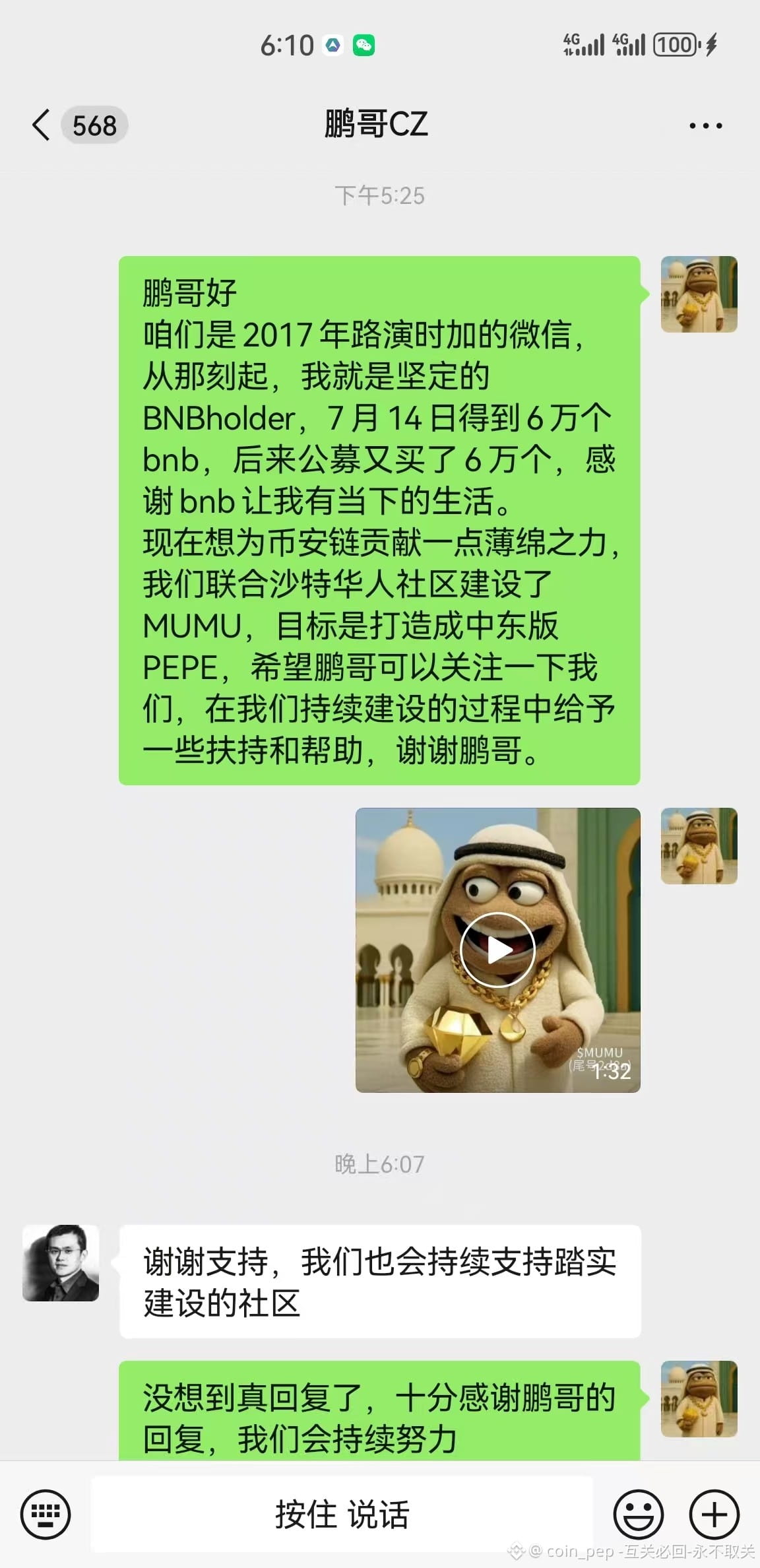
When scanning addresses on-chain, I discovered a rather interesting old coin $MUMU, contract: 0x5046deeffb03f910c9c4660237c8718a71182d8a. Initially, it caught my attention due to a sudden surge of nearly 100% in a short period of time. I followed the holding structure downwards, and the more I looked, the more interesting it became.
This project is not a new launch, but a typical early fair launch token, with no pre-mining, no complex permissions, and is the kind of 'archaeological' existence that has already been sedimented by time. More importantly, in the historical holding addresses, I can see some familiar trajectories, including addresses related to CZ and Bao Er Ye that have appeared before. This does not represent any promises or endorsements, but at least indicates that it did enter the vision of top players in the early stages.
Looking at the structure, the bottom pool is relatively stable, with some large holders in a locked state, and the contract permissions are basically discarded, making it operate more like a non-proprietary model. In simple terms, it has become difficult to be controlled by a single team, relying more on the market and community for natural evolution.
I also took a look at the community situation. Unlike many projects that rely purely on marketing to push, this coin seems to be maintained gradually by old users. The activity level isn't explosive, but the stickiness is strong, and there are still people continuously doing grassroots promotion and spontaneous dissemination.
This type of project is actually becoming less common in the current market. It has no flashy narrative, no dense exposure, but it has history, holding, and community. This combination is often easier for funds to rediscover and reprice during bull market cycles.
Of course, a small market cap means high volatility, and high volatility also means high uncertainty. I personally prefer to regard it as a worthy 'old specimen' to observe, rather than a short-term emotional play. Those who understand the structure can do more research on-chain, focusing on changes in holdings and capital flows.
Some opportunities are never sudden; they have always been there, just most people haven't noticed them yet.
Defi staking address: https://alphamumu.xyz/
When scanning addresses on-chain, I discovered a rather interesting old coin $MUMU, contract: 0x5046deeffb03f910c9c4660237c8718a71182d8a. Initially, it caught my attention due to a sudden surge of nearly 100% in a short period of time. I followed the holding structure downwards, and the more I looked, the more interesting it became.
This project is not a new launch, but a typical early fair launch token, with no pre-mining, no complex permissions, and is the kind of 'archaeological' existence that has already been sedimented by time. More importantly, in the historical holding addresses, I can see some familiar trajectories, including addresses related to CZ and Bao Er Ye that have appeared before. This does not represent any promises or endorsements, but at least indicates that it did enter the vision of top players in the early stages.
Looking at the structure, the bottom pool is relatively stable, with some large holders in a locked state, and the contract permissions are basically discarded, making it operate more like a non-proprietary model. In simple terms, it has become difficult to be controlled by a single team, relying more on the market and community for natural evolution.
I also took a look at the community situation. Unlike many projects that rely purely on marketing to push, this coin seems to be maintained gradually by old users. The activity level isn't explosive, but the stickiness is strong, and there are still people continuously doing grassroots promotion and spontaneous dissemination.
This type of project is actually becoming less common in the current market. It has no flashy narrative, no dense exposure, but it has history, holding, and community. This combination is often easier for funds to rediscover and reprice during bull market cycles.
Of course, a small market cap means high volatility, and high volatility also means high uncertainty. I personally prefer to regard it as a worthy 'old specimen' to observe, rather than a short-term emotional play. Those who understand the structure can do more research on-chain, focusing on changes in holdings and capital flows.
Some opportunities are never sudden; they have always been there, just most people haven't noticed them yet.
Defi staking address: https://alphamumu.xyz/
This project is not a new launch, but a typical early fair launch token, with no pre-mining, no complex permissions, and is the kind of 'archaeological' existence that has already been sedimented by time. More importantly, in the historical holding addresses, I can see some familiar trajectories, including addresses related to CZ and Bao Er Ye that have appeared before. This does not represent any promises or endorsements, but at least indicates that it did enter the vision of top players in the early stages.
Looking at the structure, the bottom pool is relatively stable, with some large holders in a locked state, and the contract permissions are basically discarded, making it operate more like a non-proprietary model. In simple terms, it has become difficult to be controlled by a single team, relying more on the market and community for natural evolution.
I also took a look at the community situation. Unlike many projects that rely purely on marketing to push, this coin seems to be maintained gradually by old users. The activity level isn't explosive, but the stickiness is strong, and there are still people continuously doing grassroots promotion and spontaneous dissemination.
This type of project is actually becoming less common in the current market. It has no flashy narrative, no dense exposure, but it has history, holding, and community. This combination is often easier for funds to rediscover and reprice during bull market cycles.
Of course, a small market cap means high volatility, and high volatility also means high uncertainty. I personally prefer to regard it as a worthy 'old specimen' to observe, rather than a short-term emotional play. Those who understand the structure can do more research on-chain, focusing on changes in holdings and capital flows.
Some opportunities are never sudden; they have always been there, just most people haven't noticed them yet.
Defi staking address: https://alphamumu.xyz/



1
1
3
69
·
--
Easily Understand the Three Major U.S. Stock Indices: What They Are and How They Work
The first time I encountered the U.S. stock market was through those few lines of numbers in the news. In the early morning, I would see "Dow up" and "Nasdaq down"; the more I read, the less I truly understood what they were saying. In fact, these three major indices are more like three windows, through which you can see different aspects of the same market.
The Dow Jones Index tends to be mature and stable, composed of 30 large companies, resembling a group of established enterprises. Its fluctuations are usually not drastic, more reflecting the pulse of the traditional economy. The S&P 500 is more like a panoramic view, encompassing about 500 leading companies across various industries, presenting the overall market state through a market capitalization-weighted approach. Therefore, it is often used as a core indicator for observing the U.S. economy. As for the Nasdaq, the pace is noticeably faster, with a high proportion of technology and growth-oriented companies; the ups and downs often hide the market's expectations for the future.
Many beginners do not rush to choose individual stocks at first but focus on the changes in indices to get a feel for the market. For instance, when wanting to observe stable sectors, they will pay attention to the Dow; to judge overall trends, they will look at the S&P 500; and when sensitive to technology sentiment, they will watch the Nasdaq more closely. Gradually, these numbers will shift from abstract points to a way of understanding the market's temperature.
As the perspective gradually shifts from "watching indices" to "participating in the market," some may choose index funds as an entry path to lower the difficulty of judgment. In this process, capital management, currency exchange, and trading paths will also be taken into consideration. Some people prefer to integrate these steps at the same entry point, such as first checking the exchange rate and capital arrangements through BiyaPay before deciding whether to further trade U.S. stocks, making the operation more coherent.
Understanding the three major indices is essentially about establishing a coordinate system for viewing the market. The Dow is like an old tree, firmly rooted; the S&P resembles a map, covering the whole area; and the Nasdaq is like the wind direction, signaling change. First, learn to read them, then decide your own pace; investing will not feel so unfamiliar.
Easily Understand the Three Major U.S. Stock Indices: What They Are and How They Work
The first time I encountered the U.S. stock market was through those few lines of numbers in the news. In the early morning, I would see "Dow up" and "Nasdaq down"; the more I read, the less I truly understood what they were saying. In fact, these three major indices are more like three windows, through which you can see different aspects of the same market.
The Dow Jones Index tends to be mature and stable, composed of 30 large companies, resembling a group of established enterprises. Its fluctuations are usually not drastic, more reflecting the pulse of the traditional economy. The S&P 500 is more like a panoramic view, encompassing about 500 leading companies across various industries, presenting the overall market state through a market capitalization-weighted approach. Therefore, it is often used as a core indicator for observing the U.S. economy. As for the Nasdaq, the pace is noticeably faster, with a high proportion of technology and growth-oriented companies; the ups and downs often hide the market's expectations for the future.
Many beginners do not rush to choose individual stocks at first but focus on the changes in indices to get a feel for the market. For instance, when wanting to observe stable sectors, they will pay attention to the Dow; to judge overall trends, they will look at the S&P 500; and when sensitive to technology sentiment, they will watch the Nasdaq more closely. Gradually, these numbers will shift from abstract points to a way of understanding the market's temperature.
As the perspective gradually shifts from "watching indices" to "participating in the market," some may choose index funds as an entry path to lower the difficulty of judgment. In this process, capital management, currency exchange, and trading paths will also be taken into consideration. Some people prefer to integrate these steps at the same entry point, such as first checking the exchange rate and capital arrangements through BiyaPay before deciding whether to further trade U.S. stocks, making the operation more coherent.
Understanding the three major indices is essentially about establishing a coordinate system for viewing the market. The Dow is like an old tree, firmly rooted; the S&P resembles a map, covering the whole area; and the Nasdaq is like the wind direction, signaling change. First, learn to read them, then decide your own pace; investing will not feel so unfamiliar.
The first time I encountered the U.S. stock market was through those few lines of numbers in the news. In the early morning, I would see "Dow up" and "Nasdaq down"; the more I read, the less I truly understood what they were saying. In fact, these three major indices are more like three windows, through which you can see different aspects of the same market.
The Dow Jones Index tends to be mature and stable, composed of 30 large companies, resembling a group of established enterprises. Its fluctuations are usually not drastic, more reflecting the pulse of the traditional economy. The S&P 500 is more like a panoramic view, encompassing about 500 leading companies across various industries, presenting the overall market state through a market capitalization-weighted approach. Therefore, it is often used as a core indicator for observing the U.S. economy. As for the Nasdaq, the pace is noticeably faster, with a high proportion of technology and growth-oriented companies; the ups and downs often hide the market's expectations for the future.
Many beginners do not rush to choose individual stocks at first but focus on the changes in indices to get a feel for the market. For instance, when wanting to observe stable sectors, they will pay attention to the Dow; to judge overall trends, they will look at the S&P 500; and when sensitive to technology sentiment, they will watch the Nasdaq more closely. Gradually, these numbers will shift from abstract points to a way of understanding the market's temperature.
As the perspective gradually shifts from "watching indices" to "participating in the market," some may choose index funds as an entry path to lower the difficulty of judgment. In this process, capital management, currency exchange, and trading paths will also be taken into consideration. Some people prefer to integrate these steps at the same entry point, such as first checking the exchange rate and capital arrangements through BiyaPay before deciding whether to further trade U.S. stocks, making the operation more coherent.
Understanding the three major indices is essentially about establishing a coordinate system for viewing the market. The Dow is like an old tree, firmly rooted; the S&P resembles a map, covering the whole area; and the Nasdaq is like the wind direction, signaling change. First, learn to read them, then decide your own pace; investing will not feel so unfamiliar.
6
254
·
--
Stock Market Investment Guide: A Review of Must-See Leading Tech Stocks
In 2026, China's technology sector is gradually moving from 'concept-driven' to 'industry realization'. Over the past few years, the market has experienced repeated pulls from regulation, cycles, and valuations, but what remains are often companies with technological accumulation and cash flow capabilities. At this moment, looking at Tencent, CATL, SMIC, Alibaba, and Huichuan Technology, you'll find that they resemble five different main lines, forming the overall outline of Chinese technology.
Tencent's advantage lies in its ecological depth, with AI capabilities gradually penetrating deep into its business; CATL represents the voice of the new energy industry chain, with battery technology and global production capacity layout determining its long-term position; SMIC carries the imaginative space of domestic semiconductor substitution; even under restrictions, mature processes still have stable demand; Alibaba is transitioning from an e-commerce platform to a 'cloud + AI' technical foundation; while Huichuan Technology stands at the rhythm of industrial automation and intelligent manufacturing upgrades, belonging to a long-term growth player.
When looking at these companies together, it becomes apparent that they are distributed across different industry levels, some are application-oriented, some focus on underlying manufacturing, and others play a role in infrastructure. This structure is more suited for tracking with a 'long-term observation' approach rather than just looking at short-term fluctuations. For many investors, the real challenge is not selecting companies but establishing their rhythm between different markets, such as someone simultaneously focusing on Hong Kong stocks and A-shares while also understanding the logical changes in trading US stocks.
Information verification and funding paths are often more easily overlooked than stock selection. Especially when configuring across markets, from target confirmation, exchange rate calculations to asset management, whether the process is smooth will directly affect the holding experience. Some people choose to unify their accounts and funds in the same tool, such as using multi-asset management platforms like BiyaPay for transfer and record-keeping, which at least provides clearer execution.
Overall, the core logic of Chinese tech stocks still revolves around industrial upgrading and technological independence. Putting these leading stocks on an observation list and continuously tracking their changes is, in itself, a more prudent way to participate.
Stock Market Investment Guide: A Review of Must-See Leading Tech Stocks
In 2026, China's technology sector is gradually moving from 'concept-driven' to 'industry realization'. Over the past few years, the market has experienced repeated pulls from regulation, cycles, and valuations, but what remains are often companies with technological accumulation and cash flow capabilities. At this moment, looking at Tencent, CATL, SMIC, Alibaba, and Huichuan Technology, you'll find that they resemble five different main lines, forming the overall outline of Chinese technology.
Tencent's advantage lies in its ecological depth, with AI capabilities gradually penetrating deep into its business; CATL represents the voice of the new energy industry chain, with battery technology and global production capacity layout determining its long-term position; SMIC carries the imaginative space of domestic semiconductor substitution; even under restrictions, mature processes still have stable demand; Alibaba is transitioning from an e-commerce platform to a 'cloud + AI' technical foundation; while Huichuan Technology stands at the rhythm of industrial automation and intelligent manufacturing upgrades, belonging to a long-term growth player.
When looking at these companies together, it becomes apparent that they are distributed across different industry levels, some are application-oriented, some focus on underlying manufacturing, and others play a role in infrastructure. This structure is more suited for tracking with a 'long-term observation' approach rather than just looking at short-term fluctuations. For many investors, the real challenge is not selecting companies but establishing their rhythm between different markets, such as someone simultaneously focusing on Hong Kong stocks and A-shares while also understanding the logical changes in trading US stocks.
Information verification and funding paths are often more easily overlooked than stock selection. Especially when configuring across markets, from target confirmation, exchange rate calculations to asset management, whether the process is smooth will directly affect the holding experience. Some people choose to unify their accounts and funds in the same tool, such as using multi-asset management platforms like BiyaPay for transfer and record-keeping, which at least provides clearer execution.
Overall, the core logic of Chinese tech stocks still revolves around industrial upgrading and technological independence. Putting these leading stocks on an observation list and continuously tracking their changes is, in itself, a more prudent way to participate.
In 2026, China's technology sector is gradually moving from 'concept-driven' to 'industry realization'. Over the past few years, the market has experienced repeated pulls from regulation, cycles, and valuations, but what remains are often companies with technological accumulation and cash flow capabilities. At this moment, looking at Tencent, CATL, SMIC, Alibaba, and Huichuan Technology, you'll find that they resemble five different main lines, forming the overall outline of Chinese technology.
Tencent's advantage lies in its ecological depth, with AI capabilities gradually penetrating deep into its business; CATL represents the voice of the new energy industry chain, with battery technology and global production capacity layout determining its long-term position; SMIC carries the imaginative space of domestic semiconductor substitution; even under restrictions, mature processes still have stable demand; Alibaba is transitioning from an e-commerce platform to a 'cloud + AI' technical foundation; while Huichuan Technology stands at the rhythm of industrial automation and intelligent manufacturing upgrades, belonging to a long-term growth player.
When looking at these companies together, it becomes apparent that they are distributed across different industry levels, some are application-oriented, some focus on underlying manufacturing, and others play a role in infrastructure. This structure is more suited for tracking with a 'long-term observation' approach rather than just looking at short-term fluctuations. For many investors, the real challenge is not selecting companies but establishing their rhythm between different markets, such as someone simultaneously focusing on Hong Kong stocks and A-shares while also understanding the logical changes in trading US stocks.
Information verification and funding paths are often more easily overlooked than stock selection. Especially when configuring across markets, from target confirmation, exchange rate calculations to asset management, whether the process is smooth will directly affect the holding experience. Some people choose to unify their accounts and funds in the same tool, such as using multi-asset management platforms like BiyaPay for transfer and record-keeping, which at least provides clearer execution.
Overall, the core logic of Chinese tech stocks still revolves around industrial upgrading and technological independence. Putting these leading stocks on an observation list and continuously tracking their changes is, in itself, a more prudent way to participate.

8
277
·
--
Many beginners encounter a stock's limit down for the first time, and the first reaction is just one:
It's over, does that mean it can't be sold at all?
When I first encountered a limit down, I also saw the announcement before the market opened, and my mindset completely shattered. I stared at the market all day, and in the end, not a single share was traded. Later, I truly understood one thing:
A limit down is not that trading is impossible, but that it’s just not your turn.
The limit down in A-shares is essentially just the price locked at the lower limit for the day; the trading channel is not closed. But the problem is —
Everyone wants to sell, and almost no one wants to buy.
When selling, everyone has the same price, and only one rule is in effect: those who queue up first, leave first. This is also why many experienced investors will place their orders the night before or before the morning auction, rather than waiting until market sentiment has completely collapsed before acting.
What really matters is not whether “you can sell,” but why it has hit the limit down.
I later reviewed it a few times and found that limit downs generally fall into two categories:
One is hard issues at the company level, such as poor performance, regulatory problems, or issues with core business; this type basically has no room for fantasy, if you can leave, just leave;
The other is more emotion-driven, such as a collective sell-off in sectors or panic spreading in the market; this type is more likely to cause excessive reactions.
The difference lies in this judgment.
If you can't figure out the reason, all operations are a gamble.
As for the many people who ask, “Can you bottom fish at a limit down?” my personal experience is:
Beginners should try to avoid it.
Limit downs may seem cheap, but there’s a reason why they are cheap. You think you’re picking up a bargain; in reality, you might be catching a knife that someone else has dropped.
Later, I developed a habit:
Whether trading A-shares or occasionally looking at U.S. stocks, I always check the basic information first — is there a risk warning, what is the price fluctuation, are there any sudden announcements, and then decide whether to take action.
Sometimes I use tools like BiyaPay, which cover multiple markets, to look at the market conditions, exchange rates, and trading entrances from the same perspective, avoiding the distortion of judgment when emotions are running high.
In the end, a limit down is not the scariest thing,
the scariest thing is making a decision that will be very difficult to recover from at the lowest point of emotion.
Whether trading is a technical issue,
whether to trade is a cognitive issue.
Many beginners encounter a stock's limit down for the first time, and the first reaction is just one:
It's over, does that mean it can't be sold at all?
When I first encountered a limit down, I also saw the announcement before the market opened, and my mindset completely shattered. I stared at the market all day, and in the end, not a single share was traded. Later, I truly understood one thing:
A limit down is not that trading is impossible, but that it’s just not your turn.
The limit down in A-shares is essentially just the price locked at the lower limit for the day; the trading channel is not closed. But the problem is —
Everyone wants to sell, and almost no one wants to buy.
When selling, everyone has the same price, and only one rule is in effect: those who queue up first, leave first. This is also why many experienced investors will place their orders the night before or before the morning auction, rather than waiting until market sentiment has completely collapsed before acting.
What really matters is not whether “you can sell,” but why it has hit the limit down.
I later reviewed it a few times and found that limit downs generally fall into two categories:
One is hard issues at the company level, such as poor performance, regulatory problems, or issues with core business; this type basically has no room for fantasy, if you can leave, just leave;
The other is more emotion-driven, such as a collective sell-off in sectors or panic spreading in the market; this type is more likely to cause excessive reactions.
The difference lies in this judgment.
If you can't figure out the reason, all operations are a gamble.
As for the many people who ask, “Can you bottom fish at a limit down?” my personal experience is:
Beginners should try to avoid it.
Limit downs may seem cheap, but there’s a reason why they are cheap. You think you’re picking up a bargain; in reality, you might be catching a knife that someone else has dropped.
Later, I developed a habit:
Whether trading A-shares or occasionally looking at U.S. stocks, I always check the basic information first — is there a risk warning, what is the price fluctuation, are there any sudden announcements, and then decide whether to take action.
Sometimes I use tools like BiyaPay, which cover multiple markets, to look at the market conditions, exchange rates, and trading entrances from the same perspective, avoiding the distortion of judgment when emotions are running high.
In the end, a limit down is not the scariest thing,
the scariest thing is making a decision that will be very difficult to recover from at the lowest point of emotion.
Whether trading is a technical issue,
whether to trade is a cognitive issue.
It's over, does that mean it can't be sold at all?
When I first encountered a limit down, I also saw the announcement before the market opened, and my mindset completely shattered. I stared at the market all day, and in the end, not a single share was traded. Later, I truly understood one thing:
A limit down is not that trading is impossible, but that it’s just not your turn.
The limit down in A-shares is essentially just the price locked at the lower limit for the day; the trading channel is not closed. But the problem is —
Everyone wants to sell, and almost no one wants to buy.
When selling, everyone has the same price, and only one rule is in effect: those who queue up first, leave first. This is also why many experienced investors will place their orders the night before or before the morning auction, rather than waiting until market sentiment has completely collapsed before acting.
What really matters is not whether “you can sell,” but why it has hit the limit down.
I later reviewed it a few times and found that limit downs generally fall into two categories:
One is hard issues at the company level, such as poor performance, regulatory problems, or issues with core business; this type basically has no room for fantasy, if you can leave, just leave;
The other is more emotion-driven, such as a collective sell-off in sectors or panic spreading in the market; this type is more likely to cause excessive reactions.
The difference lies in this judgment.
If you can't figure out the reason, all operations are a gamble.
As for the many people who ask, “Can you bottom fish at a limit down?” my personal experience is:
Beginners should try to avoid it.
Limit downs may seem cheap, but there’s a reason why they are cheap. You think you’re picking up a bargain; in reality, you might be catching a knife that someone else has dropped.
Later, I developed a habit:
Whether trading A-shares or occasionally looking at U.S. stocks, I always check the basic information first — is there a risk warning, what is the price fluctuation, are there any sudden announcements, and then decide whether to take action.
Sometimes I use tools like BiyaPay, which cover multiple markets, to look at the market conditions, exchange rates, and trading entrances from the same perspective, avoiding the distortion of judgment when emotions are running high.
In the end, a limit down is not the scariest thing,
the scariest thing is making a decision that will be very difficult to recover from at the lowest point of emotion.
Whether trading is a technical issue,
whether to trade is a cognitive issue.
8
354
·
--
Understanding global financial news from scratch is not as difficult as you might think.
When I first encountered global financial news, I had that experience too: I recognized all the words in the headlines, but I couldn't grasp the main point when they came together. 'Federal Reserve meeting', 'non-farm payroll data', 'better than expected', 'dot plot'... the information density was so high that I instinctively wanted to scroll away.
Truly useful financial news always revolves around three things: what happened, how the data looks, and what it means. As long as you grasp this main line, the vast majority of news can be broken down.
The first step is to determine the type of news. Macroeconomic news focuses on countries or central banks, such as interest rates and inflation; industry news discusses trends; and company news is directly related to specific stocks. Differentiating categories can help avoid misinterpretations.
The second step is to focus on the core numbers. There are many opinions in financial news, but what really drives the market often boils down to one or two key data points, such as whether it is 'higher than expected' or 'lower than expected'. You don’t need to understand the entire model; just learn to compare with 'what the market initially thought'.
The third step is to assess the impact, and you need to look at it over a longer time frame. Short-term fluctuations are often just emotional reactions; what really matters is whether the direction has changed. For example, one or two instances of data fluctuations do not necessarily change the long-term policy path.
When you start looking at news this way, it is no longer noise but rather clues.
In this process, I gradually developed a habit: to compare the information in the news with the real market state. For instance, when I see a company or index, I check the price and valuation range before returning to the news to judge whether 'this is an emotional reaction'. Sometimes I use tools just to reduce the cost of switching information, rather than for frequent trading. For me, platforms like BiyaPay, which allow viewing different market information from the same perspective, feel more like a 'proofreading book' rather than the decision itself.
Ultimately, the goal of understanding financial news is not to rush into trading US stocks immediately but to build an understanding of how the world operates. When you are no longer led by headlines swaying your emotions, news will instead become a long-term cognitive asset.
Starting today, don’t rush to understand everything; first learn to identify the key points, and you will have already outperformed most people.
Understanding global financial news from scratch is not as difficult as you might think.
When I first encountered global financial news, I had that experience too: I recognized all the words in the headlines, but I couldn't grasp the main point when they came together. 'Federal Reserve meeting', 'non-farm payroll data', 'better than expected', 'dot plot'... the information density was so high that I instinctively wanted to scroll away.
Truly useful financial news always revolves around three things: what happened, how the data looks, and what it means. As long as you grasp this main line, the vast majority of news can be broken down.
The first step is to determine the type of news. Macroeconomic news focuses on countries or central banks, such as interest rates and inflation; industry news discusses trends; and company news is directly related to specific stocks. Differentiating categories can help avoid misinterpretations.
The second step is to focus on the core numbers. There are many opinions in financial news, but what really drives the market often boils down to one or two key data points, such as whether it is 'higher than expected' or 'lower than expected'. You don’t need to understand the entire model; just learn to compare with 'what the market initially thought'.
The third step is to assess the impact, and you need to look at it over a longer time frame. Short-term fluctuations are often just emotional reactions; what really matters is whether the direction has changed. For example, one or two instances of data fluctuations do not necessarily change the long-term policy path.
When you start looking at news this way, it is no longer noise but rather clues.
In this process, I gradually developed a habit: to compare the information in the news with the real market state. For instance, when I see a company or index, I check the price and valuation range before returning to the news to judge whether 'this is an emotional reaction'. Sometimes I use tools just to reduce the cost of switching information, rather than for frequent trading. For me, platforms like BiyaPay, which allow viewing different market information from the same perspective, feel more like a 'proofreading book' rather than the decision itself.
Ultimately, the goal of understanding financial news is not to rush into trading US stocks immediately but to build an understanding of how the world operates. When you are no longer led by headlines swaying your emotions, news will instead become a long-term cognitive asset.
Starting today, don’t rush to understand everything; first learn to identify the key points, and you will have already outperformed most people.
When I first encountered global financial news, I had that experience too: I recognized all the words in the headlines, but I couldn't grasp the main point when they came together. 'Federal Reserve meeting', 'non-farm payroll data', 'better than expected', 'dot plot'... the information density was so high that I instinctively wanted to scroll away.
Truly useful financial news always revolves around three things: what happened, how the data looks, and what it means. As long as you grasp this main line, the vast majority of news can be broken down.
The first step is to determine the type of news. Macroeconomic news focuses on countries or central banks, such as interest rates and inflation; industry news discusses trends; and company news is directly related to specific stocks. Differentiating categories can help avoid misinterpretations.
The second step is to focus on the core numbers. There are many opinions in financial news, but what really drives the market often boils down to one or two key data points, such as whether it is 'higher than expected' or 'lower than expected'. You don’t need to understand the entire model; just learn to compare with 'what the market initially thought'.
The third step is to assess the impact, and you need to look at it over a longer time frame. Short-term fluctuations are often just emotional reactions; what really matters is whether the direction has changed. For example, one or two instances of data fluctuations do not necessarily change the long-term policy path.
When you start looking at news this way, it is no longer noise but rather clues.
In this process, I gradually developed a habit: to compare the information in the news with the real market state. For instance, when I see a company or index, I check the price and valuation range before returning to the news to judge whether 'this is an emotional reaction'. Sometimes I use tools just to reduce the cost of switching information, rather than for frequent trading. For me, platforms like BiyaPay, which allow viewing different market information from the same perspective, feel more like a 'proofreading book' rather than the decision itself.
Ultimately, the goal of understanding financial news is not to rush into trading US stocks immediately but to build an understanding of how the world operates. When you are no longer led by headlines swaying your emotions, news will instead become a long-term cognitive asset.
Starting today, don’t rush to understand everything; first learn to identify the key points, and you will have already outperformed most people.
16
142
·
--
Understand Canadian postal codes in one minute; they're actually more important than you might think.
Canadian postal codes consist of 6 characters, with the standard format being:
Letter-Number-Letter Space Number-Letter-Number, for example, M5V 2T6.
The first three characters are referred to as the "forward sortation area," determining which large area the mail will be sent to;
the last three are the "local delivery unit," used for precise location down to the block, building, or even a specific office tower.
Among these, the first letter is particularly critical.
It directly corresponds to a province or major city; for instance, M almost always points to Toronto, while V covers the entire province of British Columbia.
If you see the first letter of a postal code, you can roughly determine which area the address is in.
Correct formatting does affect delivery speed.
Canadian postal codes have two hard rules that are often overlooked:
First, all letters must be uppercase.
Second, there must be a space between the first three and last three characters; hyphens cannot be used.
For example:
✅ M5V 2T6
❌ m5v2t6
❌ M5V-2T6
Machine sorting heavily relies on format recognition; a mistake won't necessarily mean it won't be delivered, but it may be “slow processed.”
The most reliable ways to check are only two:
If you're unsure which postal code corresponds to a certain address, prioritize using the Canada Post official website, which is the only official data source, suitable for formal mailing and document filling.
If you just need quick confirmation, Google Maps is also very useful.
Simply search for the full address, and the postal code usually appears after the province, making it very efficient.
A small detail that is easily overlooked:
Many people check postal codes for online shopping, sending packages, or handling cross-border bills.
In practice, confirming the address clearly is just the first step; the costs often involve different currencies.
My own habit is to first convert the relevant fees uniformly after confirming the postal code is correct, to avoid exceeding expectations due to exchange rate fluctuations during settlement. Sometimes, I will also conveniently check the real-time exchange rate with BiyaPay, especially when handling cross-border spending or occasionally trading US stocks, which can make the accounts clearer.
Canadian postal codes are not complicated; the difficulty lies in the fact that no one explains them clearly the first time you encounter them.
Remembering the structure, format, and checking methods will make subsequent tasks like sending mail, placing orders, or filling out forms much smoother.
Some details may seem small, but they can really save time.
Understand Canadian postal codes in one minute; they're actually more important than you might think.
Canadian postal codes consist of 6 characters, with the standard format being:
Letter-Number-Letter Space Number-Letter-Number, for example, M5V 2T6.
The first three characters are referred to as the "forward sortation area," determining which large area the mail will be sent to;
the last three are the "local delivery unit," used for precise location down to the block, building, or even a specific office tower.
Among these, the first letter is particularly critical.
It directly corresponds to a province or major city; for instance, M almost always points to Toronto, while V covers the entire province of British Columbia.
If you see the first letter of a postal code, you can roughly determine which area the address is in.
Correct formatting does affect delivery speed.
Canadian postal codes have two hard rules that are often overlooked:
First, all letters must be uppercase.
Second, there must be a space between the first three and last three characters; hyphens cannot be used.
For example:
✅ M5V 2T6
❌ m5v2t6
❌ M5V-2T6
Machine sorting heavily relies on format recognition; a mistake won't necessarily mean it won't be delivered, but it may be “slow processed.”
The most reliable ways to check are only two:
If you're unsure which postal code corresponds to a certain address, prioritize using the Canada Post official website, which is the only official data source, suitable for formal mailing and document filling.
If you just need quick confirmation, Google Maps is also very useful.
Simply search for the full address, and the postal code usually appears after the province, making it very efficient.
A small detail that is easily overlooked:
Many people check postal codes for online shopping, sending packages, or handling cross-border bills.
In practice, confirming the address clearly is just the first step; the costs often involve different currencies.
My own habit is to first convert the relevant fees uniformly after confirming the postal code is correct, to avoid exceeding expectations due to exchange rate fluctuations during settlement. Sometimes, I will also conveniently check the real-time exchange rate with BiyaPay, especially when handling cross-border spending or occasionally trading US stocks, which can make the accounts clearer.
Canadian postal codes are not complicated; the difficulty lies in the fact that no one explains them clearly the first time you encounter them.
Remembering the structure, format, and checking methods will make subsequent tasks like sending mail, placing orders, or filling out forms much smoother.
Some details may seem small, but they can really save time.
Canadian postal codes consist of 6 characters, with the standard format being:
Letter-Number-Letter Space Number-Letter-Number, for example, M5V 2T6.
The first three characters are referred to as the "forward sortation area," determining which large area the mail will be sent to;
the last three are the "local delivery unit," used for precise location down to the block, building, or even a specific office tower.
Among these, the first letter is particularly critical.
It directly corresponds to a province or major city; for instance, M almost always points to Toronto, while V covers the entire province of British Columbia.
If you see the first letter of a postal code, you can roughly determine which area the address is in.
Correct formatting does affect delivery speed.
Canadian postal codes have two hard rules that are often overlooked:
First, all letters must be uppercase.
Second, there must be a space between the first three and last three characters; hyphens cannot be used.
For example:
✅ M5V 2T6
❌ m5v2t6
❌ M5V-2T6
Machine sorting heavily relies on format recognition; a mistake won't necessarily mean it won't be delivered, but it may be “slow processed.”
The most reliable ways to check are only two:
If you're unsure which postal code corresponds to a certain address, prioritize using the Canada Post official website, which is the only official data source, suitable for formal mailing and document filling.
If you just need quick confirmation, Google Maps is also very useful.
Simply search for the full address, and the postal code usually appears after the province, making it very efficient.
A small detail that is easily overlooked:
Many people check postal codes for online shopping, sending packages, or handling cross-border bills.
In practice, confirming the address clearly is just the first step; the costs often involve different currencies.
My own habit is to first convert the relevant fees uniformly after confirming the postal code is correct, to avoid exceeding expectations due to exchange rate fluctuations during settlement. Sometimes, I will also conveniently check the real-time exchange rate with BiyaPay, especially when handling cross-border spending or occasionally trading US stocks, which can make the accounts clearer.
Canadian postal codes are not complicated; the difficulty lies in the fact that no one explains them clearly the first time you encounter them.
Remembering the structure, format, and checking methods will make subsequent tasks like sending mail, placing orders, or filling out forms much smoother.
Some details may seem small, but they can really save time.

11
383
·
--
The matter of visa-free travel to Italy has been misunderstood by many from the start.
Every travel season in Europe, similar questions repeatedly arise:
"Is a Chinese passport visa-free for Italy?"
Conclusion first: The vast majority of people holding a private passport from mainland China need to apply for a Schengen visa in advance when traveling to Italy.
Visa-free is not the norm, but an exception for a few specific identities.
Understanding this clearly will help ensure that subsequent travel planning doesn't go astray.
The Italian visa is actually not that difficult.
According to publicly available data, the approval rate for Italian Schengen visas has remained high for a long time.
The real reason for failures is often not the conditions, but the preparation method.
Visa officers mainly focus on three points:
Whether the itinerary is genuine, whether the funds are sufficient, and whether there is a clear constraint to return to the home country.
Flight tickets and hotel reservations only require providing a booking confirmation, no need for advance payment;
The itinerary does not need to be complex, but the logic must be reasonable;
The bank statements must be real and continuous, avoiding large temporary deposits and withdrawals.
My personal approach is to first convert all potential Euro expenditures into a standard amount before preparing the materials, and then compare item by item against the bank statements to ensure that the financial records align with the itinerary logic. In this process, I use tools like BiyaPay to quickly check real-time exchange rates, mainly to avoid budget distortion due to exchange rate differences.
The earliest one can apply for the Italian Schengen visa is 180 days in advance, and the official recommendation is to allow at least 15 working days.
If you encounter peak periods such as summer vacation or National Day, the earlier you prepare, the better.
Many people are not rejected, but simply "run out of time."
The last reminder that is easy to overlook
Approval of a visa does not mean one can stay freely.
The 90-day stay rule is a strict limit.
Once overstayed, one may face fines, negative records, and even be unable to enter the Schengen area for many years, which greatly impacts future travel.
The Italian visa can be complicated or simple.
Visa-free status is a special situation for a few, while a visa is the normal path for the majority.
As long as the rules are respected, planning is done in advance, and materials are real and complete,
this trip to Italy could have gone smoothly from the very beginning.
The matter of visa-free travel to Italy has been misunderstood by many from the start.
Every travel season in Europe, similar questions repeatedly arise:
"Is a Chinese passport visa-free for Italy?"
Conclusion first: The vast majority of people holding a private passport from mainland China need to apply for a Schengen visa in advance when traveling to Italy.
Visa-free is not the norm, but an exception for a few specific identities.
Understanding this clearly will help ensure that subsequent travel planning doesn't go astray.
The Italian visa is actually not that difficult.
According to publicly available data, the approval rate for Italian Schengen visas has remained high for a long time.
The real reason for failures is often not the conditions, but the preparation method.
Visa officers mainly focus on three points:
Whether the itinerary is genuine, whether the funds are sufficient, and whether there is a clear constraint to return to the home country.
Flight tickets and hotel reservations only require providing a booking confirmation, no need for advance payment;
The itinerary does not need to be complex, but the logic must be reasonable;
The bank statements must be real and continuous, avoiding large temporary deposits and withdrawals.
My personal approach is to first convert all potential Euro expenditures into a standard amount before preparing the materials, and then compare item by item against the bank statements to ensure that the financial records align with the itinerary logic. In this process, I use tools like BiyaPay to quickly check real-time exchange rates, mainly to avoid budget distortion due to exchange rate differences.
The earliest one can apply for the Italian Schengen visa is 180 days in advance, and the official recommendation is to allow at least 15 working days.
If you encounter peak periods such as summer vacation or National Day, the earlier you prepare, the better.
Many people are not rejected, but simply "run out of time."
The last reminder that is easy to overlook
Approval of a visa does not mean one can stay freely.
The 90-day stay rule is a strict limit.
Once overstayed, one may face fines, negative records, and even be unable to enter the Schengen area for many years, which greatly impacts future travel.
The Italian visa can be complicated or simple.
Visa-free status is a special situation for a few, while a visa is the normal path for the majority.
As long as the rules are respected, planning is done in advance, and materials are real and complete,
this trip to Italy could have gone smoothly from the very beginning.
Every travel season in Europe, similar questions repeatedly arise:
"Is a Chinese passport visa-free for Italy?"
Conclusion first: The vast majority of people holding a private passport from mainland China need to apply for a Schengen visa in advance when traveling to Italy.
Visa-free is not the norm, but an exception for a few specific identities.
Understanding this clearly will help ensure that subsequent travel planning doesn't go astray.
The Italian visa is actually not that difficult.
According to publicly available data, the approval rate for Italian Schengen visas has remained high for a long time.
The real reason for failures is often not the conditions, but the preparation method.
Visa officers mainly focus on three points:
Whether the itinerary is genuine, whether the funds are sufficient, and whether there is a clear constraint to return to the home country.
Flight tickets and hotel reservations only require providing a booking confirmation, no need for advance payment;
The itinerary does not need to be complex, but the logic must be reasonable;
The bank statements must be real and continuous, avoiding large temporary deposits and withdrawals.
My personal approach is to first convert all potential Euro expenditures into a standard amount before preparing the materials, and then compare item by item against the bank statements to ensure that the financial records align with the itinerary logic. In this process, I use tools like BiyaPay to quickly check real-time exchange rates, mainly to avoid budget distortion due to exchange rate differences.
The earliest one can apply for the Italian Schengen visa is 180 days in advance, and the official recommendation is to allow at least 15 working days.
If you encounter peak periods such as summer vacation or National Day, the earlier you prepare, the better.
Many people are not rejected, but simply "run out of time."
The last reminder that is easy to overlook
Approval of a visa does not mean one can stay freely.
The 90-day stay rule is a strict limit.
Once overstayed, one may face fines, negative records, and even be unable to enter the Schengen area for many years, which greatly impacts future travel.
The Italian visa can be complicated or simple.
Visa-free status is a special situation for a few, while a visa is the normal path for the majority.
As long as the rules are respected, planning is done in advance, and materials are real and complete,
this trip to Italy could have gone smoothly from the very beginning.
9
133
·
--
Shopping online in the U.S. is not difficult; the challenge is that you don't understand this 'system'
Many people have the impression that shopping online in the U.S. is just two words: troublesome.
Either they are worried about payment being blocked, or they find the process complicated; otherwise, they calculate the shipping fees and exchange rates, only to realize that it doesn’t seem to be much cheaper, so they simply give up.
But once you get the hang of it, you'll find that shopping online in the U.S. is not complicated; it's just a system completely different from that in your home country. The problem lies not with the platform, but with the information gap.
1. First, clarify one thing: U.S. e-commerce is not 'one platform solves everything'
At home, we are used to opening one app to buy everything. But in the U.S., this mindset can lead to unnecessary spending.
2. Rebates, price comparisons, and memberships are a whole set of 'stacking logic'
With three layers of stacking, the price difference for the same item can easily widen by 20%–30%.
But there is only one prerequisite: your payment method cannot hold you back.
3. What really deters most people is actually 'how the money flows'
When I researched cross-border consumption and U.S. dollar fund pathways, I realized that the essence of the problem is not whether to buy, but whether the funding system is smooth.
For a while, I used BiyaPay to handle U.S. dollar-related expenses, converting stablecoins directly into U.S. dollars for overseas consumption; the process is simple, costs are clear, and there’s no need to repeatedly struggle with currency exchange and intermediary steps.
It’s more like a tool that solves the problem of 'how the money flows' rather than shopping itself.
4. Treat U.S. online shopping as a 'replicable process'
Once you understand the logic, shopping online in the U.S. will change from 'struggling' to a daily routine:
Choose the right platform, don’t browse aimlessly
Time your purchases, don’t act impulsively
Use all the tools, don’t be lazy
The real cost has never been the price of goods but the premium you pay for the information gap.
Once this system is established, shopping online in the U.S. is no longer a 'skill' for a few, but a stable, money-saving choice that can be reused long-term.
Shopping online in the U.S. is not difficult; the challenge is that you don't understand this 'system'
Many people have the impression that shopping online in the U.S. is just two words: troublesome.
Either they are worried about payment being blocked, or they find the process complicated; otherwise, they calculate the shipping fees and exchange rates, only to realize that it doesn’t seem to be much cheaper, so they simply give up.
But once you get the hang of it, you'll find that shopping online in the U.S. is not complicated; it's just a system completely different from that in your home country. The problem lies not with the platform, but with the information gap.
1. First, clarify one thing: U.S. e-commerce is not 'one platform solves everything'
At home, we are used to opening one app to buy everything. But in the U.S., this mindset can lead to unnecessary spending.
2. Rebates, price comparisons, and memberships are a whole set of 'stacking logic'
With three layers of stacking, the price difference for the same item can easily widen by 20%–30%.
But there is only one prerequisite: your payment method cannot hold you back.
3. What really deters most people is actually 'how the money flows'
When I researched cross-border consumption and U.S. dollar fund pathways, I realized that the essence of the problem is not whether to buy, but whether the funding system is smooth.
For a while, I used BiyaPay to handle U.S. dollar-related expenses, converting stablecoins directly into U.S. dollars for overseas consumption; the process is simple, costs are clear, and there’s no need to repeatedly struggle with currency exchange and intermediary steps.
It’s more like a tool that solves the problem of 'how the money flows' rather than shopping itself.
4. Treat U.S. online shopping as a 'replicable process'
Once you understand the logic, shopping online in the U.S. will change from 'struggling' to a daily routine:
Choose the right platform, don’t browse aimlessly
Time your purchases, don’t act impulsively
Use all the tools, don’t be lazy
The real cost has never been the price of goods but the premium you pay for the information gap.
Once this system is established, shopping online in the U.S. is no longer a 'skill' for a few, but a stable, money-saving choice that can be reused long-term.
Many people have the impression that shopping online in the U.S. is just two words: troublesome.
Either they are worried about payment being blocked, or they find the process complicated; otherwise, they calculate the shipping fees and exchange rates, only to realize that it doesn’t seem to be much cheaper, so they simply give up.
But once you get the hang of it, you'll find that shopping online in the U.S. is not complicated; it's just a system completely different from that in your home country. The problem lies not with the platform, but with the information gap.
1. First, clarify one thing: U.S. e-commerce is not 'one platform solves everything'
At home, we are used to opening one app to buy everything. But in the U.S., this mindset can lead to unnecessary spending.
2. Rebates, price comparisons, and memberships are a whole set of 'stacking logic'
With three layers of stacking, the price difference for the same item can easily widen by 20%–30%.
But there is only one prerequisite: your payment method cannot hold you back.
3. What really deters most people is actually 'how the money flows'
When I researched cross-border consumption and U.S. dollar fund pathways, I realized that the essence of the problem is not whether to buy, but whether the funding system is smooth.
For a while, I used BiyaPay to handle U.S. dollar-related expenses, converting stablecoins directly into U.S. dollars for overseas consumption; the process is simple, costs are clear, and there’s no need to repeatedly struggle with currency exchange and intermediary steps.
It’s more like a tool that solves the problem of 'how the money flows' rather than shopping itself.
4. Treat U.S. online shopping as a 'replicable process'
Once you understand the logic, shopping online in the U.S. will change from 'struggling' to a daily routine:
Choose the right platform, don’t browse aimlessly
Time your purchases, don’t act impulsively
Use all the tools, don’t be lazy
The real cost has never been the price of goods but the premium you pay for the information gap.
Once this system is established, shopping online in the U.S. is no longer a 'skill' for a few, but a stable, money-saving choice that can be reused long-term.

9
105
Log in to explore more content
Join global crypto users on Binance Square
⚡️ Get latest and useful information about crypto.
💬 Trusted by the world’s largest crypto exchange.
👍 Discover real insights from verified creators.
Email / Phone number
Trending Topics
BitcoinHoldsAbove$77000
0 views
23 Discussing
I am Decide To Open Big long in $BTC 💀🔥
Btc Is Respecting 4H Trendline and Then Pump
Entery : 76826 - 76500
Profit : 76900 - 77000 - 77300
Stop loss : 76400
Also keep long $LSK and $POWR
LedgerXpert
·2 Likes
·840 views
BitcoinCrosses$78000
1,835 views
108 Discussing
AvalancheIntegratesIntoUAEPassDigitalVault
6,764 views
237 Discussing