
资管舵
4.5k Posts

资管舵
Report
Block User
加密圈“K线甄嬛传观众”BTC涨了我秒变“多头贵妃”,跌了直接“冷宫待诏”,实盘操作主打“割肉是不可能的,嘴硬才是本命”,#币圈精神状态良好 #亏麻但嘴硬

BNB Holder
Frequent Trader
7.7 Years
361 Following
532 Followers
6.1K+ Liked
Posts
All
Quotes
Videos
·
--
Article
CATL drops more than 6% in the afternoon; its market value falls below RMB 1.5 trillionThis afternoon, lithium-battery leader CATL widened its decline to over 6%. Its stock price hit a near one-year low, and its cumulative drawdown since its historical peak on May 7, 2026 has exceeded 32%. The combined market capitalization of its A- and H-shares fell below RMB 1.5 trillion.
As a global battery leader, CATL’s performance is a barometer of the business cycle for the new-energy industry chain. Its deep pullback reflects both a cooling in expectations for energy storage and power-battery demand, and it also reminds the market: no matter how strong the sector leader is, it cannot escape the squeeze of valuation and production capacity cycles.
For the crypto industry, this line has two layers of interpretation: first, if capital expenditure for new energy and energy storage slows down, it may indirectly ease long-term electricity and energy storage costs, thereby affecting the mining rigs’ energy-consumption structure; second, the volatility of “even the leading firms can be cut in half” is a real-world lesson in risk pricing—whether for traditional assets or on-chain assets, position discipline should come before conviction.
CATL drops more than 6% in the afternoon; its market value falls below RMB 1.5 trillion
This afternoon, lithium-battery leader CATL widened its decline to over 6%. Its stock price hit a near one-year low, and its cumulative drawdown since its historical peak on May 7, 2026 has exceeded 32%. The combined market capitalization of its A- and H-shares fell below RMB 1.5 trillion.
As a global battery leader, CATL’s performance is a barometer of the business cycle for the new-energy industry chain. Its deep pullback reflects both a cooling in expectations for energy storage and power-battery demand, and it also reminds the market: no matter how strong the sector leader is, it cannot escape the squeeze of valuation and production capacity cycles.
For the crypto industry, this line has two layers of interpretation: first, if capital expenditure for new energy and energy storage slows down, it may indirectly ease long-term electricity and energy storage costs, thereby affecting the mining rigs’ energy-consumption structure; second, the volatility of “even the leading firms can be cut in half” is a real-world lesson in risk pricing—whether for traditional assets or on-chain assets, position discipline should come before conviction.
As a global battery leader, CATL’s performance is a barometer of the business cycle for the new-energy industry chain. Its deep pullback reflects both a cooling in expectations for energy storage and power-battery demand, and it also reminds the market: no matter how strong the sector leader is, it cannot escape the squeeze of valuation and production capacity cycles.
For the crypto industry, this line has two layers of interpretation: first, if capital expenditure for new energy and energy storage slows down, it may indirectly ease long-term electricity and energy storage costs, thereby affecting the mining rigs’ energy-consumption structure; second, the volatility of “even the leading firms can be cut in half” is a real-world lesson in risk pricing—whether for traditional assets or on-chain assets, position discipline should come before conviction.
1
9
·
--
Article
A-Shares Trade in a Narrow Range as Wind Power, PCB, and Semiconductors RotateDuring today’s early session, China’s A-shares traded in a narrow range. The Shanghai Composite edged down 0.1%, the Shenzhen Component rose 0.04%, and the ChiNext Index fell 0.18%. The first half-day turnover in Shanghai and Shenzhen was 1.06 trillion yuan, down 47.5 billion yuan from the previous trading day; across the market, more than 3,900 stocks declined.
On the market, hotspots rotated quickly: wind power—Jixin Technology and Dajin Heavy Industries hit the daily limit; Tianshun Wind Energy notched 2 straight limit-ups over 4 days. In PCB, Aohong Electronics recorded three consecutive limit-ups. In semiconductors, Dawei Co. hit the daily limit; Zhenbao Technology and Qipai Technology surged more than 13%. In cybersecurity, Xinxai Ke achieved four consecutive limit-ups. On the other end, agriculture and retail sectors weakened, with multiple stocks hitting the daily limit to the downside.
For the crypto community, this structure of "small themes forming a tight group while most stocks decline" is not unfamiliar—fast narrative rotation, and capital only recognizes the strongest main theme, just like the meme and sector switching in an altseason. Under shrinking trading volume, tempo matters more than direction.
A-Shares Trade in a Narrow Range as Wind Power, PCB, and Semiconductors Rotate
During today’s early session, China’s A-shares traded in a narrow range. The Shanghai Composite edged down 0.1%, the Shenzhen Component rose 0.04%, and the ChiNext Index fell 0.18%. The first half-day turnover in Shanghai and Shenzhen was 1.06 trillion yuan, down 47.5 billion yuan from the previous trading day; across the market, more than 3,900 stocks declined.
On the market, hotspots rotated quickly: wind power—Jixin Technology and Dajin Heavy Industries hit the daily limit; Tianshun Wind Energy notched 2 straight limit-ups over 4 days. In PCB, Aohong Electronics recorded three consecutive limit-ups. In semiconductors, Dawei Co. hit the daily limit; Zhenbao Technology and Qipai Technology surged more than 13%. In cybersecurity, Xinxai Ke achieved four consecutive limit-ups. On the other end, agriculture and retail sectors weakened, with multiple stocks hitting the daily limit to the downside.
For the crypto community, this structure of "small themes forming a tight group while most stocks decline" is not unfamiliar—fast narrative rotation, and capital only recognizes the strongest main theme, just like the meme and sector switching in an altseason. Under shrinking trading volume, tempo matters more than direction.
On the market, hotspots rotated quickly: wind power—Jixin Technology and Dajin Heavy Industries hit the daily limit; Tianshun Wind Energy notched 2 straight limit-ups over 4 days. In PCB, Aohong Electronics recorded three consecutive limit-ups. In semiconductors, Dawei Co. hit the daily limit; Zhenbao Technology and Qipai Technology surged more than 13%. In cybersecurity, Xinxai Ke achieved four consecutive limit-ups. On the other end, agriculture and retail sectors weakened, with multiple stocks hitting the daily limit to the downside.
For the crypto community, this structure of "small themes forming a tight group while most stocks decline" is not unfamiliar—fast narrative rotation, and capital only recognizes the strongest main theme, just like the meme and sector switching in an altseason. Under shrinking trading volume, tempo matters more than direction.
6
·
--
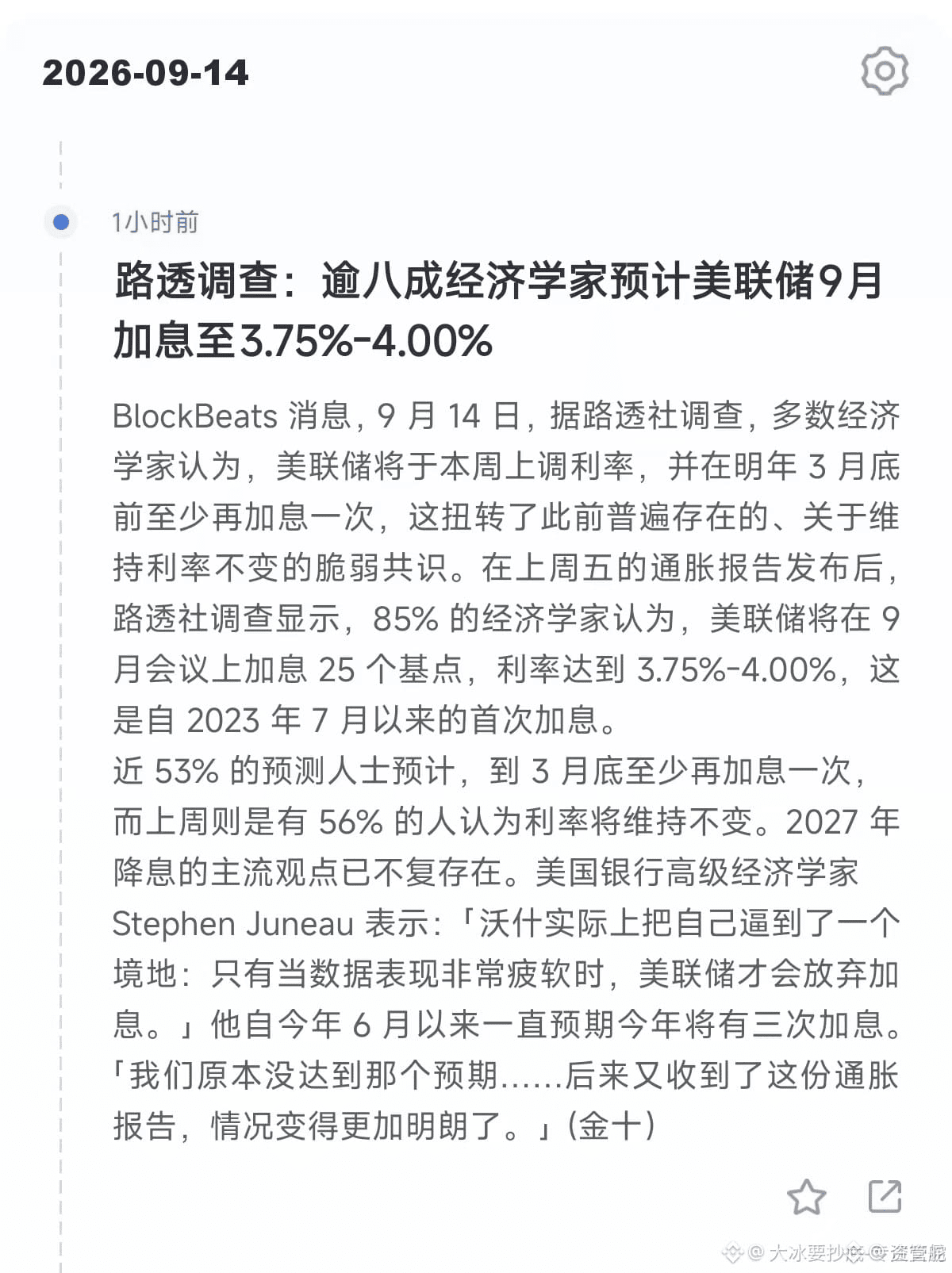
Reuters latest survey: 85% of economists expect the Federal Reserve to raise rates by 25 basis points this week, taking the policy rate to 3.75%-4.00%—the first hike since July 2023. Nearly 53% expect at least one more rate increase by the end of March next year, while expectations for rate cuts have largely faded.
For the crypto market, the call on a liquidity turning point has been pushed back again. A “higher for longer” rate environment is still weighing on risk appetite, and near-term volatility is likely to be driven by macro data.
(Source: Reuters/Golden Ten; compiled for information only and does not constitute any investment advice.)
Reuters latest survey: 85% of economists expect the Federal Reserve to raise rates by 25 basis points this week, taking the policy rate to 3.75%-4.00%—the first hike since July 2023. Nearly 53% expect at least one more rate increase by the end of March next year, while expectations for rate cuts have largely faded.
For the crypto market, the call on a liquidity turning point has been pushed back again. A “higher for longer” rate environment is still weighing on risk appetite, and near-term volatility is likely to be driven by macro data.
(Source: Reuters/Golden Ten; compiled for information only and does not constitute any investment advice.)
For the crypto market, the call on a liquidity turning point has been pushed back again. A “higher for longer” rate environment is still weighing on risk appetite, and near-term volatility is likely to be driven by macro data.
(Source: Reuters/Golden Ten; compiled for information only and does not constitute any investment advice.)
45
·
--
Article
Computing chips rebound collectively as the “15th Five-Year Plan” highlights new computing paradigmsToday’s early session, the computing chip concept saw volatile trading followed by a rebound. Suiyuan Technology rose by more than 10%. Cambrian, Chipscreen, Moore Threads, TWP, and others were among the top gainers.
Catalysts are coming from the policy front: the Ministry of Industry and Information Technology and the National Development and Reform Commission jointly issued the “14th Five-Year Plan for the Development of the Electronic Information Manufacturing Industry” (the “15th Five-Year Plan” wording used in the document), which clearly calls for building an advanced computing ecosystem, accelerating the deployment of new computing paradigms such as storage-and-compute-integration, quantum computing, optical computing, and brain-inspired computing, and breaking through the architecture design of ultra-large-scale intelligent computing facilities.
For the encryption circle, this line is worth reading in two layers: first, that AI computing power is already the most certain direction for capital expenditures at present; the AI agents on-chain, decentralized computing power, and the economic narrative of reasoning are continuous with the mainboard hardware infrastructure. Second, that the plan brings storage-and-compute-integration and quantum computing onto the table; in the long run, it also concerns the evolution pace of the underlying layer of crypto (post-quantum cryptography and privacy computing). Each time hardware is singled out by policy, it reinforces the consensus of “computing power as infrastructure.”
Computing chips rebound collectively as the “15th Five-Year Plan” highlights new computing paradigms
Today’s early session, the computing chip concept saw volatile trading followed by a rebound. Suiyuan Technology rose by more than 10%. Cambrian, Chipscreen, Moore Threads, TWP, and others were among the top gainers.
Catalysts are coming from the policy front: the Ministry of Industry and Information Technology and the National Development and Reform Commission jointly issued the “14th Five-Year Plan for the Development of the Electronic Information Manufacturing Industry” (the “15th Five-Year Plan” wording used in the document), which clearly calls for building an advanced computing ecosystem, accelerating the deployment of new computing paradigms such as storage-and-compute-integration, quantum computing, optical computing, and brain-inspired computing, and breaking through the architecture design of ultra-large-scale intelligent computing facilities.
For the encryption circle, this line is worth reading in two layers: first, that AI computing power is already the most certain direction for capital expenditures at present; the AI agents on-chain, decentralized computing power, and the economic narrative of reasoning are continuous with the mainboard hardware infrastructure. Second, that the plan brings storage-and-compute-integration and quantum computing onto the table; in the long run, it also concerns the evolution pace of the underlying layer of crypto (post-quantum cryptography and privacy computing). Each time hardware is singled out by policy, it reinforces the consensus of “computing power as infrastructure.”
Catalysts are coming from the policy front: the Ministry of Industry and Information Technology and the National Development and Reform Commission jointly issued the “14th Five-Year Plan for the Development of the Electronic Information Manufacturing Industry” (the “15th Five-Year Plan” wording used in the document), which clearly calls for building an advanced computing ecosystem, accelerating the deployment of new computing paradigms such as storage-and-compute-integration, quantum computing, optical computing, and brain-inspired computing, and breaking through the architecture design of ultra-large-scale intelligent computing facilities.
For the encryption circle, this line is worth reading in two layers: first, that AI computing power is already the most certain direction for capital expenditures at present; the AI agents on-chain, decentralized computing power, and the economic narrative of reasoning are continuous with the mainboard hardware infrastructure. Second, that the plan brings storage-and-compute-integration and quantum computing onto the table; in the long run, it also concerns the evolution pace of the underlying layer of crypto (post-quantum cryptography and privacy computing). Each time hardware is singled out by policy, it reinforces the consensus of “computing power as infrastructure.”
10
·
--
Article
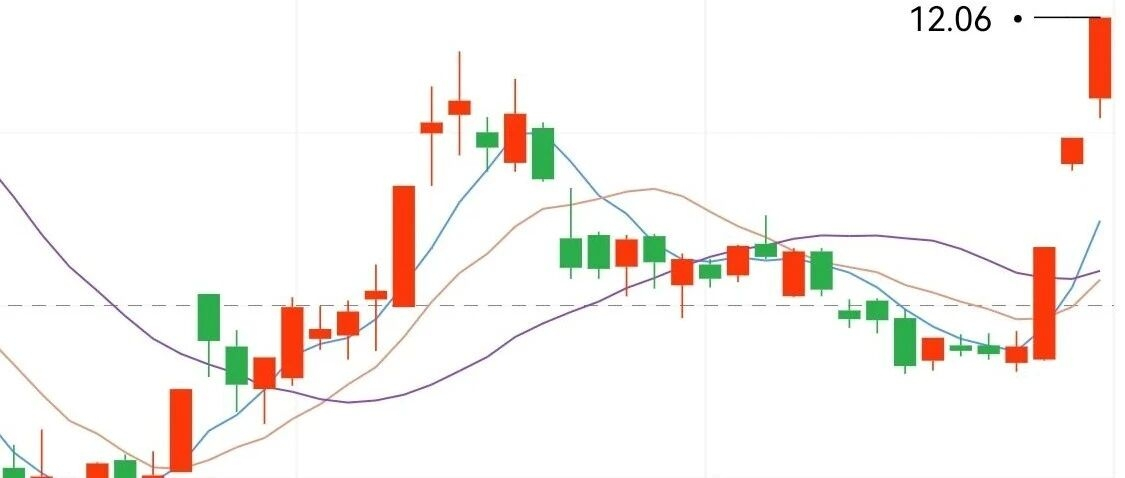
MLCC concept sees unusual activity: Murata to expand capacity by 20%, passive component cycle heats upEarlier today at the start of trading, the MLCC (multilayer ceramic capacitors) concept sector saw a volatile rise. Double Star New Materials secured three consecutive daily limit-up boards, while Torch Electronics, TDKK Group, and Steady (Sdic) also followed higher.
In terms of the news flow, global MLCC leader Murata Manufacturing has issued a clear expansion signal—according to Nikkei, it plans to increase capacity by about 20% from the current level by fiscal year 2027 (from April 2027 to March 2028).
Although MLCCs may seem inconspicuous, they are the "lifeblood" of nearly all electronic devices: smartphones, new-energy vehicles, AI servers, and even mining rig motherboards all depend on them. When the leading player expands capacity against the trend, it often reflects long-term confidence in downstream hardware demand.
MLCC concept sees unusual activity: Murata to expand capacity by 20%, passive component cycle heats up
Earlier today at the start of trading, the MLCC (multilayer ceramic capacitors) concept sector saw a volatile rise. Double Star New Materials secured three consecutive daily limit-up boards, while Torch Electronics, TDKK Group, and Steady (Sdic) also followed higher.
In terms of the news flow, global MLCC leader Murata Manufacturing has issued a clear expansion signal—according to Nikkei, it plans to increase capacity by about 20% from the current level by fiscal year 2027 (from April 2027 to March 2028).
Although MLCCs may seem inconspicuous, they are the "lifeblood" of nearly all electronic devices: smartphones, new-energy vehicles, AI servers, and even mining rig motherboards all depend on them. When the leading player expands capacity against the trend, it often reflects long-term confidence in downstream hardware demand.
In terms of the news flow, global MLCC leader Murata Manufacturing has issued a clear expansion signal—according to Nikkei, it plans to increase capacity by about 20% from the current level by fiscal year 2027 (from April 2027 to March 2028).
Although MLCCs may seem inconspicuous, they are the "lifeblood" of nearly all electronic devices: smartphones, new-energy vehicles, AI servers, and even mining rig motherboards all depend on them. When the leading player expands capacity against the trend, it often reflects long-term confidence in downstream hardware demand.
102
·
--
Article
Cybersecurity concept, top players deliver four straight limit-up boards🛡️ Cybersecurity concept, top players deliver four straight limit-up boards
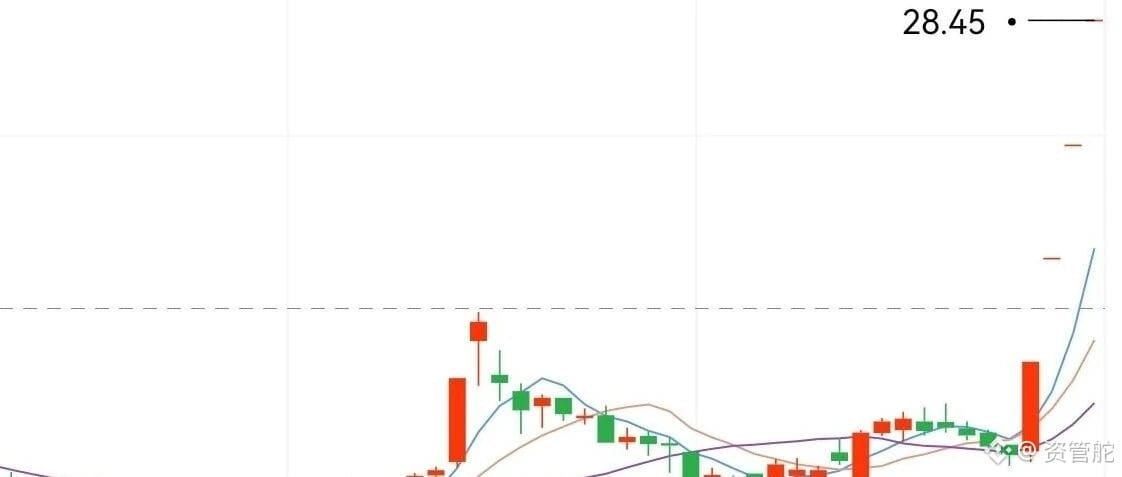
In today’s early trading, the cybersecurity sector continued to open significantly higher: Cixin Saike opened with a one-word limit-up and then achieved four straight limit-up boards; Qiming Information hit limit-up at the call auction; Tianrongxin, Yongxin Zhicheng, Zhongfu Information, and Haohaishendu opened up more than 5%.
Catalysts from the information space: Nvidia, Palantir, and Booz Allen Hamilton are reportedly asking OpenAI and Anthropic to provide new safety assurances and to reduce or halt the use of two of their most advanced AI models. AI safety is shifting from a "technical issue" to a "supply-chain constraint."
For the crypto community, this is not a new line of thought—AI and its intersection with the on-chain world (decentralized computing power, AI agent payments, model attribution) has long depended on "security" as the underlying basis for trust. When industry giants put security on the front stage, the valuation anchors of related narratives are also being repriced.
Cybersecurity concept, top players deliver four straight limit-up boards
🛡️ Cybersecurity concept, top players deliver four straight limit-up boards
In today’s early trading, the cybersecurity sector continued to open significantly higher: Cixin Saike opened with a one-word limit-up and then achieved four straight limit-up boards; Qiming Information hit limit-up at the call auction; Tianrongxin, Yongxin Zhicheng, Zhongfu Information, and Haohaishendu opened up more than 5%.
Catalysts from the information space: Nvidia, Palantir, and Booz Allen Hamilton are reportedly asking OpenAI and Anthropic to provide new safety assurances and to reduce or halt the use of two of their most advanced AI models. AI safety is shifting from a "technical issue" to a "supply-chain constraint."
For the crypto community, this is not a new line of thought—AI and its intersection with the on-chain world (decentralized computing power, AI agent payments, model attribution) has long depended on "security" as the underlying basis for trust. When industry giants put security on the front stage, the valuation anchors of related narratives are also being repriced.
In today’s early trading, the cybersecurity sector continued to open significantly higher: Cixin Saike opened with a one-word limit-up and then achieved four straight limit-up boards; Qiming Information hit limit-up at the call auction; Tianrongxin, Yongxin Zhicheng, Zhongfu Information, and Haohaishendu opened up more than 5%.
Catalysts from the information space: Nvidia, Palantir, and Booz Allen Hamilton are reportedly asking OpenAI and Anthropic to provide new safety assurances and to reduce or halt the use of two of their most advanced AI models. AI safety is shifting from a "technical issue" to a "supply-chain constraint."
For the crypto community, this is not a new line of thought—AI and its intersection with the on-chain world (decentralized computing power, AI agent payments, model attribution) has long depended on "security" as the underlying basis for trust. When industry giants put security on the front stage, the valuation anchors of related narratives are also being repriced.
2
·
--

Article
Global Gold ETFs: Record Net InflowsGlobal investors’ enthusiasm for gold is still rising. According to the latest data from the World Gold Council: in August, global gold ETFs saw net inflows of $18 billion (about RMB 120 billion), reaching the second-largest single-month inflow on record. Holdings increased by 121 tons to 4,189 tons, setting a new historical record.
What’s interesting is that after rapidly surging, the gold price has entered a period of high-level consolidation and is currently hovering around $4,300 per ounce. The market’s focus has also quietly shifted—from “safe-haven” to “expectations for the Federal Reserve’s monetary policy.”
On one side, prices are wildly fluctuating at elevated levels; on the other, funds are still accelerating into the market. Behind this divergence are not only short-term chase-buying funds, but also a reflection that global investors’ concerns about the macroeconomic outlook, fiscal deficits, and the monetary-credit system are deepening.
Global Gold ETFs: Record Net Inflows
Global investors’ enthusiasm for gold is still rising. According to the latest data from the World Gold Council: in August, global gold ETFs saw net inflows of $18 billion (about RMB 120 billion), reaching the second-largest single-month inflow on record. Holdings increased by 121 tons to 4,189 tons, setting a new historical record.
What’s interesting is that after rapidly surging, the gold price has entered a period of high-level consolidation and is currently hovering around $4,300 per ounce. The market’s focus has also quietly shifted—from “safe-haven” to “expectations for the Federal Reserve’s monetary policy.”
On one side, prices are wildly fluctuating at elevated levels; on the other, funds are still accelerating into the market. Behind this divergence are not only short-term chase-buying funds, but also a reflection that global investors’ concerns about the macroeconomic outlook, fiscal deficits, and the monetary-credit system are deepening.
What’s interesting is that after rapidly surging, the gold price has entered a period of high-level consolidation and is currently hovering around $4,300 per ounce. The market’s focus has also quietly shifted—from “safe-haven” to “expectations for the Federal Reserve’s monetary policy.”
On one side, prices are wildly fluctuating at elevated levels; on the other, funds are still accelerating into the market. Behind this divergence are not only short-term chase-buying funds, but also a reflection that global investors’ concerns about the macroeconomic outlook, fiscal deficits, and the monetary-credit system are deepening.
BTC-0.56%
GLDETF+0.18%
8
·
--
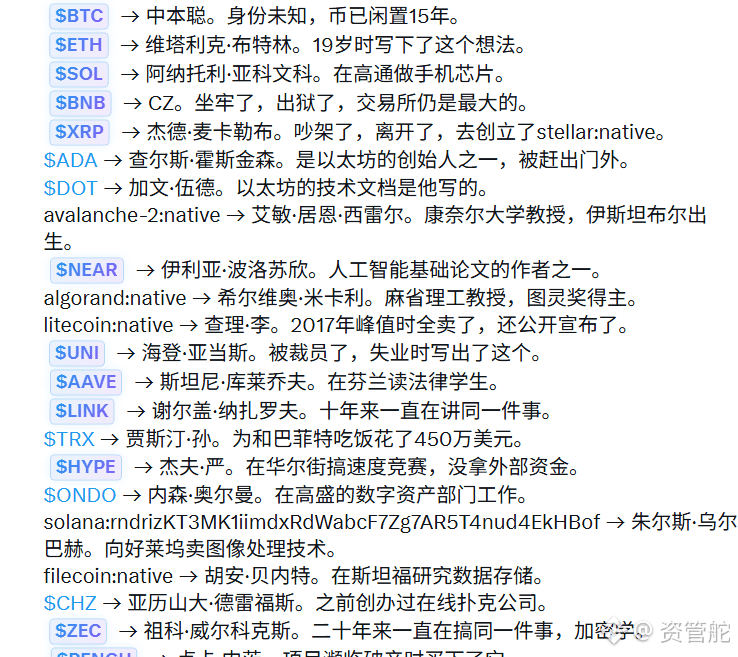
🧬 Encrypted pioneers from entirely different worlds
After reading this list, you’ll realize: crypto was never a game for just one kind of person.
Some are academia-first—Silvio Micali of ALGO is an MIT professor and a Turing Award winner; Emin Gün Sirer of AVAX is a professor at Cornell; and Ilya of NEAR is one of the authors of foundational AI papers.
Some come from hardware and engineering—Anatoly of SOL worked on mobile phone chips at Qualcomm; and Sergey of LINK spent a decade only teaching one thing.
There are also plenty of “unexpected plot twists”: Hayden Adams of UNI wrote while laid off and unemployed; Gavin Wood of DOT originally set out to write technical documentation for Ethereum; and Stani of AAVE was still a law student in Finland at the time.
And some stories aren’t particularly dignified: Jedd of XRP and Charles of ADA both started over after an “all-out fight and walk-off” from Ethereum; Charlie Lee of LTC sold everything at the 2017 peak and publicly announced it; CZ of BNB served time—and after getting out, exchanges were still the biggest.
Technology, academia, the gambling table, layoffs, departures—crypto’s backdrop has never been a single label. What’s truly scarce is often the patience to explain one thing for ten years and do it for ten years.
(List compiled from the internet; not investment advice)
🧬 Encrypted pioneers from entirely different worlds
After reading this list, you’ll realize: crypto was never a game for just one kind of person.
Some are academia-first—Silvio Micali of ALGO is an MIT professor and a Turing Award winner; Emin Gün Sirer of AVAX is a professor at Cornell; and Ilya of NEAR is one of the authors of foundational AI papers.
Some come from hardware and engineering—Anatoly of SOL worked on mobile phone chips at Qualcomm; and Sergey of LINK spent a decade only teaching one thing.
There are also plenty of “unexpected plot twists”: Hayden Adams of UNI wrote while laid off and unemployed; Gavin Wood of DOT originally set out to write technical documentation for Ethereum; and Stani of AAVE was still a law student in Finland at the time.
And some stories aren’t particularly dignified: Jedd of XRP and Charles of ADA both started over after an “all-out fight and walk-off” from Ethereum; Charlie Lee of LTC sold everything at the 2017 peak and publicly announced it; CZ of BNB served time—and after getting out, exchanges were still the biggest.
Technology, academia, the gambling table, layoffs, departures—crypto’s backdrop has never been a single label. What’s truly scarce is often the patience to explain one thing for ten years and do it for ten years.
(List compiled from the internet; not investment advice)
After reading this list, you’ll realize: crypto was never a game for just one kind of person.
Some are academia-first—Silvio Micali of ALGO is an MIT professor and a Turing Award winner; Emin Gün Sirer of AVAX is a professor at Cornell; and Ilya of NEAR is one of the authors of foundational AI papers.
Some come from hardware and engineering—Anatoly of SOL worked on mobile phone chips at Qualcomm; and Sergey of LINK spent a decade only teaching one thing.
There are also plenty of “unexpected plot twists”: Hayden Adams of UNI wrote while laid off and unemployed; Gavin Wood of DOT originally set out to write technical documentation for Ethereum; and Stani of AAVE was still a law student in Finland at the time.
And some stories aren’t particularly dignified: Jedd of XRP and Charles of ADA both started over after an “all-out fight and walk-off” from Ethereum; Charlie Lee of LTC sold everything at the 2017 peak and publicly announced it; CZ of BNB served time—and after getting out, exchanges were still the biggest.
Technology, academia, the gambling table, layoffs, departures—crypto’s backdrop has never been a single label. What’s truly scarce is often the patience to explain one thing for ten years and do it for ten years.
(List compiled from the internet; not investment advice)
2
644
·
--
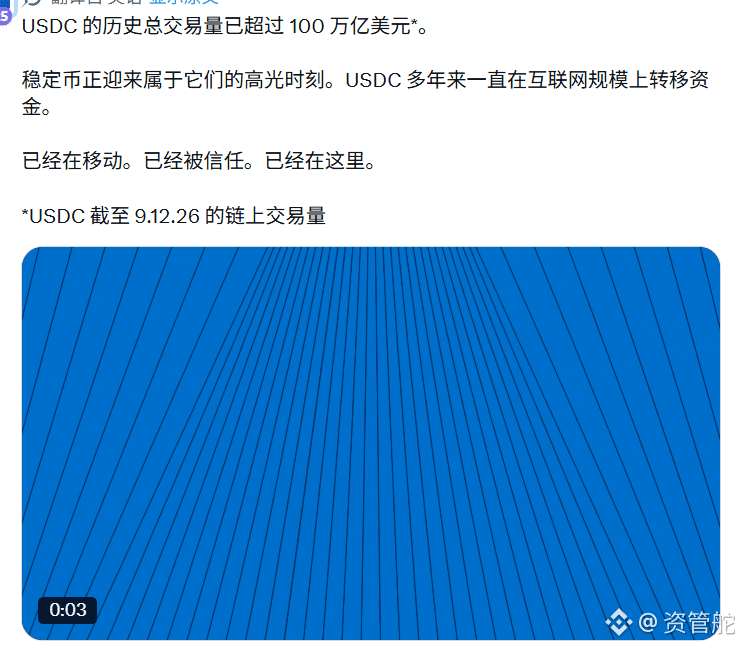
💵 USDC Cumulative On-Chain Transaction Volume Surpasses $1 Trillion
Stablecoins are entering their moment in the spotlight. For years, USDC has been transferring value at internet scale—“already in motion, already trusted, already here.”
What does $1 trillion actually mean? It’s more like a report card for a “settlement network”: stablecoins are no longer just a pit stop in trading pairs, but infrastructure for cross-border payments and on-chain settlement.
As capital transfer volumes accumulate at internet speed, the stablecoin narrative is shifting from “speculative tool” to “payments rails.”
(Data sourced from USDC’s official disclosures and does not constitute investment advice)
💵 USDC Cumulative On-Chain Transaction Volume Surpasses $1 Trillion
Stablecoins are entering their moment in the spotlight. For years, USDC has been transferring value at internet scale—“already in motion, already trusted, already here.”
What does $1 trillion actually mean? It’s more like a report card for a “settlement network”: stablecoins are no longer just a pit stop in trading pairs, but infrastructure for cross-border payments and on-chain settlement.
As capital transfer volumes accumulate at internet speed, the stablecoin narrative is shifting from “speculative tool” to “payments rails.”
(Data sourced from USDC’s official disclosures and does not constitute investment advice)
Stablecoins are entering their moment in the spotlight. For years, USDC has been transferring value at internet scale—“already in motion, already trusted, already here.”
What does $1 trillion actually mean? It’s more like a report card for a “settlement network”: stablecoins are no longer just a pit stop in trading pairs, but infrastructure for cross-border payments and on-chain settlement.
As capital transfer volumes accumulate at internet speed, the stablecoin narrative is shifting from “speculative tool” to “payments rails.”
(Data sourced from USDC’s official disclosures and does not constitute investment advice)
31
·
--
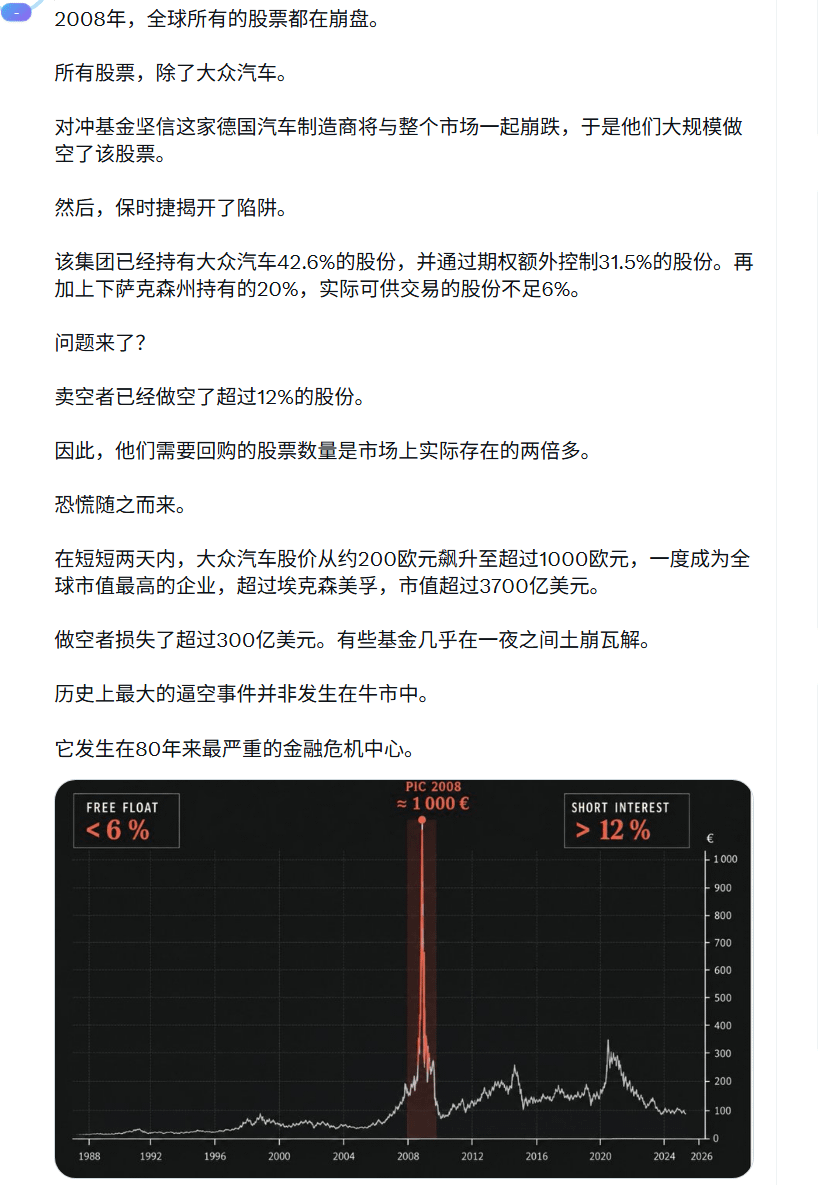
🚗 The biggest short squeeze in history—doesn’t happen in a bull market
In 2008’s financial crisis, global stocks were collapsing—except Volkswagen.
Porsche’s stake of 42.6% + option lockups of 31.5% + 20% in Lower Saxony meant the actually floatable shares were under 6%; meanwhile, the short sellers targeted more than 12%, so the amount they needed to cover was more than twice the market’s existing supply.
Result: In just two days, the share price rocketed from about €200 to over €1,000. At one point, its market cap topped the world at over $370 billion. The short sellers lost more than $30 billion.
The most extreme market conditions often emerge from the ruins of deepest panic.
(Recap of historical events; not investment advice)$AIN
{future}(AINUSDT)
🚗 The biggest short squeeze in history—doesn’t happen in a bull market
In 2008’s financial crisis, global stocks were collapsing—except Volkswagen.
Porsche’s stake of 42.6% + option lockups of 31.5% + 20% in Lower Saxony meant the actually floatable shares were under 6%; meanwhile, the short sellers targeted more than 12%, so the amount they needed to cover was more than twice the market’s existing supply.
Result: In just two days, the share price rocketed from about €200 to over €1,000. At one point, its market cap topped the world at over $370 billion. The short sellers lost more than $30 billion.
The most extreme market conditions often emerge from the ruins of deepest panic.
(Recap of historical events; not investment advice)$AIN
In 2008’s financial crisis, global stocks were collapsing—except Volkswagen.
Porsche’s stake of 42.6% + option lockups of 31.5% + 20% in Lower Saxony meant the actually floatable shares were under 6%; meanwhile, the short sellers targeted more than 12%, so the amount they needed to cover was more than twice the market’s existing supply.
Result: In just two days, the share price rocketed from about €200 to over €1,000. At one point, its market cap topped the world at over $370 billion. The short sellers lost more than $30 billion.
The most extreme market conditions often emerge from the ruins of deepest panic.
(Recap of historical events; not investment advice)$AIN
122
·
--
US Federal Reserve September FOMC meeting: The interest rate decision will be released in the early hours of September 17 Beijing time. The meeting will be held on September 15–16. What truly affects BTC is the interest rate decision + the Powell press conference/policy signals. Currently, market expectations about whether there will be a rate hike are changing significantly, so this meeting could bring substantial volatility.
US Federal Reserve September FOMC meeting: The interest rate decision will be released in the early hours of September 17 Beijing time. The meeting will be held on September 15–16. What truly affects BTC is the interest rate decision + the Powell press conference/policy signals. Currently, market expectations about whether there will be a rate hike are changing significantly, so this meeting could bring substantial volatility.
123
·
--

Article
Two A-share reorganizations terminated; market caution sentiment heats upLate yesterday evening, two A-share companies simultaneously terminated major asset reorganizations. Jiaozuo Wanfang (000612.SZ) terminated its acquisition of 99.44% equity in Cayman Aluminum Industry (Sanmenxia)—which had originally involved issuing shares to buy from 19 counterparties, constituting a major asset reorganization and related-party transaction. It cited that the "market environment has changed more than in the initial planning stage," and committed to not resuming planning for at least one month.
Jin Chengzi (688291.SH) terminated its acquisition of control of Shenzhen Zhibotai Technology Holding and its financing because it was "unable to reach an agreement on the core terms." After its stock was halted on September 8, it resumed trading on September 15.
Two deals were wrecked on the same night, and both reasons point to "timing/clauses" rather than a collapse in underlying fundamentals. This kind of "press the pause button" happens more frequently in volatile markets, reflecting increased disagreement in how top-tier and semi-tier markets price assets, and investors becoming more selective.
Two A-share reorganizations terminated; market caution sentiment heats up
Late yesterday evening, two A-share companies simultaneously terminated major asset reorganizations. Jiaozuo Wanfang (000612.SZ) terminated its acquisition of 99.44% equity in Cayman Aluminum Industry (Sanmenxia)—which had originally involved issuing shares to buy from 19 counterparties, constituting a major asset reorganization and related-party transaction. It cited that the "market environment has changed more than in the initial planning stage," and committed to not resuming planning for at least one month.
Jin Chengzi (688291.SH) terminated its acquisition of control of Shenzhen Zhibotai Technology Holding and its financing because it was "unable to reach an agreement on the core terms." After its stock was halted on September 8, it resumed trading on September 15.
Two deals were wrecked on the same night, and both reasons point to "timing/clauses" rather than a collapse in underlying fundamentals. This kind of "press the pause button" happens more frequently in volatile markets, reflecting increased disagreement in how top-tier and semi-tier markets price assets, and investors becoming more selective.
Jin Chengzi (688291.SH) terminated its acquisition of control of Shenzhen Zhibotai Technology Holding and its financing because it was "unable to reach an agreement on the core terms." After its stock was halted on September 8, it resumed trading on September 15.
Two deals were wrecked on the same night, and both reasons point to "timing/clauses" rather than a collapse in underlying fundamentals. This kind of "press the pause button" happens more frequently in volatile markets, reflecting increased disagreement in how top-tier and semi-tier markets price assets, and investors becoming more selective.
92
·
--
Article
Japanese and South Korean stock markets both open lower—has Asian risk sentiment weakened?In today’s early Asian session, both Japanese and South Korean stock markets opened lower. South Korea’s KOSPI fell 0.38% to 6,659.25 points at the open, while Japan’s Nikkei 225 opened down 0.48% at 63,190.37 points—both starting with only modest declines and no signs of sharp volatility.
Let’s clarify: this is the performance at the instant of the "open," not the full-day trend. Asia-Pacific equities are often swayed by the U.S. stock market and FX movements from the previous night—overnight risk appetite, the yen’s move, and foreign capital flows are all priced into the opening call auction. Judging only by the opening drop, the signal is somewhat weak; it’s more like a cautious mood than a trend reversal.
For the crypto market, the Asian session is an important mood window. Participation from Japan and South Korea is not low, and when stock markets gap down, it often maps to a contraction in risk appetite; however, crypto trades 24/7 and is primarily driven by its own supply and demand, so it may not move in the same direction. A weak open can serve as a "thermometer" for risk appetite rather than a directional signal for Bitcoin.
Japanese and South Korean stock markets both open lower—has Asian risk sentiment weakened?
In today’s early Asian session, both Japanese and South Korean stock markets opened lower. South Korea’s KOSPI fell 0.38% to 6,659.25 points at the open, while Japan’s Nikkei 225 opened down 0.48% at 63,190.37 points—both starting with only modest declines and no signs of sharp volatility.
Let’s clarify: this is the performance at the instant of the "open," not the full-day trend. Asia-Pacific equities are often swayed by the U.S. stock market and FX movements from the previous night—overnight risk appetite, the yen’s move, and foreign capital flows are all priced into the opening call auction. Judging only by the opening drop, the signal is somewhat weak; it’s more like a cautious mood than a trend reversal.
For the crypto market, the Asian session is an important mood window. Participation from Japan and South Korea is not low, and when stock markets gap down, it often maps to a contraction in risk appetite; however, crypto trades 24/7 and is primarily driven by its own supply and demand, so it may not move in the same direction. A weak open can serve as a "thermometer" for risk appetite rather than a directional signal for Bitcoin.
Let’s clarify: this is the performance at the instant of the "open," not the full-day trend. Asia-Pacific equities are often swayed by the U.S. stock market and FX movements from the previous night—overnight risk appetite, the yen’s move, and foreign capital flows are all priced into the opening call auction. Judging only by the opening drop, the signal is somewhat weak; it’s more like a cautious mood than a trend reversal.
For the crypto market, the Asian session is an important mood window. Participation from Japan and South Korea is not low, and when stock markets gap down, it often maps to a contraction in risk appetite; however, crypto trades 24/7 and is primarily driven by its own supply and demand, so it may not move in the same direction. A weak open can serve as a "thermometer" for risk appetite rather than a directional signal for Bitcoin.
119
·
--
U.S. Senate procedural vote on the “CLARITY Act”: around 02:15 a.m. Beijing time on September 16 (U.S. Eastern time: 14:15 on September 15). This is the most worth watching crypto regulatory event today—at least 60 votes are needed to move it forward; although the Republican Party has already added new ethical constraints to the bill, it remains uncertain whether 60 votes can be reached.
U.S. Senate procedural vote on the “CLARITY Act”: around 02:15 a.m. Beijing time on September 16 (U.S. Eastern time: 14:15 on September 15). This is the most worth watching crypto regulatory event today—at least 60 votes are needed to move it forward; although the Republican Party has already added new ethical constraints to the bill, it remains uncertain whether 60 votes can be reached.
102
·
--
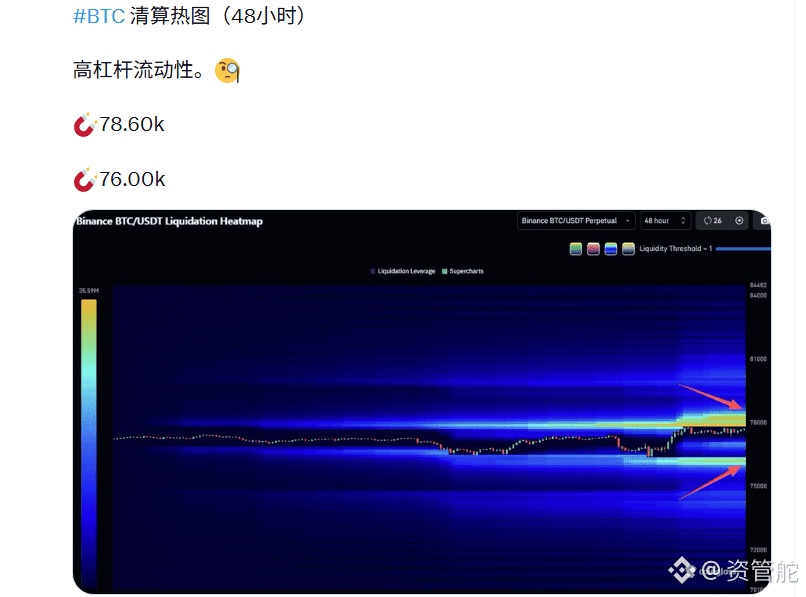
#BTC Liquidation heatmap (48 hours)
BTC is squeezed in the middle by two clusters of high-leverage liquidity: 78.60k above and 76.00k below. The brighter horizontal bands on the heatmap indicate denser liquidation orders—once the price moves close, it can easily trigger cascading liquidations and amplify short-term volatility.
This kind of “fuel on both sides” structure often shows up as repeated tug-of-war within a range; true large volatility usually occurs after one side gets swept through.
Source: Coinglass|Binance BTC/USDT perpetual. Not investment advice.
#BTC Liquidation heatmap (48 hours)
BTC is squeezed in the middle by two clusters of high-leverage liquidity: 78.60k above and 76.00k below. The brighter horizontal bands on the heatmap indicate denser liquidation orders—once the price moves close, it can easily trigger cascading liquidations and amplify short-term volatility.
This kind of “fuel on both sides” structure often shows up as repeated tug-of-war within a range; true large volatility usually occurs after one side gets swept through.
Source: Coinglass|Binance BTC/USDT perpetual. Not investment advice.
BTC is squeezed in the middle by two clusters of high-leverage liquidity: 78.60k above and 76.00k below. The brighter horizontal bands on the heatmap indicate denser liquidation orders—once the price moves close, it can easily trigger cascading liquidations and amplify short-term volatility.
This kind of “fuel on both sides” structure often shows up as repeated tug-of-war within a range; true large volatility usually occurs after one side gets swept through.
Source: Coinglass|Binance BTC/USDT perpetual. Not investment advice.
54
·
--
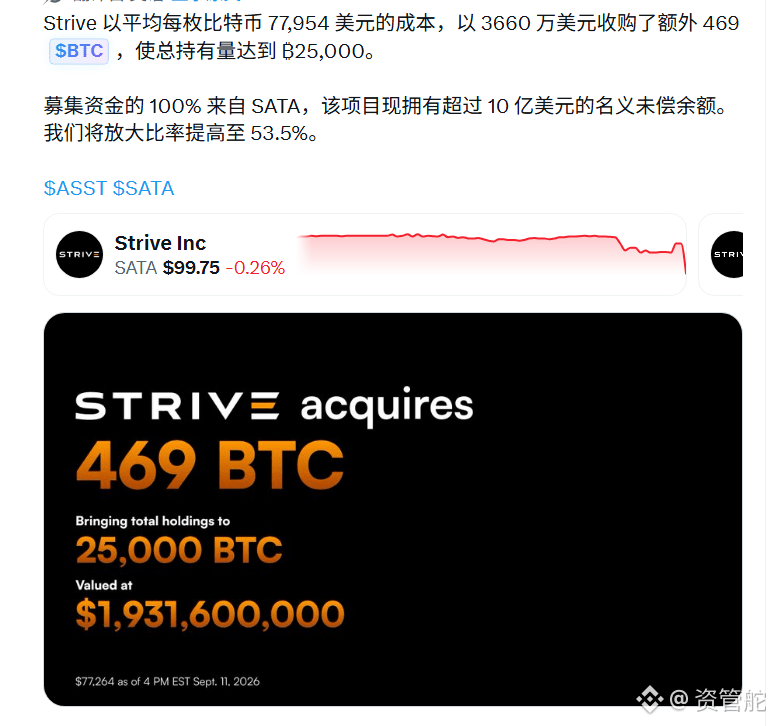
Strive (ASST) swept the market again: bought 469 BTC at an average price of $77,954, costing about $36.6M; total holdings have officially surpassed 25,000 BTC, and valued at around $1.93B based on a $77,264 estimate.
A few details worth noting:
① The added 469 BTC were bought at an average price of $77,954, falling within BTC’s recent trading range—not chasing the spike.
② 100% of the financing comes from SATA. The tool’s nominal outstanding balance has already exceeded $1 billion, and the company has also conveniently raised the “amplification ratio” to 53.5%—leverage is moving upward.
③ From the previous 24,531 BTC to the current 25,000 BTC, the pace hasn’t stopped; it’s moving toward the next integer milestone.
On one side, BTC is churning around the $77K level; on the other, a reserve company is continuously accumulating using structured financing. This “prices trade sideways while supply is quietly locked away” is arguably the most watchable thread in this round’s BTC holdings narrative.
$ASST $SATA
Strive (ASST) swept the market again: bought 469 BTC at an average price of $77,954, costing about $36.6M; total holdings have officially surpassed 25,000 BTC, and valued at around $1.93B based on a $77,264 estimate.
A few details worth noting:
① The added 469 BTC were bought at an average price of $77,954, falling within BTC’s recent trading range—not chasing the spike.
② 100% of the financing comes from SATA. The tool’s nominal outstanding balance has already exceeded $1 billion, and the company has also conveniently raised the “amplification ratio” to 53.5%—leverage is moving upward.
③ From the previous 24,531 BTC to the current 25,000 BTC, the pace hasn’t stopped; it’s moving toward the next integer milestone.
On one side, BTC is churning around the $77K level; on the other, a reserve company is continuously accumulating using structured financing. This “prices trade sideways while supply is quietly locked away” is arguably the most watchable thread in this round’s BTC holdings narrative.
$ASST $SATA
A few details worth noting:
① The added 469 BTC were bought at an average price of $77,954, falling within BTC’s recent trading range—not chasing the spike.
② 100% of the financing comes from SATA. The tool’s nominal outstanding balance has already exceeded $1 billion, and the company has also conveniently raised the “amplification ratio” to 53.5%—leverage is moving upward.
③ From the previous 24,531 BTC to the current 25,000 BTC, the pace hasn’t stopped; it’s moving toward the next integer milestone.
On one side, BTC is churning around the $77K level; on the other, a reserve company is continuously accumulating using structured financing. This “prices trade sideways while supply is quietly locked away” is arguably the most watchable thread in this round’s BTC holdings narrative.
$ASST $SATA
35
·
--
Article
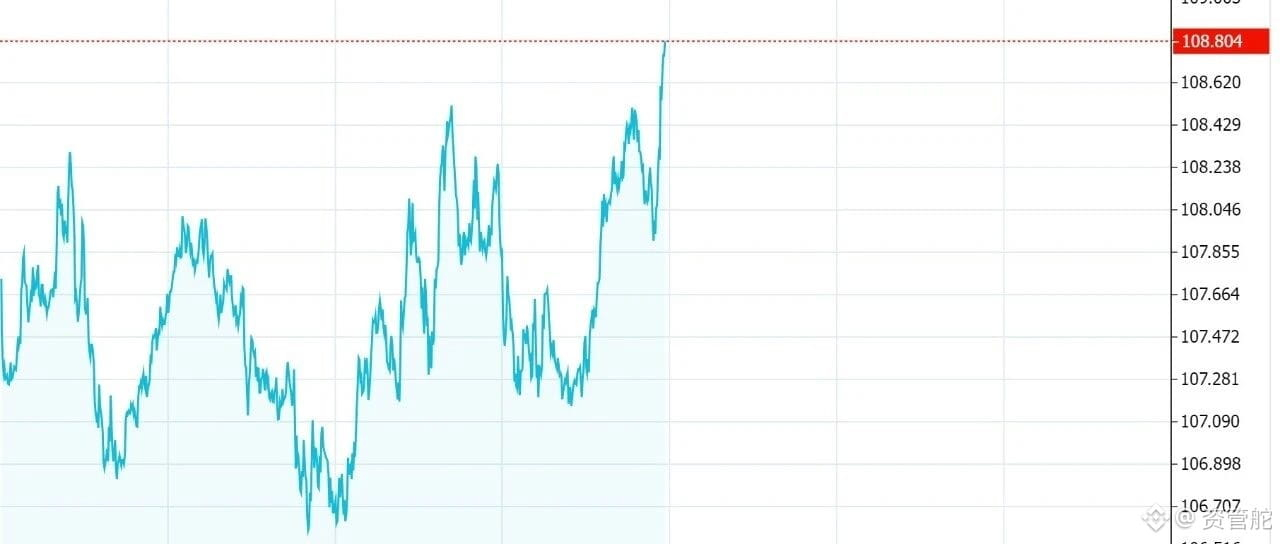
International oil prices surge upward straight away, with risk assets holding their breathThis evening, international oil prices jumped sharply. As of the time of writing, Brent crude was up about 4% to $108.66 per barrel, and WTI crude rose by roughly 4% to $104.204 per barrel in tandem.
On the news front, the US Energy Secretary said that the United States will replenish its Strategic Petroleum Reserve (SPR) over the coming months; official buying may further support the oil price center. Meanwhile, geopolitical tensions in the Middle East have again intensified, adding fuel to the risk premium for crude oil.
For the crypto market, oil prices are a sentinel of inflation expectations. If oil prices stay elevated, they will drive inflation higher and narrow the Federal Reserve’s room to cut rates, creating a valuation constraint for risk assets such as US stocks and cryptocurrencies. Surges in energy prices are often accompanied by amplified volatility, and capital becomes more selective.
International oil prices surge upward straight away, with risk assets holding their breath
This evening, international oil prices jumped sharply. As of the time of writing, Brent crude was up about 4% to $108.66 per barrel, and WTI crude rose by roughly 4% to $104.204 per barrel in tandem.
On the news front, the US Energy Secretary said that the United States will replenish its Strategic Petroleum Reserve (SPR) over the coming months; official buying may further support the oil price center. Meanwhile, geopolitical tensions in the Middle East have again intensified, adding fuel to the risk premium for crude oil.
For the crypto market, oil prices are a sentinel of inflation expectations. If oil prices stay elevated, they will drive inflation higher and narrow the Federal Reserve’s room to cut rates, creating a valuation constraint for risk assets such as US stocks and cryptocurrencies. Surges in energy prices are often accompanied by amplified volatility, and capital becomes more selective.
On the news front, the US Energy Secretary said that the United States will replenish its Strategic Petroleum Reserve (SPR) over the coming months; official buying may further support the oil price center. Meanwhile, geopolitical tensions in the Middle East have again intensified, adding fuel to the risk premium for crude oil.
For the crypto market, oil prices are a sentinel of inflation expectations. If oil prices stay elevated, they will drive inflation higher and narrow the Federal Reserve’s room to cut rates, creating a valuation constraint for risk assets such as US stocks and cryptocurrencies. Surges in energy prices are often accompanied by amplified volatility, and capital becomes more selective.
311
·
--

Article
A once-in-20-years moment: rare synchronized rate hikes by the three G3 central banks of the US, Europe, and JapanA once-in-20-years macro scenario is unfolding: the central banks of the G3 developed economies—the Federal Reserve, the European Central Bank, and the Bank of Japan—are, unusually, entering a rate-hiking cycle in sync. The last time all three were simultaneously in a hiking channel was in 2006.
Key milestones this week:
① Federal Reserve: Probability of a rate hike around 90%, expected +25bp;
② European Central Bank: Last month +25bp, and on Thursday it raised rates for the second time within the past four years. The market expects at least one more rate hike before year-end, and by 2027 the deposit rate is expected to break above 3%;
③ Bank of Japan: Expected to raise by +25bp to 1.25% this Friday, the highest level in more than 30 years;
A once-in-20-years moment: rare synchronized rate hikes by the three G3 central banks of the US, Europe, and Japan
A once-in-20-years macro scenario is unfolding: the central banks of the G3 developed economies—the Federal Reserve, the European Central Bank, and the Bank of Japan—are, unusually, entering a rate-hiking cycle in sync. The last time all three were simultaneously in a hiking channel was in 2006.
Key milestones this week:
① Federal Reserve: Probability of a rate hike around 90%, expected +25bp;
② European Central Bank: Last month +25bp, and on Thursday it raised rates for the second time within the past four years. The market expects at least one more rate hike before year-end, and by 2027 the deposit rate is expected to break above 3%;
③ Bank of Japan: Expected to raise by +25bp to 1.25% this Friday, the highest level in more than 30 years;
Key milestones this week:
① Federal Reserve: Probability of a rate hike around 90%, expected +25bp;
② European Central Bank: Last month +25bp, and on Thursday it raised rates for the second time within the past four years. The market expects at least one more rate hike before year-end, and by 2027 the deposit rate is expected to break above 3%;
③ Bank of Japan: Expected to raise by +25bp to 1.25% this Friday, the highest level in more than 30 years;
1
81
·
--
Article
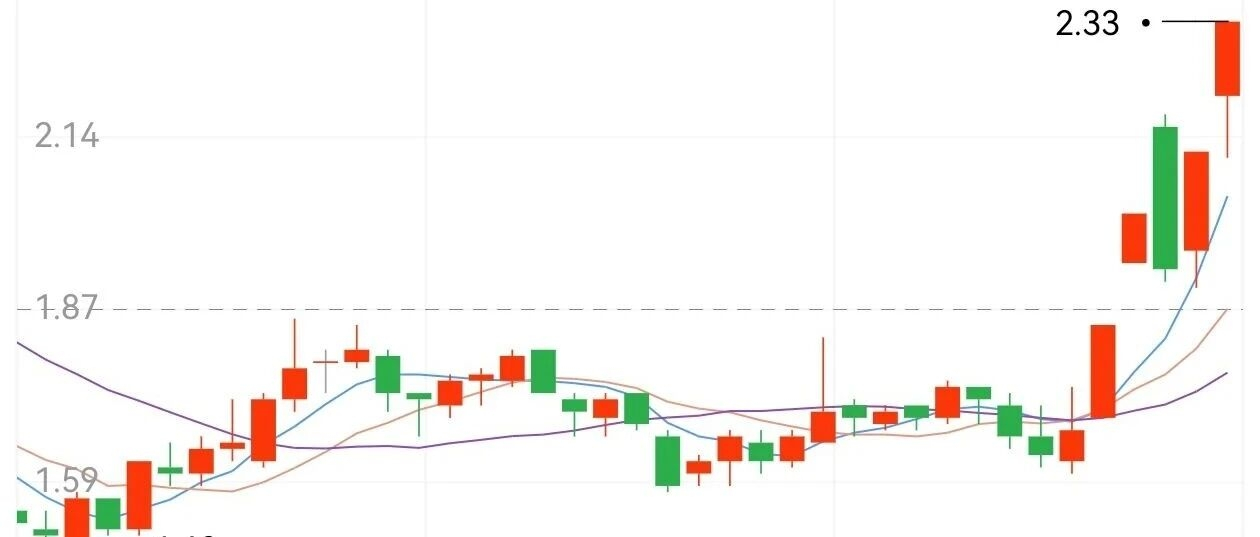
After a 5-day 4-board surge, Zhengtai Automobile itself issued an “urgent notice”Caixin News: A-Shares Zhengtai Automobile (000980.SZ) has delivered a “4 wins in 5 days” streak over the past five trading days. Today, the company proactively released an announcement regarding abnormal stock price fluctuations, pouring a bucket of cold water on market sentiment.
Highlights of the announcement: The vehicle sector is advancing the resumption of work and production, and phased progress has emerged. A brand-new A0-class model has entered batch trial production, but it mainly targets overseas markets, where regulatory certifications, channels, and demand are all uncertain. To date, no sales have been formed. The company still faces funding pressure, and further investment is required for mass production and advertising/placement; whether the funding will arrive is in doubt and could potentially slow down the overseas rollout. End-of-announcement reminder: Invest rationally and watch for risks.
After a 5-day 4-board surge, Zhengtai Automobile itself issued an “urgent notice”
Caixin News: A-Shares Zhengtai Automobile (000980.SZ) has delivered a “4 wins in 5 days” streak over the past five trading days. Today, the company proactively released an announcement regarding abnormal stock price fluctuations, pouring a bucket of cold water on market sentiment.
Highlights of the announcement: The vehicle sector is advancing the resumption of work and production, and phased progress has emerged. A brand-new A0-class model has entered batch trial production, but it mainly targets overseas markets, where regulatory certifications, channels, and demand are all uncertain. To date, no sales have been formed. The company still faces funding pressure, and further investment is required for mass production and advertising/placement; whether the funding will arrive is in doubt and could potentially slow down the overseas rollout. End-of-announcement reminder: Invest rationally and watch for risks.
Highlights of the announcement: The vehicle sector is advancing the resumption of work and production, and phased progress has emerged. A brand-new A0-class model has entered batch trial production, but it mainly targets overseas markets, where regulatory certifications, channels, and demand are all uncertain. To date, no sales have been formed. The company still faces funding pressure, and further investment is required for mass production and advertising/placement; whether the funding will arrive is in doubt and could potentially slow down the overseas rollout. End-of-announcement reminder: Invest rationally and watch for risks.
1
257
·
--
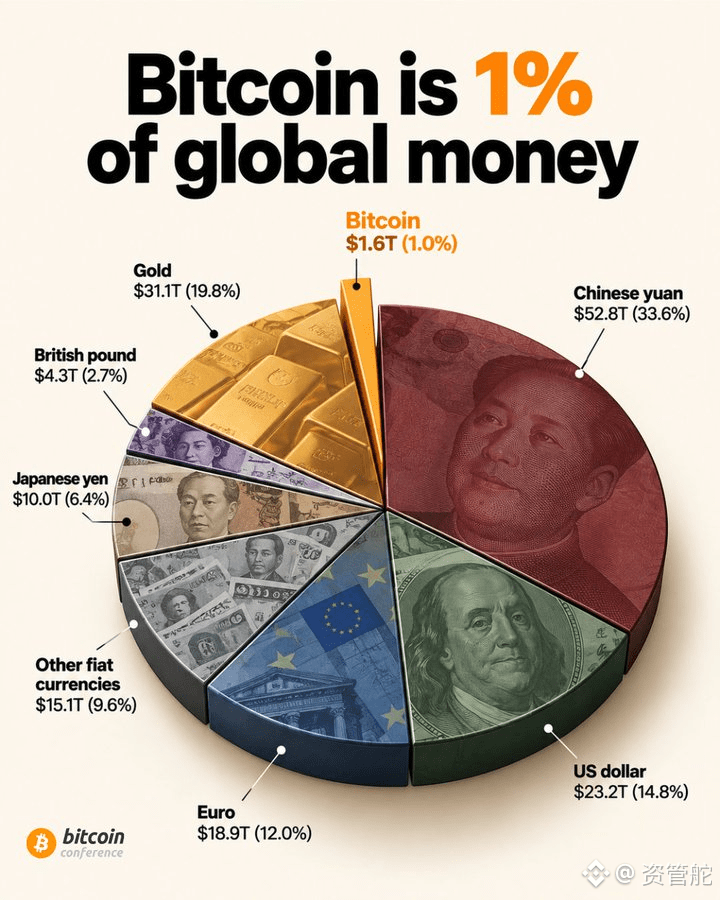
One picture to clearly see where BTC is now: Bitcoin’s total market value is about $1.6 trillion, accounting for only 1% of the world’s total money supply.
Side-by-side comparison on the same basis:
RMB $52.8T (33.6%)
Gold $31.1T (19.8%)
US dollars $23.2T (14.8%)
Euro $18.9T (12.0%)
Other fiat currencies $15.1T (9.6%)
Japanese yen $10.0T (6.4%)
British pound $4.3T (2.7%)
Bitcoin $1.6T (1.0%)
Three takeaways:
1. Gold makes up about 1/5 of the global money supply. Its size is about 19 times that of BTC—there’s still a long way to go in market share for the “digital gold” narrative.
2. BTC is only 1%. On the one hand, it shows that it’s still small; on the other hand, it also means the ceiling is still far away.
3. Fiat currencies make up nearly 90% in total. This is the origin of the long-term logic most commonly cited for BTC: “hedging against fiat currency devaluation.”
Data chart source: Bitcoin Conference.
One picture to clearly see where BTC is now: Bitcoin’s total market value is about $1.6 trillion, accounting for only 1% of the world’s total money supply.
Side-by-side comparison on the same basis:
RMB $52.8T (33.6%)
Gold $31.1T (19.8%)
US dollars $23.2T (14.8%)
Euro $18.9T (12.0%)
Other fiat currencies $15.1T (9.6%)
Japanese yen $10.0T (6.4%)
British pound $4.3T (2.7%)
Bitcoin $1.6T (1.0%)
Three takeaways:
1. Gold makes up about 1/5 of the global money supply. Its size is about 19 times that of BTC—there’s still a long way to go in market share for the “digital gold” narrative.
2. BTC is only 1%. On the one hand, it shows that it’s still small; on the other hand, it also means the ceiling is still far away.
3. Fiat currencies make up nearly 90% in total. This is the origin of the long-term logic most commonly cited for BTC: “hedging against fiat currency devaluation.”
Data chart source: Bitcoin Conference.
Side-by-side comparison on the same basis:
RMB $52.8T (33.6%)
Gold $31.1T (19.8%)
US dollars $23.2T (14.8%)
Euro $18.9T (12.0%)
Other fiat currencies $15.1T (9.6%)
Japanese yen $10.0T (6.4%)
British pound $4.3T (2.7%)
Bitcoin $1.6T (1.0%)
Three takeaways:
1. Gold makes up about 1/5 of the global money supply. Its size is about 19 times that of BTC—there’s still a long way to go in market share for the “digital gold” narrative.
2. BTC is only 1%. On the one hand, it shows that it’s still small; on the other hand, it also means the ceiling is still far away.
3. Fiat currencies make up nearly 90% in total. This is the origin of the long-term logic most commonly cited for BTC: “hedging against fiat currency devaluation.”
Data chart source: Bitcoin Conference.
1
1
181
Log in to explore more content
Join global crypto users on Binance Square
⚡️ Get latest and useful information about crypto.
💬 Trusted by the world’s largest crypto exchange.
👍 Discover real insights from verified creators.
Email / Phone number
Trending Topics
BitcoinReboundsTo$79K
20,276 views
174 Discussing
🚨 $BTC is pushing higher.
Bitcoin is trading around $78,804, up roughly 1.9%, after reclaiming the $78K area. The next level to watch is the intraday high near $78,905.
A clean break above that level could open the way toward $79K–$80K. If BTC gets rejected, support sits around $78,300, then $77,975.
Bulls have momentum, but BTC needs to hold above $78K.
#Bitcoin #BTC #CryptoTrading #CryptoMarket #CryptoAnalysis
PulseON
·18 Likes
·17.3k views
BitcoinSpotETFsNetInflow$160M
171 views
27 Discussing
SouthKoreaCryptoTaxDelayPetitionTops50000
9,808 views
279 Discussing