
Bônggggg
120 Posts

Bônggggg
9 Following
8 Followers
32 Liked
Posts
All
Videos
#termmax @TermMax
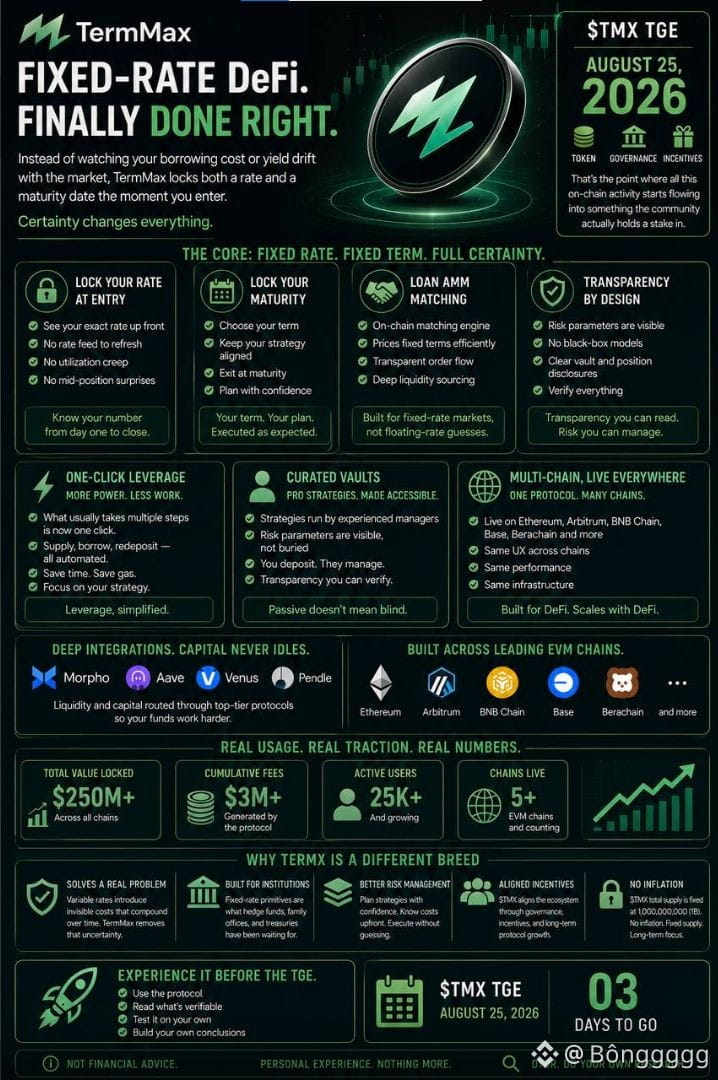
Fixed-rate DeFi has been talked about for years. TermMax is one of the few actually shipping it at scale.
Here's what makes it click: instead of watching your borrowing cost or yield drift with the market, TermMax locks both a rate and a maturity date the moment you enter. That certainty alone solves one of DeFi's oldest pain points, planning around a number that never stays put.
The design goes further than just fixed rates. One-click leverage turns looping into a single action instead of a manual grind. Curated vaults let you hand rate strategy to experienced managers instead of babysitting your own position. And it's not confined to one chain, TermMax runs across Ethereum, Arbitrum, BNB Chain, Base, Berachain and more, plugged directly into Morpho, Aave, Venus and Pendle so capital doesn't sit idle waiting to be matched.
This isn't a protocol chasing a narrative either. Real TVL, real fees, real users across chains, the fundamentals were there before the token conversation even started.
Now the token conversation is here: $TMX TGE is confirmed for August 25, 2026. That's the point where all this on-chain activity starts flowing into something the community actually holds a stake in.
Worth getting familiar with the protocol before the 25th hits.
Not financial advice. DYOR.
Fixed-rate DeFi has been talked about for years. TermMax is one of the few actually shipping it at scale.
Here's what makes it click: instead of watching your borrowing cost or yield drift with the market, TermMax locks both a rate and a maturity date the moment you enter. That certainty alone solves one of DeFi's oldest pain points, planning around a number that never stays put.
The design goes further than just fixed rates. One-click leverage turns looping into a single action instead of a manual grind. Curated vaults let you hand rate strategy to experienced managers instead of babysitting your own position. And it's not confined to one chain, TermMax runs across Ethereum, Arbitrum, BNB Chain, Base, Berachain and more, plugged directly into Morpho, Aave, Venus and Pendle so capital doesn't sit idle waiting to be matched.
This isn't a protocol chasing a narrative either. Real TVL, real fees, real users across chains, the fundamentals were there before the token conversation even started.
Now the token conversation is here: $TMX TGE is confirmed for August 25, 2026. That's the point where all this on-chain activity starts flowing into something the community actually holds a stake in.
Worth getting familiar with the protocol before the 25th hits.
Not financial advice. DYOR.
#termmax @TermMax
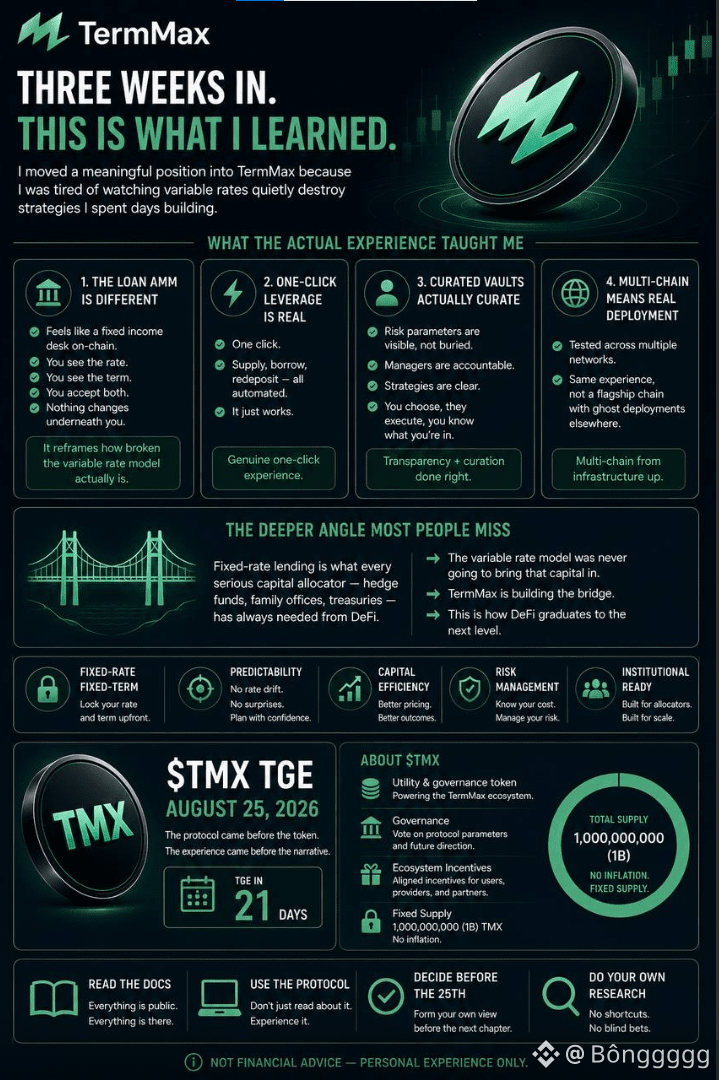
Three weeks ago I moved a meaningful position into TermMax. Not because someone shilled it — because I was tired of watching variable rates quietly destroy strategies I spent days building.
Here's what the actual experience taught me across every angle that matters.
The loan AMM surprised me first. It doesn't feel like a DeFi primitive — it feels like a fixed income desk that happens to run on-chain. You see the rate, you see the term, you accept both, and nothing changes underneath you while you sleep. That experience alone reframes how broken the variable rate model actually is. Aave and Compound are excellent protocols. But they're asking you to hold a position while the ground shifts. TermMax removes that variable entirely.
One-click leverage is genuinely one click. Curated vaults actually curate — the risk parameters are visible, not buried. Multi-chain means I tested deployments across networks and found the same experience, not a flagship chain with ghost deployments everywhere else.
The deeper angle most people miss: fixed-rate lending is what every serious capital allocator — hedge funds, family offices, treasuries — has always needed from DeFi. The variable rate model was never going to bring that capital in. TermMax is building the bridge.
And the timing right now is specific. $TMX TGE hits August 25, 2026. Protocol came before the token. Experience came before the narrative.
That sequencing is how real infrastructure gets built.
Read the docs. Use the protocol. Decide before the 25th.
Not financial advice — personal experience only.
Three weeks ago I moved a meaningful position into TermMax. Not because someone shilled it — because I was tired of watching variable rates quietly destroy strategies I spent days building.
Here's what the actual experience taught me across every angle that matters.
The loan AMM surprised me first. It doesn't feel like a DeFi primitive — it feels like a fixed income desk that happens to run on-chain. You see the rate, you see the term, you accept both, and nothing changes underneath you while you sleep. That experience alone reframes how broken the variable rate model actually is. Aave and Compound are excellent protocols. But they're asking you to hold a position while the ground shifts. TermMax removes that variable entirely.
One-click leverage is genuinely one click. Curated vaults actually curate — the risk parameters are visible, not buried. Multi-chain means I tested deployments across networks and found the same experience, not a flagship chain with ghost deployments everywhere else.
The deeper angle most people miss: fixed-rate lending is what every serious capital allocator — hedge funds, family offices, treasuries — has always needed from DeFi. The variable rate model was never going to bring that capital in. TermMax is building the bridge.
And the timing right now is specific. $TMX TGE hits August 25, 2026. Protocol came before the token. Experience came before the narrative.
That sequencing is how real infrastructure gets built.
Read the docs. Use the protocol. Decide before the 25th.
Not financial advice — personal experience only.
#binancep2pantoan @Binance Vietnam
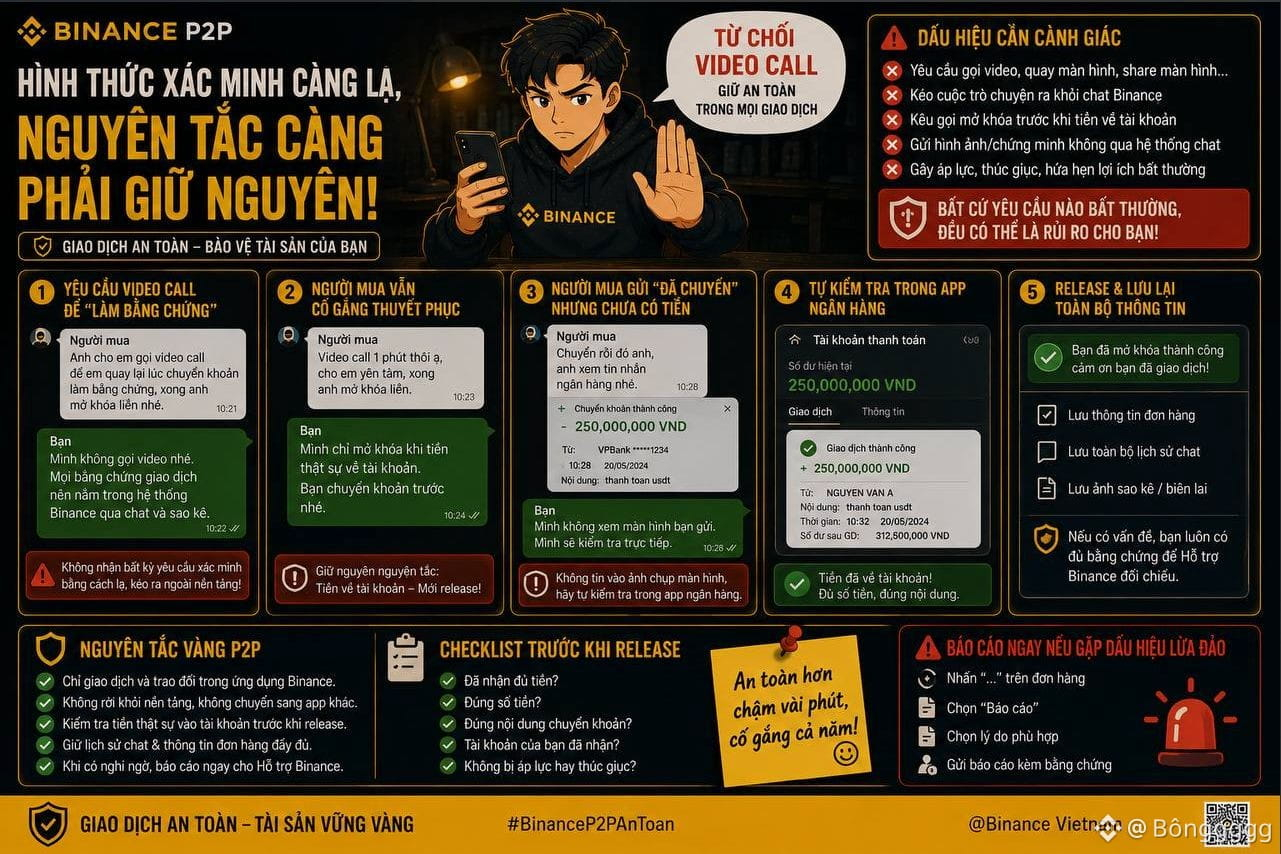
One day, someone bought and messaged: "Please let me do a video call so I can record what happened when transferring as proof, and then you can unlock it right away." It sounds quite transparent, but I still felt something wasn’t right.
I refused the call and explained clearly: all transaction evidence should be in the system—via chat and screenshots of statements—not through any other form outside the platform. I also reminded myself to stay alert whenever someone asks for verification in an unusual way, especially ways that pull the conversation out of Binance chat.
The video call ended with a line: "It’s been transferred—see the bank message." I didn’t look at the screen they sent. Instead, I opened my own banking app to check directly. My account hadn’t received anything.
I replied again, asking them to wait and sticking to my old rule: only unlock when the real money actually arrives in the account, not based on any other kind of "proof." A few minutes later, the funds arrived in the correct amount. Only then did I release, then saved the order and the chat—just like always.
If anything unusual happened after that, at least I would still have enough grounds to send to Binance Support for them to cross-check.
The stranger the verification method is, the more I need to stick to the familiar rules.
One day, someone bought and messaged: "Please let me do a video call so I can record what happened when transferring as proof, and then you can unlock it right away." It sounds quite transparent, but I still felt something wasn’t right.
I refused the call and explained clearly: all transaction evidence should be in the system—via chat and screenshots of statements—not through any other form outside the platform. I also reminded myself to stay alert whenever someone asks for verification in an unusual way, especially ways that pull the conversation out of Binance chat.
The video call ended with a line: "It’s been transferred—see the bank message." I didn’t look at the screen they sent. Instead, I opened my own banking app to check directly. My account hadn’t received anything.
I replied again, asking them to wait and sticking to my old rule: only unlock when the real money actually arrives in the account, not based on any other kind of "proof." A few minutes later, the funds arrived in the correct amount. Only then did I release, then saved the order and the chat—just like always.
If anything unusual happened after that, at least I would still have enough grounds to send to Binance Support for them to cross-check.
The stranger the verification method is, the more I need to stick to the familiar rules.
#termmax @TermMax
Different angle this time — the institutional signal most retail traders scroll past.
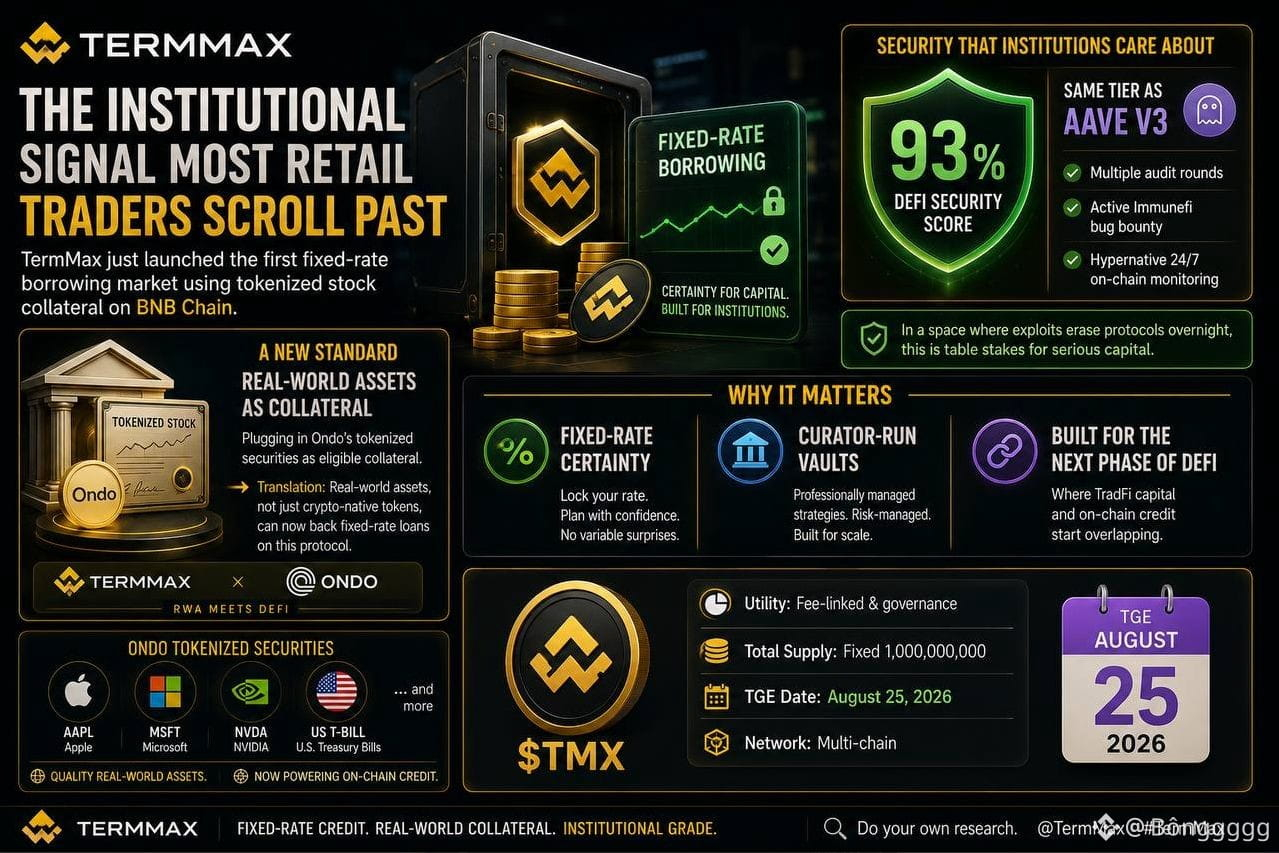
TermMax just launched the first fixed-rate borrowing market using tokenized stock collateral on BNB Chain, plugging in Ondo's tokenized securities as eligible collateral. Translation: real-world assets, not just crypto-native tokens, can now back fixed-rate loans on this protocol. That's a very different conversation than "another lending app." That's infrastructure institutions can actually plug into.
Security backs it up too. TermMax scored 93% on the DeFi Security Score — same tier as Aave V3. Multiple audit rounds, an active Immunefi bug bounty, and Hypernative running 24/7 on-chain monitoring. In a space where exploits erase protocols overnight, that's not a minor detail — it's table stakes for anyone managing serious capital.
Pair that with fixed-rate certainty and curator-run vaults, and you get a protocol quietly built for the next phase of DeFi: where TradFi capital and on-chain credit start overlapping.
$TMX sits at the center of that — fee-linked, fixed 1B supply, TGE August 25, 2026.
Worth understanding before the market prices this in. Do your own research. 👀
Different angle this time — the institutional signal most retail traders scroll past.
TermMax just launched the first fixed-rate borrowing market using tokenized stock collateral on BNB Chain, plugging in Ondo's tokenized securities as eligible collateral. Translation: real-world assets, not just crypto-native tokens, can now back fixed-rate loans on this protocol. That's a very different conversation than "another lending app." That's infrastructure institutions can actually plug into.
Security backs it up too. TermMax scored 93% on the DeFi Security Score — same tier as Aave V3. Multiple audit rounds, an active Immunefi bug bounty, and Hypernative running 24/7 on-chain monitoring. In a space where exploits erase protocols overnight, that's not a minor detail — it's table stakes for anyone managing serious capital.
Pair that with fixed-rate certainty and curator-run vaults, and you get a protocol quietly built for the next phase of DeFi: where TradFi capital and on-chain credit start overlapping.
$TMX sits at the center of that — fee-linked, fixed 1B supply, TGE August 25, 2026.
Worth understanding before the market prices this in. Do your own research. 👀
#binancep2pantoan @Binance Vietnam
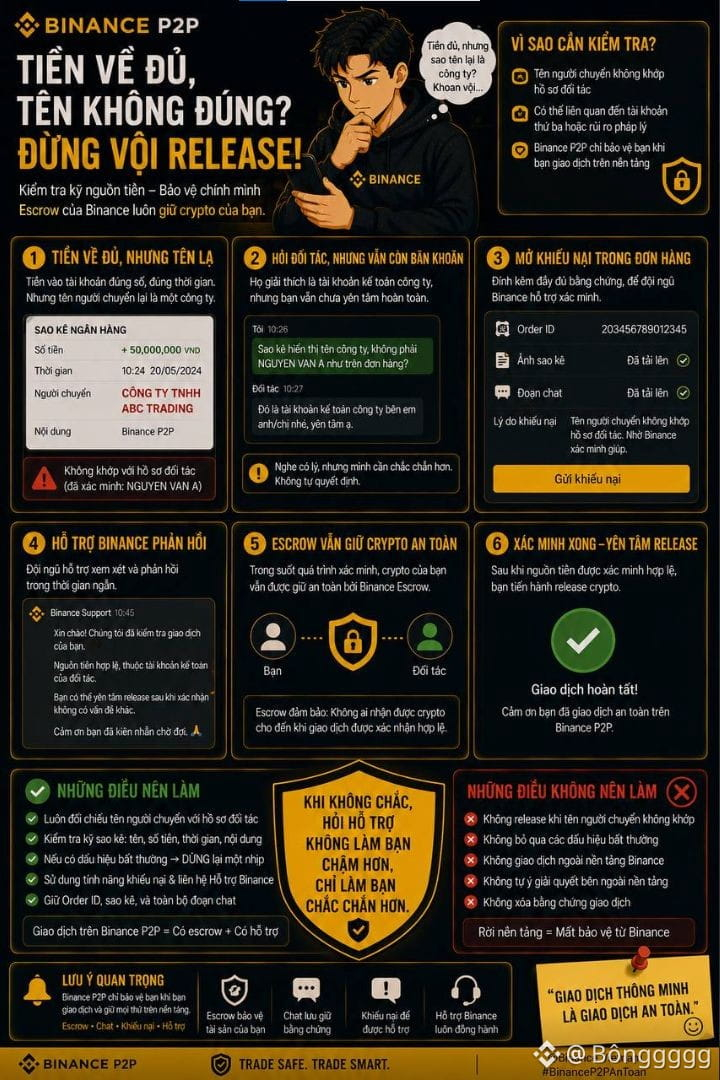
There was a time when funds were credited to my account in full, on time. But when I looked closely at the transaction statement, the remitter’s name was a company, not an individual name as shown on the counterparty’s profile in the order.
I hesitated and didn’t unlock right away even though the money had arrived in full. Confirming payment, to me, isn’t just checking whether the numbers match—it’s also making sure the source of the funds is reasonable for the person I’m actually dealing with. Seeing an unfamiliar company name appear in the middle of what should be a personal transaction is reason enough to pause.
I messaged the buyer and asked about it. They explained that it was their company’s accounting account, which sounded plausible, but I still wasn’t completely at ease. Instead of deciding on my own, I filed a dispute right in the order, attaching screenshots of the transaction statement, the chat excerpts, and the complete Order ID code.
Binance support responded within a few dozen minutes, verified that the source of the funds was valid, and guided me so I could feel confident releasing the crypto. Throughout the whole process, escrow kept the crypto portion unchanged—nothing was lost even while I waited longer.
After that, I learned one thing: when you’re not sure, asking Support doesn’t slow you down—it just makes you more certain.
There was a time when funds were credited to my account in full, on time. But when I looked closely at the transaction statement, the remitter’s name was a company, not an individual name as shown on the counterparty’s profile in the order.
I hesitated and didn’t unlock right away even though the money had arrived in full. Confirming payment, to me, isn’t just checking whether the numbers match—it’s also making sure the source of the funds is reasonable for the person I’m actually dealing with. Seeing an unfamiliar company name appear in the middle of what should be a personal transaction is reason enough to pause.
I messaged the buyer and asked about it. They explained that it was their company’s accounting account, which sounded plausible, but I still wasn’t completely at ease. Instead of deciding on my own, I filed a dispute right in the order, attaching screenshots of the transaction statement, the chat excerpts, and the complete Order ID code.
Binance support responded within a few dozen minutes, verified that the source of the funds was valid, and guided me so I could feel confident releasing the crypto. Throughout the whole process, escrow kept the crypto portion unchanged—nothing was lost even while I waited longer.
After that, I learned one thing: when you’re not sure, asking Support doesn’t slow you down—it just makes you more certain.
#termmax @TermMax
I’ve been watching TermMax closely, and with the $TMX TGE coming on August 25, 2026, this is the part of the project I’m paying the most attention to.
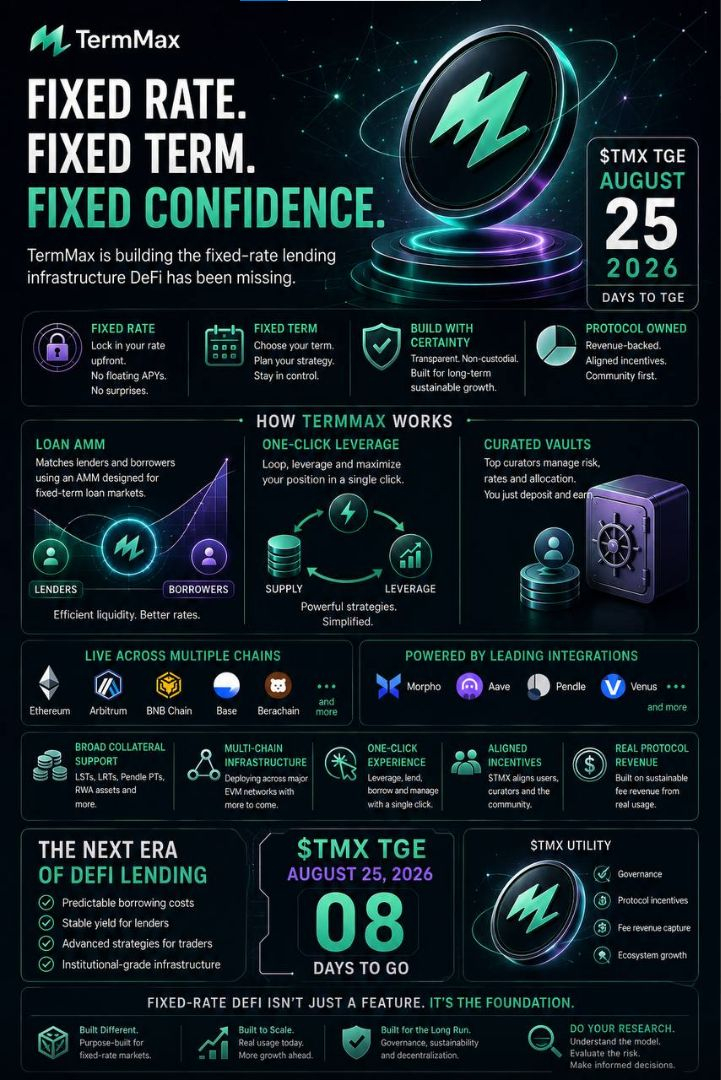
TermMax is building a different layer for DeFi lending: fixed-rate, fixed-term markets instead of leaving borrowers and lenders exposed to constantly moving rates.
The idea is straightforward.
Lock your borrowing cost.
Lock the maturity.
Know the economics of the position upfront.
But the protocol goes beyond fixed rates.
TermMax combines loan AMM infrastructure, one-click leverage, curator-managed vaults, and multi-chain deployment across Ethereum, Arbitrum, BNB Chain, Base, Berachain and other EVM networks. Its architecture also supports a broad range of collateral, including LSTs, LRTs, Pendle PTs and RWA assets.
The loan AMM angle is especially interesting to me. TermMax is essentially trying to build market infrastructure specifically around fixed-rate borrowing and lending, rather than forcing fixed-income strategies into a variable-rate model.
And then comes $TMX.
The upcoming TGE is scheduled for August 25. TMX is positioned as TermMax’s governance and utility token, marking an important transition as the protocol moves toward a more decentralized ecosystem.
What I’m watching now is simple:
Can TermMax make fixed-rate DeFi a mainstream primitive?
August 25 is the next milestone.
If you’re following DeFi infrastructure, I’d definitely keep TermMax on the radar and do your own research before the TGE.
I’ve been watching TermMax closely, and with the $TMX TGE coming on August 25, 2026, this is the part of the project I’m paying the most attention to.
TermMax is building a different layer for DeFi lending: fixed-rate, fixed-term markets instead of leaving borrowers and lenders exposed to constantly moving rates.
The idea is straightforward.
Lock your borrowing cost.
Lock the maturity.
Know the economics of the position upfront.
But the protocol goes beyond fixed rates.
TermMax combines loan AMM infrastructure, one-click leverage, curator-managed vaults, and multi-chain deployment across Ethereum, Arbitrum, BNB Chain, Base, Berachain and other EVM networks. Its architecture also supports a broad range of collateral, including LSTs, LRTs, Pendle PTs and RWA assets.
The loan AMM angle is especially interesting to me. TermMax is essentially trying to build market infrastructure specifically around fixed-rate borrowing and lending, rather than forcing fixed-income strategies into a variable-rate model.
And then comes $TMX.
The upcoming TGE is scheduled for August 25. TMX is positioned as TermMax’s governance and utility token, marking an important transition as the protocol moves toward a more decentralized ecosystem.
What I’m watching now is simple:
Can TermMax make fixed-rate DeFi a mainstream primitive?
August 25 is the next milestone.
If you’re following DeFi infrastructure, I’d definitely keep TermMax on the radar and do your own research before the TGE.
#binancep2pantoan @Binance Vietnam
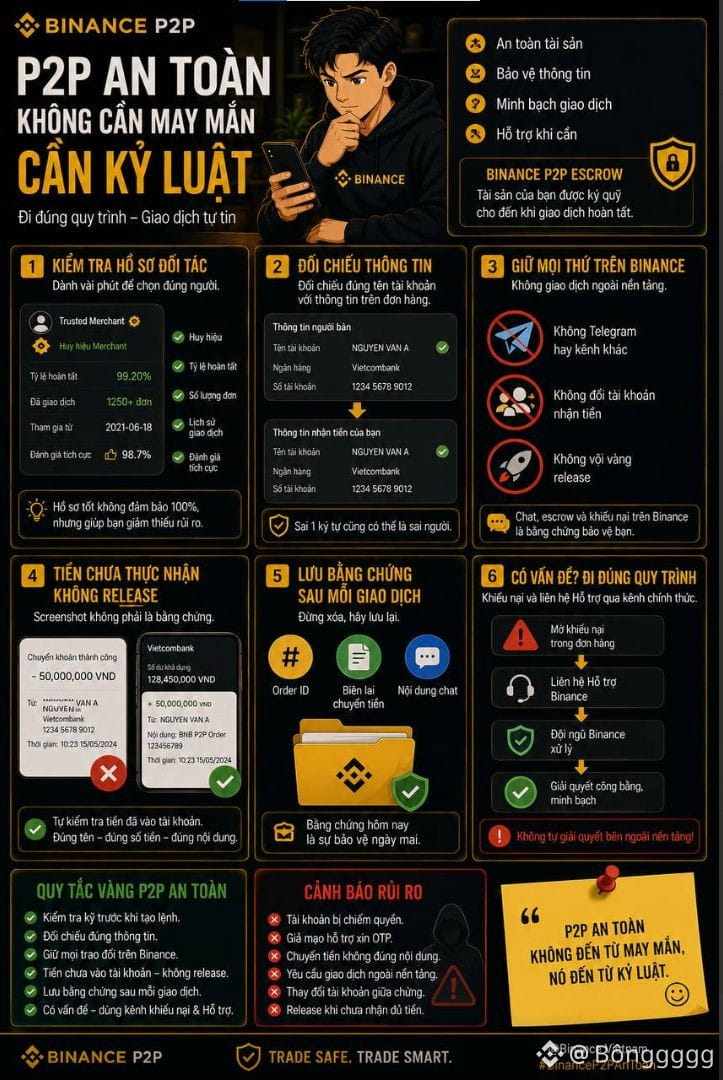
This was my first time trading on Binance P2P. I used to think the hardest part was finding a good price. After a few trades, I realized I had been looking at the problem the wrong way.
The important thing isn’t to find the buyer or seller who is the quickest. It’s to verify the right person and follow the correct process.
Before every order, I start by carefully reviewing the counterparty’s profile: badges, completion rate, and trading history. Then I cross-check the recipient account name against the information on the order. It only takes a few minutes to check, but it helps me avoid a lot of unnecessary situations.
I also have a habit I still keep to this day: I don’t release crypto until the money has actually been received. Screenshots aren’t the proof I need. I always open my banking app myself to confirm whether the transaction has gone into my account.
I also don’t switch to Telegram or trade outside Binance just because the counterparty says it will be faster. When something goes wrong, chat, escrow, and disputes/complaints on the platform are the things I can rely on.
My biggest takeaway is very simple: safe P2P doesn’t require luck—it requires discipline.
This was my first time trading on Binance P2P. I used to think the hardest part was finding a good price. After a few trades, I realized I had been looking at the problem the wrong way.
The important thing isn’t to find the buyer or seller who is the quickest. It’s to verify the right person and follow the correct process.
Before every order, I start by carefully reviewing the counterparty’s profile: badges, completion rate, and trading history. Then I cross-check the recipient account name against the information on the order. It only takes a few minutes to check, but it helps me avoid a lot of unnecessary situations.
I also have a habit I still keep to this day: I don’t release crypto until the money has actually been received. Screenshots aren’t the proof I need. I always open my banking app myself to confirm whether the transaction has gone into my account.
I also don’t switch to Telegram or trade outside Binance just because the counterparty says it will be faster. When something goes wrong, chat, escrow, and disputes/complaints on the platform are the things I can rely on.
My biggest takeaway is very simple: safe P2P doesn’t require luck—it requires discipline.
#termmax @TermMax
Been tracking fixed-rate lending for a while, and TermMax keeps standing out for one simple reason: it's solving a problem most of DeFi still ignores. Variable rates look fine until volatility hits, then your borrowing cost or your yield swings under you overnight.
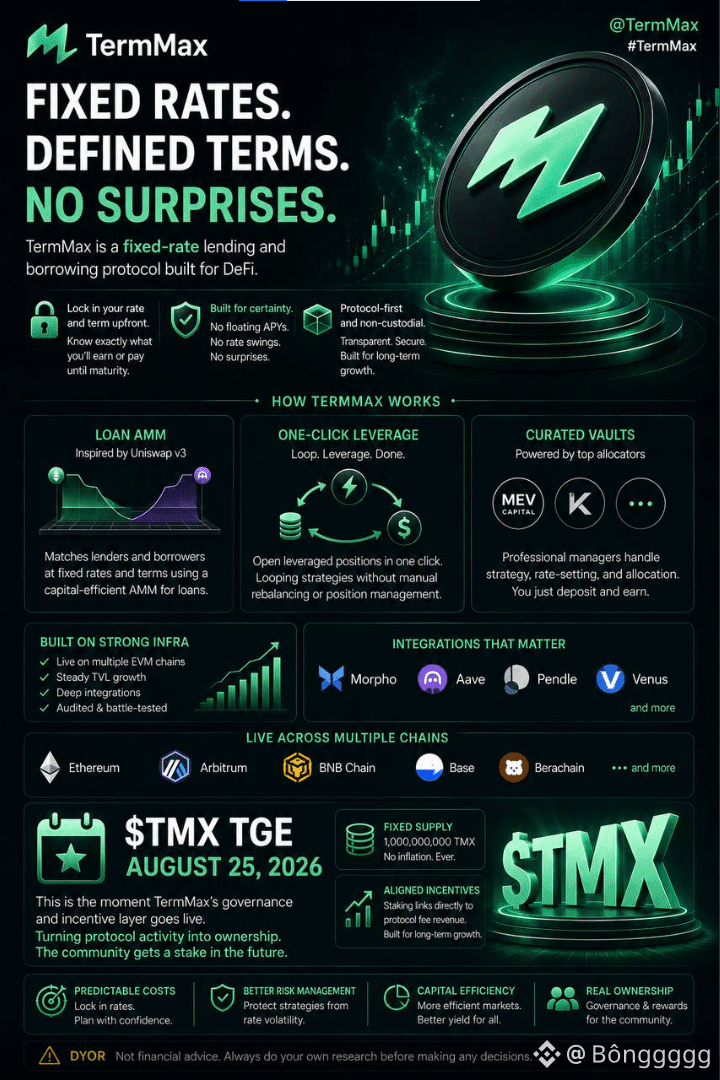
TermMax flips that. It's an AMM-based lending protocol where both lenders and borrowers lock in a fixed rate and a fixed term upfront. No surprises mid-position. Add one-click leverage on top, and you get looping strategies without manually re-borrowing every step. For passive users, curated vaults let experienced managers handle rate-setting and allocation across markets, so idle capital doesn't just sit there.
What actually caught my attention is the infra behind it: multi-chain deployment across Ethereum, Arbitrum, BNB Chain, Base, Berachain and more, plus integrations with the likes of Morpho, Aave, Venus and Pendle. That's not a small side project, that's real plumbing.
Now the part I'm actually watching closely: TGE for $TMX is set for August 25, 2026. This is the moment TermMax's governance and incentive layer goes live, turning protocol activity into something the community can actually hold a stake in.
CEX rates shift with sentiment. Most DeFi lending does too. TermMax is trying to build the fixed-income layer crypto has been missing.
Not financial advice, just something I'm keeping an eye on. Worth digging into before the 25th.
Been tracking fixed-rate lending for a while, and TermMax keeps standing out for one simple reason: it's solving a problem most of DeFi still ignores. Variable rates look fine until volatility hits, then your borrowing cost or your yield swings under you overnight.
TermMax flips that. It's an AMM-based lending protocol where both lenders and borrowers lock in a fixed rate and a fixed term upfront. No surprises mid-position. Add one-click leverage on top, and you get looping strategies without manually re-borrowing every step. For passive users, curated vaults let experienced managers handle rate-setting and allocation across markets, so idle capital doesn't just sit there.
What actually caught my attention is the infra behind it: multi-chain deployment across Ethereum, Arbitrum, BNB Chain, Base, Berachain and more, plus integrations with the likes of Morpho, Aave, Venus and Pendle. That's not a small side project, that's real plumbing.
Now the part I'm actually watching closely: TGE for $TMX is set for August 25, 2026. This is the moment TermMax's governance and incentive layer goes live, turning protocol activity into something the community can actually hold a stake in.
CEX rates shift with sentiment. Most DeFi lending does too. TermMax is trying to build the fixed-income layer crypto has been missing.
Not financial advice, just something I'm keeping an eye on. Worth digging into before the 25th.
#binancep2pantoan @Binance Vietnam
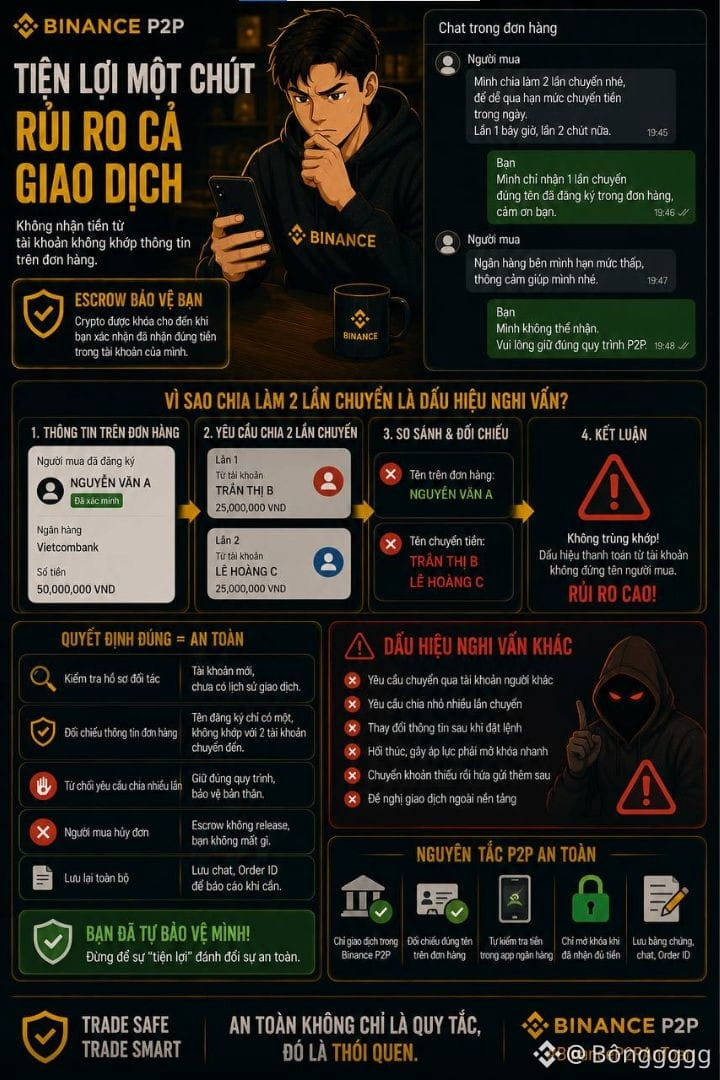
I once almost agreed to a seemingly harmless request: the buyer asked to split the payment into two transfers, from two different bank accounts, "so it’s easier to get around the daily transfer limit".
At first, it sounded reasonable—every bank has limits. But I stopped to verify the partner’s records before agreeing—the account was newly created, with no significant transaction history. I rechecked the order details: the registered name was only one, while the two accounts about to receive the transfers had completely different names—none matched the name on the order.
That’s when I realized this was a red flag: the payment coming from an account not in the actual buyer’s name, even though the reason given sounded very everyday.
I refused to proceed that way. I required a single transfer, using the registered name on the order, exactly as the process on the platform specifies. The buyer then went silent and canceled the order.
I lost nothing, because the escrow had never been released, and I still saved the entire chat log and the Order ID in case I needed to report it to Binance Support.
Sometimes the line between "convenience" and "risk" is thinner than you think—just matching a name is enough to see it clearly.
I once almost agreed to a seemingly harmless request: the buyer asked to split the payment into two transfers, from two different bank accounts, "so it’s easier to get around the daily transfer limit".
At first, it sounded reasonable—every bank has limits. But I stopped to verify the partner’s records before agreeing—the account was newly created, with no significant transaction history. I rechecked the order details: the registered name was only one, while the two accounts about to receive the transfers had completely different names—none matched the name on the order.
That’s when I realized this was a red flag: the payment coming from an account not in the actual buyer’s name, even though the reason given sounded very everyday.
I refused to proceed that way. I required a single transfer, using the registered name on the order, exactly as the process on the platform specifies. The buyer then went silent and canceled the order.
I lost nothing, because the escrow had never been released, and I still saved the entire chat log and the Order ID in case I needed to report it to Binance Support.
Sometimes the line between "convenience" and "risk" is thinner than you think—just matching a name is enough to see it clearly.
#dusk $DUSK @Dusk
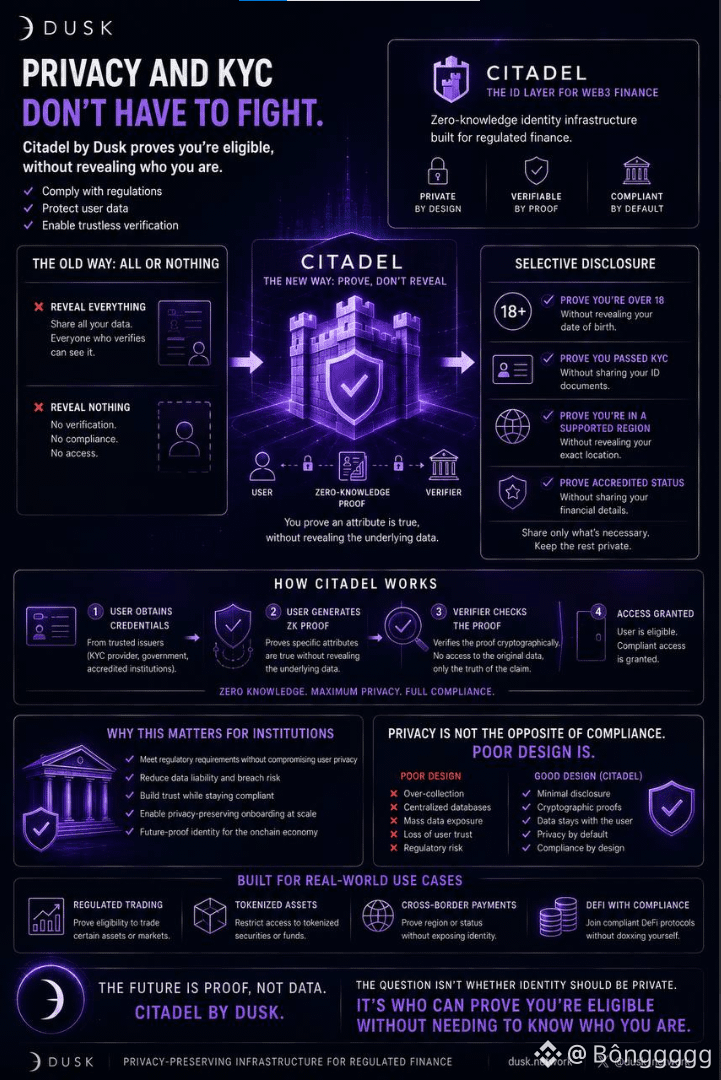
I used to think that "privacy" and "KYC" were two opposing concepts—until I read about Citadel in the @dusk ecosystem.
Most blockchains handle identity by forcing users to reveal all information to anyone who verifies them, or by not requiring verification at all.
But the more closely I read, the more I realized Dusk is choosing a different path.
Citadel uses zero-knowledge proofs so users can prove they meet the requirements—e.g., they are old enough, have completed KYC, belong to a certain legal jurisdiction—without needing to reveal the underlying data.
This is selective disclosure at the identity level, not just at the transaction level.
For a financial institution, that’s the difference between regulatory compliance and having to sacrifice users’ data to comply.
The issue isn’t whether identity should be private.
The real issue is who can prove that you’re eligible—without needing to know who you are.
I used to think that "privacy" and "KYC" were two opposing concepts—until I read about Citadel in the @dusk ecosystem.
Most blockchains handle identity by forcing users to reveal all information to anyone who verifies them, or by not requiring verification at all.
But the more closely I read, the more I realized Dusk is choosing a different path.
Citadel uses zero-knowledge proofs so users can prove they meet the requirements—e.g., they are old enough, have completed KYC, belong to a certain legal jurisdiction—without needing to reveal the underlying data.
This is selective disclosure at the identity level, not just at the transaction level.
For a financial institution, that’s the difference between regulatory compliance and having to sacrifice users’ data to comply.
The issue isn’t whether identity should be private.
The real issue is who can prove that you’re eligible—without needing to know who you are.
#binancep2pantoan @Binance Vietnam
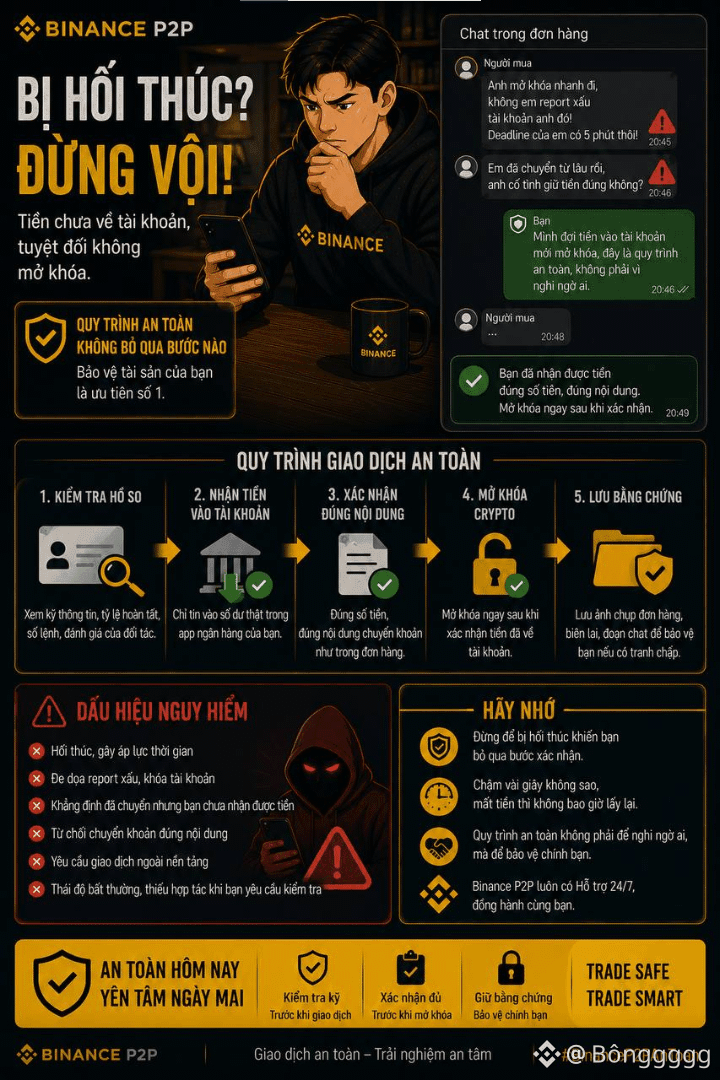
One evening, when I was selling USDT, the buyer messaged me nonstop: "Hurry up and unlock quickly. If you don’t, I’ll report your account badly. My deadline is only 5 minutes.".
I opened my banking app to check, and I didn’t see any deposit yet, even though the buyer insisted that they had transferred it long ago. The sense of being rushed, along with the threat, made me even more alert—this is exactly the kind of time-pressure I had read about before, one of the most common red flags on P2P.
I replied calmly: "I’m waiting for the funds to show up in the newly opened account before unlocking. This is a safe process, not because I doubt anyone." The buyer went silent for a moment, and then they did transfer the money—exactly the right amount, and with the exact content as listed in the order.
I unlocked right after confirming it, not slower than necessary, but also not earlier than a second before the money actually arrived.
After that, I still saved the screenshots of the order and the chat as usual, just in case the buyer changed their mind and reported without reason. That way, I’d have enough evidence to send to Binance Support.
Being pressured isn’t a reason to skip verification—it’s only a reason for me to slow down a little instead.
One evening, when I was selling USDT, the buyer messaged me nonstop: "Hurry up and unlock quickly. If you don’t, I’ll report your account badly. My deadline is only 5 minutes.".
I opened my banking app to check, and I didn’t see any deposit yet, even though the buyer insisted that they had transferred it long ago. The sense of being rushed, along with the threat, made me even more alert—this is exactly the kind of time-pressure I had read about before, one of the most common red flags on P2P.
I replied calmly: "I’m waiting for the funds to show up in the newly opened account before unlocking. This is a safe process, not because I doubt anyone." The buyer went silent for a moment, and then they did transfer the money—exactly the right amount, and with the exact content as listed in the order.
I unlocked right after confirming it, not slower than necessary, but also not earlier than a second before the money actually arrived.
After that, I still saved the screenshots of the order and the chat as usual, just in case the buyer changed their mind and reported without reason. That way, I’d have enough evidence to send to Binance Support.
Being pressured isn’t a reason to skip verification—it’s only a reason for me to slow down a little instead.
#dusk $DUSK @Dusk
I still thought crypto retail and traditional finance were two separate worlds—until I saw Dusk Trade.
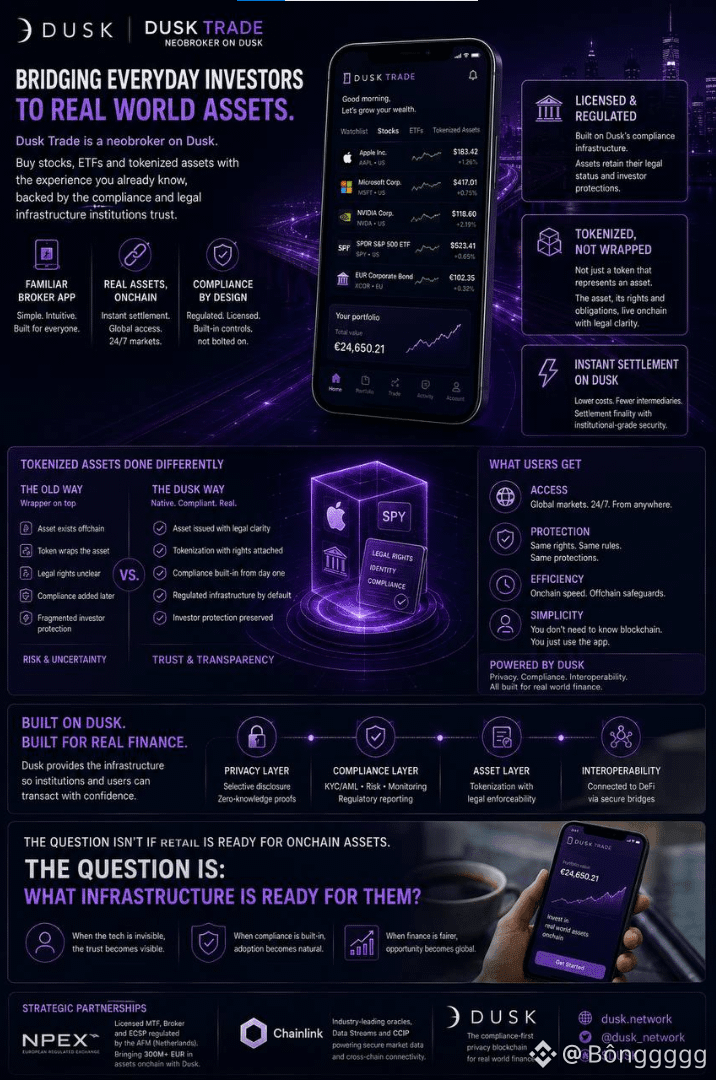
This isn’t just another DEX added to @dusk’s ecosystem. It’s a neobroker built to let everyday users buy stocks, ETFs, and tokenized assets directly on Dusk.
But the more I read, the more I realize the key differences aren’t in the interface.
They lie in the fact that tokenized assets keep their legal status and compliance as the underlying assets, thanks to Dusk’s existing compliance infrastructure—not a wrapper layer added afterward.
Three things at the same time: a familiar broker-app experience, assets settled on-chain, and compliance not being compromised in exchange for speed.
That’s the gap between "allowing trading of tokenized assets" and "allowing trading of real assets in token form".
The question isn’t whether mainstream users are willing to use blockchain.
The question is what kind of infrastructure is trustworthy enough that they don’t even realize they’re using it.
I still thought crypto retail and traditional finance were two separate worlds—until I saw Dusk Trade.
This isn’t just another DEX added to @dusk’s ecosystem. It’s a neobroker built to let everyday users buy stocks, ETFs, and tokenized assets directly on Dusk.
But the more I read, the more I realize the key differences aren’t in the interface.
They lie in the fact that tokenized assets keep their legal status and compliance as the underlying assets, thanks to Dusk’s existing compliance infrastructure—not a wrapper layer added afterward.
Three things at the same time: a familiar broker-app experience, assets settled on-chain, and compliance not being compromised in exchange for speed.
That’s the gap between "allowing trading of tokenized assets" and "allowing trading of real assets in token form".
The question isn’t whether mainstream users are willing to use blockchain.
The question is what kind of infrastructure is trustworthy enough that they don’t even realize they’re using it.
#binancep2pantoan @Binance Vietnam
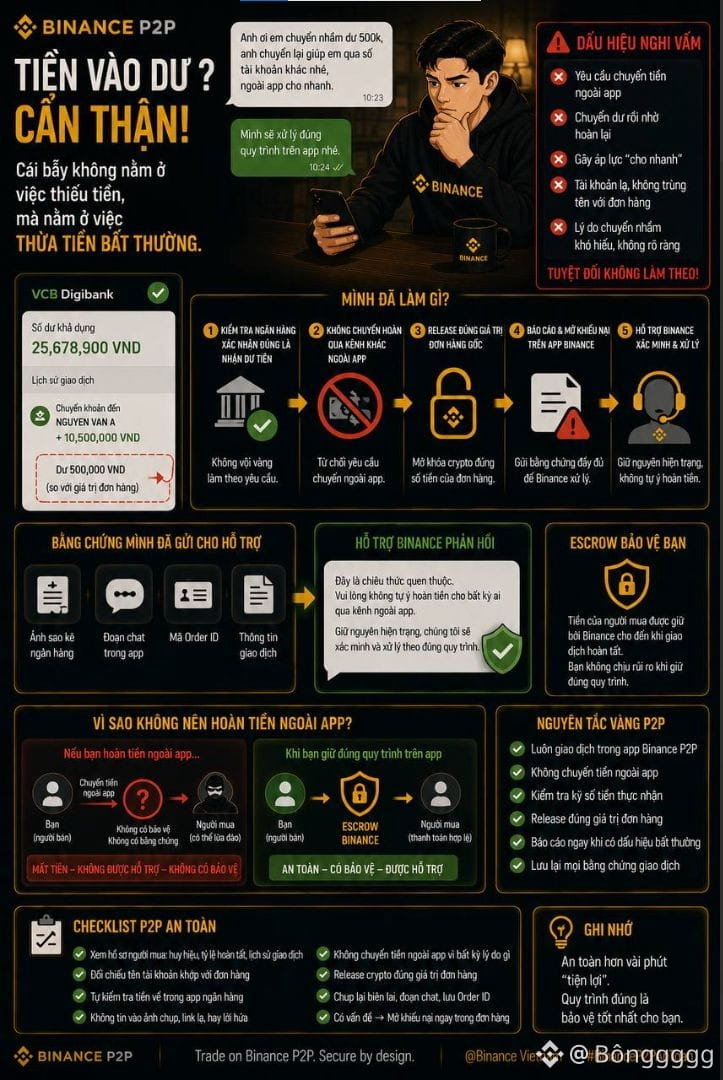
There was once someone who messaged me after completing a bank transfer: "Hey, I accidentally transferred extra 500k. Please transfer it back to me through a different bank account number. For convenience, do it outside the app".
I opened my banking app to check—yes, the amount credited was indeed higher than the actual order value. But instead of following their instruction right away, I paused for a few seconds to think. Asking me to refund through another channel, outside the platform, was a kind of suspicious sign I had read about before—"accidentally transferred" money often comes from a different source, not from the real buyer’s account.
I didn’t refund them the way they requested. I unlocked the correct crypto portion according to the original order value; the difference amount remained unchanged. Then I immediately reported it to Binance Support, along with screenshots of the remittance statement, the chat transcript, and the Order ID code so they could handle it according to the proper procedure.
Support confirmed that this was a familiar trick. They advised me to keep the situation as it was and not to refund anyone on my own through any channel outside the app.
Since that day, I’ve learned one more thing: sometimes the trap isn’t about lacking money—it’s about having an unusually large amount of money.
There was once someone who messaged me after completing a bank transfer: "Hey, I accidentally transferred extra 500k. Please transfer it back to me through a different bank account number. For convenience, do it outside the app".
I opened my banking app to check—yes, the amount credited was indeed higher than the actual order value. But instead of following their instruction right away, I paused for a few seconds to think. Asking me to refund through another channel, outside the platform, was a kind of suspicious sign I had read about before—"accidentally transferred" money often comes from a different source, not from the real buyer’s account.
I didn’t refund them the way they requested. I unlocked the correct crypto portion according to the original order value; the difference amount remained unchanged. Then I immediately reported it to Binance Support, along with screenshots of the remittance statement, the chat transcript, and the Order ID code so they could handle it according to the proper procedure.
Support confirmed that this was a familiar trick. They advised me to keep the situation as it was and not to refund anyone on my own through any channel outside the app.
Since that day, I’ve learned one more thing: sometimes the trap isn’t about lacking money—it’s about having an unusually large amount of money.
#dusk $DUSK @Dusk
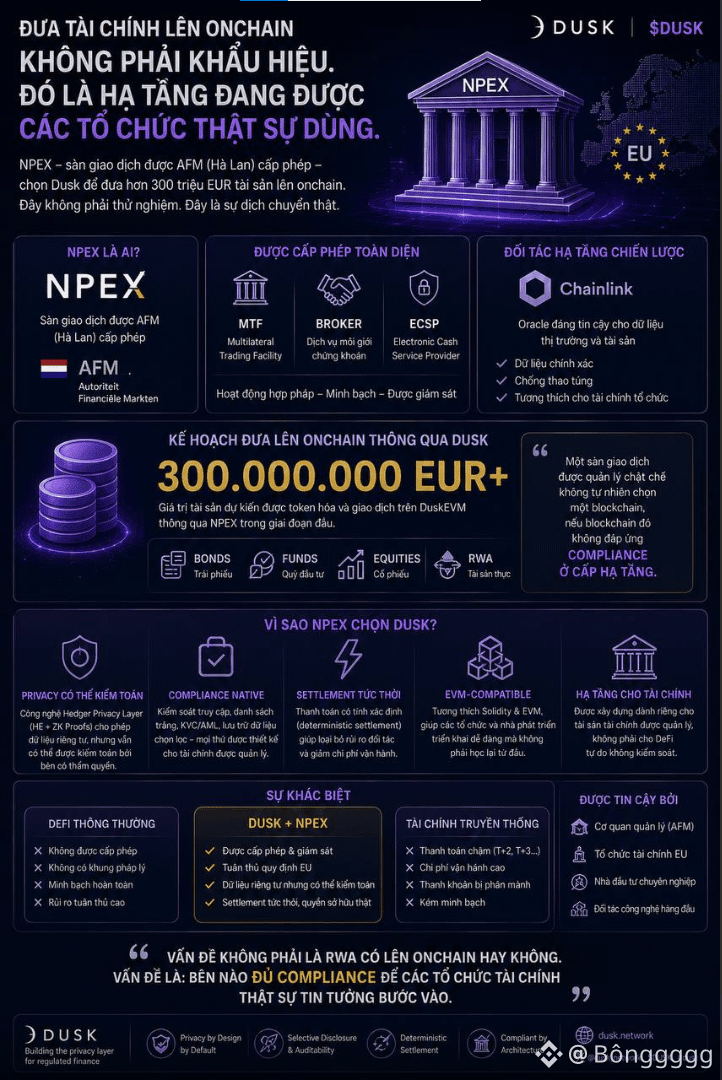
I used to think that "putting finance onchain" was just a marketing slogan—until I looked at the figures behind @dusk’s counterparties.
NPEX is an exchange licensed by the AFM (the Netherlands) and also holds MTF, Broker, and ECSP licenses. It isn’t an experimental startup.
But the more I read, the more I realize the numbers are the truly noteworthy part.
NPEX plans to move more than EUR 300 million worth of assets onchain through Dusk.
An exchange with strict governance like NPEX wouldn’t naturally choose a blockchain unless that chain meets compliance requirements at the infrastructure level.
Add in the relationship with Chainlink for reliable oracles, and the picture is no longer that of a single standalone crypto project.
It’s infrastructure that licensed organizations in the EU are actually using to transfer assets.
The question isn’t whether RWA is onchain.
The question is: which side has enough compliance for real financial institutions to trust stepping in.
I used to think that "putting finance onchain" was just a marketing slogan—until I looked at the figures behind @dusk’s counterparties.
NPEX is an exchange licensed by the AFM (the Netherlands) and also holds MTF, Broker, and ECSP licenses. It isn’t an experimental startup.
But the more I read, the more I realize the numbers are the truly noteworthy part.
NPEX plans to move more than EUR 300 million worth of assets onchain through Dusk.
An exchange with strict governance like NPEX wouldn’t naturally choose a blockchain unless that chain meets compliance requirements at the infrastructure level.
Add in the relationship with Chainlink for reliable oracles, and the picture is no longer that of a single standalone crypto project.
It’s infrastructure that licensed organizations in the EU are actually using to transfer assets.
The question isn’t whether RWA is onchain.
The question is: which side has enough compliance for real financial institutions to trust stepping in.
#binancep2pantoan @Binance Vietnam
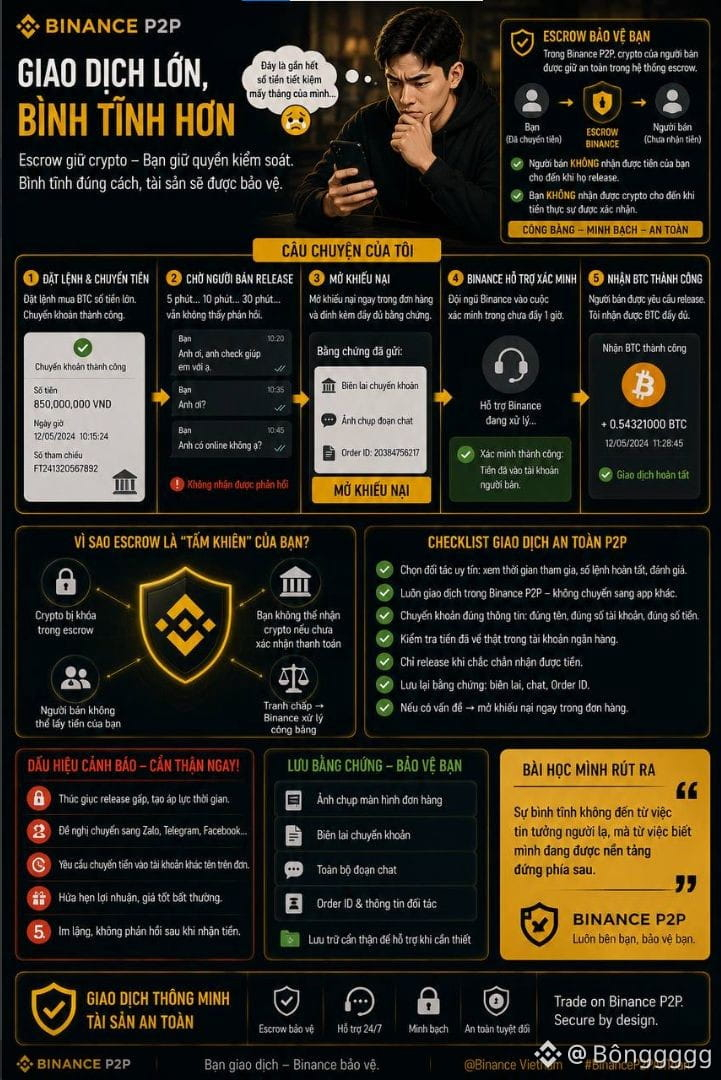
The first time I bought a fairly large amount of BTC—almost all my months of savings—the moment I placed the order my heart started racing faster than usual.
After I transferred the money, I waited for the seller to unlock it. Five minutes, ten minutes, then thirty minutes passed—still silence. I messaged to ask, but there was no reply. That’s when I realized the true value of escrow: the crypto is still being held within the system. The seller can’t just disappear with my money, because they haven’t been able to access the funds I transferred until there’s a final outcome.
Instead of continuing to wait in anxiety, I filed a dispute right in the order. I attached the bank receipt, screenshots of the entire chat, and the Order ID code clearly. All of that evidence was already there because I still have the habit of saving every transaction, whether small or large.
Binance support got involved in under an hour, verified that the money had reached the seller’s account, and then forced them to release the correct portion of BTC to me.
A big transaction taught me one thing: calm doesn’t come from trusting strangers. It comes from knowing the platform is standing behind you.
The first time I bought a fairly large amount of BTC—almost all my months of savings—the moment I placed the order my heart started racing faster than usual.
After I transferred the money, I waited for the seller to unlock it. Five minutes, ten minutes, then thirty minutes passed—still silence. I messaged to ask, but there was no reply. That’s when I realized the true value of escrow: the crypto is still being held within the system. The seller can’t just disappear with my money, because they haven’t been able to access the funds I transferred until there’s a final outcome.
Instead of continuing to wait in anxiety, I filed a dispute right in the order. I attached the bank receipt, screenshots of the entire chat, and the Order ID code clearly. All of that evidence was already there because I still have the habit of saving every transaction, whether small or large.
Binance support got involved in under an hour, verified that the money had reached the seller’s account, and then forced them to release the correct portion of BTC to me.
A big transaction taught me one thing: calm doesn’t come from trusting strangers. It comes from knowing the platform is standing behind you.
#dusk $DUSK @Dusk
I kept reading "EVM-compatible" next to "confidential" and assumed one word was doing marketing work for the other. Then I looked at how Hedger actually fits into DuskEVM.
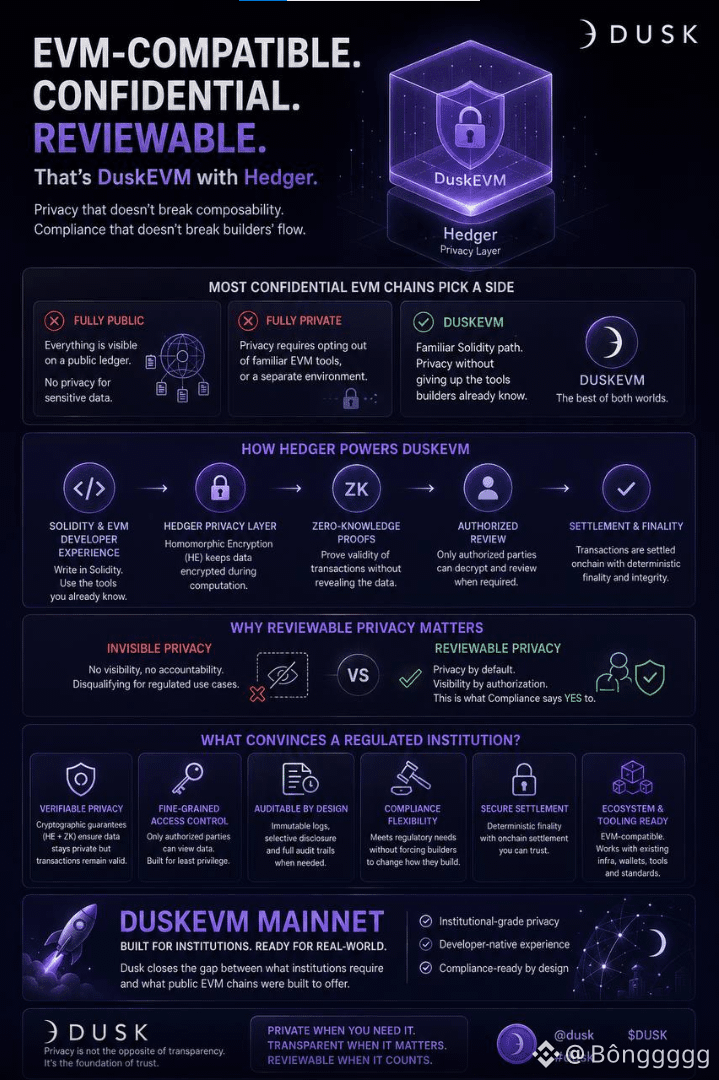
Most confidential EVM chains pick a side. Either everything stays open on a public ledger, or privacy means opting out of the tools builders already know. DuskEVM does not ask for that trade. It keeps the familiar Solidity path, and Hedger sits underneath it using homomorphic encryption and zero-knowledge proofs so transactions can stay private while still being reviewable by whoever is authorized to look.
That last part is the detail I keep coming back to. Reviewable privacy is not the same as invisible privacy. For regulated financial applications, invisible is disqualifying. Reviewable is what makes a compliance team say yes.
DuskEVM mainnet arriving on that foundation feels less like a feature launch and more like Dusk closing the gap between what institutions require and what public EVM chains were built to offer.
What would actually convince a regulated institution that onchain privacy is safe to use?
I kept reading "EVM-compatible" next to "confidential" and assumed one word was doing marketing work for the other. Then I looked at how Hedger actually fits into DuskEVM.
Most confidential EVM chains pick a side. Either everything stays open on a public ledger, or privacy means opting out of the tools builders already know. DuskEVM does not ask for that trade. It keeps the familiar Solidity path, and Hedger sits underneath it using homomorphic encryption and zero-knowledge proofs so transactions can stay private while still being reviewable by whoever is authorized to look.
That last part is the detail I keep coming back to. Reviewable privacy is not the same as invisible privacy. For regulated financial applications, invisible is disqualifying. Reviewable is what makes a compliance team say yes.
DuskEVM mainnet arriving on that foundation feels less like a feature launch and more like Dusk closing the gap between what institutions require and what public EVM chains were built to offer.
What would actually convince a regulated institution that onchain privacy is safe to use?
#binancep2pantoan @Binance Vietnam
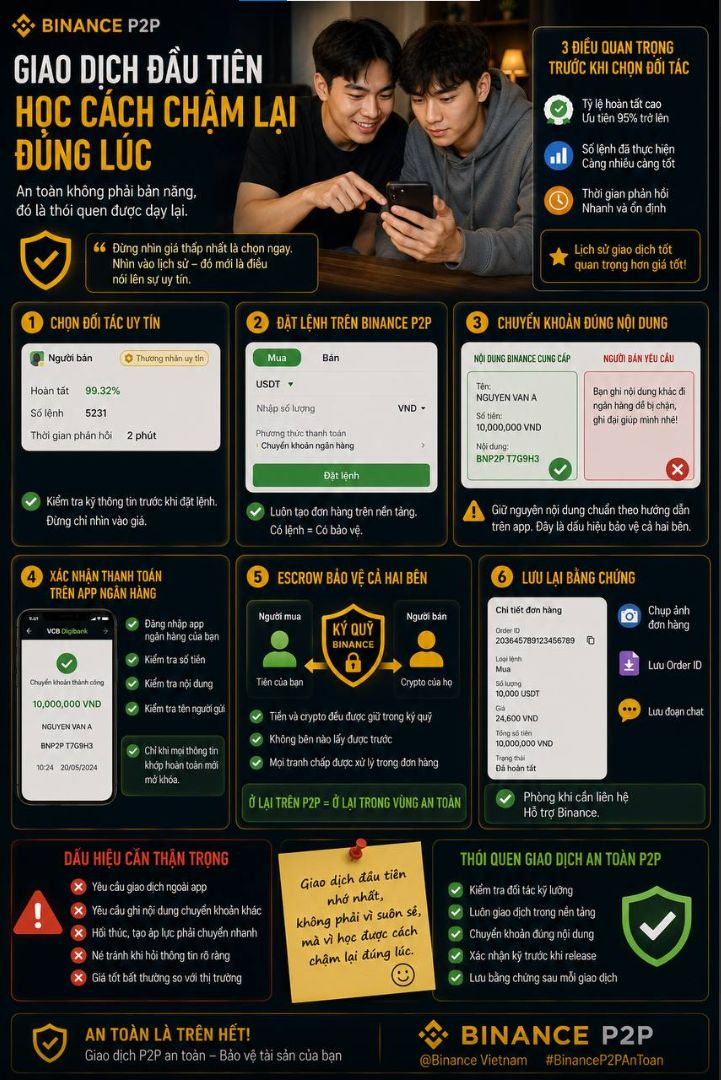
My friend is just getting into crypto, and asked me to sit next to him during his very first P2P transaction. Watching him nervously tap through "Place Order", it brought back my own first time—the feeling of it.
Before choosing a seller, I told him to pause and not simply pick the one with the lowest price right away. I told him to scroll down and check the completion rate, the number of orders already completed, and the average response time—those numbers say more than a pretty price.
When it came to the bank transfer step, the seller asked him to write a transfer memo that was totally different from what Binance provided in the order, with the reason: "The bank is more likely to get blocked if you write it correctly." I froze for a moment, then explained to him that a mismatch between the transfer content and the order is a red flag—not something to dismiss.
The two of us decided to keep the transfer details exactly as instructed in the app, and not follow that strange request. The transaction still went smoothly—escrow was released on time, with no issues.
After everything was done, I guided him to take screenshots of the order and save the Order ID, just in case he needed to contact Binance Support later.
His first transaction is the one I remember most—not because it went smoothly, but because it taught me to slow down at exactly the right moment.
My friend is just getting into crypto, and asked me to sit next to him during his very first P2P transaction. Watching him nervously tap through "Place Order", it brought back my own first time—the feeling of it.
Before choosing a seller, I told him to pause and not simply pick the one with the lowest price right away. I told him to scroll down and check the completion rate, the number of orders already completed, and the average response time—those numbers say more than a pretty price.
When it came to the bank transfer step, the seller asked him to write a transfer memo that was totally different from what Binance provided in the order, with the reason: "The bank is more likely to get blocked if you write it correctly." I froze for a moment, then explained to him that a mismatch between the transfer content and the order is a red flag—not something to dismiss.
The two of us decided to keep the transfer details exactly as instructed in the app, and not follow that strange request. The transaction still went smoothly—escrow was released on time, with no issues.
After everything was done, I guided him to take screenshots of the order and save the Order ID, just in case he needed to contact Binance Support later.
His first transaction is the one I remember most—not because it went smoothly, but because it taught me to slow down at exactly the right moment.
#binancep2pantoan @Binance Vietnam
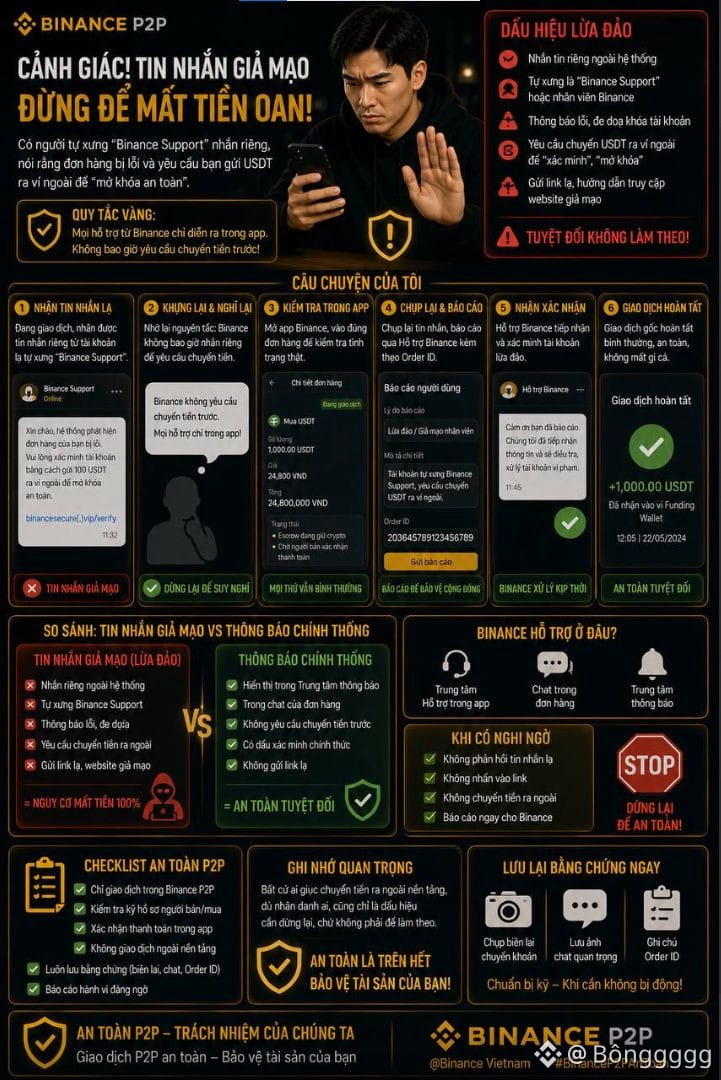
I had a transaction in progress, and I received a private message from an account claiming to be "Binance Support." They said my order had a system error and that I needed to verify it by sending a small amount of USDT to an external wallet to "unlock it safely."
I froze for a few seconds. A simple thought came to mind: Binance never sends private messages outside the system to ask you to transfer money first. Everything related to support is inside the app and within the order—never via a strange account messaging you.
I didn’t reply or click the link they sent. Instead, I opened the Binance app and went to the exact order I was trading to check the real status. The escrow was still holding the crypto as usual—there was no error at all as they claimed.
I took a screenshot of that message and submitted a report to Binance Support, along with the Order ID for them to verify.
A few minutes later, the original transaction completed normally—safe and nothing was lost.
After that, I memorized a rule: anyone who urges you to transfer money outside the platform, no matter who they claim to be, is only showing signs that you should stop—not follow.
I had a transaction in progress, and I received a private message from an account claiming to be "Binance Support." They said my order had a system error and that I needed to verify it by sending a small amount of USDT to an external wallet to "unlock it safely."
I froze for a few seconds. A simple thought came to mind: Binance never sends private messages outside the system to ask you to transfer money first. Everything related to support is inside the app and within the order—never via a strange account messaging you.
I didn’t reply or click the link they sent. Instead, I opened the Binance app and went to the exact order I was trading to check the real status. The escrow was still holding the crypto as usual—there was no error at all as they claimed.
I took a screenshot of that message and submitted a report to Binance Support, along with the Order ID for them to verify.
A few minutes later, the original transaction completed normally—safe and nothing was lost.
After that, I memorized a rule: anyone who urges you to transfer money outside the platform, no matter who they claim to be, is only showing signs that you should stop—not follow.
#binancep2pantoan @Binance Vietnam
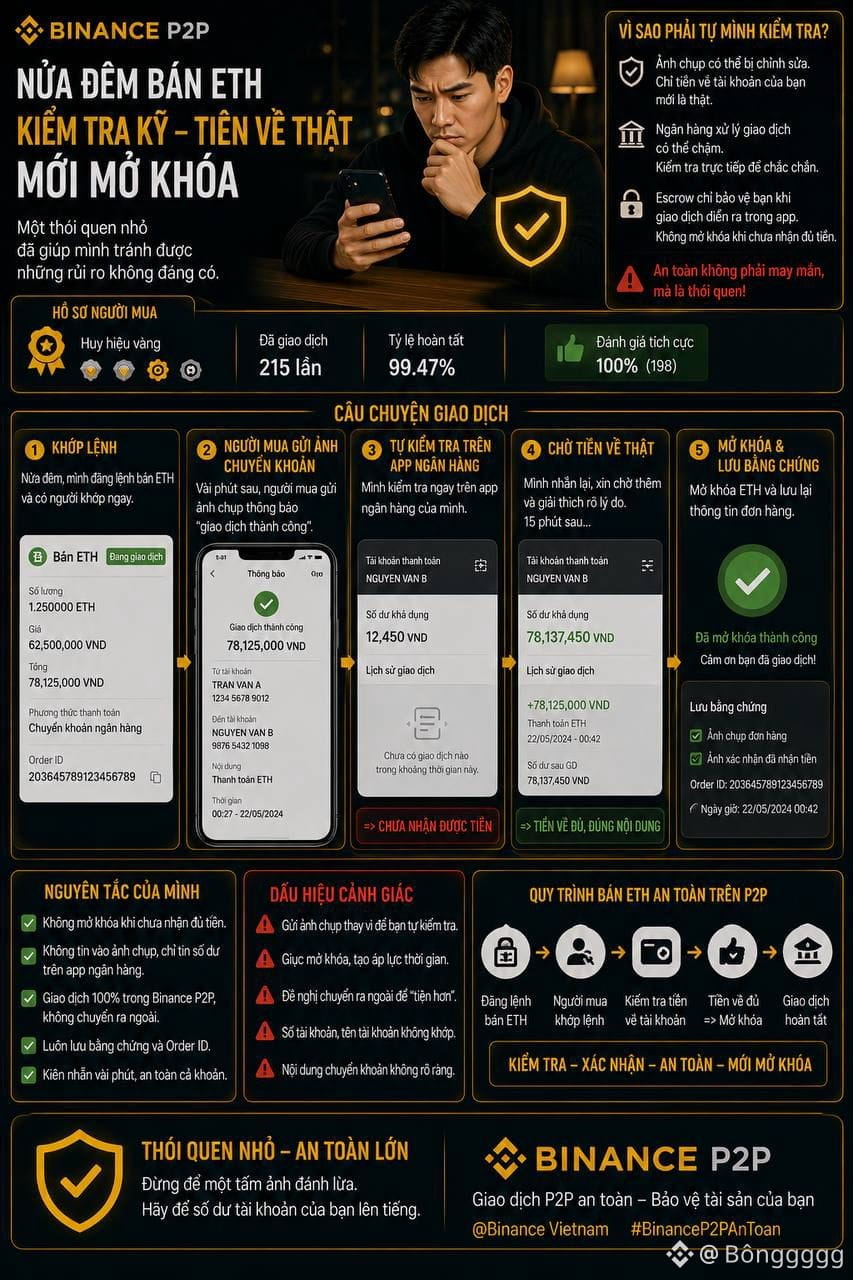
At midnight, I sold ETH to someone with a gold badge. The transaction completed in over 200 trades—after looking at the profile, I instantly felt reassured.
A few minutes later, the buyer’s phone took a screenshot and sent it in chat: a bank notification stating "transaction successful," with the amount matching the order exactly. I was about to release immediately, because the profile looked so good—so there surely wouldn’t be any issue.
But old habits pulled me back: I opened the bank app directly, without relying on the screenshot. The balance hadn’t moved at all. I messaged them again, asked to wait a bit longer, and explained clearly why—not because I doubted them, but because of my own rule before releasing any transaction.
Fifteen minutes later, the money finally arrived for real—exact amount, exact content. Maybe it was just the bank processing slowly, nothing suspicious. But if I had released early based on that photo, the risk would always have been there.
I took another screenshot of the order, saved the Order ID as usual, just in case I need to cross-check with Binance Support later.
The nice badge helps me trust them a little more, but it can’t replace the need to verify it myself.
At midnight, I sold ETH to someone with a gold badge. The transaction completed in over 200 trades—after looking at the profile, I instantly felt reassured.
A few minutes later, the buyer’s phone took a screenshot and sent it in chat: a bank notification stating "transaction successful," with the amount matching the order exactly. I was about to release immediately, because the profile looked so good—so there surely wouldn’t be any issue.
But old habits pulled me back: I opened the bank app directly, without relying on the screenshot. The balance hadn’t moved at all. I messaged them again, asked to wait a bit longer, and explained clearly why—not because I doubted them, but because of my own rule before releasing any transaction.
Fifteen minutes later, the money finally arrived for real—exact amount, exact content. Maybe it was just the bank processing slowly, nothing suspicious. But if I had released early based on that photo, the risk would always have been there.
I took another screenshot of the order, saved the Order ID as usual, just in case I need to cross-check with Binance Support later.
The nice badge helps me trust them a little more, but it can’t replace the need to verify it myself.
#binancep2pantoan @Binance Vietnam
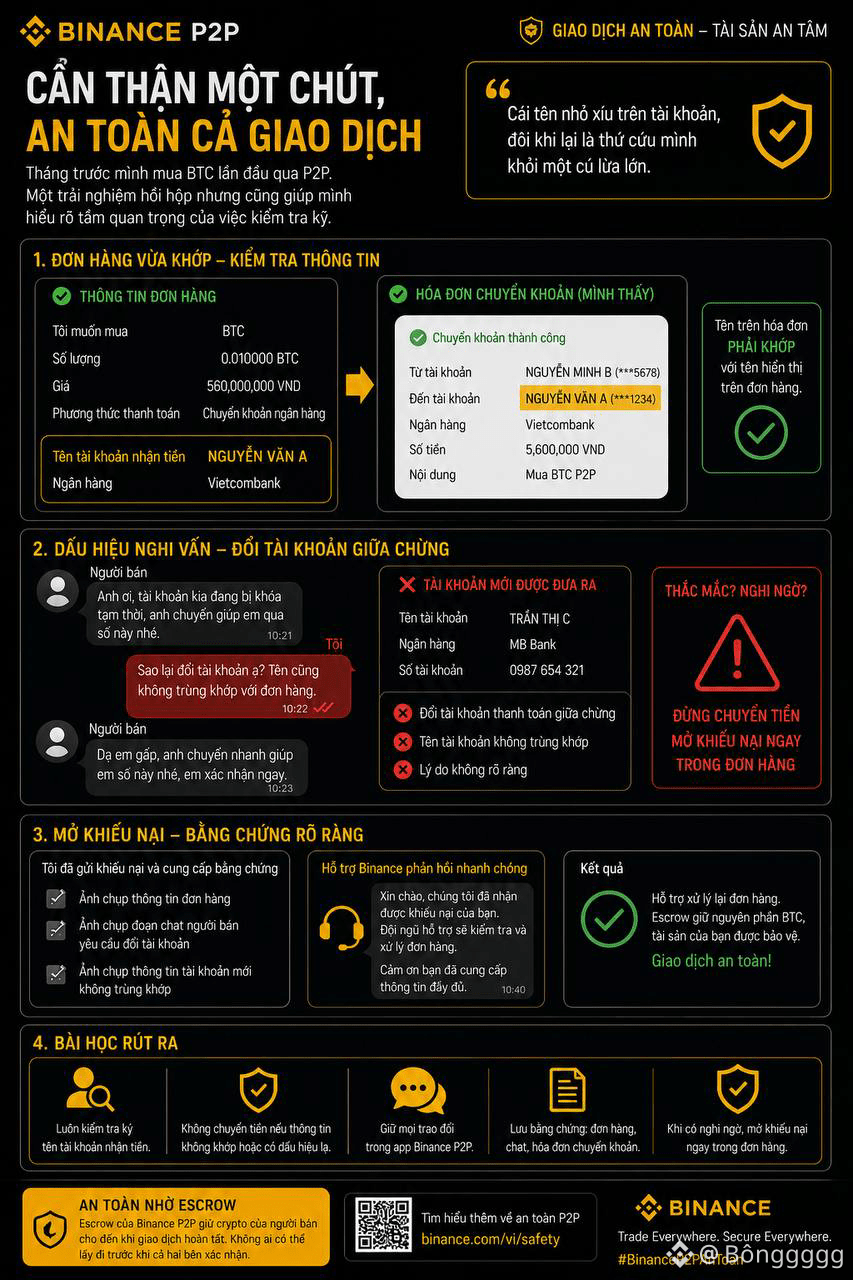
Last month, I bought BTC for the first time via P2P. I was just as nervous as when I first opened a brokerage account.
As soon as the order matched, I rechecked the information: the recipient account name on the order must match the name shown on the bank transfer receipt. I couldn’t believe it—right when I was about to transfer, the seller messaged me to switch to a different set of accounts, saying that “that account is temporarily locked.” The name on the new account also didn’t match the name I had registered.
I froze. This was exactly the kind of red flag I had read about—changing the payment account mid-transaction with no clear reason. I didn’t make the transfer. Instead, I filed a dispute right inside the order and attached screenshots of the chat as evidence.
Binance Support responded pretty quickly and reprocessed the order for me. Throughout the whole process, escrow still held the BTC portion; nothing was lost because everything happened within the platform, with a clear history for verification.
After that, I truly understood: that tiny name on the account—sometimes it’s what saves you from a big scam.
Last month, I bought BTC for the first time via P2P. I was just as nervous as when I first opened a brokerage account.
As soon as the order matched, I rechecked the information: the recipient account name on the order must match the name shown on the bank transfer receipt. I couldn’t believe it—right when I was about to transfer, the seller messaged me to switch to a different set of accounts, saying that “that account is temporarily locked.” The name on the new account also didn’t match the name I had registered.
I froze. This was exactly the kind of red flag I had read about—changing the payment account mid-transaction with no clear reason. I didn’t make the transfer. Instead, I filed a dispute right inside the order and attached screenshots of the chat as evidence.
Binance Support responded pretty quickly and reprocessed the order for me. Throughout the whole process, escrow still held the BTC portion; nothing was lost because everything happened within the platform, with a clear history for verification.
After that, I truly understood: that tiny name on the account—sometimes it’s what saves you from a big scam.
Log in to explore more content