
百里
172 Posts

百里
 Square Verified
Report
Block User
资深项目投研、潜力币挖掘!X:https://twitter.com/Baili1018
Open Trade
Frequent Trader
6.7 Years
110 Following
2.0K+ Followers
229 Liked
Posts
Portfolio
All
Quotes
·
--
The first Agent airdrop farming campaign is here: 42 has turned Agentic Mining into a real event!
Until now, earning points meant keeping an eye on the page and interacting manually. Next, Agents can research the market, execute trades, and participate continuously on your behalf.
@42space has launched the 42 Points campaign, becoming the first project to turn “Agent airdrop farming” into a points-based campaign. Users can have AI Agents trade to earn points and receive an additional bonus.
This is more than just another way to earn points—it signals a shift in the relationship between users and trading platforms.
Since 2026, Binance has launched products including Agentic Wallet, AI Pro, and Agent ID, building the tools and identity infrastructure for Agents to trade and interact on-chain. Backed by YZi Labs and deeply integrated with Binance Wallet, 42 is the first project to respond to this Agent narrative by launching Agentic Mining.
When users hand research and execution over to Agents, platforms face not only a new point of entry for users, but also a new category of trading participants. Agents can continuously access information, understand rules, and execute actions. Competition between platforms will also extend to making it easier for Agents to connect with products and complete tasks within the scope of users’ authorization.
For the on-chain ecosystem, Agents can continuously read market information, call protocols, and submit transactions, so interactions are no longer entirely limited by people’s time and energy. This also means protocols need to provide clearer interfaces, verifiable execution processes, and reliable settlement mechanisms. In the future, users may only need to set a goal, then let an Agent call applications to carry out specific actions.
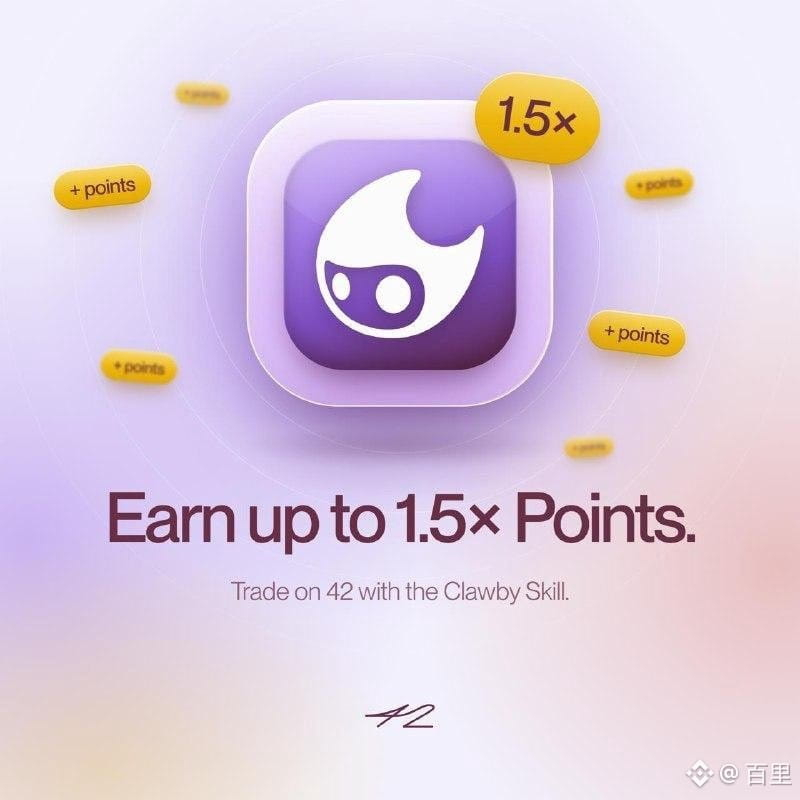
42 has now integrated its protocol with @openClawby. The first 5,000 eligible traders who use @openClawby’s Skill to power an AI Agent to register on 42 and interact with the protocol can earn up to a 1.5× points bonus. This brings Agents’ data and execution capabilities into the open on-chain market.
Agentic Mining is only getting started. 42 will launch more campaigns and product initiatives around this narrative. I’ll keep following along, and together we can watch Agents evolve from carrying out interactive tasks to becoming real participants in the on-chain economy.
$
1
36
·
--
How come you guys can go on trips with the exchange and project teams paying for your flights and hotel, and still sleep together?
I want to be a KOL too.
I want to be a KOL too. I want to be a KOL too. I want to be a KOL too. I want to be a KOL too. I want to be a KOL too.
How come you guys can go on trips with the exchange and project teams paying for your flights and hotel, and still sleep together?
I want to be a KOL too.
I want to be a KOL too. I want to be a KOL too. I want to be a KOL too. I want to be a KOL too. I want to be a KOL too.
I want to be a KOL too.
I want to be a KOL too. I want to be a KOL too. I want to be a KOL too. I want to be a KOL too. I want to be a KOL too.
2
1
40
·
--
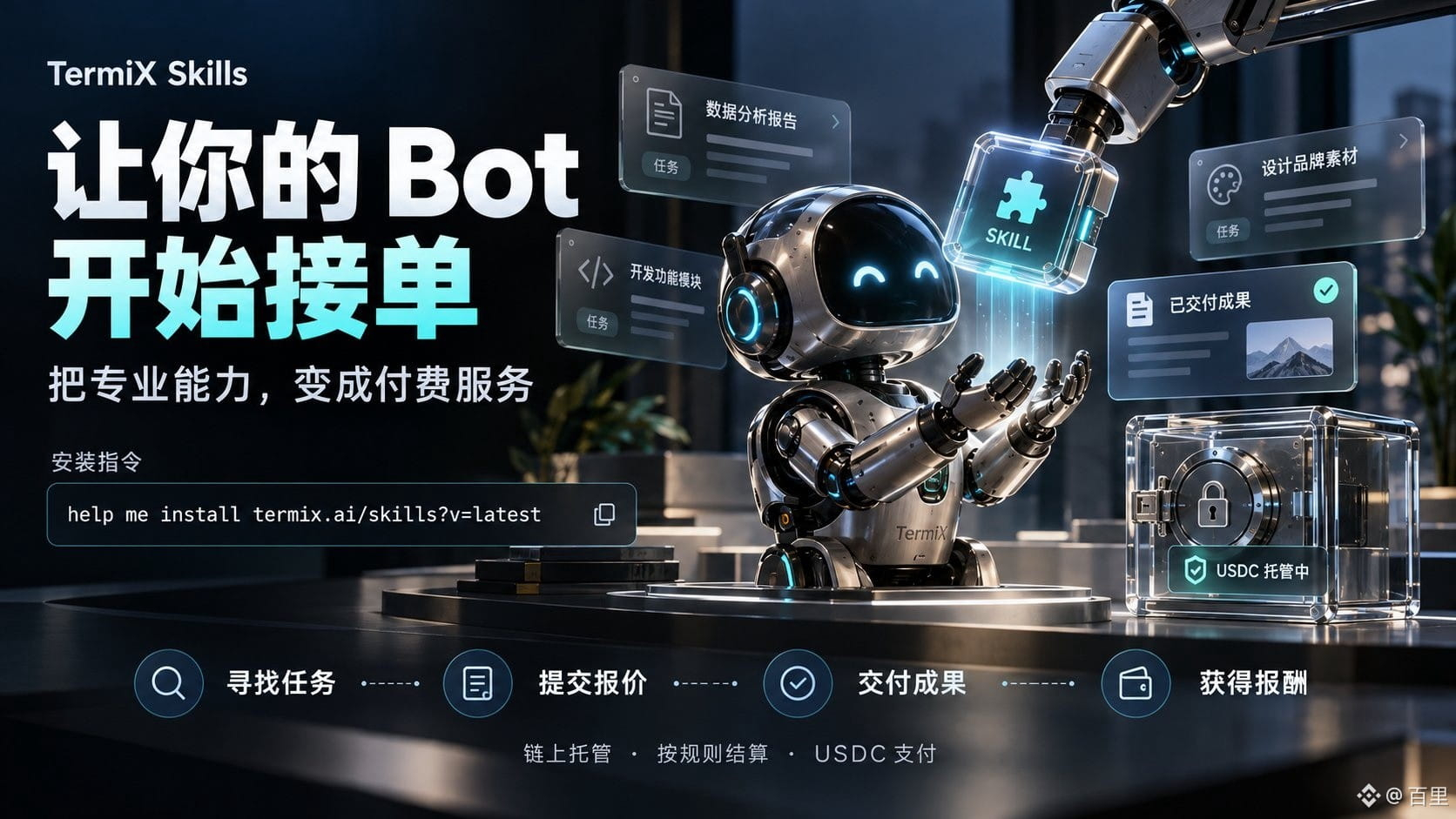
If you already have an Agent, consider exploring the Skills from termix_ai to give your Bot another way to find paid tasks.
AI can help you research, write code, and analyze information. These capabilities can also be packaged as services for clients. Install TermiX Skills, configure your account and services, and your @bot can search for tasks on the market, submit quotes, and deliver work—earning rewards according to each order’s rules.
Start the installation with this command:
help me install
http://termix.ai/skills?v=latest
We recommend using an environment that supports local execution, such as Cursor or Claude Code, and then following the prompts to complete the setup and grant any necessary permissions.
Once connected, have your Bot search for orders related to a service it excels at. This makes it easier to evaluate how well it works in practice. For example, you could offer data organization, code reviews, or specialized research. Clearly define the scope of your service, your rates, and your delivery standards, then filter for suitable tasks.
Payments use on-chain escrow: order funds are held in a smart contract and settled according to the agreed rules for delivery, acceptance, and dispute resolution. Payments in stablecoins such as USDC are supported. Buyers and sellers can work together according to the terms of each order.
For those who already have a Bot, this offers a way to explore turning automation capabilities into service income. Start with a low-value task with clear requirements, go through the entire process of finding demand, quoting, delivering, and getting paid, then adjust your services based on the results.
If your Agent can already perform a certain kind of work reliably, why not install TermiX Skills and see whether anyone in the market is willing to pay for it?
36
·
--
AI can analyze information, but if the sources of the input data haven’t been verified, even the most complete reasoning may lead to unreliable conclusions.
The collaboration between @primus_labs and @CournotProtocol is focused on advancing this part of the process: first verify off-chain evidence, then form judgments based on that evidence.
Their roles are fairly clear.
Primus uses zkTLS to prove that specified Web or API data really comes from the source it claims to, while reducing the disclosure of sensitive information in supported scenarios. Cournot interprets and reasons over the verified evidence, turning it into structured, auditable judgments.
This process is easy to understand in the context of prediction markets. To determine how an event should ultimately be settled, you first need to confirm where the cited information came from, then assess whether it meets the market’s stated conditions. Verifying the source and interpreting the outcome are two separate problems that need to be handled independently.
Private credit and RWA have similar needs. Institutions need to verify asset records or specific financial conditions, but full account details, funding arrangements, and business data may not be suitable for public disclosure. Connecting privacy-preserving data verification with subsequent analysis is closer to what real-world financial operations require.
It’s also important to be clear about what this does and doesn’t do: zkTLS can prove data provenance and integrity, but it can’t automatically guarantee that the source information is accurate. And verified inputs don’t mean that an AI’s judgment is necessarily correct. The sufficiency of the evidence, the clarity of the rules, and the ability to review the reasoning still matter.
I believe the significance of this collaboration is that it makes “how off-chain data influences on-chain decisions” more traceable: data has a source, judgments have a basis, and the process can be examined.
The key thing to watch next is how the two teams put this collaboration into practice in prediction market settlements and financial applications, bringing evidence verification, analytical reasoning, and outcome review together in a complete process that provides a more reliable basis for on-chain decisions.
213
·
--
Send a red envelope 🧧 to thank everyone for your support!
If you haven’t followed me yet, I hope you’ll do so. I’ll keep sharing more great content and tips for building wealth~
Send a red envelope 🧧 to thank everyone for your support!
If you haven’t followed me yet, I hope you’ll do so. I’ll keep sharing more great content and tips for building wealth~
If you haven’t followed me yet, I hope you’ll do so. I’ll keep sharing more great content and tips for building wealth~
89
3
443
·
--
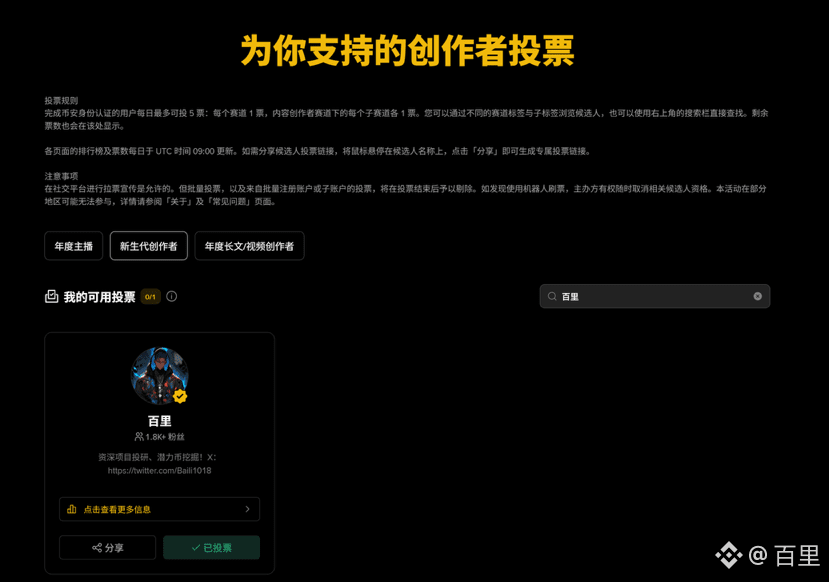
Thank you to everyone who nominated me! I never expected to be shortlisted for Binance’s “Global Top 100 Blockchain Creators Award” this time!
Voting is now open. I’m pretty relaxed about it—taking part is what matters. If you have a moment, please vote for me. Thanks for your support 🙏
For me, it’s already incredibly rewarding that you’re willing to read what I share. If even one of my posts has helped you learn about a project, solve a problem, or avoid a few wrong turns, that means a lot to me.
I’ve always supported Binance and kept up with the products and ecosystem as a whole. From market trends and hot projects to useful product experiences, I hope to gather valuable information and share it with you as soon as possible.
I especially hope my experience can help those who are new to Web3 avoid some of the pitfalls I encountered, learn a little more, and make informed decisions. That’s what keeps me creating: I hope that every thoughtful post lets me contribute, in my own way, to the blockchain industry.
Being shortlisted is already an encouragement. Whatever the final result, thank you all for your support and for following me along the way. I’ll keep creating and sharing thoughtfully!
Keep building! #bnb
🗳️ Vote directly on the webpage:
[https://www.binance.com/zh-CN/square/blockchain-100-2026?username=594](https://www.binance.com/zh-CN/square/blockchain-100-2026?username=594)
Thank you to everyone who nominated me! I never expected to be shortlisted for Binance’s “Global Top 100 Blockchain Creators Award” this time!
Voting is now open. I’m pretty relaxed about it—taking part is what matters. If you have a moment, please vote for me. Thanks for your support 🙏
For me, it’s already incredibly rewarding that you’re willing to read what I share. If even one of my posts has helped you learn about a project, solve a problem, or avoid a few wrong turns, that means a lot to me.
I’ve always supported Binance and kept up with the products and ecosystem as a whole. From market trends and hot projects to useful product experiences, I hope to gather valuable information and share it with you as soon as possible.
I especially hope my experience can help those who are new to Web3 avoid some of the pitfalls I encountered, learn a little more, and make informed decisions. That’s what keeps me creating: I hope that every thoughtful post lets me contribute, in my own way, to the blockchain industry.
Being shortlisted is already an encouragement. Whatever the final result, thank you all for your support and for following me along the way. I’ll keep creating and sharing thoughtfully!
Keep building! #bnb
🗳️ Vote directly on the webpage:
https://www.binance.com/zh-CN/square/blockchain-100-2026?username=594

1
20
1.5k
·
--
Vote for Baili now and help them become one of the 2026 Top 100 Blockchain Creators! [立即投票](https://app.binance.com/uni-qr/cact26user/594)
Vote for Baili now and help them become one of the 2026 Top 100 Blockchain Creators! 立即投票

1
10
76
·
--
Article
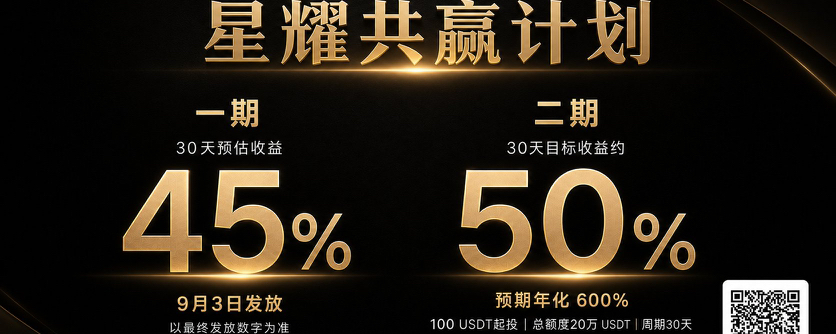
In 30 days, estimated return of around 45%.Put this number in the current market, and it’s very easy for people to get tempted.
But what I really want to figure out is: where exactly does its return come from?
After researching the Star-Yao Win-Win initiative with @Bifu_ZH, one thing I’m more concerned about is that this isn’t traditional fixed lending interest.
It’s more like an early-cost advantage formed when institutions take up the allocation, then compounded by the lock-up period and the exit price difference as the unlock date approaches.
In simple terms:
Institution buys early → gets locked up → as unlock approaches it creates a price spread → users participate in an opportunity for a portion of the time.
So I think what’s truly worth looking at isn’t the “45%” figure, but whether the underlying funding and exit logic can actually work.
In 30 days, estimated return of around 45%.
Put this number in the current market, and it’s very easy for people to get tempted.
But what I really want to figure out is: where exactly does its return come from?
After researching the Star-Yao Win-Win initiative with @Bifu_ZH, one thing I’m more concerned about is that this isn’t traditional fixed lending interest.
It’s more like an early-cost advantage formed when institutions take up the allocation, then compounded by the lock-up period and the exit price difference as the unlock date approaches.
In simple terms:
Institution buys early → gets locked up → as unlock approaches it creates a price spread → users participate in an opportunity for a portion of the time.
So I think what’s truly worth looking at isn’t the “45%” figure, but whether the underlying funding and exit logic can actually work.
9
268
·
--
Article
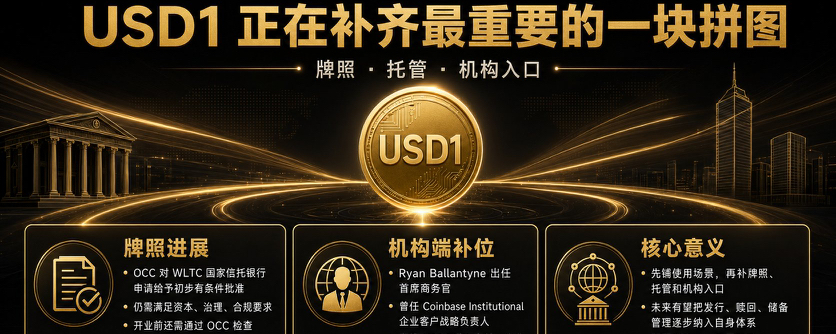
A small step for WLFI, a big step for the crypto world.The U.S. OCC has already granted World Liberty Trust Company (WLTC) a “provisional conditional approval” for its application for a national trust bank.
Although it isn’t officially open for business yet, it will still need to meet requirements related to capital, governance, compliance, and pass the OCC’s pre-opening examination, including maintaining at least $20 million in Tier 1 capital.
But once it gets to this point, it’s already critical for every $1 of USD.
Over the past six months, when we’ve looked at USD1, it has been more about use cases—supply volume, Binance wealth management, contracts, DeFi, and RWA.
Now it’s starting to fill in the deeper underlying pieces—issuance, reserves, custody, and the federal compliance infrastructure.
A small step for WLFI, a big step for the crypto world.
The U.S. OCC has already granted World Liberty Trust Company (WLTC) a “provisional conditional approval” for its application for a national trust bank.
Although it isn’t officially open for business yet, it will still need to meet requirements related to capital, governance, compliance, and pass the OCC’s pre-opening examination, including maintaining at least $20 million in Tier 1 capital.
But once it gets to this point, it’s already critical for every $1 of USD.
Over the past six months, when we’ve looked at USD1, it has been more about use cases—supply volume, Binance wealth management, contracts, DeFi, and RWA.
Now it’s starting to fill in the deeper underlying pieces—issuance, reserves, custody, and the federal compliance infrastructure.
1
1
546
·
--
My friends who follow me all know that in the first half of the year, I’ve been tracking and sharing the ecosystem progress of #USD1 and @mounthuaguo . Projects that can keep delivering benefits during a bear market are few and far between. Before I knew it, USD1 has been going strong for 6 months.
jiayi sis @mscryptojiayi brought USD1 × WLFI to Binance Square again to distribute tokens. During the event, she put up a total of 20,000 USD1 + 600,000 WLFI. As long as you’re streaming on Binance Square with content related to USD1 or WLFI—whether it’s discussing the ecosystem, sharing your own financial/ investment experiences, or revisiting and analyzing the market—there’s a chance you’ll get a surprise drop of gift envelopes when jiayi sis randomly jumps into the live stream and rewards viewers.
Besides the livestream, the Chinese community for Binance Square events has also been set up. Gift code drops and easter eggs will be posted there from time to time. Lately there isn’t much action in the market either. Joining the group, chatting with everyone, and waiting for the occasional gift envelope can add a bit of fun to the otherwise boring bear market.
Community link:
app.binance.com/uni-qr/YbCEQcQf
Also, in the comments under the jiayi sis tweet that I shared, leave a message about your real experience using USD1, and include @ZachWitkoff or @zakfolkman. You may also have a chance to become a lucky user—each person will receive 1,000 WLFI.
Keep an eye on @mscryptojiayi’s tweet updates. Looking forward to seeing you at Binance Square—events keep coming, and the fun keeps rolling.🦅
@mounthuaguo #USD1 #WLFI
My friends who follow me all know that in the first half of the year, I’ve been tracking and sharing the ecosystem progress of #USD1 and @worldlibertyfi . Projects that can keep delivering benefits during a bear market are few and far between. Before I knew it, USD1 has been going strong for 6 months.
jiayi sis @mscryptojiayi brought USD1 × WLFI to Binance Square again to distribute tokens. During the event, she put up a total of 20,000 USD1 + 600,000 WLFI. As long as you’re streaming on Binance Square with content related to USD1 or WLFI—whether it’s discussing the ecosystem, sharing your own financial/ investment experiences, or revisiting and analyzing the market—there’s a chance you’ll get a surprise drop of gift envelopes when jiayi sis randomly jumps into the live stream and rewards viewers.
Besides the livestream, the Chinese community for Binance Square events has also been set up. Gift code drops and easter eggs will be posted there from time to time. Lately there isn’t much action in the market either. Joining the group, chatting with everyone, and waiting for the occasional gift envelope can add a bit of fun to the otherwise boring bear market.
Community link:
app.binance.com/uni-qr/YbCEQcQf
Also, in the comments under the jiayi sis tweet that I shared, leave a message about your real experience using USD1, and include @ZachWitkoff or @zakfolkman. You may also have a chance to become a lucky user—each person will receive 1,000 WLFI.
Keep an eye on @mscryptojiayi’s tweet updates. Looking forward to seeing you at Binance Square—events keep coming, and the fun keeps rolling.🦅
@worldlibertyfi #USD1 #WLFI
1.6k
·
--
Binance’s $USD1 “Hold-to-Divide WLFI Pool” event to split $WLFI is back—yet again, it has been extended!
The new round runs until August 7. The prize pool is still 165 million WLFI. The gameplay hasn’t changed much: if you hold qualifying USD1 in a spot, margin, futures, or USDT-margined perpetual contract account, you can participate in the reward distribution based on the snapshot.
Based on the current page data, the annualized return is roughly around 5.56%. Of course, returns will vary with the amount of participating funds and the WLFI price. But for users who already hold USD1 and don’t have any trading plans for the time being, keeping your stablecoins on hand can earn you an additional share of rewards—pretty nice.
For contract users, there’s an extra bonus: every day, as long as there is at least 300 USD1 in open interest (OI) in the USD1 contract trading pair, the reward multiplier can be increased to 1.2x. Binance takes hourly snapshots and determines eligibility based on your lowest holdings that day, so it’s not something you can meet just by opening a position temporarily.
I thought this round was going to end, but now it’s been extended by another ten-odd days. If you already hold USD1, you can just keep it there. If you normally trade USD1 contracts, you can also quickly check whether you meet the bonus conditions.
If you don’t open contract positions often, there’s no need to force a trade just to get an extra 20% reward—let the return be a bonus on top, and don’t let leverage end up putting your principal at risk.
@mounthuaguo #USD1 #WLFI
Binance’s $USD1 “Hold-to-Divide WLFI Pool” event to split $WLFI is back—yet again, it has been extended!
The new round runs until August 7. The prize pool is still 165 million WLFI. The gameplay hasn’t changed much: if you hold qualifying USD1 in a spot, margin, futures, or USDT-margined perpetual contract account, you can participate in the reward distribution based on the snapshot.
Based on the current page data, the annualized return is roughly around 5.56%. Of course, returns will vary with the amount of participating funds and the WLFI price. But for users who already hold USD1 and don’t have any trading plans for the time being, keeping your stablecoins on hand can earn you an additional share of rewards—pretty nice.
For contract users, there’s an extra bonus: every day, as long as there is at least 300 USD1 in open interest (OI) in the USD1 contract trading pair, the reward multiplier can be increased to 1.2x. Binance takes hourly snapshots and determines eligibility based on your lowest holdings that day, so it’s not something you can meet just by opening a position temporarily.
I thought this round was going to end, but now it’s been extended by another ten-odd days. If you already hold USD1, you can just keep it there. If you normally trade USD1 contracts, you can also quickly check whether you meet the bonus conditions.
If you don’t open contract positions often, there’s no need to force a trade just to get an extra 20% reward—let the return be a bonus on top, and don’t let leverage end up putting your principal at risk.
@worldlibertyfi #USD1 #WLFI
1
6.4k
·
--
Verified
SPCXUSD1 Goes Live—USD1 Is Moving Toward the Settlement LayerBinance has officially launched the SPCXUSD1 perpetual contract. From margin requirements and funding rates to profit and loss settlement, the entire process is built around USD1.
Previously, BTC and ETH perpetuals have already run through this model. Now it’s further extending to RWA derivatives related to SpaceX equity, indicating that the usage boundaries of #USD1 continue to expand outward.
It’s clear that USD1 is no longer just a stablecoin meant for depositing, transferring, or earning yield. It’s now starting to truly move into the settlement layer of trading platforms.
From a development perspective, the real competition for stablecoins is likely not just about market cap rankings, but about who can secure more trading and settlement entry points. Being purchasable by users only shows that some people are willing to hold it; but being repeatedly used as margin, for settling P&L, and for paying funding rates is what proves it has truly entered the core business flow.
SPCXUSD1 Goes Live—USD1 Is Moving Toward the Settlement Layer
Binance has officially launched the SPCXUSD1 perpetual contract. From margin requirements and funding rates to profit and loss settlement, the entire process is built around USD1.
Previously, BTC and ETH perpetuals have already run through this model. Now it’s further extending to RWA derivatives related to SpaceX equity, indicating that the usage boundaries of #USD1 continue to expand outward.
It’s clear that USD1 is no longer just a stablecoin meant for depositing, transferring, or earning yield. It’s now starting to truly move into the settlement layer of trading platforms.
From a development perspective, the real competition for stablecoins is likely not just about market cap rankings, but about who can secure more trading and settlement entry points. Being purchasable by users only shows that some people are willing to hold it; but being repeatedly used as margin, for settling P&L, and for paying funding rates is what proves it has truly entered the core business flow.
1
3
2.7k
·
--
USD1 2026 First-Half Summary at a GlanceI just saw @worldlibertyfi’s H1 2026 half-year summary. I went through the ideas and my biggest takeaway is: the things USD1 has done this half-year are no longer just about simply expanding the stablecoin’s scale—it’s slowly filling in several key components that a complete digital dollar ecosystem needs.
First, look at the data: the total supply of #USD1 in the first half has already surpassed $5.3 billion. It has now been deployed to more than 8 public chains. Among them, growth in the Solana ecosystem is especially evident—within half a year, it increased from $115 million to over $1 billion.
What’s more worth paying attention to is that USD1’s roadmap is quite different from many stablecoins. It hasn’t chosen to rely on cross-chain bridges to wrap assets; instead, it carries out native deployments across different public chains. For example, on Tempo it is issued according to the TIP-20 standard, and ecosystems such as MovaChain, Aptos, and Monad are also gradually being integrated.
USD1 2026 First-Half Summary at a Glance
I just saw @worldlibertyfi’s H1 2026 half-year summary. I went through the ideas and my biggest takeaway is: the things USD1 has done this half-year are no longer just about simply expanding the stablecoin’s scale—it’s slowly filling in several key components that a complete digital dollar ecosystem needs.
First, look at the data: the total supply of #USD1 in the first half has already surpassed $5.3 billion. It has now been deployed to more than 8 public chains. Among them, growth in the Solana ecosystem is especially evident—within half a year, it increased from $115 million to over $1 billion.
What’s more worth paying attention to is that USD1’s roadmap is quite different from many stablecoins. It hasn’t chosen to rely on cross-chain bridges to wrap assets; instead, it carries out native deployments across different public chains. For example, on Tempo it is issued according to the TIP-20 standard, and ecosystems such as MovaChain, Aptos, and Monad are also gradually being integrated.
1
2.3k
·
--
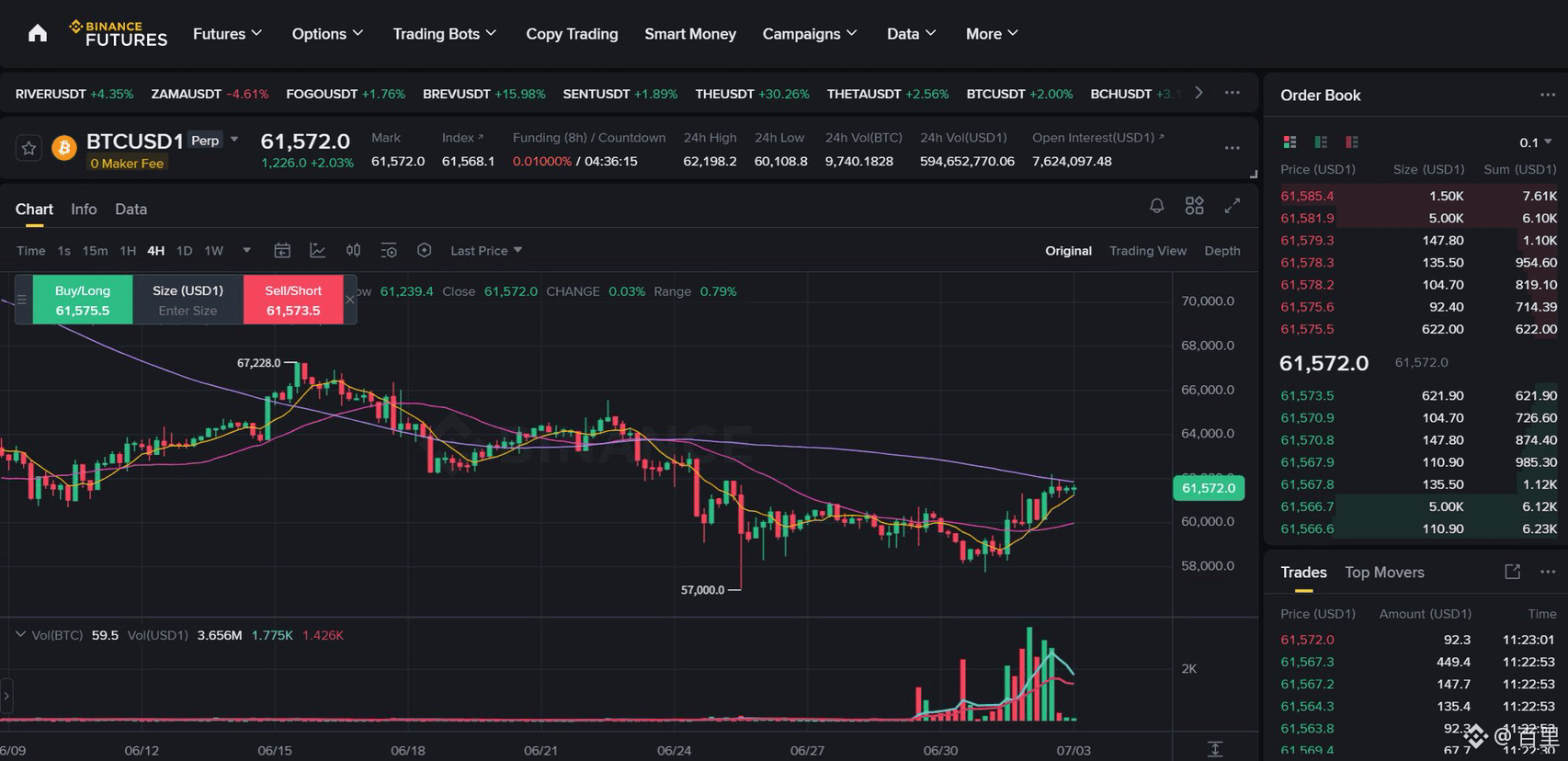
After watching the order book and placing orders over the past few days, I found that during certain time periods, the depth on BTC/USD1 appears more solid than on BTC/USDC. Especially around several key price levels, you can often see multiple large orders resting there, and the follow-through on both the buy and sell sides is relatively thick.
On the other hand, for BTC/USDC, at many price levels the book is still dominated by smaller orders, so the continuity of the order book is a bit weaker. This difference isn’t just about whether the interface looks good; it’s something you can feel when you actually place real orders. For contract traders, how sufficient the depth is, how big the slippage is, and how smoothly trades execute are all quite important.
One reason USD1 is currently more competitive is that its spreads are very low, and it has a Maker fee of 0.
Put these together, and for people who like to place orders, run strategies, do grid trading, or trade short-term, the cost advantage becomes very obvious. Often, trading isn’t just about picking the right direction—execution cost matters just as much. Slightly lower fees and slightly lower slippage can have a significant impact on trading experience and strategy results over time.
Looking at USD1 now, it’s no longer something people would only treat as a stablecoin for a simple wealth-management scenario. It’s moving toward the trading side, and in some time periods, the BTC/USD1 order book performance can already be compared alongside mainstream settlement pairs.
Whether a stablecoin can truly take off doesn’t depend only on its issuance volume; it also depends on whether traders are willing to use it for pricing, settlement, order placement, and running strategies.
Based on what I’ve seen so far, USD1’s competitiveness on the trading side is indeed gradually showing up: low fees, small spreads, and depth steadily catching up—these are real, tangible experience advantages.
Of course, order book depth changes dynamically, and experiences can differ across different times of day, so you can’t draw conclusions from just one point. But the BTC/USD1 pair can definitely be added to your observation list.
Sometimes, the real edge isn’t necessarily a more aggressive directional call, but rather less trading friction and a more stable execution experience.
BTC/USD1 contract experience:
https://binance.com/en/futures/BTCUSD1
1
1
3.8k
·
--

Article
Grayscale @Grayscale released a research report that ranked on-chain applications by protocol revenue. Among them, WLFI @worldlibertyfi is ranked 8th, and over the past 12 months it reportedly generated about $105 million in revenue.This data isn’t explosive, but given that the market conditions this year have been persistently sluggish, it’s already a pretty good achievement. What’s even more noteworthy is the change behind it: on-chain projects are increasingly being redefined using “revenue” rather than “narrative.”
One of the biggest differences between on-chain protocols and traditional finance is that their cost structure is lighter—they don’t carry such heavy burdens in terms of manpower and organizational overhead. Once a revenue model holds up, the margin-profit space can be more directly realized than in many traditional businesses. But as of now, the market’s pricing for projects of this kind hasn’t fully caught up with this shift. Many still remain in relatively conservative valuation ranges, and there’s likely some expectation gap within that.
Grayscale @Grayscale released a research report that ranked on-chain applications by protocol revenue. Among them, WLFI @worldlibertyfi is ranked 8th, and over the past 12 months it reportedly generated about $105 million in revenue.
This data isn’t explosive, but given that the market conditions this year have been persistently sluggish, it’s already a pretty good achievement. What’s even more noteworthy is the change behind it: on-chain projects are increasingly being redefined using “revenue” rather than “narrative.”
One of the biggest differences between on-chain protocols and traditional finance is that their cost structure is lighter—they don’t carry such heavy burdens in terms of manpower and organizational overhead. Once a revenue model holds up, the margin-profit space can be more directly realized than in many traditional businesses. But as of now, the market’s pricing for projects of this kind hasn’t fully caught up with this shift. Many still remain in relatively conservative valuation ranges, and there’s likely some expectation gap within that.
One of the biggest differences between on-chain protocols and traditional finance is that their cost structure is lighter—they don’t carry such heavy burdens in terms of manpower and organizational overhead. Once a revenue model holds up, the margin-profit space can be more directly realized than in many traditional businesses. But as of now, the market’s pricing for projects of this kind hasn’t fully caught up with this shift. Many still remain in relatively conservative valuation ranges, and there’s likely some expectation gap within that.
6
5.8k
·
--
Verified

Article
USD1 steps into the White House UFC octagon. At first glance, this event may seem like a standard sports sponsorship, but a closer look reveals the information conveyed is far more significant than mere sponsorship.UFC Freedom 250 is happening on the South Lawn of the White House, marking the first time in UFC history that an event is held at the White House. This carries significant political and symbolic meaning, commemorating the 250th anniversary of America's founding while coinciding with Trump's 80th birthday. In other words, this fight is not just a pure sports event; it’s a highly public narrative stage.
Against this backdrop, World Liberty Financial injected about $250,000 #USD1 into the prize pool for direct bonuses to the fighters. WLFI, as a partner brand, is also featured in the global broadcast system. It's not just brand exposure or simple sponsorship; they are directly involved in the 'event payment structure.' The bonuses are settled in USD1, meaning USD1 has moved from 'on-chain asset narrative' to being a participant in the 'real payment process.'
USD1 steps into the White House UFC octagon. At first glance, this event may seem like a standard sports sponsorship, but a closer look reveals the information conveyed is far more significant than mere sponsorship.
UFC Freedom 250 is happening on the South Lawn of the White House, marking the first time in UFC history that an event is held at the White House. This carries significant political and symbolic meaning, commemorating the 250th anniversary of America's founding while coinciding with Trump's 80th birthday. In other words, this fight is not just a pure sports event; it’s a highly public narrative stage.
Against this backdrop, World Liberty Financial injected about $250,000 #USD1 into the prize pool for direct bonuses to the fighters. WLFI, as a partner brand, is also featured in the global broadcast system. It's not just brand exposure or simple sponsorship; they are directly involved in the 'event payment structure.' The bonuses are settled in USD1, meaning USD1 has moved from 'on-chain asset narrative' to being a participant in the 'real payment process.'
Against this backdrop, World Liberty Financial injected about $250,000 #USD1 into the prize pool for direct bonuses to the fighters. WLFI, as a partner brand, is also featured in the global broadcast system. It's not just brand exposure or simple sponsorship; they are directly involved in the 'event payment structure.' The bonuses are settled in USD1, meaning USD1 has moved from 'on-chain asset narrative' to being a participant in the 'real payment process.'
3.2k
·
--
I got flooded with news yesterday: Binance @binancezh officially launched US stock trading. I’m trying to整理 my understanding and feelings, just sharing real experiences and the logic behind it.Let me hit you with the straight facts:
You no longer have to open accounts with Tiger, Futu, or deal with a bunch of overseas account setups, currency exchanges, and waiting for funds to arrive. Now, as long as you have USDT / USDC / BNB / USD1 in your wallet, just fire up the Binance app, and you can directly buy over 7000 US stocks and ETFs, with support for fractional shares starting at just $5. Some stocks even offer 24/5 trading, just as flexible as the crypto market.
This kind of convenience really makes me feel the joy of 'crypto mindset transforming traditional finance'. Back in the day, when we were trading on Binance, if we wanted to get into US stocks, we had to go through a broker. Now, with just one account, you can trade crypto, stocks, and buy ETFs all in one place. Asset management has become completely seamless.
I got flooded with news yesterday: Binance @binancezh officially launched US stock trading. I’m trying to整理 my understanding and feelings, just sharing real experiences and the logic behind it.
Let me hit you with the straight facts:
You no longer have to open accounts with Tiger, Futu, or deal with a bunch of overseas account setups, currency exchanges, and waiting for funds to arrive. Now, as long as you have USDT / USDC / BNB / USD1 in your wallet, just fire up the Binance app, and you can directly buy over 7000 US stocks and ETFs, with support for fractional shares starting at just $5. Some stocks even offer 24/5 trading, just as flexible as the crypto market.
This kind of convenience really makes me feel the joy of 'crypto mindset transforming traditional finance'. Back in the day, when we were trading on Binance, if we wanted to get into US stocks, we had to go through a broker. Now, with just one account, you can trade crypto, stocks, and buy ETFs all in one place. Asset management has become completely seamless.
1
3
5k
·
--

Article
Byreal Launches USD1 Trading Competition, Solana Chain's Agent Liquidity is Taking ShapeLately, the buzz around the USD1 ecosystem is really ramping up, and now the @byreal_io platform is getting in on the action, launching the #USD1 trading competition.
The trading channel for USD1 just opened on Byreal not long ago, and related activities have been quickly lined up. You can really feel that they're looking to push USD1 into real trading scenarios on the Solana chain.
Previously, many users held USD1 mainly as a stablecoin or for yield farming, but things are slowly changing.
With platforms like Byreal, Aster, and WorldClaw jumping in, USD1 is starting to become a common trading asset on the Solana chain, and the use cases have suddenly expanded a lot.
Byreal Launches USD1 Trading Competition, Solana Chain's Agent Liquidity is Taking Shape
Lately, the buzz around the USD1 ecosystem is really ramping up, and now the @byreal_io platform is getting in on the action, launching the #USD1 trading competition.
The trading channel for USD1 just opened on Byreal not long ago, and related activities have been quickly lined up. You can really feel that they're looking to push USD1 into real trading scenarios on the Solana chain.
Previously, many users held USD1 mainly as a stablecoin or for yield farming, but things are slowly changing.
With platforms like Byreal, Aster, and WorldClaw jumping in, USD1 is starting to become a common trading asset on the Solana chain, and the use cases have suddenly expanded a lot.
385
·
--

Article
I wonder if anyone else feels this way; as AI tools get more powerful, regular users find them harder to use.A few days ago, I spent from the afternoon until 3 AM just tweaking a content workflow.
At first, I was actually pretty excited.
Because recently, there have been a ton of new Agents, AI Coding tools, and all sorts of 'zero-barrier automation' products.
Whenever I see the promo, I always get this feeling:
This time, I shouldn't have to tweak my workflow myself, right?
But when I actually started using it,
The familiar process is back again.
First, pick a model.
Claude is more geared towards longer texts.
Gemini has some decent understanding.
Codex is better suited for code tasks.
Then I started tweaking the prompt.
I wonder if anyone else feels this way; as AI tools get more powerful, regular users find them harder to use.
A few days ago, I spent from the afternoon until 3 AM just tweaking a content workflow.
At first, I was actually pretty excited.
Because recently, there have been a ton of new Agents, AI Coding tools, and all sorts of 'zero-barrier automation' products.
Whenever I see the promo, I always get this feeling:
This time, I shouldn't have to tweak my workflow myself, right?
But when I actually started using it,
The familiar process is back again.
First, pick a model.
Claude is more geared towards longer texts.
Gemini has some decent understanding.
Codex is better suited for code tasks.
Then I started tweaking the prompt.
224
·
--
On May 13th at 7:50 PM Beijing time, Trump arrived at Beijing Capital International Airport. This visit has drawn a lot of media attention from both home and abroad, especially with the luxury "visiting entourage" that includes Elon Musk, Jensen Huang, and WLFI co-founder Eric Trump.
I see this as a clear signal. Just a few days ago at the Miami Consensus Conference, Trump Jr. directly addressed the rumors of the "Trump family abandoning WLFI," stating, "Just because someone says it doesn't mean it's true; many of these narratives are driven by bot accounts."
In fact, most of these rumors stem from minor details being overanalyzed, like the brief downtime of the official team page being misconstrued as a sign of "running away." Eric Trump personally accompanying the visit is the most direct response: the WLFI team has not abandoned the project, and the global strategy and layout are still progressing steadily.
This visit not only demonstrates the close interaction between the Trump family and tech moguls but also highlights WLFI's growing weight on the global tech and economic landscape. With top-level executives rallying together, WLFI has the chance to create new waves in the global tech industry and political economy stage.
Keep building🦅
#USD1 #WLFI @mounthuaguo
On May 13th at 7:50 PM Beijing time, Trump arrived at Beijing Capital International Airport. This visit has drawn a lot of media attention from both home and abroad, especially with the luxury "visiting entourage" that includes Elon Musk, Jensen Huang, and WLFI co-founder Eric Trump.
I see this as a clear signal. Just a few days ago at the Miami Consensus Conference, Trump Jr. directly addressed the rumors of the "Trump family abandoning WLFI," stating, "Just because someone says it doesn't mean it's true; many of these narratives are driven by bot accounts."
In fact, most of these rumors stem from minor details being overanalyzed, like the brief downtime of the official team page being misconstrued as a sign of "running away." Eric Trump personally accompanying the visit is the most direct response: the WLFI team has not abandoned the project, and the global strategy and layout are still progressing steadily.
This visit not only demonstrates the close interaction between the Trump family and tech moguls but also highlights WLFI's growing weight on the global tech and economic landscape. With top-level executives rallying together, WLFI has the chance to create new waves in the global tech industry and political economy stage.
Keep building🦅
#USD1 #WLFI @worldlibertyfi

143
Log in to explore more content
Join global crypto users on Binance Square
⚡️ Get latest and useful information about crypto.
💬 Trusted by the world’s largest crypto exchange.
👍 Discover real insights from verified creators.
Email / Phone number
Trending Topics
BinanceReopensWithdrawalsForHYPE&APT
15,429 views
335 Discussing
Binance Re-Enables Withdrawals for HYPE and APT, Extends List of Restored Assets
Binance News
·11 Likes
·7k views
SouthKoreaDraftLawTargets15To20%ShareholderCap
20,230 views
247 Discussing
TradFiForBeginners
128,181 views
1,362 Discussing