
Anniexx
50 Posts

Anniexx
Живу в перпах, изучаю токенизированные акции, крипту, и в целом цифрой мир. Без хайпа - только то, что реально торгую и проверяю.
46 Following
34 Followers
137 Liked
Posts
PINNED
#bstockscis @BinanceCIS
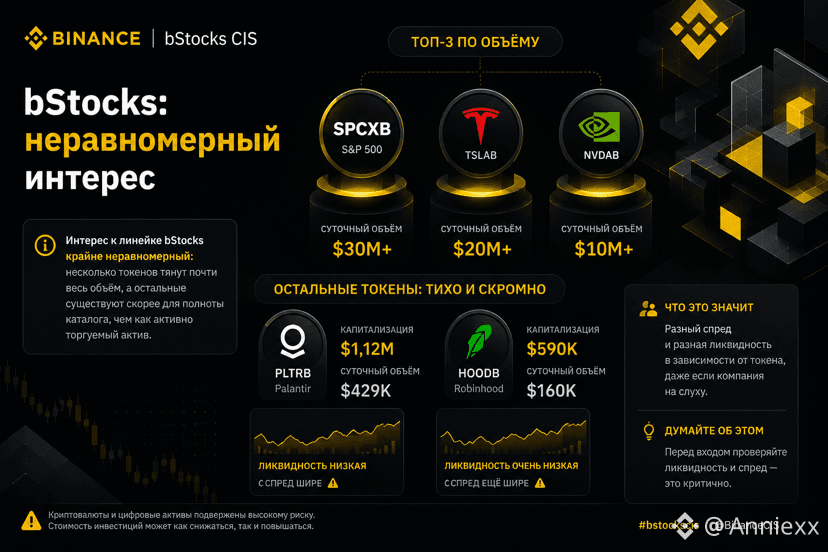
I went to check the capitalization of individual bStocks outside the top 3 (SPCXB, TSLAB, NVDAB) — and it’s actually quiet there, even though the tickers are recognizable. The semiconductor angle in bStocks is also uneven.
$PLTRB (Palantir) — the token’s capitalization is only $1.12M, and the daily volume in its pair with USDT on Binance is about $429K. For a company with a market cap in the hundreds of billions, that’s literally a drop in the bucket.
$HOODB (Robinhood) — even quieter: capitalization is $590K, daily volume $160K. The irony is that Robinhood is a broker itself—one that has spent years fighting for retail traders—while its tokenized version on Binance trades almost unnoticed.
The difference with $SPCXB is enormous—there the volume count was in the tens of millions. So it turns out interest in the bStocks lineup is extremely uneven: a few tokens account for almost all the volume, while the rest exist more for completeness of the catalog than as actively traded assets.
For anyone thinking about entering, that means different spreads and different liquidity depending on the token, even if the company is well known.
Does anyone hold PLTRB or HOODB and can compare how wide the spread is there in reality versus the top tickers?
#HOODB #PLTRB
I went to check the capitalization of individual bStocks outside the top 3 (SPCXB, TSLAB, NVDAB) — and it’s actually quiet there, even though the tickers are recognizable. The semiconductor angle in bStocks is also uneven.
$PLTRB (Palantir) — the token’s capitalization is only $1.12M, and the daily volume in its pair with USDT on Binance is about $429K. For a company with a market cap in the hundreds of billions, that’s literally a drop in the bucket.
$HOODB (Robinhood) — even quieter: capitalization is $590K, daily volume $160K. The irony is that Robinhood is a broker itself—one that has spent years fighting for retail traders—while its tokenized version on Binance trades almost unnoticed.
The difference with $SPCXB is enormous—there the volume count was in the tens of millions. So it turns out interest in the bStocks lineup is extremely uneven: a few tokens account for almost all the volume, while the rest exist more for completeness of the catalog than as actively traded assets.
For anyone thinking about entering, that means different spreads and different liquidity depending on the token, even if the company is well known.
Does anyone hold PLTRB or HOODB and can compare how wide the spread is there in reality versus the top tickers?
#HOODB #PLTRB
Verified
#bstockscis @BinanceCIS
Today, August 17, the liquidity incentive program ends for $SKHYB on Venus Protocol—the very DeFi platform where you can deposit bStocks and earn additional yield on top.
In recent days, the program has maintained an APY of 28.65%, and the remaining prize pool balance—$16 thousand—will be distributed today among those who provided liquidity. Here’s a breakdown of how the DeFi side of bStocks differs from simply “hold and wait for price growth”: there was a separate incentive specifically intended to get people to put the token into the pool, not just hold it on the spot.
SK Hynix is a major memory manufacturer—part of the same semiconductor space as Micron or Sandisk, only this ticker is hardly anyone really talks about. After the program ends, analysts expect uncertainty: whether profit-taking will happen among those who farmed the APY, or whether the token will hold onto momentum on its own, without the artificial incentive.
Did anyone enter $SKHYB specifically for this Venus program, or are they just holding it as a bet on memory/semiconductors?
Today, August 17, the liquidity incentive program ends for $SKHYB on Venus Protocol—the very DeFi platform where you can deposit bStocks and earn additional yield on top.
In recent days, the program has maintained an APY of 28.65%, and the remaining prize pool balance—$16 thousand—will be distributed today among those who provided liquidity. Here’s a breakdown of how the DeFi side of bStocks differs from simply “hold and wait for price growth”: there was a separate incentive specifically intended to get people to put the token into the pool, not just hold it on the spot.
SK Hynix is a major memory manufacturer—part of the same semiconductor space as Micron or Sandisk, only this ticker is hardly anyone really talks about. After the program ends, analysts expect uncertainty: whether profit-taking will happen among those who farmed the APY, or whether the token will hold onto momentum on its own, without the artificial incentive.
Did anyone enter $SKHYB specifically for this Venus program, or are they just holding it as a bet on memory/semiconductors?
Закидывал bStocks в пул
100%
Знал про фичу, но не пробовал
0%
Думал что можно любой bStocks
0%
Впервые слышу про возможность
0%
1 votes • Voting closed
#bstockscis @BinanceCIS
Something caught my interest🤔
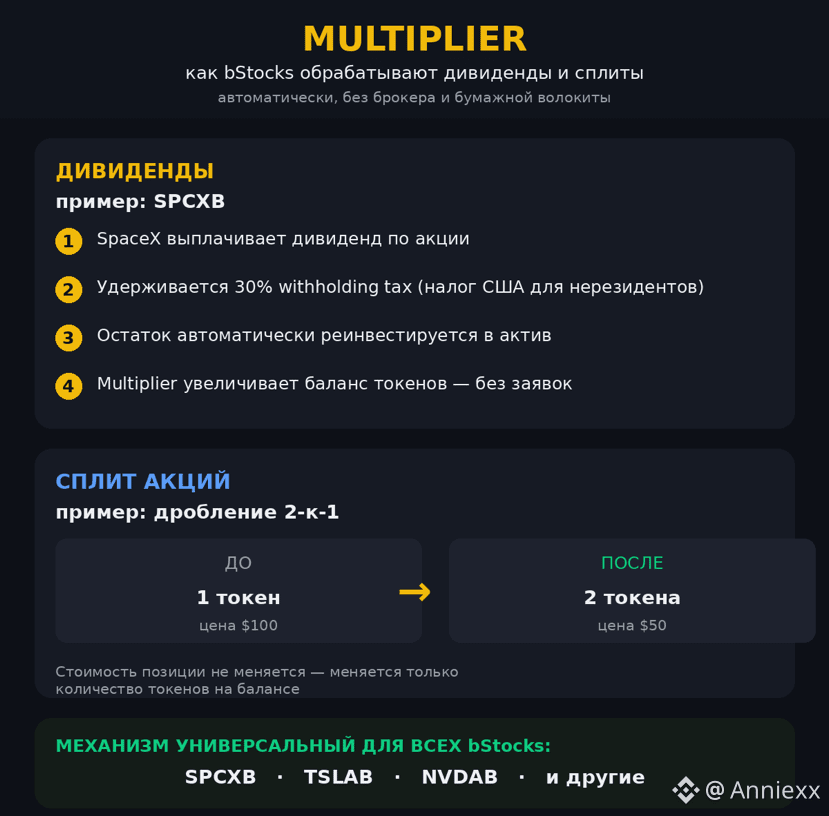
For stocks, dividends and splits are processed manually by the broker—notifications, forms. In bStocks, this is handled by a smart-contract mechanism called Multiplier.
Example: $SPCXB pays a dividend—30% withholding tax is taken from the amount (the standard US tax for non-residents), the remainder is reinvested, and Multiplier itself increases the token balance. The same logic applies to $TSLAB and $NVDAB —no applications or confirmations required.
Splits work similarly: with a 2-for-1 split, the token balance doubles, the price drops by half, and the position value stays the same. No “broken” balances, which sometimes happen with tokenized assets on other platforms.
Who’s already claimed dividends or a split via Multiplier on SPCXB, TSLAB, or NVDAB?😊
Something caught my interest🤔
For stocks, dividends and splits are processed manually by the broker—notifications, forms. In bStocks, this is handled by a smart-contract mechanism called Multiplier.
Example: $SPCXB pays a dividend—30% withholding tax is taken from the amount (the standard US tax for non-residents), the remainder is reinvested, and Multiplier itself increases the token balance. The same logic applies to $TSLAB and $NVDAB —no applications or confirmations required.
Splits work similarly: with a 2-for-1 split, the token balance doubles, the price drops by half, and the position value stays the same. No “broken” balances, which sometimes happen with tokenized assets on other platforms.
Who’s already claimed dividends or a split via Multiplier on SPCXB, TSLAB, or NVDAB?😊
Verified
#bstockscis @BinanceCIS
I broke down where the money goes in bStocks 💵
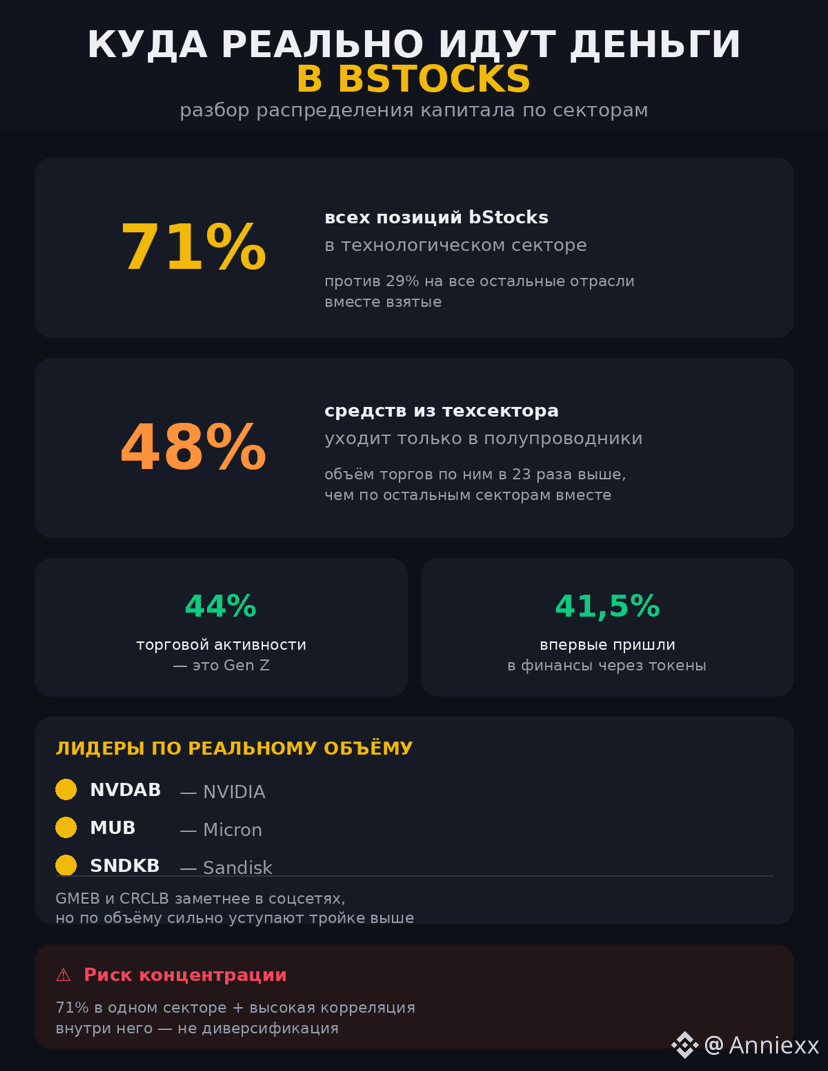
The technology sector takes 71% of all positions. Of these, almost half (48%) is purely semiconductors—the trading volume there is 23 times higher than in all the other sectors combined.
With examples: in real trading volume, the leaders are $NVDAB , $MUB , and $SNDKB —while GameStop (GMEB) or Circle (CRCLB), despite all the hype on social media, take up a share many times smaller. Social-media noise and real money are different things. ✨
The downside: when 71% of capital is in one sector and almost half is in one sub-industry, that’s a classic concentration risk. One bad report from Micron or Nvidia can drag things down more than a single position—because correlation within the sector is high. 👇
44% of all activity in bStocks is Gen Z, and 41.5% of users came to traditional finance for the first time through tokenization—not the other way around.
Who holds a portfolio outside of semiconductors on purpose? ✌️
I broke down where the money goes in bStocks 💵
The technology sector takes 71% of all positions. Of these, almost half (48%) is purely semiconductors—the trading volume there is 23 times higher than in all the other sectors combined.
With examples: in real trading volume, the leaders are $NVDAB , $MUB , and $SNDKB —while GameStop (GMEB) or Circle (CRCLB), despite all the hype on social media, take up a share many times smaller. Social-media noise and real money are different things. ✨
The downside: when 71% of capital is in one sector and almost half is in one sub-industry, that’s a classic concentration risk. One bad report from Micron or Nvidia can drag things down more than a single position—because correlation within the sector is high. 👇
44% of all activity in bStocks is Gen Z, and 41.5% of users came to traditional finance for the first time through tokenization—not the other way around.
Who holds a portfolio outside of semiconductors on purpose? ✌️
Verified
#bstockscis @BinanceCIS
Wow, Binance added GameStop ($GMEB ) to bStocks as margin collateral. 🥳
🚀 On August 12, the meme stock returned—this time on the blockchain. Binance added GameStop ($GMEB ) to bStocks, and right away as collateral for margin trading.
GameStop is the symbol of the retail-bunt movement of 2021 against hedge funds. And after 5 years, its tokenized version can be held on Binance and used as margin collateral—something that used to be done only with “serious” assets like BTC.
An important detail: this is neither synthetic nor a leveraged derivative—each GMEB is backed by a real GME share with a regulated custodian, with the issuer being BTech Holdings.
Binance already had a similar product back in 2021, which was shut down after regulatory claims from Germany, the UK, and Hong Kong. Now, they position $GMEB precisely as a regulated alternative, not a repeat of that story. 😊
At the same time, bStocks keeps growing as an issuer—the second-largest in the world by volume of tokenized stock issuance. They overtook xStocks just days ago; I mentioned this earlier.
Who holds meme stocks and has already looked at GMEB? 👀
Wow, Binance added GameStop ($GMEB ) to bStocks as margin collateral. 🥳
🚀 On August 12, the meme stock returned—this time on the blockchain. Binance added GameStop ($GMEB ) to bStocks, and right away as collateral for margin trading.
GameStop is the symbol of the retail-bunt movement of 2021 against hedge funds. And after 5 years, its tokenized version can be held on Binance and used as margin collateral—something that used to be done only with “serious” assets like BTC.
An important detail: this is neither synthetic nor a leveraged derivative—each GMEB is backed by a real GME share with a regulated custodian, with the issuer being BTech Holdings.
Binance already had a similar product back in 2021, which was shut down after regulatory claims from Germany, the UK, and Hong Kong. Now, they position $GMEB precisely as a regulated alternative, not a repeat of that story. 😊
At the same time, bStocks keeps growing as an issuer—the second-largest in the world by volume of tokenized stock issuance. They overtook xStocks just days ago; I mentioned this earlier.
Who holds meme stocks and has already looked at GMEB? 👀
Уже добавил GMEB
63%
Держу GME напрямую
0%
Просто слежу за темой
37%
Впервые слышу за GMEB
0%
8 votes • Voting closed
#bstockscis
🔥 Fresh data: bStocks has overtaken xStocks and become the second-largest issuer of tokenized stocks — $610.6M vs $601.2M (the gap is under $10M; rankings can change any day). #1 is Ondo Finance with $951.8M.
The product is just over two months old — it launched on June 11 with five tokens and now has dozens of listings. It beat a competitor that has been in the market much longer and operates across multiple blockchains.
The entire tokenized stocks market is currently about $2.8B — up 391% since the start of the year. This is no longer a niche experiment by a single exchange, but a fast-growing segment where Binance has captured most of the new capital inflow rather than poaching other exchanges’ clients.
Overall, I like the momentum: the subsequent growth and interest will clearly be on Binance’s side due to the convenience of using it inside the exchange🔥
By the way, a few articles ago, I gave a forecast that $SPCXB would go up — and it happened🤑
@BinanceCIS #bStocksCIS
Who’s watching this race of issuers? 👀
🔥 Fresh data: bStocks has overtaken xStocks and become the second-largest issuer of tokenized stocks — $610.6M vs $601.2M (the gap is under $10M; rankings can change any day). #1 is Ondo Finance with $951.8M.
The product is just over two months old — it launched on June 11 with five tokens and now has dozens of listings. It beat a competitor that has been in the market much longer and operates across multiple blockchains.
The entire tokenized stocks market is currently about $2.8B — up 391% since the start of the year. This is no longer a niche experiment by a single exchange, but a fast-growing segment where Binance has captured most of the new capital inflow rather than poaching other exchanges’ clients.
Overall, I like the momentum: the subsequent growth and interest will clearly be on Binance’s side due to the convenience of using it inside the exchange🔥
By the way, a few articles ago, I gave a forecast that $SPCXB would go up — and it happened🤑
@BinanceCIS #bStocksCIS
Who’s watching this race of issuers? 👀
Торгую bStocks
86%
Слежу, не входил
0%
Впервые слышу про гонку
14%
7 votes • Voting closed
Verified
#bstockscis
Something that I found😅
From the new batch dated August 5, the most discussed are ASML and Netflix — while Super Micro Computer ($SMCIB ) and Coherent ($COHRB ) went almost unnoticed, even though their tickers are far more recognizable than Astera Labs.
SMCIB — Super Micro makes servers for AI workloads; the topic has been in everyone’s ears all this year, but the tokenized version on Square was barely discussed by anyone.
COHRB — Coherent, laser and optical components for data centers and telecom. Also an infrastructure story, also a fresh listing, also in the shadows.
Both of these stocks are technologically close to the same trend as ASML — infrastructure for AI computing, just from different angles: one is hardware, the other optics.🤑
@BinanceCIS #bstockscis
Something that I found😅
From the new batch dated August 5, the most discussed are ASML and Netflix — while Super Micro Computer ($SMCIB ) and Coherent ($COHRB ) went almost unnoticed, even though their tickers are far more recognizable than Astera Labs.
SMCIB — Super Micro makes servers for AI workloads; the topic has been in everyone’s ears all this year, but the tokenized version on Square was barely discussed by anyone.
COHRB — Coherent, laser and optical components for data centers and telecom. Also an infrastructure story, also a fresh listing, also in the shadows.
Both of these stocks are technologically close to the same trend as ASML — infrastructure for AI computing, just from different angles: one is hardware, the other optics.🤑
@BinanceCIS #bstockscis
Держу SMCIB
20%
Держу COHRB
20%
Слежу, не входил
60%
Впервые слышу
0%
5 votes • Voting closed
#bstockscis
A fresh number I saw literally just yesterday: a week before the weekend, Binance confirmed that bStocks on average “bake in” 92% of the stock’s future gap to the Monday open—meaning the token price over the weekend almost exactly predicts where the actual stock will open on Monday.
While Nasdaq is closed all weekend, the token market continues to search for a price—and it does so surprisingly accurately.
Also, trading volume for July really exploded: from $2.9 billion to $8.8 billion per month. bStocks now account for more than 85% of all tokenized stock volume on DEX. The share of BNB Chain in this segment increased from 23.2% to 28.4% over 90 days.
So it’s no longer an “experimental feature”—it’s a real pricing mechanism that works precisely when the traditional market can’t, physically.
Has anyone noticed similar discrepancies in their tokens over the weekend, before Nasdaq opens on Monday?
@BinanceCIS #bStocksCIS
A fresh number I saw literally just yesterday: a week before the weekend, Binance confirmed that bStocks on average “bake in” 92% of the stock’s future gap to the Monday open—meaning the token price over the weekend almost exactly predicts where the actual stock will open on Monday.
While Nasdaq is closed all weekend, the token market continues to search for a price—and it does so surprisingly accurately.
Also, trading volume for July really exploded: from $2.9 billion to $8.8 billion per month. bStocks now account for more than 85% of all tokenized stock volume on DEX. The share of BNB Chain in this segment increased from 23.2% to 28.4% over 90 days.
So it’s no longer an “experimental feature”—it’s a real pricing mechanism that works precisely when the traditional market can’t, physically.
Has anyone noticed similar discrepancies in their tokens over the weekend, before Nasdaq opens on Monday?
@BinanceCIS #bStocksCIS
Замечал и торговал
75%
Не замечал, буду следить
0%
Не держу позу на выходных
25%
4 votes • Voting closed
#bstockscis
Today I realized I was wrong about fractional trades on BStocks. I thought it was a gimmick for people who don’t have money for a proper share.
I decided to check the numbers for Tesla, and it’s truly crazy—almost 99.65% of trades by quantity are fractional parts of the stock. And it’s not a small thing compared to the overall volume: it’s 88.5% of all turnover on TSLAB. So the bulk of trading literally is, AND I MEAN, fractional trades—not some leftover bits.
I sat there thinking, well maybe it’s only Tesla that’s like this—a popular topic. But in fact it’s logical: if your entry threshold is $5, why would you buy a whole share when you can buy a quarter or a tenth, and also allocate that money across other tickers.
All in all, it changes how I look at the entire BStocks lineup (there are already 25+ tokens, by the way—back in June it was only 5). Not as a “product for beginners without money,” but as a real tool for positioning capital in small pieces that people actually use—not just a marketing phrase in the description that “everything is guaranteed 1:1 with the actual share held by BTech Holdings” (the Binance structure).
Who else looked at these numbers on fractional trades—am I the only one who was shocked?😅
@BinanceCIS #bStocksCIS
Today I realized I was wrong about fractional trades on BStocks. I thought it was a gimmick for people who don’t have money for a proper share.
I decided to check the numbers for Tesla, and it’s truly crazy—almost 99.65% of trades by quantity are fractional parts of the stock. And it’s not a small thing compared to the overall volume: it’s 88.5% of all turnover on TSLAB. So the bulk of trading literally is, AND I MEAN, fractional trades—not some leftover bits.
I sat there thinking, well maybe it’s only Tesla that’s like this—a popular topic. But in fact it’s logical: if your entry threshold is $5, why would you buy a whole share when you can buy a quarter or a tenth, and also allocate that money across other tickers.
All in all, it changes how I look at the entire BStocks lineup (there are already 25+ tokens, by the way—back in June it was only 5). Not as a “product for beginners without money,” but as a real tool for positioning capital in small pieces that people actually use—not just a marketing phrase in the description that “everything is guaranteed 1:1 with the actual share held by BTech Holdings” (the Binance structure).
Who else looked at these numbers on fractional trades—am I the only one who was shocked?😅
@BinanceCIS #bStocksCIS
Беру дробями давно
100%
Пересмотрю подход
0%
Покупаю только целыми
0%
Не знал про дробное
0%
3 votes • Voting closed
#bstockscis
People ask me: “why do you need tokenized shares, it’s not a real share.”
In reality: bStock is a 1:1 certificate to a real share (issuer BTech Holdings, Binance-backed structure). It trades 24/7, and conversion into the share and back is free. Entry starts from $5 — you don’t have to save up for a whole share.
Right now, the CreatorPad for bStocks is ongoing with a prize pool—jump in while the topic is still fresh. I’ve already started participating; I’m trading for now: $SPCXB
I think there will be growth soon
@BinanceCIS #bStocksCIS
People ask me: “why do you need tokenized shares, it’s not a real share.”
In reality: bStock is a 1:1 certificate to a real share (issuer BTech Holdings, Binance-backed structure). It trades 24/7, and conversion into the share and back is free. Entry starts from $5 — you don’t have to save up for a whole share.
Right now, the CreatorPad for bStocks is ongoing with a prize pool—jump in while the topic is still fresh. I’ve already started participating; I’m trading for now: $SPCXB
I think there will be growth soon
@BinanceCIS #bStocksCIS
Verified
$911 million shares of SpaceX thawed on August 6 — while Nasdaq at that moment was closed.
While the traditional exchange waited for the market to open, the token $SPCXB on Binance continued trading calmly — because it isn’t an exchange listing; it’s an on-chain certificate backed 1:1 by a real share, and it follows the crypto market schedule, not Nasdaq.
That’s the essence of bStocks: you hold exposure to a company, and at any time you can freely convert the token back into the real share — but without voting rights and dividends, like a full broker shareholder would have. Everything is provided by BTech Holdings, a Binance subsidiary.
bStocks — not the share itself, but a 1:1 certificate backed by a real share (issuer — BTech Holdings, an affiliate of Binance), without voting rights and brokerage-shareholder dividends. Conversion to the share and back is free, at any time. There are already 25+ tokens available, not only the five early pioneers (NVDAB, TSLAB, CRCLB, MUB, SNDKB) — SPCXB, AMD, Intel, Strategy, and others have been added.
@BinanceCIS #bStocksCIS
While the traditional exchange waited for the market to open, the token $SPCXB on Binance continued trading calmly — because it isn’t an exchange listing; it’s an on-chain certificate backed 1:1 by a real share, and it follows the crypto market schedule, not Nasdaq.
That’s the essence of bStocks: you hold exposure to a company, and at any time you can freely convert the token back into the real share — but without voting rights and dividends, like a full broker shareholder would have. Everything is provided by BTech Holdings, a Binance subsidiary.
bStocks — not the share itself, but a 1:1 certificate backed by a real share (issuer — BTech Holdings, an affiliate of Binance), without voting rights and brokerage-shareholder dividends. Conversion to the share and back is free, at any time. There are already 25+ tokens available, not only the five early pioneers (NVDAB, TSLAB, CRCLB, MUB, SNDKB) — SPCXB, AMD, Intel, Strategy, and others have been added.
@BinanceCIS #bStocksCIS
Log in to explore more content