
SilentValidator
1.1k Posts
SilentValidator
Report
Block User
Mr.DavidElite | BTC ETH Discipline Charts don’t lie People do Trade smart. Stay patient Risk managed Emotions controlled X:@Max_BRaKeR
Open Trade
Frequent Trader
8 Months
246 Following
8.1K+ Followers
1.4K+ Liked
Posts
Portfolio
All
Quotes
Live
·
--
Bullish
Babylon (BABY): Bitcoin as Shared Security
I almost skipped Babylon.
Crypto has made me suspicious of anything promising rewards without giving up custody.
But Babylon is difficult to ignore.
It lets BTC holders stake directly through Bitcoin and help secure proof-of-stake chains without wrapping or handing over their coins.
That sounds powerful.
But self-custody does not remove every risk.
What happens when the security layer becomes gameable?
Most users may follow the easiest platform or highest reward.
Then convenience becomes control.
Babylon could extend Bitcoin’s security to other networks—
or create new dependencies around an asset built to avoid them.@babylonlabs_io #baby $BABY
Babylon (BABY): Bitcoin as Shared Security
I almost skipped Babylon.
Crypto has made me suspicious of anything promising rewards without giving up custody.
But Babylon is difficult to ignore.
It lets BTC holders stake directly through Bitcoin and help secure proof-of-stake chains without wrapping or handing over their coins.
That sounds powerful.
But self-custody does not remove every risk.
What happens when the security layer becomes gameable?
Most users may follow the easiest platform or highest reward.
Then convenience becomes control.
Babylon could extend Bitcoin’s security to other networks—
or create new dependencies around an asset built to avoid them.@BabylonLabs_io #baby $BABY
I almost skipped Babylon.
Crypto has made me suspicious of anything promising rewards without giving up custody.
But Babylon is difficult to ignore.
It lets BTC holders stake directly through Bitcoin and help secure proof-of-stake chains without wrapping or handing over their coins.
That sounds powerful.
But self-custody does not remove every risk.
What happens when the security layer becomes gameable?
Most users may follow the easiest platform or highest reward.
Then convenience becomes control.
Babylon could extend Bitcoin’s security to other networks—
or create new dependencies around an asset built to avoid them.@BabylonLabs_io #baby $BABY

86
·
--
Bullish
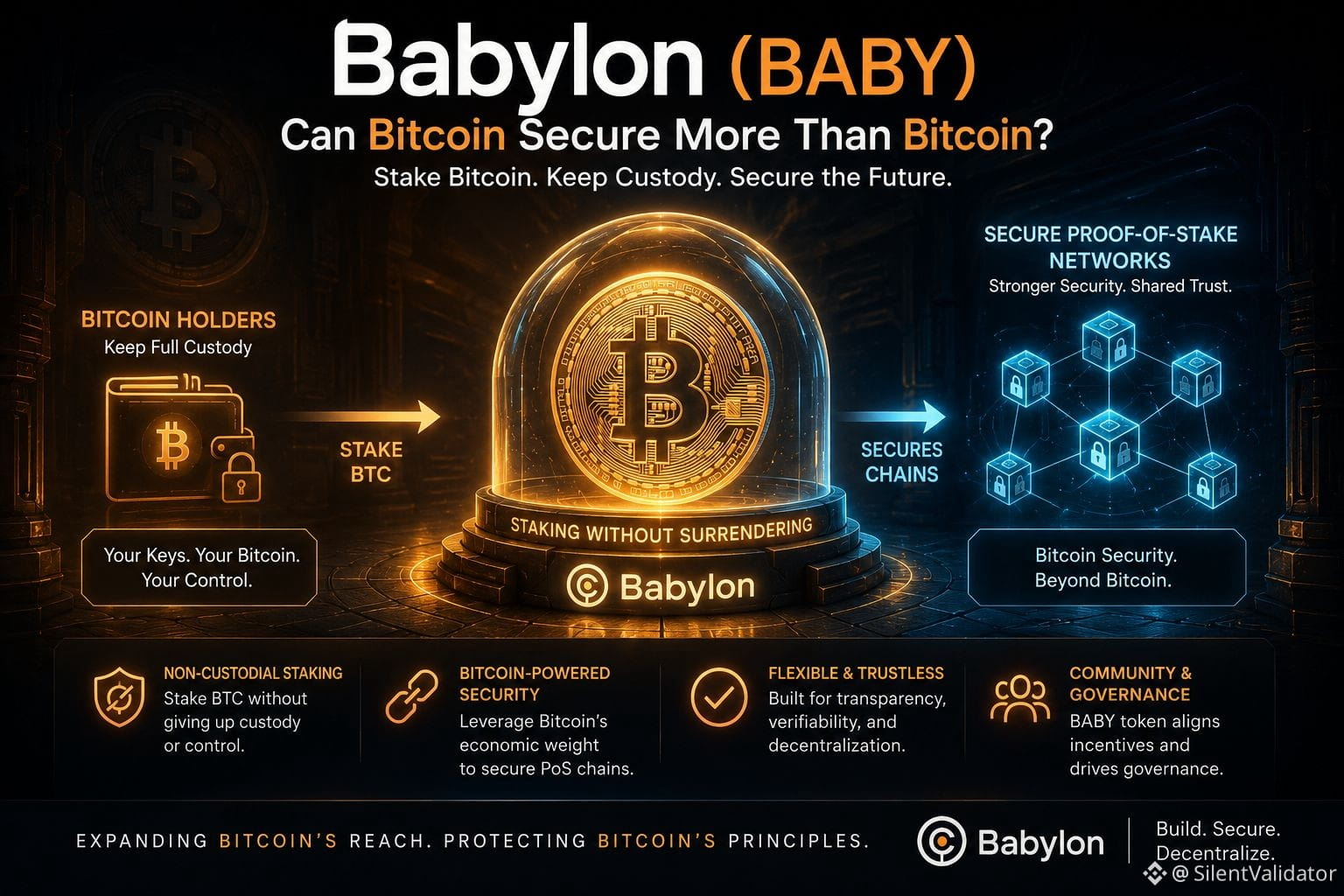
Babylon (BABY): Can Bitcoin Secure More Than Bitcoin?
I didn't take Babylon seriously at first.
Stake your Bitcoin, keep custody, use that weight to secure proof-of-stake chains. On paper, it solves everything at once.
That's usually when I get cautious.
An idle asset. Someone builds a system around it. Suddenly there's a reason to make it "work harder." Sometimes that's utility. Sometimes it's just risk in a better outfit.
Not easy to trust. Not easy to ignore.
What interests me isn't the token — it's separating staking from surrendering ownership.
But who takes responsibility when a network fails? Who gets rewarded for trust? Who decides when punishment is justified?
What happens when the security mechanism itself becomes gameable?
Convenience wins at scale. Most people pick the easiest platform, not the safest one. Defaults start to matter. A few operators become "trusted" because everyone already trusts them.
A system built to spread security can end up concentrating it.
Maybe Babylon gives proof-of-stake real security without Bitcoin holders losing control.
Or maybe it just builds new dependencies while keeping the appearance of independence.
So which matters more — expanding what Bitcoin secures, or protecting it from becoming a foundation its holders don't fully control? @babylonlabs_io #baby $BABY
Babylon (BABY): Can Bitcoin Secure More Than Bitcoin?
I didn't take Babylon seriously at first.
Stake your Bitcoin, keep custody, use that weight to secure proof-of-stake chains. On paper, it solves everything at once.
That's usually when I get cautious.
An idle asset. Someone builds a system around it. Suddenly there's a reason to make it "work harder." Sometimes that's utility. Sometimes it's just risk in a better outfit.
Not easy to trust. Not easy to ignore.
What interests me isn't the token — it's separating staking from surrendering ownership.
But who takes responsibility when a network fails? Who gets rewarded for trust? Who decides when punishment is justified?
What happens when the security mechanism itself becomes gameable?
Convenience wins at scale. Most people pick the easiest platform, not the safest one. Defaults start to matter. A few operators become "trusted" because everyone already trusts them.
A system built to spread security can end up concentrating it.
Maybe Babylon gives proof-of-stake real security without Bitcoin holders losing control.
Or maybe it just builds new dependencies while keeping the appearance of independence.
So which matters more — expanding what Bitcoin secures, or protecting it from becoming a foundation its holders don't fully control? @BabylonLabs_io #baby $BABY
I didn't take Babylon seriously at first.
Stake your Bitcoin, keep custody, use that weight to secure proof-of-stake chains. On paper, it solves everything at once.
That's usually when I get cautious.
An idle asset. Someone builds a system around it. Suddenly there's a reason to make it "work harder." Sometimes that's utility. Sometimes it's just risk in a better outfit.
Not easy to trust. Not easy to ignore.
What interests me isn't the token — it's separating staking from surrendering ownership.
But who takes responsibility when a network fails? Who gets rewarded for trust? Who decides when punishment is justified?
What happens when the security mechanism itself becomes gameable?
Convenience wins at scale. Most people pick the easiest platform, not the safest one. Defaults start to matter. A few operators become "trusted" because everyone already trusts them.
A system built to spread security can end up concentrating it.
Maybe Babylon gives proof-of-stake real security without Bitcoin holders losing control.
Or maybe it just builds new dependencies while keeping the appearance of independence.
So which matters more — expanding what Bitcoin secures, or protecting it from becoming a foundation its holders don't fully control? @BabylonLabs_io #baby $BABY

111
·
--
Bullish
@OpenGradient I’ve spent the last decade watching tech cycles play out, and I can’t shake a lingering frustration about the AI space. Everyone is obsessing over the intelligence of the models, but almost no one is looking at the metal underneath them.
A massive centralization problem is quietly taking hold. What happens when just three companies control the hosting, inference, and total access to global intelligence? Who actually owns AI once it becomes foundational infrastructure?
We are reaching a point where fighting for open intelligence matters more than training larger models. How can developers trust model outputs if independent verification is impossible? Can AI truly remain open without decentralized AI infrastructure underneath it?
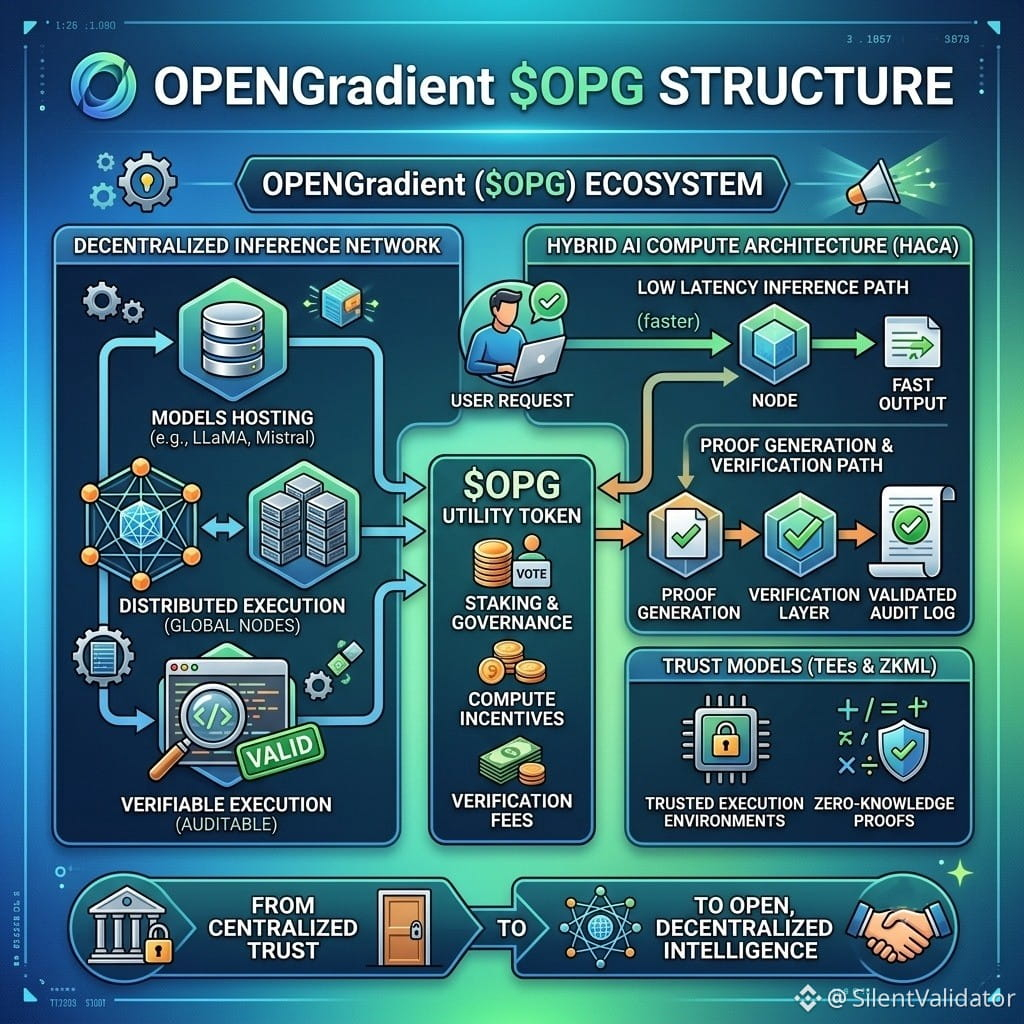
This realization is why I’ve stopped chasing AI hype and started looking at underlying layers like OpenGradient ($OPG). They are attempting to build an AI inference network designed to host and run models at scale.
The focus here is verifiable AI execution. If we want any real trust and transparency in these systems, we have to actively reduce our dependence on centralized AI providers. I still have my doubts about whether decentralized networks can rival the latency of corporate server farms. Scaling distributed computation is undeniably hard.
But the alternative is surrendering control of global cognition to a few executives. Maybe the future of AI is not about who builds the smartest model, but who builds the infrastructure that keeps intelligence open for everyone.#opg $OPG
@OpenGradient I’ve spent the last decade watching tech cycles play out, and I can’t shake a lingering frustration about the AI space. Everyone is obsessing over the intelligence of the models, but almost no one is looking at the metal underneath them.
A massive centralization problem is quietly taking hold. What happens when just three companies control the hosting, inference, and total access to global intelligence? Who actually owns AI once it becomes foundational infrastructure?
We are reaching a point where fighting for open intelligence matters more than training larger models. How can developers trust model outputs if independent verification is impossible? Can AI truly remain open without decentralized AI infrastructure underneath it?
This realization is why I’ve stopped chasing AI hype and started looking at underlying layers like OpenGradient ($OPG ). They are attempting to build an AI inference network designed to host and run models at scale.
The focus here is verifiable AI execution. If we want any real trust and transparency in these systems, we have to actively reduce our dependence on centralized AI providers. I still have my doubts about whether decentralized networks can rival the latency of corporate server farms. Scaling distributed computation is undeniably hard.
But the alternative is surrendering control of global cognition to a few executives. Maybe the future of AI is not about who builds the smartest model, but who builds the infrastructure that keeps intelligence open for everyone.#opg $OPG
A massive centralization problem is quietly taking hold. What happens when just three companies control the hosting, inference, and total access to global intelligence? Who actually owns AI once it becomes foundational infrastructure?
We are reaching a point where fighting for open intelligence matters more than training larger models. How can developers trust model outputs if independent verification is impossible? Can AI truly remain open without decentralized AI infrastructure underneath it?
This realization is why I’ve stopped chasing AI hype and started looking at underlying layers like OpenGradient ($OPG ). They are attempting to build an AI inference network designed to host and run models at scale.
The focus here is verifiable AI execution. If we want any real trust and transparency in these systems, we have to actively reduce our dependence on centralized AI providers. I still have my doubts about whether decentralized networks can rival the latency of corporate server farms. Scaling distributed computation is undeniably hard.
But the alternative is surrendering control of global cognition to a few executives. Maybe the future of AI is not about who builds the smartest model, but who builds the infrastructure that keeps intelligence open for everyone.#opg $OPG
6
4
136
·
--
Bullish
@OpenGradient I'm finding it harder to sound confident about any of this.
A few years ago the conversation was mostly about building better models. Before that, in crypto, it was mostly about trust and who controlled the rails. I spent enough time around both to recognize how every cycle develops its own favorite narrative. Eventually the narrative changes, but the questions underneath don't.
What keeps bothering me is how much of AI now depends on infrastructure most of us never see. We ask whether an answer is useful, but rarely where it came from, who actually ran the computation, or whether someone else could verify the same result. The more capable these systems become, the less visible they seem.
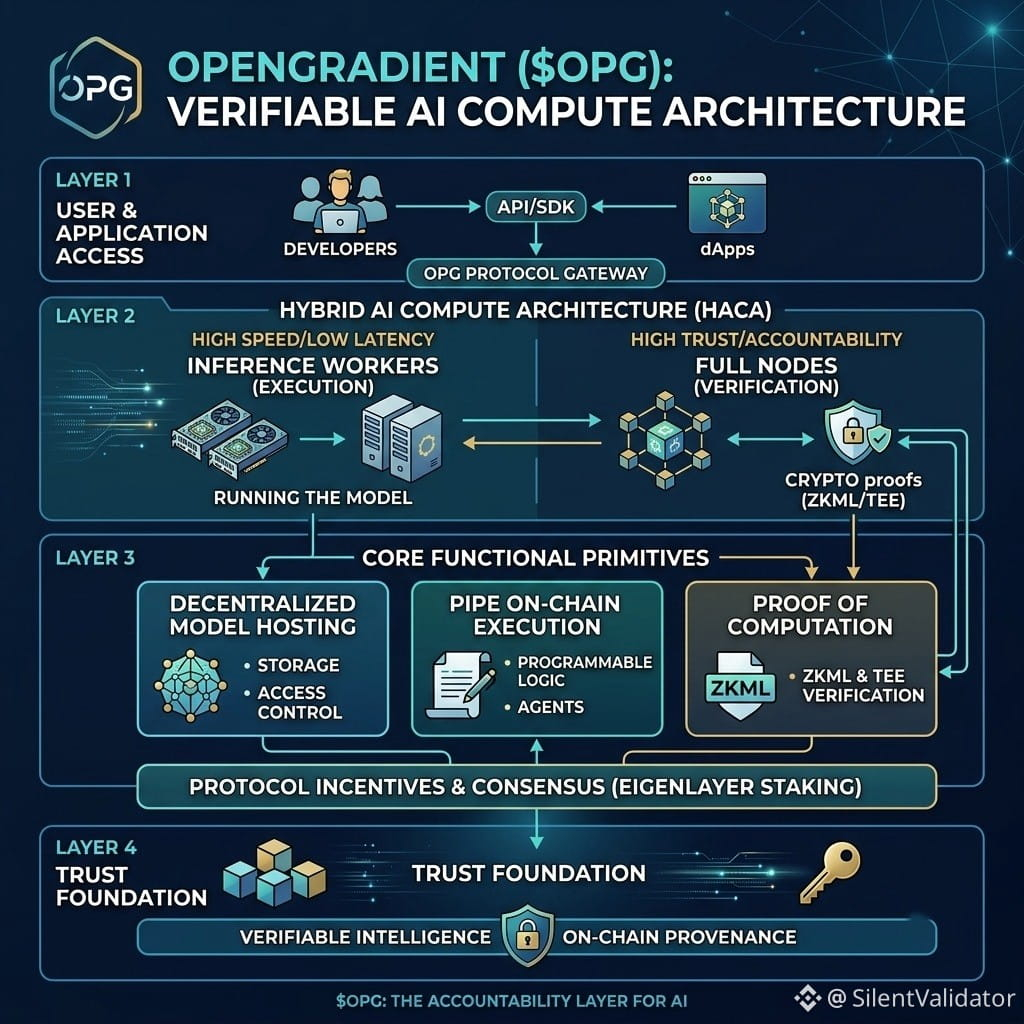
That's probably why OpenGradient ($OPG) has been sitting in the back of my mind. Not because I think decentralized infrastructure is automatically the answer. I've learned to be careful with simple explanations. Still, the idea of hosting models, running inference, and making those processes verifiable feels like it's addressing a part of the stack that has quietly become too important to ignore.
I'm also not convinced "open intelligence" remains open once incentives, ownership, and scale begin pulling in different directions. Those tensions don't disappear because we want them to.
Maybe trust in AI ends up being less about the models themselves and more about the systems that make them accountable. I suspect we're only beginning to realize how difficult that question really is.#opg $OPG
@OpenGradient I'm finding it harder to sound confident about any of this.
A few years ago the conversation was mostly about building better models. Before that, in crypto, it was mostly about trust and who controlled the rails. I spent enough time around both to recognize how every cycle develops its own favorite narrative. Eventually the narrative changes, but the questions underneath don't.
What keeps bothering me is how much of AI now depends on infrastructure most of us never see. We ask whether an answer is useful, but rarely where it came from, who actually ran the computation, or whether someone else could verify the same result. The more capable these systems become, the less visible they seem.
That's probably why OpenGradient ($OPG ) has been sitting in the back of my mind. Not because I think decentralized infrastructure is automatically the answer. I've learned to be careful with simple explanations. Still, the idea of hosting models, running inference, and making those processes verifiable feels like it's addressing a part of the stack that has quietly become too important to ignore.
I'm also not convinced "open intelligence" remains open once incentives, ownership, and scale begin pulling in different directions. Those tensions don't disappear because we want them to.
Maybe trust in AI ends up being less about the models themselves and more about the systems that make them accountable. I suspect we're only beginning to realize how difficult that question really is.#opg $OPG
A few years ago the conversation was mostly about building better models. Before that, in crypto, it was mostly about trust and who controlled the rails. I spent enough time around both to recognize how every cycle develops its own favorite narrative. Eventually the narrative changes, but the questions underneath don't.
What keeps bothering me is how much of AI now depends on infrastructure most of us never see. We ask whether an answer is useful, but rarely where it came from, who actually ran the computation, or whether someone else could verify the same result. The more capable these systems become, the less visible they seem.
That's probably why OpenGradient ($OPG ) has been sitting in the back of my mind. Not because I think decentralized infrastructure is automatically the answer. I've learned to be careful with simple explanations. Still, the idea of hosting models, running inference, and making those processes verifiable feels like it's addressing a part of the stack that has quietly become too important to ignore.
I'm also not convinced "open intelligence" remains open once incentives, ownership, and scale begin pulling in different directions. Those tensions don't disappear because we want them to.
Maybe trust in AI ends up being less about the models themselves and more about the systems that make them accountable. I suspect we're only beginning to realize how difficult that question really is.#opg $OPG
2
1
188
·
--
Bullish
I find myself wincing when people talk about crypto and AI merging. I've watched both spaces spin up massive narratives for years, and seeing them crash into each other now is mostly just tiring.
But I keep getting stuck on how dark the rooms are getting. We type into these massive systems and just take whatever they spit out as truth. There's this hidden infrastructure layer we all completely ignore, controlled by maybe three or four entities. It feels incredibly fragile. The gap between creating an AI and actually holding it accountable just keeps widening.
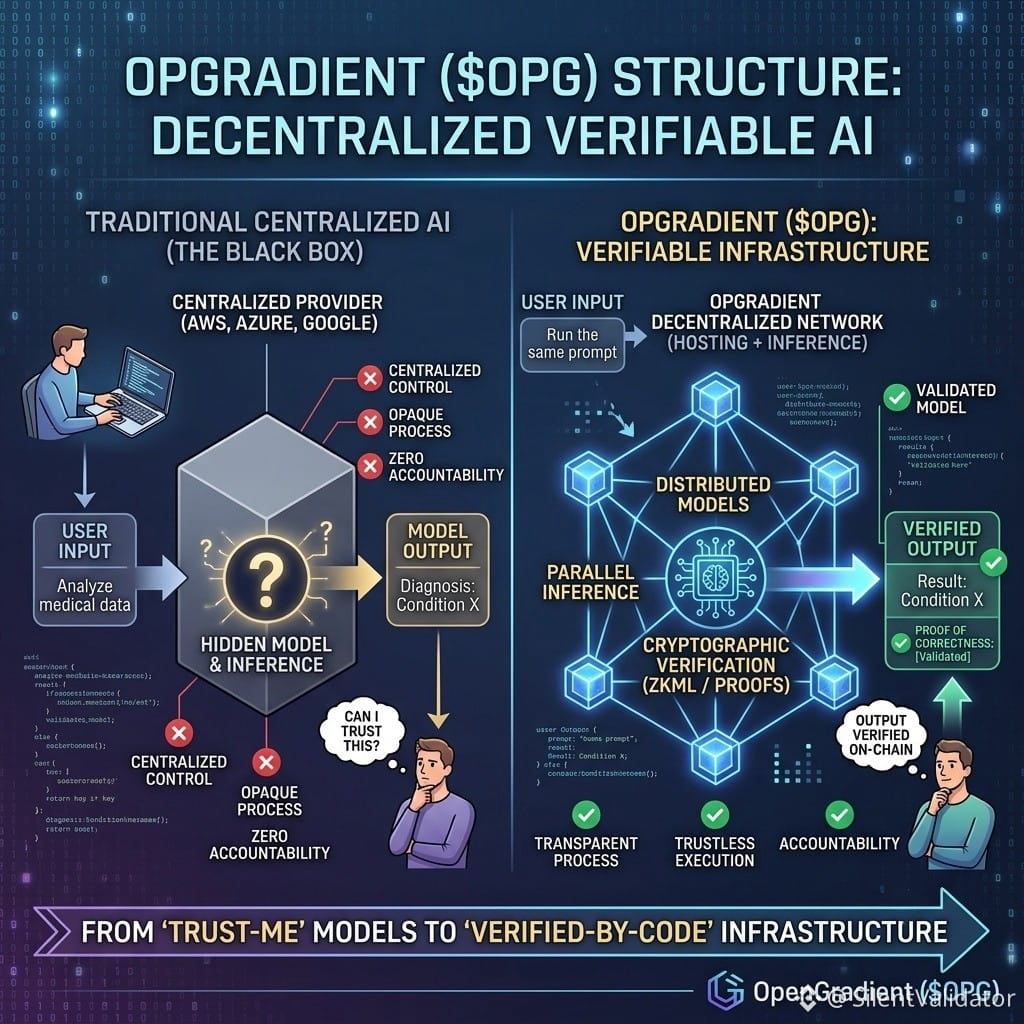
I ended up reading about OpenGradient ($OPG) the other night. The idea is treating AI trust as an infrastructure problem rather than a model problem—decentralizing the hosting and inference so outputs can actually be verified. "Open intelligence." It’s an interesting pivot. Verification is honestly starting to feel way more important than raw intelligence.
But I don't know. Infrastructure behaves very differently under real pressure than it does on paper. I'm not convinced you can decentralize compute at that scale without the whole thing buckling.
Maybe the future of AI isn't about building smarter models anymore. Maybe it's about figuring out who gets to verify them, trust them, and keep them from becoming invisible black boxes. Assuming we even care enough to look inside.@OpenGradient #opg $OPG
I find myself wincing when people talk about crypto and AI merging. I've watched both spaces spin up massive narratives for years, and seeing them crash into each other now is mostly just tiring.
But I keep getting stuck on how dark the rooms are getting. We type into these massive systems and just take whatever they spit out as truth. There's this hidden infrastructure layer we all completely ignore, controlled by maybe three or four entities. It feels incredibly fragile. The gap between creating an AI and actually holding it accountable just keeps widening.
I ended up reading about OpenGradient ($OPG ) the other night. The idea is treating AI trust as an infrastructure problem rather than a model problem—decentralizing the hosting and inference so outputs can actually be verified. "Open intelligence." It’s an interesting pivot. Verification is honestly starting to feel way more important than raw intelligence.
But I don't know. Infrastructure behaves very differently under real pressure than it does on paper. I'm not convinced you can decentralize compute at that scale without the whole thing buckling.
Maybe the future of AI isn't about building smarter models anymore. Maybe it's about figuring out who gets to verify them, trust them, and keep them from becoming invisible black boxes. Assuming we even care enough to look inside.@OpenGradient #opg $OPG
But I keep getting stuck on how dark the rooms are getting. We type into these massive systems and just take whatever they spit out as truth. There's this hidden infrastructure layer we all completely ignore, controlled by maybe three or four entities. It feels incredibly fragile. The gap between creating an AI and actually holding it accountable just keeps widening.
I ended up reading about OpenGradient ($OPG ) the other night. The idea is treating AI trust as an infrastructure problem rather than a model problem—decentralizing the hosting and inference so outputs can actually be verified. "Open intelligence." It’s an interesting pivot. Verification is honestly starting to feel way more important than raw intelligence.
But I don't know. Infrastructure behaves very differently under real pressure than it does on paper. I'm not convinced you can decentralize compute at that scale without the whole thing buckling.
Maybe the future of AI isn't about building smarter models anymore. Maybe it's about figuring out who gets to verify them, trust them, and keep them from becoming invisible black boxes. Assuming we even care enough to look inside.@OpenGradient #opg $OPG
37
23
143
·
--
Bullish
I keep coming back to the same uncomfortable thought: we are trusting AI more than we understand it.
Not the models themselves, exactly. The whole stack underneath them. Where they run, who owns the compute, which version answered, what gets changed quietly and what never gets questioned because the output looked good enough. It feels a lot like the early days of crypto, except now the black boxes are producing language that sounds confident, so people relax faster.
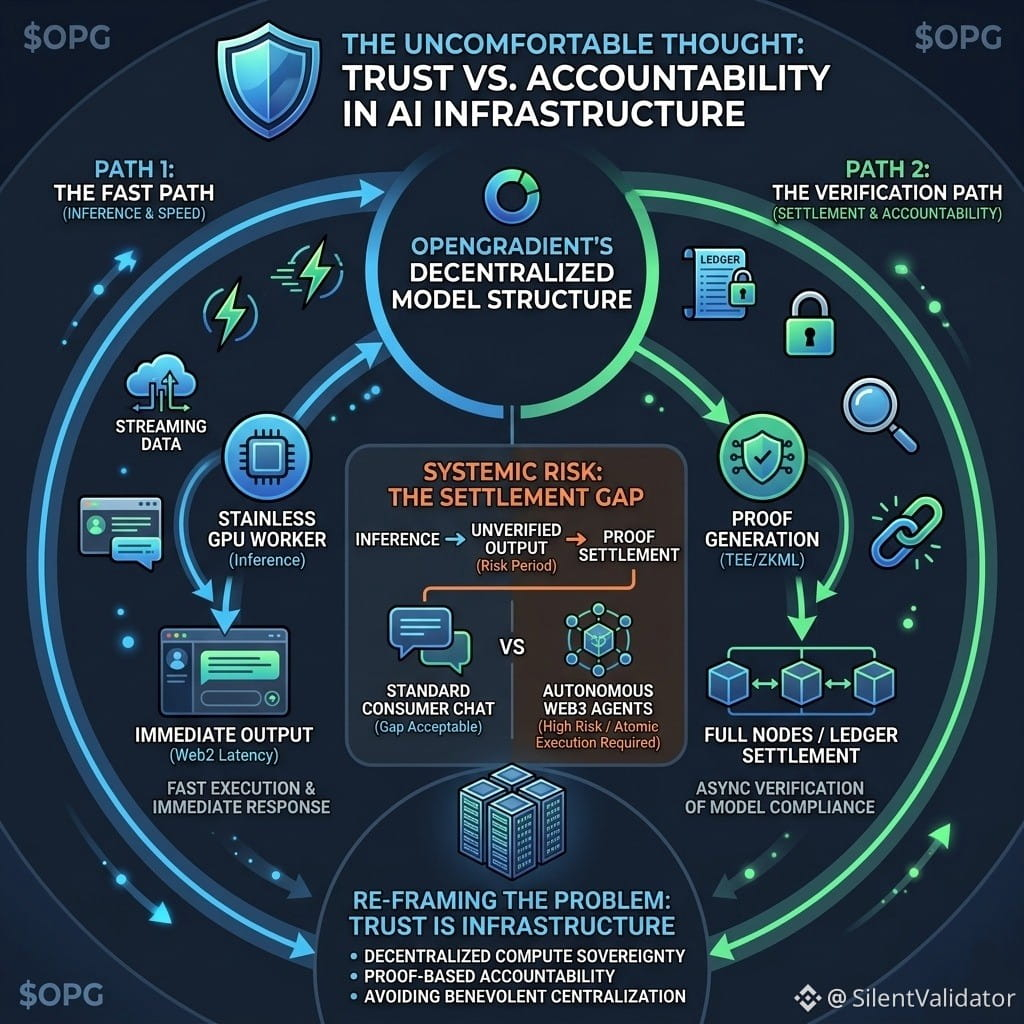
That’s why projects like OpenGradient ($OPG) get my attention, even if I’m still unsure what actually survives once the hype clears. The idea of hosting, running inference, and verifying models through decentralized infrastructure makes sense on paper. Maybe because the real issue isn’t intelligence anymore. It’s accountability. It’s whether the system can be checked when pressure shows up, when incentives shift, when one provider decides access is a privilege.
I don’t know if “open intelligence” scales without turning into another slogan. I don’t know if ownership and verification can stay aligned once money and power enter the room, which they always do.
But the gap between creating models and being responsible for them keeps widening. That part feels hard to ignore now. Maybe trust in AI is going to turn into an infrastructure problem, and I’m not sure we’ve admitted that to ourselves yet.@OpenGradient #opg $OPG
I keep coming back to the same uncomfortable thought: we are trusting AI more than we understand it.
Not the models themselves, exactly. The whole stack underneath them. Where they run, who owns the compute, which version answered, what gets changed quietly and what never gets questioned because the output looked good enough. It feels a lot like the early days of crypto, except now the black boxes are producing language that sounds confident, so people relax faster.
That’s why projects like OpenGradient ($OPG ) get my attention, even if I’m still unsure what actually survives once the hype clears. The idea of hosting, running inference, and verifying models through decentralized infrastructure makes sense on paper. Maybe because the real issue isn’t intelligence anymore. It’s accountability. It’s whether the system can be checked when pressure shows up, when incentives shift, when one provider decides access is a privilege.
I don’t know if “open intelligence” scales without turning into another slogan. I don’t know if ownership and verification can stay aligned once money and power enter the room, which they always do.
But the gap between creating models and being responsible for them keeps widening. That part feels hard to ignore now. Maybe trust in AI is going to turn into an infrastructure problem, and I’m not sure we’ve admitted that to ourselves yet.@OpenGradient #opg $OPG
Not the models themselves, exactly. The whole stack underneath them. Where they run, who owns the compute, which version answered, what gets changed quietly and what never gets questioned because the output looked good enough. It feels a lot like the early days of crypto, except now the black boxes are producing language that sounds confident, so people relax faster.
That’s why projects like OpenGradient ($OPG ) get my attention, even if I’m still unsure what actually survives once the hype clears. The idea of hosting, running inference, and verifying models through decentralized infrastructure makes sense on paper. Maybe because the real issue isn’t intelligence anymore. It’s accountability. It’s whether the system can be checked when pressure shows up, when incentives shift, when one provider decides access is a privilege.
I don’t know if “open intelligence” scales without turning into another slogan. I don’t know if ownership and verification can stay aligned once money and power enter the room, which they always do.
But the gap between creating models and being responsible for them keeps widening. That part feels hard to ignore now. Maybe trust in AI is going to turn into an infrastructure problem, and I’m not sure we’ve admitted that to ourselves yet.@OpenGradient #opg $OPG
23
17
96
·
--
Bullish
I keep feeling a little uneasy about how much of AI now happens behind layers most people never see.
Not the models themselves. The infrastructure beneath them.
Maybe that comes from spending too many years around crypto, where people had a tendency to obsess over the things nobody else wanted to talk about. Verification. Ownership. Trust assumptions. At the time, a lot of those debates felt detached from reality.
Lately they feel relevant again.
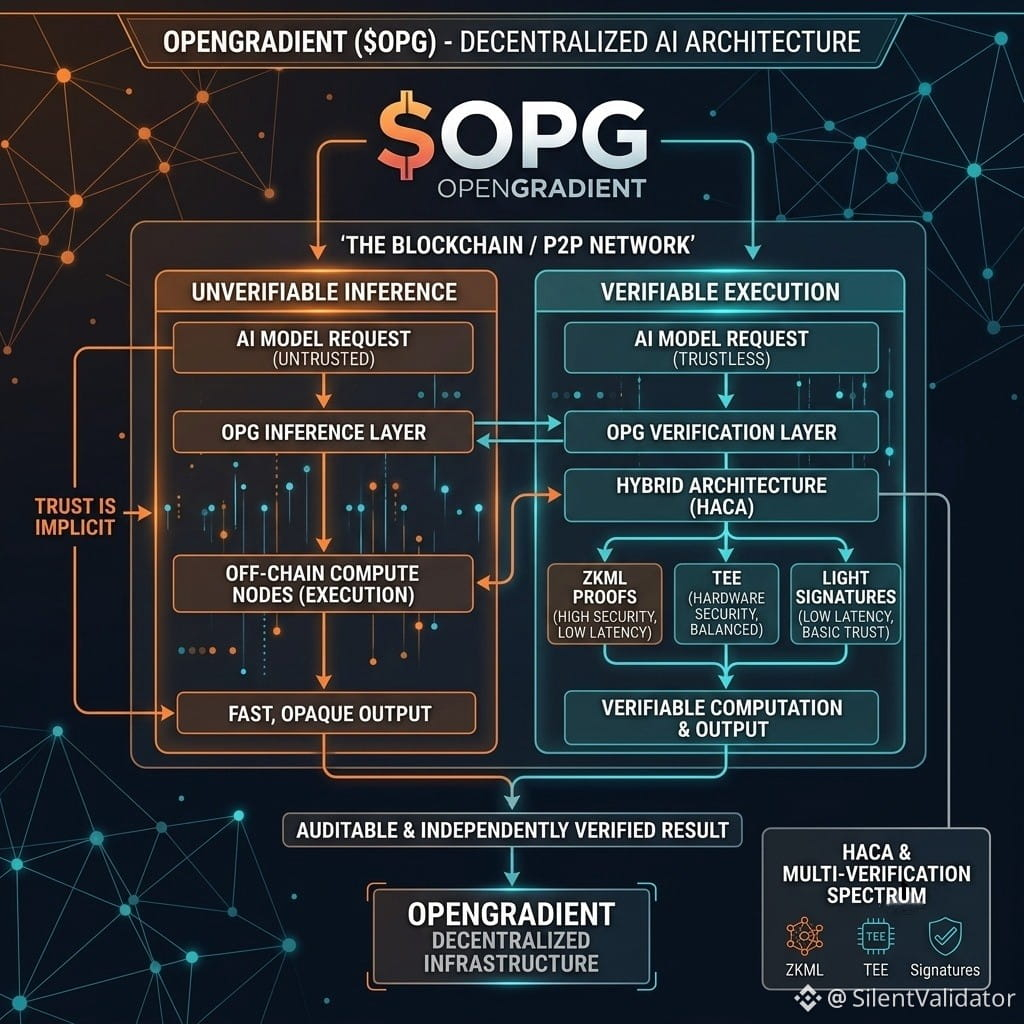
AI has become extremely useful. Most people accept that. What's less obvious is how much that usefulness relies on systems we can’t really inspect. We get outputs, summaries, recommendations, decisions. We rarely know who ran the model, where the computation happened, or whether the result could be independently verified if anyone cared to check.
The trust is implicit.
And implicit trust tends to hold up exactly until conditions stop being ideal.
That’s partly why OpenGradient ($OPG) has been interesting to me. Not because I think decentralized infrastructure is some guaranteed fix. History makes me skeptical of guaranteed fixes. But because it seems focused on hosting, inference, and verification—the parts of the stack that usually disappear until accountability becomes the topic.
I keep hearing people talk about smarter models.
Maybe that’s still the central challenge.
Maybe it isn’t.
The more I think about it, the more I wonder whether the harder problem ahead is figuring out who gets to verify AI once it becomes so embedded in daily life that nobody bothers to look under the hood.
That tension feels unresolved to me. And it probably stays that way for a while longer.#opg $OPG @OpenGradient
I keep feeling a little uneasy about how much of AI now happens behind layers most people never see.
Not the models themselves. The infrastructure beneath them.
Maybe that comes from spending too many years around crypto, where people had a tendency to obsess over the things nobody else wanted to talk about. Verification. Ownership. Trust assumptions. At the time, a lot of those debates felt detached from reality.
Lately they feel relevant again.
AI has become extremely useful. Most people accept that. What's less obvious is how much that usefulness relies on systems we can’t really inspect. We get outputs, summaries, recommendations, decisions. We rarely know who ran the model, where the computation happened, or whether the result could be independently verified if anyone cared to check.
The trust is implicit.
And implicit trust tends to hold up exactly until conditions stop being ideal.
That’s partly why OpenGradient ($OPG ) has been interesting to me. Not because I think decentralized infrastructure is some guaranteed fix. History makes me skeptical of guaranteed fixes. But because it seems focused on hosting, inference, and verification—the parts of the stack that usually disappear until accountability becomes the topic.
I keep hearing people talk about smarter models.
Maybe that’s still the central challenge.
Maybe it isn’t.
The more I think about it, the more I wonder whether the harder problem ahead is figuring out who gets to verify AI once it becomes so embedded in daily life that nobody bothers to look under the hood.
That tension feels unresolved to me. And it probably stays that way for a while longer.#opg $OPG @OpenGradient
Not the models themselves. The infrastructure beneath them.
Maybe that comes from spending too many years around crypto, where people had a tendency to obsess over the things nobody else wanted to talk about. Verification. Ownership. Trust assumptions. At the time, a lot of those debates felt detached from reality.
Lately they feel relevant again.
AI has become extremely useful. Most people accept that. What's less obvious is how much that usefulness relies on systems we can’t really inspect. We get outputs, summaries, recommendations, decisions. We rarely know who ran the model, where the computation happened, or whether the result could be independently verified if anyone cared to check.
The trust is implicit.
And implicit trust tends to hold up exactly until conditions stop being ideal.
That’s partly why OpenGradient ($OPG ) has been interesting to me. Not because I think decentralized infrastructure is some guaranteed fix. History makes me skeptical of guaranteed fixes. But because it seems focused on hosting, inference, and verification—the parts of the stack that usually disappear until accountability becomes the topic.
I keep hearing people talk about smarter models.
Maybe that’s still the central challenge.
Maybe it isn’t.
The more I think about it, the more I wonder whether the harder problem ahead is figuring out who gets to verify AI once it becomes so embedded in daily life that nobody bothers to look under the hood.
That tension feels unresolved to me. And it probably stays that way for a while longer.#opg $OPG @OpenGradient
40
23
290
·
--
Bullish
@OpenGradient I’m not sure if this is skepticism or just fatigue from watching enough technology cycles, but I keep finding myself less interested in what AI can do and more interested in what sits underneath it.
For years, AI and crypto felt like they were having completely different conversations. AI focused on capability. Crypto focused on verification. One wanted smarter systems. The other wanted systems people didn’t have to blindly trust.
Now those conversations seem to be meeting in the same place.
The thing that feels increasingly uncomfortable is how much of modern AI depends on infrastructure most people never see. We interact with outputs every day, often without knowing where they came from, who controlled the computation, or whether the result can be independently verified. We trust because the system is useful.
That works remarkably well.
Until trust becomes the actual question.
Infrastructure is strange that way. It stays invisible when conditions are good. It becomes the whole story when conditions aren't. Access changes. Incentives shift. Dependencies surface. Suddenly the fact that a small number of entities control large portions of computation and model access feels more important than the model itself.
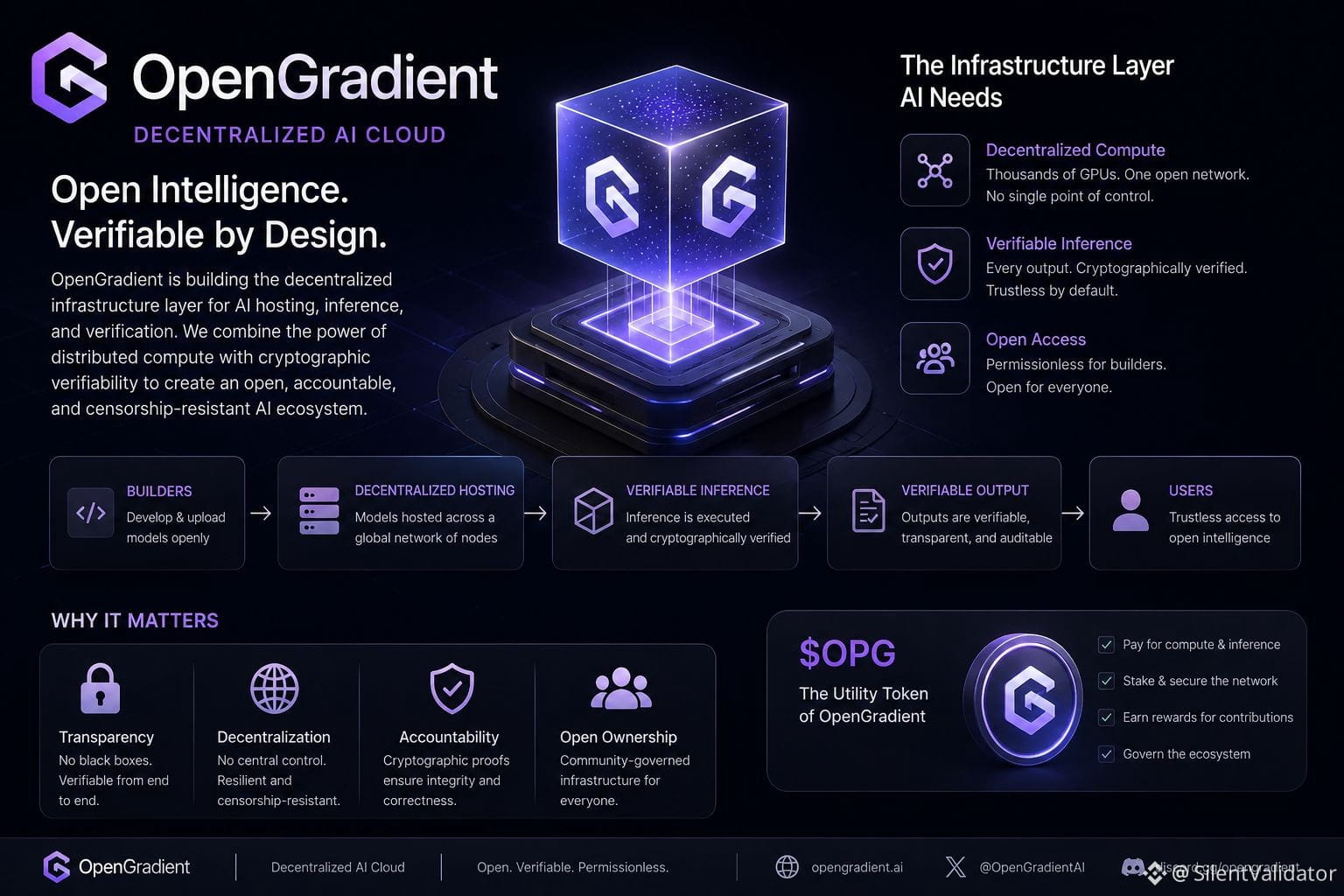
That’s partly why OpenGradient ($OPG) caught my attention. Not because I think decentralized infrastructure is a guaranteed answer. I’ve been around crypto long enough to be careful with those assumptions. But because it seems focused on hosting, inference, and verification—the layer where accountability either exists or doesn’t.
I’m curious about the idea of open intelligence.
I’m also unconvinced that openness, ownership, scale, and verification naturally coexist.
Maybe the future challenge isn’t building smarter models.
Maybe it’s making sure they don’t become systems everyone depends on but nobody can meaningfully verify anymore.#opg $OPG
@OpenGradient I’m not sure if this is skepticism or just fatigue from watching enough technology cycles, but I keep finding myself less interested in what AI can do and more interested in what sits underneath it.
For years, AI and crypto felt like they were having completely different conversations. AI focused on capability. Crypto focused on verification. One wanted smarter systems. The other wanted systems people didn’t have to blindly trust.
Now those conversations seem to be meeting in the same place.
The thing that feels increasingly uncomfortable is how much of modern AI depends on infrastructure most people never see. We interact with outputs every day, often without knowing where they came from, who controlled the computation, or whether the result can be independently verified. We trust because the system is useful.
That works remarkably well.
Until trust becomes the actual question.
Infrastructure is strange that way. It stays invisible when conditions are good. It becomes the whole story when conditions aren't. Access changes. Incentives shift. Dependencies surface. Suddenly the fact that a small number of entities control large portions of computation and model access feels more important than the model itself.
That’s partly why OpenGradient ($OPG ) caught my attention. Not because I think decentralized infrastructure is a guaranteed answer. I’ve been around crypto long enough to be careful with those assumptions. But because it seems focused on hosting, inference, and verification—the layer where accountability either exists or doesn’t.
I’m curious about the idea of open intelligence.
I’m also unconvinced that openness, ownership, scale, and verification naturally coexist.
Maybe the future challenge isn’t building smarter models.
Maybe it’s making sure they don’t become systems everyone depends on but nobody can meaningfully verify anymore.#opg $OPG
For years, AI and crypto felt like they were having completely different conversations. AI focused on capability. Crypto focused on verification. One wanted smarter systems. The other wanted systems people didn’t have to blindly trust.
Now those conversations seem to be meeting in the same place.
The thing that feels increasingly uncomfortable is how much of modern AI depends on infrastructure most people never see. We interact with outputs every day, often without knowing where they came from, who controlled the computation, or whether the result can be independently verified. We trust because the system is useful.
That works remarkably well.
Until trust becomes the actual question.
Infrastructure is strange that way. It stays invisible when conditions are good. It becomes the whole story when conditions aren't. Access changes. Incentives shift. Dependencies surface. Suddenly the fact that a small number of entities control large portions of computation and model access feels more important than the model itself.
That’s partly why OpenGradient ($OPG ) caught my attention. Not because I think decentralized infrastructure is a guaranteed answer. I’ve been around crypto long enough to be careful with those assumptions. But because it seems focused on hosting, inference, and verification—the layer where accountability either exists or doesn’t.
I’m curious about the idea of open intelligence.
I’m also unconvinced that openness, ownership, scale, and verification naturally coexist.
Maybe the future challenge isn’t building smarter models.
Maybe it’s making sure they don’t become systems everyone depends on but nobody can meaningfully verify anymore.#opg $OPG
16
12
147
·
--
Bullish
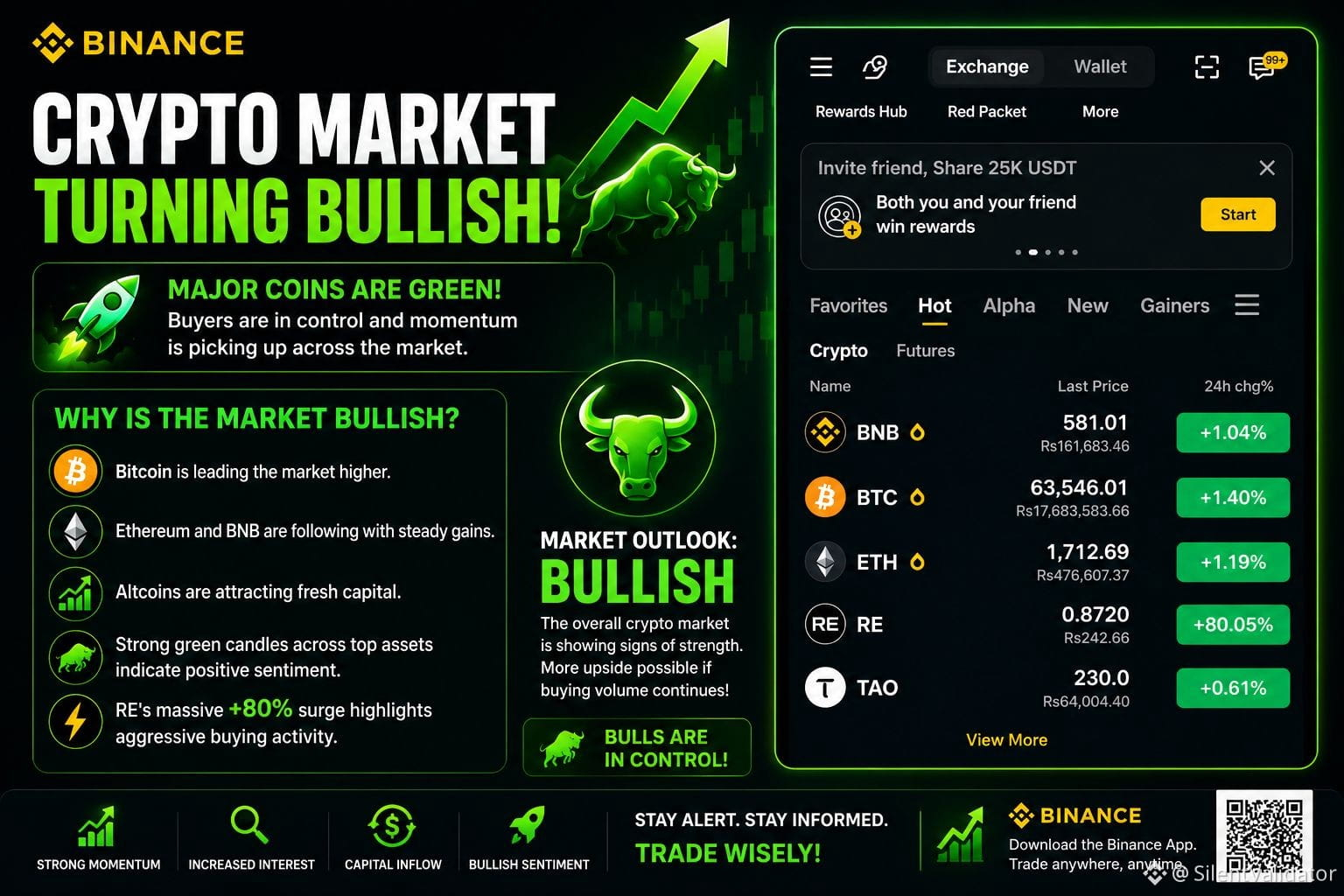
🚀 CRYPTO MARKET BULLISH SIGNALS! 🚀
🟢 The market is showing strong bullish momentum as major cryptocurrencies are trading in the green:
📈 HYPE/USDT ➜ +3.84% 📈 SOL/USDT ➜ +2.19% 📈 GT/USDT ➜ +1.98% 📈 BTC/USDT ➜ +1.30% 📈 ETH/USDT ➜ +0.95%
🔥 Why is the market bullish? ✅ Bitcoin is maintaining upward momentum. ✅ Altcoins are outperforming BTC, showing increased risk appetite. ✅ SOL and HYPE leading gains indicate strong buying pressure. ✅ Multiple top assets are green simultaneously, a sign of healthy market sentiment. ✅ Traders are rotating capital into high-growth crypto assets.
🐂 Market Sentiment: BULLISH 💰 Buyers are currently dominating the market. 👀 Watch for increased volume to confirm further upside potential.
#Bitcoin #BTC #Ethereum #ETH #Solana #SOL #HYPE #GateToken #Crypto #Bullish #CryptoMarket #Altcoins #MarketUpdate #TradingSignals #CryptoNews #BullRun #Blockchain #CryptoCommunity 🚀
⚠️ This post is for informational purposes only and not financial advice. Always do your own research before investing.
🚀 CRYPTO MARKET BULLISH SIGNALS! 🚀
🟢 The market is showing strong bullish momentum as major cryptocurrencies are trading in the green:
📈 HYPE/USDT ➜ +3.84% 📈 SOL/USDT ➜ +2.19% 📈 GT/USDT ➜ +1.98% 📈 BTC/USDT ➜ +1.30% 📈 ETH/USDT ➜ +0.95%
🔥 Why is the market bullish? ✅ Bitcoin is maintaining upward momentum. ✅ Altcoins are outperforming BTC, showing increased risk appetite. ✅ SOL and HYPE leading gains indicate strong buying pressure. ✅ Multiple top assets are green simultaneously, a sign of healthy market sentiment. ✅ Traders are rotating capital into high-growth crypto assets.
🐂 Market Sentiment: BULLISH 💰 Buyers are currently dominating the market. 👀 Watch for increased volume to confirm further upside potential.
#Bitcoin #BTC #Ethereum #ETH #Solana #SOL #HYPE #GateToken #Crypto #Bullish #CryptoMarket #Altcoins #MarketUpdate #TradingSignals #CryptoNews #BullRun #Blockchain #CryptoCommunity 🚀
⚠️ This post is for informational purposes only and not financial advice. Always do your own research before investing.
🟢 The market is showing strong bullish momentum as major cryptocurrencies are trading in the green:
📈 HYPE/USDT ➜ +3.84% 📈 SOL/USDT ➜ +2.19% 📈 GT/USDT ➜ +1.98% 📈 BTC/USDT ➜ +1.30% 📈 ETH/USDT ➜ +0.95%
🔥 Why is the market bullish? ✅ Bitcoin is maintaining upward momentum. ✅ Altcoins are outperforming BTC, showing increased risk appetite. ✅ SOL and HYPE leading gains indicate strong buying pressure. ✅ Multiple top assets are green simultaneously, a sign of healthy market sentiment. ✅ Traders are rotating capital into high-growth crypto assets.
🐂 Market Sentiment: BULLISH 💰 Buyers are currently dominating the market. 👀 Watch for increased volume to confirm further upside potential.
#Bitcoin #BTC #Ethereum #ETH #Solana #SOL #HYPE #GateToken #Crypto #Bullish #CryptoMarket #Altcoins #MarketUpdate #TradingSignals #CryptoNews #BullRun #Blockchain #CryptoCommunity 🚀
⚠️ This post is for informational purposes only and not financial advice. Always do your own research before investing.
2
3
140
·
--
Bullish
@OpenGradient I've been watching this AI and crypto overlap for a while now, and honestly, mostly it just makes me tired. We keep building these massive, increasingly opaque boxes. You ask a question, you get an output, and you just kind of... trust it. Because what else are you going to do?
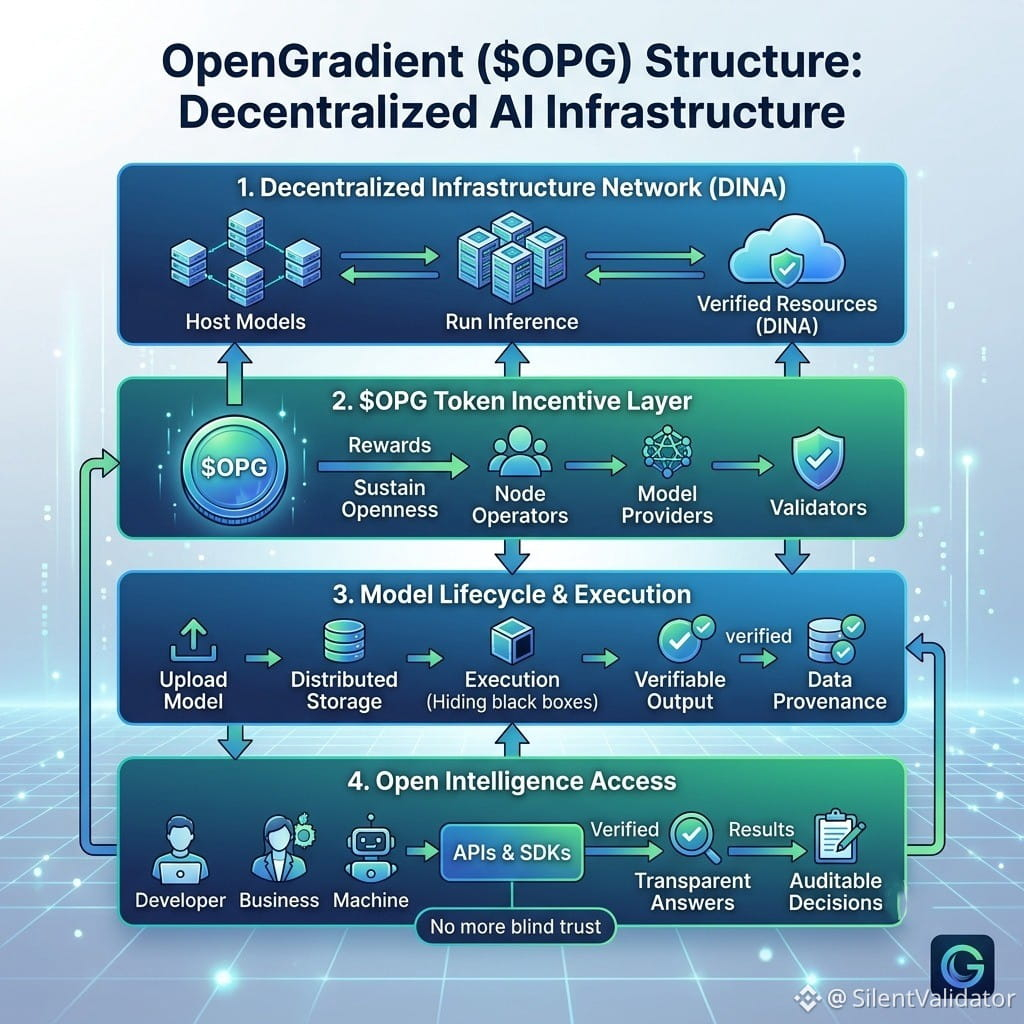
But that blind trust is starting to feel fragile. We just accepted that a few entities own the math and the servers. I've been looking at things like OpenGradient lately. They’re trying to build a decentralized infrastructure network to host, run inference, and actually verify these models. The idea of "open intelligence" sounds nice in theory. The premise that trust in AI is fundamentally an infrastructure problem rather than a model problem—that actually makes a lot of sense. If you can’t verify how an inference was run, does the intelligence even matter?
Building this at scale is messy, though. Openness is incredibly hard to maintain when incentives inevitably shift. $OPG is trying to make sure AI doesn’t just become an invisible black box running in a private server farm somewhere. I get why that infrastructure layer is necessary. I really do.
But I don't know if the world actually wants accountability, or if we just want the machines to give us answers faster. Maybe verification is the only way this doesn't fall apart entirely. Or maybe people just don't care where the outputs come from.#opg $OPG
@OpenGradient I've been watching this AI and crypto overlap for a while now, and honestly, mostly it just makes me tired. We keep building these massive, increasingly opaque boxes. You ask a question, you get an output, and you just kind of... trust it. Because what else are you going to do?
But that blind trust is starting to feel fragile. We just accepted that a few entities own the math and the servers. I've been looking at things like OpenGradient lately. They’re trying to build a decentralized infrastructure network to host, run inference, and actually verify these models. The idea of "open intelligence" sounds nice in theory. The premise that trust in AI is fundamentally an infrastructure problem rather than a model problem—that actually makes a lot of sense. If you can’t verify how an inference was run, does the intelligence even matter?
Building this at scale is messy, though. Openness is incredibly hard to maintain when incentives inevitably shift. $OPG is trying to make sure AI doesn’t just become an invisible black box running in a private server farm somewhere. I get why that infrastructure layer is necessary. I really do.
But I don't know if the world actually wants accountability, or if we just want the machines to give us answers faster. Maybe verification is the only way this doesn't fall apart entirely. Or maybe people just don't care where the outputs come from.#opg $OPG
But that blind trust is starting to feel fragile. We just accepted that a few entities own the math and the servers. I've been looking at things like OpenGradient lately. They’re trying to build a decentralized infrastructure network to host, run inference, and actually verify these models. The idea of "open intelligence" sounds nice in theory. The premise that trust in AI is fundamentally an infrastructure problem rather than a model problem—that actually makes a lot of sense. If you can’t verify how an inference was run, does the intelligence even matter?
Building this at scale is messy, though. Openness is incredibly hard to maintain when incentives inevitably shift. $OPG is trying to make sure AI doesn’t just become an invisible black box running in a private server farm somewhere. I get why that infrastructure layer is necessary. I really do.
But I don't know if the world actually wants accountability, or if we just want the machines to give us answers faster. Maybe verification is the only way this doesn't fall apart entirely. Or maybe people just don't care where the outputs come from.#opg $OPG
24
11
232
·
--
Bullish
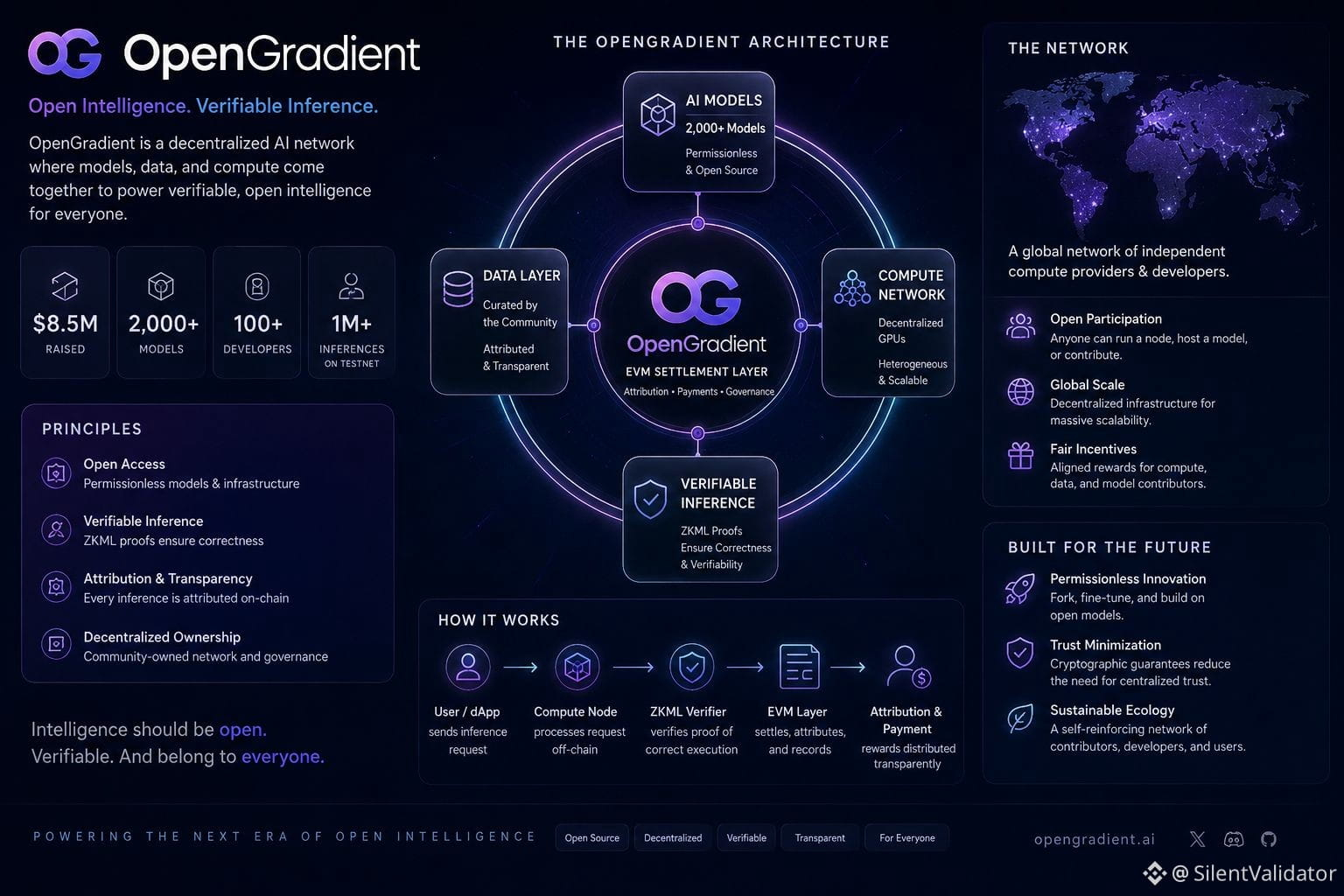
@OpenGradient I didn’t take OpenGradient seriously at first — just another claim of “open intelligence” draped over a decentralized network, another promise that models, data, and compute would finally belong to users instead of the usual clouds. I’ve watched too many infrastructure cycles stall in slow motion, where the blueprints look pristine and the real-world pressure arrives uninvited. Maybe that’s too harsh. They raised $8.5M, which means someone believes this can hold. The network hosts over 2,000 models, serves 100+ developers, and has done more than a million inferences on testnet. That part is measurable. But it works in theory. Most things do.
I keep coming back to the fragile point: verifiable inference is elegant until incentives distort behavior. If compute nodes get paid per inference, they start optimizing for payout, not truth. ZKML proofs sound clean, but they’re heavy, expensive, and easy to sideline when the bar gets low. Attribution is supposed to keep things honest, yet once data becomes financialized, people tidy datasets, they rent influence, they chase the scoreboard. That’s where things start to feel uncomfortable. The heterogeneous AI compute architecture weaves decentralized GPUs into an EVM layer that settles and attributes every inference. Neat on paper. But the invisible stack — relayers, verifiers, arbitragers — only shows up when something breaks. Trust decays. “Open” slowly recentralizes.
What happens when models are permissionless and anyone can fork them? Power disperses, yes, but extraction finds new paths. Coordination between humans, models, and incentives is stubbornly human. I’m curious, a bit queasy. I don’t know if this architecture can stop the drift. The problem isn’t really the technology. It’s the ecology. I watch, waiting to see which threads hold when pressure comes. And then I trail off, because the question keeps mutating as soon as you name it.
#opg $OPG
@OpenGradient I didn’t take OpenGradient seriously at first — just another claim of “open intelligence” draped over a decentralized network, another promise that models, data, and compute would finally belong to users instead of the usual clouds. I’ve watched too many infrastructure cycles stall in slow motion, where the blueprints look pristine and the real-world pressure arrives uninvited. Maybe that’s too harsh. They raised $8.5M, which means someone believes this can hold. The network hosts over 2,000 models, serves 100+ developers, and has done more than a million inferences on testnet. That part is measurable. But it works in theory. Most things do.
I keep coming back to the fragile point: verifiable inference is elegant until incentives distort behavior. If compute nodes get paid per inference, they start optimizing for payout, not truth. ZKML proofs sound clean, but they’re heavy, expensive, and easy to sideline when the bar gets low. Attribution is supposed to keep things honest, yet once data becomes financialized, people tidy datasets, they rent influence, they chase the scoreboard. That’s where things start to feel uncomfortable. The heterogeneous AI compute architecture weaves decentralized GPUs into an EVM layer that settles and attributes every inference. Neat on paper. But the invisible stack — relayers, verifiers, arbitragers — only shows up when something breaks. Trust decays. “Open” slowly recentralizes.
What happens when models are permissionless and anyone can fork them? Power disperses, yes, but extraction finds new paths. Coordination between humans, models, and incentives is stubbornly human. I’m curious, a bit queasy. I don’t know if this architecture can stop the drift. The problem isn’t really the technology. It’s the ecology. I watch, waiting to see which threads hold when pressure comes. And then I trail off, because the question keeps mutating as soon as you name it.
#opg $OPG
I keep coming back to the fragile point: verifiable inference is elegant until incentives distort behavior. If compute nodes get paid per inference, they start optimizing for payout, not truth. ZKML proofs sound clean, but they’re heavy, expensive, and easy to sideline when the bar gets low. Attribution is supposed to keep things honest, yet once data becomes financialized, people tidy datasets, they rent influence, they chase the scoreboard. That’s where things start to feel uncomfortable. The heterogeneous AI compute architecture weaves decentralized GPUs into an EVM layer that settles and attributes every inference. Neat on paper. But the invisible stack — relayers, verifiers, arbitragers — only shows up when something breaks. Trust decays. “Open” slowly recentralizes.
What happens when models are permissionless and anyone can fork them? Power disperses, yes, but extraction finds new paths. Coordination between humans, models, and incentives is stubbornly human. I’m curious, a bit queasy. I don’t know if this architecture can stop the drift. The problem isn’t really the technology. It’s the ecology. I watch, waiting to see which threads hold when pressure comes. And then I trail off, because the question keeps mutating as soon as you name it.
#opg $OPG
2
3
143
·
--
Bullish
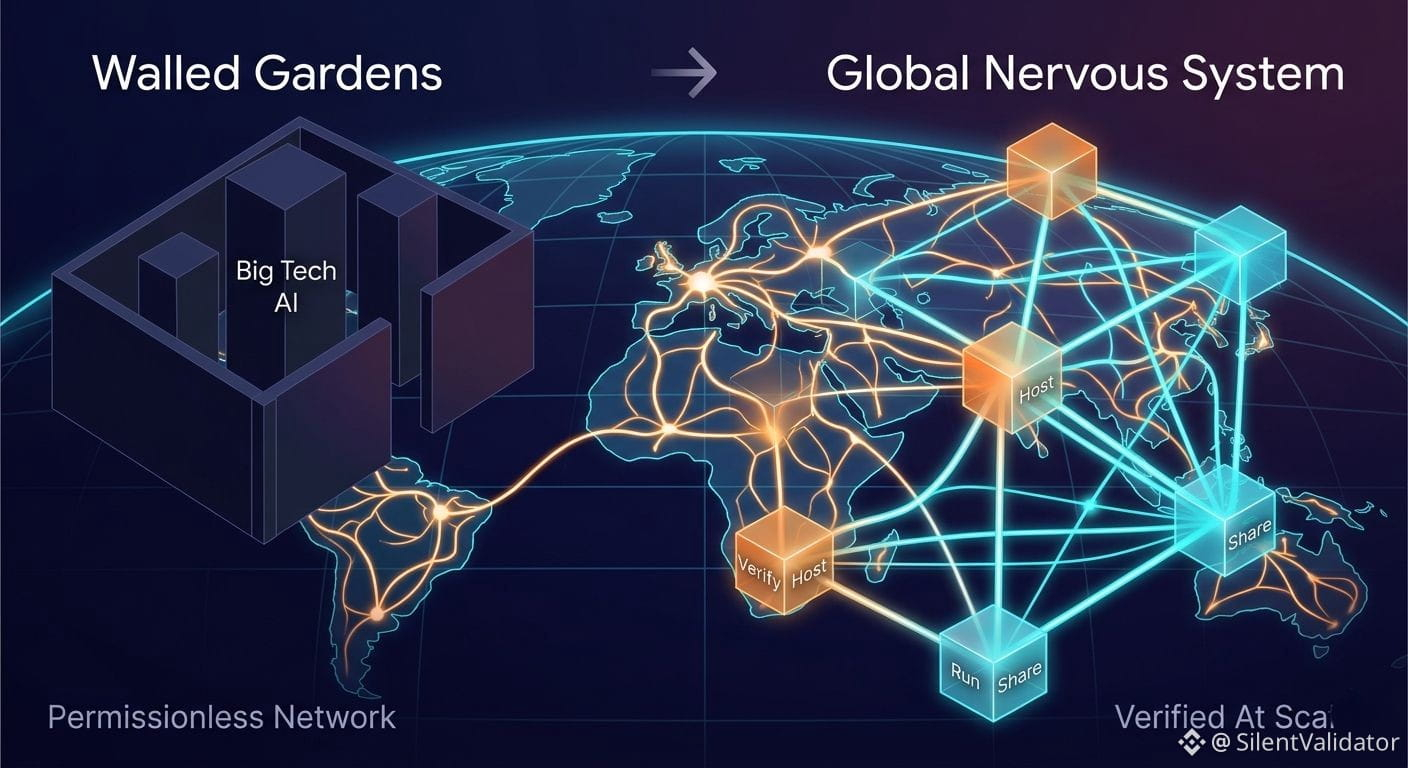
@OpenGradient For years, the future of AI has felt like it belongs to someone else. Locked behind the walls of a few tech giants, innovation has a price tag and a permission slip. We watched as a handful of companies built the infrastructure that would define our digital world, and we were left on the outside looking in.
But that's starting to crack. Look closer at the market noise, and you’ll see systems like OpenGradient emerging. This isn’t just another project; it’s a global, permissionless network built to host, run, and verify AI models at scale. Think of it as a coordinated nervous system for open intelligence.
This is more than just infrastructure; it's a declaration. It says that the power to create and deploy intelligence shouldn't be owned, but shared. The silent war for the future of AI is happening right now, at the deepest layers of the stack. Don’t blink.#opg $OPG
@OpenGradient For years, the future of AI has felt like it belongs to someone else. Locked behind the walls of a few tech giants, innovation has a price tag and a permission slip. We watched as a handful of companies built the infrastructure that would define our digital world, and we were left on the outside looking in.
But that's starting to crack. Look closer at the market noise, and you’ll see systems like OpenGradient emerging. This isn’t just another project; it’s a global, permissionless network built to host, run, and verify AI models at scale. Think of it as a coordinated nervous system for open intelligence.
This is more than just infrastructure; it's a declaration. It says that the power to create and deploy intelligence shouldn't be owned, but shared. The silent war for the future of AI is happening right now, at the deepest layers of the stack. Don’t blink.#opg $OPG
But that's starting to crack. Look closer at the market noise, and you’ll see systems like OpenGradient emerging. This isn’t just another project; it’s a global, permissionless network built to host, run, and verify AI models at scale. Think of it as a coordinated nervous system for open intelligence.
This is more than just infrastructure; it's a declaration. It says that the power to create and deploy intelligence shouldn't be owned, but shared. The silent war for the future of AI is happening right now, at the deepest layers of the stack. Don’t blink.#opg $OPG
1
2
139
·
--
Bullish
@OpenGradient Why I Can't Stop Thinking About Open Intelligence
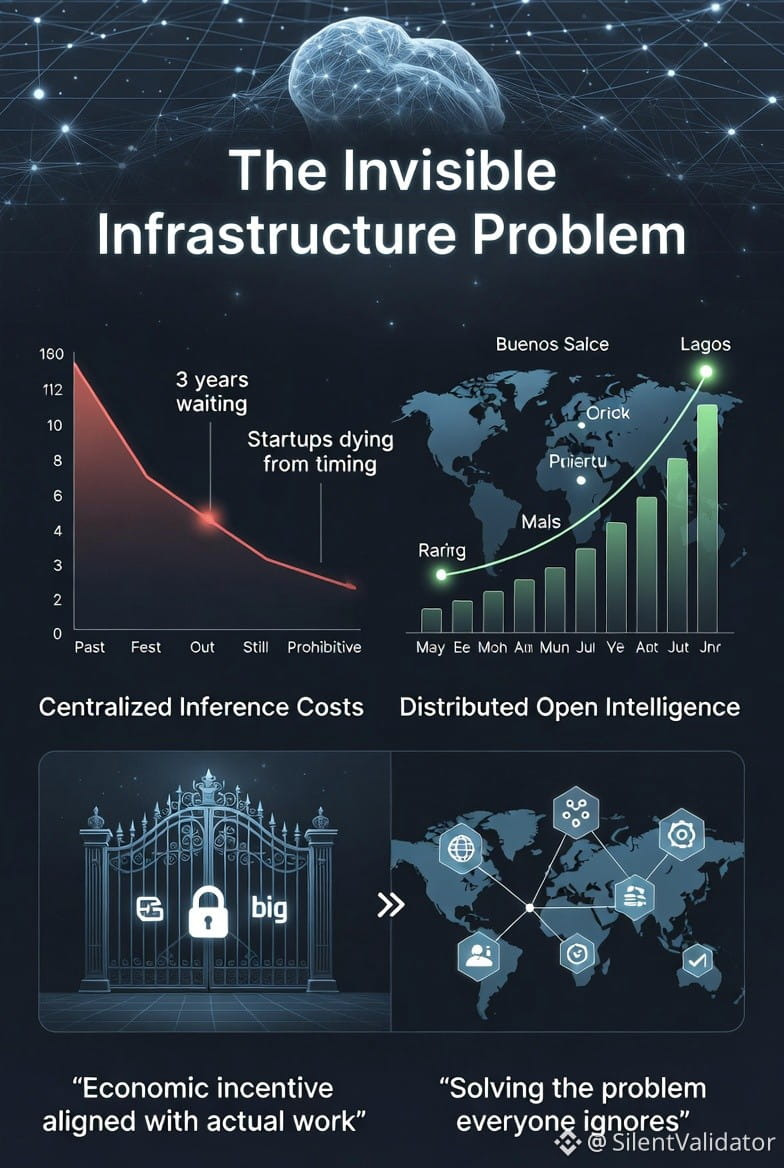
Watched my friend's startup die waiting for inference costs to drop. Three years. Decent product. Wrong timing. Infrastructure wasn't there yet.
OpenGradient keeps creeping into my thoughts because it's solving something I actually felt—that suffocation of waiting for centralized compute to get cheaper, faster, less gatekept.
Distributed verification of AI models sounds boring in text. But it's not. It's someone in Lagos running inference. Someone in Buenos Aires validating it. Economic incentive aligned with actual work. No middleman deciding if you're allowed to participate.
The skeptic in me knows this gets messy at scale. But the part of me that watched good projects die for infrastructure reasons? That part is paying attention.
Sometimes the most thrilling thing isn't the hype. It's watching someone actually try to solve the invisible problem everyone else ignores.
That's happening here.
#opg $OPG
@OpenGradient Why I Can't Stop Thinking About Open Intelligence
Watched my friend's startup die waiting for inference costs to drop. Three years. Decent product. Wrong timing. Infrastructure wasn't there yet.
OpenGradient keeps creeping into my thoughts because it's solving something I actually felt—that suffocation of waiting for centralized compute to get cheaper, faster, less gatekept.
Distributed verification of AI models sounds boring in text. But it's not. It's someone in Lagos running inference. Someone in Buenos Aires validating it. Economic incentive aligned with actual work. No middleman deciding if you're allowed to participate.
The skeptic in me knows this gets messy at scale. But the part of me that watched good projects die for infrastructure reasons? That part is paying attention.
Sometimes the most thrilling thing isn't the hype. It's watching someone actually try to solve the invisible problem everyone else ignores.
That's happening here.
#opg $OPG
Watched my friend's startup die waiting for inference costs to drop. Three years. Decent product. Wrong timing. Infrastructure wasn't there yet.
OpenGradient keeps creeping into my thoughts because it's solving something I actually felt—that suffocation of waiting for centralized compute to get cheaper, faster, less gatekept.
Distributed verification of AI models sounds boring in text. But it's not. It's someone in Lagos running inference. Someone in Buenos Aires validating it. Economic incentive aligned with actual work. No middleman deciding if you're allowed to participate.
The skeptic in me knows this gets messy at scale. But the part of me that watched good projects die for infrastructure reasons? That part is paying attention.
Sometimes the most thrilling thing isn't the hype. It's watching someone actually try to solve the invisible problem everyone else ignores.
That's happening here.
#opg $OPG
1
110
·
--
Bullish
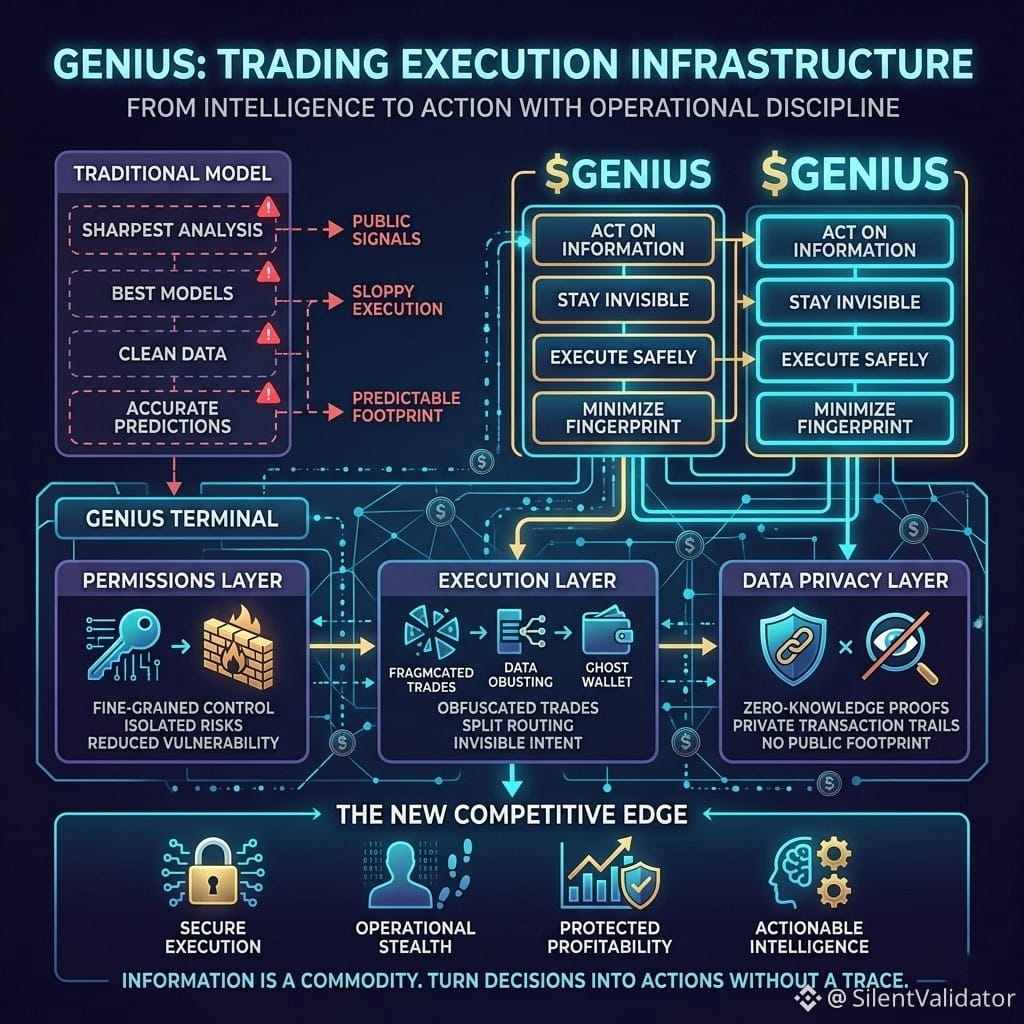
@GeniusOfficial I used to think the key to winning in crypto was having the sharpest analysis—the best models, the cleanest data, the most accurate predictions. But after years of watching how markets actually move, I've come to see that intelligence alone doesn't create lasting advantage.
What matters more is the ability to act on information without becoming predictable. Every transaction leaves a footprint. Every permission creates a vulnerability. Every automated decision broadcasts your intent to anyone watching the chain. The market doesn't just price information—it prices operational discipline, and most people don't even recognize that cost until it's too late.
I've seen traders with brilliant models lose money because their execution was sloppy. I've watched bots fail not from bad logic, but from over-permissioned wallets and public transaction trails that turned every move into a teachable moment for competitors. The difference between profit and loss often comes down to who can act while staying invisible.
That's why I've been thinking about execution infrastructure that treats privacy and permissions as core features rather than afterthoughts. Projects like Genius Terminal ($GENIUS) fit into this conversation—not as a solution, but as a recognition that in an AI-driven market, the real edge comes from who can execute safely, not just who can analyze better.
Information is becoming a commodity. The value will shift to whoever can turn decisions into actions without leaving fingerprints.@GeniusOfficial l#genius s$GENIUS
{future}(GENIUSUSDT)
@GeniusOfficial I used to think the key to winning in crypto was having the sharpest analysis—the best models, the cleanest data, the most accurate predictions. But after years of watching how markets actually move, I've come to see that intelligence alone doesn't create lasting advantage.
What matters more is the ability to act on information without becoming predictable. Every transaction leaves a footprint. Every permission creates a vulnerability. Every automated decision broadcasts your intent to anyone watching the chain. The market doesn't just price information—it prices operational discipline, and most people don't even recognize that cost until it's too late.
I've seen traders with brilliant models lose money because their execution was sloppy. I've watched bots fail not from bad logic, but from over-permissioned wallets and public transaction trails that turned every move into a teachable moment for competitors. The difference between profit and loss often comes down to who can act while staying invisible.
That's why I've been thinking about execution infrastructure that treats privacy and permissions as core features rather than afterthoughts. Projects like Genius Terminal ($GENIUS ) fit into this conversation—not as a solution, but as a recognition that in an AI-driven market, the real edge comes from who can execute safely, not just who can analyze better.
Information is becoming a commodity. The value will shift to whoever can turn decisions into actions without leaving fingerprints.@GeniusOfficial l#genius s$GENIUS
What matters more is the ability to act on information without becoming predictable. Every transaction leaves a footprint. Every permission creates a vulnerability. Every automated decision broadcasts your intent to anyone watching the chain. The market doesn't just price information—it prices operational discipline, and most people don't even recognize that cost until it's too late.
I've seen traders with brilliant models lose money because their execution was sloppy. I've watched bots fail not from bad logic, but from over-permissioned wallets and public transaction trails that turned every move into a teachable moment for competitors. The difference between profit and loss often comes down to who can act while staying invisible.
That's why I've been thinking about execution infrastructure that treats privacy and permissions as core features rather than afterthoughts. Projects like Genius Terminal ($GENIUS ) fit into this conversation—not as a solution, but as a recognition that in an AI-driven market, the real edge comes from who can execute safely, not just who can analyze better.
Information is becoming a commodity. The value will shift to whoever can turn decisions into actions without leaving fingerprints.@GeniusOfficial l#genius s$GENIUS
139
·
--
Bullish
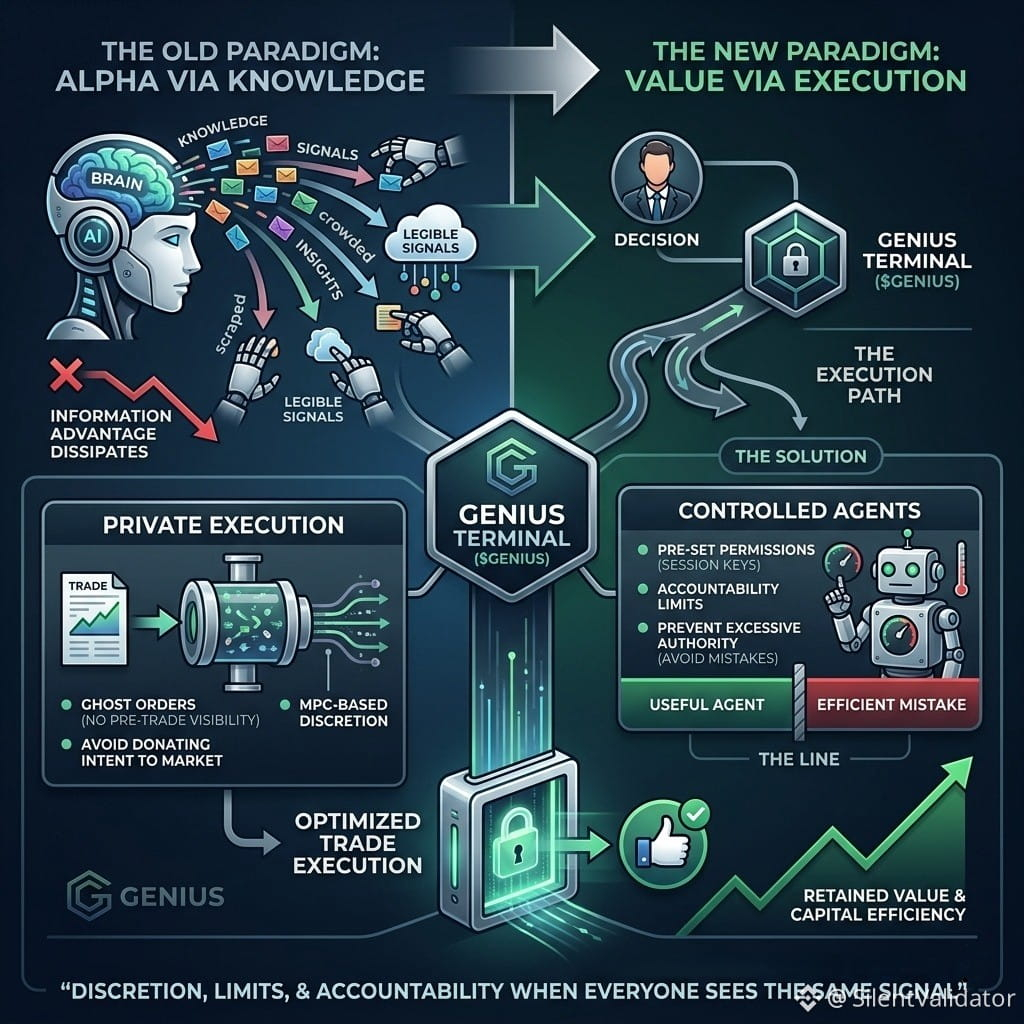
@GeniusOfficial Everyone keeps asking whether AI will find better trades than humans. After enough years around crypto, I think that’s a comforting but shallow question. Information advantages don’t last here. The moment a signal becomes legible, it gets scraped, mirrored, and crowded.
What actually matters is the path from decision to execution. In on-chain markets, edge leaks through visibility, overbroad permissions, and automation that can act faster than it can be supervised. Privacy isn’t just an ideological preference; sometimes it’s the only way to avoid donating your intent to the market. And permissions aren’t some minor UX detail. They’re the line between a useful agent and a very efficient mistake.
Some of the most expensive lessons I’ve seen had nothing to do with being wrong on the trade itself. They came from bots with too much authority, wallets left too open, and systems that looked elegant until real market conditions exposed all the assumptions underneath.
That’s why Genius Terminal ($GENIUS) caught my attention. Not as another source of insight, but as a sign that the conversation is shifting toward private, controlled execution for agents and advanced users.
If AI makes knowledge abundant, then value probably won’t come from who knows more. It will come from who can act with limits, discretion, and accountability when everyone else is seeing the same thing.
@GeniusOfficial #genius $GENIUS
@GeniusOfficial Everyone keeps asking whether AI will find better trades than humans. After enough years around crypto, I think that’s a comforting but shallow question. Information advantages don’t last here. The moment a signal becomes legible, it gets scraped, mirrored, and crowded.
What actually matters is the path from decision to execution. In on-chain markets, edge leaks through visibility, overbroad permissions, and automation that can act faster than it can be supervised. Privacy isn’t just an ideological preference; sometimes it’s the only way to avoid donating your intent to the market. And permissions aren’t some minor UX detail. They’re the line between a useful agent and a very efficient mistake.
Some of the most expensive lessons I’ve seen had nothing to do with being wrong on the trade itself. They came from bots with too much authority, wallets left too open, and systems that looked elegant until real market conditions exposed all the assumptions underneath.
That’s why Genius Terminal ($GENIUS ) caught my attention. Not as another source of insight, but as a sign that the conversation is shifting toward private, controlled execution for agents and advanced users.
If AI makes knowledge abundant, then value probably won’t come from who knows more. It will come from who can act with limits, discretion, and accountability when everyone else is seeing the same thing.
@GeniusOfficial #genius $GENIUS
What actually matters is the path from decision to execution. In on-chain markets, edge leaks through visibility, overbroad permissions, and automation that can act faster than it can be supervised. Privacy isn’t just an ideological preference; sometimes it’s the only way to avoid donating your intent to the market. And permissions aren’t some minor UX detail. They’re the line between a useful agent and a very efficient mistake.
Some of the most expensive lessons I’ve seen had nothing to do with being wrong on the trade itself. They came from bots with too much authority, wallets left too open, and systems that looked elegant until real market conditions exposed all the assumptions underneath.
That’s why Genius Terminal ($GENIUS ) caught my attention. Not as another source of insight, but as a sign that the conversation is shifting toward private, controlled execution for agents and advanced users.
If AI makes knowledge abundant, then value probably won’t come from who knows more. It will come from who can act with limits, discretion, and accountability when everyone else is seeing the same thing.
@GeniusOfficial #genius $GENIUS
116
·
--
Bullish
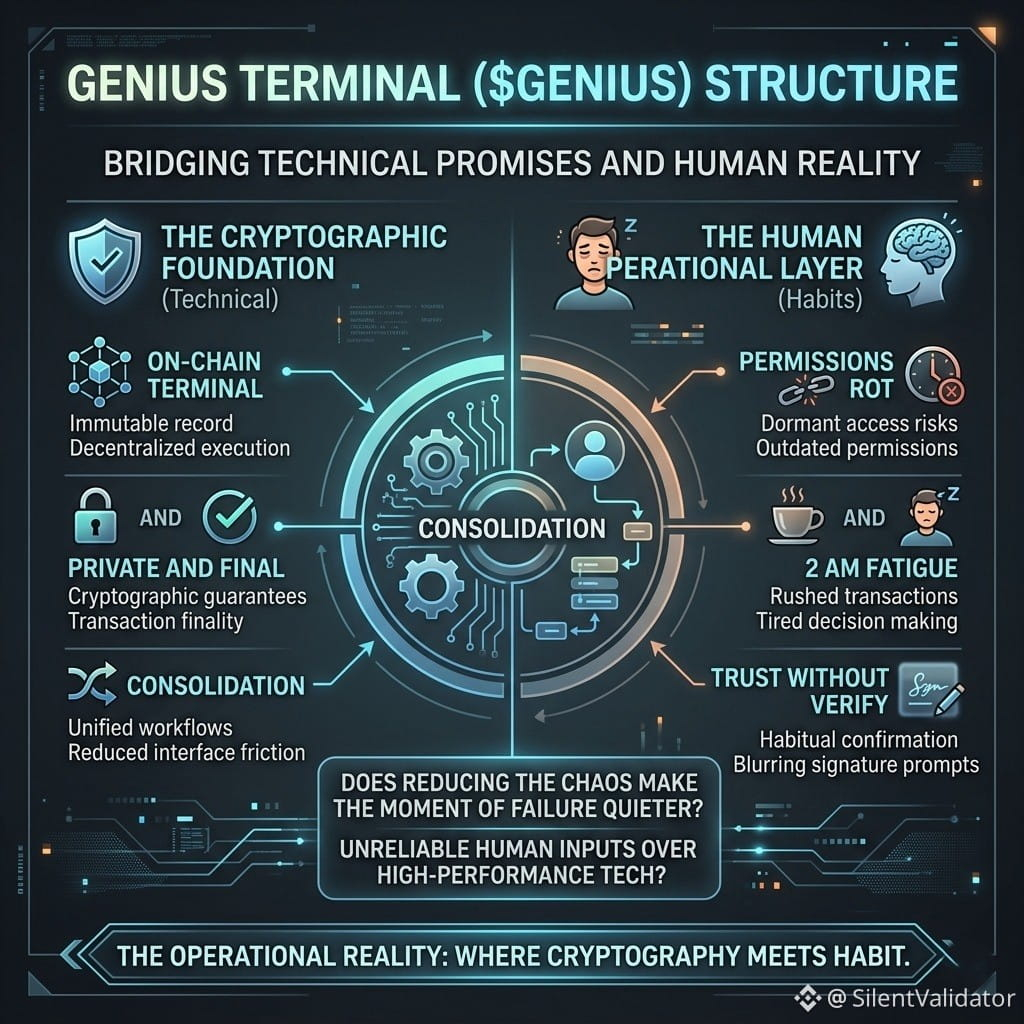
@GeniusOfficial Maybe I should've paid more attention earlier. But after years of watching infrastructure projects announce themselves like they've solved something permanent, you learn to wait. Permanence is a strange promise in a space where the operational reality changes every few months and the human layer never really catches up.
Genius Terminal ($GENIUS) calls itself the first private and final on-chain terminal. That phrase sits heavy. Not because it's wrong, necessarily—but because "private" and "final" are conditions that depend entirely on what people actually do at two in the morning when they're tired and a transaction needs to clear. I've seen permissions rot. Sessions that should've expired three teams ago. Approvals nobody questions because questioning means slowing down, and slowing down feels like falling behind.
That's where things start to feel uncomfortable. The terminal isn't just an interface—it becomes the place where "verify" silently turns into "trust." And we already trust too much. Too many dashboards. Too many signature prompts that blur together. The cryptographic guarantees are real, but they sit on top of workflows held together by habits and assumptions nobody wants to examine.
I keep circling this thought: does consolidating all of that into one layer reduce the chaos, or does it just make the moment of failure quieter, harder to see coming? Some questions just keep asking themselves.
$GENIUS
{spot}(GENIUSUSDT)
#genius
@GeniusOfficial Maybe I should've paid more attention earlier. But after years of watching infrastructure projects announce themselves like they've solved something permanent, you learn to wait. Permanence is a strange promise in a space where the operational reality changes every few months and the human layer never really catches up.
Genius Terminal ($GENIUS ) calls itself the first private and final on-chain terminal. That phrase sits heavy. Not because it's wrong, necessarily—but because "private" and "final" are conditions that depend entirely on what people actually do at two in the morning when they're tired and a transaction needs to clear. I've seen permissions rot. Sessions that should've expired three teams ago. Approvals nobody questions because questioning means slowing down, and slowing down feels like falling behind.
That's where things start to feel uncomfortable. The terminal isn't just an interface—it becomes the place where "verify" silently turns into "trust." And we already trust too much. Too many dashboards. Too many signature prompts that blur together. The cryptographic guarantees are real, but they sit on top of workflows held together by habits and assumptions nobody wants to examine.
I keep circling this thought: does consolidating all of that into one layer reduce the chaos, or does it just make the moment of failure quieter, harder to see coming? Some questions just keep asking themselves.
$GENIUS
#genius
Genius Terminal ($GENIUS ) calls itself the first private and final on-chain terminal. That phrase sits heavy. Not because it's wrong, necessarily—but because "private" and "final" are conditions that depend entirely on what people actually do at two in the morning when they're tired and a transaction needs to clear. I've seen permissions rot. Sessions that should've expired three teams ago. Approvals nobody questions because questioning means slowing down, and slowing down feels like falling behind.
That's where things start to feel uncomfortable. The terminal isn't just an interface—it becomes the place where "verify" silently turns into "trust." And we already trust too much. Too many dashboards. Too many signature prompts that blur together. The cryptographic guarantees are real, but they sit on top of workflows held together by habits and assumptions nobody wants to examine.
I keep circling this thought: does consolidating all of that into one layer reduce the chaos, or does it just make the moment of failure quieter, harder to see coming? Some questions just keep asking themselves.
$GENIUS
#genius
2
2
89
·
--
Bullish
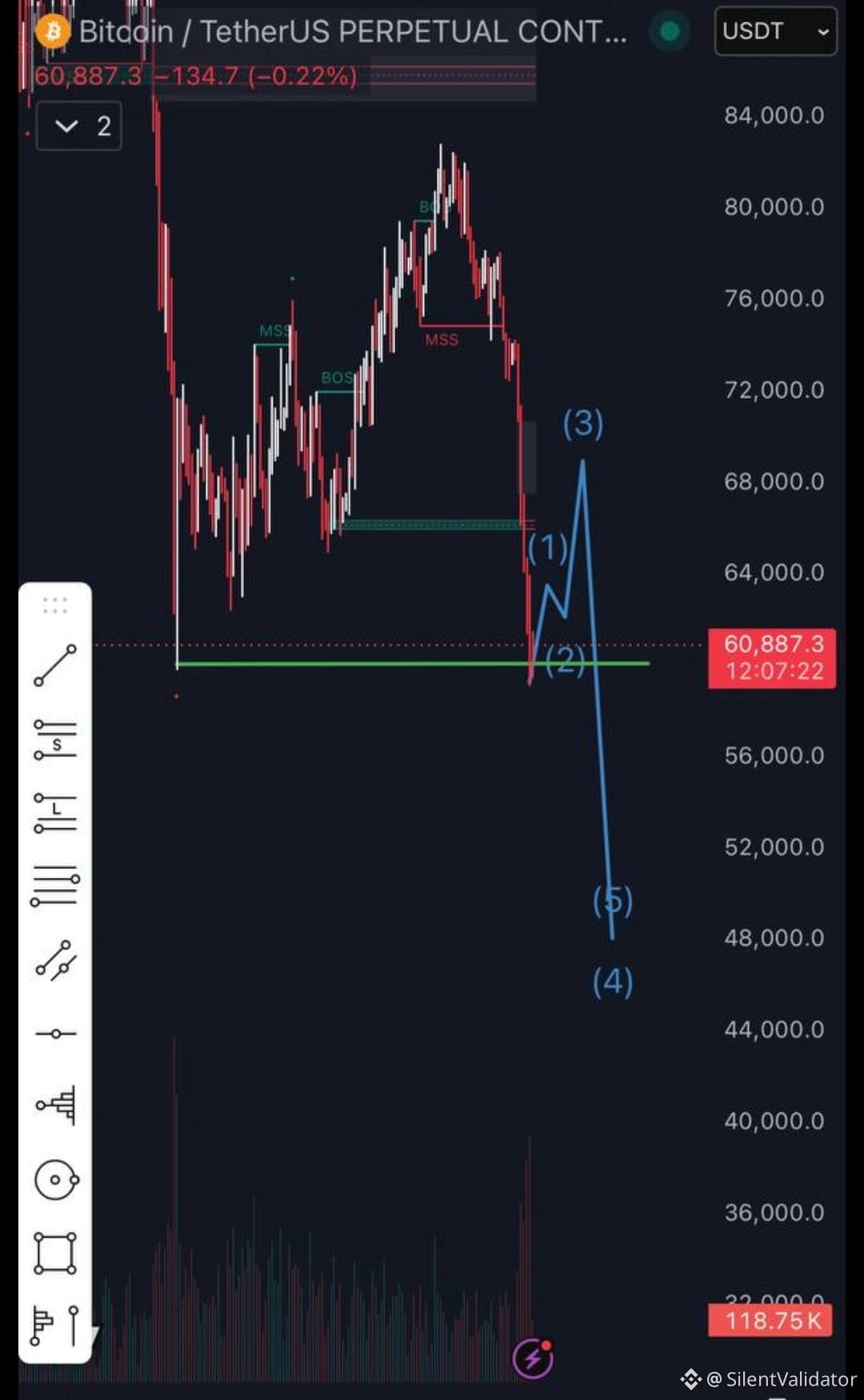
$BTC Update 📉
today AM now analysis and confirm poin
Bitcoin just lost a major support level and sellers are still in control.
The current structure suggests a short-term relief bounce may occur first, but unless bulls reclaim key resistance, this looks like a continuation setup to the downside.
📍 Support: ~$60K
📍 Relief Bounce Zone: $64K–68K
📍 Bearish Target: $48K–50K
A bounce doesn't automatically mean reversal. Watch for liquidity grabs and lower highs before assuming the bottom is in.
#Bitcoin #BTC #Crypto #Trading #PriceAction #CryptoTrading #BTCUSDT
$BTC Update 📉
today AM now analysis and confirm poin
Bitcoin just lost a major support level and sellers are still in control.
The current structure suggests a short-term relief bounce may occur first, but unless bulls reclaim key resistance, this looks like a continuation setup to the downside.
📍 Support: ~$60K
📍 Relief Bounce Zone: $64K–68K
📍 Bearish Target: $48K–50K
A bounce doesn't automatically mean reversal. Watch for liquidity grabs and lower highs before assuming the bottom is in.
#Bitcoin #BTC #Crypto #Trading #PriceAction #CryptoTrading #BTCUSDT
today AM now analysis and confirm poin
Bitcoin just lost a major support level and sellers are still in control.
The current structure suggests a short-term relief bounce may occur first, but unless bulls reclaim key resistance, this looks like a continuation setup to the downside.
📍 Support: ~$60K
📍 Relief Bounce Zone: $64K–68K
📍 Bearish Target: $48K–50K
A bounce doesn't automatically mean reversal. Watch for liquidity grabs and lower highs before assuming the bottom is in.
#Bitcoin #BTC #Crypto #Trading #PriceAction #CryptoTrading #BTCUSDT
75
·
--
Bearish
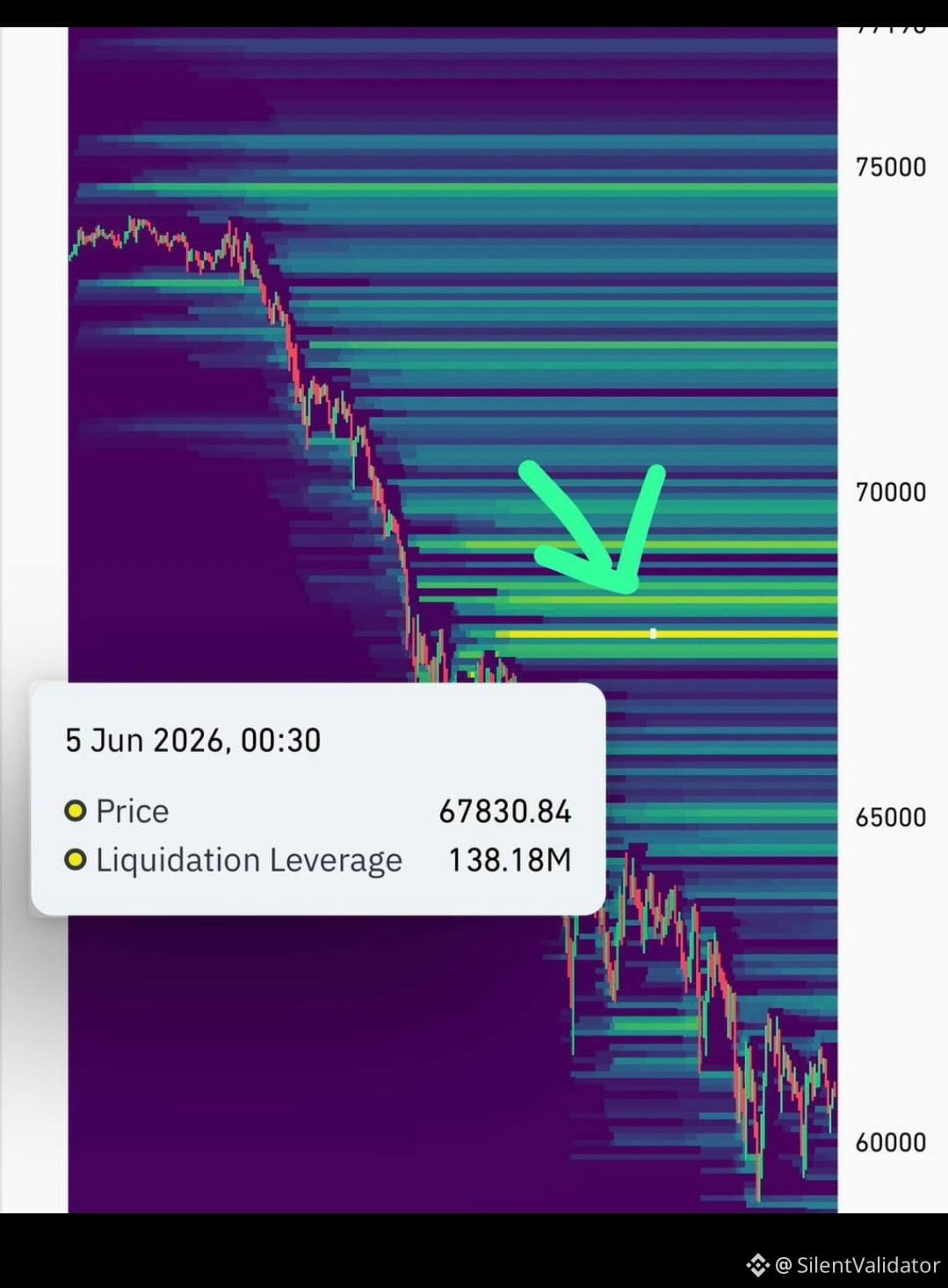
🚨 $BTC Liquidation Magnet Alert 🚨
The heatmap shows a major liquidation cluster around $67.8K, with roughly $138M in leveraged positions concentrated at that level.
When large liquidity pools like this appear, price often gets drawn toward them as market makers hunt liquidity.
📍 Key Level: $67,830 💰 Liquidation Size: $138.18M 🎯 What it means: • Heavy short liquidations above = potential squeeze fuel • Heavy long liquidations below = downside magnet • Expect volatility as price approaches this zone
Remember: liquidation levels are magnets, not guarantees. Always combine them with market structure, volume, and trend analysis.
#Bitcoin #BTC #Crypto #LiquidationHeatmap #TradingSignals #CryptoTrading #BitcoinPrice #Liquidity #ShortSqueeze #LongSqueeze
🚨 $BTC Liquidation Magnet Alert 🚨
The heatmap shows a major liquidation cluster around $67.8K, with roughly $138M in leveraged positions concentrated at that level.
When large liquidity pools like this appear, price often gets drawn toward them as market makers hunt liquidity.
📍 Key Level: $67,830 💰 Liquidation Size: $138.18M 🎯 What it means: • Heavy short liquidations above = potential squeeze fuel • Heavy long liquidations below = downside magnet • Expect volatility as price approaches this zone
Remember: liquidation levels are magnets, not guarantees. Always combine them with market structure, volume, and trend analysis.
#Bitcoin #BTC #Crypto #LiquidationHeatmap #TradingSignals #CryptoTrading #BitcoinPrice #Liquidity #ShortSqueeze #LongSqueeze
The heatmap shows a major liquidation cluster around $67.8K, with roughly $138M in leveraged positions concentrated at that level.
When large liquidity pools like this appear, price often gets drawn toward them as market makers hunt liquidity.
📍 Key Level: $67,830 💰 Liquidation Size: $138.18M 🎯 What it means: • Heavy short liquidations above = potential squeeze fuel • Heavy long liquidations below = downside magnet • Expect volatility as price approaches this zone
Remember: liquidation levels are magnets, not guarantees. Always combine them with market structure, volume, and trend analysis.
#Bitcoin #BTC #Crypto #LiquidationHeatmap #TradingSignals #CryptoTrading #BitcoinPrice #Liquidity #ShortSqueeze #LongSqueeze
87
·
--
Bullish
@GeniusOfficial I didn't take it seriously at first. Maybe that's too harsh, but after watching more crypto cycles than I care to admit, I've learned to flinch at anything that looks like a clean fix. Because nine times out of ten, the problem doesn't disappear. It just learns how to stay out of sight.
I keep coming back to that whenever I hear mention of Genius Terminal ($GENIUS). Not for what it is, exactly, but for why something like a private and final on-chain terminal is even being considered in the first place.
Most of the disasters I've seen weren't cryptographic. They were the slow, unremarkable kind. Wallet permissions left open for far too long. Sessions that quietly outlived their purpose. A thousand little trusts accumulated across dashboards, until one day, something broke and revealed just how little of it was intentional. The math held. Everything around it didn't.
That's where things start to feel uncomfortable. We like to think "private" shields us, but it doesn't shield us from human behavior. Operators get tired. Users get tired. Too many signatures, too many dashboards, too many assumptions. So we slowly trade verification for convenience, and pretend it doesn't count.
Maybe that's why something like this is trying to solve more than UX. But consolidating the entire decision layer into one terminal gives me pause. Does that remove risk, or does it bury that invisible operational layer even deeper? Especially when the same fallible people are still the ones inside of it.
I understand the exhaustion. Trust has decayed for good reason. But I can't help wondering if we're just swapping one quiet fragility for another. One that, this time, might not even look like a permission we forgot to check, until it's far too easy to overlook.
$GENIUS
{spot}(GENIUSUSDT)
#genius
@GeniusOfficial I didn't take it seriously at first. Maybe that's too harsh, but after watching more crypto cycles than I care to admit, I've learned to flinch at anything that looks like a clean fix. Because nine times out of ten, the problem doesn't disappear. It just learns how to stay out of sight.
I keep coming back to that whenever I hear mention of Genius Terminal ($GENIUS ). Not for what it is, exactly, but for why something like a private and final on-chain terminal is even being considered in the first place.
Most of the disasters I've seen weren't cryptographic. They were the slow, unremarkable kind. Wallet permissions left open for far too long. Sessions that quietly outlived their purpose. A thousand little trusts accumulated across dashboards, until one day, something broke and revealed just how little of it was intentional. The math held. Everything around it didn't.
That's where things start to feel uncomfortable. We like to think "private" shields us, but it doesn't shield us from human behavior. Operators get tired. Users get tired. Too many signatures, too many dashboards, too many assumptions. So we slowly trade verification for convenience, and pretend it doesn't count.
Maybe that's why something like this is trying to solve more than UX. But consolidating the entire decision layer into one terminal gives me pause. Does that remove risk, or does it bury that invisible operational layer even deeper? Especially when the same fallible people are still the ones inside of it.
I understand the exhaustion. Trust has decayed for good reason. But I can't help wondering if we're just swapping one quiet fragility for another. One that, this time, might not even look like a permission we forgot to check, until it's far too easy to overlook.
$GENIUS
#genius
I keep coming back to that whenever I hear mention of Genius Terminal ($GENIUS ). Not for what it is, exactly, but for why something like a private and final on-chain terminal is even being considered in the first place.
Most of the disasters I've seen weren't cryptographic. They were the slow, unremarkable kind. Wallet permissions left open for far too long. Sessions that quietly outlived their purpose. A thousand little trusts accumulated across dashboards, until one day, something broke and revealed just how little of it was intentional. The math held. Everything around it didn't.
That's where things start to feel uncomfortable. We like to think "private" shields us, but it doesn't shield us from human behavior. Operators get tired. Users get tired. Too many signatures, too many dashboards, too many assumptions. So we slowly trade verification for convenience, and pretend it doesn't count.
Maybe that's why something like this is trying to solve more than UX. But consolidating the entire decision layer into one terminal gives me pause. Does that remove risk, or does it bury that invisible operational layer even deeper? Especially when the same fallible people are still the ones inside of it.
I understand the exhaustion. Trust has decayed for good reason. But I can't help wondering if we're just swapping one quiet fragility for another. One that, this time, might not even look like a permission we forgot to check, until it's far too easy to overlook.
$GENIUS
#genius
4
120
·
--
Bullish
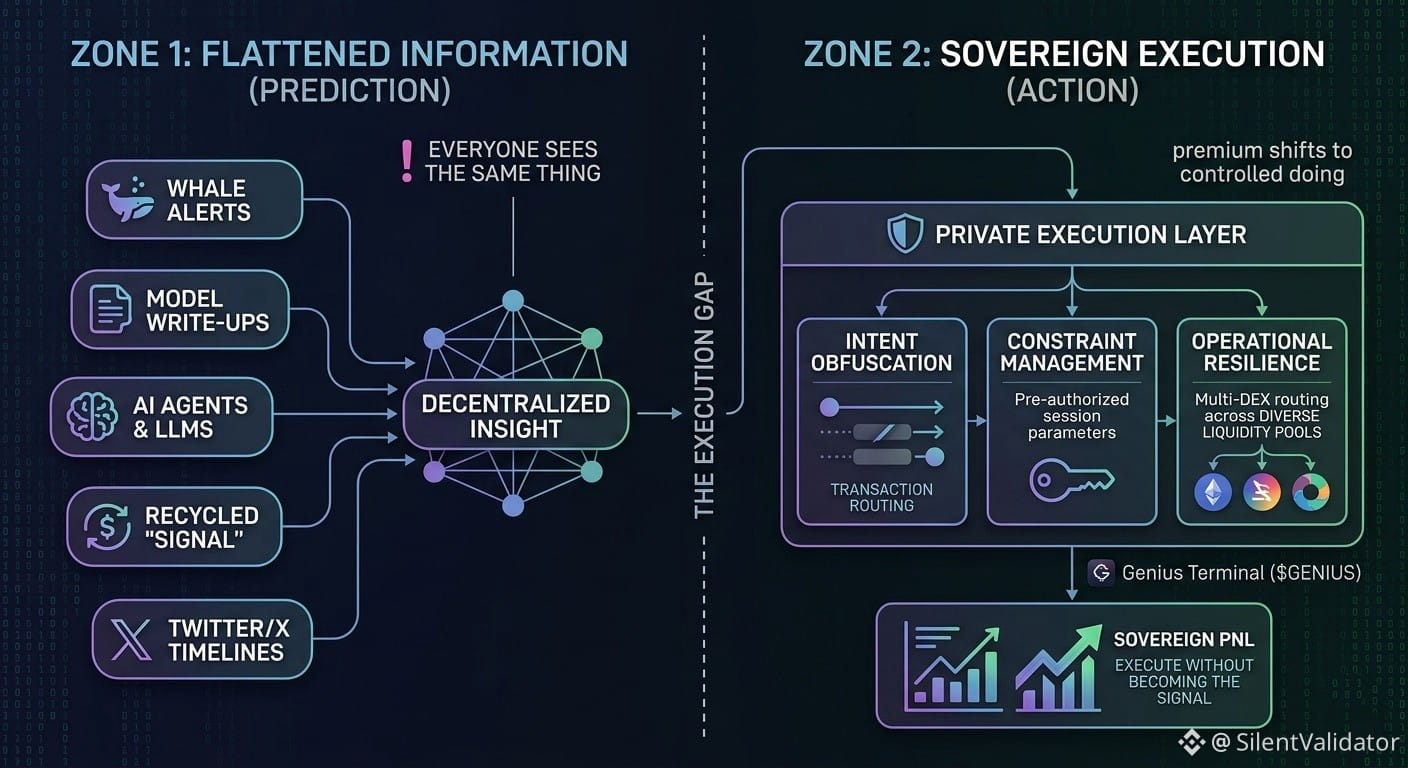
@GeniusOfficial Everyone keeps asking whether AI agents will outsmart the market, as if the only thing left to compete on is prediction.
After a decade of watching crypto, I think the more useful question is: who gets to act, and under what constraints? Information has been flattened. If you’re online, you see the same whale alerts, the same model write-ups, the same “signal” recycled across timelines within minutes.
What still separates outcomes is execution. Markets don’t punish the trader with the second-best thesis; they punish the trader who leaks intent, over-approves a wallet, or can’t translate a decision into a clean on-chain action when it matters. I’ve had weeks where my read was right and my PnL was wrong, purely because I hesitated, routed publicly, or left permissions too wide and paid for it later.
That’s why Genius Terminal ($GENIUS) interests me in a quiet way. It points at the layer where agents and advanced users actually operate: private, permissioned, accountable execution, not endless analysis.
As AI makes “knowing” cheap, the premium shifts to controlled doing. In an automated market, is alpha just insight—or is it the ability to execute without becoming the signal?#genius $GENIUS
@GeniusOfficial Everyone keeps asking whether AI agents will outsmart the market, as if the only thing left to compete on is prediction.
After a decade of watching crypto, I think the more useful question is: who gets to act, and under what constraints? Information has been flattened. If you’re online, you see the same whale alerts, the same model write-ups, the same “signal” recycled across timelines within minutes.
What still separates outcomes is execution. Markets don’t punish the trader with the second-best thesis; they punish the trader who leaks intent, over-approves a wallet, or can’t translate a decision into a clean on-chain action when it matters. I’ve had weeks where my read was right and my PnL was wrong, purely because I hesitated, routed publicly, or left permissions too wide and paid for it later.
That’s why Genius Terminal ($GENIUS ) interests me in a quiet way. It points at the layer where agents and advanced users actually operate: private, permissioned, accountable execution, not endless analysis.
As AI makes “knowing” cheap, the premium shifts to controlled doing. In an automated market, is alpha just insight—or is it the ability to execute without becoming the signal?#genius $GENIUS
After a decade of watching crypto, I think the more useful question is: who gets to act, and under what constraints? Information has been flattened. If you’re online, you see the same whale alerts, the same model write-ups, the same “signal” recycled across timelines within minutes.
What still separates outcomes is execution. Markets don’t punish the trader with the second-best thesis; they punish the trader who leaks intent, over-approves a wallet, or can’t translate a decision into a clean on-chain action when it matters. I’ve had weeks where my read was right and my PnL was wrong, purely because I hesitated, routed publicly, or left permissions too wide and paid for it later.
That’s why Genius Terminal ($GENIUS ) interests me in a quiet way. It points at the layer where agents and advanced users actually operate: private, permissioned, accountable execution, not endless analysis.
As AI makes “knowing” cheap, the premium shifts to controlled doing. In an automated market, is alpha just insight—or is it the ability to execute without becoming the signal?#genius $GENIUS
2
129
Log in to explore more content
Join global crypto users on Binance Square
⚡️ Get latest and useful information about crypto.
💬 Trusted by the world’s largest crypto exchange.
👍 Discover real insights from verified creators.
Email / Phone number
Trending Topics
FedRateWatch
1.5M views
6,745 Discussing
Share & Win Traffic Reward in our Trending Hashtag Campaign
✨Topic: FOMC September, What's The Fed's Next Move?
👉How to Join:
Publish a short post or article with hashtag #FedRateWatch
Create content based on the below angles:
- August core CPI rose 0.3% month-over-month, and the odds of a 25bp hike this week are now close to 90%. Do you anticipate a rate hike this week? Is it a one-off, or the start of a longer hiking cycle?
- If the hike lands, how does it play out for BTC, tech stocks, and gold? Bullish or bearish?
- How are you planning to trade next? Share your BTC, stocks or gold trade/holdings with our trade sharing widget.
⏰Campaign Period:
- 2026-09-15 11:00 - 2026-09-17 3:00 UTC
🎁Reward:
- Qualified posts that comply with the above guidelines and contain more than 100 words will be reviewed and may receive a random traffic boost of 500 to 3,000 views. You will receive a notification from your feed secretary if your post is selected.
- Get a chance to have your article featured on Binance Square Official
Need ideas for your post? Visit the topic page #FedRateWatch or the Square Guide on How to Post for Better Reach.
Binance Square Official
·648 Likes
·1.7M views
ZcashRises6%
52,971 views
657 Discussing
XRPSinks10%
35,503 views
430 Discussing