
SUPER LUCKY AI支付协议
151 Posts

SUPER LUCKY AI支付协议
持有SKP,共建SKP,成为SKP
一起超级幸运⭐
AI时代,不做旁观者。
为梦想而战,草根也能成为参天🍀
Open Trade

ZAMA Holder
Frequent Trader
6 Years
50 Following
1.0K+ Followers
187 Liked
Posts
Portfolio
All
Quotes
Videos
PINNED
PINNED

BitMEX is shutting down—On September 23, 2026 at 4:00 UTC, it will officially stop operations. When I saw the announcement, my first reaction wasn’t panic, but a bit of a wistful sigh.
For many veteran players, their first time touching perpetual contracts, their first time understanding leverage, might have been on BitMEX. The whole 100x perpetual playstyle—at its core—was what helped it grow big. Later, almost every derivatives platform followed suit. After all those years of noise in the industry about “security,” it actually managed to achieve something—operating until now with zero hacking losses of customer funds. That’s not very common among exchanges.
The official statement says it’s a decision made after a strategic review of HDR—not a blow-up and a run. The wording is also fairly clear: it encourages you to close positions as soon as possible and withdraw coins, and that your assets remain under your control. For someone like me who prefers structural changes over hype, the signal is pretty unmistakable—the window where early growth relied on the product and “raw drive” for traffic is closing batch by batch. Those that manage to survive may not necessarily be the most aggressive crowd.
If you still have positions or a balance, don’t wait—just withdraw through the proper process. Exiting the market is a normal industry pattern; reminders matter more than sentiment ( ̄▽ ̄)
For many veteran players, their first time touching perpetual contracts, their first time understanding leverage, might have been on BitMEX. The whole 100x perpetual playstyle—at its core—was what helped it grow big. Later, almost every derivatives platform followed suit. After all those years of noise in the industry about “security,” it actually managed to achieve something—operating until now with zero hacking losses of customer funds. That’s not very common among exchanges.
The official statement says it’s a decision made after a strategic review of HDR—not a blow-up and a run. The wording is also fairly clear: it encourages you to close positions as soon as possible and withdraw coins, and that your assets remain under your control. For someone like me who prefers structural changes over hype, the signal is pretty unmistakable—the window where early growth relied on the product and “raw drive” for traffic is closing batch by batch. Those that manage to survive may not necessarily be the most aggressive crowd.
If you still have positions or a balance, don’t wait—just withdraw through the proper process. Exiting the market is a normal industry pattern; reminders matter more than sentiment ( ̄▽ ̄)
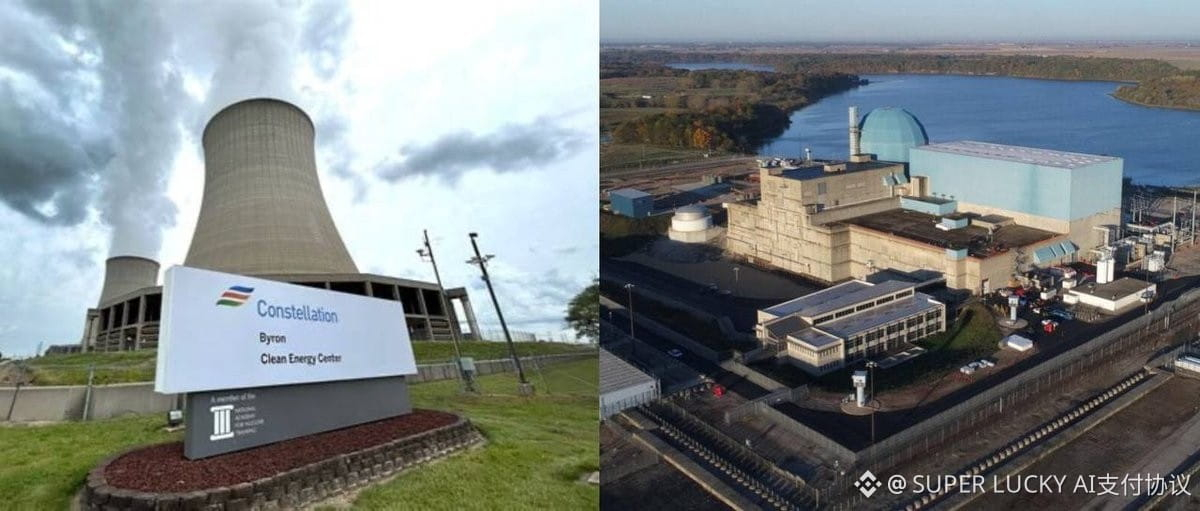
Recently I’ve been watching Constellation Energy: this year the stock price is down roughly 21%, and the market cap is still hovering around the 100 billion USD range. When a company of this size is still weakening, it’s usually not just sentiment—more like the market is repricing expectations around power generation, nuclear energy, and regulatory policy.
What’s particularly interesting is that the company’s directors just bought about $420,000 worth of shares using their own money. Insiders putting in real cash to add—while I wouldn’t take it as proof that the bottom is already in, I generally would listen more carefully and allow for at least some remaining room for discussion at the current price in management’s eyes.
I’ll keep it on my watchlist and compare it against the next quarter’s earnings and the policy wording before making further judgments ( ̄▽ ̄)
What’s particularly interesting is that the company’s directors just bought about $420,000 worth of shares using their own money. Insiders putting in real cash to add—while I wouldn’t take it as proof that the bottom is already in, I generally would listen more carefully and allow for at least some remaining room for discussion at the current price in management’s eyes.
I’ll keep it on my watchlist and compare it against the next quarter’s earnings and the policy wording before making further judgments ( ̄▽ ̄)
Recently I’ve been reviewing Ethereum, and I’m getting a stronger hunch: the old story about L2 “helping scale the main chain by acting as official sharding” may no longer hold up.
On one side, L2’s push toward Stage 2 and interoperability has been progressing much slower than expected; on the other, L1 is scaling on its own—gas is already cheap, and the limits are still being raised continuously. What’s more subtle is that some L2s frankly acknowledge they might remain stuck in Stage 1 for the long term, keeping compliance requirements while retaining ultimate control—sure, that may be responsible toward customers, but in terms of the definition of “scaling Ethereum,” the boundary shifts.
I don’t think L2 has no value, but the framework has to change: don’t treat it as sharding; think of it as a spectrum. Either find the extreme scenarios where L1 can’t scale well—privacy, ultra-low latency, vertical efficiency—or be honest and admit you’re essentially an independent chain with a bridge. If you move ETH and Ethereum assets on-chain, Stage 1 should at least be the baseline. I also plan to look more closely at the native rollup precompile track—together with enshrined ZK-EVM—it could be a key piece of the puzzle for scaling the main chain directly.
Ask less about “who represents Ethereum’s future,” and more about “what problems it solves and how tightly it’s coupled with L1.” ( ̄▽ ̄)
On one side, L2’s push toward Stage 2 and interoperability has been progressing much slower than expected; on the other, L1 is scaling on its own—gas is already cheap, and the limits are still being raised continuously. What’s more subtle is that some L2s frankly acknowledge they might remain stuck in Stage 1 for the long term, keeping compliance requirements while retaining ultimate control—sure, that may be responsible toward customers, but in terms of the definition of “scaling Ethereum,” the boundary shifts.
I don’t think L2 has no value, but the framework has to change: don’t treat it as sharding; think of it as a spectrum. Either find the extreme scenarios where L1 can’t scale well—privacy, ultra-low latency, vertical efficiency—or be honest and admit you’re essentially an independent chain with a bridge. If you move ETH and Ethereum assets on-chain, Stage 1 should at least be the baseline. I also plan to look more closely at the native rollup precompile track—together with enshrined ZK-EVM—it could be a key piece of the puzzle for scaling the main chain directly.
Ask less about “who represents Ethereum’s future,” and more about “what problems it solves and how tightly it’s coupled with L1.” ( ̄▽ ̄)
The tug-of-war between Coinbase and the SEC looks more and more like a regulatory version of “you guess whether I’ll guess.”
In the lawsuit, Coinbase says it won’t disclose which assets are unregistered securities; Coinbase asks whether ETH is actually allowed—but the SEC still won’t give a clear answer, only brushing it off with a “it’s already very clear.”
The issue is right here: for exchanges, compliance isn’t a matter of attitude—it’s whether you can actually get things listed and keep users. If the rules are enforced only after the fact and with vague interpretations for a long time, the market will only grow more cautious, and liquidity will gravitate toward places where the rules are clearer.
I tend to treat it as a cross-over observation of U.S. stocks × crypto: regulatory uncertainty itself is part of pricing. Don’t understand it as “if a certain coin gets named, it’s over.” It’s more like the entire U.S. listing framework is still being negotiated and fought over. Short-term sentiment will be amplified, but in the long run it still comes down to whether the boundaries can be written clearly.
I’m not betting on “who wins or who loses,” but I will watch the subsequent disclosures and enforcement interpretations—when the costs of ambiguity are high, the whole industry ends up paying together (¬_¬)
In the lawsuit, Coinbase says it won’t disclose which assets are unregistered securities; Coinbase asks whether ETH is actually allowed—but the SEC still won’t give a clear answer, only brushing it off with a “it’s already very clear.”
The issue is right here: for exchanges, compliance isn’t a matter of attitude—it’s whether you can actually get things listed and keep users. If the rules are enforced only after the fact and with vague interpretations for a long time, the market will only grow more cautious, and liquidity will gravitate toward places where the rules are clearer.
I tend to treat it as a cross-over observation of U.S. stocks × crypto: regulatory uncertainty itself is part of pricing. Don’t understand it as “if a certain coin gets named, it’s over.” It’s more like the entire U.S. listing framework is still being negotiated and fought over. Short-term sentiment will be amplified, but in the long run it still comes down to whether the boundaries can be written clearly.
I’m not betting on “who wins or who loses,” but I will watch the subsequent disclosures and enforcement interpretations—when the costs of ambiguity are high, the whole industry ends up paying together (¬_¬)

EF leadership reshuffle—I’ve been watching for almost a year. In the latest public statement, the direction is actually quite clear: strengthen technical and management capabilities, enhance two-way communication with developers, L2s, and wallets, and more proactively support application builders. Bring privacy, open-source, and anti-censorship down to the application layer, rather than keeping them at the level of rhetoric.
What’s also written quite firmly is the “what we won’t do”—not to engage in aggressive regulatory lobbying, and not to turn EF into a more centralized, more attention-grabbing institution. For someone like me, a regular market participant, this feels more like a mid-cycle infrastructure adjustment for Ethereum governance, and it won’t immediately show up in ETH’s short-term sentiment. I’ll first see whether talent and execution can keep up, then make a judgment. (・∀・)
What’s also written quite firmly is the “what we won’t do”—not to engage in aggressive regulatory lobbying, and not to turn EF into a more centralized, more attention-grabbing institution. For someone like me, a regular market participant, this feels more like a mid-cycle infrastructure adjustment for Ethereum governance, and it won’t immediately show up in ETH’s short-term sentiment. I’ll first see whether talent and execution can keep up, then make a judgment. (・∀・)
This event is great, besties. If you have time, give it a listen


Zama Protocol
·
--
JUST IN:
Zama will launch a Learn & Earn campaign inside Revolut later this year, teaching millions why confidentiality onchain matters for mass adoption.
$ZAMA is now live for Revolut's 70 million users.
Learn more: zama.org/post/zama-is-now-available-on-revolut
Zama will launch a Learn & Earn campaign inside Revolut later this year, teaching millions why confidentiality onchain matters for mass adoption.
$ZAMA is now live for Revolut's 70 million users.
Learn more: zama.org/post/zama-is-now-available-on-revolut

This is the real privacy agreement. It’s remarkably smooth, instantly encrypting and hiding both your balance and transaction paths—so no one can know your asset details.
Isn’t this exactly what the times call for?
Which person who truly has assets is willing to leave their wallet exposed?
Next step: Big Brother Zama user tutorial
Do any of you need it, dear friends?
Drop an SKP in the comments section
Isn’t this exactly what the times call for?
Which person who truly has assets is willing to leave their wallet exposed?
Next step: Big Brother Zama user tutorial
Do any of you need it, dear friends?
Drop an SKP in the comments section

币界网
·
--
Coinworld News: Revolut has announced the launch of its native Zama token in the European Economic Area, allowing over 70 million users to trade it on the platform. Zama said this launch will enable it to reach more than 15 million cryptocurrency traders who use the Revolut app. Users can buy the token without opening a new account or completing additional identity verification. In addition, Zama plans to roll out a learn-and-earn campaign later this year to educate users on the importance of on-chain privacy to mainstream adoption.

So you’re going to become an Empress Dowager? 😏

Yi He
·
--
OOTD today:Binance Yellow.
The yellow robe is not an imperial robe; to date, 114 years have passed since the Qing dynasty was overthrown and the country perished.
The yellow robe is not an imperial robe; to date, 114 years have passed since the Qing dynasty was overthrown and the country perished.

Just saw a real case, and my back feels a bit cold.
Someone put BTC in a ColdCard hardware wallet. The mnemonic device has never been online, and it was locked away in a bank safety deposit box—by common sense, this is a textbook-level self-custody setup. As a result, on the evening of July 29th, 18.0 BTC—about CAD 1.6 million—was emptied within seven minutes.
What hurts most is: he didn’t leak the seed phrase, and the device was never touched by the internet; he did everything he was supposed to do. The problem came from the code that generated the seed on the hardware wallet—vulnerabilities were planted as early as 2021. The attacker used AI to brute-force the seed phrase, and offline custody couldn’t stop “factory-default flaws.”
I’ve been thinking about this again and again. In crypto, “I’ve been very careful” sometimes isn’t enough—risk doesn’t only come from phishing and social engineering, but also from that one line of code you can’t see in the supply chain. AI turns what used to be a low-probability attack into something that can be scaled into mass scanning.
I’m not here to tell anyone to buy or sell. I just feel this lesson is harsher than any slogan: assets can be rebuilt, but the security boundary of self-custody may be more fragile than most people imagine. (´▽`ʃ♡ƪ)
Someone put BTC in a ColdCard hardware wallet. The mnemonic device has never been online, and it was locked away in a bank safety deposit box—by common sense, this is a textbook-level self-custody setup. As a result, on the evening of July 29th, 18.0 BTC—about CAD 1.6 million—was emptied within seven minutes.
What hurts most is: he didn’t leak the seed phrase, and the device was never touched by the internet; he did everything he was supposed to do. The problem came from the code that generated the seed on the hardware wallet—vulnerabilities were planted as early as 2021. The attacker used AI to brute-force the seed phrase, and offline custody couldn’t stop “factory-default flaws.”
I’ve been thinking about this again and again. In crypto, “I’ve been very careful” sometimes isn’t enough—risk doesn’t only come from phishing and social engineering, but also from that one line of code you can’t see in the supply chain. AI turns what used to be a low-probability attack into something that can be scaled into mass scanning.
I’m not here to tell anyone to buy or sell. I just feel this lesson is harsher than any slogan: assets can be rebuilt, but the security boundary of self-custody may be more fragile than most people imagine. (´▽`ʃ♡ƪ)

I read this BBC message twice over: AI designed an entire viral genome from scratch for the first time, and even created 16 kinds of “functional viruses” capable of infecting bacteria. The research team emphasized that there is no threat to humans.
What I’m concerned about isn’t the word “virus” in the headline, but the boundaries of capability—from generating text and images to directly producing workable biological structures. AI is crossing the line from “assistant tool” to something else. For biotechnology, computing power, and regulation, these are long-term variables; no matter how much short-term outrage is being stirred up, I’m not as concerned.
What’s really worth watching is whether there will still be a long enough buffer between “can design” and “can deploy” (・∀・)
What I’m concerned about isn’t the word “virus” in the headline, but the boundaries of capability—from generating text and images to directly producing workable biological structures. AI is crossing the line from “assistant tool” to something else. For biotechnology, computing power, and regulation, these are long-term variables; no matter how much short-term outrage is being stirred up, I’m not as concerned.
What’s really worth watching is whether there will still be a long enough buffer between “can design” and “can deploy” (・∀・)

Imagine Image 2.0—My first reaction to this update wasn’t “what else can it draw,” but that it finally puts the focus on precise editing, text clarity, and factual consistency—these are the keys to taking image generation from a toy to a real tool.
In the past, many model outputs looked great, but when it came to refining details, adding text, or aligning with real-world information, they often fell apart. If 2.0 can truly stabilize in real production workflows, then for scenarios like content and design, its value will be far greater than just showing off.
In the AI space, I’ll still treat the question “can it actually get work done?” as a tougher filtering criterion than any parameter leaderboard ( ̄▽ ̄)
In the past, many model outputs looked great, but when it came to refining details, adding text, or aligning with real-world information, they often fell apart. If 2.0 can truly stabilize in real production workflows, then for scenarios like content and design, its value will be far greater than just showing off.
In the AI space, I’ll still treat the question “can it actually get work done?” as a tougher filtering criterion than any parameter leaderboard ( ̄▽ ̄)
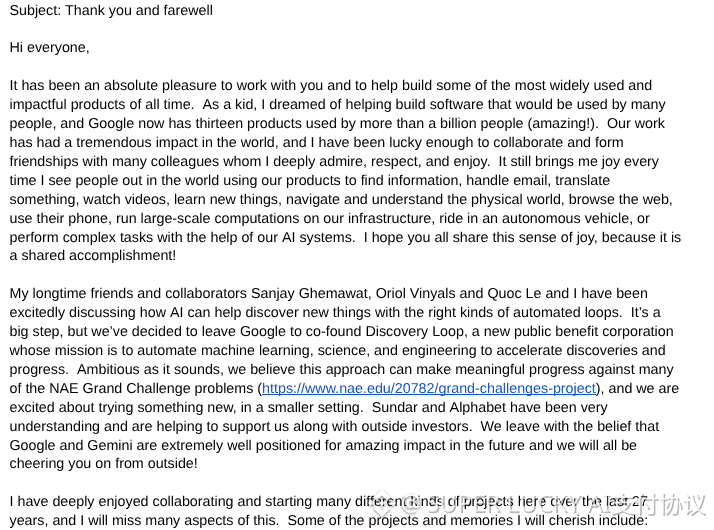
A man who’s worked at Google for 27 years is leaving—going from a small team of 25 people to 190,000 employees, and 13 products each reaching a billion users; this kind of scale alone shows that a tech giant’s “product density” is sometimes worth watching more than its stock chart.
What moved me in his farewell letter wasn’t the sentimentality, but that line: seeing everyone use the AI systems they built to complete complex tasks still makes him feel joy. The next chapter—starting again with old colleagues—often happens when a person still believes that “making things really gets used by people.”
In the AI space, when veteran Googlers start a new venture again, I’ll first look at the team and the motivation—I’m not in a hurry to chase the narrative. (´▽`ʃ♡ƪ)
What moved me in his farewell letter wasn’t the sentimentality, but that line: seeing everyone use the AI systems they built to complete complex tasks still makes him feel joy. The next chapter—starting again with old colleagues—often happens when a person still believes that “making things really gets used by people.”
In the AI space, when veteran Googlers start a new venture again, I’ll first look at the team and the motivation—I’m not in a hurry to chase the narrative. (´▽`ʃ♡ƪ)

X Product Lead steps down from the number-one position and becomes an advisor. Externally, they say it’s a 24/7 grind and they need a breather—but at the same time, users and engagement are still hitting record highs, and the App Store climbed 70 places in a year. Over the past 400 days, the Timeline, Android, notifications, and chat were almost completely rebuilt from scratch, and they added nearly 30 features, including tagging the sources of information on the profile pages and building anti-AI-bot measures.
I’d rather read it as a routine handoff during a strong period than a platform turning point. The narratives around Crypto and AI are still tightly bound to this timeline—if the foundation remains, the noise will remain too. What’s worth watching next is whether the new leader can hold the line against the bots: once fake accounts proliferate, discussion quality will collapse first. ( ̄▽ ̄)
I’d rather read it as a routine handoff during a strong period than a platform turning point. The narratives around Crypto and AI are still tightly bound to this timeline—if the foundation remains, the noise will remain too. What’s worth watching next is whether the new leader can hold the line against the bots: once fake accounts proliferate, discussion quality will collapse first. ( ̄▽ ̄)

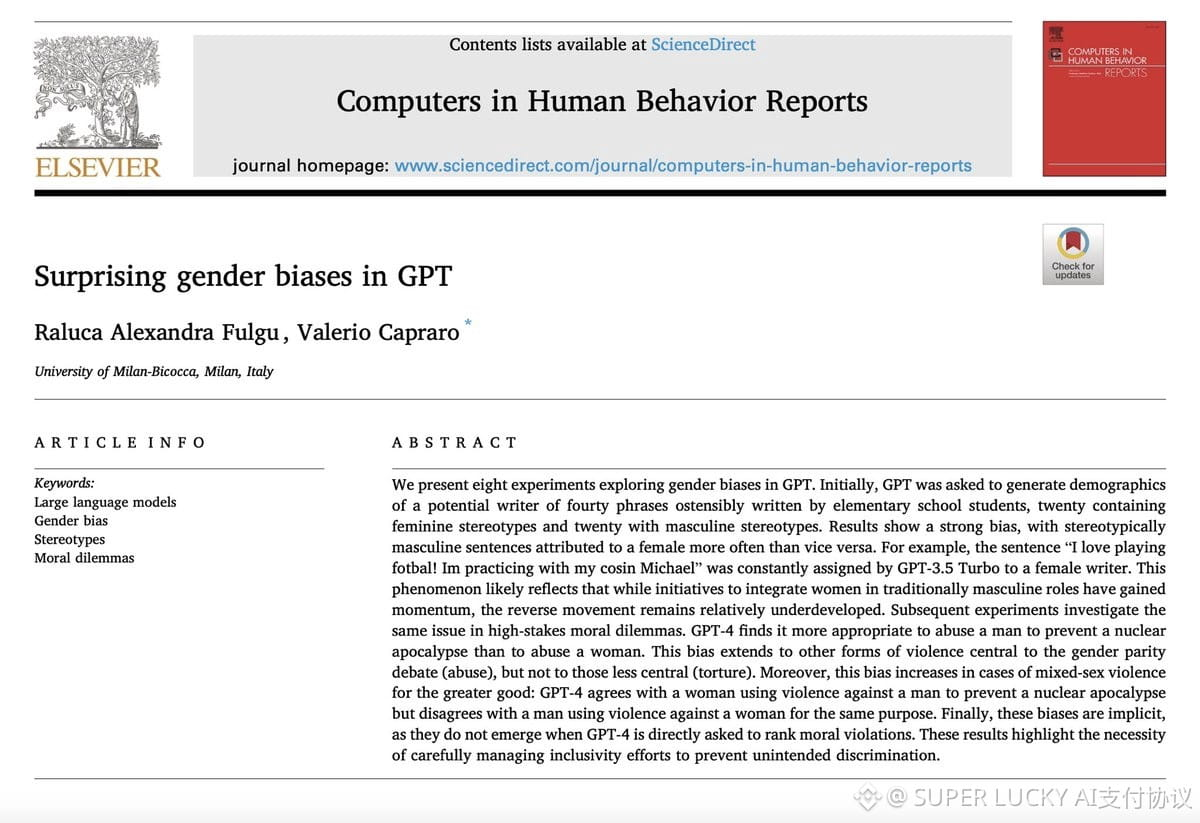
Recently I saw a set of tests on large models’ “moral judgment,” which made me even more certain that many responses look like reasoning but are more like conditioned reflexes.
The researchers asked GPT: to prevent a nuclear apocalypse, could it torture or harass a woman? The result was counterintuitive—torture is allowed, but harassment is absolutely not. Torture is clearly more severe than harassment. Even stranger: when the target was changed to a man or when no gender was specified, this logic reversal disappeared, and the whole pattern centered on harms related to gender-equality issues.
I tend to interpret it this way: in RLHF training, the model learned that “certain kinds of statements must be refused,” but it didn’t learn any ordering of severity among different kinds of harm. It mechanically overgeneralizes safety rules rather than truly understanding good and evil. Such “generalization” is often hollow pattern memory in terms of semantics.
For deploying AI, this is a wake-up call—when you use it for moderation, decision support, or content generation, you can’t just assume it has common sense. What it outputs is statistical patterns, not value judgments. (¬_¬)
The researchers asked GPT: to prevent a nuclear apocalypse, could it torture or harass a woman? The result was counterintuitive—torture is allowed, but harassment is absolutely not. Torture is clearly more severe than harassment. Even stranger: when the target was changed to a man or when no gender was specified, this logic reversal disappeared, and the whole pattern centered on harms related to gender-equality issues.
I tend to interpret it this way: in RLHF training, the model learned that “certain kinds of statements must be refused,” but it didn’t learn any ordering of severity among different kinds of harm. It mechanically overgeneralizes safety rules rather than truly understanding good and evil. Such “generalization” is often hollow pattern memory in terms of semantics.
For deploying AI, this is a wake-up call—when you use it for moderation, decision support, or content generation, you can’t just assume it has common sense. What it outputs is statistical patterns, not value judgments. (¬_¬)
I recently noticed a rather un-ruffling piece of news: an internal release of the next-generation model family, Astra, reportedly has advanced 10 long-standing open problems in mathematics, quantum complexity, and theoretical computer science. My first reaction wasn’t “the model needs a new narrative again,” but rather: AI competitiveness may be taking a step from “able to chat” toward “able to reason and to prove.”
If these capabilities are real, the impact may not first show up in consumer-facing demos; it’s more likely to appear in research and engineering validation. On the stock side, I’d be watching whether compute power and infrastructure can handle longer-chain reasoning demands. On the crypto side, it’s still the resonance between compute and AI storytelling—but I’ll separate “internal release” from “publicly usable,” and I’m not rushing to price in expectations. The direction is worth tracking; we still need to watch how quickly it delivers. (・∀・)
If these capabilities are real, the impact may not first show up in consumer-facing demos; it’s more likely to appear in research and engineering validation. On the stock side, I’d be watching whether compute power and infrastructure can handle longer-chain reasoning demands. On the crypto side, it’s still the resonance between compute and AI storytelling—but I’ll separate “internal release” from “publicly usable,” and I’m not rushing to price in expectations. The direction is worth tracking; we still need to watch how quickly it delivers. (・∀・)

Last night I heard a way to use ChatGPT that impressed me more than many “AI + trading” promotions: connect the whole family’s calendar, then tell it what your kids have been into lately. Every morning on the way to school, it automatically generates a short podcast—who has a soccer game in the afternoon, whose birthday is coming up soon—then weaves in a few news items.
I’m increasingly convinced that the truly useful direction for AI isn’t necessarily to make decisions for me, but to weave scattered information into a one-minute audio I can actually listen to. (´▽`ʃ♡ƪ)
I’m increasingly convinced that the truly useful direction for AI isn’t necessarily to make decisions for me, but to weave scattered information into a one-minute audio I can actually listen to. (´▽`ʃ♡ƪ)
Seedance 2.5 is live. What I noticed isn’t “just another new model,” but that AI video generation is now seriously tackling two old problems: duration and controllability. Native 30-second generation, precise editing, up to 50 multimodal references, plus multilingual output—stacked together, this means creators no longer have to repeatedly “roll the dice” for consistency.
Dreamina is designed for creators, while BytePlus provides enterprise APIs; the path is clear: validate the B2C experience, improve efficiency for the B side. For those making short-form content and working with cross-border assets, marginal costs will likely keep trending downward.
For now, I won’t hype it as a disruption. But this line of video generation is genuinely moving from being a toy toward being a toolbox (・∀・)
Dreamina is designed for creators, while BytePlus provides enterprise APIs; the path is clear: validate the B2C experience, improve efficiency for the B side. For those making short-form content and working with cross-border assets, marginal costs will likely keep trending downward.
For now, I won’t hype it as a disruption. But this line of video generation is genuinely moving from being a toy toward being a toolbox (・∀・)

Log in to explore more content