
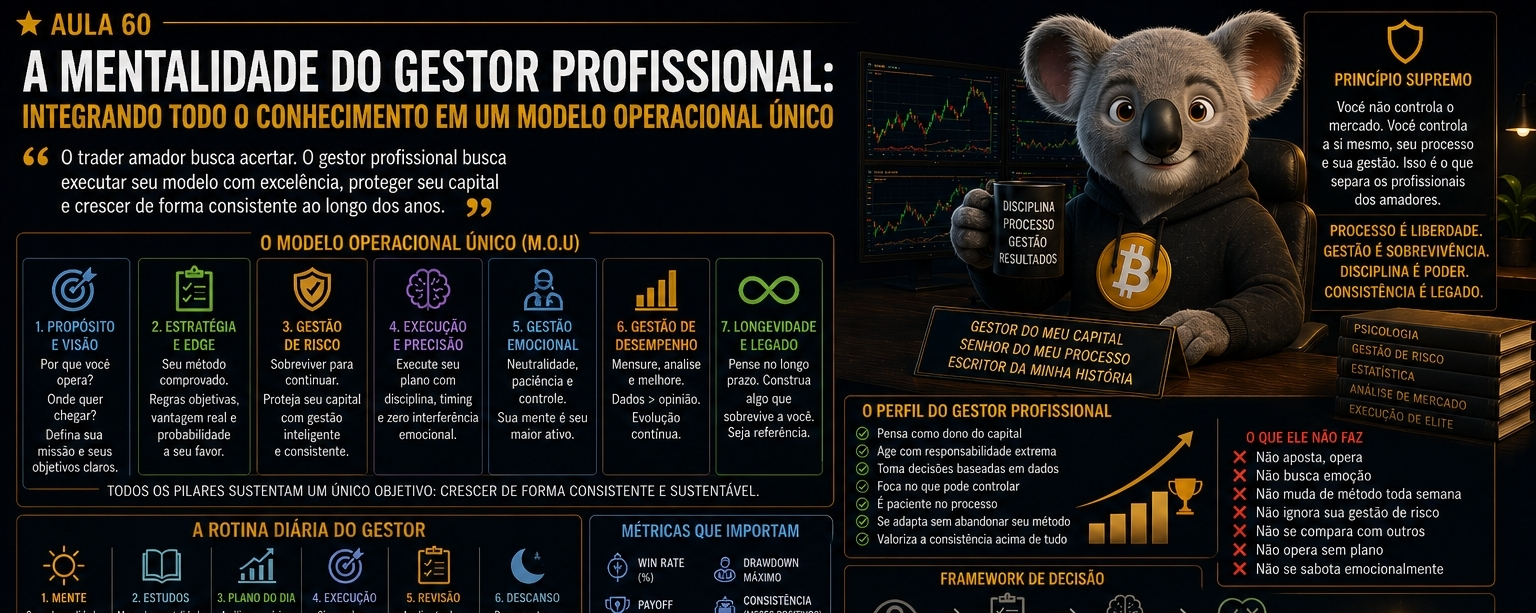

Congratulations. You reached the last lesson.
So far, you have studied:
Market structure
Liquidity
BOS and CHoCH
Order Blocks
Fair Value Gaps
Breakers
PD Arrays
Risk management
Psychology
Execution
Statistical validation
Robustness
Consistency
Longevity
In this lesson, the goal is not to learn a new technique.
The goal is to integrate everything into a single mental model, exactly like professional traders and capital managers do.
1️⃣ THE MARKET IS NOT A COLLECTION OF CONCEPTS
The biggest mistake of the intermediate trader is thinking:
"Now I’m going to look for an FVG."
Or:
"Now I’m going to look for an Order Block."
The professional thinks differently.
It asks:
"What is the market trying to do?"
After that, use the appropriate tools to answer that question.
📌 The concepts are not the goal.
They are only reading tools.
2️⃣ THE HIERARCHY OF DECISION-MAKING
Every professional decision follows this exact sequence:
First
- Macro Context
Questions:
Trend or sideways movement?
Expansion or compression?
Where is the liquidity?
Second
- Structure
Questions:
HH?
HL?
HL?
LL?
BOS?
CHoCH?
Third
- Institutional Narrative
Questions:
Who is probably trapped?
Who provides liquidity?
Is there manipulation?
Is there absorption?
Fourth
- PD Arrays
Only now do you look for:
Order Block
FVG
Breaker
Liquidity
Mitigation
Premium/Discount
Fibonacci
Fifth
- Execution
Only at the end do you decide:
Entry
Stop
Target
Management
📌 Never start by looking for an entry.
Entry is the last stage.
3️⃣ THE FIVE-FILTER MODEL
Before any trade, confirm:
Filter 1
Is there context?
If not, do not trade.
Filter 2
Is there asymmetry?
If risk and reward are similar, do not trade.
Filter 3
Is there structural confirmation?
If it is still only a hypothesis, wait.
Filter 4
Is there a clear invalidation point?
If there is not, the trade does not exist.
Filter 5
Does my risk management allow this risk?
If not, reduce position size or simply stay out.
4️⃣ WHAT A MANAGER SEES
The trader looks:
"Can I make money?"
The manager looks:
"How much can I lose if I am wrong?"
That small change changes absolutely everything.
Because:
preserves capital
reduces anxiety
improves execution
📌 Profit becomes a consequence.
Never immediate objective.
5️⃣ THE IMPORTANCE OF SIMPLICITY
After 60 lessons, you know dozens of concepts. But that does not mean you should use them all at the same time. In fact, the more professional you become, the fewer things you will use.
You will only do:
reading
context
confirmation
execution
The rest serves only to increase conviction.
6️⃣ THE COMPLETE CYCLE OF A PROFESSIONAL TRADE
Every trade goes through the following stages:
Context
↓
Liquidity
↓
Structure
↓
Narrative
↓
PD Array
↓
Entry
↓
Management
↓
Exit
↓
Audit
↓
Learning
📌 The trade ends only after the audit.
7️⃣ THE TRUE OBJECTIVE
After all this training, your objective is not:
be right more often
trade more
predict the market
Your true objective is:
👉 make good decisions repeatedly.
If you do this, statistics work for you.
8️⃣ WHAT YOU SHOULD NEVER FORGET
The market:
will remain unpredictable
will keep changing
will keep manipulating liquidity
You will never control that.
But you will always be able to control:
discipline
execution
risk
exposure
preparation
review
That is what separates a professional.
9️⃣ THE PRINCIPLES THAT MUST ACCOMPANY YOU
Always remember:
Capital is the priority.
Liquidity moves the market.
Context comes before entry.
Asymmetry is worth more than frequency.
Risk comes before profit.
Process is worth more than results.
Consistent execution beats occasional genius.
The market owes you nothing.
Patience is also a position.
The best trade is often no trade at all.
🔟 CONCLUSION — THE END OF THE COURSE AND THE BEGINNING OF THE CAREER
You have completed training that was built to develop the mindset of a professional trader.
From this point on:
Do not look for new indicators just because they seem interesting.
Do not change your method after a few losses.
Do not trade out of emotional need.
Continue studying, recording, and refining your process.
Remember:
The goal was never to predict the market. The goal was always to build a process capable of thriving in an unpredictable market.
When you trade with context, control risk, accept uncertainty, and execute your plan with discipline, you stop relying on luck and start trusting your method.
🧠 Final Exercises
Exercise 1 — Building Your Operating Manual
Write, in your own words:
How you define context.
Which setups are part of your method.
Which criteria are required to enter.
How you define the stop.
How you define the targets.
When you increase or reduce exposure.
When you decide not to trade.
This document will be the basis of your trading plan.
Exercise 2 — Audit of the Last 50 Trades
Analyze your last 50 trades and answer:
How many followed all the rules?
How many were influenced by emotion?
Which mistakes were repeated the most?
What was your best setup?
Which setup should be eliminated?
The goal is not to judge the results, but to strengthen your process.
Exercise 3 — Professional Commitment
Write a statement and reread it before each session:
"I accept that I do not control the market. I only control my decisions. My job is to protect my capital, execute my plan with discipline, and allow my edge to manifest over time. I will not seek certainty; I will seek probability. I will not seek perfection; I will seek consistency."
🎓 Congratulations!
You have completed the 60 lessons of the course.
Now the most important phase begins: deliberate practice. A professional trader is built through the combination of knowledge, repetition, auditing, and discipline. The market will continue teaching new lessons every day, but with the foundation you have developed, you will have a solid model to keep evolving for many years. I wish you great success on your journey.