

 In decentralized systems, the hardest problem isn’t generating data it’s knowing when data can be trusted.
Blockchains execute deterministically, but the inputs they depend on often do not. Prices, identities, credentials, attestations, and behavioral signals come from off-chain sources or different systems. As DeFi and Web3 stacks become more automated, the cost of making decisions based on incorrect data increases greatly.
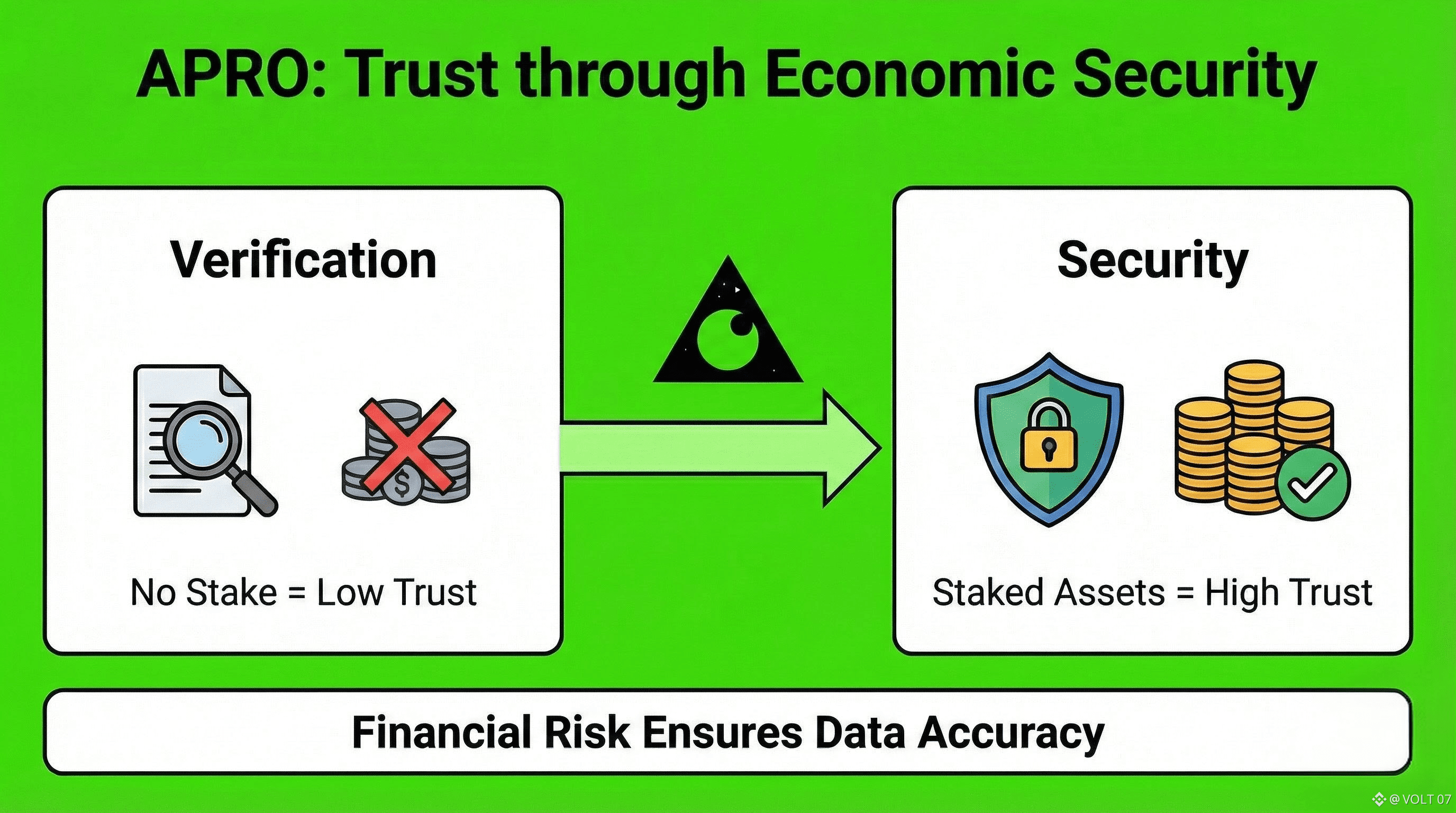
APRO changes how we view this challenge by treating data verification as an economic security issue, rather than just a technical one.
Technical verification fails to work effectively at scale.
Traditional approaches to data verification focus on cryptography, signatures, and correctness proofs. These are necessary but insufficient in adversarial, incentive-driven environments.
A signature can be valid while the data is misleading.
A feed can be cryptographically correct while economically harmful.
A credential can be authentic while behavior is malicious.
APRO recognizes that truth in decentralized systems is inseparable from incentives.
APRO’s core insight: unreliable data must be made expensive.
Instead of assuming that verification can completely remove bad data, APRO takes a more realistic approach: bad data will always be present. The key question is whether providing or depending on it makes economic sense.
By including economic consequences in the verification process, APRO changes the focus from:
“Is this data technically valid?”
to
“Is it economically safe to act on this data?”
This shift is subtle but essential.
Verification becomes a market, not a checkbox.
Participants who confirm the accuracy of the data in APRO's framework benefit economically.Trustworthy actions improve reputation and access. Untrustworthy actions result in penalties, exclusion, or financial loss.
This changes verification into:
a continuous process, not a one-time check
a probabilistic trust signal, not a binary flag
an economically enforced system, not a social agreement
Data integrity is no longer assumed; it is priced.
Economic security grows where manual trust does not.
As automated agents, DAOs, and strategies interact at machine speed, human review becomes impossible. Systems must decide instantly whether to trust inputs and counterparties.
APRO enables this by providing:
machine-readable reliability signals
historically weighted trust scores
behavior-based verification layers
economic penalties for false signaling
Automation can act decisively because risk is bounded by economic design.
Bad data becomes a liability, not an exploit opportunity.
In many systems, attackers profit by injecting misleading but valid-looking data. APRO inverts this incentive.
If providing low-quality or manipulative data leads to:
loss of reputation
reduced future participation
financial penalties
isolation from automated workflows
then the rational strategy shifts from exploitation to compliance.
Security emerges not from perfect detection, but from misaligned incentives for attackers.
APRO aligns data verification with capital preservation.
In automated DeFi, bad data doesn’t just cause errors it causes losses. Liquidations trigger incorrectly. Strategies rebalance at the wrong time. Agents route capital into unsafe paths.
By linking verification to economic responsibility, APRO makes sure that:
capital exposure depends on data reliability
automated systems can reject low-confidence inputs
failures are confined rather than widespread
Verification is part of risk management, not just data upkeep.
Reputation becomes an economic primitive.
APRO elevates reputation from a social concept into a functional layer of security.
Participants are no longer anonymous data sources they are economically accountable identities with a track record.
This allows systems to:
weight data by source reliability
prefer historically accurate providers
throttle or exclude degraded actors
adapt trust thresholds dynamically
Reputation doesn’t replace cryptography it complements it with economic memory.
Economic verification is more resilient than rule-based enforcement.
Rules can be gamed. Thresholds can be adjusted. Static assumptions fail under pressure. Economic systems, on the other hand, naturally change. When the cost of failure increases, behavior shifts automatically.
APRO takes advantage of this by making sure that:
honesty is cheaper than lying
reliability builds benefits
manipulation reduces access over time
This forms a self-correcting verification layer.
Institutions understand this model intuitively because it reflects real markets.
Traditional finance does not rely solely on correctness proofs. It relies on:
counterparty risk
reputation
capital requirements
penalties for misrepresentation
APRO brings this logic on-chain, making automated systems legible to institutional capital that already thinks in economic security terms.
As automation increases, verification must move from certainty to survivability.
Perfect data does not exist.
Perfect verification is impossible.
But economically safe behavior is achievable.
APRO’s contribution is recognizing that decentralized systems don’t need absolute truth they need bounded risk when truth is imperfect.
Data becomes trustworthy when lying is no longer profitable.
That is the essence of APRO’s design.
By turning verification into an economic security problem, APRO aligns incentives, scales trust, and enables automated systems to operate safely in uncertain environments.
In a DeFi stack increasingly driven by machines, economic accountability becomes the strongest form of security.
In decentralized systems, security doesn’t come from knowing who is right it comes from making it too costly to be wrong.


