

Financial Times: 144 million suspicious funds were still released after Binance's settlement
The UK (Financial Times) reveals that the well-known cryptocurrency exchange Binance, after settling with the United States in November 2023 and promising to strengthen anti-money laundering controls, still seems unable to effectively stop the operations of some suspicious accounts.
Reports indicate that 13 suspicious accounts transferred approximately 144 million dollars in funds after the settlement agreement took effect. If traced back to 2021, the total amount handled by these accounts reached as high as 1.7 billion dollars.
Suspicious account cash flow anomalies, IP address can move instantly
Leaked internal documents show the dynamics of two suspicious accounts as follows:
25-year-old Venezuelan woman's account: received over $177 million in cryptocurrency within two years after April 2022. During the period from January 2023 to March 2024, payment information was changed up to 647 times, involving 496 different bank accounts across the Americas.
30-year-old Caracas junior banker’s account: received $93 million from 2022 to May of this year and transferred an equivalent amount of cryptocurrency. Internal IP login records show that the account logged in from Caracas on the afternoon of February 24 this year, but logged in from Japan at 1:30 am the next day.
 Source: PBS. The well-known cryptocurrency exchange Binance reached a settlement with the U.S. in November 2023 and promised to strengthen anti-money laundering controls.
Some funds originate from accounts involved in terrorist attacks, related to Hezbollah and the Syrian regime.
According to statistics, these 13 accounts distributed in Venezuela, Brazil, Syria, and China received a total of $29 million in stablecoins $USDT from February 2022 to March 2023, which were later identified by Israeli authorities as related to financing terrorism and were frozen.
It is understood that this fund mainly comes from four cryptocurrency wallets associated with the Syrian Tawfiq Al-Law, who is accused of assisting Hezbollah, Houthi forces in Yemen, and the Assad regime in Syria in transferring illegal funds.
Although these four source wallets were seized by Israel in May 2023, and the U.S. Office of Foreign Assets Control (OFAC) sanctioned Al-Law the following year, data also shows that since Binance's settlement with the U.S. in November 2023, the activity frequency of these 13 suspicious accounts has decreased but has not completely stopped.
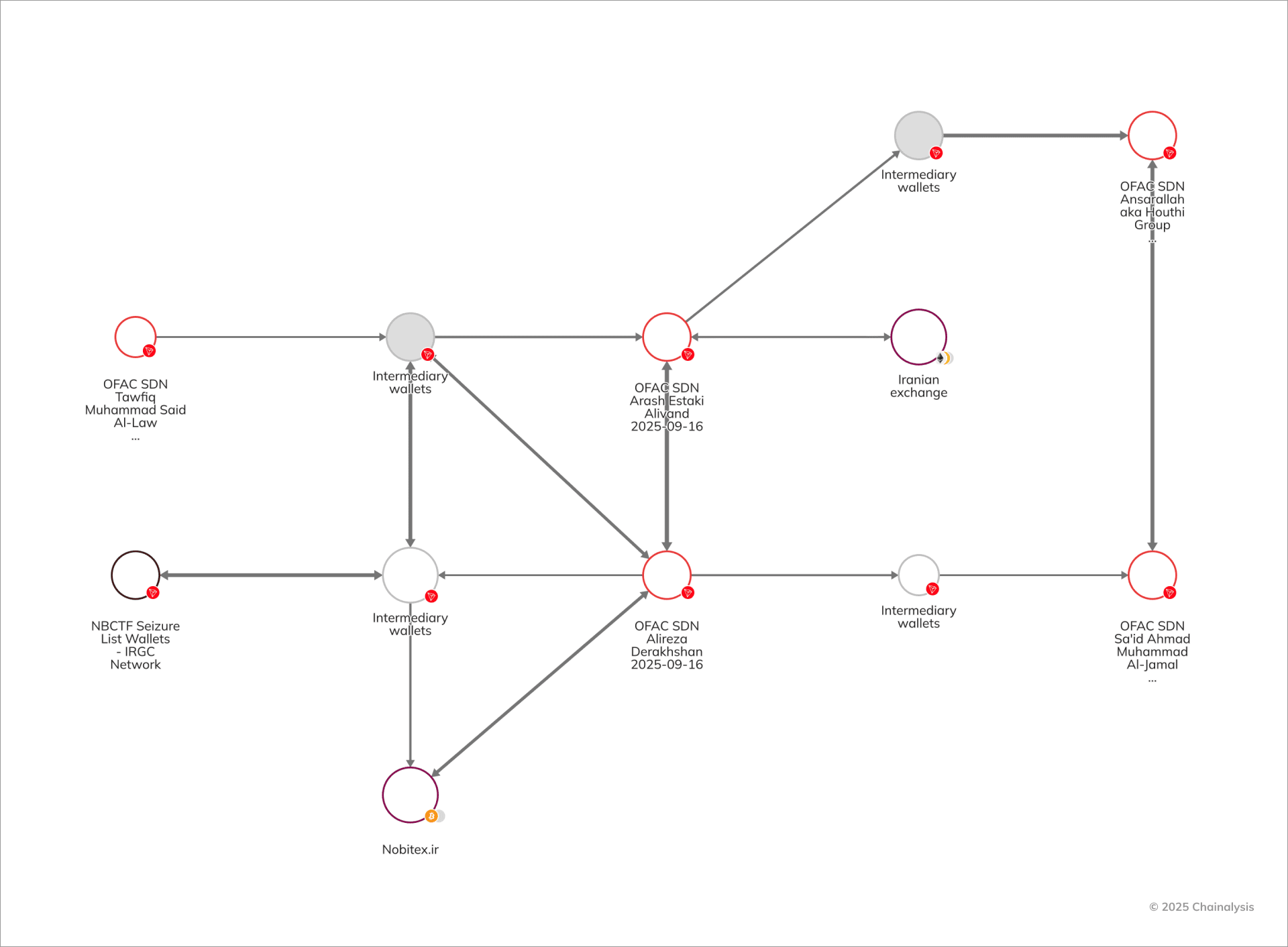 Source: Chainalysis. Chainalysis analysis, OFAC has previously taken action against Iran's $600 million shadow banking.
Binance's official response: the transaction was not a sanctioned entity at the time it occurred.
In response to the allegations from the Financial Times, a Binance spokesperson told the media Decrypt that the exchange has a robust system to flag and investigate suspicious transactions.
A spokesperson explained that all transactions are assessed based on the information available at the time, and stated that the wallet mentioned in the media report was not on the sanctions list when the related activities occurred.
Binance reiterated that since November 2023, the company has been under the supervision of independent monitors and strictly complies with all relevant financial sanctions regulations.
Officials emphasize that compliance and user safety have always been their top priorities, and a report by the Financial Times also acknowledged that there is currently no evidence showing that Binance continued to trade with related entities after they were officially sanctioned.
Further reading:
International investigation report: Binance, OKX, HTX involved in criminal money chains, with a total amount involved exceeding $1 billion.
The five-year regulatory period is still ongoing, and Binance may face a fine of $150 million if it violates regulations.
According to the settlement agreement reached with the U.S. Financial Crimes Enforcement Network (FinCEN) in 2023, Binance is currently under a five-year regulatory period. The monitors' responsibilities include overseeing Binance's remedial measures, conducting regular reviews, and reporting investigation results to FinCEN, OFAC, and the Commodity Futures Trading Commission (CFTC).
If Binance fails to fulfill its obligations under the settlement agreement, it may face further financial penalties, including a deferred execution fine of up to $150 million.
'Is Binance's anti-money laundering not implemented? Accused of allowing $144 million of suspicious funds, officials rebut: at the time, it was not a sanctioned entity.' This article was first published in 'Crypto City'.