Yesterday, I gave a 2-hour lesson to the small class, and the topic was New Year's Outlook. However, the focus was mainly on investment and market trends, and there was no time to discuss some more macro topics. So in the next few days, I will use posts here to talk about this, as a rough overview of my expectations for the overall situation in the coming year.
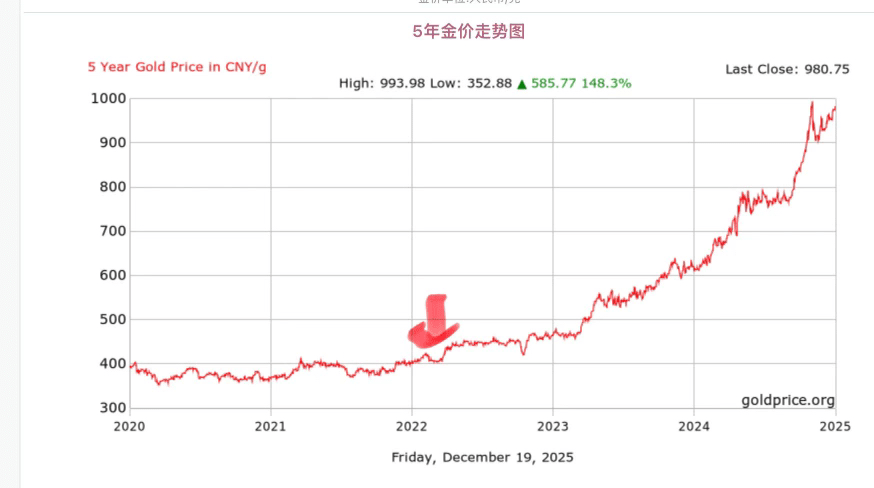
So how can we translate an understanding of the overall situation into our own successful investment strategies? Here, I can explain a bit. For example, since the outbreak of the Russia-Ukraine war, the comprehensive sanctions imposed by the US and Europe on Russia have further weakened the already problematic post-Bretton Woods dollar global financial system. Under the weaponization of finance, non-Western economies' currencies have started to shift from being anchored to the dollar back to being anchored to gold, and based on this, actions for currency swaps have begun. Under the financial sanctions of the US and Europe, a certain Eastern power once held an emergency meeting to discuss whether there were ways to cope with the same situation, and the answer received was none. Therefore, after this critical juncture, this Eastern power began to replace a large amount of its dollar-denominated government bonds with gold. If you understand this logic, then after this meeting, your long-term investment direction should include gold, shouldn't it?
However, due to the inherent scarcity of gold, it inevitably spills over to other precious metals, and even cheap metals. Considering that silver was once, like gold, the legal tender of many countries, so the spillover to silver, is that strange? If from the end of 2024 to the end of this year, silver is the most rapidly appreciating investment, would you be surprised?
If you understand non-physical currencies, you might have heard a familiar saying: if you missed the big pancake at over ten dollars, hurry to grab the little mistress at over ten dollars (especially after the fork rollback), but if you also missed the little mistress, you can go for the counterfeit!
But counterfeit products are all traps, just like cheap metals are all traps, how to choose. Here you can see in picture three, look down according to the important order inside. Everyone knows that there is currently a ceasefire between China and the U.S., and the reason for the ceasefire is mainly that the East has a chokehold on the West and its allies (rare earths and key metals) far more than the West and its allies have a chokehold on the East (advanced semiconductors), which is much more lethal. So during the ceasefire, you can imagine how the West tries to fill in the gaps (after all, hedge funds have already been driven crazy by silver, and are now scrambling for commodities), not only can they seize mineral resources, but also the technological breakthroughs that Western media loves to brag about as game-changers. It doesn't matter whether these things ultimately make a significant impact, as long as they get a hype, you can make a fortune, do you understand?
For example, recently you know, the East's Liaoning aircraft carrier's fighter jet J-15 used radar to outshine the little booklet's F-15, which is a classic case of advanced weapons facing off against primitive ones. On one side is advanced GaN (gallium nitride), and on the other is the older generation GaAr (gallium arsenide). So gallium, this key metal, sorry, the East controls 98.7% of the global supply. Therefore, it's difficult for the West to catch a break here, because gallium is a byproduct of aluminum refining, and aluminum refining is very energy-intensive. So let’s not talk about anything else; first, let’s build 20 nuclear power plants before discussing why to refine so much aluminum. Then someone tells you that we have a new invention that can refine gallium without refining aluminum. Whether this thing is real or whether it will really be economically viable in the future, don't worry about it, just remember to get on it early. In fact, if you understood this a few years ago, you could have invested in the Mountain Pass rare earths in California, USA; their products are subpar, but they would still be touted as treasures, and you could still make money. After all, we can't let the American people lose all confidence, can we?
But if you look at the East from the opposite perspective, you can also see that they are also being choked, can't you see the benefits of investing in stocks like Moore?
Having discussed this, let’s talk about the trends for next year.
Let’s first talk about a recent international topic, which is what Trump mentioned, wanting to abandon G7 and form a C5. To understand this, first, understand two concepts in economics.
The first concept is the nominal GDP based on exchange rates that we all know. The current rankings are approximately as follows: First is the United States, second is China, third is Germany, fourth is Japan, fifth is India, sixth is the United Kingdom, seventh is France, eighth is Italy, ninth is Russia, and tenth is Canada.
Here I can remind you that Germany and Japan sometimes fluctuate, mainly because the yen is severely undervalued, while the euro is severely overvalued. You might say that India's GDP seems inflated, which is correct, but isn't the UK's and France's also inflated? The UK ranks ahead of France, also because the pound is actually overvalued against the euro, although recently the pound has been falling against the euro.
If you take a closer look, excluding China, India, and Russia, the remaining seven of the top ten economies are the G7 countries.
However, if you look at the size of the real economy, excluding the factors of currency overvaluation and undervaluation, from the perspective of purchasing power parity (PPP), the ranking of the top ten economies is completely different.
First is China, second is the United States, third is India, fourth is Russia, fifth is Japan, sixth is Germany, seventh is Brazil, eighth is Indonesia, ninth is France, and tenth is the United Kingdom.
Thinking back to the establishment of the United Nations after World War II, the United States proposed that we have four permanent members of the Security Council: the United States, the Soviet Union, China, and the United Kingdom. The Soviet Union saw that, damn, China and the UK are both America's little brothers; with one vote, it would be three to one. They had to add one more country that doesn't get along with the U.S. as much. So France was added. The joke in English is that the Soviet Union asked: Who has the gall to go against America? The French replied: We have de Gaulle! (The pronunciation is similar to “the gall,” we have de Gaulle!)
So if we identify the four major economies globally based on PPP, you see China, the United States, India, and Russia, doesn’t it seem a bit like the situation of the Soviet Union back in the UN? So the U.S. says, let's add one more, which is Japan.
In this way, you see the configuration inside C5 is quite interesting; because the relationship between China and India is generally average, in any organization where China and Russia are together, the dual leadership of China and Russia is somewhat like big China and small Russia. Thus, whether it's the Shanghai Cooperation Organization or the BRICS organization, bringing in India to double team can somewhat balance China’s influence. So what about the U.S. side?