

@KITE AI It feels like we’re standing at a crossroads in the way machines will interact with one another and with us. Over the last few years, artificial intelligence has leapt from being a set of clever tools to something more autonomous, more proactive. Today’s AI systems don’t just answer questions or categorize photos; they can act on our behalf, making decisions and carrying out tasks with minimal human prompting. Yet for all this progress, one essential piece of infrastructure has been missing: a reliable, standardized way for these systems to participate in economic activity with each other. That’s where concepts like an “economic passport for AI” and projects like @undefined come into sharp focus not as marketing buzzwords, but as responses to a very concrete problem.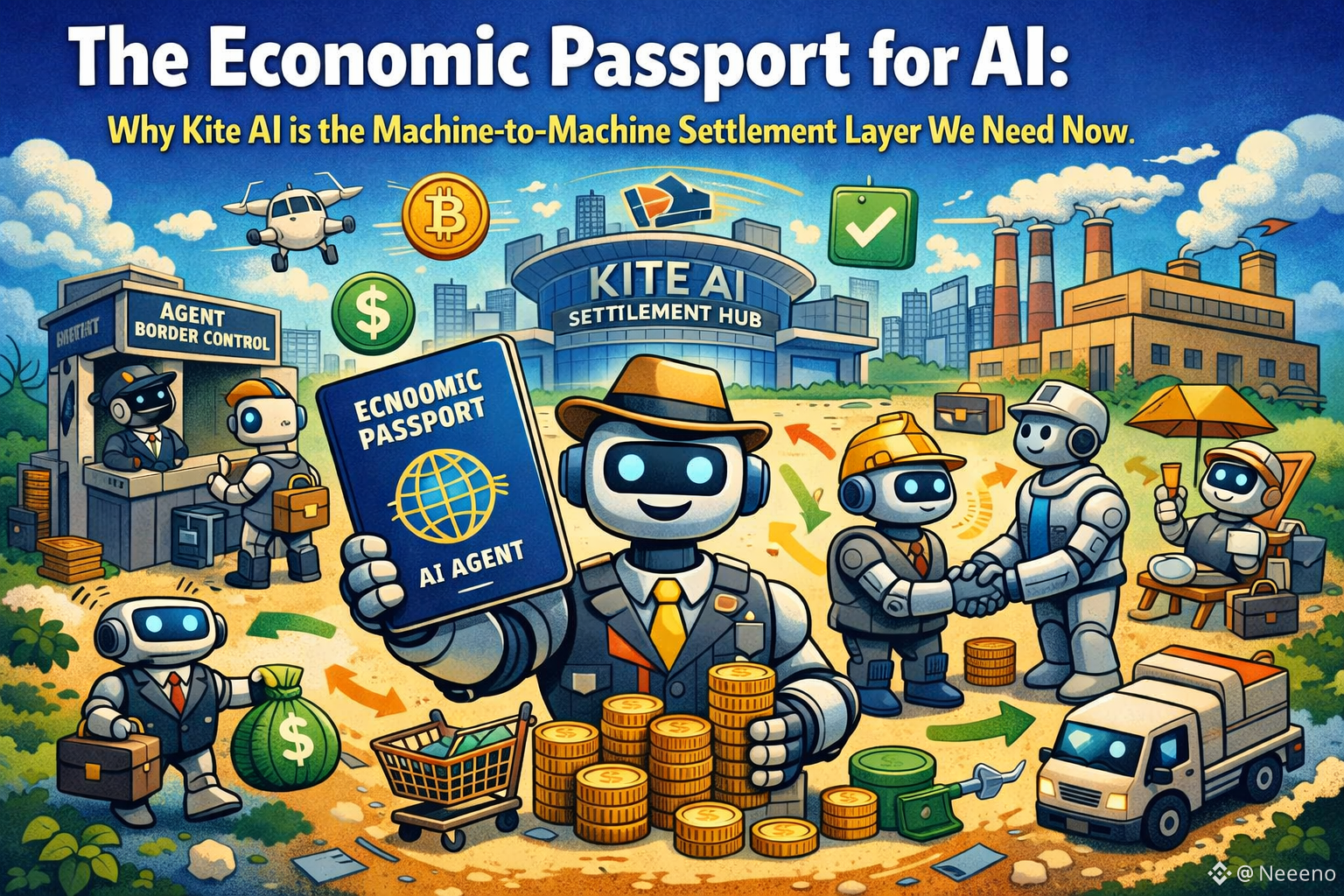
Put simply, Kite AI is a purpose-built blockchain layer designed to let autonomous AI agents operate as first-class economic actors. It’s a settlement layer, a payment rail, and an identity system all rolled into one, optimized for the needs of machine-to-machine interactions rather than human-centered workflows. In that sense, it’s trying to be to the agentic economy what the banking system and credit cards have been to human commerce: a foundation that others can build on without reinventing the wheel every time.
The idea of an economic passport for AI might sound abstract at first — but when you break it down, it really isn’t. Right now, if you ask one AI system to pay another for a service — say, a data provider charging for cleaned datasets, or a scheduling agent booking a flight — there’s no standardized way for those transactions to happen securely, instantly, and with verifiable identity. Payment processors exist, but they are built for human wallets and regulatory frameworks that assume a person is behind each transaction. AI agents need something different: a way to verify their identity, enforce spending rules set by their human owners, and settle payments in real time without human intervention. Kite AI’s blockchain seeks to provide precisely that.
At the core of Kite’s architecture is a Layer-1 blockchain that’s compatible with the Ethereum Virtual Machine (EVM), but with important extensions for agent-native operations. Instead of relying on human-centric accounts, each AI agent can have its own cryptographic identity — effectively its own passport — which lives on-chain and can be used across services. That identity isn’t just a name; it carries reputation, verifiable credentials, and programmable permissions around what the agent is allowed to do.
Identity alone, however, isn’t enough. Autonomous systems need to transact. Kite’s design incorporates native stablecoin payments and micropayment channels that let agents settle transactions with sub-second finality and extremely low fees. In practical terms, this means that a machine could pay another machine for a tiny computation or a slice of data without significant overhead — something human payment networks struggle with because they were built for dollars and cents, not nanotransactions between autonomous processes. The goal is to make economic activity as frictionless for AI agents as browsing can be for humans on today’s internet.
It’s interesting that projects like Kite are showing up now, in late 2025, instead of five years ago. That’s not random. AI — especially big language models, automated workflows, and API-based services — is moving so fast that the need for better infrastructure is urgent. People can already build advanced multi-agent systems that plan and carry out tasks. But it’s still hard to let those agents make payments or trade value in a way that’s safe, clear, and easy to verify.The current web and financial layers simply weren’t designed with autonomous agents in mind, and retrofitting them has proven clumsy at best.
This isn’t just a speculative exercise either. Kite AI has already raised tens of millions in venture funding from prominent backers, and its native token has begun trading on major exchanges, signaling real financial interest in this future-oriented infrastructure. Its developers are pushing standards like the x402 protocol, which aims to standardize intent authorization and payments for AI agents — a rough analogue to how HTTP standardized communication for human-driven web browsers.
Of course, any infrastructure project that seeks to redefine how economic value flows requires careful scrutiny. One question that naturally arises is whether autonomous AI agents should be able to engage in financial transactions without human oversight. There’s a tension here: on the one hand, autonomy is necessary if machines are to act on our behalf at scale; on the other hand, we need clear mechanisms for accountability and control. Kite’s approach — with cryptographic identity, programmable spending limits, and on-chain governance — tries to strike a balance. Agents don’t just roam free; they carry verifiable credentials and operate within rules that can be audited or adjusted by their human principals.
One more angle is the ripple effects on the economy. If AI agents can negotiate and pay other agents without humans involved, how does that change work, business, and the job market?It’s easy to imagine a future where buying and selling digital services becomes a continuous, automated flow of value between systems, reducing friction but also displacing entire classes of intermediary work. That’s not a problem unique to Kite, but a wider shift that projects like this make more tangible. There’s a kind of quiet excitement in imagining new business models and markets emerging from these primitives — and an equal need for sober discussion about where responsibility and risk lie when machines transact.
For now, the agentic economy is still in its infancy. Kite and similar efforts are laying down rails and settlement layers before the traffic truly arrives. That’s an odd order compared with how most technologies evolve — usually demand appears first, then infrastructure follows. Here, we’re seeing infrastructure anticipating demand, an inverse that suggests just how fast expectations for autonomous systems have grown.
Whether Kite becomes the definitive economic passport for AI or one of several competing layers, the project highlights a key inflection point: we are no longer talking only about what AI can do for individual tasks, but how it can participate in an economy of value. That shift — from isolated intelligence to economic agency — is why discussions around machine-to-machine settlement matter today. We’re not merely optimizing algorithms anymore; we’re building the plumbing that could let those algorithms work together, exchange value, and perhaps, change the way economic activity unfolds in the digital age.


