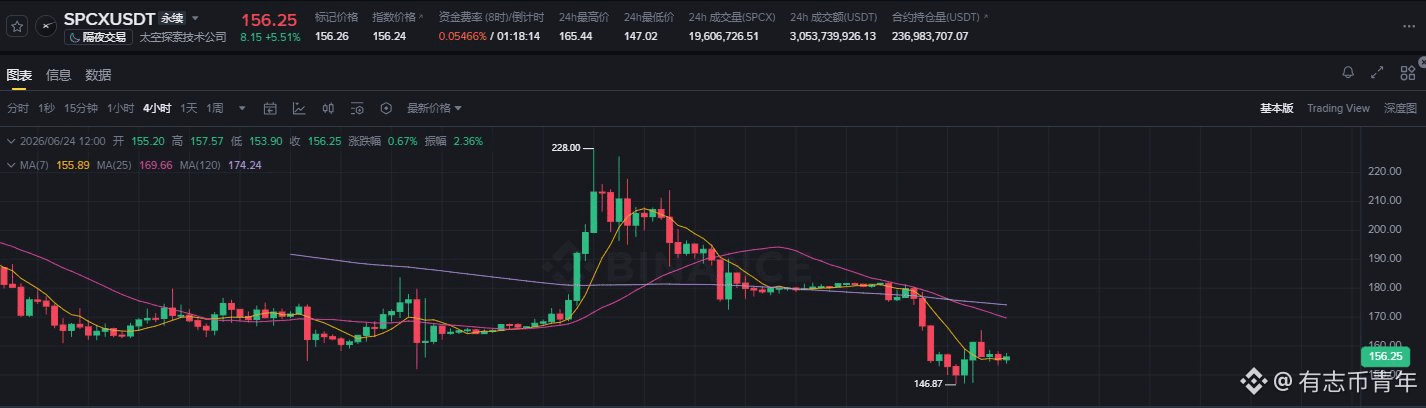
#Space listed at $135, raising about $75 billion, with a valuation of $1.77 trillion.
On the opening day, it kicked off around $150, spiking to about $228 in the first week, then quickly retracing, with yesterday’s low hitting around $146, close to the opening price. The market cap has evaporated by about $200 billion, resulting in many high-entry buyers seeing paper losses.
So, is this dip just a short-term correction, or the start of a bigger adjustment? Can the upcoming passive fund buys withstand the unlocking sell pressure?
In the short term, the first wave of shares unlocking from late July to early August is expected to release 7%-11% of shares, which can amplify volatility in a low float environment.
Coupled with an overall tech sector adjustment, the sell pressure constitutes the main hurdle, but the Nasdaq 100 index inclusion (expected in early July) will bring in billions in passive funds, with some institutions already loading up at lower levels to form support.
These two factors will directly clash, and price volatility is expected to remain high. Longer term, SpaceX holds a genuine competitive edge with its dominance in space launches, the expansion of Starlink users, and breakthroughs in Starship technology, backed by ample cash reserves.
However, the high valuation corresponds to an expected revenue of about $18.7 billion in 2025, necessitating a sustained performance delivery, while facing challenges in tech execution, regulation, and capital investment. The growth story ultimately hinges on actual delivery rather than early-stage hype.
On the opening day, it kicked off around $150, spiking to about $228 in the first week, then quickly retracing, with yesterday’s low hitting around $146, close to the opening price. The market cap has evaporated by about $200 billion, resulting in many high-entry buyers seeing paper losses.
So, is this dip just a short-term correction, or the start of a bigger adjustment? Can the upcoming passive fund buys withstand the unlocking sell pressure?
In the short term, the first wave of shares unlocking from late July to early August is expected to release 7%-11% of shares, which can amplify volatility in a low float environment.
Coupled with an overall tech sector adjustment, the sell pressure constitutes the main hurdle, but the Nasdaq 100 index inclusion (expected in early July) will bring in billions in passive funds, with some institutions already loading up at lower levels to form support.
These two factors will directly clash, and price volatility is expected to remain high. Longer term, SpaceX holds a genuine competitive edge with its dominance in space launches, the expansion of Starlink users, and breakthroughs in Starship technology, backed by ample cash reserves.
However, the high valuation corresponds to an expected revenue of about $18.7 billion in 2025, necessitating a sustained performance delivery, while facing challenges in tech execution, regulation, and capital investment. The growth story ultimately hinges on actual delivery rather than early-stage hype.