

Author: Leo
Have you ever wondered why learning a new skill is always so difficult? It's not because the content is too hard, but because we simply don't know where to start. You want to learn stock trading, and the search engine returns thousands of results, but no one tells you what the first step should be. You want to understand the basics of AI, and there are countless videos on YouTube, but you don't know which ones are suitable for your level. You want to master a programming language, and there are tutorials everywhere online, but you can't find a clear learning path.
I have always believed that the biggest paradox of the internet lies here: information has never been so abundant, yet effective learning has never been so difficult. Until recently, I noticed a company called Oboe just completed a $16 million Series A funding round led by a16z. The founders of this company, Nir Zicherman and Michael Mignano, previously founded Anchor, the podcast platform that was later acquired by Spotify. As I delved into what Oboe is doing, I realized they might be addressing the core issue in online learning: how to enable anyone to learn anything efficiently.
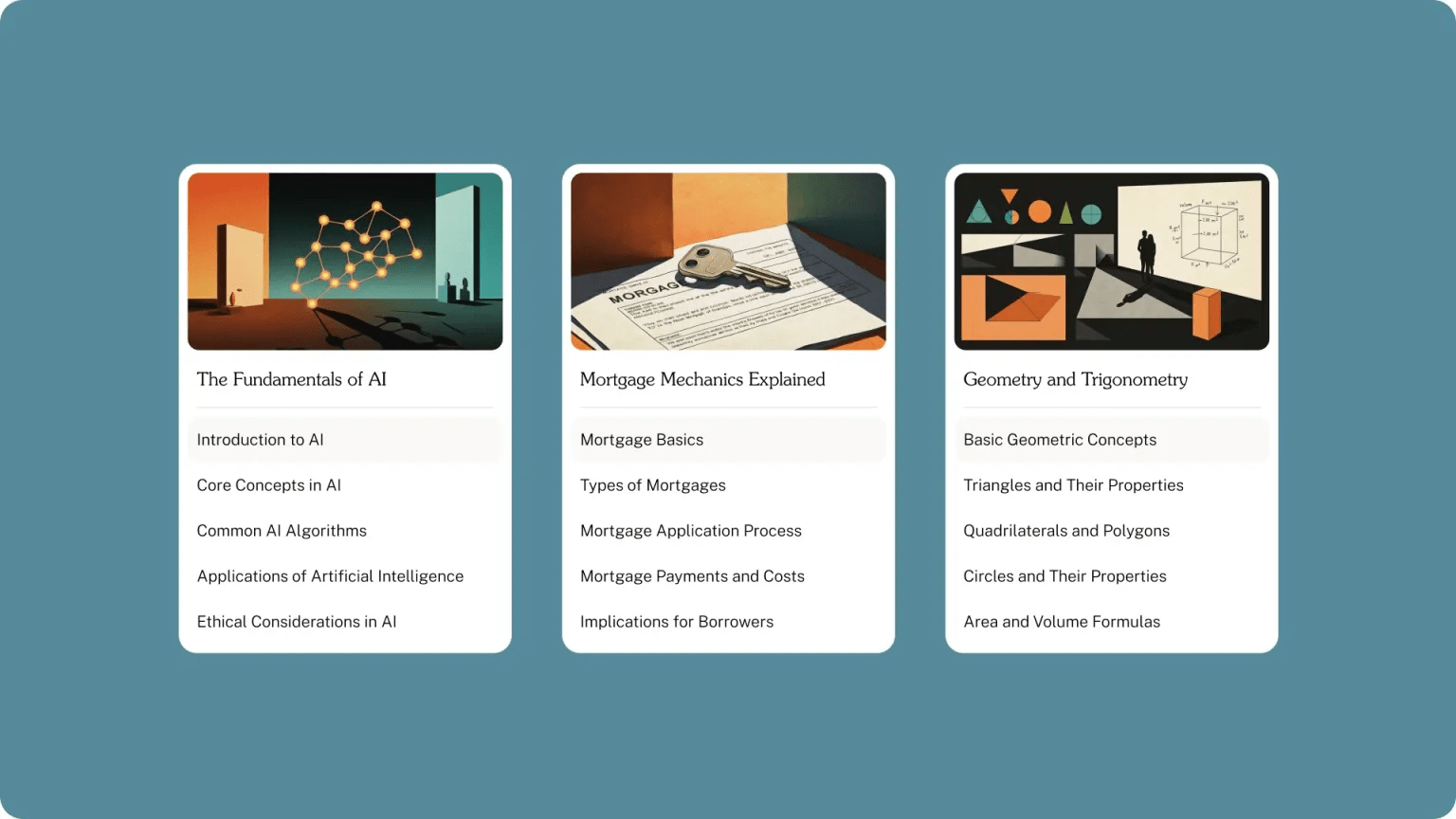
This isn't just another online course platform, nor is it simply an AI chatbot packaged as a learning tool. Oboe is building a completely new learning architecture that understands your learning style, adapts to your pace, and gets smarter with use. I believe this represents a true revolution in online education.
Why do traditional online learning methods always fail?
Before delving into Oboe's innovations, I'd like to discuss why most existing online learning methods are ineffective. Over the past decade, we've witnessed the rise of countless online education platforms, from Coursera to Udemy, from Khan Academy to various coding bootcamps. These platforms have indeed made educational resources more accessible, but one undeniable fact remains: most people cannot stick to online courses, and the learning outcomes are far less effective than offline education.
I believe the root of the problem lies in the fact that traditional online learning platforms merely move offline classrooms online without addressing the fundamental challenges of digital learning. They offer static, one-size-fits-all content, assuming all students learn in the same way and at the same pace. A person with no prior programming experience and a developer with five years of experience might see exactly the same course content on these platforms. Worse still, these platforms fail to understand what you truly want to learn and why, and they cannot dynamically adjust the content based on your learning progress and comprehension ability.
There's a deeper problem: the activation energy is too high. When you want to learn a new topic, you need to search for related courses, browse numerous options, read course outlines, assess whether the difficulty level is appropriate, and only then can you begin learning. This process itself is fraught with friction, and many people give up before they even start learning. I've seen far too many people buy online courses but never even finish the first lesson. This isn't because they lack motivation, but because the entire system is poorly designed.
Research data also supports this view. Studies show that students who take notes digitally have a significantly lower knowledge retention rate than those who take notes by hand. Online learning completion rates are typically below 10%, and of those who complete the course, the proportion who can actually apply the knowledge in practice is even smaller. This indicates that the problem lies not only in the quality of the content, but also in the inherent flaws in the entire underlying architecture of online learning from the outset.
In an interview, Nir Zicherman put it bluntly: "The word 'education' conjures up images of formal academic environments and the prescribed courses students are accustomed to from a young age. But the truth is, we are all lifelong learners. We spend a lot of time on the internet trying to better understand things, but the truth is, the internet was designed to grab our attention, not to teach effectively." This statement hits the nail on the head: existing online learning tools are not designed for real learning.
Where does Oboe's groundbreaking innovation lie?
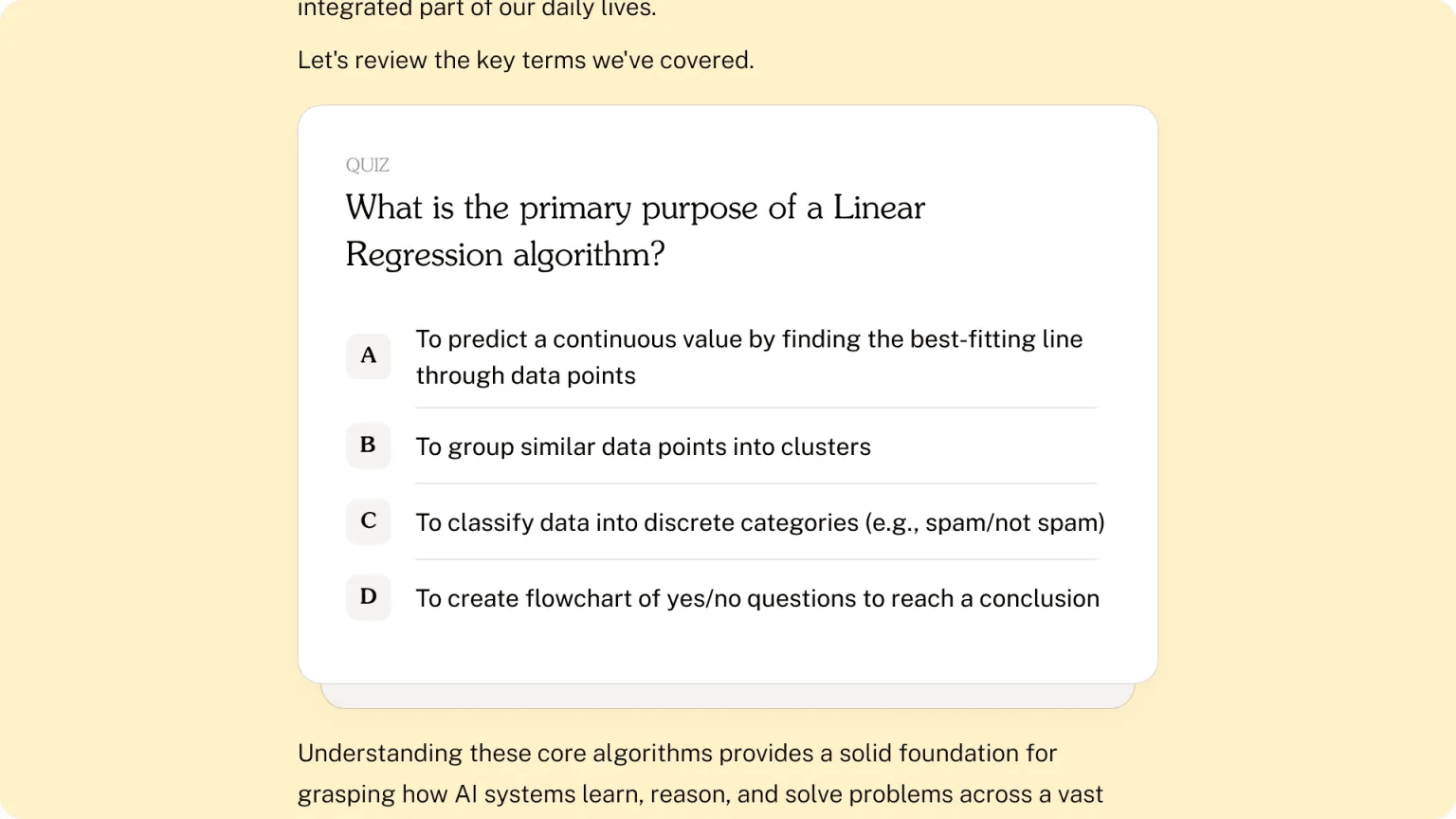
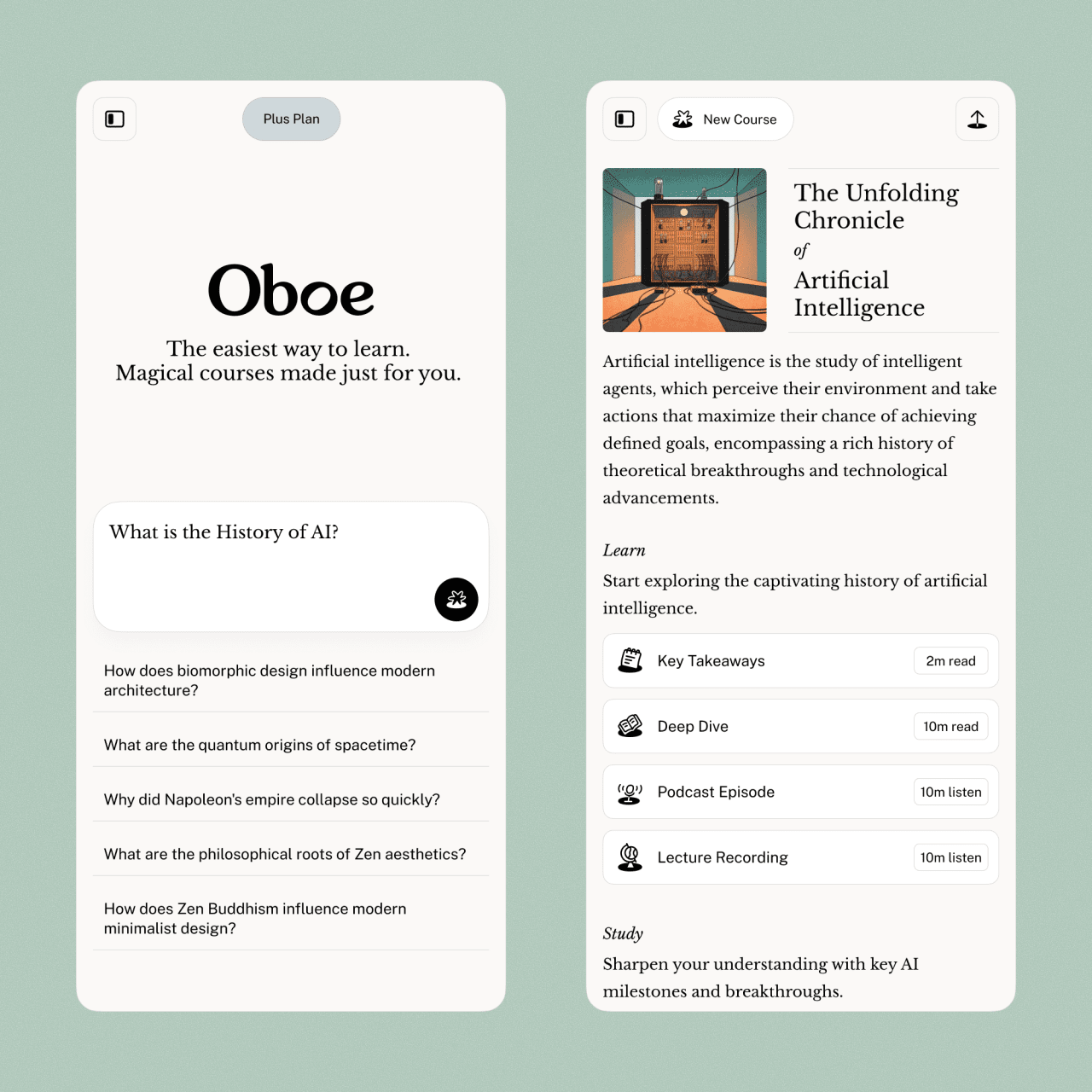
When I first experienced Oboe, what impressed me most wasn't the speed at which it generated content, but rather its rethinking of the learning process. You simply input a learning goal, such as "I want to understand the science behind coastal erosion" or "I want to learn the basics of AI," and Oboe will generate a complete, structured course for you within seconds. This course isn't just a simple compilation of text; it's a multimodal learning experience that includes chapter divisions, visual materials, audio explanations, interactive quizzes, and flashcards.
I believe Oboe's real innovation lies in its sophisticated multi-AI agent architecture. Nir explained in an interview, "The real magic comes from the internal architecture we built from scratch, which I would describe as a complex multi-AI agent architecture where each component is meticulously orchestrated and runs in parallel during course generation. The challenge was how to create high-quality, fully personalized courses that could be generated extremely quickly? All of this happens in seconds."
The system operates in a very sophisticated way. Different AI agents are responsible for different tasks: some develop the course framework, some develop and validate the basic materials to be taught, some write podcast scripts, and some extract real images from the internet instead of AI-generated ones and integrate these visual materials into the reading format. There are also agents specifically responsible for reviewing the content to ensure that the courses are accurate, high-quality, and personalized to meet the learning needs of users.
But I think what's more important is Oboe's reflection on long-term learning. Nir emphasized a key point: large language models themselves cannot support effective long-term learning. He said, "The infrastructure driving large language models is inherently unable to sustain effective, high-quality learning over a long period. When I say long-term, I mean students taking courses for an entire semester, not just cramming for a final exam." This insight is very profound because it reveals why tools like ChatGPT, while able to answer questions, cannot truly become effective learning platforms.
The problem with LLMs is that they operate based on probabilistic models, meaning the likelihood of errors and illusions actually increases as the conversation progresses. The longer the context window and the longer the conversation lasts, the higher the probability of system drift and accumulated errors. If you've ever had a long conversation with any LLM, you'll find that their quality degrades over time. This is fatal for scenarios that require months or even years of continuous learning.
Oboe's solution is to build a completely opposite system: the more you interact with the platform, the better it becomes at teaching you. It understands how you learn, what motivates you, and what media and formats you prefer for learning. Are you a visual learner? Do you have a good memory? Do you need many examples? What type of examples do you need? Like a real tutor, the longer you spend with it, the better it understands how to teach you. This is something LLM can't do.
From a technical perspective, Oboe employs a hybrid architecture. It relies on LLM—without LLM, Oboe wouldn't exist. But it also builds a unique, proprietary data architecture that allows Oboe to do things that traditional LLM alone couldn't. Nir says, "I think it's a hybrid approach, relying on LLM—as I said, this wouldn't be possible without LLM—but it also has half unique proprietary architecture and data architecture, which I think allows us to do things that traditional LLM alone couldn't do. It's this combination that unlocks the magic of building a learning platform that's better than anything before."
From podcasts to education: The unique strengths of the founding team
After learning about the founding team of Oboe, I better understand why they were able to create such a product. Nir Zicherman and Michael Mignano previously founded Anchor, a platform that allows anyone to easily create and publish podcasts. Before being acquired by Spotify in 2021, Anchor had raised $25 million in funding, had over 100 employees, and more than 300 clients. More importantly, Anchor successfully democratized podcast creation, enabling countless people who previously lacked technical skills to produce podcasts.
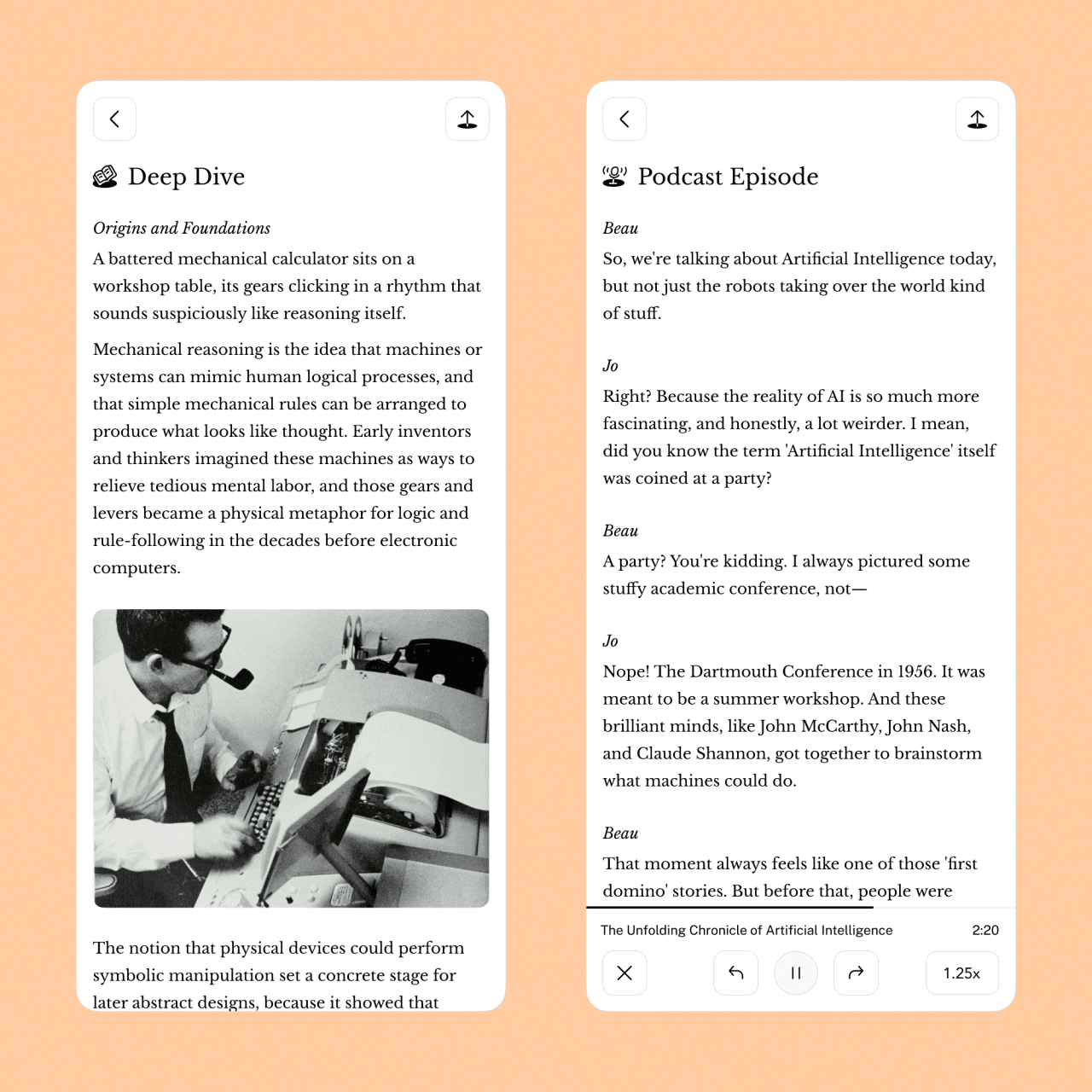
I believe this experience gave them two key advantages. The first is a deep understanding of narrative and content design. Podcasts are essentially a narrative medium, and how to make content both interesting and valuable, how to maintain listener attention, and how to convey information through sound—these are the core competencies that the Anchor team has accumulated. Now they apply these competencies to the design of educational content. Oboe offers audio courses in two formats: one is more like a university lecture, and the other is similar to Google NotebookLM, with two hosts discussing the topic in depth. This diverse presentation style stems from their deep understanding of audio content.
The second advantage lies in their understanding of product distribution and user growth. In Anchor's early days, their biggest challenge was getting their content seen by a wider audience. They tried various distribution strategies and ultimately realized they had to leverage existing distribution channels—traditional podcast platforms—rather than trying to create a completely new, closed ecosystem. This lesson is also reflected in Oboe's product design: Oboe allows paid users to export course content and consume it outside the platform, rather than trying to lock users into its own ecosystem.
When announcing the investment, a16z partner Bryan Kim specifically mentioned one aspect that impressed him: the speed at which Oboe generates content. He said they had been looking for the right AI-assisted learning company, and when Oboe launched, they tried the product and immediately fell in love with it. "We wanted to support a founder who was ambitious, flexible enough to adopt different formats, and understood AI to build a large platform. We found those qualities in Oboe."
This assessment is interesting because it emphasizes not the technology itself, but the founder's vision and execution capabilities. In the AI era, the technical barriers to entry for startups have actually decreased; the key lies in whether you truly understand user needs and have the ability to iterate quickly and find a product-market fit. Nir and his team have already proven this capability once, and now they are proving it again in the education sector.
In-depth thinking on product design
After delving into Oboe's product evolution, I gained a deeper understanding of their design philosophy. In its initial version, Oboe generated different text and audio formats for users, allowing them to choose different styles, but the number of courses generated per month was limited. While this design provided flexibility, it also increased the burden of choice for users.
In its new version, Oboe has made a key change: the app first understands your learning objectives and then generates chapters based on those objectives to help you learn those topics. More importantly, users will see quizzes and other modalities seamlessly integrated into the course materials. For some courses, Oboe will also generate flashcards to help you easily remember the content. The thinking behind this design is: instead of letting users decide what format to use for learning, let the system determine the best presentation method based on the content and learning objectives.
The audio improvements are also quite interesting. Previously, users had to choose between podcast and lecture formats; now, Oboe automatically generates podcasts for you and adjusts its tone based on the learning material and other user signals. This reflects an important product philosophy: reducing the user's cognitive load and allowing the system to make more intelligent decisions.
Nir mentioned that they have observed a high demand from users for learning STEM subjects (science, technology, engineering, and mathematics). Therefore, the company is making special efforts to find the highest quality materials for these subjects, including programming. He said, "Good teachers determine what is best for students to learn, and our company is adopting this approach to designing courses for learners."
This statement reminds me of a deeper question: what should educational product design look like in the AI era? I think Oboe provides a great answer: it's not simply about using AI to generate content, but about using AI to simulate the thought process of excellent teachers. Excellent teachers don't teach the exact same lessons to all students; they adjust their teaching methods based on each student's unique characteristics. Oboe is attempting to use technology to achieve this personalization.
The Business Logic Behind Pricing Strategies
Oboe's pricing model changes are also noteworthy. They've completely redesigned their pricing strategy, offering unlimited course generation to all users. However, if you want to delve deeper into a particular topic, you can pay $15 per month ($144 per year) to access more course chapters. There's also a premium plan for $40 per month ($384 per year) that provides unlimited chapter access and allows users to export or download courses for use outside of Oboe.
I think this pricing strategy is very clever. It solves several key problems: lowering the barrier to entry for users by allowing them to quickly experience the product's value through free, unlimited course generation; providing paid options for in-depth users, as those who truly want to systematically learn a particular topic are willing to pay for more advanced content; and offering offline learning options for specific groups such as students, meeting their needs for printed learning materials and offline consumption.
More importantly, this pricing strategy reflects Oboe's understanding of the nature of learning. Learning is not a one-time consumption, but a continuous process. Some people just want a quick overview of a topic, while others want to delve deeper. Oboe's tiered pricing allows users with different needs to find a solution that suits them.
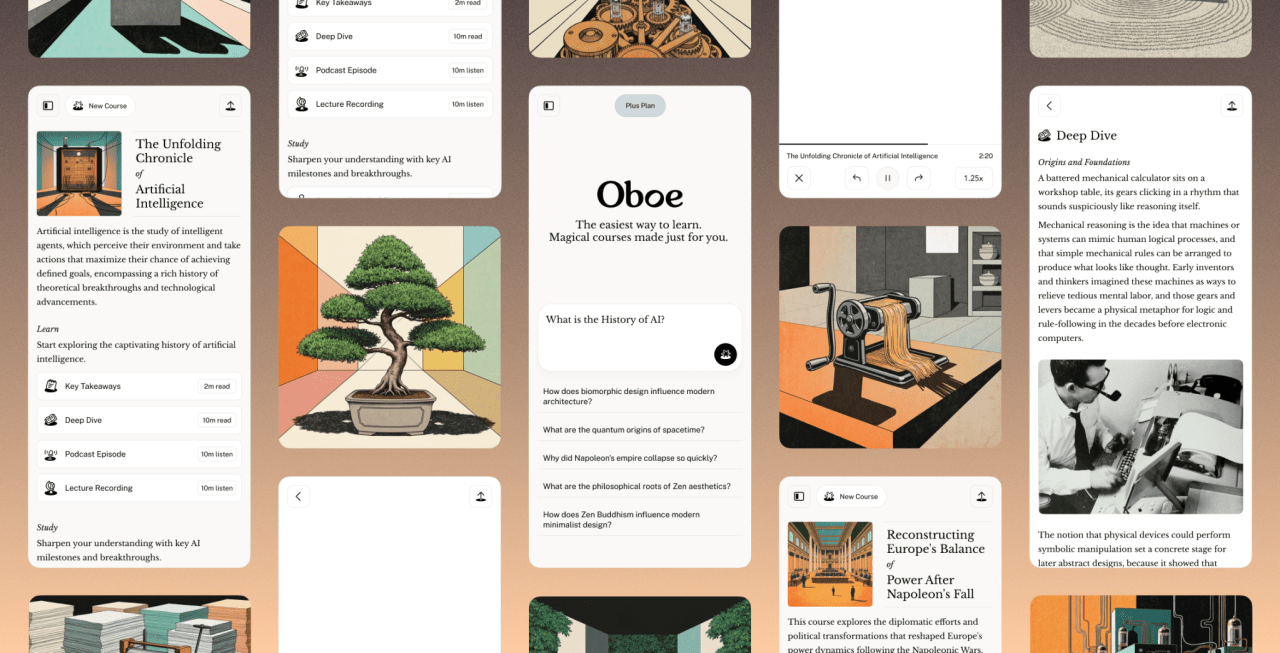
From a business perspective, this "freemium" model also makes user growth easier. In the education sector, user acquisition costs have always been high because people often require a long evaluation period before paying for educational products. By offering free core features, Oboe can quickly build a user base and then convert free users into paying users through a superior product experience.
In the interview, Nir mentioned that while their courses are currently offered in English, they hope to better reach different regions of the world through localized courses and language support. The platform is currently available on a website, with plans to launch mobile support in the future. This expansion plan is also pragmatic: first validate the product model in one market (English-speaking users) before expanding to other languages and regions.
Why Now is the Best Time for AI Learning Tools to Explode
I've been pondering a question: why is it only now that products like Oboe are emerging? The answer is that the technology has just matured. Large language models have made a qualitative leap in the past two years, evolving from simply generating text to understanding context, performing reasoning, and invoking tools. But more importantly, people's expectations of AI have also changed.
A few years ago, if you told users that "AI can generate a personalized course for you," most people would be skeptical. But now, educated by products like ChatGPT, users have become accustomed to AI-generated content. Their expectations are no longer "Can AI do it?" but rather "How well can AI do it?" This shift in mindset has created market opportunities for products like Oboe.
From a cost perspective, the significant decrease in AI inference costs has made products like Oboe, which require substantial AI computation, economically viable. Imagine generating personalized, multimodal courses for each user; two years ago, this would have been prohibitively expensive to sustain a viable business model. Now, with improved model efficiency and reduced inference costs, it has become a viable business solution.
The changing competitive landscape is also interesting. Many AI learning tools have emerged in the past few years, including Google's NotebookLM and Huxli, founded by former Google employees. These tools let you input a prompt to get a podcast episode to explore a topic. But as Nir points out, these are one-off generation, while Oboe's approach allows you to delve deeper into a topic through chapter-based learning.
I think this comparison reveals a key difference: one-off content generation and a systematic learning experience are two completely different things. NotebookLM can generate a podcast episode on a specific topic, which is cool, but it can't help you build a complete knowledge system. Oboe, on the other hand, attempts to provide a complete learning path, from beginner to advanced, with each step carefully designed.
In his investment memo, Bryan Kim wrote, "Curiosity is the essence of being human. It's how we improve our lives, interpret the world, and open doors to new understandings. Yet for many, that spark has faded—not because curiosity has disappeared, but because learning new, meaningful things is both difficult and time-consuming." I wholeheartedly agree. Technology should lower the barrier to learning, not raise it. Oboe is working in that direction.
What will the future of learning look like?
My conversation with Nir gave me new insights into the future of learning. He raised a very interesting point: we shouldn't call Oboe an "education platform," but rather a "learning platform." This isn't just a difference in terminology, but a fundamental expansion of the vision's scope.
The word "education" conjures up images of formal academic settings like schools, courses, and exams. But learning is a broader concept; it encompasses our curiosity and exploration of everything in our daily lives. Nir provides a vivid example: the physical world we encounter every day contains countless things we don't fully understand. In the not-too-distant future, you should be able to learn anything you encounter—not just things in the digital realm.
He said, "One of my dreams is that, in the short term, you should be able to learn about anything you encounter in the digital realm. Anything you don't understand, anything you need context for, you should be able to incorporate into your curriculum and fully comprehend it through Oboe's teaching tools. But there's no reason to think this should be limited to the digital world."
This makes me imagine a scenario: You see a painting in a museum, scan it with your phone, and Oboe generates a complete course for you about the painting, the painter, and the art movement. You see a tree in a park and want to learn about its biological characteristics and ecological role, and Oboe immediately creates a botany course for you. You read about an economic concept in the news and want to understand it in depth, and Oboe generates a personalized economics course based on your knowledge level.
Nir said, "The key is the entry point—how I access Oboe's ability to teach me something, and what Oboe can teach me. The really ambitious thing is that it doesn't have to be limited to everything online, it can be everything. That's how it really makes humans smarter, that's how it really elevates what we can do: whenever a person wants to better understand anything, no matter where it is, no matter how they interact with it, they should be able to come to Oboe and achieve that."
This vision reminds me of scenes from science fiction, but it's not far off. With the development of augmented reality technology, the widespread adoption of the Internet of Things, and the continuous improvement of AI capabilities, seamlessly integrating digital learning experiences into the physical world is entirely feasible. And the underlying architecture and learning engine that Oboe is currently building forms the foundation for realizing this vision.
Implications for the online education industry
Looking back at Oboe's story, I believe it offers several important insights for the entire online education industry. The first is that innovation in user experience alone is no longer sufficient. Over the past decade, we've seen many EdTech companies focus on creating beautiful interfaces, smooth interactions, and gamified design. These are all important, but they fail to address the fundamental problem of education—how to make learning truly effective.
Nir made the difference between Anchor and Oboe clear: "I think Anchor's user interface is a major aspect of our innovation. We build products in a very outdated industry, with a lot of traditional ways of doing things. We have this core value of 'building the future,' which means we don't care about the past; we just focus on building things the way they should be in the future. But I think Oboe is very different. I think in education, the problem isn't user experience. There are a lot of beautiful products in education, with gorgeous user interfaces and truly smooth, seamless, fun, gamified, and accessible user experiences. I don't think the room for improvement is there. I think in education, it's a fundamental issue of underlying architecture and content."
The second lesson is that product innovation in the AI era requires focusing on the underlying architecture. Simply wrapping an LLM in a pretty interface is not enough; the real competitive advantage comes from the proprietary technologies and data architecture you build. Oboe's multi-AI agent system, which it has invested heavily in building, and its learning engine that can improve over time, are the sources of its long-term competitive advantage.
The third lesson is the importance of patiently iterating on the product. Nir repeatedly emphasized in the interview that they held a "strong belief but loose adherence" attitude towards the specific implementation of the product. He knew that many assumptions would prove wrong, and the product needed continuous evolution. But at the same time, he had a stronger belief in the underlying architecture and long-term vision. This balance between flexibility and steadfastness is key to successful entrepreneurship.
The fourth lesson is: start with a niche market and expand gradually. Oboe's current focus on English-language content and STEM topics is a wise strategy. Instead of trying to cover all languages and subjects from the outset, it's better to first prove product value and build a reputation in a niche market before expanding. This pragmatic approach is especially important in the early stages of a startup with limited resources.
The final takeaway is that being mission-driven is crucial. "Making humans smarter" is a grand mission, but it's precisely this sense of mission that attracts top team members, investors, and early adopters. In the AI era, the technical barriers have lowered, and many can quickly build product prototypes. What truly sets a company apart is a deep understanding of the problem it's solving and an enduring passion for it.
We also welcome everyone to leave comments and share your opinions!
