I opened the chart $YGG today, saw $0.0702 with a loss of 2.77%, and instead of the usual despair, I felt something different, some strange clarity of mind. Maybe because after months of red days, the brain just stops reacting to pain, or maybe because I finally started to understand the true picture of what is happening with @YieldGuildGames. The price is between $0.0675 and $0.0723 for the day, we are practically at the daily minimum, but if we step away from emotions and look at the technical picture soberly, there is something interesting to see.
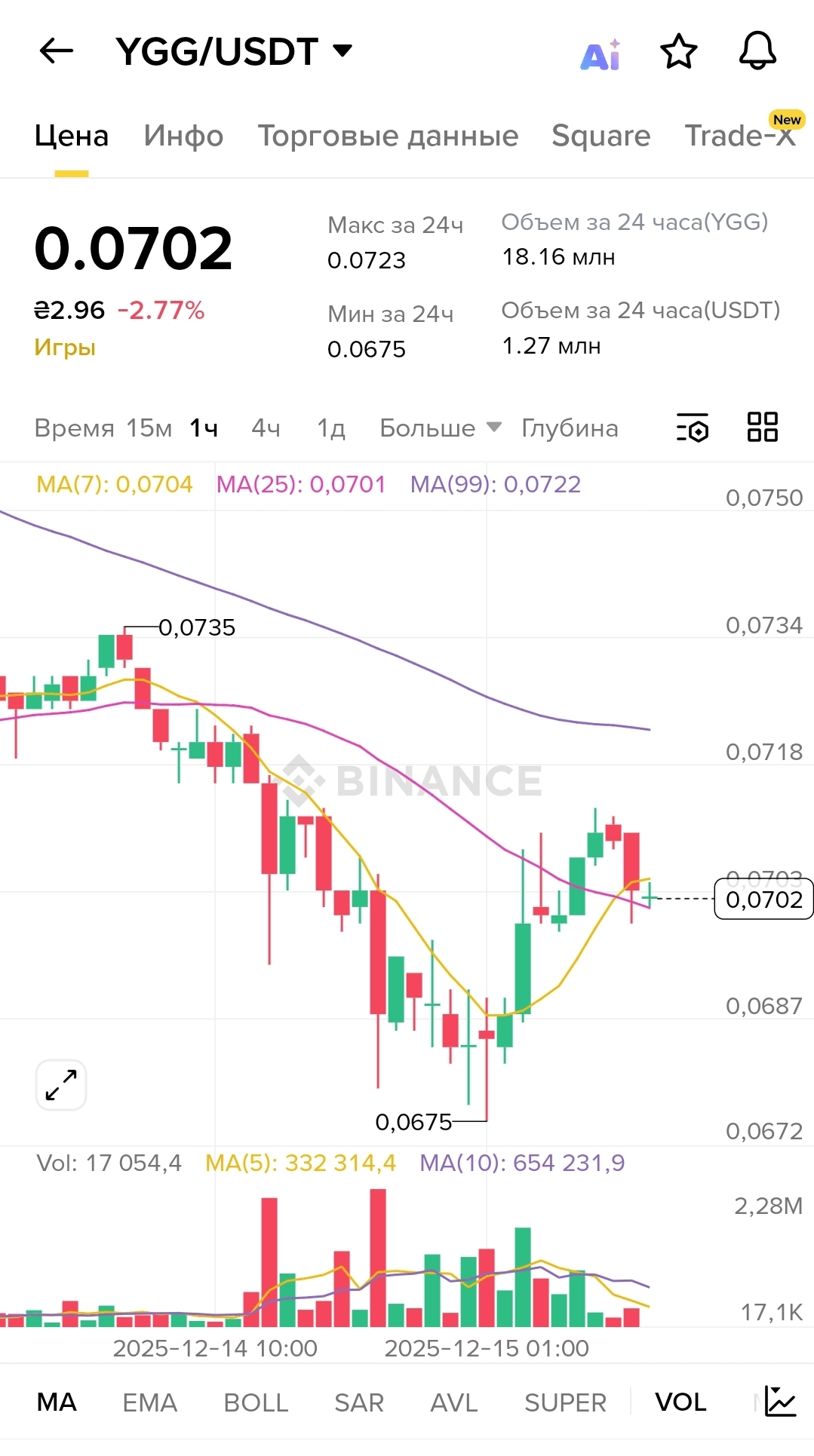
All three moving averages have compressed into one narrow range, MA7 at 0.0704, MA25 at 0.0701, MA99 at 0.0722, with the difference between them being less than three percent. When I first saw such compression, I didn’t understand what it meant, but then I remembered reading in some book about technical analysis. When moving averages converge at one point after a long trend, it is called volatility compression, and this usually precedes a sharp movement in one direction. Imagine a spring that is being compressed more and more, energy builds up, and then it either shoots up or falls down, but rarely stays in place for long.
The volumes tell an even more interesting story. Eighteen million YGG in one day is 1.27 million dollars, and if we compare it to the five-day average of only 332 thousand, we see almost a fourfold increase in activity. But the most interesting thing is not just the growth but the nature of these volumes. Looking at the histogram below, I see that the last bars are quite high, but these are not the giant red columns of panic we saw when the price dropped to 0.0695 earlier. This is more even trading, with green and red bars approximately the same height, which usually means not panic selling but redistribution of tokens among different groups of investors.
Let’s talk about what has actually changed in YGG over the past few months because there is news, and it is important. They launched the YGG Play Launchpad back in October, creating a platform where you can find your favorite web3 games from YGG, a quest system where you complete tasks in games and in return gain access to new game tokens on the platform before the public launch. This is not just a marketing feature; it is a real change in the business model, moving from a guild that invests in gaming assets to a publishing platform that curates and promotes games.
What impressed me when I started digging deeper was the scale of plans for 2026. The Guild Protocol that YGG is developing is set to evolve into a coordination layer not only for gamers but also for any on-chain communities, from content creators to groups that label data for artificial intelligence. It's no longer just about gaming; it's about creating infrastructure for any group of people who want to coordinate their activities and distribute rewards transparently on-chain. Imagine a freelance platform where instead of a centralized intermediary like Upwork, there is just a smart contract that automatically distributes payment among project participants based on their contributions.
LOL Land, one of the games in the YGG ecosystem, earned four and a half million dollars from May to August 2025, and part of that money went to buyback YGG from the market, totaling one and a half million dollars in buybacks for the year. This is real money, not venture capital or tokens from thin air, but profit from operational activities. When a project can generate revenue and use it to reduce the supply of its token, it fundamentally changes the economics.
Looking at the candlestick chart in more detail, I see that after falling to 0.0675, there was an attempt to recover, a few green candles lifted us to 0.0723, but then a pullback came. A pattern is now forming that technical analysts call a symmetrical triangle, where the support line is going up and the resistance line is going down, and these two lines converge at one point. Usually, the price breaks through such a triangle at 75% of its length, meaning closer to the peak, and the direction of the breakout determines the next trend.
#YGGPlay is not just a hashtag; it’s a philosophy of how web3 gaming should work after all the failures of the past. They redesigned the quest system after the end of the tenth season in August, now focusing on tasks that require real skills rather than just mechanical repetition of actions. Inter-game compatibility means that your achievements in one game can provide advantages in another, creating a true on-chain reputation for the player that has value regardless of the specific game.
Support at 0.0675 is a critical zone that has held for several days. If we break it down on high volume, the next stop may be around 0.065 or even 0.060, which will be psychologically difficult because it would mean that all hopes of forming a bottom were in vain. Resistance at 0.0722-0.0723 is the upper boundary of our triangle; breaking this level with volume above average could be the start of a real upward movement, the first target will be 0.075, then 0.080, and then even 0.10 doesn’t look so unattainable.
Analysts' forecasts look to 2026 with cautious optimism; some mention the potential for growth to 0.15-0.20 if the ecosystem continues to develop, others are more conservative and see a range of 0.08-0.12. But they all agree on one thing: the current price does not reflect the fundamental value of what is being built, and if YGG can execute its roadmap, the gap between price and value will eventually close.
Right now, the price is 0.0702, and I understand that the next few weeks will be critical. If we hold above 0.0675 and start moving toward the upper boundary of the triangle, it will be the first positive signal in a long time. If we fall below, we will need to re-evaluate the entire investment thesis and possibly take losses. But for now, I see a project that is building something real, a team that has learned from past mistakes, and a mechanism that makes sense, so I remain and wait for the moment when the market will finally see what I see right now.
#YGGPlay @Yield Guild Games $YGG