
- Bitcoin price stabilizes overall as the Fed's cautious stance on future interest rate cuts impacts cryptocurrency markets.
- A slight increase in institutional demand for Bitcoin through exchange-traded funds, while Strategy adds an additional ten thousand Bitcoins to its holdings.
- The price of Bitcoin is approaching a descending trend line, which, if broken, could open the door for a strong rally.
Bitcoin (BTC) continues to trade during the recent consolidation phase, hovering around $90,000 at the time of writing this text on Friday, as investors absorb the Fed's cautious interest rate reduction in December and its implications for risk assets.
Bitcoin's price movement is approaching a major descending trend line that could define its next directional movement. At the same time, institutional flows into spot Bitcoin funds showed moderate inflows, and Strategy added more Bitcoin to its reserves.
## Fed policy tone stirs consolidation in Bitcoin
Bitcoin started the week on a positive note, continuing its recovery during the weekend and remaining above $92,600 on Tuesday.
However, momentum eased on Wednesday, as BTC closed at $92,015 after the Federal Open Market Committee (FOMC) meeting.
In a widely anticipated move, the Fed lowered interest rates by 25 basis points. However, the FOMC meeting indicated a possible pause in January.
To enhance caution, policymakers anticipated only a quarter-point reduction in the overall forecast for 2026. This was the same expectation as in September, which tempered market expectations for two interest rate cuts and contributed to short-term pressure on short-duration risk assets.
The Fed's cautious approach, along with disappointing Oracle earnings, contributed to a short move away from risk.
All these factors affected the riskiest assets, as the largest cryptocurrency by market capitalization dropped to a low of $89,260 before bouncing back to close above $92,500 on Thursday.
With no major data coming out in the U.S., cryptocurrency markets will now look to speeches from FOMC members and a broader trend in risk sentiment over the weekend.
Bitcoin is likely to consolidate in the near term unless a significant catalyst emerges.
## Uncertainty between Russia and Ukraine limits risk momentum
On the geopolitical front, U.S. President Donald Trump expressed being "very frustrated" with Russia and Ukraine and does not want further talks, according to a spokesperson on Thursday.
Earlier, Ukrainian President Volodymyr Zelensky stated that the United States is pushing the country to concede land to Russia as part of an agreement to end a war that has lasted nearly four years.
These ongoing geopolitical tensions and stalled peace talks continue to affect global risk sentiment, limiting risk appetite and contributing to Bitcoin's consolidation so far this week.
## Institutional demand sees slight signs of improvement
Institutional demand for Bitcoin shows slight signs of improvement.
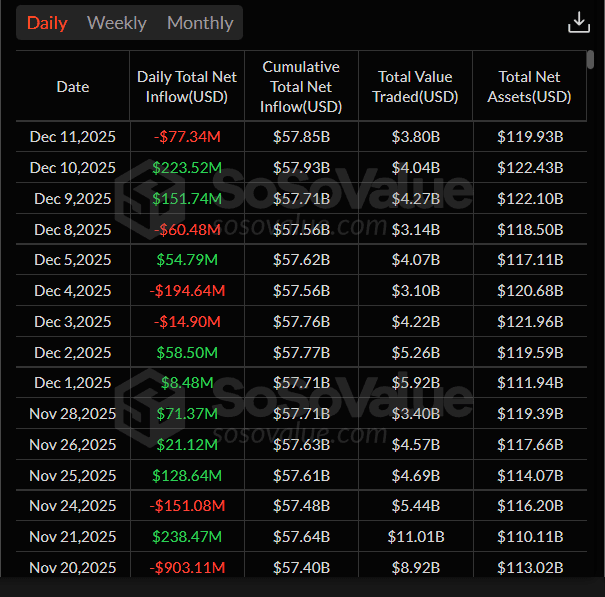
According to SoSoValue data, U.S.-listed Bitcoin ETFs recorded a total inflow of Bitcoin amounting to $237.44 million as of Thursday, following a slight outflow of $87.77 million a week ago, indicating a somewhat improved interest from institutional investors.
However, these weekly inflows remain small compared to those observed in mid-September. For BTC to continue its recovery, inflows into exchange-traded funds must increase.
Institutionally, Strategy Inc. (MSTR) announced on Monday that it purchased 10,624 Bitcoins for $962.7 million between December 1 and 7 at an average price of $90,615.
The company currently holds 660,624 Bitcoins worth $49.35 billion. Strategy still retains significant capacity to raise additional capital, which may allow for widespread accumulation of Bitcoin.
## On-chain data shows easing selling pressure
CryptoQuant's weekly report on Wednesday highlights that selling pressure on Bitcoin has begun to ease.
The report indicates that exchange deposits have decreased as major players reduce their transfers to exchanges.
The chart shows that the share of total deposits from major players dropped from a peak average of 47% over 24 hours in mid-November to 21% by Wednesday.
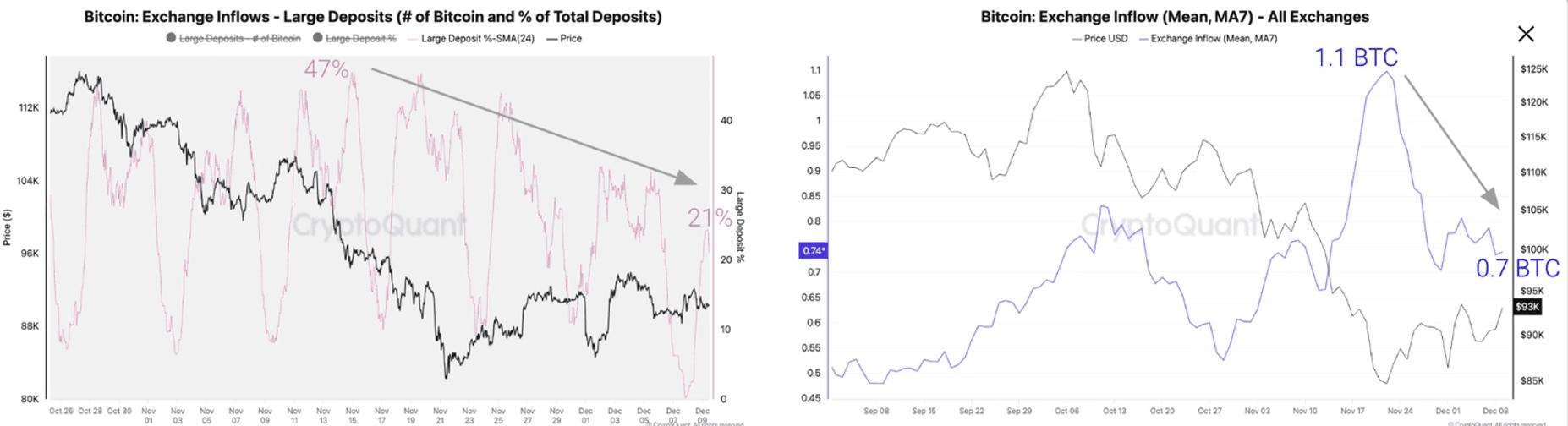
Meanwhile, the average deposit decreased by 36%, from 1.1 Bitcoin on November 22 to 0.7 Bitcoin.
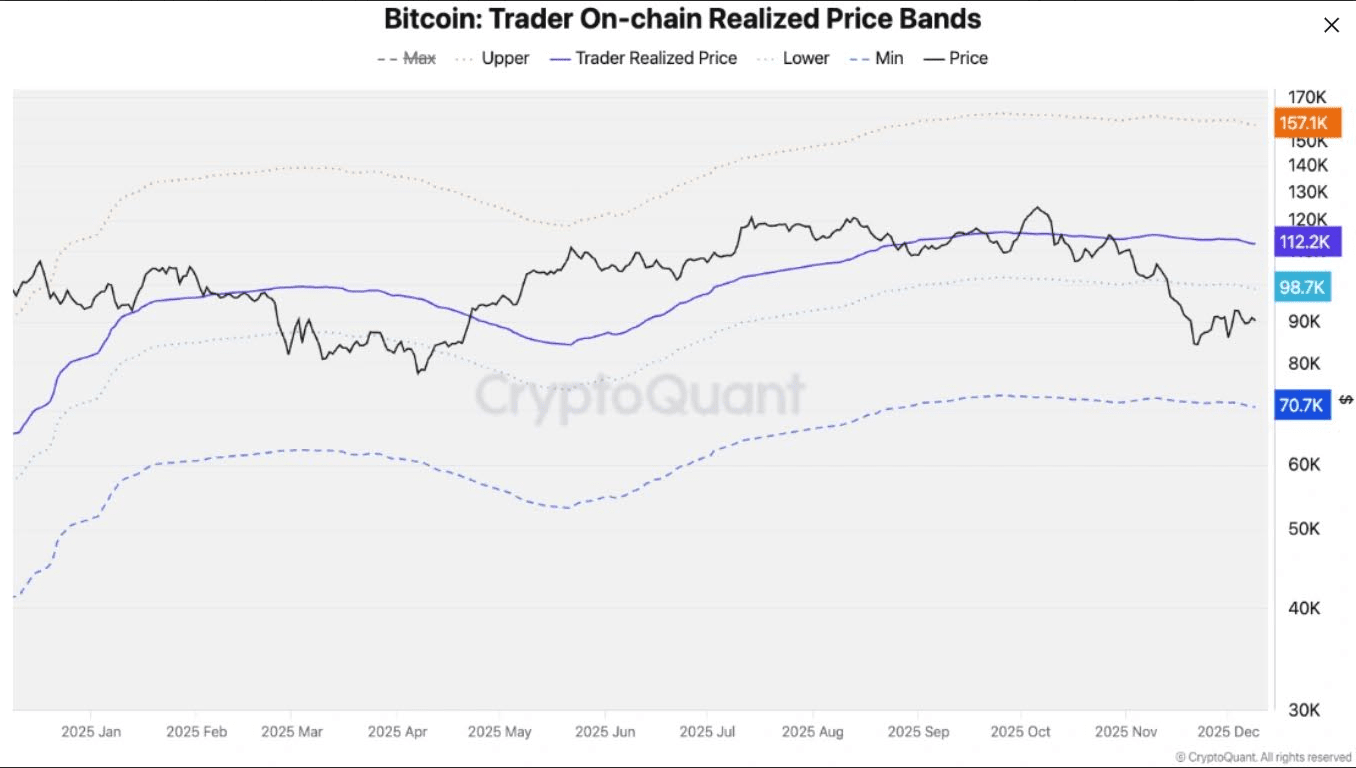
CryptoQuant concluded that if selling pressure remains low, a rise in dilution could push Bitcoin to $99,000. This level is the lower range of the realized price range on-chain from traders, and it is price resistance during bear markets.
After this level, the main price resistances are $102,000 (one-year moving average) and $112,000 (the realized price for traders on-chain).
Copper Research's report also noted optimism regarding Bitcoin. The report suggests that the four-year Bitcoin cycle has not ended; it has merely been replaced.
Since the launch of spot ETFs, Bitcoin has shown repeatable cycles between cost yield and basis.
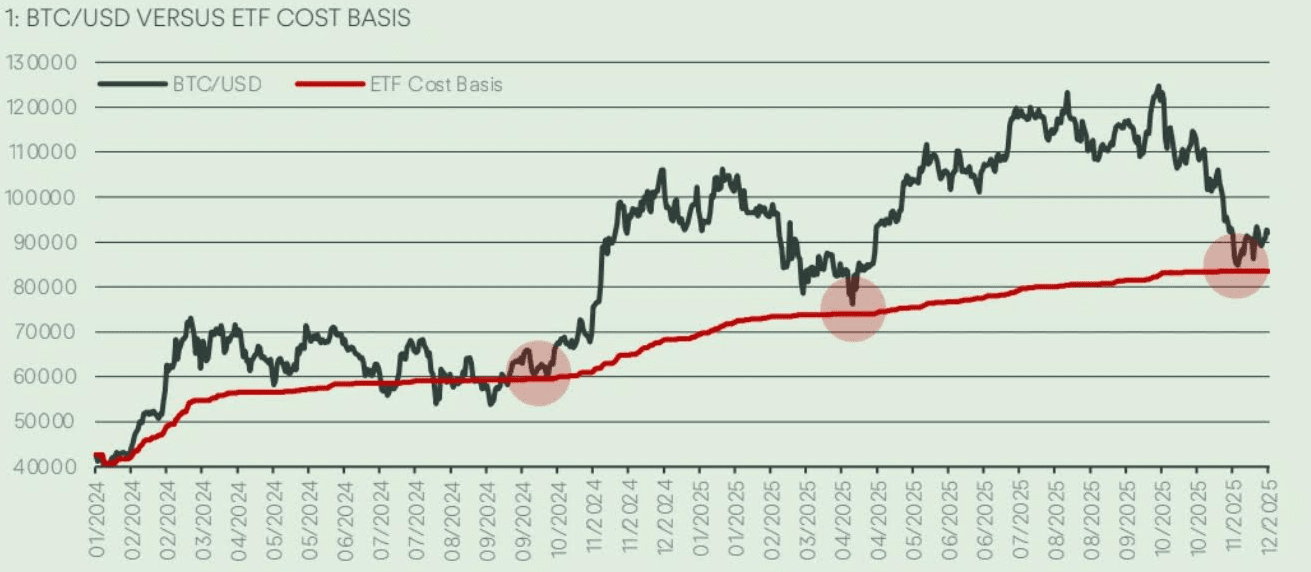
Fadi Abu Alfa, head of research at Copper, stated: "Since the launch of spot ETFs, Bitcoin has moved in small repeatable cycles as it returns to the cost basis and then rebounds by about 70%.
With Bitcoin now trading near a cost basis of $84,000, this pattern suggests a move north of $140,000 over the next 180 days.
If the cost basis rises by 10-15%, as in previous cycles, the resulting premium observed in prior peaks produces a targeted range of between $138,000 to $148,000.
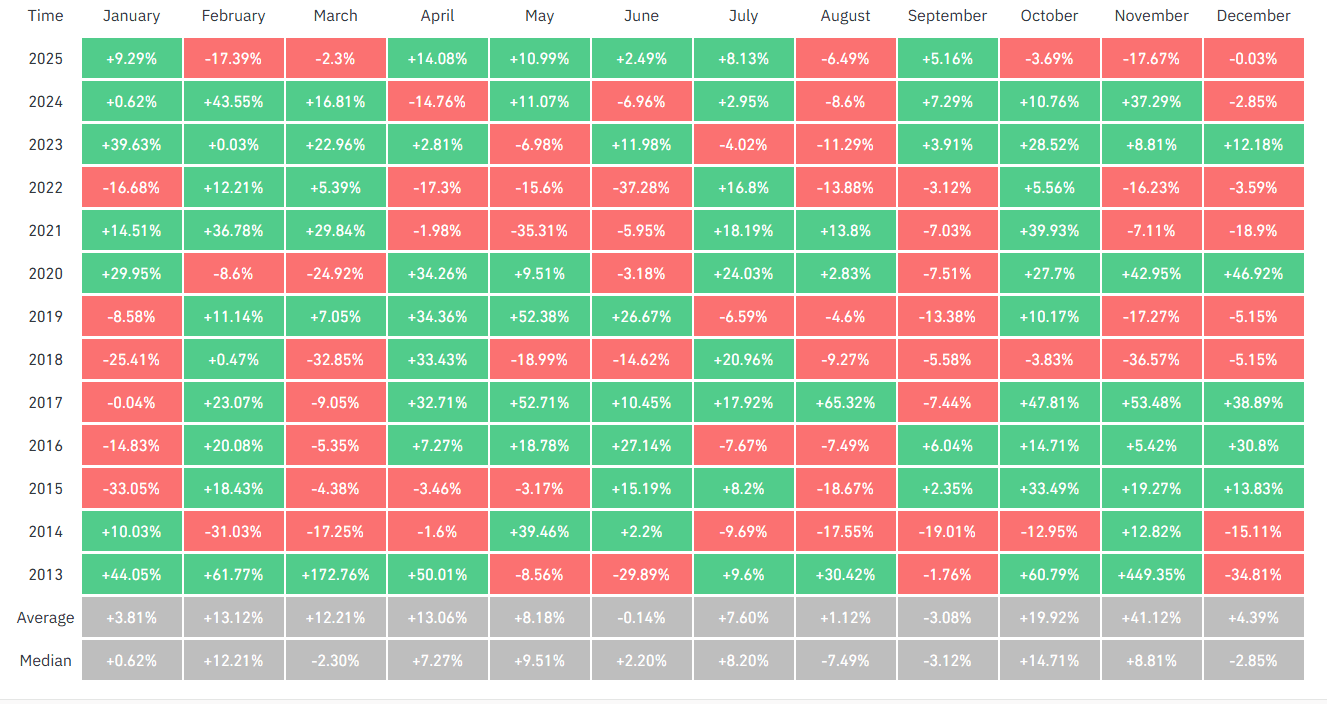
## Will Santa accumulate Bitcoin in the future?
Bitcoin recorded a loss of 17.67% in November, disappointing traders who anticipated a higher increase.

