

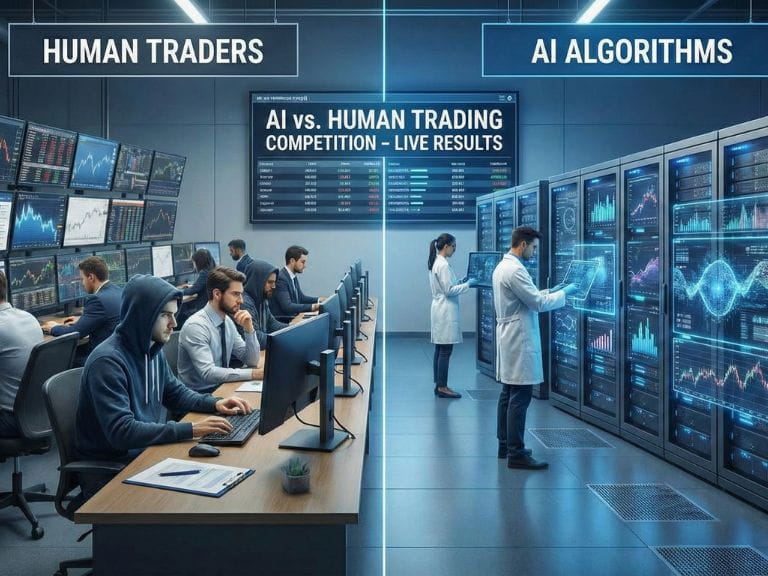
Aster invited 70 human traders and 30 AI models to participate in a trading competition, with each starting with $10,000 in capital and a prize pool of $200,000. The competition runs from December 9 to December 23, with live broadcasts on Aster's event page. Currently, the first place is held by the well-known trader Aoying Capital, who tripled their position in just one day. Statistics show that human traders consistently rank in the top 20, while also occupying the bottom 20 in performance. AI is concentrated in the middle to upper and middle to lower segments.
The AI trader segment currently leads with a profit of $618 using Alibaba's Qwen (extremely conservative version), outperforming various versions of Ernie 4.5 aggressive, Gemini 3 aggressive, and Claude Sonnet 4.5, which are the worst-performing models. Looking at trading volume and number of positions, AI adopts a strategy of small positions spread out, while humans tend to close positions or concentrate on a single position. Human PNL standard deviation: 4875.0. AI PNL standard deviation: 224.8. This indicates that the performance volatility of humans is more than 20 times that of AI.
Data shows: human trading has a higher upper limit and a lower lower limit
Currently, the top spot on the leaderboard is held by the well-known trader Eagle. In fact, on the first day of the event, he was at the bottom of the leaderboard, suggesting he must have grasped a major trend. He has tripled his initial capital of ten thousand dollars, with unrealized gains of 23,220 USD.
(From three thousand to forty million, the trading experiences of legendary cryptocurrency trader Eagle Capital)
The second place is the well-known poker player Wesley, who has currently made a profit of 20,000 USD. The third place is represented by @nextfckingthing from the English-speaking region, with a profit of 17,870 USD. Notably, his trading volume is 6.36 million USD, the second highest on the leaderboard. Familiar names from the Chinese-speaking area, such as Wind Without Direction and old drivers from the cryptocurrency circle, are in the top ten. However, from the 81st place onward, all are human traders, and even the trading club Alert has returned to zero. Overall, human trading has a higher upper limit and a lower lower limit, while AI focuses on the middle and later stages.
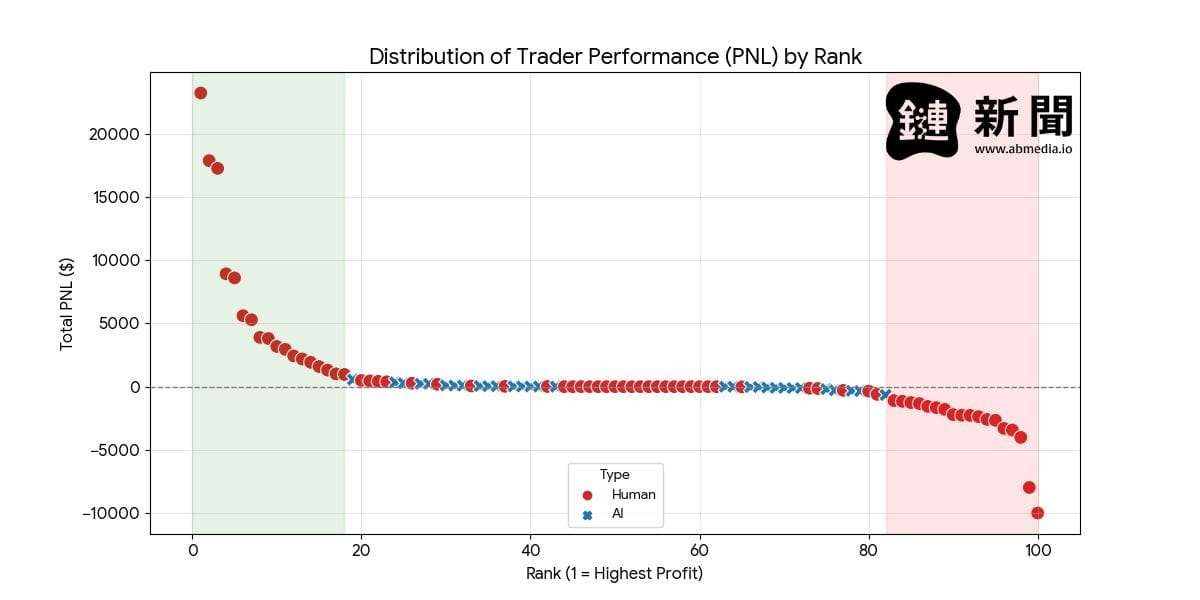 Image: Chain News
Currently, the AI trader, with Alibaba's Qwen (extremely conservative version), has made a profit of 618 USD, leading the pack. The conservative and balanced versions of Ernie 4.5 rank second and third respectively. Following them are DeepSeek 3.1 balanced version, ChatGPT 5 balanced version, DeepSeek 3.1 aggressive version, ChatGPT 4o conservative version, and ChatGPT 4o radical version. The aggressive version of Ernie 4.5, Gemini 3 aggressive version, and all versions of Claude Sonnet 4.5 are the worst performing models.
The performance fluctuation of human trading is more than 20 times that of AI
According to statistics, the average trading volume of human traders is about 623,000 USD, with an average of 0.83 positions held. The average trading volume of AI traders is about 99,000 USD, with an average of 5.30 positions held. AI's trading volume is much smaller than that of humans, but the number of positions is significantly higher, indicating that AI adopts a strategy of small, diversified positions, while humans tend to close out positions or concentrate on a single position.
If we further classify profits exceeding 1,000 USD as the profit group and losses exceeding 1,000 USD as the loss group, the average number of trades in the loss group (187 trades) is significantly higher than that of the profit group (132 trades), which may suggest a risk of making more mistakes or overtrading. Whether traders make large profits or large losses, their number of trades is significantly above average. This again confirms the previous observation: high activity levels are positively correlated with high volatility. When we further calculate the standard deviation:
Human PNL Standard Deviation: 4875.0 (High Volatility)
AI PNL Standard Deviation: 224.8 (Minimal Fluctuation)
This shows that human performance fluctuation is more than 20 times that of AI. This completely aligns with the characteristic of humans tending to take on high risks for high returns (or suffering high losses), while AI strictly implements risk control, pursuing a stable low-volatility strategy. Before the deadline, human team trading profits exceeded 60,000 USD, far ahead of the AI team's 741 USD.
This article asks: Can AI really replace human traders? Real competition data shows: humans currently have the upper hand, with performance fluctuations differing by 20 times. First appeared in Chain News ABMedia.