

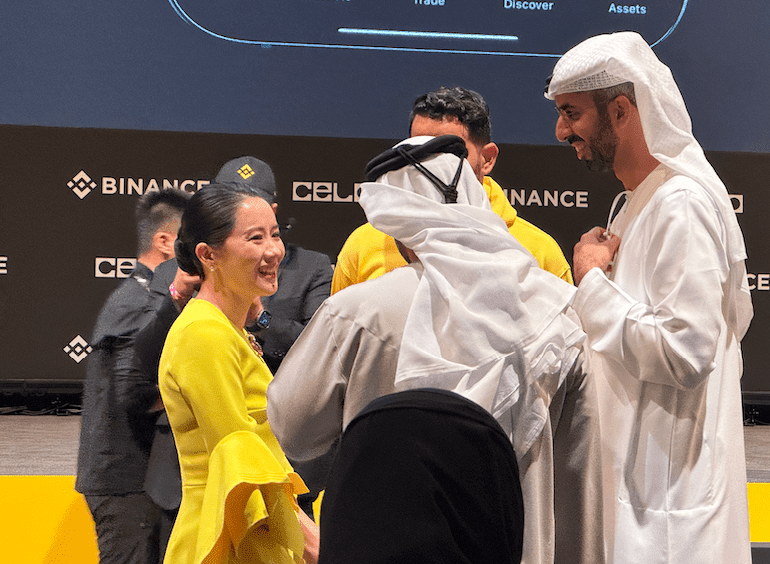
During the Binance Blockchain Week in December 2025, Binance co-founder He Yi announced she would become the co-CEO of Binance. Interviews that week revealed she would take on the responsibility of the world's largest cryptocurrency exchange, attempting to lead Binance towards a sustainable vision through organizational reform, technology integration, and value investment concepts. Below is a summary of some interview content.
Why did Binance activate a co-CEO? A new management structure of '1+1>2'
Under the new personnel arrangement, CEO Richard Teng leverages his compliance background and global regulatory communication, while He Yi focuses on corporate culture, human resources, and user experience. She stated that such a dual leadership system has precedents in traditional financial institutions like JPMorgan Chase, achieving professional division of labor and institutional efficiency.
She emphasized that more than a year ago, when she took over the HR department, she began to contemplate Binance's 'de-founderization' issue, striving to create a system-driven company organization rather than relying on individual heroism.
Binance's management philosophy: Inverted triangle organization and 'garden-style' growth mechanism.
As Binance's co-CEO, He Yi has not only taken over corporate culture and the HR department but has also vigorously promoted organizational management reform. She shared that she spent the past two years extensively researching organizational capabilities, attempting to transform Binance into an institution with 'self-evolving' capabilities rather than a traditional pyramid company.
'Our organization is more like a garden.' He Yi described that Binance is an environment with 'secondary growth' capabilities, where as long as an individual's growth genes are strong enough, they can find a place in this ecosystem. 'If you do things to the extreme, you are the boss, and you don't need to manage others, nor do you need others to manage you.'
She further explained that Binance adopts an 'inverted triangle' management model, meaning that the lowest management level supports the entire organization rather than high-level decision-makers. The benefit of this model is that the company can still operate normally even in the absence of specific individuals (such as herself). However, the downside is that newcomers may feel lost when they first enter the company, and may not even know who the final decision-maker, the 'boss', is.
'Every day newcomers ask me, why is everyone directing me? Who is the supervisor?' She joked that this confusion actually stems from Binance emphasizing that 'the loud and reasonable voices count,' rather than those in high positions being able to direct others.
However, she also frankly stated that this flat and proactive culture may not be friendly to some introverted or passive personalities. Sometimes, a strong newcomer becomes the 'silent top student', easily overshadowed by louder colleagues. This can lead to cultural misalignment, suppression of potential, and even become 'weeds' within the organization.
To address this issue, she emphasized that Binance encourages proactive cross-departmental upgrades and feedback to avoid 'hollow suggestions' that merely add icing on the cake. She stated, 'Neither Binance nor the outside world is afraid of critical voices. It is these disharmonious voices that help us discover problems faster and find solutions more quickly.'
This seemingly chaotic yet truly encouraging organizational philosophy demonstrates He Yi's concrete implementation of Binance's vision of 'de-personalization' and 'system-driven', paving the way for her to build a 'garden-type organization' that allows the company to continue growing in the rapidly changing crypto industry.
Denies 'white glove' rumors: No listing fees were collected, nor do they need to steal their own money.
In response to external doubts about the existence of 'white glove' assistance for listing within Binance, He Yi directly denied it and emphasized that 'Binance does not collect listing fees, the core is that the project needs to benefit users.' She believes that it is precisely because the listing threshold is high and the standards are strict that the market has seen impersonators. In this regard, Binance has zero tolerance and welcomes reports, willing to cooperate with law enforcement to severely punish violations.
As a female leader: It is not 'female advantage', but 'professional success'.
He Yi does not wish to be defined as a 'female CEO'. She stated, 'Using gender to gain likability in the workplace will ultimately backfire on your professional image in the long run.' She emphasized that whether in Web2 or Web3, professional capability is the core of the workplace. Gender is neither an advantage nor a limitation; 'the real ceiling is what you set for yourself.'
Binance's three major strategic pillars: user culture, organizational efficiency, and AI integration.
After taking on the role of co-CEO of Binance, He Yi will focus on three things:
Continuing the user-centric culture;
Building a systematic organization that does not rely on individual capabilities;
Integrating AI technology into Binance's internal operations to enhance efficiency and decision-making.
She believes that technological innovation will be the key driving force for Binance's future growth.
Facing meme coins and new tracks: From 'saying no to doing' to 'never say never'.
When discussing meme coins, contracts, and emerging prediction markets, He Yi admitted that in the past she had rejected new things due to a lack of understanding and learned from it: 'never say never'. Now she is more inclined to face innovation with an open and cautious attitude, even if she doesn't fully understand it yet, she won't easily deny its potential.
The challenge behind three hundred million users: It is not the product, but the talent density.
Binance has reached the milestone of three hundred million global users, but He Yi pointed out that the real challenge lies in 'talent density'. Compared to traditional finance and large tech companies, the crypto industry has long been stigmatized, making it difficult to attract top talent. She believes that building a team that understands finance and believes in the crypto industry is key for Binance to move to the next stage.
Hong Kong and U.S. layout: 'Feeling the way across the river' amid policy uncertainty.
When discussing the development potential of Hong Kong, He Yi stated that Binance adopts an open strategy, but pointed out that local exchanges still face limitations in accessing global liquidity, 'everything needs to be taken step by step.' As for the U.S. market, she frankly stated that the political game is too complex, and Binance is currently just a 'small company trying to survive in the cracks', unable to influence the overall situation, but will not give up trying.
Investment philosophy: The most decentralized asset is BTC, the most 'intense' company is Binance.
He Yi admires the investment logic of Duan Yongping and Buffett — holding top assets for the long term. In the crypto world, she believes Bitcoin (BTC) is the most decentralized asset, while Binance is the company with the greatest capacity for continuous innovation. She hopes to incubate more 'Binance series' companies like OPPO, VIVO, and Pinduoduo in the Binance ecosystem in the future.
Market volatility and retail protection: We do not compete with users.
He Yi pointed out that within Binance's trading mechanism, the company does not gamble against users, which allows retail investors to have a fairer chance even in extreme market conditions. For example, the 'October 11 flash crash' incident was caused by market makers halting operations, leading to a liquidity vacuum. She emphasized that this is the price of the platform's insistence on not competing against its users, as well as a commitment to a fair market.
Looking ahead: Not predicting ten years, but focusing on doing well in the present.
When discussing Binance's plans for 2026, He Yi admitted, 'There is no five-year plan, nor a ten-year plan,' because the industry changes too quickly. But she firmly stated, 'We will always be user-centric, creating products and services that make everyone feel secure and trustworthy.'
From the dream at 18 to the current driver: I just want to try.
He Yi recalled that at the age of 18, she once said she wanted to 'be someone who influences the world', and it seems she is now realizing this dream. She believes that the greatest driving force in life is the four words 'I want to try', which have driven her from host to entrepreneur, and now to CEO of Binance, fueled by curiosity and courage.
Facing confusion and pressure: The clouds are in the blue sky, and the water is in the bottle; everything has its arrangement.
In the extremely high-pressure work environment, she frankly admitted to experiencing countless 'the sky is falling' moments, including the October flash crash and misunderstandings from the outside world. But she faces everything with a philosophical attitude: 'The clouds are in the blue sky, and the water is in the bottle. Whatever fate gives you, live it well.'
This article features He Yi's interview: From 'I want to try' to co-CEO of Binance, the new management structure of '1+1>2' first appeared in Chain News ABMedia.
