

Most people still picture @Yield Guild Games as the Axie-era scholarship machine that rode the first wave of play-to-earn and then quietly faded with it. That version of YGG is already history. What’s taking shape now looks less like a “guild” and more like a protocol-level identity fabric for Web3 gaming a layer that sits beneath games, communities, and platforms, tying them together through players’ history, reputation, and coordination rather than just their wallets. 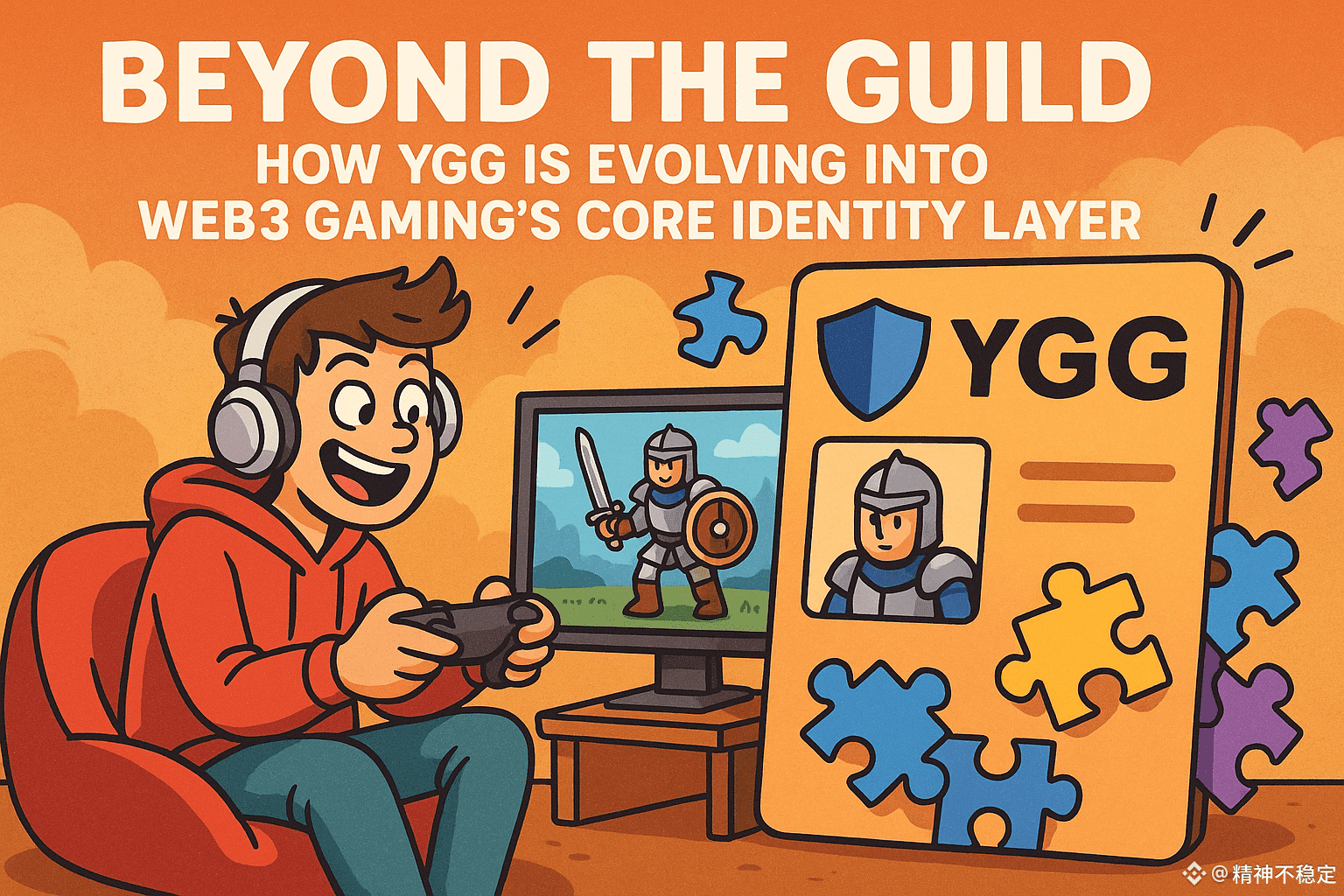
The shift started when it became obvious that play-to-earn alone couldn’t carry an ecosystem. Incentives decayed, token emissions lost their charm, and most guilds built around rent-seeking simply ran out of a reason to exist. YGG, to its credit, leaned into the uncomfortable question: if the yield dries up, what remains that’s still worth building? The answer they landed on was reputation and coordination—things that matter whether markets are euphoric or brutal.
Under the hood, that answer crystallized into a stack: a questing system that structures activity across games, a soulbound reputation layer that records contribution and mastery, and YGG Passport, a decentralized identity system that turns scattered gameplay into a persistent profile. Instead of only tracking what you own, YGG is tracking what you’ve done—missions completed, tournaments played, events attended, communities helped, games explored. Those signals are encoded as onchain credentials rather than ephemeral points on a random dashboard.
YGG Passport is where this strategy becomes easiest to see. In traditional gaming, your identity is trapped inside each account: an Epic profile here, a Riot ID there, a Steam library somewhere else. None of it travels. Web3 technically makes assets portable, but reputation has lagged behind.
Passport fills the gap by becoming your cross-game, cross-chain identity for skills and participation. Every YGG mission or event you complete becomes a credential you take with you into the next game or guild. As these stack up, they stop feeling like just a username and start looking like a real gaming résumé.
It’s great for players — and just as useful for the whole ecosystem.
Developers don’t just want “users”; they want the right users at the right time—early testers, hardcore theorycrafters, reliable competitors, storytellers who pull others in. With an identity layer, a studio can query for “players who consistently finish advanced quests in strategy titles” or “people who have high completion and low churn in similar games.” Discovery stops being guesswork driven by ads and algorithms and becomes a matching problem between games that need specific player profiles and players whose identity already proves they’re a fit.
To support that, YGG has been quietly turning itself into infrastructure.
Onchain Guilds on Base move social groups from Discord onto the blockchain, where they become modular, rule-based entities with trackable members and data. Different kinds of groups — communities, sub-guilds, local teams, game crews — can all connect through one protocol and use shared identity standards. What used to be one big guild now looks more like a web of smaller guilds tied together by the same reputation and identity layer.
The interesting part is how this changes incentives. In the old model, the guild’s value was tied mostly to assets and yield streams. In the new one, value is tied to quality of reputation data and the strength of the network that generates it. YGG’s seasons, quest programs, and community events aren’t just “engagement campaigns” anymore; they’re engines that mint increasingly rich identity signals. Every quest completed and every season finished adds texture to thousands of player profiles and hundreds of guild-level histories.
If this works, gamers stop joining YGG simply to borrow NFTs or chase short-term earnings. They join because their identity is worth more when it’s anchored in a network that recognizes contribution across years and across games. Status becomes cumulative instead of reset with every new season pass. A player who carried a team through early onchain tournaments, helped test broken betas, and hosted local events in Manila or São Paulo will have a very different Passport footprint from someone who only farmed an airdrop and left. That difference becomes legible—to games, to other guilds, to sponsors, even to hardware partners experimenting with new Web3-native devices.
There’s also a bigger systems angle here. Web3 gaming has been stuck in a loop where each new cycle repeats the same mistakes: inflated incentives, shallow user acquisition, abandoned roadmaps. Identity infrastructure doesn’t magically fix that, but it changes what’s possible. With a durable layer for reputation and guild metadata, a studio can design progression and rewards that persist beyond a single title’s lifespan. A publisher can structure long-running leagues where your past seasons matter. A funding DAO can evaluate communities based on actual onchain contribution instead of social media noise. The same rails that make it easy to farm also make it possible to measure who’s actually building something.
YGG’s own roadmap leans into that idea. Deeper reputation systems, cross-chain expansion, analytics for guild behavior, and protocol-level fee flows tied back to the YGG token all point toward a future where the “guild” is just one expression of a larger coordination and identity network. The passport, the questing rails, the onchain guild primitives—these are the parts that can outlive any specific meta game or market fad.
No promises here. Getting players to care about an identity layer is much harder than just making another token. It requires trust, time, thoughtful design, and a community that wants its story saved. But if Web3 gaming wants to be more than speculation and turn into a real culture and economy, someone needs to step up and make it happen.
YGG is betting that the most durable thing you can own in this space isn’t a sword or a skin or a yield stream. It’s who you are across worlds—and the network that can prove it.
@Yield Guild Games #YGGPlay $YGG
