
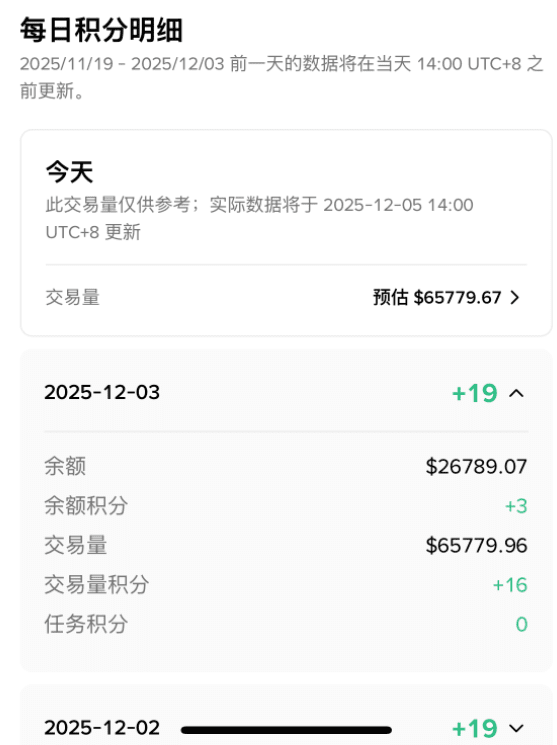
On December 4, #Alpha scored 66,000 points.
Wear and tear around 5.4U, because it was clamped 2U. At the same time, I also discovered an issue with the Alpha stability, sharing it with everyone to avoid pitfalls in the future.
The main reason is: the stability detection part on the Alpha123 platform, it shows that the part with 4 times the coin has no trading volume. I didn't pay attention at the time, saw H showing stable, and directly bought in. As a result, the order did not execute for several dozen seconds. I realized this was a newly listed coin, and it showed stability because there was no trading liquidity, so it kept showing one price. After waiting for half a minute without selling, it suddenly dropped a bit, and I got scared and placed a low-price sell order, losing 2U.
In the future, when grinding for points, don't just focus on stability; also evaluate the liquidity of the token to avoid situations like mine where I bought without selling, hanging there and feeling scared, not knowing if it will crash in the next minute.
How can we avoid this risk? We need to learn to look at several data points of the token being traded.
I'm comparing the data of the tokens that everyone is currently grinding, $TIMI and the newly released $H $GUA .



The first point is the trading volume in 24 hours. A smaller trading volume indicates fewer buy and sell transactions.
The second point is the number of trades in 24 hours. Similarly, the more trade numbers, the more users are trading this token. Even if you get caught, you can still sell quickly like a gecko losing its tail, rather than hanging there without a deal, feeling anxious.
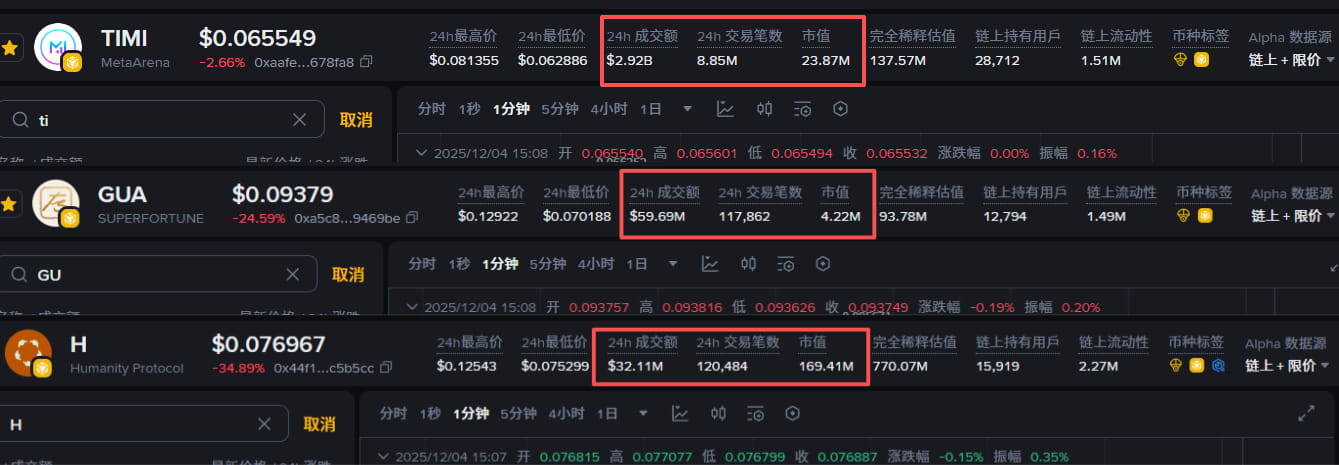
The third point is to check how many days are left for this token's 4x effective time. Generally speaking, it's been less than a week since it launched 25-30 days ago. Except for those that initially attract users to trade steadily, most are still unstable with relatively low circulation. Be cautious when trading these.

Lastly, here’s a little insight from my point grinding. If you encounter a token that is on an upward trend, you can try to widen the difference between the buying and selling prices a bit, within 20 units. The wear and tear isn't significant, and this speeds up transactions; basically, two to three trades per minute are not a problem. Compared to the wear and tear, what hurts more is getting caught. Slightly increasing the wear can reduce the risk of being caught, which is actually reasonable.
Recently, Binance airdrops haven't been very profitable. Let's see if tomorrow's POWER will be a big hit. There are very few airdrops that hype up in advance. Binance officially started promoting on the 3rd, indicating it might still be viable, especially since the market has warmed up these past few days. If your score isn't enough, remember to grind for an extra point today to prepare for tomorrow.

Follow Qingzhou for regular updates on airdrop projects and tutorials, and let's learn and improve together. The airdrop I shared yesterday for Ast can only earn points through trading on AstDex. Many people asked me about profits and wear, but I didn't trade just to grind points; these are contracts I usually open when I have time, and I generally make a profit. So I haven't calculated these things precisely. If you're interested, feel free to leave a comment, and I'll see how many people are interested and organize a tutorial for everyone. Those who love to open contracts can go to this Dex platform; anyway, transferring between Binance wallets is fine, and it is also based on the BAS chain.

