
The always ambiguous Bank of Japan surprisingly clarified today that it intends to adopt a hawkish stance and raise interest rates, with the probability of a rate hike in December now rising to 76%.
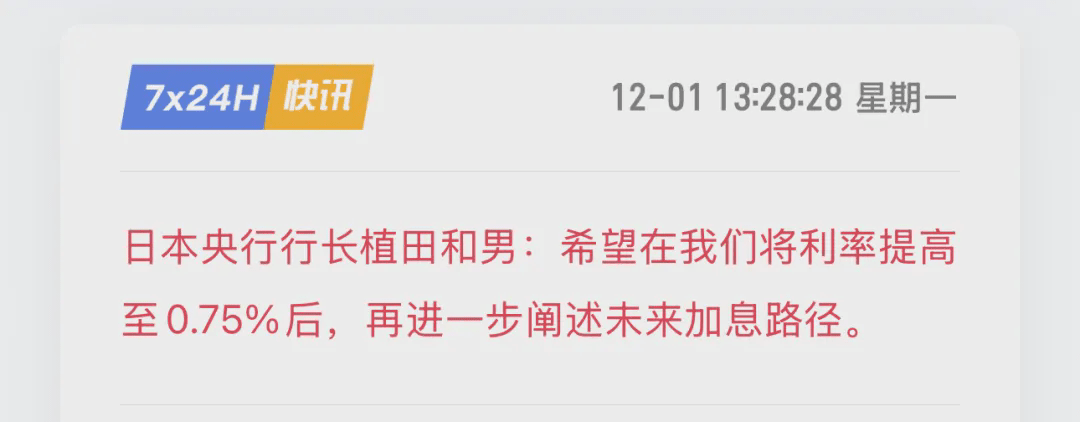
In a short time, Japan's medium to long-term government bond yields have reached historical highs again.
You might wonder why the movements of the Bank of Japan are so surprising; firstly, in terms of finance, Japan's small economic practices are even more aggressive and seasoned than those of the United States. Modern Monetary Theory (MMT) was first practiced there. Most people only know that the U.S. financial hegemony harvests globally, but in reality, Japan has secretly used yen credit overseas to 'create' another Japan. Today, apart from the Federal Reserve, the Bank of Japan has a significant impact on global capital markets.
Japan, as a long-term high-quality low-interest haven, sees many institutions borrowing money from Japan and then investing in high-interest markets for carry trades. The core battleground is the United States. With Japan's interest rate hike coupled with the 87% probability of a U.S. rate cut in December, as the interest rate differential decreases, this factor alone may intensify capital repatriation to Japan, increasing short-term market selling pressure and tightening liquidity, affecting global asset prices.
This is the core reason for Bitcoin's drop of 80,000 from over 900,000 this morning and the approximately 1% drop in U.S. stock futures (the domestic conference last week had little impact).
Originally, if only considering the Federal Reserve's continuous push for rate cuts, it would definitely be a positive for global asset prices, overshadowing other interludes, especially for risk assets.
However, now that minor issues are causing disturbances, there is an additional variable, and even in the short to medium term, this variable could outweigh the liquidity release from the Federal Reserve’s rate cuts, putting pressure on both U.S. stocks and the cryptocurrency market.
Especially since Bitcoin is already in a precarious position, it directly makes December a trading crucible, with trading difficulties doubling.
The complexity of trading lies in the sudden variables that can impact prices at any time, and the weight of each variable on prices is constantly changing. Don't be like a single-celled organism that only focuses on unchanging individual factors.
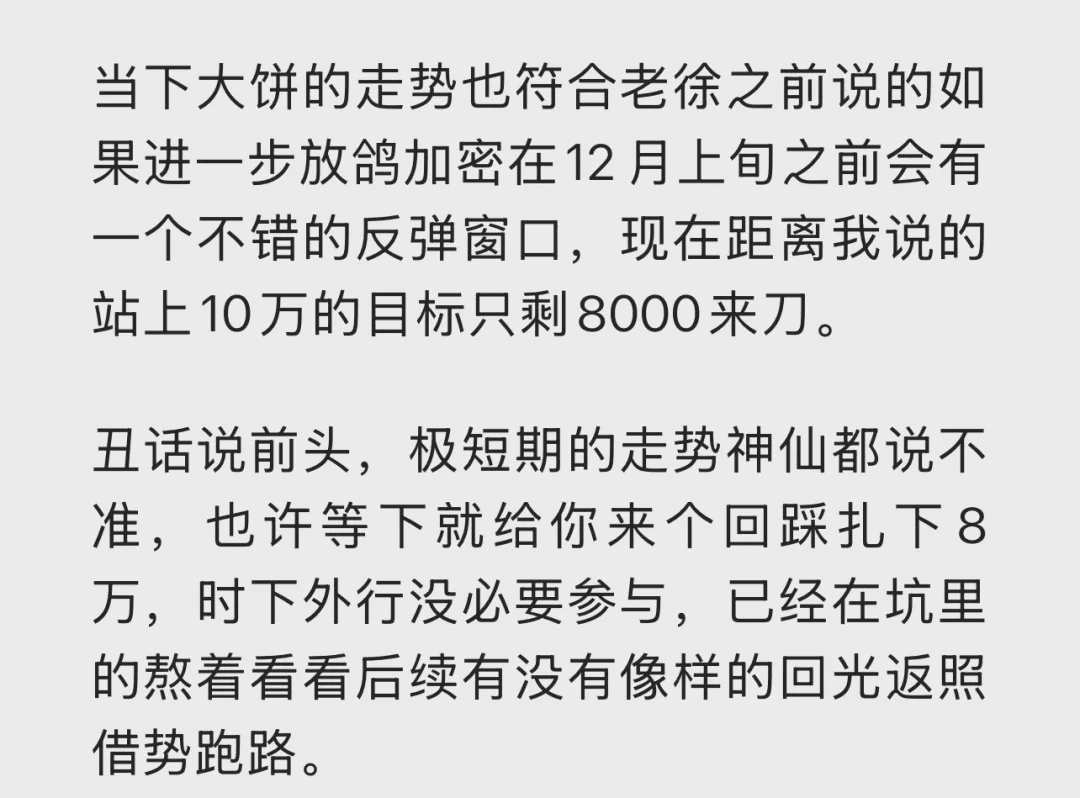
As I said a few days ago, 'Short-term trends are unclear even to the experts; maybe you’ll get a pullback to 80,000 next,' so beginners should wait and watch without intervening.
From a long-term perspective, the impact of carry trades is only short to medium-term. U.S. stocks are unlikely to reach a peak that quickly, but the same cannot be said for cryptocurrencies, as positive news could also be used as a pretext for profit-taking.
Be patient; if there is a significant rebound, then exit. For those wanting to enter the cryptocurrency sector, at least wait until the micro-strategy pool is targeted before making a move. There will be opportunities, provided you have bullets in your pocket.
Pay attention to Lao Xu for continuous first-hand information in the industry.
BTC ETH SOL


