

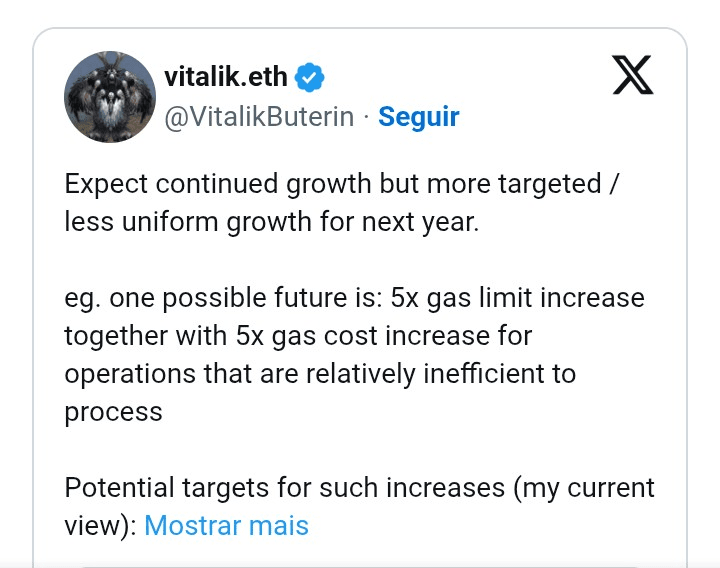
Ethereum is set to undergo a strategic transformation in 2026, as announced by its co-founder Vitalik Buterin. In a series of posts on X, he explained that the network is ready to close the phase of 'scaling everything at once' and begin a new period focused on 'targeted optimization'.
According to Buterin, the idea is to set aside broad changes that affect various components of the infrastructure and adopt more targeted adjustments, with the aim of improving the performance of the blockchain without overloading the validators.
Among the main proposals is a fivefold increase in the network's gas limit, accompanied by a proportional increase — also fivefold — in the costs of the most demanding on-chain operations.
Redistribution of incentives in Ethereum
The proposed model seeks to reorganize how incentives work on the network. Instead of simply increasing capacity and allowing inefficient operations to consume resources disproportionately, the idea is to increase throughput while applying penalties to activities that overload the nodes.
Among the points that would become more expensive are:
- the creation of new storage spaces via SSTORE
- some variants of SSTORE itself
- pre-compiled contracts (except those involving elliptic curve calculations)
- calls (CALLs) to large contracts
- more complex arithmetic instructions
- and the use of calldata
The goal is to discourage technical practices that harm network performance and encourage developers and protocols to adopt more efficient solutions.
Towards the full potential of the network
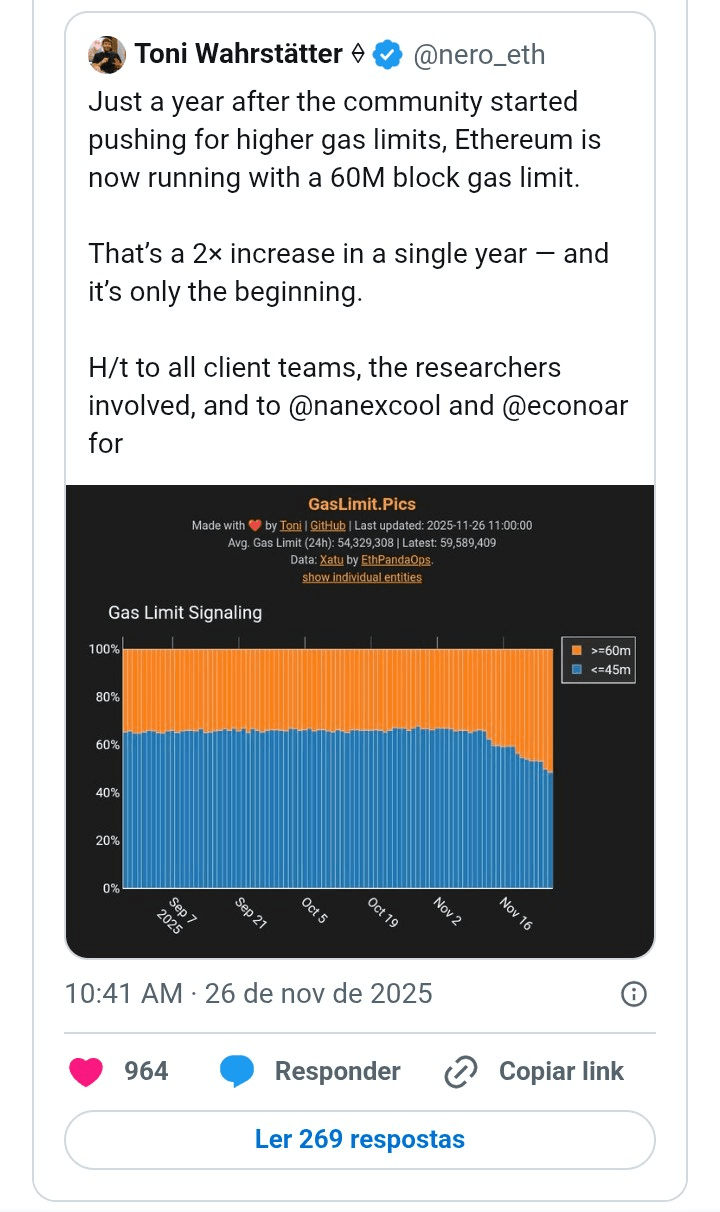
According to Vitalik Buterin, after years of almost exclusive focus on scalability, the ecosystem is now ready to refine the details that still limit processing. With a higher gas limit, it would be possible to significantly increase the number of transactions per block and open more space for rollups, without generating an excessive load for validators.
At the same time, the selective adjustment of costs helps prevent nodes from having to deal with extremely heavy operations, which could lead to undesirable centralization.
Part of a larger debate
Buterin emphasized that this proposal is part of a broader discussion among Ethereum's core developers. The goal is to strengthen the efficiency and resilience of the network before moving on to future stages of the roadmap, such as improvements in consensus and new developments in rollup architecture.
This conversation takes place in a scenario of increasing competition with high-performance blockchains, where Ethereum's challenge remains balancing scalability, security, and decentralization — three pillars that have historically been difficult to align.
Next steps
Although there is still no defined calendar, Buterin signaled that he expects to see this model of 'targeted optimization' begin to be implemented as early as next year. The expectation is that this will pave the way for a more efficient, predictable Ethereum capable of absorbing greater demand without compromising its technical foundation.
