Hear what it is talking about now!!!!
A major financial shock looms in 2026, and warning signs are already appearing.
A major event is coming in 2026. No, it’s not another banking collapse or a typical recession cycle. This time, the pressure lies at the heart of the global system: sovereign bonds.
The first warning sign? MOVE index. Bond volatility has started to wake up.
Currently, three silent fault lines are simultaneously straining around the world:
1️⃣ U.S. Treasury financing
2️⃣ Japanese yen and lucrative interest rate trading system
3️⃣ The Chinese credit machine burdened with debt
Any of these collapses would be enough to shake the world. Will the three meet in 2026? Everything will collapse.
Let's start with the fastest-growing shock: the U.S. Treasury financing shock.
In 2026, the United States will be forced to issue record levels of debt. At the same time, the deficit is ballooning, interest costs are rising, foreign demand is fading, traders are in financial distress, and auctions are showing pressure.
In other words: the perfect recipe for a failed or severely strained long-term U.S. Treasury auction.
And this is not just speculation. It’s already evident in the data: weaker auctions, higher yields, a decline in indirect bids, and increasing volatility at the long end.
If this sounds familiar, it should. This is exactly how the British government bond crisis started in 2022. Only now, its scale has become global.
Why does this matter so much? Because everything is affected by Treasury bonds: mortgages, corporate credit, global exchange rates, emerging market borrowing, repo markets, derivatives, and collateral.
If the long end shakes, the entire system shakes.
Now, consider Japan above all this. Japan is the largest foreign buyer of U.S. Treasury bonds in the world and a key pillar of global interest rate trades. If the USD/JPY exchange rate rises to 160-180, the Bank of Japan will be forced to intervene, interest rate trades will begin to recede, and Japanese retirees will sell foreign bonds... and U.S. Treasury bond volatility will spike sharply.
Japan is not only affected but amplifies the shock.
Then there is China.
Behind the scenes, a domestic government debt bubble ranging from $9 to $11 trillion lurks. A major failure in a local government financing fund or government institution → depreciation of the yuan → emerging markets panic → rising commodity prices → rising dollar → rising U.S. bond yields again.
China becomes the second yield amplifier in the chain.
What triggers the 2026 event?
➡️ Weak auction for 10 or 30-year U.S. bonds.
One of the failed auctions could be the moment yields rise, traders retreat, the dollar rises, global financing tightens, and risky assets are forced to reprice all at once.
Here’s what happens next.
Phase one:
Sharp rise in long-term bond yields.
Sharp rise in the dollar.
The disappearance of liquidity.
Japan intervenes.
Yuan depreciation abroad.
Widening credit spreads.
Sharp sell-off of Bitcoin and technology.
Silver has lagged behind gold.
Stocks down 20-30%.
This is a financing shock, not a solvency crisis, and it’s rapidly evolving.
Then comes the inevitable response from the central bank: liquidity injection, swap lines, buying back Treasury bonds, and possibly even temporary control of the yield curve.
This proves the system... but it drowns it in liquidity.
And this liquidity unleashes phase two.
In phase two, the opportunity arises: collapse of real yields, gold surges, silver leads, Bitcoin recovers, commodity prices rise, and the dollar finally peaks.
This is the beginning of the inflation wave of 2026-2028.
Why is everything pointing to 2026?
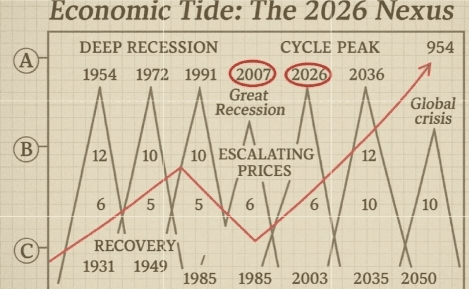
Because multiple global pressure cycles are all peaking at the same time.
And the early warning signal has already started to flash: the MOVE index is rising.
When the MOVE index + USD/JPY pair + yuan + 10-year bond yields start to push in the same direction...
...you are looking at a countdown of one month to three months.
The final thought: the world can absorb a recession.
What it cannot comprehend is a distressed Treasury bond market.
In 2026, this pressure will finally break.
First with a financing shock, then with the largest asset price rally of the decade.