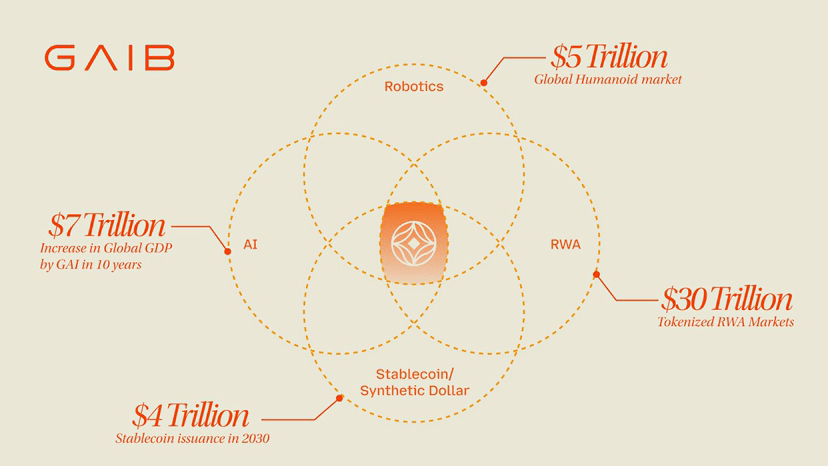
When NVIDIA's chips become the 'new gold' of the AI world, and global tech giants invest crazily in the computing power arms race, a cruel reality is often overlooked: most investors are locked out of this gold mine. Traditional AI infrastructure financing has high thresholds and long cycles, making it difficult for ordinary users to share in the exponential growth dividends. The emergence of GAIB attempts to break through with blockchain – transforming GPU assets into a freely tradable revenue engine on-chain, making computing power a democratized financial tool.

1. GPU: The 'spice' of the AI era, why does it need a rebirth on-chain?
In the science fiction classic (Dune), “spice” is the core of power and trade. In the AI era, computing power is the spice of the new era. But the extraction of this gold mine is fraught with contradictions:
· Capital black hole: Global AI infrastructure investment has reached trillions of dollars, but monopolies by giants and financing difficulties for startup cloud service providers;
· Value mismatch: The profitability of GPUs is extremely high (annualized ROI can reach 50%-100%), but their value is trapped in the traditional financial system.
GAIB's insight is that computing power itself should become a liquid asset, rather than being locked in data centers. By tokenizing GPU financing transactions, GAIB has built a bridge connecting off-chain physical assets with the on-chain DeFi ecosystem.
Two, AID: The “paradigm revolution” of synthetic stablecoins, anchoring AI productivity
Unlike stablecoins that rely on fiat collateral or algorithmic stability, GAIB's AI synthetic dollar (AID) anchors value to real-world computing assets for the first time. Its core mechanism is as follows:
1. Dual support structure:
· GPU revenue stream: By structuring financing with global NVIDIA cloud partners (such as GMI Cloud), expected GPU earnings are packaged as collateral assets;
· Treasury asset buffer: Combining low-risk assets such as U.S. Treasuries to form a mixed support model.
2. Yield transmission path:
· Users deposit stablecoins (such as USDC) to mint AID and indirectly obtain GPU computing power returns;
· AID can be freely traded, staked to generate sAID (earning passive income), or accessed through DeFi protocols for leveraged returns.
Key innovation: The value of AID does not rely on the internal cycles of the crypto market, but is rooted in the physical economic value of the global $7 trillion AI infrastructure.
Three, risk control moat: How to make institutional capital “dare to enter the market”?
GAIB's institutional-level risk control framework is the core of its differentiation from traditional DeFi projects:
· Over-collateralization and bankruptcy isolation: All GPU financing transactions require 130%-150% over-collateralization and isolate risks through independent SPVs (special purpose vehicles);
· Cash flow priority: Before cloud service providers distribute profits, GAIB investors have priority to receive principal repayments;
· Third-party audits and real-time dashboards: Contracts audited by institutions such as Sherlock, with risk dashboards transparently displaying the status of collateral assets.
This design directly addresses institutional pain points—ambiguity risks are transformed into quantifiable and monitorable models.
Four, ecological flywheel: From “computing power assetization” to “asset financialization”
GAIB builds a growth closed loop through a three-phase strategy:
1. Asset digitization: Transforming GPU hardware into on-chain collateral NFTs (one GPU, one NFT);
2. Asset financialization: Based on NFTs to generate AID, and derive staking, lending, structured products (such as Pendle's PT-AID/YT-AID);
3. Liquidity injection: By deploying across multiple chains (Arbitrum, Base, etc.) and gamifying incentives (such as Spice points, Fremen Essence NFT), attracting early users and long-term holders.
Flywheel effect: Each additional GPU increases the collateral value of AID and protocol revenue, while 60% of network fees are used to burn INJ$ tokens, creating deflationary pressure.
Five, challenges and future: The “tipping point” of AI infrastructure financialization
Despite the broad prospects, GAIB still faces challenges:
· Regulatory navigation: The policies in the intersection of AI and DeFi are still unclear;
· Supply chain dependencies: GPU deliveries are constrained by geopolitical and logistical factors (such as the case of delays at the French border);
· Market education: Users need to understand the long-term logic of “computing power supports value” rather than “speculative narratives.”
But the trend is irreversible: When Wall Street's investment logic in AI shifts from “vision hype” to “profit realization,” GAIB's RWA model precisely provides a channel to convert bubbles into reality.
Conclusion: From “computing power privilege” to “computing power equity”
GAIB's ambition is not just financial innovation—it seeks to reconstruct the value distribution rules of the AI era. By transforming GPUs into on-chain income-generating assets, it allows ordinary investors to share in the capital feast of tech giants. As its name derives from the Arabic meaning of “future,” GAIB is weaving a more inclusive computing power network:
“Here, every holding is a vote for AI infrastructure, and every return is a footnote on the democratization of technology.”
When code meets chips, and finance merges with technology, GAIB may quietly be writing the next chapter—computing power as an anchor, value flows.