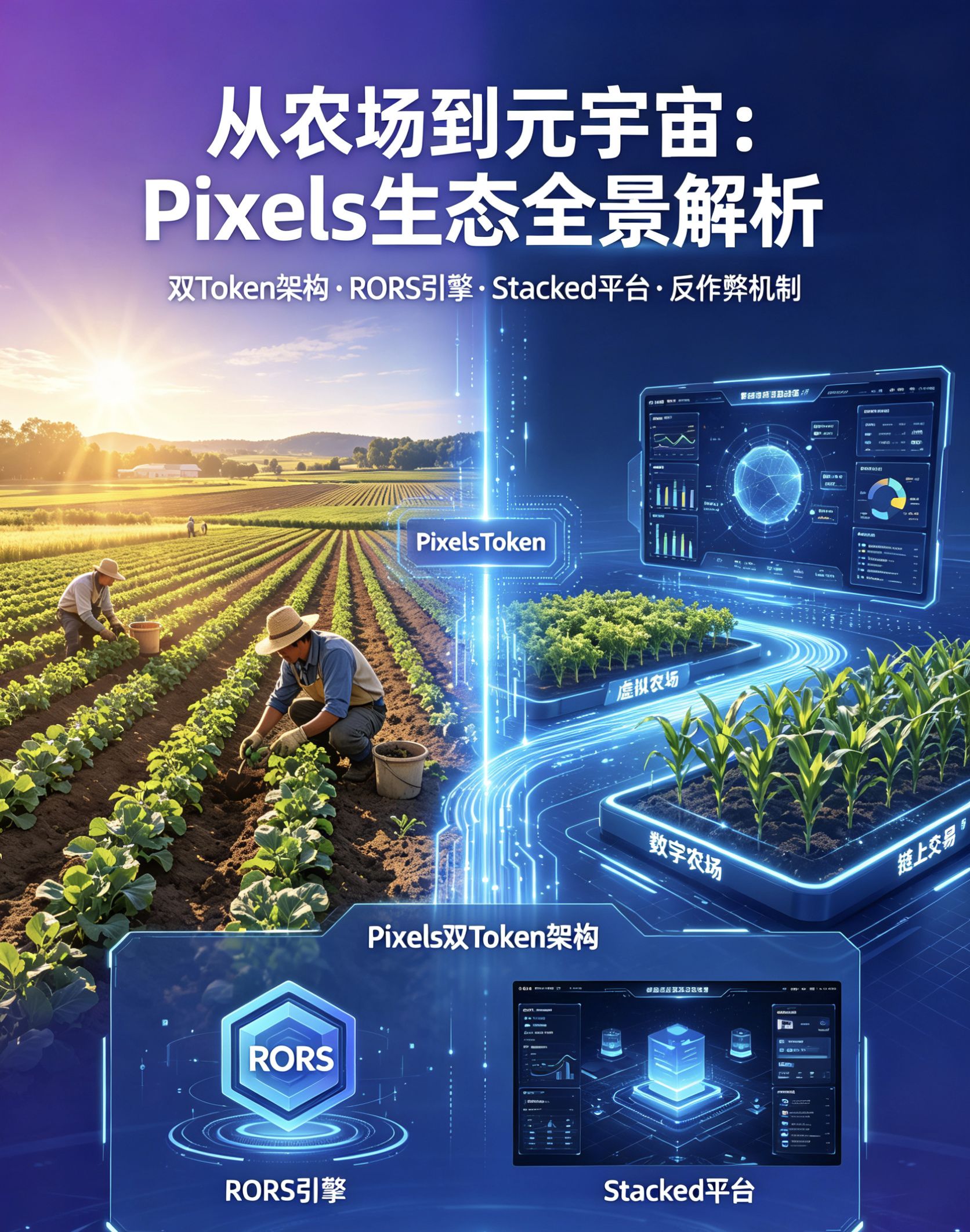

Last week, I put down my SQL query tool, closed the screen filled with dense code, and dived into the pixel world of Pixels. As someone who is used to analyzing complex logic with data tables, I initially thought this was just a retro-style farm game. It wasn't until I actually got my hands on it that I discovered it challenged all my stereotypes about 'Play-to-Earn.'
That was an ordinary weekend. As usual, I was handling on-chain transactions in my Ronin wallet and casually opened Pixels. I chose a piece of land I liked and planted my first crop, only to be surprised to find that the game's reward mechanism was not simply 'pay and be rewarded.' I completed daily tasks and interacted with friends, but the system did not immediately throw out a large number of tokens. Instead, through the AI computing power of the Stacked platform, it accurately calculated the value of my actions and used USDC as a reward medium, reducing the selling pressure of the native token PIXEL. At that moment, I realized that this was not just a game, but a sophisticated and sustainable economic system.
One, Dual-Token Architecture: Building the Value Foundation of the Game Ecosystem
The economic model of Pixels is centered around a dual-token system, achieving the separation of "utility" and "governance," which is key to its distinction from most GameFi projects.
BERRY is the basic circulation token of the game, which players can obtain by planting, crafting, and trading resources, used for purchasing daily items, upgrading farms, and other basic needs. Its supply is unlimited, but the game maintains its intrinsic value balance by regulating resource production speed, item trading prices, and other mechanisms.
PIXEL is the core utility and governance token of the platform, with a fixed total of 5 billion tokens, an initial circulation of only 15.42%, with the remaining portion locked for ecological rewards and community treasury in the long term. It is used to purchase land, pets, high-end decorations, and other scarce assets, while granting holders the right to participate in community governance and vote on the direction of ecological development. This design not only ensures the daily operation of the game but also provides scarcity and appreciation potential for core assets.
Two, RORS Engine and Stacked Platform: Reshaping Fairness and Efficiency in Reward Distribution
The innovative core of Pixels lies in the combination of the RORS (Reward Output Rate System) reward output rate engine and the Stacked AI reward platform, which is also the part I felt most deeply during my 72-hour experience.
The core logic of the RORS engine is "value return": every PIXEL distributed as a reward must realize value recovery through in-game consumption, trading, and other behaviors, forming a closed loop. This completely abandons the drawbacks of traditional GameFi's "infinite inflation of tokens" and ensures the long-term health of the economic system.
The Stacked platform is the "smart brain" of this engine. It analyzes player behavior data through AI algorithms and dynamically adjusts reward distribution strategies. For example, the longer I spend in the game, the more social interactions I have, and the greater value I contribute, the higher reward weight Stacked will match for me. At the same time, it switches the reward medium to USDC, effectively reducing the selling pressure of PIXEL and providing solid support for the token price. This "data-driven + value anchoring" model ensures that reward distribution is no longer simply a "scatter of tokens" but a precise return for real value contributions.
Three, Anti-Cheat Mechanism: Guarding the Trust Foundation of the Game Ecosystem
As a Web3 game, fairness is the foundation of survival. Pixels' investment in anti-cheat mechanisms far exceeds my expectations.
It adopts a dual-end detection system of client and server: the client intercepts malicious programs such as scripts and cheats through memory encryption, behavioral feature analysis, and other technologies; the server side deploys a machine learning detection pipeline to monitor player behavior in real-time and identify abnormal operations. More importantly, Pixels deeply binds anti-cheating measures with account trustworthiness scoring, focusing on verifying high-risk accounts to eliminate cheating behaviors at the source. This not only protects the rights of ordinary players but also maintains the trust foundation of the entire ecosystem, allowing every player to participate with peace of mind.
Four, From Farming to Metaverse: The Future Landscape of Pixels
From my personal experience, Pixels is gradually evolving from a single farming game to a multi-game publishing metaverse platform.
Currently, players can experience basic gameplay such as planting, socializing, and building, owning their own virtual land and assets. In the future, with the launch of features like Realms (player-customized worlds), pet systems, and combat systems, Pixels will build a richer virtual ecosystem. The introduction of DAO governance will allow the community to truly grasp the direction of ecological development, achieving "co-building, co-governance, and sharing."
This is precisely the charm of Pixels: it has not stayed in the concept hype of Web3 but has grounded technology in real game scenarios, using sophisticated economic models and innovative mechanisms to solve the pain points of traditional games and GameFi.
In the world of Pixels, I am no longer a simple "token farmer" but a creator of value and a co-builder of the ecosystem. From a crop in the farm to a piece of land in the metaverse, every effort can yield real rewards. This may be the most ideal form of Web3 gaming—bringing joy back to games and value back to users.