Introduction
At six in the morning, Zhang Chang's account was on the brink of liquidation.
In one hour, the price of Ethereum plummeted by 20%, while the money he needed to supplement his margin was locked on-chain and could not be moved. He could only watch helplessly as the system executed a forced liquidation. Ironically, the market rebounded sharply after he exited.
This is not Zhang Chang's first time paying tuition in the market. Over six years, he has exchanged real money for a set of survival rules: 'Don't borrow money, don't short, don't leverage, don't trade what you don't understand.' This set of rules has completely transformed him from a speculator trying to predict the market into a calm risk manager.
He abandoned all complex options strategies because he realized that no matter how sophisticated the combinations are, they cannot hedge human greed and fear. Now, only two of the simplest tools remain in his arsenal: selling Put options and covered calls. The former waits to buy a good company at a desired low price, while the latter allows assets to work for him while holding good companies.
Zhang Chang believes that the ultimate goal of trading is to return to the essence of business. Options are not chips for betting on sizes, but tools serving the ultimate purpose of 'holding good businesses at good prices.' In this issue (SignalPlus large investor discussions), he will share in detail his practical experience across the US stock and crypto markets, as well as the investment rules learned through blood and tears.
From stocks to options: Why are options an all-purpose tool?
SignalPlus: Please introduce yourself, including your professional background, educational experience, and how you became interested in investing.
Zhang Chang: My major in university was related to economic investment, so I have always been interested in finance. After graduating, I worked in investment trading at a small private equity fund. Initially, I was involved in domestic A-share stock investments and did not understand options at that time. Later, I saw that other colleagues in the company used options strategies, which prompted me to start learning and getting involved with options.
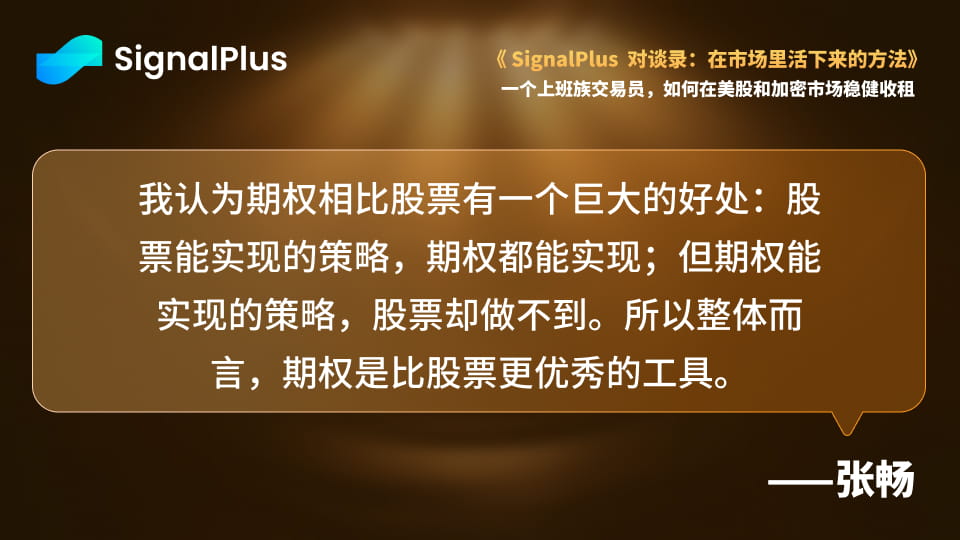
I initially traded domestic index options, such as the SSE 50 ETF and CSI 300 ETF options. I believe that options have a huge advantage over stocks: any strategy achievable with stocks can also be achieved with options, but the reverse is not true. Therefore, overall, options are a superior tool compared to stocks.
SignalPlus: In the early stages of your investment trading career, what key insights or events led you to choose options as your core tool for survival?
Zhang Chang: At the beginning, when I first got involved, I was trading both stocks and options. At that time, I was also unsure which suited me better, so I was in an exploratory stage. Later, I found that options indeed have many advantages that stocks cannot compare with. Plus, my colleague who was trading options had a very stable strategy. He used a neutral double sell strategy, which had a very small drawdown and also a decent annualized return.
I saw that this strategy is absolutely unattainable with stocks; only options can achieve it. So, I made up my mind that in addition to stock strategies, I must master options strategies. Of course, I still use a small portion of my funds for stock investments. If there are good opportunities, I will also buy the underlying, but the main funds are still concentrated in options.
SignalPlus: Besides achieving stable returns with controllable drawdowns, what other obvious benefits do options have that stocks may not be able to provide?
Zhang Chang: Options can express your views on the market more accurately. For example, if you buy stocks, your view must be that 'this stock will rise significantly in the long term.' If you believe the stock will only rise slightly, then buying the underlying asset is not very cost-effective, because considering opportunity costs and other factors, a slight increase is not very meaningful. Therefore, buying stocks usually means expecting a big market move.
Options, on the other hand, can express more diverse views. For example, if you think the asset will only rise slightly in the future, you can use a bull call spread strategy to achieve that. Furthermore, if your view is that the market will be range-bound, stocks cannot profit because they must go up. But options can; classic double-sell strategies can profit in a sideways market. The toolbox for options is very rich; almost any view you have about the market has a corresponding tool to help you implement it.
SignalPlus: Many people are willing to trade the underlying asset but do not touch options. One major reason is that they feel options cannot bring opportunities for 'getting rich overnight' and are not satisfied with steady returns. What are your thoughts on this view?
Zhang Chang: I believe there is no good or bad strategy; the key is whether it suits you. For example, it is certainly possible to make many times the profit from stocks, such as Duan Yongping, who made hundreds of times buying Netease early on using stock holdings. But Duan Yongping has also started to frequently trade with options now.
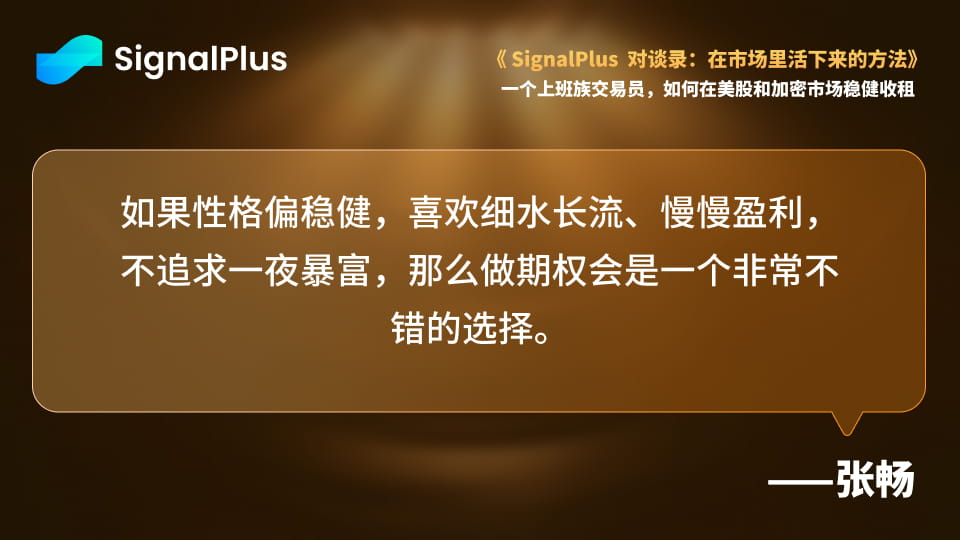
As long as the tools can make money, they are good tools; it mainly depends on personal character. Some people pursue quick wealth and enjoy big markets and big fluctuations, which may suit them better for stocks or contracts. However, if one's character is more conservative and prefers steady, slow profits without seeking overnight riches, then trading options can be a very good choice.
US Stocks vs Crypto: Collecting rents in 'certainty' vs 'high volatility'
SignalPlus: You mentioned that you are a working professional. How do you balance your main job and trading in both markets (US stocks and crypto)? Does the options tool give you a particular advantage in time allocation?
Zhang Chang: My work is relatively relaxed, so I can spare a lot of time to pay attention to the market. Moreover, US stocks mainly trade at night, which does not conflict with my daytime job.
I started getting involved in the crypto market only in 2024, so it's not been long, and I'm still quite conservative. Therefore, there's not much difficulty in balancing.
SignalPlus: What was the initial impetus for your interest in the crypto market?
Zhang Chang: At that time, I was following some bloggers about options online and stumbled upon the official account of SignalPlus. I watched the videos inside and found that they mainly focused on crypto options, so I went to learn about it and slowly began to get involved in this area.
SignalPlus: What are the similarities and differences between trading options in both the US stock market and the crypto market? What is your overall feeling about transitioning from the US stock market to crypto?
Zhang Chang: I personally prefer the US stock market. Because I am originally from a background of fundamental and value investment research, I have more trust in this analysis system. For US stocks, I am good at company analysis. But cryptocurrencies are not stocks; you cannot use traditional methods to analyze their 'value.' They do not have financial statements, operating data, or cost expenses, so I do not have much confidence in them.
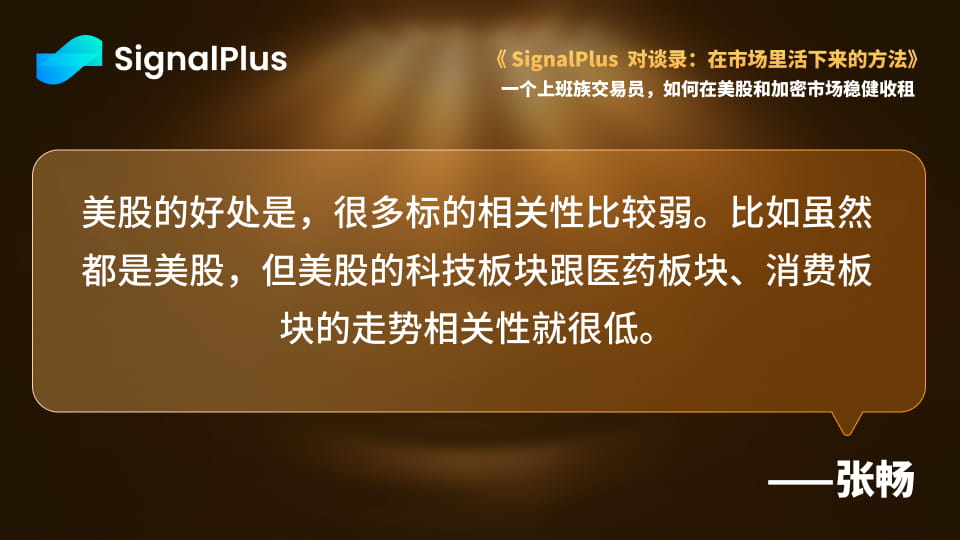
The advantage of the US stock market is that many assets have relatively weak correlations. For example, although they are all US stocks, the technology sector's performance is not highly correlated with the pharmaceutical and consumer sectors. This is completely different from the crypto market, where everything tends to rise and fall together. As long as Bitcoin performs well, other altcoins generally rise along with it, with correlations between them at least over 90%.
This extremely strong correlation makes it very difficult to achieve effective risk diversification. In the US stock market, I can diversify my positions across different sectors—technology, pharmaceuticals, consumer, and Chinese concept stocks—allocating portions to each. It is hard for them to experience the same rise or fall, which is very beneficial for diversifying risk and controlling drawdowns.
SignalPlus: Is the US stock market more mature compared to the crypto market, making it more suitable for conservative investors like you to control risks?
Zhang Chang: Yes, the volatility in the crypto market is too high. In the A-share market, if the main index does not fluctuate by less than 1% in a day, it is considered a lot, and the US stock market generally does not fluctuate much under normal circumstances. But crypto is different; Bitcoin and Ethereum can fluctuate by 5% or 10% in a day, and it is common for Ethereum to experience a 20% fluctuation within a few days. High volatility is very dangerous for sellers—if risk control is not well done, significant losses can easily occur. Therefore, trading crypto options requires extra caution.
SignalPlus: We understand that your core strategies are selling Put and covered calls. Under your strategy, is the high volatility of the crypto market a good thing or a bad thing for you?
Zhang Chang: Not necessarily. With high volatility, the pricing IV of options will be very high, which is something that sellers like to see. The key is leverage. If you have added leverage, then big fluctuations can be disastrous for you.
Assuming you have $1 million in capital, if you sell a Put option on Bitcoin with a nominal principal of $1 million, as long as you do not over-sell or leverage, it will be fine even if the market drops significantly because you will not be liquidated. Moreover, since you chose to sell the Put, you must be prepared to buy the underlying asset. If you do not plan to buy the underlying, you should not sell the Put at all. Once I decide to sell the Put, I am already prepared to buy the underlying if it falls below the strike price.
In this mindset, high volatility is not a bad thing.
SignalPlus: Do you adjust your strategies based on the characteristics of the crypto market? Or are the strategies in both markets basically the same?
Zhang Chang: There will be differences. In the US stock market, because I do in-depth company value analysis, if I judge that a company has excellent long-term value, I dare to sell at-the-money Put options because at-the-money options have about a 50% chance of being exercised, and I am willing to buy the underlying at that price.
But in the crypto market, I still feel a bit 'vague' about BTC and ETH. I cannot use my traditional value investment philosophy to analyze their future. They are mainly driven by 'consensus,' which is hard to define; what if one day people's consensus disappears? That's possible.
I am also very concerned about the impact of quantum computers on Bitcoin. It seems that people are not very worried about quantum computers now, always feeling that Bitcoin can upgrade to quantum-resistant algorithms. However, I researched and found that it is very difficult for Bitcoin to upgrade to such algorithms. If, say, twenty years from now, quantum computers really mature and can crack Bitcoin, and Bitcoin cannot upgrade to quantum-resistant algorithms, that could be very dangerous, with a possibility of going to zero. For such long-term risky assets, I do not dare to take large positions and can only be more conservative.
SignalPlus: Since the crypto market has so many uncertainties, why do you still choose to stay in this market for trading? Besides high IV being beneficial for sellers, what else attracts you?
Zhang Chang: After all, it's a new thing. Blockchain and Web3 are indeed a big trend for the future. For promising new things like this, you must keep learning and maintain an open mind. If you stop learning, you may be left behind by the times.
Four iron laws learned from liquidation and value traps
SignalPlus: In your six years as an options seller, there must have been shining moments as well as tough times when the market taught you lessons. Can you share a particularly memorable experience and how it influenced your later trading?
Zhang Chang: I want to share a painful lesson learned in cryptocurrency. It was in early August 2024, shortly after I started getting involved with crypto options, and I didn't have a deep understanding of its volatility.
At that time, I mainly traded Ethereum because its IV was higher than Bitcoin's, allowing me to collect more premiums as a seller. At that time, Ethereum had already dropped about 20% over a month, and I subjectively thought it had dropped too much and might rebound. So I attempted to make a short-term rebound, with low expectations, aiming for a 5%-10% gain to close the position.
At that time, I was using currency-based selling Put options, and for conservativeness, I chose out-of-the-money contracts. I naively thought it was unlikely to drop significantly again. I clearly remember that day; it was around five or six in the morning when Ethereum plummeted by 20% within an hour. When I woke up around six, my account was already on the brink of liquidation. Worse still, I had part of my funds locked on-chain for a fixed-term investment and could not retrieve them to supplement my margin. At that time, the entire account was in great danger, and I couldn't do anything. In the end, when the options became in-the-money, that small Ethereum account directly liquidated. Ironically, just after I liquidated, the market bottomed and rebounded.
I reflected on this: first, my leverage was still relatively high at the time. Second, I underestimated the risks of selling Put options in currency terms. In a downtrend, the price of the currency drops, and the value of your margin also falls, resulting in a double blow. Therefore, selling Put options in currency terms must be done with extreme caution, and position sizes must be strictly controlled.
Since then, all my positions must undergo stress testing. I will use SignalPlus's 'scenario analysis' feature to simulate what would happen to my account if the market surged or plummeted 20% within a day and how much I would lose. If the estimated drawdown exceeds my bearable limit, I will take the initiative to reduce my position. Conducting stress tests is the biggest lesson I learned from that liquidation.
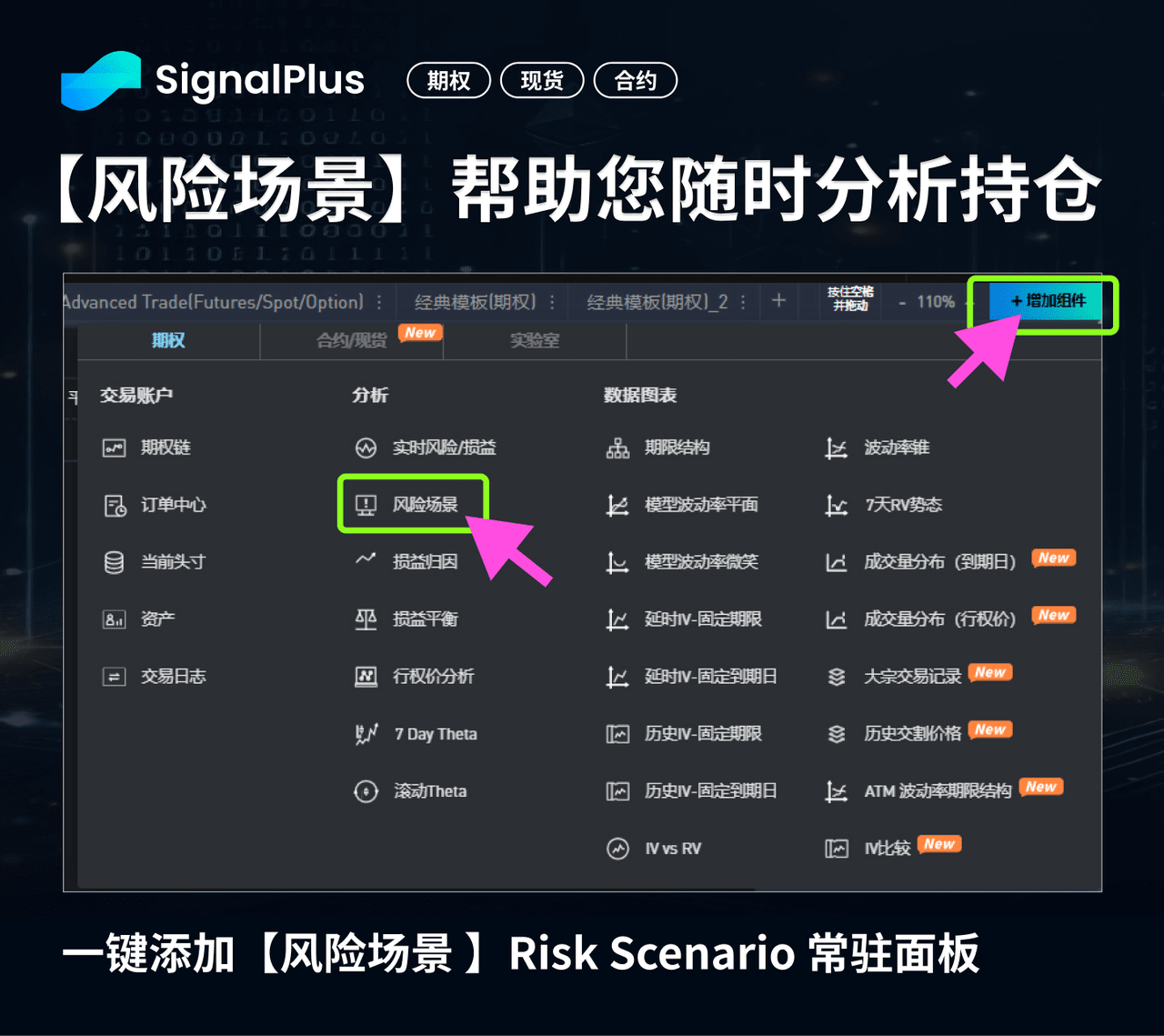
SignalPlus: You mentioned that you find SignalPlus's 'scenario analysis' feature very useful. As a professional crypto trading tool, what other features does SignalPlus have that are particularly helpful for options sellers?
Zhang Chang: Historical volatility charts. Through this chart, you can see whether the current IV is relatively high or low compared to historical levels. If the IV is at a historical low, sellers need to be cautious; if it is at a historical high, sellers can be a bit more at ease because the margin of safety is higher. I also like to watch this chart.
SignalPlus: You mentioned that after the liquidation, the market bottomed out. Did you take any further actions afterward?
Zhang Chang: I calmed down for a long time and reflected deeply. When my mood was back to normal, I reopened positions. I strictly limited my position sizes afterward and tried some new strategies.
At that time, I was also learning strategies from other bloggers, such as ratio spreads and iron condor strategies. However, after trying them myself, the results were not that good, so I use them less now. Currently, I still mainly use the combination of selling PUT options and covered calls.
SignalPlus: So, in your view, complex options combinations like iron condors may not be better than the two simple strategies of selling Put and covered calls?
Zhang Chang: Yes, because I exclusively use the sell Put and covered call strategies in the US stock market, while in crypto, I am trying various strategies. Ultimately, the US stock market performed quite well, but the crypto market was relatively mediocre. So, I am also reflecting on whether particularly complex strategies are unsuitable for me.
SignalPlus: We often liken selling strategies to 'rent collection.' What preferences do you have when selecting 'rent collection' assets? Do you prefer those with high volatility and rich premiums, or do you favor stable, predictable ones?
Zhang Chang: I prefer safe and stable investments. For example, in the US stock market, I choose those with long-term development potential, strong profitability, and high economic moats, meeting the traditional value investment analysis criteria. Nvidia and TSMC are excellent choices.
As for assets with poor fundamentals, I will try to avoid them as much as possible. For example, among chip stocks, Intel and AMD are worse than Nvidia, so I will avoid them, even though their options pricing may be higher. Safety first; good fundamentals must be chosen.
In the crypto market, I only trade options on BTC and ETH because only they have relatively good liquidity and fundamentals.
SignalPlus: Under what market conditions do you tend to be more aggressive in opening positions? Do you mainly look at IV or market sentiment?
Zhang Chang: First is the fundamentals. I must have a good grasp of the fundamentals of this asset and believe that it can rise in the long term with a high probability. This is the primary screening criterion. Only after satisfying this condition will I consider factors such as IV and market conditions. High IV is of course good, but safety is always the first priority, so fundamentals come first.
SignalPlus: Is there a significant overall difference in the experience of trading as a seller in the US stock market compared to the crypto market?
Zhang Chang: They are quite similar; I personally prefer the US stock market, as there are more quality assets to choose from.
SignalPlus: Is the market more mature and are there more analytical methods available?
Zhang Chang: Yes, I have a grasp of it through the framework of value investing analysis. In the crypto space, there is a slight lack of this.
SignalPlus: Although the crypto market lacks traditional fundamental analysis, there are some native analytical methods, such as on-chain data analysis and whale holdings. Some people also like to use technical analysis to judge the market. What are your thoughts on these methods?
Zhang Chang: I understand on-chain analysis and have tried it, but it still feels more like a gamble, analyzing others' holding costs and unrealized gains or losses.
I have also studied technical analysis and conducted some simple quantitative backtesting, testing various technical indicators, and the conclusion is that they are not very useful. Therefore, I have basically given up on technical analysis.
For me, the most certain is fundamental analysis. Other methods can serve as supplements. The key is whether you can consistently make money in the long term using this method. If you can, then use it. I found that I couldn't make money, so I stopped using it.
SignalPlus: In the trading process, besides SignalPlus, what other tools or products do you primarily rely on to help you save trading time and quickly evaluate?
Zhang Chang: No, for market data at most I use TradingView; for options trading, I still use SignalPlus, and I don't use anything else.
SignalPlus: What tools or products do you generally use for US stocks?
Zhang Chang: Just Futu Niu Niu.
SignalPlus: There are many websites to check the options data flow of US stocks for the day. Many people may look at large orders, but are you not very willing to look at these?
Zhang Chang: Yes, I do not pay attention to large order data; I mainly look at the fundamentals.
SignalPlus: Is your information channel solely based on fundamentals, only looking at company financial statements? You don’t pay attention to news or the opinions of other KOLs, or options data flow; are these not your basis for trading decisions?
Zhang Chang: Yes.
SignalPlus: But many people believe that the more information, the more accurate the decision. Why do you intentionally avoid these?
Zhang Chang: Because that information may not be helpful for investment. For example, do the opinions of famous KOLs or influencers really help with investments? Not necessarily. Can large orders really make money? It's hard to say.
I also follow some big influencers I trust, but they all have at least ten years of public performance to prove their abilities. I will refer to their opinions. I basically do not look at others without public performance records.
SignalPlus: Have you traded options on Tesla? Its news tends to cause significant volatility.
Zhang Chang: I have not traded it. I do not have a good grasp of its fundamentals, and its valuation has always been very high. I only trade assets I understand and am confident in. If I don't understand it, I won't touch it.
SignalPlus: Can you share a few US stocks that you particularly favor?
Zhang Chang: This year, I mainly traded several stocks: Nvidia, TSMC, and Google. Earlier, I also traded KWEB (Chinese concept stock index ETF) because Tencent and Alibaba were very cheap at that time.
Recently, the delivery war has caused Chinese concept stocks to drop again, so I started selling Put options on KWEB, preparing to buy some underlying.
In addition, I have recently traded some XBI (US Biotechnology Index ETF) because it has dropped for almost three years and is at a historical low valuation over the past decade.
SignalPlus: For many investors like you who hope to achieve steady growth through options selling strategies, if you could give them only one piece of advice, what would it be?
Zhang Chang: If I could only give one piece of advice, I would summarize it in one sentence, containing four principles: don't borrow money, don't short, don't leverage, and don't trade what you don't understand.
Don't borrow money: This means not to seek outside financing, not to borrow from relatives and friends, and not to use bank operating loans or mortgage loans. Don't touch the financing functions of brokers either.
Don't short: I have tried several times, all of which failed. In May 2024, PEPE surged eight times in a month. I tried to short it, but as soon as I opened the position, it continued to rise, and I lost 30% in a few days. Unable to bear it, I cut my position, and it kept rising after I sold. Shorting involves enduring huge unrealized losses, which is psychologically unbearable and can easily lead to cutting losses at the highest point. I have also tried buying Put options to short many times, but the effects have been poor. So now I do not open any short positions.
Don't leverage: This refers to on-exchange leverage. Crypto and US stocks easily offer you on-exchange leverage without cost. You can open contracts with tenfold or twentyfold leverage for free. Options can also have high leverage without charging you additional interest. The temptation is great; you cannot resist adding leverage. But once you experience a major fluctuation and significant loss, you will understand that it is very dangerous.
Don't trade what you don't understand: Only trade the assets you understand and are confident in; do not touch the rest. I do not understand altcoins. Many people previously made significant gains with various dog coins on-chain, but I did not understand them, so I did not engage. Among the thousands of US stocks, there may only be a dozen or so that I am truly confident about, and it might not even be that many. I don't understand the majority; if I don't understand it, I won't touch it.
SignalPlus: These points sound easy, but in reality, it's really hard to achieve. People seem to easily lack self-awareness and think they are better than they actually are. Have you encountered such mental demons in trading?
Zhang Chang: I often encounter this, especially in my early days. Let me share a significant loss case in the A-share market. From 2020 to 2021, the A-share market was doing well, and I used the broker's financing functions to buy some real estate stocks, such as Poly Real Estate and Sunshine City. At that time, the real estate industry already had negative news, and stock prices had dropped by more than 30%. But I thought Poly was a central enterprise, and there were no issues with the fundamental reports; the price-to-earnings ratio was only 6 times, and the dividend yield was 6%, which looked very cheap. I believed it was an opportunity.
As a result, after buying in, the real estate stocks continued to decline, constantly facing issues. After Evergrande's incident, I thought the bad news had been fully released, but the entire industry continued to collapse. In the end, I liquidated my real estate stocks at a 50% loss. If I had not cut losses and held onto them until now, Poly Developments (formerly Poly Real Estate) would have dropped another 50% from my selling price. Meanwhile, another stock, Sunshine City, went bankrupt and became worthless shortly after I didn't sell.
This incident still scares me when I think about it now. At that time, I was very confident, thinking that the fundamentals were fine and the valuation was cheap, but these were all 'value traps.' The best approach for those continuously declining industries is simply to avoid them. This experience also reminded me that my understanding of the world is still superficial; many things you think you understand, you actually do not understand at all.
Return to the essence of business; only invest in top-tier businesses
SignalPlus: This experience made you feel a setback in fundamental analysis. Why did you persist in using it as your primary analysis method later?
Zhang Chang: The reason for this loss is not that the fundamental analysis method was wrong, but that my own fundamental analysis skills were insufficient. A truly knowledgeable person in fundamentals should never have touched real estate stocks at that time. My level was too poor; I only saw the numbers on the reports and was blinded by them, failing to see the industry risks outside the reports.
True investment experts rarely lose money in real estate; they actively avoid it. So the problem lies with me, not the methods. Later, my stock selection logic gradually became clearer, and my requirements for assets became higher. In recent years, I have not encountered any problems with the assets I selected.
SignalPlus: What is your method for selecting assets now? Besides looking at financial statements, what else do you need to do?
Zhang Chang: The core point is: understanding the business model of this company. Is this business model excellent or mediocre? If it is mediocre, just give up. Because a mediocre business model cannot enable you to make money in the long term. Only an excellent business model can ensure long-term profitability, like Apple, Google, Nvidia, and TSMC. The core of selecting assets is understanding the business model.
SignalPlus: How to distinguish between an 'excellent' and a 'mediocre' business model?
Zhang Chang: On one hand, you need to look and compare more; only by comparing different industries can you know who is good and who is bad. On the other hand, I have summarized three core criteria:
Growth: Will its revenue and profits be higher in the next five to ten years than they are now?
Strong profitability: Look at gross margin and net margin. Many industries have good growth prospects, like the former solar energy industry, but fundamentally it is a tough manufacturing sector with low profit margins, and now the entire industry is losing money.
Deep economic moat: How high are your barriers? Can others come to take your business? Most industries have no barriers. However, companies like Apple, TSMC, and Nvidia have extremely high barriers that others can hardly surpass.
Only when all three points are satisfied can it be considered a top-tier business model.
Zhang Chang's story proves that successful trading is not just the privilege of full-time gamblers. An ordinary office worker can also establish a stable cash flow stream for their assets outside of work through strict discipline and clear strategies.
We firmly believe that every trader who can survive bull and bear markets must have a set of disciplines and strategies earned through real money. (SignalPlus dialogues: How to survive in the market) We are looking for experienced investors like you.
If you are a seasoned player managing investment assets of over $1 million, we invite you to participate in our one-on-one in-depth interview. We are eager to understand your unique investment style and winning strategies and are willing to invest professional resources to organize your valuable experiences into in-depth articles to share with the entire community.
Your success deserves to be seen. I look forward to your contact!